
Showing 149 items matching "the four forces"
-
 Moorabbin Air Museum
Book - Flight training, Let's Learn to Fly
... ...The four forces...Flight training The sea of air The four forces Turning Climbing & descending Straight & level flight Stalling Air speed & ground speed Take off & landing Control of the approach path Spinning Forced landings The first solo flight Overview of the principles of flight for pupils, circa 1956 Let's Learn to Fly Book Flight training ...Overview of the principles of flight for pupils, circa 1956non-fictionOverview of the principles of flight for pupils, circa 1956the sea of air, the four forces, turning, climbing & descending, straight & level flight, stalling, air speed & ground speed, take off & landing, control of the approach path, spinning, forced landings, the first solo flight -
 Uniting Church Archives - Synod of Victoria
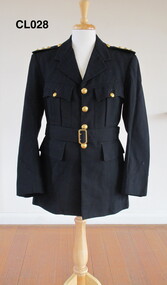
Uniform - Jacket, Australian Military Chaplain, c1942
... Black wool belted jacket with four Australian Military Forces brass buttons and pleated breast pockets and front pockets. ...The original badge contains the motto "Tria Juncta in Uno", which means "Three Joined in One", and refers to the union of the three kingdoms of the British Isles (England/Wales, Scotland and Ireland). https://corregidor.org/acgq/web_redirect_3628.3645.8883/forum_pages/omh_1104.html Black wool belted jacket with four Australian Military Forces brass buttons and pleated breast pockets and front pockets. ...This military jacket is an Australian military Chaplain's jacket. It has three 'pips' on the epaulets. The four-sided "star" or "pip" has been used to designate officer rank in the British and Australian armies for many years and is a stylized version of the very elaborate star of the Knight Grand Cross of the military division of the Most Honourable Order of the Bath, one of Great Britain's four senior orders of knighthood. The original badge contains the motto "Tria Juncta in Uno", which means "Three Joined in One", and refers to the union of the three kingdoms of the British Isles (England/Wales, Scotland and Ireland). https://corregidor.org/acgq/web_redirect_3628.3645.8883/forum_pages/omh_1104.htmlBlack wool belted jacket with four Australian Military Forces brass buttons and pleated breast pockets and front pockets. The jacket has epaulets with three pips, or rank insignia, and an Australian Military Forces button. The belt has a brass buckle and has leather tabs at the back which are buttoned to a fabric carrier to keep the belt in place. -
 Bendigo Military Museum
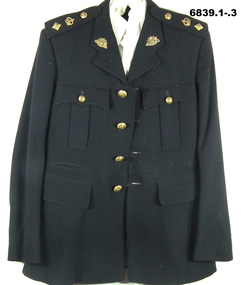
Uniform - MESS DRESS - FORMAL, unknown
... Aust Commonwealth Military Forces. Four pockets. Four gold centre buttons. ...Aust Commonwealth Military Forces. Four pockets. Four gold centre buttons. ...Service Ribbons are: British War medal 1939 - 45 annd Australian Service Medal. Belonged to Lt. Col. E.P. Seymour. One of the CO's of 38 Bn.1. Jacket - woollen, black. Lt Col Rank Badges, gold, on epaulettes. Rising Sun badges on collars. Aust Commonwealth Military Forces. Four pockets. Four gold centre buttons. Top two pockets held shut with a gold button. 2. Trousers, woollen, black with red vertical stripe on sides. Pockets - 1 coin, 2 hip, 1 rear. Fly held shut four black buttons. 3. Shirt (ex) white short sleeved. 1 button missing. E... its cotton pocket. 4. Belt, Woollen black. Brass buckle. Two mini straps on inside of belt. 5. Tie, black, cotton. 6. Ribbon bar WW2 (2 medals). 7. Hat peaked black. Formal wear. Gold braid on brim. Red band and red piping. Rising Sun Badge. Aust Comm Military Forces.On trousers, written on two pockets is name: “Seymour” Hat has a ticket inside. “Lt. Col. E.P. Seymour”post ww2, passchendaele barracks trust, e.p. seymour -
 Eltham District Historical Society Inc
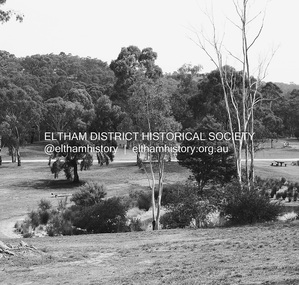
Photograph - Digital Photograph, Alan King, Alistair Knox Park, Eltham, 2008
... The park designers were four major forces in the urban bush landscape garden –Knox, landscape designer Gordon Ford, artist Peter Glass and landscaper Ivan Stranger. ...The park designers were four major forces in the urban bush landscape garden –Knox, landscape designer Gordon Ford, artist Peter Glass and landscaper Ivan Stranger. ...Alistair Knox Park, an oasis of peace and beauty. Covered under National Trust of Australia (Victoria) Landscape Significance and Heritage Overlay, Nillumbik Planning Scheme. Published: Nillumbik Now and Then / Marguerite Marshall 2008; photographs Alan King with Marguerite Marshall.; p173 It is hard to imagine that the Alistair Knox Park, an oasis of peace and beauty beside busy Main Road, Eltham, was once the township’s rubbish dump. It was only in the 1970s that the tip was transformed into this beautiful six hectare space, which later earned it a National Trust Landscape classification. Before its life as a dump, the area was used for small farms. Thanks largely to the foresight and efforts of local environmental builder Alistair Knox, the park was designed sympathetically with the character of the wider Eltham landscape. Then, appropriately, the park was named after Knox, who was an Eltham Shire Councillor from 1971 to 1975 and Shire President in 1975. The park designers were four major forces in the urban bush landscape garden –Knox, landscape designer Gordon Ford, artist Peter Glass and landscaper Ivan Stranger. The National Trust citation for the park, originally called Eltham Town Park, includes the Eltham railway trestle bridge and the Shillinglaw Cottage. The citation states ‘the semi-natural setting of the parkland provides a landscape which is evocative of the history of the area’. Manna Gums (Eucalyptus viminalis) and Candlebarks (Eucalyptus rubida) are significant features. Most of the park’s construction was directed by Bob Grant, Superintendent of the Parks and Gardens Department for the Eltham Shire Council. First plantings occurred in Arbour Week in 1973, then the lake and botanic area were completed in 1975, with Federal Government funding, and the toilet block in 1978. Bounded by the Eltham railway line, Panther Place, Main Road, Bridge and Susan Streets, the park is in a valley about a kilometre wide overlooked by steep hills at the east and west. The Diamond Creek flows through it and the picturesque historic timber trestle railway bridge edges the north. Informal plantings of Australian indigenous and native species in open and undulating grassed settings blend with the natural landscape of the Diamond Creek to the west. The bush-style plants, particularly around the creek, balance with open lawns, paths and a cascade flowing from a small lake to another below. A footbridge over the creek leads to the park’s west. The park includes an adventure playground and barbecue areas. The park stands on part of the land bought from the Crown in 1851 by Josiah Holloway, who subdivided it into allotments and which he called Little Eltham. Most of the land was subdivided into residential lots, but the creek valley, on which the park stands, was subdivided into farm-size lots, used mainly for orchards and grazing. One of the earliest owners was John Hicks Petty, who in 1874 bought a plot from Holloway. Other families who owned properties in that area, included Rees, Clark, Waterfall, Graham, Hill and Morant. In 1901 the railway was built through the area. Jock Read, an Eltham resident since around 1920, remembers several farms in the 1920s and ’30s that occupied the site of today’s park. A poultry farm, which extended from present day Panther Place, was owned by the Gahan family. Next to that farm was another for grazing cattle owned by Jack Carrucan. Beside this was land owned by John Lyon. A doctor lived beside this, and at the north-west corner of Bridge Street and Main Road stood a memorial to the soldiers who died in World War One, which was later moved to the RSL site. Mr Read also remembers other farms and orchards west of the creek In the early 1960s the Eltham Council began buying these farms and in the late 1960s turned the areas east of the Diamond Creek into a garbage tip. When this was filled above the creek’s flood plain, the tip was moved to the west of the creek.This collection of almost 130 photos about places and people within the Shire of Nillumbik, an urban and rural municipality in Melbourne's north, contributes to an understanding of the history of the Shire. Published in 2008 immediately prior to the Black Saturday bushfires of February 7, 2009, it documents sites that were impacted, and in some cases destroyed by the fires. It includes photographs taken especially for the publication, creating a unique time capsule representing the Shire in the early 21st century. It remains the most recent comprehenesive publication devoted to the Shire's history connecting local residents to the past. nillumbik now and then (marshall-king) collection, alistair knox park, eltham -
 Federation University Historical Collection
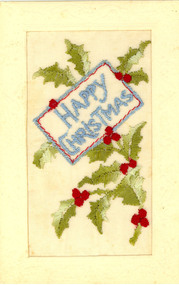
Postcard, World War One Souvenir Christmas Postcard, c1916
... Forces (AIF) in France. HENRY SMERDON (Harry) HOLMES was born in 1897 at the family property, ’Sauchieburn’, 17 km north of Ballarat, in the Ascot district. He was the youngest of four...Forces (AIF) in France. HENRY SMERDON (Harry) HOLMES was born in 1897 at the family property, ’Sauchieburn’, 17 km north of Ballarat, in the Ascot district. He was the youngest of four ...Soldier Harry Holmes of Ascot, Victoria sent this postcard to his family while serving in the Australian Imperial Forces (AIF) in France. HENRY SMERDON (Harry) HOLMES was born in 1897 at the family property, ’Sauchieburn’, 17 km north of Ballarat, in the Ascot district. He was the youngest of four children. After finishing his education at St Patrick’s College, Ballarat, Henry joined the Holmes family farming interests. At the age of 18 he enlisted and served with AIF in Egypt, France and Belgium 1915-1918. Henry served at the famous battlegrounds of Ypes and Somme in the Australian Army 8th Battalion. He was a Driver with the 4th D.A.C. The postcard is of "The Ascot" boys. Includes [Samuel] Gordon Spittle, Henry [Harry] Holmes's first cousin, and other Ascot lads and district connections: neighbours, Ascot State School classmates and football mates from Clunes / Creswick districts. (Research by Jane Dyer) White Postcard with embroidery on white silk. The embroidery features green ivy leaves and red berries, and the words "Happy Christmas".Verso "All good wishes to all the dear ones at home for a happy Xmas and a bright New Year from Harry 11/11/16."chatham - holmes family archive, chatham, holmes, harry holmes, world war, world war 1, world war one, world war i, france, christmas -
 Federation University Historical Collection
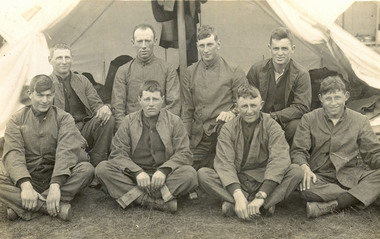
Postcard, Eight Men Outside a Tent, c1917
... four children. After finishing his education at St Patrick’s College, Ballarat, Henry joined the Holmes family farming interests. At the age of 18 he enlisted and served with AIF in Egypt, France and Belgium 1915-1918. Henry served at the famous battlegrounds of Ypes and Somme in the Australian Army 8th Battalion. He was a Driver with the 4th D.A.C. [Jane Dyer May 2024] harry holmes world war one tent AIF soldiers uniform henry smerdon holmes Sauchieburn Ascot postcard Black and white photograph showing eight men outside a tent. They are most probably World War One soldiers in the Australian Imperial Forces ...HENRY SMERDON (Harry) HOLMES was born in 1897 at the family property, ’Sauchieburn’, 17 km north of Ballarat, in the Ascot district. He was the youngest of four children. After finishing his education at St Patrick’s College, Ballarat, Henry joined the Holmes family farming interests. At the age of 18 he enlisted and served with AIF in Egypt, France and Belgium 1915-1918. Henry served at the famous battlegrounds of Ypes and Somme in the Australian Army 8th Battalion. He was a Driver with the 4th D.A.C. [Jane Dyer May 2024] Black and white photograph showing eight men outside a tent. They are most probably World War One soldiers in the Australian Imperial Forces (AIF). The postcard is of "The Ascot" boys. Includes [Samuel] Gordon Spittle, Henry [Harry] Holmes's first cousin, and other Ascot lads and district connections: neighbours including a Wrigley son, Ascot State School classmates and football mates from Clunes / Creswick districts. The man in the front row, second from the right is probably my great-grandfather Henry [Harry] Holmes. The man far left in the back row is probably his cousin, Samuel Gordon Spittle [Jane Dyer 2024]harry holmes, world war one, tent, aif, soldiers, uniform, henry smerdon holmes, sauchieburn, ascot, postcard -
 Mission to Seafarers Victoria
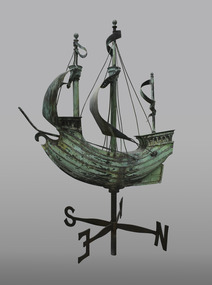
Decorative object - Finial, c. 1920
... four children. Also known as Harry Saw according to his grandson Brian, he died on 9th February 1960. Henry and Florence both died within two months of each other in 1960. It is not clear when the ship was actually installed on the roof, the earliest photograph dating from 1927. The windvane fell or moved several times because of gale forces...four children. Also known as Harry Saw according to his grandson Brian, he died on 9th February 1960. Henry and Florence both died within two months of each other in 1960. It is not clear when the ship was actually installed on the roof, the earliest photograph dating from 1927. The windvane fell or moved several times because of gale forces ...Appearances to the contrary, the item is not a weathervane but a finial. It was the gift of Mr John Sanderson (Jottings Easter 1920), from John Sanderson & Co., wool merchants, stock and station agents, commission and shipping agents before he leaves for England to become senior partner in Sanderson Murray & Elder, London, import and export agents. It was designed by Walter & Richard Butler Architects. (sketch published in Building : the magazine for the architect, builder, property owner and merchant vol.33, no 193, 12 Sept. 1923). The finial was already drawn on the sketch of the Central Institute made by Walter Butler. The maker of the finial, was Henry Alfred George Arnold Saw (born June 1881 in Hotham, Victoria was the son of Edward Saw (1854-1926) a tinsmith and Catherine Barton (1863-1907). He worked as a metal artificer for a metal-working business located opposite the Trades Hall in Lygon Street and was given the job of making the copper ship finial. Henry married Florence Charlotte Reeder and they had four children. Also known as Harry Saw according to his grandson Brian, he died on 9th February 1960. Henry and Florence both died within two months of each other in 1960. It is not clear when the ship was actually installed on the roof, the earliest photograph dating from 1927. The windvane fell or moved several times because of gale forces: - In 1995 : After the funds were raised to repair it, it was treated by sculptor David Hope, and reinstalled in the 1998 (Ship to Shore #3 Sept 1998). - In 2017: Carmela Lonetti from the Grimwade Centre for Cultural Materials Conservation (Ship to Shore Autumn 2017) - In 2019: a generous passerby donated the necessary funds for the conservation. It was sent to Grimwade Centre for Cultural Materials Conservation (Ship to Shore 2019), treated by Evan Tindal (City of Melbourne Magainze Oct. 2020). It was reinstalled over the Summer of 2019-2020 (Ship to Shore Summer 2020). The weathervane was stolen during the night of the 6-7 March 2022. Copper price surge sparks rise in theft in Victoria in 2021-22 so it's likely the vane was stolen to be melted This sculpture is closely associated with the 1917 building and described in clippings and annual reports when the building was first newly opened. It can be seen in some of the earliest photographs of the new building and in the artist/architect Butler's impressions. The galleon is often a decorative design of Mission to Seafarers wind vane (London, Adelaide).Bronze and copper sculpture fashioned as a Wind Vane in the form of a Galleon style sailing ship with 2 pennants flying and two sails rigged atop with lower cross piece with wind directions N S E W . There is a decorative ornamental pierced scrollwork ferrule / finial with reinforcing chrome steel piping armature at base of main support which attaches to the roof or a base support. See also comments below weather vane, wind vane, sculpture, galleon, sailing ship, finial, henry alfred saw, david hope, windvane, weathervane, walter richmond butler (1864–1949), richard butler, john sanderson -
 Lara RSL Sub Branch
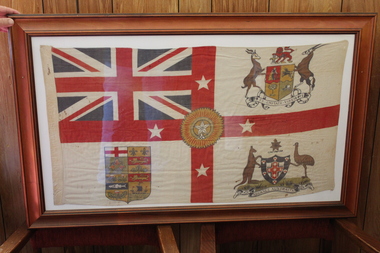
British Commonwealth of Nations flag circ world war 1, British Commonwealth of Nations flag world war 1
... British Imperial Forces involved in World War 1 Rear representation, british expeditionary forces flag union jack white ensign coat of arms of south africa coat of arms canada coat of arms advance australia rosette of india The flag on the left border is marked with "Groves" Flag White Ensign is made up from Commonwealth Countries and displayed as a flag- Top left-hand corner British flag, right-hand top corner Coat of arms of South Africa, bottom-left Coat of Arms for Canada, Bottom right corner Advance Australia Coat of Arms, flag center is for India is a yellow and red rosette and New Zealand is represented by four white 5 pointed stars centralized as representation of the Southern Cross. ...British Imperial Forces involved in World War 1Rear representation, Flag White Ensign is made up from Commonwealth Countries and displayed as a flag- Top left-hand corner British flag, right-hand top corner Coat of arms of South Africa, bottom-left Coat of Arms for Canada, Bottom right corner Advance Australia Coat of Arms, flag center is for India is a yellow and red rosette and New Zealand is represented by four white 5 pointed stars centralized as representation of the Southern Cross.The flag on the left border is marked with "Groves"british expeditionary forces flag, union jack, white ensign, coat of arms of south africa, coat of arms canada, coat of arms advance australia, rosette of india -
 Lara RSL Sub Branch
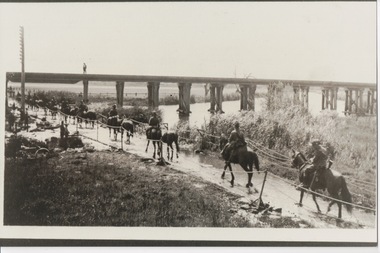
Photograph, Set 4 photographs. and others for Torquay Light Horse camp, 1940
... four were involved in the charge of Beersheba- John GAYLARD, Philip QUINN.(Winchelsea); Wallace FINDLAY (Anglesea); Harry TRIGG (Bambra). After the war, Light Horse units played a key role in the Australian Government’s compulsory military training programme. The Citizen Military Forces...four were involved in the charge of Beersheba- John GAYLARD, Philip QUINN.(Winchelsea); Wallace FINDLAY (Anglesea); Harry TRIGG (Bambra). After the war, Light Horse units played a key role in the Australian Government’s compulsory military training programme. The Citizen Military Forces ...These images capture for all time Light Horsemen travelling through Geelong on their way to camp at Torquay for the last Group meeting in Australia . information following - details obtained from .........https://torquayhistory.com/light-horse-brigade/ On Australia Day, 1997, Sir John Young unveiled this plaque on Point Danger, Torquay. Torquay history, Light Horse Training Camp, WW2 Plaque at Pt. Danger Note----- (See images to view plaque) The plaque identifies a significant event in Torquay’s history and the sentiments of ‘change’ for the Light Horse Brigade – from horses to machines. In 1940 the four Light Horse Regiments (4th, 8th, 13th and 20th), some 5000 Light Horse and 2000 horses camped and trained at Torquay. Three other regiments, formerly mounted on horses, were also at Torquay ‘mounted’ on privately owned trucks and cars. Division troops included Artillery, Engineers, Signals, Field Ambulance and other branches of the Army necessary to enable a Division to function. It wasn’t just the sheer numbers of men coming to this little town that made the event significant, it was also the fact that the men of the Light Horse were dramatic, almost glamorous figures and it is easy to see their exploits as some splendid adventure. Horses have played a special role in the story of Australia. They were the only means of transport across this huge country, so it was necessary for everyone to have the ability to ride a horse. When war broke out in 1899 between Britain and the Boers of South Africa (“Boer” was Dutch for “farmer”) Australia sent troops to fight. At first Britain was wary of using untried, unprofessional colonial cavalrymen but soon saw that the slouch-hatted Australian “bushmen” were a match for the fast-moving and unconventional mounted commandos of the Boers. The Australians proved themselves to be expert rough-riding horsemen and good shots. Bush life had hardened them to go for long periods with little food and water. They also showed remarkable ability to find their way in a strange country and use its features for cover, in both attack and defence. By 1914, when Australia joined the war against Germany, there were 23 Light Horse regiments of militia volunteers. Many men from these units joined the Light Horse regiments of the Australian Imperial Force (AIF). Men were given remounts (if not using their own horses) – army horses bought by Commonwealth purchasing officers from graziers and breeders. These were called “walers” because they were a New South Wales stockhorse type – strong, great-hearted animals with the strains of the thoroughbred and semi-draught to give them speed, strength and stamina. On 1st November, 1914, Australia’s First Infantry Division and the first four Light Horse regiments sailed for England in a fleet of transport ships. The first of the Light Horse arrived at Gallipoli in May without their horses. Back with their horses after Gallipoli, they were formidable combatants across the Sinai and Palestine. Some British commanders observed that the light horseman moved with a “lazy, slouching gait, like that of a sleepy tiger” but described how the promise of battle “changes that careless gait, into a live athletic swing that takes him over the ground much quicker than other troops”. They had Light Horse, Torquay, training campdeveloped a reputation as formidable infantrymen. The Turks called them “the White Ghurkas” – a reference to their deadly skill with the bayonet. The Arabs called them “The Kings of the Feathers”. The plume had originally been a battle honour of the Queensland Mounted Infantry for their work in the shearer’s strike of 1891. During WW1 it was adopted by almost all the Light Horse Regiments. It was the proud badge of the light horseman. The most famous of their battles was the attack on Beersheba- the charge of the 4th Light Horse Brigade. Mounted infantrymen and their superb walers had carried out one of the most successful cavalry charges in history – against what seemed impossible odds. They surprised the Turks by charging cavalry-style, when they would normally have ridden close to an objective then dismounted to fight. The fall of Beersheba swung the battle tide against the Turks in Palestine; and changed the history of the Middle East. While 19 men from the Surf Coast Shire served with the 4th Light Horse over the course of WW1, only four were involved in the charge of Beersheba- John GAYLARD, Philip QUINN.(Winchelsea); Wallace FINDLAY (Anglesea); Harry TRIGG (Bambra). After the war, Light Horse units played a key role in the Australian Government’s compulsory military training programme. The Citizen Military Forces (C.M.F.) thrived on the glamour of the wartime Light Horse tradition, ignoring the possibility that motor vehicles would soon replace the horses. When training was no longer compulsory, the C.M.F. regiments declined and horses became more of a luxury during the 1930s depression years of poverty and unemployment. Some regiments were motorised. Then, in 1939, Australia joined Britain in another world war. Training was increased for the militia at both home bases and regional training camps. The camp at Torquay in 1940, commanded by Major General Rankin, was at Divisional strength. By the end of the camp some felt that the Division was ready for active service. Gradually, over the next four years, the Australian Light Horse units were mounted on wheels and tracks and the horses were retired. Six men enlisted at the Torquay camp and another 57 men and women enlisted at Torquay for service in WW2. Those who served in the Militia provided valuable Officers and NCOs and men for the armed services during the war. Each infantry division of the 2nd AIF had a Light Horse regiment attached to it. But the day of the Australian mounted soldier hadn’t quite passed. During World War II, Australia’s 6th Cavalry Regiment formed a mounted unit they called “The Kelly Gang” which did valuable scouting work. In New Guinea, a mounted Light Horse Troop did patrol duty and helped carry supplies. Some fully equipped walers were flown into Borneo for reconnaissance in rugged mountain country. But by the end of the war, in 1945, the horse had disappeared from the Australian Army. References: Australian Light Horse Association www.lighthorse.org.au National Australia Archives Australian War Memorial Surf Coast Shire WW1 memorials www.togethertheyserved.com The Light horse- a Cavalry under Canvas Light Horse, Training Camp, Torquay, WW2 Late in 1939 it was decided to set up a Lighthorse training camp in Torquay to train both men and horses for the battles of the Second World War. Horses, men and equipment came on special trains from all over Victoria and NSW, and as you would expect horseman came from areas such as Omeo and Sale, the Wimmera and the Western District. They arrived at the Geelong racecourse for watering in the Barwon River and then were ridden across the ford at the breakwater and began their 11 mile trek to Torquay. Light Horse, Training Camp, Torquay, WW2 Tent city By the end of January 1940 the camp at Torquay accommodated some 5000 men and 2500 horses of the Second Cavalry Division. The rows of horses, tents and huts near Blackgate Road were quite a sight. While the cavalrymen engaged in exercises on the land and on the beaches, many of the troops took over the Torquay School for special training of men and officers. Mr Bob Pettit local farmer and Councillor for the Barrabool Shire, wrote about the Light horse in the Surf Coast Community News in 1985 saying “They used to travel about the district riding four abreast in one long convoy. To my annoyance they went through my property and shut all the gates behind them. I had certain gates open to let stock in to the water holes and it would take me three -quarters of an hour to follow the horsemen up and put all the gates right again” he continued “the men from the Light Horse were here when the fire went through in March 1940. He recalled an incident when early one morning, as some one blew the bugle, a soldier putting a white sheet on the line frightened the horses. They panicked and ran off in all directions. Six went over the cliff near Bird Rock, five were never found, and the rest were gathered up after nearly a fortnight in the bush around Addiscott and Anglesea" Light Horse, Training Camp, Torquay, WW2, Geelong Parade Geelong parade The training camp culminated in a parade through the streets of Geelong on March 12th 1940. The salute was given at the Town Hall and the troops continued on a route to the You Yang’s for a training exercise. Note-----(see media section for photograph) The Camp was abandoned in mid 1940 as it was deemed unsuitable for training during winter and the cost of a permanent camp could not be justified if it could not be used all year. Historic.......Rare,,,Interpretive.Sepia photographs.set of four ....post card size ....Horses &LighthorsemenNo 1, Lighthorsemen Regiment Geelong 1940......No 2 Light Horse at Breakwater Geelong 1938 to 1940....No 3 Light Horse at Breakwater Geelong 1938 to 1940.....No 4 Light Horse crossing Breakwater camped at Geelong Showgrounds. These markings are on reverse of photographs.light horsemengeelong 1940., world war 2 -
 Lara RSL Sub Branch
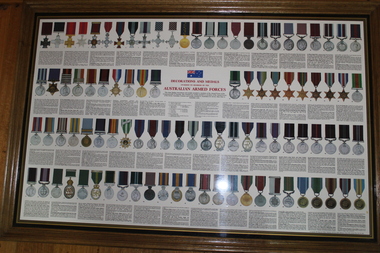
Photograph, Decorations and Medals of The Australian Armed Forces, 1985
... The Australian Defence Medal (ADM) has been established to recognise Australian Defence Force Regular and Reserve personnel who have demonstrated their commitment and contribution to the nation by serving for an initial enlistment period or four years service whichever is the lesser. Decorations and Medals awarded to members of the Australian Armed Forces Rectangular shaped glass covered Picture frame showing Decorations and Medals of The Australian Armed Forces. ...Over 1,400,000 Australians have served in times of conflict, from the Boer War to Afghanistan. Receiving awards on recognition of their service, some Australians have earned prestigious awards for their valour and gallantry. These are soldiers that have overwhelmed their opponents. They've gone over the wall or held the line, at huge personal cost. They've contributed to landmark events that history will long remember.The Australian Defence Medal (ADM) has been established to recognise Australian Defence Force Regular and Reserve personnel who have demonstrated their commitment and contribution to the nation by serving for an initial enlistment period or four years service whichever is the lesser.Rectangular shaped glass covered Picture frame showing Decorations and Medals of The Australian Armed Forces.Decorations and Medals awarded to members of the Australian Armed Forces -
 Shepparton RSL Sub Branch
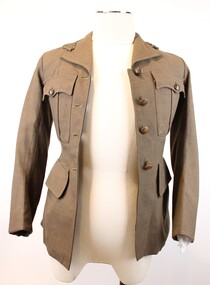
Uniform, Dress Jacket, 1943
... FORCES." Khaki-coloured woollen jacket which fastens along the centre via four metal buttons. ...This jacket belonged to Dorothy May Mortlock (VF518245) who was part of the Australian Womens Army Service (AWAS). Dorothy Mortlock was born in Swan Hill and enlisted with the 3rd AUST AWS REC DEPOT.Khaki-coloured woollen jacket which fastens along the centre via four metal buttons. Two hip-height pockets with external flap; two chest pockets with pleat in centre fastened via a metal button. Fabric belt around waist held in place by two fabric loops on back and fastened through metal buckle and loop. Collar carries two metal rising sun badges on the left and right side. Two epaulettes on either shoulder are held in place by a button and carries a badge reading "AWAS". Colour patch on both left and right side is square, half green and half black. Interior label on base of neck.Label reads "V 579/1943/SIZE/MADE IN/AUSTRALIA/D. MORTLOCK/VF518245". Rising sun badge reads "AUSTRALIAN COMMONWEALTH/MILITARY FORCES." Buttons read "AUSTRALIAN MILITARY FORCES."world war ii, second world war, wwii, women, australian women's army service -
 Lara RSL Sub Branch
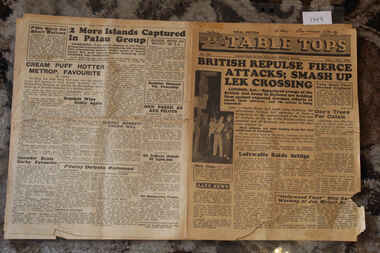
Newspaper - Table Tops Newspaper Dated 1/10/1944, Table Tops Newspaper Dated 1/10/1944 Armed Forces Australian produced for Australian Troops
... Table Tops Newspaper produced by First Australian Army Press unit for Australian Troops Dated 1/10/1944 four pages Australian Forces produced Newspaper for issue to Australian Troops british repulse fierce attacks smash up lek crossing - 2 more island captured in palau group - local news events world war 2 newspaper table tops dated 1/10/1944 British Repulse Fierce Attacks Smash Up Lek Crossing - 2 more island captured in Palau Group - Local News Events, for pages Table Tops Newspaper dated 1/10/1944 -Produced by Australian Armed Forces Queensland for Issue to Australian Troops Table Tops Newspaper Dated 1/10/1944 Armed Forces Australian produced for Australian Troops Newspaper Table Tops Newspaper Dated 1/10/1944 ...Table Tops Newspaper produced by First Australian Army Press unit for Australian Troops Dated 1/10/1944 four pagesAustralian Forces produced Newspaper for issue to Australian TroopsTable Tops Newspaper dated 1/10/1944 -Produced by Australian Armed Forces Queensland for Issue to Australian TroopsBritish Repulse Fierce Attacks Smash Up Lek Crossing - 2 more island captured in Palau Group - Local News Events, for pagesbritish repulse fierce attacks smash up lek crossing - 2 more island captured in palau group - local news events, world war 2, newspaper, table tops dated 1/10/1944 -
 Federation University Historical Collection
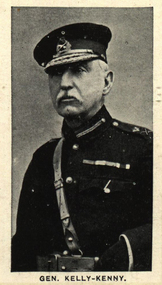
Photograph (black & White), General Sir Thomas Kelly-Kenny - South Africa Forces
... forces. He was twice mentioned in dispatches and received the Queen's South African Medal with four clasps. ...forces. He was twice mentioned in dispatches and received the Queen's South African Medal with four clasps. ...As well as his army positions, Kelly-Kenny was very interested in politics in his native County Clare. In the Second Anglo-Boer War he was , as a Lieutenant-General, General Officer Commanding the 6th Division of the South African field forces. He was twice mentioned in dispatches and received the Queen's South African Medal with four clasps. He was involved in the relief of Kimberley, the battles of Paardeberg, Poplar Grove and Driefontein. Lieutenant-General Kitchener was appointed commander and over-ruled Kelly-Kenny's plan to besiege Cronji and bombard his force from a safe distance. Kitchener ordered an assault on the Boer trenches. The result was "Bloody Sunday" - an unnecessary sacrifice of hundreds of lives on the British side. Kelly-Kenny was involved in the engagements at Poplar Grove and Driefontein where the 6th Division distinguished itself. These were viewed as key to destroying the Boer morale and winning the war. General Kelly-Kenny was a close friend of King Edward VII. Appointments made, at the insistence of the King, were often challenged. Due to his loyalty and abilities Kelly-Kenny was appointed Knight Commander of the Order of the Bath and received a knighthood in a private audience. Once again others tried to have him moved from the War Office but the King intervened again and he remained in his position. He was conferred with the Knight Grand Cross of the Order of the Bath (1904), Grand Cross of the Red Eagle (1905 - Germany), Grand Cross of the Rising Sun (1906 - Japan) and on his return to Britain he received the Knight Grand Cross of the Royal Victorian Order (1906) Individual image taken from photographed poster of tobacco and cigarette cards.kell-kenny, county clare, lieutenant-general, kimberley, queen's south african medal, paardeberg, poplar grove, driefontein, kitchener, bloody sunday, cronji, boer war, trenches, knight commander of the order of the bath, war office, king, king edward vii, knight grand cross of the order of the bath, grand cross of the red eagle, grand cross of the rising sun, knight grand cross of the royal victorian order -
 Flagstaff Hill Maritime Museum and Village
Badge - Australian Military cloth patch, Army Medical Corps, 108 Australian General Hospital, 1939-1945
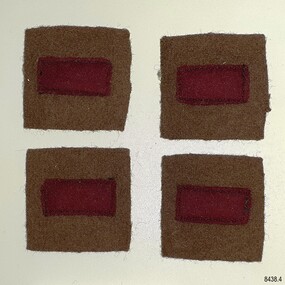
... four cloth patches belonged to Dr William Roy Angus and are now part of Flagstaff Hill’s comprehensive W.R. Angus Collection, donated by the family of Dr W R Angus (1901-1970), surgeon and oculist. The badges date to the Second World War era, when Dr Angus was a Surgeon Captain for the Australian Defence Forces...Badges; set of four cloth patches, red rectangles on brown squares. Insignia of the Australian Defence Forces, Army Medical Corps, 108 Australian General Hospital, WWII era. ...Angus Collection Australian Army Surgeon Captain Ballarat Bonegilla badge insignia badge collection World War 2 Second World War Australian Defence Forces Army Medical Corps 108 Australian General Hospital Great War Military uniform 106 Australian General Hospital 1939-1945 Badges; set of four cloth patches, red rectangles on brown squares. ...The four cloth patches belonged to Dr William Roy Angus and are now part of Flagstaff Hill’s comprehensive W.R. Angus Collection, donated by the family of Dr W R Angus (1901-1970), surgeon and oculist. The badges date to the Second World War era, when Dr Angus was a Surgeon Captain for the Australian Defence Forces in the Army Medical Corps, 108 Australian General Hospital and 106 Australian General Hospital, stationed in Ballarat, Victoria, and in Bonegilla, N.S.W. He completed his service just before the end of the war due to suffering from a heart attack. In World War I the troops of the Australian Military Forces staked coloured flags of various shapes and colours in the ground where they camped to identify their units. These flag codes were quickly recognised. The system worked so well that miniature flags were called colour patches. They became part of the uniform, to be worn on both sleeves just below the shoulder. The system was slightly modified for use in the Second World War. The W.R. Angus Collection: - The W.R. Angus Collection includes historical medical equipment, surgical instruments and material belonging to Dr Edward Ryan and Dr Thomas Francis Ryan, (both of Nhill, Victoria) and Dr Angus’ own belongings. The Collection’s history spans the medical practices of the two Doctors Ryan, from 1885-1926 plus that of Dr Angus, up until 1969. It includes historical medical and surgical equipment and instruments from the doctors Edward and Thomas Ryan of Nhill, Victoria. Dr Angus married Gladys in 1927 at Ballarat, the nearest big city to Nhill where he began as a Medical Assistant. He was also Acting House surgeon at the Nhill hospital where their two daughters were born. During World War II He served as a Military Doctor in the Australian Defence Forces. Dr Angus and his family moved to Warrnambool in 1939, where Dr Angus operated his own medical practice. He later added the part-time Port Medical Officer responsibility and was the last person appointed to that position. Both Dr Angus and his wife were very involved in the local community, including the planning stages of the new Flagstaff Hill and the layout of the gardens there. Dr Angus passed away in March 1970.Dr W R Angus (1901-1970), surgeon and oculist, collected a range of military objects including those he personally used during his time as Surgeon Captain in the Australian Defence Forces in World War II. The objects allow insight into military life in the early-to-mid 20th century. The W.R. Angus Collection is significant for still being located at the site it is connected with, Doctor Angus being the last Port Medical Officer in Warrnambool. The Collection includes historical medical objects that date back to the late 1800s.Badges; set of four cloth patches, red rectangles on brown squares. Insignia of the Australian Defence Forces, Army Medical Corps, 108 Australian General Hospital, WWII era. Dr W R Angus owned the cloth patches that are now part of the W. R. Angus Collection.flagstaff hill, warrnambool, maritime village, maritime museum, shipwreck coast, great ocean road, flagstaff hill maritime museum and village, dr w r angus, w.r. angus collection, australian army, surgeon captain, ballarat, bonegilla, badge, insignia, badge collection, world war 2, second world war, australian defence forces, army medical corps, 108 australian general hospital, great war, military uniform, 106 australian general hospital, 1939-1945 -
 Flagstaff Hill Maritime Museum and Village
Badge - Australian Military cloth patch, Army Medical Corps, Non-Divisional Units, 1925 - 1942
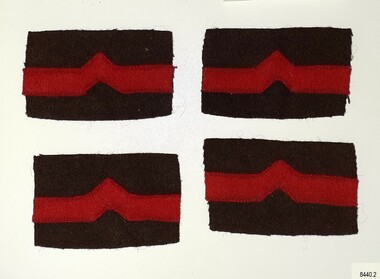
... Angus Collection Australian Army Surgeon Captain Ballarat Bonegilla badge insignia badge collection World War 2 Second World War Australian Defence Forces Army Medical Corps Military uniform cloth patch insignia patch Australian Army Medical Corp (Militia) WW 2 ww II 1925-1940 Military badge Non-Divisional Unit AAMC 1940-1942 8th Field Ambulance peacetime training insignia history Badge, cloth insignia patch. Set of four ...The cloth insignia badges date to 1925-1940, after the First World War and into the early Second World War era. During peacetime training, the "brown with a cherry-red crossbar" badge was initially used for the 8th Field Ambulance, 2nd Military District Medical and Veterinary Stores. The colour patch was approved for wear by full-time duty personnel of all medical units apart from the Infantry and Cavalry. In 1942 these patches were replaced by the new scheme of colour patches introduced by the Australian Army Medical Corps. Dr W R Angus was a Surgeon Captain for the Australian Defence Forces, Army Medical Corps, stationed in Ballarat, Victoria, and in Bonegilla, N.S.W. He completed his service just before the end of the war due to suffering from a heart attack. The badges are now part of Flagstaff Hill’s comprehensive W.R. Angus Collection, donated by the family of Dr W R Angus (1901-1970), surgeon and oculist. The W.R. Angus Collection: - The W.R. Angus Collection includes historical medical equipment, surgical instruments and material belonging to Dr Edward Ryan and Dr Thomas Francis Ryan, (both of Nhill, Victoria) and Dr Angus’ own belongings. The Collection’s history spans the medical practices of the two Doctors Ryan, from 1885-1926 plus that of Dr Angus, up until 1969. It includes historical medical and surgical equipment and instruments from the doctors Edward and Thomas Ryan of Nhill, Victoria. Dr Angus married Gladys in 1927 at Ballarat, the nearest big city to Nhill where he began as a Medical Assistant. He was also Acting House surgeon at the Nhill hospital where their two daughters were born. During World War II He served as a Military Doctor in the Australian Defence Forces. Dr Angus and his family moved to Warrnambool in 1939, where Dr Angus operated his own medical practice. He later added the part-time Port Medical Officer responsibility and was the last person appointed to that position. Both Dr Angus and his wife were very involved in the local community, including the planning stages of the new Flagstaff Hill and the layout of the gardens there. Dr Angus passed away in March 1970.These colour insignia patches represent the history between the First and Second World Wars and the evolution of Australian Army Medical Corps patches. Dr W R Angus (1901-1970), surgeon and oculist, collected a range of military objects including those he personally used during his time as Surgeon Captain in the Australian Defence Forces in World War II. The item allows insight into military life in the early-to-mid 20th century. The W.R. Angus Collection is significant for still being located at the site it is connected with, Doctor Angus being the last Port Medical Officer in Warrnambool. The Collection includes historical medical objects that date back to the late 1800s.Badge, cloth insignia patch. Set of four Insignia colour patches.Red stripe with an inverted 'V' shape on brown fabric. Insignia of the Australian Army Medical Corps, Non-Divisional Units. The cloth patches belonged to Dr W R Angus and are now part of the W. R. Angus Collection.flagstaff hill, warrnambool, maritime village, maritime museum, shipwreck coast, great ocean road, flagstaff hill maritime museum and village, dr w r angus, w.r. angus collection, australian army, surgeon captain, ballarat, bonegilla, badge, insignia, badge collection, world war 2, second world war, australian defence forces, army medical corps, military uniform, cloth patch, insignia patch, australian army medical corp (militia), ww 2, ww ii, 1925-1940, military badge, non-divisional unit, aamc, 1940-1942, 8th field ambulance, peacetime training, insignia history -
 Flagstaff Hill Maritime Museum and Village
Equipment - Personal Care kit, 1939-1945
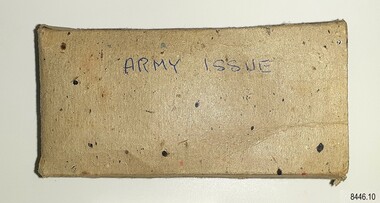
... Angus Collection Australian Army World War 2 Second World War Australian Defence Forces WW 2 ww II Military Equipment Army issue personal care personal hygene prevention of STD prevention of STI prevention of VD On the large box, handwritten “ARMY ISSUE” On waxed paper wrapper; “CHECKER NEW LATEX PROPHYLACTIC” On the small box “THE BLUE LIGHT OUTFIT” “DIRECTIONS INSIDE” Australian Army personal care kit, WWII era. A rectangular brown box containing a small blue cardboard box with a leaflet and two small tubes of ointment inside it, four ...This Personal Care kit was issued by the Australian Army to those in military service during WWII, including Dr.W.R. Angus. The kit was part of a soldier's equipment to guard against possible sexually transmitted infections. It is now part of Flagstaff Hill’s comprehensive W.R. Angus Collection, donated by the family of Dr W R Angus (1901-1970), surgeon and oculist. Dr W R Angus was a Surgeon Captain for the Australian Defence Forces, Army Medical Corps, stationed in Ballarat, Victoria, and in Bonegilla, N.S.W. He completed his service just before the end of the war due to suffering from a heart attack. The W.R. Angus Collection: - The W.R. Angus Collection includes historical medical equipment, surgical instruments and material belonging to Dr Edward Ryan and Dr Thomas Francis Ryan, (both of Nhill, Victoria) and Dr Angus’ own belongings. The Collection’s history spans the medical practices of the two Doctors Ryan, from 1885-1926 plus that of Dr Angus, up until 1969. It includes historical medical and surgical equipment and instruments from the doctors Edward and Thomas Ryan of Nhill, Victoria. Dr Angus married Gladys in 1927 at Ballarat, the nearest big city to Nhill where he began as a Medical Assistant. He was also Acting House surgeon at the Nhill hospital where their two daughters were born. During World War II He served as a Military Doctor in the Australian Defence Forces. Dr Angus and his family moved to Warrnambool in 1939, where Dr Angus operated his own medical practice. He later added the part-time Port Medical Officer responsibility and was the last person appointed to that position. Both Dr Angus and his wife were very involved in the local community, including the planning stages of the new Flagstaff Hill and the layout of the gardens there. Dr Angus passed away in March 1970.This item is significant in Australia's Military History. It aids in understanding life in the military and the changes to normal life and morality. Dr W R Angus (1901-1970), surgeon and oculist, collected a range of military objects including those he personally used during his time as Surgeon Captain in the Australian Defence Forces in World War II. The W.R. Angus Collection is significant for still being located at the site it is connected with, Doctor Angus being the last Port Medical Officer in Warrnambool. The Collection includes historical medical objects that date back to the late 1800s.Australian Army personal care kit, WWII era. A rectangular brown box containing a small blue cardboard box with a leaflet and two small tubes of ointment inside it, four square waxed paper prophylactic packets and a brown cardboard cylinder with enclosed ends containing a waxy substance. The overall box has a handwritten inscription. The kit belonged to Dr W R Angus and are now part of the W. R. Angus Collection.On the large box, handwritten “ARMY ISSUE” On waxed paper wrapper; “CHECKER NEW LATEX PROPHYLACTIC” On the small box “THE BLUE LIGHT OUTFIT” “DIRECTIONS INSIDE” flagstaff hill, warrnambool, maritime village, maritime museum, shipwreck coast, great ocean road, flagstaff hill maritime museum and village, dr w r angus, w.r. angus collection, australian army, world war 2, second world war, australian defence forces, ww 2, ww ii, military equipment, army issue, personal care, personal hygene, prevention of std, prevention of sti, prevention of vd -
 Geelong RSL Sub Branch
Uniform Jacket- Service Dress Ceremonial, 1941
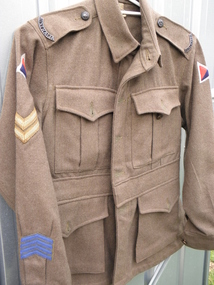
... The Jacket has two 'Australia' shoulder titles on the epaulets, one only small (king's Crown) rising sun badge on the collar, six small buttons, four small buttons with King's Crown, map of Australia and embossed Australian Military Forces. ...The Jacket has two 'Australia' shoulder titles on the epaulets, one only small (king's Crown) rising sun badge on the collar, six small buttons, four small buttons with King's Crown, map of Australia and embossed Australian Military Forces. ...This particular Jacket was issued to VX 33678 Bdr E. O'Shea.Bdr O'Shea served during WW2Khaki Wool cloth Jacket, four patch pockets on the front of the Jacket. The Jacket has two 'Australia' shoulder titles on the epaulets, one only small (king's Crown) rising sun badge on the collar, six small buttons, four small buttons with King's Crown, map of Australia and embossed Australian Military Forces. One small button at the collar. On the right and left sleeve are the colour patch of Artillery. On the right sleeve is the badge of rank of Bombardier and four blue service chevrons. Inside the Jacket hand written OSWR. Makers Tag - Freedman & Co Pty Ltd. 1941. Size 6. Name Tag - Regimental No VX33678. Name Bdr E. O'Shea. uniform, jacket, service dress, khaki, amf -
 Geelong RSL Sub Branch
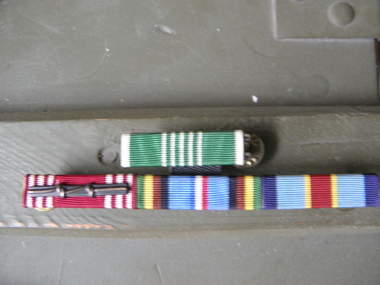
Ribbon Bars - US Military Decorations, No makers mark, Late 20th Century
... Four Coloured Cloth Ribbons mounted for wearing on Uniform. The ribbons correspond to the Army Commendation Medal, Good Conduct Medal, Armed Forces Expeditionary Medal and Overseas Service Ribbon. ...Four Coloured Cloth Ribbons mounted for wearing on Uniform. The ribbons correspond to the Army Commendation Medal, Good Conduct Medal, Armed Forces Expeditionary Medal and Overseas Service Ribbon. ...The decoration ribbons have belonged to a US Military Service Person.These decorations are the originals that have belonged to a US Military Service Person.Four Coloured Cloth Ribbons mounted for wearing on Uniform. The ribbons correspond to the Army Commendation Medal, Good Conduct Medal, Armed Forces Expeditionary Medal and Overseas Service Ribbon. The bronze clasp on the Good Conduct Medal indicates that the decoration has been awarded more than once.There are no inscriptions or markings. us military medal ribbons -
 Geelong RSL Sub Branch
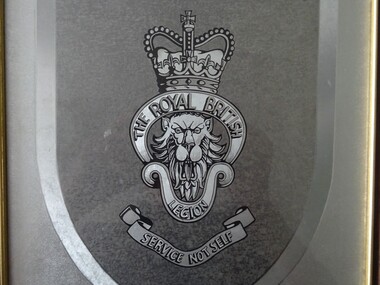
Plaque: The Royal British Legion, Ammo & Company
... The Royal British Legion is a Charity providing support to members of the British Armed Forces and their Families. The Legion was formed on 15 May 1921 and combined four organizations that had been raised after WW1 into one, The Royal British Legion. ...The Royal British Legion is a Charity providing support to members of the British Armed Forces and their Families. The Legion was formed on 15 May 1921 and combined four organizations that had been raised after WW1 into one, The Royal British Legion. ...The Royal British Legion is a Charity providing support to members of the British Armed Forces and their Families. The Legion was formed on 15 May 1921 and combined four organizations that had been raised after WW1 into one, The Royal British Legion. There is a branch of The Royal British Legion in Melbourne and meets Monthly.This is an original item as presented to the Geelong RSL President.A framed Motto of the Royal British Legion, timber frame, silver coloured photograph.The Royal British Legion, Service Not Self, Teign Mouth Devon. Presented to Geelong RSL by Gordon Randell, Newquay Royal British Legion, Cornwall, UK, Presidentroyal, british, legion -
 Montmorency–Eltham RSL Sub Branch
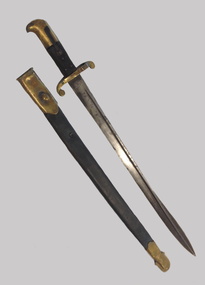
Weapon - 1855 Pattern Sappers and Miners Lancaster Sword Bayonet, Carl Reinhard KIRSCHBAUM, 1855 Pattern Sapper and Miners Lancaster Sword Bayonet, 1855
... Pattern 1855 bayonets were issued to some volunteer units of the Victorian defence forces in the late 1850s, bayonet victorian defence forces lancaster carbine Knight's Head stamping of the German Solingen-based firm Carl Reinhard KIRSCHBAUM Stylised beaked-brass pommel with T- shaped attachment slot. A steel press stud operates the locking catch via a steel leaf spring on right side of hilt. Two-piece black chequered leather grips. Left grip has four ...This bayonet and scabbard was made for the Charles Lancaster .577 calibre Oval Bore Carbine and was known as the Pattern 1855 'Sappers and Miners' bayonet because they were designed for use by the Corps of British Royal Sappers & Miners. The first model Sappers and Miners bayonet appeared in 1841 and differs significantly from this type. Pattern 1855 bayonets were issued to some volunteer units of the Victorian defence forces in the late 1850s, Stylised beaked-brass pommel with T- shaped attachment slot. A steel press stud operates the locking catch via a steel leaf spring on right side of hilt. Two-piece black chequered leather grips. Left grip has four small steel rivets, right grip three rivets and the leaf spring securing screw. Brass cross-guard with formed muzzle ring. Long single-edged, pipe backed, quill pointed 24 inch (615mm) steel blade. Original leather scabbard with brass locket and chape.Knight's Head stamping of the German Solingen-based firm Carl Reinhard KIRSCHBAUM bayonet, victorian defence forces, lancaster carbine -
 Montmorency–Eltham RSL Sub Branch
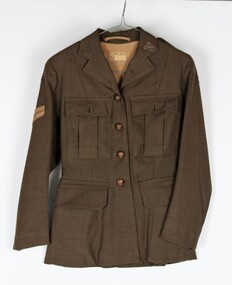
Uniform - Jacket, Khaki, Service Dress WW2 (Womens), 1943
... Four metal buttons down the front with the inscription Australian Military Forces with a map of Australia in the center with a crown at the top of the map. ...Four metal buttons down the front with the inscription Australian Military Forces with a map of Australia in the center with a crown at the top of the map. ...Dress jacket worn by Corporal Kathleen Phyllis Gill from Toorak Hill, Casterton. Army No. VF345716 Unit LHQ (Mil. Sec)Lined women's khaki dress jacket. Long sleeved. Wool polyester. Four metal buttons down the front with the inscription Australian Military Forces with a map of Australia in the center with a crown at the top of the map. Two hip pockets on the left and right with a flap on each. Two pleated pockets over the left and right breasts with flaps and small metal buttons inscribed Australian Military Forces with a map of Australia in the center with a crown at the top of the map. Australian Military Forces badge on the upper left lapel Two epaulets on the left and right shoulders with two small buttons inscribed Australian Military Forces with a map of Australia in the center with a crown at the top of the map. AWAS (Australian Women's Army Service) badges at the base of each epaulet. Corporal's stripes 6 cm down the right sleeve. Unit patch red over black - LHQ (Mill Sec). Two vertical belt loops at the back on the left and right. Pleat opening at the back. Horizontal strip of material inside the collar at the back of the neck to hang jacket. Tag sewn onto the lining at the back 2.5 cm down from the top stating - V 579 Made in Australia D. broad arrow D. 1943 Size kathleen gill, wool polyester, women's dress jacket -
 Montmorency–Eltham RSL Sub Branch
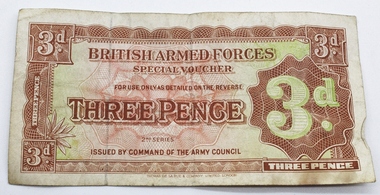
Currency - Voucher, Special, British Armed Forces, Three Pence, Three Pence
... On the front it has British Armed Forces Special Voucher written with 3d in three of the four corners then Three Pence and 3d in large letters. 2nd seeries issued by command of the army council. ...On the front it has British Armed Forces Special Voucher written with 3d in three of the four corners then Three Pence and 3d in large letters. 2nd seeries issued by command of the army council. ...It is a cream coloured bank note with with brown, green and red printingOn the front it has British Armed Forces Special Voucher written with 3d in three of the four corners then Three Pence and 3d in large letters. 2nd seeries issued by command of the army council. On the reverse it has Three Pence and 3d then this note is valid only for transactions within official canteens and organisations laid down in G.R.O's of the theatre except as may be expessly provided in G.R.O'S. It must in no circumstances be offered to any person who is not entitled to use British Service Canteens. Improper use of this note is a disciplinary offence and may render the offender liable to penalties -
 Mission to Seafarers Victoria
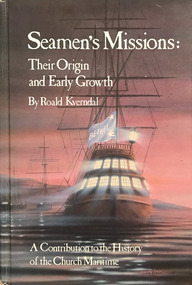
Book, Roald Kverndal, Seamen's Missions: Their origin and Early Growth. A contribution to the History of the Church Maritime, 1986
... He was born to Norwegian parents, Olav & Valli Kverndal, on July 8th 1921 in Bromley, England, one of four boys, where the Norwegian Seamen’s Church in London played a central role in their lives. He was educated in England and Norway and joined Norwegian Free Forces during World War II. ...He was born to Norwegian parents, Olav & Valli Kverndal, on July 8th 1921 in Bromley, England, one of four boys, where the Norwegian Seamen’s Church in London played a central role in their lives. He was educated in England and Norway and joined Norwegian Free Forces during World War II. ...Hardback cover book with white Title (see above) and author text, KVERNDAL, Roald, on pink grey cover. pp 903, ills. Cover image depicts a masted galleon ship at anchor with interior lights at dusk or dawn flying from the stern of the ship is the blue BETHEL flag featuring a star and dove of peace in top and lwr corners respectively. xxviii, 903 p. : ill. ; 24 cmnon-fictionmerchant seamen, missions and charities, royal navy chaplains, missions-to-seamen, mission to seafarers, roald kverndal -
 Orbost & District Historical Society
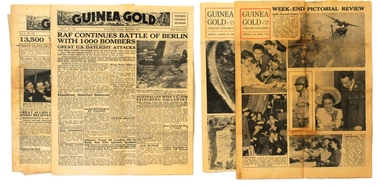
newspapers, Guinea Gold, 1943-1944
... At its peak, distribution was 37,000 to US forces and 27,000 to Australian forces, daily. The daily version had four pages and the WEEK-END SUPPLEMENT edition contained 8 pages (with extra pictures & cartoons)....At its peak, distribution was 37,000 to US forces and 27,000 to Australian forces, daily. The daily version had four pages and the WEEK-END SUPPLEMENT edition contained 8 pages (with extra pictures & cartoons). ...In WWII New Guinea, GUINEA GOLD presented news to all troops "in the field". It avoided editorial comment. It published for 1320 continuous days, without missing a single edition. The front and back pages concentrated on current world news, including major sporting events. Page 2 was generally devoted to extracts from Australian and US newspapers. Some news was obtained by taking shorthand notes of short-wave radio bulletins from Australia, the U.S. and the B.B.C. At its peak, distribution was 37,000 to US forces and 27,000 to Australian forces, daily. The daily version had four pages and the WEEK-END SUPPLEMENT edition contained 8 pages (with extra pictures & cartoons).Guinea Gold" daily brought to the news-hungry men of the Australian and American forces serving in the steaming jungle, topics of interest to allay their boredom and boost their morale. It was able to do so because US General Douglas MacArthur, Supreme Commander of Allied Forces in the South-West Pacific, gave it permission to publish his communiqués 20 hours before the release time for the rest of the world's media. The newspaper contains Australian, American & world news (military, political, sports & tabloid).Eight editions of "Guinea Gold" from 1943 and 1944. 2103.1 is edition 7/6/1943. 2103.2 is edition 8/6/1943. 2103.3 is edition 12/6/1943. 2103.4 is edition 27/2/1944. 2103.5 is edition 26/3/1944 and is the Weekend Supplement. 2103.6 is edition 26/3/1944 and 2103.7 is dated 9/4/1944 and is the Weekend Supplement. 2103.8 is dated 18/5/1944 is a field editionguinea-gold newspaper ww11 pacific-campaign new-guinea -
 Bendigo Military Museum
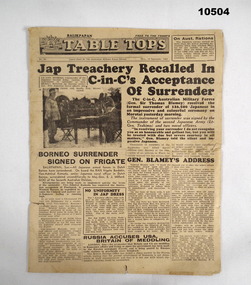
Newsletter - ARMY NEWSLETTER WW2, Australian Military Forces, 10 Sept 1945
... Four pages of a newspaper to Australian Troops. Cream paper with black writing and black and white photos. Dated Monday 10th September and contents mainly centred on the surrender of the Japanese. Name of the Newspaper at the top was "Table Tops" with the Rising Sun symbol. Newsletter ARMY NEWSLETTER WW2 Australian Military Forces ...Table Tops was a newspaper published for Australian Troops during WW2 in the Atherton Tablelands. Part of the collection of William (Bill) Thomason. Part of 4136P.Four pages of a newspaper to Australian Troops. Cream paper with black writing and black and white photos. Dated Monday 10th September and contents mainly centred on the surrender of the Japanese. Name of the Newspaper at the top was "Table Tops" with the Rising Sun symbol.Dated 10th Sep 1945.collection of william (bill) thomason, table tops, newspaper, japanese surrender -
 Bendigo Military Museum
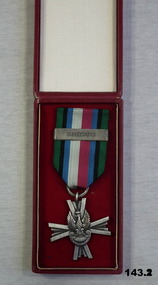
Award - MEDAL WW2, POLISH, 1998
... Zachoozie 1945" (Polish Armed Forces in the West) In relief on front of ribbon - "Tobruk" White eagle on front is national symbol of Poland .1) Polish medal connected to Tobruk, has white eagle on front, four-pointed shape; on blue, black, green, white & red cloth ribbon, metal bar at top. .2) Red leatherette case lined with red velvet and white satin. ...Medal issued by Polish Government to all forces who served in Tobruk WW11with Polish forces. This medal was issued to Frederick Lloyd CARLETON VX33476, 2/23rd Batt AIF. Refer Cat No 142.7 (medals) for his service history..1) Polish medal connected to Tobruk, has white eagle on front, four-pointed shape; on blue, black, green, white & red cloth ribbon, metal bar at top. .2) Red leatherette case lined with red velvet and white satin. In Polish, on rear of medal, "1939 Polskie Sily Zbrojne na. Zachoozie 1945" (Polish Armed Forces in the West) In relief on front of ribbon - "Tobruk" White eagle on front is national symbol of Polandnumismatics, medals, military, containers -
 Bendigo Military Museum
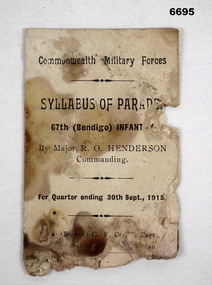
Booklet - BOOKLET, SYLLABUS OF PARADES
... Small yellow cardboard booklet from Commonwealth Military Forces. One sheet folded over to make four pages....Small yellow cardboard booklet from Commonwealth Military Forces. One sheet folded over to make four pages. Booklet BOOKLET, SYLLABUS OF PARADES ...Each Battalion would have a number of parades over the period with dates and purpose.Small yellow cardboard booklet from Commonwealth Military Forces. One sheet folded over to make four pages.Front page heading - "Syllabus of Parade" 67 Infantry Battalion - quarter ending "30 Sept., 1915" with inside breakdown of parades.passchendaele barracks trust, parades, 67th battalion -
 Bendigo Military Museum
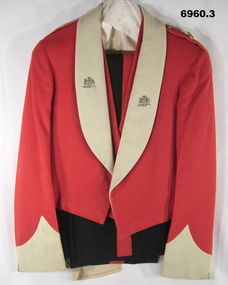
Uniform - MESS DRESS, OFFICER, unknown
... Forces. The jacket is lined with red cotton. 2. Red woollen vest, cotton backing. Two small pockets, Four small brass buttons - motif is Australian Military Forces - vest lined with white cotton. 3. ...Forces. The jacket is lined with red cotton. 2. Red woollen vest, cotton backing. Two small pockets, Four small brass buttons - motif is Australian Military Forces - vest lined with white cotton. 3. ...1. Red woollen jacket with white facings and white cuffs. On the collars are a 38Bn NVR badge. On epaulettes are - Brass letter "R". Brass Major's badge, small brass button - motif is Australian Military Forces. The jacket is lined with red cotton. 2. Red woollen vest, cotton backing. Two small pockets, Four small brass buttons - motif is Australian Military Forces - vest lined with white cotton. 3. Black trousers, wool with a red wool stripe on outside seam (4cm wide). Button fly (6 buttons) Pockets are white cotton, waistband lining is blue and white striped cotton. Small piece of leather at bottom of trousers at back. Two side pockets. One back pocket on right. Two buttons on each side of fly (for braces) two buttons at back.3. Written on right front pocket in black ink "SULLIVAN C4".post ww2, uniform, officers mess dress, passchendaele barracks trust -
 Bendigo Military Museum
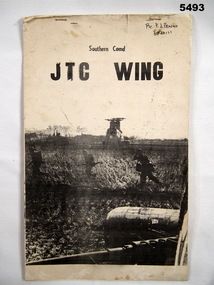
Administrative record - BOOKLET, Australian Army Southern Command, Southern Command JTC Wing, C1967
... forces plus other Allied nations 1962-1972. Before our soldiers left Aust they had specific jungle training. Vietnam War SVN Front cover in biro PTE P.J. PENNO 3790111 Programme- front cover cardboards with grainy image of a twin rotor helicopter, three helmeted US soldiers moving to left of picture. Machine gin barrel in the foreground. 3 pages, white paper of instructions, two pink pages of lessons and times. Four ...Australia served alongside SVN forces plus other Allied nations 1962-1972. Before our soldiers left Aust they had specific jungle training.Programme- front cover cardboards with grainy image of a twin rotor helicopter, three helmeted US soldiers moving to left of picture. Machine gin barrel in the foreground. 3 pages, white paper of instructions, two pink pages of lessons and times. Four pages of wartime tasks in the field. Front cover in biro PTE P.J. PENNO 3790111vietnam war, svn -
 Bendigo Military Museum
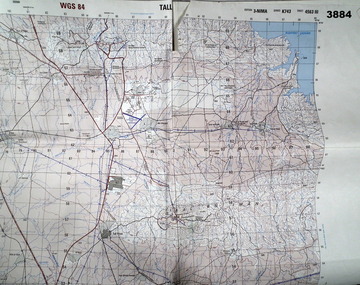
Map - MAP of IRAQ
... Four topographical maps taped together of Tall Uwaynat and Tall Musa region of Iraq. Item belonging to Mathew Redwood. Refer Cat No 3891 for his service details. maps iraq Orange fluoro marking out route taken by Australian forces in escort duties. ...Four topographical maps taped together of Tall Uwaynat and Tall Musa region of Iraq. Item belonging to Mathew Redwood. Refer Cat No 3891 for his service details.White paper, folded, four maps sticky taped togetherOrange fluoro marking out route taken by Australian forces in escort duties.maps, iraq
