
Showing 27 items matching "the peak district"
-
 Hymettus Cottage & Garden Ballarat
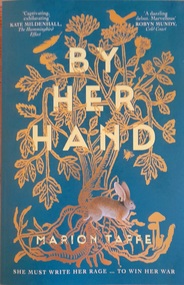
Work on paper - Book, By Her Hand
... ...The Peak District...Mercia Wessex England Aethelflaed The Peak District Set in tenth century England in the time of Aethelflaed of Mercia and the consolidation of Mercia, Wessex and other regions prior to the rise of Edward 1st. ...Set in tenth century England in the time of Aethelflaed of Mercia and the consolidation of Mercia, Wessex and other regions prior to the rise of Edward 1st. The work relates the story of a girl who is subjected to a hard father and suffers from the devastation of Viking raids before advancing through her maturity and independence from male domination.See image.fictionSet in tenth century England in the time of Aethelflaed of Mercia and the consolidation of Mercia, Wessex and other regions prior to the rise of Edward 1st. The work relates the story of a girl who is subjected to a hard father and suffers from the devastation of Viking raids before advancing through her maturity and independence from male domination. mercia, wessex, england, aethelflaed, the peak district -
 The Beechworth Burke Museum
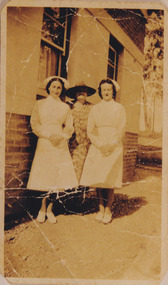
Audio - Oral History, Jennifer Williams, Mrs Sheila Parkinson, 3 January 2000
... district. Mayday Hills was renamed several times since its establishment in 1867. At the peak of operations, it comprised sixty-seven buildings housing over twelve hundred patients patients and five hundred staff. ...district. Mayday Hills was renamed several times since its establishment in 1867. At the peak of operations, it comprised sixty-seven buildings housing over twelve hundred patients patients and five hundred staff. ...Mrs Sheila Parkinson was born in Wagga in 1916 and came to Beechworth as a young woman around 1938. Sheila trained as a psychiatric nurse at Mayday Hills hospital prior to the second World War. At that time, unmarried women were accommodated and received nursing training on-site. Shiela was obliged to cease professional training and employment when she married in 1941, which disrupted completion of her final nursing examinations. Following post-war changes to the law that allowed married women to work, Sheila returned to Mayday Hills. Sheila's husband, Don, returned to Beechworth after four years abroad as a serviceman in the Australian Air Force. Beechworth's institutions were a major source of local employment throughout the twentieth century. As well as providing limited employment opportunities to young women like Shiela, post-war European migrants from Bonegilla Migrant camp found at Mayday Hills, encouraging European migrant settlement in the district. Mayday Hills was renamed several times since its establishment in 1867. At the peak of operations, it comprised sixty-seven buildings housing over twelve hundred patients patients and five hundred staff. The hospital officially closed in 1998. Today, the decommissioned two-storey Italianate style main building stands on eleven hectares of botanical gardens under National Trust protection. The site remains a popular cultural heritage destination for visitors. This oral history recording was part of a project conducted by Jennifer Williams in the year 2000 to capture the everyday life and struggles in Beechworth during the twentieth century. This project involved recording seventy oral histories on cassette tapes of local Beechworth residents which were then published in a book titled: Listen to what they say: voices of twentieth century Beechworth. The cassette tapes were digitised in July 2021 with funds made available by the Friends of the Burke.Employed as a psychiatric nurse at one of Beechworth's large welfare institutions, Mayday Hills, Mrs Sheila Parkinson recalls the conditions faced by staff and patients at the hospital, which cared for chronically ill people from the Ovens region and patients from the Yarra Bend Asylum, Melbourne, which closed in 1925. When Sheila first began her nurse training, Mayday Hills suffered from a lack of resources and rudimentary facilities and patients frequently suffered from the cold due to poor heating and inadequate clothing and bedding. However, as the twentieth century progressed, Sheila recalls how conditions and treatments improved as a result of increased government funding of services and advances in psychiatry and pharmaceutical medicine. Mrs Sheila Parkinson's oral history recording is historically and socially significant for its witness to life in Beechworth in the pre- and post-WWII period. Sheila's story enriches our understanding of processes of modernisation with regard to psychiatric and welfare services, while the course of Sheila's professional training and employment brings attention to systemic and socio-economic barriers faced by women, as well as the valuable contribution women and migrants make in the delivery of care and ancillary services. This oral history account is socially and historically significant as it is a part of a broader collection of interviews conducted by Jennifer Williams which were published in the book 'Listen to what they say: voices of twentieth-century Beechworth.' While the township of Beechworth is known for its history as a gold rush town, these accounts provide a unique insight into the day-to-day life of the town's residents during the twentieth century, many of which would have been lost if they had not been preserved.This is a digital copy of a recording that was originally captured on a cassette tape. The cassette tape is black with a horizontal white strip and is currently stored in a clear flat plastic rectangular container. It holds up 40 minutes of recordings on each side.Mrs Sheila Parkinson /twentieth century beechworth, mayday hills, psychiatric care, benevolent asylums, nursing, wwii, psychiatric treatment, country women, psychiatric hostpital, beechworth's institutions, local employment, government institutions, listen to what they say, oral history, burke museum, sheila parkinson, beechworth lunatic asylum, beechworth mental hospital, beechworth hospital for the insane, the kerferd clinic, bonegilla migrant camp, working women, white australia policy -
 Marysville & District Historical Society
THE TRIANGLE NEWS-VOL 38 NO 38-OCTOBER 21 2011
... marysville & district historial society...sneak peak...marysville victoria australia buxton & acheron gardens feature in local open gardens weekend mops butters cafe of buxton igloo roadhouse buxton black spur roadhouse young artist draws community to inspirational exhibition book signing by kaz cowley kinglake ranges community marysville & district historial society sneak peak history week fire ready victoria meetings scheduled THE TRIANGLE NEWS-VOL 38 NO 38-OCTOBER 21 2011 ...marysville, victoria, australia, buxton & acheron gardens feature in local open gardens weekend, mops, butters cafe of buxton, igloo roadhouse buxton, black spur roadhouse, young artist draws community to inspirational exhibition, book signing by kaz cowley, kinglake ranges community, marysville & district historial society, sneak peak history week, fire ready victoria meetings scheduled -
Marysville & District Historical Society
THE TRIANGLE NEWS-VOL 38 NO 39-OCTOBER 28 2011
... district historical society...national and international donations...andrew mckenzie...janet schultz...michael darmondy property...yvonne knight bequest...black saturday 2009...murrindindi shire council...sneak peak...marysville victoria australia mops opening marysville & district historical society national and international donations andrew mckenzie janet schultz michael darmondy property yvonne knight bequest black saturday 2009 murrindindi shire council sneak peak history week fire ready victoria meetings scheduled THE TRIANGLE NEWS-VOL 38 NO 39-OCTOBER 28 2011 ...marysville, victoria, australia, mops opening, marysville & district historical society, national and international donations, andrew mckenzie, janet schultz, michael darmondy property, yvonne knight bequest, black saturday 2009, murrindindi shire council, sneak peak history week, fire ready victoria meetings scheduled -
 The Beechworth Burke Museum
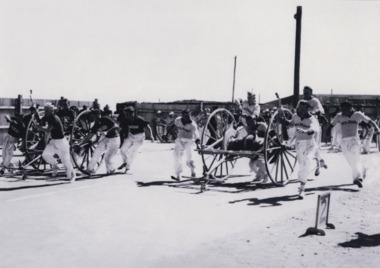
Photograph, c1950s
... The State Championship became the peak of the season's competitions conducted by districts and associations across the state. ...The State Championship became the peak of the season's competitions conducted by districts and associations across the state. emergency services beechworth fire brigade firemen photograph competition black and white fire Black and white rectangular photo reproduction printed on matte photographic paper Photograph Photograph ...Photograph of 2 teams with hoses and reels in a race as part of a CFA competition. Fire brigade competitions have been running for almost 150 years with the first State Championship held in Melbourne in 1874. State Championships have continued every year since 1873. The event goes on regardless of weather conditions or natural disasters. The only cancellations being due to WWI and WWII. In the 1950s, the Rural State Championships were developed to reflect the unique skills of rural brigades. The competitions started out as 'Demonstrations' with the introduction of hose reels into the fire service in the mid 1800s. This was to assist in getting hose and other necessary equipment to the scene of a fire faster. Brigades soon find that competing with other brigades improved their training and efficiency. The State Championship became the peak of the season's competitions conducted by districts and associations across the state. Black and white rectangular photo reproduction printed on matte photographic paperemergency services, beechworth, fire brigade, firemen, photograph, competition, black and white, fire -
 Orbost & District Historical Society
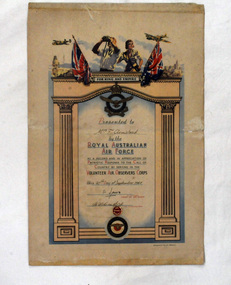
certificate, 1945
... peak strength of 24,000 personnel and 2,656 observation posts in 1944. After the end of the war the VAOC was reduced to a cadre in December 1945 and was disbanded on 10 April 1946. The Volunteer Air Observers Corps was an Australian air defence organisation of World War II. This certificate is a record of the participation of members of the Orbost district ...The Volunteer Air Observers Corps was an Australian air defence organisation of World War II.It was formed on 31 December 1941 to support the Royal Australian Air Force by sighting and observing aircraft over Australia.It swiftly established observation posts across Australia and provided information to the RAAF's regional air control posts. As the threat to Australia declined its role was expanded to include coast watching, assisting air traffic control and weather reporting. The corps was staffed by civilian volunteers and reached a peak strength of 24,000 personnel and 2,656 observation posts in 1944. After the end of the war the VAOC was reduced to a cadre in December 1945 and was disbanded on 10 April 1946. The Volunteer Air Observers Corps was an Australian air defence organisation of World War II. This certificate is a record of the participation of members of the Orbost district. Anita Armistead, wife of Francis Armistead had a son, Sydney, who served as a gunner in Malaysia during WW11.A certificate of service awarded to Mrs F. Armistead for being a volunteer in the Air Observers Corps. It was awarded on 20 Sept, 1945 for one year's service.For King and Empire Presented to Mrs F. Armistead by the ROYAL AUSTRALIAN AIR FORCE As a record and in appreciation of patriotic response to the call of country by serving in the VOLUNTEER AIR OBSERVERS CORPS This 20th day of September 1945 signed G. Jones Air Vice Marshall Chief of Air Staff signed ? Unit Commanding Officercertificate ww11 air-observers-corps -
 Warrnambool and District Historical Society Inc.
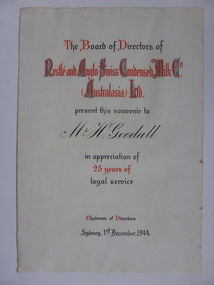
Document, Certificate Mr H Goodall, 1944
... At its peak it employed 600 people and processed 55000 gallons daily in the milk condensery which is a process whereby much of the water content is drawn from the milk and sugar is added making a product which has a long shelf life and because it is processed at low temperature the milk maintains much of its vitamin content. A certificate which links a local person to a long and well known industry in Warrnambool and the Western district ...This certificate was awarded in appreciation of 25 years service to the Nestle Company which operated a dairy factory at Dennington in Warrnambool. The company came to Warrnambool in 1907 and purchased 17 acres at Dennington and a new dairy plant was established by 1911. At its peak it employed 600 people and processed 55000 gallons daily in the milk condensery which is a process whereby much of the water content is drawn from the milk and sugar is added making a product which has a long shelf life and because it is processed at low temperature the milk maintains much of its vitamin content.A certificate which links a local person to a long and well known industry in Warrnambool and the Western district.Cream soft card certificate with red and black text.Mr H Goodall. Nestle and Anglo Swiss Condensed Milk Co Australasia Ltd. dated 1st December 1944. The signature of the Chairman of directors is unreadable.warrnambool, nestle dennington, h goodall -
 Kiewa Valley Historical Society
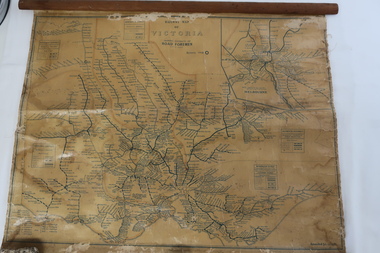
Map - Railway Map of Victoria, Amended to 1/11/1945
... peak in the early 1940s.Steam trains were followed by electric trains with both running after the war in 1945. Bright was the closest station to the Kiewa Valley but road transport was used more often as the Kiewa Valley Highway was improved with the construction of the Kiewa Hydro Electric Scheme. To travel to Melbourne or Sydney by train residents went via Wodonga/Albury where they also did their shopping. Victorian railways 1945 trains transport Plastic on parchment with detailed railway routes (in green) across Victoria including each district's ...Railways began in the 1850s and were privately owned and operated. Later they were taken over by the Victorian Government reaching a peak in the early 1940s.Steam trains were followed by electric trains with both running after the war in 1945.Bright was the closest station to the Kiewa Valley but road transport was used more often as the Kiewa Valley Highway was improved with the construction of the Kiewa Hydro Electric Scheme. To travel to Melbourne or Sydney by train residents went via Wodonga/Albury where they also did their shopping.Plastic on parchment with detailed railway routes (in green) across Victoria including each district's 'Road Foremen' and 'Depots'. There is a length of flat wood attached by 10 tacks across the top of the mapvictorian railways 1945, trains, transport -
 Eltham District Historical Society Inc
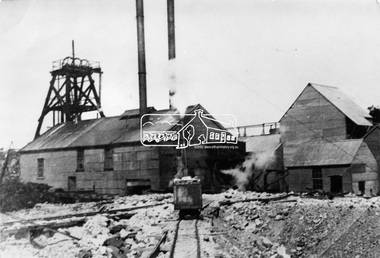
Photograph, Diamond Creek Gold Mine
... peak of its development in 1915. The surface plant was quite large with four boilers and five steam engines working the battery, winder, water pump, air compressor and lighting generator. This photo forms part of a collection of photographs gathered by the Shire of Eltham for their centenary project book, "Pioneers and Painters: 100 years of the Shire of Eltham" by Alan Marshall (1971). The collection of over 500 images is held in partnership between Eltham District ...Situated at the end of Fraser Street, Diamond Creek. The Diamond Creek Gold Mine was the largest in the Diamond Valley Shire with a shaft depth of over 290 metres at the peak of its development in 1915. The surface plant was quite large with four boilers and five steam engines working the battery, winder, water pump, air compressor and lighting generator.This photo forms part of a collection of photographs gathered by the Shire of Eltham for their centenary project book, "Pioneers and Painters: 100 years of the Shire of Eltham" by Alan Marshall (1971). The collection of over 500 images is held in partnership between Eltham District Historical Society and Yarra Plenty Regional Library (Eltham Library) and is now formally known as 'The Shire of Eltham Pioneers Photograph Collection.' It is significant in being the first community sourced collection representing the places and people of the Shire's first one hundred years.Digital imagesepp, shire of eltham pioneers photograph collection, diamond creek, goldmine, gold mine, poppet head -
 Warrnambool and District Historical Society Inc.
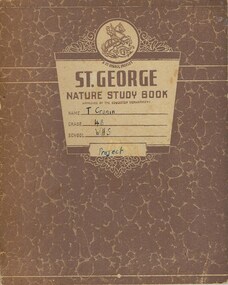
Work on paper - Booklets Fletcher Jones, 001143.1 Project Book 001143.2 Booklet:Plusites 001143.3 Flyer, Mid 20th century
... peak to approximately 200. The company had commenced importing a range of clothing by this time These three items present different views of a company which was an important part of industry in Warrnambool for over 60 years in the latter part of the 20th century. The founder was one of Warrnambool’s most well respected people and many district ...Fletcher Jones Clothing Factory was a key industry in Warrnambool from 1948 to its closure in 2005. The business was founded by David Fletcher Jones (1897-1977), a clothing manufacturer and retailer who worked as a hawker in the Western District following service with the A.I.F. in World War One. In 1924 Fletcher Jones opened three shops in Liebig Street selling men’s wear, hosiery and linen and operating a small tailoring business. He moved his shop to another location in Liebig Street and began to concentrate on men’s trousers production. In 1946 he opened a shop in Collins Street in Melbourne and eventually had stores and factories all over Australia. In Warrnambool he opened his factory at Pleasant Hill in Flaxman Street in 1948 and became a major Warrnambool employer, with over 1000 employees at one time. He transformed his business into a co-operative, with the name, ‘Fletcher Jones and Staff’ registered in 1947. The business diversified into other ranges of clothing for men and women but failed to compete with cheaper overseas clothing imports and the factory and shops were closed in the early 21st century. 001143.1 Project Book. This project book tells the story of the establishment and development of the Fletcher Jones company across the various stores which were established in Melbourne, Adelaide, Sydney, Geelong and Hobart. It explores the philosophy behind the business and milestones achieved and the factory gardens. The book itself provides an example of schoolwork completed in the mid 20th century. 001143.2 Booklet: Plusites: This is a staff booklet which has items of interest relating to staff such as births deaths and marriages. It tells of renovations and happenings in regard to the various shops around the country as well as trading figures. It tells of the royal visit of 1954 and other social events and items of interest around the various shops. 001143.3 Flyer :The text on this flyer also tells the story of the development of the Fletcher Jones brand to the point where there in the year2000 retail expansion was still happening but the Warrnambool workforce had shrunk from over 1000 at the peak to approximately 200. The company had commenced importing a range of clothing by this time These three items present different views of a company which was an important part of industry in Warrnambool for over 60 years in the latter part of the 20th century. The founder was one of Warrnambool’s most well respected people and many district people had connections to the firm. 001143.1 Project Book. Brown mottled card cover with cream insert for personal details. Back cover plain cream. It contains a student’s project work on the Fletcher Jones company. Some is handwritten and also contains a number of black and white photographs throughout the book. A coloured map of Australia is in the middle pages. 001143.2 Booklet: Plusites. White light card cover with dark blue text and diagram. Bottom left of page has a map of the coastline of Victoria. 20 pages. 001143.3 Flyer. Advertising Flyer re factory direct sales at Warrnambool. Black text with maroon border and Fletcher jones logo at the bottom and 4 photographs at the top. 001143.1 Project Book. T Cronin 4B WHS 001143.2 Booklet: Plusites. Vol 1 No 1 June 1954. 001143.3 Flyer fletcher jones, warrnambool history, fletcher jones and staff pty ltd -
 Bendigo Military Museum
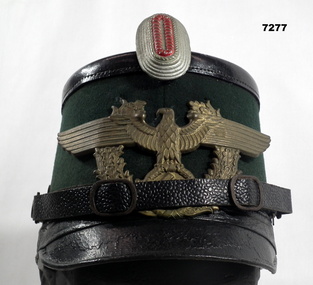
Headwear - CAP, PEAKED
... District. German Uniform Police Hat WW2 Hard round peaked cap. Top one centimetre black leather, next 9 cm green felt attached to firm backing and bottom peak again black leather. ...World War 2 German Police Hat (Schutzpolizei) of an NCO pattern for the Munich District.Hard round peaked cap. Top one centimetre black leather, next 9 cm green felt attached to firm backing and bottom peak again black leather. Metal studs on side with black leather buckled strap going around the back. Attached to back is a large golden emblem of an eagle with wings spread, sitting on a shield with a Swaztika on it and gold laurel leaves coming off to the side. Mounted on the top at back is a silver oval shaped object with red markings. Lining on inside of hat is dark brown leather.german uniform, police hat, ww2 -
 Warrnambool and District Historical Society Inc.
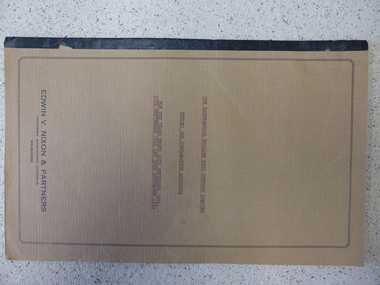
Report, W'bool Woollen Mill Co Ltd, 1945
... District Historical Society. The Warrnambool Woollen Mill was a major industry in Warrnambool , employing at its peak several hundred people and it was a significant building in the city, with the social and economic ramifications connected to a major business in a regional centre. ...This is a document showing the state of the accounts in 1944-5 of the Warrnambool Woollen Mill, a significant commercial business in Warrnambool for several decades that was well-known nationally, particularly during World War Two. The Warrnambool Woollen Mill operated in South Warrnambool off McDonald Street from 1910 to 2001 and produced mainly woollen blankets and flannels. Some of the old Woollen Mill buildings today are heritage-listed. The item shows that there was a reduced turnover in 1944-5 because of fewer Government contracts but the company was still making a profit. The Federal Government was a major buyer of Warrnambool Woollen Mill products with the factory supplying blankets for the Armed Forces in World War Two.This is an important document which forms part of a larger collection of Warrnambool Woollen Mill material in the archives of the Warrnambool and District Historical Society. The Warrnambool Woollen Mill was a major industry in Warrnambool , employing at its peak several hundred people and it was a significant building in the city, with the social and economic ramifications connected to a major business in a regional centre. The document shows the state of the business during World War Two.This is a document of 14 pages produced for the Warrnambool Woollen Mill Company Limited by Edward V. Nixon & Partners, Chartered Accountants, Melbourne, a Report and Comparative Accounts for the years ended 30th September 1944 and 30th September 1945. The cover is grey-coloured light cardboard bound with a paper adhesive. The report covers five pages and the financial statements nine pages. The material is typed.The report is signed Edwin V. Nixon & Partners and the financial reports are initialled E.V.N. & P. warrnambool, warrnambool woollen mill, warrnambool woollen mill report 1944-45 -
 Warrnambool and District Historical Society Inc.
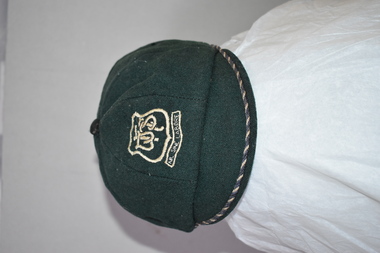
Hat, School W'bool High School, Early 1930s
... district. Warrnambool High School Goodall family History of Warrnambool W.H.S. Sine Labore V. Becker Boys Shop & Hosiery Parlour Warrnambool Name: M. Goodall This is a boy’s cap made of dark green cloth with octagonal sections and a cloth button on top. The peak ...This is a Warrnambool High School cap from the 1930s. Warrnambool High School was established in 1907 with a farm site in Merrivale and it was also in several sites in the main town area, with the longest occupancy in Hyland Street. In 1961 the school moved to its present location in Albert Park (Grafton Road). The High School amalgamated with Warrnambool North Technical School in 1995 to form Warrnambool College. Malcolm Goodall, the owner of the cap, was born in 1917 and died in 2010. He lived in Coulstock Street and he worked in the tinning department of Nestles. The Goodall family has been in the Warrnambool area since the mid 1850s including being at the farm, ‘Wanstead’ in East Warrnambool and at Framlingham in the 19th century where William Goodall was the manager of the aboriginal settlement. This cap is of interest as an example of the boys’ uniform at Warrnambool High School in the 1930s and as a memento of Malcolm Goodall. His ancestors were pioneers in the Warrnambool district.This is a boy’s cap made of dark green cloth with octagonal sections and a cloth button on top. The peak is edged with navy and cream cord. The centre front of the cap has a school badge with the school initials and motto. The inside of the cap is lined with black cloth with a cream centre and has the cap seller’s business details and the name of the owner of the cap. Some of the printed material here is indecipherable. The stitching is worn in some places. W.H.S. Sine Labore V. Becker Boys Shop & Hosiery Parlour Warrnambool Name: M. Goodall warrnambool high school, goodall family, history of warrnambool -
 Warrnambool and District Historical Society Inc.
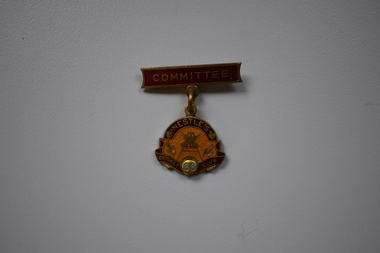
Badge, K.G.Luke, Nestles Cricket Club, 1966
... peak in the 1960s and 70s was employing 800 people. It produced the drink, Milo and the coffee, Nescafe (this latter ceasing in 2000). In 2005 the Nestles Factory was taken over by the New Zealand firm, Fonterra and it is due to cease business entirely late in 2019. The Nestles Factory encouraged and sponsored several social and sporting clubs, including the Nestles Cricket Club and the Nestles Rowing Club. The Nestles Cricket Club commenced in 1944 and has been a part of the Warrnambool and District...peak in the 1960s and 70s was employing 800 people. It produced the drink, Milo and the coffee, Nescafe (this latter ceasing in 2000). In 2005 the Nestles Factory was taken over by the New Zealand firm, Fonterra and it is due to cease business entirely late in 2019. The Nestles Factory encouraged and sponsored several social and sporting clubs, including the Nestles Cricket Club and the Nestles Rowing Club. The Nestles Cricket Club commenced in 1944 and has been a part of the Warrnambool and District ...This badge was issued in 1966 to a member of the committee of the Nestles Cricket Club in Dennington (Warrnambool). The Nestles Milk Factory was established at Dennington in 1911, being one of the few Nestles factories at the time to be opened outside of Europe. During World War One and the 1920s the Dennington Nestles Factory was the world’s largest milk condensery and at its peak in the 1960s and 70s was employing 800 people. It produced the drink, Milo and the coffee, Nescafe (this latter ceasing in 2000). In 2005 the Nestles Factory was taken over by the New Zealand firm, Fonterra and it is due to cease business entirely late in 2019. The Nestles Factory encouraged and sponsored several social and sporting clubs, including the Nestles Cricket Club and the Nestles Rowing Club. The Nestles Cricket Club commenced in 1944 and has been a part of the Warrnambool and District Cricket Association competition since that time. It still operates today under the same name and includes a women’s team. This item is of interest as a memento of Nestles Cricket Club, a prominent cricket team in Warrnambool today.This is a shield-shaped metal badge with a red and gold background, an image in yellow of cricket bats and stumps and two decorative patterns and gold-coloured printing. A circular number has been attached to the lower part of the badge. This is detachable. A bar with gold-coloured edging and a red background and gold-coloured printing is attached to the badge by a metal ring. The back of the bar has a metal clip.Committee Nestles Cricket Club 66 K.G.Luke Melb. nestles milk factory, dennington, nestles cricket club, history of warrnambool -
 Sunshine and District Historical Society Incorporated
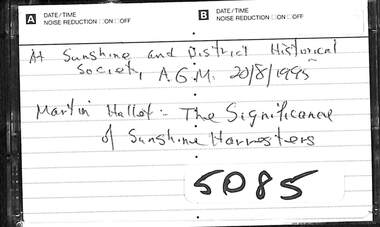
Audio - Sunshine and District Historical Society Annual General Meeting 1995 Audio Tape, 20/8/1995
... The factory was also a huge industrial complex that contributed to the development of the City of Sunshine, and at its peak was the largest manufacturing facility in the southern hemisphere. Martin Hallett Sunshine Harvester Works At Sunshine and District Historical Society A.G.M. 20/8/1995 Martin Hallett The significance of Sunshine Harvesters Audio tape This audio tape has been digitised This audio tape has been transcribed. ...Martin Hallett was a museum curator and Deputy Chief Executive of Museums Victoria. The Sunshine Harvester Works was an agricultural equipment factory in Sunshine, Victoria founded by industrialist HV McKay, It was famous for producing the 'Sunshine Harvester' a combine harvester that could strip, thresh and winnow grain in one operation. The factory was also a huge industrial complex that contributed to the development of the City of Sunshine, and at its peak was the largest manufacturing facility in the southern hemisphere.At Sunshine and District Historical Society A.G.M. 20/8/1995 Martin Hallett The significance of Sunshine Harvestersmartin hallett, sunshine harvester works -
 Sunshine and District Historical Society Incorporated
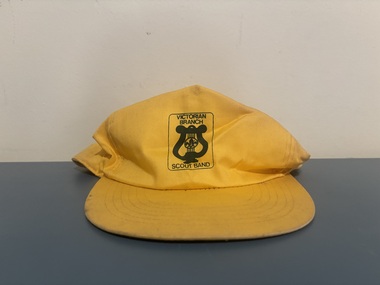
Headwear - Victorian Branch Scout Band Peak Cap
... districts. Scouting Scouts Cubs Victorian Branch Scout Band Yellow peak cap Headwear Victorian Branch Scout Band Peak Cap ...The Victorian Branch Scout Band was the official musical ensemble of the Boy Scouts Association, Victorian Branch. It is sometimes referred to in records as; Victorian Scout Band Victorian Branch Band Victorian Branch Scout Band State Scout Band (Victoria) The band operated as a state‑level band, providing ceremonial and marching music for major Scouting events such as; State rallies Jamboree openings and parades Government House ceremonies Queen’s Scout and Queen’s Guide presentations District anniversaries and major civic events ANZAC Day marches Scout Gang Show events It was considered a prestige unit, with membership drawn from trained youth musicians across multiple districts.Yellow peak capVictorian Branch Scout Bandscouting, scouts, cubs -
 Royal District Nursing Service (now known as Bolton Clarke)
Photograph - Photograph, sepia, 1916
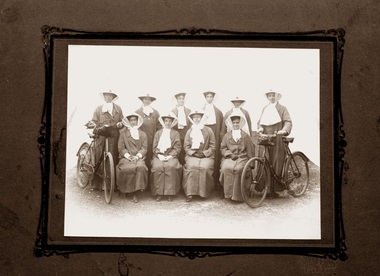
... district nursing service...nurse blanche wilson...nurse pat lee...nurse deans...nurse o'sullivan...nurse warren...nurse amess...nurse peak...They taught them, by verbal instruction and demonstration, how to make poultices, to make and apply bandages, apply medical appliances such as splints. mdns melbourne district nursing society mdns uniforms mdns transport mdns matron rdns royal district nursing service nurse blanche wilson nurse pat lee nurse deans nurse o'sullivan nurse warren nurse amess nurse peak nurse brown matron Janie Freeman Photographer's embossed stamp Sepia photograph on brown card mount with 'Kirk Studio' on bottom right of the card. ...Matron Freeman and the MDNS Trained Nurses are wearing long grey coats and white pith helmets, which display a red Maltese cross.The Pith helmets are held on with a white veil. The two Bicycles with nursing bags attached to handlebars show the transport used by MDNS at that time.. Nurses - Back - L-R - O'Sullivan, Deans, Warren, Amess, Pat Lee and Jane with bicycle Front - L-R - Blanche Wilson, Matron Janie Freeman, Peake and Brown. In February 1885, 50 years after Melbourne was founded, it was recognized that nursing care was needed for the sick poor in inner Melbourne. The Melbourne District Nursing Society (MDNS) was founded with one Trained nurse (Nurse), and a second employed six months later. This was the first such service in Australia. They worked in the now CBD, ie from Spencer Street to Spring Street and from Victoria Parade to Flinders Street. From its inception the Society was at the forefront of health care. They provided high quality nursing care; educated their patients in the curing and prevention of disease; teaching the importance of cleanliness and good nutrition, both by verbal instruction and demonstration, even supplying soup and milk when needed. At that time they walked the streets and lane ways amid the slums of inner Melbourne carrying their nursing bag containing lotion ointments, powders, liniment, bandages, dressings, a case of spirits, and the Nurse's own clean apron. They loaned equipment, such as earthenware hot water bottles, splints, urinals, bed pans, bed cradles, feeding mugs, and air-cushions as well as providing clean bed linen and nightdresses as necessary. Trained Midwives began home births in August 1893 taking midwifery bundles and providing clothes for the babe as needed. This was arduous work, particularly in the heat of summer. Permission to use bicycles was given to the Nurses in 1898 and the Society decided to purchase their own in 1903. A business man offered ‘new free wheel’ bicycles at £13 each which included maintenance for one year. Bells and wooden frames were added, at a cost of £5 per frame, so the Nurses could carry extra equipment. Nurses’ bags were strapped to the handlebars. Soup was made for those in need 2-3 times a week and if patients could not arrange to have it collected the soup was delivered by the Nurses on their bicycles. The use of bicycles caused a change in uniform, with white pith helmets, and veils covering them and tied under their chin, now being used. In 1913 a Nurse had her Board and residence, uniforms, bicycles and laundry expensive provided and was paid £50 a year for her first six months. At the end of a year her salary is increased by £5, and later she earned £60 a year. Over the years the Nurses complained their veils became wet in the rain and asked for a change of uniform but this did not occur until 1921. Bicycles continued to be used in inner areas until 1945. From its inception the Society was at the forefront of health care and liaised with Doctors. They provided high quality nursing care to a range of people, often in destitute situations, some lying on rags on the floor as they had no bed, others with just a bed and maybe a thin blanket, a chair and nothing else. Their ages ranged from babes, children, adults to the elderly. The Nurses gave medications as ordered, dressed wounds e.g. to the injured, and surgical cases, and to those with leg ulcers; attended to patients with ‘surgical ailments’ such as ‘hip disease’; gave care to those with acute illnesses such as bronchitis, pleurisy, pneumonia, measles, and scarlet fever, as well as those with chronic illnesses such as consumption (tuberculosis), heart disease, arthritis, cancer, debility, neuritis and paralysis. They educated their patients, and their Carers, in the curing and prevention of disease; teaching the importance of hygiene, cleanliness, ventilation and good nutrition. They taught them, by verbal instruction and demonstration, how to make poultices, to make and apply bandages, apply medical appliances such as splints.Sepia photograph on brown card mount with 'Kirk Studio' on bottom right of the card. The photograph shows Matron Freeman and nine Melbourne District Nursing Society (MDNS) Trained nurses, (Nurses), with bicycles. The back row of six Nurses are standing and the Nurses either end are holding bicycles which have leather oblong nursing bags attached to the handlebars with two straps. The front row are seated. All are wearing the MDNS uniform of long dark coats and white helmets, with white scarves covering them and tied under their chins. A Maltese cross can be seen in the centre of the helmets. Both bicycles have two large wire spoked wheels at either end of the black V shape bicycle frame; a rubber tyre runs around the outside of each wheel. The metal handlebars are a horizontal configuration and are attached with a central column into a black vertical column at the front of the V shape bicycle frame which has 'fork shaped' thin metal pierces running down either side of the wheel attaching the frame to the central hub of the wheel. The rear wheel is attached the same way to a central column at the rear of the frame which runs up to V shape solid seat. At the bottom of the V of the frame a pedal is attached with a rotating arm on either side of the bicycle and on the right side the rotating arm is attached to a sprocket which has a chain running around it back to a smaller sprocket on the hub of the back wheel. The chain has a thin metal guard over it. There are narrow thin metal mud guards running a short distance above the top of each wheel.Photographer's embossed stampmdns, melbourne district nursing society, mdns uniforms, mdns transport, mdns matron, rdns, royal district nursing service, nurse blanche wilson, nurse pat lee, nurse deans, nurse o'sullivan, nurse warren, nurse amess, nurse peak, nurse brown, matron janie freeman -
 Royal District Nursing Service (now known as Bolton Clarke)
Headwear - Photograph, colour, c.1960
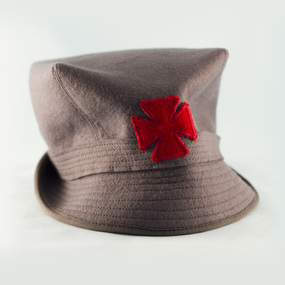
... District Nursing Service (MDNS) felt grey peaked hat, which has a deep crown and a flat top. Stitching comes from four corners of the crown at an angle to a grey band, which contains several rows of stitching, and surrounds the crown.. A stiff sloping grey brim, containing several rows of stitching, joins the band surrounding the crown, the rear of the brim is turned up and the front forms a peak. ...District Nursing Service (MDNS) felt grey peaked hat, which has a deep crown and a flat top. Stitching comes from four corners of the crown at an angle to a grey band, which contains several rows of stitching, and surrounds the crown.. A stiff sloping grey brim, containing several rows of stitching, joins the band surrounding the crown, the rear of the brim is turned up and the front forms a peak. ...This hat is part of the uniform worn by all the Trained nurses (Sisters) of the Melbourne District Nursing Service, (MDNS), during the 1960s. The Sisters travelled around the inner and outer suburbs of Melbourne administering nursing care to patients in their homes. From its earliest years when Melbourne District Nursing Society (MDNS) began to wear uniforms the chosen colour was grey, though the style changed throughout the years as fashions changed from the late 1800s through to the 1970s. The Trained nurses firstly wore long grey frocks and a white cap with a long white tail hanging from the centre back. When bicycles were introduced the headgear changed to a white pith helmet adorned with a red Maltese cross in the centre front. This was held on with a veil going over the hat and tied under the chin. Over the years there were complaints that the veils became wet in the rain and they asked for a change of uniform, but this did not happen until 1921. The nurses complained their skirts became wet when riding their bicycles in the rain and asked, when raining, to be able to wear breeches and gaiters. This was granted provided they wore aprons when attending patients. It was not long before the uniform changed to a shorter length grey frock, red cardigan, grey coat and grey brimmed hat; later changed to a peaked grey hat. In 1966 MDNS were granted Royal patronage. Now as Royal District Nursing Service, RDNS, the uniform was redesigned and colour changed in 1971. By 1972 the Sisters were wearing the new winter uniform of a blue/grey skivvie under a V neck tunic style frock made of blue/grey herringbone winter material with the RDNS insignia on the upper left, and a beret of the same material. In summer the uniform became a royal blue V neck tunic style frock, with the RDNS insignia on the upper left, worn over a short sleeve white blouse. A royal blue peaked hat with the RDNS insignia in the centre front was worn at first and then only worn on official occasions. This uniform was worn until changed to a corporate style in the mid 1980s,A Melbourne District Nursing Service (MDNS) felt grey peaked hat, which has a deep crown and a flat top. Stitching comes from four corners of the crown at an angle to a grey band, which contains several rows of stitching, and surrounds the crown.. A stiff sloping grey brim, containing several rows of stitching, joins the band surrounding the crown, the rear of the brim is turned up and the front forms a peak. A cotton red Maltese cross is sewn to the centre front of the crown and band. A white with blue 'created by Effie Joy' label is attached to the inner hat band along with 'Size 22'. The crown is 9.5 cm deep and the brim is 5 cm deepmdns, melbourne district nursing service, mdns uniforms, rdns, royal district nursing service -
 Royal District Nursing Service (now known as Bolton Clarke)
Photograph - Photograph, black and white, 09 05 1967
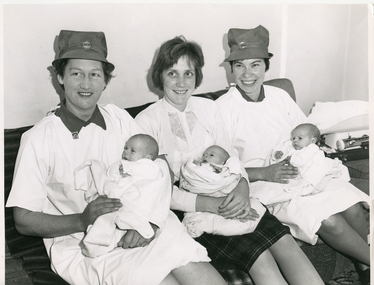
... District Nursing Service, (RDNS), Postnatal Service Sisters visiting a mother and her triplets in their home. Both Sisters and the mother are smiling and sitting on a dark coloured couch with each holding one of the babes who are wrapped in light coloured bunny rugs. The Sister on the left is wearing a white gown, with the grey peaks...District Nursing Service, (RDNS), Postnatal Service Sisters visiting a mother and her triplets in their home. Both Sisters and the mother are smiling and sitting on a dark coloured couch with each holding one of the babes who are wrapped in light coloured bunny rugs. The Sister on the left is wearing a white gown, with the grey peaks ...In 1964 Melbourne District Nursing Service (MDNS) commenced a Domiciliary Postnatal Service, later called Domiciliary Infant and Maternal.Care (DIMC), when Royal patronage was granted in 1966 (RDNS). The Sisters gave Post-natal care to the mother and babes and visited for support and advice as long as needed. The central RDNS badges on the Sisters hats is made of metal and has 'Royal District Nursing Service' written in the outside royal blue circle. The inner area is divided in three parts, the top and bottom sections are a silver rising sun and the central royal blue horizontal band has the letters 'RDNS' written white capital letters.In August 1893 Melbourne District Nursing Society (MDNS), commenced a Midwifery Service with Nurse Fowler, who was Hospital trained in General nursing and Midwifery nursing, being the first Midwife employed. Mothers were assessed for suitability of a home birth, or if they required delivery at the Women’s Hospital. The Midwife worked in conjunction with the Doctors at the Women’s Hospital and if a complication arose the patient was transferred to their care. Following birth they gave Post-Natal care to both the mother and babe. In 1898 the service ceased due to lack of funds but recommenced in 1906, and in the August 1925 Annual Report the number of MDNS home births was recorded at 478. MDNS built the After-Care Home and an Anti-Natal Clinic was opened in 1930. The last Ante-Natal clinic was held there in December 1951 and the MDNS Midwifery service ceased in February 1952. In 1964 MDNS commenced a Post-Natal service with General and Midwifery trained MDNS Sisters working from a room at Footscray Hospital, and visiting early discharged Footscray Hospital maternity cases at home. Later, as Royal District Nursing Service (RDNS), this service was extended to a Domiciliary Infant and Maternal Care (DIMC), service operating from most Centres and visiting early discharged, often 24 hours after birth, maternity cases from hospitals to give post-natal care to the mother and babe. Many of the RDNS Sisters who did DIMC had their Triple Certificate (Infant Welfare), though Midwifery trained nurses also visited. Black and white photograph showing two Royal District Nursing Service, (RDNS), Postnatal Service Sisters visiting a mother and her triplets in their home. Both Sisters and the mother are smiling and sitting on a dark coloured couch with each holding one of the babes who are wrapped in light coloured bunny rugs. The Sister on the left is wearing a white gown, with the grey peaks of her uniform showing; her nursing badge is attached to the right hand peak of her uniform. She is wearing her grey peaked hat, with central attached RDNS badge, over her short dark curled hair. To her right is the mother, who has short straight dark hair, and is wearing a white blouse and dark tartan skirt. On the far right is Sister Barbara Weisart, wearing a white gown; with the grey peaks of her uniform showing, and wearing her grey peaked hat with central RDNS badge over her short dark straight hair. A set of white baby scales are seen to her rightPhotographers Stamp. Quote No. GE 13mdns, melbourne district nursing society, melbourne district nursing service, royal district nursing service, rdns, rdns domiciliary postnatal service, dimc, sister barbara weisart -
 Royal District Nursing Service (now known as Bolton Clarke)
Photograph - Photograph, black and white, c.1965
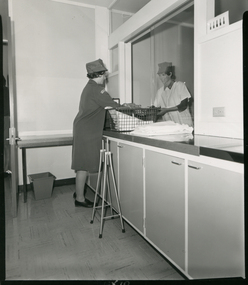
... On the right of the black and white photograph is a Melbourne District Nursing Service (MDNS) Sister, wearing a white gown over her grey uniform, with peaks showing, and wearing her grey peaked hat over her short dark hair. ...GX 6 Handwritten information On the right of the black and white photograph is a Melbourne District Nursing Service (MDNS) Sister, wearing a white gown over her grey uniform, with peaks showing, and wearing her grey peaked hat over her short dark hair. ...This photograph is taken in the Melbourne District Nursing Service (MDNS) Footscray Centre and shows a Sister receiving sterilized equipment from a Sister in the Autoclave room. The Sister receiving the equipment will use this when giving specific nursing care to a patient in her home.Melbourne District Nursing Service (MDNS), later called Royal District Nursing Service (RDNS), had an Autoclave room in each Centre where Catheter trays, dressing trays, as well as dressing packs and gowns and towels were sterilized for their Trained staff (Sisters) to take to the home when attending to a patient who required specific nursing care. When the Sisters returned to the Centre they cleaned the equipment and set up the trays ready for re-sterilizing. On the right of the black and white photograph is a Melbourne District Nursing Service (MDNS) Sister, wearing a white gown over her grey uniform, with peaks showing, and wearing her grey peaked hat over her short dark hair. She is smiling as she is handing sterilized equipment through the opened sliding window of the sterilizing room. The Sister receiving the equipment is to the left in the next room. She is wearing her grey uniform coat and peaked hat over her short dark curled hair, and is standing against a row of cupboards with their bench top at the level of the sliding window. To her right, a rectangular metal basket sits on the bench top; a white drape is in the basket and another to its right. A four pronged walking stick stands on the floor to her right hand side. At the rear left a small table is against the wall with a small grey square tapering rubbish bin beneath it. The edge of the open door can be seen on the far left. In the foreground some of the cupboards, and part of a wall with an electric switch can be seen.Photographer's stamp. Quote No. GX 6 Handwritten informationmelbourne district nursing service, mdns, royal district nursing service, rdns, rdns equipment, sterilizing, rdns centre -
 Royal District Nursing Service (now known as Bolton Clarke)
Photograph - Photograph, black and white, c.1967
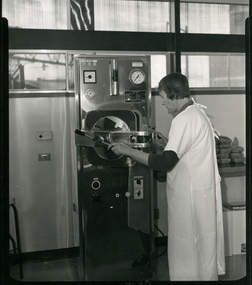
... Black and white photograph showing Royal District Nursing Service (RDNS), Sister Margaret Short, who has short dark hair, and is wearing a white gown over her uniform, with the grey peaks seen. ...GX 12 Handwritten information Black and white photograph showing Royal District Nursing Service (RDNS), Sister Margaret Short, who has short dark hair, and is wearing a white gown over her uniform, with the grey peaks seen. ...This photograph is taken in the Sterilizing room in the Royal District Nursing Service (RDNS) Footscray Centre. Sister Short is closing the door of the Autoclave to sterilize equipment and dressings which will then be used by a RDNS Sister when she is visiting a patient in the community. Sterilizing of equipment and dressings were carried out at each RDNS Centre. Royal District Nursing Service (RDNS) supplied sterilized equipment, such as ready set up catheter trays and dressing trays, as well as dressing packs for their trained staff (Sisters) to take to the home when attending to specific patient care. When the Sisters returned to the Centre they washed and set up the trays again ready for re-sterilization. Each RDNS Centre had an Autoclave room and equipment and dressings were sterilized each day.Black and white photograph showing Royal District Nursing Service (RDNS), Sister Margaret Short, who has short dark hair, and is wearing a white gown over her uniform, with the grey peaks seen. She is using the Autoclave in the Sterilizing room. The tall rectangular metal sterilizer stands in the centre of the photograph. There are several small dials and a larger square dial on its upper left, with a long encased thermometer in the centre and a large round dial to its right. Below this is the partly open large metal door of the sterilizing section. A thick horizontal metal piece runs from the left side of the sterilizer, across, and attached at the centre, of the door. Sister Short has her left hand on the turning bar attached to the centre section, and her right hand is on the locking section as she closes the door. Below the door are two switches and several small dials. To the left of the sterilizer is a cabinet, and to the right of Sister Short, eight small wrapped dressing packs are on a shelf. At the rear of the photograph the wall goes halfway up, with windows above.Photographer's Stamp. Quote No. GX 12 Handwritten informationroyal district nursing service, rdns, footscray centre, sterilizing, sister margaret short -
 Royal District Nursing Service (now known as Bolton Clarke)
Photograph - Photograph, black and white, Barry Sutton, c.1970
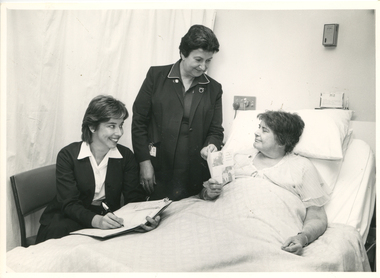
... District Nursing Service (RDNS) Sister (Sr.) Moira Coates doing Liaison work at St. Vincent's Hospital in Melbourne. Miss C. Healy is St. Vincent's Home Care Supervisor and she and Sr. Coates are discussing plans with Miss E. Monks for the future care she requires following her discharge from hospital. Sr. Coates is wearing the RDNS uniform of a royal blue dress with white piping around the peaks...District Nursing Service (RDNS) Sister (Sr.) Moira Coates doing Liaison work at St. Vincent's Hospital in Melbourne. Miss C. Healy is St. Vincent's Home Care Supervisor and she and Sr. Coates are discussing plans with Miss E. Monks for the future care she requires following her discharge from hospital. Sr. Coates is wearing the RDNS uniform of a royal blue dress with white piping around the peaks ...This photograph shows Royal District Nursing Service (RDNS) Sister (Sr.) Moira Coates doing Liaison work at St. Vincent's Hospital in Melbourne. Miss C. Healy is St. Vincent's Home Care Supervisor and she and Sr. Coates are discussing plans with Miss E. Monks for the future care she requires following her discharge from hospital. Sr. Coates is wearing the RDNS uniform of a royal blue dress with white piping around the peaks of the collar. An RDNS logo is on its upper left. She is wearing a darker blue jacket.Liaison had occurred between Doctors and the the Trained nurses (Nurses) of the Melbourne District Nursing Society (MDNS), from its inception in 1885. This increased when Midwifery was introduced in August 1893 with close liaising with the Women’s Hospital. As District nursing grew it was recognized that closer liaising between many Public Hospitals would be beneficial, for not only the MDNS, later called Royal District Nursing Service (RDNS), Trained nurses (Sisters), but also for the patients and the hospitals. In August 1964 a Liaison Officer commenced at the Alfred Hospital. This soon increased to Liaison Officers working full time at several Public Hospitals. They facilitated the smooth transition from hospital to home for many patients who required ongoing nursing care. Liaison Sisters regularly attended discharge planning meetings, interviewed prospective patients, co-ordinated discharge and booked the first visit by the visiting RDNS Sister. At the time of a patient’s discharge, the Liaison Sister forwarded information on their diagnosis and instructions regarding the care required at home to the appropriate RDNS Centre, and in turn the attending District Sister wrote a report of progress and any queries to the Hospital Doctor, via the Liaison Sister, at the time the patient was attending outpatients. Any new instructions were then sent back to the District Sister. Liaising also occurred between District Sisters and Doctors when patients were referred by General Practitioners and did not attend a hospital.In the left foreground of this black and white photograph is Miss C. Healy who has collar length dark hair and is wearing a hospital uniform dark cardigan over a white blouse and dark skirt. She is sitting on a kitchen style chair and has an open folder; a pen in her right hand is poised over a white sheet of paper. She is smiling and looking to her left at Miss E. Monks who is resting in a bed in front of her. Standing to her right, and at the head of the bed, is RDNS Sister Moira Coates who has short dark hair. and is wearing a dark jacket over a dark colour dress with white piping on the collar peaks. Her identity card is clipped on the right hand pocket. She is smiling at Miss Monks and has her left hand on an RDNS leaflet which Miss Monks is holding. To her right is Miss Monk who has short dark hair and wearing a light coloured nightdress. She sitting up supported against pillows on a hospital bed which has the top section raised. She is looking at the RDNS folded leaflet; two photographs and writing can be seen on the front cover. White bedclothes cover most of Miss Monks body. Drawn curtains are seen in the left rear of the photograph and some switches and a name card are seen behind the bed. Barry Sutton. LJ93 and namesrdns, royal district nursing service, rdns liaison, rdns uniform, sister moira coates, miss c. healy, miss e. monks -
 Wodonga & District Historical Society Inc
Uniform - Uniform of Bombardier Charles Frederick Clark
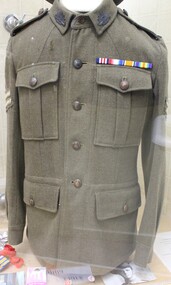
... District resident who received the Military Medal which was awarded for acts of gallantry and devotion to duty under fire during World War 1. Australian Military uniforms WW1 Bonella Military Medal 13th Light Horse 4th Australian Medium Trench Mortar Battery Khaki Australia WW1 uniform for AIF. This uniform has 2 external patch chest pockets and 2 internal pockets with opening flap. It has 5 central buttons and 4 pocket buttons. There is a buttoned down epaulet on each shoulder and unit badges sewn onto each arm. An AIF Rising collar badge is on each peak ...Charles Frederick Clark was 1 of 3 sons of Thomas and Elizabeth Clark of Bonegilla who served in WW1. Charles, Ernest and Thomas were the eldest children of a family of 12 children. At the age of 25, Charles enlisted in 13th Light Horse Brigade 1st Reinforcement on 25 January 1915. He was later transferred to the 2nd Division Artillery Column and the 4th Australian Medium Trench Mortar Battery. Charles served in Egypt, Gallipoli and France. As a result of his actions at the Third Battle of Morlancourt on the Western Front, Charles was awarded the Military Medal. The citation for the medal read:- Awarded: Military Medal 24th June 1918 Recommended by: Brigadier-General O. F. Phillips Commanding 2nd Division Artillery Column Action for which commended: 637 Bombardier Charles Frederick Clark 868 Bombardier (T/Corporal) George Traill McLennan "On the night 10/11th June 1918 during the attack South of MORLANCOURT near ALBERT, these NCOs showed great courage and determination under most trying conditions. They were each in charge of 6” Newton Mortars which had very important tasks. Just prior to the attack their gun positions were very heavily shelled and this continued throughout the barrage fire covering the advance. The work of these NCOs, who could not remain under cover all the time, was extremely dangerous, the enemy batteries having the range exactly. Their great gallantry set a splendid example of coolness to their men." (Signed) C. Rosenthal, Major General Commanding 2nd Australian Division He also received the 1914-15 Star, the British War medal and the Victory Medal.This uniform is significant as it was worn by a Wodonga District resident who received the Military Medal which was awarded for acts of gallantry and devotion to duty under fire during World War 1.Khaki Australia WW1 uniform for AIF. This uniform has 2 external patch chest pockets and 2 internal pockets with opening flap. It has 5 central buttons and 4 pocket buttons. There is a buttoned down epaulet on each shoulder and unit badges sewn onto each arm. An AIF Rising collar badge is on each peak of the collar. A strip of service ribbons is attached at the top of one chest pocket.australian military uniforms, ww1 bonella, military medal, 13th light horse, 4th australian medium trench mortar battery -
 Bacchus Marsh & District Historical Society
Map - Land Sales Plan, Broadlands Estate, Bacchus Marsh, 1916
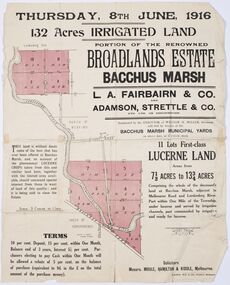
... The Broadlands Estate was just over 2,000 acres at its its peak size and was a significant holding of land in the Bacchus Marsh district. ...This land sales map was produced by real estate agents for an auction of part of a property near Bacchus Marsh known as the Broadlands Estate. 132 acres of irrigated land in 11 separate lots was to be auctioned on the 8th of June 1916. On the 27 May 1916, nine of the 11 eleven lots were withdrawn from sale. The reason stated was due to "road and severance difficulties", according to a notice in the Bacchus Marsh Express newspaper on 27 May, 1916, page.2. When the sale took place on 8th June the two lots were passed in but the local newspaper reported they were expected to be sold privately, see Express, 17 June, 1916, page. 2. The Broadlands Estate was owned by the Miller family whose father Henry Miller, 1809-1888, was a politician and an immensely wealthy financier in Victoria.A typical example of a land sale map of this era. The Broadlands Estate was just over 2,000 acres at its its peak size and was a significant holding of land in the Bacchus Marsh district. Paper printed land sales mapbroadlands estate bacchus marsh, land sales bacchus marsh, farms bacchus marsh, henry miller 1809-1888 -
 Flagstaff Hill Maritime Museum and Village
Book - Fictional stories, Sir Walter Scott, Waverley Novels Peveril of the Peak- 3 Vol 30, 1838
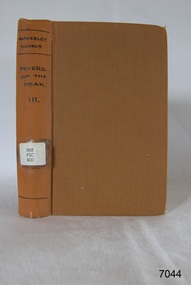
... The story covers political intrigue, family feuds, and conspiracies drawing the characters into events spanning Derbyshire's Peak District, the Isle of Man, and London. The story continues on the Peveril family's royalist loyalties clashing with the Bridgenorths' Puritan resentment, fuelled by past Civil War grievances like the execution of William Christian. ...The subject volume “Waverley Novels Vol 30” published by Fisher Son & Co (1838) is part of a collected edition of Sir Walter Scott's works, containing stories from the "Tales of My Landlord" series. "Tales of My Landlord" forms a key subset of Scott's Waverley Novels, presented as fictional tales gathered by characters like Peter Pattieson from the landlord of the Wallace “Inn at Gandercleugh”. The series spans multiple books across four sub-series, including “The Black Dwarf” (1707 setting), “Old Mortality” (1679–1689), “The Heart of Midlothian” (1736), “The Bride of Lammermoor” (1709–1711), “A Legend of Montrose” (1644–1645), “Count Robert of Paris” (1097), and “Castle Dangerous” (1307). Vol 46 in the 1838 Fisher edition reprints later entries like “Count Robert of Paris” or “Castle Dangerous” from the fourth series, as these stories originally appeared in Scott's Magnum Opus collected volume editions, the first from 1816. With the influential 48-volume “Magnum Opus” edition from 1829–1833 by Robert Cadell, serving as the basis for later collected published sets like Fisher's. Peveril of the Peak is Walter Scott's longest novel, published in 1823 and set during the late 17th century amid the Popish plot hysteria under Charles II. It follows young Cavalier Julian Peveril's forbidden romance with Alice Bridgenorth a Puritan's daughter. The story covers political intrigue, family feuds, and conspiracies drawing the characters into events spanning Derbyshire's Peak District, the Isle of Man, and London. The story continues on the Peveril family's royalist loyalties clashing with the Bridgenorths' Puritan resentment, fuelled by past Civil War grievances like the execution of William Christian. Julian and Alice's love is tested when Julian's parents face Popish Plot accusations with subplots involving a scheming dwarf, the Countess of Derby, and court figures like the Duke of Buckingham. It resolves with royal intervention, exposing intrigues and eventually uniting the lovers.Waverley Novels Peveril of the Peak- 3 Vol 30, Light brown hardcover lettering in black text. Author: Sir Walter Scott Publisher: Fisher Son & Co Date: 1838fictionThe subject volume “Waverley Novels Vol 30” published by Fisher Son & Co (1838) is part of a collected edition of Sir Walter Scott's works, containing stories from the "Tales of My Landlord" series. "Tales of My Landlord" forms a key subset of Scott's Waverley Novels, presented as fictional tales gathered by characters like Peter Pattieson from the landlord of the Wallace “Inn at Gandercleugh”. The series spans multiple books across four sub-series, including “The Black Dwarf” (1707 setting), “Old Mortality” (1679–1689), “The Heart of Midlothian” (1736), “The Bride of Lammermoor” (1709–1711), “A Legend of Montrose” (1644–1645), “Count Robert of Paris” (1097), and “Castle Dangerous” (1307). Vol 46 in the 1838 Fisher edition reprints later entries like “Count Robert of Paris” or “Castle Dangerous” from the fourth series, as these stories originally appeared in Scott's Magnum Opus collected volume editions, the first from 1816. With the influential 48-volume “Magnum Opus” edition from 1829–1833 by Robert Cadell, serving as the basis for later collected published sets like Fisher's. Peveril of the Peak is Walter Scott's longest novel, published in 1823 and set during the late 17th century amid the Popish plot hysteria under Charles II. It follows young Cavalier Julian Peveril's forbidden romance with Alice Bridgenorth a Puritan's daughter. The story covers political intrigue, family feuds, and conspiracies drawing the characters into events spanning Derbyshire's Peak District, the Isle of Man, and London. The story continues on the Peveril family's royalist loyalties clashing with the Bridgenorths' Puritan resentment, fuelled by past Civil War grievances like the execution of William Christian. Julian and Alice's love is tested when Julian's parents face Popish Plot accusations with subplots involving a scheming dwarf, the Countess of Derby, and court figures like the Duke of Buckingham. It resolves with royal intervention, exposing intrigues and eventually uniting the lovers. warrnambool, shipwrecked-coast, flagstaff-hill, flagstaff-hill-maritime-museum, maritime-museum, shipwreck-coast, flagstaff-hill-maritime-village, shipwrecked-artefact, book, waverley novels vol 46 tales of my landlord, sir walter scott, pattison collection, warrnambool library, warrnambool mechanics’ institute, ralph eric pattison, corangamite regional library service, warrnambool city librarian, mechanics’ institute library, victorian library board, warrnambool books and records, warrnambool children’s library -
Emerald Museum & Nobelius Heritage Park
Machine - Label Machine, Roovers Bros. Co, Between 1905 and 1915
... peak prior to World War 1 where it was used from the 1900s until at least the 1940s. The Nursery was renowned for its supply of plants and trees of high quality and reliability; the name plate maker was part of this process by providing imprinted metal labels. The object is of great significance to the history of Nobelius Nurseries. labelling machine Name plate maker Gembrook Nurseries 1900s A. H. Roovers Carl Axel Nobelius Emerald & District ...This machinewas used by Nobelius Nurseries to create metal labels for tree stock. It was imported from the USA between 1905 and 1915.'Gembrook Nursery established by Carl Axel Nobelius from 1886. In the early twentieth century it was of one of Australia's foremost plant nurseries, and was described in 1920 as the largest nursery in the southern hemisphere. It was the originator of an extensive range of exotic plants and fruit trees, supplied other prominent nurseries of the era, and influenced garden and orchard plantings throughout Australia, as well as exporting to the USA, South America, South Africa, New Zealand, Europe and Asia. Through the supply of exotic trees to municipalities in many parts of Australia the Nobelius Nursery had a significant influence on Victoria's landscapes, including public parks, private gardens, orchards, avenues of honor and tree-shaded streets.' -Vic Heritage Database Report.The name plate maker is of historic and social significance. It is associated with the Gembrook Nurseries, the largest nursery in the Southern Hemisphere at its peak prior to World War 1 where it was used from the 1900s until at least the 1940s. The Nursery was renowned for its supply of plants and trees of high quality and reliability; the name plate maker was part of this process by providing imprinted metal labels. The object is of great significance to the history of Nobelius Nurseries.Wooden and cast iron, four legged label maker with alphabetical dial on top side of object. The legs show designs of engraved floral decorative detailing. Front door opening reveals mechanics of the object. The machine includes some of the original pressed metal coils that were imprinted to create labels for individual nursery stock.Front: THIS MACHINE / IS SOLD FOR / USE IN THE / UNITED STATES / ONLY. / PATENTED / NOV 19 1901 / NOV 22 1904 / JAN 31 1905 / PAT. APPL'D FOR / Right side: PATENT APPLID FOR /labelling machine, name plate maker, gembrook nurseries, 1900s, a. h. roovers, carl axel nobelius, emerald & district collection -
 Sunshine and District Historical Society Incorporated
Photograph - Spaldings Employees Ballarat Road Sunshine North 1991 Photographs, Sharon Cavanagh, 9th May 1991
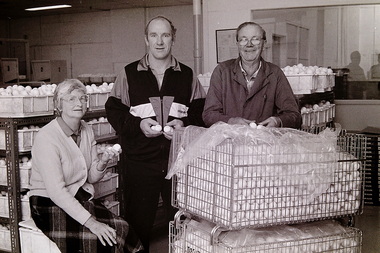
... district. These photographs are of three long time serving employees of the Spaldings Factory located at Ballarat Road North East Corner of McIntyre Road, Sunshine North. The photograph features employees Phyllis Shimmin, Barry Priest (Supervisor, Golf Ball Department) and Tom Tribe (Machine Setter and Operator). When the image was taken, Phyllis had accumulated 43 years of service and Tom an outstanding 53 years of continuous service with the company. As the factory faced difficult times, the three long-serving employees reminisced about its peak...district. These photographs are of three long time serving employees of the Spaldings Factory located at Ballarat Road North East Corner of McIntyre Road, Sunshine North. The photograph features employees Phyllis Shimmin, Barry Priest (Supervisor, Golf Ball Department) and Tom Tribe (Machine Setter and Operator). When the image was taken, Phyllis had accumulated 43 years of service and Tom an outstanding 53 years of continuous service with the company. As the factory faced difficult times, the three long-serving employees reminisced about its peak ...These photograph, taken by The Advocate in 1991, were published as part of the newspaper’s ongoing column profiling local traders and businesses across the district. These photographs are of three long time serving employees of the Spaldings Factory located at Ballarat Road North East Corner of McIntyre Road, Sunshine North. The photograph features employees Phyllis Shimmin, Barry Priest (Supervisor, Golf Ball Department) and Tom Tribe (Machine Setter and Operator). When the image was taken, Phyllis had accumulated 43 years of service and Tom an outstanding 53 years of continuous service with the company. As the factory faced difficult times, the three long-serving employees reminisced about its peak years. During its most successful period, the factory produced a wide range of sporting goods, including tennis and squash equipment, shuttlecock bases, table tennis tables, baseball and softball products, and doggie bell balls for pet shops. It also served major industrial clients, manufacturing rubber components for Ford and International Harvester, along with hoses for Massey Ferguson and Connor Shea. Spalding was one of the last major manufacturing factories to close in Sunshine, following the decline of many of the area's industrial employers. Its closure reflected broader changes in Australian manufacturing, including the globalisation of production to lower-cost countries, trade liberalisation and reduced tariff protection, increasing international competition, advances in technology that required substantial investment in new equipment and processes, rising labour and operating costs, and industry consolidation, whereby large corporations centralised production or relied on specialist suppliers rather than maintaining diverse local manufacturing operations.The Sunshine Advocate’s feature on local traders and businesses was a modest yet well‑liked column that played a meaningful role in strengthening community identity. Through these regular profiles, the newspaper promoted local businesses and helped shape Sunshine’s understanding of its developing commercial district.7392.01 - Spaldings Employees Ballarat Road Sunshine North 1991 Photographs (Advocate 187.3).JPG 7392.02 - Spaldings Employees Ballarat Road Sunshine North 1991 Photographs (Advocate 187.3).JPGspaldings, ballarat road, sunshine north
