
Showing 49 items matching "warrnambool football"
-
 Warrnambool and District Historical Society Inc.
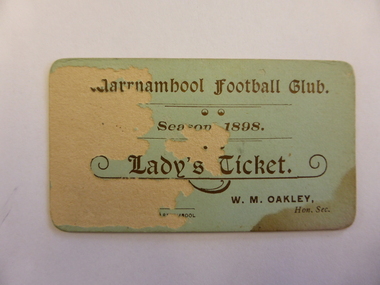
Ticket, Warrnambool Football Club 1898, 1898
... Warrnambool Football Club 1898...Warrnambool Football Club... This is a lady’s ticket issued by the Warrnambool Football Club in 1898. The Warrnambool Football Club, established in 1861, is one of the oldest clubs in Victoria (and the world?). ...‘Warrnambool Football Club, Season 1898, Lady’s Ticket, Warrnambool, W.M.Oakley, Hon. ...This is a lady’s ticket issued by the Warrnambool Football Club in 1898. The Warrnambool Football Club, established in 1861, is one of the oldest clubs in Victoria (and the world?). ...This is a lady’s ticket issued by the Warrnambool Football Club in 1898. The Warrnambool Football Club, established in 1861, is one of the oldest clubs in Victoria (and the world?). It merged with South Warrnambool in 1924, was re-established as a stand-alone club in 1928 and joined the Hampden League in 1933. It still competes in this League. The secretary in 1898, William Oakley, was a well-known footballer known as ‘Wing’ and was also a co-Principal with Richard Lawson of a private boy’s school, Warrnambool College, in the late 1890s. This is a significant item as an example of a football club’s lady’s ticket in 1898 and as a 19th century memento from the Warrnambool Football Club and from William Oakley.This is a small cardboard ticket with a green background and gold lettering. The green colouring on the left side has been scratched and removed.‘Warrnambool Football Club, Season 1898, Lady’s Ticket, Warrnambool, W.M.Oakley, Hon. Sec.’warrnambool football club, lady’s ticket, 1898, hampden league, south warrnambool, william oakley -
 Warrnambool and District Historical Society Inc.
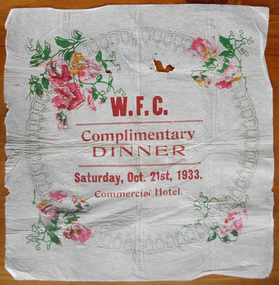
Ephemera - Serviette Warrnambool Football Club dinner 1933, 1933
... Serviette Warrnambool Football Club dinner 1933......warrnambool football club...Warrnambool Football Club was formed in June 1861 making it one of the earliest clubs formed in Australia and many of the earliest players and associates were members also of the Warrnambool Cricket club which was established around 1854. ...Ephemera Serviette Warrnambool Football Club dinner 1933 ...Warrnambool Football Club was formed in June 1861 making it one of the earliest clubs formed in Australia and many of the earliest players and associates were members also of the Warrnambool Cricket club which was established around 1854. Games of various sized teams were played in the early years and it was in 1889 that the Warrnambool and District Football Association was formed. The year marked with the celebration of this dinner, was important in the club’s history as it marked their entry into the wider Hampden football league, where it still plays to the present day. As the venue for this dinner, the Commercial Hotel on the corner of Liebig and Timor Sts, was commonly used in the early days as a club meeting place. The history of the club was recorded in “The Birth of the Blues” by Ron Cole, Harry Keilar, Ron McCorkell and Ian Wright, in 2007.The Warrnambool Football club is one of the longest surviving sporting clubs in the Warrnambool district and as such, would have involved or touched the lives of many of its residents. This serviette marks a dinner which was an important event in the history of the Warrnambool Football Club. White crepe paper with circular bell pattern, which has been embellished in each corner with pink flowers and green leaves. Centre of circle printed in large red lettering.WFC Complimentary Dinner Saturday Oct. 21st 1933 Commercial hotel.warrnambool, warrnambool football club, wfc dinner 1933, commercial hotel 1933, commercial hotel -
 Warrnambool and District Historical Society Inc.
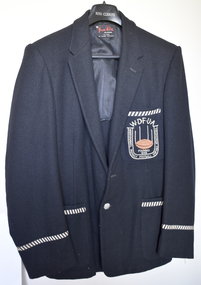
Uniform - Warrnambool District Football Umpires Association Blazer, Ince Bros Melbourne, c.1970
... Warrnambool District Football Umpires Association Blazer......Warrnambool and District Football...This blazer would have been worn by a member of the Warrnambool District Football Umpires Association at formal and social occasions. ...W.D.F.U.A. WARRNAMBOOL DISTRICT FOOTBALL UMPIRES ASSOCIATION FOUNDED 1946...Uniforms Warrnambool and District Football Warrnambool District Football Umpires Association PURE WOOL Ince Bros. ...This blazer would have been worn by a member of the Warrnambool District Football Umpires Association at formal and social occasions. This Association was founded in 1946 and continues today, providing umpires for football matches in the Warrnambool District including the Hampden Football League.This uniform came from a Collectables Shop in Fairy Street, Warrnambool but the original owner is unknown. The blazer is a memento of a Warrnambool sporting group of interest and would be useful for display.This is a black cloth blazer with beige and black bands on the sleeves and pockets. It has one silver coloured button and one missing at the front. Inside the blazer is black lining at the top. The sleeves have a white and black pin striped lining. The pocket has the Association badge embroidered with beige and tan. There is a maker's label inside the front collar and a loop for hanging the blazer on a hook.PURE WOOL Ince Bros. Melbourne Tailors and Blazer Specialists. W.D.F.U.A. WARRNAMBOOL DISTRICT FOOTBALL UMPIRES ASSOCIATION FOUNDED 1946uniforms, warrnambool and district football, warrnambool district football umpires association -
 Warrnambool and District Historical Society Inc.
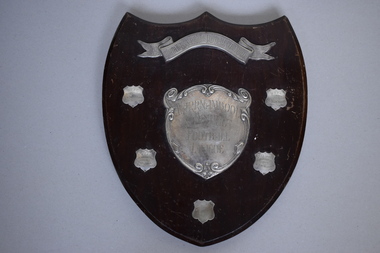
Shield, 1947
... South Warrnambool Football Club... This trophy has been presented to the Warrnambool & District Football League by the South Warrnambool Football Club. ...‘South Warrnambool Football Club Shield’ ‘Warrnambool & District Football League’ ‘R.C.F.C. ...This trophy has been presented to the Warrnambool & District Football League by the South Warrnambool Football Club. ...This trophy has been presented to the Warrnambool & District Football League by the South Warrnambool Football Club. This latter club still plays in the Hampden Football League and dates back to the 1880s and possibly beyond and has always been a traditional rival of the Warrnambool Football Club. West End Football Club dates back to the 1890s and joined with the Allansford Football Club in the 1960s to form the West End Allansford team. In 2001 the name ‘West End’ was dropped from the club’s name. Russells Creek Football Club was established in 1931 and still plays in the Warrnambool & District Football League which dates back to the early 1900sThis football trophy is of interest as it comes from the mid 20th century and concerns two local Warrnambool football clubs still existing today and one club that no longer exists.This is a wooden trophy in the shape of a shield. It has a silver scroll on the top and a silver heart shape in the middle. There is a cord on the back of the shield attached by metal hooks for hanging purposes. There are five small shields with etched writing on four of these. The shield is a little scratched. ‘South Warrnambool Football Club Shield’ ‘Warrnambool & District Football League’ ‘R.C.F.C. Premiers 1947 Tom Zanos (Captain) H. Drewitt (Coach)’ ‘W.E.F.C. Premiers 1948 P. Lake Capt. & Coach G.R.Thomas Pres.’ ‘W.E.F.C. Premiers 1949 W.L. ‘Jack’ McMurrick Capt. & Coach’ ‘West End F.C. Premiers 1950 W.L. McMurrick Capt. & Coach’ south warrnambool football club, warrnambool & district football league -
 Warrnambool and District Historical Society Inc.
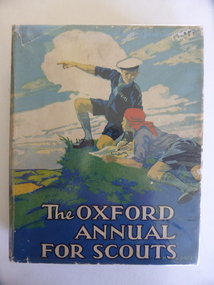
Book, The Oxford Annual for Scouts, 1927
... ...South Warrnambool Football Club...The donor of the prize was South Warrnambool Football Club. This club was established in 1902 and has competed in the Hampden Football League since 1933. ...‘Grade IV First Prize Awarded to Arthur Rogers by the South Warrnambool Football Club December 1928 A.S.James Head Teacher’ ...This book is of interest because of its 1920s connection to the South Warrnambool State School, the South Warrnambool Football Club and a local South Warrnambool resident, Bill Rogers South Warrnambool State School South Warrnambool Football Club Bill Rogers, South Warrnambool ‘Grade IV First Prize Awarded to Arthur Rogers by the South Warrnambool Football Club December 1928 A.S.James Head Teacher’ This is a hard cover book of 196 pages. ...This book was a prize given to Arthur Rogers in 1928. Arthur George (Bill) Rogers was the grandson of Joseph Rogers, a Warrnambool plumber and the son of Arthur and Agnes Rogers of Warrnambool. He worked in the advertising department of the Warrnambool Standard newspaper for nearly 50 years and died in 1995. It is presumed that the school that awarded the prize was South Warrnambool State School No. 1902. This school was established in 1877 with the first Head Teacher, Mrs Eliza Clarke. It was closed in 1994. The donor of the prize was South Warrnambool Football Club. This club was established in 1902 and has competed in the Hampden Football League since 1933. It is a successful club with many of its players going on to play in A.F.L./V.F.L teams. This book is of interest because of its 1920s connection to the South Warrnambool State School, the South Warrnambool Football Club and a local South Warrnambool resident, Bill RogersThis is a hard cover book of 196 pages. The cover is multi-coloured with an image of scouts on top of a hill with their encampment beneath. The lettering is white. The dust cover has the same illustration and is rubbed at the edges and partly torn away at the top left edge. It also shows some silverfish damage. It has a protective plastic cover. The book has one full page colour illustrations and many black and white illustrations and sketches. The book has 20 stories or articles. The inscription is handwritten in black ink.‘Grade IV First Prize Awarded to Arthur Rogers by the South Warrnambool Football Club December 1928 A.S.James Head Teacher’ south warrnambool state school, south warrnambool football club, bill rogers, south warrnambool -
 Warrnambool and District Historical Society Inc.
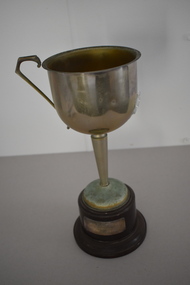
Trophy, W F A L Earles Cup 1937
... Warrnambool Football Association 1930s...In the 1930s it was in the Warrnambool Football Association competition and about the 1960s it amalgamated with Allansford to form the West End Allansford Football Club. ...In the 1930s it was in the Warrnambool Football Association competition and about the 1960s it amalgamated with Allansford to form the West End Allansford Football Club. ...This trophy was won by the West End Football Club in 1937. This football team appears to date back from the late 1890s but it is known that it was competing in the early 1900s in the Thursday afternoon matches in the Warrnambool and District Football Association. In the 1930s it was in the Warrnambool Football Association competition and about the 1960s it amalgamated with Allansford to form the West End Allansford Football Club. The name West End disappeared in 2001 when the name changed to Allansford Football Netball Club. No further information has been found on the J.Earls Cup.Although this trophy is in poor condition it is interesting as a memento of a local club that existed for over 100 years.This is a gold-coloured cup with a slender tapering piece resting on a circular base. The base is on a brown Bakelite stand. The cup has had two side handles but one handle is missing. The stand has a silver-coloured plaque. The cup and plaque are much stained and oxidized. ‘W.F.A. J. Earls Cup Premiers West End 1937’ warrnambool football association 1930s -
 Warrnambool and District Historical Society Inc.
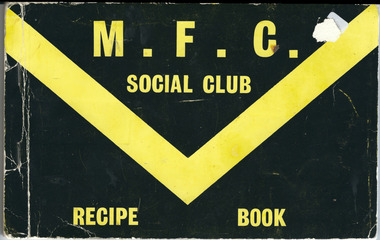
Booklet, Merrivale Football Club Recipe, 1970s
... warrnambool football...This recipe book was produced about the 1970s to raise funds for the Merrivale Football Club, an Australian Football club (the Tigers) from Merrivale, a suburb of Warrnambool. It is in the Warrnambool and District Football League, being one of the four founding clubs in 1946, and winning premierships in 1958, 1979, 1991, 1996 and 2003. ...The recipe book is of some interest as it demonstrates the way sporting clubs raised funds in the 1970s and the recipes themselves show the types of meals and food that were popular at that time. warrnambool football merrivale football club 1970's Front Cover: M.F.C. ...This recipe book was produced about the 1970s to raise funds for the Merrivale Football Club, an Australian Football club (the Tigers) from Merrivale, a suburb of Warrnambool. It is in the Warrnambool and District Football League, being one of the four founding clubs in 1946, and winning premierships in 1958, 1979, 1991, 1996 and 2003. The recipe book is of some interest as it demonstrates the way sporting clubs raised funds in the 1970s and the recipes themselves show the types of meals and food that were popular at that time. This is an in-house publication by the Merrivale Football Club Social Club with recipes (about 60 pages) typed in pink, buff, lemon, green, blue and Old Gold coloured paper. The front cover is black with gold printing and marking. The pages are stapled. Front Cover: M.F.C. Social Club Recipe Bookwarrnambool football, merrivale football club 1970's -
 Warrnambool and District Historical Society Inc.
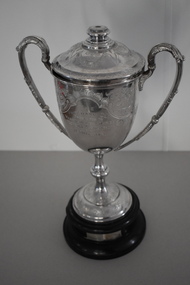
Trophy, Walker & Hall Ltd Silversmiths, Pritchard cup, 1920s
... Football in Warrnambool District... This is a trophy given to a Warrnambool Football Association by Harry Pritchard. ...‘The Pritchard Cup presented to Warrnambool Ward’s (sic) Football Association by H. Pritchard.’ ...This is a trophy given to a Warrnambool Football Association by Harry Pritchard. ...This is a trophy given to a Warrnambool Football Association by Harry Pritchard. He was a Warrnambool businessman who had the Warrnambool Sports Depot store in Kepler Street in the 1920s. The trophy was for the winner of the Warrnambool Wards Football Association. This was a Junior Association promoted by the Warrnambool Football Club and it existed from 1924 to 1930. It was proposed that the four Council Wards, Hopkins, Victoria, Albert and Merri each had a football team but it is not clear if all had teams and how many teams from other areas took part in the competition. The Pritchard Cup records that the Hopkins Ward Football Team won the trophy in 1926 and that Allansford, a team outside of the four wards, won in 1927. The records of the Allansford Football Club go back to the 1890s. This cup is of considerable interest, firstly as an attractive trophy in its own right and secondly as a memento of a football association connected with the Warrnambool Council Wards. Both the Council Wards structure and the Wards football association no longer exist. This is a silver cup with two ornamental handles, a slender stem and a silver base. The cup has a lid with a knob in the middle. The cup, lid and base are all heavily etched and patterned with scrolls, leaves and flowers. There is an inscription on one side of the cup. The cup sits on a circular brown wooden base which has a cloth or paste mixture affixed to the bottom. The wooden section has two silver plaques with inscriptions. There is a small piece of wood missing on the side of the top of the mount. ‘The Pritchard Cup presented to Warrnambool Ward’s (sic) Football Association by H. Pritchard.’ ‘Won by Hopkins Ward Football Club Season 1926’ ‘Won by Allansford Football Club Season 1927’ football in warrnambool district, harry pritchard, warrnambool 1920s, history of warrnambool -
 Warrnambool and District Historical Society Inc.
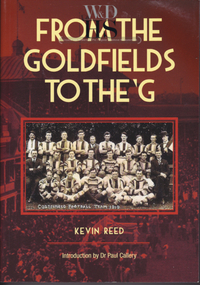
Book, Kevin Reed, From the Goldfields to the G, 2014
... ...warrnambool football 1970's 1980's...It contains information on the footballing career of Dr John Douglas, a former resident of Warrnambool and important chapters on football and cricket in the Warrnambool district in the 1970s, 80s and 90s and the footballing personalities who came from the area over the years. ...It demonstrates the importance of Australian football in country towns and cities warrnambool kevin reed Dr John Douglas warrnambool cricket 1980's warrnambool football 1970's 1980's An account of the development of Australian Rules football in both rural and suburban Victoria. ...An account of the development of Australian Rules football in both rural and suburban Victoria.This is a paper back book with a red and gold cover with a photograph of Costerfield Football Team, 1919 on the cover (335 pages) The book is signed inside by Kevin Reed non-fictionAn account of the development of Australian Rules football in both rural and suburban Victoria.warrnambool, kevin reed, dr john douglas, warrnambool cricket 1980's, warrnambool football 1970's 1980's -
 Warrnambool and District Historical Society Inc.
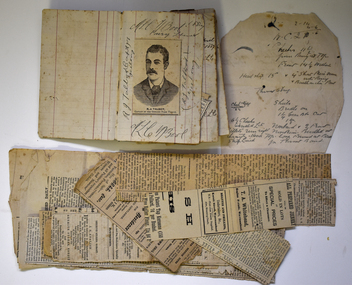
Memorabilia - Newspaper cuttings scrapbook, Martin Carter, Saddler, Warrnambool, late 19th century (1887-1894)
... Martin Carter Warrnambool...Football...Martin Carter was very active in community affairs - President of the Warrnambool Bowling Club, a member of the local Volunteer Militia, Secretary of the Progress Association, a football player and umpire and a local cricketer. ...Warrnambool Town Band Martin Carter Warrnambool Football in the Warrnambool District Sydney Giddings Warrnambool Saddler M.L.Carter Warrnambool June 13th 1887 S.Carter Saddler Warrnambool (stamp) This is a small notebook with a black cover. ...This scrapbook contains newspaper cuttings, mainly about football, and other written material from the late 19th century. It belonged to Martin Carter ((1870-1943), a Warrnambool saddler who worked for many years in the saddlery business established by his father, Samuel. Martin Carter was very active in community affairs - President of the Warrnambool Bowling Club, a member of the local Volunteer Militia, Secretary of the Progress Association, a football player and umpire and a local cricketer. He was the Secretary of the Warrnambool Town (later City) Band for fifty years and a memorial plaque in his honour was erected at the Band headquarters in Warrnambool. He was also a Warrnambool Councillor (1917-1925) and Warrnambool Mayor (1922-24). His interest in football can be seen from the great number of football newspaper cuttings in this notebook.This little notebook is most interesting as it provides us with details on football in the Warrnambool district in the late 19th century and gives us an indication of the popularity of the game at that time. It is a valuable research tool.This is a small notebook with a black cover. The pages contain ruled red lines over which have been pasted newspaper cuttings. Some pages have handwritten material and some pages are blank. There are also several loose cuttings. The notebook has been stapled but the staples have been removed.M.L.Carter Warrnambool June 13th 1887 S.Carter Saddler Warrnambool (stamp)warrnambool town band, martin carter warrnambool, football in the warrnambool district, sydney giddings warrnambool saddler -
 Warrnambool and District Historical Society Inc.
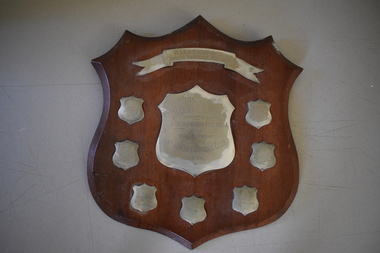
Trophy, Junior Challenge Shield 1936, 1932
... West End Football Club...Warrnambool...Football Club. This club, founded in the late 19th century, played in Western District Leagues until 1946 when it joined the newly-formed Warrnambool District Football League. ...‘Warrnambool Junior Football League’ ‘Junior Challenge Shield presented by J.V. ...West End Football Club Warrnambool J.V.Fairbairn ‘Warrnambool Junior Football League’ ‘Junior Challenge Shield presented by J.V. ...This junior football shield was given by James Fairbairn (1897-1940), a prominent Western District pastoralist, aviator, local politician and Federal Cabinet minister. He was killed in a Canberra air disaster in 1940. The shield shows that several football teams, including West End, Russells Creek and East Warrnambool won the shield in the 1930s. In 1936 the shield was won outright by West End Football Club. This club, founded in the late 19th century, played in Western District Leagues until 1946 when it joined the newly-formed Warrnambool District Football League. In 1971 it merged with the Allansford Football Club to become the West End-Allansford Club and in 2002 the name ceased to exist when the team name was changed back to Allansford Football Club. This trophy is of interest as a football trophy given over 80 years ago and as a memento of the Warrnambool West End Football Club, a team no longer existing. The sport of Australian football has been, and still is, highly prominent in the Warrnambool district with football first played in the town in 1861. This is a wooden shield with nine silver-coloured metal discs affixed to the shield with metal pins. Eight of these discs are shield-shaped. All of the discs have etched inscriptions. The discs are somewhat stained and the wooden shield has traces of paint on it. There is a wire attached to the back of the shield for hanging on a wall. ‘Warrnambool Junior Football League’ ‘Junior Challenge Shield presented by J.V. Fairbairn Esq. M.L.A. 1932’ ‘Won Outright West End Football Club 1936’ west end football club, warrnambool, j.v.fairbairn -
 Flagstaff Hill Maritime Museum and Village
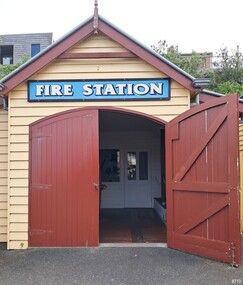
Memorabilia - Fire Brigade Collection, Warrnambool Fire Brigade, 1863-1950s
... ...Warrnambool Fire Brigade Football Club...The items include: EQUIPMENT: 2 fire reels, 3 leather buckets, 1 wooden ladder, 2 old pumps, 2 fire extinguishers, 1 foam nozzle, 2 hydrants, 1 red chest with breathing apparatus, 1 large grey chest, 1 red metal thread gauges box, 2 copper and brass extinguishers, 3 copper and brass branches, 1 canvas bucket, assorted reels of hose, assorted couplings and branches, PHOTOGRAPHS/CERTIFICATES: 3 Discipline Certificates dated 1894, 1893, 1911, Mounted photo of members of the Warrnambool Fire Brigade Football Club, Mounted photos of members of the Warrnambool Fire Brigade in uniform, framed photo of LC Marshall UNIFORMS: 1 Officer’s jacket, 1 blazer, 1 turnout jacket, 1 harness belt, 1 leather helmet, 1 pair of boots, 1 brass helmet, 1 axe belt with axe and plug spanner TROPHIES: 1 clock ...Flagstaff Hill Maritime Museum and Village Great Ocean Road Shipwreck Coast Flagstaff Hill Warrnambool Maritime Village Maritime Museum CFA Fire Brigade Warrnambool Fire Brigade fire reel leather bucket wooden ladder pump fire extinguisher foam nozzle fireman’s hydrant breathing apparatus copper and brass extinguishers copper and brass branches canvas bucket Discipline Certificates Warrnambool Fire Brigade Football Club L C Marshall Officer’s jacket blazer turnout jacket harness belt leather helmet pair of boots brass helmet axe belt with axe and plug spanner clock mantle clock Warrnambool Fire Brigade Collection: a variety of historic objects and equipment used by the firemen of the brigade since 1863. ...The original replica Fire Station at Flagstaff Hill was constructed in 2006 by members of the CVA Warrnambool Fire Brigade. It was rebuilt in 2015, ironically due to damage from fire in the adjacent building, and now includes a locked display. The fire station faithfully replicates the designs of the late 1800s fire stations found across Victoria. Every detail, including the type of nails used, adheres to period-correct specifications. The objects on display are on loan from the CFA. They provide a glimpse into the history and evolution of firefighting in Victoria, preserving the heritage and legacy of the brave men and women who have served their communities. Fire Brigade Collection highlights: . Hose reels and equipment: essential firefighting equipment used during the late 19th and early 20th centuries. . Brass helmets: symbolic headgear worn by firefighters for protection and identification. . Photographs: historical images capturing the evolution of firefighting in the region. . Certificates: awards highlighting the skill and dedication of firefighters. A BRIEF HISTORY OF THE WARRNAMBOOL FIRE BRIGADE - [Ref: Quarrell, A, 2013, The Warrnambool Fire Brigade: 1863-2013, Amazon Printing, Warrnambool]: “Since the township of Warrnambool was established in the 1840s, there were several attempts at forming a Fire Brigade. However, many issues hindered progress. Firstly, minimal fires were recorded. Secondly, the town had no money to purchase expensive equipment, including a fire engine, and thirdly and most importantly, there was no infrastructure for accessible running water from pipes, as we know today. But after the expansion and growth of the township, it was time for action. The Warrnambool Fire Brigade was formed in 1863. The Brigade has served Warrnambool on a daily basis ever since. The volunteers of the Brigade were required to fill their water carts each evening from a spring on Cannon Hill and be on standby to deliver water to fire scenes. In 1889, the Warrnambool Council built a new Fire Station at 25 Liebig Street. Today, the Civic Centre is located on this site.” The objects on loan from the Warrnambool Fire Brigade are significant to local history since its establishment in 1863. They tell the story of the Brigade’s history, which is part of Warrnambool and the district’s history.Warrnambool Fire Brigade Collection: a variety of historic objects and equipment used by the firemen of the brigade since 1863. The items are kindly on loan from the Warrnambool Fire Brigade in a building originally erected in the Village by the Fire Brigade to house their historic collection. The items include: EQUIPMENT: 2 fire reels, 3 leather buckets, 1 wooden ladder, 2 old pumps, 2 fire extinguishers, 1 foam nozzle, 2 hydrants, 1 red chest with breathing apparatus, 1 large grey chest, 1 red metal thread gauges box, 2 copper and brass extinguishers, 3 copper and brass branches, 1 canvas bucket, assorted reels of hose, assorted couplings and branches, PHOTOGRAPHS/CERTIFICATES: 3 Discipline Certificates dated 1894, 1893, 1911, Mounted photo of members of the Warrnambool Fire Brigade Football Club, Mounted photos of members of the Warrnambool Fire Brigade in uniform, framed photo of LC Marshall UNIFORMS: 1 Officer’s jacket, 1 blazer, 1 turnout jacket, 1 harness belt, 1 leather helmet, 1 pair of boots, 1 brass helmet, 1 axe belt with axe and plug spanner TROPHIES: 1 clock flagstaff hill maritime museum and village, great ocean road, shipwreck coast, flagstaff hill, warrnambool, maritime village, maritime museum, cfa, fire brigade, warrnambool fire brigade, fire reel, leather bucket, wooden ladder, pump, fire extinguisher, foam nozzle, fireman’s hydrant, breathing apparatus, copper and brass extinguishers, copper and brass branches, canvas bucket, discipline certificates, warrnambool fire brigade football club, l c marshall, officer’s jacket, blazer, turnout jacket, harness belt, leather helmet, pair of boots, brass helmet, axe belt with axe and plug spanner, clock, mantle clock -
 Warrnambool and District Historical Society Inc.
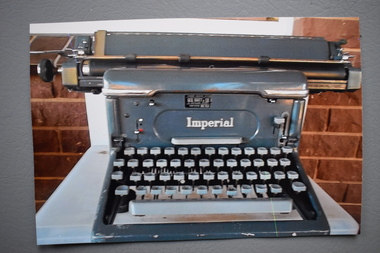
Typewriter & ribbon, Imperial, Mid 20th century
... He was also a life member of the Hampden Football League as a long-term Secretary and Treasurer and a secretary of the Warrnambool Football Club....He was also a life member of the Hampden Football League as a long-term Secretary and Treasurer and a secretary of the Warrnambool Football Club. This typewriter is of interest as one belonging to Gordon Toleman, a Warrnambool 20th century resident and a person well-known for his involvement in community activities. ...This typewriter belonged to Gordon William Toleman (1910-1975). The first known Toleman born in the Western District was born at Mortlake in 1845 and Gordon Toleman was also born in Mortlake. He lived with his family in Warrnambool for many years. He was an accountant the Nestles Factory at Dennington for over 25 years. He was actively involved in community affairs, including the Warrnambool Urban Fire Brigade (life member), the Florado Festival, the Warrnambool Olympic Pool committee and the Merrivale and Terang Football Clubs (player and captain). He was also a life member of the Hampden Football League as a long-term Secretary and Treasurer and a secretary of the Warrnambool Football Club.This typewriter is of interest as one belonging to Gordon Toleman, a Warrnambool 20th century resident and a person well-known for his involvement in community activities..1 This is a metal typewriter with black and grey keys and a red and black typewriting ribbon. It has three gauges or scales. .2 These are two typewriter ribbons in red and black with circular metal covers. ‘Imperial’ ‘Geo Wraitt & Co 15 McKillop Street Repairs MU 7051’ gordon toleman, history of warrnambool -
 Warrnambool and District Historical Society Inc.
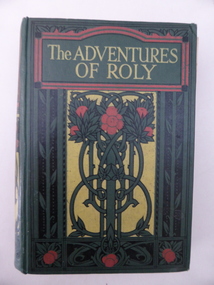
Book, The Adventures of Roly, Early 1930s
... He went from the primary school to the Warrnambool Technical School and was well-known for his sporting prowess, especially as a footballer. ...He went from the primary school to the Warrnambool Technical School and was well-known for his sporting prowess, especially as a footballer. ...This book was given by the Warrnambool State School as a school prize to Ruddy Holland in 1933. He went from the primary school to the Warrnambool Technical School and was well-known for his sporting prowess, especially as a footballer. The Warrnambool State School in Jamieson Street, Warrnambool was opened in 1876, replacing the four Common Schools in the town. This book is of interest as a memento of the Warrnambool State School in the 1930s and of Ruddy Holland, a well-known sportsperson in Warrnambool in the mid 20th century. This is a hard cover book of 206 pages. The cover is dark green with yellow, pink, black and green floral designs on the front cover and spine. The lettering is yellow. The book has several full-page black and white illustrations, with the one at the front detached from the binding. The cover is partly detached from the binding and has been mended with adhesive tape. The book plate on the first page is printed with an ornamental red, blue and gold border. The book plate has been filled in with hand-printing in black ink. ‘Warrnambool 1743, presented to Ruddy Holland, Leadership in Sport, Head Teacher’s Prize, Dec. 1933’. ruddy holland, warrnambool state school -
 Warrnambool and District Historical Society Inc.
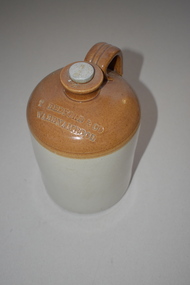
Domestic Object - Container, demijohn, Circa 1900
... Thomas Redford was a noted sportsman in Warrnambool (cricket and football) and was a Town Councillor from 1884 to 1890. ...Thomas Redford was a noted sportsman in Warrnambool (cricket and football) and was a Town Councillor from 1884 to 1890. ...This demijohn came from the produce store of T. Redford and Co. Thomas Redford came to Warrnambool in 1864 and worked in the produce store at the corner of Fairy and Timor Streets. This had been established by Redford’s uncle, Frederick Stevens in 1857. Thomas Redford became the proprietor of this produce store in 1879 with the trading name of T. Redford & Co. Thomas Redford was a noted sportsman in Warrnambool (cricket and football) and was a Town Councillor from 1884 to 1890. His son, a Major in World War One, was killed at the battle of the Nek in 1915. Thomas Redford senior died in 1907 but the firm of T. Redford & Co continued on until the early 1920s. This demijohn is of significance as a memento of an important produce business in Warrnambool – the firm of T. Redford & Co was in existence for over 40 years. This is a stone demijohn with a cream-coloured base and body and a brown top and brown handle. The circular opening has a metal top. The maker’s name is etched into the top section. ‘T. Redford & Co Warrnambool’t. redford & co, warrnambool, demijohn, carboy, brewing -
 Warrnambool and District Historical Society Inc.
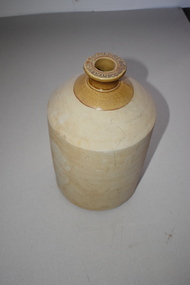
Demijohn, T. Redford and Co. (seller of contents), Early 20th century
... Thomas Redford was a noted sportsman in Warrnambool (cricket and football) and a Town Councillor from 1884 to 1890. ...Thomas Redford was a noted sportsman in Warrnambool (cricket and football) and a Town Councillor from 1884 to 1890. ...Thomas Redford came to Warrnambool in 1864 and worked in the produce store of his uncle, Frederick Stevens, a business that had been established at the corner of Fairy and Timor Streets in 1857. In 1879 Thomas Redford became the proprietor of this business under the trading name of T. Redford and Co. Thomas Redford was a noted sportsman in Warrnambool (cricket and football) and a Town Councillor from 1884 to 1890. One of his sons, Thomas, was a Major in World War One and was killed in 1915 in the Battle of the Nek. The business of T. Redford and Co was continued after Redford’s death in 1907 by family members and ceased to trade in the early 1920s. This demijohn is of interest as it came from the business of T. Redford & Co, a business operating in Warrnambool for over 40 years. This is a stoneware demijohn with a beige-coloured base and body and a brown neck and opening. The circular opening is chipped on the edges. The name of the seller of the contents is on the opening section.‘T. Redford & Co. Warrnambool’redford family, warrnambool, t. redford & co. warrnambool -
 Warrnambool and District Historical Society Inc.
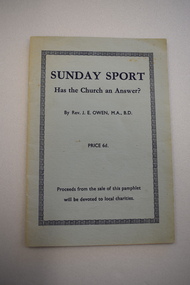
Booklet, Collett & Bain, Printers, Sunday Sport – Has the Church an Answer?, 1960s
... (Eric) Owen in response to the campaign regarding the playing of Sunday sport in Warrnambool in the 1960s. The specific point of contention was the playing of football on Warrnambool City Council-managed grounds. ...(Eric) Owen in response to the campaign regarding the playing of Sunday sport in Warrnambool in the 1960s. The specific point of contention was the playing of football on Warrnambool City Council-managed grounds. ...This booklet was written by the Rev. J. E. (Eric) Owen in response to the campaign regarding the playing of Sunday sport in Warrnambool in the 1960s. The specific point of contention was the playing of football on Warrnambool City Council-managed grounds. The article written by the Rev. Owen concluded that there was nothing inherently wrong with the playing of Sunday sport. The Rev. Eric Owen served as the Presbyterian Minister at St. John’s Church in Warrnambool from December 1960 to 1965, dying in office in the May of 1965. Today Sunday sport, both organized and recreational, is an acceptable and common occurrence. This booklet is of interest as one written by a local Warrnambool person in the 1960s and as a memento of the time when the playing of Sunday sport was a contentious issue. This is a booklet of four pages. It has a pale blue cover with dark blue printing and a decorative edging around the printing. The pages are loose within the cover. rev eric owen, warrnambool presbyterian church, sunday sport -
 Flagstaff Hill Maritime Museum and Village
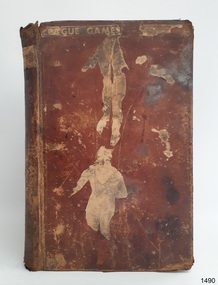
Book - Ledger Book, Warrnambool Harbour Board, Ships' Report Inward, ca. 1877 plus scrapbook entries to ca. 1953
... Warrnambool Harbour...Harbour Master...AFL...VFL...Australian Football...It is a record of vessels that visited the Port of Warrnambool during that time and was filled in by the Harbour Master on behalf of the Warrnambool Harbour Board. The book has also been used as football scrapbook for both the Australian and Victorian Leagues, with articles and photographs from the early 20th century events and photos of players in 1953. ...Warrnambool. First entry 1877. Last entry 1917. The book has also been used for a football scrapbook and contains newspaper cuttings of early 20th century AFL (Australian Football League) and VFL (Victorian Football League) events and photographs. ...It is a record of vessels that visited the Port of Warrnambool during that time and was filled in by the Harbour Master on behalf of the Warrnambool Harbour Board. The book has also been used as football scrapbook for both the Australian and Victorian Leagues, with articles and photographs from the early 20th century events and photos of players in 1953. ...The Ship's Report Inward contains entries from 1877 to 1917. It is a record of vessels that visited the Port of Warrnambool during that time and was filled in by the Harbour Master on behalf of the Warrnambool Harbour Board. The book has also been used as football scrapbook for both the Australian and Victorian Leagues, with articles and photographs from the early 20th century events and photos of players in 1953. A child has also used the book for drawing and writing.It appears that this historic ledger was once regarded as insignificant and used for other purposes such as a scrapbook and spare paper for drawing. However, the ledger is now considered to be of important locall significant for its accurate reports of all vessels inward bound to the Port of Warrnambool, giving a summary of activities during the forty year period from 1877 to 1917. It is also a reference to early Australian and Victorian football media.Ledger of the Warrnambool Harbour Board, containing the handwritten Ships Report Inwards for the Port of Warrnambool. First entry 1877. Last entry 1917. The book has also been used for a football scrapbook and contains newspaper cuttings of early 20th century AFL (Australian Football League) and VFL (Victorian Football League) events and photographs. There are several lose clippings between the pages throughout the book. The cover's spine has a gold embossed title and a pasted title, and the pasted front cover has figures relate to the scrapbook. There are also child's writing and drawings in pencil on some pages. A white label inside the back cover has a blue pen inscription. Embossed title "SHIPS' / REPORT / INWARDS" Pasted title "LEAGUE / GAMES" Label inside back cover: "R 759"flagstaff hill, warrnambool, shipwrecked-coast, flagstaff-hill, flagstaff-hill-maritime-museum, maritime-museum, shipwreck-coast, flagstaff-hill-maritime-village, book, warrnambool harbour board, ships' report inward, port of warrnambool, warrnambool harbour, harbour master, afl, vfl, australian football league, victorian football league, early 20th century, newspaper cuttings, maritime record, maritime history, 1877-1917, 1953 -
 Flagstaff Hill Maritime Museum and Village
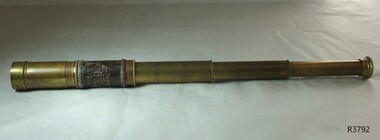
Instrument - Three draw Telescope, 20th century
... football club successfully won a court case giving them the sole rights to the trademark in 2012. The item is also an example of the shipwreck artefacts gathered along the southwest coast of Victoria. It is also a sample of scientific instruments used up to the mid 20th century. Flagstaff Hill Flagstaff Hill Maritime Museum and Village Warrnambool ...This telescope was amongst various items collected from a sea dive in Port Phillip Bay. The diver was the caretaker of the Port Lonsdale Lighthouse, who dived on various wrecks in the bay during the 1960's. After the caretaker's death, his son sold off many of the shipwreck artefacts. The telescope was purchased from the caretaker's son in the 1990's by a previous owner of the Marine Shop, Queenscliff, Victoria. Many companies were making scientific instruments in Liverpool. Between 1730 up too today, they manufactured spectroscopes, telescopes, microscopes, barometers, photometers, cameras, ophthalmoscopes, and electrical equipment such as electric lamps. Liverpool was a major centre for the production of scientific items rivaling Glasgow and London from 1850 to 1920. This telescope appears to be of quality manufacture but the origins can only be surmised at based on the gold embossing to the leather surrounding the main brass tube as being associated with Liverpool England. There is no maker or owners mark, so again there is no sure way to determine the year of manufacture or maker. There were many opticians and scientific instrument makers working in and around Liverpool from 1730 through too today. Also the possibility the telescope could have been made outside Liverpool overseas should not be overlooked and may have been made as a souvenir item from Liverpool from the mid to late 20th century. The size and type of telescope is a traditional type that was used for many sporting activities in the mid to late 19th century for deer stalking, bird watching, or used generally. I believe the item dates from sometime around the early to late part of the 20th century as the use of the liver bird mark became popular in 1911. It began appearing on many manufactured items of the period up too today, denoting that these items were made by companies operating in or around Liverpool England. If the item had been made by a notable firm it would have been engraved with the makers name city of origin, or owner as was the accepted practice for these items. The writer has been unable to determine if any specific company had had exclusive use of the liver bird logo as it was widely used and was not copyrighted until the Liverpool football club successfully won a court case giving them the sole rights to the trademark in 2012.The item is also an example of the shipwreck artefacts gathered along the southwest coast of Victoria. It is also a sample of scientific instruments used up to the mid 20th century.Victorian style gentleman's three draw brass telescope with machine milling surrounding the end of each tube and around the objective end. The three tube draw has no split and all three cartridges are held within the main brass tube wrapped in leather with rope bindings at both ends 5 cm in length and beginning 7 cm from the objective end. The last 2.8 cm makes up the remainder of the brass tube which has a sliding brass sunshade. The eyepiece is flat and has a protective slide over the lens aperture. Two relay lenses are missing on the ends of the second and third tube. Gold embossed into the leather an inscription “Trade the Liver Mark” also embossed in gold a depiction of the mythical liver bird, associated with the city seal of Liverpool England. flagstaff hill, flagstaff hill maritime museum and village, warrnambool, maritime museum, maritime village, great ocean road, shipwreck coast, shipwreck artefact, port phillip bay, port lonsdale lighthouse, wreck, 1960’s diver, queenscliff marine shop, liver bird, scientific instrument, telescope, three drawer telescope, liverpool, liver bird trade mark, trade mark -
 Flagstaff Hill Maritime Museum and Village
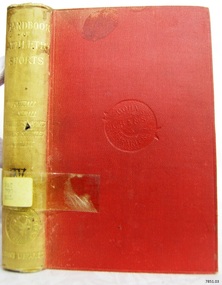
Book, Handbook of Athletic Sports Vol 4
... The Warrnambool Mechanics' Institute’s publication collection is of both local and state significance. warrnambool shipwrecked-coast flagstaff-hill flagstaff-hill-maritime-museum maritime-museum shipwreck-coast flagstaff-hill-maritime-village shipwrecked-artefact book pattison collection warrnambool library warrnambool mechanics’ institute ralph eric pattison corangamite regional library service warrnambool city librarian mechanics’ institute library victorian library board warrnambool books and records warrnambool children’s library great ocean road Handbook of Athletic Sports Vol 4 Ernest Bell Label on spine cover with typed text PAT 790 BEL Pastedown front endpaper has sticker from Warrnambool Mechanics Institute and Free Library covered by a sticker from Corangamite Regional Library Service Front loose endpaper has a stamp from Corangamite Regional Library Service Handbook of Athletic Sports Vol 4 Rugby Football - Association Footall - Baseball - Rounders - Quoits - Bowls - Skittles - Curling. ...This item is from the ‘Pattison Collection’, a collection of books and records that was originally owned by the Warrnambool Mechanics’ Institute, which was founded in Warrnambool in 1853. By 1886 the Warrnambool Mechanics’ Institute (WMI) had grown to have a Library, Museum and Fine Arts Gallery, with a collection of “… choice productions of art, and valuable specimens in almost every branch and many wonderful national curiosities are now to be seen there, including historic relics of the town and district.” It later included a School of Design. Although it was very well patronised, the lack of financial support led the WMI in 1911 to ask the City Council to take it over. In 1935 Ralph Pattison was appointed as City Librarian to establish and organise the Warrnambool Library as it was then called. When the WMI building was pulled down in 1963 a new civic building was erected on the site and the new Warrnambool Library, on behalf of the City Council, took over all the holdings of the WMI. At this time some of the items were separated and identified as the ‘Pattison Collection’, named after Ralph Pattison. Eventually the components of the WMI were distributed from the Warrnambool Library to various places, including the Art Gallery, Historical Society and Flagstaff Hill. Later some were even distributed to other regional branches of Corangamite Regional Library and passed to and fro. It is difficult now to trace just where all of the items have ended up. The books at Flagstaff Hill Maritime Village generally display stamps and markings from Pattison as well as a variety of other institutions including the Mechanics’ Institute itself. RALPH ERIC PATTISON Ralph Eric Pattison was born in Rockhampton, Queensland, in 1891. He married Maude Swan from Warrnambool in 1920 and they set up home in Warrnambool. In 1935 Pattison accepted a position as City Librarian for the Warrnambool City Council. His huge challenge was to make a functional library within two rooms of the Mechanics’ Institute. He tirelessly cleaned, cleared and sorted a disarrayed collection of old books, jars of preserved specimens and other items reserved for exhibition in the city’s museum. He developed and updated the library with a wide variety of books for all tastes, including reference books for students; a difficult task to fulfil during the years following the Depression. He converted all of the lower area of the building into a library, reference room and reading room for members and the public. The books were sorted and stored using a cataloguing and card index system that he had developed himself. He also prepared the upper floor of the building and established the Art Gallery and later the Museum, a place to exhibit the many old relics that had been stored for years for this purpose. One of the treasures he found was a beautiful ancient clock, which he repaired, restored and enjoyed using in his office during the years of his service there. Ralph Pattison was described as “a meticulous gentleman whose punctuality, floorless courtesy and distinctive neat dress were hallmarks of his character, and ‘his’ clock controlled his daily routine, and his opening and closing of the library’s large heavy doors to the minute.” Pattison took leave during 1942 to 1945 to serve in the Royal Australian Navy, Volunteer Reserve as Lieutenant. A few years later he converted one of the Museum’s rooms into a Children’s Library, stocking it with suitable books for the younger generation. This was an instant success. In the 1950’s he had the honour of being appointed to the Victorian Library Board and received more inspiration from the monthly conferences in Melbourne. He was sadly retired in 1959 after over 23 years of service, due to the fact that he had gone over the working age of council officers. However he continued to take a very keen interest in the continual development of the Library until his death in 1969. The Pattison Collection, along with other items at Flagstaff Hill Maritime Village, was originally part of the Warrnambool Mechanics' Institute’s collection. The Warrnambool Mechanics’ Institute Collection is primarily significant in its totality, rather than for the individual objects it contains. Its contents are highly representative of the development of Mechanics' Institute libraries across Australia, particularly Victoria. A diversity of publications and themes has been amassed, and these provide clues to our understanding of the nature of and changes in the reading habits of Victorians from the 1850s to the middle of the 20th century. The collection also highlights the Warrnambool community’s commitment to the Mechanics’ Institute, reading, literacy and learning in the regions, and proves that access to knowledge was not impeded by distance. These items help to provide a more complete picture of our community’s ideals and aspirations. The Warrnambool Mechanics Institute book collection has historical and social significance for its strong association with the Mechanics Institute movement and the important role it played in the intellectual, cultural and social development of people throughout the latter part of the nineteenth century and the early twentieth century. The collection of books is a rare example of an early lending library and its significance is enhanced by the survival of an original collection of many volumes. The Warrnambool Mechanics' Institute’s publication collection is of both local and state significance. Handbook of Athletic Sports Vol 4 Rugby Football - Association Footall - Baseball - Rounders - Quoits - Bowls - Skittles - Curling. Edited by Ernest Bell Publisher: George Bell & Sons Date: 1892Label on spine cover with typed text PAT 790 BEL Pastedown front endpaper has sticker from Warrnambool Mechanics Institute and Free Library covered by a sticker from Corangamite Regional Library Service Front loose endpaper has a stamp from Corangamite Regional Library Service warrnambool, shipwrecked-coast, flagstaff-hill, flagstaff-hill-maritime-museum, maritime-museum, shipwreck-coast, flagstaff-hill-maritime-village, shipwrecked-artefact, book, pattison collection, warrnambool library, warrnambool mechanics’ institute, ralph eric pattison, corangamite regional library service, warrnambool city librarian, mechanics’ institute library, victorian library board, warrnambool books and records, warrnambool children’s library, great ocean road, handbook of athletic sports vol 4, ernest bell -
 Flagstaff Hill Maritime Museum and Village
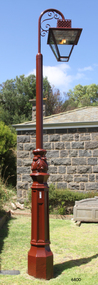
Functional object - Lamp Light, late 19th - early-20th century
... In 1879 a football match was played at the MCG under electric lighting and gradually electric arc lights were installed inside and outside buildings in the city. Lamp lights such as the one in Flagstaff Hill’s collection were no longer needed. (References: John Lindsay re Lamp Light history 2019-01-29, Former Warrnambool...In 1879 a football match was played at the MCG under electric lighting and gradually electric arc lights were installed inside and outside buildings in the city. Lamp lights such as the one in Flagstaff Hill’s collection were no longer needed. (References: John Lindsay re Lamp Light history 2019-01-29, Former Warrnambool ...This gas lamp light and stand came from the original manufacturer in Melbourne. Gas street lights such as this one were used in Melbourne from the mid-19th century. The lights enabled safer after-dark travel for pedestrians and vehicles and were a deterrent to crime. A lamp lighter was employed to keep the lamps lit, sometimes with little success due to weather conditions and the pranks of youths. WARRNAMBOOL Gasworks In Warrnambool prior to 1874 there were about twenty rare, individually lit street lights in Warrnambool, each with its own supply of kerosene. These lamps were in the central business area of Timor, Koroit and Liebig Streets. The Warrnambool Gas Company Ltd. was registered as an incorporated company in 1873. It was a private, locally owned business. It was located at 209-215 Merri Street, Warrnambool, on the land, which is just west of the later-built railway station. The first managers of the Gas Company lived in a substantial stone house on site, but later the managers lived in a residence in Henna Street between Merri and Timor Streets. The original home, which still stands, became a residence for the Railway Station Master from about 1890. In August 1874 the construction of the gasworks was complete and at the end of that month gas was supplied to all of the existing lamps in Warrnambool for the first time. The Warrnambool Gas Company wound up in 1880-1881 and was purchased by the Warrnambool Borough Council with money raised by a loan – the Borough’s first ‘loan transaction’. The Council established a piped network to supply gas to other street connections. The gasworks were privatised and upgraded in 1952. In 1972 the town supply was converted to liquid petroleum gas and by the early 1980s the gasworks were closed down. In 1986 Warrnambool was supplied with natural gas from a site near Port Campbell. The Warrnambool gasworks supplied all street and shop lighting and most domestic lighting until 1923 when electricity was available for lighting. Bromfield Street in Warrnambool was named after the director of the gasworks, James Astley Bromfield (1823-1903). He arrived in Warrnambool from Worcestershire, England, in 1852 and was very active in the local council and community. Cockman Street was named after the first secretary of the gasworks in 1874, Walter Cockman (c.1821-1892). He was a Mayor and businessman. The second Manager, Luther Rodgers, worked for the gas company for about twenty years and both Rodger Place and Rodgers Road in Warrnambool have been named after him. LAMP LIGHTS IN MELBOURNE In the 1820s Melbourne's innkeepers were legally required to have a lamp light outside their premises from sunset to sunrise. This was the first instance of street lamps being used in Melbourne. In 1847 the first oil lamp was used in the city. In 1849 a gas lamp was installed on the Swanston Street Bridge and much of the city had oil lamps installed by then. In August 1857 the installation of street gas lamps began in Melbourne. They were welcomed for the much brighter illumination they gave. By 1860 there were 414 lamp pillars. The phrase was quoted often - "A light was as good as a policeman". The first gas burners used for street lighting were called 'fishtail' gas burners. These were replaced in the early 1900s by gas mantles. The City of Melbourne Gas Coke Company was formed in 1850 but due to the Gold Rush the manufacture and distribution of the gas supply was delayed until January 1856. By the 1890s the gas supplying the lights was supplied by three companies in Melbourne. In 1879 a football match was played at the MCG under electric lighting and gradually electric arc lights were installed inside and outside buildings in the city. Lamp lights such as the one in Flagstaff Hill’s collection were no longer needed. (References: John Lindsay re Lamp Light history 2019-01-29, Former Warrnambool Gas Company Limited, Victorian Heritage Database Report, Heritage Number 149746 https://vhd.heritagecouncil.vic.gov.au/places/149746/download-report ) The lamp light is representative of the lamps used in Melbourne from the mid-nineteenth century to light the streets at night and make Melbourne a safer city. The lamp is also representative of the gas street lighting in Warrnambool from the mid-1870s-1920s.Lamp light or gas light. Street light, one of the last gas street lights removed from Melbourne. (Reconditioned by Friends of Flagstaff Hill, 2013)flagstaff hill, warrnambool, shipwrecked coast, flagstaff hill maritime museum, maritime museum, shipwreck coast, flagstaff hill maritime village, great ocean road, lamp light, gas light, gas lamp, street lamp, street light, gas street light, melbourne street lighting, warrnambool street lighting, melbourne gas street light, warrnambool gas company, warrnambool gasworks, james bromfield, walter cockman, luther rodgers, city of melbourne gas coke company -
 Warrnambool and District Historical Society Inc.
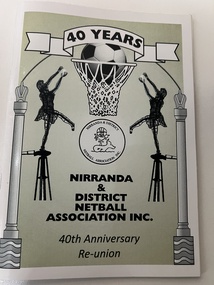
Booklet, Nirranda & District Netball Ass 1840-1970, 2011
... Nirranda is a small settlement 28 kilometres south east of Warrnambool and its history and activities are of interest to the surrounding districts. Netball is the most popular sport for women in the area and the clubs are mostly allied with the local football teams. ...This is a booklet giving information on the Nirranda & District Netball Association Inc. It is a 40th anniversary publication. This association was formed in 1971 with Nirranda, Nirranda South, AllansForest, Curdievale and Commingle the competing teams. In 1991 the competing teams were AllansForest, Nullawarre North, Nirranda and Nirranda South and these clubs continued until 2010 when a new format saw individual teams playing under the administration of the Association. The Association continues today.This book is of interest as a record of the Nirranda & District Netball Association. Nirranda is a small settlement 28 kilometres south east of Warrnambool and its history and activities are of interest to the surrounding districts. Netball is the most popular sport for women in the area and the clubs are mostly allied with the local football teams. This is a soft cover booklet of 52 pages. The cover has a white background with a stylized sketch of two netballers (wire sculptures) standing on a windmill frame and throwing at a netball ring with decorative columns on the side. The sketch is in black, green and grey tonings. The booklet contains a Foreword, Personal Profiles, Extracts from Association Minutes and records of competition winners. The pages are stapled.Front Cover: ‘40 Years Nirranda & District Netball Association Inc, 40th Anniversary Re-union’. nirranda & district netball association, history of nirranda, warrnambool history -
 Warrnambool and District Historical Society Inc.
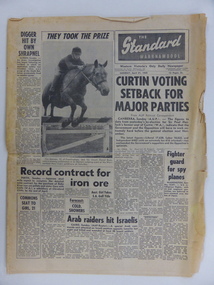
Document Newspaper, The Standard 1969, Monday 21st April 1969
... This paper records local, national and International news with events such as elections news, sports news, and 807 entries for the Warrnambool May Races.Other local articles relate to curriculum at Warrnambool High School,Port Fairy Sea Scouts as well as football results for many local teams of all levels. ...This paper records local, national and International news with events such as elections news, sports news, and 807 entries for the Warrnambool May Races.Other local articles relate to curriculum at Warrnambool High School,Port Fairy Sea Scouts as well as football results for many local teams of all levels. ...This paper records local, national and International news with events such as elections news, sports news, and 807 entries for the Warrnambool May Races.Other local articles relate to curriculum at Warrnambool High School,Port Fairy Sea Scouts as well as football results for many local teams of all levels. There are also photographs of Junior tennis A grade champions. Likewise there are many advertisements for local businesses such as Swintons Rock A bye Cradle shop and Stephens Stores. The film The graduate was playing at the Capitol Theatre and still drawing large crowds The Warrnambool Standard was established in 1872 and had remained locally owned until taken over by the Melbourne Age in 1980. Both were subsequently taken over by Fairfax media in 1983As the only daily local newspaper in the Western District,The Warrnambool Standard contains much that is of interest socially and historically. Black text with photograph of young boy on horseback ,jumping fence. back page has articles about sport with photograph of three footballers contesting for the ball. 12 PagesThe Warrnambool Standard Monday April 21 1969.warrnambool, warrnambool standard, standard 1969, -
 Warrnambool and District Historical Society Inc.
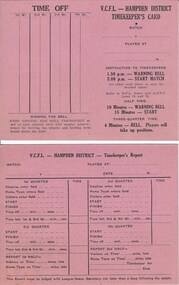
Document, VCFL Hampden District, Mid 20th century
... football game. A common but essential part of the running of sports . warrnambool, hampden league hampden district timekeepers vcfl V C F L Hampden District Both cards are identical and are bright pink with black text in table form on front and back. ...These cards are to be filled out by the timekeeper at football matches in the hampden district which covers the area from Colac to Port Fairy in Western Victoria. The form has space to record the various aspects of time matters for each football game. A common but essential part of the running of sports .Both cards are identical and are bright pink with black text in table form on front and back. V C F L Hampden Districtwarrnambool,, hampden league, hampden district, timekeepers vcfl -
 Warrnambool and District Historical Society Inc.
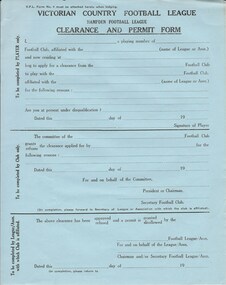
Document, Hampden Football League Clearance Form, 1950s
... Hampden Football-Netball League...History of Warrnambool...Hampden Football-Netball League History of Warrnambool Western District Sport This is a blue sheet of paper –the form used for football players being cleared to other clubs in the Hampden Football League (4 copies). ...This form was used by football players wishing to transfer to other clubs. It was used in the 1950s by the Hampden Football League. This League, now known as the Hampden Football-Netball League, is in south western Victoria and was founded in 1930. This form is of minor interest as an example of the forms used by footballers wishing to transfer to other clubs in the 1950s. This is a blue sheet of paper –the form used for football players being cleared to other clubs in the Hampden Football League (4 copies). The form is blue with black print. There are spaces for the applicant for transfer, the committee representative of the team from which the applicant desires a clearance and the Hampden Football League representative to insert the relevant information. hampden football-netball league, history of warrnambool, western district sport -
 Warrnambool and District Historical Society Inc.
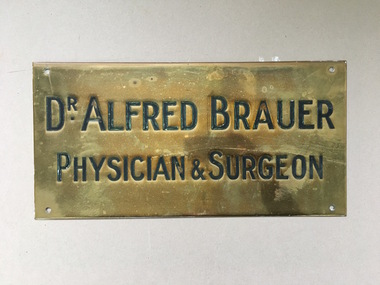
Brass Plate, Dr Alfred Brauer, Circa 1930
... He initially took up the position as resident medical officer at the Warrnambool Base Hospital before entering private practice. he was appointed honorary medical officer at the hospital and was a life member of the Hospital board , serving as its president from 1952-54.he was a founding member of the South Western Victoria Ambulance service.as vice president, a position he held until his death in 1972.He had wide sporting and community interests including cricket, football, and horseracing. ...He initially took up the position as resident medical officer at the Warrnambool Base Hospital before entering private practice. he was appointed honorary medical officer at the hospital and was a life member of the Hospital board , serving as its president from 1952-54.he was a founding member of the South Western Victoria Ambulance service.as vice president, a position he held until his death in 1972.He had wide sporting and community interests including cricket, football, and horseracing. ...This plaque is the name plate of one of Warrnambool's longest serving doctors. Alfred Ernest Brauer came to Warrnambool after graduating from the University of Melbourne in 1927. He initially took up the position as resident medical officer at the Warrnambool Base Hospital before entering private practice. he was appointed honorary medical officer at the hospital and was a life member of the Hospital board , serving as its president from 1952-54.he was a founding member of the South Western Victoria Ambulance service.as vice president, a position he held until his death in 1972.He had wide sporting and community interests including cricket, football, and horseracing. He was a founding member of the Warrnambool Lutheran church and was closely associated with Warrnambool High School and Warrnambool Technical School. he died in September 1972 and was survived by his wife and three daughters. His practice was situated in Koroit StWarrnambool, firstly at Ambleside where he also lived, then later on the other side of the street , in practice with a number of other doctors. A link to one of Warrnambool's longest serving doctors who contributed to the city in a wide range of roles. It therefore has strong historic and social significance.Rectangular brass plaque stamped and infilled with black. A screw hole in each of the four corners.Dr. Alfred Brauer physician & Surgeonwarrnambool, dr a e brauer, alfred brauer, warrnambool doctors, warrnambool doctors 1940-50's, ambleside warrnambool -
 Warrnambool and District Historical Society Inc.
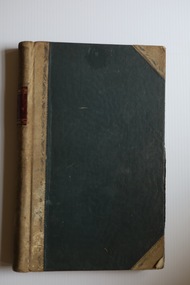
Administrative record - Warrnambool Friendly Societies Park Trust Ledgers, Friendly Societies Park Trust administrative personnel, 1871 to 1947
... In 1871 the Friendly Societies of Warrnambool (benefit societies which mainly offered members heath cover, including the Oddfellows, Foresters, Hibernians,, Rechabites, Sons of Temperance, Druids and Protestant Alliance) established a sports ground in Warrnambool. This included facilities for cricket, football and Athletics Carnivals and other public demonstrations and meetings and was administered by a Trust with members representing each of the Friendly Societies. ...In 1871 the Friendly Societies of Warrnambool (benefit societies which mainly offered members heath cover, including the Oddfellows, Foresters, Hibernians,, Rechabites, Sons of Temperance, Druids and Protestant Alliance) established a sports ground in Warrnambool. This included facilities for cricket, football and Athletics Carnivals and other public demonstrations and meetings and was administered by a Trust with members representing each of the Friendly Societies. ...These ledgers are administrative records of the Warrnambool Friendly Societies Park Trust. One contains Minutes of meetings from 1931 to 1947 and the other is an Accounts Book with records of payments for salaries, insurance, rentals, ground improvements etc. from 1908 to 1947. Some inserts in the ledgers date back to the early days of the Trust. In 1871 the Friendly Societies of Warrnambool (benefit societies which mainly offered members heath cover, including the Oddfellows, Foresters, Hibernians,, Rechabites, Sons of Temperance, Druids and Protestant Alliance) established a sports ground in Warrnambool. This included facilities for cricket, football and Athletics Carnivals and other public demonstrations and meetings and was administered by a Trust with members representing each of the Friendly Societies. Today the area is a major sports facility and still has the name Friendly Societies Park but it is now administered by the Warrnambool City Council. These items are of considerable historical interest as they contain much detail about the early history of the Friendly Societies Park Trust and give researchers valuable information on the work of benefit societies in the late 19th and early 20th centuries in Warrnambool and also on a major sports facility still existing in Warrnambool. .1 Ledger of 380 pages with a black cover and beige leather spine and corners. The edges of the pages are marbled and the pages have printed red and blue lines. The handwritten entries are in ink. There are some loose inserts in this ledger. .2 Ledger of 510 pages with a black cover and beige leather spine and corners. The pages have an alphabetical index at the front and have red and blue printed lines. The handwritten entries are in ink. friendly societies park warrnambool, friendly societies in warrnambool -
 Warrnambool and District Historical Society Inc.
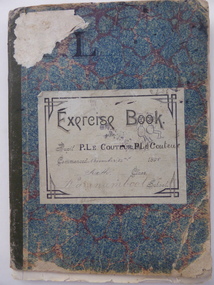
Book, Exercise book P Le Couteur, 1898
... Warrnambool Academy run by Richard Lawson and William Oakley. He matriculated at the age of 14 and completed an Arts degree at Melbourne University before studying first year medicine. At the university he excelled in sport – cricket, football...Warrnambool Academy run by Richard Lawson and William Oakley. He matriculated at the age of 14 and completed an Arts degree at Melbourne University before studying first year medicine. At the university he excelled in sport – cricket, football ...This school exercise book belonged to Philip Ridgway Le Couteur, Warrnambool’s first Rhodes Scholar. Philip Le Couteur (1885-1958), the son of George Le Couteur, a Warrnambool chemist and Fanny Byron (nee Maling), began his schooling at Middle Park State School and continued it in Warrnambool at the Warrnambool Academy run by Richard Lawson and William Oakley. He matriculated at the age of 14 and completed an Arts degree at Melbourne University before studying first year medicine. At the university he excelled in sport – cricket, football and tennis. In 1908 he won the Rhodes Scholarship for Victoria and studied classics, classical history and philosophy at Oxford University. In 1913 he was appointed the foundation lecturer in Mental and Moral Philosophy at the University of Western Australia. Following this he was the Head Master at various secondary schools, including Methodist Ladies’ College for 11 years. This book is of great interest because it contains examples of the schoolwork of Warrnambool’s first Rhodes Scholar, Philip Le Couteur.This is a school exercise book of 40 pages. The cardboard cover is a mottled blue and red colour with brown binding. All the pages have handwritten school work including dictation, arithmetic, spelling, map work, grammar and composition. The pages are detached from the cover and the cover is partly torn away and bent. The cover has some sketches drawn presumably by the owner of the book Philip Le Couteur. ‘P. Le Couteur, commenced 22nd November 1898, Sixth Class, Warrnambool School.’rhodes scholars, philip le couteur -
 Warrnambool and District Historical Society Inc.
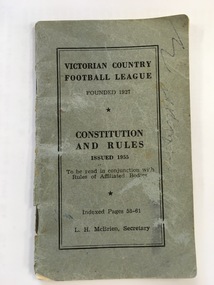
Booklet, Victorian Country Football League Constitution and Rules, 1955
... victorian country football league...warrnambool...This booklet is of some interest as it details the Constitution and Rules of the Victorian Country Football League in 1955. The Hampden League centred around the Warrnambool area was one of the districts covered at that time by the Victorian Country Football League. victorian country football league warrnambool Back cover: ‘189936’ This is a small soft-covered booklet of 64 pages. ...This booklet lists the Constitution and Rules of the Victorian Country Football League in 1955. The Victorian Country Football League was founded in 1927 and merged with AFL Victoria in 2012 to form AFL Victoria Country. In 1955 the Victorian Country Football League had eight delegates elected by the League and one District Councillor from each of the fifteen designated country districts. The object of the League was to promote the game in the Victorian country areas. This booklet is of some interest as it details the Constitution and Rules of the Victorian Country Football League in 1955. The Hampden League centred around the Warrnambool area was one of the districts covered at that time by the Victorian Country Football League.This is a small soft-covered booklet of 64 pages. It has a pale green cover with ruled black lines and printed information on the front and the name of the printer on the back. The pages have been stapled but the staples are now removed. The cover is torn at the spine and the cover is somewhat scuffed with some scribble on the cover edge. The back cover and one of the pages have biro annotations on them. The booklet has an index at the back and a couple of blank pages for notes. Back cover: ‘189936’victorian country football league, warrnambool -
 Warrnambool and District Historical Society Inc.
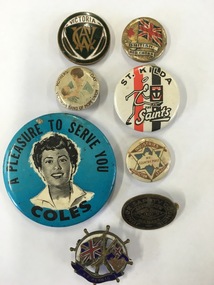
Badge - Badges x 8, Collection of various badges
... These badges reflect various aspects of life in Australia and the many allegiance which people have to organisations from the Country Womans Association, to football clubs, with groups such as the Industries Protection league and Temperance groups such as the Band of Hope Union espousing interests and ideas in the early to mid 20th century Social significance warrnambool history industries protection league badge band of hope union badge s s persic badge 001048.1 CWA badge Round metal badge with dark green rim surrounding monogrammed shield and gum leaf on either side. ...These badges reflect various aspects of life in Australia and the many allegiance which people have to organisations from the Country Womans Association, to football clubs, with groups such as the Industries Protection league and Temperance groups such as the Band of Hope Union espousing interests and ideas in the early to mid 20th centurySocial significance001048.1 CWA badge Round metal badge with dark green rim surrounding monogrammed shield and gum leaf on either side. Victoria in bronze at top of shield. Stokes **** Melb on rear. 001048.2 British Red Cross. Round tin badge with Union Jack flag and red cross on left with text in banners below flag. 001048.3 Victorian Badge of Hope Union. Small button badge with cream background, brown text around edge with image of mother and child in blue tones in the centre 001048.4 St Kilda Football badge. Round tin plastic coated. White background with image of saint emblem on front on background of club colours. 001048.5 Coles Badge. Large button badge with bright blue background with image of lady in black and white in the centre. Text in black. 001048.6 Industries Protection League. Small cream plastic badge with outline of Australia inside a star. Brown boomerangs top and bottom. 001048.7 Junior safety Council. Oval metal badge. Black with brass text and artwork. 001048.8 S.S. Persis. Three dimensional with ship’s wheel at back in white and Australia and British flags in foreground with S.S. Persic on banner below flags. warrnambool history, industries protection league badge, band of hope union badge, s s persic badge
