
Showing 52 items matching "william weatherly"
-
 Ballarat Clarendon College
Book, Cook's voyages Vols 1-2
... ...william-weatherly...Alastair's daughter Mia attended the school 1983-4. h-p-mackenzie harold-ponsonby-mackenzie gladys-dalziel-mackenzie william-weatherly weatherly-library library 1936 alastair-mackenzie mia-mackenzie Book plate inside front cover: Crest / Ballarat College Library / PRESENTED BY / Eng Com H D MacKenzie 1936 / ... ...H P MacKenzie donated these books to the Ballarat College library in the year that his wife donated money to the school in memory of her parents, Mr and Mrs W Weatherly. The money was used to purchase book shelves and furnishings for a new library and a call was made to old collegians and membersof the school community to donate books to stock the new library. Harold Ponsonby MacKenzie served on Ballarat College council 1925 - 1946. His sons Alastair and Kenneth also attended the school. Alastair served on councils also - BC Council 1957-73, BCC Council 1974-80. Alastair's daughter Mia attended the school 1983-4. Large cloth bound books with gold lettering and patterns on spine and coversBook plate inside front cover: Crest / Ballarat College Library / PRESENTED BY / Eng Com H D MacKenzie 1936 / ...h-p-mackenzie, harold-ponsonby-mackenzie, gladys-dalziel-mackenzie, william-weatherly, weatherly-library, library, 1936, alastair-mackenzie, mia-mackenzie -
 Bayside Gallery - Bayside City Council Art & Heritage Collection
Photograph - type C photograph, Newmark Aerial Photography, Billilla, Halifax Street, Brighton, 1996
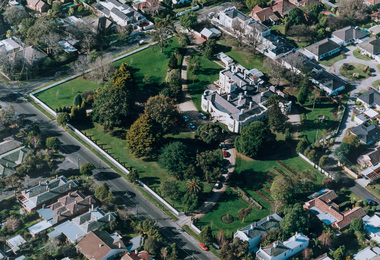
... ...William Weatherly...brighton historic house aerial photograph newmark aerial photography streets Billilla Weatherly William Weatherly Smith and Johnson Walter Richmond Butler Halifax Street Billilla, Halifax Street, Brighton Photograph type C photograph Newmark Aerial Photography ...brighton, historic house, aerial, photograph, newmark aerial photography, streets, billilla, weatherly, william weatherly, smith and johnson, walter richmond butler, halifax street -
 Streatham and District Historical Society
Picture, Blythvale Streatham
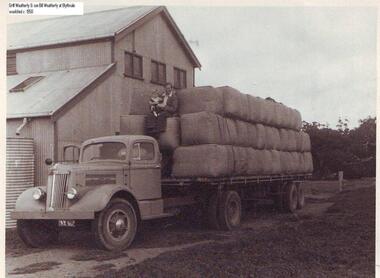
... Sitting on the truck is Griff (adult) and Bill (William) Weatherly (son) next to the Blythvale woolshed....Sitting on the truck is Griff (adult) and Bill (William) Weatherly (son) next to the Blythvale woolshed. ...Black & white rectangle photo showing a truck stacked with wool. Sitting on the truck is Griff (adult) and Bill (William) Weatherly (son) next to the Blythvale woolshed.In blue pen on back: Griff and Bill Weatherly Blythvale 1950. -
 Ballarat Clarendon College
Framed items
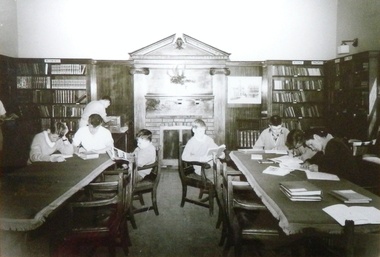
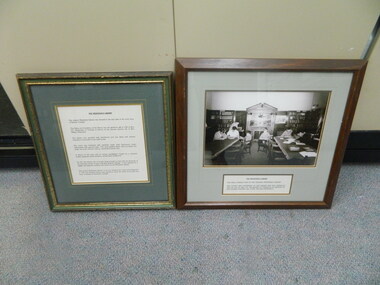
... The fittings and furnishing of the library was a generous gift in 1936 of Mrs H P Mackenzie of Trawalla in honour of her pioneer parents, Mr and Mrs William Weatherly. The library was panelled with blackwood and fitted with shelves intended to eventually house 3000 books. ...The fittings and furnishing of the library was a generous gift in 1936 of Mrs H P Mackenzie of Trawalla in honour of her pioneer parents, Mr and Mrs William Weatherly. The library was panelled with blackwood and fitted with shelves intended to eventually house 3000 books. ...The original Weatherly Library was situated in the space immediately on the left of the archway. The fittings and furnishing of the library was a generous gift in 1936 of Mrs H P Mackenzie of Trawalla in honour of her pioneer parents, Mr and Mrs William Weatherly. The library was panelled with blackwood and fitted with shelves intended to eventually house 3000 books. Specially made solid blackwood chairs, upholstered in genuine hide, two long reading tables, an upholstered bench seat under the north window and an ornate carved mantelpiece topped by a classical broken pediment framing a carved head of Minerva were also donated. In 1971 this library was no longer large enought o serve the growing number of boys at the college; it was replaced by a bigger, separate building, also known as the Weatherly Library. This building is currently in use, and recently renovated, as the senior staff room. In 1993 a third library building was opened and named Erindale in recognition of property associated with Clarendon PLC. In 2012 the school opened the Fraser Library on the senior campus in honour of old collegian and school council chair, Darrell J Fraser. Wooden frames with mounts and glass; both include printed descriptions; one includes a black and white photographh p mackenzie, weatherly library -
 Flagstaff Hill Maritime Museum and Village
Ceramic - Soap dish, circa 1883
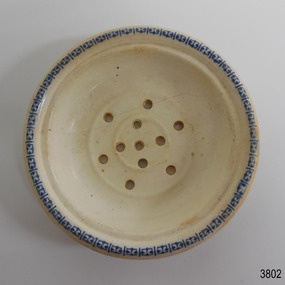
... She had almost reached her destination on July 4 1883, approaching Port Phillip Bay and being towed by the steam tug William. The weather changed to rough with fog and both the George Roper and the William hit the dangerous Lonsdale Reef at Port Phillip Heads. ...She had almost reached her destination on July 4 1883, approaching Port Phillip Bay and being towed by the steam tug William. The weather changed to rough with fog and both the George Roper and the William hit the dangerous Lonsdale Reef at Port Phillip Heads. ...This ceramic soap dish was recovered from the wreck of the 1882-1883 George Roper between the late 1960’s to early 1970’s. It is one of the shipwreck artefacts in the John Chance Collection. Soap dishes were often part of a wash set that also included a water jug and wash bowl. The holes in the dish allowed water to drain out of the dish, keeping the soap dry for next use. The GEORGE ROPER 1882 - 1883 - The George Roper was a 4-masted iron sailing ship built in Liverpool, England, in 1882 for fast international trade with Australia. The large vessel was launched in February 1883. The ship was on its first trip, departing Liverpool for Melbourne, captained by John Ward and a crew of 31. She had almost reached her destination on July 4 1883, approaching Port Phillip Bay and being towed by the steam tug William. The weather changed to rough with fog and both the George Roper and the William hit the dangerous Lonsdale Reef at Port Phillip Heads. The Captain and crew were eventually rescued and taken to Queenscliff. Salvage syndicates were able to recover a lot of the cargo before the George Roper broke up and sank. Amongst the cargo was soft goods, draperies, household items, spirits of malt and distilled liquors, chemicals, dynamite, and 1,400 tons of steel rails for the Victorian Government. Also in the hold were Russell Stourbridge bricks, as paying ballast. This 1880s soap dish is an example of personal hygiene accessories and may have been part of a set comprising jug, bowl and dish.. The soap dish is also significant as it was recovered by John Chance, a diver from the wreck of the George Roper in the 1960s-70s. Items that come from several wrecks along Victoria's coast have since been donated to the Flagstaff Hill Maritime Village’s museum collection by his family, illustrating this item’s level of historical value. The soap dish is significant for its association with the barque George Roper, which is considered historically and archaeologically significant and as such, is listed on the Victorian Heritage Database, VHR S286. The George Roper is an example of a vessel built specifically for fast travel to and from Australia with a large shipment of cargo. Its cargo of steel rails adds to the historical significance of international trade to the growing colony of Australia and Victoria in particular, with rail transportation soon to become a faster and safer form of transportation between colonial towns. Divers can still access parts of the scattered wreck and other artefacts recovered in the 1970s and 1980s can be viewed in both public and private collections. Soap dish; glazed white porcelain. Round shallow bowl with blue patterned border, resembling butterflies. Two raised, concentric rings are moulded into the base. Six pierced holes are evenly spaced between the rings, five holes are in the centre of the dish.flagstaff hill, warrnambool, flagstaff hill maritime museum, maritime museum, shipwreck coast, flagstaff hill maritime village, great ocean road, john chance, west coast trader, george roper, captain john ward, russell stourbridge bricks, port phillip heads, lonsdale reef, dive wreck, vhr s286, coastal trader, ceramic, vintage, personal hygiene, bathroom accessory, soap dish -
 Flagstaff Hill Maritime Museum and Village
Ceramic - Cover, circa 1883
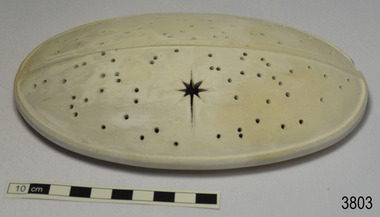
... She had almost reached her destination on July 4 1883, approaching Port Phillip Bay and being towed by the steam tug William. The weather changed to rough with fog and both the George Roper and the William hit the dangerous Lonsdale Reef at Port Phillip Heads. ...She had almost reached her destination on July 4 1883, approaching Port Phillip Bay and being towed by the steam tug William. The weather changed to rough with fog and both the George Roper and the William hit the dangerous Lonsdale Reef at Port Phillip Heads. ...This ceramic cover was recovered from the wreck of the 1882-1883 George Roper between the late 1960’s to early 1970’s. It is one of the shipwreck artefacts in the John Chance Collection. The purpose of the cover is unclear. The holes could be for ventilation. The cover may have been used to protect food or keep it at an even temperature. It may also have been used for covering fragrant petals, allowing some scent to escape through the holes. The residue around the underside of the holes and their random placement indicate that the cover could be partially handmade. The discolouration could have come from its time in the sea. The GEORGE ROPER 1882 - 1883 - The George Roper was a 4-masted iron sailing ship built in Liverpool, England, in 1882 for fast international trade with Australia. The large vessel was launched in February 1883. The ship was on its first trip, departing Liverpool for Melbourne, captained by John Ward and a crew of 31. She had almost reached her destination on July 4 1883, approaching Port Phillip Bay and being towed by the steam tug William. The weather changed to rough with fog and both the George Roper and the William hit the dangerous Lonsdale Reef at Port Phillip Heads. The Captain and crew were eventually rescued and taken to Queenscliff. Salvage syndicates were able to recover a lot of the cargo before the George Roper broke up and sank. Amongst the cargo was soft goods, draperies, household items, spirits of malt and distilled liquors, chemicals, dynamite, and 1,400 tons of steel rails for the Victorian Government. Also in the hold were Russell Stourbridge bricks, as paying ballast. The ventilated cover is as an example of domestic ceramic ware of the 1880s. The cover also holds significance as it was recovered by John Chance, a diver from the wreck of the George Groper in the 1960s-70s. Items that come from several wrecks along Victoria's coast have since been donated to the Flagstaff Hill Maritime Village’s museum collection by his family, illustrating this item’s level of historical value. The George Roper is considered historically and archaeologically significant and as such, is listed on the Victorian Heritage Database, VHR S286. It is an example of a vessel built specifically for fast travel to and from Australia with a large shipment of cargo. The George Roper’s cargo of steel rails adds to the historical significance of international trade to the growing colony of Australia and Victoria in particular, with rail transportation soon to become a faster and safer form of transportation between colonial towns. Divers can still access parts of the scattered wreck and other artefacts recovered in the 1970s and 1980s can be viewed in both public and private collections. Cover; unglazed white ceramic, oval shape. The cover has holes randomly poked through its surface, one large hole is a six pointed star shape. Underneath there is a narrow rim placed slightly inside the edge. There is residue on the underneath around the holes. There is orange-brown discolouration and areas where the surface is lighter coloured. flagstaff hill, warrnambool, flagstaff hill maritime museum, maritime museum, shipwreck coast, flagstaff hill maritime village, great ocean road, john chance, west coast trader, george roper, w. h. potter & sons, w.t. dickson and son, captain john ward, russell stourbridge bricks, port phillip heads, lonsdale reef, dive wreck, vhr s286, coastal trader, ceramic, vintage, ventilated cover, domestic item -
 Federation University Historical Collection
Photograph - Photograph - Black and White, Ballarat School of Mines Cricket Team, 1941, 1941
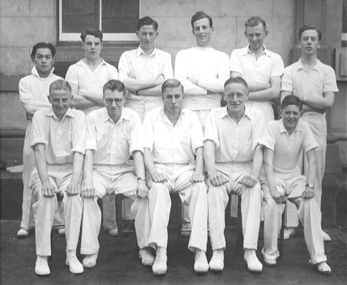
... weather and conflicting arrangements only three matches were played. Scores: Ballarat School of Mines 130 defeated Ballarat High School 114 Ballarat School of Mines 53 defeated Ballarat Church of England Grammar School 34 Ballarat School of Mines 102 defeated Ballarat Church of England Grammar School 101 Eric William Goon was the son of Chinese Herbalist F.S. ...weather and conflicting arrangements only three matches were played. Scores: Ballarat School of Mines 130 defeated Ballarat High School 114 Ballarat School of Mines 53 defeated Ballarat Church of England Grammar School 34 Ballarat School of Mines 102 defeated Ballarat Church of England Grammar School 101 Eric William Goon was the son of Chinese Herbalist F.S. ...This photograph is reproduced on page 19 of the 1941 Ballarat School of Mines Students' Magazine. The 1941 Cricket team had a successful season, but owing to the weather and conflicting arrangements only three matches were played. Scores: Ballarat School of Mines 130 defeated Ballarat High School 114 Ballarat School of Mines 53 defeated Ballarat Church of England Grammar School 34 Ballarat School of Mines 102 defeated Ballarat Church of England Grammar School 101 Eric William Goon was the son of Chinese Herbalist F.S. Goon of Peel Street, Ballarat Black and white photograph of 11 young men dressed in white. The photo depicts the Ballarat School of Mines Cricket team, 1941. Back Row: Eric Goon, D. Eltringham, K. Richard, L. Evans, I. McLachlan, Philip Kempe. Front Row: M. Laurence, J. Elliott, J. Gibbs (capt), Gordon Hale (vice-captain). W. RoweOn back in pencil "1941"eric goon, d. eltringham, k. richard, l. evans, i. mclachlan, philip kempe., m. laurence, j. elliott, j. gibbs, gordon hale, w. rowe, ballarat school of mines, cricket -
 Federation University Historical Collection
Postcard, G. Lelong, The Sugar Manufacture, Somme, France, c1917, c1917
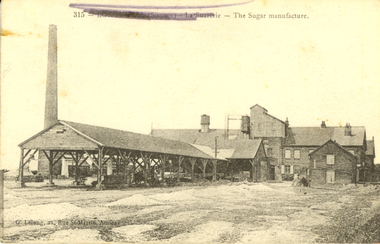
... Relations and friends thronged the Melbourne shipping office, but the answer was always the same - All passengers unaccounted for were presumed drowned. somme la suererie chatham family collection amiens france World War 1 postcard ly-ee-moon william Coghill Junior ascot victoria pioneers of ascot shipwreck Written on back of card: Dear Violet, received photos and letters and thank you for forwarding same. Are we having lovely spell of weather ...This postcard was sent from France during World War One WW1 to Violet Holmes [mother and aunty of other WW1 soldiers], by the son of a neighbouring Ascot Tourello District Family, the Wrigley Family. Violet inherited "Sauchieburn" an Ascot property on the death of her husband William Holmes in 1914. On her death this property was to be left to their 4 children and administered by a relative till the youngest child turned 27. As young boys, Violet's husband William, and his brother Henry, lived with their Aunt Catherine Coghill and Uncle William Coghill at ‘Sauchieburn’ Ascot. The Coghills had no children of their own. He and his brother Edward started a stock and station business at Clunes. Henry and Violet Holmes subsequently inherited "Sauchieburn" from Catherine (nee Holmes) and William Coghill, direct descendants of the Coghills Creek, Ascot, Tourello pioneer settler Captain William Coghill [Jane Dyer, May 2024] Catherine and her brother Edward Carter Holmes drowned at sea.This is an extract from the Korumburra Times, Wednesday June 6, 1956: The fated travellers wrecked off N.S.W. ‘On May 29th, 1886 in bright moonlight the Ly-e-Moon, the pride of the Australian coastal fleet, broke her back on the treacherous rocks of Green Cape, off the NSW coast. Eighty souls perished within range of the beacon rays of the lighthouse, including representatives of the earliest families ever to settle in Poowong. The passengers. On the main deck, Mr Edward Holmes, a Poowong grazier and former owner of ‘Wombalano’. He had sold this property with the object of going to Queensland and settling there. The proceeds of sale amounting to 1,200 pounds in gold sovereigns were under lock and key in the Purser's Office. Mr Holmes, although advanced in years, had unformed plans to invest his money in some Queensland enterprise. In the meantime he would visit his married daughter and [his] two sons, who had previously settled in Queensland. With him on board was his widowed sister Mrs Coghill who had also accepted an invitation to go north. News of the shipwreck, means of communication being slow, did not reach Korumburra for nearly a week. By then all hope had been abandoned for the missing. Relations and friends thronged the Melbourne shipping office, but the answer was always the same - All passengers unaccounted for were presumed drowned. Black and white postcard of a sugar refinery in The Somme, France. The name of the town has been scrubbed out in purple pencil by a censor during World War One. The back of the card is written on in pencil,Written on back of card: Dear Violet, received photos and letters and thank you for forwarding same. Are we having lovely spell of weather. This morning is quite warm and pleasant. The photo of you all standing in front of your house is a good one and you all look to be getting enough to eat. Mother looks as if she it getting stronger after her severe illness. Your concert party will be broken up through the Vale girls leaving but you should have no difficulty in finding volunteers to fill the ranks. By all of your letters you are all looking forward to the day we return 9as we are). I wouldn't like to bet too much that we would be home by this time next year [ ? ] by the way fritz is fighting lately he would very much like to get [peace?] I think we will give him all he wants this summer. J. Waller was here last night is looking well. With best wished to you all. I am sincerely. [W.Wrigbee? Wrigley]somme, la suererie, chatham family collection, amiens, france, world war 1, postcard, ly-ee-moon, william coghill junior, ascot victoria, pioneers of ascot, shipwreck -
 Flagstaff Hill Maritime Museum and Village
Steel Sample, ca. 1876
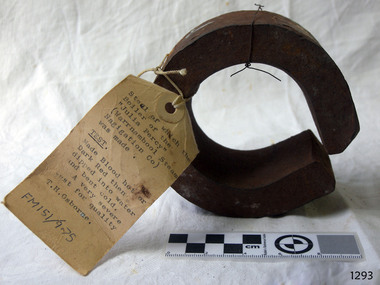
... weather permitting”. The Julia Percy changed hands several times. Her next owner was the Western Steam Navigaiton Co of Melbourne (1887). It was the manager of this company, Mr. T.H. Osborne, who tagged ths steel sample above. Melbourne Steamship Co became the next owners (1890), followed by William...weather permitting”. The Julia Percy changed hands several times. Her next owner was the Western Steam Navigaiton Co of Melbourne (1887). It was the manager of this company, Mr. T.H. Osborne, who tagged ths steel sample above. Melbourne Steamship Co became the next owners (1890), followed by William ...The sample of steel from the S.S. Julia Percy’s boiler was made has been tested, according to the attached label. The test involved heating the steel to blood red temperature (or dark red colour) then dipping it into water and bending it when it was cold. A “very severe test for quality” was written on the ticket by T.H. Osborne. (Mr Thomas Hamilton Osborne was the secretary for the Western Steam Navigation Co, established in Warrnambool in 1886. The company’s office was on the corner of Timor and Liebig Streets in Warrnambool and its north-western wall is now part of the current Warrnambool Regional Art Gallery. ) Cold bending of steel in a press or through rollers is the typical method of curving steel for construction. The steel needs to be manufactured in such a way that it is strong enough yet still flexible enough not to crack when bent or rolled. The boiler on the Julia Percy could have been a Scotch Boiler, a design introduced in the 1870’s and still being used today. This design was more robust that previous boilers, generating higher working steam pressures. The design incorporate greater ability to roll iron plates, leading to greater strength, thicker plating and fewer riveted joints. They were originally made of iron then later incorporated steel sections until they were entirely constructed of steel. Many examples of this type of boiler can be found on wreck sites. Shipping was the cheapest and most practical means of carrying produce and goods during the period 1840-1890. Regular domestic steamer services commenced in the Warrnambool district in the late 1850’s and by 1870 the passenger trade was booming. Produce was loaded from the jetty into ‘lighters’ (small boats), which took it to the ships at anchorage in the bay. Passengers were taken to the ship’s side then climbed aboard up ladders or gangways. The coming of the railway in October 1889 meant the gradual decline and end of the steam shipping era. Originally the ship was known as the SS Julia Percy and was later renamed as the Leeuwin. She was an iron passenger-cargo steam ship built in Glasgow by Thomas Wingate for the Warrnambool Steam Packet Company, which commissioned the ship for the steamship trade in Victoria’s western district. She was first registered in Warrnambool, Victoria in 1876. At one point in time the Julia Percy would sail from Warrnambool to Melbourne every Friday and return from Melbourne to Warrnambool every Tuesday. The cost of a return ticket for a Saloon Fare was £1.0.0. She would sail “if practical and weather permitting”. The Julia Percy changed hands several times. Her next owner was the Western Steam Navigaiton Co of Melbourne (1887). It was the manager of this company, Mr. T.H. Osborne, who tagged ths steel sample above. Melbourne Steamship Co became the next owners (1890), followed by William Howard Smith and Sons (1901) for use in Queensland coastal trades, then she was bought by George Turnbull in 1903 and used for local mail contract in Western Australia. She was sold to the Melbourne Steamship Company Ltd. (1906) and re-named the Leeuwi but continued in her Western Australian coastal run. She was converted into a coal hulk in Melbourne in 1910 as a result of damaged caused when she was driven against the jetty at Dongara during a gale. The ship was eventually dismantled and scuttled in Bass Strait on 28 December 1934. The steel sample is significant for its association with the wreck of the Leeuwin (Julia Percy), which is on the Victorian Heritage Register. It is historically significant for being a rare artefact that has potential to interpret aspects of western Victoria’s 19th century steamship trade and Victorian cultural history, including the testing and manufacturing process associated with steam power. Leeuwin is listed on the Victorian heritage Register as being historically significant ‘as one of only four wrecks of steamships in Victorian waters associated with the western district of Victoria’s coastal steamship trade. Her registered number is VHR S413. A sample of the steel from which the boiler of the "SS Julia Percy" (later named Leeuwin) was made. The piece of steel is a ‘C’ shape with the ends almost meeting. A luggage ticket is tied onto the steel and has an inscription on it. The steel is rusty.Ticket with typed information “Steel of which the Boiler of the “Julia Percy” (Warrnambool Steam Navigation Co) was made. TEST: Made Blood hot or Dark Red then dipped into water and bent cold. A very severe test for quality T.H. Osborne. Below these words is the hand written inscription in black “FM 151 / 9.75” julia percy, leeuwin, steel, boiler, steam ship, metal testing, western steam navigation co., flagstaff hill, warrnambool, shipwrecked-coast, flagstaff-hill, flagstaff-hill-maritime-museum, maritime-museum, shipwreck-coast, flagstaff-hill-maritime-village, t.h. osborne -
 Flagstaff Hill Maritime Museum and Village
Photograph - Shipwreck rescue, c. 1890's
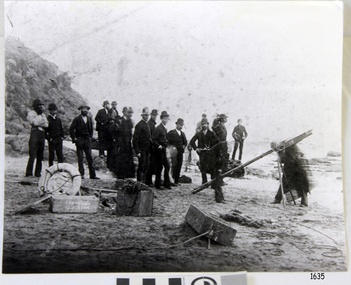
... William Vickers with a crew of 25. The Cape Otway light was sighted on September 5, 1891. However, the bearing was different from Captain Vickers’ calculations. At about 2:30 am the next morning, the land was reported only 4-5 miles away. The captain tried to redirect the ship in the rough weather...William Vickers with a crew of 25. The Cape Otway light was sighted on September 5, 1891. However, the bearing was different from Captain Vickers’ calculations. At about 2:30 am the next morning, the land was reported only 4-5 miles away. The captain tried to redirect the ship in the rough weather ...CONTEXT – UPDATED The photograph taken on Sunday, September 6, 1891, shows the Port Campbell Rocket Rescue Crew and Equipment at Wreck Beach, Moonlight Head, preparing to save the stranded men on the wreck of the barque Fiji. The man standing in the middle, front of the photograph, facing the ocean, is Herbert Maxwell Morris, a farmer at Barruppa near Princetown, who is also a member of the Rocket Rescue Crew. The Rocket Rescue lifesaving method used an explosive rocket to shoot a light line from the shore across to the distressed vessel. The line was then secured to the ship’s mast, and a heavy, continuous line was sent out with a ‘breaches buoy’ attached (a buoy similar to the seat of a pair of trousers). The stranded seafarers would sit in the seats and be pulled along the line to safety. A lot of skill was needed to set up the line to reach its target, and the crew trained regularly to keep up their skills. The FIJI and the RESCUE: - The three-masted iron barque Fiji was built at Belfast, Ireland, in 1875 by Harland and Wolfe for a Liverpool-based shipping company. The ship departed Hamburg on May 22, 1891, bound for Melbourne under the command of Captain William Vickers with a crew of 25. The Cape Otway light was sighted on September 5, 1891. However, the bearing was different from Captain Vickers’ calculations. At about 2:30 am the next morning, the land was reported only 4-5 miles away. The captain tried to redirect the ship in the rough weather without success, and the Fiji struck rock only 300 yards (274 metres) from shore. The crew burned blue lights and fired rockets to signal distress. The lifeboats either capsized or were swamped and smashed to pieces. Two younger crewmen volunteered to swim to the shore with a line. One, a Russian named Daniel Carkland, drowned after he was swept away when the line broke. The other, Julius Gebauhr, a 17-year-old German able seaman, reached shore safely on his second attempt but had cut the line loose with his sheath-knife when it tangled in kelp. He climbed the cliffs in search of help. Later that morning, a young man named William (Willie) Ward reported that he saw the wreck of the ship close to shore near Moonlight Head from the cliffs, and the alarm for help was sent to Princetown, six miles away. At around the same time, a Mott’s party of land selectors, including F. J. Stansmore and Leslie Dickson, was travelling on horseback from Princetown towards Moonlight Head. They were near Ryans Den when they found Gebauhr in the scrub, bleeding and dressed only in a singlet, socks and a belt with his sheath-knife. They thought the man might be an escaped lunatic, due to his wild and shaggy-looking state and what seemed to be gibberish speech. After Gebauhr threw his knife away, they realised that he was speaking half-English, half-German as he talked about the wreck. They gave him food, brandy and clothing, and he was taken to a nearby guest house, Rivernook, owned by John Evans, where he was cared for. Most of the party went off to the wreck site. Stanmore and Dickson rode for help from both Port Campbell, for the two Rocket Rescue Crew buggies, and from Warrnambool, for the lifeboat. The vessel S.S. Casino sailed from Portland towards the scene. Half of the Port Campbell Rocket Crew and equipment arrived after a 25-mile journey and set up the rocket tripod on the beach below the cliffs. By this time, the weary crew of the Fiji had been clinging to the jib-boom for almost 15 hours, calling frantically for help. The Office in Charge of the Rocket Crew, W. Tregear, ordered the rocket to be fired, but the light line broke and the rocket was carried away. A second line was successfully set up by Herbert Morris. It crossed the ship and was secured. The anxious sailors tried to come ashore along the line, but some were washed off as the line sagged with too many on it at one time. Other nearly exhausted crewmen made their way through masses of seaweed and were often smothered by waves. Only 14 of the 24 who had remained on the ship made it to shore. Rocket Crew members and onlookers on the beach took turns to go into the surf and drag the half-drowned seamen to safety. These rescuers included Bill (William James) Robe, Herbert Maxwell Morris, Edwin Vinge, Hugh Cameron, Fenelon Mott, Arthur Wilkinson and Peter Carmody, who was also involved in the rescue of men from the Newfield. Arthur Wilkinson, a 29-year-old land selector from Geelong, swam out to help one of the ship’s crewmen, a carpenter named John Plunken, who was trying to swim from the ship to the shore. Two or three times, both men almost reached the shore but were washed back to the wreck, where they were both hauled back on board. Wilkinson was unconscious, possibly from hitting his head on the anchor before they were brought up. Plunken survived, but Wilkinson later died, and his body washed up the next day. The 26-year-old Bill Robe hauled out the last man; it was the captain, and he’d been tangled in the kelp. Only 20 minutes later, the wreck of the Fiji was smashed apart, and it settled in about 6 metres of water. Of the 26 men on the Fiji, 11 in total lost their lives. The remains of 7 bodies were washed onto the beach. Their coffins were made from timbers from the wrecked Fiji, and they were buried on the cliff top above the wreck. The survivors were taken to Rivernook and cared for over the next few days. Funds were raised by locals soon after the wreck in aid of the sufferers of the Fiji disaster. Captain Vickers was severely reprimanded for his mishandling of the ship. His Master's Certificate was suspended for 12 months. There was public criticism of the rescue. The important canvas ‘breeches buoy’ and heavy line for the Rocket Rescue were in the half of the rocket outfit that didn’t make it in time for the rescue, as they had been delayed at the Gellibrand River ferry. The communications to Warrnambool were down, so the call for help didn’t get through on time. The boat that was notified of the wreck failed to reach it in time. Much cargo looting occurred. One looter was caught with a small load of red and white rubber balls. Essence of peppermint mysteriously turned up in many settlers' homes. Sailcloth was salvaged and used for horse rugs and tent flies. Soon after the wreck, “Fiji tobacco” was advertised around Victoria. A Customs officer, trying to prevent some of the looting, was assaulted by looters and thrown over a cliff. He managed to cling to a bush lower down until rescued. In 1894, some coiled fencing wire was salvaged from the wreck. Hundreds of coils are still strewn over the site of the wreck, encrusted and solidified. The hull is broken, but the vessel’s iron ribs can be seen along with some of the cargo of concrete and pig iron. Captain Vickers presented Bill Robe with his silver-cased pocket watch, the only possession that he still had, as a token for having saved his life and the lives of some of the crew. Years later, Bill used the pocket watch to pay a debt, and it was handed down through that family. Seaman Julius Gebauhr later gave his knife, in its handcrafted leather sheath, to F. J. Stansmore for caring for him when he came ashore. The knife handle had a personal inscription on it. A marble headstone on the cliffs overlooking Wreck Beach pays tribute to the men who lost their lives when Fiji ran aground. The scene of the wreck is marked by the anchor from the Fiji, erected by Warrnambool skin divers in 1967. Captain Vickers’ pocket watch and Julius Gebauhr’s sheath knife are among the artefacts salvaged from the Fiji that are now part of the Fiji collection at Flagstaff Hill Maritime Village. The man identified in the photograph, Herbert Maxwell Morris, was the nephew of the Victorian era artist, William Morris. Herbert had sailed from England to Australia; he was about 25 years old when he joined the Rocket Rescue Crew at Port Campbell, where he lived. His successful rocket line firing at the Fiji wreck site was noted by author Jack Loney in one of his historic shipwreck books. Later, Morris moved from his property at Baruppa to Laver’s Hill to run a more profitable enterprise. This photograph is significant as an image of a historical event, being the willingness of local volunteers to aid in the saving of lives of stranded seafarers. It gives a clear picture of the use of Rocket Rescue Equipment in shore-to-ship rescues. Flagstaff Hill’s Fiji collection is of historical significance at a State level because of its association with the wreck Fiji, which is on the Victorian Heritage Register VHR S259. The Fiji is archaeologically significant as the wreck of a typical 19th century international sailing ship with cargo. It is educationally and recreationally significant as one of Victoria's most spectacular historic shipwreck dive sites with structural features and remains of the cargo evident. It also represents aspects of Victoria’s shipping history and its potential to interpret sub-theme 1.5 of Victoria’s Framework of Historical Themes. The Fiji collection meets the following criteria for assessment; Importance to the course, or pattern, of Victoria’s cultural history, possession of uncommon, rare or endangered aspects of Victoria’s cultural history, and potential to yield information that will contribute to an understanding of Victoria’s cultural history. Black and white photograph of the Rocket Rescue Crew from Pt Campbell on Wreck Beach, Moonlight Head, at the barque 'Fiji' wreck site. September 6, 1891.warrnambool, shipwrecked coast, flagstaff hill, flagstaff hill maritime museum, maritime museum, shipwreck coast, flagstaff hill maritime village, shipwrecked artefact, pocket watch, fob watch fiji, william vickers, william robe, bill robe, gebauhr, stansmore, carmody, wreck bay, moonlight head, fiji shipwreck 1891, rocket crew, port campbell rocket crew, lifesaving crew, photograph of rocket crew, herbert morris, warrnambool, shipwreck artefact, mott, william ward, rocket rescue, breeches buoy, rivernook guest house -
 Mission to Seafarers Victoria
Furniture - Pulpit, Rodney Howard Alsop, 1909
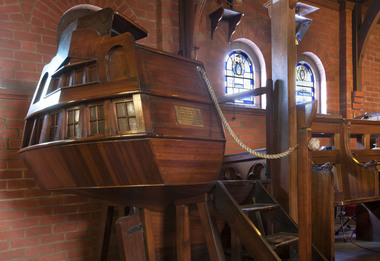
... William John Dalziel (furniture manufacturer). It was initially used in the first Mission in Central Melbourne, Siddeley St. It is located in the Chapel of Saint Peter of the Mission to Seafarers 717 Flinders St. complex since 1917 (State Heritage listed (H1496). This complex was designed by Walter Richmond Butler in 1916, and officially opened on 11 September 1917, a day '...of unusually kind weather...William John Dalziel (furniture manufacturer). It was initially used in the first Mission in Central Melbourne, Siddeley St. It is located in the Chapel of Saint Peter of the Mission to Seafarers 717 Flinders St. complex since 1917 (State Heritage listed (H1496). This complex was designed by Walter Richmond Butler in 1916, and officially opened on 11 September 1917, a day '...of unusually kind weather ...In 1909, assistant Chaplain Rev. Haire presented the Mission with an 'uncommonly artistic pulpit' in memory of his mother. A plaque in memory of Jane King Haire can be found on the side next to the steps. The dedication was performed by the Archbishop of Melbourne on the 26th January (date engraves on the plaque) This pulpit was designed by Melbourne architect Rodney Howard Alsop (1881-1932) and manufactured by William John Dalziel (furniture manufacturer). It was initially used in the first Mission in Central Melbourne, Siddeley St. It is located in the Chapel of Saint Peter of the Mission to Seafarers 717 Flinders St. complex since 1917 (State Heritage listed (H1496). This complex was designed by Walter Richmond Butler in 1916, and officially opened on 11 September 1917, a day '...of unusually kind weather', by the Governor of Victoria, the Honourable Sir Arthur Stanley. According to a later article published in 1950: The pulpit is a model, built to scale, of the stern of an old ship of the line in Lord Nelson's day. This pulpit is significant as it is housed in The Memorial Chapel of Saint Peter forming part of the State Heritage listed Mission to Seafarers Victoria complex. It was built in Melbourne of Australian timbers, and is one of only two known maritime inspired pulpits, both associated with Missions to Seamen of the early 20th C. the other is held in the ANMM Collection see link. Their statement of significance is worth quoting in part as it applies equally to this pulpit "...an extremely rare and unique example of such pulpits. It is highly significant as a wonderfully preserved example of a time when religion was preached to sailors for their spiritual guidance and temperance..." Rodney Howard Alsop was an important Melbourne architect of the Arts and Crafts movement. John William Dalziel had sailed from Liverpool to Melbourne in 1862. Seventeen years later Penman and Dalziel founded the business in Lonsdale Street West, and won recognition at the Indian and Colonial Exhibition in London in 1886. Penman and Dalziel were identified in 1937 as one of Melbourne’s early ‘skilled craftsmen’ and ‘leading names’ in the manufacture of fine furniture. He died in February 1918 in a railway accident.Timber pulpit built in the form of a ship's stern including a timber step ladder for access, a timber keel and rudder, a rope fixed from the pulpit to a post mounted to the floor, and a dedication plaque on the side of the pulpit. The pulpit sits on timber legs. It's likely to be the original rope: traditionally made coir rope with twisted fibres, covered with canvas supported by a thread. At lower end the rope is secured by a monkey fist know and at the top by a turk head knot.Inside the pulpit (right) is the cardboard label with the maker details: " On an attached plaque see 0678 To the greater glory of God and in ever loving memory of Jane King Haire. This pulpit is erected by her son. Blessed are the pure in heart. For they shall see God. St. Matt. V.8. 26.1.09mission, seafarers, melbourne, victoria, chapel, saint peter, pulpit, australian timber, stern, walter richmond butler, australian maritime history, reverend w.f. haire, rodney howard alsop (1881-1932), wright's lane, william john dalziel, gifts-1917, heritage listed -
 Ballarat Clarendon College
Book, Wonders of the physical world: the glacier, the iceberg, the ice-field and the avalanche, 1875
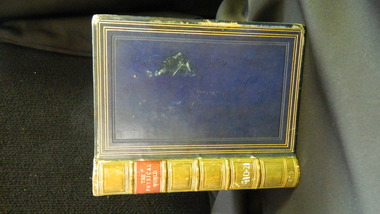
... William Henderson Chair of Council. Newton subsequently donated the book back to the school for inclusion in the Weatherly LIbrary in 1937. ...William Henderson Chair of Council. Newton subsequently donated the book back to the school for inclusion in the Weatherly LIbrary in 1937. ...Book prize awarded to Newton Wanliss for excellence in History by William Henderson Chair of Council. Newton subsequently donated the book back to the school for inclusion in the Weatherly LIbrary in 1937. Accession number 1812. The book was catalogued and call number 910.12 painted on spine. Socially significant item due to signature of William Henderson, founder of the school. Prizes were usually given in the name of the Headmaster. During Headmaster McCoy's time (1864 - 1874) the prizes were given in his name and at his expense. The school was between principals at Christmas 1876, hence the signature of William Henderson. Dark blue calf binding with gold borders to front and back covers, raised bands on spine with six compartments and gold title lettering; marbled endpapers; book plate on front cover verso; library plate on right endpaper; pages gilt-edged; black and white illustrations; left side of back endpaper missing; Book plate inside front cover; Ballarat College crest / 1st Prize for / History / AWARDED TO / N Wanliss / Xmas 1876 / W Henderson, Chairman. Book plate on right endpaper: Crest / Ballarat College Library / PRESENTED BY / Mr Newton Wanliss 1937 newton-wanliss, william-henderson, 1876, book-prize, -
 Ballarat Clarendon College
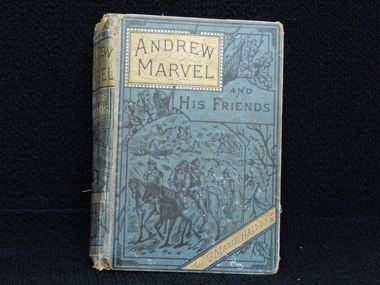
Book, Andrew Marvel and his friends, 1884
... William who's occupation is noted as "Squatter" and who resided at Nhill Station in Nhill. Presbyterian educators placed great value on a classical education matched with diligence in study. Book prizes were highly regarded and academic success admired. In the school’s early years prizes were ordered direct from London and had the school crest embossed in gold on the front or back cover. Many of the prizes given in early years were returned to the school to equip the Weatherly ...This book was awarded to Mary Isabella Macdonald for second prize in Third English History in 1886. Mary entered Clarendon Ladies' College in 1885. On the original register it states that Mary was enrolled by her father named William who's occupation is noted as "Squatter" and who resided at Nhill Station in Nhill.Presbyterian educators placed great value on a classical education matched with diligence in study. Book prizes were highly regarded and academic success admired. In the school’s early years prizes were ordered direct from London and had the school crest embossed in gold on the front or back cover. Many of the prizes given in early years were returned to the school to equip the Weatherly Library when it opened in 1936.Bound in green fabric with ornate decorative illustration on cover and gilt lettering. Detached spine, black and white illustrated, 469 p. Book plate inside front cover: CLARENDON LADIES' COLLEGE./ BALLARAT./ Second PRIZE./ III rd English History/ AWARDED TO/ Mary Isabella Macdonald/ 19 th December, 1886.mary-isabella-macdonald, clarendon-ladies' -college, 1886, william-macdonald. -
 Ballarat Clarendon College
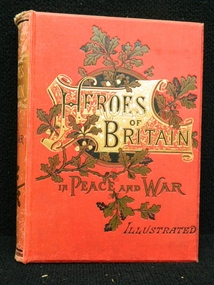
Book, Edwin Hodder, Heroes of Britain in peace and war, Prior to the book prize received in December of 1894
... William and the residence as Neil St, Ballarat. Presbyterian educators placed great value on a classical education matched with diligence in study. Book prizes were highly regarded and academic success admired. In the school’s early years prizes were ordered direct from London and had the school crest embossed in gold on the front or back cover. Many of the prizes given in early years were returned to the school to equip the Weatherly ...This book was awarded to May Adelaide Anstis in 1894 for first prize in Health. May entered Clarendon Ladies' College in 1891. On the original register father's name is listed as William and the residence as Neil St, Ballarat.Presbyterian educators placed great value on a classical education matched with diligence in study. Book prizes were highly regarded and academic success admired. In the school’s early years prizes were ordered direct from London and had the school crest embossed in gold on the front or back cover. Many of the prizes given in early years were returned to the school to equip the Weatherly Library when it opened in 1936.Bound in red cloth with black, green and gilt decoration on front cover and spine. Gilt edges on pages, black and white illustrations throughout. In poor condition with spine and several pages detached. Foxing on pages, 328 p.Book plate inside front cover: Clarendon Ladies' College,/ BALLARAT./ First PRIZE./ Health-Class II./ AWARDED TO/ May Adelaide Anstis/ R. Kennedy,/ PRINCIPAL./ December, 1894. "Clarendon Presbyterian ladies' college" stamped on title page. Book plate on fly leaf: Clarendon Presyterian/ Ladies' College/ Ballarat/ college crest/ Presented by:/ Miss Kimberly/ Date: 30/11/61may-adelaide-anstis, book-prize, 1894, clarendon-ladies'-college, william. -
 Ballarat Clarendon College
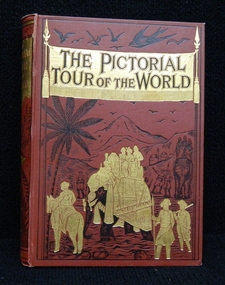
Book, Frederick Warne and Co, The pictorial tour of the world, Prior to the book prize given on December, 1897
... William and the residence as Neil St, Ballarat. Presbyterian educators placed great value on a classical education matched with diligence in study. Book prizes were highly regarded and academic success admired. In the school’s early years prizes were ordered direct from London and had the school crest embossed in gold on the front or back cover. Many of the prizes given in early years were returned to the school to equip the Weatherly ...This book was awarded to May Adelaide Anstis in 1897 for first prize in Geography. May entered Clarendon Ladies' College in 1891. On the original register father's name is listed as William and the residence as Neil St, Ballarat.Presbyterian educators placed great value on a classical education matched with diligence in study. Book prizes were highly regarded and academic success admired. In the school’s early years prizes were ordered direct from London and had the school crest embossed in gold on the front or back cover. Many of the prizes given in early years were returned to the school to equip the Weatherly Library when it opened in 1936.Bound in red calf with gilt and black illustrations on front cover and spine. Gilt edges on pages, color and black and white illustrations throughout. 507 p.Book plate inside front cover: Clarendon Ladies' College/ BALLARAT./ First Prize/ Geography-Class II/ Awarded to/ May Adelaide Anstis/ MRS. KENNEDY,/ PRINCIPAL./ DECEMBER 1897. "Clarendon Presbyterian ladies' college" stamped inside first page. Book plate on fly leaf: Clarendon Presyterian/ Ladies' College/ Ballarat/ college crest/ Presented by:/ Miss Kimberly/ Date: 30/11/61may-adelaide-anstis, book-prize, 1897, clarendon-ladies'-college, william. -
 Ballarat Clarendon College
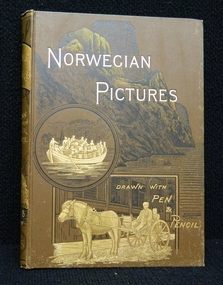
Book, The Religious Tract Society, Norwegian pictures, 1890
... William and the residence as Neil St, Ballarat. Presbyterian educators placed great value on a classical education matched with diligence in study. Book prizes were highly regarded and academic success admired. In the school’s early years prizes were ordered direct from London and had the school crest embossed in gold on the front or back cover. Many of the prizes given in early years were returned to the school to equip the Weatherly ...This book was awarded to May Adelaide Anstis in 1898 for first prize in Botany. May entered Clarendon Ladies' College in 1891. On the original register father's name is listed as William and the residence as Neil St, Ballarat.Presbyterian educators placed great value on a classical education matched with diligence in study. Book prizes were highly regarded and academic success admired. In the school’s early years prizes were ordered direct from London and had the school crest embossed in gold on the front or back cover. Many of the prizes given in early years were returned to the school to equip the Weatherly Library when it opened in 1936.Bound in brown cloth with gilt and black illustrations on front cover and spine. Gilt edges on pages, floral end pages, foxing on pages throughout. Black and white illustrations throughout with fold out colored map. 221 p.Book plate inside front cover: Clarendon Ladies' College,/ BALLARAT./ First Prize./ Botany-Class I/ Awarded to/ May Adelaide Anstis/ MRS. KENNEDY,/ Principal./ DECEMBER, 1898. "Clarendon Ladies' College" stamped on title page. Book plate on fly leaf: Clarendon Presyterian/ Ladies' College/ Ballarat/ college crest/ Presented by:/ Miss Kimberly/ Date: 30/11/61may-adelaide-anstis, book-prize, 1898, clarendon-ladies'-college, william. -
 Ballarat Clarendon College
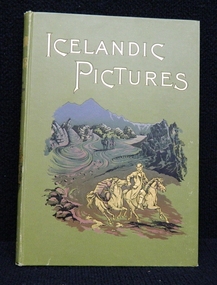
Book, The Religious Tract Society, Icelandic pictures, 1893
... William and the residence as Neil St, Ballarat. Presbyterian educators placed great value on a classical education matched with diligence in study. Book prizes were highly regarded and academic success admired. In the school’s early years prizes were ordered direct from London and had the school crest embossed in gold on the front or back cover. Many of the prizes given in early years were returned to the school to equip the Weatherly ...This book was awarded to May Adelaide Anstis in 1898 for first prize in English. May entered Clarendon Ladies' College in 1891. On the original register father's name is listed as William and the residence as Neil St, Ballarat.Presbyterian educators placed great value on a classical education matched with diligence in study. Book prizes were highly regarded and academic success admired. In the school’s early years prizes were ordered direct from London and had the school crest embossed in gold on the front or back cover. Many of the prizes given in early years were returned to the school to equip the Weatherly Library when it opened in 1936.Bound in green cloth with color illustrations on front cover and spine. Floral end papers, gilt edges, foxing on pages throughout, black and white illustrations throughout. 176 p.Book plate inside front cover: Clarendon Ladies' College,/ BALLARAT./ First Prize./ English-Class I/ Awarded to/ May Adelaide Anstis/ MRS. KENNEDY,/ Principal./ December, 1898. Book plate on fly leaf: Clarendon Presbyterian/ Ladies' College/ Ballarat/ college crest/ Presented by:/ Miss Kimberly/ Date: 30/11/61. "Clarendon Presbyterian Ladies' College" stamped on fly leaf and title page.may-adelaide-anstis, book-prize, 1898, clarendon-ladies'-college, william. -
 Ballarat Clarendon College
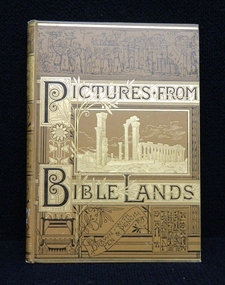
Book, The Religious Tract Society, Pictures from bible lands, Prior to the book prize given on December, 1895
... William and the residence as Neil St, Ballarat. Presbyterian educators placed great value on a classical education matched with diligence in study. Book prizes were highly regarded and academic success admired. In the school’s early years prizes were ordered direct from London and had the school crest embossed in gold on the front or back cover. Many of the prizes given in early years were returned to the school to equip the Weatherly ...This book was awarded to May Adelaide Anstis in 1895 for first prize in Bible. May entered Clarendon Ladies' College in 1891. On the original register father's name is listed as William and the residence as Neil St, Ballarat.Presbyterian educators placed great value on a classical education matched with diligence in study. Book prizes were highly regarded and academic success admired. In the school’s early years prizes were ordered direct from London and had the school crest embossed in gold on the front or back cover. Many of the prizes given in early years were returned to the school to equip the Weatherly Library when it opened in 1936. Bound in brown cloth with gilt and black illustrations on front cover and spine. Floral end papers, gilt edges, black and white illustrations throughout, foxing on pages. 214 p.Book plate inside front cover: Clarendon Ladies' College,/ BALLARAT./ First PRIZE./ Bible-Class II./ AWARDED TO/ May Adelaide Anstis/ R. Kennedy,/ PRINCIPAL./ December, 1895. "Clarendon Presbyterian ladies' college" stamped on fly leaf and title page. Book plate on fly leaf: Clarendon Presyterian/ Ladies' College/ Ballarat/ college crest/ Presented by:/ Miss Kimberly/ Date: 30/11/61may-adelaide-anstis, book-prize, 1895, clarendon-ladies'-college, william. -
 Ballarat Clarendon College
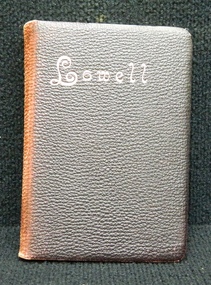
Book, W. P. Nimmo, Hay, & Mitchell, The poetical works of James Russell Lowell, Prior to the book prize given on December, 1898
... William and the residence as Neil St, Ballarat. Presbyterian educators placed great value on a classical education matched with diligence in study. Book prizes were highly regarded and academic success admired. In the school’s early years prizes were ordered direct from London and had the school crest embossed in gold on the front or back cover. Many of the prizes given in early years were returned to the school to equip the Weatherly ...This book was awarded to May Adelaide Anstis in 1898 for first prize in Latin. May entered Clarendon Ladies' College in 1891. On the original register father's name is listed as William and the residence as Neil St, Ballarat.Presbyterian educators placed great value on a classical education matched with diligence in study. Book prizes were highly regarded and academic success admired. In the school’s early years prizes were ordered direct from London and had the school crest embossed in gold on the front or back cover. Many of the prizes given in early years were returned to the school to equip the Weatherly Library when it opened in 1936.Bound in brown padded calf with red/gilt edges. Floral end papers, several black and white illustrations, slight spine detachment. Some discolouring of pages, 519 p.Book plate inside front cover: Clarendon Ladies' College,/ BALLARAT./ First PRIZE./ Latin-Class I./ AWARDED TO/ May Adelaide Anstis/ R. Kennedy,/ PRINCIPAL./ December, 1894. "Clarendon Presbyterian ladies' college" stamped on fly leaf. Book plate on fly leaf: Clarendon Presyterian/ Ladies' College/ Ballarat/ college crest/ Presented by:/ Miss Kimberly/ Date: 30/11/61may-adelaide-anstis, book-prize, 1898, clarendon-ladies'-college, william. -
 Ballarat Clarendon College
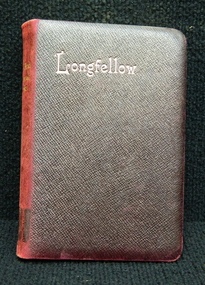
Book, Frederick Warne and Co. et al, The poetical works of Longfellow, Prior to the book prize given on December 1897
... William and the residence as Neil St, Ballarat. Presbyterian educators placed great value on a classical education matched with diligence in study. Book prizes were highly regarded and academic success admired. In the school’s early years prizes were ordered direct from London and had the school crest embossed in gold on the front or back cover. Many of the prizes given in early years were returned to the school to equip the Weatherly ...This book was awarded to May Adelaide Anstis in 1897 for first prize in Arithmetic. May entered Clarendon Ladies' College in 1891. On the original register father's name is listed as William and the residence as Neil St, Ballarat.Presbyterian educators placed great value on a classical education matched with diligence in study. Book prizes were highly regarded and academic success admired. In the school’s early years prizes were ordered direct from London and had the school crest embossed in gold on the front or back cover. Many of the prizes given in early years were returned to the school to equip the Weatherly Library when it opened in 1936.Bound in soft brown calf with gilt lettering on front cover and spine. Floral end papers with slight foxing on pages. Red gilt edges, 664 p.Book plate inside front cover: Clarendon Ladies' College/ BALLARAT./ First Prize./ Arithmetic-Class II/ Awarded to/ May Adelaide Anstis/ MRS. KENNEDY,/ PRINCIPAL./ DECEMBER 1897. Book plate on fly leaf: Clarendon Presyterian/ Ladies' College/ Ballarat/ college crest/ Presented by:/ Miss Kimberly/ Date: 30/11/61may-adelaide-anstis, book-prize, 1897, clarendon-ladies'-college, william. -
 Ballarat Clarendon College
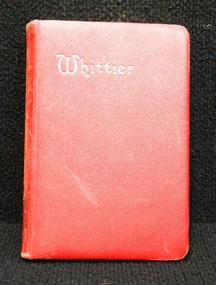
Book, Frederick Warne and Co. et al, The poetical works of John Greenleaf Whittier, Prior to the book prize given on December, 1897
... William and the residence as Neil St, Ballarat. Presbyterian educators placed great value on a classical education matched with diligence in study. Book prizes were highly regarded and academic success admired. In the school’s early years prizes were ordered direct from London and had the school crest embossed in gold on the front or back cover. Many of the prizes given in early years were returned to the school to equip the Weatherly ...This book was awarded to May Adelaide Anstis in 1897 for first prize in Arithmetic. May entered Clarendon Ladies' College in 1891. On the original register father's name is listed as William and the residence as Neil St, Ballarat.Presbyterian educators placed great value on a classical education matched with diligence in study. Book prizes were highly regarded and academic success admired. In the school’s early years prizes were ordered direct from London and had the school crest embossed in gold on the front or back cover. Many of the prizes given in early years were returned to the school to equip the Weatherly Library when it opened in 1936.Bound in soft red calf with gilt lettering on front cover and spine. Red gilt edges and floral end papers. 576 p.Book plate inside front cover: Clarendon Ladies' College/ BALLARAT./ First Prize./ Composition-Class II/ Awarded to/ May Adelaide Anstis/ MRS. KENNEDY,/ PRINCIPAL./ DECEMBER 1897 "Clarendon Presbyterian ladies' college" stamped on title page adn fly leaf. Book plate on fly leaf: Clarendon Presyterian/ Ladies' College/ Ballarat/ College crest/ Presented by:/ Miss Kimberly/ Date: 30/11/61may-adelaide-anstis, book-prize, 1897, clarendon-ladies'-college, william. -
 Ballarat Clarendon College
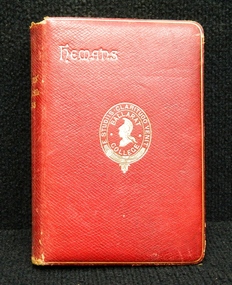
Book, William Michael Rossetti, The poetical works of Mrs. Felicia Hemans, Prior to the book prize presented on Christmas, 1891
... Weatherly Library when it opened in 1936. Connection to college war memorabilia and war heroes. stephen-john-holgate 1891 book-prize miners-rest harold-holgate george-holgate edward-holgate robert-holgate thomas-holgate. Book plate inside front cover: College crest/ Bookkeeping/ V Form./ First Prize. Awarded to/ S. Holgate/ Christmas, 1891. Bound in soft red calf with gilt lettering and college crest embossed on front cover and gilt lettering on spine. Floral end papers, foxing on pages, black and white illustrations throughout. 595 p. The poetical works of Mrs. Felicia Hemans Book Griffith and Farran William ...Book was awarded to Stephen John Holgate in 1891 for first prize in bookkeeping. Stephen (D.O.B. 09/07/1877) entered the college on 27/01/1890. The original registry notes parent as Stephen Holgate from Miners Rest and Stephen's previously school is noted as 'Home Tuition'. Other family members noted as attending the college are Harold, George, Edward, Robert and Thomas. Archives also hold war memorabilia for Edward and George Holgate.Presbyterian educators placed great value on a classical education matched with diligence in study. Book prizes were highly regarded and academic success admired. In the school’s early years prizes were ordered direct from London and had the school crest embossed in gold on the front or back cover. Many of the prizes given in early years were returned to the school to equip the Weatherly Library when it opened in 1936. Connection to college war memorabilia and war heroes.Bound in soft red calf with gilt lettering and college crest embossed on front cover and gilt lettering on spine. Floral end papers, foxing on pages, black and white illustrations throughout. 595 p.Book plate inside front cover: College crest/ Bookkeeping/ V Form./ First Prize. Awarded to/ S. Holgate/ Christmas, 1891.stephen-john-holgate, 1891, book-prize, miners-rest, harold-holgate, george-holgate, edward-holgate, robert-holgate, thomas-holgate. -
 Ballarat Clarendon College
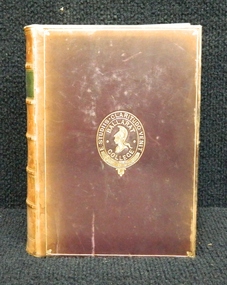
Book, Sir Walter Scott, The poetical works of Sir Walter Scott, 1894
... William's brother David McMurtrie enrolled in the college in 1886 at the age of 14. Presbyterian educators placed great value on a classical education matched with diligence in study. Book prizes were highly regarded and academic success admired. In the school’s early years prizes were ordered direct from London and had the school crest embossed in gold on the front or back cover. Many of the prizes given in early years were returned to the school to equip the Weatherly ...This book was awarded to William Kerr Paterson for English Subjects as first prize in the fifth form in 1894. William enrolled in Ballarat College in 1891 (D.O.B. 5/11/1876). In the original register it lists parent/guardian as John Paterson, contractor, residing at 12 Errard Street South. It also states that previous school was SS.33, [subsequently known as Dana Street P.S]. William's brother David McMurtrie enrolled in the college in 1886 at the age of 14.Presbyterian educators placed great value on a classical education matched with diligence in study. Book prizes were highly regarded and academic success admired. In the school’s early years prizes were ordered direct from London and had the school crest embossed in gold on the front or back cover. Many of the prizes given in early years were returned to the school to equip the Weatherly Library when it opened in 1936.Bound in brown calf with college crest embossed on front cover. Six raised bands on spine with gilt lettering on all but second compartment. Second compartment contains green calf with gilt lettering. Marble end papers, red/gilt edges, slight foxing on pages, slight detached spine, 758 p.Book plate inside front cover: College crest/ English Subjects/ Fifth Form./ First Prize./ Awarded to/ William Paterson/ Christmas, 1894william-kerr-paterson, book-prize, 1894, john-paterson, 12-errard-street-south, ss.33, david-mcmurtrie-paterson. -
 Ballarat Clarendon College
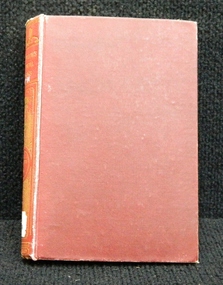
Book, Frederick Warne and Co. et al, The poetical works of Longfellow, Prior to the book prize received in December of 1893
... William, occupation Barrister and residence as 58 Doveton Street, South Ballarat. Lilian's sibling attending Clarendon Ladies' College is Sarah Florence (enrolled 1884). Siblings attending Ballarat Clarendon College are George (enrolled 1889) and Arthur (enrolled 1885). Presbyterian educators placed great value on a classical education matched with diligence in study. Book prizes were highly regarded and academic success admired. In the school’s early years prizes were ordered direct from London and had the school crest embossed in gold on the front or back cover. Many of the prizes given in early years were returned to the school to equip the Weatherly ...This book was awarded to Lilian Jane Tweedie in 1893 for First prize in Latin (Preparation). Lilian enrolled in Clarendon Ladies' College in April 1891. In the original register it lists parent as William, occupation Barrister and residence as 58 Doveton Street, South Ballarat. Lilian's sibling attending Clarendon Ladies' College is Sarah Florence (enrolled 1884). Siblings attending Ballarat Clarendon College are George (enrolled 1889) and Arthur (enrolled 1885). Presbyterian educators placed great value on a classical education matched with diligence in study. Book prizes were highly regarded and academic success admired. In the school’s early years prizes were ordered direct from London and had the school crest embossed in gold on the front or back cover. Many of the prizes given in early years were returned to the school to equip the Weatherly Library when it opened in 1936.Bound in brown cloth with gilt decoration and inscription on spine. Floral end papers, detached papers, slight foxing on pages, 664 p.Book plate inside front cover: Clarendon Ladies' College,/ BALLARAT./ First Prize./ Latin (Preparation) Class III/ Awarded to/ Lilian Jane Tweedie/ REV. R. KENNEDY,/ PRINCIPAL./ December, 1893. Stamped on fly leaf: "BALLARAT COLLEGE NOT TO BE REMOVED FROM LIBRARY" Donation label on fly leaf: Literature./ College emblem/ Ballarat College Library/ PRESENTED BY/ Miss E. Tweedie/ &/ Mr F. Tweedie 1947/ PLEASE REPORT ANY LOOSE LEAVES, ETC.lilian-jane-tweedie, 1893, book-prize, clarendon-ladies'-college, william-tweedie, 58-doveton-st-south-ballarat, sarah-florence-tweedie, george-tweedie, arthur-tweedie. -
 Ballarat Clarendon College
Book, The history of the decline and fall of the Roman Empire: 8 Vols, 1848
... william-meinhardt...ballarat-college...weatherly...Books donated to the Ballarat College Weatherly Library by W L Meinhardt in 1942. William (Bill) Meinhardt attended Ballarat College 1935 - 1945....Books donated to the Ballarat College Weatherly Library by W L Meinhardt in 1942. William (Bill) Meinhardt attended Ballarat College 1935 - 1945. ...Books donated to the Ballarat College Weatherly Library by W L Meinhardt in 1942. William (Bill) Meinhardt attended Ballarat College 1935 - 1945.Example of ongoing old collegian support of school. The Weatherly Library was opened in 1936 and its collection significantly established by donation or bequest of old collegians.Set of eight volumes leather bound with gold patterning on spine and cover and marbled endpapers.Book plates on flyleaf: Ballarat College crest / Ballarat College Library / PRESENTED BY / W L Meinhardt 1942.... Book plates inside front cover: St Aidan's Clergy Trainign House Ballaratwilliam-meinhardt, ballarat-college, weatherly-library, 1942 -
Ballarat Clarendon College
Book
... Thirteen books donated by Mrs Paterson to the Weatherly Library at Ballarat College in 1946. Books include hand-written signatures of Mollie Paterson and William Paterson. ...Thirteen books donated by Mrs Paterson to the Weatherly Library at Ballarat College in 1946. Books include hand-written signatures of Mollie Paterson and William Paterson. ...Thirteen books donated by Mrs Paterson to the Weatherly Library at Ballarat College in 1946. Books include hand-written signatures of Mollie Paterson and William Paterson. This may identify the books as having been donated by the wife of old collegian William Paterson who attended Ballarat College 1917 - 1825. He served on the Ballarat College council 1960-1971.Sixteen books, variously titled and sized, including 13 volume set 'The history of the great European war. Book plate inside front covers: Ballarat College Library / PRESENTED BY / Mrs Paterson 1946william-paterson, mollie-paterson, 1946, ballarat-college, mrs-w-paterson, weatherly-library -
Ballarat Clarendon College
Book, Memoirs of the court of England
... Donated to the Ballarat College Weatherly Library in 1952 by former student William (Bill) Jeffrey Bainbridge Elliot House | Head prefect | School Captain 1948 | Magazine editor...Donated to the Ballarat College Weatherly Library in 1952 by former student William (Bill) Jeffrey Bainbridge Elliot House | Head prefect | School Captain 1948 | Magazine editor weatherly-library ballarat-college william-j-bainbridge 1939 Inside front cover: Crest / Ballarat College / Library / PRESENTED BY / W Bainbridge 1952 etc Red cloth bound book with gold lettering on cover; black library binding around spine. call number fixed to base of spine and white lettering. ...Donated to the Ballarat College Weatherly Library in 1952 by former student William (Bill) Jeffrey Bainbridge Elliot House | Head prefect | School Captain 1948 | Magazine editorRed cloth bound book with gold lettering on cover; black library binding around spine. call number fixed to base of spine and white lettering.Inside front cover: Crest / Ballarat College / Library / PRESENTED BY / W Bainbridge 1952 etcweatherly-library, ballarat-college, william-j-bainbridge, 1939 -
 Ballarat Clarendon College
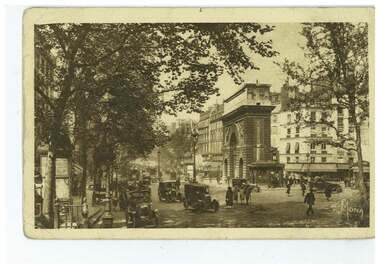
Postcard
... Postcard sent to Ballarat College boarder, William L Sloss, by his mother Bernice A Sloss during a visit to Paris with his father in 1929.Its slightly formal phrasing gives insight into parent-child relations of the era. bernice-a-sloss ballarat college boarding 1929 bill-sloss william-l-sloss-1934 postcard Address: Master Bill Sloss / Ballarat College / Ballarat - Victoria / Australia Letter: 21/3/29 / This is just a tiny corner of Paris. It is a very busy city and the taxis and cars make a dreadful noice - far greater noise than in London. Though traffic is just as great - We are having lovely weather ...Postcard sent to Ballarat College boarder, William L Sloss, by his mother Bernice A Sloss during a visit to Paris with his father in 1929.Its slightly formal phrasing gives insight into parent-child relations of the era. Black and white illustrated postcard; photograph of Paris scene on front; hand-written letter on back and 90p stamp attached;Address: Master Bill Sloss / Ballarat College / Ballarat - Victoria / Australia Letter: 21/3/29 / This is just a tiny corner of Paris. It is a very busy city and the taxis and cars make a dreadful noice - far greater noise than in London. Though traffic is just as great - We are having lovely weather to see this beautiful city. We are all well. Hope you are. Daddy is visiting hospital. Love from us all - Your loving mother, Bernice A Sloss.bernice-a-sloss, ballarat college, boarding, 1929, bill-sloss, william-l-sloss-1934, postcard -
Ballarat Clarendon College
Book, The history of the Great European War . Vols I-II
... Possibly wife of old collegian William Arbuckle Paterson (PY1925) who served on the Ballarat College Council 1960-1971. Example of ongoing commmunity support of the school. The Weatherly ...Presented to the school by Mrs W Paterson in 1948. Possibly wife of old collegian William Arbuckle Paterson (PY1925) who served on the Ballarat College Council 1960-1971.Example of ongoing commmunity support of the school. The Weatherly Library was opened in 1936 and its collection significantly established by donation or bequest of old collegians and members of the college community and associates.Red cloth bound books with gold and black lettering and illutsration on spine and coverBook plate on flyleaf: Literature / Crest / Ballarat College / Library / Presented by / Mrs W Paterson 1948...w-a-paterson, weatherly-library, ballarat-college -
Ballarat Clarendon College
Book, The life of Vice-Admiral William Bligh Vol I-II
... The Weatherly Library was opened in 1936 and its collection significantly established by donation or bequest of old collegians and members of the college community and associates. peebles ballarat-college weatherly-library Book plate inside front cover: Crest / Ballarat College / Library / Presented by / Misses Peebles 1936... Medium cloth bound books with gold lettering on spine The life of Vice-Admiral William Bligh Vol I-II Book ...Presented to the school by the Misses Peebles, identity unknown. Example of ongoing community support of the school. The Weatherly Library was opened in 1936 and its collection significantly established by donation or bequest of old collegians and members of the college community and associates.Medium cloth bound books with gold lettering on spineBook plate inside front cover: Crest / Ballarat College / Library / Presented by / Misses Peebles 1936...peebles, ballarat-college, weatherly-library
