
Showing 285 items matching "wood, p."
-
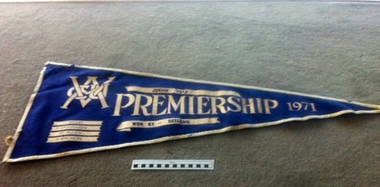 Geelong Cycling Club
Pennant, 1971
... vacu; junior road; premiership; 1971; geelong cycling club; gcc; i. wood; p. mckinnon; m. allen; k. salmon;..."VACU/Junior Road/Premiership 1971/Won by Geelong/I Wood/P McKinnon/M Allen/K Salmon"...Record of strength of Juniors in the Club vacu; junior road; premiership; 1971; geelong cycling club; gcc; i. wood; p. mckinnon; m. allen; k. salmon; "VACU/Junior Road/Premiership 1971/Won by Geelong/I Wood/P McKinnon/M Allen/K Salmon" Triangular Pennant in blue felt trimmed with white felt. ...Amateurs during this period were strong. Ian Wood had won a schoolboys championship. This pennant charts his progress.Record of strength of Juniors in the ClubTriangular Pennant in blue felt trimmed with white felt. Wording regarding event and winners is embossed in white over the navy blue felt."VACU/Junior Road/Premiership 1971/Won by Geelong/I Wood/P McKinnon/M Allen/K Salmon"vacu; junior road; premiership; 1971; geelong cycling club; gcc; i. wood; p. mckinnon; m. allen; k. salmon; -
 Bendigo Historical Society Inc.
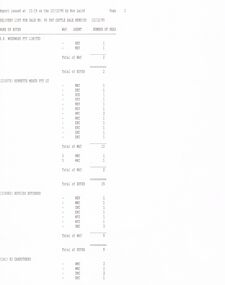
Document - BENDIGO SALEYARDS COLLECTION: FAT CATTLE SALE BENDIGO 12/12/95
... ... R Wood... P...Buyers names are: R H Woodward Pty Limited, Bennetts Meats Pty Ltd, Boydies Butchers, KJ Carruthers, Earl Chislett, Clifford Quality Meats, Dalgety Farmers Pty, Elders Ltd, Ferntree Meats, Friswell K, RJ Gilbertson 210263, R J Gilbertson 640, Gregory J, Grenfell N, hardwick GF & VC, Highland S Huddle, ICM1, ICM4, Maher L, Masons Meat Pty Ltd, JJ McAllister, McGillivary GK & GY, McIvor Meats Midfield Meat Wholesa, No Commercial Value, Newman Livestock Sales 153, Newman Livestock Sales N 257,Newman Livestock Sales 3 269, Newman Livestock Sale No 271, Newman Livestock Sales N 480, Newman Livestock Sale No 282, Oakey C/- T Newman, O'Connor G & K Pty Ltd, Penney & Lang PtyLtd, J H Ralph & Son, Safeway No 188, Andrew Schenk, Starr A, Tehan TP & MW, Top Meats, Wagstaff Cranbourne P, D & K Webb, Welsh, RH Woodward & Co 442, RH Woodward & Co 454, RH Woodward & Co 466, Woodhead B, RH Woodward & Co 405, RH Woodward & Co 417, N Lowndes, Penney & Lang 2, Comer, R Wood and P Sheldon....BENDIGO Council cattle markets Bendigo Saleyards Collection - Fat Cattle Sale Bendigo 12/12/95 Ron Laird R H Woodward Pty Limited Bennetts Meats Pty Ltd Boydies Butchers KJ Carruthers Earl Chislett Clifford Quality Meats Dalgety Farmers Pty Elders Ltd Ferntree Meats Friswell K RJ Gilbertson 210263 R J Gilbertson 640 Gregory J Grenfell N hardwick GF & VC Highland S Huddle ICM1 ICM4 Maher L Masons Meat Pty Ltd JJ McAllister McGillivary GK & GY McIvor Meats Midfield Meat Wholesa No Commercial Value Newman Livestock Sales 153 Newman Livestock Sales N 257 Newman Livestock Sales 3 269 Newman Livestock Sale No 271 Newman Livestock Sales N 480 Newman Livestock Sale No 282 Oakey C/- T Newman O'Connor G & K Pty Ltd Penney & Lang PtyLtd J H Ralph & Son Safeway No 188 Andrew Schenk Starr A Tehan TP & MW Top Meats Wagstaff Cranbourne P D & K Webb Welsh RH Woodward & Co 442 RH Woodward & Co 454 RH Woodward & Co 466 Woodhead B RH Woodward & Co 405 RH Woodward & Co 417 N Lowndes Penney & Lang 2 Comer R Wood P Sheldon Continuous twenty page report for Sale No. 90 Fat Cattle Sale Bendigo dated 12/12/95. ...Continuous twenty page report for Sale No. 90 Fat Cattle Sale Bendigo dated 12/12/95. Report issued on the 12/12/95 by Ron Laird. Report lists the buyers name and the number of head purchased each time from each agent and the total number purchased. Agents names are abbreviated. Buyers names are: R H Woodward Pty Limited, Bennetts Meats Pty Ltd, Boydies Butchers, KJ Carruthers, Earl Chislett, Clifford Quality Meats, Dalgety Farmers Pty, Elders Ltd, Ferntree Meats, Friswell K, RJ Gilbertson 210263, R J Gilbertson 640, Gregory J, Grenfell N, hardwick GF & VC, Highland S Huddle, ICM1, ICM4, Maher L, Masons Meat Pty Ltd, JJ McAllister, McGillivary GK & GY, McIvor Meats Midfield Meat Wholesa, No Commercial Value, Newman Livestock Sales 153, Newman Livestock Sales N 257,Newman Livestock Sales 3 269, Newman Livestock Sale No 271, Newman Livestock Sales N 480, Newman Livestock Sale No 282, Oakey C/- T Newman, O'Connor G & K Pty Ltd, Penney & Lang PtyLtd, J H Ralph & Son, Safeway No 188, Andrew Schenk, Starr A, Tehan TP & MW, Top Meats, Wagstaff Cranbourne P, D & K Webb, Welsh, RH Woodward & Co 442, RH Woodward & Co 454, RH Woodward & Co 466, Woodhead B, RH Woodward & Co 405, RH Woodward & Co 417, N Lowndes, Penney & Lang 2, Comer, R Wood and P Sheldon.bendigo, council, cattle markets, bendigo saleyards collection - fat cattle sale bendigo 12/12/95, ron laird, r h woodward pty limited, bennetts meats pty ltd, boydies butchers, kj carruthers, earl chislett, clifford quality meats, dalgety farmers pty, elders ltd, ferntree meats, friswell k, rj gilbertson 210263, r j gilbertson 640, gregory j, grenfell n, hardwick gf & vc, highland s huddle, icm1, icm4, maher l, masons meat pty ltd, jj mcallister, mcgillivary gk & gy, mcivor meats midfield meat wholesa, no commercial value, newman livestock sales 153, newman livestock sales n 257, newman livestock sales 3 269, newman livestock sale no 271, newman livestock sales n 480, newman livestock sale no 282, oakey c/- t newman, o'connor g & k pty ltd, penney & lang ptyltd, j h ralph & son, safeway no 188, andrew schenk, starr a, tehan tp & mw, top meats, wagstaff cranbourne p, d & k webb, welsh, rh woodward & co 442, rh woodward & co 454, rh woodward & co 466, woodhead b, rh woodward & co 405, rh woodward & co 417, n lowndes, penney & lang 2, comer, r wood, p sheldon -
 Uniting Church Archives - Synod of Victoria
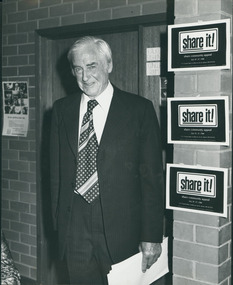
Photograph, C. 1980
... Wood, P....Gillam Albert McConnell Wood (Pat) (1910-1993) OBE OAM was a RAFF Chaplain 1942-49 and Moderator General Australian in 1975. Wood, P. Presbyterian Moderator General Gloss, three-quarter image of Rev. ...Rev. Gillam Albert McConnell Wood (Pat) (1910-1993) OBE OAM was a RAFF Chaplain 1942-49 and Moderator General Australian in 1975.Gloss, three-quarter image of Rev. Gillam Albert McConnell Wood (Pat) in situ.wood, p., presbyterian, moderator general -
 Uniting Church Archives - Synod of Victoria
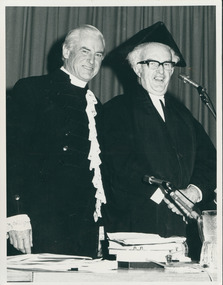
Photograph, 1970
... Wood, P....He was Director of General Conference, Department of Christian Education. Wood, P. Presbyterian Methodist Moderator General Voice of Methodism Yarra Bank Gloss, three-quarter image of Rev. ...Rev. Pat Wood (1910-1993) OBE OAM was a RAFF Chaplain 1942-49 and Moderator General Australian in 1975. Re Rex Collis Mathias (1907-1986) was a peace activist and spoke to the public on the Yarra Bank under the banner of "voice of Methodism". He led the Young People's Department in 1939 and in 1940 was Chaplain of Wesley College. He was Director of General Conference, Department of Christian Education.Gloss, three-quarter image of Rev. Gillam Albert McConnell Wood (Pat) and Rev. Rex Collis Mathias in situ.wood, p., presbyterian, methodist, moderator general, voice of methodism, yarra bank -
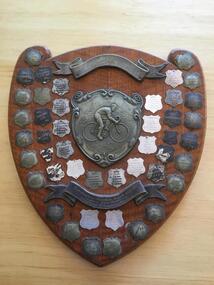 Geelong Cycling Club
Shield, 1948
... perpetual shield; ian davis; annual western district teams championship; terang acc; warrnambool acc; sebastopol acc; geelong acc; camperdown acc; wilson; godfrey; macauley; hose; g. williams; n. williams; d. libbis; c. judd; r. bush; p. macauley; i. wood; colac; p. forster; p. rippon; p. taylor; d.lunn; ballarat; sebastopol; p. taylor; m. leverett; d. keirl; d. williams; g. fitsimmons; b. crane; l. clinnick; d. lunn; c.caspon; d. allan; p. jannsen; p. macaule; b. crane; d. fitzsimmons; c. cashin; d. forster; l. nogera; s. cropley; c. cashin; j. stirling; d. whitford; p. evans; m. varker;...Williams/R. Bush/ P. Macauley/I. Wood/1983/Colac/P. Forster/P. Rippon/P. ...Williams/R. Bush/ P. Macauley/I. Wood/1983/Colac/P. Forster/P. Rippon/P. ...Team Road Races were a popular feature of club cycling in the Western District of Victoria during the second half of the 20th century. The shield was initiated by the Camperdown cycling club to record team winners of the races held between the clubs in the Western District of Victoria. This shield has an important place in the history of cycling in the Western District of Victoria. A large wooden shield with silver coloured plated plaques containing inscriptions of team winners of road races in the Western District of Victoria. There is a smaller shield in the centre of the shield depicting a cyclist and above and below this are banner like plaques with inscriptions on them. Many of the inscriptions have worn with age. "Perpetual Shield/Ian Davis - Gift Specialist/Camperdown .... CycleClub/Annual Western District/Teams Championship/1948/Terang ACC/No1 Team/1949/Terang ACC/No 1 Team/1950/Warrnambool ACC/No1 Team/1951/Warrnambool ACC/No1Team/1952/WarrnamboolACC/No1Team/1953/Sebastopol/ACC/1954/Sebastopol/ACC/1955/Geelong/No1 Team/1956/Camperdown ACC/1957/Sebastopol/No1 Team/1958/Geelong ACC/No1 Team/1959/Warrnambool ACC/No1 Team/1960/Geelong ACC/No1 Team/1961/Camperdown ACC/No 1 Team/1962/Geelong Camperdown/No1 Teams/ Equal/1963/Camperdown ACC/No 1 Team/1964/Geelong ACC/No 1 Team/1965/Geelong ACC/No 1 Team/1966/Geelong ACC/No 1 Team/1967/Geelong ACC/No 1 Team/1968/Geelong ACC/No 1 Team/1969/Geelong ACC/No 1 Team/1970/Geelong ACC/No 1 Team/1971-1976/inscriptions faded/1977/Warrnambool ACC/No1 Team/1978/Warrnambool ACC/No1 Team/1979/Geelong/N. Wilson/Godfrey/MacAuley/Hose/1980/Geelong/Inscriptions faded/1981/Geelong/G. Williams/N. Williams/D. Libbis/C. Judd/1982/Geelong/G. Williams/R. Bush/ P. Macauley/I. Wood/1983/Colac/P. Forster/P. Rippon/P. Taylor/D. Lunn/1984/Ballarat/Sebastopol/P. Taylor/M. Leverett/D. Keirl/1985/Geelong/D. Williams/G. Fitsimmons/B. Crane/L. Clinnick/1986/Colac/D. Lunn/C.Caspon/D. Allan/P. Jannsen/1987/Geelong/G. Williams/P. Macauley/B. Crane/D. Fitzsimmons/1988/.../1989/.../1990/Colac/C. Cashin/D. Forster/L. Nogera/S. Cropley/1991/Colace/C. Cashin/J. Stirling/S. Cropley/1992/Geelong West/D. Whitford/D. Wilson/P. Evans/M. Varker"perpetual shield; ian davis; annual western district teams championship; terang acc; warrnambool acc; sebastopol acc; geelong acc; camperdown acc; wilson; godfrey; macauley; hose; g. williams; n. williams; d. libbis; c. judd; r. bush; p. macauley; i. wood; colac; p. forster; p. rippon; p. taylor; d.lunn; ballarat; sebastopol; p. taylor; m. leverett; d. keirl; d. williams; g. fitsimmons; b. crane; l. clinnick; d. lunn; c.caspon; d. allan; p. jannsen; p. macaule; b. crane; d. fitzsimmons; c. cashin; d. forster; l. nogera; s. cropley; c. cashin; j. stirling; d. whitford; p. evans; m. varker; -
 Glen Eira Historical Society
Letter - CAULFIELD CENTENARY - 1957
... P.... Wood F.G....Kirkham C.F. Lloyd C.Du P. Wood F.G. Akhurst A.C. Riddell W.J.C. Sharp T.C. ...This file contains seven items: 1/One double sided pamphlet regarding the Caulfield Centenary Carnival at Caulfield Park from 25/10/1957 to 05/11/1957, listing attractions and special events. Includes advertising for Bunny Industries on the back. 2/One pamphlet for the Children’s Carnival at Caulfield Racecourse on 29/10/1957 as part of the City of Caulfield Centenary celebrations. The pamphlet includes a timetable for the day’s events. 3/One six page pamphlet for a film festival organised by the Caulfield Film Society as part of the City of Caulfield Centenary Celebrations. The pamphlet includes a programme for each of the four days of the film festival, 14/10/1957, 17/10/1957, 23/10/1957 and 25/10/1957. The pamphlet also includes information about the Caulfield Film Society regarding their formation, their values, their manifesto and their officials. 4/An eight page programme for the centenary Thanksgiving Service on 13/10/1957 featuring prayers and hymns. 5/Two copies of a pamphlet regarding City of Caulfield Centenary Celebrations from 13/10/1957 to 05/11/1957 created by H.G. Nelson, Town Clerk. Events listed include Thanksgiving Service, Music Festival, Film Festival, Special Centenary Council Meeting, Gymkhana, Parade of Decorated Floats, Spring Flower Show, Massed Bands Display, Display of Art, Naturalisation Ceremony, Solemn High Mass, carnivals and plaque unveiling. 6/One original and one photocopy of an eight page notice paper for the Special Meeting of Caulfield City Council to commemorate the 100th Anniversary of the proclamation and declaration of the Caulfield Road District, to be held on 15/10/1957. The booklet includes the agenda, a council summons, a picture of Caulfield’s City Hall and a list of current and past councillors, chairmen, presidents, mayors and Shire Secretaries and town clerks. 7/A letter addressed to F. Campbell from Hazel Da Costa, dated 07/11/1997 regarding the acquisition of pamphletts for the Caulfield Centenary Carnival. For further information refer to the Oakleigh and Caulfield Times 09/10/1957 and Caulfield-Elsternwick Advertiser 05/11/1957 and 22/10/1957 stored in the Newspaper Archive room 4.caulfield centenary carnival, queen crowning ceremony, dandh bunny pty ltd, caulfield film society, carnegie memorial hall, caulfield park, hawthorn road, balaclava road, glenhuntly road, parades and processions, fire works displays, festivals and celebrations, bunny industries, glen press, hardware stores, builders suppliers, plumbers suppliers, centenary celebration, caulfield centenary, children’s carnival, caulfield racecourse, sinclair a.j.g., sporting events, film festival, new supper room, town hall, methodist hall, saint john hall, birch street, orrong road, princes park, caulfield hospital, daughters e.f., ward miss n., madigan mr. r, ritchie miss e., weichelt mr f., machin l.r., green w.c., jenner e.r., thomas w.r., centenary thanksgiving service, hymns, prayers, naturalisation ceremony, caulfield and district horses and pony club, special centenary council meeting, caulfield horticulture society, saint aloysius church, packer reserve, oakleigh road, caulfield memorial youth centre, commemoration, caulfield road district, mayors, presidents, chairmen, councillors, town clerks, parton e.m., bunny f.c.d., sims h.e., thomson w.r., wallace g.e., gunn e.e., gamble h.a., yorston j.s., handasyde g., murry ross w., stephen j.w., masters s., lloyd j.c., watts thos., watts t., nelson c., webb g.h., stephen f.j., crosbie j.w., watts w.c., holland j.c., lempriere w.g., millar w., newing t. r., ballantyne j., cotton a.d., long j., kirkham c.f., lloyd c.du p., wood f.g., akhurst a.c., riddell w.j.c., sharp t.c., phillips r.l., lempriere j.t., bayston w.s., dunbar a., hall p., saint j., fiske w., thompson h., murphy e.c., eggleston f.w., murray n.l., wood h.s., tyner w., wharington w.a., packer j.t., falls t., brooks w.r., lord r.h., morris a.e., page j.w., porter f.w., england e.f.s, patton r.t., mcculloch r., richie h.g., packer j.t., mackinnon d.c., mackinnon g.a., smith h.c.h., shillabeer f.e., pullman c.a., stewart l.mcr., tyers s.w., morris t.w., prior p.l., brooks w.r., webster h.c., sims h.e., prior p.l., thomson w.r., gunn e.e., parton e.m., wallace g.e., dempsey w., hart j., jowett f., briggs j.r., nelson h.g. -
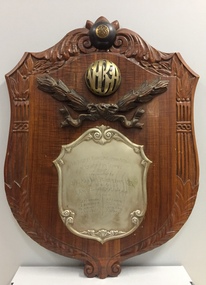 Kew Historical Society Inc
Award, V.B.A, President’s Trophy, 1937
... VBA / VICTORIA BOWLING ASSOCIATION / PRESIDENT'S TROPHY / PRESENTED BY *** SIR WM BRUNTON / WON BY KEW BOWLING CLUB / TEAMS / JP CUMMINS, LH HAMBLETON, CG WOOD, P VANCE, / AD TAYLOR, RLR TROON, HE FRASER, FH RIGG...The collection illuminates two of the Victorian historic themes - 'Building community life' through forming community organisations and 'Shaping cultural and creative life' by participating in sport and recreation. kew bowling club - wellington street - kew (vic) clubs - lawn bowls - kew (vic) trophies - lawn bowls VBA / VICTORIA BOWLING ASSOCIATION / PRESIDENT'S TROPHY / PRESENTED BY *** SIR WM BRUNTON / WON BY KEW BOWLING CLUB / TEAMS / JP CUMMINS, LH HAMBLETON, CG WOOD, P VANCE, / AD TAYLOR, RLR TROON, HE FRASER, FH RIGG Wood, brass and white metal VBA President's trophy. ...Sports Clubs in Kew in the final decades of the 19th century and in the early 20th century were often umbrella organisations with facilities for a number of sports. Typically in Kew, this included teams in lawn bowls, tennis and croquet. The Kew Bowling Club was formed in 1880 while the privately owned Auburn Heights Recreation Club was opened in 1904. By 1998, the two Clubs decided to amalgamate at the Auburn Heights site in Barkers Road, forming the Kew Heights Sports Club. The combined club was itself taken over by the Melbourne Cricket Club in 2012 becoming MCC Kew Sports Club. In 2017 MCC Kew closed and its landholding was subsequently sold to Carey Baptist Grammar School. Both the Kew and Auburn Heights Clubs assembled important collections. These historically significant and large collections were donated to the Society in 2020. The collections include manuscripts, pictures, trophies, plans, honour boards etc. References Barnard FGA 1910, 'Sports and Pastimes' in Jubilee History of Kew Victoria: Its origin & progress 1803-1910. Nixon NV 1980, The History of the Kew Bowling Club 1880-1980. Reeve S 2012, City of Boroondara: Thematic Environmental History, p.216.The combined collections of the four sporting clubs making up the collection number hundreds of items that are historically significant locally. They are also significant to the sporting history of the greater Melbourne area and to the sports of lawn bowls and tennis in Australia in the 19th and 20th centuries. The collection illuminates two of the Victorian historic themes - 'Building community life' through forming community organisations and 'Shaping cultural and creative life' by participating in sport and recreation.Wood, brass and white metal VBA President's trophy. While the names of the winners have been partially abraided, contemporary press reports confirm the details and the significance of the trophy. An article in The Australasian (30 Jan 1937 reports: V.B.A. OFFICIALS' TROPHIES The three competitions involved in this title have now been concluded. Commenced on December 12, they occupied two Saturdays, and then were played on Tuesday afternoons to the conclusion. The president's trophy - the oldest competition in bowls, dating back to 1873 is for a two-rInk team of A pennant players; while the vice-president's B trophy and the vice-president's C trophy are also confined to two-rink teams in their respective grades. In the semi-final ot the president's trophy Kew, 34, defeated Richmond Union, 23, and Oakleigh defeated City of Hawthorn by 45-35. In the final Kew defeated Oakleigh, the scores being Kew, 39 (Cummins, Hambleton, Wood, Vance, 14; Taylor, Troon, Fraser, Rigg, 25), and Oakleigh. 20 (Cameron, Sumsion, Gronow, Walker, 12; Emmett, Skjellerup, Pakes, Geggie, 8). Kew had to wait 35 years to win its second president's trophy. That club was runner-up in 1890. Oakleigh has been twice runner-up (in 1924 and 1937), but has never won it. [The item is part of the historic Kew Bowling Club collection (1880-1988) gifted to the Kew Historical Society in 2020].VBA / VICTORIA BOWLING ASSOCIATION / PRESIDENT'S TROPHY / PRESENTED BY *** SIR WM BRUNTON / WON BY KEW BOWLING CLUB / TEAMS / JP CUMMINS, LH HAMBLETON, CG WOOD, P VANCE, / AD TAYLOR, RLR TROON, HE FRASER, FH RIGGkew bowling club - wellington street - kew (vic), clubs - lawn bowls - kew (vic), trophies - lawn bowls -
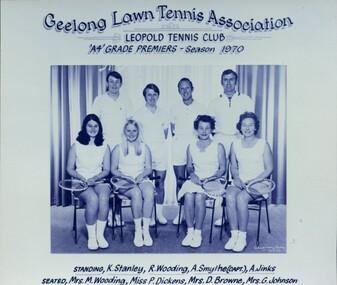 Leopold Tennis Club
Photograph, Robert Pockley Studios, Geelong Lawn Tennis Association Leopold Tennis Club A4 Grade Premiers - Season 1970, 1970
... Jinks Seated: Mrs M. Wooding, Miss P. Dickins, Mrs D. Browne, Mrs G. ...Jinks Seated: Mrs M. Wooding, Miss P. Dickins, Mrs D. Browne, Mrs G. ...Image taken of the Geelong Lawn Tennis Association - A4 Grade Premiers for Season 1970.1 photograph of Premiership tennis teamStanding: K. Stanley, R. Wooding, A. Smythe (Capt.), A. Jinks Seated: Mrs M. Wooding, Miss P. Dickins, Mrs D. Browne, Mrs G. Johnsonleopold tennis club, geelong lawn tennis association, p dickens, k stanley, a smythe, g johnson, dorothy browne, marlene wooding, ray wooding, allan jinks -
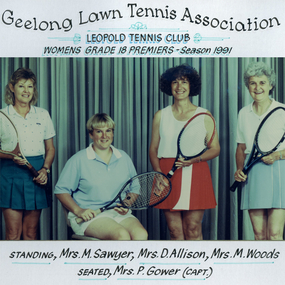 Leopold Tennis Club
Photograph, Robert Pockley Studios, Geelong Lawn Tennis Association Leopold Tennis Club Womens Grade 18 Premiers - Season 1991, 1991
... Allison, Mrs M. Woods Seated, Mrs P. Gower (Capt.) ...Allison, Mrs M. Woods Seated, Mrs P. Gower (Capt.) 1 photograph of Premiership tennis team Geelong Lawn Tennis Association Leopold Tennis Club Womens Grade 18 Premiers - Season 1991 Photograph Robert Pockley Studios ...Image taken of the Geelong Lawn Tennis Association Womens Grade 18 Premiers for Season 1991.1 photograph of Premiership tennis teamStanding, Mrs M. Sawyer, Mrs D. Allison, Mrs M. Woods Seated, Mrs P. Gower (Capt.) leopold tennis club, geelong lawn tennis association, m sawyer, d allison, prue gower, maureen woods -
 The Beechworth Burke Museum
Photograph, c. 1900
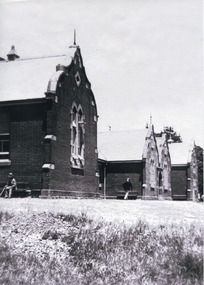
... This photo is estimated to have been taken in the early 1900’s when the Ovens Benevolent home would have still been fairly contemporary. According to Woods (p. 121) in the 1860’s the government spent considerable sums to establish several public buildings such as the Benevolent Asylum, the Hospital and Insane Asylum to support those in need of care in the area directly after the Indigo gold rush which had left Beechworth, a fairly remote regional and newly formed township (Gold was first discovered in Beechworth in 1852) with a number of infirm and destitute people in its wake and which due to the support and establishment of these facilities ‘made Beechworth a significant social welfare centre in Victoria’ (Woods, p. 121). ...This photo is estimated to have been taken in the early 1900’s when the Ovens Benevolent home would have still been fairly contemporary. According to Woods (p. 121) in the 1860’s the government spent considerable sums to establish several public buildings such as the Benevolent Asylum, the Hospital and Insane Asylum to support those in need of care in the area directly after the Indigo gold rush which had left Beechworth, a fairly remote regional and newly formed township (Gold was first discovered in Beechworth in 1852) with a number of infirm and destitute people in its wake and which due to the support and establishment of these facilities ‘made Beechworth a significant social welfare centre in Victoria’ (Woods, p. 121). ...This black and white photograph shows the front view of the Ovens Benevolent Home with one person sitting on a bench seat against the nearest part of the building and another person walking on the grass. This photo is estimated to have been taken in the early 1900’s when the Ovens Benevolent home would have still been fairly contemporary. According to Woods (p. 121) in the 1860’s the government spent considerable sums to establish several public buildings such as the Benevolent Asylum, the Hospital and Insane Asylum to support those in need of care in the area directly after the Indigo gold rush which had left Beechworth, a fairly remote regional and newly formed township (Gold was first discovered in Beechworth in 1852) with a number of infirm and destitute people in its wake and which due to the support and establishment of these facilities ‘made Beechworth a significant social welfare centre in Victoria’ (Woods, p. 121). Originally named the Benevolent Asylum, the building was renamed as The Ovens Benevolent Asylum in 1935 and again to The Ovens and Murray Home in 1954. The building construction began in 1862 and was unique in its features of Flemish Gothic Revival style which utilised red brick and granite, ‘the main facade is dominated by four curved, Flemish gable ends, […] incorporates paired windows of pointed Gothic form and dark brick diaperwork patterning. The adjacent J. A. Wallace Wing of 1899 was designed by Donald Fiddes as a separate building. Also constructed of red brick, Fiddes adopted a conservative approach, designing a simple domestic scale building with central projecting gable porch and flanking bull nosed verandahs.’ (https://vhd.heritagecouncil.vic.gov.au/places/118). Initially established to provide housing and care for aged, orphaned or widowed members of the population, over time the Ovens Benevolent Home focused more on the age care responsibility which functioned as such up until 2005.The Ovens Benevolent Home is significance due to its association with the early development of Beechworth. It shows the civic, social welfare development that took place in the town after the peak of the gold rush which helps to establish the character of the community being built at the time and their cultural values at play. This photograph also clearly shows the early functioning landscape of that building and its purpose as well as the significant elements of its aesthetic significance and unique and striking architectural forms of the building.Black and white rectangular photograph [copy from slide]Reverse: / 7588 /housing and care, aged care, donald fiddes, ovens benevolent home, flemish gable, brick diaperwork, photograph, black and white photograph, public building, benevolent asylum, indigo gold rush, beechworth, the ovens and murray home -
 Northern District School of Nursing. Managed by Bendigo Historical Society Inc.
Photograph - Nurses with Tutor and Skeleton, 1964
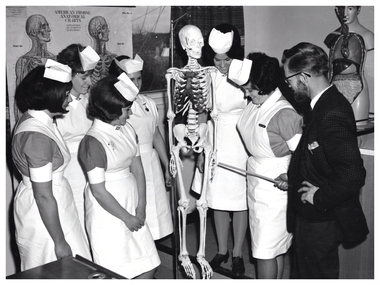
... L. Abbott, J. M. Wood, P. A. Tuohey, Denise O'Sullivan, Lyn Heath, Northern District School of Nursing, 37 Rowan Street Bendigo. ...L. Abbott, J. M. Wood, P. A. Tuohey, Denise O'Sullivan, Lyn Heath, Northern District School of Nursing, 37 Rowan Street Bendigo. ...The Northern District School of Nursing opened in 1950 to address the issues around nurse recruitment, training and education that had previously been hospital based. The residential school was to provide theoretical and in-house education and practical training over three years. The students would also receive practical hands-on training in the wards of associated hospitals. The Northern District School of Nursing operated from Lister House, Rowan Street, Bendigo. It was the first independent school of nursing in Victoria and continued until it closed in 1989.Nurses with Tutor and Skeleton, schools 64 and 63. Two photos of Six nurses and Tutor Jack Hutley (with stick) standing around a skeleton. Behind them are body charts and props. On rear of Photos the nurses names are written, however their position in the photos are difficult to work out: Schools 63 and 64, Tutor Jack Hutley, Nurses R. L.Heath, B. L. Abbott, J. M. Wood, P. A. Tuohey, Denise O'Sullivan, Lyn Heath, Northern District School of Nursing, 37 Rowan Street Bendigo. BCV8 Bendigonurse training, ndsn, lister house, school 63, school 64, jack hutly -
 The Beechworth Burke Museum
Photograph
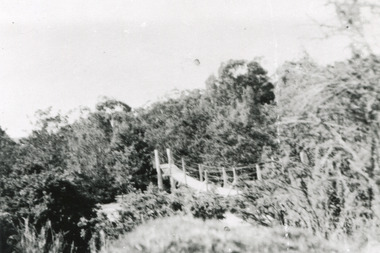
... The Ovens tannery was among several new businesses establishing themselves such as a foundry that brought industrial manufacturing alongside the developing township and which strengthened the economic stability of Beechworth after the receding mining surge. According to Woods (p. 121) in the 1860’s the government spent considerable sums to establish several public buildings such as the Benevolent Asylum, the Hospital and Insane Asylum to support those in need of care in the area directly after the Indigo gold rush which had left Beechworth, a fairly remote regional and newly formed township (Gold was first discovered in Beechworth in 1852) with a number of infirm and destitute people in its wake and which due to the support and establishment of these facilities ‘made Beechworth a significant social welfare centre in Victoria’ (Woods, p. 121). ...The Ovens tannery was among several new businesses establishing themselves such as a foundry that brought industrial manufacturing alongside the developing township and which strengthened the economic stability of Beechworth after the receding mining surge. According to Woods (p. 121) in the 1860’s the government spent considerable sums to establish several public buildings such as the Benevolent Asylum, the Hospital and Insane Asylum to support those in need of care in the area directly after the Indigo gold rush which had left Beechworth, a fairly remote regional and newly formed township (Gold was first discovered in Beechworth in 1852) with a number of infirm and destitute people in its wake and which due to the support and establishment of these facilities ‘made Beechworth a significant social welfare centre in Victoria’ (Woods, p. 121). ...This rectangle black and white photograph shows a bush scene with part of a suspension rope and wooden plank bridge visible in the middle of the image. It is likely this suspension bridge was used by the Tannery workers to move between the town and the Ovens Tannery located South-West of Beechworth due to its secluded bush location, the bridge likely spanned the gorge across Spring creek. The tannery itself was located alongside Gimlet Creek, about three kilometres from town, down what is now known as Malakoff and Old Tannery Road but which at the time was remote and accessed through bushland. The Ovens tannery was stablished in 1858 by Matthew Dodd and Hallahan and later Matthew and his brother Thomas Dodd in 1866 who developed it over the years. According to Doyle, 'we have little information about its early operations except the tannery itself comprised four small buildings' by 1870 ‘a small village with gardens of vines and fruit trees surrounded the tannery’ (Woods, 121), and by 1887 the Tannery employed fifteen men. The Ovens tannery was among several new businesses establishing themselves such as a foundry that brought industrial manufacturing alongside the developing township and which strengthened the economic stability of Beechworth after the receding mining surge. According to Woods (p. 121) in the 1860’s the government spent considerable sums to establish several public buildings such as the Benevolent Asylum, the Hospital and Insane Asylum to support those in need of care in the area directly after the Indigo gold rush which had left Beechworth, a fairly remote regional and newly formed township (Gold was first discovered in Beechworth in 1852) with a number of infirm and destitute people in its wake and which due to the support and establishment of these facilities ‘made Beechworth a significant social welfare centre in Victoria’ (Woods, p. 121). The tannery provided employment and connected the regional centre with other parts of Victoria and the wider colonial outposts and would have been a welcome opportunity for those seeking work after gold was no longer a source of income.A good example of the ingenuity of regional settlers to achieve what would have been a difficult and remote construction of a bridge as a means of access. This bridge is evidence of planning and forethought and shows dedication to establishing a life in a remote landscape.Black and white rectangular photograph printed on paperreverse: / 2983 / / BMM2983 /black and white photograph, bush, suspension bridge, rope bridge, tannery, spring creek, ovens tannery, bushland, gimlet creek, matthew dodd, beechworth -
 The Beechworth Burke Museum
Photograph, c. 1910
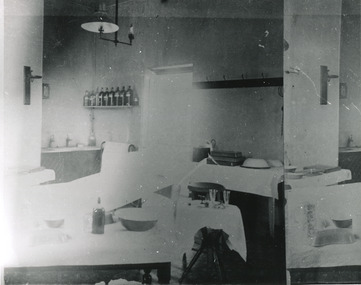
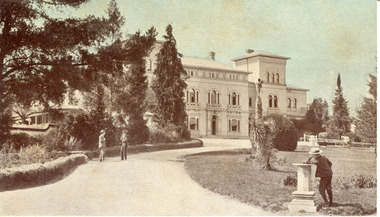
... The hospital is made up of a number of buildings, landscaping, ha-ha, workshops, laundry, administrative facilities and farmland, it was constructed in 'Italianate' style by a team of up to two hundred and fifty workers (Woods p. 122). The asylum was established in response to the need for the regional shire to locally care for those particularly affected by their time working the Ovens goldfield during the Indigo Shire gold rush era where poor living conditions and isolation were significantly affecting the welfare of a great many people through poverty and lack of resources. ...The hospital is made up of a number of buildings, landscaping, ha-ha, workshops, laundry, administrative facilities and farmland, it was constructed in 'Italianate' style by a team of up to two hundred and fifty workers (Woods p. 122). The asylum was established in response to the need for the regional shire to locally care for those particularly affected by their time working the Ovens goldfield during the Indigo Shire gold rush era where poor living conditions and isolation were significantly affecting the welfare of a great many people through poverty and lack of resources. ...Taken approximately 1910, this black and white photograph shows the interior of the surgery and consulting rooms at the Mayday Hills mental hospital known at that time as a lunatic asylum in Beechworth. Mayday Hills Hospital, then known as the Beechworth Lunatic Asylum was constructed between 1864-67 designed by The Public Works Department. The hospital is made up of a number of buildings, landscaping, ha-ha, workshops, laundry, administrative facilities and farmland, it was constructed in 'Italianate' style by a team of up to two hundred and fifty workers (Woods p. 122). The asylum was established in response to the need for the regional shire to locally care for those particularly affected by their time working the Ovens goldfield during the Indigo Shire gold rush era where poor living conditions and isolation were significantly affecting the welfare of a great many people through poverty and lack of resources. The gaol and orphan labour systems were not able to effectively support to give housing, rehabilitation and ongoing care for the mentally ill, and transporting to Melbourne by waggon was a time consuming and counter-productive solution when the metro facilities were already overcrowded. According to Woods (A Titan's Field p. 122), between 1901 and 1911 a large percentage (thirty five percent in 1901 and twenty four in 1911) of the Beechworth population were either patients or inmates of Beechworth institutions, Mayday Hills accounted for some six hundred and seventy four patients in 1901, Beechworth's Mayday Hills was chosen as the site of Victoria's newest asylum, at the time, due to the landscape and altitude. The hilltop atmosphere and the native fauna, it was argued, would assist in the cure of the patients kept at the hospital (Wood 1985, 122). The positioning of the hospital had a beneficial effect on the rural town and the large volume of people living at the hospital and contributing to this population growth is counted as reason for the survival of Beechworth as a regional township. Mayday Hills continued to function as a mental hospital up until 1995 when it was sold to LaTrobe university. The building and grounds are listed on the Victorian Heritage Register under criterion A, B, D, E and F. Although grainy, the image gives a good indication of a functioning interior space of a surgery and consulting room at Mayday Hills in the early 1900's, from which we might interpret (from the types of tools and furniture present), the medical practices being performed at the time.Black and white rectangular photographmedical, asylum, surgery, hospital, beechworth, mayday hills, mayday hills asylum, mayday hills hospital, mental hospital, beechworth lunatic asylum, beechworth institutions, social welfare, public works department, consulting room -
 The Beechworth Burke Museum
Photograph - Postcard, George Rose, c. 1910
... The hospital is made up of a number of buildings, landscaping, ha-ha, workshops, laundry, administrative facilities and farmland, it was constructed in 'Italianate' style by a team of up to two hundred and fifty workers (Woods p. 122). The asylum was established in response to the need for the regional shire to locally care for those particularly affected by their time working the Ovens goldfield during the Indigo Shire gold rush era where poor living conditions and isolation were significantly affecting the welfare of a great many people through poverty and lack of resources. ...The hospital is made up of a number of buildings, landscaping, ha-ha, workshops, laundry, administrative facilities and farmland, it was constructed in 'Italianate' style by a team of up to two hundred and fifty workers (Woods p. 122). The asylum was established in response to the need for the regional shire to locally care for those particularly affected by their time working the Ovens goldfield during the Indigo Shire gold rush era where poor living conditions and isolation were significantly affecting the welfare of a great many people through poverty and lack of resources. ...Produced c. 1910 by The Rose Stereograph co. This colourised photographic postcard shows the exterior of the administrative buildings at Mayday Hills mental hospital with three young boys in the foreground. This postcard forms part of the extensive Rose Series. (P. 4689) of postcards being produced by the Rose Stereograph co. which depicted landmarks from across Australia. Despite the early date attributed to this image, according to Walsh dates from this series place the postcards being produced typically between 1920-54. Mayday Hills Hospital, then known as the Beechworth Lunatic Asylum was constructed between 1864-67 designed by The Public Works Department. The hospital is made up of a number of buildings, landscaping, ha-ha, workshops, laundry, administrative facilities and farmland, it was constructed in 'Italianate' style by a team of up to two hundred and fifty workers (Woods p. 122). The asylum was established in response to the need for the regional shire to locally care for those particularly affected by their time working the Ovens goldfield during the Indigo Shire gold rush era where poor living conditions and isolation were significantly affecting the welfare of a great many people through poverty and lack of resources. The gaol and orphan labour systems were not able to effectively support to give housing, rehabilitation and ongoing care for the mentally ill, and transporting to Melbourne by waggon was a time consuming and counter-productive solution when the metro facilities were already overcrowded. According to Woods (A Titan's Field p. 122), between 1901 and 1911 a large percentage (thirty five percent in 1901 and twenty four in 1911) of the Beechworth population were either patients or inmates of Beechworth institutions, Mayday Hills accounted for some six hundred and seventy four patients in 1901, Beechworth's Mayday Hills was chosen as the site of Victoria's newest asylum, at the time, due to the landscape and altitude. The hilltop atmosphere and the native fauna, it was argued, would assist in the cure of the patients kept at the hospital (Wood 1985, 122). The positioning of the hospital had a beneficial effect on the rural town and the large volume of people living at the hospital and contributing to this population growth is counted as reason for the survival of Beechworth as a regional township. Mayday Hills continued to function as a mental hospital up until 1995 when it was sold to LaTrobe university. The building and grounds are listed on the Victorian Heritage Register under criterion A, B, D, E and F. Through the colourisation of the photograph and through the unusual choice of the subject matter being used as a postcard, we can get a good indication of aesthetic interests of the time.Rectangular coloured photograph printed as postcardObverse: Beautiful / Beechworth / (Vic.) / 1800 ft. / above / Sea / Level / - / Asylum / for / insane / (Front / View) / Copyright. / F. / Foxcroft / Photo Reverse: 1997.2454 / Postcard / THIS / SPACE / MAY / BE / USED / FOR / CORRESPONDENCE: / THIS / SPACE / FOR / NAME / AND / ADDRESS / STAMPpostcard, rose series, mayday hills hospital, mayday hills, beechworth lunatic asylum, photographic postcard, george rose, the rose stereograph co., social welfare, welfare services, ovens goldfield, lunatic asylum, the public works department, australian landmark, regional shire, indigo shire council, gold rush, beechworth institution, victorian heritage register -
 The Beechworth Burke Museum
Photograph - Photographs, E. Yellard, c. 1950's
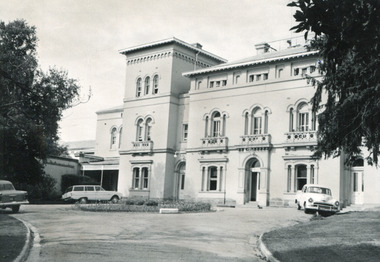
... The hospital is made up of a number of buildings, landscaping, ha-ha, workshops, laundry, administrative facilities and farmland, it was constructed in 'Italianate' style by a team of up to two hundred and fifty workers (Woods p. 122). The asylum was established in response to the need for the regional shire to locally care for those particularly affected by their time working the Ovens goldfield during the Indigo Shire gold rush era where poor living conditions and isolation were significantly affecting the welfare of a great many people through poverty and lack of resources. ...The hospital is made up of a number of buildings, landscaping, ha-ha, workshops, laundry, administrative facilities and farmland, it was constructed in 'Italianate' style by a team of up to two hundred and fifty workers (Woods p. 122). The asylum was established in response to the need for the regional shire to locally care for those particularly affected by their time working the Ovens goldfield during the Indigo Shire gold rush era where poor living conditions and isolation were significantly affecting the welfare of a great many people through poverty and lack of resources. ...Two rectangular black and white photographs of the Beechworth Mental Hospital (Mayday Hills) administrative building showing the left and right hand sides of the exterior building with three cars parked in driveway turning circle in the foreground taken in the 1950's by E. Yellard. Mayday Hills Hospital, originally known as the Beechworth Lunatic Asylum was constructed between 1864-67 designed by The Public Works Department. The hospital is made up of a number of buildings, landscaping, ha-ha, workshops, laundry, administrative facilities and farmland, it was constructed in 'Italianate' style by a team of up to two hundred and fifty workers (Woods p. 122). The asylum was established in response to the need for the regional shire to locally care for those particularly affected by their time working the Ovens goldfield during the Indigo Shire gold rush era where poor living conditions and isolation were significantly affecting the welfare of a great many people through poverty and lack of resources. The gaol and orphan labour systems were not able to effectively support to give housing, rehabilitation and ongoing care for the mentally ill, and transporting to Melbourne by waggon was a time consuming and counter-productive solution when the metro facilities were already overcrowded. According to Woods (A Titan's Field p. 122), between 1901 and 1911 a large percentage (thirty five percent in 1901 and twenty four in 1911) of the Beechworth population were either patients or inmates of Beechworth institutions, Mayday Hills accounted for some six hundred and seventy four patients in 1901, Beechworth's Mayday Hills was chosen as the site of Victoria's newest asylum, at the time, due to the landscape and altitude. The hilltop atmosphere and the native fauna, it was argued, would assist in the cure of the patients kept at the hospital (Wood 1985, 122). The positioning of the hospital had a beneficial effect on the rural town and the large volume of people living at the hospital and contributing to this population growth is counted as reason for the survival of Beechworth as a regional township. According to the Victorian Heritage database, during the period 1921-1950 Mayday Hills underwent some modernisation by Public Works Department architect Percy Everett which included a nurses' hostel and new ward which were further developed and continued to function as a mental hospital up until 1995 when it was sold to LaTrobe university. The building and grounds are listed on the Victorian Heritage Register under criterion A, B, D, E and F.These photographs give a good indication of the ongoing use of Mayday Hills from its original establishment in the 1860's through to almost one hundred years later when these photographs were taken. The clarity of the images combined with the style and make of the cars in the foreground give a good indication of the time period and show the continued use and need for the facility over the years. Through images of building facades such as these, we might gain fuller understanding of the structural and aesthetic characteristics to be used in any future development or restorative work.2 x black and white rectangular photographs [copies] printed on Ilford photographic paper8688.1 reverse: Beechworth / Mental / Hospital / 80% 19cm / 12 cm / 80% / 728 / New / Print / BMM / 8688.1 / E. / Yellard / [Stamped : ILFORD] 8688.2 reverse: Beechworth / Mental / Hospital / E. / Yellard / BMM / 8688.1 / [Stamped : ILFORD]administrative building, black and white photographs, beechworth, mental hospital, beechworth mental hospital, mayday hills, cars, 1950, e. yellard, the public works department, public works department, hospital, mayday hills hospital, beechworth lunatic asylum, lunatic asylum, asylum, ovens goldfield, indigo shire, indigo shire gold rush -
 Stawell Historical Society Inc
Photograph, Stawell and District Juniors Cycling Team Country Premiers 1936
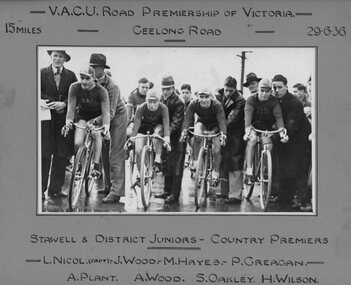
... (Capt.),- J. Woods,- M. Hayes,- P. Greagan. A. Plant. A. Wood. S. ...(Capt.),- J. Woods,- M. Hayes,- P. Greagan. A. Plant. A. Wood. S. ...Four men on Bicycles being supported by 4 males and several males in background. Stawell and District Juniors Cycling Team Country Premiers 1936Four males on bicycles, being supported by 4 males and several males in background.V.A.C.U. Road Premiership of Victoria 15Miles - Geelong Road - 29.6.36 Stawell & District Juniors -Country Premiers - L. Nicol.(Capt.),- J. Woods,- M. Hayes,- P. Greagan. A. Plant. A. Wood. S. Oakley. H. Wilson Copyright Photograph Permission for reproduction must be made every instance Les. H. Pritchard, 852 P. O. Place, Melb. stawell sport cycling -
 Bendigo Historical Society Inc.
Newspaper - JENNY FOLEY COLLECTION: ATTENTION
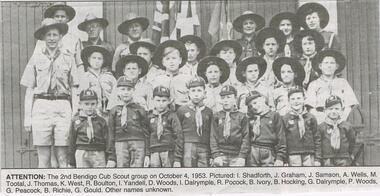
... Woods, I. Dalrymple, R. Pocock, B. Ivory, B. Hocking, G. Dalrymple, P. Woods, G. ...Woods, I. Dalrymple, R. Pocock, B. Ivory, B. Hocking, G. Dalrymple, P. Woods, G. ...Bendigo Advertiser "The way we were" from Friday, November 7, 2003. Attention: then 2nd Bendigo Cub Scout group on October 4, 1953. Pictured I. Shadforth, J. Graham, J. Samson, A. Wells, M. Tootal, J. Thomas, K. West, R. Boulton, I. Yandell, D. Woods, I. Dalrymple, R. Pocock, B. Ivory, B. Hocking, G. Dalrymple, P. Woods, G. Peacock, B. Richie, G. Gould. Other names unknown.newspaper, bendigo advertiser, the way we were -
 Bendigo Historical Society Inc.
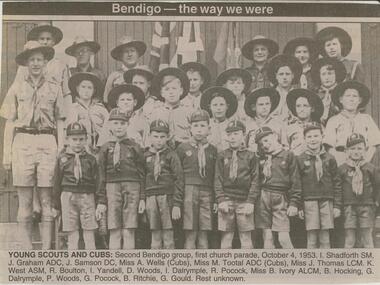
Newspaper - JENNY FOLEY COLLECTION: YOUNG SCOUTS AND CUBS
... Woods, I. Dalrymple, R. Pocock, Miss B. Ivory ALCM, B. Hocking, G. Dalrymple, P. ...Woods, I. Dalrymple, R. Pocock, Miss B. Ivory ALCM, B. Hocking, G. Dalrymple, P. ...BHS CollectionBendigo Advertiser ''The way we were'' from Monday, December 1, 2003. Young scouts and cubs: Second Bendigo group, first church parade, October 4, 1953. I. Shadforth SM, J. Graham ADC, J. Samson DC, Miss A. Wells (cubs), Miss A. Tootal ADC (cubs), Miss J. Thomas LCM, K. West ASM, R. Boulton, I. Yandell, D. Woods, I. Dalrymple, R. Pocock, Miss B. Ivory ALCM, B. Hocking, G. Dalrymple, P. Woods, G. Pocock, B. Ritchie, G. Gould. Rest unknown. The clip is in a folder.newspaper, bendigo advertiser, the way we were -
 Flagstaff Hill Maritime Museum and Village
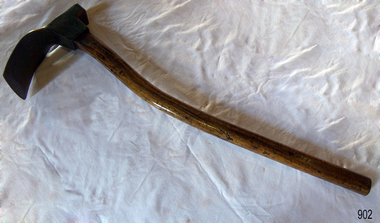
Tool - Adze, Ward & Payne Ltd, Between 1843 to Mid 20th Century
... wood. The subject item was made by Ward & Payne of the Limbrick Works at Hillsborough, Sheffield England manufacturers of hand-forged tools. Their trademark registered in 1850 was a Letter "W" & "P...wood. The subject item was made by Ward & Payne of the Limbrick Works at Hillsborough, Sheffield England manufacturers of hand-forged tools. Their trademark registered in 1850 was a Letter "W" & "P ...An adze is an ancient and versatile cutting tool and has been in use for thousands of years. Adze are similar to an axe but with the cutting edge perpendicular to the handle rather than parallel. They have been used since the Stone Age. Adzes are hand tools used for smoothing or carving wood. The subject item was made by Ward & Payne of the Limbrick Works at Hillsborough, Sheffield England manufacturers of hand-forged tools. Their trademark registered in 1850 was a Letter "W" & "P" stamped into the steel. The firm was established by David Ward (1767-1822) in 1803 the company became David Ward & Sons, in 1837 after Ward's son Edward joined the firm. In 1845 Henry Payne the founder's son-in-law became a partner but died in 1850 after which the company reverted to the Ward family. The business then concentrated on making carving tools, chisels and gouges. In 1882 David Ward's grandson David Ward Jr. (1835-1889) purchased land and built a factory at Sheffield North known as the "Limerick Wheel". For a time Wards operated from both 106-114 West Street Sheffield and at Limbrick Road, Hillsborough on the river Loxley. By 1911 they had expanded into making spades, forks, sheep shears and many other types of edged tools including drills and wood planes. In 1967 Wilkinson Sword purchased all the company's share capital and continued to sell Ward & Payne tools until 1970 when a fire burned the factory down and housing development was built on the site.The subject item is significant as it gives a snapshot of the technological development of sailing ships and their operation before steam-powered vessels took over around the world. Tools such as the subject item demonstrate the traditional craftsmanship and skill of the shipwright and the aesthetic quality of the timber ships designs of the time. Adze with wooden handle curved painted green with patent number and maker's name inscribed on inside curve of blade. Inscribed "Patd 561 Ward" "2w". flagstaff hill, warrnambool, flagstaff-hill, flagstaff-hill-maritime-museum, maritime-museum, shipwreck-coast, flagstaff-hill-maritime-village, smoothing tool, hand tool, carpenders tool, adze, coopers tool, woodworking tools -
 Flagstaff Hill Maritime Museum and Village
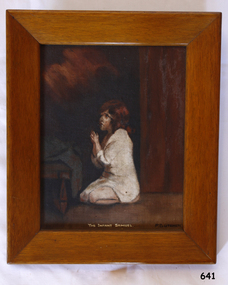
Painting - Religious Portrait, P Butcher, artist, The Infant Samuel, ca. 1943
... wood. Portrait of a child dressed in white, kneeling in prayer, within a dark room. The artist, P Butcher, titled the picture "The Infant Samuel". ...Flagstaff Hill Maritime Museum and Village Flagstaff Hill Warrnambool Maritime Museum Maritime Village Shipwreck Coast Great Ocean Road Religion Religious service St Nicholas Seamen’s Church Williamstown Missions to Seamen Victoria painting oil painting religious painting infant samuel P Butcher religious worship worship service Mission to Seafarers St Nicholas Missions to Seamen’s Church Williamstown Missions to Seamen St Nicholas Missions to Seamen’s Church Flagstaff Hill 139 Nelson Place Williamstown Anglican church church furnishings religious furnishings Painted at centre bottom edge "THE INFANT SAMUEL.", and right bottom edge "B. BUTCHER" Painting, oil on board, behind glass framed with wood ...This painting was part of the original furnishings of the St Nicholas' Mission to Seamen's Church at 139 Nelson Place, Williamstown, Victoria. The Church was operated by the Mission to Seamen organisation. It was donated to the Church by the Williamstown Lightkeepers' Auxiliary. THE MISSIONS TO SEAMEN (Brief History: for more, see our Reg. No. 611, Set of Pews) The Missions to Seamen was an Anglican charity that served seafarers of the world since 1856 in Great Britain. It symbol is a Flying Angel, inspired by a Bible verse. Today there are centres in over 200 ports worldwide where seamen of all backgrounds are offered a warm welcome and provided with a wide range of facilities. In Victoria, the organisation began in Williamstown in 1857 as a Sailors’ Church, also known as ‘Bethel’ or the ‘Floating Church’ in an old hulk floating in Hobson’s Bay, Port of Melbourne. It soon became part of the Missions to Seamen, Victoria. In the year 2000 the organisation, now named Mission to Seafarers, still operated locally in Melbourne, Portland, Geelong and Hastings. The Ladies’ Harbour Lights Guild was formed in 1906 to support the Missions to Seamen in Melbourne and other centres such as Williamstown. Two of the most significant ladies of the Guild were founder Ethel Augusta Godfrey and foundation member Alice Sibthorpe Tracy (who established a branch of the Guild in Warrnambool in 1920). The Guild continued its work until the 1960s. In 1943 a former Williamstown bank was purchased for the Missions to Seaman Club. The chapel was named St Nicholas’ Seamen’s Church and was supported by the Ladies’ Harbour Lights Guild, the Williamstown Lightkeepers’ Auxiliary and the League of Soldiers’ and Sailors’ Friends. It ceased operation in 1966. A Missions to Seamen Chapel and Recreation Room was a significant feature of ports during the late 1800s and into the 1900s. It seemed appropriate for Flagstaff Hill to include such a representation within the new Maritime Village, so the Melbourne Board of Management of Missions to Seamen Victoria gave its permission on 21st May 1979 for the entire furnishings of the Williamstown chapel to be transferred to Flagstaff Hill. The St Nicholas Seamen’s Church was officially opened on October 11, 1981, and closely resembles the Williamstown chapel. This painting is significant historically for its origin in the St Nicholas Mission to Seamen's Church in Williamstown, established in 1857 to cater for the physical, social, and spiritual needs of seafarers. It originated in Bristol, England when a Seamen's Mission was formed in 1837. The painting is historically significant for its connection to the Williamstown Lightkeepers’ Auxiliary, an organisation of women, formed to support seafarers. The connection of this painting to the Mission to Seamen and to the Ladies Lightkeepers’ Auxiliary highlights the strong community awareness of the life of people at sea, their dangers and hardships, and their need for physical, financial, spiritual and moral support. Painting, oil on board, behind glass framed with wood. Portrait of a child dressed in white, kneeling in prayer, within a dark room. The artist, P Butcher, titled the picture "The Infant Samuel". This object is part of the St Nicholas Seamen's Church Collection.Painted at centre bottom edge "THE INFANT SAMUEL.", and right bottom edge "B. BUTCHER"flagstaff hill maritime museum and village, flagstaff hill, warrnambool, maritime museum, maritime village, shipwreck coast, great ocean road, religion, religious service, st nicholas seamen’s church, williamstown, missions to seamen victoria, painting, oil painting, religious painting, infant samuel, p butcher, religious worship, worship service, mission to seafarers, st nicholas missions to seamen’s church williamstown, missions to seamen, st nicholas missions to seamen’s church flagstaff hill, 139 nelson place williamstown, anglican church, church furnishings, religious furnishings -
 Flagstaff Hill Maritime Museum and Village
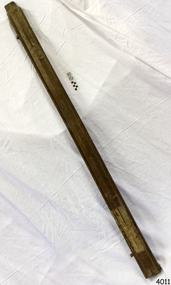
Tool - Wood Sample, Before 1878
... The collection is also historically significant for its association with the LOCH ARD, which was one of the worst and best known shipwrecks in Victoria’s history. flagstaff hill warrnambool shipwrecked coast flagstaff hill maritime museum maritime museum shipwreck coast flagstaff hill maritime village great ocean road loch line loch ard captain gibbs eva carmichael tom pearce glenample station mutton bird island loch ard gorge nineteenth-century souveniring shipwreck scavenging loch line sailing ships wood sample The inscription on the paper reads: “A [p]iece of w[r]ec[k] of the Loch Ard wrecked near Sherbroke River”. ...On a piece of paper subsequently glued near one end of its curved upper face, this length of planed and polished hardwood timber bears the inscription: “A [p]iece of w[r]ec[k] of the Loch Ard wrecked near Sherbroke River”. The timber is carefully worked with rich dark colouring and a uniformly moulded design, suggesting that it was part of a fitting or furnishing that was publicly visible and prominent. If the artefact is what it is declared to be, then it is possible that it formed part of the ship’s railings or companionway stairs. The LOCH ARD was a 1,693 ton, 3 masted barque, built on the Clyde in 1873. In an age of increasing competition for the emigrant passenger trade from steam-driven vessels, special attention was paid to her wooden furnishings and fittings. The Loch Line owners prided themselves on their attractive, distinctively painted, sailing ships. Below decks, where cargo and third class passengers were stowed, was made of iron. But everything above deck, and on show to the saloon and second class passengers, was carved and varnished timber. Captain Daish’s 1878 report for the ship’s underwriters notes “a quantity of general Cargo washed up in a confused mass” in the cove and “a number of Cases, Casks and Bales; also deals and boards floating about in some of the gorges” further west of the shipwreck. Contemporary newspaper accounts also reported a large quantity of cargo and timber washed ashore in the days following the LOCH ARD shipwreck, adding “but those were speedily removed by persons who came down from Port Campbell, Scott’s Creek and other places with carts and pack horses”. The appearance and good condition of this wood artefact, and the aged patina and dated hand-writing style of its pasted on inscription, support the suggestion that it was ‘souvenired’ from the floating debris of the LOCH ARD at or near the 1878 date of its foundering off Mutton Bird Island. HISTORY OF THE LOCH ARD The LOCH ARD belonged to the famous Loch Line which sailed many ships from England to Australia. Built in Glasgow by Barclay, Curdle and Co. in 1873, the LOCH ARD was a three-masted square rigged iron sailing ship. The ship measured 262ft 7" (79.87m) in length, 38ft (11.58m) in width, 23ft (7m) in depth and had a gross tonnage of 1693 tons. The LOCH ARD's main mast measured a massive 150ft (45.7m) in height. LOCH ARD made three trips to Australia and one trip to Calcutta before its final voyage. LOCH ARD left England on March 2, 1878, under the command of Captain Gibbs, a newly married, 29 year old. She was bound for Melbourne with a crew of 37, plus 17 passengers and a load of cargo. The general cargo reflected the affluence of Melbourne at the time. On board were straw hats, umbrella, perfumes, clay pipes, pianos, clocks, confectionary, linen and candles, as well as a heavier load of railway irons, cement, lead and copper. There were items included that intended for display in the Melbourne International Exhibition in 1880. The voyage to Port Phillip was long but uneventful. At 3am on June 1, 1878, Captain Gibbs was expecting to see land and the passengers were becoming excited as they prepared to view their new homeland in the early morning. But LOCH ARD was running into a fog which greatly reduced visibility. Captain Gibbs was becoming anxious as there was no sign of land or the Cape Otway lighthouse. At 4am the fog lifted. A man aloft announced that he could see breakers. The sheer cliffs of Victoria's west coast came into view, and Captain Gibbs realised that the ship was much closer to them than expected. He ordered as much sail to be set as time would permit and then attempted to steer the vessel out to sea. On coming head on into the wind, the ship lost momentum, the sails fell limp and LOCH ARD's bow swung back. Gibbs then ordered the anchors to be released in an attempt to hold its position. The anchors sank some 50 fathoms - but did not hold. By this time LOCH ARD was among the breakers and the tall cliffs of Mutton Bird Island rose behind the ship. Just half a mile from the coast, the ship's bow was suddenly pulled around by the anchor. The captain tried to tack out to sea, but the ship struck a reef at the base of Mutton Bird Island, near Port Campbell. Waves broke over the ship and the top deck was loosened from the hull. The masts and rigging came crashing down knocking passengers and crew overboard. When a lifeboat was finally launched, it crashed into the side of LOCH ARD and capsized. Tom Pearce, who had launched the boat, managed to cling to its overturned hull and shelter beneath it. He drifted out to sea and then on the flood tide came into what is now known as LOCH ARD Gorge. He swam to shore, bruised and dazed, and found a cave in which to shelter. Some of the crew stayed below deck to shelter from the falling rigging but drowned when the ship slipped off the reef into deeper water. Eva Carmichael had raced onto deck to find out what was happening only to be confronted by towering cliffs looming above the stricken ship. In all the chaos, Captain Gibbs grabbed Eva and said, "If you are saved Eva, let my dear wife know that I died like a sailor". That was the last Eva Carmichael saw of the captain. She was swept off the ship by a huge wave. Eva saw Tom Pearce on a small rocky beach and yelled to attract his attention. He dived in and swam to the exhausted woman and dragged her to shore. He took her to the cave and broke open case of brandy which had washed up on the beach. He opened a bottle to revive the unconscious woman. A few hours later Tom scaled a cliff in search of help. He followed hoof prints and came by chance upon two men from nearby Glenample Station three and a half miles away. In a state of exhaustion, he told the men of the tragedy. Tom returned to the gorge while the two men rode back to the station to get help. By the time they reached LOCH ARD Gorge, it was cold and dark. The two shipwreck survivors were taken to Glenample Station to recover. Eva stayed at the station for six weeks before returning to Ireland, this time by steamship. In Melbourne, Tom Pearce received a hero's welcome. He was presented with the first gold medal of the Royal Humane Society of Victoria and a £1000 cheque from the Victorian Government. Concerts were performed to honour the young man's bravery and to raise money for those who lost family in the LOCH ARD disaster. Of the 54 crew members and passengers on board, only two survived: the apprentice, Tom Pearce and the young woman passenger, Eva Carmichael, who lost all of her family in the tragedy. Ten days after the LOCH ARD tragedy, salvage rights to the wreck were sold at auction for £2,120. Cargo valued at £3,000 was salvaged and placed on the beach, but most washed back into the sea when another storm developed. The wreck of LOCH ARD still lies at the base of Mutton Bird Island. Much of the cargo has now been salvaged and some was washed up into what is now known as LOCH ARD Gorge. Cargo and artefacts have also been illegally salvaged over many years before protective legislation was introduced. One of the most unlikely pieces of cargo to have survived the shipwreck was a Minton porcelain peacock - one of only nine in the world. The peacock was destined for the Melbourne International Exhibition in 1880. It had been well packed, which gave it adequate protection during the violent storm. Today, the Minton peacock can be seen at the Flagstaff Hill Maritime Museum in Warrnambool. From Australia's most dramatic shipwreck it has now become Australia's most valuable shipwreck artefact and is one of very few 'objects' on the Victorian State Heritage Register. The Loch Ard wreck is of state significance – Victorian Heritage Register S417. However there is a lack of documented provenance that limits the interpretive value of this piece of timber (for example, its potential to interpret nineteenth century souveniring and scavenging from shipwrecks along the south west coast of Victoria). Flagstaff Hill’s collection of artefacts from LOCH ARD is significant for being one of the largest collections of artefacts from this shipwreck in Victoria. It is significant for its association with the shipwreck, which is on the Victorian Heritage Register (VHR S417). The collection is significant because of the relationship between the objects, as together they have a high potential to interpret the story of the LOCH ARD. The LOCH ARD collection is archaeologically significant as the remains of a large international passenger and cargo ship. The LOCH ARD collection is historically significant for representing aspects of Victoria’s shipping history and its potential to interpret sub-theme 1.5 of Victoria’s Framework of Historical Themes (living with natural processes). The collection is also historically significant for its association with the LOCH ARD, which was one of the worst and best known shipwrecks in Victoria’s history. A length of hardwood timber, planed and varnished to smooth finish on three sides, with two unfinished tongues protruding from each end (one broken off), possibly from the wreck of the LOCH ARD. The front or upper face is moulded and routed to a regular, linear (skirting board type) design along its entire length, the two sides flat planed. One side contains two inserted dowel rods that have been broken off. The bottom face has not been finished to the same standard. The sample is good quality wood that has retained its density and weight and shows no evidence of having been submerged in seawater for any length of time. Glued on to the upper face of the length of timber near the right hand end is a deteriorated square of paper bearing an inscription. The paper, peeling back and with torn edges, is stuck over an original wood stain but under a subsequent layer of varnish. The faded ink words are indecipherable where paper is missing, but written carefully in an old fashioned cursive script.The inscription on the paper reads: “A [p]iece of w[r]ec[k] of the Loch Ard wrecked near Sherbroke River”. flagstaff hill, warrnambool, shipwrecked coast, flagstaff hill maritime museum, maritime museum, shipwreck coast, flagstaff hill maritime village, great ocean road, loch line, loch ard, captain gibbs, eva carmichael, tom pearce, glenample station, mutton bird island, loch ard gorge, nineteenth-century souveniring, shipwreck scavenging, loch line sailing ships, wood sample -
 Federation University Historical Collection
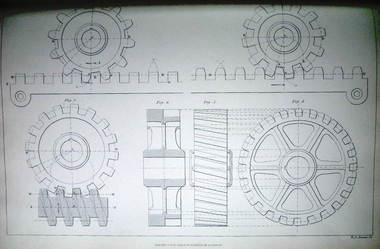
Book, The Engineer and Machinist's Drawing-Book: a complete course of instruction for the practical engineer, Possibly c1887
... Illustrated by numerous engravings on wood and steel, including select details, and complete machines. Illustrations in b/w. It includes a list of b/w plates, a table of contents, 116 p. of text and 112 p. of plates. ...Illustrated by numerous engravings on wood and steel, including select details, and complete machines. Illustrations in b/w. It includes a list of b/w plates, a table of contents, 116 p. of text and 112 p. of plates. ...A large brown cloth hardcover book with black leather spine and corners. Title is engraved in gold on spine. Illustrated by numerous engravings on wood and steel, including select details, and complete machines. Illustrations in b/w. It includes a list of b/w plates, a table of contents, 116 p. of text and 112 p. of plates. This workwork provids instruction on drawing and illustrating heavy machinery including steam engines. It also contains lessons in drawings and examples of approved construction. non-fictionengineer drawings, drawing instruments, the sector, the lines of numbers, drawing of elementary forms, m le blanc, mm armengaud, linear drawing, projection, eccentric curves, machinery sketching, forms of gearing, projections of shadows, spur gearing -
 Federation University Historical Collection
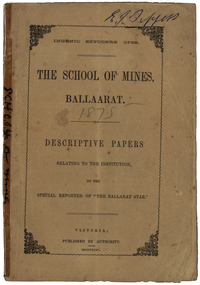
Booklet, The School of Mines Ballaarat: Descriptive papers relating to the institution by the special reporter of "The Ballarat Star", 1875 (exact)
... p chauncy...j m davey...joseph flude...r f hudson...robert lewis...james oddie...robert m serjeant...john walker...j williamson...richard ford...ballarat court house...assay...john victor...grenville college...trinity college dublin...c w thomas...jonathan robinson...union foundry...s keast...blessdale...john day...r evan day...w w evans...j y fishburne...felice giordano...julius von haast...james hector...charles a la...trobe...archibald liversidge...j j macgregor...j t mckenna...henry rosales...harrie wood...The President of Examiners was Judge Rogers, and the Honorary Auditor was Richard Ford. melbourne mla ballarat school of mines redmond barry j f usher james bickett w f hopkins rivett henry bland s m b judge rogers somerville learmonth charles gavan duffy gavan duffy john macpherson william mclellan duncan gillies f mccoy university john bleasdale henry richards caselli henry caselli p chauncy j m davey joseph flude r f hudson robert lewis james oddie robert m serjeant john walker j williamson richard ford ballarat court house assay john victor grenville college trinity college dublin c w thomas jonathan robinson union foundry s keast blessdale john day r evan day w w evans j y fishburne felice giordano julius von haast james hector charles a la trobe archibald liversidge j j macgregor j t mckenna henry rosales harrie wood john walthew fees Frederick McCoy W.H. ...The booklet comprises of a series of papers published in the Ballarat Star, with some revisions. The Administrative Council hoped the publication would increase interest in Technical Education, especially the Art of Mining. He would also hope the public would recognise the Ballarat School of Mines as an institution adapted to supply technical education. The Ballarat School of Mines Council listed at the front of the book includes: Redmond Barry (President and Trustee), Judge Rogers (Vice-President), Somerville Livingstone Learmonth (Trustee), Rivett Henry Bland (Trustee), Charles Gavan Duffy, John A. MacPherson (MLA), William McLellan (MLA), Duncan Gillies (MLA), F. McCoy (University of Melbourne), John I. Bleasdale, W.H. Barnard, James M. Bickett, Henry Richards Caselli, P. Chauncy, J.M. Davey, Joseph Flude, R.F. Hudson, Robert Lewis, James Oddie, Robert M. Serjeant, J. F. Usher, John Walker, J. Williamson, Mayor of the City of Ballaarat, chairman (for the time being) of each of the seven Mining Boards of Victoria. The President of Examiners was Judge Rogers, and the Honorary Auditor was Richard Ford.Stapled, brown soft covered booklet of 48 pages. Section I outlines the establishment of the Ballarat School of Mines, the buildings and land used by the school, describes in detail the former Ballarat Circuit Court and describes the lecture rooms. Section II describes the Ballarat School of Mines Museum, including a description of exhibits. Section III describes the lecture hall, and the apartments on either side of the hall, including the office of the registrar W.H. Barnard, mathematical classroom, chemical laboratory, and metallurgical laboratory. Section IV outlines the subjects offered by the Ballarat School of Mines, including Mathematics taught by John Victor of Grenville College, who had been educated at Trinity College Dublin. Mining and Land Surveying was taught by C.W. Thomas. Mr Croll taught mechanical drawing, followed by Jonathan Robinson of the Union Foundry, and finally S. Keast. It then lists some text books used in the school. Section V mentions the School Council, lack of funds, future directions, mining laboratory. Vi- Describes the land and out buildings, and the proposed building for metal and wood turning, brass foundry, blacksmith, working engine, etc. This section describes some large donations to the school - 50 pounds from the Misses Meglin of Melbourne, 10 pounds 10 shillings to the 'Pyrites fund' by the Walhalla and Long Tunnel Companies in Gippsland. Section VII covers the teaching of chemistry by Joseph Flude. Section VIII outlines the metallurgy classes and the process of assaying. Section IX covers telegraphy taught by Mr Bechervaise Section X describes the examination process at the Ballarat School of Mines. Examiners in mathematics were G.J. Russell (Buninyong) and John Lynch (Smythesdale), mining and land surveying John Lynch and P.C. Fitzpatrick (Ballarat), Principles and Practice of Mining R.M. Serjeant (Band and Albion Consols), Mechanical Engineering John Lewis (New North Company Clunes, Mineralogy and Geology G.H. F. Ulrich, Assayign and Chemistry J. Cosmo Newberry, and Telegraphy R.L.J. Ellery (government astronomer) and Sam W. Macgowan. Underground managers and captains in quart mining was examined by Henry Rosales (Walhalla Company), and alluvial mines by Messrs Bockett, Kent, Martin and Mitchell. Engineers and Engine driving was examined by W.H. Keast,Peter Matthews, Jonathan Robinson and J.M. Troup. Section XI - Covers Annual reports of the school, and honorary correspondents of the school including: John Day (Geelong); R. Evan Day (London); W.W. Evans, M.J.C.E. of New York; J.Y. Fishburne, M.B. of Ararat; Felice Giordano, Inspector of Mines, Italy; Julius Von Haast, Ph. D.F.R.S., Government Geologist of Canterbury; James Hector, M.D., F.R.S., Government Geologist of Wellington, New Zealand, W.F. Hopkins (Grant); Charles A. La Trobe, C.E. (Engineer-in-Chief International Railway Plant, London); Archibald Liversidge, F.G.S. (Professor of Mineralogy and Reader in geology at Sydney University; J.J. Macgregor, M.D. (Creswick); J.T. McKenna (1st class of SMB underground management - Northern Territory); Henry Rosales, M.E. and M. (Walhalla); Harrie Wood (SMB founder and Under-secretary for Mines, Sydney); John Walthew (Stockport, England) .2) Signed 'E.J. Tippett', former President of the Ballarat School of Mines Council melbourne, mla, ballarat school of mines, redmond barry, j f usher, james bickett, w f hopkins, rivett henry bland, s m b, judge rogers, somerville learmonth, charles gavan duffy, gavan duffy, john macpherson, william mclellan, duncan gillies, f mccoy, university, john bleasdale, henry richards caselli, henry caselli, p chauncy, j m davey, joseph flude, r f hudson, robert lewis, james oddie, robert m serjeant, john walker, j williamson, richard ford, ballarat court house, assay, john victor, grenville college, trinity college dublin, c w thomas, jonathan robinson, union foundry, s keast, blessdale, john day, r evan day, w w evans, j y fishburne, felice giordano, julius von haast, james hector, charles a la, trobe, archibald liversidge, j j macgregor, j t mckenna, henry rosales, harrie wood, john walthew, fees, frederick mccoy, w.h. barnard -
 Federation University Historical Collection
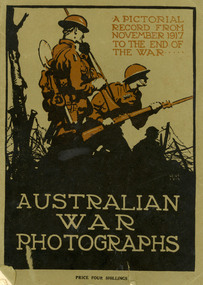
Book, Cassell and Company, Ltd, Australian War Photographs, 1917
... wood prisoners pigeons australian commonwealth military forces sgs Chatham - Holmes Family Archive Photographic history of Australians during World War One 129 page book with soft beige, brown and black cover depicting three soldiers at the front during World War One. The book includes many photographs and artwork of Australians at the French front from November 1917 until the end of the war. Photographers include Frank Hurley, E. Brooks, H.F. Baldwin and G.H. Wilkins. Artists include Crozier, W.L. King, Alan Lewis, Lothian, John Davis, S. Perks, I. Picking, Daryl Lindsay, Alf Saville, L.H. Howie, Stuart Shaw, P ...Photographic history of Australians during World War One129 page book with soft beige, brown and black cover depicting three soldiers at the front during World War One. The book includes many photographs and artwork of Australians at the French front from November 1917 until the end of the war. Photographers include Frank Hurley, E. Brooks, H.F. Baldwin and G.H. Wilkins. Artists include Crozier, W.L. King, Alan Lewis, Lothian, John Davis, S. Perks, I. Picking, Daryl Lindsay, Alf Saville, L.H. Howie, Stuart Shaw, P. Huthnance, Stiggo, S. Perks, C.H. Gould, Ted Canon, Bernie Bragg, S. Shaw, Will Dyson, An introduction is written by W. Birdwood, France, 28 September 1917. A number of pages have written notes on them by someone who had obviously been on the French Front. (These pages have been scanned and uploaded onto Victorian Collections. non-fictionPhotographic history of Australians during World War Onechatham family collection, chatham, world war one, world war 1, world war i, france, trenches, front line, birdwood, mark ridgeay, harold williamson, flanders, poziers, somme, becourt, mouquet farm, rupert whiteley, ypres, montauban, field cooker, gueudecourt, band, bapaume, bullecourt, h. murray, hindernburg wire, messines, howitzer, w. holmes. canon, ted canon, hill 60, gas masks, siege battery, menin road, ambulance, dressing station, glencorse wood, prisoners, pigeons, australian commonwealth military forces, sgs, chatham - holmes family archive -
 Federation University Historical Collection
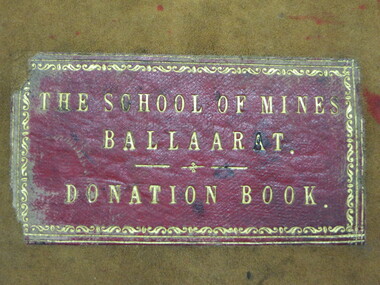
Book - Ledger, Ballarat School of Mines Donation Book, 1878 - 1895, 1878-1895
... Dr Pinnock, Ballarat - Collection of Living Sponges
2363. P. Curnow, Ballarat - Piece of wood with stone naturally embedded
2364. ...Dr Pinnock, Ballarat - Collection of Living Sponges
2363. P. Curnow, Ballarat - Piece of wood with stone naturally embedded
2364. ...The Donation Book relates to the Ballarat School of Mines Museum which opened in 1872. Very few of these items are still held by Federation University. The Museum was emptied in the 1960s with items being distrubuted to the Ballarat Historical Society, returned to original lenders (ie Pern Collection), of disposed of. Donations to the Ballarat School of Mines include: 34. M. Hamburger, Ballarat - bunsen burner 41. W.H. Shaw, Phoenix Foundry - 81 nos of 'Engineer' 89. Juvenile Industrial Exhibition Association Committee per Joseph Flude - dies used for striking medals awarded to successful exhibits. 165. Ferdinand Von Mueller 172 Ferdinand Von Mueller o hortus siccus 6 197. James Stoddart 203. Edward Gazzard, North Creswick - Model of safety Cage invented and made by donor 218. E. Morey 222. Alfred Lestor 228. J.J. Sleep, Ballarat, patent Lever escarpment Clock (displayed in laboratories) 237. Bernard Smith (Warden) per favor of James M. Bickett - Bust of Mr John Lynch, Smythesdale. (Note: This item is not in the present Federation University Historical Collection) 241. James Oddie, J.P., Ballarat, Copy of 'the Chemist and Druggist' 267. John Lynch Junior, Smythesdale - Cast of "Golden Age" nugget, found at Browns by Co-operative party, 12 men. Weight 75 oz, 12 dwts, 12 grs.(Note: This item is not in the present Federation University Historical Collection) 270. Isaac Davis, Main Road, Ballarat 294. W. H. Shaw, Ballarat - 94 nos of 'The Engineer' 295. Rivett Henry Bland, Clunes - Specimen of water pipe from the Port Phillip Company's mine encrusted with carbonites of lime and magnesium (Note: This item is not in the present Federation University Historical Collection) 299. D.J. Williams, Queenscliff - 1 case shells from Fiji 305. C. Retallack, Ballarat 314. William Henry Shaw, Ballarat - glass case 323. W. Longley, Ballarat - Botanical Specimen (Note: This item is not in the present Federation University Historical Collection) 327. W. H. Angove, Perth 337. J. Cosmo Newbery, B Sc, Melbourne 343. James Hector, M.D., New Zealand 353. R.S. Mitchell, Ballarat - 8 specimens live plants (medicinal) (for the Ballarat School of Mines Garden) 355. W. Magee, Ballarat - Sugar cane plants and seeds (for the Ballarat School of Mines Garden) 363. James Hector, Wellington, new Zealand 371. William Wesley, 28 Essex St, Strand, London - Scientific book circular 380. Jacob Upfold (deceased) per favor of the trustees - bequest of steam engine indicator and belongings (boothe and case) 381. Joseph Mitchell, 22 Macarthur Street, Ballarat - sod of turf cut from Warboy's High Few, County Huntingdon, England, 1872. 394. W.H. Barnard 401. James Orr 418. F. Ratte, Sydney 440. Alfred Mica Smith, Sandhurst (Bendigo), Inaugural Address, delivered to the Bendigo School of Mines Science Society, June 20. 1881 by P.H. Macgillivray, MA, MRCS, FLS, President. (Note: This item is not in the present Federation University Historical Collection) (Note: This item is not in the present Federation University Historical Collection) 446. C. C. Shoppee, Ballarat 462. Dr Bunce, Ballarat 468. James Black, Mining Manager "Kerrit Bureet' 479. J.S. North, Mining Manager No. 2 Queen Co, Black Hill Ballarat. 505. Smith Tibbitts - A block of ancient leaves from the Nigtingbool Estate near Haddon on the Ballarat district from shaft 80 feet deep. (Note: This item is not in the present Federation University Historical Collection) 512. F.W. Niven, Ballarat - "A Handy Book to Tasmania" 522. James Hector, Wellington, New Zealand 549. C.E. Grainger, Manager Ballarat Woollen Mills - samples of dyed and raw wools 600. (4 July 1882) Henry Sutton, Ballarat - 13th annual report of the Aeronautical Society of Great Britain; 2 papers from the Proceedings of the Royal Society, nos 217 and 218- 1882, "One a new electrical storage battery by Henry Sutton, Ballarat, Victoria. 608. H. Glenny J.P., Ballarat - Specimen of Asbestos from Tasmania 610. M.H. Edelmann, Munich, Germany 674. W.H. Shaw, Phoenix Foundry - Steel boring 95 feet long taken from bed-plate of locomotive engine. 675 - H.R. Hancock J.P. pre favour Mr James Pryor, Moonta Mines 676. Baron Ferdinand Von Mueller KCMG, etc, Melbourne 678. E.F.A. Gaunt, Royal Navy, H.M.S. Nelson, per favour Lyde Gaunt - Specimen of manganese ore from the mines - Russell - New Zealand 728. Dr Pinnock, Ballarat 760. Simon Morrison, Ballarat 784. James Shugg, Hamilton - 1 case fossils from Muddy Creek, near Hamilton. (Note: This item is not in the present Federation University Historical Collection) 786. W. Bolam (inspector of Schools), Melbourne - 2 spears and 1 fishing prong Fijian 806. James Oddie, Ballarat 708. Henry G. Hanks, San Francisco 786. W. Bolam (Inspector of Government Schools Melbourne) - 2 spears and one fishing prong Fijian 824. Henrique Gorceixm Onro Preto, Brazil 840. W. Laplau, Ballarat - Gas furnace with a large assortment of fittings, also large gas holder and oil-heating apparatus 854. Robert Borch, Main Road, Ballarat - Improved safety chain (Note: This item is not in the present Federation University Historical Collection) 928. James Oddie 944. James P. Munroe, Registrar, Massachusetts 952. L.E. Cutter per favour of Mr F.J. Martell - Unexploded bomb shell from the Eureka Stockade 957. H. Glenny, Hobart 962. George Hart, Ballarat - eagle 976. Henry Sutton, Ballarat - 1 volume "Plattner on the Blowpipe" 978. J.W. Flatow, 45 Madeline Street, Carlton, Melbourne 984. Charles C Shoppee Ballarat - Copies of ancient coins 989-95 - Specimens from Moonta, South Australia 985. W.H. Wooster BOlwarra - books microscope related 1179. James Oddie - Live hedgehog 1181 C. Crisp, Bacchus Marsh, Portugal Copper Coin, 1785 1248 James Oddie, Solomon Islands - Bow and arrows & Spears 1285. C. Colyer, Smythesdale 1327. John L. McKenna, Smeaton - Fragment of Stone Axe. 1395. Mrs O. Skoglund, Nerrina 1428. Daniel Brophy, Ballarat - Collection of mineral specimen form Silverton (Collected by Mrs James Murray) 1442. Henry Sutton, Ballarat - Specimens of fossil fruits collected at Haddon by Charles Brown. 1444. Mining Department - Underground Mine Workings from Band of Hope and others. 1517. W.H. Wooster, Ballarat 1592. Bishop of Ballarat - Stone Axe and other native items 1669. H. McHaffier, Napoleons - 1 Spanish silver coin 1681. James Oddie, Dunedin 1688. W. Burbridge, Ballarat - Native Tomahawk from Metung 1708. A. Doepel, Ballarat 1712. Marty Guerin, Ballarat 1735. Bella Guerin. M.A., Ballarat - Copy Wide Awake Vol 1 No 7 May 28th 1887 and The Bulletin, March 19th 1887. 1747. Bella Geurin M.A., Ballarat - Copy Wide Awake Vol 1 No 8 June 4 1887 1751. Bella Geurin M.A., Ballarat - Copy Wide Awake Vol 1 No 9 June 11th 1887 1842. Linnean Society, London England - Charter, By Laws, Proceedings, Transactions, Journals 1853. W.J. Corbould, Silverton, NSW - chloride of silver from Pinnacles, Broken Hill, Silverton 1888. W. J. Corbould, Sample of metallic silver from Silverton, NSW 1928. E. Morey, Ballarat - Steam Engine 1937. Henry Sutton A.S.I.E., Ballarat - Plate Electric Machine, chimes and Sportman (number crossed out) 1951. Henry Sutton A.S.I.E., Ballarat - Plate Electric Machine, chimes and Sportman 1981. Harrie Wood (per W.H.B.[Barnard?), Ballarat 1996. W.H. Shaw, Phoenix Foundry - Papers "The Vict Engineer July 1887, May June July August 1888 and others 2014. Harrie Wood, Sydney - Report Department of Mines, 18872027. W.J. Bechervaise - Copy of Book by Baldwin Spencer 2034. A.G. Randall - Native Hatchet 2045. W.H. Corbould, Silverton, Collection of silver ores 2051. Fowler, Tarnagulla - Native Tomahawk 2123-2131. James Oddie, London 2163. Roff. F. Taplier, Sturt Street - Native Tomahawk 2178. Syd. Johnson, Meredith - Native Tomahawk, Greenstone 2184. Mr Tupp for Hall - Native Spear and Club 2292. Emmanuel Steinfeld, Melbourne 2313. A. Atwood, Rowlands Factory, Dana Street 2361. Dr Pinnock, Ballarat - Collection of Living Sponges 2363. P. Curnow, Ballarat - Piece of wood with stone naturally embedded 2364. R. Dowling, Waubra 2875. Mrs C, Flude, Ballarat - Collection of (5) mineral specimens 3460. Joseph Weir, Ballarat - Sample of rolled Annibar 3466. J. Hart, Ballarat - Native Shield - supposed to have been made by King Billy 4784. Mr. O. Woolnaugh, Pleasant Street - Four Native Tomahawks 6469. L. Balhausen, Ballarat 3472. John English, Smeaton - three samples of auriferous wash dirt 3607. Columbia College, New York - Handbook of Information of the Columbia College in the Ciry of New York 1892-3. 3672. L.A. Samuels, Bendigo 3724. P. Paperhagen 3736. The Late Rivett Henry Bland per John Noble Wilson - Collection of mineral specimens and fossils 3752. G.A. Denny, South Africa 3755. J. Carroll, Ballarat - Specimen of Native bread found in Ballarat East. 4765. J. Donnelly, Springs, Bungaree I. Fowler, Coolgardie, Specimen of Gold Bearing Quartz ballarat school of mines, doantions, museum, ballarat school of mines museum, safety cage, botanical garden, materia medica garden, library, bella guerin, james oddie, phoenix foundry, w.h. shaw, john lynch, henry sutton, aboriginal, stone axe, tomahawk, geological specimens, moonta, fedinand krause, oddie collection of minerals, thomas bath, spears, solomon islands, king billy, bows and arrows, ancient coins, birds eggs, snakes -
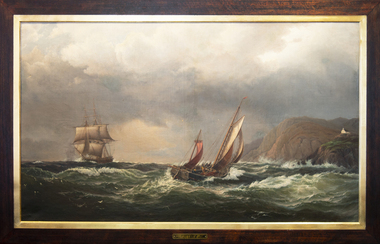 Mission to Seafarers Victoria
Painting - Oil painting, Madeline M.Ravenna Lewellin, Start Point Light, Devonshire, 1875
... P.&O. Fleet. painting ships mast church sea storm oil painting seagulls madeline r. lewellin artwork-paintings ngv wilhelm melby eugene von guerard botanist rms mongolia captain herbert gordon hill lewellin (1862-1935) paddy lewellin reproduction seascape danger Front: ENGRAVED PLAQUE: Start Point Light. Devonshire. SIGNATURE: After W. Melby / M.M.R Lewellin. 1875. Reverse: IN BLACK MARKER PEN: * Hang from two points * WHITE STICKER WITH CONSERVATOR DETAILS: Art Conservation Frames / 118 Bridport Street, Albert Park, VIC, 3206 / 9696 9066 / artconservationframers.com.au This oil painting has a dark polished wood ...This painting was made after an artwork by Wilhelm Melby held at the National Gallery of Victoria. Melby is a Danish artist (1824-1882). It depicts a famous Devonshire coastal region famous now for its lighthouse and the pick up point for the pilot when entering waters approaching Dartmouth. The sailing vessels pre-date the construction of the famous lighthouse. Over the centuries the view would have been familiar to many sailors as they left or approached the English mainland and south coast ports in the English Channel. Madeline Mary Ravenna Lewellin (1854 – 24 November 1944) was born in Victoria to Dr John Henry Hill Lewellin, a physician, and Grace Elizabeth (née Danneby). She was one of five daughters, and the family lived in Prahran. Lewellin's brother, Captain Herbert Gordon Hill Lewellin, was a commander in the P. and O. fleet (apprentice on the Romanoff, Lieutenant RNR on the HMS Arethusa in 1899, RMS Mongolia in 1913 sunk in 1917, Naldera in 1920). She studied painting at the National Gallery School in 1879 under Eugene von Guerard. She's also known for collecting and painting specimens, and became a member of the Field Naturalists Club of Victoria in 1885. In 1884 she won a silver medal for her studies of fungi. She collected plants for Australian botanist Ferdinand von Mueller, and the variety of Dicrastylis lewellinii (Purple sand-sage) is named after her. Miss Lewellin, who had a love of the sea and ships as subject matter is listed in 1910 as a donor as a 10/6 member donating to the motor launch fund and in 1918 as a working member of the Ladies Harbour Lights Guild which involved regular volunteer shifts at the Mission to Seamen on canteen and other duties. The painting was donated by Miss Lewellin in 1918 and hanged above the stage in the main hall; it appears on several postcards of the time.Marine art, Maritime artThis oil painting has a dark polished wood and gold leaf slip. The painting depicts two masted boats. The choppy sea takes up the lower-third of the painting, and the other two-thirds of the image of made up of stormy grey clouds. A rocky cliff face can be seen on the right-hand side of the painting. A small church can be seen on the hillside. The ship on the left third of the painting sits on the horizon line of the sea. The centre ship with two masts appears to be leaning to the right and its deck is exposed to the viewer showing four men attempting to handle the masts and rigging. The left-hand ship with three masts is surrounded by two grey distant silhouetted mast ships. There are three seagulls at the upper left-centre of the image. There are another three gulls down on the lower-left of the image. Front: ENGRAVED PLAQUE: Start Point Light. Devonshire. SIGNATURE: After W. Melby / M.M.R Lewellin. 1875. Reverse: IN BLACK MARKER PEN: * Hang from two points * WHITE STICKER WITH CONSERVATOR DETAILS: Art Conservation Frames / 118 Bridport Street, Albert Park, VIC, 3206 / 9696 9066 / artconservationframers.com.aupainting, ships, mast, church, sea, storm, oil painting, seagulls, madeline r. lewellin, artwork-paintings, ngv, wilhelm melby, eugene von guerard, botanist, rms mongolia, captain herbert gordon hill lewellin (1862-1935), paddy lewellin, reproduction, seascape, danger -
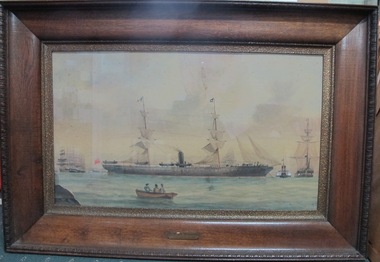 Mission to Seafarers Victoria
Painting, George Frederick Gregory (1821-1887), P&O S.S. Bangalore, 1867 - 1886
... Central at front lower edge of frame is a small chipped wood plaque with inscription. P&O S.S. Bangalore Painting Painting George Frederick Gregory (1821-1887) Charles Dickson Gregory ...This ship was number 1 of 2 ships named Bangalore and run by P & O. This ship has listed the same tonnage as that on the inscription on the frame of this work. The ship was subsequently sold in 1886 sold to Hajee Cassum Joosub and used for passengers on pilgrimage into Jeddah. Another view of the history of the Bangalore is that to be found at the Maritime Museums of Sydney listing of another painting of the Bangalore which provides a somewhat different history. It is possible that the story of Bangalore 1 and Bangalore 2 have become conflated further research is needed to verify. see Links field. SS BANGALORE was built in 1867 by William Denny of Dumbarton. Owned by P&O, SS BANGALORE operated from Bombay and Galle to Melbourne and Sydney from 1872 to 1886 as a passenger and mail ship. In 1891 BANGALORE was sold to Wilh. Wilhelmsen, Norway and renamed SS CORINGA.Marine art, Maritime artP&O S.S. Bangalore by George Frederick Gregory (1821-1887)Thinly painted image on board featuring centrally a moored, at anchor, 19th C dual masted steamship with black funnel and flying at the stern a red ensign. To either side are conventional rigged clippers or sailing ships. Near the bow of the steamship there seems to be a tug or paddle steamer face on. In the foreground is a small rowing boat with boatman and two passengers, a male and a female. The painting on board is mounted in a large polished or varnished cedarwood frame with edge carving and a decorative pitted slip which holds in place a thin piece of glazing. Backing paper and seal has all been removed except for hanging wire. Central at front lower edge of frame is a small chipped wood plaque with inscription.Painted in black on plaque and coloured black: "P & O S.S. "BANGALORE" / 2342 tons Built 1867"s.s. bangalore, marine painting, sailing ships, 1867, william denny, artwork-paintings, peninsular and oriental steam navigation company, steamship, p&o, sandridge, port melbourne, hobson's bay, charles dickson gregory, centenary maritime exhibition, george frederick gregory (1821-1887), ss bangalore -
 Mission to Seafarers Victoria
Decorative object - Lamp, c. 1930
... (Victorian Railways newsletter April 1948, p 11) The lighthouse is the symbol of hope and security for seafarers. lighthouse lamp maritime art art deco Lighthouse shaped lamp with art deco lamp shade. Base is mallee wood ...From research from PROV, maker could be Arthur Apps, a Victorian Railways employee (Head Office liftman), who was making those lamps to sell for his "favourite" charity, the Children's Hospital where he was a Life Governor. (Victorian Railways newsletter April 1948, p 11)The lighthouse is the symbol of hope and security for seafarers.Lighthouse shaped lamp with art deco lamp shade. Base is mallee wood, lighthouse is kauri wood.lighthouse, lamp, maritime art, art deco -
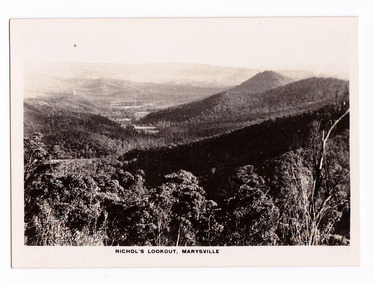 Marysville & District Historical Society
Photograph (item) - Black and white photograph, Rose Stereograph Company, Nichol's Lookout, Marysville, 1913-1967
... An early black and white photograph of the view from Nichol's Lookout which is on the Marysville-Wood's Point Road near Marysville, Victoria. The photograph was also used to produce the Rose Series postcard P. 2324. marysville victoria photograph nichol's lookout marysville-wood's point road p. 2324 rose series postcard souvenir rose stereograph company wood's point mining yarra track An early black and white photograph of the view from Nichol's Lookout which is on the Marysville-Wood's Point Road near Marysville in Victoria. ...An early black and white photograph of the view from Nichol's Lookout which is on the Marysville-Wood's Point Road near Marysville, Victoria.An early black and white photograph of the view from Nichol's Lookout which is on the Marysville-Wood's Point Road near Marysville, Victoria. The photograph was also used to produce the Rose Series postcard P. 2324.marysville, victoria, photograph, nichol's lookout, marysville-wood's point road, p. 2324, rose series postcard, souvenir, rose stereograph company, wood's point, mining, yarra track -
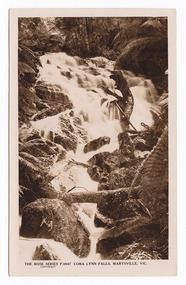 Marysville & District Historical Society
Postcard (item) - Black and white postcard, Rose Stereograph Company, Cora Lynn Falls, Marysville, Vic, 1913-1967
... Cambarville was impacted by the 2009 Black Saturday bushfires and any remaining structures were destroyed. marysville victoria photograph cora lynn falls waterfalls rose series postcard rose stereograph company souvenir cambarville marysville-wood's point road eucalyptus regnans cumberland memorial scenic reserve mining big culvert yarra track a cameron fj barton 1939 bushfires 2009 black saturday bushfires timber mills p. 4947 POST CARD REAL PHOTO THE "ROSE" SERIES DE LUXE PRODUCED IN AUSTRALIA Published by The Rose Stereograph Co./ Armadale, Victoria An early black and white photograph of the Cora Lynn Falls in Marysville, Victoria. ...A postcard in a series produced by the Rose Stereograph Company in Victoria, Australia as a souvenir of Marysville.An early black and white photograph of the Cora Lynn Falls in Marysville, Victoria. These falls are located on the Marysville-Wood's Point Road. Cambarville is notable for its giant mountain ash (Eucalyptus regnans) trees within the Cumberland Memorial Scenic Reserve, and relics from former sawmills and gold mining. The Big Culvert is located nearby on the Marysville - Woods Point Road, which was historically part of the Yarra Track. Cambarville was established as a timber mill town in the 1940s. Timber mill owners A Cameron and FJ Barton named Cambarville. They established the mill to salvage timber from trees destroyed in the 1939 bushfires. Cambarville was impacted by the 2009 Black Saturday bushfires and any remaining structures were destroyed.POST CARD REAL PHOTO THE "ROSE" SERIES DE LUXE PRODUCED IN AUSTRALIA Published by The Rose Stereograph Co./ Armadale, Victoriamarysville, victoria, photograph, cora lynn falls, waterfalls, rose series postcard, rose stereograph company, souvenir, cambarville, marysville-wood's point road, eucalyptus regnans, cumberland memorial scenic reserve, mining, big culvert, yarra track, a cameron, fj barton, 1939 bushfires, 2009 black saturday bushfires, timber mills, p. 4947
