
Showing 155 items matching "wood properties "
-
 Moorabbin Air Museum
Book - Wooden aircraft, Aircraft Woodwork
... Wood properties & characteristics...Wooden aircraft Wood properties & characteristics Aircraft woods Defects in & selection of aircraft woods Plywood Fundamentals of aircraft woodworking Technical drawings Glues & gluing Joints & Laminations Aircraft woodworkers tools Aircraft doping & finishing Safety rules Construction of various wing & tail components Wood propellers Repairs Overview of the characteristics, identification & uses of aircraft woods, circa 1946 Aircraft Woodwork Book Wooden aircraft ...Overview of the characteristics, identification & uses of aircraft woods, circa 1946non-fictionOverview of the characteristics, identification & uses of aircraft woods, circa 1946wood properties & characteristics, aircraft woods, defects in & selection of aircraft woods, plywood, fundamentals of aircraft woodworking, technical drawings, glues & gluing, joints & laminations, aircraft woodworkers tools, aircraft doping & finishing, safety rules, construction of various wing & tail components, wood propellers, repairs -
 Greensborough Historical Society
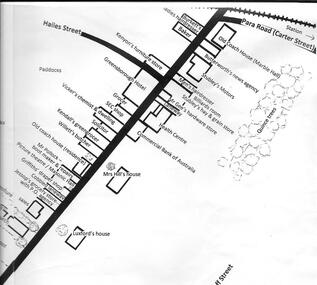
Map, U. M. Woods, Main Street Greensborough, early to mid 1950s, 2014
... Map of Main and Grimshaw Streets Greensborough by U.M. Woods. Properties shown are drawn from memory and represent the town in the early to late 1950s....Map of Main and Grimshaw Streets Greensborough by U.M. Woods. Properties shown are drawn from memory and represent the town in the early to late 1950s. u. m. woods grimshaw street greensborough main street greensborough Sketch map, black on white paper. letter of explanation. ...Map of Main and Grimshaw Streets Greensborough by U.M. Woods. Properties shown are drawn from memory and represent the town in the early to late 1950s.Sketch map, black on white paper. letter of explanation.u. m. woods, grimshaw street greensborough, main street greensborough -
 Flagstaff Hill Maritime Museum and Village
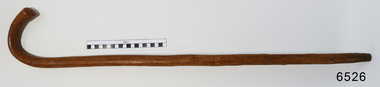
Accessory - Walking Stick, William Dale, early 1900's
... In the words of the Donor, Betty Stone, "This walking stick was made by William Dale from wood obtained from his property Bluestone Quarries situated at Wangoom, Warrnambool. ...Made by William Dale in the early 1900's of wood from his property, "Dale Bluestone Quarries", Wangoom, Warrnambool. ...Made by William Dale in the early 1900's of wood from his property, "Dale Bluestone Quarries", Wangoom, Warrnambool. ...In the words of the Donor, Betty Stone, "This walking stick was made by William Dale from wood obtained from his property Bluestone Quarries situated at Wangoom, Warrnambool. William Dale, the son of William Booth and Hannah (nee Broadbent) Dale was born on 8 July 1828 in Saddleworth, Yorkshire, England. He emigrated to Australia in 1852 and seven years later purchased twenty acres of land in the shire of Wangoom, Warrnambool where he operated a quarry known as The Dale Bluestone Quarries. According to family legend, when William and his wife Elizabeth (nee Chamberlain) first moved into their bluestone cottage on the property, it was surrounded by dense bush that abounded with wildlife. William Dale used this walking stick in his later years. Although physically bent after years of toil, his grandchildren remembered him wheeling his barrow and walking with his stick around the quarries when aged well over eighty years. William Dale died at his residence on 14 December 1913 aged 85 years." (Note: For additional information please refer to Betty Stone’s book “Pioneers and Places - A History of three Warrnambool Pioneering Families” ie. Chamberlain, Dale and Lees Families) This item is associated with the families of Chamberlain, Dale and Lees. These families are listed in the "Pioneers' Register" for Warrnambool Township and Shire, 1835-1900, published by A.I.G.S. Warrnambool Branch. The handmade walking stick was made from local resources.Walking Stick, polished wood with grain and knots showing. Brass tip, 'J' shaped handle. Made by William Dale in the early 1900's of wood from his property, "Dale Bluestone Quarries", Wangoom, Warrnambool. From the 'Chamberlain Dale and Lees Collection'.flagstaff hill, warrnaflagstaff hill, warrnambool, shipwrecked coast, flagstaff hill maritime museum, maritime museum, shipwreck coast, flagstaff hill maritime village, great ocean road, chamberlain, dale, lees, stone, betty stone, warrnambool pioneers, mbool, shipwrecked-coast, flagstaff-hill, flagstaff-hill-maritime-museum, maritime-museum, shipwreck-coast, flagstaff-hill-maritime-village, dale bluestone quarries, william dale, walking aid, walking stick, mobility aid -
 Flagstaff Hill Maritime Museum and Village
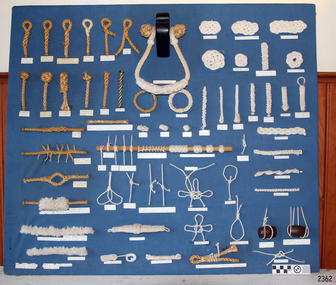
Education kit - Knot Board, Tom Long, DSM (Member of International Guild of Knot Tyers), ca 1975 to 1986
... wood, reinforcing spliced rope and even for decorative work. The sailmakers, travelling as part of the ship’s crew, stored their tool kit in a canvas ditty bag. It contained needles, awls, a sailmaker’s leather-palmed glove with a heavily reinforced palm, a shuttle to mend and make nets, fids, knives, mallets, brushes, rulers, and rope gauges. Sailmakers used their ropework and knot-making skills for various purposes and chose the type of rope fibre for its particular properties...wood, reinforcing spliced rope and even for decorative work. The sailmakers, travelling as part of the ship’s crew, stored their tool kit in a canvas ditty bag. It contained needles, awls, a sailmaker’s leather-palmed glove with a heavily reinforced palm, a shuttle to mend and make nets, fids, knives, mallets, brushes, rulers, and rope gauges. Sailmakers used their ropework and knot-making skills for various purposes and chose the type of rope fibre for its particular properties ...The Display Board of Konts was handmade in Kings Lynn, Devon, England, by Tom Long DSM, a member of the International Guild of Knot Tyers. Tom Long more recently lived in a suburb of Melbourne. This display board shows the knots and joins used in ropework performed by a sailmaker and other skilled knot tyers and ropeworkers. It demonstrates the uses of some of the knots, such as knobs and handles, suspending lengths of wood, reinforcing spliced rope and even for decorative work. The sailmakers, travelling as part of the ship’s crew, stored their tool kit in a canvas ditty bag. It contained needles, awls, a sailmaker’s leather-palmed glove with a heavily reinforced palm, a shuttle to mend and make nets, fids, knives, mallets, brushes, rulers, and rope gauges. Sailmakers used their ropework and knot-making skills for various purposes and chose the type of rope fibre for its particular properties. For example, Italian hemp rope was preferred for the light line used in shore-to-ship rescues because it was lightweight, not easily knotted, and absorbed less water. A supply of various types of rope was a commodity on board a ship and on land in the new colonies. It was flexible, easily stored, and could be worked to create an endless variety of objects on its own or with other materials like wood. An example is a simple rope ladder. Lengths could be combined to make various thicknesses, and pieces could be skilfully joined together by splicing. The importance of knots in seafaring cannot be overestimated. When ships relied on only the wind for power and speed, there were a huge number of various ropes in use, particularly about the sails and rigging. Seafarers would be judged on their ability to tie knots speedily and correctly. A mounted display of authentic seamen's knots is on a board covered in blue fabric. Various rope grades and fibres were used to work numerous knots and splices. Some of the uses are familiar, such as the toggle, the pineapple knot, and the Turk’s head. A selection of rope grades and fibres was used to work numerous knots and splices. Some of the uses are familiar, such as the toggle, the pineapple knot, and the Turk’s head. The name or purpose of the knot is on the label below it. Labels below each knot give its name or use.flagstaff hill, warrnambool, maritime museum, maritime village, great ocean road, shipwreck coast, knot display, knot making, ropework, marine technology, sailmaker's work, sailor's knots, ship's rigging, seamen's knots, handmade, rope craft, knots, splices, display board of knots, knot board, tom long, sailmaker's knots, mariner's knots -
 Federation University Historical Collection
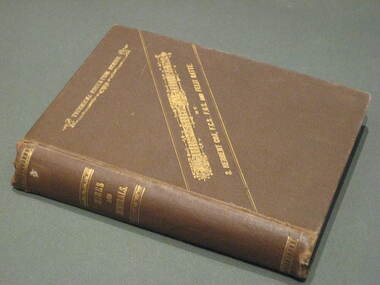
Book, Mines and Minerals: A Guide for the Australian Miner, 1885
... Chapters in the book include Geology; Rocks and their Movements; Stratified Deposits; Mineral Veins and Lodes; Dynamics of Lodes; Filling of Lodes; Irregular Deposits; Alluvial Deposits; Physical Properties of Minerals; Compsition and Determination of Minerals; Noble Mineral; Silver and Lead; Quicksilver or Mercury; Haloids and salts; Quartz and Opal; Precious stones; assays and the use of Blowpipes; Special Assays for Gold and Silver Mines and Minerals: A Guide for the Australian Miner Book S. Herbert Cox Felix Ratte James Wood ...This book was presented to Professor Ferdinand Krause of the Ballarat School of Mines by the co-author Felix Ratte who had taught Geology at the Ballarat School of Mines. Felix Ratte became mineralogist to the Australian Museum, Sydney.Hardcovered book with brown cloth cover. 341 pages with illustrations. Chapters in the book include Geology; Rocks and their Movements; Stratified Deposits; Mineral Veins and Lodes; Dynamics of Lodes; Filling of Lodes; Irregular Deposits; Alluvial Deposits; Physical Properties of Minerals; Compsition and Determination of Minerals; Noble Mineral; Silver and Lead; Quicksilver or Mercury; Haloids and salts; Quartz and Opal; Precious stones; assays and the use of Blowpipes; Special Assays for Gold and SilverFrontise page handwritten in ink: 'Prof. Krause from F. Ratte'mining, ballarat school of mines, geology, felix ratte, minerals, ferdinand krause -
 Federation University Historical Collection
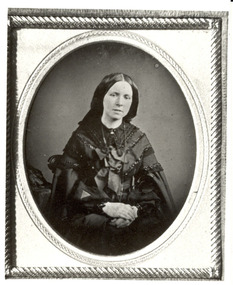
Photograph, Catherine Coghill, 1860s
... Mark Gardiner [Gardner], wife of the contractor for laying down the wood pavement in Elizabeth- street, sailed for Queensland aboard the elegant steamship, ‘Ly-ee-Moon’ to visit her sister Adelaide Reid and purchase a property in the Darling Downs, Qld. ...Mark Gardiner [Gardner], wife of the contractor for laying down the wood pavement in Elizabeth- street, sailed for Queensland aboard the elegant steamship, ‘Ly-ee-Moon’ to visit her sister Adelaide Reid and purchase a property in the Darling Downs, Qld. ...Catherine Holmes married William Coghill Junior. William died in 1884. This is possibly a photo of Catherine in her mourning clothes. They had no children. His estate passed to Catherine. In 1886 Catherine accompanied by her brother, Edward Carter Holmes, Mr. Holmes a farmer at Ascot and her companion Mrs. Mark Gardiner [Gardner], wife of the contractor for laying down the wood pavement in Elizabeth- street, sailed for Queensland aboard the elegant steamship, ‘Ly-ee-Moon’ to visit her sister Adelaide Reid and purchase a property in the Darling Downs, Qld. Tragically all three, and the gold sovereigns they were carrying to purchase same, were lost when the steamship struck rocks and was wrecked off the rugged Green Cape Coast, just south of Bega, New South Wales [Jane Dyer, 15 June 2024]Black and white photograph of a seated woman wearing black clothing, a cap with centrally parted hair. The woman is Catherine Coghill (formerly Holmes), who married William Coghill Jnr. catherine coghill, catherine holmes, william coghill, william coghill junior, holmes family collection, chatham-holmes family collection, ly-ee-moon, mourning, shipwreck, women, pioneer women, family history -
 Flagstaff Hill Maritime Museum and Village
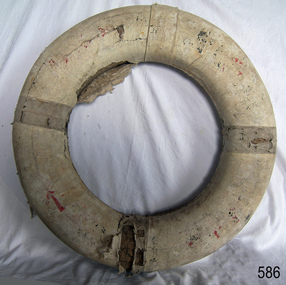
Equipment - Lifebuoy
... The strips of cork wood have been joined together to make the ring shape. The broad arrow symbol indicates that it was once the property of the British or Australian defence force. ...The strips of cork wood have been joined together to make the ring shape. The broad arrow symbol indicates that it was once the property of the British or Australian defence force. ...This lifebuoy is part of the lifesaving equipment that would be carried on vessels in the late 19th and early 20th century. The strips of cork wood have been joined together to make the ring shape. The broad arrow symbol indicates that it was once the property of the British or Australian defence force. A lifebuoy, or life-preserver, is used as a buoyancy device to keep a person afloat in the. It is usually connected by a rope to a person in a safe area such a nearby vessel or on shore. The lifebuoy is thrown to a person in distress in the water, allowing the rescuer to pull the person to safety. The lifebuoy is a made from a buoyant material such as cork or rubber and is usually covered with canvas for protection and to make it easy to grip. The first use of life saving devices in recent centuries was by the Nordic people, who used light weight wood or cork blocks to keep afloat. From the early 20th century Kapok fibre was used as a filling for buoys. Light weight balsa wood was used as a filler after WW1. In 1928 Peter Markus invented and patented the first inflatable life-preserver. By WW2 foam was combined with Kapok. Laws were passed over time that has required aeroplanes and water going-vessels to carry life-preservers on board. The lifebuoy is an example of equipment carried on vessels in the late 19th and early 20th century to help preserve life. There were many lives lost in Australia’s colonial period, particularly along the coast of South West Victoria. The lifebuoy was once the property of the British or Australian defence force.Lifebuoy, round cork object with canvas wrapped around it and rope attached to one side. Broad arrow mark and other red marks indecipherable. Painted white.Symbol of broad arrow. indecipherable markings.flagstaff hill, warrnambool, shipwrecked-coast, flagstaff-hill, flagstaff-hill-maritime-museum, maritime-museum, shipwreck-coast, flagstaff-hill-maritime-village, life rings, lifebuoy, safety ring, life-saving buoy, ring buoy, life preserver, personal floating device, floatation device, safety equipment, government lifebuoy, broad arrow -
 The Beechworth Burke Museum
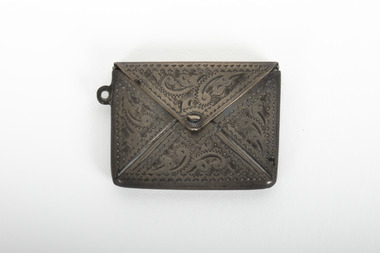
Functional object - Silver Stamp Case, unknown
... wood, and silver. In this case, the item is made of sterling silver and has patterns and details etched into the metal sheets that make up the case. Sterling silver is the standard alloy used in jewellery and detailed metalworks with its physical properties making it maleable and corrosion resistant, therefore a favourable metal to work with both across many centuriesn the past and present. ...wood, and silver. In this case, the item is made of sterling silver and has patterns and details etched into the metal sheets that make up the case. Sterling silver is the standard alloy used in jewellery and detailed metalworks with its physical properties making it maleable and corrosion resistant, therefore a favourable metal to work with both across many centuriesn the past and present. ...Stamp cases/holders began being produced in the late 19th century, commonly made of gold, wood, and silver. In this case, the item is made of sterling silver and has patterns and details etched into the metal sheets that make up the case. Sterling silver is the standard alloy used in jewellery and detailed metalworks with its physical properties making it maleable and corrosion resistant, therefore a favourable metal to work with both across many centuriesn the past and present. Stamp cases where popularised by James Allen of Birmingham who created and registered the stamp holders he made. As they gained popularity, it was common for stamp holders to consist of multiple compartments holding various small items such as matches, strikers and of course stamps. Metalwork and silverwork has been a prominent proffession and artform historically and socially for many years. There are many different types of metal work to specialise in and distinct patterns and inscriptions for identifying the provenance of the item. Hallmarking is this proccess of inscribing the item, and consissts of four main components (including assaying) which can indicate the date of creation. Unfortunately this item has no hallmark, therefore it is relatively unknown where, what, when and who created it.This item is of social and historic significance as it highlights the importance of preserving histoical items. This item display's the intricate and highly skilled trades of the past with a glimpse into the social and cultural aspects of the beechworths' history.A small, silver stamp holder with decorative details etched into the metal. It has a small loop on the left side of the case, indicating it could be connected and held by a chain or ring. A01145 (obejct number): A01145 [object number inside stamp case] / STERLING SILVER [inscription inside stamp case]metalwork, silver, silverware, sterling silver, stamp holder, stamp case, burke museum, social history, burke museum collection, beechworth -
 Marysville & District Historical Society
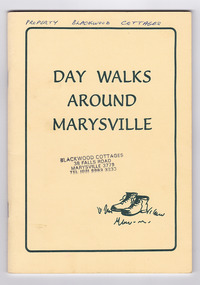
Booklet - Paperback booklet, Maroondah Bushwalking Club Inc, Day Walks Around Marysville, 1996
... This booklet was produced by the Maroondah Bushwalking Club in 1996. marysville victoria day walks bushwalking maroondah bushwalking club cathedral range sugarloaf peak neds gully maroondah highway woods lookout cement creek acheron lake mountain snowy hill cumberland reserve wilks creek mount strickland the beeches mount margaret stevensons falls steavensons falls de la rue lookout oxlee lookout keppel lookout keppel hut north jawbone peak cumberland scenic reserve acheron road buxton man o war track phantom falls keppel falls athols abbey sunds road trestle track booklet A booklet outlining day walks of various difficulties in and around the surrounds of Marysville. PROPERTY ...A booklet outlining day walks of various difficulties in and around the surrounds of Marysville.Paperback booklet. Front cover shows title with a cartoon drawing of a pair of walking boots. Back cover shows details of the publisher and distributor of the publication.non-fictionA booklet outlining day walks of various difficulties in and around the surrounds of Marysville.marysville, victoria, day walks, bushwalking, maroondah bushwalking club, cathedral range, sugarloaf peak, neds gully, maroondah highway, woods lookout, cement creek, acheron, lake mountain, snowy hill, cumberland reserve, wilks creek, mount strickland, the beeches, mount margaret, stevensons falls, steavensons falls, de la rue lookout, oxlee lookout, keppel lookout, keppel hut, north jawbone peak, cumberland scenic reserve, acheron road, buxton, man o war track, phantom falls, keppel falls, athols abbey, sunds road, trestle track, booklet -
Federation University Historical Collection
Book, New York Post, The School of Mine Quarterly: A Journal of Applied Science, 1889-1809
... The School of Mines Quarterly was a jpournal of Applied Science from Columbia College, New York City. school of mines new york columbia college schools of mines columbia school of mines Witwatersrand Goldfield INter-continental Railway Mine Ropes Harbor improvememnts on the Pacific coast Glycerine and artificial Butter industry Transit Factors for teh Columbia College Observatory Tables for the Reducation of Transit Observations Ancienct methods for dividing and Recoording time in Japan Assay of tin John Strong Newberry Standards of linnear Measure Comparison of costs of electric lighting Huanchaca Mine Bolivia El Callao Gold Mine Venezuela John Magnus Adams Ores in Saxony Hartz and Rhenish Prussia Hofmann Apparatus Adjustment of Trangulation Determination of Carbonic Acid in White Lead Lower Coals in Western Clearfield County Pennsylvania Old Telegraph Mine Ningham Canon Utah mechanical Preparation of Ores modern waterworks construction curdling of milk French regenerative gas furnace Irrication Canals peruvian salt mine Collection of Metallurgic Dust and fume Permeability of iron and steel Assay of Silver Explosion in a Zinc Fume condenser Teaching archtectural history Liquid air between the mine and the smelter Ballistic Galvonometer Assay of Telluride ores Analytical Chemistry Theory and design of the masonry arch silver pick mine Wilson colorado telegraphy and telephoney mineralogy morse code Michigan mining practices Titaniferous magnetites paradox of the pantheon Rocks from Wyoming Witwatersrand goldfields Gaseous sun Alternating current distribution Engineering tests on direct current Electrical Machinery Thomas Egleston Ore dressing Frederick Morgan Watson Camp Bird Gold Mine and Mills Magnetic properties of Iron and Steel Morphology of Organic compounds Antimony structure of the Starch Molecule Cerrillos Hills New Mexico geology Rossie Lead Veins practical electrochemistry lines of graphic statics Anistic Acid by the ozidation of Anniseed Oil Bromate method for antimony John Krom Rees Trust company of America Building Helion lamp Frederick Arthur Goetze Mine Surveying Pine Wood Oils Malleable Cast iron Electrolytic treatment of Galena turpentine and pine oils Bluestone Ashokan Dam bluestone road resistances Oxy-gas blowtorch Mine dumps segregation of steel ingots masonry dam formulas putnam county magnetic belts gases Continuity of education Hydraulic diagrams standardistion of Potassium permanganate Sewerage Discharge into Sea Water Modern waterworks True Column formula Slags from lead furnaces missouri river tempreture of gases rocks architectural history Modern dome oil machine undulations in railway tracks Irrigation engineering Cleps-tachymeters Electrical Engineering New York Shales fan pump Sucrose Isaac Newton French school of anstronomers Electrolytic polarization Benjamin bowden lawrence diamond drilling New York Ciy Water Front Engineering profession ethics The Index to the School of Mines Quarterlu Volumes X1-XX (1900) and 32 green covered journals The School of Mine Quarterly: A Journal of Applied Science Book New York Post ...The School of Mines Quarterly was a jpournal of Applied Science from Columbia College, New York City.The Index to the School of Mines Quarterlu Volumes X1-XX (1900) and 32 green covered journals school of mines, new york, columbia college, schools of mines, columbia school of mines, witwatersrand goldfield, inter-continental railway, mine ropes, harbor improvememnts on the pacific coast, glycerine and artificial butter industry, transit factors for teh columbia college observatory, tables for the reducation of transit observations, ancienct methods for dividing and recoording time in japan, assay of tin, john strong newberry, standards of linnear measure, comparison of costs of electric lighting, huanchaca mine bolivia, el callao gold mine venezuela, john magnus adams, ores in saxony, hartz and rhenish prussia, hofmann apparatus, adjustment of trangulation, determination of carbonic acid in white lead, lower coals in western clearfield county pennsylvania, old telegraph mine ningham canon utah, mechanical preparation of ores, modern waterworks construction, curdling of milk, french regenerative gas furnace, irrication canals, peruvian salt mine, collection of metallurgic dust and fume, permeability of iron and steel, assay of silver, explosion in a zinc fume condenser, teaching archtectural history, liquid air, between the mine and the smelter, ballistic galvonometer, assay of telluride ores, analytical chemistry, theory and design of the masonry arch, silver pick mine wilson colorado, telegraphy and telephoney, mineralogy, morse code, michigan mining practices, titaniferous magnetites, paradox of the pantheon, rocks from wyoming, witwatersrand goldfields, gaseous sun, alternating current distribution, engineering tests on direct current electrical machinery, thomas egleston, ore dressing, frederick morgan watson, camp bird gold mine and mills, magnetic properties of iron and steel, morphology of organic compounds, antimony, structure of the starch molecule, cerrillos hills new mexico, geology, rossie lead veins, practical electrochemistry, lines of graphic statics, anistic acid by the ozidation of anniseed oil, bromate method for antimony, john krom rees, trust company of america building, helion lamp, frederick arthur goetze, mine surveying, pine wood oils, malleable cast iron, electrolytic treatment of galena, turpentine and pine oils, bluestone, ashokan dam bluestone, road resistances, oxy-gas blowtorch, mine dumps, segregation of steel ingots, masonry dam formulas, putnam county magnetic belts, gases, continuity of education, hydraulic diagrams, standardistion of potassium permanganate, sewerage discharge into sea water, modern waterworks, true column formula, slags from lead furnaces, missouri river, tempreture of gases, rocks, architectural history, modern dome, oil machine, undulations in railway tracks, irrigation engineering, cleps-tachymeters, electrical engineering, new york shales, fan pump, sucrose, isaac newton, french school of anstronomers, electrolytic polarization, benjamin bowden lawrence, diamond drilling, new york ciy water front, engineering profession ethics -
 Marysville & District Historical Society
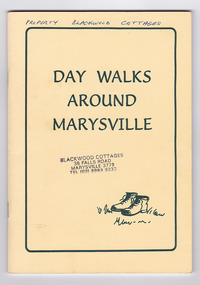
Booklet - Paperback booklet, Maroondah Bushwalking Club Inc, Day Walks Around Marysville, 1996
... This booklet was produced by the Maroondah Bushwalking Club in 1996. marysville victoria day walks bushwalking maroondah bushwalking club cathedral range sugarloaf peak neds gully maroondah highway woods lookout cement creek acheron lake mountain snowy hill cumberland reserve wilks creek mount strickland the beeches mount margaret stevensons falls steavensons falls de la rue lookout oxlee lookout keppel lookout keppel hut north jawbone peak cumberland scenic reserve acheron road buxton man o war track phantom falls keppel falls athols abbey sunds road trestle track booklet A booklet outlining day walks of various difficulties in and around the surrounds of Marysville. PROPERTY ...A booklet outlining day walks of various difficulties in and around the surrounds of Marysville.Paperback booklet. Front cover shows title with a cartoon drawing of a pair of walking boots. Back cover shows details of the publisher and distributor of the publication.non-fictionA booklet outlining day walks of various difficulties in and around the surrounds of Marysville.marysville, victoria, day walks, bushwalking, maroondah bushwalking club, cathedral range, sugarloaf peak, neds gully, maroondah highway, woods lookout, cement creek, acheron, lake mountain, snowy hill, cumberland reserve, wilks creek, mount strickland, the beeches, mount margaret, stevensons falls, steavensons falls, de la rue lookout, oxlee lookout, keppel lookout, keppel hut, north jawbone peak, cumberland scenic reserve, acheron road, buxton, man o war track, phantom falls, keppel falls, athols abbey, sunds road, trestle track, booklet -
 Ballarat Clarendon College
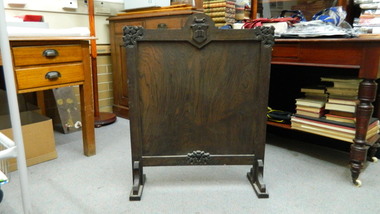
Furniture, Fire screen
... His breadth of vision, generosity, devotion to the advancement of the school in every way, and meticulous care of the property and ikts interests, have given him a unique place in the hostory of the school. j-j-watson clarendon-presbyterian-ladies-college mair-street-campus school-council watson-hall life-member fire-screen furniture Plaque: Presented to / Mr J J WATSON / in appreciation of his devoted service / as secretary of the council of / CLARENDON PRESBYTERIAN LADIES / COLLEGE / FROM 1920 - 1952. Wood ...The fire screen was gifted to Mr J J Watson at his retirement in 1952. The assembly hall at the Mair Street property was named in his honour. Mr J J watson was a member of the school council from its inception in 1919 when he was elected as a representative of Scots' Church. He succeeded Rev J T Riddle as secretary to council in 1920. In 1954 the assembly hall at the Mair Street property was officially named Watson Hall in his honour. In 1957 the constitution of the Council was amended to enable Mr Watson to be elected its first life member. The fire screen was returned to the school by the family after his death. In a tribute in 1952 at the time of Mr watson's retirement from secretarial position on council, Principal Kerr said, 'Mr watson's family was friendly with the Kennedy(founder) family in Ireland, so that his interest in Clarendon was almost hereditary. His breadth of vision, generosity, devotion to the advancement of the school in every way, and meticulous care of the property and ikts interests, have given him a unique place in the hostory of the school. Wood fire screen with school crest at top of front. Carved details at top corners and base of front feature scottish thistle and leaves. Solid wood frame and stand; veneer insert. Small bronze plaque fixed to top of back. Plaque: Presented to / Mr J J WATSON / in appreciation of his devoted service / as secretary of the council of / CLARENDON PRESBYTERIAN LADIES / COLLEGE / FROM 1920 - 1952.j-j-watson, clarendon-presbyterian-ladies-college, mair-street-campus, school-council, watson-hall, life-member, fire-screen, furniture, -
 Ballarat Clarendon College
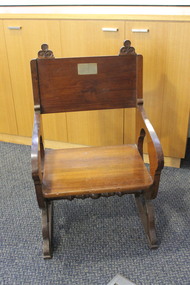
Chair
... property in 2019. Congregation member, Max Harris, kindly arranged the donation of the chair to the school because of Mrs Cairn's long association with Clarendon PLC. mrs mary cairns 1919 st andrews kirk clarendon presbyterian ladies college Plaque: This chair was presented by the / Members of the St Andrews P W M U / on the occasion of the retirement of / Mrs T R Cairns / from the Presidency of the Branch / after holding that office for more than fifty years / as an acknowledgement of her devoted service / as President / & of their deep personal regard. Solid wood ...Wife of the Rev T D Cairns, Minister of St Andrews Kirk, Mrs Mary Cairns served on the Council of Clarendon Presbyterian Ladies College 1919 - 1949. Her generous guarantee of loans from the Ballarat Banking Company, together with other donations, enabled the Presbytery of Ballarat to purchase Clarendon Ladies College from Mr Kennedy in 1919 for 1500 pounds. Mrs Cairns was an inaugural member of the new Clarendon Presbyterian Ladies College Council, established 1919 and remained on the Council for 30 years. This chair was a personal gift to Mrs Cairns by the PWMU to honour of her long and devoted service to that organisation. Mrs Cairns donated the chair back to St Andrews Kirk where it remained in use until the sale of the property in 2019. Congregation member, Max Harris, kindly arranged the donation of the chair to the school because of Mrs Cairn's long association with Clarendon PLC. Solid wood chancel chair with discreet carving; plaque on front side of back supportPlaque: This chair was presented by the / Members of the St Andrews P W M U / on the occasion of the retirement of / Mrs T R Cairns / from the Presidency of the Branch / after holding that office for more than fifty years / as an acknowledgement of her devoted service / as President / & of their deep personal regard. mrs mary cairns, 1919, st andrews kirk, clarendon presbyterian ladies college -
 Federation University Historical Collection
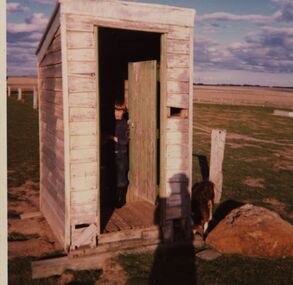
Photograph - Colour, Chatham-Holmes Collection: Andrew Chatham in the Out House, Kur-a-ruc South, Rokewood, Vic. {circa 1976)
... property, "Kur-a-ruc South" a former part of the Kur-a ruc Station, Rokewood, Victoria purchased by Philip and Elizabeth Chatham in 1964. The family lived at Ascot, 15 miles north of Ballarat, and had regular weekend day trips and Easter holidays picnicking, droving sheep, feeding stock, checking water troughs and dams, hand-weeding Patterson curse, repairing fences, collecting paddock rocks and sugar-gum wood at "Kur-a-ruc South'. ...property, "Kur-a-ruc South" a former part of the Kur-a ruc Station, Rokewood, Victoria purchased by Philip and Elizabeth Chatham in 1964. The family lived at Ascot, 15 miles north of Ballarat, and had regular weekend day trips and Easter holidays picnicking, droving sheep, feeding stock, checking water troughs and dams, hand-weeding Patterson curse, repairing fences, collecting paddock rocks and sugar-gum wood at "Kur-a-ruc South'. ...Andrew Chatham, the youngest of Philip and Elizabeth Chatham's 5 children, was born in 1968. In this photo, he looks about 8 - 10 years old. The photo was taken at Rokewood, Victoria on his parent's Western District property, "Kur-a-ruc South" a former part of the Kur-a ruc Station, Rokewood, Victoria purchased by Philip and Elizabeth Chatham in 1964. The family lived at Ascot, 15 miles north of Ballarat, and had regular weekend day trips and Easter holidays picnicking, droving sheep, feeding stock, checking water troughs and dams, hand-weeding Patterson curse, repairing fences, collecting paddock rocks and sugar-gum wood at "Kur-a-ruc South'. Home base for these excursions was either a car, the shearing shed, sometimes a 6-berth caravan and by the mid-1980s a shearer's quarters with an inside toilet. [Jane Dyer (nee Chatham).15 June 2024] chatham-holmes collection, andrew chatham, outdoor shed, toilet facility, rokewood, kur-a-ruc south, rokewood -
Marysville & District Historical Society
Document (item) - Research document, Judith Vimpani, Gorman Family of Acheron, 2019
... property being 'Hillside'. The eldest son married William Lawlor's (Buxton) eldest daughter. A document outlining the history of the Gorman Family from Acheron. acheron buxton victoria australia gorman family john hall gorman mary gorman mary wood A document outlining the history of the Gorman Family from Acheron. ...A document outlining the history of the Gorman Family from Acheron. The Gorman's owned over 600 acres north of Acheron, the home property being 'Hillside'. The eldest son married William Lawlor's (Buxton) eldest daughter.A document outlining the history of the Gorman Family from Acheron. acheron, buxton, victoria, australia, gorman family, john hall gorman, mary gorman, mary wood -
 Marysville & District Historical Society
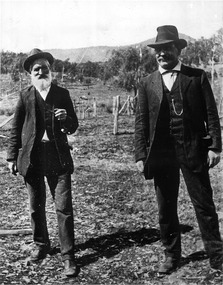
Photograph (item) - Black and white photograph, Unknown
... property being 'Hillside'. The eldest son married William Lawlor's (Buxton) eldest daughter. A copy of a black and white photograph of John James Gorman and his father-in-law William Lawlor. acheron buxton victoria australia gorman family john hall gorman mary gorman mary wood john james gorman photograph A copy of a black and white photograph of John James Gorman and his father-in-law William Lawlor. ...A copy of a black and white photograph of John James Gorman and his father-in-law William Lawlor. The Gorman's owned over 600 acres north of Acheron, the home property being 'Hillside'. The eldest son married William Lawlor's (Buxton) eldest daughter.A copy of a black and white photograph of John James Gorman and his father-in-law William Lawlor.acheron, buxton, victoria, australia, gorman family, john hall gorman, mary gorman, mary wood, john james gorman, photograph -
 Flagstaff Hill Maritime Museum and Village
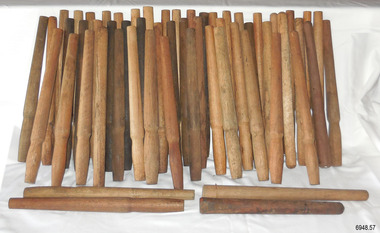
Equipment - Belaying Pins, Late 19th Century
... property of the Australian Government's Department of Defence. Belaying pins are essential equipment on a traditional sailing ship of the 19th and early 20th centuries. They are usually made of wood...property of the Australian Government's Department of Defence. Belaying pins are essential equipment on a traditional sailing ship of the 19th and early 20th centuries. They are usually made of wood ...The pins in this collection vary in the timber used and the design. They were found in a warehouse beside Crown Casino in Melbourne, located along the Yarra River, close to the sailing ship "Polly Woodside" and not far from the docks of Port Melbourne. Some of the pins have the mark of a 'Broad Arrow' with 'D ↑ D, which signifies that they were the property of the Australian Government's Department of Defence. Belaying pins are essential equipment on a traditional sailing ship of the 19th and early 20th centuries. They are usually made of wood but some are metal. A belaying pin is used to secure the running ropes of the rigging to the ship's rails using holes drilled onto the rails for that purpose. The belaying pins are inserted into holes in the ship’s rail, drilled for that purpose. When the sail has been raised, the ropes are wrapped around the upper and lower sections of the pins in a figure-eight pattern. The shapes of these belaying pins taper from the rounded end of the handle inwards towards the bottom, which allows them to have a firm fit into the holes in the rails. The rigging rope is wound around the pins in such a way that a tug on the pin's handle pulls it out of the hole and quickly frees the rope and the sail.These belaying pins are significant for their association with sailing vessels, particularly vessels of the late 19th and early 20th centuries. They are also significant for their association with the Port of Melbourne where sailing ships docked to and from the Port of Melbourne. Some of the pins have additional significance for being connected with the Australian Government's Department of Defence.Belaying pin, wooden, simple design, wooden shaft with a wider rounded end on top third, tapering to the centre third, which is wider than a lower third. The bottom has a blunt base. Some of the pins have the three sections divided by a line around their circumferences. This collection of fifty-seven pins of varying shapes, colours and timber. Some of the pins are stained with colour, and some have been left natural Stored in a wooden crate. Some have inscriptions.Marks: (Government Defence Department Broad Arrow) "D ↑ D"sailiing equipment, nautical equipment, rigging, yards, flagstaff hill, maritime museum, maritime village, belaying pin, broad arrow, australian government, australian department of defence, sailing ship, sail -
 Flagstaff Hill Maritime Museum and Village
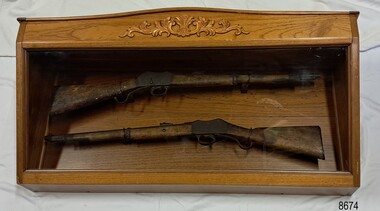
Weapon - Historic Rifles, Royal Small Arms Factory, 1877-1900
... property was sold by the Education Department to a private owner. The Woodford Community donated the pair of Martini-Henry Carbines to the Victoria Police Museum in the late 1990s for mounting and display, which was funded by the Victoria Police Historical Society Inc. The decorative wood...property was sold by the Education Department to a private owner. The Woodford Community donated the pair of Martini-Henry Carbines to the Victoria Police Museum in the late 1990s for mounting and display, which was funded by the Victoria Police Historical Society Inc. The decorative wood ...Martini-Henry Artillery Carbin rifles were made by the Royal Small Arms Factory at Enfield, Britain, from 1877 until 1900. Many were distributed to the British Colonies, including this pair, which was allocated to the Woodford Police, Victoria Police District of Warrnambool, Southwest Victoria. The Carbine model rifles were shorter than the standard rifles and more suited to mounted police and troopers. It is likely that in the early 20th century, Victoria Police replaced the two carbines with more modern firearms, and the outdated guns were stored in the stables. The rifles were left there and likely forgotten about due to changes in police staff. In 1915, police authorities announced that they would be replacing patrol horses with bicycles and would also close some smaller police stations. This affected Woodford Police Station, which closed in 1917. The forgotten firearms remained in the stables and were noticed by schoolboy Robert Jellie in 1940 and seen again in 1946. In 1995, the property was sold by the Education Department to a private owner. The Woodford Community donated the pair of Martini-Henry Carbines to the Victoria Police Museum in the late 1990s for mounting and display, which was funded by the Victoria Police Historical Society Inc. The decorative wood and glass display case and frame were designed to preserve the significant history of the guns. On November 1st 1999, the display was presented to Warrnambool Police and the local community due to the historical significance of the Woodford Police Station. In 2025, these items were formally deaccessioned by the Victoria Police Museum, and ownership was transferred to the Warrnambool Police Station. On March 10th, 2025, the display was transferred to Flagstaff Hill Maritime Museum and Village, where the historical story of the Martini-Henry Carbines could continue to be preserved and accessed by local families, the community, visitors to the area, and online visitors. WOODFORD POLICE: - The small settlement at Woodford was established in the 1840s around the Merri River where there was a ford across the water and a bridge from 1848 to 1851. The area was settled very early in Victoria’s history, and the river crossing provided travellers with access to the early route between Port Fairy (named Belfast at that time), Warrnambool and Melbourne. Occasionally, a Warrnambool police trooper would ride through Woodford and the district. In December 1854, Woodford Police barracks and stables were built on the hill by the Merri River on Bridge Road east, where Jubilee Park now stands. A local mounted trooper kept law and order in the area. In 1856, a lock-up was installed, and the first Woodford Police Station was in action in 1857. By 1871, the police station had been moved from the hill to land across the Merri River bridge, on the southern side of Bridge Road west, near Mill Street. In 1890, the police residence there was replaced by a stone Edwardian-style building with the stables and lock-up behind it and the old police station at the rear. The police continued to have a presence in Woodford until it was closed by the Police Commissioner in July 1917 for economic reasons. The residence was used for government housing until 1923, when it was taken over by the Education Department for the school teacher’s home. In 1995, it became privately owned. THE MARTINI-HENRY ARTILLERY CARBINE: - The Martini-Henry rifles were made in Britain from 1871 at the Royal Small Arms factory at Enfield and were stamped with the symbol of the Royal Cipher (Crown over VR) over ENFIELD to identify their origin. They were named after two of several people who helped design this method: Swiss Friederich von Martini and Scotsman Alexander Henry. The design was breech-loaded, and the inner barrel was rifled. A thumb rest was incorporated into the top right of the bullet receiver’s chamber. The small teardrop lever on the right side of the rifle showed whether the rifle was ready to be shot. In 1877, the shorter, lighter-weight Carbine version of the firearm was produced for mounted troops and artillery. Its official name was “Carbine, B.L., Rifled, Martini-Henry.” The bullets were slightly lighter in weight than those used for the longer rifle. The sight position was adjusted for the shorter gun, and wings were added to the sight on the tip, making it easier to slide the rifle back into a saddle bag. Some of the later Carbines also had leather sight covers screwed to the stock to prevent them from catching on the saddle bags. The Carbines had accessories available, such as barrel extensions with bayonets and swivels for adding slings. The Martini-Henry Carbine designs were later modified to fire the British .303 ammunition. Eventually, by 1900, the Martini-Henry Carbines were replaced by the Lee Enfield gun design. The pair of Martini-Henry Carbine firearms represents policing in the early pre-1900 days of colonial settlement; Woodford was one of the first townships settled in Victoria, and it had a police presence from 1854 until 1917. The rifles and display provide a historic connection between the location of Woodford and relatives and associates. The carbine rifles show a stage in the evolution of weapon design, adapted to suit mounted troops, and adding features to streamline use and storage. The ammunition was also improved during this progression. The carbines are important for their connection to policing law and order in a remote area. They are significant for their association with the township of Woodford, which was important to travel in the southwest Victoria district, providing access across a river for a road between Port Fairy and Melbourne, and later Warrnambool, and supplying food, goods and accommodation for the travellers. A pair of mounted rifles is mounted behind glass in a timer case, accompanied by a framed display of two photographs and an account of the rifles’ history. The case and display each have a horizontal board with a gently curved edge and carved decorations added. The identical firearms are British-made Martini Henry Carbine breach-loaded rifled guns, supplied by Britain to its Colonial troops from around 1877. The rifles are lever-action, single-shot .500 calibre weapons. They have a teardrop lever on their right side. They were used by Victoria Police mounted troops at the Woodford Police Station, Victoria. The black and white photographs were taken in 1946. The left photograph has a circled area; the right photograph is an enlarged view of the circled area, showing the Woodford Police Station in detail. The printed text is on textured paper with the Victoria Police watermark. It gives a summary of the rifle’s history. There is an inscription on the left photograph. Left photograph, handwritten in white pen: “WOODFORD” Document’s print: “During the late 1840s the small town of Woodford grew around the crossing of the Merri River on the Melbourne/Port Fairy Rad. Woodford was proclaimed a township in 1854 and a police quarters was established there in 1857. The police station remained until 1917 when it was closed and police service from then on was provided from Warrnambool. The building was then used as a school residence and is now privately owned. In !940 Robert JELLIE, then a schoolboy, observed two rifles mounted on the wall of the disused stable at the rear of the old police building. Following the devastating flood of 1946 (see photograph above) the rifles were again seen in the room next to the stable but were not seen again until the building was sold by the Education Department many years later. It was a recognition of the historical value of the rifles which led to their donation to the Warrnambool Police Complex. The rifles have been authenticated by the Victoria Police Armoury as being Victoria Police issue some time before 1900. The rifles are an identical pair of the famous British-made Martini Henry, a .500 inch calibre military weapon widely used by British Colonial troops. Victoria Police and the wider community of Warrnambool are indebted to the members of the Woodford community for their fine gesture in donating the rifles for mounting so that their historical importance can be preserved and they can be displayed for generations to come. This display was funded by the Victoria Police Historical Society Incorporated, and presented on the first day of November, 1999.”flagstaff hill maritime museum and village, great ocean road, shipwreck coast, martini henry, victoria police, woodford police station, rifle, carbine, display case, british, martini henry carbine, breech-loaded, rifled, colonial, single-shot, .500 calibre, weapon, gun, 1877, troops, mounted troops, merri river, victoria police woodford, victoria police warrnambool, victoria police melbourne, police quarters, robert jellie, school residence, stable, 1946 flood, victoria police armoury, identical pair, british colonial troops, victoria police historical society incorporated, woodford, bicycles, found by a schoolboy, edwardian-style building, victoria police museum, warrnambool police station -
 City of Moorabbin Historical Society (Operating the Box Cottage Museum)
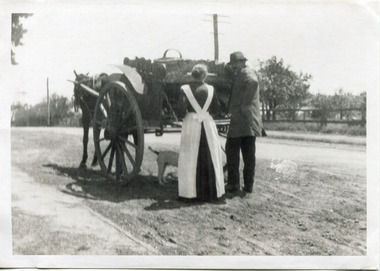
Photograph - Photograph, Black & White Mrs J.L.Smith & Butcher, 1915
... J.L.Smith at first rented a cottage 'Law Muir Den' & Shed from Mr Box and commenced business as a wood merchant - sawing logs into shorter pieces using one horse to power the saw. He purchased the property, added to the buildings , began trading in fuel and fodder as well and installed a chaff cutting mill powered by 10hp steam engine. ...J.L.Smith at first rented a cottage 'Law Muir Den' & Shed from Mr Box and commenced business as a wood merchant - sawing logs into shorter pieces using one horse to power the saw. He purchased the property, added to the buildings , began trading in fuel and fodder as well and installed a chaff cutting mill powered by 10hp steam engine. ...The Butcher Mr Bill Ellin delivering meat to Mrs J.L.Smith in front of the house Law Muir Den 510 Centre Rd Bentleigh c 1915. Groceries, Ice, Milk, Bread, Eggs, Poultry were delivered to housewives by the traders in horse drawn carts, Also Hawkers and Pedlars plied their wares by visiting the cottages. John Logan Smith 1860-1932 , the son of Irish immigrants James and Marianne Smith was born at their home near the 'Toll Gates' on Point Nepean Road and Dendy Street. East Brighton. At that time the area had many orchards that were later replaced by market gardens. J.L.Smith at first rented a cottage 'Law Muir Den' & Shed from Mr Box and commenced business as a wood merchant - sawing logs into shorter pieces using one horse to power the saw. He purchased the property, added to the buildings , began trading in fuel and fodder as well and installed a chaff cutting mill powered by 10hp steam engine. The business prospered 1909 following the death of Tommy Bent, J/L Smith was nominated for Councillor of the Shire of Moorabbin. WW1 1914 - 18 both John and Mary Ann supported local War Relief Auxiliaries and their son Vic served as a Signaler in AIF. As Motor transport was increasing 1926 J L Smith built a small Garage on the opposite corner (Woolworths Supermarket 2005) , employed a good mechanic ( Reg Hunt ) and developed another successful business. The Grain Store was managed by family until 1930. In 1932 JL Smith assisted a man whose car had broken down, pushing it to the garage and sadly suffered a heart attack and died. He is buried in Cheltenham Cemetery. J.L.Smith was an early settler in East Brighton now Bentleigh and established successful Wood cutting, Grain & Chaff cutting and Motor garage businesses in Centre Road . He was elected Councillor of the Shire of Moorabbin and, with Mary Ann, his family were involved with local Church, Red Cross, and other community organizations.A Black and white photograph c 1915 showing the Butcher delivering meat to Mrs J.L Smith Bentleighsmith j l, smith mary ann, stanley helen, smith vic, smith harry redvers, chaff cutter, horse drawn carts, toll gates brighton, motor cars 1900, steam engines, early settlers, bentleigh, parish of moorabbin, city of moorabbin, county of bourke, moorabbin roads board, shire of moorabbin, henry dendy's special survey 1841, bent thomas, charman s, highett william, ormond francis, market gardeners, vineyards, orchards, william ellin, butcher -
 City of Moorabbin Historical Society (Operating the Box Cottage Museum)
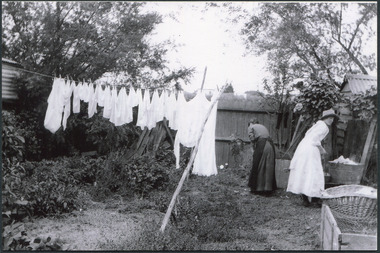
Photograph - Washing Day at 'Law Muir Den' Mrs J L Smith c1910, c1910
... Mary Ann Smith was married John Logan Smith 1860-1932 who at first rented a cottage 'Law Muir Den' & Shed from Mr Box and commenced business as a wood merchant - sawing logs into shorter pieces using one horse to power the saw. He purchased the property, added to the buildings , began trading in fuel and fodder as well and installed a chaff cutting mill powered by 10hp steam engine. ...Mary Ann Smith was married John Logan Smith 1860-1932 who at first rented a cottage 'Law Muir Den' & Shed from Mr Box and commenced business as a wood merchant - sawing logs into shorter pieces using one horse to power the saw. He purchased the property, added to the buildings , began trading in fuel and fodder as well and installed a chaff cutting mill powered by 10hp steam engine. ...Mrs J.L.Smith and Ada Smith in the backyard of the house Law Muir Den 510 Centre Rd Bentleigh c 1910. . The early settler women usually devoted a whole day to washing as it was very labourious. A fire was lit in a stone pit and a large tub of water boiled. Soap that had been made, usually in the previous Autumn, from fat drippings and caustic soda, was flaked into the tub to form suds. The clothes were moved around in the tub with a long wooden paddle that was also used to lift the clothes out of the tub into another tub of cold rinsing water..Stains were removed by scrubbing soap on the cloth against a scrubbing board. Clothes were wrung by hand or a mechanical wringer and hung on the clothes line to dry. Mary Ann Smith was married John Logan Smith 1860-1932 who at first rented a cottage 'Law Muir Den' & Shed from Mr Box and commenced business as a wood merchant - sawing logs into shorter pieces using one horse to power the saw. He purchased the property, added to the buildings , began trading in fuel and fodder as well and installed a chaff cutting mill powered by 10hp steam engine. The business prospered As Motor transport was increasing 1926 J L Smith built a small Garage on the opposite corner (Woolworths Supermarket 2005) , employed a good mechanic ( Reg Hunt ) and developed another successful business. J.L.Smith was an early settler in East Brighton now Bentleigh and established successful Wood cutting, Grain & Chaff cutting and Motor garage businesses in Centre Road . He was elected Councillor of the Shire of Moorabbin and, with Mary Ann, his family were involved with local Church, Red Cross, and other community organizations.Photograph, Black & White, showing 2 women washing clothes in a large tub, set over a fire in a stone pit, in the back yard. Clothes are hanging from a rope line strung between 2 trees and held up with a wooden 'prop' -
 City of Moorabbin Historical Society (Operating the Box Cottage Museum)
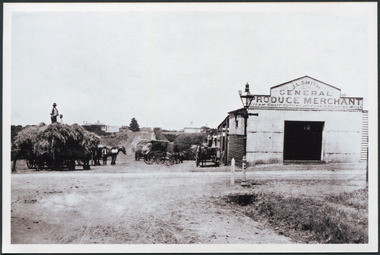
Photograph, Black & White J. L. Smith Hay & Grain Store Bentleigh c1910, c1910
... J.L.Smith at first rented a cottage 'Law Muir Den' & Shed from Mr Box and commenced business as a wood merchant - sawing logs into shorter pieces using one horse to power the saw. He purchased the property, added to the buildings , began trading in fuel and fodder as well and installed a chaff cutting mill powered by 10hp steam engine. ...J.L.Smith at first rented a cottage 'Law Muir Den' & Shed from Mr Box and commenced business as a wood merchant - sawing logs into shorter pieces using one horse to power the saw. He purchased the property, added to the buildings , began trading in fuel and fodder as well and installed a chaff cutting mill powered by 10hp steam engine. ...John Logan Smith 1860-1932 , the son of Irish immigrants James and Marianne Smith was born at their home near the 'Toll Gates' on Point Nepean Road and Dendy Street. East Brighton. At that time the area had many orchards that were later replaced by market gardens. J.L.Smith at first rented a cottage 'Law Muir Den' & Shed from Mr Box and commenced business as a wood merchant - sawing logs into shorter pieces using one horse to power the saw. He purchased the property, added to the buildings , began trading in fuel and fodder as well and installed a chaff cutting mill powered by 10hp steam engine. The business prospered 1909 following the death of Tommy Bent, J/L Smith was nominated for Councillor of the Shire of Moorabbin. WW1 1914 - 18 both John and Mary Ann supported local War Relief Auxiliaries and their son Vic served as a Signaler in AIF. As Motor transport was increasing 1926 J L Smith built a small Garage on the opposite corner (Woolworths Supermarket 2005) , employed a good mechanic ( Reg Hunt ) and developed another successful business. The Grain Store was managed by family until 1930. In 1932 JL Smith assisted a man whose car had broken down, pushing it to the garage and sadly suffered a heart attack and died. He is buried in Cheltenham Cemetery. J.L.Smith was an early settler in East Brighton now Bentleigh and established successful Wood cutting, Grain & Chaff cutting and Motor garage businesses in Centre Road . He was elected Councillor of the Shire of Moorabbin and, with Mary Ann, his family were involved with local Church, Red Cross, and other community organizations.Black & white photograph of the Hay & Grain Store of John Logan Smith 1860-1932 on the corner of Jasper Rd and Centre Rd Bentleigh ( East Brighton) c1910. A Horse drawn cart loaded with hay and another outside the first building used by J L Smith -
 City of Moorabbin Historical Society (Operating the Box Cottage Museum)
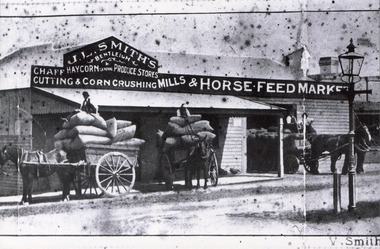
Photograph, Black & White, J.L.Smith Hay & Grain Store c1916 Bentleigh, 1916
... J.L.Smith at first rented a cottage 'Law Muir Den' & Shed from Mr Box and commenced business as a wood merchant - sawing logs into shorter pieces using one horse to power the saw. He purchased the property, added to the buildings , began trading in fuel and fodder as well and installed a chaff cutting mill powered by 10hp steam engine. ...J.L.Smith at first rented a cottage 'Law Muir Den' & Shed from Mr Box and commenced business as a wood merchant - sawing logs into shorter pieces using one horse to power the saw. He purchased the property, added to the buildings , began trading in fuel and fodder as well and installed a chaff cutting mill powered by 10hp steam engine. ...John Logan Smith 1860-1932 , the son of Irish immigrants James and Marianne Smith was born at their home near the 'Toll Gates' on Point Nepean Road and Dendy Street. East Brighton. At that time the area had many orchards that were later replaced by market gardens. J.L.Smith at first rented a cottage 'Law Muir Den' & Shed from Mr Box and commenced business as a wood merchant - sawing logs into shorter pieces using one horse to power the saw. He purchased the property, added to the buildings , began trading in fuel and fodder as well and installed a chaff cutting mill powered by 10hp steam engine. The business prospered 1909 following the death of Tommy Bent, J/L Smith was nominated for Councillor of the Shire of Moorabbin. WW1 1914 - 18 both John and Mary Ann supported local War Relief Auxiliaries and their son Vic served as a Signaler in AIF. As Motor transport was increasing 1926 J L Smith built a small Garage on the opposite corner (Woolworths Supermarket 2005) , employed a good mechanic ( Reg Hunt ) and developed another successful business. The Grain Store was managed by family until 1930. In 1932 JL Smith assisted a man whose car had broken down, pushing it to the garage and sadly suffered a heart attack and died. He is buried in Cheltenham Cemetery J.L.Smith was an early settler in East Brighton now Bentleigh and established successful Wood cutting, Grain & Chaff cutting and Motor garage businesses in Centre Road . He was elected Councillor of the Shire of Moorabbin and, with Mary Ann, his family were involved with local Church, Red Cross, and other community organizations.Black & White photograph of J L Smith Hay & Grain Store and Crushing Mill Jasper Rd / Centre Rd Bentleigh 1916. A veranda has been added to the store, new signage attached and a Gas light and hitching post are in foreground. 3 Horse drawn carts loaded with grain bags and drivers sitting on top of loadV. Smithgas street light, hitching posts, smith vic, photography, smith j l; smith mary ann, stanley helen, smith vic, smith harry redvers, chaff cutter, horse drawn carts, toll gates brighton, motor cars 1900, steam engines, early settlers, bentleigh, parish of moorabbin, city of moorabbin, county of bourke, moorabbin roads board, shire of moorabbin, henry dendy's special survey 1841, were j.b.; bent thomas, o'shannassy john, king richard, charman s, highett william, ormond francis, maynard dennis, market gardeners, vineyards, orchards -
 City of Moorabbin Historical Society (Operating the Box Cottage Museum)
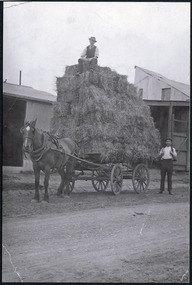
Photographs, x 2 ,Black & White, F Smith Horse drawn cart loaded, Baled Straw, Grain, c1920
... J.L.Smith at first rented a cottage 'Law Muir Den' & Shed from Mr Box and commenced business as a wood merchant - sawing logs into shorter pieces using one horse to power the saw. He purchased the property, added to the buildings , began trading in fuel and fodder as well and installed a chaff cutting mill powered by 10hp steam engine. ...J.L.Smith at first rented a cottage 'Law Muir Den' & Shed from Mr Box and commenced business as a wood merchant - sawing logs into shorter pieces using one horse to power the saw. He purchased the property, added to the buildings , began trading in fuel and fodder as well and installed a chaff cutting mill powered by 10hp steam engine. ...John Logan Smith 1860-1932 , the son of Irish immigrants James and Marianne Smith was born at their home near the 'Toll Gates' on Point Nepean Road and Dendy Street. East Brighton. At that time the area had many orchards that were later replaced by market gardens. J.L.Smith at first rented a cottage 'Law Muir Den' & Shed from Mr Box and commenced business as a wood merchant - sawing logs into shorter pieces using one horse to power the saw. He purchased the property, added to the buildings , began trading in fuel and fodder as well and installed a chaff cutting mill powered by 10hp steam engine. The business prospered 1909 following the death of Tommy Bent, J/L Smith was nominated for Councillor of the Shire of Moorabbin. WW1 1914 - 18 both John and Mary Ann supported local War Relief Auxiliaries and their son Vic served as a Signaler in AIF. As Motor transport was increasing 1926 J L Smith built a small Garage on the opposite corner (Woolworths Supermarket 2005) , employed a good mechanic ( Reg Hunt ) and developed another successful business. The Grain Store was managed by family until 1930. In 1932 J L Smith assisted a man whose car had broken down, pushing it to the garage and sadly suffered a heart attack and died. He is buried in Cheltenham Cemetery. J.L.Smith was an early settler in East Brighton now Bentleigh and established successful Wood cutting, Grain & Chaff cutting and Motor garage businesses in Centre Road . He was elected Councillor of the Shire of Moorabbin and, with Mary Ann, his family were involved with local Church, Red Cross, and other community organizations.2 x Black & White photographs showing horse drawn carts loaded with (a) Hay and (b) bags of grain outside J.L.Smith Grain & Chaff Store Centre Rd Bentleigh c1920smith frank, smith arch, smith tom, smith j l; smith mary ann, stanley helen, smith vic, smith harry redvers, chaff cutter, horse drawn carts, toll gates brighton, motor cars 1900, steam engines, early settlers, bentleigh, parish of moorabbin, city of moorabbin, county of bourke, moorabbin roads board, shire of moorabbin, henry dendy's special survey 1841, were j.b.; bent thomas, o'shannassy john, king richard, charman s, highett william, ormond francis, maynard dennis, market gardeners, vineyards, orchards -
 City of Moorabbin Historical Society (Operating the Box Cottage Museum)
Functional object - Manufactured Objects, Perambulator, c1914
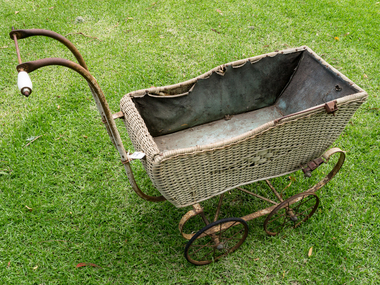
... property in lots, some privately, others to the Municipality. Some lots became part of Hodgson Reserve, Higgins Road, Bentleigh, and another lot, the Bentleigh Bowling Club. Herbert and Victoria, known as Queenie, had five children between 1914 and 1928. The youngest Dorothy, who remembered sitting in this pram and later using it to carry papers, wood...property in lots, some privately, others to the Municipality. Some lots became part of Hodgson Reserve, Higgins Road, Bentleigh, and another lot, the Bentleigh Bowling Club. Herbert and Victoria, known as Queenie, had five children between 1914 and 1928. The youngest Dorothy, who remembered sitting in this pram and later using it to carry papers, wood ...JAMES JOSEPH HIGGINS, was born in Dublin in 1821 and, at age twenty, emigrated via Liverpool in 1841 with his wife Ellen and baby daughter Margarete, on board the 'Intrinsic'. They lived in Little Lonsdale Street, Melbourne, for some years, where their son James John Clarke Higgins was born in 1850. JAMES JOHN CLARKE HIGGINS moved to Brighton East when he married Ruth Simmonds in 1873. The couple lived on Jasper Rd near the corner of Centre Rd for the rest of their lives, and produced eight children HERBERT JOHN HIGGINS was the sixth child born in 1886, to James John Clarke Higgins and Ruth Simmonds, and grew up in Centre Rd, Brighton East, now Bentleigh. He was renting and working a property on Jasper Rd from the time he was married in 1913 to Victoria Matilda Long, daughter of Charles John Long and Annie Matilda Allnutt. Herbert John bought his property on Jasper Rd in 1921. [Metropolitan Board of works plan 3220, Municipality of Moorabbin, shows that in 1928, Higgins Rd was planned (and probably built soon after). Herbert was a dairyman and market gardener. He bred and milked cows and sold milk, cream, butter and eggs to the locals. He supplied hay/corn to be made into chaff to J L Smith’s produce store. He also leased land from other farmers in the area and helped work their land. c1950 he sold the property in lots, some privately, others to the Municipality. Some lots became part of Hodgson Reserve, Higgins Road, Bentleigh, and another lot, the Bentleigh Bowling Club. Herbert and Victoria, known as Queenie, had five children between 1914 and 1928. The youngest Dorothy, who remembered sitting in this pram and later using it to carry papers, wood, vegetable etc., lived on the property in Jasper Road until her passing in 2016. ( Ronald Alexander Higgins, descendant , Helen Stanley CMHS 2017) The family of Dorothy Higgins 1928-2016, were early settlers in Moorabbin Shire establishing a dairy farm c 1873 in East Brighton ( now Bentleigh)Wicker Perambulator, baby carriage, c. 1914, with a lined, painted wicker body, iron spring scrolled frame with leather straps and 4 steel wheels with rubber tyres. The push handle is broken and hood is missing. dairy farms, higgins james joseph, simmonds ruth, higgins dorothy, poultry farms, jasper road bentleigh, city of moorabbin historical society 1961, sheehy t.a., newsletters, ashley r, neville f, blackman n, moorabbin city council, moorabbin roads board toll gates, pioneers moorabin cheltenham, bentleigh, highett -
 Dunkeld Museum Inc.
Box, Collar, Edward Henty's Collar Box, Late 18th century
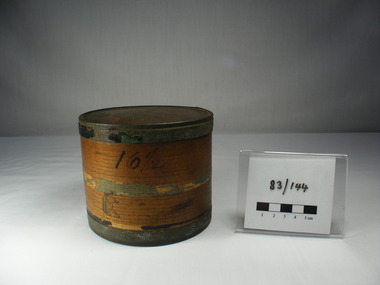
... property to wind up his estate . Beleived to be Edward Henty's collar box. 16 and 1/2 on the side in ink. Wood ...This collar box was purchased at a clearing sale at the Henty property to wind up his estate .Beleived to be Edward Henty's collar box.Wood veneer circular collar box with tin rims on base and lid. Veneer overlapped and glued. Part of a paper label glued on the lower half of the box.16 and 1/2 on the side in ink. -
 Orbost & District Historical Society
bellows, late 19th century-early 20th century
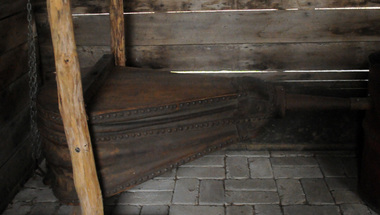
... Wood and leather bellows with metal studs. The frame and handle were constructed by Graham Fall c.2009 and are not original. The handle is attached by a chain. This was probably used on the Lynn property...properties to have , of necessity, their own blacksmithing facilities. The Lynn family settled in Orbost circa 1890 and is well known in the Orbost area. blacksmith bellows tools Wood and leather bellows with metal studs. ...These bellows are from the Lynn property at Jarrahmond and were used in the blacksmith's shop. It was common for rural properties to have , of necessity, their own blacksmithing facilities.These bellows are from the Lynn property at Jarrahmond and were used in the blacksmith's shop. It was common for rural properties to have , of necessity, their own blacksmithing facilities. The Lynn family settled in Orbost circa 1890 and is well known in the Orbost area.Wood and leather bellows with metal studs. The frame and handle were constructed by Graham Fall c.2009 and are not original. The handle is attached by a chain. This was probably used on the Lynn property at Jarrahmond in the blacksmith's shop.blacksmith bellows tools -
 Orbost & District Historical Society
farm implement
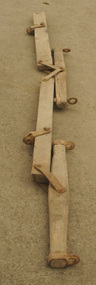
... property on the Orbost district. This item is an example of an early farming implement used in the Orbost district. It also demonstrates the improvisation skills of the agricultural community. agricultural-implement horses farming swinglebar Four pieces of wood connected by iron fittings. ...This is a very common 'farm' style of old swinglebar. Blacksmiths and agricultural machinery suppliers made them by the thousands. They were used most commonly on heavy vehicles pulled by horses. This one would have been used on a farming property on the Orbost district.This item is an example of an early farming implement used in the Orbost district. It also demonstrates the improvisation skills of the agricultural community.Four pieces of wood connected by iron fittings. Two pieces have iron loops at both ends. The two straight pieces appear to be newer. There are two swingle trees. It appears to be a 2-horse set of swinglebars with a double-bar. which has been added to and repaired.agricultural-implement horses farming swinglebar -
 Ringwood and District Historical Society
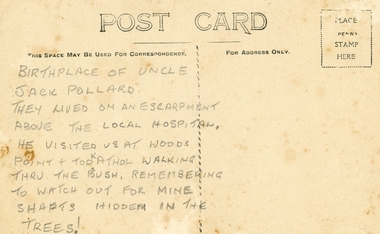
Photographs, Collection of Pollard Photographs, Ringwood (Undated -probably early 1900's). Also Woods Point 1900, circa 1900
... Woods Point with arrow indicating mine manager's house: that of Joseph Pollard. Circa 1900. The Pollard family had a 20 acre orcharding property between Mullum Mullum Road and Wonga Road. ...Woods Point with arrow indicating mine manager's house: that of Joseph Pollard. Circa 1900. The Pollard family had a 20 acre orcharding property between Mullum Mullum Road and Wonga Road. ...Pollard Photographs:; 1. Back of postcard of the Pollard home in Wonga Road (also called Anderson Creek Road Road, and now Warrandyte Road).; 2. One bushel net apples, J Pollard, Victoria, Australia.; 3. Joseph and Emma Pollard and Family. Emma is nursing baby Ethyl.; 4. Ringwood PS photograph. Jack Pollard is second from the RHS in the back row.; 5. Woods Point with arrow indicating mine manager's house: that of Joseph Pollard. Circa 1900. The Pollard family had a 20 acre orcharding property between Mullum Mullum Road and Wonga Road. Given on 4th September 2010 by Arthur Lunt from his cousin. The Pollard family. School photo at Ringwood State School. Jack�s father was Joseph � land (orchard) between Mullum and Wonga Roads +Additional Keywords: Pollard -
 Ringwood and District Historical Society
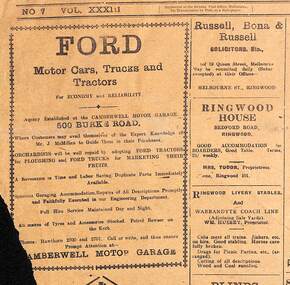
Newspaper - Newspaper Cutting, The Box Hill Reporter clipping, 1922 - Ringwood articles, 7-Feb-22
... Kent's property on the Warrandyte Road; After Fifty Years - golden wedding of Mr and Mrs. Milne, late of Ringwood; Prizes at Ringwood Show; Wood Chop Contests at Ringwood Show....Kent's property on the Warrandyte Road; After Fifty Years - golden wedding of Mr and Mrs. Milne, late of Ringwood; Prizes at Ringwood Show; Wood Chop Contests at Ringwood Show. ...Newspaper fragment "The Reporter" No.7 Vol XXXIII Feb 7, 1922 - including Russell, Bona & Russell, Solicitors, Melbourne Street, Ringwood; Ringwood House Accommodation - Mrs Tudor, Proprietress; Ringwood Livery Stables and Warrandyte Coach Line - Wm. Hussey, Proprietor; Menace of Fires - worst outbreak in Mr. Kent's property on the Warrandyte Road; After Fifty Years - golden wedding of Mr and Mrs. Milne, late of Ringwood; Prizes at Ringwood Show; Wood Chop Contests at Ringwood Show. -
 Ringwood and District Historical Society
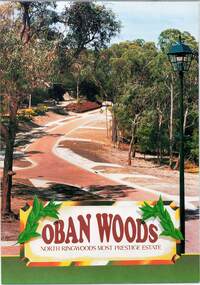
Document - Land Sale Folder, Oban Woods Subdivision, Ringwood North, Vic., - circa 1997
... Folder containing multi-fold colour pamphlet advertising Lots 6 to 12 of Oban Woods Estate with location map and summary of subdivision features. A4 size attachments include subdivision layout of Lots 2 to 25 with summary of property sizes and undated indications of whether sold or still available at the time, with price where known. ...Folder containing multi-fold colour pamphlet advertising Lots 6 to 12 of Oban Woods Estate with location map and summary of subdivision features. A4 size attachments include subdivision layout of Lots 2 to 25 with summary of property sizes and undated indications of whether sold or still available at the time, with price where known. ...Folder containing multi-fold colour pamphlet advertising Lots 6 to 12 of Oban Woods Estate with location map and summary of subdivision features. A4 size attachments include subdivision layout of Lots 2 to 25 with summary of property sizes and undated indications of whether sold or still available at the time, with price where known. Dates not documented however early sales within the development took place around 1997.Estate plan includes Oban Woods (thoroughfare) and Chifley Parade. Location map of area shows development site of Oban Woods Estate off Oban Road and Kubis Drive, Ringwood North. Agents - R.E. Appleby Ringwood Pty Ltd., 170 Warrandyte Road Ringwood North 3134, Telephone 9876 4222, Fax 9876 4209.
