
Showing 279 items matching "world politics"
-
 Unions Ballarat
World politics : trend and transformation, 12th ed, Kegley, Charles W Jnr et al, 2009
... World politics : trend and transformation, 12th ed...Trend and Transformation in World Politics 1. Interpreting world politics 2. ...Trend and Transformation in World Politics 1. Interpreting world politics 2. ...GovernGlobal politics, economy, power and collective action. Table of contents: Part 1. Trend and Transformation in World Politics 1. Interpreting world politics 2. Theories of world politics 3. International decision making Part 2. The Globe's Actors and Their Relations 4. Great power rivalries and relations 5. The global south in a world of powers 6. Intergovernmental organizations and the quest for global governance 7. Nongovernmental organizations and the shape of the global future 8. People power and the promotion of human rights Part 3. The Economic and Demographic Dimensions of Globalization 9. The globalization of international finance 10. International trade in the global marketplace 11. The demographic and cultural dimensions of globalization Part 4. Threats to the World 12. Threats to the preservation of the world's common ecology 13. The treat of armed aggression to the world Part 5. Realist Roads to National and International Security 14. The military pursuit of power through arms and military strategy 15. Alliances and the balance of power Part 6. Liberal Paths to World Order 16. Negotiated conflict resolution and international law 17. Liberal approaches to collective security Part 7. Envisioning Your Alternative Global Futures and Predicting Global Transformations 18.Thinking about global trends, transformations, and the future of world politics. Relevant to global issues in the political arena.Paper; book. Front cover: orange/red/brown theme; white lettering.Front cover: author's name, title and edition.btlc, ballarat trades and labour council, ballarat trades hall, politics, economics, economy, collective action, globalisation, power, ecology, military, law -
 Surrey Hills Historical Society Collection
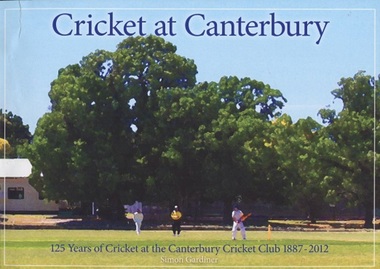
Book, Canterbury Cricket Club : 125 years of cricket at the Canterbury Cricket Club 1887-2012, 2017
... The Canterbury Cricket Club has survived world wars, the great depression, uncertain world politics and major social changes to the way we work and to our leisure time options. ...The Canterbury Cricket Club has survived world wars, the great depression, uncertain world politics and major social changes to the way we work and to our leisure time options. ...The Canterbury Cricket Club has survived world wars, the great depression, uncertain world politics and major social changes to the way we work and to our leisure time options. ...In 1887 Melbourne was a little more that 50 years old and the game of cricket barely established in the colony. The Canterbury Cricket Club has survived world wars, the great depression, uncertain world politics and major social changes to the way we work and to our leisure time options. This is the story of 125 years of Canterbury Cricket Club.In 1887 Melbourne was a little more that 50 years old and the game of cricket barely established in the colony. The Canterbury Cricket Club has survived world wars, the great depression, uncertain world politics and major social changes to the way we work and to our leisure time options. This is the story of 125 years of Canterbury Cricket Club.Front page : signed by the author : Sam Gardinercanterbury cricket club, cricket, (mr) simon gardiner -
 Monbulk RSL Sub Branch
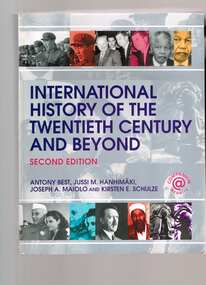
Book, Routledge, International history of the twentieth century and beyond, 2008
... World politics - 20th century...World politics - 20th century World politics 21st century This major global history of the twentieth century is written by four prominent international historians for first-year undergraduate level and upward. ...This major global history of the twentieth century is written by four prominent international historians for first-year undergraduate level and upward. Using their thematic and regional expertise, the authors cover events in Europe, Asia, the Middle East, Africa and the Americas from the last century and beyond. Among the areas this book covers are: the decline of European hegemony over the international order; the diffusion of power to the two superpowers; the rise of newly independent states in Asia and Africa; and, the course and consequences of the major global conflicts of the twentieth century. This second edition is thoroughly updated, and includes extended coverage of European integration, the rise of supra-governmental organizations, and the 'global War on Terror'.Index, bib, ill, maps, p.613.non-fictionThis major global history of the twentieth century is written by four prominent international historians for first-year undergraduate level and upward. Using their thematic and regional expertise, the authors cover events in Europe, Asia, the Middle East, Africa and the Americas from the last century and beyond. Among the areas this book covers are: the decline of European hegemony over the international order; the diffusion of power to the two superpowers; the rise of newly independent states in Asia and Africa; and, the course and consequences of the major global conflicts of the twentieth century. This second edition is thoroughly updated, and includes extended coverage of European integration, the rise of supra-governmental organizations, and the 'global War on Terror'.world politics - 20th century, world politics 21st century -
 Monbulk RSL Sub Branch
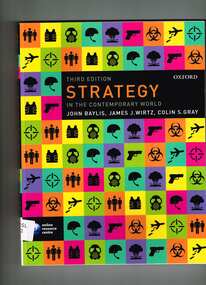
Book, Oxford University Press, Strategy in the contemporary world : an introduction to strategic studies, 2010
... ...World politics - 20th century...Strategy World politics - 20th century The most comprehensive analysis of strategic studies available, Strategy in the Contemporary World, Third Edition, reflects upon recent events and assesses the role of military power in the contemporary world. ...The most comprehensive analysis of strategic studies available, Strategy in the Contemporary World, Third Edition, reflects upon recent events and assesses the role of military power in the contemporary world. Taking a functional approach and looking at issues from both times of war and of peace, editors John Baylis, James J. Wirtz, and Colin S. Gray analyze the conflicts themselves--as well as what can be learned from them. This new edition covers topics such as intelligence and strategy, strategic studies and its critics, as well as strategy in practice, providing a comprehensive and insightful collection of contributions from a team of leading experts in the field.Index, bib, p.442.The most comprehensive analysis of strategic studies available, Strategy in the Contemporary World, Third Edition, reflects upon recent events and assesses the role of military power in the contemporary world. Taking a functional approach and looking at issues from both times of war and of peace, editors John Baylis, James J. Wirtz, and Colin S. Gray analyze the conflicts themselves--as well as what can be learned from them. This new edition covers topics such as intelligence and strategy, strategic studies and its critics, as well as strategy in practice, providing a comprehensive and insightful collection of contributions from a team of leading experts in the field.strategy, world politics - 20th century -
 Monbulk RSL Sub Branch
Book, Time-Life Books, The aftermath: Europe, 1982
... ...World politics - 1945...Diplomatic history - Europe World politics - 1945 The geopolitical consequences of the European war Index, bib, ill, p.208. ...The geopolitical consequences of the European warIndex, bib, ill, p.208.non-fictionThe geopolitical consequences of the European wardiplomatic history - europe, world politics - 1945 -
 Monbulk RSL Sub Branch
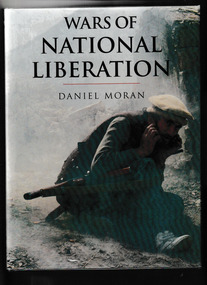
Book, Cassel, Wars of national liberation, 2001
... World politics - 1945-...World politics - 1945- National liberation movements An account of why wars have been fought in the post world war two period. ...An account of why wars have been fought in the post world war two period.Index, bibliography, ill, maps, p.224.non-fictionAn account of why wars have been fought in the post world war two period.world politics - 1945-, national liberation movements -
 Monbulk RSL Sub Branch
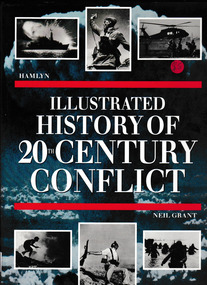
Book, Hamlyn, Illustrated history of twentieth century conflict, 1992
... ...World politics - 20th century...Military history - 20th century World politics - 20th century Chronological pictorial and textual description of 20th century conflict Index, ill, p.400. ...Chronological pictorial and textual description of 20th century conflictIndex, ill, p.400.non-fictionChronological pictorial and textual description of 20th century conflictmilitary history - 20th century, world politics - 20th century -
 Monbulk RSL Sub Branch
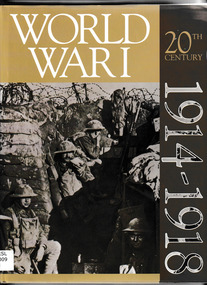
Book, Chancellor Press, World War I, 1914-1918, 1998
... ...World politics - 20th century...World War 1914-1918 - History World politics - 20th century An illustrated history of social and military aspects of the Great war Index, ill, maps, p.175. ...An illustrated history of social and military aspects of the Great warIndex, ill, maps, p.175.non-fictionAn illustrated history of social and military aspects of the Great warworld war 1914-1918 - history, world politics - 20th century -
 Mrs Aeneas Gunn Memorial Library
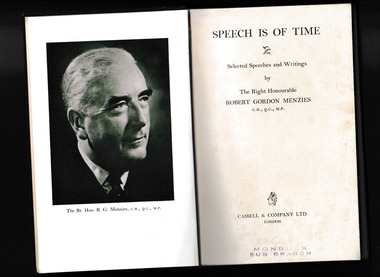
Book, Robert Gordon Menzies, Speech is of time : selected speeches and writings, 1958
... World politics...World politics Commonwealth of nations A selection of speeches and writings by Robert Gordon Menzies Ill, p.246. ...A selection of speeches and writings by Robert Gordon MenziesIll, p.246.non-fictionA selection of speeches and writings by Robert Gordon Menziesworld politics, commonwealth of nations -
 Greensborough Historical Society
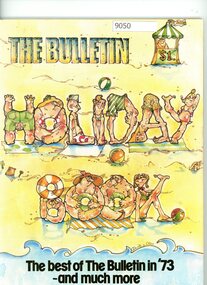
Magazine, The Bulletin, The Bulletin Holiday Book - The best of The Bulletin in '73 - and much more, 1973
... world history...australia politics and government...The Bulletin: a 1973 magazine with articles and stories regarding politics, history and cartoons relative to Australia and abroad. comics australian culture world history australia politics and government Magazine in black and white print, illus. ...The Bulletin: a 1973 magazine with articles and stories regarding politics, history and cartoons relative to Australia and abroad.Magazine in black and white print, illus. (some col.)comics, australian culture, world history, australia politics and government -
 Bendigo Historical Society Inc.
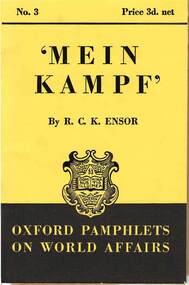
Book - PAPERBACK BOOKLET MEIN KAMPF BY R.C.K. ENSOR
... ...Politics...World...BOOK Politics World war II Adolf Hitler Yellow cardboard bound Paperback Booklet covered in brown paper - 'MEIN KAMPF' BY R.C.K. ...Yellow cardboard bound Paperback Booklet covered in brown paper - 'MEIN KAMPF' BY R.C.K. ENSOR - OXFORD PAMPHLETS ON WORLD AFFAIRS NO.3 / Oxford at the Clarendon Press 1939 / first page - 'Herr Hitler’s self- disclosure in Mein Kompf / Page 2' In this pamphlet Mr. R CK Ensor gives an account of Herr Hitler's disclosures of policy in Mein Kampf (My Struggle) and of the extent to which this policy has been so far carried out, and assesses future possibilities. He describes briefly Herr Hitler's theory of 'race' , the doctrine of Lebenstraum, or 'habitat', and the scale of annexation prescribed for Greater Germany. Mr. Ensor is a Fellow of Corpus Christi College /// first published 6.7.1939, reprinted July 1939book, politics, world war ii, adolf hitler -
Unions Ballarat
Year of decisions: Memoirs by Harry S. Truman Volume I (Don Woodward Collection), Truman, Harry S, 1955
... military - world war ii...politics... and biographical interest - United States. btlc ballarat trades hall ballarat trades and labour council truman, harry s. presidents - united states military - world war ii politics and government - usa memoirs history - usa Purple stamps: "COMPLIMENTARY" and "TUDOR DISTRIBUTORS PTY LTD, 54 PORTER STREET, PRAHRAN … VIC." ...Memoirs of Harry S. Truman focussing upon the year 1945. 1945 was the end of World War II and the beginning of the Atomic Age. Truman was President of the United States from 1945–1953. He took office following the death of Franklin Roosevelt.Historical, political and biographical interest - United States.Book; 637 pages. Cover: white background; black and white photograph of Harry S. Truman, blue, black, grey and yellow lettering; author's name and title.Purple stamps: "COMPLIMENTARY" and "TUDOR DISTRIBUTORS PTY LTD, 54 PORTER STREET, PRAHRAN … VIC."btlc, ballarat trades hall, ballarat trades and labour council, truman, harry s., presidents - united states, military - world war ii, politics and government - usa, memoirs, history - usa -
 Ballarat Tramway Museum
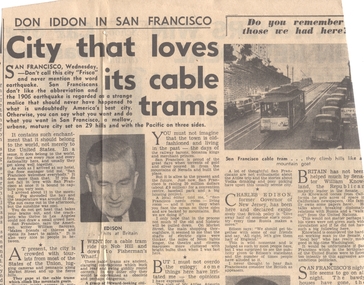
Newspaper, "City that loves its cable trams", 1950's
... Discusses the social mix and cultures of the city, its cable trams, politicians, night life, and its position in world politics. Has a photo of a California St cable car. ...Discusses the social mix and cultures of the city, its cable trams, politicians, night life, and its position in world politics. Has a photo of a California St cable car. ...Newspaper clipping from a Melbourne paper, no date marked titled "City that loves its cable trams", written by Journalist Don Iddon visiting San Francisco. Discusses the social mix and cultures of the city, its cable trams, politicians, night life, and its position in world politics. Has a photo of a California St cable car. Item was contained within the back cover of Reg Item 5485 - Service Exercise Book, black covers, with label, red binding titled "No. 2 - Ballarat Tramways & S.E.C. Systems" - see list. cable trams, san francisco, usa -
 Federation University Art Collection
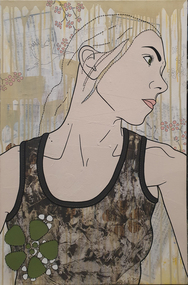
Mixed media, Simone Maynard, Looking East, 2006
... Simone MAYNARD (1974- ) Melbourne based contemporary artist SIMONE Maynard is primarily influenced by the 1980s, reflecting a period of increasing global capitalisation, political upheaval, world-wide mass media, wealth discrepancies and distinctive music and fashion characterised by hip hop and electric pop music....Simone MAYNARD (1974- ) Melbourne based contemporary artist SIMONE Maynard is primarily influenced by the 1980s, reflecting a period of increasing global capitalisation, political upheaval, world-wide mass media, wealth discrepancies and distinctive music and fashion characterised by hip hop and electric pop music. available Portrait Verso: Looking East 40x3 20060 inches; acrylic, ink & collage, hand stitching on canvas. ...Simone MAYNARD (1974- ) Melbourne based contemporary artist SIMONE Maynard is primarily influenced by the 1980s, reflecting a period of increasing global capitalisation, political upheaval, world-wide mass media, wealth discrepancies and distinctive music and fashion characterised by hip hop and electric pop music.Portrait of a womanVerso: Looking East 40x3 20060 inches; acrylic, ink & collage, hand stitching on canvas. SIMONE MAYNARD DEC 2006available, portrait -
 Sunshine and District Historical Society Incorporated
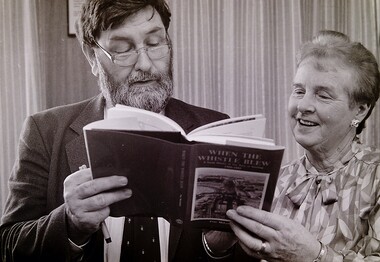
Photograph - When The Whistle Blew Book Launch, Sharon Cavanagh, 16th October 1989
... The keynote speaker at the launch was Barry Jones, an Australian politician, writer, historian, and public intellectual whose historical work spans biography, world history, political history, and cultural analysis. ...The keynote speaker at the launch was Barry Jones, an Australian politician, writer, historian, and public intellectual whose historical work spans biography, world history, political history, and cultural analysis. ...The book When the Whistle Blew explores the social history of Sunshine between 1920 and 1950, a period when the Sunshine Harvester Works and other major industries were profoundly shaping the daily life, community identity, and social fabric of the town. The Author, Prue McGoldrick was a Victorian historian, journalist, and author best known for writing this book. She produced several major works on Gippsland, Yallourn, Morwell, and Sunshine, and is widely recognised for documenting the lives of working‑class communities, industrial towns, and the social fabric of 20th‑century Victoria. The keynote speaker at the launch was Barry Jones, an Australian politician, writer, historian, and public intellectual whose historical work spans biography, world history, political history, and cultural analysis. These photographs were taken by The Advocate newspaper during coverage of the book’s launch.The launch of When the Whistle Blew marked an important moment in preserving Sunshine’s industrial and community heritage, celebrating the stories of workers, families, and the broader social history connected to the Sunshine Harvester Works. The event brought together former employees, local historians, and community members to recognise the legacy of the factory and the people who shaped the suburb.Launching Of Book By Prue McGoldrick By Barry Jones Sunshine Townhall 145.1prue mcgoldrick, barry jones, when the whistle blew -
Unions Ballarat
Edmund Burke (Don Woodward Collection), Kramnick, Isaac, 1974
... From back cover: Edmund Burke has long been recognized as the intellectual source of one of the modern world's most influential political ideologies: conservatism. ...From back cover: Edmund Burke has long been recognized as the intellectual source of one of the modern world's most influential political ideologies: conservatism. ...From back cover: Edmund Burke has long been recognized as the intellectual source of one of the modern world's most influential political ideologies: conservatism. Yet he took an uncompromising stand for the cause of the American colonies and championed the rights of persecuted Catholics in Ireland and England. In this volume, Isaac Kramnick explores the many sides of this fascinating political sceptic. This multifaceted portrait examines the skillful writings and speeches that catapulted Burke into the aristocratic political community. In addition, the comments of such men as Tom Paine and Samuel Johnson reflect the way Burke's contemporaries regarded the man who decried both the French Revolution and the rape of India by English adventurers. The commentaries by modern historians illustrate the profound impact of Burke's dynamic words and actions on his own time and country and the legacy he has left for the modern world. ------------ Burke was a Whig who served in the House of Commons.Political, social and biographical interest - United Kingdom.Book; 180 pages. Front cover: cream/white background; black and white picture of Edmund Burke; white and black lettering on brown background; editor's name and title.Title page: name (illegible). Inside back cover: stamp reading "Book Market, Peter White 212-2478, 711 George Street, Sydney"; in pencil, (a) 3308 (b) 575 (c) PC 82875. btlc, ballarat trades and labour council, ballarat trades hall, burke, edmund, biography, autobiography, politics and government, whig party, political ideology -
 Flagstaff Hill Maritime Museum and Village
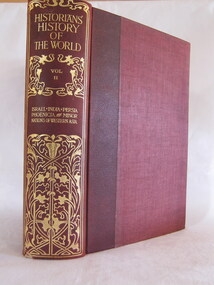
Book - Reference Book/History, Henry Smith Williams, The Historians History of the World Vol 21 set 1 - Edited by Henry Smith Williams L.L.D. Published by “The Times” 1908, 1908
... World (1908 edition) is titled "Israel, India, Persia, Phoenicia, Minor Nations of Western Asia." While Volume 1 laid the groundwork with Egypt and Mesopotamia, Volume 2 shifts focus to the groups that shaped the spiritual, commercial, and political landscape of the ancient Near East and beyond. ...World (1908 edition) is titled "Israel, India, Persia, Phoenicia, Minor Nations of Western Asia." While Volume 1 laid the groundwork with Egypt and Mesopotamia, Volume 2 shifts focus to the groups that shaped the spiritual, commercial, and political landscape of the ancient Near East and beyond. ...The 1908 edition of The Historians' History of the World is a monumental work of Edwardian scholarship, representing a specific era of "universal history" where the goal was to synthesise all human knowledge into a single narrative. Volume 2 of The Historians' History of the World focuses on "Israel, India, Persia, Phoenicia, Minor Nations of Western Asia."Book is part of a 25 volume set with red cloth bindings and gold filigree design to rib.non-fictionThe 1908 edition of The Historians' History of the World is a monumental work of Edwardian scholarship, representing a specific era of "universal history" where the goal was to synthesise all human knowledge into a single narrative. Volume 2 of The Historians' History of the World focuses on "Israel, India, Persia, Phoenicia, Minor Nations of Western Asia."flagstaff hill, warrnambool, shipwrecked-coast, flagstaff-hill, flagstaff-hill-maritime-museum, maritime-museum, shipwreck-coast, flagstaff-hill-maritime-village, book, the historians history of the world vol 2 set 1 -
 Flagstaff Hill Maritime Museum and Village
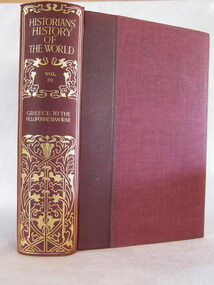
Book - Reference Book/History, Henry Smith Williams, The Historians History of the World Vol 3 set 1 - Edited by Henry Smith Williams L.L.D. Published by “The Times” 1908, 1908
... political and intellectual life. The volume opens with a significant introductory essay by Dr. Eduard Meyer (University of Berlin), one of the foremost historians of antiquity, who argues that Greek civilisation represented a unique "freedom" that allowed it to surpass its neighbours. Williams utilises the "historian's historian" approach, weaving together the primary accounts of Herodotus and Thucydides with the 19th-century analyses of scholars like George Grote and Ernst Curtius. Volume 3 of The Historians' History of the World...political and intellectual life. The volume opens with a significant introductory essay by Dr. Eduard Meyer (University of Berlin), one of the foremost historians of antiquity, who argues that Greek civilisation represented a unique "freedom" that allowed it to surpass its neighbours. Williams utilises the "historian's historian" approach, weaving together the primary accounts of Herodotus and Thucydides with the 19th-century analyses of scholars like George Grote and Ernst Curtius. Volume 3 of The Historians' History of the World ...The 1908 edition of The Historians' History of the World is a monumental work of Edwardian scholarship, representing a specific era of "universal history" where the goal was to synthesise all human knowledge into a single narrative. Volume 3 is a pivotal installment in the series, shifting the narrative from the "stagnant" (as viewed by 1904 scholars) empires of the East to the dynamic birth of Western civilisation.Book is part of a 25 volume set with red cloth bindings and gold filigree design to rib.non-fictionThe 1908 edition of The Historians' History of the World is a monumental work of Edwardian scholarship, representing a specific era of "universal history" where the goal was to synthesise all human knowledge into a single narrative. Volume 3 is a pivotal installment in the series, shifting the narrative from the "stagnant" (as viewed by 1904 scholars) empires of the East to the dynamic birth of Western civilisation.flagstaff hill, warrnambool, shipwrecked-coast, flagstaff-hill, flagstaff-hill-maritime-museum, maritime-museum, shipwreck-coast, flagstaff-hill-maritime-village, book, the historians history of the world vol 3 set 1 -
 Flagstaff Hill Maritime Museum and Village
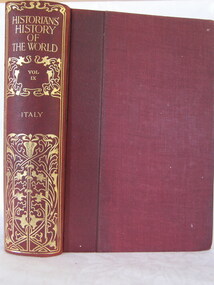
Book - Reference Book/History, Henry Smith Williams, The Historians History of the World Vol 9 set 1 - Edited by Henry Smith Williams L.L.D. Published by “The Times” 1908, 1908
... political history while other volumes (like those on Prussia or France) focus heavily on wars and kings. Volume 9 is forced to focus on culture and intellect. Because Italy was not a unified nation for most of this period, the volume highlights how a region can dominate the world through ideas, art, and religion rather than a single central government. ...political history while other volumes (like those on Prussia or France) focus heavily on wars and kings. Volume 9 is forced to focus on culture and intellect. Because Italy was not a unified nation for most of this period, the volume highlights how a region can dominate the world through ideas, art, and religion rather than a single central government. ...The 1908 edition of The Historians' History of the World is a monumental work of Edwardian scholarship, representing a specific era of "universal history" where the goal was to synthesise all human knowledge into a single narrative. While previous volumes dealt with the Roman Empire, Volume 9 picks up the story after the "Fall of Rome" and tracks the peninsula’s evolution through the dawn of the 20th century.The Book is part of a 25 volume set with red cloth bindings and gold filigree design to ribnon-fictionThe 1908 edition of The Historians' History of the World is a monumental work of Edwardian scholarship, representing a specific era of "universal history" where the goal was to synthesise all human knowledge into a single narrative. While previous volumes dealt with the Roman Empire, Volume 9 picks up the story after the "Fall of Rome" and tracks the peninsula’s evolution through the dawn of the 20th century. warrnambool, shipwrecked-coast, flagstaff-hill, flagstaff-hill-maritime-museum, maritime-museum, book, the historians history of the world vol 9 set 1, henry smith williams -
 Flagstaff Hill Maritime Museum and Village
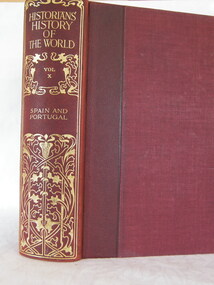
Book - Reference Book/History, Henry Smith Williams, The Historians History of the World Vol 10 set 1 - Edited by Henry Smith Williams L.L.D. Published by “The Times” 1908, 1908
... politics in the 1800s. The set is of historiographical value and significant because it captures the state of historical knowledge in 1908. In addition it reflects the "Great Man" theory of history and Western-centric perspectives common to that era. The volumes also had great editorial innovation as it was one of the first major attempts to create a "polyphonic" history using original source texts rather than a single author’s voice. Volume 10 holds a unique position in The Historians' “History of the World ...The 1908 edition of The Historians' History of the World is a monumental work of Edwardian scholarship, representing a specific era of "universal history" where the goal was to synthesise all human knowledge into a single narrative. Volume 10 specifically focuses on the Late “Middle Ages” and the “Renaissance period”, particularly in Italy and Spain. Starting with the clash of civilisations, Islam vs. Christianity.The Book is part of a 25 volume set with red cloth bindings and gold filigree design to rib.non-fictionThe 1908 edition of The Historians' History of the World is a monumental work of Edwardian scholarship, representing a specific era of "universal history" where the goal was to synthesise all human knowledge into a single narrative. Volume 10 specifically focuses on the Late “Middle Ages” and the “Renaissance period”, particularly in Italy and Spain. Starting with the clash of civilisations, Islam vs. Christianity. flagstaff hill, warrnambool, shipwrecked-coast, flagstaff-hill, flagstaff-hill-maritime-museum, maritime-museum, shipwreck-coast, flagstaff-hill-maritime-village, the historians history of the world vol 10 set 1, book -
 Flagstaff Hill Maritime Museum and Village
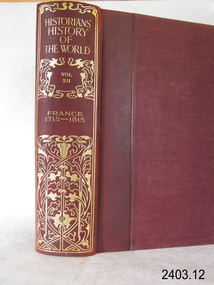
Book - Reference Book/History, Henry Smith Williams, The Historians History of the World Vol 12 set 1 - Edited by Henry Smith Williams L.L.D. Published by “The Times” 1908, 1908
... political and military milestones and therefore of cultural importance. (For more information on the Pattison Collection and the Mechanics Institute visit) https://victoriancollections.net.au/items/5580c7e72162f114d8b758db flagstaff hill warrnambool shipwrecked-coast flagstaff-hill flagstaff-hill-maritime-museum maritime-museum shipwreck-coast flagstaff-hill-maritime-village the historians history of the world vol 12 book henry smith williams l.l.d Henry Smith Williams’ “The Historians' History of the World” is a chronological and geographical "tapestry" of human events, these twenty five volumes occupy a very specific and prestigious place in historical research. ...Henry Smith Williams’ “The Historians' History of the World” is a chronological and geographical "tapestry" of human events, these twenty five volumes occupy a very specific and prestigious place in historical research. This volume continues on with the history of France. The primary focus of Volume 12 is the continuation of the history of France from 1715 to 1815. This century is arguably the most trans formative in French history, and the volume meticulously documents the transition from absolute monarchy to revolutionary chaos and, finally, to the Napoleonic Empire.The Book is part of a 25 volume set with red cloth bindings and gold filigree design to rib.non-fictionHenry Smith Williams’ “The Historians' History of the World” is a chronological and geographical "tapestry" of human events, these twenty five volumes occupy a very specific and prestigious place in historical research. This volume continues on with the history of France. The primary focus of Volume 12 is the continuation of the history of France from 1715 to 1815. This century is arguably the most trans formative in French history, and the volume meticulously documents the transition from absolute monarchy to revolutionary chaos and, finally, to the Napoleonic Empire.flagstaff hill, warrnambool, shipwrecked-coast, flagstaff-hill, flagstaff-hill-maritime-museum, maritime-museum, shipwreck-coast, flagstaff-hill-maritime-village, the historians history of the world vol 12, book, henry smith williams l.l.d -
 Flagstaff Hill Maritime Museum and Village
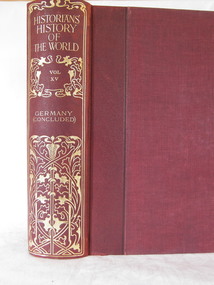
Book - Reference Book/History, Henry Smith Williams, The Historians History of the World Vol 15 set 1 - Edited by Henry Smith Williams L.L.D. Published by “The Times” 1908, 1908
... World” moves into the heart of modern European power dynamics. Published by The Times in 1908, this volume focuses on the rise of the modern German state and the evolution of the Austrian Empire. While Volume 14 introduced the early Germanic tribes and the Holy Roman Empire, Volume 15 is titled “The Germanic Empires (Concluded).” It covers the era of "Great Power" politics...It bridges the gap between the medieval religious wars and the geopolitical tensions that would eventually lead to World War I and the culmination of modern Europe. Volume 15 is arguably one of the most "politically charged" volume in the 1908 edition for several reasons. ...Henry Smith Williams’ “The Historians' History of the World” is a chronological and geographical "tapestry" of human events, these twenty five volumes occupy a very specific and prestigious place in historical research. Volume 15 of “The Historians' History of the World” moves into the heart of modern European power dynamics. Published by The Times in 1908, this volume focuses on the rise of the modern German state and the evolution of the Austrian Empire.The Book is part of a 25 volume set with red cloth bindings and gold filigree design to rib.non-fictionHenry Smith Williams’ “The Historians' History of the World” is a chronological and geographical "tapestry" of human events, these twenty five volumes occupy a very specific and prestigious place in historical research. Volume 15 of “The Historians' History of the World” moves into the heart of modern European power dynamics. Published by The Times in 1908, this volume focuses on the rise of the modern German state and the evolution of the Austrian Empire.flagstaff hill, warrnambool, shipwrecked-coast, flagstaff-hill-maritime-museum, maritime-museum, shipwreck-coast, flagstaff-hill-maritime-village, book, the historians history of the world vol 15 set 1, henry smith williams -
 Flagstaff Hill Maritime Museum and Village
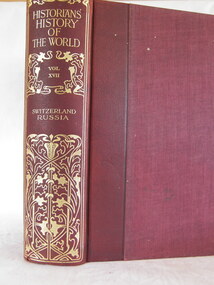
Book - Reference Book/History, The Times Newspaper, The Historians History of the World Vol 17 set 1 - Edited by Henry Smith Williams L.L.D. Published by “The Times” 1908, 1908
... political heritage prior to its eventual restoration as a sovereign nation. Edited by Henry Smith Williams, this set was a "history of histories." Rather than being written by a single author, it is a comprehensive compilation of primary sources and snippets from over 2,000 of the world's most famous historians (such as Edward Gibbon and Alfred Rambaud). ...Henry Smith Williams’ “The Historians' History of the World” is a chronological and geographical "tapestry" of human events, these twenty five volumes occupy a very specific and prestigious place in historical research. Volume 17 focuses primarily on the history of Switzerland with concluding sections on Russia, and Poland. The volume concludes the Swiss narrative began in volume 16.The Book is part of a 25 volume set with red cloth bindings and gold filigree design to rib.non-fictionHenry Smith Williams’ “The Historians' History of the World” is a chronological and geographical "tapestry" of human events, these twenty five volumes occupy a very specific and prestigious place in historical research. Volume 17 focuses primarily on the history of Switzerland with concluding sections on Russia, and Poland. The volume concludes the Swiss narrative began in volume 16.flagstaff hill, warrnambool, shipwrecked-coast, flagstaff-hill, flagstaff-hill-maritime-museum, maritime-museum, shipwreck-coast, flagstaff-hill-maritime-village, book, the historians history of the world vol 17 set 1 -
 Flagstaff Hill Maritime Museum and Village
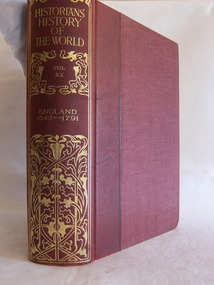
Book - Reference Book/History, Henry Smith Williams, The Historians History of the World Vol 20 set 1 - Edited by Henry Smith Williams L.L.D. Published by “The Times” 1908, 1908
... The era called “The Enlightenment,” the political and social developments throughout the early Georgian period leading up to 1791, including the rise of the British Empire's influence and the early stages of the Industrial Revolution. As part of a 25-volume world ...Henry Smith Williams’ “The Historians' History of the World” is a chronological and geographical "tapestry" of human events, these twenty five volumes occupy a very specific and prestigious place in historical research. Volume 20 focuses on the transformation period of England from the outbreak of the English Civil War to the late 18th century.The Book is part of a 25 volume set with red cloth bindings and gold filigree design to rib.non-fictionHenry Smith Williams’ “The Historians' History of the World” is a chronological and geographical "tapestry" of human events, these twenty five volumes occupy a very specific and prestigious place in historical research. Volume 20 focuses on the transformation period of England from the outbreak of the English Civil War to the late 18th century. warrnambool, flagstaff-hill, flagstaff-hill-maritime-museum, maritime-museum, shipwreck-coast, flagstaff-hill-maritime-village, book, the historians history of the world vol 20 set 1, henry smith williams -
 Flagstaff Hill Maritime Museum and Village
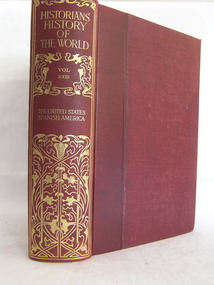
Book - Reference Book/History, Henry Smith Williams, The Historians History of the World Vol 23 set 1 - Edited by Henry Smith Williams L.L.D. Published by “The Times” 1908, 1908
... (For more information on the Pattison Collection and the Mechanics Institute visit) https://victoriancollections.net.au/items/5580c7e72162f114d8b758db flagstaff hill warrnambool shipwrecked-coast flagstaff-hill-maritime-museum maritime-museum flagstaff-hill-maritime-village book the historians history of the world vol 23 set 1 Henry Smith Williams The historians' History of the World, Volume 23 serves as a fascinating transition point where the series moves from the political history of nations to the broader history of the West, and the late-stage development of several major world powers. ...The historians' History of the World, Volume 23 serves as a fascinating transition point where the series moves from the political history of nations to the broader history of the West, and the late-stage development of several major world powers. This volume covers and returns to, Germany, Scandinavia, and the Modern Nations. It is a diverse volume that primarily focuses on the History of Germany (Part II), covering the period from the mid-18th century through the early 20th century, and the History of Scandinavia.The Book is part of a 25 volume set with red cloth bindings and gold filigree design to rib.non-fictionThe historians' History of the World, Volume 23 serves as a fascinating transition point where the series moves from the political history of nations to the broader history of the West, and the late-stage development of several major world powers. This volume covers and returns to, Germany, Scandinavia, and the Modern Nations. It is a diverse volume that primarily focuses on the History of Germany (Part II), covering the period from the mid-18th century through the early 20th century, and the History of Scandinavia. flagstaff hill, warrnambool, shipwrecked-coast, flagstaff-hill-maritime-museum, maritime-museum, flagstaff-hill-maritime-village, book, the historians history of the world vol 23 set 1, henry smith williams -
 Flagstaff Hill Maritime Museum and Village
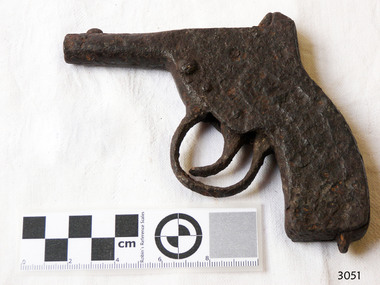
Toy Gun, 1911
... world emulated their heroes and collected and played with these toy guns. Eventually all of the famous cap gun manufacturers either sold out to other toy companies or started manufacturing other types of toys. Before it was deemed dangerous or politically ...This cap gun was found by a local Warrnambool resident in about 1971. Cap guns first appeared following the end of the American Civil War in the mid-1860s, when firearms companies experimented with toy guns to stay in business. Cap guns became especially popular when the heroes of cinema and television rode through the West ridding the territories of villains. Many cap guns were named after or endorsed by leading matinee idols like Roy Rogers, Gene Autry, Hopalong Cassidy, The Lone Ranger, Tonto, Dale Evans, Marshal Matt Dillon, or any of countless others. Cap guns became popular after the second world war and children all over the world emulated their heroes and collected and played with these toy guns. Eventually all of the famous cap gun manufacturers either sold out to other toy companies or started manufacturing other types of toys. Before it was deemed dangerous or politically incorrect for young children to point pistols at each other and fire at will, cap guns were a staple of toy chests. The item demonstrates how society has changed its attitudes and now regard these types of toys as morally unacceptable as they tend to promote violent attitudes towards others. The item demonstrates significantly how our societies social attitudes have changed since world war two from general societal acceptance of such toys to one of distaste.Toy gun; cap gun. Cast iron toy pistol with metal trigger. Name "National" in raised embossing in the casting on the handle on both sides of the gun. Made in 1911."National" flagstaff hill, warrnambool, shipwrecked-coast, flagstaff-hill, flagstaff-hill-maritime-museum, maritime-museum, shipwreck-coast, flagstaff-hill-maritime-village, toys, cap gun, national fireworks distrubuting company, toy guns, toy pistol -
The Beechworth Burke Museum
Audio - Oral History, Jennifer Williams, Mrs Vanessa McDonald, 9 November 2000
... World War. She met her husband at a Beechworth football match and was married at the Stanley Methodist Church in 1941. The gold diggings known as the 'Nine Mile' became the hamlet of Stanley, after the British Prime Minister, Lord Stanley, in 1858. By the late 1850s, Stanley boasted schools, an athenaeum, a church, a weekly newspaper and several hotels and other civic infrastructure to cater for a growing population. The area attracted large numbers of Chinese miners, whose presence was frequently resisted. Like other early Victorian mining settlements, Stanley was a hotbed of political...World War. She met her husband at a Beechworth football match and was married at the Stanley Methodist Church in 1941. The gold diggings known as the 'Nine Mile' became the hamlet of Stanley, after the British Prime Minister, Lord Stanley, in 1858. By the late 1850s, Stanley boasted schools, an athenaeum, a church, a weekly newspaper and several hotels and other civic infrastructure to cater for a growing population. The area attracted large numbers of Chinese miners, whose presence was frequently resisted. Like other early Victorian mining settlements, Stanley was a hotbed of political ...Mrs. Vanessa McDonald was born in Beechworth in 1917. Christened, Agnes Bertha Collins, Vanessa changed her name in 1960. Mrs. McDonald's family's connection with gold mining in the district reach back to the first of Beechworth's gold rushes, when her great grandfather, a Dutchman who adopted the name Charles Collins, arrived in 1851-1852. Mrs. McDonald spent her childhood in the isolated hamlet of Stanley, in the area known as 'Little Scotland', where she recalls helping her mother to raise younger siblings, picking apples and walnuts on the family farm, and roaming the hills for wildflowers. As a young woman Mrs. McDonald attended religious and social gatherings in the local community. In 1940 she went to Melbourne to work as a mothercraft nurse during the Second World War. She met her husband at a Beechworth football match and was married at the Stanley Methodist Church in 1941. The gold diggings known as the 'Nine Mile' became the hamlet of Stanley, after the British Prime Minister, Lord Stanley, in 1858. By the late 1850s, Stanley boasted schools, an athenaeum, a church, a weekly newspaper and several hotels and other civic infrastructure to cater for a growing population. The area attracted large numbers of Chinese miners, whose presence was frequently resisted. Like other early Victorian mining settlements, Stanley was a hotbed of political and racial tensions during the gold rush. One side of the Nine Mile Creek was known as 'Little Scotland’, the other, 'Little Ireland'. A number of Christian denominations built congregations and churches in Stanley, including the Church of England, Methodist Church, the Catholic Church, and Presbyterian Church. Stanley became part of the United Shire of Beechworth in 1871. By 1880 timber was being cut and two sawmills were established by 1887. River-dredged gold mining consumed vast amounts of timber from the forests in the area, and in 1931 the first of several softwood plantations began. This oral history recording was part of a project conducted by Jennifer Williams in the year 2000 to capture the everyday life and struggles in Beechworth during the twentieth century. This project involved recording seventy oral histories on cassette tapes of local Beechworth residents which were then published in a book titled: 'Listen to what they say: voices of twentieth century Beechworth'. These cassette tapes were digitised in July 2021 with funds made available by the Friends of the Burke.Following the decline in the mining and associated industries during the early-mid-twentieth century, the Beechworth district experienced a period of general economic decline. On the east side of the Dingle Range, Mrs. McDonald's father, William Henry Collins, felled timber and the family were pioneer apple orchardists. The establishment of apple orchards in Stanley reflects changes to how land was used and contributes to our understanding of the historical development of rural communities following the gold rush. Mrs. McDonald's recollections are significant for understanding family and social life in a small rural town in years leading up to the Great Depression and prior to the Second World War. This oral history recording may be compared with other oral histories and items in the Burke Museum's collection. This oral history account is socially and historically significant as it is a part of a broader collection of interviews conducted by Jennifer Williams which were published in the book 'Listen to what they say: voices of twentieth-century Beechworth.' While the township of Beechworth is known for its history as a gold rush town, these accounts provide a unique insight into the day-to-day life of the town's residents during the 20th century, many of which will have now been lost if they had not been preserved.This is a digital copy of a recording that was originally captured on a cassette tape. The cassette tape is black with a horizontal white strip and is currently stored in a clear flat plastic rectangular container. It holds up 40 minutes of recordings on each side.Mrs Vanessa McDonald /listen to what they say, beechworth, oral history, burke museum, emigration, gold rush immigration, victorian gold rush, mining families, apple orchard, forestry, forest plantation, little scotland, stanley, twentieth century history, regional australia, rural australia, farming, harvest festival, great depression, dingle range, the nine mile, australian wildflowers, high country wildflowers, mothercraft nurse, rural and regional women, social history, collins, mrs. vanessa mcdonald, building community life, shaping cultural and creative life, fruit growers, family history, changes to land use in regional victoria -
 Mission to Seafarers Victoria
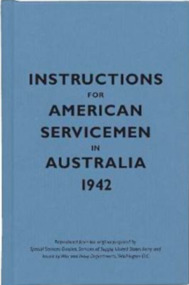
Book - Pocket book, Special Service Devision, Service of Supply, United States Army, Instructions for American Servicemen in Australia 1942, 2007
... World War II. As well as general information about the country and its customs. The American Army requisitioned the Port Melbourne Mission on Beach Road. 1942 American soldiers australia In 1942, the United States issued Instructions for American Servicemen in Australia as a quick guide to Australia's people, politics, history and culture for Americans stationed there during the Second World War. ...In 1942, the United States issued Instructions for American Servicemen in Australia as a quick guide to Australia's people, politics, history and culture for Americans stationed there during the Second World War. It was one of several similar sets of instructions put together by the US government to help its soldiers, sailors and airmen adjust to life abroad.Pocket size book of blue colour ix, [54] p. : ill., mapsnon-fictionIn 1942, the United States issued Instructions for American Servicemen in Australia as a quick guide to Australia's people, politics, history and culture for Americans stationed there during the Second World War. It was one of several similar sets of instructions put together by the US government to help its soldiers, sailors and airmen adjust to life abroad. 1942, american soldiers, australia -
 Federation University Historical Collection
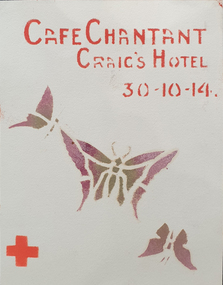
Card, Chef Chantant Craig's Hotel 30.10.14, 30/10/1914
... political or confrontational. This event was possibly associated with the Ballarat School of Mines as a fundraiser for the Red Cross during World War One....political or confrontational. This event was possibly associated with the Ballarat School of Mines as a fundraiser for the Red Cross during World War One. ...Cafe Chantant is a type of musical establishment associated with the Belle Époque in France. The music was generally lighthearted, sometimes risqué, even bawdy but, as opposed to the cabaret tradition, not particularly political or confrontational. This event was possibly associated with the Ballarat School of Mines as a fundraiser for the Red Cross during World War One.A card with silk screen design and a Red Crossred cross, craig's hotel, world war one -
Federation University Historical Collection
Document, Zelda Martin, Confirmation of Candidature - Central Victorian Towns - Boom or Bust, c1996
... Zelda had a Bachelor of Commerce (majoring in Economic History and Economic Geography), an Master of Arts (in Politics) and a Diploma of Education; all from the University of Melbourne. Zelda is the author of a book titled " Australia's Relations with the Third World in the context of negotiations for a new international commodity order in the 1970's: continuity or change?" ...Zelda had a Bachelor of Commerce (majoring in Economic History and Economic Geography), an Master of Arts (in Politics) and a Diploma of Education; all from the University of Melbourne. Zelda is the author of a book titled " Australia's Relations with the Third World in the context of negotiations for a new international commodity order in the 1970's: continuity or change?" ...Zelda Martin was a PhD candidate at the University of Melbourne. Zelda had a Bachelor of Commerce (majoring in Economic History and Economic Geography), an Master of Arts (in Politics) and a Diploma of Education; all from the University of Melbourne. Zelda is the author of a book titled " Australia's Relations with the Third World in the context of negotiations for a new international commodity order in the 1970's: continuity or change?" Pub. [Parkville, Victoria]: University of Melbourne, 1982.Eleven page article on Victorian goldfields town. The article was written during the author's PhD study. zelda martin, victorian goldfield towns, bendigo, castlemaine, ballarat, maldon, stawell, ararat, maryborough, creswick, avoca, heathcote, banks, bank of australasia, union bank of australia, government camp, sandhurst, water supply, tarnagulla, talbot, back creek, mountain creek, police court, carisbrook, dunolly, thompson's foundry
