
Showing 44 items matching "chemistry report"
-
 University of Melbourne, Burnley Campus Archives
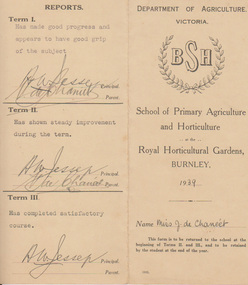
Card - Report Card, Dept of Agriculture, Victoria, School of Primary Agriculture and Horticulture at the Royal Horticultural Gardens, Burnley, 1939
... ...Chemistry Report...Report Card of Miss June de Chaneet, Terms I, II and III 1939. Lists subjects taken. Miss J.de Chaneet graduated in Certificate of Competency in Horticulture 1939. Subjects taken: Botany, Chemistry...She graduated with a Certificate of Competency in Horticulture in 1939 certificate of competency june de chaneet report card Term reports Botany report Chemistry Report Gardening report Entomology Report Vegetable Pathology Report Viticulture Report Citriculture Report Garden Design Report Out-door Work Report Garden Observation Report Attendances Punctuality Conduct The report is signed by the principal A.W. ...Miss June De Chaneet, Terms I, II and III 1939. She graduated with a Certificate of Competency in Horticulture in 1939Report Card of Miss June de Chaneet, Terms I, II and III 1939. Lists subjects taken. Miss J.de Chaneet graduated in Certificate of Competency in Horticulture 1939. Subjects taken: Botany, Chemistry, Gardening, Entomology, Vegetable Pathology, Viticulture, Citriculture, Garden Design, Outdoor Work, Garden observation. Note by T. H. Kneen 1/4/92 "This report card show the name of the school as it was known from the time of Mr. McLennan's appointment in 1916. See B91 228 - on the sign Horticulture takes precedence over Primary Agriculture. The location Royal Horticultural Gardens owes its origin to the Royal Horticultural Society of Victoria which relinquished management of the Gardens to the Department of Agriculture in 1891." "I would have thought the use of Royal was for the RHSV exclusively." THKThe report is signed by the principal A.W. Jessop and Miss de Chaneet's parent V. de Chaneet.certificate of competency, june de chaneet, report card, term reports, botany report, chemistry report, gardening report, entomology report, vegetable pathology report, viticulture report, citriculture report, garden design report, out-door work report, garden observation report, attendances, punctuality, conduct -
 Federation University Historical Collection
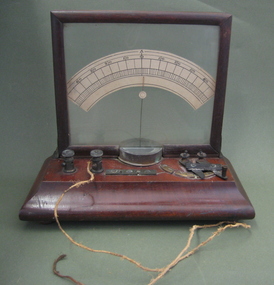
Ammeter, Henry Sutton (probably), Ammeter attributed to Henry Sutton, 1883 (estimated)
... Sutton presented a vacuum pump, worked by water jet, for use in SMB Chemistry classes. His report of 1883 states: ‘A telephonic circuit has been laid down between the [SMB] engine-house and workshops, to be used for experimental purposes.’ ...Sutton presented a vacuum pump, worked by water jet, for use in SMB Chemistry classes. His report of 1883 states: ‘A telephonic circuit has been laid down between the [SMB] engine-house and workshops, to be used for experimental purposes.’ ...W.B Withers wrote of Sutton: "In the realm of science Ballarat has become of world-wide fame through the inventions by Mr Henry Sutton, a native of the place. His skill and acquirements in electricity, telegraphy, telephony, photography and also in astronomical and microscopal studies have won for him a high position as a practical scientist, and the credit is the greater as he is a self-taught student … Mr Sutton, before he was fourteen years old, had read every book on science to be found in the library of the Ballarat Mechanics' Institute." The Ballarat School of Mines (SMB) was fortunate to have this genius appointed as the lecturer-in-charge of the new Electricity and Magnetism department from 23 April 1883. Although Henry Sutton submitted his resignation to the Council of SMB in October 1884 it was resolved that he be asked to reconsider, and Mr Sutton continued to teach at SMB until the end of 1886. He was a prominent member of the Camera Club, and many of the other SMB clubs. Sutton had an active and fertile brain, and was known for his inventions, especially his work on the telephone, telephane and carbon lamps. Sutton presented a vacuum pump, worked by water jet, for use in SMB Chemistry classes. His report of 1883 states: ‘A telephonic circuit has been laid down between the [SMB] engine-house and workshops, to be used for experimental purposes.’ Henry Sutton spent much thought on artificial flight, and made some interesting experimental studies with flying birds. The storage of electricty also attracted his attention, and, after much work and thought evolved the Sutton Secondary Battery. A paper on this battery was presented to the Royal Society, London, and was afterwards printed in the 'Transactions'. Henry Sutton is listed on the Federation University Honour Roll at https://www.federation.edu.au/curator/honour-roll/honourroll_sutton.shtmlA crude scientific instrument that measures amps, with a timber base and frame. Terminal posts and sliders contacts are positioned on top of the base, with flex attached. Henry Sutton lectured at the Ballarat School of Mines (SMB) in Electricty and Magnestism between 1883 and 1886. In 1883 Sutton reported: ‘…The class has been unfortunately situated, by having to wait for instruments of precision ordered from England, but which have not come to hand. The delay has caused us to start constructing instruments, which it is hoped will bear favourable comparison with those of older date.'ammeter, henry sutton, electrical, inventor, electricity and magnetism, sutton, scientific instruments -
 Flagstaff Hill Maritime Museum and Village
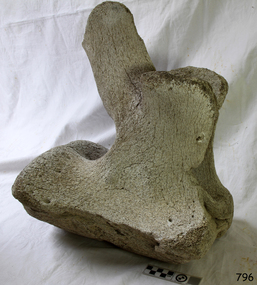
Animal specimen - Whale bone, Undetermined
... Prior to carrying out a detailed condition report of the cetacean skeletons, it is useful to have an understanding of the materials we are likely to encounter, in terms of structure and chemistry. ...Prior to carrying out a detailed condition report of the cetacean skeletons, it is useful to have an understanding of the materials we are likely to encounter, in terms of structure and chemistry. ...Prior to carrying out a detailed condition report of the cetacean skeletons, it is useful to have an understanding of the materials we are likely to encounter, in terms of structure and chemistry. This entry invites you to join in learning about the composition of whale bone and oil. Whale bone (Cetacean) bone is comprised of a composite structure of both an inorganic matrix of mainly hydroxylapatite (a calcium phosphate mineral), providing strength and rigidity, as well as an organic protein ‘scaffolding’ of mainly collagen, facilitating growth and repair (O’Connor 2008, CCI 2010). Collagen is also the structural protein component in cartilage between the whale vertebrae and attached to the fins of both the Killer Whale and the Dolphin. Relative proportions in the bone composition (affecting density), are linked with the feeding habits and mechanical stresses typically endured by bones of particular whale types. A Sperm Whale (Physeter macrocephalus Linnaeus, 1758) skeleton (toothed) thus has a higher mineral value (~67%) than a Fin Whale (Balaenoptera physalus Linnaeus, 1758) (baleen) (~60%) (Turner Walker 2012). The internal structure of bone can be divided into compact and cancellous bone. In whales, load-bearing structures such as mandibles and upper limb bones (e.g. humerus, sternum) are largely composed of compact bone (Turner Walker 2012). This consists of lamella concentrically deposited around the longitudinal axis and is permeated by fluid carrying channels (O’Connor 2008). Cancellous (spongy) bone, with a highly porous angular network of trabeculae, is less stiff and thus found in whale ribs and vertebrae (Turner Walker 2012). Whale oil Whales not only carry a thick layer of fat (blubber) in the soft tissue of their body for heat insulation and as a food store while they are alive, but also hold large oil (lipid) reserves in their porous bones. Following maceration of the whale skeleton after death to remove the soft tissue, the bones retain a high lipid content (Higgs et. al 2010). Particularly bones with a spongy (porous) structure have a high capacity to hold oil-rich marrow. Comparative data of various whale species suggests the skull, particularly the cranium and mandible bones are particularly oil rich. Along the vertebral column, the lipid content is reduced, particularly in the thoracic vertebrae (~10-25%), yet greatly increases from the lumbar to the caudal vertebrae (~40-55%). The chest area (scapula, sternum and ribs) show a mid-range lipid content (~15-30%), with vertically orientated ribs being more heavily soaked lower down (Turner Walker 2012, Higgs et. al 2010). Whale oil is largely composed of triglycerides (molecules of fatty acids attached to a glycerol molecule). In Arctic whales a higher proportion of unsaturated, versus saturated fatty acids make up the lipid. Unsaturated fatty acids (with double or triple carbon bonds causing chain kinks, preventing close packing (solidifying) of molecules), are more likely to be liquid (oil), versus solid (fat) at room temperature (Smith and March 2007). Objects Made From the Whaling Industry We all know that men set forth in sailing ships and risked their lives to harpoon whales on the open seas throughout the 1800s. And while Moby Dick and other tales have made whaling stories immortal, people today generally don't appreciate that the whalers were part of a well-organized industry. The ships that set out from ports in New England roamed as far as the Pacific in hunt of specific species of whales. Adventure may have been the draw for some whalers, but for the captains who owned whaling ships, and the investors which financed voyages, there was a considerable monetary payoff. The gigantic carcasses of whales were chopped and boiled down and turned into products such as the fine oil needed to lubricate increasing advanced machine tools. And beyond the oil derived from whales, even their bones, in an era before the invention of plastic, was used to make a wide variety of consumer goods. In short, whales were a valuable natural resource the same as wood, minerals, or petroleum we now pump from the ground. Oil From Whale’s Blubber Oil was the main product sought from whales, and it was used to lubricate machinery and to provide illumination by burning it in lamps. When a whale was killed, it was towed to the ship and its blubber, the thick insulating fat under its skin, would be peeled and cut from its carcass in a process known as “flensing.” The blubber was minced into chunks and boiled in large vats on board the whaling ship, producing oil. The oil taken from whale blubber was packaged in casks and transported back to the whaling ship’s home port (such as New Bedford, Massachusetts, the busiest American whaling port in the mid-1800s). From the ports it would be sold and transported across the country and would find its way into a huge variety of products. Whale oil, in addition to be used for lubrication and illumination, was also used to manufacture soaps, paint, and varnish. Whale oil was also utilized in some processes used to manufacture textiles and rope. Spermaceti, a Highly Regarded Oil A peculiar oil found in the head of the sperm whale, spermaceti, was highly prized. The oil was waxy, and was commonly used in making candles. In fact, candles made of spermaceti were considered the best in the world, producing a bright clear flame without an excess of smoke. Spermaceti was also used, distilled in liquid form, as an oil to fuel lamps. The main American whaling port, New Bedford, Massachusetts, was thus known as "The City That Lit the World." When John Adams was the ambassador to Great Britain before serving as president he recorded in his diary a conversation about spermaceti he had with the British Prime Minister William Pitt. Adams, keen to promote the New England whaling industry, was trying to convince the British to import spermaceti sold by American whalers, which the British could use to fuel street lamps. The British were not interested. In his diary, Adams wrote that he told Pitt, “the fat of the spermaceti whale gives the clearest and most beautiful flame of any substance that is known in nature, and we are surprised you prefer darkness, and consequent robberies, burglaries, and murders in your streets to receiving as a remittance our spermaceti oil.” Despite the failed sales pitch John Adams made in the late 1700s, the American whaling industry boomed in the early to mid-1800s. And spermaceti was a major component of that success. Spermaceti could be refined into a lubricant that was ideal for precision machinery. The machine tools that made the growth of industry possible in the United States were lubricated, and essentially made possible, by oil derived from spermaceti. Baleen, or "Whalebone" The bones and teeth of various species of whales were used in a number of products, many of them common implements in a 19th century household. Whales are said to have produced “the plastic of the 1800s.” The "bone" of the whale which was most commonly used wasn’t technically a bone, it was baleen, a hard material arrayed in large plates, like gigantic combs, in the mouths of some species of whales. The purpose of the baleen is to act as a sieve, catching tiny organisms in sea water, which the whale consumes as food. As baleen was tough yet flexible, it could be used in a number of practical applications. And it became commonly known as "whalebone." Perhaps the most common use of whalebone was in the manufacture of corsets, which fashionable ladies in the 1800s wore to compress their waistlines. One typical corset advertisement from the 1800s proudly proclaims, “Real Whalebone Only Used.” Whalebone was also used for collar stays, buggy whips, and toys. Its remarkable flexibility even caused it to be used as the springs in early typewriters. The comparison to plastic is apt. Think of common items which today might be made of plastic, and it's likely that similar items in the 1800s would have been made of whalebone. Baleen whales do not have teeth. But the teeth of other whales, such as the sperm whale, would be used as ivory in such products as chess pieces, piano keys, or the handles of walking sticks. Pieces of scrimshaw, or carved whale's teeth, would probably be the best remembered use of whale's teeth. However, the carved teeth were created to pass the time on whaling voyages and were never a mass production item. Their relative rarity, of course, is why genuine pieces of 19th century scrimshaw are considered to be valuable collectibles today. Reference: McNamara, Robert. "Objects Made From the Whaling Industry." ThoughtCo, Jul. 31, 2021, thoughtco.com/products-produced-from-whales-1774070.Whale bone was an important commodity, used in corsets, collar stays, buggy whips, and toys.Whale bone vertebrae. Advanced stage of calcification as indicated by deep pitting. Off white to grey.Noneflagstaff hill, warrnambool, shipwrecked-coast, flagstaff-hill, flagstaff-hill-maritime-museum, maritime-museum, shipwreck-coast, flagstaff-hill-maritime-village, whales, whale bone, corsets, toys, whips, whalebone -
 Flagstaff Hill Maritime Museum and Village
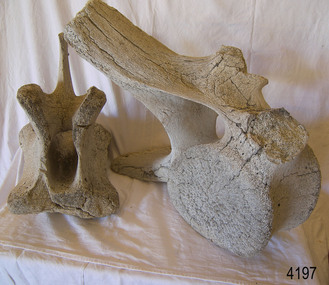
Animal specimen - Whale bone, Undetermined
... Prior to carrying out a detailed condition report of the cetacean skeletons, it is useful to have an understanding of the materials we are likely to encounter, in terms of structure and chemistry. ...Prior to carrying out a detailed condition report of the cetacean skeletons, it is useful to have an understanding of the materials we are likely to encounter, in terms of structure and chemistry. ...Prior to carrying out a detailed condition report of the cetacean skeletons, it is useful to have an understanding of the materials we are likely to encounter, in terms of structure and chemistry. This entry invites you to join in learning about the composition of whale bone and oil. Whale bone (Cetacean) bone is comprised of a composite structure of both an inorganic matrix of mainly hydroxylapatite (a calcium phosphate mineral), providing strength and rigidity, as well as an organic protein ‘scaffolding’ of mainly collagen, facilitating growth and repair (O’Connor 2008, CCI 2010). Collagen is also the structural protein component in cartilage between the whale vertebrae and attached to the fins of both the Killer Whale and the Dolphin. Relative proportions in the bone composition (affecting density), are linked with the feeding habits and mechanical stresses typically endured by bones of particular whale types. A Sperm Whale (Physeter macrocephalus Linnaeus, 1758) skeleton (toothed) thus has a higher mineral value (~67%) than a Fin Whale (Balaenoptera physalus Linnaeus, 1758) (baleen) (~60%) (Turner Walker 2012). The internal structure of bone can be divided into compact and cancellous bone. In whales, load-bearing structures such as mandibles and upper limb bones (e.g. humerus, sternum) are largely composed of compact bone (Turner Walker 2012). This consists of lamella concentrically deposited around the longitudinal axis and is permeated by fluid carrying channels (O’Connor 2008). Cancellous (spongy) bone, with a highly porous angular network of trabeculae, is less stiff and thus found in whale ribs and vertebrae (Turner Walker 2012). Whale oil Whales not only carry a thick layer of fat (blubber) in the soft tissue of their body for heat insulation and as a food store while they are alive, but also hold large oil (lipid) reserves in their porous bones. Following maceration of the whale skeleton after death to remove the soft tissue, the bones retain a high lipid content (Higgs et. al 2010). Particularly bones with a spongy (porous) structure have a high capacity to hold oil-rich marrow. Comparative data of various whale species suggests the skull, particularly the cranium and mandible bones are particularly oil rich. Along the vertebral column, the lipid content is reduced, particularly in the thoracic vertebrae (~10-25%), yet greatly increases from the lumbar to the caudal vertebrae (~40-55%). The chest area (scapula, sternum and ribs) show a mid-range lipid content (~15-30%), with vertically orientated ribs being more heavily soaked lower down (Turner Walker 2012, Higgs et. al 2010). Whale oil is largely composed of triglycerides (molecules of fatty acids attached to a glycerol molecule). In Arctic whales a higher proportion of unsaturated, versus saturated fatty acids make up the lipid. Unsaturated fatty acids (with double or triple carbon bonds causing chain kinks, preventing close packing (solidifying) of molecules), are more likely to be liquid (oil), versus solid (fat) at room temperature (Smith and March 2007). Objects Made From the Whaling Industry We all know that men set forth in sailing ships and risked their lives to harpoon whales on the open seas throughout the 1800s. And while Moby Dick and other tales have made whaling stories immortal, people today generally don't appreciate that the whalers were part of a well-organized industry. The ships that set out from ports in New England roamed as far as the Pacific in hunt of specific species of whales. Adventure may have been the draw for some whalers, but for the captains who owned whaling ships, and the investors which financed voyages, there was a considerable monetary payoff. The gigantic carcasses of whales were chopped and boiled down and turned into products such as the fine oil needed to lubricate increasing advanced machine tools. And beyond the oil derived from whales, even their bones, in an era before the invention of plastic, was used to make a wide variety of consumer goods. In short, whales were a valuable natural resource the same as wood, minerals, or petroleum we now pump from the ground. Oil From Whale’s Blubber Oil was the main product sought from whales, and it was used to lubricate machinery and to provide illumination by burning it in lamps. When a whale was killed, it was towed to the ship and its blubber, the thick insulating fat under its skin, would be peeled and cut from its carcass in a process known as “flensing.” The blubber was minced into chunks and boiled in large vats on board the whaling ship, producing oil. The oil taken from whale blubber was packaged in casks and transported back to the whaling ship’s home port (such as New Bedford, Massachusetts, the busiest American whaling port in the mid-1800s). From the ports it would be sold and transported across the country and would find its way into a huge variety of products. Whale oil, in addition to be used for lubrication and illumination, was also used to manufacture soaps, paint, and varnish. Whale oil was also utilized in some processes used to manufacture textiles and rope. Spermaceti, a Highly Regarded Oil A peculiar oil found in the head of the sperm whale, spermaceti, was highly prized. The oil was waxy, and was commonly used in making candles. In fact, candles made of spermaceti were considered the best in the world, producing a bright clear flame without an excess of smoke. Spermaceti was also used, distilled in liquid form, as an oil to fuel lamps. The main American whaling port, New Bedford, Massachusetts, was thus known as "The City That Lit the World." When John Adams was the ambassador to Great Britain before serving as president he recorded in his diary a conversation about spermaceti he had with the British Prime Minister William Pitt. Adams, keen to promote the New England whaling industry, was trying to convince the British to import spermaceti sold by American whalers, which the British could use to fuel street lamps. The British were not interested. In his diary, Adams wrote that he told Pitt, “the fat of the spermaceti whale gives the clearest and most beautiful flame of any substance that is known in nature, and we are surprised you prefer darkness, and consequent robberies, burglaries, and murders in your streets to receiving as a remittance our spermaceti oil.” Despite the failed sales pitch John Adams made in the late 1700s, the American whaling industry boomed in the early to mid-1800s. And spermaceti was a major component of that success. Spermaceti could be refined into a lubricant that was ideal for precision machinery. The machine tools that made the growth of industry possible in the United States were lubricated, and essentially made possible, by oil derived from spermaceti. Baleen, or "Whalebone" The bones and teeth of various species of whales were used in a number of products, many of them common implements in a 19th century household. Whales are said to have produced “the plastic of the 1800s.” The "bone" of the whale which was most commonly used wasn’t technically a bone, it was baleen, a hard material arrayed in large plates, like gigantic combs, in the mouths of some species of whales. The purpose of the baleen is to act as a sieve, catching tiny organisms in sea water, which the whale consumes as food. As baleen was tough yet flexible, it could be used in a number of practical applications. And it became commonly known as "whalebone." Perhaps the most common use of whalebone was in the manufacture of corsets, which fashionable ladies in the 1800s wore to compress their waistlines. One typical corset advertisement from the 1800s proudly proclaims, “Real Whalebone Only Used.” Whalebone was also used for collar stays, buggy whips, and toys. Its remarkable flexibility even caused it to be used as the springs in early typewriters. The comparison to plastic is apt. Think of common items which today might be made of plastic, and it's likely that similar items in the 1800s would have been made of whalebone. Baleen whales do not have teeth. But the teeth of other whales, such as the sperm whale, would be used as ivory in such products as chess pieces, piano keys, or the handles of walking sticks. Pieces of scrimshaw, or carved whale's teeth, would probably be the best remembered use of whale's teeth. However, the carved teeth were created to pass the time on whaling voyages and were never a mass production item. Their relative rarity, of course, is why genuine pieces of 19th century scrimshaw are considered to be valuable collectibles today. Reference: McNamara, Robert. "Objects Made From the Whaling Industry." ThoughtCo, Jul. 31, 2021, thoughtco.com/products-produced-from-whales-1774070.Whale bone was an important commodity, used in corsets, collar stays, buggy whips, and toys.Whale bone in two pieces. Advanced stage of calcification as indicated by deep pitting. Off white to grey.None.flagstaff hill, warrnambool, shipwrecked-coast, flagstaff-hill, flagstaff-hill-maritime-museum, maritime-museum, shipwreck-coast, flagstaff-hill-maritime-village, whale bones, whale skeleton, whales, whale bone, corsets, toys, whips -
 Federation University Historical Collection
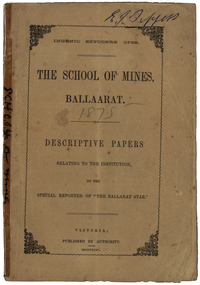
Booklet, The School of Mines Ballaarat: Descriptive papers relating to the institution by the special reporter of "The Ballarat Star", 1875 (exact)
... Chemistry J. Cosmo Newberry, and Telegraphy R.L.J. Ellery (government astronomer) and Sam W. Macgowan. Underground managers and captains in quart mining was examined by Henry Rosales (Walhalla Company), and alluvial mines by Messrs Bockett, Kent, Martin and Mitchell. Engineers and Engine driving was examined by W.H. Keast,Peter Matthews, Jonathan Robinson and J.M. Troup. Section XI - Covers Annual reports...Chemistry J. Cosmo Newberry, and Telegraphy R.L.J. Ellery (government astronomer) and Sam W. Macgowan. Underground managers and captains in quart mining was examined by Henry Rosales (Walhalla Company), and alluvial mines by Messrs Bockett, Kent, Martin and Mitchell. Engineers and Engine driving was examined by W.H. Keast,Peter Matthews, Jonathan Robinson and J.M. Troup. Section XI - Covers Annual reports ...The booklet comprises of a series of papers published in the Ballarat Star, with some revisions. The Administrative Council hoped the publication would increase interest in Technical Education, especially the Art of Mining. He would also hope the public would recognise the Ballarat School of Mines as an institution adapted to supply technical education. The Ballarat School of Mines Council listed at the front of the book includes: Redmond Barry (President and Trustee), Judge Rogers (Vice-President), Somerville Livingstone Learmonth (Trustee), Rivett Henry Bland (Trustee), Charles Gavan Duffy, John A. MacPherson (MLA), William McLellan (MLA), Duncan Gillies (MLA), F. McCoy (University of Melbourne), John I. Bleasdale, W.H. Barnard, James M. Bickett, Henry Richards Caselli, P. Chauncy, J.M. Davey, Joseph Flude, R.F. Hudson, Robert Lewis, James Oddie, Robert M. Serjeant, J. F. Usher, John Walker, J. Williamson, Mayor of the City of Ballaarat, chairman (for the time being) of each of the seven Mining Boards of Victoria. The President of Examiners was Judge Rogers, and the Honorary Auditor was Richard Ford.Stapled, brown soft covered booklet of 48 pages. Section I outlines the establishment of the Ballarat School of Mines, the buildings and land used by the school, describes in detail the former Ballarat Circuit Court and describes the lecture rooms. Section II describes the Ballarat School of Mines Museum, including a description of exhibits. Section III describes the lecture hall, and the apartments on either side of the hall, including the office of the registrar W.H. Barnard, mathematical classroom, chemical laboratory, and metallurgical laboratory. Section IV outlines the subjects offered by the Ballarat School of Mines, including Mathematics taught by John Victor of Grenville College, who had been educated at Trinity College Dublin. Mining and Land Surveying was taught by C.W. Thomas. Mr Croll taught mechanical drawing, followed by Jonathan Robinson of the Union Foundry, and finally S. Keast. It then lists some text books used in the school. Section V mentions the School Council, lack of funds, future directions, mining laboratory. Vi- Describes the land and out buildings, and the proposed building for metal and wood turning, brass foundry, blacksmith, working engine, etc. This section describes some large donations to the school - 50 pounds from the Misses Meglin of Melbourne, 10 pounds 10 shillings to the 'Pyrites fund' by the Walhalla and Long Tunnel Companies in Gippsland. Section VII covers the teaching of chemistry by Joseph Flude. Section VIII outlines the metallurgy classes and the process of assaying. Section IX covers telegraphy taught by Mr Bechervaise Section X describes the examination process at the Ballarat School of Mines. Examiners in mathematics were G.J. Russell (Buninyong) and John Lynch (Smythesdale), mining and land surveying John Lynch and P.C. Fitzpatrick (Ballarat), Principles and Practice of Mining R.M. Serjeant (Band and Albion Consols), Mechanical Engineering John Lewis (New North Company Clunes, Mineralogy and Geology G.H. F. Ulrich, Assayign and Chemistry J. Cosmo Newberry, and Telegraphy R.L.J. Ellery (government astronomer) and Sam W. Macgowan. Underground managers and captains in quart mining was examined by Henry Rosales (Walhalla Company), and alluvial mines by Messrs Bockett, Kent, Martin and Mitchell. Engineers and Engine driving was examined by W.H. Keast,Peter Matthews, Jonathan Robinson and J.M. Troup. Section XI - Covers Annual reports of the school, and honorary correspondents of the school including: John Day (Geelong); R. Evan Day (London); W.W. Evans, M.J.C.E. of New York; J.Y. Fishburne, M.B. of Ararat; Felice Giordano, Inspector of Mines, Italy; Julius Von Haast, Ph. D.F.R.S., Government Geologist of Canterbury; James Hector, M.D., F.R.S., Government Geologist of Wellington, New Zealand, W.F. Hopkins (Grant); Charles A. La Trobe, C.E. (Engineer-in-Chief International Railway Plant, London); Archibald Liversidge, F.G.S. (Professor of Mineralogy and Reader in geology at Sydney University; J.J. Macgregor, M.D. (Creswick); J.T. McKenna (1st class of SMB underground management - Northern Territory); Henry Rosales, M.E. and M. (Walhalla); Harrie Wood (SMB founder and Under-secretary for Mines, Sydney); John Walthew (Stockport, England) .2) Signed 'E.J. Tippett', former President of the Ballarat School of Mines Council melbourne, mla, ballarat school of mines, redmond barry, j f usher, james bickett, w f hopkins, rivett henry bland, s m b, judge rogers, somerville learmonth, charles gavan duffy, gavan duffy, john macpherson, william mclellan, duncan gillies, f mccoy, university, john bleasdale, henry richards caselli, henry caselli, p chauncy, j m davey, joseph flude, r f hudson, robert lewis, james oddie, robert m serjeant, john walker, j williamson, richard ford, ballarat court house, assay, john victor, grenville college, trinity college dublin, c w thomas, jonathan robinson, union foundry, s keast, blessdale, john day, r evan day, w w evans, j y fishburne, felice giordano, julius von haast, james hector, charles a la, trobe, archibald liversidge, j j macgregor, j t mckenna, henry rosales, harrie wood, john walthew, fees, frederick mccoy, w.h. barnard -
 Federation University Historical Collection
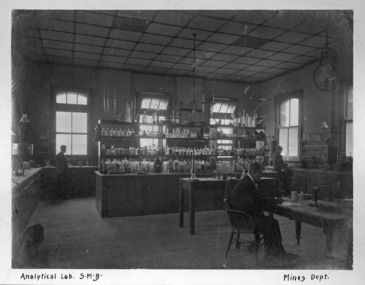
Photograph - Photograph (Black & White), Ballarat School of Mines Analytical Laboratory, c1900
... This photograph was reproduced in the Ballarat School of Mines Annual Report 1900 This image is now (2012) used as Founders' Room in the Ballarat School of Mines Administration Building. mining ballarat school of mines chemistry laboratory scientific objects scientific instruments analytical laboratory administration building a building founders room Written on lower mount "Analytical Lab. ...Around 1900 the Ballarat School of Mines had an international reputation. it is thought that that this photograph was originally taken by the New South Wales Mines Department during a visit to Victoria. This photograph was reproduced in the Ballarat School of Mines Annual Report 1900 This image is now (2012) used as Founders' Room in the Ballarat School of Mines Administration Building. Black and white photograph on green mountboard. It shows three men in a Ballarat School of Mines laboratory surrounded by chemicals and scientific equipment.Written on lower mount "Analytical Lab. S.M.B. Mines Deptmining, ballarat school of mines, chemistry, laboratory, scientific objects, scientific instruments, analytical laboratory, administration building, a building, founders room -
 Federation University Historical Collection
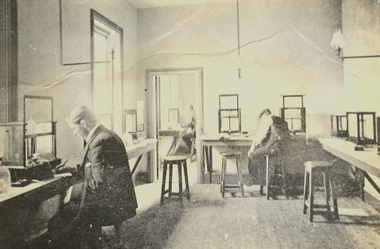
Photograph, Ballarat School of Mines Balance Room, c1907
... Report. It is a room in the building now known as the "Old Chemistry Building'....Report. It is a room in the building now known as the "Old Chemistry Building'. ballarat school of mines scientific equipment assaying assay weigh weight scales assay laboratory old chemistry building mining "Plate 117 Balance Rooms, School of Mines Black and white photograph showing three men working at balances while assaying in the Ballarat School of Mines Balance Room. ...This image was reproduced in the 1908 Ballarat School of Mines Calendar. During the early 1900s the Ballarat School of Mines had an international reputation for producing quality mining graduates. The graduates had much sought after practical experience. Their studies included 'real' experience in the Ballarat School of Mines Mining Laboratory, Assay Room, Balance Room, etc. This image was reproduced in the 1908 Ballarat School of Mines Annual Report. It is a room in the building now known as the "Old Chemistry Building'.Black and white photograph showing three men working at balances while assaying in the Ballarat School of Mines Balance Room. "Plate 117 Balance Rooms, School of Minesballarat school of mines, scientific equipment, assaying, assay, weigh, weight, scales, assay laboratory, old chemistry building, mining -
 Federation University Historical Collection
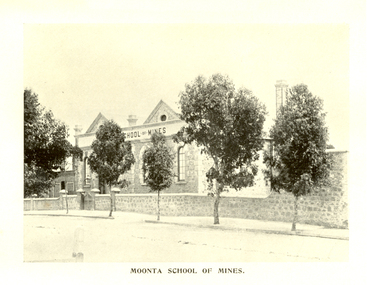
Book, Moonta School of Mines, Moonta School of Mines Annual Report, 1904, 1904
... Contents include: * General objects of the School * Report for 1903 * Instructors Reports * Balance Sheet * Examination Questions * Timetable * Certificates granted by Council.cm Images include: * Moonta School of Mines * members of Council (Hancock, Symons, Uffindell, James, Hughes, Cowling, Haining) * Instructors (Rogers, Hancock, Pomroy, Blatchford, Martin, Richardson, Brown, Potter) * Classroom * Laboratory (Practical Chemistry) * Mine Surveying Class...Contents include: * General objects of the School * Report for 1903 * Instructors Reports * Balance Sheet * Examination Questions * Timetable * Certificates granted by Council.cm Images include: * Moonta School of Mines * members of Council (Hancock, Symons, Uffindell, James, Hughes, Cowling, Haining) * Instructors (Rogers, Hancock, Pomroy, Blatchford, Martin, Richardson, Brown, Potter) * Classroom * Laboratory (Practical Chemistry) * Mine Surveying Class Moonta School of Mines Annual Report, 1904 Book Moonta School of Mines Phillips, Practical Printer ...Opening in 1891 the Moonta School of Mines was intended for students who wanted to increase their knowledge of those arts and sciences which were especially important to miners and others similarly engaged. The School was situated close to the Moonta Mines, at that time the most important copper mines in Australia, and the smelters at Wallaroo. The the mines students were able to acquire practical knowledge of the work of a miner. The close by smelting works at Wallaroo were seen to be of great service to those wanting to become acquainted with chemistry and metallurgy. Subjects taught at the Moonta School of Mines included Chemistry, Metallurgy, Steam and the Steam Engine, Magnetism and Electricity, Mathematics, Machine Design, Mine Surveying and Leveling, Drawing, Plumbing and Sheet Metal Work. The Moonta School of Mines building in Ellen Street was formerly Baptist Church. Brown soft covered book of 87 pages. Contents include: * General objects of the School * Report for 1903 * Instructors Reports * Balance Sheet * Examination Questions * Timetable * Certificates granted by Council.cm Images include: * Moonta School of Mines * members of Council (Hancock, Symons, Uffindell, James, Hughes, Cowling, Haining) * Instructors (Rogers, Hancock, Pomroy, Blatchford, Martin, Richardson, Brown, Potter) * Classroom * Laboratory (Practical Chemistry) * Mine Surveying Classhancockmoonta, moonta school of mines, symons, uffindell, james, hughes, cowling, haining, rogers, hancock, pomroy, blatchford, martin, richardson, brown, potter, e.f. blatchford, a.l. brown, r. cowling, r. haining, h. lipson hancock, henry richard hancock, leigh g. hancock, j.w. hughes, t. james, edward martin, h. pomroy, f. potter, g.h richardson, g.j. rogers, j. symons, h.w. uffindell, schools of mines -
 Federation University Historical Collection
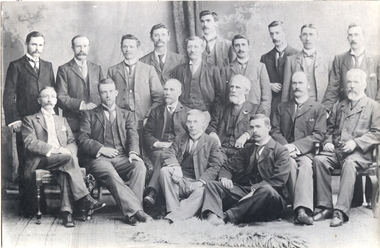
Book, Ballarat School of Mines Calendar, 1902-3, 1901
... Associateship and Final Certificates, Calendar for 1903, Discipline, Discipline Board, Fees, Full Certificates Issued, General Regulations, Honorary Correspondents, Office Bearers, President's Annual Report, Professors and Lecturers, Results of Examinations Conducted by Education Department 1901, Statistics - Students Attending Lectures, Subscriptions and Donations, Subjects Included in Regulations Technical Schools, Subjects of Instruction - Department of Chemistry and Metallurgy, Geological Department, Engineering Department, Electrical Department, Department of Mathematics and Physics, Practical, Plane and Solid Geometry, Photography, Syllabus for Assaying and Metallurgy, Time Table. ...Associateship and Final Certificates, Calendar for 1903, Discipline, Discipline Board, Fees, Full Certificates Issued, General Regulations, Honorary Correspondents, Office Bearers, President's Annual Report, Professors and Lecturers, Results of Examinations Conducted by Education Department 1901, Statistics - Students Attending Lectures, Subscriptions and Donations, Subjects Included in Regulations Technical Schools, Subjects of Instruction - Department of Chemistry and Metallurgy, Geological Department, Engineering Department, Electrical Department, Department of Mathematics and Physics, Practical, Plane and Solid Geometry, Photography, Syllabus for Assaying and Metallurgy, Time Table. ...The Ballarat School of Mines Calendar and Annual Report 1901. Associateship and Final Certificates, Calendar for 1903, Discipline, Discipline Board, Fees, Full Certificates Issued, General Regulations, Honorary Correspondents, Office Bearers, President's Annual Report, Professors and Lecturers, Results of Examinations Conducted by Education Department 1901, Statistics - Students Attending Lectures, Subscriptions and Donations, Subjects Included in Regulations Technical Schools, Subjects of Instruction - Department of Chemistry and Metallurgy, Geological Department, Engineering Department, Electrical Department, Department of Mathematics and Physics, Practical, Plane and Solid Geometry, Photography, Syllabus for Assaying and Metallurgy, Time Table. Includes several photographs.Green soft covered book of 96 pages, it includes the 1901 Annual Report of the Ballarat School of Mines. Images include: Senior Members of Staff and the Linkenbach Tableballarat school of mines, senior members of staff, linkenbach table, linkenbach, mica smith, dawson, hart, usher, annual report, andrew anderson, james m. bickett, r. t. vale, john warrington rogers, james millhinch bickett, james oddie, henry cuthbert, r. g. middleton, charles kent, robert lambert, andrew berry, fred j. martell, thomas s. hart, g. stephen hart, g. j. dawbarn, engineering department, a. e. c. kerr, lewis a. westcott, edgar a. mcconnon, laboratory assistant, john m. sutherland, electrical department, kerr grant, mathematics and physics, henry j. hall, charles e. campbell, photography -
 Federation University Historical Collection
Booklet - Annual Report and Calendar, Ballarat School of Mines Annual Report and Calendar, 1896
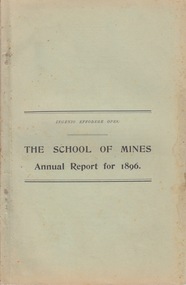
... report...calendar...andrew anderson j.p. - president...hon. r. t. vale - vice president...r. denham pinnock - vice president...the hon. sir w. j. clarke - trustee...the hon. john warrington rogers - trustee...the right reverend samuel thornton - trustee...andrew anderson - trustee...james millhinch - trustee...james oddie - trustee...the hon. henry cuthbert - honorary solicitor...r. g. middleton - honorary treasurer...charles kent - auditor...fred. j. martell - director and registrar...professor alf. mica smith - chemistry...report calendar andrew anderson j.p. - president hon. r. t. vale - vice president r. denham pinnock - vice president the hon. sir w. j. clarke - trustee the hon. john warrington rogers - trustee the right reverend samuel thornton - trustee andrew anderson - trustee james millhinch - trustee james oddie - trustee the hon. henry cuthbert - honorary solicitor r. g. middleton - honorary treasurer charles kent - auditor fred. j. martell - director and registrar professor alf. mica smith - chemistry metallurgy natural philosophy professor purdie - geology mineralogy principles of mining professor g. j. dawbarn - mine and land surveying mining mechanics hydraulics civil engineering applied mechanics j. rowe - practical mining w. huey steele - electrical technology electricity and magnetism d. walker - chemistry and natural philosophy w. e. bennett - mathematics henry j. hall - freehand and perspective drawing a. e. c. kerr - mechanical drawing (machine construction and design) j. f. usher - paleontology zoology materia medica professor purdie - botany george clegg - building construction l. hart - photography h. g. a. brown - carpentry r. e. weir - veterinary science daniel walker henry cuthbert james millhinch jams oddie j.f. usher .1) Ballarat School of Mines Annual Report .2) Ballarat School of Mines calendar The Ballarat School of Mines Calendar and Annual Report 1896. ...The Ballarat School of Mines was the first Technical School on Australia..1) Ballarat School of Mines Annual Report .2) Ballarat School of Mines calendar The Ballarat School of Mines Calendar and Annual Report 1896. Associateship of The School, Calendar for 1896, Certificates Granted by Education Department 1894, Certificates Issued by The School 1895, Certificates Issued Prior to 1895, Certificates Issued by Education Department 1895, Examiners, Examination Fees, Fees, Honorary Correspondents, Life Governors, Meteorological Observations, Number of Students attended The School, Office Bearers, Professors and Lecturers, Report of the Superintendent of Laboratories, Report of the Professor of Mineralogy, Geology and Botany, Report of the Professor of Engineering, Report of the Lecturer on Mathematics, Report of the Instructor in Engineering Drawing, Report of the Lecturer on Electricity, Report of the Teacher of Drawing, Report of the Lecturer in Veterinary Science, Statement of Receipts and Expenditure for year 1895, Statistics - Student attending Lectures, Subscriptions and Donations, Subjects Included in Regulations Technical Schools, Time Tableballarat school of mines, examiners, examination fees, fees, honorary correspondents, life governors, meteorological observations, number of students attended the school, office bearers, professors and lecturers, report of the superintendent of laboratories, report of the professor of mineralogy, geology and botany, report of the professor of engineering, report of the lecturer on mathematics, report of the instructor in engineering drawing, report of the lecturer on electricity, report of the teacher of drawing, report of the lecturer in veterinary science, statement of receipts and expenditure for year 1895, statistics - student attending lectures, subscriptions and donations, subjects included in regulations technical schools, time table, annual report, calendar, andrew anderson j.p. - president, hon. r. t. vale - vice president, r. denham pinnock - vice president, the hon. sir w. j. clarke - trustee, the hon. john warrington rogers - trustee, the right reverend samuel thornton - trustee, andrew anderson - trustee, james millhinch - trustee, james oddie - trustee, the hon. henry cuthbert - honorary solicitor, r. g. middleton - honorary treasurer, charles kent - auditor, fred. j. martell - director and registrar, professor alf. mica smith - chemistry, metallurgy, natural philosophy, professor purdie - geology, mineralogy, principles of mining, professor g. j. dawbarn - mine and land surveying, mining mechanics, hydraulics, civil engineering, applied mechanics, j. rowe - practical mining, w. huey steele - electrical technology, electricity and magnetism, d. walker - chemistry and natural philosophy, w. e. bennett - mathematics, henry j. hall - freehand and perspective drawing, a. e. c. kerr - mechanical drawing (machine construction and design), j. f. usher - paleontology, zoology, materia medica, professor purdie - botany, george clegg - building construction, l. hart - photography, h. g. a. brown - carpentry, r. e. weir - veterinary science, daniel walker, henry cuthbert, james millhinch, jams oddie, j.f. usher -
 Flagstaff Hill Maritime Museum and Village
Animal specimen - Whale bone, Undetermined
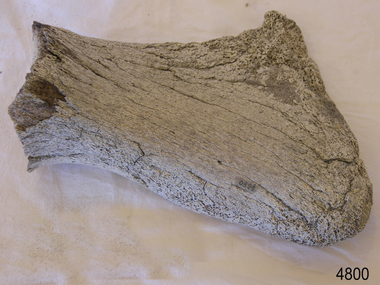
... Prior to carrying out a detailed condition report of the cetacean skeletons, it is useful to have an understanding of the materials we are likely to encounter, in terms of structure and chemistry. ...Prior to carrying out a detailed condition report of the cetacean skeletons, it is useful to have an understanding of the materials we are likely to encounter, in terms of structure and chemistry. ...Prior to carrying out a detailed condition report of the cetacean skeletons, it is useful to have an understanding of the materials we are likely to encounter, in terms of structure and chemistry. This entry invites you to join in learning about the composition of whale bone and oil. Whale bone (Cetacean) bone is comprised of a composite structure of both an inorganic matrix of mainly hydroxylapatite (a calcium phosphate mineral), providing strength and rigidity, as well as an organic protein ‘scaffolding’ of mainly collagen, facilitating growth and repair (O’Connor 2008, CCI 2010). Collagen is also the structural protein component in cartilage between the whale vertebrae and attached to the fins of both the Killer Whale and the Dolphin. Relative proportions in the bone composition (affecting density), are linked with the feeding habits and mechanical stresses typically endured by bones of particular whale types. A Sperm Whale (Physeter macrocephalus Linnaeus, 1758) skeleton (toothed) thus has a higher mineral value (~67%) than a Fin Whale (Balaenoptera physalus Linnaeus, 1758) (baleen) (~60%) (Turner Walker 2012). The internal structure of bone can be divided into compact and cancellous bone. In whales, load-bearing structures such as mandibles and upper limb bones (e.g. humerus, sternum) are largely composed of compact bone (Turner Walker 2012). This consists of lamella concentrically deposited around the longitudinal axis and is permeated by fluid carrying channels (O’Connor 2008). Cancellous (spongy) bone, with a highly porous angular network of trabeculae, is less stiff and thus found in whale ribs and vertebrae (Turner Walker 2012). Whale oil Whales not only carry a thick layer of fat (blubber) in the soft tissue of their body for heat insulation and as a food store while they are alive, but also hold large oil (lipid) reserves in their porous bones. Following maceration of the whale skeleton after death to remove the soft tissue, the bones retain a high lipid content (Higgs et. al 2010). Particularly bones with a spongy (porous) structure have a high capacity to hold oil-rich marrow. Comparative data of various whale species suggests the skull, particularly the cranium and mandible bones are particularly oil rich. Along the vertebral column, the lipid content is reduced, particularly in the thoracic vertebrae (~10-25%), yet greatly increases from the lumbar to the caudal vertebrae (~40-55%). The chest area (scapula, sternum and ribs) show a mid-range lipid content (~15-30%), with vertically orientated ribs being more heavily soaked lower down (Turner Walker 2012, Higgs et. al 2010). Whale oil is largely composed of triglycerides (molecules of fatty acids attached to a glycerol molecule). In Arctic whales a higher proportion of unsaturated, versus saturated fatty acids make up the lipid. Unsaturated fatty acids (with double or triple carbon bonds causing chain kinks, preventing close packing (solidifying) of molecules), are more likely to be liquid (oil), versus solid (fat) at room temperature (Smith and March 2007). Objects Made From the Whaling Industry We all know that men set forth in sailing ships and risked their lives to harpoon whales on the open seas throughout the 1800s. And while Moby Dick and other tales have made whaling stories immortal, people today generally don't appreciate that the whalers were part of a well-organized industry. The ships that set out from ports in New England roamed as far as the Pacific in hunt of specific species of whales. Adventure may have been the draw for some whalers, but for the captains who owned whaling ships, and the investors which financed voyages, there was a considerable monetary payoff. The gigantic carcasses of whales were chopped and boiled down and turned into products such as the fine oil needed to lubricate increasing advanced machine tools. And beyond the oil derived from whales, even their bones, in an era before the invention of plastic, was used to make a wide variety of consumer goods. In short, whales were a valuable natural resource the same as wood, minerals, or petroleum we now pump from the ground. Oil From Whale’s Blubber Oil was the main product sought from whales, and it was used to lubricate machinery and to provide illumination by burning it in lamps. When a whale was killed, it was towed to the ship and its blubber, the thick insulating fat under its skin, would be peeled and cut from its carcass in a process known as “flensing.” The blubber was minced into chunks and boiled in large vats on board the whaling ship, producing oil. The oil taken from whale blubber was packaged in casks and transported back to the whaling ship’s home port (such as New Bedford, Massachusetts, the busiest American whaling port in the mid-1800s). From the ports it would be sold and transported across the country and would find its way into a huge variety of products. Whale oil, in addition to be used for lubrication and illumination, was also used to manufacture soaps, paint, and varnish. Whale oil was also utilized in some processes used to manufacture textiles and rope. Spermaceti, a Highly Regarded Oil A peculiar oil found in the head of the sperm whale, spermaceti, was highly prized. The oil was waxy, and was commonly used in making candles. In fact, candles made of spermaceti were considered the best in the world, producing a bright clear flame without an excess of smoke. Spermaceti was also used, distilled in liquid form, as an oil to fuel lamps. The main American whaling port, New Bedford, Massachusetts, was thus known as "The City That Lit the World." When John Adams was the ambassador to Great Britain before serving as president he recorded in his diary a conversation about spermaceti he had with the British Prime Minister William Pitt. Adams, keen to promote the New England whaling industry, was trying to convince the British to import spermaceti sold by American whalers, which the British could use to fuel street lamps. The British were not interested. In his diary, Adams wrote that he told Pitt, “the fat of the spermaceti whale gives the clearest and most beautiful flame of any substance that is known in nature, and we are surprised you prefer darkness, and consequent robberies, burglaries, and murders in your streets to receiving as a remittance our spermaceti oil.” Despite the failed sales pitch John Adams made in the late 1700s, the American whaling industry boomed in the early to mid-1800s. And spermaceti was a major component of that success. Spermaceti could be refined into a lubricant that was ideal for precision machinery. The machine tools that made the growth of industry possible in the United States were lubricated, and essentially made possible, by oil derived from spermaceti. Baleen, or "Whalebone" The bones and teeth of various species of whales were used in a number of products, many of them common implements in a 19th century household. Whales are said to have produced “the plastic of the 1800s.” The "bone" of the whale which was most commonly used wasn’t technically a bone, it was baleen, a hard material arrayed in large plates, like gigantic combs, in the mouths of some species of whales. The purpose of the baleen is to act as a sieve, catching tiny organisms in sea water, which the whale consumes as food. As baleen was tough yet flexible, it could be used in a number of practical applications. And it became commonly known as "whalebone." Perhaps the most common use of whalebone was in the manufacture of corsets, which fashionable ladies in the 1800s wore to compress their waistlines. One typical corset advertisement from the 1800s proudly proclaims, “Real Whalebone Only Used.” Whalebone was also used for collar stays, buggy whips, and toys. Its remarkable flexibility even caused it to be used as the springs in early typewriters. The comparison to plastic is apt. Think of common items which today might be made of plastic, and it's likely that similar items in the 1800s would have been made of whalebone. Baleen whales do not have teeth. But the teeth of other whales, such as the sperm whale, would be used as ivory in such products as chess pieces, piano keys, or the handles of walking sticks. Pieces of scrimshaw, or carved whale's teeth, would probably be the best remembered use of whale's teeth. However, the carved teeth were created to pass the time on whaling voyages and were never a mass production item. Their relative rarity, of course, is why genuine pieces of 19th century scrimshaw are considered to be valuable collectibles today. Reference: McNamara, Robert. "Objects Made From the Whaling Industry." ThoughtCo, Jul. 31, 2021, thoughtco.com/products-produced-from-whales-1774070.Whale bone was an important commodity, used in corsets, collar stays, buggy whips, and toys.Whale bone piece. Advanced stage of calcification as indicated by deep pitting. Off white to grey.None.flagstaff hill, warrnambool, shipwrecked-coast, flagstaff-hill, flagstaff-hill-maritime-museum, maritime-museum, shipwreck-coast, flagstaff-hill-maritime-village, whales, whale bone, corsets, toys, whips -
 Flagstaff Hill Maritime Museum and Village
Animal specimen - Whale bone, Undetermined
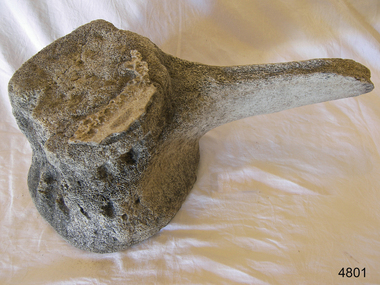
... Prior to carrying out a detailed condition report of the cetacean skeletons, it is useful to have an understanding of the materials we are likely to encounter, in terms of structure and chemistry. ...Prior to carrying out a detailed condition report of the cetacean skeletons, it is useful to have an understanding of the materials we are likely to encounter, in terms of structure and chemistry. ...Prior to carrying out a detailed condition report of the cetacean skeletons, it is useful to have an understanding of the materials we are likely to encounter, in terms of structure and chemistry. This entry invites you to join in learning about the composition of whale bone and oil. Whale bone (Cetacean) bone is comprised of a composite structure of both an inorganic matrix of mainly hydroxylapatite (a calcium phosphate mineral), providing strength and rigidity, as well as an organic protein ‘scaffolding’ of mainly collagen, facilitating growth and repair (O’Connor 2008, CCI 2010). Collagen is also the structural protein component in cartilage between the whale vertebrae and attached to the fins of both the Killer Whale and the Dolphin. Relative proportions in the bone composition (affecting density), are linked with the feeding habits and mechanical stresses typically endured by bones of particular whale types. A Sperm Whale (Physeter macrocephalus Linnaeus, 1758) skeleton (toothed) thus has a higher mineral value (~67%) than a Fin Whale (Balaenoptera physalus Linnaeus, 1758) (baleen) (~60%) (Turner Walker 2012). The internal structure of bone can be divided into compact and cancellous bone. In whales, load-bearing structures such as mandibles and upper limb bones (e.g. humerus, sternum) are largely composed of compact bone (Turner Walker 2012). This consists of lamella concentrically deposited around the longitudinal axis and is permeated by fluid carrying channels (O’Connor 2008). Cancellous (spongy) bone, with a highly porous angular network of trabeculae, is less stiff and thus found in whale ribs and vertebrae (Turner Walker 2012). Whale oil Whales not only carry a thick layer of fat (blubber) in the soft tissue of their body for heat insulation and as a food store while they are alive, but also hold large oil (lipid) reserves in their porous bones. Following maceration of the whale skeleton after death to remove the soft tissue, the bones retain a high lipid content (Higgs et. al 2010). Particularly bones with a spongy (porous) structure have a high capacity to hold oil-rich marrow. Comparative data of various whale species suggests the skull, particularly the cranium and mandible bones are particularly oil rich. Along the vertebral column, the lipid content is reduced, particularly in the thoracic vertebrae (~10-25%), yet greatly increases from the lumbar to the caudal vertebrae (~40-55%). The chest area (scapula, sternum and ribs) show a mid-range lipid content (~15-30%), with vertically orientated ribs being more heavily soaked lower down (Turner Walker 2012, Higgs et. al 2010). Whale oil is largely composed of triglycerides (molecules of fatty acids attached to a glycerol molecule). In Arctic whales a higher proportion of unsaturated, versus saturated fatty acids make up the lipid. Unsaturated fatty acids (with double or triple carbon bonds causing chain kinks, preventing close packing (solidifying) of molecules), are more likely to be liquid (oil), versus solid (fat) at room temperature (Smith and March 2007). Objects Made From the Whaling Industry We all know that men set forth in sailing ships and risked their lives to harpoon whales on the open seas throughout the 1800s. And while Moby Dick and other tales have made whaling stories immortal, people today generally don't appreciate that the whalers were part of a well-organized industry. The ships that set out from ports in New England roamed as far as the Pacific in hunt of specific species of whales. Adventure may have been the draw for some whalers, but for the captains who owned whaling ships, and the investors which financed voyages, there was a considerable monetary payoff. The gigantic carcasses of whales were chopped and boiled down and turned into products such as the fine oil needed to lubricate increasing advanced machine tools. And beyond the oil derived from whales, even their bones, in an era before the invention of plastic, was used to make a wide variety of consumer goods. In short, whales were a valuable natural resource the same as wood, minerals, or petroleum we now pump from the ground. Oil From Whale’s Blubber Oil was the main product sought from whales, and it was used to lubricate machinery and to provide illumination by burning it in lamps. When a whale was killed, it was towed to the ship and its blubber, the thick insulating fat under its skin, would be peeled and cut from its carcass in a process known as “flensing.” The blubber was minced into chunks and boiled in large vats on board the whaling ship, producing oil. The oil taken from whale blubber was packaged in casks and transported back to the whaling ship’s home port (such as New Bedford, Massachusetts, the busiest American whaling port in the mid-1800s). From the ports it would be sold and transported across the country and would find its way into a huge variety of products. Whale oil, in addition to be used for lubrication and illumination, was also used to manufacture soaps, paint, and varnish. Whale oil was also utilized in some processes used to manufacture textiles and rope. Spermaceti, a Highly Regarded Oil A peculiar oil found in the head of the sperm whale, spermaceti, was highly prized. The oil was waxy, and was commonly used in making candles. In fact, candles made of spermaceti were considered the best in the world, producing a bright clear flame without an excess of smoke. Spermaceti was also used, distilled in liquid form, as an oil to fuel lamps. The main American whaling port, New Bedford, Massachusetts, was thus known as "The City That Lit the World." When John Adams was the ambassador to Great Britain before serving as president he recorded in his diary a conversation about spermaceti he had with the British Prime Minister William Pitt. Adams, keen to promote the New England whaling industry, was trying to convince the British to import spermaceti sold by American whalers, which the British could use to fuel street lamps. The British were not interested. In his diary, Adams wrote that he told Pitt, “the fat of the spermaceti whale gives the clearest and most beautiful flame of any substance that is known in nature, and we are surprised you prefer darkness, and consequent robberies, burglaries, and murders in your streets to receiving as a remittance our spermaceti oil.” Despite the failed sales pitch John Adams made in the late 1700s, the American whaling industry boomed in the early to mid-1800s. And spermaceti was a major component of that success. Spermaceti could be refined into a lubricant that was ideal for precision machinery. The machine tools that made the growth of industry possible in the United States were lubricated, and essentially made possible, by oil derived from spermaceti. Baleen, or "Whalebone" The bones and teeth of various species of whales were used in a number of products, many of them common implements in a 19th century household. Whales are said to have produced “the plastic of the 1800s.” The "bone" of the whale which was most commonly used wasn’t technically a bone, it was baleen, a hard material arrayed in large plates, like gigantic combs, in the mouths of some species of whales. The purpose of the baleen is to act as a sieve, catching tiny organisms in sea water, which the whale consumes as food. As baleen was tough yet flexible, it could be used in a number of practical applications. And it became commonly known as "whalebone." Perhaps the most common use of whalebone was in the manufacture of corsets, which fashionable ladies in the 1800s wore to compress their waistlines. One typical corset advertisement from the 1800s proudly proclaims, “Real Whalebone Only Used.” Whalebone was also used for collar stays, buggy whips, and toys. Its remarkable flexibility even caused it to be used as the springs in early typewriters. The comparison to plastic is apt. Think of common items which today might be made of plastic, and it's likely that similar items in the 1800s would have been made of whalebone. Baleen whales do not have teeth. But the teeth of other whales, such as the sperm whale, would be used as ivory in such products as chess pieces, piano keys, or the handles of walking sticks. Pieces of scrimshaw, or carved whale's teeth, would probably be the best remembered use of whale's teeth. However, the carved teeth were created to pass the time on whaling voyages and were never a mass production item. Their relative rarity, of course, is why genuine pieces of 19th century scrimshaw are considered to be valuable collectibles today. Reference: McNamara, Robert. "Objects Made From the Whaling Industry." ThoughtCo, Jul. 31, 2021, thoughtco.com/products-produced-from-whales-1774070. Whale bone was an important commodity, used in corsets, collar stays, buggy whips, and toys.Whale bone vertebrae. Advanced stage of calcification as indicated by deep pitting. Off white to grey.None.flagstaff hill, warrnambool, shipwrecked-coast, flagstaff-hill, flagstaff-hill-maritime-museum, maritime-museum, shipwreck-coast, flagstaff-hill-maritime-village, whales, whale bone, corsets, toys, whips -
 Federation University Historical Collection
Book - Report, Ballarat School of Mines Conservation Management Plan, 2016, 2016
... Chemistry Building Building C Amenities Building, Governor's Quarters, Gaol Gatehouse and Watch Tower and Gaol Walls - Building D Courthouse Theatre (Former Ballarat Supreme Court) - Building F A.W. Steane Building (Former Ballarat Junior Technical School) - Building J Flecknoe Building and E.J. Barker Building (Building N) Old Plumbing Building - Builidng ) Unistyle Haridressing Building (Formerly Ballarat School of Mines Museum and Wesleyan Church) - Building P Ballarat School of Mines Conservation Management Plan, 2016 Book Report David Rowe Wendy Jacobs David Rowe Wendy Jacobs ...The Ballarat School of Mines was the first school of mines in Australasia, and is a predecessor institution of Federation University Australia.CD-ROM of the SMB Campus Conservation Management plan, and a printout of the 390 page Draft report on the Federation University SMB Campus. Contents include: Establishment of the Wesleyan church Reserve Selection of a Site for the Ballarat Gaol and Court House Building the Court of Mines The Gaol Culvert The Ballarat School of Mines Establishment Ballarat iron Workers' Association Ballarat Technical Art School Ballarat School of Mines Museum Acquisition of Lewin's Land The Ballarat School of Mines site in c1970 Master Planning Flecknoe Biulding The Ballarat School of Mines in 1988 Architectects Caselli, Figgus, Molloy and Smith. Public Work Department Architects Ballarat School of Mines Botanical Garden Former Ballarat Junior Technical School Administration Building - Building A W.J. Gribble Building (Ballarat Technical Art School) - Building B Old Chemistry Building Building C Amenities Building, Governor's Quarters, Gaol Gatehouse and Watch Tower and Gaol Walls - Building D Courthouse Theatre (Former Ballarat Supreme Court) - Building F A.W. Steane Building (Former Ballarat Junior Technical School) - Building J Flecknoe Building and E.J. Barker Building (Building N) Old Plumbing Building - Builidng ) Unistyle Haridressing Building (Formerly Ballarat School of Mines Museum and Wesleyan Church) - Building P david rowe, wendy jacobs, ballarat school of mines conservation management plan, ballarat school of mines, buildings, wesleyan church reserve, former ballarat gaol, court of mines, circuit courthouse, gal culvert, ballarat school of mines museum, ballarat technical art school, x-rays, ballarat junior technical school, motor mechanics, wool classing, former governor's quarters, library, flecknoe building, former supreme court, architects, henry richards caselli, figgis, molloy and smith, public work department architects, ballarat school of mines botanic garden, former ballarat junior technical school commemorative gardem, w.j. gribble building, old chemistry building, amenities building, former warden's quarters, courthouse theatre, a.w. steane building, old plumbing building, unistyle hairdressing building, former ballarat post office, post office gallery, former ballarat government offices, cmp, conservation management plan, ballarat school of mines campus, smb campus -
 Federation University Historical Collection
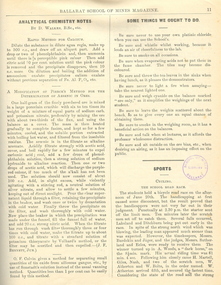
Magazine, Ballarat School of Mines Students' Magazine, 1898-1901, 1898-1901
... Outtrim) * Lal Lal Geology Trip (Thomas Hart) * Rifle Club now defunct, pg 3 * A Contribution to the Mining Geology of Kalgoorlie, W.A. by Ferdinand Krause (includes cross sections) (Wood's Point, Rand, Johannesburg, South Africa, Gaffney's Creek, Walhalla, Shady Creek, Sago Hill at Cardigan, Bunbury) * Summaries and Notes from the Australian Mining Standard (Buninyong Estate Mine) * Monthly Progress Reports of the Geological Survey * Electrical Notes by John M Sutherland (Telagraphone, phonograph, telephone receiver) * Students' Theatre Party (Gordon Todd, Ohe Jaeger, C.S. Wakley) * Opening of the New Buildings - Ministerial Speeches (Outtrim, W.H. Irvine, New Mining Laboratory, Old Chemistry...Outtrim) * Lal Lal Geology Trip (Thomas Hart) * Rifle Club now defunct, pg 3 * A Contribution to the Mining Geology of Kalgoorlie, W.A. by Ferdinand Krause (includes cross sections) (Wood's Point, Rand, Johannesburg, South Africa, Gaffney's Creek, Walhalla, Shady Creek, Sago Hill at Cardigan, Bunbury) * Summaries and Notes from the Australian Mining Standard (Buninyong Estate Mine) * Monthly Progress Reports of the Geological Survey * Electrical Notes by John M Sutherland (Telagraphone, phonograph, telephone receiver) * Students' Theatre Party (Gordon Todd, Ohe Jaeger, C.S. Wakley) * Opening of the New Buildings - Ministerial Speeches (Outtrim, W.H. Irvine, New Mining Laboratory, Old Chemistry ...Bound copies of the Ballarat School of Mines Students' Magazine, 1898-1901 Vol 1, No. 1, September 1898 * News and Notes (Ballarat School of Mines Museum, J.F. Usher, New British Pharmacopoeia, excursion to Bendigo) * History of the Ballarat School of Mines * Current Topics (Federation, Gladstone, Anglo-American Alliance) * Of Custom * Discovery of Coolgardie * Mining Notes(Clunes, Pitfield, Birthday Mine, Western Australia, Transvaal, Mt Bischoff, Rand Drill Co.) * From the Journals * The Societies - (Student Association, Ballarat Field Club and Science Society, Ballarat Photographic Club) * Original Poetry * Sports * Students' Association Committee Meetings * On the Increase of Temperature of the Earth With Increased Depth Vol 1, No. 2, October 1898 * Notes about some of the Past Students (E.M. Weston, J.A. Porter, H.R. Sleeman, G.E. Sander, B.C.T. Solley, T. Rhys, C. Burbury, D. McDougal, J. Matsen) * Excursion to Daylesford, p.3 * History of the Ballarat School of Mines (continued) * The Soudan * Greater Melbourne * Image of J. Hopkinson, electrical engineer killed ascending the Alps * What is Science * Mining Notes (Pitfield Plains, Victoria United G.M.Co., Lithgow, Avoca, great Cobar, Mt Whycheproof) * Student's Association (women's franchise) * Sports Vol 2, No. 1, March 1899 * News and Notes * History of the Ballarat School of Mines (continued) * Notes of Victorian Geology, 1. Granites, by Thomas S. Hart * Sir William Crookes * Summaries and Notes from the Mining Journals * Students' Association * Sports * The Bush Assayer * Solubility of Gold-Silver Alloys in Potassium Cyanide * Correspondence Vol 2, No. 2, April 1899 * News and Notes (Smythesdale Excursion, New Buildings, A.S. Coyte, R.J. Allan) * History of the Ballarat School of Mines (Continued) * The New Students (J. Owen, A. Clayton Morrisby, A.S. Atkin, J. Alexander Reid, Alfred G. Johnston, L. Lowe, F.H. Dalton, W.M. Robertson, A. Hacke, H.L. Giles, W. Martin, E. Walshe, H.L. Krause, R. Sawyer) * Berringa by Oh'E Jay * Summaries and Notes from the Mining Journals * Mount Magnet to Victoria - A Long Bicycle Trip * 1898 Examination returns * Sports Vol 2, No. 3, May 1899 * Technical Education and the Proposed Affiliation of the Schools of Mines with the Melbourne University. * Laying of the Foundation Stone of the New Classrooms (now Administration Building). Alexander J. Peacock * News and Notes (Past Students - A.S. Lilburn, J.W. Sutherland, J. Richardson, E. Prendergast, J. Wallace, J. Kidd, J. Lake, Mathew Thompson), Coolgardie Exhibition. * Trip to Lal Lal * Students' Association * Summaries and Notes from the Mining Journals * Professor Henry Louis on Mining Education * Corrections Used in Chaining by C.W. Adams * The Black Horse Cyanide Plant * Sports * Completed List of 1898 Examinations Vol 2, No. 4, June 1899 * News and Notes * The Education Problem by D.N. McLean * A Few Hints on Histological Technique by Emil Gutheil * Summaries and Notes from the Mining Journals * Students' Association * A Visit to the Skipton Caves (Mount Widdern, Ormand Hill, volcano, Emu Creek, Mount Kinross, Mount Elephant, Mount Vite Vite, Mount Kinross, Mount Hamiston) * Mount Magnet To Victoria (cont) * The New Engines at the Ballarat Woollen Mills - includes image of the Compound 700 H.P. Engines constructed for the Ballarat Woollen Mills by Austral Otis Company and consulting engineers Monash and Anderson. * Sports * Original Poetry * Correspondence Vol 2, No. 5, July 1899 * News and Notes (E. Byron Moore, Visit to Britannia Gold Mine, J. Bryant, Visit to Last Chance Mine) * A Few Hints on Histological Technique (cont) by Emil Gutheil * Summaries and Notes from the Mining Journals * Professor Alfred Mica Smith (includes image) * Notes on Victorian Geology Part 2 The Trappean Rocks, by Thomas Hart * Origin of Diamonds * Hydraulic Mining by A.E.C. Kerr * Volcanoes by F.G. Bonney * Analytical Chemistry Notes by Daniel Walker * Some Things Out To Do * Sports * Correspondence Vol 2, No. 6, August 1899 *Summaries and notes from the Mining Journals * Some Regulations of the Academy of Mines at Freiberg * A visit to Mt Lyell Smelters * Professor Gilbert J. Dawbarn (includes image) * Air compressor and Transmission of Power by Compressed air by A.E.C. Kerr * Chemistry Notes by Daniel Walker * Mineralogical Notes, Ballarat by Thomas S. Hart * Kalgurli Gold Mines, W.A. * OUr New Lab Vol 2., No 7, September 1899 * Summaries and Notes from the Mining Journals * Some recent Steam Plants at Bendigo by Gilbert Dawbarn * Professor Thomas Stephen Hart (includes image) * Students Association * Notes on Victorian Geology by Thomas Hart * Centrifugal Pumps * A New Chum's Experience by E.M. Weston Vol 2., No 8, October 1899 * The institute of Chemistry Examinations * A New Method of Qualitative Chemical Analysis by Emil Gutheil * Steam Engine Valves and Valve-Gears by Gilbert Dawbarn * Daniel Walker (includes image) * Notes on Victorian Geology by Thomas Hart * Cyaniding Cripple Creek Tellurides (Metallic Extraction Company) * Notes on Two Ballarat Gravel Pumping Plants, G.A. Wilberforce (Eureka Jennings Co and Yarrowee Sluicing Co) * History of the School of Mines (concluded) Vol 3., No 1, March 1900 * A Journey from Natal to Mashomaland with the British Police * A Plea for Research * New Caledonia by C.A.M. Deane * Notes of Victorian Geology - Lower Palaeoroic Rocks by Thomas Hart * Mt Bischoff Mine and Mill * Summaries and Notes from the Mining Journals * Things we Eat and Drink * Farewell to A.S. Coyte Vol 3., No 1, March 1900 * Mining Education * Model Locomotive made by the apprentices of the Phoenix Foundry, p2 * Glimpses of Rhodesian Police Camp Life * New Caledonia (continued) * Summaries from the Mining and Engineering Journals * Boot and Saddle Vol 3., No 3, May 1900 * A Students' Common Room * Geological Excursion to Hardie's Hill * Notes on Victorian Geology by Thomas Hart * The Planet Venus by John Brittain * Summaries and Notes from the Australian Mining Standard * The Assay Ton * Zeehan Smelters * Electrical Notes by Ohe Jay * Trop of the Cricket Club to Stawell * Students' Association * Solid Hydrogen Vol 3., No 4, June 1900 * The Minister of Mines on Mining Education (Minister A.R. Outtrim) * Lal Lal Geology Trip (Thomas Hart) * Rifle Club now defunct, pg 3 * A Contribution to the Mining Geology of Kalgoorlie, W.A. by Ferdinand Krause (includes cross sections) (Wood's Point, Rand, Johannesburg, South Africa, Gaffney's Creek, Walhalla, Shady Creek, Sago Hill at Cardigan, Bunbury) * Summaries and Notes from the Australian Mining Standard (Buninyong Estate Mine) * Monthly Progress Reports of the Geological Survey * Electrical Notes by John M Sutherland (Telagraphone, phonograph, telephone receiver) * Students' Theatre Party (Gordon Todd, Ohe Jaeger, C.S. Wakley) * Opening of the New Buildings - Ministerial Speeches (Outtrim, W.H. Irvine, New Mining Laboratory, Old Chemistry Building, Battery, Model Mine) * Students' Association * Relief of Mafeking * A Critic Criticised * Things We Eat and Drink by Ohe Jay - Oatmeal, Coffee and Cocoa. Vol 3., No 5, July 1900 * Research * Adelaide Varsity Students at Ballarat * The Manchester-Liverpool Mono Railway * Students Association * *A Contribution to the Mining Geology of Kalgoorlie, W.A. by Ferdinand Krause (continued) (includes cross-sections) * Motive Power, address by Charles A. Parsons * Summaries and Notes from the Australian Mining Standard * Sugar Manufacturing by Sugna * Great Creswick Hydraulic Sluicing Plant (THomas Hart, Ballarat School of Mines Mining Class visit) * Reminiscences of a Students Life in Germany * Football - Ballarat School of Mines v Geelong Grammar School (Australian Rules Football) Vol 3., No 6, August 1900 * Cheap Mine Management * Library * Bendigo School of Mines, pg 3 * Notes on Ore Dressing by T, Vincent, Manager The Zeehan (Tas) Silver-Lead Mines Ltd) * Motive Power * Notes on Broken Hill - Its Mines and Minerals by J. Williams * The Concert * Summaries and Notes from the Australian Mining Standard * The Dandy Duke's Dreadful Demise * The Road Race Vol 3., No 7, September 1900 * Michaelmas Excursion (Melbourne University, Prof Kernot, Applied Mechanics) * Injury to School Property * Return of E. Ditchburn (Boer War) * Mt William Gold-Field visit, pg 3 * The Stoping of Wide Lodes by J.V. Lake (includes cross sections) * Summaries of Notes from the Australian Mining Standard * Notes on Broken Hill Part 2- Its Mines and Minerals by W.J. Williams * Motive Power from the Waves * Electrical Notes * Some Account of Italian Mining (Sarinia, Sicily, Peidmont, Lombardia) by Candido Maglione * Students Association * Should Women Have the Vote by Frank Bessemeres * The School Theatre Parly * Past Students * Poetry * Football * Surveying Rules Vol 3., No 8, October 1900 * Ballarat School of Mines Associateship * An Engineering Laboratory * Students' Practical Work * Notes on Broken Hill Part 3 by W.J. Williams * The Lake View Consols by F.S. Earp - Battery Treatment of Sulpo-Telluride Ore * Neglected Mineral Fields - Eurowie and Warrata * A Glimpse Ahead * News and Notes * A.W. G. McPherson, Boer War * Students Association * Ballarat School of Mines Melbourne Excursion to the Government Electric Lighting Station, Austral-Otis Co, Working Mens College * Ballarat School of Mines Concert in Aid of Soldiers Statue Balance Sheet * Football * Cricket Vol 3., No 8b, November 1900 * Position of the Ballarat School of Mines with Regards to Mining Education * Age Limit * Entrance Examination * Presentation t0 Professor Alfred Mica Smith * Image of a Group of Old Ballarat School of Mines Students in Coolgardie and Kalgoorlie. * Students Association Vol 4., No 1, March 1901 * Espirit De Corps * A few Notes on the Testing of Explosives * Round About Inverell, NSW by F. and J. Mawl * On the Choice of Drawing Instruments * Summaries and Notes From the Technical Journals * Annual Examinations 1900 * New Students * Sporting Notes * The Vale of Coolgardie Mine, Bonnievale, W.A. by G. Stephen Hart * News and Notes (Kerr Grant, C.L. Nash, R. Gordon Todd, Vial) * Editorial Notices Vol 4., No 2, Second Term 1901 * The Metallurgical Treatment of Sulpho-Telluride Ores by L.W. Grayson * Some Metallurgical Difficulties of Aluminium * Diehl's Sulphide Process by A.E. C. Kerr * A Californian Gold Mine by A.E. C. Kerr * New Express Locomotives for the Victorian Government (Phoenix Foundry) * An Excursion to Geelong (Electric Light and Traction Company of Australia) * The Linkenback Table for our New Mining Laboratory (Humboldt Company of Colgne) * Death of Thomas Bath * The Late Alfred G. Johnson (Boer War) * An Introduction to Natural Science by Emil Gutheil * The First Annual School Sports Meeting * Concert in Aid of Magazine Funds * The Men That Made the Concert (C.E. Denniston, W.H. Chandler, Mr White, William Litte Jnr, Marriott, Giles McCracken) * Sports * News and Notes Vol 4., No 2, Third Term 1901 * Bagging-Up - A Sketch * Concentration of Difficult Silver-Lead Ores * Estimation of Chlorine, Bromine and Iodine by D. Runting * Summaries of Notes from teh technical Journals * Notes on the Use and Care of Platinum Ware Common Sense * The Machinery at the Tasmania Gold Mine, Beaconsfield, Tasmania * Mining at Walhalla - The Long Tunnel Mine * Past Students * Mapping our of Agricultural Areas, etc, In Dense Vine Lands, North Queensland by R.A. Suter * News and Notes * Concert Balance Sheet e.m. weston, robert brough smyth, mcdougall, bruce, charles burbury, harrie wood, graham j. hopwood, emil gutheil, daniel walker, thomas hart, thomas stephen hart, m. hacker, schnitzler, f.a., ditchfield, l.h, alfred e.c. kerr, charles harvey, campbell, joseph bryant, campbell & ferguson, gilbert j. dawburn, irving, g.b., kerr, a.e.c., john walter sutherland, william robertson, herbert l. krause, alfred mica smith, binh pham, crosbie, d. jack, ditchburn, j., james hiscock, alfred johnston, reid, j.a., kidd, john, james bonwick, james, j.p, overall, d, e.h salmon, gaynor marquand, williams, w.w., williams, william, deane, c.m., vincent, tom, phillips, g.e., hart, d.w., jarnail suingh, rowlands, e., ferdinand m. krause,, easterby, f.l, parsons, r.g., partington, j.r., vial, s.b., meadows, h, atkins, arthur, john braisted burdekin, w.h. corbould, ditchburn, john, hill, john, otto e. jager, mcpherson, g.t, nicholls, c, thom, j.m., crafter, stewart, john brittain, peter lalor, hardy - commissioner, thomas bath, alf johnston, charles campbell, nash, llewellyn, watson, m.a, gardener, eddie, adamson, s.g, alford, l.c, allen, r.j, arthur, d.w.b., burge, a., willia, cairncross, cooper, i, maurice osric copland, maurice copland, dickinson, s., doepel, dunstan, john, loveday dunstan, eeles, terri, flegeltaub, israel, fletcher, a, fyrar, peter, kerr grant, w.kerr, green, gary, betty harris, harris, c.m., hay, a.l., hearn, hill, martin, james, david, johnston, alfred g, kilner, marion, kingston, thomas, lewin, f.c.k., lilburne, arthur m, linahan, colin, macready, w.h, major birlefco, markwald, henry, mccaffrey, mcfarlane, kaye, mciver, s.k, mellins, b, morton, felicity, w. kenneth moss, ken moss, nash, c.w., nash, neville, nickolls, berkeley, osborne, percy, philp, e., playford, william, reid, e, roberts, gordon, ross, f.c., royce, phillip, sawyer, basil, stewart, r.c., todhunter, i, vaisey, a., vincent, john, vinden, sue, wakley, cecil, watt, james, westcott, lewis, charles w. whyte,, vial, s browning, ballarat school of mines students in coolgardie and kalgoorlie, coolgardie, kalgoorlie, claude maitland, a.l. hay, a.s. lilburne, latham watson, arthur kildahl, thomas copeland, f.a. moss, w.a. hearman, cardoc james, alexander fraser, e.o. watt, g.m. roberts, j.j. dunstan, h.v. moss, j.a. hill,, john dunstan, c.m. harris, william h. corbould, j.w. sutherland, ballarat photographic club, ballarat field naturalists club, ballarat field club and science society, photography, geology, excursions, last chance mine, tasmania gold mine, beaconsfield, tasmania, rand, south africa, mount lyell, ballarat school of mines student excursion to mount lyell, h.l. krause, ferdinand krause, krause, hardie's hill, hardie's hill excursion, lal lal, lal lal excursion, lal lal geology excursion, smythesdale, smythesdale excursion, soudan, south african miners, south star mines, wynne and tregurtha battery, ananconda copper mining, arizona copper mining, boiler plates, british guinea, butte copper smelter, daylesford geology camp, daylesford excursion, diehl process, electric power house ballarat, electric pumps, geelong rope factory, gympie, golden horseshoe estate, c johnstone, jack nichol, c. macgennis, alec saunders, alfred g. johnstone, graeme jolly, william purdie, john mann, maxwell l gaunt, sale school of mines, freiberg school of mines, schools of mines, railway locomotive -
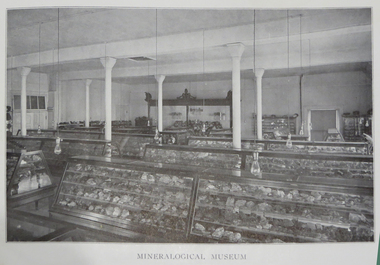 Federation University Historical Collection
Booklet, Views of the Michigan College of Mines, c1906
... * General View * Hubbell Hall * Mechanical Engineering Building * Mining and Metallurgy Buildings, with Stamp Mill in the Distance * Chemistry Building * College Club and Gymnasium Building * Architects Sketch of Library and Museum Building * Metallurgy Building * Mining Engineering Building * Assaying Course G1 * General Chemistry Course F1 * Inspecting Drill Operations * Mineralogy - COurses W1 and W2 * Railroad Surveying - Course Q1 * Field Geology * Reporting on Power PLants at Tamarack No. 5 Hoist * Sketching Ore Pockets * Pattern Shop * Physics Course * Underground in Champion Mine * QUalitative Chemistry * Field Surveying * Ore Dressing * HYdraulics Course * Machine Shop * Palaeontology and Historical Geology * Just Up from Lake Angeline Mine, Ishpeming Mineralogical Museum * Gymnasium, College Club Building * Lounging Room of College Club Building... * General View * Hubbell Hall * Mechanical Engineering Building * Mining and Metallurgy Buildings, with Stamp Mill in the Distance * Chemistry Building * College Club and Gymnasium Building * Architects Sketch of Library and Museum Building * Metallurgy Building * Mining Engineering Building * Assaying Course G1 * General Chemistry Course F1 * Inspecting Drill Operations * Mineralogy - COurses W1 and W2 * Railroad Surveying - Course Q1 * Field Geology * Reporting on Power PLants at Tamarack No. 5 Hoist * Sketching Ore Pockets * Pattern Shop * Physics Course * Underground in Champion Mine * QUalitative Chemistry * Field Surveying * Ore Dressing * HYdraulics Course * Machine Shop * Palaeontology and Historical Geology * Just Up from Lake Angeline Mine, Ishpeming Mineralogical Museum * Gymnasium, College Club Building * Lounging Room of College Club Building Views of the Michigan College of Mines Booklet Booklet ...Charcoal grey soft covered booklet with views of the Michigan College of Mines. * General View * Hubbell Hall * Mechanical Engineering Building * Mining and Metallurgy Buildings, with Stamp Mill in the Distance * Chemistry Building * College Club and Gymnasium Building * Architects Sketch of Library and Museum Building * Metallurgy Building * Mining Engineering Building * Assaying Course G1 * General Chemistry Course F1 * Inspecting Drill Operations * Mineralogy - COurses W1 and W2 * Railroad Surveying - Course Q1 * Field Geology * Reporting on Power PLants at Tamarack No. 5 Hoist * Sketching Ore Pockets * Pattern Shop * Physics Course * Underground in Champion Mine * QUalitative Chemistry * Field Surveying * Ore Dressing * HYdraulics Course * Machine Shop * Palaeontology and Historical Geology * Just Up from Lake Angeline Mine, Ishpeming Mineralogical Museum * Gymnasium, College Club Building * Lounging Room of College Club Buildingmichigan college of mines, school of mines, michigan, houghton, michigan, f.w. mcnair, united states of america, schools of mines, michigan school of mines -
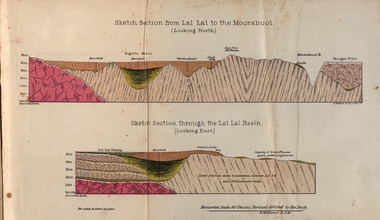 Federation University Historical Collection
Booklet, Luplau, Hewood & Riderm Printers, The School of Mines Ballaarat Annual Report 1883, 1883
... report of the lecturer in materia medica...statement of receipts and expenditure for the year 1882...subjects and lectures...subjects and examiners...subcriptions and donations, from 1st january to 31st december 1882...alf. mica smith, professor of chemistry...Life Governors, Museum - open to visitors, Notes on the Geology of Lal Lal (with Geological Plan & Sections), Obituary, Office Bearers, Paper of Particulars, Rules of the Ballaarat Field Club and Science Society (Appendix), Report of the Curator of the Museum and Library, Report of the Superintendent of Laboratories, Report of the Lecturer in Mathematics, Report of the Lecturer in Mechanical Engineering, Report of the Lecturer in Telegraphy, Report of the Lecturer in Materia Medica, Statement of Receipts and Expenditure for the year 1882, Subjects and Lectures, Subjects and Examiners, Subscriptions and Donations, from 1st January to 31st December 1882. ballarat school of mines annual report balance sheet certificates granted by the council examination papers extracts from the visitors' book fees form of bequest honorary correspondents life governors museum notes on the geology of lal lal obituary: charles william thomas. one of the examiners in mining and surveying office bearers paper of particulars rules of the ballaarat field club and science society report of the curator of the museum and library report of the superintendent of laboratories report of the lecturer in mathematics report of the lecturer in mechanical engineering report of the lecturer in telegraphy report of the lecturer in materia medica statement of receipts and expenditure for the year 1882 subjects and lectures subjects and examiners subcriptions and donations, from 1st january to 31st december 1882 alf. mica smith, professor of chemistry alf. mica smith, metallurgy f. m. krause - professor of geology, mineralogy, scientific mining t. h. thompson, practical mining w. h. shaw mechanical engineering h. reid, mechanical enginnering, phoenix foundry company (limited) a. a. buley, mathematics f. m. krause, land, mining and engineering surveying w. d. campbell, telegraphy james oddie, vice-president alf. mica smith, natural philosophy (elementary mechanics and hydrostatics, magnetism and electricty, sound, light and heat) j. f. usher, materia medica, pharmacy and physiology examiner, professor h. m. andrew, m. a. examiner, h. d. de la poer wall, m. a, c. e. examiner, thomas mann, b. a. examiner, p. c. fitzpatrick, c. s. examiner, h. rosale, j.p., f.g.s, m.e. and m examiner, john lewis examiner, w. c. kernot, m.a., c.e. examiner, professor mccoy examiner, j. cosmo newbery, c.m.g., b. sc. examiner, baron von mueller, k.c.m.g., m. et ph. d., f. r.s. examiner, sam. w. macgowan examiner, w. p. bechervaise examiner, r. l. j. ellery, f.r.s. govt. astronomer examiner, f. m. krause, c.e. examiner, j. m. bickett examiner, n. kent examiner, a. martin examiner, r. s. mitchell examiner, w. h. keast examiner, p. matthews examiner, d. milliken examiner, j. t. richards examiner, jonathan robinson examiner, t. h. thompson examiner, h. brookes allen, m.d. examiner, joseph bosisto examiner, c. r. blackett, m.l.a. examiner, wm. johnson, analyst to the government of victoria ferdinand krause Ballarat Field Naturalists Club Ferdinand von mueller thomas mann a.a. buley ferrdinand krause Alfred Mica Smith James Oddie William Johnson jonathan robinson james bickett r.l.j. ellery cosmo newbery Ballarat Field Naturalists Ballaarat School of Mines annual Report. ...The School of Mines Ballaarat. Annual Report 1883. Statement of Receipts and expenditure, general balance sheet, and list of subscriptions donations 1882. Sketch of School of Mines. Sketch Section from Lal Lal to the Moorabool (looking north) Geological map of Lal Lal. In the County of Grant. Annual Report, Balance Sheet, Certificates granted by the Council, Examination Papers - Elementary Science Classes (Appendix), Extracts from Visitors' Book, Fees, Form of Bequest, Honorary Correspondents. Life Governors, Museum - open to visitors, Notes on the Geology of Lal Lal (with Geological Plan & Sections), Obituary, Office Bearers, Paper of Particulars, Rules of the Ballaarat Field Club and Science Society (Appendix), Report of the Curator of the Museum and Library, Report of the Superintendent of Laboratories, Report of the Lecturer in Mathematics, Report of the Lecturer in Mechanical Engineering, Report of the Lecturer in Telegraphy, Report of the Lecturer in Materia Medica, Statement of Receipts and Expenditure for the year 1882, Subjects and Lectures, Subjects and Examiners, Subscriptions and Donations, from 1st January to 31st December 1882.Ballaarat School of Mines annual Report. Hard cover red book of 101 pages. Includes plans on Lal Lal and surrounds. ballarat school of mines, annual report, balance sheet, certificates granted by the council, examination papers, extracts from the visitors' book, fees, form of bequest, honorary correspondents, life governors, museum, notes on the geology of lal lal, obituary: charles william thomas. one of the examiners in mining and surveying, office bearers, paper of particulars, rules of the ballaarat field club and science society, report of the curator of the museum and library, report of the superintendent of laboratories, report of the lecturer in mathematics, report of the lecturer in mechanical engineering, report of the lecturer in telegraphy, report of the lecturer in materia medica, statement of receipts and expenditure for the year 1882, subjects and lectures, subjects and examiners, subcriptions and donations, from 1st january to 31st december 1882, alf. mica smith, professor of chemistry, alf. mica smith, metallurgy, f. m. krause - professor of geology, mineralogy, scientific mining, t. h. thompson, practical mining, w. h. shaw mechanical engineering, h. reid, mechanical enginnering, phoenix foundry company (limited), a. a. buley, mathematics, f. m. krause, land, mining and engineering surveying, w. d. campbell, telegraphy, james oddie, vice-president, alf. mica smith, natural philosophy (elementary mechanics and hydrostatics, magnetism and electricty, sound, light and heat), j. f. usher, materia medica, pharmacy and physiology, examiner, professor h. m. andrew, m. a., examiner, h. d. de la poer wall, m. a, c. e., examiner, thomas mann, b. a., examiner, p. c. fitzpatrick, c. s., examiner, h. rosale, j.p., f.g.s, m.e. and m, examiner, john lewis, examiner, w. c. kernot, m.a., c.e., examiner, professor mccoy, examiner, j. cosmo newbery, c.m.g., b. sc., examiner, baron von mueller, k.c.m.g., m. et ph. d., f. r.s., examiner, sam. w. macgowan, examiner, w. p. bechervaise, examiner, r. l. j. ellery, f.r.s. govt. astronomer, examiner, f. m. krause, c.e., examiner, j. m. bickett, examiner, n. kent, examiner, a. martin, examiner, r. s. mitchell, examiner, w. h. keast, examiner, p. matthews, examiner, d. milliken, examiner, j. t. richards, examiner, jonathan robinson, examiner, t. h. thompson, examiner, h. brookes allen, m.d., examiner, joseph bosisto, examiner, c. r. blackett, m.l.a., examiner, wm. johnson, analyst to the government of victoria, ferdinand krause, ballarat field naturalists club, ferdinand von mueller, thomas mann, a.a. buley, ferrdinand krause, alfred mica smith, james oddie, william johnson, jonathan robinson, james bickett, r.l.j. ellery, cosmo newbery, ballarat field naturalists -
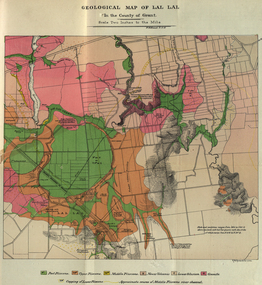 Federation University Historical Collection
Booklet, The School of Mines Ballaarat Annual Report 1883, 1883
... report...balance sheet...certificates granted by the council...examination papers...fees...honorary correspondents...life governors...museum...office bearers...paper of particulars...ballarat school of mines museum...library...superintendent of laboratories...mathematics...mechanical engineering...telegraphy...lecturer in materia medica...statement of receipts and expenditure for the year 1882...examiners...subcriptions and donations...alfred mica smith...chemistry...Life Governors, Museum - open to visitors, Office Bearers, Paper of Particulars, Report of the Curator of the Museum and Library, Report of the Superintendent of Laboratories, Report of the Lecturer in Mathematics, Report of the Lecturer in Mechanical Engineering, Report of the Lecturer in Telegraphy, Report of the Lecturer in Materia Medica, Report of the Lecturer of Astronomy, Scale of Charges for Assays and Analyses, Examinations Held, Statement of Receipts and Expenditure for the year 1883, Subjects and Lectures, Subjects and Examiners, Subscriptions and Donations, from 1st January to 31st December 1883. ballarat school of mines annual report balance sheet certificates granted by the council examination papers fees honorary correspondents life governors museum office bearers paper of particulars ballarat school of mines museum library superintendent of laboratories mathematics mechanical engineering telegraphy lecturer in materia medica statement of receipts and expenditure for the year 1882 examiners subcriptions and donations alfred mica smith chemistry metallurgy f.m. krause ferdinand krause geology mineralogy scientific mining t.h. thompson practical mining w.h. shaw h. reid mechanical enginnering phoenix foundry company (limited) phoenix foundry arthur. a. buley mining engineering surveying walter. d. campbell j. wall astronomy james oddie natural philosophy elementary mechanics and hydrostatics magnetism and electricty sound, light and heat j.f. usher materia medica pharmacy physiology w.h. shawmechanical engineering h.m. andrew h.d. de la poer wall thomas mann p.c. fitzpatrick h. rosale john lewis w.c. kernot mccoy j. cosmo newbery baron von mueller samuel w. macgowan w.p. bechervaise r.l.j. ellery astronomer j.m. bickett james bickett n. kent a. martin r.s. mitchell w.h. keast p. matthews d. milliken j.t. richards jonathan robinson h. brookes allen joseph bosisto c.r. blackett, m.l.a. william. johnson government of victoria analyst moorabool lal lal skipton coal skipton coal discovery Lal Lal Creek Moorabool Falls Lal Lal Race Course Lal Lal Falls Moorabool River William H. ...The School of Mines Ballaarat. Annual Report 1883. Statement of Receipts and expenditure, general balance sheet, and list of subscriptions donations 1883. Annual Report, Balance Sheet, Certificates granted by the Council, Examination Papers - Elementary Science Classes (Appendix), Fees, Honorary Correspondents. Life Governors, Museum - open to visitors, Office Bearers, Paper of Particulars, Report of the Curator of the Museum and Library, Report of the Superintendent of Laboratories, Report of the Lecturer in Mathematics, Report of the Lecturer in Mechanical Engineering, Report of the Lecturer in Telegraphy, Report of the Lecturer in Materia Medica, Report of the Lecturer of Astronomy, Scale of Charges for Assays and Analyses, Examinations Held, Statement of Receipts and Expenditure for the year 1883, Subjects and Lectures, Subjects and Examiners, Subscriptions and Donations, from 1st January to 31st December 1883.Ballaarat School of Mines annual Report. Soft cover pale green booklet of 67 pages. Includes a colour Geological Map of Lal Lal and a sketch Section from Lal Lal to the Moorabool. Inscription on front cover 'Office Copy' On pages 4 and 5 some names have been crossed out and others added.ballarat school of mines, annual report, balance sheet, certificates granted by the council, examination papers, fees, honorary correspondents, life governors, museum, office bearers, paper of particulars, ballarat school of mines museum, library, superintendent of laboratories, mathematics, mechanical engineering, telegraphy, lecturer in materia medica, statement of receipts and expenditure for the year 1882, examiners, subcriptions and donations, alfred mica smith, chemistry, metallurgy, f.m. krause, ferdinand krause, geology, mineralogy, scientific mining, t.h. thompson, practical mining, w.h. shaw, h. reid, mechanical enginnering, phoenix foundry company (limited), phoenix foundry, arthur. a. buley, mining, engineering surveying, walter. d. campbell, j. wall, astronomy, james oddie, natural philosophy, elementary mechanics and hydrostatics, magnetism and electricty, sound, light and heat, j.f. usher, materia medica, pharmacy, physiology, w.h. shawmechanical engineering, h.m. andrew, h.d. de la poer wall, thomas mann, p.c. fitzpatrick, h. rosale, john lewis, w.c. kernot, mccoy, j. cosmo newbery, baron von mueller, samuel w. macgowan, w.p. bechervaise, r.l.j. ellery, astronomer, j.m. bickett, james bickett, n. kent, a. martin, r.s. mitchell, w.h. keast, p. matthews, d. milliken, j.t. richards, jonathan robinson, h. brookes allen, joseph bosisto, c.r. blackett, m.l.a., william. johnson, government of victoria analyst, moorabool, lal lal, skipton, coal, skipton coal discovery, lal lal creek, moorabool falls, lal lal race course, lal lal falls, moorabool river, william h. keast -
Federation University Historical Collection
Booklet, The School of Mines, Ballaarat, Annual Report 1881, 1882
... report of the lecturer in mechanical engineering...statement of receipts and expenditure for the year 1881...subjects and lecturers...subjects and examiners...subscriptions and donations from 1st january to 31st december 1881...the lignite deposit at skipton...james oddie, esq., j.p....alf. mica smith, lecturer in chemistry...Francis Ormond, M.L.C., Extracts from the Visitors' Book, Fees, Form of Bequest, Life Governors, Museum - open to Visitors', Office Bearers, Paper of Particulars, Report of the Curator of the Museum and Library (with plans), Report of the Superintendent of Laboratories, Report of the Lecturer in Telegraphy, Report of the Lecturer in Mechanical Engineering, Statement of Receipts and Expenditure for the year 1881, Subjects and Lecturers, Subjects and Examiners, Subscriptions and Donations from 1st January to 31st December 1881, The Lignite Deposit at Skipton (with Section and Plan) annual report additional examination statute certificates granted by the council copy of letter received from the honble. francis ormond, m.l.c. extracts from visitors' book fees form of bequest paper of particulars life governors museum officer bearers report of the curator of the museum and library report of the lecturer in telegraphy report of the lecturer in mechanical engineering statement of receipts and expenditure for the year 1881 subjects and lecturers subjects and examiners subscriptions and donations from 1st january to 31st december 1881 the lignite deposit at skipton james oddie, esq., j.p. alf. mica smith, lecturer in chemistry, natural philosophy and botany f. m. krause, lecturer in geology, scientific mining, land, mining and engineering surveying t. h. thompson, lecturer in practical mining w. h. shaw, lecturer in mechanical engineering h. reid, lecturer in mechanical engineering a. a. buley, lecturer in mathematics w. d. campbell, lecturer in telegraphy j. f. usher, lecturer in materia medica, pharmacy and physiology a.a. buley w.d. campbell j.f. usher w.h. shaw ferdinand krause t.h. krause skipton lignite deposit skipton coal Ballarat school of mines annual report Soft covered pale green booklet of 63 pages. ...The School of Mines Ballaarat Annual Report 1881. Annual Report, Additional Examination Statute, Certificates Granted by the Council, Copy of letter received from the Honble. Francis Ormond, M.L.C., Extracts from the Visitors' Book, Fees, Form of Bequest, Life Governors, Museum - open to Visitors', Office Bearers, Paper of Particulars, Report of the Curator of the Museum and Library (with plans), Report of the Superintendent of Laboratories, Report of the Lecturer in Telegraphy, Report of the Lecturer in Mechanical Engineering, Statement of Receipts and Expenditure for the year 1881, Subjects and Lecturers, Subjects and Examiners, Subscriptions and Donations from 1st January to 31st December 1881, The Lignite Deposit at Skipton (with Section and Plan)Soft covered pale green booklet of 63 pages.annual report, additional examination statute, certificates granted by the council, copy of letter received from the honble. francis ormond, m.l.c., extracts from visitors' book, fees, form of bequest, paper of particulars, life governors, museum, officer bearers, report of the curator of the museum and library, report of the lecturer in telegraphy, report of the lecturer in mechanical engineering, statement of receipts and expenditure for the year 1881, subjects and lecturers, subjects and examiners, subscriptions and donations from 1st january to 31st december 1881, the lignite deposit at skipton, james oddie, esq., j.p., alf. mica smith, lecturer in chemistry, natural philosophy and botany, f. m. krause, lecturer in geology, scientific mining, land, mining and engineering surveying, t. h. thompson, lecturer in practical mining, w. h. shaw, lecturer in mechanical engineering, h. reid, lecturer in mechanical engineering, a. a. buley, lecturer in mathematics, w. d. campbell, lecturer in telegraphy, j. f. usher, lecturer in materia medica, pharmacy and physiology, a.a. buley, w.d. campbell, j.f. usher, w.h. shaw, ferdinand krause, t.h. krause, skipton lignite deposit, skipton coal, ballarat school of mines annual report -
Federation University Historical Collection
Booklet, A. A. Herberte, "STAR' Printing Works, The School of Mines, Ballaarat, Annual Report 1884, 1885
... report of the lecturer in astronomy...scale of charges for assays and analyses...examinations held...statement of receipts and expenditure for the year 1884...statement of receipts and expenditure for special funds...subjects and lecturers...subjects and examiners...subscriptions and donations from 1st january to 31st december 1884...time table...james oddie, esq., j.p....alf. mica smith, lecturer in chemistry...Annual Report, Balance Sheet, Certificates Granted by the Council, Examination Papers - Elementary Science Classes (Appendix), Fees, Honorary Correspondents, Life Governors, Museum - open to Visitors', Office Bearers, Report of the Curator of the Museum and Library, Report of the Lecturer in Mathematics, Report of the Lecturer in Mechanical Engineering, Report of the Lecturer in Electricity and Magnetism, Report of the Lecturer in Telegraphy, Report of the Lecturer in Botany, Report of the Lecturer in Materia Medica and Physiology, Report of the Lecturer in Astronomy, Scale of Charges for Assays and Analyses, Examinations Held, Statement of Receipts and Expenditure for the year 1884, Statement of Receipts and Expenditure for Special Funds, Subjects and Lecturers, Subjects and Examiners, Subscriptions and Donations from 1st January to 31st December 1884, Time Table annual report balance sheet certificates granted by the council examination papers - elementary science fees honorary correspondents life governors museum officer bearers report of the curator of the museum and library report of the lecturer in telegraphy report of the lecturer in mechanical engineering report of the lecturer in astronomy scale of charges for assays and analyses examinations held statement of receipts and expenditure for the year 1884 statement of receipts and expenditure for special funds subjects and lecturers subjects and examiners subscriptions and donations from 1st january to 31st december 1884 time table james oddie, esq., j.p. alf. mica smith, lecturer in chemistry, natural philosophy and botany f. m. krause, lecturer in geology, scientific mining, land, mining and engineering surveying t. h. thompson, lecturer in practical mining j. sommers, lecturer in mechanical engineering h. sutton, lecturer in mechanical applied electricity and magnetism a. a. buley, lecturer in mathematics w. d. campbell, lecturer in telegraphy j. f. usher, lecturer in materia medica, pharmacy and physiology geo. day, lecturer in botany john wall, lecturer in astronomy Subscriptions fonations telegraphy henry sutton Usher george day Soft covered pale green booklet of 67 pages. ...The School of Mines Ballaarat Annual Report 1884. Annual Report, Balance Sheet, Certificates Granted by the Council, Examination Papers - Elementary Science Classes (Appendix), Fees, Honorary Correspondents, Life Governors, Museum - open to Visitors', Office Bearers, Report of the Curator of the Museum and Library, Report of the Lecturer in Mathematics, Report of the Lecturer in Mechanical Engineering, Report of the Lecturer in Electricity and Magnetism, Report of the Lecturer in Telegraphy, Report of the Lecturer in Botany, Report of the Lecturer in Materia Medica and Physiology, Report of the Lecturer in Astronomy, Scale of Charges for Assays and Analyses, Examinations Held, Statement of Receipts and Expenditure for the year 1884, Statement of Receipts and Expenditure for Special Funds, Subjects and Lecturers, Subjects and Examiners, Subscriptions and Donations from 1st January to 31st December 1884, Time TableSoft covered pale green booklet of 67 pages. The Ballarat School of Mines Annual Report for 1984.annual report, balance sheet, certificates granted by the council, examination papers - elementary science, fees, honorary correspondents, life governors, museum, officer bearers, report of the curator of the museum and library, report of the lecturer in telegraphy, report of the lecturer in mechanical engineering, report of the lecturer in astronomy, scale of charges for assays and analyses, examinations held, statement of receipts and expenditure for the year 1884, statement of receipts and expenditure for special funds, subjects and lecturers, subjects and examiners, subscriptions and donations from 1st january to 31st december 1884, time table, james oddie, esq., j.p., alf. mica smith, lecturer in chemistry, natural philosophy and botany, f. m. krause, lecturer in geology, scientific mining, land, mining and engineering surveying, t. h. thompson, lecturer in practical mining, j. sommers, lecturer in mechanical engineering, h. sutton, lecturer in mechanical applied electricity and magnetism, a. a. buley, lecturer in mathematics, w. d. campbell, lecturer in telegraphy, j. f. usher, lecturer in materia medica, pharmacy and physiology, geo. day, lecturer in botany, john wall, lecturer in astronomy, subscriptions, fonations, telegraphy, henry sutton, usher, george day -
Federation University Historical Collection
Booklet, Ballarat School of Mines Annual Report 1888, 1888
... report...the hon sir william foster stawell, president...andrew anderson, vice president...alf. mica smith - professor of chemistry...Secretary St John Ambulance Association, Examinations Held, Scale of Charges for Assays and Analyses, Statement of Receipts and Expenditure for the year 1888 and Special Trust Funds, Statistics - Students Attending Lectures, Subjects and Lecturers, Subscriptions and Donations from 1st January to 31st December 1888, Time Table. ballarat school of mines annual report the hon sir william foster stawell, president andrew anderson, vice president alf. mica smith - professor of chemistry and metallurgy f. m. krause - professor of geology and minealogy j. h. horwood - mechanical engineering, machine drawing and design, mining, mathematics henry j. hall - freehand and model drawing daniel walker - chemistry and physics w. e. burbridge - demonstrator of chemistry and metallurgy w. d. campbell - telegraphy george day - botany j. f. usher - materia, medica, pharmacy and physiology gilbert j. dawbarn e. thornton charles kent - auditor andrew berry - registrar t. h. thompson jp - mayor of the city of ballarat james russell jp - mayor of the town of ballarat daniel brophy jp - chairman of the band and albion consols walter gude elizabeth phillips thomas commons kate porritt emily mary wheeler grace shrigley george clendinning rose ditchburn cecelia h. murphy eliza a. turpie rebecca walton george g. zilles william menzies john waters sutherland h.w. sutherland alfred kerr william coltman alfred j. dunstan arthur bregazzi maggie miller serna davey william thomas grownow sarah davies anna bella cravno william corbould thomas copeland robert john gribble henry lipson hancock leigh george hancock harry m. martell ivan rosenblum john la gerche samuel barrell walter reed bechercaise william treloar adolf gode arthur e. lilburne carl werner isaac bernstein george kidd arthur lynch henry coltman josiah wasley david curtain martha maud berry mary ann cameron harriet mary mitchell anna s. schloo ellen fussell lavinia treloar mary drury annie winifred eastwood annie louisa gatliff mary gatliff james edward gribble frank uren alfred curthoys william edwin kernot j. ditchburn john bradshaw david michael curtain alfred ernest campbell kerr walter nettleton william henry keast george ja,es donald mcgregor john king john bailey bullen john trevan patrick murray josiah curnow tobert taplin samuel earnest figgis W.H. ...Ballarat School of Mines Annual Report 1888. President's Annual Report, Constitution and Statute of Affiliation, Monetary prize by R. M. Serjeant for Treatment of Ores, Balance Sheet: Liabilities and Assets, Certificates Granted by the Council, Fees, Honorary Correspondents, Life Governors, Number of Students attending the School of Mines, Office Bearers, Report of the Curator of the Museum and Library, Report of the Superintendent of Laboratories, Report of the Lecturer on Machine Drawing, Report of the Lecturer on Mechanical Engineering, Report of the Lecturer on Telegraphy, Report of the Lecturer on Botany, Report of the Lecturer on Freehand and Model Drawing, Report of the Lecturer on Materia, Medica and Physiology, Report of the Hon. Secretary St John Ambulance Association, Examinations Held, Scale of Charges for Assays and Analyses, Statement of Receipts and Expenditure for the year 1888 and Special Trust Funds, Statistics - Students Attending Lectures, Subjects and Lecturers, Subscriptions and Donations from 1st January to 31st December 1888, Time Table. Ballarat School of Mines annual Report. Cover attached by tape on booklet, spine missing, 108 pages. ballarat school of mines, annual report, the hon sir william foster stawell, president, andrew anderson, vice president, alf. mica smith - professor of chemistry and metallurgy, f. m. krause - professor of geology and minealogy, j. h. horwood - mechanical engineering, machine drawing and design, mining, mathematics, henry j. hall - freehand and model drawing, daniel walker - chemistry and physics, w. e. burbridge - demonstrator of chemistry and metallurgy, w. d. campbell - telegraphy, george day - botany, j. f. usher - materia, medica, pharmacy and physiology, gilbert j. dawbarn, e. thornton, charles kent - auditor, andrew berry - registrar, t. h. thompson jp - mayor of the city of ballarat, james russell jp - mayor of the town of ballarat, daniel brophy jp - chairman of the band and albion consols, walter gude, elizabeth phillips, thomas commons, kate porritt, emily mary wheeler, grace shrigley, george clendinning, rose ditchburn, cecelia h. murphy, eliza a. turpie, rebecca walton, george g. zilles, william menzies, john waters sutherland, h.w. sutherland, alfred kerr, william coltman, alfred j. dunstan, arthur bregazzi, maggie miller, serna davey, william thomas grownow, sarah davies, anna bella cravno, william corbould, thomas copeland, robert john gribble, henry lipson hancock, leigh george hancock, harry m. martell, ivan rosenblum, john la gerche, samuel barrell, walter reed bechercaise, william treloar, adolf gode, arthur e. lilburne, carl werner, isaac bernstein, george kidd, arthur lynch, henry coltman, josiah wasley, david curtain, martha maud berry, mary ann cameron, harriet mary mitchell, anna s. schloo, ellen fussell, lavinia treloar, mary drury, annie winifred eastwood, annie louisa gatliff, mary gatliff, james edward gribble, frank uren, alfred curthoys, william edwin kernot, j. ditchburn, john bradshaw, david michael curtain, alfred ernest campbell kerr, walter nettleton, william henry keast, george ja,es, donald mcgregor, john king, john bailey bullen, john trevan, patrick murray, josiah curnow, tobert taplin, samuel earnest figgis, w.h. keast -
Federation University Historical Collection
Booklet, W. B. Macdonald, Ballarat School of Mines Annual Report 1889, 1889
... report...andrew anderson j.p. - president...rivett henry bland - trustee...the hon. sir w. j. clarke - trustee...the hon. john warrington rogers - trustee...james oddie - trustee...the hon. henry cuthbert - honorary solicitor...i. j. jones - honorary treasurer...chas. kent - auditor...andrew berry - registrar...sir william foster stawell...the honorable francis ormond...alf. mica. smith - professor of chemistry...report andrew anderson j.p. - president rivett henry bland - trustee the hon. sir w. j. clarke - trustee the hon. john warrington rogers - trustee james oddie - trustee the hon. henry cuthbert - honorary solicitor i. j. jones - honorary treasurer chas. kent - auditor andrew berry - registrar sir william foster stawell the honorable francis ormond alf. mica. smith - professor of chemistry j. h. horwood - engineering and surveying h. j. hall - geometrical and free hand drawing w. d. campbell - telegraphy george day - botany j. f. usher - materia medica and physiology bella guerin - university classes henry krone - assistant registrar of titles henry b. loch Paris school of mines Ballarat School of Mines annual Report. ...Ballarat School of Mines Annual Report 1889. Annual Report, Crown Grant, Affiliation Statute, Constitution, Liabilities and Assets, Certificates Granted by Council, Fees, Honorary Correspondents, Life Governors, Meteorological Observations, Number of Students attended The School of Mines, Office Bearers, Report of the Curator of the Museum and Library, Report of the Superintendent of Laboratories, Report of the Lecturer on Engineering and Surveying, Report of the Lecturer on Freehand and Model Drawing, Report of the Lecturer on Telegraphy, Report of the Lecturer on Botany, Report of the Lecturer on Materia Medica and Physiology, Report of University Classes, Examinations Held, Scale of Charges for Assays and Analyses, Statement of Receipts and Expenditure for the year 1889 and Special Trust Funds, Statistics - Students attending Lectures, Subjects and Examiners, Subscriptions and Donations from 1st January to 31st December 1889, Time Table, Obituary - Sir William Foster Stawell and The Honorable Francis Ormond Ballarat School of Mines annual Report. Cover has brown marks on it, 106 pages. ballarat school of mines, annual report, andrew anderson j.p. - president, rivett henry bland - trustee, the hon. sir w. j. clarke - trustee, the hon. john warrington rogers - trustee, james oddie - trustee, the hon. henry cuthbert - honorary solicitor, i. j. jones - honorary treasurer, chas. kent - auditor, andrew berry - registrar, sir william foster stawell, the honorable francis ormond, alf. mica. smith - professor of chemistry, j. h. horwood - engineering and surveying, h. j. hall - geometrical and free hand drawing, w. d. campbell - telegraphy, george day - botany, j. f. usher - materia medica and physiology, bella guerin - university classes, henry krone - assistant registrar of titles, henry b. loch, paris school of mines -
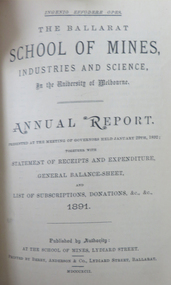 Federation University Historical Collection
Booklet - Annual Report, The Ballarat School of Mines, Industries and Science, Annual Report 1891, 1891
... report...andrew anderson j.p. - president...f. j. martell - vice president...r. denham pinnock - vice president...rivett henry bland - trustee...the hon. sir w. j. clarke - trustee...the hon. john warrington rogers - trustee...james oddie - trustee...the hon. henry cuthbert - honorary solicitor...c. eyres - honorary treasurer...charles kent - auditor...andrew berry - registrar...f. m. krause - professor of mineralogy and geology, and curator of the museum...alf. mica. smith - chemistry...report andrew anderson j.p. - president f. j. martell - vice president r. denham pinnock - vice president rivett henry bland - trustee the hon. sir w. j. clarke - trustee the hon. john warrington rogers - trustee james oddie - trustee the hon. henry cuthbert - honorary solicitor c. eyres - honorary treasurer charles kent - auditor andrew berry - registrar f. m. krause - professor of mineralogy and geology, and curator of the museum alf. mica. smith - chemistry, metallurgy, natural philosophy f. m. krause - geology, mineralogy, geological surveying j. h. horwood - lecturer on engineering and surveying h. j. hall - lecturer free-hand and model drawing george day - botany j. f. usher - materia medica and physiology c. w. wilson - university classes isaac jaques jones j.p. mr e. wattis - manager, mining laboratory j. a. dawson - electrical engineering and telegraphy elder gray harry e. sando charles matthews - auditor j. h. daley - auditor henry crone - assistant registrar of titles henry b. loch isaac jacques jones charles eyres j.a j.a. dawson statistics university classes bella guerin c.w. wilson clunes branch of the ballarat school of mines w.e. burbridge h.j. hall museum state school students daniel walker a.j. higgins state school science classes The Ballarat School of Mines Industries and Science Annual Report, 1891. ...The Ballarat School of Mines Annual Report 1891. Annual Report, Crown Grant, Affiliation Statute, Constitution, Examination Statutes, Associateship of The School, Certificates Granted by the Council, Clunes Branch Report, Departmental Expenditure, Fees, Form of Bequest, Gauge-Testing Apparatus, General Balance Sheet and Liabilities and Assets, Honorary Correspondents, Life Governors, Meteorological Observations, Number of Students attended The School of Mines, Office Bearers, Practical Treatment of Ores, Report of the Professor of Mineralogy and Geology and Curator of the Museum, Report of the Superintendent of Laboratories, Report of the Lecturer on Engineering and Surveying, Report of the Lecturer on Mathematics, Report of the Lecturer on Electrical Engineering and Telegraphy, Report of the Lecturer on Botany, Report of the Lecturer on Geometrical and Freehand Drawing, Report of the Lecturer on Materia Medica and Physiology, Report of University Classes, Report on Mining Laboratory, Examinations Held, Scale of Charges for Assays and Analyses, Statement of Receipts and Expenditure for the year 1891 and Special Trust Funds, Statistics - Students attending Lectures, Subjects and Lecturers, Subjects and Examiners, Subscriptions and Donations from 1st January to 31st December 1891, Syllabus of Lecture CoursesThe Ballarat School of Mines Industries and Science Annual Report, 1891. Cover is browning around the edges, front cover has small tear on bottom of cover, 132 pages. ballarat school of mines, annual report, andrew anderson j.p. - president, f. j. martell - vice president, r. denham pinnock - vice president, rivett henry bland - trustee, the hon. sir w. j. clarke - trustee, the hon. john warrington rogers - trustee, james oddie - trustee, the hon. henry cuthbert - honorary solicitor, c. eyres - honorary treasurer, charles kent - auditor, andrew berry - registrar, f. m. krause - professor of mineralogy and geology, and curator of the museum, alf. mica. smith - chemistry, metallurgy, natural philosophy, f. m. krause - geology, mineralogy, geological surveying, j. h. horwood - lecturer on engineering and surveying, h. j. hall - lecturer free-hand and model drawing, george day - botany, j. f. usher - materia medica and physiology, c. w. wilson - university classes, isaac jaques jones j.p., mr e. wattis - manager, mining laboratory, j. a. dawson - electrical engineering and telegraphy, elder gray, harry e. sando, charles matthews - auditor, j. h. daley - auditor, henry crone - assistant registrar of titles, henry b. loch, isaac jacques jones, charles eyres, j.a, j.a. dawson, statistics, university classes, bella guerin, c.w. wilson, clunes branch of the ballarat school of mines, w.e. burbridge, h.j. hall, museum, state school students, daniel walker, a.j. higgins, state school science classes -
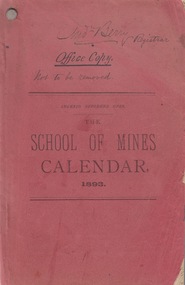 Federation University Historical Collection
Booklet, The Ballarat School of Mines, Industries and Science, Calendar and Annual Report 1893, 1893
... report...andrew anderson j.p. - president...f. j. martell - vice president...r. denham pinnock - vice president...rivett henry bland - trustee...the hon. sir w. j. clarke - trustee...the hon. john warrington rogers - trustee...james oddie - trustee...the hon. henry cuthbert - honorary solicitor...r. g. middleton - honorary treasurer...charles kent - auditor...andrew berry - registrar...alf. mica. smith - chemistry...report andrew anderson j.p. - president f. j. martell - vice president r. denham pinnock - vice president rivett henry bland - trustee the hon. sir w. j. clarke - trustee the hon. john warrington rogers - trustee james oddie - trustee the hon. henry cuthbert - honorary solicitor r. g. middleton - honorary treasurer charles kent - auditor andrew berry - registrar alf. mica. smith - chemistry, metallurgy f. m. krause - geology, mineralogy, mining j. h. horwood - mechanical engineering, machine drawing and design, theoretica and applied mechanics, mathematics henry j. hall - freehand and model drawing j. a. dawson - electricity and magnetism george day - botany e. gutheil - biology, materia medica, pharmacy a. e. c. kerr - mechanical drawing, machine construction and design e. gutheil - biology, pharmacy, materia medica henry crone - assistant registrar of titles henry b. loch elder gray - president, clunes branch harry e. sando - registrar, clunes branch w. y. witherden - hon. treasurer, clunes branch 6188: The Ballarat School of Mines Industries and Science Calendar and Annual Report, 1893. ...The Ballarat School of Mines Annual Report 1893. Annual Report, Examination Papers, Associateship of The School of Mines, Syllabus for Technical Schools, Crown Grant, Affiliation Statute, Certificates Granted by the Council, Clunes Branch Report, Departmental Expenditure, Fees, Form of Bequest, General Balance Sheet and Liabilities and Assets, Honorary Correspondents, Life Governors, Meteorological Observations, Number of Students attended The School of Mines, Office Bearers, Practical Treatment of Ores, Report of the Professor of Mineralogy and Geology and Curator of the Museum, Report of the Superintendent of Laboratories, Report of the Lecturer on Engineering and Surveying, Report of the Lecturer on Mathematics, Report of the Lecturer in Mechanical Drawing, Machine Construction and Design, Report of the Lecturer on Electrical Engineering and Telegraphy, Report of the Lecturer on Botany, Report of the Lecturer on Biology, Pharmacy, Materia Medica, Report on Mining Laboratory, Examinations Held, Scale of Charges for Assays and Analyses, Statement of Receipts and Expenditure for the year 1892 and Special Trust Funds, Statistics - Students attending Lectures, Subjects and Lecturers, Subjects and Examiners, Subscriptions and Donations from 1st January to 31st December 1892, Syllabus of Lecture Courses6188: The Ballarat School of Mines Industries and Science Calendar and Annual Report, 1893. Red soft cover is browning around the edges, spine is tattered, 156 pages. 6188.2: Red soft covered booklet of 26 pages, Office Copyballarat school of mines, annual report, andrew anderson j.p. - president, f. j. martell - vice president, r. denham pinnock - vice president, rivett henry bland - trustee, the hon. sir w. j. clarke - trustee, the hon. john warrington rogers - trustee, james oddie - trustee, the hon. henry cuthbert - honorary solicitor, r. g. middleton - honorary treasurer, charles kent - auditor, andrew berry - registrar, alf. mica. smith - chemistry, metallurgy, f. m. krause - geology, mineralogy, mining, j. h. horwood - mechanical engineering, machine drawing and design, theoretica and applied mechanics, mathematics, henry j. hall - freehand and model drawing, j. a. dawson - electricity and magnetism, george day - botany, e. gutheil - biology, materia medica, pharmacy, a. e. c. kerr - mechanical drawing, machine construction and design, e. gutheil - biology, pharmacy, materia medica, henry crone - assistant registrar of titles, henry b. loch, elder gray - president, clunes branch, harry e. sando - registrar, clunes branch, w. y. witherden - hon. treasurer, clunes branch -
Federation University Historical Collection
Booklet, Berry Anderson & Co, The Ballarat School of Mines, Calendar and Annual Report 1894, 1894
... report...andrew anderson j.p. - president...f. j. martell - vice president...r. denham pinnock - vice president...rivett henry bland - trustee...the hon. sir w. j. clarke - trustee...the hon. john warrington rogers - trustee...james oddie - trustee...the hon. henry cuthbert - honorary solicitor...r. g. middleton - honorary treasurer...charles kent - auditor...andrew berry - registrar...professor alf. mica smith - chemistry...report andrew anderson j.p. - president f. j. martell - vice president r. denham pinnock - vice president rivett henry bland - trustee the hon. sir w. j. clarke - trustee the hon. john warrington rogers - trustee james oddie - trustee the hon. henry cuthbert - honorary solicitor r. g. middleton - honorary treasurer charles kent - auditor andrew berry - registrar professor alf. mica smith - chemistry, metallurgy, natural philosophy professor krause - geology, mineralogy, principles of mining professor j. h. horwood - mine and land surveying, mining mechanics, hydraulics, civil engineering, applied mechanics j. a. dawson - electrical engineering d. walker - chemistry and natural philosophy w. e. bennetts - mathematics henry j. hall - freehand and perspective drawing a. e. c. kerr - mechanical drawing george p. day - botany e. gutheil - paleontology, zoology, materia medica w. d. snowball - veterinary science The Ballarat School of Mines Calendar and Annual Report, 1894. ...The Ballarat School of Mines Calendar and Annual Report 1894. Associateship of The School, Calendar for 1894, Certificates Granted by the Council 1893, Comparative Statement of Receipts and Expenditure, Departmental Expenditure, Examiners, Examination Papers, Examination Fees, Fees, Honorary Correspondents, Life Governors, Meteorological Observations, Mining Engineering Scholarship, Number of Certificates Granted since Inception, Number of Students attended The School of Mines, Office Bearers, Plant and Appliances, Practical Treatment of Ores, Professors and Lecturers, Report of the Professor of Mineralogy and Geology and Curator of the Museum, Report of the Superintendent of Laboratories, Report of the Lecturer on Engineering and Surveying, Report of the Lecturer on Mathematics, Report of the Instructor in Mechanical Drawing and Machine Construction and Design, Report of the Lecturer on Electrical Engineering and Telegraphy, Report of the Lecturer on Geometrical Model and Perspective Drawing, Report of the Lecturer on Botany, Report of the Lecturer on Biology, Pharmacy, Materia Medica, Scale of Charges for Assays and Analyses, State School Science Classes, Statement of Receipts and Expenditure for year 1893 and Serjeant Scholarship Fund, Statistics - Student attending Lectures, Subscriptions and Donations, Syllabus of Lecture Courses, Time TableThe Ballarat School of Mines Calendar and Annual Report, 1894. Green soft cover, 116 pages. ballarat school of mines, annual report, andrew anderson j.p. - president, f. j. martell - vice president, r. denham pinnock - vice president, rivett henry bland - trustee, the hon. sir w. j. clarke - trustee, the hon. john warrington rogers - trustee, james oddie - trustee, the hon. henry cuthbert - honorary solicitor, r. g. middleton - honorary treasurer, charles kent - auditor, andrew berry - registrar, professor alf. mica smith - chemistry, metallurgy, natural philosophy, professor krause - geology, mineralogy, principles of mining, professor j. h. horwood - mine and land surveying, mining mechanics, hydraulics, civil engineering, applied mechanics, j. a. dawson - electrical engineering, d. walker - chemistry and natural philosophy, w. e. bennetts - mathematics, henry j. hall - freehand and perspective drawing, a. e. c. kerr - mechanical drawing, george p. day - botany, e. gutheil - paleontology, zoology, materia medica, w. d. snowball - veterinary science -
Federation University Historical Collection
Booklet, Berry Anderson & Co, The Ballarat School of Mines, Calendar and Annual Report 1895, 1895
... report...andrew anderson j.p. - president...f. j. martell - vice president...r. denham pinnock - vice president...the hon. sir w. j. clarke - trustee...the hon. john warrington rogers - trustee...The Right Reverend Samuel Thornton - Trustee...Andrew Anderson - Trustee...James Millhinch - Trustee...james oddie - trustee...the hon. henry cuthbert - honorary solicitor...r. g. middleton - honorary treasurer...charles kent - auditor...andrew berry - registrar...professor alf. mica smith - chemistry...report andrew anderson j.p. - president f. j. martell - vice president r. denham pinnock - vice president the hon. sir w. j. clarke - trustee the hon. john warrington rogers - trustee The Right Reverend Samuel Thornton - Trustee Andrew Anderson - Trustee James Millhinch - Trustee james oddie - trustee the hon. henry cuthbert - honorary solicitor r. g. middleton - honorary treasurer charles kent - auditor andrew berry - registrar professor alf. mica smith - chemistry, metallurgy, natural philosophy professor krause - geology, mineralogy, principles of mining professor G. ...The Ballarat School of Mines Calendar and Annual Report 1895. Associateship of The School, Calendar for 1895, Certificates Granted by the Council 1894, Certificates Granted by the Education Department 1893, Comparative Statement of Receipts and Expenditure, Departmental Expenditure, Examiners, Examination Papers, Examination Fees, Fees, Honorary Correspondents, Life Governors, Meteorological Observations, Number of Students attended The School of Mines, Obituary, Office Bearers, Practical Treatment of Ores, Professors and Lecturers, Report of the Professor of Mineralogy and Geology and Curator of the Museum, Report of the Superintendent of Laboratories, Report of the Lecturer on Engineering and Surveying, Report of the Lecturer on Mathematics, Report of the Instructor in Engineering and Machine Construction and Design, Report of the Lecturer on Electrical Engineering, Report of the Lecturer on Geometrical Model and Perspective Drawing, Report of the Lecturer on Botany, Report of the Lecturer on Palaeontology, Materia Medica and Mining Ambulance, Scale of Charges for Assays and Analyses, Statement of Receipts and Expenditure for year 1894, Statistics - Student attending Lectures, Subscriptions and Donations, Syllabus of Lecture Courses, Time TableThe Ballarat School of Mines Calendar and Annual Report, 1895. Pale brown soft cover, 90 pages. ballarat school of mines, annual report, andrew anderson j.p. - president, f. j. martell - vice president, r. denham pinnock - vice president, the hon. sir w. j. clarke - trustee, the hon. john warrington rogers - trustee, the right reverend samuel thornton - trustee, andrew anderson - trustee, james millhinch - trustee, james oddie - trustee, the hon. henry cuthbert - honorary solicitor, r. g. middleton - honorary treasurer, charles kent - auditor, andrew berry - registrar, professor alf. mica smith - chemistry, metallurgy, natural philosophy, professor krause - geology, mineralogy, principles of mining, professor g. j. dawbarn - mine and land surveying, mining mechanics, hydraulics, civil engineering, applied mechanics, j. rowe - practical mining, j. a. dawson - electrical engineering, d. walker - chemistry and natural philosophy, w. e. bennett - mathematics, henry j. hall - freehand and perspective drawing, a. e. c. kerr - mechanical drawing (machine construction and design), george p. day - botany, e. gutheil - paleontology, zoology, materia medica, rivett henry bland - obituary, george gant scott - obituary, fiddian, bennett, r. allan, dawbarn, rosales, krause, joseph bryant, matthews, j. robinson, andrew robertson, john lynch, jonathan robinson, a.e.c. kerr, alfred mica smith, frederick mccoy, j. cosmo newberry, blackett, elelry, arnot, robert allan, bickett, kent, martin, mitchell, ferdinand von mueller, rivett henry bland, thomas bath, john rowe, museum, andrew anderson, george day, subscriptions and donations, examination papers -
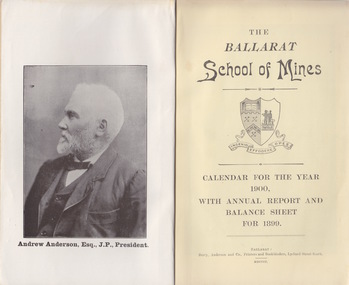 Federation University Historical Collection
Booklet, Ballarat School of Mines Calendar for the Year 1900 with Annual Report and Balance Sheet for 1899, 1900
... Annual Report, Associateship and Certificates, Calendar for 1901, Examination Fees, Fees, Full Certificates Issued prior to 1899, Honorary Correspondents, Life Governors, Meteorological Observations, Office Bearers, Passes obtained since 1892 in Final Examinations, Professors and Lecturers, Report of the Superintendent of Laboratories, Report of the Lecturer of Geology and Botany, Report of the Professor of Engineering, Report of the Lecturer in Engineering Drawing, Report of the Lecturer in Electricity, Report of the Teacher of Drawing, Report of the Teacher of Photography, Results of Examinations Conducted by Education Department 1899, Statement of Receipts and Expenditure for year 1899, Statistics - Students attending Lectures, Subscriptions and Donations, Subjects included in Regulations Technical Schools, Time Table annual report 1900 andrew anderson - president r. denham pinnock - vice president hon. r.t. vale - vice president the hon. john warrington rogers - trustee the right reverend samuel thornton bishop of ballarat - trustee james millhinch - trustee james oddie - trustee the hon. henry cuthbert - honorary solicitor r. g. middleton - honorary treasurer thomas s. hart - curator of museum chas. kent - auditor fred j. martell - director professor alfred mica smith daniel walker hubert r. murphy charles a. deane percy r. osborne arthur garrad thomas evans stanley b. vial harry lego thomas s. hart godfrey hart professor g. j. dawbarn robert j. allan a. e. c. kerr henry j. hall john m. sutherland g. f. fryer j. f. usher chas, e. campbell charles kent - auditor engineering lecture room cyanide plant senior chemistry laboratory chemistry laboratory junior chemistry laboratory Ballarat School of Mines Calendar for the Year 1900 with Annual Report and Balance Sheet for 1899, Pale grey soft cover, 73 Pages, including photos of a number of lecture theatres. ...Annual Report, Associateship and Certificates, Calendar for 1901, Examination Fees, Fees, Full Certificates Issued prior to 1899, Honorary Correspondents, Life Governors, Meteorological Observations, Office Bearers, Passes obtained since 1892 in Final Examinations, Professors and Lecturers, Report of the Superintendent of Laboratories, Report of the Lecturer of Geology and Botany, Report of the Professor of Engineering, Report of the Lecturer in Engineering Drawing, Report of the Lecturer in Electricity, Report of the Teacher of Drawing, Report of the Teacher of Photography, Results of Examinations Conducted by Education Department 1899, Statement of Receipts and Expenditure for year 1899, Statistics - Students attending Lectures, Subscriptions and Donations, Subjects included in Regulations Technical Schools, Time TableBallarat School of Mines Calendar for the Year 1900 with Annual Report and Balance Sheet for 1899, Pale grey soft cover, 73 Pages, including photos of a number of lecture theatres. annual report 1900, andrew anderson - president, r. denham pinnock - vice president, hon. r.t. vale - vice president, the hon. john warrington rogers - trustee, the right reverend samuel thornton bishop of ballarat - trustee, james millhinch - trustee, james oddie - trustee, the hon. henry cuthbert - honorary solicitor, r. g. middleton - honorary treasurer, thomas s. hart - curator of museum, chas. kent - auditor, fred j. martell - director, professor alfred mica smith, daniel walker, hubert r. murphy, charles a. deane, percy r. osborne, arthur garrad, thomas evans, stanley b. vial, harry lego, thomas s. hart, godfrey hart, professor g. j. dawbarn, robert j. allan, a. e. c. kerr, henry j. hall, john m. sutherland, g. f. fryer, j. f. usher, chas, e. campbell, charles kent - auditor, engineering lecture room, cyanide plant, senior chemistry laboratory, chemistry laboratory, junior chemistry laboratory -
Federation University Historical Collection
Book - Annual Report, Berry, Anderson & Co, Ballarat School of Mines Calendar Year 1901-02 with Annual Report and Balance Sheet for 1900, 1901
... Calendar and Annual Report 1901-02, Associateship and Final Certificates, Calendar for 1902, Certificates issued during 1900 in Metallurgy of Gold and Ore Dressing, Discipline, Discipline Board, Fees, Full Certificates Issued, General Regulations, Honorary Correspondents, Meteorological Observations, Office Bearers, Passes Obtained since 1892 in Final Examinations, President's Annual Report, Professors and Lecturers, Results of Examinations Conducted by Education Department 1900, Statement of Receipts and Expenditure for Year 1900, Statistics - Students Attending Lectures, Subscriptions and Donations, Subjects Included in Regulations Technical Schools, Subjects of Instruction - Department of Chemistry and Metallurgy, Geological Department, Engineering Department, Electrical Department, Department of Mathematics and Physics, Practical, Plane and Solid Geometry, Photography, Time Table ...1) 05225.1 Ballarat School of Mines Calendar for the Year 1901-02 with Annual Report and Balance Sheet for 1900, Pale grey soft cover, 93 Pages 2) 05225.2 Ballarat School of Mines Calendar for the Year 1901-02 with Annual Report and Balance Sheet for 1900, Pale grey soft cover, 93 Pages Images include: Senior Members of Staff, Interior of Museum, Balance Rooms, Engineering Lecture Room, Part of Cyanide Plant, Senior Chemistry Laboratory, Chemistry Lecture Room, Assay Laboratory, Junior Chemistry Laboratory...Calendar and Annual Report 1901-02, Associateship and Final Certificates, Calendar for 1902, Certificates issued during 1900 in Metallurgy of Gold and Ore Dressing, Discipline, Discipline Board, Fees, Full Certificates Issued, General Regulations, Honorary Correspondents, Meteorological Observations, Office Bearers, Passes Obtained since 1892 in Final Examinations, President's Annual Report, Professors and Lecturers, Results of Examinations Conducted by Education Department 1900, Statement of Receipts and Expenditure for Year 1900, Statistics - Students Attending Lectures, Subscriptions and Donations, Subjects Included in Regulations Technical Schools, Subjects of Instruction - Department of Chemistry and Metallurgy, Geological Department, Engineering Department, Electrical Department, Department of Mathematics and Physics, Practical, Plane and Solid Geometry, Photography, Time Table annual report 1901-02 andrew anderson - president r. denham pinnock - vice president hon. r.t. vale - vice president the hon. john warrington rogers - trustee the right reverend samuel thornton bishop of ballarat - trustee james millhinch bickett - trustee james oddie - trustee the hon. henry cuthbert - honorary solicitor r. g. middleton - honorary treasurer thomas s. hart - curator of museum chas. kent - auditor fred j. martell - director professor alfred mica smith daniel walker hubert r. murphy charles a. deane percy r. osborne arthur garrad thomas evans douglas a. runting ernest trend thomas s. hart g. stephen hart professor g. j. dawbarn a. e. c. kerr herbert krause henry j. hall john m. sutherland kerr grant j. f. usher chas, e. campbell charles kent - auditor chemistry laboratory assay laboratory electricity lecture room charles kent cyanide plant Judge warrington Rogers john warrington rogers samuel thornton james bickett thomas hart t.s. hart henry hall charles campbell j.m. sutherland 1) 05225.1 Ballarat School of Mines Calendar for the Year 1901-02 with Annual Report and Balance Sheet for 1900, Pale grey soft cover, 93 Pages 2) 05225.2 Ballarat School of Mines Calendar for the Year 1901-02 with Annual Report and Balance Sheet for 1900, Pale grey soft cover, 93 Pages Images include: Senior Members of Staff, Interior of Museum, Balance Rooms, Engineering Lecture Room, Part of Cyanide Plant, Senior Chemistry Laboratory, Chemistry Lecture Room, Assay Laboratory, Junior Chemistry Laboratory Ballarat School of Mines Calendar Year 1901-02 with Annual Report and Balance Sheet for 1900 Book Annual Report Berry, Anderson & Co. ...Calendar and Annual Report 1901-02, Associateship and Final Certificates, Calendar for 1902, Certificates issued during 1900 in Metallurgy of Gold and Ore Dressing, Discipline, Discipline Board, Fees, Full Certificates Issued, General Regulations, Honorary Correspondents, Meteorological Observations, Office Bearers, Passes Obtained since 1892 in Final Examinations, President's Annual Report, Professors and Lecturers, Results of Examinations Conducted by Education Department 1900, Statement of Receipts and Expenditure for Year 1900, Statistics - Students Attending Lectures, Subscriptions and Donations, Subjects Included in Regulations Technical Schools, Subjects of Instruction - Department of Chemistry and Metallurgy, Geological Department, Engineering Department, Electrical Department, Department of Mathematics and Physics, Practical, Plane and Solid Geometry, Photography, Time Table 1) 05225.1 Ballarat School of Mines Calendar for the Year 1901-02 with Annual Report and Balance Sheet for 1900, Pale grey soft cover, 93 Pages 2) 05225.2 Ballarat School of Mines Calendar for the Year 1901-02 with Annual Report and Balance Sheet for 1900, Pale grey soft cover, 93 Pages Images include: Senior Members of Staff, Interior of Museum, Balance Rooms, Engineering Lecture Room, Part of Cyanide Plant, Senior Chemistry Laboratory, Chemistry Lecture Room, Assay Laboratory, Junior Chemistry Laboratoryannual report 1901-02, andrew anderson - president, r. denham pinnock - vice president, hon. r.t. vale - vice president, the hon. john warrington rogers - trustee, the right reverend samuel thornton bishop of ballarat - trustee, james millhinch bickett - trustee, james oddie - trustee, the hon. henry cuthbert - honorary solicitor, r. g. middleton - honorary treasurer, thomas s. hart - curator of museum, chas. kent - auditor, fred j. martell - director, professor alfred mica smith, daniel walker, hubert r. murphy, charles a. deane, percy r. osborne, arthur garrad, thomas evans, douglas a. runting, ernest trend, thomas s. hart, g. stephen hart, professor g. j. dawbarn, a. e. c. kerr, herbert krause, henry j. hall, john m. sutherland, kerr grant, j. f. usher, chas, e. campbell, charles kent - auditor, chemistry laboratory, assay laboratory, electricity lecture room, charles kent, cyanide plant, judge warrington rogers, john warrington rogers, samuel thornton, james bickett, thomas hart, t.s. hart, henry hall, charles campbell, j.m. sutherland -
Federation University Historical Collection
Booklet, The School of Mines and Industries Ballarat, Annual Report, 1912, 1912
... Part of the report includes are: 'The Trade Classes in Plumbing, Manual Training, Carpentry, Telegraphy, Blacksmithing and Fitting and Turning are all being carried out with success'. 'Classes in Agricultural Chemistry...Part of the report includes are: 'The Trade Classes in Plumbing, Manual Training, Carpentry, Telegraphy, Blacksmithing and Fitting and Turning are all being carried out with success'. 'Classes in Agricultural Chemistry ...In 1912 W. H. Middleton was Acting President of the Ballarat School of Mines. Part of the report includes are: 'The Trade Classes in Plumbing, Manual Training, Carpentry, Telegraphy, Blacksmithing and Fitting and Turning are all being carried out with success'. 'Classes in Agricultural Chemistry and Botany for teachers have been carried on during the year, and have been well attended by those for whom they were intended'. Photocopy - 4 page booklet relating to the Ballarat School of Mines in the year 1912. ballarat school of mines, w. h. middleton, gwenda mann, daniel walker, hon. w. a. watt, a. g. gilchrist, f. foster, h. hall, j. s. sutherland, professor t. s. hart, w. poole, e. j. mcconnon, h. thwaites, f. w. hawkins -
Federation University Historical Collection
Film - Microfilm Rolls, Microfilm of the Ballarat School of Mines Minute Books, 1870- 1883, 12/2020
... report...microfilm...former ballarat circuit court...redmond barry...james flude...mining laboratory...james bickett...william stawell...judge rogers...constitution...mining board of ballarat...duncan gillies...william mclennan...ballarat mechanics' institute...judge warrington rogers...pepper corn rent...harrie wood...professor mccoy...james mcculloch...john alexander macpherson...williammclellan...master...arithmatic...mensuration...surveying...drawing...book-keeping...algebra...euclid...mining...chemistry...It later became a part of the University of Ballarat , then Federation University Australia. ballarat school of mines minute books annual report microfilm former ballarat circuit court redmond barry james flude mining laboratory james bickett william stawell judge rogers constitution mining board of ballarat duncan gillies william mclennan ballarat mechanics' institute judge warrington rogers pepper corn rent harrie wood professor mccoy james mcculloch john alexander macpherson williammclellan master arithmatic mensuration surveying drawing book-keeping algebra euclid mining chemistry somerville Learmonth somerville Livingstone Learmonth robert lewis J.M. ...The Ballarat School of Mines was established in 1870, the first of its kind in Australasia. It later became a part of the University of Ballarat , then Federation University Australia.A roll of microfilm containing digitised images of each page of the first four Ballarat School of Mines Minute Books. 26 October 1870 ... The originl intention of the founders of the School - as per resolution of the Mining Bord was to hold the School at the Mechanics Institite Ballaarat and to have special rooms in that building set apart for this purpose. The reasons for this was that the Mechanics Institute had already rooms which could be used for these purposes and the pupils had easy access to the Libary and Museum belonging to that instituions, but after more mature consideration it was deemed advisabke to establish an indpependent institution and obtain a seperate buidling for the School. His Honor J.W. Rogers suggested that an effort should be made to obtain from the Government a lease of teh Old Court House at a pepper corn rent. The building at that time being out of repait and not used by the Government ...ballarat school of mines, minute books, annual report, microfilm, former ballarat circuit court, redmond barry, james flude, mining laboratory, james bickett, william stawell, judge rogers, constitution, mining board of ballarat, duncan gillies, william mclennan, ballarat mechanics' institute, judge warrington rogers, pepper corn rent, harrie wood, professor mccoy, james mcculloch, john alexander macpherson, williammclellan, master, arithmatic, mensuration, surveying, drawing, book-keeping, algebra, euclid, mining, chemistry, somerville learmonth, somerville livingstone learmonth, robert lewis, j.m. bickett, walter cotchett, usher, john cumming, philip russell, andrew anderson, a.h. king, william robertson, band of hope and albion consols, robert gibbs'james mcdowall, r.w. newman, jphn edward bakman, thomas gray, borough council of clunes, h.r. caselli, henry richards caselli, borough council of ballarat west, f.c. downes, l.s. christie, j.d. wanliss, francis summers, thomas whitelaw, h.b. de la poer wall, library donations, roderick murchison, robert brough smyth, museum donation, j.e. crocker, p.c. fitzpatrick, opening address, j.f. usher, edwin trenery, c.s. reeves, t.d. wanliss, john edward bathman, architect, robert davidson -
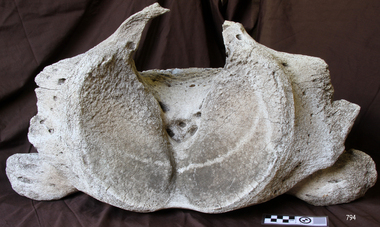 Flagstaff Hill Maritime Museum and Village
Animal specimen - Whale Vertebrae, Undetermined
... Prior to carrying out a detailed condition report of the cetacean skeletons, it is useful to have an understanding of the materials we are likely to encounter, in terms of structure and chemistry. ...Prior to carrying out a detailed condition report of the cetacean skeletons, it is useful to have an understanding of the materials we are likely to encounter, in terms of structure and chemistry. ...Prior to carrying out a detailed condition report of the cetacean skeletons, it is useful to have an understanding of the materials we are likely to encounter, in terms of structure and chemistry. This entry invites you to join in learning about the composition of whale bone and oil. Whale bone (Cetacean) bone is comprised of a composite structure of both an inorganic matrix of mainly hydroxylapatite (a calcium phosphate mineral), providing strength and rigidity, as well as an organic protein ‘scaffolding’ of mainly collagen, facilitating growth and repair (O’Connor 2008, CCI 2010). Collagen is also the structural protein component in cartilage between the whale vertebrae and attached to the fins of both the Killer Whale and the Dolphin. Relative proportions in the bone composition (affecting density), are linked with the feeding habits and mechanical stresses typically endured by bones of particular whale types. A Sperm Whale (Physeter macrocephalus Linnaeus, 1758) skeleton (toothed) thus has a higher mineral value (~67%) than a Fin Whale (Balaenoptera physalus Linnaeus, 1758) (baleen) (~60%) (Turner Walker 2012). The internal structure of bone can be divided into compact and cancellous bone. In whales, load-bearing structures such as mandibles and upper limb bones (e.g. humerus, sternum) are largely composed of compact bone (Turner Walker 2012). This consists of lamella concentrically deposited around the longitudinal axis and is permeated by fluid carrying channels (O’Connor 2008). Cancellous (spongy) bone, with a highly porous angular network of trabeculae, is less stiff and thus found in whale ribs and vertebrae (Turner Walker 2012). Whale oil Whales not only carry a thick layer of fat (blubber) in the soft tissue of their body for heat insulation and as a food store while they are alive, but also hold large oil (lipid) reserves in their porous bones. Following maceration of the whale skeleton after death to remove the soft tissue, the bones retain a high lipid content (Higgs et. al 2010). Particularly bones with a spongy (porous) structure have a high capacity to hold oil-rich marrow. Comparative data of various whale species suggests the skull, particularly the cranium and mandible bones are particularly oil rich. Along the vertebral column, the lipid content is reduced, particularly in the thoracic vertebrae (~10-25%), yet greatly increases from the lumbar to the caudal vertebrae (~40-55%). The chest area (scapula, sternum and ribs) show a mid-range lipid content (~15-30%), with vertically orientated ribs being more heavily soaked lower down (Turner Walker 2012, Higgs et. al 2010). Whale oil is largely composed of triglycerides (molecules of fatty acids attached to a glycerol molecule). In Arctic whales a higher proportion of unsaturated, versus saturated fatty acids make up the lipid. Unsaturated fatty acids (with double or triple carbon bonds causing chain kinks, preventing close packing (solidifying) of molecules), are more likely to be liquid (oil), versus solid (fat) at room temperature (Smith and March 2007). Objects Made From the Whaling Industry We all know that men set forth in sailing ships and risked their lives to harpoon whales on the open seas throughout the 1800s. And while Moby Dick and other tales have made whaling stories immortal, people today generally don't appreciate that the whalers were part of a well-organized industry. The ships that set out from ports in New England roamed as far as the Pacific in hunt of specific species of whales. Adventure may have been the draw for some whalers, but for the captains who owned whaling ships, and the investors which financed voyages, there was a considerable monetary payoff. The gigantic carcasses of whales were chopped and boiled down and turned into products such as the fine oil needed to lubricate increasing advanced machine tools. And beyond the oil derived from whales, even their bones, in an era before the invention of plastic, was used to make a wide variety of consumer goods. In short, whales were a valuable natural resource the same as wood, minerals, or petroleum we now pump from the ground. Oil From Whale’s Blubber Oil was the main product sought from whales, and it was used to lubricate machinery and to provide illumination by burning it in lamps. When a whale was killed, it was towed to the ship and its blubber, the thick insulating fat under its skin, would be peeled and cut from its carcass in a process known as “flensing.” The blubber was minced into chunks and boiled in large vats on board the whaling ship, producing oil. The oil taken from whale blubber was packaged in casks and transported back to the whaling ship’s home port (such as New Bedford, Massachusetts, the busiest American whaling port in the mid-1800s). From the ports it would be sold and transported across the country and would find its way into a huge variety of products. Whale oil, in addition to be used for lubrication and illumination, was also used to manufacture soaps, paint, and varnish. Whale oil was also utilized in some processes used to manufacture textiles and rope. Spermaceti, a Highly Regarded Oil A peculiar oil found in the head of the sperm whale, spermaceti, was highly prized. The oil was waxy, and was commonly used in making candles. In fact, candles made of spermaceti were considered the best in the world, producing a bright clear flame without an excess of smoke. Spermaceti was also used, distilled in liquid form, as an oil to fuel lamps. The main American whaling port, New Bedford, Massachusetts, was thus known as "The City That Lit the World." When John Adams was the ambassador to Great Britain before serving as president he recorded in his diary a conversation about spermaceti he had with the British Prime Minister William Pitt. Adams, keen to promote the New England whaling industry, was trying to convince the British to import spermaceti sold by American whalers, which the British could use to fuel street lamps. The British were not interested. In his diary, Adams wrote that he told Pitt, “the fat of the spermaceti whale gives the clearest and most beautiful flame of any substance that is known in nature, and we are surprised you prefer darkness, and consequent robberies, burglaries, and murders in your streets to receiving as a remittance our spermaceti oil.” Despite the failed sales pitch John Adams made in the late 1700s, the American whaling industry boomed in the early to mid-1800s. And spermaceti was a major component of that success. Spermaceti could be refined into a lubricant that was ideal for precision machinery. The machine tools that made the growth of industry possible in the United States were lubricated, and essentially made possible, by oil derived from spermaceti. Whalebone The bones and teeth of various species of whales were used in a number of products, many of them common implements in a 19th century household. Whales are said to have produced “the plastic of the 1800s.” The bone of the whale which was most commonly used wasn’t technically a bone, it was baleen, a hard material arrayed in large plates, like gigantic combs, in the mouths of some species of whales. The purpose of the baleen is to act as a sieve, catching tiny organisms in sea water, which the whale consumes as food. As baleen was tough yet flexible, it could be used in a number of practical applications. And it became commonly known as whalebone. Perhaps the most common use of whalebone was in the manufacture of corsets, which fashionable ladies in the 1800s wore to compress their waistlines. One typical corset advertisement from the 1800s proudly proclaims, “Real Whalebone Only Used.” Whalebone was also used for collar stays, buggy whips, and toys. Its remarkable flexibility even caused it to be used as the springs in early typewriters. The comparison to plastic is apt. Think of common items which today might be made of plastic, and it's likely that similar items in the 1800s would have been made of whalebone. Baleen whales do not have teeth. But the teeth of other whales, such as the sperm whale, would be used as ivory in such products as chess pieces, piano keys, or the handles of walking sticks. Pieces of scrimshaw, or carved whale's teeth, would probably be the best remembered use of whale's teeth. However, the carved teeth were created to pass the time on whaling voyages and were never a mass production item. Their relative rarity, of course, is why genuine pieces of 19th century scrimshaw are considered to be valuable collectibles today. Reference: McNamara, Robert. "Objects Made From the Whaling Industry." ThoughtCo, Jul. 31, 2021, thoughtco.com/products-produced-from-whales-1774070.Whale bone during the 17th, 18th, 19th and early 20th centuries was an important industry providing an important commodity. Whales from these times provided everything from lighting & machine oils to using the animal's bones for use in corsets, collar stays, buggy whips, and many other everyday items then in use.Whale bone Vertebrae with advanced stage of calcification as indicated by deep pitting. Off white to grey.None.warrnambool, flagstaff-hill, flagstaff-hill-maritime-museum, maritime-museum, shipwreck-coast, flagstaff-hill-maritime-village, whale bones, whale skeleton, whales, whale bone, corsets, toys, whips, whaleling industry, maritime fishing, whalebone
