
Showing 67 items matching "coat hooks"
-
 Flagstaff Hill Maritime Museum and Village
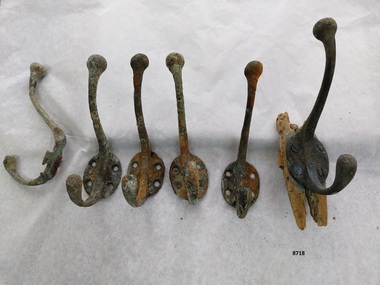
Functional object - Coat Hooks, circa 1870's
... Coat Hooks......coat hooks...One of the coat hooks is still attached to a fragment of timber which suggests it was a fitting on the Loch Ard rather than cargo. ...Six Victorian brass coat hooks in varying degrees of damage and oxidation recovered from the wreck of the Loch Ard. ...Functional object Coat Hooks ...These six brass Victorian coat hooks were salvaged from the wreck of the Loch Ard, on the southwest coast of Victoria and donated by a friend of the diver. One of the coat hooks is still attached to a fragment of timber which suggests it was a fitting on the Loch Ard rather than cargo. It is not known if the other hooks were cargo or fittings. They are designed to be screwed into a wall to hang coats, hats or towels. Victorian brass coat hooks were mass produced in factories using the "Sand Casting" method, where molten brass (a copper and zinc alloy) was poured into sand molds to form the correct shape. Once the molten brass solidified, the sand mold was broken open and the rough hooks removed to be cleaned and sanded. Workers would use an early lathe and drill press to flatten the mounting plates and drill the screw holes. They were then polished with abrasive wheels to achieve a bright finish. The hooks are showing different degrees of green Patina and brown Copper Oxide which occurs when copper is exposed to air and water over long periods. it is generally harmless and acts as a protective shield against further decay. The ship Loch Ard was built on the River Clyde in Scotland in 1873 for the prestigious Loch Line of colonial clipper ships, designed for the Australian run. It sailed from England on 1st March 1878 carrying 37 crew, 17 passengers and a load of cargo. The general cargo reflected the affluence of Melbourne at the time. On board were straw hats, umbrellas, perfumes, clay pipes, pianos, clocks, confectionary, linen and candles, as well as a heavier load of railway irons, cement, lead and copper. There were items included that were intended for display in the Melbourne International Exhibition in 1880 - a diverse general cargo ranging from luxury items to bulk railway iron. On 1 June 1878, emerging from fog and hearing too late the sound of breakers against the tall limestone cliffs, the vessel struck the southern foot of Mutton Bird Island and sank in 23 metres of water. Of the fifty-four people on board only two survived, one young male crewman, Tom Pearce, and one young female passenger, Eva Carmichael. Ten days after the Loch Ard tragedy, salvage rights to the wreck were sold at auction for £2,120. Cargo valued at £3,000 was salvaged and placed on the beach, but most washed back into the sea when another storm developed. The wreck of Loch Ard still lies at the base of Mutton Bird Island. Much of the cargo has now been salvaged and some was washed up into what is now known as Loch Ard Gorge. Cargo and artefacts have also been illegally salvaged over many years before protective legislation was introduced in 1976. One of the most unlikely pieces of cargo to have survived the shipwreck was a Minton porcelain peacock - one of only seven in the world. The peacock was destined for the Melbourne International Exhibition in 1880. It had been well packed, which gave it adequate protection during the violent storm. Today, the Minton peacock can be seen at the Flagstaff Hill Maritime Museum in Warrnambool. From Australia's most dramatic shipwreck it has now become Australia's most valuable shipwreck artefact and is one of very few 'objects' on the Victorian State Heritage Register.Flagstaff Hill’s collection of artefacts from LOCH ARD is significant for being one of the largest collections of artefacts from this shipwreck in Victoria. It is significant for its association with the shipwreck, which is on the Victorian Heritage Register (VHR S417). The collection is significant because of the relationship between the objects, as together they have a high potential to interpret the story of the LOCH ARD. The LOCH ARD collection is archaeologically significant as the remains of a large international passenger and cargo ship. The LOCH ARD collection is historically significant for representing aspects of Victoria’s shipping history and its potential to interpret sub-theme 1.5 of Victoria’s Framework of Historical Themes (living with natural processes). The collection is also historically significant for its association with the LOCH ARD, which was one of the worst and best known shipwrecks in Victoria’s history.Six Victorian brass coat hooks in varying degrees of damage and oxidation recovered from the wreck of the Loch Ard. All of the hooks are the same size and design (with two prongs of different lengths and four screw holes) but one of the hooks (8721.6) is still attached to a fragment of wood. Hook 8721.1 has a broken attachment plate on either side of the main shaft and most of them have varying degrees of green and brown oxidation.flagstaff hill maritime museum and village, warrnambool, great ocean road, shipwreck coast, loch ard, wreck of the loch ard, loch ard artifacts, hooks, coat hooks, victorian coat hooks, salvage -
 Whitehorse Historical Society Inc.
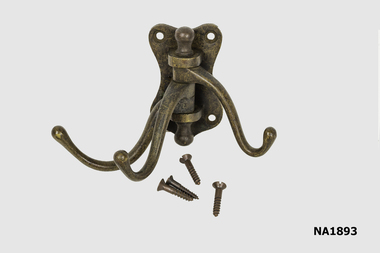
Functional object - Coat Hook
... Coat Hook...Heavy metal three pronged coat hook. Hooks are curved at ends and swivel from centre piece....Functional object Coat Hook ...Heavy metal three pronged coat hook. Hooks are curved at ends and swivel from centre piece.buildings, fittings -
 Whitehorse Historical Society Inc.
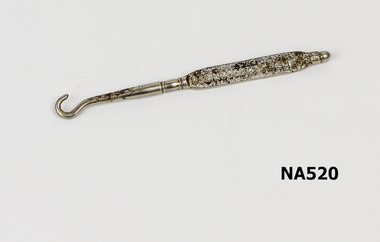
Accessory - Button Hook
... Silver coated button hook...Used as advertising material by Nugget Boot Polish Co. costume accessories footwear accessories 'Use Nugget Polish' Silver coated button hook Accessory Button Hook ...Used as advertising material by Nugget Boot Polish Co.Silver coated button hook'Use Nugget Polish'costume accessories, footwear accessories -
 Mont De Lancey
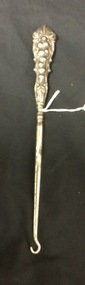
Button hook
... Large silver coated button hook with elaborate handle....buttonhooks Large silver coated button hook with elaborate handle. Button hook ...Large silver coated button hook with elaborate handle.buttonhooks -
 Orbost & District Historical Society
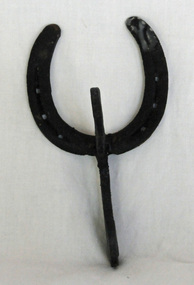
coat hook
... coat hook...A home-made coat hook made from two small horseshoes which have been bent and welded together to make a hook for hanging coats. ...It has been painted black. coat hook ...This hanging rack has been made out of used horse shoes. It may have been used separately or as part of a longer rack attached to a wooden backing.This item shows the skill and craftmanship of self-reliant rural families.A home-made coat hook made from two small horseshoes which have been bent and welded together to make a hook for hanging coats. It has been painted black.horse-shoes handicraft hanging-rack -
 Ithacan Historical Society
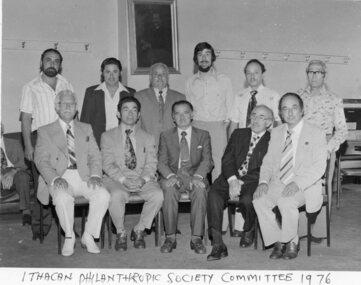
Photograph, Ithacan Philanthropic Society committee, 1976
... They are seated and standing in front of a wall which has a large photograph on it and coat hooks along the wall....They are seated and standing in front of a wall which has a large photograph on it and coat hooks along the wall. Ithacan Philanthropic Society committee Photograph ...The photograph of the all male committee of the IPS was taken at Ithaca House in 1976, sixty years after the establishment of the Ithacan Philanthropic Society. At the time, in accordance with the constitution, women were ineligible to be full members and therefore committee members. Pictured L-R, back: Petros Kouratos, Dennis Lourantos, J. Mavromatis, Dennis Katsamas, Naki Raftopoulos, Parry Gabriel; front: Michael Black, (Mavrokefalos) Evangelos Metaxas, Nick Varigos (Varvarigos), Sotiris Sikiotis, Stathy Raftopoulos. A black and white photograph of eleven men, members of the Ithacan Philanthropic Society Committee 1976. They are seated and standing in front of a wall which has a large photograph on it and coat hooks along the wall. -
 Whitehorse Historical Society Inc.
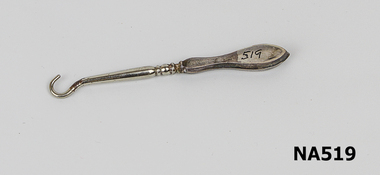
Accessory - Button Hook
... Small silver coated button hook used to catch buttons and pull them through eyelets of boots and shoes....costume accessories footwear accessories Small silver coated button hook used to catch buttons and pull them through eyelets of boots and shoes. ...Small silver coated button hook used to catch buttons and pull them through eyelets of boots and shoes.costume accessories, footwear accessories -
 Musculoskeletal Health Australia (now held by the Glen Eira Historical Society)
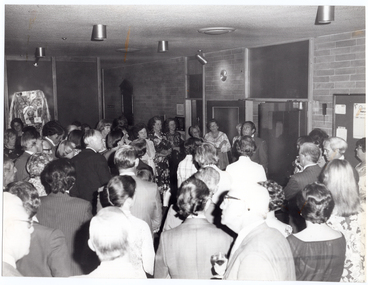
Photograph - Group photo, 02/12/1976
... There are various items hanging on the wall, including a notice board, a decorative wooden honour board, some coat hooks, and a clock....There are various items hanging on the wall, including a notice board, a decorative wooden honour board, some coat hooks, and a clock. Photograph Group photo ...On Thursday the 2nd of December 1976, the Rheumatism and Arthritis Association of Victoria held a Wine Tasting and Smorgasboard fundraising event at the Green Room Club in Albert Park. It was attended by around 120 members and friends. In this photo, members and guests listen to a wine appreciation speaker during the event. This photo appears on page 8 of the Vol 3, December 1976 edition of the Rheumatism and Arthritis Association of Victoria's quarterly newsletter, News Review. The photo accompanies a brief article titled, "Wine Tasting and Smorgasboard". It is captioned: "A section of the interested audience listening to an informative wine appreciation talk given by a representative of Dalgetys who so generously donated the wines for the wine tasting. Photo: Ben Baxter." Beneath the article and photos is some information about the Photographer: "Ben Baxter is R.A.A.V.'s official Photographer and we are indeed fortunate to have obtained his expertise on a voluntary basis. If you wish to purchase any of the Photographs appearing in News Review, con-tack the Editor direct through the R.A.A.V. Office."B&W photo of a large group of people gathered around a man, who is on one side of a large room. He is standing near the wall and a double doorway, facing the group of people in the room. There are various items hanging on the wall, including a notice board, a decorative wooden honour board, some coat hooks, and a clock.[Handwritten in light blue ink] 53% PIC "D" [Handwritten in black ink] watching raffle draw [crossed out] Wine talk by rep from Dalgety's (donators of wine) Wine Tasting & Smorgasborg Green Room Club, 2/12/76rheumatism and arthritis association of victoria, raav, wine tasting, smorgasboard, fundraising, wine appreciation, presentation, dalgety’s wine estates, donation, green room club, albert park, ben baxter, photographer, news review, 1976 -
 Warrnambool and District Historical Society Inc.
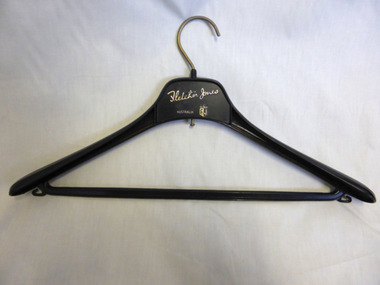
Domestic object - Fletcher Jones Coat Hanger, Late 20th century
... Black plastic coat hanger with metal hook. ...The Fletcher Jones Gardens remain a significant landmark in the city warrnambool fletcher jones pleasant hill fletcher jones gardens coathanger Fletcher Jones in gold lettering below the hook. Black plastic coat hanger with metal hook. Domestic object Fletcher Jones Coat Hanger ...David Fletcher Jones commenced his tailoring and hawking business in the 1920’s. The business expanded through the decades to become the main manufacturing employer in the city of Warrnambool. The business moved from Liebig Street around 1947 to a site in East Warrnambool which was once an old quarry. The factory which was built at “Pleasant Hill” manufactured quality clothing, initially men’s trousers, suits which expanded in later times to include ladies’ wear. A network of stores was opened throughout Australia to sell the garments. A common item linked to a significant business and personality of Warrnambool.Fletcher Jones Factory held a significant place in the economic development of the city. The Fletcher Jones Gardens remain a significant landmark in the cityBlack plastic coat hanger with metal hook. Fletcher Jones in gold lettering below the hook.warrnambool, fletcher jones, pleasant hill, fletcher jones gardens, coathanger -
 Williamstown Historical Society Inc
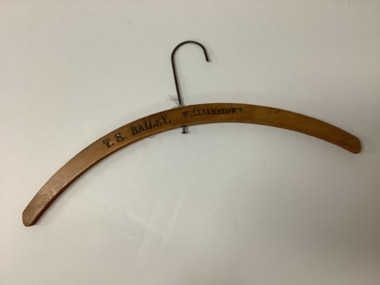
Domestic object - Wooden coat hanger
... Varnished wooden coat hanger with metal hook and black stamped inscription ...Bailey Williamstown" Varnished wooden coat hanger with metal hook and black stamped inscription Domestic object Wooden coat hanger ...Thomas Samuel Bailey traded as a local merchant tailor in Williamstown from 1886 to 1926. He occupied premises in Parker Street, Nelson Place and at 2 Thompson Street. He was married with four daughters and two sons; one son was killed in WW1 in 1917. He sold his business in 1926 to H. Russ, a tailor from Ballarat and died in September 1926. Items like this coat hanger were usually offered free to advertise businesses.Varnished wooden coat hanger with metal hook and black stamped inscription "T. S. Bailey Williamstown" williamstown tailors, clothing accessories -
 Cheese World Museum
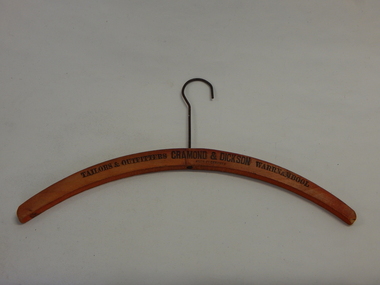
Coathanger, prior to 1973
... Orange varnished curved wooden coat hanger with wire hook damaged on one end...Cramond and Dickson was a large department store located on the corner of Liebig and Timor Streets Warrnambool trading from 1856 to 1973. warrnambool cramond & dickson uebergang germany coathanger Black ink engraving -Tailors & Outfitters Cramond & Dickson Warrnambool/ Made in Germany Orange varnished curved wooden coat hanger with wire hook damaged on one end Coathanger ...The Percy Uebergang family lived at Tooram Park, Allansford from 1912 until 1992. Percy and Myrtle Uebergang's children were twins, Ray and Joyce born in 1926 who lived at Tooram Park until their deaths, Ray in 1986 and Joyce in 1992. Neither Ray nor Joyce married and following the death of her brother Joyce set up the Ray and Joyce Uebergang Foundation which supports the local community. This coathanger is part of the collection of items given into the care of the Cheese World Museum. Cramond and Dickson was a large department store located on the corner of Liebig and Timor Streets Warrnambool trading from 1856 to 1973.Orange varnished curved wooden coat hanger with wire hook damaged on one endBlack ink engraving -Tailors & Outfitters Cramond & Dickson Warrnambool/ Made in Germanywarrnambool, cramond & dickson, uebergang, germany, coathanger -
 Whitehorse Historical Society Inc.
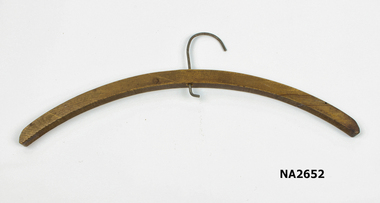
Functional object - Coat hanger, 1930-1940
... Plain curved wooden coat hanger with metal hook. Incised and stained name on one side....Plain curved wooden coat hanger with metal hook. Incised and stained name on one side. ...Plain curved wooden coat hanger with metal hook. Incised and stained name on one side.Tailor and Outfitters Ince Bros|174 Swanston Street Melbourne|Made in U.S.A.trades, tailoring -
 Emerald Museum & Nobelius Heritage Park
Functional object - Spectacles, Dobbie Bros, 1940s
... Black celluloid circular spectacles with gold-coated/plated hook arms. The small accompanying case is constructed with a hard plastic with a thin textured coating. ...Jim and Rita had two daughters, one being Vera, and the other Shirley. 1940s Spectacles eyeglasses Eyewear Dobbie Bros Rita Madigan Vera Madigan Madigan Emerald & District Collection Black celluloid circular spectacles with gold-coated/plated hook arms. The small accompanying case is constructed with a hard plastic with a thin textured coating. ...The Madigan family were long term residents and business owners in Emerald. Jim Madigan was the local Butcher once he returned from World War 1. Rita's father owned the Emerald bakery since 1917. These spectacles belonged to Rita Madigan (nee McLean) in the 1940s and were donated to the Emerald Museum by Vera Madigan, one of Jim and Rita's daughters. Jim and Rita had two daughters, one being Vera, and the other Shirley.Black celluloid circular spectacles with gold-coated/plated hook arms. The small accompanying case is constructed with a hard plastic with a thin textured coating. The inside has a protective royal blue velvet coating. Inside the case there is a label identifying the Opticians as 'Dobbie Bros', located at 22 Bourke Street, Melbourne.1940s, spectacles, eyeglasses, eyewear, dobbie bros, rita madigan, vera madigan, madigan, emerald & district collection -
 Melbourne Tram Museum
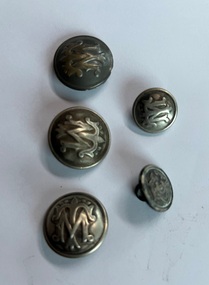
Uniform - Coat Buttons, Melbourne Tramway and Omnibus Co (MTOCo), 1900s
... Set of five MTOCo coat buttons fitted with hooks - nickel plated brass - 3 large coat, 2 small sleeve or cap....Trams tramways cable trams MTO Co buttons uniforms Set of five MTOCo coat buttons fitted with hooks - nickel plated brass - 3 large coat, 2 small sleeve or cap. ...Each button has the logo of the Melbourne Tramway and Omnibus Co. pressed into the front of the badge - a M interwoven with a T. All made by Stokes and Sons of Melbourne. Worn by Cable Tram employeesDemonstrates buttons worn by the MTOCo staff.Set of five MTOCo coat buttons fitted with hooks - nickel plated brass - 3 large coat, 2 small sleeve or cap.trams, tramways, cable trams, mto co, buttons, uniforms -
 Lakes Entrance Historical Society
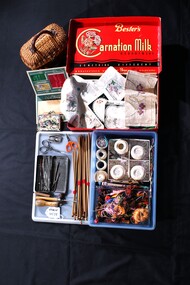
Equipment - Collection of Sewing/Knitting/Crochet Equipment, c1900 -1920
... Small plastic box containing 1 awl, 1 thimble, 1 large crochet hook, 3 embroidery scissors, 1 tiny screw driver, large sewing needles. Large Plastic box containing 8 reels crochet cottons (Coats), 1 fine crochet hook, 1 small embroidery scissors, 1 crochet pattern, embroidery silks. ...Small plastic box containing 1 awl, 1 thimble, 1 large crochet hook, 3 embroidery scissors, 1 tiny screw driver, large sewing needles. Large Plastic box containing 8 reels crochet cottons (Coats), 1 fine crochet hook, 1 small embroidery scissors, 1 crochet pattern, embroidery silks. ...This wonderful collection of craft equipment has been lovingly preserved by the donor, much of it is 100 years old.Twenty two bamboo knitting needles. Small sewing basket containing small embroidered sewing kit. Small tin containing 14 crochet hooks with covers, 9 fine crochet hooks, one fine latch hook. Small plastic box containing 1 awl, 1 thimble, 1 large crochet hook, 3 embroidery scissors, 1 tiny screw driver, large sewing needles. Large Plastic box containing 8 reels crochet cottons (Coats), 1 fine crochet hook, 1 small embroidery scissors, 1 crochet pattern, embroidery silks. Red Box containing crochet butterfly paper patterns, Embroidery pieces unfinished.craft supplies, equipment, collections -
 Warrnambool RSL Sub Branch
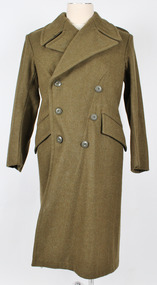
Great Coat, Kindred Manufacturing
... Above this there is a thin strip of fabric attached at either short end to use for hanging the coat on a hook. At the back of the coat there is a single pleat stretching from the base of the neck to the base of the coat. ...Above this there is a thin strip of fabric attached at either short end to use for hanging the coat on a hook. At the back of the coat there is a single pleat stretching from the base of the neck to the base of the coat. ...Long khaki coloured heavy coat. Thick, sharp angled collars. Each collar has a split half way down and a small metallic hoop attached to the lower middle section of the high parts of the collars. Each shoulder has a lapel that is fastened with a plastic button. The coat is double breasted. There are three grey buttons for use on the right and three grey buttons for show on the left. There is also a spare button on the inside left front section near the breast area. There are two pockets on the front that are angled with the highest point near the centre and the lowest point near the hips. There is a small section of spare fabric attached with two small plastic buttons to the inner left of the jacket near the breast. The arms, underarm and upper back section contains an inside khaki coloured lining of thinner, most likely cotton fabric. Attached to this at the base of the neck is a satin or synthetic fabric label with inscriptions in black ink. Above this there is a thin strip of fabric attached at either short end to use for hanging the coat on a hook. At the back of the coat there is a single pleat stretching from the base of the neck to the base of the coat. Approximately half way down the pleat there is a split in the fabric that is fastened with two plastic buttons. At the waist there are two fabric flaps that fasten together at the back with three buttons.The label attached on the inside at the base of the neck reads: “KINDRED MANUFACTURING / PTY LTD. / QLD / 1083” There is then a broad arrow followed by: “B406-66-093-1812 / SIZE 109 / TO FIT CHEST 100cm / NAME.................../ SERVICE No......................” -
 Warrnambool RSL Sub Branch
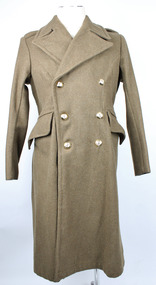
Great Coat, Bradley's Industries N.S.W, 1951
... Above this there is a thin strip of fabric attached at either short end to use for hanging the coat on a hook. At the back of the coat there is a single pleat stretching from the base of the neck to the base of the coat. ...Above this there is a thin strip of fabric attached at either short end to use for hanging the coat on a hook. At the back of the coat there is a single pleat stretching from the base of the neck to the base of the coat. ...Long khaki coloured heavy coat. Thick, sharp angled collars. Right collar has a hook and eye attached in the lapel split. Collar has zig zag stitching and two plastic buttons on each the left and right sides. Each shoulder has a lapel that is fastened with a plastic button. The coat is double breasted. Three buttons on the right side, held in place by metal loops on the interior rather than stiches; mirrored on the left side. Left interior has oval shaped fabric buttoned to the interior with two brown (possibly bakelite) buttons. A larger brown button sits atop the smaller as a means of closing the jacket from the inside. There are two pockets on the front that are angled with the highest point near the centre and the lowest point near the hips. The arms, underarm and upper back section contains an inside khaki coloured lining of thinner, most likely cotton fabric. Above this there is a thin strip of fabric attached at either short end to use for hanging the coat on a hook. At the back of the coat there is a single pleat stretching from the base of the neck to the base of the coat. Approximately half way down the pleat there is a split in the fabric that is fastened with two plastic buttons. At the waist there are two fabric flaps that fasten together at the back with three buttons, also held in place with metal loops on the reverse.Label on interior back lining reads "REGIMENTAL No./NAME" Label on interior of the right "GREATCOATS. G.S. 1946 Patt/SIZE 1/HEIGHT 5'3"/CHEST 34"-36"/BRADLEY'S INDUSTRIES N.S.W./1951" Handwritten on label, "M J Davis"post war, army uniform, great coat, inter war, uniform, military uniform, wool, greatcoats, bradley's industries -
 Flagstaff Hill Maritime Museum and Village
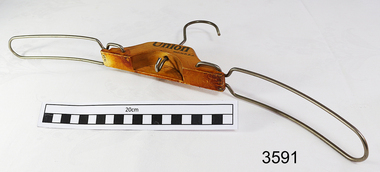
Coat hanger, mid 1900's
... Folding coat hanger owned by Dr Angus. Wooden centre piece and looped metal shoulder pieces and metal hook. ...Folding coat hanger owned by Dr Angus. Wooden centre piece and looped metal shoulder pieces and metal hook. ...This wooden and wire, folding coat hanger was donated to Flagstaff Hill Maritime Village by the family of Doctor William Roy Angus, Surgeon and Oculist. It is part of the “W.R. Angus Collection” that includes historical medical equipment, surgical instruments and material once belonging to Dr Edward Ryan and Dr Thomas Francis Ryan, (both of Nhill, Victoria) as well as Dr Angus’ own belongings. The Collection’s history spans the medical practices of the two Doctors Ryan, from 1885-1926 plus that of Dr Angus, up until 1969. ABOUT THE “W.R.ANGUS COLLECTION” Doctor William Roy Angus M.B., B.S., Adel., 1923, F.R.C.S. Edin.,1928 (also known as Dr Roy Angus) was born in Murrumbeena, Victoria in 1901 and lived until 1970. He qualified as a doctor in 1923 at University of Adelaide, was Resident Medical Officer at the Royal Adelaide Hospital in 1924 and for a period was house surgeon to Sir (then Mr.) Henry Simpson Newland. Dr Angus was briefly an Assistant to Dr Riddell of Kapunda, then commenced private practice at Curramulka, Yorke Peninsula, SA, where he was physician, surgeon and chemist. In 1926, he was appointed as new Medical Assistant to Dr Thomas Francis Ryan (T.F. Ryan, or Tom), in Nhill, Victoria, where his experiences included radiology and pharmacy. In 1927 he was Acting House Surgeon in Dr Tom Ryan’s absence. Dr Angus had become engaged to Gladys Forsyth and they decided he would take time to further his studies overseas in the UK in 1927. He studied at London University College Hospital and at Edinburgh Royal Infirmary and in 1928, was awarded FRCS (Fellow from the Royal College of Surgeons), Edinburgh. He worked his passage back to Australia as a Ship’s Surgeon on the on the Australian Commonwealth Line’s SS Largs Bay. Dr Angus married Gladys in 1929, in Ballarat. (They went on to have one son (Graham 1932, born in SA) and two daughters (Helen (died 12/07/1996) and Berenice (Berry), both born at Mira, Nhill ) Dr Angus was a ‘flying doctor’ for the A.I.M. (Australian Inland Ministry) Aerial Medical Service in 1928 . The organisation began in South Australia through the Presbyterian Church in that year, with its first station being in the remote town of Oodnadatta, where Dr Angus was stationed. He was locum tenens there on North-South Railway at 21 Mile Camp. He took up this ‘flying doctor’ position in response to a call from Dr John Flynn; the organisation was later known as the Flying Doctor Service, then the Royal Flying Doctor Service. A lot of his work during this time involved dental surgery also. Between 1928-1932 he was surgeon at the Curramulka Hospital, Yorke Peninsula, South Australia. In 1933 Dr Angus returned to Nhill where he’d previously worked as Medical Assistant and purchased a share of the Nelson Street practice and Mira hospital from Dr Les Middleton one of the Middleton Brothers, the current owners of what was once Dr Tom Ryan’s practice. Dr L Middleton was House Surgeon to the Nhill Hospital 1926-1933, when he resigned. [Dr Tom Ryan’s practice had originally belonged to his older brother Dr Edward Ryan, who came to Nhill in 1885. Dr Edward saw patients at his rooms, firstly in Victoria Street and in 1886 in Nelson Street, until 1901. The Nelson Street practice also had a 2 bed ward, called Mira Private Hospital ). Dr Edward Ryan was House Surgeon at the Nhill Hospital 1884-1902 . He also had occasions where he successfully performed veterinary surgery for the local farmers too. Dr Tom Ryan then purchased the practice from his brother in 1901. Both Dr Edward and Dr Tom Ryan work as surgeons included eye surgery. Dr Tom Ryan performed many of his operations in the Mira private hospital on his premises. He too was House Surgeon at the Nhill Hospital 1902-1926. Dr Tom Ryan had one of the only two pieces of radiology equipment in Victoria during his practicing years – The Royal Melbourne Hospital had the other one. Over the years Dr Tom Ryan gradually set up what was effectively a training school for country general-practitioner-surgeons. Each patient was carefully examined, including using the X-ray machine, and any surgery was discussed and planned with Dr Ryan’s assistants several days in advance. Dr Angus gained experience in using the X-ray machine there during his time as assistant to Dr Ryan. Dr Tom Ryan moved from Nhill in 1926. He became a Fellow of the Royal Australasian College of Surgeons in 1927, soon after its formation, a rare accolade for a doctor outside any of the major cities. He remained a bachelor and died suddenly on 7th Dec 1955, aged 91, at his home in Ararat. Scholarships and prizes are still awarded to medical students in the honour of Dr T.F. Ryan and his father, Dr Michael Ryan, and brother, John Patrick Ryan. ] When Dr Angus bought into the Nelson Street premises in Nhill he was also appointed as the Nhill Hospital’s Honorary House Surgeon 1933-1938. His practitioner’s plate from his Nhill surgery states “HOURS Daily, except Tuesdays, Fridays and Saturday afternoons, 9-10am, 2-4pm, 7-8pm. Sundays by appointment”. This plate is now mounted on the doorway to the Port Medical Office at Flagstaff Hill Maritime Village, Warrnambool. Dr Edward Ryan and Dr Tom Ryan had an extensive collection of historical medical equipment and materials spanning 1884-1926 and when Dr Angus took up practice in their old premises he obtained this collection, a large part of which is now on display at the Port Medical Office at Flagstaff Hill Maritime Village in Warrnambool. During his time in Nhill Dr Angus was involved in the merging of the Mira Hospital and Nhill Public Hospital into one public hospital and the property titles passed on to Nhill Hospital in 1939. In 1939 Dr Angus and his family moved to Warrnambool where he purchased “Birchwood,” the 1852 home and medical practice of Dr John Hunter Henderson, at 214 Koroit Street. (This property was sold in1965 to the State Government and is now the site of the Warrnambool Police Station. ). The Angus family was able to afford gardeners, cooks and maids; their home was a popular place for visiting dignitaries to stay whilst visiting Warrnambool. Dr Angus had his own silk worm farm at home in a Mulberry tree. His young daughter used his centrifuge for spinning the silk. Dr Angus was appointed on a part-time basis as Port Medical Officer (Health Officer) in Warrnambool and held this position until the 1940’s when the government no longer required the service of a Port Medical Officer in Warrnambool; he was thus Warrnambool’s last serving Port Medical Officer. (The duties of a Port Medical Officer were outlined by the Colonial Secretary on 21st June, 1839 under the terms of the Quarantine Act. Masters of immigrant ships arriving in port reported incidents of diseases, illness and death and the Port Medical Officer made a decision on whether the ship required Quarantine and for how long, in this way preventing contagious illness from spreading from new immigrants to the residents already in the colony.) Dr Angus was a member of the Australian Medical Association, for 35 years and surgeon at the Warrnambool Base Hospital 1939-1942, He served as a Surgeon Captain during WWII1942-45, in Ballarat, Victoria, and in Bonegilla, N.S.W., completing his service just before the end of the war due to suffering from a heart attack. During his convalescence he carved an intricate and ‘most artistic’ chess set from the material that dentures were made from. He then studied ophthalmology at the Royal Melbourne Eye and Ear Hospital and created cosmetically superior artificial eyes by pioneering using the intrascleral cartilage. Angus received accolades from the Ophthalmological Society of Australasia for this work. He returned to Warrnambool to commence practice as an ophthalmologist, pioneering in artificial eye improvements. He was Honorary Consultant Ophthalmologist to Warrnambool Base Hospital for 31 years. He made monthly visits to Portland as a visiting surgeon, to perform eye surgery. He represented the Victorian South-West subdivision of the Australian Medical Association as its secretary between 1949 and 1956 and as chairman from 1956 to 1958. In 1968 Dr Angus was elected member of Spain’s Barraquer Institute of Barcelona after his research work in Intrasclearal cartilage grafting, becoming one of the few Australian ophthalmologists to receive this honour, and in the following year presented his final paper on Living Intrasclearal Cartilage Implants at the Inaugural Meeting of the Australian College of Ophthalmologists in Melbourne In his personal life Dr Angus was a Presbyterian and treated Sunday as a Sabbath, a day of rest. He would visit 3 or 4 country patients on a Sunday, taking his children along ‘for the ride’ and to visit with him. Sunday evenings he would play the pianola and sing Scottish songs to his family. One of Dr Angus’ patients was Margaret MacKenzie, author of a book on local shipwrecks that she’d seen as an eye witness from the late 1880’s in Peterborough, Victoria. In the early 1950’s Dr Angus, painted a picture of a shipwreck for the cover jacket of Margaret’s book, Shipwrecks and More Shipwrecks. She was blind in later life and her daughter wrote the actual book for her. Dr Angus and his wife Gladys were very involved in Warrnambool’s society with a strong interest in civic affairs. Their interests included organisations such as Red Cross, Rostrum, Warrnambool and District Historical Society (founding members), Wine and Food Society, Steering Committee for Tertiary Education in Warrnambool, Local National Trust, Good Neighbour Council, Housing Commission Advisory Board, United Services Institute, Legion of Ex-Servicemen, Olympic Pool Committee, Food for Britain Organisation, Warrnambool Hospital, Anti-Cancer Council, Boys’ Club, Charitable Council, National Fitness Council and Air Raid Precautions Group. He was also a member of the Steam Preservation Society and derived much pleasure from a steam traction engine on his farm. He had an interest in people and the community He and his wife Gladys were both involved in the creation of Flagstaff Hill, including the layout of the gardens. After his death (28th March 1970) his family requested his practitioner’s plate, medical instruments and some personal belongings be displayed in the Port Medical Office surgery at Flagstaff Hill Maritime Village, and be called the “W. R. Angus Collection”. The W.R. Angus Collection is significant for still being located at the site it is connected with, Doctor Angus being the last Port Medical Officer in Warrnambool. The collection of medical instruments and other equipment is culturally significant, being an historical example of medicine from late 19th to mid-20th century. Dr Angus assisted Dr Tom Ryan, a pioneer in the use of X-rays and in ocular surgery. Folding coat hanger owned by Dr Angus. Wooden centre piece and looped metal shoulder pieces and metal hook. Wood is stamped “UNION / Made in U.S.A.” and hand engraved “W.R.A.”. Folded measurements (W.R. Angus Collection) Wood is stamped “UNION / Made in U.S.A.” and hand engraved “W.R.A.”. flagstaff hill, warrnambool, shipwrecked-coast, flagstaff-hill, flagstaff-hill-maritime-museum, maritime-museum, shipwreck-coast, flagstaff-hill-maritime-village, dr w r angus, medical equipment, surgical instrument, dr ryan, ophthalmology, warrnambool base hospital, nhill base hospital, flying doctor, medical history, medical treatment, mira hospital, medical education, medical text book, t.s.s largs bay -
 Flagstaff Hill Maritime Museum and Village
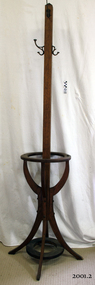
Coat rack
... coat, store an umbrella and leave a calling card but also to show family wealth, social position and knowledge of current styles. A hall stand or a hat rack was the most important piece of furniture in homes at this time. New and more elaborate designs began to appear about 1840, as homes became larger and social visits became more structured. Usually made of wood and standing at least 1.5 meters tall, they have a single-pole making up most of the height, with a sturdy base to prevent toppling, and an array of lengthy pegs or hooks...Coat rack with four curved legs, circular holder for umbrellas and walking sticks. Four metal hooks, screwed onto main column of stand. ...Condition: one curved leg broken. 2 hooks broken. Coat rack ...A hat coat and umbrella stand is a device used to store hats and often coats on, and umbrellas within. Some catalogues in Europe marketed this furniture as a portmanteau from the French words Porter (carry) and Manteau (cloak). The front hall was the introduction to the house, and as such was an important part of the Victorian home. Furnishings were selected not only to make it a useful place to hang a hat and coat, store an umbrella and leave a calling card but also to show family wealth, social position and knowledge of current styles. A hall stand or a hat rack was the most important piece of furniture in homes at this time. New and more elaborate designs began to appear about 1840, as homes became larger and social visits became more structured. Usually made of wood and standing at least 1.5 meters tall, they have a single-pole making up most of the height, with a sturdy base to prevent toppling, and an array of lengthy pegs or hooks at the top for placement of hats. Smaller houses had smaller front halls, so a single-pole type as by the 1920s houses had become smaller. A household furniture item possibly from the 1920s that was common in houses from the early 1840s, it's significance is social, demonstrating how furniture trends change over time with the more elaborate the item the more social standing was attributed to the owners' position in society. even today persons association and ownership with inanimate objects tend to represent their social standing along with their financial and community acceptability. Coat rack with four curved legs, circular holder for umbrellas and walking sticks. Four metal hooks, screwed onto main column of stand. Condition: one curved leg broken. 2 hooks broken.Noneflagstaff hill, warrnambool, shipwrecked-coast, flagstaff-hill, flagstaff-hill-maritime-museum, maritime-museum, shipwreck-coast, flagstaff-hill-maritime-village -
 Shepparton RSL Sub Branch
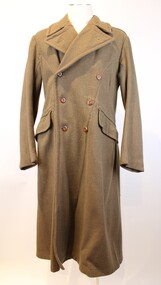
Uniform, Great Coat, C. 1951
... coat in khaki-green with double breasted fastening via three bakelite brown buttons. Two angled hip height pockets on the left and right hips with exterior flap, lined with cotton. Two red curved shoulder flashes on each shoulder embroidered with the words “ROYAL AUSTRALIAN/REGIMENT” in a cream thread with a cream border. Collar has two small buttons either side on the exterior and a hook...coat in khaki-green with double breasted fastening via three bakelite brown buttons. Two angled hip height pockets on the left and right hips with exterior flap, lined with cotton. Two red curved shoulder flashes on each shoulder embroidered with the words “ROYAL AUSTRALIAN/REGIMENT” in a cream thread with a cream border. Collar has two small buttons either side on the exterior and a hook ...Shin length long sleeved heavy woollen coat in khaki-green with double breasted fastening via three bakelite brown buttons. Two angled hip height pockets on the left and right hips with exterior flap, lined with cotton. Two red curved shoulder flashes on each shoulder embroidered with the words “ROYAL AUSTRALIAN/REGIMENT” in a cream thread with a cream border. Collar has two small buttons either side on the exterior and a hook and eye which fastens under the chin. Fabric epaulette on either shoulder with brown button to secure. Lower back of coat is secured by two buttons and a belt which attaches to left and right seam line and fastens via three buttons. Interior shoulder area is lined with short cotton lining which sits under the arms; sleeves lined in cotton. Pockets are cotton on interior with inscriptions; two labels on interior lower right. Labels reads “REGIMENTAL NO. 3/400922/NAME ROBINSON/GREAT COAT G.S. 1966 PATT/1951/[two lines of text overwritten with “83A” stamp]/A LANDAU VIC 1951”. Interior right pocket reads “11556/ROBERTSON/203 111051”. Shoulder lining has three stamps reading “83A” and one handwritten “83A”. Buttons read “AUSTRALIAN MILITARY FORCES”. Shoulder flashes read “ROYAL AUSTRALIAN/REGIMENT”robinson, robertson, world war ii, second world war, wwii, winter, uniform, military -
Federation University Historical Collection
Book, University of Ballarat Annual Report 2005, 2005
... University of Ballarat is a predecessor institution of Federation University Australia. annual report robert h.t. smith kerry o. cox maria strikland john mcclure technology park stan jeffrey westvic academy of sport dennis olmstead sid morris wayne robinson town and gown clare gervasoni dorothy wickham carolyn taylor christine nixon geoffrey blainey arts academy betty collier terry lloyd indigenous employment strategy eureka encyclopaedia brian west joel epstein scholarships penelope boadle cameron brown felice cua zoe ferrier Lauren Gaylard Sarah Hardy Natalie Kirby Marcus Kirkpatrick kimberley murphy luke whykes amy yole jessica meek melissa mitchell robert hook albert coates memorial awards brian mclennan art scholarship ibm .1 and .2) Bound soft covered University of Ballarat Annual Report .3) Financial Statements University of Ballarat Annual Report 2005 Book ...University of Ballarat is a predecessor institution of Federation University Australia..1 and .2) Bound soft covered University of Ballarat Annual Report .3) Financial Statementsannual report, robert h.t. smith, kerry o. cox, maria strikland, john mcclure, technology park, stan jeffrey, westvic academy of sport, dennis olmstead, sid morris, wayne robinson, town and gown, clare gervasoni, dorothy wickham, carolyn taylor, christine nixon, geoffrey blainey, arts academy, betty collier, terry lloyd, indigenous employment strategy, eureka encyclopaedia, brian west, joel epstein, scholarships, penelope boadle, cameron brown, felice cua, zoe ferrier, lauren gaylard, sarah hardy, natalie kirby, marcus kirkpatrick, kimberley murphy, luke whykes, amy yole, jessica meek, melissa mitchell, robert hook, albert coates memorial awards, brian mclennan art scholarship, ibm -
 Flagstaff Hill Maritime Museum and Village
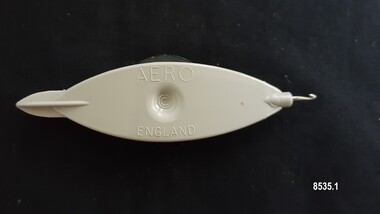
Domestic object - Tatting Shuttle, Aero Needles Group Ltd, Mid to late 20th century
... coated aluminium shuttle with a sharp pick at one end. In the 1970's it was superseded by the grey plastic "Aero" which has a removeable bobbin which you can put on the end of the shuttle to make thread winding easier and an embedded crochet hook for joining picots. ...coated aluminium shuttle with a sharp pick at one end. In the 1970's it was superseded by the grey plastic "Aero" which has a removeable bobbin which you can put on the end of the shuttle to make thread winding easier and an embedded crochet hook for joining picots. ...Tatting is a form of knotted lace making using thread and a small shuttle. Twisted threads are tied around or through small, pointed shuttles that can be made of bone, mother of pearl, tortoise shell, steel or plastic. This produces a stable, strong lace using simple knots of two half hitches to make rings and chains embellished with picots.The origins of tatting are not clear but early versions of decorative knotting were used by the Egyptians on their ceremonial dress. Tatting also has elements of fishermen's net making techniques and the decorative knotting that was practiced by aristocratic women from the 15th century.Tatting, as we know it today, emerged in the first half of the 19th century. The new availability of mercerised thread from 1835 encouraged a burgeoning of lace crafts of all sorts. It was known in Italy as "occhi" and in France as "la frivolite". Tatting looks fragile but is both strong and durable. An article in a column named "Wives and Daughters" published in the Star newspaper in May 1910 describes the durability of tatting lace - "there is edging and insertion still in existence that have outworn two sets of pillow slips." In the 19th century and well into the 20th century, tatting was used like crochet and knitted lace for decorative edgings, collars, doylies, tray cloths etc. At first, different tatting patterns were passed along by word of mouth from person to person, however in time, patterns regularly appeared in newspapers and magazines well into the 1950's. A shuttle is a small tool that looks like a small boat "sailing" in and out of the thread. Tatting is called "schiffchenarbeit" in German, which means "the work of a little boat". There are two popular types of shuttles. The first has closed ends and a removable bobbin where the thread is wound around - often made from metal or plastic (as is item 8535.1). The second type has a post in the center where the thread is wound (e.g. item 8535.2). The ends of this bobbin are open but snug. Because it is constructed in two pieces, it can be made from materials like bone, ivory or mother of pearl. Shuttles hold a larger amount of thread (as compared with needles) which means fewer ends to weave in. Fishermen in the past are thought to have used large shuttles to weave cord into certain knots whilst making their fishing nets. Their methods were copied by weavers, who innovated by using threads and smaller shuttles to make lace. One type of tatting shuttle produced by "Aero" from the 1930's to the late 1960's was an anodized grey coated aluminium shuttle with a sharp pick at one end. In the 1970's it was superseded by the grey plastic "Aero" which has a removeable bobbin which you can put on the end of the shuttle to make thread winding easier and an embedded crochet hook for joining picots. The "Aero" company developed in Redditch, England - a town renowned as a centre for manufacturing needles. Firms run by Henry Milward and Abel Morrall were based in Redditch and by the 18th century Redditch was manufacturing one million sewing needles per year. Abel Morrall Ltd launched the "Aero" brand in 1936 and greatly expanded the firm's product line to include tatting shuttles and knitting needles. The classic plastic "Aero" tatting shuttle was manufactured in England from the early 1970's until the 1990's. These items are significant as examples of easily accessible handiwork tools that enabled women in the 1930s -1960s to be able to decorate and personalize their household linen and clothing.Shuttle no. 8535.1 is a beige, boat shaped plastic shuttle with enclosed ends, small round central indentations on both sides and an enclosed black removeable bobbin. The shuttle has a grooved point at one end to hold a bobbin and a small metal crochet hook at the other end. Shuttle no. 8535.2 is a beige, boat shaped metal shuttle with pointed ends that are open but snug, small round central indentations and two smaller circular markings (on both sides) and two internal posts with cream thread wound around.Shuttle no. 8535.1 - "AERO" / "ENGLAND" Shuttle no. 8535.2 - "AERO' / "ENGLAND" "39c" (written in ball point pen)flagstaff hill maritime museum and village, flagstaff hill, warrnambool, shipwreck coast, great ocean road, tatting shuttle, aero company, handwork, handwork tool, craft, handcraft, needlework, tatting -
 City of Moorabbin Historical Society (Operating the Box Cottage Museum)
Craftwork, crochet silk and hooks, c1960
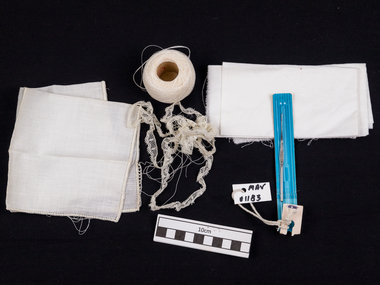
... 2 Crochet Hooks ; a) Made in England / 4 / CROSS FOX b) ARGOBY / 6 / ; packet MILWARD Silk Cotton ; J & P COATES / MERCER CROCHET / 80...Gladys Reed was and accomplished dressmaker and was involved in local community activities like the Ormond Choral Society Craftwork, Crochet, Knitting and Sewing were all popular in post World War 11 Moorabbin as the new settlers established their homes on the previous market garden estates. 2 Crochet Hooks ; a) Made in England / 4 / CROSS FOX b) ARGOBY / 6 / ; packet MILWARD Silk Cotton ; J & P COATES / MERCER CROCHET / 80 A ball of silk thread and 2 steel crochet hooks, 1 completed cotton handkerchief, 2 squares of fine cotton and a small length of lacework Craftwork, crochet silk and hooks J & P Coates Pty Ltd / Milward & Sons Ltd ...Craftwork, Crochet, Knitting and Sewing were all popular in post World War 11 Moorabbin as the new settlers established their homes on the previous market garden estates. Gladys Reed was and accomplished dressmaker and was involved in local community activities like the Ormond Choral Society Craftwork, Crochet, Knitting and Sewing were all popular in post World War 11 Moorabbin as the new settlers established their homes on the previous market garden estates.A ball of silk thread and 2 steel crochet hooks, 1 completed cotton handkerchief, 2 squares of fine cotton and a small length of lacework 2 Crochet Hooks ; a) Made in England / 4 / CROSS FOX b) ARGOBY / 6 / ; packet MILWARD Silk Cotton ; J & P COATES / MERCER CROCHET / 80 -
 Kiewa Valley Historical Society
Coathanger - trousers/skirts
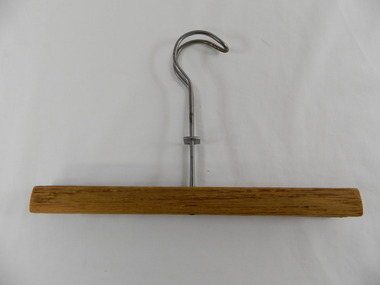
... Wooden coat hanger with wire fitted hook used to hang trousers (or skirts) by moving a steel plate along the wire (to tighten the grip). ...Wooden coat hanger with wire fitted hook used to hang trousers (or skirts) by moving a steel plate along the wire (to tighten the grip). ...Coat hangers were used to hang up trousers or skirts by the waist. This coat hanger was designed prior to clips with springs being used.Wooden coat hanger with wire fitted hook used to hang trousers (or skirts) by moving a steel plate along the wire (to tighten the grip). There are 2 rectangular pieces of wood with small padding attached on the inside outer edges. Each piece of wood has wire coming out of the centre. The wire is vertical before rounding to form a hook and is continuous. The wire has a small steel plate with 2 holes along the vertical section.coat hanger. clothes. skirts. trousers. -
 Warrnambool and District Historical Society Inc.
Coat Hanger, Cramond & Dickson, Early 20th century
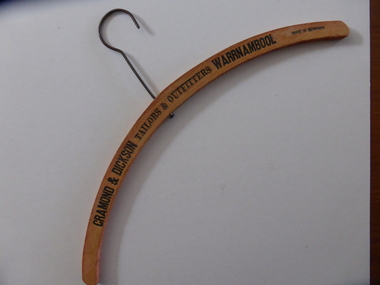
... This is a wooden coat hanger with a metal hook inserted in the centre of the hanger. ...This is a wooden coat hanger with a metal hook inserted in the centre of the hanger. ...This is a coat hanger made in Germany for the Warrnambool firm of Cramond and Dickson. John Cramond and James Dickson opened a general store in Warrnambool in 1856, selling men’s and women’s clothing, drapery and manchester and it had its own tailoring and millinery business. This store became a prominent one in Warrnambool for over 100 years, closing in 1973. The business operated for most of this time at the corner of Timor and Liebig Streets. This coat hanger is of great interest as a memento of the business of Cramond and Dickson, one of the most important businesses in Warrnambool’s history.This is a wooden coat hanger with a metal hook inserted in the centre of the hanger. The wood has been smoothed and stained to a light brown colour. The wood is curved and the ends are slightly tapered. The hook has a round stud at the bottom to prevent the hook from coming out of the hole. The hook is somewhat rusted. The printing on the hanger is in black.‘Cramond & Dickson Tailors & Outfitters Warrnambool Made in Germany’.cramond and dickson,, warrnambool, history of warrnambool -
 Warrnambool and District Historical Society Inc.
Coat Hanger, Cramond & Dickson Coat Hangers
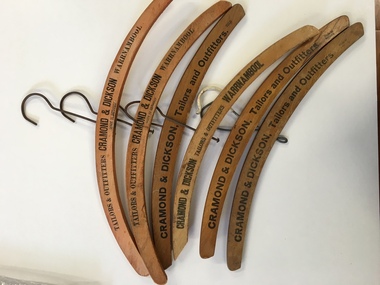
... Wooden hangers with rounded corners and metal hooks, one plastic coated. Printed names engraved and painted in black with business name....Cramond and Dickson store warrnambool Cramond & Dickson Tailors & Outfitters Warrnambool. 2 made on America and 3 made in Germany. 1 unmarked Wooden hangers with rounded corners and metal hooks, one plastic coated. Printed names engraved and painted in black with business name. ...John Glass Cramond 1829 and James Dickson 1831-1910 were founders of a large drapery store. Both were Scots and both came separately to Australia in 1852. Cramond initially came for gold but soon opened a store in St Kilda with a post Office attached and he was the first post master there. Dickson was a farmer’s son but became a draper and while he was unsuccessful on the Bendigo diggings and then returned to Melbourne where he met Cramond and soon after they opened a store on Lonsdale Street. They opened their business in Warrnambool in 1855 as a general store with groceries, drapery and ironmongery. Both partners were involved with the community and James Dickson was an original director of the Warrnambool Woollen Mill 1909 and the Warrnambool Cheese and butter factory. He also served on the committee of management of Warrnambool Base Hospital. These coathangers were an everyday item from their store. A common item which provides a link to one of Warrnambool’s largest and longest running businesses.Wooden hangers with rounded corners and metal hooks, one plastic coated. Printed names engraved and painted in black with business name.Cramond & Dickson Tailors & Outfitters Warrnambool. 2 made on America and 3 made in Germany. 1 unmarkedcramond and dickson store, warrnambool -
 Warrnambool and District Historical Society Inc.
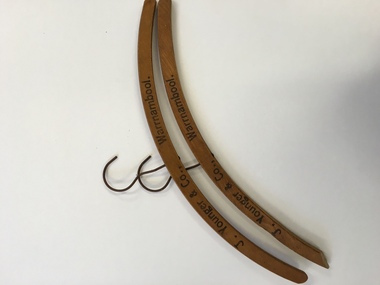
Coat Hanger, J Younger & Co Warrnambool x 2
... hooks. Printed names engraved and painted in black with business name. J Younger & Co Warrnambool x 2 Coat Hanger ...John Wilson Younger was the proprietor of J Younger & Co Warrnambool, which was a former branch of Melbourne Cash Stores. The Youngers store operated in Liebig St Warrnambool until the 1980’s as a department store James Younger died in 1939 and the store was operated by his son in law, Carlos Gordon for many years. John Younger was involved in many areas of social and community life in Warrnambool. In 1903 he lived at Riccalton 3 Darling St, Warrnambool. He was a director of the Warrnambool Woollen Mill and was Mayor around 1910 for two terms. He purchased the property Dwarroon and divided it among his four children.A common item which provides a link to one of Warrnambool’s largest and longest running businesses.Wooden hangers with rounded corners and metal hooks. Printed names engraved and painted in black with business name.J Younger & Co Warrnamboolwarrnambool, youngers, j younger warrnambool -
 Warrnambool and District Historical Society Inc.
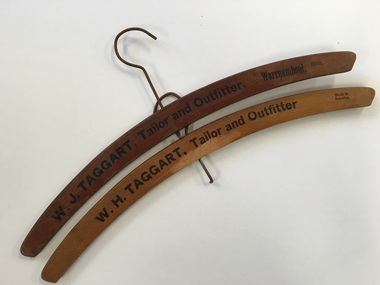
Coat Hanger, W. H Taggart Tailor & Outfitter
... hooks. Printed names engraved and painted in black with business name. W. H Taggart Tailor & Outfitter Coat Hanger ...W J Taggart was a tailor who operated from Fairy Street at the time near Russell’s and Powell’s. This is near The Caledonian Hotel and in the current RSPCA shop. They had moved to this shop around 1884. A notice in the local paper in 1922 states that he was re- opening his business in the same premises.Provides a link to one of Warrnambool’s 19th Century businesses.Wooden hangers with rounded corners and metal hooks. Printed names engraved and painted in black with business name.W J Taggart Tailor and Outfitter Warrnambool W H Taggart Tailor and outfitter Warrnambool. Both made in America w j taggart, coathangers, warrnambool -
 Bendigo Military Museum
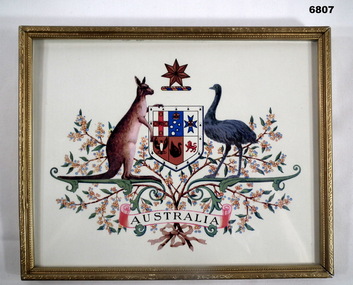
Print - PRINT, FRAMED, COAT of ARMS, Unknown
... Gold ornate metallic frame with a coloured print of Australian Coat of Arms (Wreath of gold and blue with Kangaroo and Emu holding a shield and at top a 7 pointed star). Is in colour on a white background. Image has glass protection and frame has hard cardboard backing with a hook on either side connected with a length of copper hanging wire. ...Gold ornate metallic frame with a coloured print of Australian Coat of Arms (Wreath of gold and blue with Kangaroo and Emu holding a shield and at top a 7 pointed star). Is in colour on a white background. Image has glass protection and frame has hard cardboard backing with a hook on either side connected with a length of copper hanging wire. ...Seven point star represents 6 states and 7th for Territorial shield has 6 symbols for each of 6 states. Wreath colours of gold and blue are colours of Australia's livery and shield held up by native animals of Kangaroo and Emu.Gold ornate metallic frame with a coloured print of Australian Coat of Arms (Wreath of gold and blue with Kangaroo and Emu holding a shield and at top a 7 pointed star). Is in colour on a white background. Image has glass protection and frame has hard cardboard backing with a hook on either side connected with a length of copper hanging wire. Coat of Arms with "Australia" at bottom. Stamp on back stating "Passchendaele Barracks Trust".coat of arms, passchendaele barracks trust -
 Bendigo Historical Society Inc.
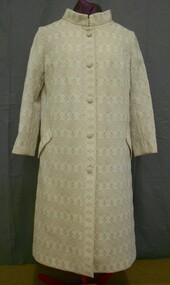
Clothing - AILEEN AND JOHN ELLISON COLLECTION: CRIMPLENE COAT BY GINA OF MELBOURNE: PART OF ENSEMBLE WITH 11400.520, 1950s
... coat of crimplene fabric. Fabric has all over pattern of horizontal rows of looped knot pattern. Fabric also has silver thread woven into fabric. High round neck with stand-up collar - 4.3cm. Two press studs at top below collar, plus one hook...coat of crimplene fabric. Fabric has all over pattern of horizontal rows of looped knot pattern. Fabric also has silver thread woven into fabric. High round neck with stand-up collar - 4.3cm. Two press studs at top below collar, plus one hook ...A Line cream coloured knee length coat of crimplene fabric. Fabric has all over pattern of horizontal rows of looped knot pattern. Fabric also has silver thread woven into fabric. High round neck with stand-up collar - 4.3cm. Two press studs at top below collar, plus one hook and loop to close the collar. Full length front opening with 4.5cm band. Five 2cm fabric covered buttons – evenly spaced from neckline to below hip line. Front has two side darts at bust line. Two false pocket flaps (14cm x 5cm) set at 45° angle to side seams at hem line. Long straight set in sleeves slightly tapered to the wrist. Part of ensemble with 11400.520.Top inside back below neckline: Fashioned by Gina of Melbourne Registered TMS Crimplene. Made from terylene polyester fibre. Wash by hand or machine in warm water. Rinse thoroughly. Gently squeeze out surplus water. Drip dry.costume, female daywear, coat
