
Showing 45 items matching "cooking instructions"
-
 Mont De Lancey
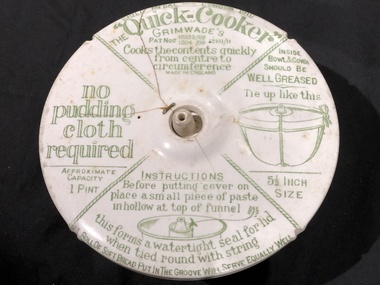
Pudding Basin, Grimwade's, Circa 1911
... White ironstone "Quick-Cooker" pudding basin with lid and written cooking instructions in green....Pudding basins "Gold Medal London 1911 The Quick-Cooker" Grimwades's Pat Nos 12835/09 and 1504/09 and 12181/11 Excellent for stews of all kinds" etc White ironstone "Quick-Cooker" pudding basin with lid and written cooking instructions in green. Pudding Basin Grimwade's ...White ironstone "Quick-Cooker" pudding basin with lid and written cooking instructions in green."Gold Medal London 1911 The Quick-Cooker" Grimwades's Pat Nos 12835/09 and 1504/09 and 12181/11 Excellent for stews of all kinds" etcpudding basins -
 Flagstaff Hill Maritime Museum and Village
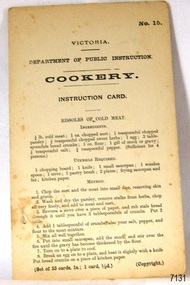
Card - Cookery Recipe Card No. 10, Department of Public Instruction, Victoria, Cookery Instruction Card, 1910s
... ...cooking instructions...Pattison Collection see item 3678 Flagstaff Hill collections) https://victoriancollections.net.au/items/5580c7e72162f114d8b758db Warrnambool Shipwreck Coast Flagstaff Hill Maritime Museum Maritime Village Flagstaff Hill Maritime Museum and Village cooking instructions Department of Public Instruction food domestic cookery kitchen recipe education training Domestic life cooking recipes food & beverages domestic work education and training card no. 10 This is one card from a numbered series of 33 recipe cards issued by the Victorian Government. ...This is one card from a numbered series of 33 recipe cards issued by the Victorian Government. The cards gave basic meal recipes and instructions for teaching domestic cookery. Card No. 10 carries recipes for Rissoles of Cold Meat and a Grilled Chop or Steak. The cards were sold at one shilling for the set or a halfpenny for a single card, and each covers one topic, from roasting and boiling meat to vegetables, pies and cakes. The card is overprinted with its price and the word “Copyright”.Hard cover book. Cookery Instruction Card No. 10 Author: Department of Public Instruction, Victoria Publisher: Department of Public Instruction, Victoria Printer: Albert J. Moffett, Government Printer, Melbourne. Date: 1910s Further Information: Cream coloured card with printed ingredients and instructions for recipes. A number is printed in the top right corner.non-fictionThis is one card from a numbered series of 33 recipe cards issued by the Victorian Government. The cards gave basic meal recipes and instructions for teaching domestic cookery. Card No. 10 carries recipes for Rissoles of Cold Meat and a Grilled Chop or Steak. The cards were sold at one shilling for the set or a halfpenny for a single card, and each covers one topic, from roasting and boiling meat to vegetables, pies and cakes. The card is overprinted with its price and the word “Copyright”. warrnambool, shipwreck coast, flagstaff hill, maritime museum, maritime village, flagstaff hill maritime museum and village, cooking instructions, department of public instruction, food, domestic, cookery, kitchen, recipe, education, training, domestic life, cooking, recipes, food & beverages, domestic work, education and training, card no. 10 -
 Flagstaff Hill Maritime Museum and Village
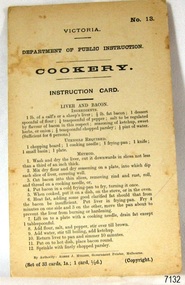
Card - Cookery Recipe Card No. 13, Department of Public Instruction, Victoria, Cookery Instruction Card, 1910s
... ...cooking instructions...Pattison Collection see item 3678 Flagstaff Hill collections) https://victoriancollections.net.au/items/5580c7e72162f114d8b758db Warrnambool Shipwreck Coast Flagstaff Hill Maritime Museum Maritime Village Flagstaff Hill Maritime Museum and Village cooking instructions Department of Public Instruction food domestic cookery kitchen recipe education training Domestic life cooking recipes food & beverages domestic work education and training card no. 10 This is one card from a numbered series of 33 recipe cards issued by the Victorian Government. ...This is one card from a numbered series of 33 recipe cards issued by the Victorian Government. The cards gave basic meal recipes and instructions for teaching domestic cookery. Card No. 13 carries various recipes. The cards were sold at one shilling for the set or a halfpenny for a single card, and each covers one topic, from roasting and boiling meat to vegetables, pies and cakes. The card is overprinted with its price and the word “Copyright”.Hard cover book. Cookery Instruction Card No. 13 Author: Department of Public Instruction, Victoria Publisher: Department of Public Instruction, Victoria Printer: Albert J. Moffett, Government Printer, Melbourne. Date: 1910s Further Information: Cream coloured card with printed ingredients and instructions for recipes. A number is printed in the top right corner.non-fictionThis is one card from a numbered series of 33 recipe cards issued by the Victorian Government. The cards gave basic meal recipes and instructions for teaching domestic cookery. Card No. 13 carries various recipes. The cards were sold at one shilling for the set or a halfpenny for a single card, and each covers one topic, from roasting and boiling meat to vegetables, pies and cakes. The card is overprinted with its price and the word “Copyright”. warrnambool, shipwreck coast, flagstaff hill, maritime museum, maritime village, flagstaff hill maritime museum and village, cooking instructions, department of public instruction, food, domestic, cookery, kitchen, recipe, education, training, domestic life, cooking, recipes, food & beverages, domestic work, education and training, card no. 10 -
 Flagstaff Hill Maritime Museum and Village
Card - Recipe Card, Department of Public Instruction, Cookery Instruction Card No. 13, 1910S
... ...cooking instructions...Warrnambool Shipwreck Coast Flagstaff Hill Maritime Museum Maritime Village Flagstaff Hill Maritime Museum and Village cooking instructions Department of Public Instruction food domestic cookery kitchen recipe education training Domestic life cooking recipes food & beverages domestic work education and training card no. 13 Overprinted: “(Set of 33 cards, 1s.; 1 card 1/2d.)” ...Cookery Instruction Card No. 13 Author: Department of Public Instruction, Victoria Publisher: Department of Public Instruction, Victoria Printed – By Authority: Albert J. Moffett, Government Printer, Melbourne. Cream coloured card with printed ingredients and instructions for recipes. A number is printed in the top right corner. The back is blank.warrnambool, shipwreck coast, flagstaff hill, maritime museum, maritime village, flagstaff hill maritime museum and village, cooking instructions, department of public instruction, food, domestic, cookery, kitchen, recipe, education, training, domestic life, cooking, recipes, food & beverages, domestic work, education and training, card no. 13 -
 Flagstaff Hill Maritime Museum and Village
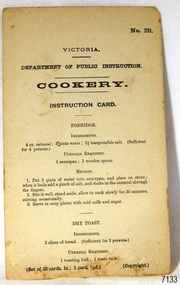
Card - Recipe Card, Department of Public Instruction, Victoria, Cookery Instruction Card No. 29, 1910s
... ...cooking instructions...Pattison Collection see item 3678 Flagstaff Hill collections) https://victoriancollections.net.au/items/5580c7e72162f114d8b758db Warrnambool Shipwreck Coast Flagstaff Hill Maritime Museum Maritime Village Flagstaff Hill Maritime Museum and Village cooking instructions Department of Public Instruction food domestic cookery kitchen recipe education training Domestic life cooking recipes food & beverages domestic work education and training card no. 29 This is one card from a numbered series of 33 recipe cards issued by the Victorian Government. ...This is one card from a numbered series of 33 recipe cards issued by the Victorian Government. The cards gave basic meal recipes and instructions for teaching domestic cookery. Card No. 29 carries various recipes. The cards were sold at one shilling for the set or a halfpenny for a single card, and each covers one topic, from roasting and boiling meat to vegetables, pies and cakes. The card is overprinted with its price and the word “Copyright”.Hard cover book. Cookery Instruction Card No. 29 Author: Department of Public Instruction, Victoria Publisher: Department of Public Instruction, Victoria Printer: Albert J. Moffett, Government Printer, Melbourne. Date: 1910s Further Information: Cream coloured card with printed ingredients and instructions for recipes. A number is printed in the top right corner.non-fictionThis is one card from a numbered series of 33 recipe cards issued by the Victorian Government. The cards gave basic meal recipes and instructions for teaching domestic cookery. Card No. 29 carries various recipes. The cards were sold at one shilling for the set or a halfpenny for a single card, and each covers one topic, from roasting and boiling meat to vegetables, pies and cakes. The card is overprinted with its price and the word “Copyright”. warrnambool, shipwreck coast, flagstaff hill, maritime museum, maritime village, flagstaff hill maritime museum and village, cooking instructions, department of public instruction, food, domestic, cookery, kitchen, recipe, education, training, domestic life, cooking, recipes, food & beverages, domestic work, education and training, card no. 29 -
 Flagstaff Hill Maritime Museum and Village
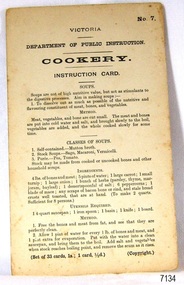
Card - Recipe Card, Department of Public Instruction, Cookery Instruction Card No. 7, 1910s
... ...cooking instructions...Pattison Collection see item 3678 Flagstaff Hill collections) https://victoriancollections.net.au/items/5580c7e72162f114d8b758db Warrnambool Shipwreck Coast Flagstaff Hill Maritime Museum Maritime Village Flagstaff Hill Maritime Museum and Village cooking instructions Department of Public Instruction food domestic cookery kitchen recipe education training Domestic life cooking recipes food & beverages domestic work education and training card no. 10 This is one card from a numbered series of 33 recipe cards issued by the Victorian Government. ...This is one card from a numbered series of 33 recipe cards issued by the Victorian Government. The cards gave basic meal recipes and instructions for teaching domestic cookery. Card No.7 carries various recipes. The cards were sold at one shilling for the set or a halfpenny for a single card, and each covers one topic, from roasting and boiling meat to vegetables, pies and cakes. The card is overprinted with its price and the word “Copyright”.Hard cover book. Cookery Instruction Card No. 7 Author: Department of Public Instruction, Victoria Publisher: Department of Public Instruction, Victoria Printer: Albert J. Moffett, Government Printer, Melbourne. Date: 1910s Further Information: Cream coloured card with printed ingredients and instructions for recipes. A number is printed in the top right corner.non-fictionThis is one card from a numbered series of 33 recipe cards issued by the Victorian Government. The cards gave basic meal recipes and instructions for teaching domestic cookery. Card No.7 carries various recipes. The cards were sold at one shilling for the set or a halfpenny for a single card, and each covers one topic, from roasting and boiling meat to vegetables, pies and cakes. The card is overprinted with its price and the word “Copyright”. warrnambool, shipwreck coast, flagstaff hill, maritime museum, maritime village, flagstaff hill maritime museum and village, cooking instructions, department of public instruction, food, domestic, cookery, kitchen, recipe, education, training, domestic life, cooking, recipes, food & beverages, domestic work, education and training, card no. 10 -
 Bendigo Military Museum
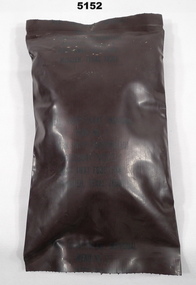
Accessory - RATION PACK, USA, US DEFENCE FORCE, c1981
... Other items hard to read, menu and cooking instructions....Other items hard to read, menu and cooking instructions. This is a sealed plastic container. ...Developed in 1981 onwards.This is a sealed plastic container. Inside is some sort of ration. It is heat sealed both ends. Colour is brown with black printing on one side.In black ink, hardly visible, is "Pork Patty dehydrated". "Accessory pack D - Meal, ready to eat, Individual." Other items hard to read, menu and cooking instructions.us defence force, food pouch -
 Whitehorse Historical Society Inc.
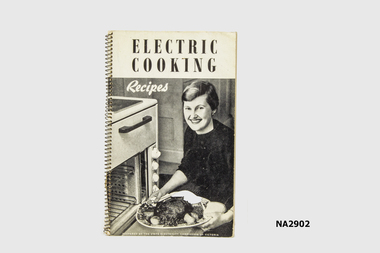
Book
... Electric Cooking Recipes including general instruction for use....books cookery Prepared by State Electricity Commission of Victoria Electric Cooking Recipes including general instruction for use. Book Book ...Electric Cooking Recipes including general instruction for use.Prepared by State Electricity Commission of Victoriabooks, cookery -
National Vietnam Veterans Museum (NVVM)
Functional Object, freeze dried rice
... freeze dried rice in foil enclosed in brown bag. Instructions on cooking. 55gms...ration food rice freeze dried rice freeze dried rice in foil enclosed in brown bag. Instructions on cooking. 55gms freeze dried rice Functional Object Functional Object ...freeze dried rice in foil enclosed in brown bag. Instructions on cooking. 55gmsfreeze dried riceration, food, rice -
 Greensborough Historical Society
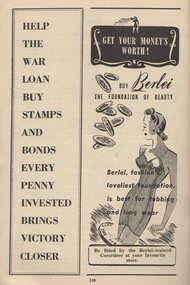
Article - Advertisement - Digital Image, NSW Cookery Teachers' Association, Berlei: in Domestic Science Handbook, 1942_
... An example of 1940s advertising through cooking and homemaker books. In this book, instructions are given for many aspects of household management, interspersed with advertisements for useful items. ...An example of 1940s advertising through cooking and homemaker books. In this book, instructions are given for many aspects of household management, interspersed with advertisements for useful items. ...Advertisement for Berlei (foundation garments) from "Domestic Science Handbook: for use by the pupils of domestic science schools". An example of 1940s advertising through cooking and homemaker books. In this book, instructions are given for many aspects of household management, interspersed with advertisements for useful items. This Berlei advertisement is for corsetry that was popular at the time. Also on this page is an advert for War Bonds, to support the war effort in World War 2.An example of mid 20th century advertising through 'how-to' books.Digital copy of advertisement from a bookhistoric advertisements, domestic science, nsw cookery teachers association, berlei, war bonds, world war 2 -
 Greensborough Historical Society
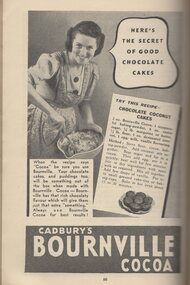
Article - Advertisement - Digital Image, NSW Cookery Teachers' Association, Cadbury's Bourneville Cocoa: in Domestic Science Handbook, 1942_
... An example of 1940s advertising through cooking and homemaker books. In this book, instructions are given for many aspects of household management, interspersed with advertisements for useful items. ...An example of 1940s advertising through cooking and homemaker books. In this book, instructions are given for many aspects of household management, interspersed with advertisements for useful items. ...Advertisement for Cadbury's Bourneville Cocoa from "Domestic Science Handbook: for use by the pupils of domestic science schools". An example of 1940s advertising through cooking and homemaker books. In this book, instructions are given for many aspects of household management, interspersed with advertisements for useful items. This Cadbury's Bourneville Cocoa advertisement includes a recipe for chocolate cake.An example of mid 20th century advertising through 'how-to' books.Digital copy of advertisement from a bookhistoric advertisements, domestic science, nsw cookery teachers association, cadburys bourneville cocoa, chocolate cake -
 Greensborough Historical Society
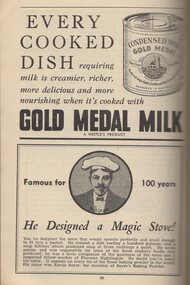
Article - Advertisement - Digital Image, NSW Cookery Teachers' Association, Gold Medal Milk: in Domestic Science Handbook, 1942_
... An example of 1940s advertising through cooking and homemaker books. In this book, instructions are given for many aspects of household management, interspersed with advertisements for useful items. ...An example of 1940s advertising through cooking and homemaker books. In this book, instructions are given for many aspects of household management, interspersed with advertisements for useful items. ...Advertisement for Gold Medal Milk from "Domestic Science Handbook: for use by the pupils of domestic science schools". An example of 1940s advertising through cooking and homemaker books. In this book, instructions are given for many aspects of household management, interspersed with advertisements for useful items. This Gold Medal Milk advertisement is for tinned condensed milk. The page includes an advertisement for Soyer's Baking Powder.An example of mid 20th century advertising through 'how-to' books.Digital copy of advertisement from a bookhistoric advertisements, domestic science, nsw cookery teachers association, gold medal milk, condensed milk, baking powder, soyers baking powder -
 Greensborough Historical Society
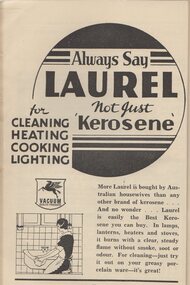
Document - Advertisement - Digital Image, NSW Cookery Teachers' Association, Laurel Kerosene: in Domestic Science Handbook, 1942_
... An example of 1940s advertising through cooking and homemaker books. In this book, instructions are given for many aspects of household management, interspersed with advertisements for useful items. ...An example of 1940s advertising through cooking and homemaker books. In this book, instructions are given for many aspects of household management, interspersed with advertisements for useful items. ...Advertisement for Laurel Kerosene from "Domestic Science Handbook: for use by the pupils of domestic science schools". An example of 1940s advertising through cooking and homemaker books. In this book, instructions are given for many aspects of household management, interspersed with advertisements for useful items. This Laurel Kerosene advertisement claims that Lauren Kerosene is good for cleaning, heating, cooking and lighting.An example of mid 20th century advertising through 'how-to' books.Digital copy of advertisement from a bookhistoric advertisements, domestic science, nsw cookery teachers association, laurel kerosene, kerosene -
 Greensborough Historical Society
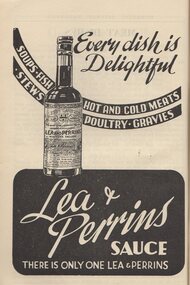
Document - Advertisement - Digital Image, NSW Cookery Teachers' Association, Lea and Perrins Sauce: in Domestic Science Handbook, 1942_
... An example of 1940s advertising through cooking and homemaker books. In this book, instructions are given for many aspects of household management, interspersed with advertisements for useful items. ...An example of 1940s advertising through cooking and homemaker books. In this book, instructions are given for many aspects of household management, interspersed with advertisements for useful items. ...Advertisement for Lea and Perrins Sauce from "Domestic Science Handbook: for use by the pupils of domestic science schools". An example of 1940s advertising through cooking and homemaker books. In this book, instructions are given for many aspects of household management, interspersed with advertisements for useful items. Lea and Perrins Worcestershire Sauce is still available today.An example of mid 20th century advertising through 'how-to' books.Digital copy of advertisement from a bookhistoric advertisements, domestic science, nsw cookery teachers association, lea and perrins, worcestershire sauce -
 Greensborough Historical Society
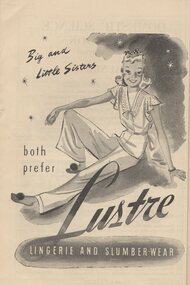
Document - Advertisement - Digital Image, NSW Cookery Teachers' Association, Lustre Lingerie: in Domestic Science Handbook, 1942_
... An example of 1940s advertising through cooking and homemaker books. In this book, instructions are given for many aspects of household management, interspersed with advertisements for useful items. ...An example of 1940s advertising through cooking and homemaker books. In this book, instructions are given for many aspects of household management, interspersed with advertisements for useful items. ...Advertisement for Lustre Lingerie and Slumberwear from "Domestic Science Handbook: for use by the pupils of domestic science schools". An example of 1940s advertising through cooking and homemaker books. In this book, instructions are given for many aspects of household management, interspersed with advertisements for useful items. This advertisement for Lustre Lingerie and Slumberwear claims it is suitable for all ages - 'big and little sisters'.An example of mid 20th century advertising through 'how-to' books.Digital copy of advertisement from a bookhistoric advertisements, domestic science, nsw cookery teachers association, lustre lingerie -
 Greensborough Historical Society
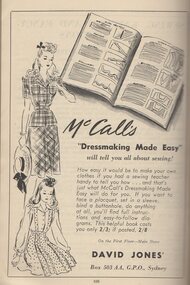
Document - Advertisement - Digital Image, NSW Cookery Teachers' Association, McCall's "Dressmaking made easy": in Domestic Science Handbook, 1942_
... An example of 1940s advertising through cooking and homemaker books. In this book, instructions are given for many aspects of household management, interspersed with advertisements for useful items. ...An example of 1940s advertising through cooking and homemaker books. In this book, instructions are given for many aspects of household management, interspersed with advertisements for useful items. ...Advertisement for McCall's "Dressmaking made easy" in "Domestic Science Handbook: for use by the pupils of domestic science schools". An example of 1940s advertising through cooking and homemaker books. In this book, instructions are given for many aspects of household management, interspersed with advertisements for useful items. This advertisement for another book McCall's "Dressmaking made easy" was available from David Jones in Sydney.An example of mid 20th century advertising through 'how-to' books.Digital copy of advertisement from a bookhistoric advertisements, domestic science, nsw cookery teachers association, mccalls, dressmaking, david jones -
 Greensborough Historical Society
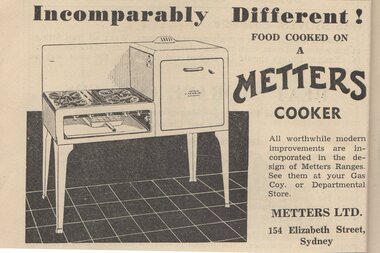
Document - Advertisement - Digital Image, NSW Cookery Teachers' Association, Metters Cooker: in Domestic Science Handbook, 1942_
... An example of 1940s advertising through cooking and homemaker books. In this book, instructions are given for many aspects of household management, interspersed with advertisements for useful items. ...An example of 1940s advertising through cooking and homemaker books. In this book, instructions are given for many aspects of household management, interspersed with advertisements for useful items. ...Advertisement for Metters Gas Cooker in "Domestic Science Handbook: for use by the pupils of domestic science schools". An example of 1940s advertising through cooking and homemaker books. In this book, instructions are given for many aspects of household management, interspersed with advertisements for useful items. This advertisement is for a Metters Gas Cooker or stove.An example of mid 20th century advertising through 'how-to' books.Digital copy of advertisement from a bookhistoric advertisements, domestic science, nsw cookery teachers association, metters, gas stoves -
 Greensborough Historical Society
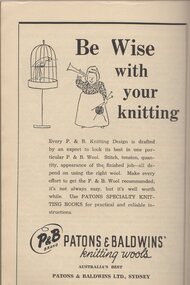
Document - Advertisement - Digital Image, NSW Cookery Teachers' Association, Patons and Baldwins' Knitting Wool: in Domestic Science Handbook, 1942_
... An example of 1940s advertising through cooking and homemaker books. In this book, instructions are given for many aspects of household management, interspersed with advertisements for useful items. ...An example of 1940s advertising through cooking and homemaker books. In this book, instructions are given for many aspects of household management, interspersed with advertisements for useful items. ...Advertisement for Patons and Baldwins' Knitting Wool in "Domestic Science Handbook: for use by the pupils of domestic science schools". An example of 1940s advertising through cooking and homemaker books. In this book, instructions are given for many aspects of household management, interspersed with advertisements for useful items. This advertisement is for Patons and Baldwins' Knitting Wool and knitting books.An example of mid 20th century advertising through 'how-to' books.Digital copy of advertisement from a bookhistoric advertisements, domestic science, nsw cookery teachers association, knitting patterns, patons and baldwins knitting wool -
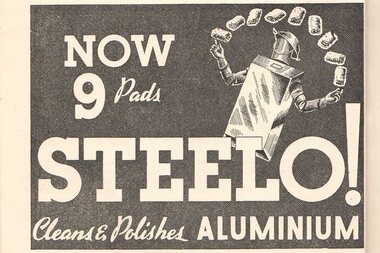 Greensborough Historical Society
Document - Advertisement - Digital Image, NSW Cookery Teachers' Association, Steelo steel wool: in Domestic Science Handbook, 1942_
... An example of 1940s advertising through cooking and homemaker books. In this book, instructions are given for many aspects of household management, interspersed with advertisements for useful items. ...An example of 1940s advertising through cooking and homemaker books. In this book, instructions are given for many aspects of household management, interspersed with advertisements for useful items. ...Advertisement for Steelo in "Domestic Science Handbook: for use by the pupils of domestic science schools". An example of 1940s advertising through cooking and homemaker books. In this book, instructions are given for many aspects of household management, interspersed with advertisements for useful items. This advertisement is for Steelo steel wool used for cleaning saucepans.An example of mid 20th century advertising through 'how-to' books.Digital copy of advertisement from a bookhistoric advertisements, domestic science, nsw cookery teachers association, steelo, steel wool -
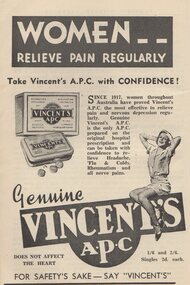 Greensborough Historical Society
Flyer - Advertisement - Digital Image, NSW Cookery Teachers' Association, Vincent's A.P.C.: in Domestic Science Handbook, 1942_
... An example of 1940s advertising through cooking and homemaker books. In this book, instructions are given for many aspects of household management, interspersed with advertisements for useful items. ...An example of 1940s advertising through cooking and homemaker books. In this book, instructions are given for many aspects of household management, interspersed with advertisements for useful items. ...Advertisement for Vincent's A.P.C. in "Domestic Science Handbook: for use by the pupils of domestic science schools". An example of 1940s advertising through cooking and homemaker books. In this book, instructions are given for many aspects of household management, interspersed with advertisements for useful items. This advertisement is for Vincent's A.P.C., a drug containing aspirin, phenacetin, and caffeine, used to 'relieve pain and nervous depression'. It was banned in Australia in 1979 due to possible kidney complications.An example of mid 20th century advertising through 'how-to' books.Digital copy of advertisement from a bookhistoric advertisements, domestic science, nsw cookery teachers association, vincents apc, pain relief -
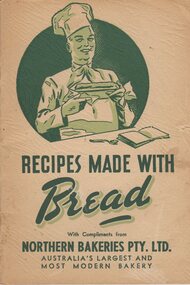 Greensborough Historical Society
Book - Book - Digital Image, Northern Bakeries, Recipes made with bread, 1953_
... An example of 1950s advertising through cooking and homemaker books. In this book, instructions are given for recipes using bread, interspersed with advertisements for bakeries, including Tip Top Bakeries throughout Melbourne's suburbs....An example of 1950s advertising through cooking and homemaker books. In this book, instructions are given for recipes using bread, interspersed with advertisements for bakeries, including Tip Top Bakeries throughout Melbourne's suburbs. ...Covers and sample page from "Recipes made with bread". An example of 1950s advertising through cooking and homemaker books. In this book, instructions are given for recipes using bread, interspersed with advertisements for bakeries, including Tip Top Bakeries throughout Melbourne's suburbs.An example of mid 20th century advertising through 'how-to' books.Digital copy of front and back covers of a book with sample page.historic advertisements, recipes, bread, bakeries, tip top bakeries -
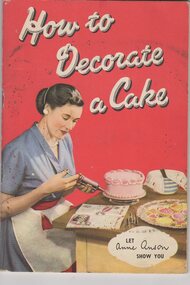 Greensborough Historical Society
Book - Book - Digital Image, Taylor, Law et al, How to decorate a cake: by Anne Anson, 1954_
... An example of 1950s advertising through cooking and homemaker books. In this book, instructions are given for decorating cakes, including advertisements for decorating suppliest. ...An example of 1950s advertising through cooking and homemaker books. In this book, instructions are given for decorating cakes, including advertisements for decorating suppliest. ...Covers and sample page from "How to decorate a cake: by Anne Anson". An example of 1950s advertising through cooking and homemaker books. In this book, instructions are given for decorating cakes, including advertisements for decorating suppliest. The sample shows "Tala" brand decorating equipment.An example of mid 20th century advertising through 'how-to' books.Digital copy of front cover of a book with sample pages.historic advertisements, recipes, cake decorating, tala -
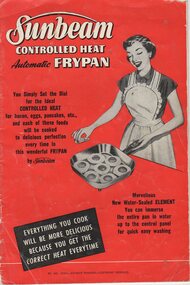 Greensborough Historical Society
Book - Book - Digital Image, Sunbeam Corporation, Sunbeam Frypan instruction manual, 1959_
... Covers from "Sunbeam Frypan instruction manual". An example of 1950s advertising through cooking and homemaker books. ...Covers from "Sunbeam Frypan instruction manual". An example of 1950s advertising through cooking and homemaker books. ...Covers from "Sunbeam Frypan instruction manual". An example of 1950s advertising through cooking and homemaker books. In this book, instructions and recipes are given for using a Sunbeam controlled heat electric frypan. The back cover shows examples of other Sunbeam appliances.An example of mid 20th century advertising through 'how-to' books.Digital copy of front and back covers of a book.historic advertisements, recipes, electric appliances, electric frypans, sunbeam appliances -
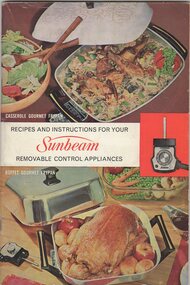 Greensborough Historical Society
Book - Book - Digital Image, Sunbeam Corporation, Sunbeam Removable Control Appliances: instruction manual, 1965_
... Covers from "Sunbeam Removable Control Appliances instruction manual". An example of 1960s advertising through cooking and homemaker books. ...Covers from "Sunbeam Removable Control Appliances instruction manual". An example of 1960s advertising through cooking and homemaker books. ...Covers from "Sunbeam Removable Control Appliances instruction manual". An example of 1960s advertising through cooking and homemaker books. In this book, instructions and recipes are given for using various Sunbeam Removable Control Appliances, such as frypans, and deep fryers. The back cover shows photographs of Sunbeam deep fryers.An example of mid 20th century advertising through 'how-to' books.Digital copy of front and back covers of a book.historic advertisements, recipes, electric appliances, electric frypans, sunbeam appliances, deep fryers -
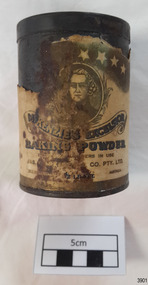 Flagstaff Hill Maritime Museum and Village
Container - Tin, McKenzies Foods, circa 1930s
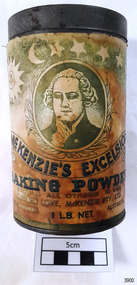
... cooking ingredient baking powder mckenqie Text includes “JAS. F. McKENZIE & CO. PTY. LTD. / AUSTRALIA“ “McKENZIE’S EXCELSIOR / BAKING POWDER”. Motif: man’s portrait within oval frame with wheat sheaf border, placed below figures of sun, moon and stars. Information and instructions ...This tin once contained McKenzie’s baking powder, a cooking ingredient. It was donated with other similar tins that were used by the donor’s mother who was married in 1932. It those times in Australia all manner of household items, including food and drink, were sold by hawkers (salesmen) who travelled from door to door in both suburban and rural areas. The donor remembered the bicarb soda tin on her mother’s pantry shelf. The McKenzie’s Baking Powder label adds the information that the ingredients were “Prepared with Aerophos, Regd. Trade Mark, the finest raising ingredient. A product of Albright & Wilson, Australia Pty. Ltd.” It also says that it “Excels all others in use”. The Australian family business, McKenzie’s Foods, began in Melbourne in 1852 and continues today, now run be the fifth generation of descendants from the original owners. Its baking and cookery products are well recognised by Australians. This tin originates in the early 1900s from an Australian company that is now managed by fifth generation descendants of the original family after its inception in 1852. The tin increases in significance for its use as a recognised object found in many Australian kitchens since early days. It gives a snapshot into domestic life and social norms of the pre and post war period in Melbourne The tin is significant for its association with a local family in the 1930s for the preparation of family meals. Tin container, cylindrical, with cream paper label with gold highlights, motif and text. Used for selling McKenzie’s Excelsior baking powder. Container has push-on lid. Quantity of 1/2 LB. NETT. Made in Australia by Jas. F. McKenzie & Co. Pty Ltd. Text includes “JAS. F. McKENZIE & CO. PTY. LTD. / AUSTRALIA“ “McKENZIE’S EXCELSIOR / BAKING POWDER”. Motif: man’s portrait within oval frame with wheat sheaf border, placed below figures of sun, moon and stars. Information and instructions. flagstaff hill asset, baking powder tin, container, flagstaff hill museum, kitchen item, cookery, baking, grocery, mckenzie, rising agent, food container, flagstaff hill, warrnambool, shipwrecked coast, flagstaff hill maritime museum, maritime museum, shipwreck coast, flagstaff hill maritime village, great ocean road, tin, cooking ingredient, baking powder, mckenqie -
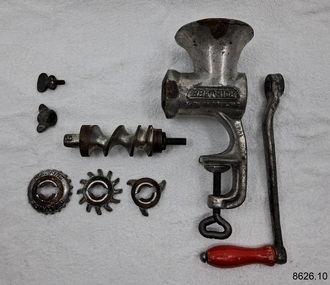 Flagstaff Hill Maritime Museum and Village
Domestic object - Food Mincer, John Harper & Co, Early - Mid 20th Century
... Flagstaff Hill Maritime Museum and Village Great Ocean Road Shipwreck Coast Mincer Grinder Meat Cooking Beatrice Made in England Harper No. 3181 W.R. Angus Harper. No 3181. Beatrice. Made in England. No 3 Fine. Also a leaflet of instructions ...A meat grinder, commonly known as the meat mincer, is used for chopping meat into fine pieces. Alternatively, it can be used for the mixing of raw or cooked meat, fish and vegetables. It is the best way to process meat, and is a widely used piece of equipment by butchers and in the home.. Butchers have been known to use either mincing knives or meat cleavers in the kitchen for years to produce a quantity of minced meat. This was a slow and laborious process. The advent of the meat mincer has not only made the mincing process easier but also faster. The meat mincer has slowly evolved over the years into what it is today. The first meat mixer or meat mincer was invented in the 19th century by a German inventor named Baron Karl Drais. Although some versions of the device date back to much earlier. The oldest form of meat mincer was hand cranked which forced meat through a metal plate with several small holes in it, which resulted in long and thin strands of the meat. The meat was fed into the funnel that was placed at the top of the mixer. This meat would pass through a hand cranked screw conveyor that would squash and mix the meat before passing it through the metal plate. Needless to say, this was again a slow and laborious procedure to follow to produce large quantity of meat. With passage of time, this hand cracked machine became powered by electricity. The meat mincer has a great adaptability and efficiency now. The huge variety in mincer plates allows a butcher to produce different types of minced meat in any shape desired. However, traditional manual meat mincers have not really changed a lot. They are manually operated and made of cast iron, as earlier. They are similar to the original mincer designs, dating back to the early 1900s. Some butchers still prefer using a variety of mincer knives. Adapted from: https://brennan-group.com/blogs/news/history-of-the-meat-mincer This meat mincer belonged to the family of Dr.William Roy Angus, Surgeon and Oculist. It was donated to Flagstaff Hill Maritime Village by his daughter, Bernice McDade. It is part of the “W.R. Angus Collection” that includes historical medical equipment, surgical instruments and material once belonging to Dr Edward Ryan and Dr Thomas Francis Ryan, (both of Nhill, Victoria) as well as Dr Angus’ own belongings. The Collection’s history spans the medical practices of the two Doctors Ryan, from 1885-1926 plus that of Dr Angus, up until 1969. ABOUT THE “W.R.ANGUS COLLECTION” Doctor William Roy Angus M.B., B.S., Adel., 1923, F.R.C.S. Edin.,1928 (also known as Dr Roy Angus) was born in Murrumbeena, Victoria in 1901 and lived until 1970. He qualified as a doctor in 1923 at University of Adelaide, was Resident Medical Officer at the Royal Adelaide Hospital in 1924 and for a period was house surgeon to Sir (then Mr.) Henry Simpson Newland. Dr Angus was briefly an Assistant to Dr Riddell of Kapunda, then commenced private practice at Curramulka, Yorke Peninsula, SA, where he was physician, surgeon and chemist. In 1926, he was appointed as new Medical Assistant to Dr Thomas Francis Ryan (T.F. Ryan, or Tom), in Nhill, Victoria, where his experiences included radiology and pharmacy. In 1927 he was Acting House Surgeon in Dr Tom Ryan’s absence. Dr Angus had become engaged to Gladys Forsyth and they decided he would take time to further his studies overseas in the UK in 1927. He studied at London University College Hospital and at Edinburgh Royal Infirmary and in 1928, was awarded FRCS (Fellow from the Royal College of Surgeons), Edinburgh. He worked his passage back to Australia as a Ship’s Surgeon on the on the Australian Commonwealth Line’s T.S.S. Largs Bay. Dr Angus married Gladys in 1929, in Ballarat. (They went on to have one son (Graham 1932, born in SA) and two daughters (Helen (died 12/07/1996) and Berenice (Berry), both born at Mira, Nhill ) Dr Angus was a ‘flying doctor’ for the A.I.M. (Australian Inland Ministry) Aerial Medical Service in 1928 . The organisation began in South Australia through the Presbyterian Church in that year, with its first station being in the remote town of Oodnadatta, where Dr Angus was stationed. He was locum tenens there on North-South Railway at 21 Mile Camp. He took up this ‘flying doctor’ position in response to a call from Dr John Flynn; the organisation was later known as the Flying Doctor Service, then the Royal Flying Doctor Service. A lot of his work during this time involved dental surgery also. Between 1928-1932 he was surgeon at the Curramulka Hospital, Yorke Peninsula, South Australia. In 1933 Dr Angus returned to Nhill where he’d previously worked as Medical Assistant and purchased a share of the Nelson Street practice and Mira hospital from Dr Les Middleton one of the Middleton Brothers, the current owners of what was once Dr Tom Ryan’s practice. Dr L Middleton was House Surgeon to the Nhill Hospital 1926-1933, when he resigned. [Dr Tom Ryan’s practice had originally belonged to his older brother Dr Edward Ryan, who came to Nhill in 1885. Dr Edward saw patients at his rooms, firstly in Victoria Street and in 1886 in Nelson Street, until 1901. The Nelson Street practice also had a 2 bed ward, called Mira Private Hospital ). Dr Edward Ryan was House Surgeon at the Nhill Hospital 1884-1902 . He also had occasions where he successfully performed veterinary surgery for the local farmers too. Dr Tom Ryan then purchased the practice from his brother in 1901. Both Dr Edward and Dr Tom Ryan work as surgeons included eye surgery. Dr Tom Ryan performed many of his operations in the Mira private hospital on his premises. He too was House Surgeon at the Nhill Hospital 1902-1926. Dr Tom Ryan had one of the only two pieces of radiology equipment in Victoria during his practicing years – The Royal Melbourne Hospital had the other one. Over the years Dr Tom Ryan gradually set up what was effectively a training school for country general-practitioner-surgeons. Each patient was carefully examined, including using the X-ray machine, and any surgery was discussed and planned with Dr Ryan’s assistants several days in advance. Dr Angus gained experience in using the X-ray machine there during his time as assistant to Dr Ryan. Dr Tom Ryan moved from Nhill in 1926. He became a Fellow of the Royal Australasian College of Surgeons in 1927, soon after its formation, a rare accolade for a doctor outside any of the major cities. He remained a bachelor and died suddenly on 7th Dec 1955, aged 91, at his home in Ararat. Scholarships and prizes are still awarded to medical students in the honour of Dr T.F. Ryan and his father, Dr Michael Ryan, and brother, John Patrick Ryan. ] When Dr Angus bought into the Nelson Street premises in Nhill he was also appointed as the Nhill Hospital’s Honorary House Surgeon 1933-1938. His practitioner’s plate from his Nhill surgery states “HOURS Daily, except Tuesdays, Fridays and Saturday afternoons, 9-10am, 2-4pm, 7-8pm. Sundays by appointment”. This plate is now mounted on the doorway to the Port Medical Office at Flagstaff Hill Maritime Village, Warrnambool. Dr Edward Ryan and Dr Tom Ryan had an extensive collection of historical medical equipment and materials spanning 1884-1926 and when Dr Angus took up practice in their old premises he obtained this collection, a large part of which is now on display at the Port Medical Office at Flagstaff Hill Maritime Village in Warrnambool. During his time in Nhill Dr Angus was involved in the merging of the Mira Hospital and Nhill Public Hospital into one public hospital and the property titles passed on to Nhill Hospital in 1939. In 1939 Dr Angus and his family moved to Warrnambool where he purchased “Birchwood,” the 1852 home and medical practice of Dr John Hunter Henderson, at 214 Koroit Street. (This property was sold in1965 to the State Government and is now the site of the Warrnambool Police Station. ). The Angus family was able to afford gardeners, cooks and maids; their home was a popular place for visiting dignitaries to stay whilst visiting Warrnambool. Dr Angus had his own silk worm farm at home in a Mulberry tree. His young daughter used his centrifuge for spinning the silk. Dr Angus was appointed on a part-time basis as Port Medical Officer (Health Officer) in Warrnambool and held this position until the 1940’s when the government no longer required the service of a Port Medical Officer in Warrnambool; he was thus Warrnambool’s last serving Port Medical Officer. (The duties of a Port Medical Officer were outlined by the Colonial Secretary on 21st June, 1839 under the terms of the Quarantine Act. Masters of immigrant ships arriving in port reported incidents of diseases, illness and death and the Port Medical Officer made a decision on whether the ship required Quarantine and for how long, in this way preventing contagious illness from spreading from new immigrants to the residents already in the colony.) Dr Angus was a member of the Australian Medical Association, for 35 years and surgeon at the Warrnambool Base Hospital 1939-1942, He served as a Surgeon Captain during WWII1942-45, in Ballarat, Victoria, and in Bonegilla, N.S.W., completing his service just before the end of the war due to suffering from a heart attack. During his convalescence he carved an intricate and ‘most artistic’ chess set from the material that dentures were made from. He then studied ophthalmology at the Royal Melbourne Eye and Ear Hospital and created cosmetically superior artificial eyes by pioneering using the intrascleral cartilage. Angus received accolades from the Ophthalmological Society of Australasia for this work. He returned to Warrnambool to commence practice as an ophthalmologist, pioneering in artificial eye improvements. He was Honorary Consultant Ophthalmologist to Warrnambool Base Hospital for 31 years. He made monthly visits to Portland as a visiting surgeon, to perform eye surgery. He represented the Victorian South-West subdivision of the Australian Medical Association as its secretary between 1949 and 1956 and as chairman from 1956 to 1958. In 1968 Dr Angus was elected member of Spain’s Barraquer Institute of Barcelona after his research work in Intrasclearal cartilage grafting, becoming one of the few Australian ophthalmologists to receive this honour, and in the following year presented his final paper on Living Intrasclearal Cartilage Implants at the Inaugural Meeting of the Australian College of Ophthalmologists in Melbourne In his personal life Dr Angus was a Presbyterian and treated Sunday as a Sabbath, a day of rest. He would visit 3 or 4 country patients on a Sunday, taking his children along ‘for the ride’ and to visit with him. Sunday evenings he would play the pianola and sing Scottish songs to his family. One of Dr Angus’ patients was Margaret MacKenzie, author of a book on local shipwrecks that she’d seen as an eye witness from the late 1880’s in Peterborough, Victoria. In the early 1950’s Dr Angus, painted a picture of a shipwreck for the cover jacket of Margaret’s book, Shipwrecks and More Shipwrecks. She was blind in later life and her daughter wrote the actual book for her. Dr Angus and his wife Gladys were very involved in Warrnambool’s society with a strong interest in civic affairs. Their interests included organisations such as Red Cross, Rostrum, Warrnambool and District Historical Society (founding members), Wine and Food Society, Steering Committee for Tertiary Education in Warrnambool, Local National Trust, Good Neighbour Council, Housing Commission Advisory Board, United Services Institute, Legion of Ex-Servicemen, Olympic Pool Committee, Food for Britain Organisation, Warrnambool Hospital, Anti-Cancer Council, Boys’ Club, Charitable Council, National Fitness Council and Air Raid Precautions Group. He was also a member of the Steam Preservation Society and derived much pleasure from a steam traction engine on his farm. He had an interest in people and the community He and his wife Gladys were both involved in the creation of Flagstaff Hill, including the layout of the gardens. After his death (28th March 1970) his family requested his practitioner’s plate, medical instruments and some personal belongings be displayed in the Port Medical Office surgery at Flagstaff Hill Maritime Village, and be called the “W. R. Angus Collection”.The English-made food mincer is an example of kitchenware available to households from the early 20th century. The W.R. Angus Collection is significant for still being located at the site it is connected with, Doctor Angus being the last Port Medical Officer in Warrnambool. The collection of medical instruments and other items and equipment is culturally significant, being an historical example of medicine from late 19th to mid-20th century. Dr Angus assisted Dr Tom Ryan, a pioneer in the use of X-rays and in ocular surgery.Metal food mincer labelled Harper No. 3181, Beatrice. Made in England. The object is part of the W.R. Angus Collection. Harper. No 3181. Beatrice. Made in England. No 3 Fine. Also a leaflet of instructions headed up: 'Harper No.3181 "Beatrice" Food Mincer. Instuctions for Use.'flagstaff hill maritime museum and village, great ocean road, shipwreck coast, mincer, grinder, meat, cooking, beatrice, made in england, harper, no. 3181, w.r. angus -
 Flagstaff Hill Maritime Museum and Village
Container - Tin, McKenzies Foods, circa 1930s
... cooking ingredient food container grocery cookery rising agent baking powder mckenzie mckenzie foods Text includes “CLIFFORD LOVE, McKENZIE PTY. LTD.” “McKENZIE’S EXCELSIOR / BAKING POWDER”. Motif: man’s portrait within oval frame with wheat sheaf border, placed below figures of sun, moon and stars. Information and instructions ...This tin once contained McKenzie’s baking powder, a cooking ingredient. It was donated with other similar tins that were used by the donor’s mother who was married in 1932. It those times in Australia all manner of household items, including food and drink, were sold by hawkers (salesmen) who travelled from door to door in both suburban and rural areas. The donor remembered the bicarb soda tin on her mother’s pantry shelf. The McKenzie’s Baking Powder label adds the information that the ingredients were “Prepared with Aerophos, Regd. Trade Mark, the finest raising ingredient. A product of Albright & Wilson, Australia Pty. Ltd.” It also says that it “Excels all others in use”. The company began in Melbourne in 1852 and continues today, now run be the fifth generation of descendants from the original owners. This tin originates in the early 1900s from an Australian company that is now managed by fifth generation descendants of the original family after its inception in 1852. The tin increases in significance for its use as a recognised object found in many Australian kitchens since early days. It gives a snapshot into domestic life and social norms of the pre and post war period in Melbourne The tin is significant for its association with a local family in the 1930s for the preparation of family meals. Tin container, cylindrical, with cream and green paper label with gold highlights, motif and text. Used for selling McKenzie’s Excelsior baking powder. Container has push-on lid. Quantity of 1LB. NET. Made in Australia by McKenzie Ltd.Text includes “CLIFFORD LOVE, McKENZIE PTY. LTD.” “McKENZIE’S EXCELSIOR / BAKING POWDER”. Motif: man’s portrait within oval frame with wheat sheaf border, placed below figures of sun, moon and stars. Information and instructions. flagstaff hill asset, baking powder tin, container, flagstaff hill museum, kitchen item, cooking ingredients, flagstaff hill, warrnambool, shipwrecked coast, flagstaff hill maritime museum, maritime museum, shipwreck coast, flagstaff hill maritime village, great ocean road, tin, cooking ingredient, food container, grocery, cookery, rising agent, baking powder, mckenzie, mckenzie foods -
 City of Moorabbin Historical Society (Operating the Box Cottage Museum)
Domestic object - Kitchen equipment, spirit-fuelled sad iron, c1920
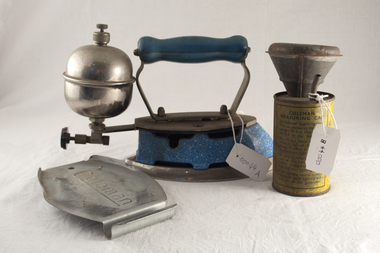
... cooking stoves and domestic irons. This spirit- fuelled flat iron was very popular in 1920s - 30s These sad irons remind us of the difficult circumstances experienced in their daily routines by the pioneers and early settlers of Moorabbin Shire The family of Miss M Curtis were early settlers in Moorabbin Shire sad iron kitchen equipment coleman william kansas oklahoma pioneers early settlers market gardeners sewing craftwork clothing moorabbin brighton bentleigh fireplaces stoves petrol fuelled irons spirit flat irons coleman lamp stove co. ltd. Metal Trivet/stand " COLEMAN" ; Petrol can " COLEMAN" / MEASURING CAN / for INSTANT LIGHTING IRON/ with printed instructions ...Sad-irons or "solid" irons were made by blacksmiths and used to smooth out material by pressing the hot iron over it. A piece of sheet -iron was placed over the kitchen fire and the irons placed on it could be heated whilst remaining clean of ash.. The women used 2 irons - one heating while the other was used. Thick cloth or gloves protected their hands from the hot irons. The handle was removed from the cool iron and re- attached to remove the hot iron from the fire. The cool iron was replaced on the fire or stove to heat again. These irons were cleaned with steel wool to prevent them marking the material. If the iron was too hot the material would scorch. Most homes set aside one day for ironing and some large households had an ironing room with a special stove designed to heat irons. However, most women had to work with a heavy, hot iron close to the fireplace even in summer. Late in the 19thC designers experimented with heat retaining fillings for these irons. William Coleman began selling Kerosene lanterns in 1900 in Kingfisher, Oklahoma, USA. He moved to Wichita, Kansas in 1902 and the company became world wide. The company also produced a range of cooking stoves and domestic irons. This spirit- fuelled flat iron was very popular in 1920s - 30s These sad irons remind us of the difficult circumstances experienced in their daily routines by the pioneers and early settlers of Moorabbin Shire The family of Miss M Curtis were early settlers in Moorabbin ShireA) spirit- fuelled, sad iron with chrome plated sole c1920, and metal trivet The iron is blue enamel with a white speckled body, with a hemispherical tank for the Coleman 'Lighting Petrol' that provided the heat for smoothing the material B) Coleman Fuel measuring can and funnellMetal Trivet/stand " COLEMAN" ; Petrol can " COLEMAN" / MEASURING CAN / for INSTANT LIGHTING IRON/ with printed instructionssad iron, kitchen equipment, coleman william, kansas, oklahoma, pioneers, early settlers, market gardeners, sewing, craftwork, clothing, moorabbin, brighton, bentleigh, fireplaces, stoves, petrol fuelled irons, spirit flat irons, coleman lamp stove co. ltd. -
 Kiewa Valley Historical Society
Box Starch, circa 1914 to late 1900's
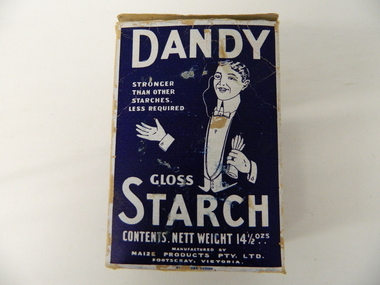
... cooking. Allow to cool, and add blueing if required. Underneath these two sets of instructions is "Make your consistency thinner than if using another kind of Starch"...cooking. Allow to cool, and add blueing if required. Underneath these two sets of instructions is "Make your consistency thinner than if using another kind of Starch" This box with white writing and a "formally clad" man on a navy blue background held Australian grown maize based starch powder(1 LB gross). ...This brand of starch was first manufactured in 1914, during the First World War, and continued to cover the other wars and military conflicts that followed. It was a time when Australian made was important due to the limited supplies coming from England and Europe. This was a period when the demand for "home grown" produce was at its peak. This was in a time when by necessity not by the "Buy Australian" campaign (of later years) which was the major factor for the demand of goods. It was in a time when starch was used in formal clothing to put a "crisp" or fresh new appearance for clothes. The important social more of "clothes make the person" was in vogue.This box which once contained starch powder is very significant to a rural semi isolated region because it clearly demonstrates that the social mores of the city were also entrenched into the rural population. The fashion of the day, even in remote areas, especially rural, were still a requirement to be maintained on certain special occasions. Cleanliness and stiff "upper lip" persona were just as important in the rural sector as in city and Government circles. Institutions such as hospitals, Government Offices and the legal personnel were bound by the fashion of the starch appearance (no dirt sticks to a personage with the "starch" look). Appearances, especially the first ones, were the judgmental image that remained in the uppermost regions of the viewer. This box with white writing and a "formally clad" man on a navy blue background held Australian grown maize based starch powder(1 LB gross). The package is made from 200 gsm thick cardboard. As production was made during the two World Wars 1914 to 1945 the promotion was heavily focused on Australian made and Australian grown maize.The same cover both front and back, "DANDY" below this a figure outlined in white on a navy blue background "hat and tails" outfit. Next to the sketch in smaller lettering" STRONGER THAN OTHER STARCHES. LESS REQUIRED". Below the figure "GLOSS" and below this in larger print "STARCH". Below this and in smaller print "CONTENTS. NETT WEIGHT 14 1/2 ozs" Below this and in smaller print "MANUFACTURED BY MAIZE PRODUCTS PTY LTD FOOTSCRAY VICTORIA" On one side of the box and in large white print on royal blue background"PURITY, STRENGTH AND UNIFORMITY." On the other side are the manufacturers directions. On the left side "FOR RAW STARCH" Underneath and in smaller print,"Dissolve in warm water a quantity to give the required thickness. Add bluing if required Stir before each using. On the right side "FOR BOILING STARCH" underneath this in small print"Mix well in small quantity of cold water to creamy consistency. Add boiling water, and stir constantly while cooking. Allow to cool, and add blueing if required. Underneath these two sets of instructions is "Make your consistency thinner than if using another kind of Starch"household starch, household cleaning, domestic laundering. -
 Kiewa Valley Historical Society
Box Sample Dandy Starch, circa mid to late 1900's
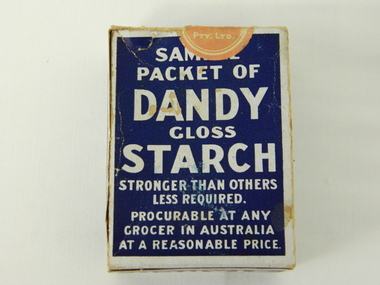
... cooking. Allow to cool, and add blueing if required. Underneath these two sets of instructions is "Make your consistency thinner than if using another kind of Starch"...cooking. Allow to cool, and add blueing if required. Underneath these two sets of instructions is "Make your consistency thinner than if using another kind of Starch" This box with white writing and a "formally clad" man on a navy blue background held Australian grown maize based starch powder(1 LB gross). ...This brand of starch was first manufactured in 1914, during the First World War, and continued to cover the other wars and military conflicts that followed. It was a time when Australian made was important due to the limited supplies coming from England and Europe. This was a period when the demand for "home grown" produce was at its peak. This was in a time when by necessity not by the "Buy Australian" campaign (of later years) which was the major factor for the demand of goods. It was in a time when starch was used in formal clothing to put a "crisp" or fresh new appearance for clothes. The important social more of "clothes make the person" was in vogue. This is a sample box provided by the manufacturer as an advertising and promotional method of prospective customers becoming aware of the product. This type of promotional avenue brought results and ensured that this type of advertising and inducement by manufacturers would be ingrained as a lasting avenue through to the 2nd Millennium This box which once contained starch powder is very significant to a rural semi isolated region because it clearly demonstrates that the social mores of the city were also entrenched into the rural population. The fashion of the day, even in remote areas, especially rural, were still a requirement to be maintained on certain special occasions. Cleanliness and stiff "upper lip" persona were just as important in the rural sector as in city and Government circles. Institutions such as hospitals, Government Offices and the legal personnel were bound by the fashion of the starch appearance (no dirt sticks to a personage with the "starch" look). Appearances, especially the first ones, were the judgmental image that remained in the uppermost regions of the viewer.This box with white writing and a "formally clad" man on a navy blue background held Australian grown maize based starch powder(1 LB gross). The package is made from 200 gsm thick cardboard. As production was made during the two World Wars 1914 to 1945 the promotion was heavily focused on Australian made and Australian grown maize.The front(has "Sample" on top) the rest inscriptions are the same on each cover both and back, "DANDY" below this a figure outlined in white on a navy blue background "hat and tails" outfit. Next to the sketch in smaller lettering" STRONGER THAN OTHER STARCHES. LESS REQUIRED". Below the figure "GLOSS" and below this in larger print "STARCH". Below this and in smaller print "CONTENTS. NETT WEIGHT 14 1/2 ozs" Below this and in smaller print "MANUFACTURED BY MAIZE PRODUCTS PTY LTD FOOTSCRAY VICTORIA" On one side of the box and in large white print on royal blue background"PURITY, STRENGTH AND UNIFORMITY." On the other side are the manufacturers directions. On the left side "FOR RAW STARCH" Underneath and in smaller print,"Dissolve in warm water a quantity to give the required thickness. Add bluing if required Stir before each using. On the right side "FOR BOILING STARCH" underneath this in small print"Mix well in small quantity of cold water to creamy consistency. Add boiling water, and stir constantly while cooking. Allow to cool, and add blueing if required. Underneath these two sets of instructions is "Make your consistency thinner than if using another kind of Starch"household starch, household cleaning, domestic laundering.
