
Showing 239 items matching "corner tower"
-
 Glen Eira Historical Society
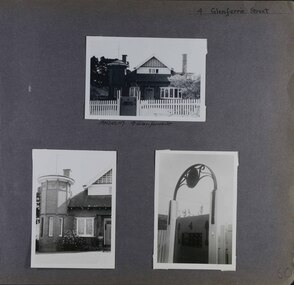
Album - Album page, Glenferrie Street, 4, Circa 1972
... ...corner tower...There is a octagonal corner tower with saucer shaped domed roof surmounted by a weather vane, and the tower has decorative terracotta panels immediately below the eaves line. ...This photograph is part of the Caulfield Historical Album 1972. This album was created in approximately 1972 as part of a project by the Caulfield Historical Society to assist in identifying buildings worthy of preservation. The album is related to a Survey the Caulfield Historical Society developed in collaboration with the National Trust of Australia (Victoria) and Caulfield City Council to identify historic buildings within the City of Caulfield that warranted the protection of a National Trust Classification. Principal photographer thought to be Trevor Hart, member of Caulfield Historical Society. Most photographs were taken between 1966-1972 with a small number of photographs being older and from unknown sources. All photographs are black and white except where stated, with 386 photographs over 198 pages. From Glen Eira Heritage Management Plan 1996 by Andrew Ward: In 1905, most of portion 27 was vacant land, however Glenferrie Street had been formed and the land subsequently subdivided. In 1906, Robert Joseph Haddon, architect and painter, designed and built for his private residence, a brick house on the west side. Haddon named the house "Anselm". Also built on the property were a garage and fibro cement studio. "Anselm" is architecturally important at the State level as a substantially intact, highly personalised and boldly expressed house expressive the Arts and Crafts movement and incorporating Art Nouveaux enrichment in a variety of forms, the use of ornamental terra cotta tiles to the comer tower being of special note. Its importance at the State level is strengthened by its place as the home of the noted architect and Melbourne's most influential exponent (Freeland, J.M., Architecture in Australia, p. 213) of the Art Nouveaux movement.https://vhd.heritagecouncil.vic.gov.au/places/4442 Victorian Heritage Register: What is significant? Anselm was designed by noted English born architect Robert Joseph Haddon(1866-1929) as his own house and constructed in 1906. A single storey Arts and Crafts influenced red brick house with attic, Anselm has a pyramidal slate roof with prominent chimney stacks. There is a octagonal corner tower with saucer shaped domed roof surmounted by a weather vane, and the tower has decorative terracotta panels immediately below the eaves line. The front door opens immediately into a large living or common room, screened from view by a timber and bottle glass screen. The large room was designed to function as a drawing and dining room. The house is rich with hand crafted details including door and window furniture, wrought iron gutter brackets, fireplaces (one with built in wood box), and fire tools. The interior decoration includes hand painted frieze of Port Phillip in the study, and a hand painted frieze of turbulent sea with sailing boats in the tiled bathroom. There is a small hand painted tile at the base of the tower which states ?This building was erected AD1906 from designs by Robt J Haddon FRIBA,Lond FRIVA Melb Architect?. He also designed an attic addition which was constructed in 1927. Anselm is substantially intact although the double casement window immediately to the south of the front door was originally circular....Page 60 of Photograph Album with three exterior photographs (one portrait and two landscape) of Anselm.Hand written: 4 Glenferrie Street [top right] / ANSELM 4 Glenferrie St [under top photo] / 60 [bottom right] trevor hart, anselm, art nouveaux, arts and crafts, tower, bay window, glenferrie street, robert joseph haddon, 1900's, terra cotta tiles, double storey, caulfield north, corner tower, gates, cast iron work -
 Glen Eira Historical Society
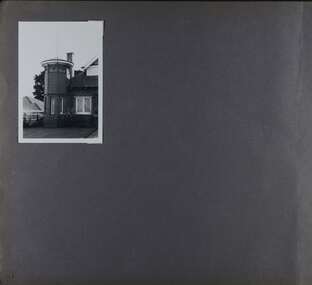
Album - Album page, Glenferrie Street, 4, Circa 1972
... ...corner tower...There is a octagonal corner tower with saucer shaped domed roof surmounted by a weather vane, and the tower has decorative terracotta panels immediately below the eaves line. ...This photograph is part of the Caulfield Historical Album 1972. This album was created in approximately 1972 as part of a project by the Caulfield Historical Society to assist in identifying buildings worthy of preservation. The album is related to a Survey the Caulfield Historical Society developed in collaboration with the National Trust of Australia (Victoria) and Caulfield City Council to identify historic buildings within the City of Caulfield that warranted the protection of a National Trust Classification. Principal photographer thought to be Trevor Hart, member of Caulfield Historical Society. Most photographs were taken between 1966-1972 with a small number of photographs being older and from unknown sources. All photographs are black and white except where stated, with 386 photographs over 198 pages. From Glen Eira Heritage Management Plan 1996 by Andrew Ward: In 1905, most of portion 27 was vacant land, however Glenferrie Street had been formed and the land subsequently subdivided. In 1906, Robert Joseph Haddon, architect and painter, designed and built for his private residence, a brick house on the west side. Haddon named the house "Anselm". Also built on the property were a garage and fibro cement studio. "Anselm" is architecturally important at the State level as a substantially intact, highly personalised and boldly expressed house expressive the Arts and Crafts movement and incorporating Art Nouveaux enrichment in a variety of forms, the use of ornamental terra cotta tiles to the comer tower being of special note. Its importance at the State level is strengthened by its place as the home of the noted architect and Melboume's most influential exponent (Freeland, J.M., Architecture in Australia, p. 213) of the Art Nouveaux movement. Victorian Heritage Register https://vhd.heritagecouncil.vic.gov.au/places/4442 What is significant? Anselm was designed by noted English born architect Robert Joseph Haddon(1866-1929) as his own house and constructed in 1906. A single storey Arts and Crafts influenced red brick house with attic, Anselm has a pyramidal slate roof with prominent chimney stacks. There is a octagonal corner tower with saucer shaped domed roof surmounted by a weather vane, and the tower has decorative terracotta panels immediately below the eaves line. The front door opens immediately into a large living or common room, screened from view by a timber and bottle glass screen. The large room was designed to function as a drawing and dining room. The house is rich with hand crafted details including door and window furniture, wrought iron gutter brackets, fireplaces (one with built in wood box), and fire tools. The interior decoration includes hand painted frieze of Port Phillip in the study, and a hand painted frieze of turbulent sea with sailing boats in the tiled bathroom. There is a small hand painted tile at the base of the tower which states ?This building was erected AD1906 from designs by Robt J Haddon FRIBA,Lond FRIVA Melb Architect?. He also designed an attic addition which was constructed in 1927. Anselm is substantially intact although the double casement window immediately to the south of the front door was originally circular....Page 61 of Photograph Album with one exterior photograph (portrait) of Anselm.Hand written: 61 [bottom left] trevor hart, anselm, art nouveaux, arts and crafts, tower, bay window, glenferrie street, robert joseph haddon, 1900's, terra cotta tiles, double storey, caulfield north, corner tower, brick house, attics -
 Glen Eira Historical Society
Historical Caulfield to 1972, photo album by Jenny O’Donnell, Normanby St
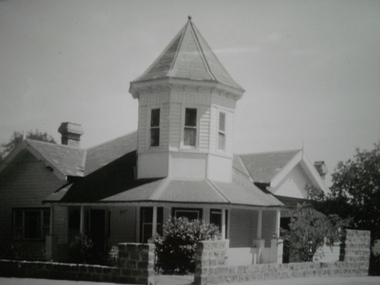
... 1 photo of a corner tower house...Caulfield East Normanby St Houses O’Donnell Jenny 1 photo of a corner tower house Historical Caulfield to 1972, photo album by Jenny O’Donnell, Normanby St ...1 photo of a corner tower housecaulfield east, normanby st, houses, o’donnell, jenny -
 Bendigo Historical Society Inc.
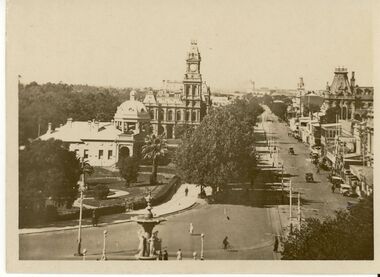
Photograph - PALL MALL, BENDIGO
... Post Office on corner with clock tower....Post Office on corner with clock tower. Photograph PALL MALL, BENDIGO ...Pall Mall view Bendigo. Post Office on corner with clock tower.unknownbendigo, council -
 Port Fairy Historical Society Museum and Archives
Photograph
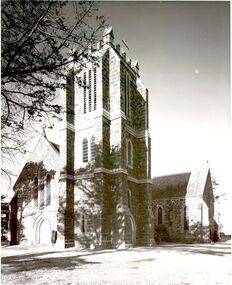
... St John's Church North west corner complete with tower...St John's Church North west corner complete with tower church sunday-school building Black and white photograph Photograph Photograph ...St John's Church North west corner complete with towerBlack and white photographchurch, sunday-school, building -
 Canterbury History Group
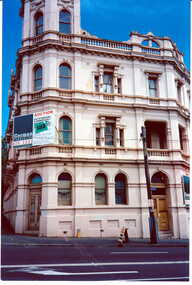
Photograph - Canterbury Road view of the Canterbury Mansions at No. 208 Canterbury Road, Jan Pigot, 1994
... Also depicts the corner roof tower and the sold sign after the auction of the building....Also depicts the corner roof tower and the sold sign after the auction of the building. ...Coloured photograph of the Canterbury Road view of the 3 storey Victorian Building called Canterbury Mansions. Also depicts the corner roof tower and the sold sign after the auction of the building.canterbury, canterbury road, shops, victorian architecture, signs -
 Surrey Hills Historical Society Collection
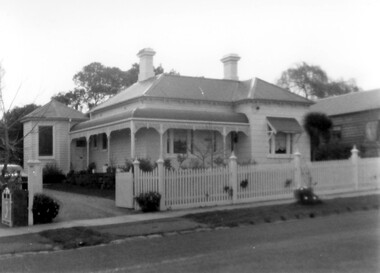
Photograph, 'Garmure', 26 Russell Street, Surrey Hills in 1988
... This photo was taken after renovation of the rear of the house when the corner tower was added. Occupants: 1890: Mr Caffin 1910: Miss Agnes Campbell Hutchinson Orr 1930 – 1988: Sextons Miss Orr was born in Hutchesontown, Glasgow to Francis Orr (1834-1859) and Jane McDonald. ...This photo was taken after renovation of the rear of the house when the corner tower was added. Occupants: 1890: Mr Caffin 1910: Miss Agnes Campbell Hutchinson Orr 1930 – 1988: Sextons Miss Orr was born in Hutchesontown, Glasgow to Francis Orr (1834-1859) and Jane McDonald. ...‘Garmure’, 26 Russell Street, Surrey Hills was built c. 1887 and renovated c1988. This photo was taken after renovation of the rear of the house when the corner tower was added. Occupants: 1890: Mr Caffin 1910: Miss Agnes Campbell Hutchinson Orr 1930 – 1988: Sextons Miss Orr was born in Hutchesontown, Glasgow to Francis Orr (1834-1859) and Jane McDonald. Her father died soon after her birth and her mother married Thomas Blood. She had a half-brother Robert McDonald Blood. In 1903 she, her brother and mother were living in Boundary Road. She is buried with them in Kew Cemetery. She died aged 57 on 1 December 1926. A black and white photograph of a Queen Anne Style weatherboard house with a return veranda. The roof is corrugated iron. There is a picket fence along the front and a driveway on the left had side of the building.garmure, house names, (mr) - caffin, sexton family, queen anne style, corrugated iron, weatherboard, russell street, surrey hills, (miss) agnes campbell hutchinson orr -
 Surrey Hills Historical Society Collection
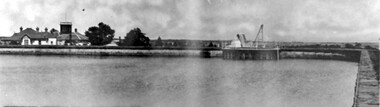
Photograph, Surrey Hills Reservoir No 1
... This is Surrey Hills Reservoir No 1 on the corner of Tower Street built in c1892 at a cost of £12,000 to supply higher sections of the area. ...This is Surrey Hills Reservoir No 1 on the corner of Tower Street built in c1892 at a cost of £12,000 to supply higher sections of the area. ...Copied by Ken Hall from an early postcard. This is Surrey Hills Reservoir No 1 on the corner of Tower Street built in c1892 at a cost of £12,000 to supply higher sections of the area. The builders were Jack and Bob Laudehr, partners in a wood yard in St. Kilda (Vic). They began by delivering firewood but extended to contract work involving timber. Another of their projects was to lay cable tram tracks commencing in Acland Street St. Kilda and running along The Esplanade. The reservoir in Canterbury Road was a large concrete structure built before the introduction of reinforcements. The excavated material was banked against the sides and pine trees were planted in it to add strength to the embankment. They were paid £2,000 for their work. Construction of Surrey Hills Number 2 Reservoir was completed in 1913 and the accompanying tower was built in 1929. It is assumed that the Miss Hill as the source of the donation (via Bill Dempsey) was Ivy Annie Hill (1902-1984). She was the only female child of William Valentine Dempsey to not marry. Bill Dempsey's mother was Laura Constance 'Birdie' Hill (1900-1968) who married Albert Dempsey.A sepia photograph within a post card of a reservoir on Canterbury Road, Surrey Hills. In the background to the left you can see the top halves of two houses and the tops of some trees. The photo takes up only the central section of the postcard.Below the photo on the front of the postcard on blue biro "Reservor [sic] Canterbury Rd / Surrey Hills." On the rear in grey lead pencil in Jocelyn Hall's handwriting: "Donor W Dempsey ------------- Keep / (nephew) / [arrow pointing down] / From Miss Hill / 10 Pembroke St SH / This house can be / seen in front of / No 12 which has / tower"1890, water supply, mmbw, edward d dyer (mr), 10 pembroke street, 12 pembroke street, surrey hills, ivy annie hill (miss), william valentine hill (mr), canterbury road, tower street, water supply structures and establishments, dams and reservoirs, jack laudehr (mr), bob laudehr (mr) -
 Bendigo Historical Society Inc.
Photograph - ESTELLE HEWSTON COLLECTION: COLOUR PHOTOGRAPHS OF THE BENDIGO POST OFFICE BUILDING, PALL MALL BUILDING, Sept 1990
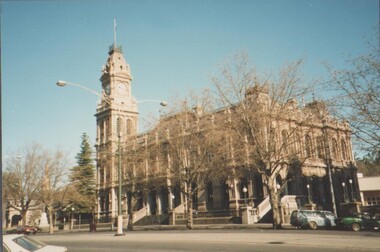
... Two colour photographs of the exterior of the Bendigo Post Office Building, corner of Pall Mall and Sydney Myer Place, Bendigo Photos dated September 1990. 26A Exterior view of former Bendigo Post Office looking toward southerly aspect of building. 26B Exterior view of former Bendigo Post Office from corner of Williamson Street and Pall Mall. Note clock tower on corner of building....Post Office Bendigo Pall Mall Estelle Hewston Two colour photographs of the exterior of the Bendigo Post Office Building, corner of Pall Mall and Sydney Myer Place, Bendigo Photos dated September 1990. 26A Exterior view of former Bendigo Post Office looking toward southerly aspect of building. 26B Exterior view of former Bendigo Post Office from corner of Williamson Street and Pall Mall. Note clock tower on corner of building. ...Two colour photographs of the exterior of the Bendigo Post Office Building, corner of Pall Mall and Sydney Myer Place, Bendigo Photos dated September 1990. 26A Exterior view of former Bendigo Post Office looking toward southerly aspect of building. 26B Exterior view of former Bendigo Post Office from corner of Williamson Street and Pall Mall. Note clock tower on corner of building.Estelle Hewstonpost office, bendigo, pall mall -
 Bendigo Historical Society Inc.
Postcard - CARWARDINE COLLECTION: TOWN HALL BENDIGO
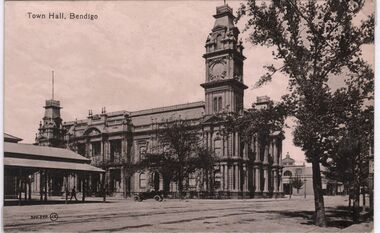
... On top LH corner 'Town Hall, Bendigo'. Image shows two storey Town Hall building with clock tower. ...On top LH corner 'Town Hall, Bendigo'. Image shows two storey Town Hall building with clock tower. ...Black and white postcard. On top LH corner 'Town Hall, Bendigo'. Image shows two storey Town Hall building with clock tower. Corner of Market Building on LH side. Early motor vehicle ( 1920's) in front of building. Written on back of card ' 1926, Dear Alf, just a line to say that we were very pleased hearing that you got back safely. The flowers arrived in good order. I was very pleased to get them. We were surprised to see that you had such a variety of carnations, sweet peas and marguerites also were very (illegible) Mother does not seem nearly so well she is certainly getting weaker, doctor was up again today, he said he could not prescribe anything different to what she is taking to keep up her strength' Card not signed. Receipt number 355/16bendigo, business, carwardine soap and candle -
 Bendigo Historical Society Inc.
Photograph - LANDSCAPE VIEW OF BENDIGO
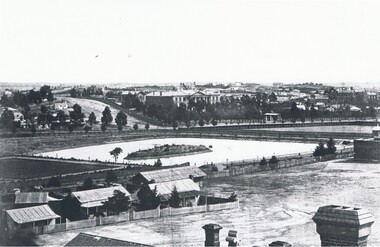
... Lake or dam with small island centre, stone brick wall with lookout tower at corner ( Bendigo gaol ) at right centre distanc,e large building. ...Lake or dam with small island centre, stone brick wall with lookout tower at corner ( Bendigo gaol ) at right centre distanc,e large building. ...Black and white photograph. In foreground, roof and chimneys. Row of 3 small weatherboard houses with verandah, picket fences. 1 small and 1 larger building behind. Lake or dam with small island centre, stone brick wall with lookout tower at corner ( Bendigo gaol ) at right centre distanc,e large building. Benevolent Asylum. Many other buildings in distance. James Lerk 11.2.2000 ' view from the Corporate High School, Benevolent Asylum in centre' Unknown BHS member 5.11.1999 ' lower dam ( site of present tennis courts, Park Road, pumped out C 1926' Written on back of photo 'Bendigo Victoria 1860's, Sandhurst North view 100 miles north from Melbourne. C. Nettleton, Victorian Views'C. Nettleton ?place, landscape view, bendigo -
 Warrnambool and District Historical Society Inc.
Artefact, Model of Church, C1900
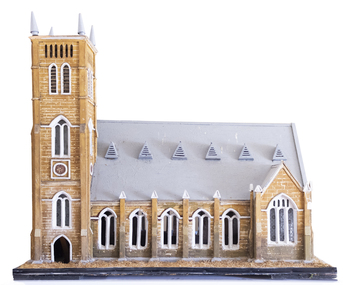
... tower is square-shaped with four conical-shaped finials. The upper part has four sets of louvres and two arched windows. The centre and lower sections have rosette patterns and several sets of dual arched windows with frosted decorated glass panels. The north east corner...tower is square-shaped with four conical-shaped finials. The upper part has four sets of louvres and two arched windows. The centre and lower sections have rosette patterns and several sets of dual arched windows with frosted decorated glass panels. The north east corner ...This model of St. John’s Presbyterian Church in Warrnambool was made by Johan Carl August Landmann (1826-1920). August Landmann and his wife, Christina came from Silesia to Australia in 1854. They settled in Warrnambool where August made a living as a carpenter and joiner. At first he rented shops in Timor Street and then built a two-storeyed shop and residence in Henna Street. Landmann built many of the early commercial buildings and residences in Warrnambool and he and his family were associated with the management of the Warrnambool Western Brewery. When he retired in 1900 he built another residence in Mickle Street and it was at that time that it is believed he made the model of the Presbyterian Church and the model of the Ozone Hotel (which is in the Warrnambool Art Gallery today). St. John’s Presbyterian Church, designed by Andrew Kerr, was built in the English Gothic style and opened in 1875. It was destroyed by fire in 1920 but was rebuilt to a similar style. This model is of great significance for two reasons: 1. It was made by a prominent early Warrnambool carpenter and joiner, Johan Carl August Landmann. 2. It is the only known model of the Warrnambool St. John’s Presbyterian Church which was destroyed by fire in 1920.This model is on a wooden stand or base which is painted black with metal screws. The edging of the stand contains straw which is now brown but was originally green to resemble grass or lawn. The church is a wooden structure (hollow inside) with some sections painted to resemble sandstone. The roof is slanted and painted grey and has six dormer windows or ventilation pieces on each side. The main body of the church has a nave with dual arched windows, the west end has dual arched windows and a door with louvre ventilation and the east end has a door and dual arched windows and two conical-shaped finials. The windows, some of which are triangular, have frosted decorated glass. Some of the glass in the windows is missing. The main tower is square-shaped with four conical-shaped finials. The upper part has four sets of louvres and two arched windows. The centre and lower sections have rosette patterns and several sets of dual arched windows with frosted decorated glass panels. The north east corner has a smaller tower.johan carl august landmann, st. john’s presbyterian church, warrnambool, warrnambool history -
 Federation University Historical Collection
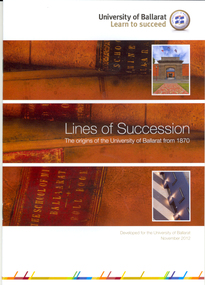
Booklet, Lines of Succession: The Origins of the University of Ballarat from 1870, November 2012
... This University of Ballarat is a predecessor institution of Federation University Australia. university of ballarat ballarat university 2012 1870 ballarat school of mines smb lines of succession 1994 school of mines ballarat mining education education mining technical art school university of melbourne mt pleasant observatory observatory teaching chemistry laboratory workshops mining museum gardens gauge tower flude usher smith guerin ballarat junior technical school bjts heseltine richards barker arblaster ballarat technical school ballarat school of industries biae mt helen tafe ballarat teachers' college btc bcae smb tafe ballarat brewery ballarat university college university of ballarat act 1993 University of Ballarat Learn to succeed and logo on top right hand corner of cover. ...This University of Ballarat is a predecessor institution of Federation University Australia. Two booklets, 10 pages plus covers with full colour illustrations, with black and blue text. The book gives a brief overview of the origins of the University, including the Ballarat School of Mines, Ballarat Teachers College, State College of Victoria, Ballarat Junior Technical School, Ballarat Institute of Advanced Education, Ballarat College of Advanced Education, Ballarat University College, Wimmera Institute of TAFE, Ararat Technical School, University of Ballarat Technology Park.University of Ballarat Learn to succeed and logo on top right hand corner of cover. Lines of Succession The origins of the University of Ballarat from 1870 in middle of front cover. Developed for the University of Ballarat November 2012. Timeline at the bottom of pagesuniversity of ballarat, ballarat, university, 2012, 1870, ballarat school of mines, smb, lines of succession, 1994, school of mines ballarat, mining education, education, mining, technical art school, university of melbourne, mt pleasant observatory, observatory, teaching, chemistry laboratory, workshops, mining museum, gardens, gauge tower, flude, usher, smith, guerin, ballarat junior technical school, bjts, heseltine, richards, barker, arblaster, ballarat technical school, ballarat school of industries, biae, mt helen, tafe, ballarat teachers' college, btc, bcae, smb tafe, ballarat brewery, ballarat university college, university of ballarat act, 1993 -
 Federation University Historical Collection
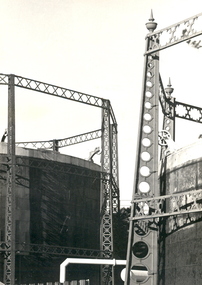
Photograph - Photograph - Black and White, Geoff Biddington, Views of Ballarat, 1967
... Corner Eyre and Lyons Street South) featuring Ballarat Bertie Sign 4. Cast Iron Gasometer Frames 5. Former Ballarat Supreme Court (Ballarat School of Mines Electrical Engineering 6. Telegraph Station (Castlemaine?) 7. Ballarat Fine Art Gallery (later Art Gallery of Ballarat) 8. Former Ballarat Police Station, Camp Street 9. Former Baptist Church, Dawson Street 10. Craig's Hotel Lamp 11-13. Goller's, Camp Street 14. Old Post Box- Crown on Top 15. Former Ballarat Gaol Gates 16. Golden Point Football Club Rooms, Main Road 17. Ballarat Fire Station, Ballarat East 18. Ballarat Town Hall Tower...Corner Eyre and Lyons Street South) featuring Ballarat Bertie Sign 4. Cast Iron Gasometer Frames 5. Former Ballarat Supreme Court (Ballarat School of Mines Electrical Engineering 6. Telegraph Station (Castlemaine?) 7. Ballarat Fine Art Gallery (later Art Gallery of Ballarat) 8. Former Ballarat Police Station, Camp Street 9. Former Baptist Church, Dawson Street 10. Craig's Hotel Lamp 11-13. Goller's, Camp Street 14. Old Post Box- Crown on Top 15. Former Ballarat Gaol Gates 16. Golden Point Football Club Rooms, Main Road 17. Ballarat Fire Station, Ballarat East 18. Ballarat Town Hall Tower ...These images were taken by Geoff Biddington who was highly active in the Ballarat Branch of the National Trust. Twenty two black and white photographic views of Ballarat by Geoff Biddington. 1. Ballarat Mechanics' Institute 2. 18-20 Lyons Street south, Ballarat 3. Licensed grocer (Corner Eyre and Lyons Street South) featuring Ballarat Bertie Sign 4. Cast Iron Gasometer Frames 5. Former Ballarat Supreme Court (Ballarat School of Mines Electrical Engineering 6. Telegraph Station (Castlemaine?) 7. Ballarat Fine Art Gallery (later Art Gallery of Ballarat) 8. Former Ballarat Police Station, Camp Street 9. Former Baptist Church, Dawson Street 10. Craig's Hotel Lamp 11-13. Goller's, Camp Street 14. Old Post Box- Crown on Top 15. Former Ballarat Gaol Gates 16. Golden Point Football Club Rooms, Main Road 17. Ballarat Fire Station, Ballarat East 18. Ballarat Town Hall Tower 19. Ballan Hotel 20. Building on Inglis street, Ballan 21. Ballan News Building (Est 1872) 22. Adam Lindsay Gordon Cottagebiddington, ballarat mechanics' institute, ballaarat mechanics' institute, mechanics institute, gasometer, ballarat police station, police, baptist church, craig's hotel, goller, post box, crown, golden point, ballarat town hall, ballan hotel, adam lindsay gordon cottage, ballarat gaol gates, wrought iron, bluestone, ballarat bertie, orlando, penfolds, signwriting, licensed grover, ballarat bitter, craig's royal hotel lamp, craig's hotel -
 Federation University Historical Collection
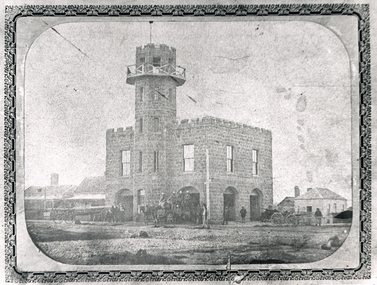
Photograph, Solomon and Bardwell, Western Fire Brigade Ballarat, c1861, c1861
... Black and white photograph showing a double storey bluestone building with tower known as the Ballarat West Fire Brigade on the corner of Sturt Street and Raglan (north) Street. ...The former Ballarat West Fire Brigade is one of the oldest fire stations still standing in Victoria. ballarat west fire brigade western fire brigade Bluestone Black and white photograph showing a double storey bluestone building with tower known as the Ballarat West Fire Brigade on the corner of Sturt Street and Raglan (north) Street. ...The former Ballarat West Fire Brigade is one of the oldest fire stations still standing in Victoria. Black and white photograph showing a double storey bluestone building with tower known as the Ballarat West Fire Brigade on the corner of Sturt Street and Raglan (north) Street. A number of fire carriages and uniformed men are evident in front of the fire station. ballarat west fire brigade, western fire brigade, bluestone -
 Federation University Historical Collection
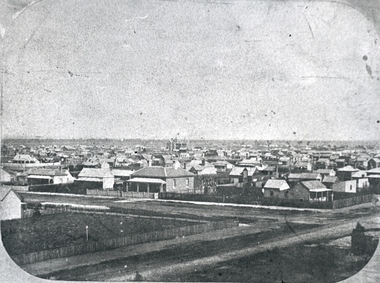
Photograph, Solomon and Bardwell, Ballarat From the Western Fire Brigade Tower Looking South
... Ballarat Ballarat West Fire Brigade Solomon and Bardwell Black and white photograph of Ballarat taken from the Ballarat West Fire Brigade on the corner of Sturt Street and Raglan Street. Ballarat From the Western Fire Brigade Tower Looking South Photograph Solomon and Bardwell ...Black and white photograph of Ballarat taken from the Ballarat West Fire Brigade on the corner of Sturt Street and Raglan Street. ballarat, ballarat west fire brigade, solomon and bardwell -
 Mission to Seafarers Victoria
Slide - Glass slide, Black and white, Mission to seamen building, Flinders St and loaded horse-drawn wagon, circa 1920s
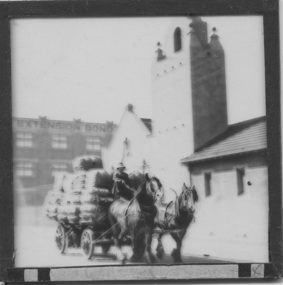
... building positioned to make use of the Yarra-side docks known as the Australian Wharf. missions to seamen institute mission building extension bond store warehouse pencil cross at lower right corner on adhesive tape edging Positive photograph on medium format glass slide ; b & w image of the chapel and bell tower of 1917 Mission Building, extension to Flinders St. with a loaded horse-drawn dray or wagon being driven in the foreground. . ...This Spanish Mission style building first opened in 1917 and has been in continual use since as the Mission to seamen and later Mission to Seafarers at a location initially known as the extension to Flinders St near the Australian Wharf and later address known as 717 Flinders St. "The Extension Bond and Free stores" building which can be seen in the background can be identified on an aerial photograph of the area dated 1927.This image besides showing an early view of the current Mission to Seafarers building also features a glimpse of the early 20th C (Flinders St) Extension Bond ( Store ?) building positioned to make use of the Yarra-side docks known as the Australian Wharf.Positive photograph on medium format glass slide ; b & w image of the chapel and bell tower of 1917 Mission Building, extension to Flinders St. with a loaded horse-drawn dray or wagon being driven in the foreground. . In the background of image can be seen a section of a large warehouse or Bond store building, visible signage reads: "Extension Bond"in upper case letters. The foreground details appear to have been hand touched up with linear ink highlights. Image is slightly blurry. The slide is edged with adhesive tape.pencil cross at lower right corner on adhesive tape edgingmissions to seamen institute, mission building, extension bond store, warehouse -
 Federation University Historical Collection
Photograph - Photograph - Black and White, Ballarat Post Office, 1938, 1938
... tower - a feature of the building. Top has a cast iron balustraded widow's walk. The Post Office building is now part of Federation University Ballarat Camp Street Campus - Arts Academy. The official opening of the Arts Academy, by Steve Bracks, Premier of Victoria, was on 11 October 2002. Classes commenced at the Arts Academy in 2002. sturt street lydiard street post office anniverary centenary william parker victorian italianate style Black and white photograph showing the Ballarat Post Office on corner of Sturt and Lydiard Streets. ...The first section of the Post Office was built in 1864. During 1865 the second section and tower were built. Building is of a Victorian Italianate design. Arched headed windows on the ground floor originally formed a colonnade. These were filled in to give additional space inside. The tower - a feature of the building. Top has a cast iron balustraded widow's walk. The Post Office building is now part of Federation University Ballarat Camp Street Campus - Arts Academy. The official opening of the Arts Academy, by Steve Bracks, Premier of Victoria, was on 11 October 2002. Classes commenced at the Arts Academy in 2002.Black and white photograph showing the Ballarat Post Office on corner of Sturt and Lydiard Streets. Banner across building "1838-1938 POST A SOUVENIR"sturt street, lydiard street, post office, anniverary, centenary, william parker, victorian italianate style -
Federation University Historical Collection
Photograph - Black and White, Former Ballarat Library, c1960
... corner of Sturt and Camp Streets in 1878. 1880s plans show section of the reserve be used for a Free Library and Reading Room. Lease was granted and the old mining boardroom was initially used. Land for additional building to house a Museum and Art Gallery sought and agreement reached in 1882-3. Compensation paid to owners and library granted the land. Plans for a new library building with tower...corner of Sturt and Camp Streets in 1878. 1880s plans show section of the reserve be used for a Free Library and Reading Room. Lease was granted and the old mining boardroom was initially used. Land for additional building to house a Museum and Art Gallery sought and agreement reached in 1882-3. Compensation paid to owners and library granted the land. Plans for a new library building with tower ...First known development on this site was the establishment of the Government Camp from the early 1850s. It was established to accommodate officials, troopers and police who were needed to administer the goldfields. Some permanent buildings were constructed. Lack of materials and bad weather prolonged the building of more permanent buildings and most men were still living in tents. Area was known as Camp Reserve. In 1864 a subdivision map shows the reserve be used for Public Buildings. Library applied for land on corner of Sturt and Camp Streets in 1878. 1880s plans show section of the reserve be used for a Free Library and Reading Room. Lease was granted and the old mining boardroom was initially used. Land for additional building to house a Museum and Art Gallery sought and agreement reached in 1882-3. Compensation paid to owners and library granted the land. Plans for a new library building with tower and lantern roof abandoned due to lack of funds. It wasn't until 1895 that a solution to funding was found and the library was able to begin constructing the complex of buildings on the Free Library Reserve. A number of changes have occurred since 1910s - the Classical Revival facade replaced with an angled facade in a stripped Classical style with Art Deco features and high parapet. Building is now part of Federation UniversityPhotograph of former library. Shows a two-storey rendered brick building in a Classical style. Some Art Deco features. Central pair of double windows with single window either side. High parapet above.government camp, goldfields, camp reserve, free library, reading room, sturt street, camp street, museum, art gallery, troopers, police, barracks, camp street -
Federation University Historical Collection
Black and white photograph - copy, Ballarat Post Office and Academy of Art on corner of Sturt and Lydiard Streets - c1890, c1890
... tower was built in 1885. Built in the Victorian Italianate style. Arched headed windows on the ground floor originally formed a colonnade. These were filled in later to provide more internal space. former ballarat post office colonnade victorian italianate victorian italianate style arched windows sturt street lydiard street Black and white photograph - copy of the original. Shows former Ballarat Post Office. Horse drawn carriages outside. Another building shown is "Academy of Art" with name above. This cannot be determined. Ballarat Post Office and Academy of Art on corner ...First section of the Post Office built 1864. Second section which included a tower was built in 1885. Built in the Victorian Italianate style. Arched headed windows on the ground floor originally formed a colonnade. These were filled in later to provide more internal space. Black and white photograph - copy of the original. Shows former Ballarat Post Office. Horse drawn carriages outside. Another building shown is "Academy of Art" with name above. This cannot be determined.former ballarat post office, colonnade, victorian italianate, victorian italianate style, arched windows, sturt street, lydiard street -
 Federation University Historical Collection
Photograph, Lisa Gervasoni, Ballarat Post Office from Town Hall Tower, 2007
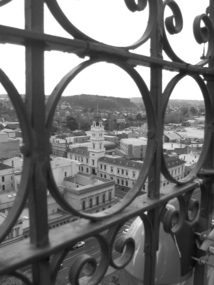
... Aerial view of the Ballarat Post Office, corner of Sturt Street and Lydiard Street North, taken from the tower of the Ballarat Town Hall, corner of Sturt Street and Armstrong Street South. ...Black and white photograph of the Ballarat Post Office on the corner of Sturt Street and Lydiard Street North, taken from the tower of the Ballarat Town Hall corner of Sturt Street and Armstrong Street South. ...Aerial view of the Ballarat Post Office, corner of Sturt Street and Lydiard Street North, taken from the tower of the Ballarat Town Hall, corner of Sturt Street and Armstrong Street South. ...Aerial view of the Ballarat Post Office, corner of Sturt Street and Lydiard Street North, taken from the tower of the Ballarat Town Hall, corner of Sturt Street and Armstrong Street South. The Post Office was opened in December 1858. Photograph taken through the wrought iron of the tower in 2007. The tower and main entrance to the Post Office face Lydiard Street North. Other buildings from the same era are the former Bank of Australia, opposite corner, and the Mining Exchange. In the distance is Black Hill, an old mining area.Black and white photograph of the Ballarat Post Office on the corner of Sturt Street and Lydiard Street North, taken from the tower of the Ballarat Town Hall corner of Sturt Street and Armstrong Street South. View is taken through the wrought iron of the tower. post office, town hall, tower, wrought iron, sturt street, lydiard street, armstrong street, bank of australia, mining exchange, black hill -
 Federation University Historical Collection
Photograph - Black and White, Ballarat School of Mines from the north-east corner, c1917
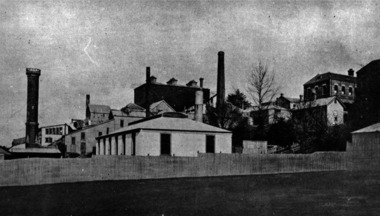
... henry richards caselli gauge tower ballarat school of mines dana street albert street model mine mining laboratory .1) Ballarat School of Mines buildings from Dana Street, near Albert Street, Ballarat showing Caselli's Gauge Tower, Administration Building, and Model Mine. .2) similar view to .1) but showing more foreground and additional buildings, c1917 Ballarat School of Mines from the north-east corner Photograph - Black and White ....1) Ballarat School of Mines buildings from Dana Street, near Albert Street, Ballarat showing Caselli's Gauge Tower, Administration Building, and Model Mine. .2) similar view to .1) but showing more foreground and additional buildings, c1917henry richards caselli, gauge tower, ballarat school of mines, dana street, albert street, model mine, mining laboratory -
 Federation University Historical Collection
Photograph - Sepia, Bardwell and Beauchamp, State School No 2103, Ballarat, c1878
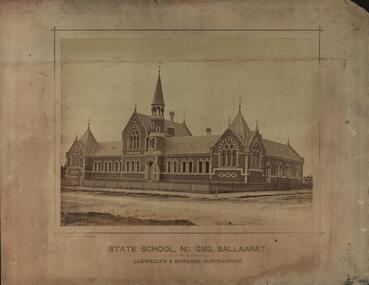
... tower known as Urquhart Street Primary School. Llewellyn and Edwards were the contractors. The photograph shows a brick building on a corner behind a picket fence. ...tower known as Urquhart Street Primary School. Llewellyn and Edwards were the contractors. The photograph shows a brick building on a corner behind a picket fence. ...Urquhart Street Primary School was opened on 09 December 1878 by the Minister of Public Instruction, Major William Collard Smith. The school originated from Errard School no 227 which was extablished by the Presbyterian Church as early as 1860.Brick School building with bell tower known as Urquhart Street Primary School. Llewellyn and Edwards were the contractors. The photograph shows a brick building on a corner behind a picket fence. ballarat, school, education, llewellyn and edwards, urquhart street primary school -
 Flagstaff Hill Maritime Museum and Village
Postcard - Historical, Warrnambool, Ozone hotel, Warrnambool, 1902-1929
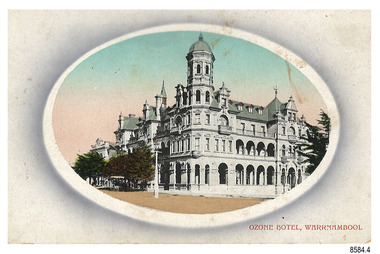
... Ozone Hotel, Warrnambool – Construction of Warrnambool’s Ozone Hotel and Coffee Palace on the corner of Koroit and Kepler streets began in 1890. The luxury venue included ballrooms, dining rooms, a theatre and a tower. ...Ozone Hotel, Warrnambool – Construction of Warrnambool’s Ozone Hotel and Coffee Palace on the corner of Koroit and Kepler streets began in 1890. The luxury venue included ballrooms, dining rooms, a theatre and a tower. ...The nine postcards in this set were donated together and date to the early 1900s. All but one postcard in this set shows images of Warrnambool, in the Western District of Victoria; the other has a London image. The postcards were all printed in Great Britain according to that country’s postal regulations. The fronts of all cards have titles printed in red. Most of the images on the cards are attributed to photographer Joseph Jordan and belong to the Jordan Series. The back of these cards has an outline for a postage stamp, a vertical dividing line and a heading on each side of the line to separate the Correspondence from the Address. Postcards or ‘correspondence cards’ appeared in Britain in 1894. They were plain cards with a space for the message on one side and an address on the other; regulations didn’t allow anything but the address to be written on the ‘address’ side. In 1902 the British regulations then allowed a picture to be printed on the front and the address on the back, so messages had to be written on the picture side. Soon, the regulations changed and the back was divided for a message and the address. Ozone Hotel, Warrnambool – Construction of Warrnambool’s Ozone Hotel and Coffee Palace on the corner of Koroit and Kepler streets began in 1890. The luxury venue included ballrooms, dining rooms, a theatre and a tower. In 1929 it burnt to the ground in a spectacular fire. Joseph Jordan - Joseph Jordan was born in 1841 in Leicester England. When he was 16 he joined the 7th Queen's Own Hussars and was sent to India at the outbreak of the mutiny. He took part in the relief of Lucknow and remained in India for eleven years. It was during this time that he became interested in photography. He was posted to New Zealand and later came to Victoria, becoming a sergeant major of the Mounted Rifles. In the mid-1880s he came to the Western district where he was responsible for establishing units of the Mounted Rifles in various country towns such as Dunkeld, Mortlake, Panmure, Bushfield, Koroit etc. He resigned from the army in 1889 and set up a professional photography studio in Liebig Street, Warrnambool. He became very well known in the Western District for family photographs, official photographs of local councillors and groups as well as views of local scenery. In 1891 he photographed the wrecked barque ‘Fiji’ at ‘Wrecks Beach’ near Princetown. His business was taken over by his son Arthur around 1917. Joseph was a keen rifle shot and in 1924 he donated the "Jordan Shield" as a prize to the Victorian Rifle Association. He was made a "Life Honorary Member" of the Warrnambool Returned Soldiers League and in 1933 he was recognised as being the oldest living soldier in Victoria. Joseph died in 1935 aged 95.This postcard of the Ozone Hotel and Coffee Palace is significant for its connection to the Victorian-era hotel. The hotel was a luxury facility that attracted visitors to the town by sea, rail and road. The postcard also represents the short period in which the hotel operated and the notable, unforgettable event of its burning to the ground. Out of the set of nine postcards in this donation, this card is the only one that includes the location of Warrnambool on the back. It is also the only one with text within the outline for the postage stamp and with headings in this font. Joseph Jordan is a significant figure in Warrnambool history as he helped to establish early units of the Mounted Rifles (G Company) in local towns during the late 1880's and later, photographed local scenes, groups and citizens of early Warrnambool.Postcard, one of nine, landscape orientation, coloured print within an oval border and mauve-toned shading. The cameo image is of a grand three-storey building on a street corner with a tall turret, shorter turrets, and arches on the verandas. The back has inscriptions and outlines for a postage stamp. There is no correspondence written on the card. Jordan Series, printed in Great Britain.Front, in red: “Ozone hotel, Warrnambool” Back in black: “Jordan Series” “POST CARD” “PRINTED IN GREAT BRITAIN” “For correspondence” “The Address only to be written here”flagstaff hill maritime museum, flagstaff hill maritime village, flagstaff hill maritime museum and village, maritime museum, warrnambool, great ocean road, warrnambool and district, warrnambool scenes, local scenes, views of warrnambool, joseph jordan, jordan series, jordan photography, postcard, souvenir, correspondence, cameo postcard, landscape, ozone hotel and coffee palace, ozone hotel, warrnambool hotel, destroyed by fire, coffee palace -
 Flagstaff Hill Maritime Museum and Village
Postcard - Scenic, Warrnambool, Tower Hill and Lake, Warrnambool, 1902-1929
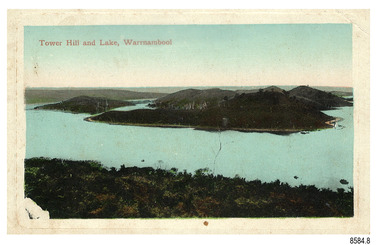
... Flagstaff Hill Maritime Museum Flagstaff Hill Maritime Village Flagstaff Hill Maritime Museum and Village Maritime Museum Warrnambool Great Ocean Road Warrnambool and District Warrnambool Scenes local scenes Views of Warrnambool Joseph Jordan Jordan Series Jordan Photography postcard souvenir correspondence cameo postcard Tower Hill Tower Hill National Park Victoria's first National Park Henry Giles Mary Jane Freckleton Breakwater early settlers Front, in red: “Tower Hill Lake, Warrnambool” Back in green: “Jordan Series” “POST CARD” “PRINTED IN GREAT BRITAIN” “For correspondence” “The Address only to be written here” Postcard, one of nine, landscape orientation, coloured print within a rectangle and an impressed line around the image on the front. The picture shows several islands close together with hills around them and bushland in the foreground. There are dead trees amongst the vegetation and a sandy shore at the foot of some of the hills. The lower left corner ...The nine postcards in this set were donated together and date to the early 1900s. All but one postcard in this set shows images of Warrnambool, in the Western District of Victoria; the other has a London image. The postcards were all printed in Great Britain according to that country’s postal regulations. The fronts of all cards have titles printed in red. Most of the images on the cards are attributed to photographer Joseph Jordan and belong to the Jordan Series. The back of these cards has an outline for a postage stamp, a vertical dividing line and a heading on each side of the line to separate the Correspondence from the Address. Postcards or ‘correspondence cards’ appeared in Britain in 1894. They were plain cards with a space for the message on one side and an address on the other; regulations didn’t allow anything but the address to be written on the ‘address’ side. In 1902 the British regulations then allowed a picture to be printed on the front and the address on the back, so messages had to be written on the picture side. Soon, the regulations changed and the back was divided for a message and the address. Tower Hill and Lake, Warrnambool – Tower Hill Wildlife Reserve is in the crater of a dormant volcano. In 1892 the area was declared a National Park, the first in Victoria, preserving native animals and Indigenous plants. The rich volcanic soil in the area attracted early settlers including the families of Henry Giles, born at Tower Hill in 1858 and his wife Mary Jane (born Freckleton) born nearby at Cooramook in 1860. Henry and Mary worked in the local area where they also raised their six children. For a time, Henry was employed as a labourer on the Warrnambool Breakwater. Joseph Jordan - Joseph Jordan was born in 1841 in Leicester England. When he was 16 he joined the 7th Queen's Own Hussars and was sent to India at the outbreak of the mutiny. He took part in the relief of Lucknow and remained in India for eleven years. It was during this time that he became interested in photography. He was posted to New Zealand and later came to Victoria, becoming a sergeant major of the Mounted Rifles. In the mid-1880s he came to the Western district where he was responsible for establishing units of the Mounted Rifles in various country towns such as Dunkeld, Mortlake, Panmure, Bushfield, Koroit etc. He resigned from the army in 1889 and set up a professional photography studio in Liebig Street, Warrnambool. He became very well known in the Western District for family photographs, official photographs of local councillors and groups as well as views of local scenery. In 1891 he photographed the wrecked barque ‘Fiji’ at ‘Wrecks Beach’ near Princetown. His business was taken over by his son Arthur around 1917. Joseph was a keen rifle shot and in 1924 he donated the "Jordan Shield" as a prize to the Victorian Rifle Association. He was made a "Life Honorary Member" of the Warrnambool Returned Soldiers League and in 1933 he was recognised as being the oldest living soldier in Victoria. Joseph died in 1935 aged 95.The postcard of Tower Hill and Lake is connected to the location near Warrnambool where many of our early settlers lived and worked. One of these settlers was the Giles family, whose son Henry was born at Tower Hill. His family has donated many Victorian-era items which are now on display at Flagstaff Hill. Tower Hill National Park is the first place in Victoria to be named a National Park. As in the times when coastal trading ships brought passengers and cargo to the Port of Warrnambool, it continues to be a popular place to visit. Joseph Jordan is a significant figure in Warrnambool history as he helped to establish early units of the Mounted Rifles (G Company) in local towns during the late 1880's and later, photographed local scenes, groups and citizens of early Warrnambool.Postcard, one of nine, landscape orientation, coloured print within a rectangle and an impressed line around the image on the front. The picture shows several islands close together with hills around them and bushland in the foreground. There are dead trees amongst the vegetation and a sandy shore at the foot of some of the hills. The lower left corner shows what appears to be two white rails, possibly a lookout fence. There is no correspondence written on the card. The title is printed in red on the front and the back has inscriptions and outlines for a postage stamp. Jordan Series, printed in Great Britain. Front, in red: “Tower Hill Lake, Warrnambool” Back in green: “Jordan Series” “POST CARD” “PRINTED IN GREAT BRITAIN” “For correspondence” “The Address only to be written here”flagstaff hill maritime museum, flagstaff hill maritime village, flagstaff hill maritime museum and village, maritime museum, warrnambool, great ocean road, warrnambool and district, warrnambool scenes, local scenes, views of warrnambool, joseph jordan, jordan series, jordan photography, postcard, souvenir, correspondence, cameo postcard, tower hill, tower hill national park, victoria's first national park, henry giles, mary jane freckleton, breakwater, early settlers -
 Flagstaff Hill Maritime Museum and Village
Postcard - Historical, building, New Gaiety Theatre, Strand, 1905-1907
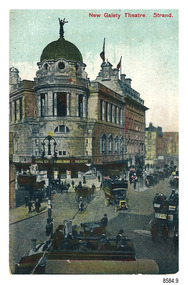
... The image shows a tall three-storey corner building with a statue on its domed tower and smaller towers on the sides. ...The image shows a tall three-storey corner building with a statue on its domed tower and smaller towers on the sides. ...The nine postcards in this set were donated together and date to the early 1900s. All but one postcard in this set shows images of Warrnambool, in the Western District of Victoria; the other has a London image. The postcards were all printed in Great Britain according to that country’s postal regulations. The fronts of all cards have titles printed in red. Most of the images on the cards are attributed to photographer Joseph Jordan and belong to the Jordan Series. The back of these cards has an outline for a postage stamp, a vertical dividing line and a heading on each side of the line to separate the Correspondence from the Address. However, this postcard is the 'odd one out' in that its location is London, it has no border, it has no reference to 'Jordan' or 'Jordan Series' no reference to the printer, no 'correspondence heading', it is slightly smaller than the others, and it has text in the stamp area that refers to 'inland' and 'foreign' postage, a half-penny inland and one-penny overseas.. Postcards or ‘correspondence cards’ appeared in Britain in 1894. They were plain cards with a space for the message on one side and an address on the other; regulations didn’t allow anything but the address to be written on the ‘address’ side. In 1902 the British regulations then allowed a picture to be printed on the front and the address on the back, so messages had to be written on the picture side. Soon, the regulations changed and the back was divided for a message and the address. New Gaiety Theatre, Strand [London] - The New Gaiety Theatre opened in 1903 on the corner of The Strand and Aldwych, London. The second show performed in the new theatre was “The Spring Chicken” in 1905. The third show followed in 1907. The preprinted postage cost on the stamp outline is ½ d. or half penny; according to The Great Britain Philatelic Society, Great Britain Postcard Stamps were priced 1/2 d. or Half Penny from 1-Oct-1870 to 3-Jun-1916. The postcard is significant for its inclusion with a set of nine postcards, eight of which are images of Warrnambool and its district and photographed by Joseph Jordan. It is also curious for is lack of connection to Jordan. Postcard, one of nine, portrait orientation, coloured print. The image shows a tall three-storey corner building with a statue on its domed tower and smaller towers on the sides. The top two storeys have balconies with columns, and overhang the ground floor, providing cover over the footpath. The foreground has horse-drawn carriages and coaches, and motorised vehicles including a bus. Figures wearing top hats and others in long dresses are in front of the building, which has a sign on the corner advertising the building and its current show. There is no correspondence written on the card. The front of the postcard has a printed red title and an inscription on the image. The reverse has inscriptions and outlines for a postage stamp. Made in Britain.Sign on the image of the building: “GAIETY / SPRING CHICKEN / THEATRE” On the front in red: “New Gaiety Theatre, Strand” On the back in printed in green: Stamp box “INLAND / 1/2d.’ STAMP / FOREIGN 1d.” “POST CARD” “THE ADDRESS ONLY TO BE WRITTEN HERE” flagstaff hill maritime museum, flagstaff hill maritime village, flagstaff hill maritime museum and village, maritime museum, warrnambool, great ocean road, warrnambool and district, warrnambool scenes, local scenes, views of warrnambool, postcard, souvenir, correspondence, cameo postcard, new gaiety theater, the strand, spring chicken, gaiety theatre, london theatre -
 Flagstaff Hill Maritime Museum and Village
Furniture - Chair, Haberfield Chair, Michael Bradshaw, Circa 1860s-1890s
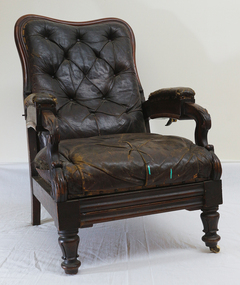
... Flagstaff Hill Maritime Museum and Village Great Ocean Road Shipwreck Coast armchair reclining armchair reading board Mahogany chair Haberfield Chair furniture living room furniture domestic furniture 19th century luxury Morroco leather book stand book rest side table music stand reading stand reading rest foot rest reading table In pen and ink: “Made from Mahogany Ship wrecked near Tower Hill, July 3, 1835: made by Michael Bradshaw 18-2-“ [originally thought to read 1842] The Haberfield Chair is a reclining armchair that includes a footrest and a detachable book rest. The chair features a dark timber frame and dark burgundy (now dark brown), Morocco goat skin leather upholstery. The backrest is finished with button detailing, and its frame is distinguished by gracefully curved corners ...This elegant reclining armchair is generously on loan from the local Haberfield family. Mrs Haberfield is a member of the Anderson family from the Tower Hill region, and the chair was handed down to her from them. When it arrived at Flagstaff Hill in 2009, it was at least 100 years old. The maker, Michael Bradshaw, is currently unknown. The origin of the chair's timber has been lost through the generations, but some have named the armchair the 'Mahogany Chair' after the legendary Mahogany Ship. In August 2009, the wood was expertly examined. The structure of the wood specimens was found to be consistent with: • Pale coloured carcass timber - Fagus sylvatica – Beech (European) • Pale coloured frame timber - Agathis sp – NZ Kauri • Dark coloured timber chair legs (solid) - Swietenia sp. – True Mahogany • Dark coloured timber veneer - Swietenia sp. – True Mahogany • Repair fill-in piece – Quercus sp. – White Oak ( Northern hemisphere) • Repair fill-in piece (fine textured) – Populus sp. – Poplar • Runner wood - Eucalyptus sp – Pale coloured ash group, or messmate The chair is significant for its local origin and history, being connected to generations of the Anderson and Haberfield families. It is also significant for its elaborate and unusual design, the quality of its workmanship and materials. It is a fine example of good quality furniture of the late 19th century.The Haberfield Chair is a reclining armchair that includes a footrest and a detachable book rest. The chair features a dark timber frame and dark burgundy (now dark brown), Morocco goat skin leather upholstery. The backrest is finished with button detailing, and its frame is distinguished by gracefully curved corners, lending the chair an elegant appearance. The chair’s padded leather armrests have attractive, crafted carvings at each end. A lever located below the armrest operates the recliner’s ratchet mechanism, which also causes a footrest to slide forward for greater comfort. The turned and carved front legs are equipped with wheels, allowing for easy movement. The removable book rest is mounted on a brass pedestal. Its angle can be conveniently adjusted using a screw to move the ball and socket joint, ensuring personalised reading comfort. There is a handwritten inscription on the underside of the back rail. The chair is kindly on loan from the local Haberfield family. In pen and ink: “Made from Mahogany Ship wrecked near Tower Hill, July 3, 1835: made by Michael Bradshaw 18-2-“ [originally thought to read 1842]flagstaff hill maritime museum and village, great ocean road, shipwreck coast, armchair, reclining armchair, reading board, mahogany chair, haberfield chair, furniture, living room furniture, domestic furniture, 19th century, luxury, morroco leather, book stand, book rest, side table, music stand, reading stand, reading rest, foot rest, reading table -
 Flagstaff Hill Maritime Museum and Village
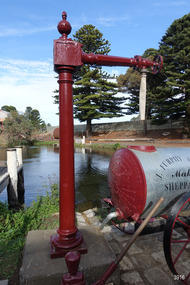
Functional object - Water standpipe, Langlands Bros. & Co, 1880-1893
... corner of Liebig and Timor streets. The water was pumped from springs at Cannon Hill through the connected pipeline to the standpipe, then distributed to households via horse and cart. Each of the licenced cart drivers were compelled by Council regulations to keep their carts full from sunset to sunrise, ready to cart water to outbreaks of fire. They received a fee for this service. In 1893 the town installed a water supply, sourced from the Merri River, stored in a reservoir basin and tower...corner of Liebig and Timor streets. The water was pumped from springs at Cannon Hill through the connected pipeline to the standpipe, then distributed to households via horse and cart. Each of the licenced cart drivers were compelled by Council regulations to keep their carts full from sunset to sunrise, ready to cart water to outbreaks of fire. They received a fee for this service. In 1893 the town installed a water supply, sourced from the Merri River, stored in a reservoir basin and tower ...This water standpipe is believed to be the only one of its kind in working order. It was originally located in Warrnambool, on the hillside at the corner of Mickle Crescent and Banyan Street, providing water for the Chinese Market Gardens below, on the flats. It was removed from this location on May 2nd, 1979, with the intention to relocate it at the new Flagstaff Hill Maritime Museum & Village. The standpipe lay in storage for years until the Warrnambool Company, Chemblast, offered to restore it for use as a working display. The display was officially opened on March 31, 2014. The water from the adjacent lake is drawn out with a hand operated water pump, and goes up into the standpipe, where flows through the canvas hose and into the top of the Furphy Farm Water Cart. The display is a visual acknowledgement of the years served by Flagstaff Hill volunteer and Friends of Flagstaff Hill Chairperson, Bob Crossman. Warrnambool’s early settlers had no water supply prior to the mid-1850s. They relied on rain water tanks, domestic wells and springs. The town experienced a huge, destructive fire in William Bateman Jnr. & Co.’s large produce store in November 1856, which highlighted the need for both a fire brigade and a good supply of water. In 1863 a volunteer fire brigade was established. In August 1880 the town celebrated the installation of its first water standpipe on the corner of Liebig and Timor streets. The water was pumped from springs at Cannon Hill through the connected pipeline to the standpipe, then distributed to households via horse and cart. Each of the licenced cart drivers were compelled by Council regulations to keep their carts full from sunset to sunrise, ready to cart water to outbreaks of fire. They received a fee for this service. In 1893 the town installed a water supply, sourced from the Merri River, stored in a reservoir basin and tower in north Liebig Street, and distributed throughout the town in a system of pipes. By late 1939 a reticulated supply was installed, with the water piped in under the Otway Scheme. Standpipes are still used in modern times in rural and remote areas for homes, farms, stock, agriculture and firefighting. Many commercial or government owned standpipes are metered, charging a fee for the quantities of water supplied. This water standpipe was made by Langlands Foundry Co. Limited, Melbourne, which was establish in 1842. It was Melbourne’s first foundry and iron shipbuilder, and one of the largest employers in Victoria at the time. Langlands was known for its high quality workmanship and wide range of goods for mining, engineering, marine, railway and other industrial uses. The company made the first cast bell, the first lamp posts in the colony, and the boiler for the first Australian train. In the 1860s it produced cast iron pipes for the Board of Works, which laid the pipes for Melbourne’s first reticulated water supply. The firm was bought by Austral Otis Co. in 1897.This water standpipe is significant historically as it is believed to be the only one of its type in working condition. The standpipe is significant for being manufactured by early colonial firm Langlands Foundry of Melbourne, which was known for high quality, cast iron products. The firm made the boiler for the first Australian train, assembled the first Australian paddle steamer and made the first Australian cast bell and lamp posts. Langlands was one of the largest employers in Victoria at the time. The standpipe is significant historically as it represents the evolution of water supply services in Australia. Standpipe; vertical cast iron water pipe, painted crimson, fixed in position, tapering inward from the round base to the rectangular joint near the finial on top. A hexagonal pipe extends at right angles from the joint, with an outlet fitting and flow-controlling wheel on the end. A length of canvas hose hangs from the outlet fitting. Inscriptions are on one face of the joint. The standpipe was made by Langlands Foundry Company of Melbourne. Embossed “LANGLANDS FOUNDRY CO. / LIMITED / ENGINEERS / MELBOURNE”warrnambool, flagstaff hill maritime museum, maritime museum, shipwreck coast, flagstaff hill maritime village, great ocean road, flagstaff hill, standpipe, stand-pipe, water standpipe, fire standpipe, firefighting equipment, water supply equipment, chinese market gardens, banyan street, liebig street, water tower, bateman’s fire, working display, water supply, town water, rural water, reticulated water, cannon hill spring, merri river, otway water, water carters, horse and cart water supply, volunteer fire brigade, langlands foundry, early melbourne, iron works, bob crossman, late 19th century water supply -
Glenelg Shire Council Cultural Collection
Photograph - Photograph - six contact prints of silo construction, 1964
... First and fourth photo's are of the corner KS Anderson Wharf and some construction equipment. Second and third metal tower being constructed. ...First and fourth photo's are of the corner KS Anderson Wharf and some construction equipment. Second and third metal tower being constructed. ...Port of Portland Authority ArchivesSheet of (6) black and white contact prints relating to Silo Construction. First and fourth photo's are of the corner KS Anderson Wharf and some construction equipment. Second and third metal tower being constructed. Fifth shed on KS Anderson. Sixth photo completed structure of metal tower.Front: 2. 28-2-64 3. 28-2-64 4. 10-3-64 5. 5-3-64 6. 5-3-64 7. 10-3-64 (Under each of the prints, in white.)port of portland archives, construction, silo, k s anderson wharf -
Glenelg Shire Council Cultural Collection
Photograph - Sheet of contact prints - silo construction, 1964
... corner of K.S. Anderson Wharf and some construction equipement. One and six metal tower being constructed. ...corner of K.S. Anderson Wharf and some construction equipement. One and six metal tower being constructed. ...Port of Portland Authority ArchivesFront: 2. 28-2-64 4. 28-2-64 5. 5-3-64 6. 5-3-64 7. 10-3-64 3. 28-2-64port of portland archives, grain silos, k s anderson wharf
