
Showing 24 items matching "eight wheels"
-
 Ballarat Tramway Museum
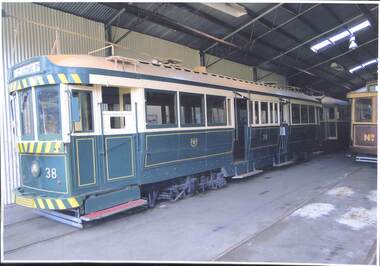
Photograph - Photograph - coloured, Tram No. 38- Maximum Traction truck bogie (eight wheels), drop end and centre combination, modified for one man operation
... Tram No. 38- Maximum Traction truck bogie (eight wheels), drop end and centre combination, modified for one man operation....St Aidens Dvs shown in destination window Large colour photograph - laminated Tram No. 38- Maximum Traction truck bogie (eight wheels), drop end and centre combination, modified for one man operation. ...This eight wheel tramcar was built 1914 for the Prahran and Malvern Tramways Trust. It was sold to the State Electricity Commission in 1951 for use on the Ballarat tramway system. The tram was altered to its present form in 1953 to permit one-man operation. It was modified to operate as a one man tram but limited use due to industrial bans. A conductor was used in Ballarat. In 1954 the tram was decorated for the visit of Queen Elizabeth II. In 1971 it was acquired by the Museum and repainted in the 1960s SEC colour scheme in 1979 Large colour photograph - laminatedGreen and cream tram with gold number and SEC symbol. St Aidens Dvs shown in destination window1914, melbourne, ballarat, tram 38, eight wheel, four wheel, one man tram, industrial ban, queen elizabeth -
 Ballarat Tramway Museum
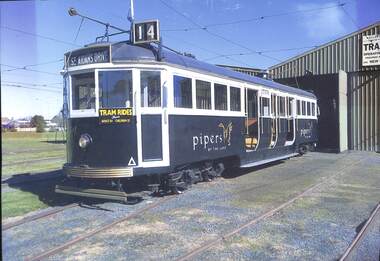
Photograph - Photograph - coloured, Tram No 671 - Pipers by the Lake
... ...eight wheels...It has an equal wheel truck bogie - eight wheels, with a drop centre combination. It is in service at Ballarat Tramway Museum with a created livery using an all over advertising design for "Pipers" a restaurant on Lake Wendouree....It has an equal wheel truck bogie - eight wheels, with a drop centre combination. It is in service at Ballarat Tramway Museum with a created livery using an all over advertising design for "Pipers" a restaurant on Lake Wendouree. 1976 truck bogie eight wheels drop centre combination pipers restaurant lake wendouree "pipers by the lake" with yellow swan. ...This tram came to Ballarat in 1976. It has an equal wheel truck bogie - eight wheels, with a drop centre combination. It is in service at Ballarat Tramway Museum with a created livery using an all over advertising design for "Pipers" a restaurant on Lake Wendouree.Large coloured photograph, laminated. Blue and white tram - all over advertising for "Pipers""pipers by the lake" with yellow swan. St Aidans Drive in destination window. No.14, top LHS1976, truck bogie, eight wheels, drop centre combination, pipers, restaurant, lake wendouree -
 Ballarat Tramway Museum
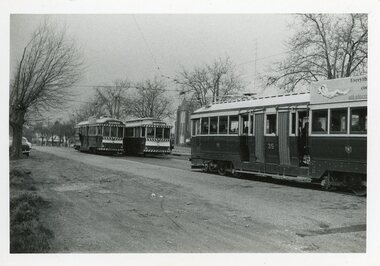
Photograph - Ballarat Tram 35, Ballarat Tram 35 in Drummond Street near Urquhart Street
... Ballarat Tram 35 is a maximum traction truck bogie - eight wheels, with drop end and centre combination. ...Ballarat Tram 35 is a maximum traction truck bogie - eight wheels, with drop end and centre combination. ...Ballarat Tram 35 is a maximum traction truck bogie - eight wheels, with drop end and centre combination. Photograph shows the tram in Drummond Street at the Urquhart Street loop. Photograph taken by Campbell Duncan.Black and white photograph of Tram 35 and other tramsTram number and symbol of State Electricity Commission on side of tramballarat tram 35, drummond street, tram loop, urquhart street, campbell duncan, photographer -
 Whitehorse Historical Society Inc.
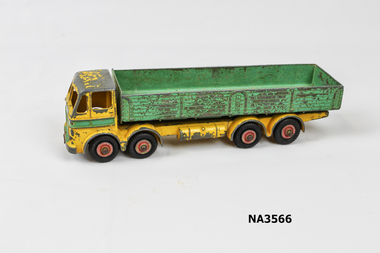
Leisure object - Dinky Toy
... Yellow and green painted truck with eight rubber tyred wheels...Purchased by Valda Arrowsmith for Toy Collection toys mobile Dinky Supertoys, Leyland Octopus Yellow and green painted truck with eight rubber tyred wheels Leisure object Dinky Toy ...Purchased by Valda Arrowsmith for Toy CollectionYellow and green painted truck with eight rubber tyred wheelsDinky Supertoys, Leyland Octopustoys, mobile -
 Ballarat Tramway Museum
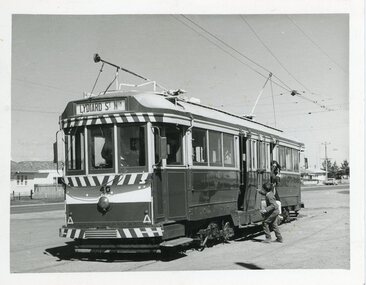
Photograph - Ballarat Tram 40, Ballarat Tram 40: At Sebastopol Terminus, last day, 1971
... Tram 40 had a Maximum Traction truck bogie (eight wheels), drop end and centre combination. ...Tram 40 had a Maximum Traction truck bogie (eight wheels), drop end and centre combination. ...This tram was built in 1913 by Duncan and Fraser in 1913 for the Prahran and Malvern Tramways Trust. It began service as their Number 35. It was classified "C" by the Melbourne Tramways Board. In 1951 it was sold to the State Electricity Commission of Victoria and renumbered 40. This tram was the last Ballarat tram to operate by the SEC to officially carry passengers in Ballarat on 19 September 1971. Tram 40 had a Maximum Traction truck bogie (eight wheels), drop end and centre combination. Photograph taken by Campbell Duncan.Black and white photograph "Sebastopol Terminus last day" on backballarat tram 40, 1913, duncan & fraser, prahran and malvern tramways trust, number 35, melbourne tramways board, 1951, state electricity commission, number 40, ballarat, last tram, 1971, campbell duncan, photographer -
 Ballarat Tramway Museum
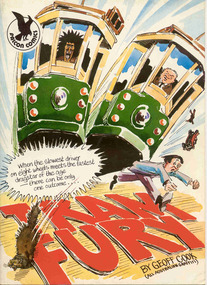
Domestic object - Comic Book, Geoff Cook, "Tram Fury", 1976
... Comic book - 32 pages + card covers titled "Tram Fury", with the subtitle "when the slowest driver on eight wheels meets the fastest dragster of the age - there can only be one outcome ...." ...Tram trams Melbourne Comics Comic book - 32 pages + card covers titled "Tram Fury", with the subtitle "when the slowest driver on eight wheels meets the fastest dragster of the age - there can only be one outcome ...." ...Comic book - 32 pages + card covers titled "Tram Fury", with the subtitle "when the slowest driver on eight wheels meets the fastest dragster of the age - there can only be one outcome ...." Written and illustrated by Geoff Cook 1976, published by Falcon Comics. Colour cover with green back cover. Publication details on rear cover. Based on a story about Melbourne W2 tramcar drivers racing each other. Image of front cover, page 32 and the rear cover.tram, trams, melbourne, comics -
 Ballarat Tramway Museum
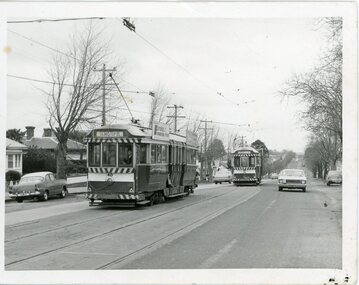
Photograph - Ballarat Tram 40, Ballarat Tram 40: In Drummond Street at the Urqhuart Street Loop
... Tram 40 had a Maximum Traction truck bogie (eight wheels), drop end and centre combination. ...Tram 40 had a Maximum Traction truck bogie (eight wheels), drop end and centre combination. ...This tram was built in 1913 by Duncan and Fraser in 1913 for the Prahran and Malvern Tramways Trust. It began service as their Number 35. It was classified "C" by the Melbourne Tramways Board. In 1951 it was sold to the State Electricity Commission of Victoria and renumbered 40. This tram was the last Ballarat tram to operate by the SEC to officially carry passengers in Ballarat on 19 September 1971. Tram 40 had a Maximum Traction truck bogie (eight wheels), drop end and centre combination. The photograph shows the tram on Drummond Street at the Urquhart Street loop. Another tram is about to enter the loop to allow No 40 to proceed on the way to Sebastopol. Photograph by Campbell Duncan. Black and white photograph "Urquhart St Loop" on backballarat tram 40, 1913, duncan & fraser, prahran and malvern tramways trust, number 35, melbourne tramways board, 1951, state electricity commission, number 40, ballarat, last tram, 1971, drummond street, urquart street loop, destination blind, sebastopol, campbell duncan, photographer -
 Melbourne Tram Museum
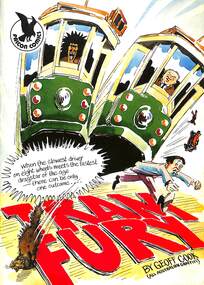
Book - Comic Book, Geoff Cook, "Tram Fury", 1976
... Comic book - 32 pages + card covers titled "Tram Fury", with the subtitle "when the slowest driver on eight wheels meets the fastest dragster of the age - there can only be one outcome ...." ...Trams tramways Melbourne Comics Comic book - 32 pages + card covers titled "Tram Fury", with the subtitle "when the slowest driver on eight wheels meets the fastest dragster of the age - there can only be one outcome ...." ...Comic book - 32 pages + card covers titled "Tram Fury", with the subtitle "when the slowest driver on eight wheels meets the fastest dragster of the age - there can only be one outcome ...." Written and illustrated by Geoff Cook 1976, published by Falcon Comics. Colour cover with green back cover. Publication details on rear cover. Based on a story about Melbourne W2 tramcar drivers racing each other. 2nd copy added 27--1-2019 from Donation of Barry Brooks ex Bob Prentice Collection.trams, tramways, melbourne, comics -
 Bendigo Historical Society Inc.
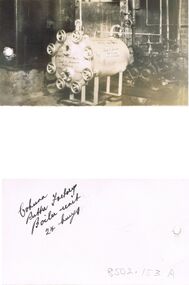
Photograph - BILL ASHMAN COLLECTION: A 24 SCALEBUOY UNIT
... Unit is a tank like structure mounted on the floor and has an end with eight fastening wheels and two other plates with six bolts in them. ...Unit is a tank like structure mounted on the floor and has an end with eight fastening wheels and two other plates with six bolts in them. ...Black and white photo showing a 24 Scalebuoy Unit at the Cohuna Butter Factory. Unit is a tank like structure mounted on the floor and has an end with eight fastening wheels and two other plates with six bolts in them. Written on the back is: Cohuna Butter Factory Boiler unit 24 buoys.sciences, bill ashman collection - correspondence, cohuna butter factory -
 Ballarat Tramway Museum
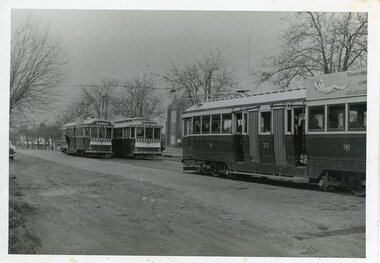
Photograph - Ballarat Trams 35, 39 and 26, Tram 35, 39, 26 in Drummond Street
... Ballarat Tram 35 is a maximum traction truck bogie - eight wheels, with drop end and centre combination. ...Ballarat Tram 35 is a maximum traction truck bogie - eight wheels, with drop end and centre combination. ...Ballarat Tram 35 is a maximum traction truck bogie - eight wheels, with drop end and centre combination. It was built in 1916 by Duncan and Fraser for the Hawthorn Tramways Trust. It came to Ballarat in 1947. In 1974 the body went to Ballarat and Clarendon College. Returned to Ballarat Tramway Preservation Society in 1978. Ballarat Tram 26 was built in 1916 by Duncan and Fraser for the Hawthorn Tramways Trust. It came to Ballarat in 1930 and was part of the SEC's consolidated tramcar fleet. In 1971 it transferred to the Ballarat Tramway Preservation Society. Tram 39 was built in 1914 by Duncan and Fraser for the Prahran and Malvern Tramways Trust. It came to Ballarat in 1951 and was part of the SEC's consolidated tramcar fleet. It was converted to a static museum display and souvenir shop. In 1971 it went to the Lions Club of Lismore. Ballarat Tramway Preservation Society acquired it in 1976. (See No. 10755 for a series of 16 photographs of the return of tram 39 to Ballarat. These were taken by Campbell Duncan) Photo shows the trams in Drummond Street at the Urquhart Street loop.Black and white photographtram 35, tram 39, tram 26, duncan and fraser, hawthorn tramway trust, prahran and malvern tramway trust, ballarat, 1916, 1947, ballarat and clarendon college, 1974, ballarat tramway preservation society, 1978, 1930, lions club lismore, static museum display, drummond street, urquhart street loop, campbell duncan, photographer -
 Puffing Billy Railway
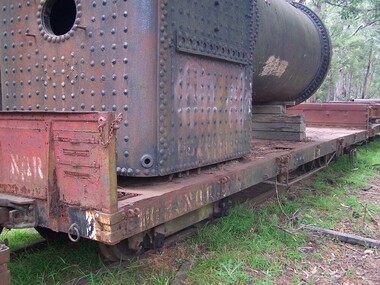
Equipment - 103 NQR - Open Medium Truck, 16/12/1909
... There are three long drop-down sides and eight narrow guage wheels. The wagon is 7671mm long and 1905mm wide with steel couplings at either end. ...There are three long drop-down sides and eight narrow guage wheels. The wagon is 7671mm long and 1905mm wide with steel couplings at either end. ...The NQRs were the standard Medium open goods wagon. Generally the sides and ends were removable thus providing a totally flat truck. Three long drop-down doors formed the sides thus allowing easy loading and unloading. 218 of these goods vehicles were built between 1898 and 1914 ? numbered 1 - 218. Originally, these wagons carried the code letter R as they were built with sides and ends. They later had the R removed. Unlike the Broad Gauge, VR's 2 ft 6 in (762 mm) narrow gauge network never had four-wheeled wagons (aside from a handful of trolleys). Because of this, a single design of open wagon emerged and this was the only type of wagon ever used on these lines. This was the NQR class, a wagon with the same length and loading capacity as a Broad Gauge four-wheeled open wagon to make transferring freight between the gauges easier. The wagons, numbered 1 through 218, were built between 1898 and 1914. The wagons used the same underframe as most other non-locomotives on the VR Narrow Gauge. Letters and numbers were originally painted only on the end bulkheads and doors, both of which could be removed as traffic dictated, and this made wagon identification difficult until the decals were transferred to the underframes of each wagon In the 1910s some NQRs were provided with removable wood and steel frameworks with canvas roof canopies and side curtains, and internal seating to supplement the rest of the passenger stock during busy holiday periods. Puffing Billy has re-created these for emergency capacity. Five more NQRs, numbered 219-223, were built between 1990 and 1992 initially for passenger use so were fitted with the removable frames In the 1960s the Puffing Billy Railway added grids in the floor of some to enable them to be used to drop ballast on the track where needed. Vehicle Length 25 feet 2 inches ( 7671 mm) Coupled Length 27 feet 4 inches (8330 mm) Width 6 feet 3 inches (1905 mm) Weight 5 tons Capacity 11 tons Built 1898 - 1915 (1992) Number Built 218 (223) In use 14 To be restored 6 103 NQR - Open Medium Truck 16/12/1909 NWS Built new Vehicle Length 25 feet 2 inches ( 7671 mm) Coupled Length 27 feet 4 inches (8330 mm) Width 6 feet 3 inches (1905 mm) Weight 5 tons Capacity 11 tons Built 1898 - 1915 (1992) Number Built 218 (223) In use 14 To be restored 6 VR Service History *NQR 103.VA - 16/12/1909 NWS Built new - / /1926 - To NQ 103.VA - Puffing Billy Service History or Notes Untrafficable at ClematisHistoric - Victorian Railways - Narrow Gauge Rolling Stock - NQR Open Medium TruckA large rectangualr open good wagon, with removable sides and ends creating a flat-bed. There are three long drop-down sides and eight narrow guage wheels. The wagon is 7671mm long and 1905mm wide with steel couplings at either end. The wagon is painted crimson (faded) with the words '103 NQR' stenciled in white at both ends. 103 NQRpuffing billy railway, pbr, rolling stock , 103 nqr - open medium truck, victorian railways, narrow gauge rolling stock, nqr wagon -
 Puffing Billy Railway
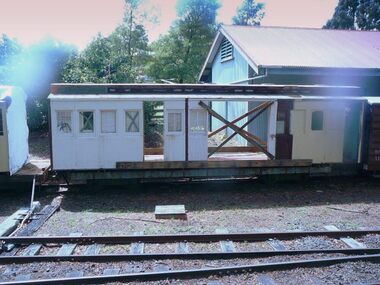
8 NB - Compartment Passenger Carriage, 1906
... Type: 2nd Class swing door carriage - 5 or 6 compartments 2'6" Bogie [8W]: Eight Wheels (2 x Four Wheel bogies) [CDG]: Continuous Draw Gear [WHB]: Westinghouse Brake circa 1910 - reclassed to NB 8 May 1926 - Modified with Automatic Couplers Malco Oct 1928 - Modified with Automatic Couplers Malco Bottom Operated 16 Dec 1937 - Consigned as to be scrapped 19 Feb 1938 - Condemned 4 Mar 1938 - Scrapped & Broken Up - Condemned Rolling stock Book Body to be offered for sale & underframe & bogies retained for use in construction of any additional NG trucks undertaken in near future. ...Type: 2nd Class swing door carriage - 5 or 6 compartments 2'6" Bogie [8W]: Eight Wheels (2 x Four Wheel bogies) [CDG]: Continuous Draw Gear [WHB]: Westinghouse Brake circa 1910 - reclassed to NB 8 May 1926 - Modified with Automatic Couplers Malco Oct 1928 - Modified with Automatic Couplers Malco Bottom Operated 16 Dec 1937 - Consigned as to be scrapped 19 Feb 1938 - Condemned 4 Mar 1938 - Scrapped & Broken Up - Condemned Rolling stock Book Body to be offered for sale & underframe & bogies retained for use in construction of any additional NG trucks undertaken in near future. ...8 NB - 6 compartments (40) Victorian Railways Service History 8 NB - passenger carriage (PBPS Body only - currently no underframe) 21 Dec 1906 Built New at Newport Workshops - numbered classed as NBB 8. Type: 2nd Class swing door carriage - 5 or 6 compartments 2'6" Bogie [8W]: Eight Wheels (2 x Four Wheel bogies) [CDG]: Continuous Draw Gear [WHB]: Westinghouse Brake circa 1910 - reclassed to NB 8 May 1926 - Modified with Automatic Couplers Malco Oct 1928 - Modified with Automatic Couplers Malco Bottom Operated 16 Dec 1937 - Consigned as to be scrapped 19 Feb 1938 - Condemned 4 Mar 1938 - Scrapped & Broken Up - Condemned Rolling stock Book Body to be offered for sale & underframe & bogies retained for use in construction of any additional NG trucks undertaken in near future. Sold by V.R and privately bought and used in the construction of a house at 80 Dare Street, Ocean Grove Puffing Billy Preservation Society Service History or Notes Sept 2010 - Ocean Grove house demolition results in PBPS being contacted that there were two carriages (6 NB & 8 NB) in the house. PBPS arrange to buy the two carriages bodies from the Demolition company Nov 2010 - Two carriages have been rescued from 80 Dare Street, Ocean Grove where they had been built into a house. Many people were involved in the move: thanks go to Raymond and Thelma Cotter for providing tarps to protect the cars from the elements. Dec 2010 - Two carriages rescued from Ocean Grove are now at Emerald, one being a platform NB car (6NB) and the other 8 NB a 2nd Class swing door carriage. Minor refurbishment has taken place along with covering with Tarpaulins. 29 Jan 2020 - 8 NB - passenger carriage - Body only is moved by the PBPS Heritage Rolling Stock Committee from Emerald Station sidings and placed into storage in a warehouse at Officer to enable it to be investigated into its possible restoration. 29 Feb 2020 - investigation on the carriage by the PBPS Heritage Rolling Stock Committee found the number of the carriage 8 NB stamped on the inside of the side of the windows frames. Current - At OfficerNB Class - Number Built (1st Series) 6 - Number Built (2nd Series) 17 - Number Built (3rd Series) 4 Historic - Victorian Railways Narrow Gauge - Passenger Rolling Stock: Passsenger carriage. 14 NB and this carriage (both of the 2nd Series) are the last known existing vehicles of this type out of the 17 built - maybe!.Passenger Rolling Stock: ? NB - Passenger carriage - Made of Timber NB - 2nd Class swing door carriage - 5 compartments number unknown ? NB puffing billy, nb passenger carriage, victorian railways, narrow gauge passenger rolling stock, 2'6" gauge -
 Flagstaff Hill Maritime Museum and Village
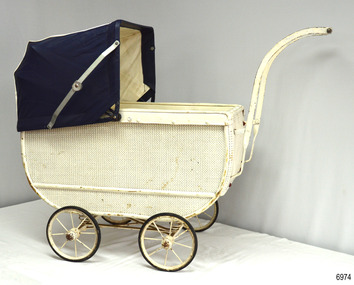
Leisure object - Doll's pram, late-1930s to early-1940s
... The base and hood are lined with white vinyl. The wheels have eight spokes and black rubber tyres. ...The base and hood are lined with white vinyl. The wheels have eight spokes and black rubber tyres. ...This doll's pram was owned by the daughter of Dr William Roy Angus and his wife Gladys when the family came to Warrnambool in the late 1930s. It is part of the W.R. Angus collection, donated by the family of Dr W R Angus, surgeon and oculist. The W R Angus Collection spans the years 1885 to the mid-1900s and includes historical medical and surgical equipment and instruments from the doctors Edward and Thomas Ryan of Nhill, Victoria. Dr Angus married Gladys in 1927 at Ballarat, the nearest big city to Nhill where he began as a Medical Assistant. He was also Acting House surgeon at the Nhill hospital where their two daughters were born. Dr Angus and his family moved to Warrnambool in 1939, where Dr Angus operated his own medical practice. He later added the responsibility of part-time Port Medical Officer and was the last person appointed to that position. Both Dr Angus and his wife were very involved in the local community, including the planning stages of the new Flagstaff Hill and the layout of the gardens there. Dr Angus passed away in March 1970.This doll's pram is connected to the history of Warrnambool, as it was owned by the daughter of Dr W. R. Angus and his wife Gladys, and is part of the W.R. Angus Collection, which is important for still being located at the site connected to Doctor Angus, Warrnambool’s last Port Medical Officer. Dr Angus and his wife brought their young family to Warrnambool in 1939 and he remained a resident until his death in 1970. Early in his profession in the town of Nhill, Dr Angus assisted Dr Tom Ryan in his pioneering use of X-rays and in ocular surgery, and Dr Angus later inherited these items. The W.R. Angus Collection includes these medical instruments and other related equipment and is culturally and historically significant as an example of the medical practice of the late 19th to the mid-20th century. Other items in the collection relate to Dr Angus’ service in the Flying Doctor Service and the Army.Pram has a folding blue vinyl hood and a rectangular, white wicker base with curved corners at the bottom. The base and hood are lined with white vinyl. The wheels have eight spokes and black rubber tyres. The curved handle has a metal bard the width of the pram, which is covered in a white rubber tube. The handle sides are joined to two curved flat bars that extend in an outwards curve away from the pram. The Hood is hinged to flip from the back to the front of the pram and is designed to can fold. The undercarriage has suspension springs. The pram is part of the W.R. Angus Collection.flagstaff hill, warrnambool, maritime village, maritime museum, shipwreck coast, great ocean road, dr w r angus, dr roy angus, dr ryan, warrnambool oculist, port medical officer, nhill base hospital, mira hospital nhill, doll's pram', toy pram, child's pram, toy, w.r. angus collection -
 Flagstaff Hill Maritime Museum and Village
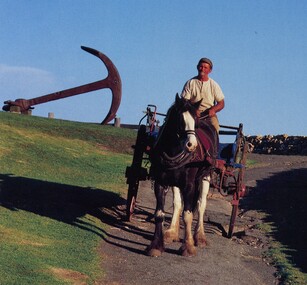
Vehicle - Spring Cart, Late 19th to early 20th centuries
... Both wheels have a brake block that is operated by a lever on the cart's right. The cart has eight-leaf suspension from front to back. ...Both wheels have a brake block that is operated by a lever on the cart's right. The cart has eight-leaf suspension from front to back. ...A spring cart is a two-wheeled, one-horse cart, often with the driver standing up to drive it, and otherwise seated on a simple seat. Carts like this one had springs to make the ride smoother. It is a lighter version of a farm dray and is sometimes called a spring dray. Spring carts were often used on farms for carrying loads. In the towns, some businesses used a spring cart for deliveries of bread, milk and other goods. The carts would be used for travel and for families going on outings and picnics. Visitors to Flagstaff Hill Maritime Village from 1986 to 1992 would enjoy watching a Clydesdale horse named Duke as he worked around the village with his driver Pat McGowan. He would be hitched to a wagon or to this lightweight spring cart or sometimes he would pull the wagon with the cart attached as a trailer. The cart was used for maintenance, carting loads of timber or stone around the site or from town to Flagstaff Hill. Sometimes Duke and the cart would take visitors for cart rides around the Village. Pat McGowan was known for his restoration of horse-drawn vehicles including this spring cart. He already had 40 years of horse handling experience when he began looking after Duke, feeding and harnessing him and driving the horse and cart around the Village. Pat’s dog ‘Yabbie’ would often join them. In August 1992 Duke had to be put down. Warrnambool Veterinary Clinic and other fund-raisers began well-supported appeals and the beloved horse was replaced by a Clydesdale also named Duke (the second), who began work in late October 1992. He, like his predecessor, had a quiet temperament and was comfortable in the traffic. The spring card is an example of vehicles used on farms, for business delivery and for domestic transport in the late-19th and early-20th century. This cart is of note for being associated with the Clydesdale horse Duke which pulled the cart around Flagstaff Hills in the 1980s and 1990s, representing transport of that period.Spring cart; two-wheeled cart with shallow box tray and plank seat bolted across the front. Wheels have metal rims and fourteen (14) wooden spokes. A plank is bolted from side to side. A decorative metal step is on the cart's left and has acorn cut-out shapes in the plate. Both wheels have a brake block that is operated by a lever on the cart's right. The cart has eight-leaf suspension from front to back. The box tray is painted blue and has decorative pale yellow detail. Each shaft pole has has a handle fitting on it. (Horse equipment with the cart is a leather covered, straw filled collar.) flagstaff hill, flagstaff hill maritime museum and village, warrnambool, maritime museum, maritime village, great ocean road, shipwreck coast, springcart, spring cart, jingle, horse-drawn cart, one horse cart, two-wheeled cart, dray, spring dray, wagon, transportation, travel, cart, duke, clydesdale, pat mcgowan, delivery cart, yabbie, cartwright, horse-drawn vehicle, transport, horse cart -
 Bay Steamers Maritime Museum
Ship's Wheel
... wheels that are associated with the steam tug Wattle. This wooden wheel replaced the original steel wheel which was much larger and proved unwieldly. wood ships wheel wattle steering gear steam tug bay steamers maritime museum Wooden Ship's wheel with eight spoke handles and a central brass reinforcing plate. ...This is one of two ship's wheels that are associated with the steam tug Wattle. This wooden wheel replaced the original steel wheel which was much larger and proved unwieldly.Wooden Ship's wheel with eight spoke handles and a central brass reinforcing plate. The wheel is constructed of mid brown timber. The outer wheel is constructed of short timber lengths inbetween the eight turned spokes. A central circular brass plate is rivetted in the middle to hold the wooden components together.wood, ships wheel, wattle, steering gear, steam tug, bay steamers maritime museum -
 Bendigo Historical Society Inc.
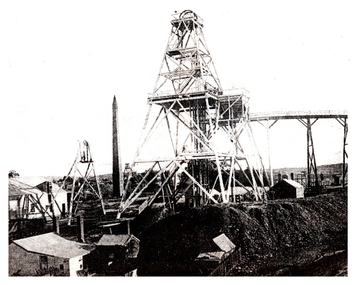
Newspaper - Fortuna Articles - "Discover Bendigo - Lansell erects Australia's tallest poppet head", Dec 31 1998
... eight large logs forming the four legs.Steel fittings were custom-made and riveted by blacksmiths. Harkness Foundry built Bendigo's largest winding plant for the mine, with 1.5-metre stroke cylinders. Two boilers powered the engine and compressor, with a flue connected to a brick chimney resembling Cleopatra's Needle. Gin wheels...eight large logs forming the four legs.Steel fittings were custom-made and riveted by blacksmiths. Harkness Foundry built Bendigo's largest winding plant for the mine, with 1.5-metre stroke cylinders. Two boilers powered the engine and compressor, with a flue connected to a brick chimney resembling Cleopatra's Needle. Gin wheels ...This article details the construction and significance of the 222 mine's poppet head in Bendigo, Australia, during the late 19th century. George Lansell, known as the 'Quartz King,' commissioned the tallest poppet legs in Australia for the 222 mine to transport ore to his crushing battery. Local carpenter George Fauckner, experienced but new to such a scale, led the construction. The mine was named '222' after Lansell's 222-yard lease along the New Chum reef. Ten years after acquiring the land, Lansell planned the substantial plant and poppet head. Lansell initially proposed a steel tube leg to serve as a boiler flue, but engineers rejected the idea. The poppet head needed to be 39 metres tall (much higher than the typical 23 metres) to accommodate an elevated tramway connecting the mine to the battery. The first landing brace was 24.3 metres above ground; legs were raised using manually operated geared crab winches.Stringy Bark timber from Ballarook Forest was used, with eight large logs forming the four legs.Steel fittings were custom-made and riveted by blacksmiths. Harkness Foundry built Bendigo's largest winding plant for the mine, with 1.5-metre stroke cylinders. Two boilers powered the engine and compressor, with a flue connected to a brick chimney resembling Cleopatra's Needle. Gin wheels on the top brace were 3.5 metres in diameter. The 222 poppet head remained the tallest in Bendigo into the 20th century, unmatched by other mines. The article references a photograph from the 1890s showing the mine and its surroundings.Fortuna Articles - "Discover Bendigo - Lansell erects Australia's tallest poppet head" Dec 31 1998 The Bendigo Weekly by James Lerk This item contains the following: 11217.53a Black and white photo of the poppet heads 11217.53b Part of Page 3 - Fortuna Articles - "Discover Bendigo - Lansell erects Australia's tallest poppet head"non-fictionbendigo, fortuna, george lansell, james lerk, george fauckner, 222 mine, new chum reef, ballarook forest, harkness foundry -
 Bendigo Historical Society Inc.
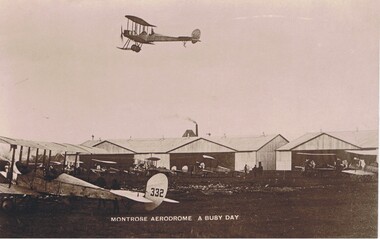
Postcard - BASIL WATSON COLLECTION: POSTCARD - MONTROSE AERODROME, ca. 1914
... eight ? Planes on field in front of hangars (three sheds) - one nearby plane has 332 on tailplane - further one is a 233? One plane with skids in front of landing wheels is in air above, this plane has number on tail but is unclear....eight ? Planes on field in front of hangars (three sheds) - one nearby plane has 332 on tailplane - further one is a 233? One plane with skids in front of landing wheels is in air above, this plane has number on tail but is unclear. ...Postcard - Montrose Aerodrome titled 'Montrose Aerodrome - a busy day' . Showing seven /eight ? Planes on field in front of hangars (three sheds) - one nearby plane has 332 on tailplane - further one is a 233? One plane with skids in front of landing wheels is in air above, this plane has number on tail but is unclear.Excelsior Seriesaviation, civilian, montrose aerodrome uk -
 Ballarat Tramway Museum
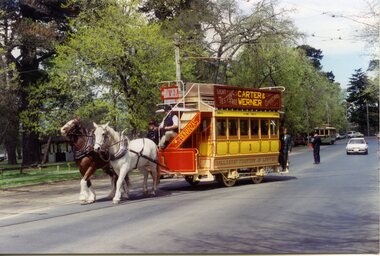
Vehicle - Tramcar, Duncan and Fraser and Ballarat Tramway Preservation Society, Horse Tram No 1, 1887 - original, reconstruction 1986-1992
... wheels of cast iron, hand brakes - see notes. Originally built by Duncan & Fraser in 1887. Rebuilt by BTPS 1991. From the BTM Fleet page on the website: Built in 1887 by Duncan and Fraser for the Ballaarat Tramway Company Ltd. as a double-decked horse tramcar. One of eight...wheels of cast iron, hand brakes - see notes. Originally built by Duncan & Fraser in 1887. Rebuilt by BTPS 1991. From the BTM Fleet page on the website: Built in 1887 by Duncan and Fraser for the Ballaarat Tramway Company Ltd. as a double-decked horse tramcar. One of eight ...A double deck horse drawn tram with single saloon. drop ends, stairs, longitudinal seats, sliding doors, wheels of cast iron, hand brakes - see notes. Originally built by Duncan & Fraser in 1887. Rebuilt by BTPS 1991. From the BTM Fleet page on the website: Built in 1887 by Duncan and Fraser for the Ballaarat Tramway Company Ltd. as a double-decked horse tramcar. One of eight cars which ran as trailers behind electric trams at times of heavy patronage, after takeover and conversion of the horse lines by the Electric Supply Company of Victoria Ltd. in 1905. Withdrawn in the late 1920's when the body shell became a residential outbuilding locally, until retrieved in 1985. Fully reconstructed to its original form and placed on a modified Melbourne saloon cable car truck. See attached notestrams, horse trams, tram 1 -
 Puffing Billy Railway
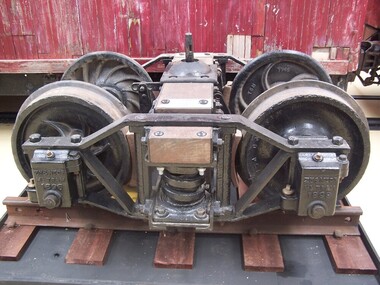
Zeehan & North East Dundas Tramway Bogie 1896, wagon bogie, 1896
... The rolling stock for the Tramway was built in the Launceston Railway workshops, and comprised twenty five eight-wheel low-side trucks, tare 3 tons 1 cwt. 1 qr., load 10 tons; six eight-wheel flat trucks, tare 2 tons 18 cwt. 1 qr., load 10 tons; two four-wheel bolster trucks, for carrying long timber, tare 1 ton 19 cwt., load 5 tons; and four passenger cars, each with six cross-seats with reversible backs, to carry eighteen passengers, also a locker for mails and parcels. All trucks and cars have cast-steel wheels...The rolling stock for the Tramway was built in the Launceston Railway workshops, and comprised twenty five eight-wheel low-side trucks, tare 3 tons 1 cwt. 1 qr., load 10 tons; six eight-wheel flat trucks, tare 2 tons 18 cwt. 1 qr., load 10 tons; two four-wheel bolster trucks, for carrying long timber, tare 1 ton 19 cwt., load 5 tons; and four passenger cars, each with six cross-seats with reversible backs, to carry eighteen passengers, also a locker for mails and parcels. All trucks and cars have cast-steel wheels ...Zeehan & North East Dundas Tramway Bogie 1896 The North East Dundas Tramway (NEDT) was a 2 ft (610 mm) narrow gauge tramway on West Coast Tasmania that ran between Zeehan and Deep Lead (now Williamsford). It was part of Tasmanian Government Railways. The line was opened in 1896 to carry ore from the Williamsford mines to Zeehan where it would be loaded onto another train for shipment to Burnie. The narrow-gauge (2 ft) was chosen because of the extremely difficult terrain that the railway crossed, requiring several big trestle bridges, including one at the foot of Montezuma Falls. After some rain the engine and carriages would get soaked by spray from the falls. There was a break-of-gauge with the mainline 1,067 mm (3 ft 6 in) system at Zeehan. The railway was closed in 1932. The rolling stock for the Tramway was built in the Launceston Railway workshops, and comprised twenty five eight-wheel low-side trucks, tare 3 tons 1 cwt. 1 qr., load 10 tons; six eight-wheel flat trucks, tare 2 tons 18 cwt. 1 qr., load 10 tons; two four-wheel bolster trucks, for carrying long timber, tare 1 ton 19 cwt., load 5 tons; and four passenger cars, each with six cross-seats with reversible backs, to carry eighteen passengers, also a locker for mails and parcels. All trucks and cars have cast-steel wheels 21 inches in diameter and are fitted with automatic vacuum brakes. The trucks have side levers and the cars have hand-screw brakes. The vacuum brake can be worked from the engine or from the passenger cars, which act as brake vans. When this brake was introduced, one effect was to accelerate the journey speed by about 10 minutes owing to more even running on down gradients. Historic - Industrial Narrow Gauge railway - Bogie used on the Zeehan & North East Dundas Tramway, Tasmania, Australia Bogie made from steel, iron and wrought ironZN & NTDS ML TRAM 1896 Griffinpuffing billy, bogie, zeehan & north east dundas tramway bogie, zeehan & north east dundas tramway, industrial narrow gauge railway, gauge: 2' (610 mm) -
 Puffing Billy Railway
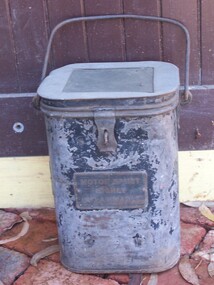
Motor Spirit, Highly Inflamable Transporting Tin Container
... eight-horsepower Gang Motor held five people, and was built at Arden Street in late 1923. In 1950 the vehicle was removed from the rolling stock register and given to "Way and Works" as a track motor. Motor Car The Motor Car was put into service in mid 1925, after being fitted with rail wheels...eight-horsepower Gang Motor held five people, and was built at Arden Street in late 1923. In 1950 the vehicle was removed from the rolling stock register and given to "Way and Works" as a track motor. Motor Car The Motor Car was put into service in mid 1925, after being fitted with rail wheels ...Motor Spirit Highly Inflammable Transporting Tin Container "Motor Spirit" is just another name for petrol. "K" and the "KS" Kasey Trolleys were two stroke petrol motors Operation, Care and Maintenance of Track Motors Victorian Railways, 1959 http://www.geoffsrailpix.com/Documents/Motors.pdf#zoom=100 gives the following : Inspection motor type B, - straight petrol Inspection motor type V, - pre-mixed petrol Motorised tricycle type M.T., - pre-mixed petrol Gang motor type K.S., - pre-mixed petrol Gang motor type K - pre-mixed petrol Motor cars altered for rail uses (Wiki) Petrol Inspection Car This was a small car numbered '1' and named the Inspection Car. It was built in England in 1923, but was not found in the 1936 stocktake. Gang Motor The eight-horsepower Gang Motor held five people, and was built at Arden Street in late 1923. In 1950 the vehicle was removed from the rolling stock register and given to "Way and Works" as a track motor. Motor Car The Motor Car was put into service in mid 1925, after being fitted with rail wheels in lieu of tyres. In 1927 the car was named "Mr Molomby's Inspection Car", and allocated to Seymour. It was scrapped in 1952. Dodge Cars There were seven Dodge cars in rail service. The cars were numbered 1 to 6, with car 7 listed "No 7 Repair". The cars were built by the Dodge Company of Melbourne and assembled at Newport. Construction was in 1925 and they lasted until 1949. Historic - Railways Permanent Way and Works - track equipment - Motor Spirit Highly Inflamable Transporting Tin ContainerMotor Spirit Highly Inflamable Transporting Tin Container made of tin Motor Spirit Highly Inflamable puffing billy, motor spirit transporting container -
 Puffing Billy Railway
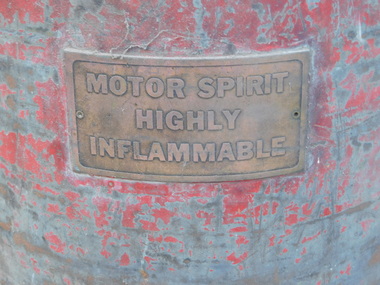
Victorian Railways Fuel Can for Trolly
... eight-horsepower Gang Motor held five people, and was built at Arden Street in late 1923. In 1950 the vehicle was removed from the rolling stock register and given to "Way and Works" as a track motor. Motor Car The Motor Car was put into service in mid 1925, after being fitted with rail wheels...eight-horsepower Gang Motor held five people, and was built at Arden Street in late 1923. In 1950 the vehicle was removed from the rolling stock register and given to "Way and Works" as a track motor. Motor Car The Motor Car was put into service in mid 1925, after being fitted with rail wheels ...V.R Fuel Can for Trolley - Victorian Railways Fuel Can for Trolly Motor Spirit Highly Inflammable Transporting Tin Container "Motor Spirit" is just another name for petrol. "K" and the "KS" Kasey Trolleys were two stroke petrol motors Operation, Care and Maintenance of Track Motors Victorian Railways, 1959 http://www.geoffsrailpix.com/Documents/Motors.pdf gives the following : Inspection motor type B, - straight petrol Inspection motor type V, - pre-mixed petrol Motorised tricycle type M.T., - pre-mixed petrol Gang motor type K.S., - pre-mixed petrol Gang motor type K - pre-mixed petrol Motor cars altered for rail uses (Wiki) Petrol Inspection Car This was a small car numbered '1' and named the Inspection Car. It was built in England in 1923, but was not found in the 1936 stocktake. Gang Motor The eight-horsepower Gang Motor held five people, and was built at Arden Street in late 1923. In 1950 the vehicle was removed from the rolling stock register and given to "Way and Works" as a track motor. Motor Car The Motor Car was put into service in mid 1925, after being fitted with rail wheels in lieu of tyres. In 1927 the car was named "Mr Molomby's Inspection Car", and allocated to Seymour. It was scrapped in 1952. Dodge Cars There were seven Dodge cars in rail service. The cars were numbered 1 to 6, with car 7 listed "No 7 Repair". The cars were built by the Dodge Company of Melbourne and assembled at Newport. Construction was in 1925 and they lasted until 1949.Historic - Victorian Railways - Permanent Way and Works - track equipment - V.R Fuel Can for TrolleyV.R Fuel Can for Trolly - Metal Fuel TinMotor Spirit Highly Flammable V.R 8 ?puffing billy, victorian railways, fuel can, trolley, trolly -
 Southern Sherbrooke Historical Society Inc.
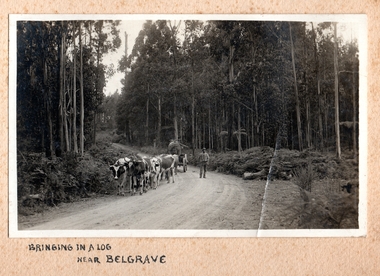
Photograph, Bringing in a log near Belgrave
... Photo of a worker bringing in a log on a dray with what appear to be narrow steel wheels. Dray is being pulled by eight or ten steers or small bullocks. ...Photo of a worker bringing in a log on a dray with what appear to be narrow steel wheels. Dray is being pulled by eight or ten steers or small bullocks. ...Photo of a worker bringing in a log on a dray with what appear to be narrow steel wheels. Dray is being pulled by eight or ten steers or small bullocks. Heavy bush and tall, straight timber on side of the road. Most likely Sherbrooke Forest. Road bends to left behind team then possibly to the right, going up a small rise. The man could be well-known bullocky Bill Martin. He is dressed in a wellworn hat, a pale shirt with sleeves rolled up, and darker pants, and is carrying a long, slender stick or possibly a whip in his right hand. -
 Melbourne Tram Museum
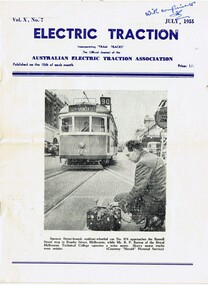
Magazine, Australian Electric Traction Association (AETA), "Electric Traction - July 1955", Jul. 1955
... Trams tramways Bourke St W7 class East Preston Depot Resilient wheels Wheels Testing Eight page magazine, centre stapled, "Electric Traction - July 1955", with a photo of 974 undergoing noise testing in Bourke St. ...Eight page magazine, centre stapled, "Electric Traction - July 1955", with a photo of 974 undergoing noise testing in Bourke St. Has an article on the Minister for Transport, Mr. A. G. Warner speech at the time of the opening of the new East Preston Depot, and the efficiency of tramways. Has an item on the Resilient wheel that reduces noise. Also items on the new W7 tramcars, route numbers for the Bourke Street routes, NSW electric railways and Ballarat.trams, tramways, bourke st, w7 class, east preston depot, resilient wheels, wheels, testing -
 Melbourne Tram Museum
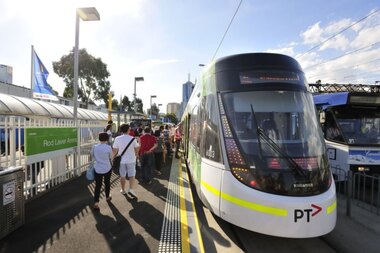
Newspaper, The Age, "Trackless and with rubber wheels, it may be our next generation trams", 2/05/2021 12:00:00 AM
... wheels, electric batteries and no overhead wires could be the future for Melbourne’s trams. By 2025, 100 new trams will be designed and built due to a $1.5 billion government injection to fund 100 ‘‘next-generation trams’’, replacing A and Z-Class trams. Two manufacturers have been shortlisted to design and build the trams: French rail manufacturer Alstom and a joint venture comprising Spanish rail maker CAF and UGL. At 25 metres long – about eight...wheels, electric batteries and no overhead wires could be the future for Melbourne’s trams. By 2025, 100 new trams will be designed and built due to a $1.5 billion government injection to fund 100 ‘‘next-generation trams’’, replacing A and Z-Class trams. Two manufacturers have been shortlisted to design and build the trams: French rail manufacturer Alstom and a joint venture comprising Spanish rail maker CAF and UGL. At 25 metres long – about eight ...Newspaper clipping titled: “Trackless and with rubber wheels, it may be our next generation trams” by Timna Jacks Newspaper clipping from the Age 02/05/2021 Rubber wheels, electric batteries and no overhead wires could be the future for Melbourne’s trams. By 2025, 100 new trams will be designed and built due to a $1.5 billion government injection to fund 100 ‘‘next-generation trams’’, replacing A and Z-Class trams. Two manufacturers have been shortlisted to design and build the trams: French rail manufacturer Alstom and a joint venture comprising Spanish rail maker CAF and UGL. At 25 metres long – about eight metres shorter than the newest E-Class trams – the trams will carry 150 passengers, fewer than the E-Class, which carry 210 people. Despite the smaller size, seating will remain proportionally comparable with the E-Class, with 48 people or a third of passengers getting a seat on the new fleet. The new fleet will be the first in Melbourne to be partly powered by on-board batteries.trams, tramways, yarra trams, keolis downer, caf, rolling stock, e class, z class, a class, ugl, tramcar acquisition, tramcar design, tramcar manufacture
