
Showing 435 items matching "farming in australia"
-
 Sunshine and District Historical Society Incorporated
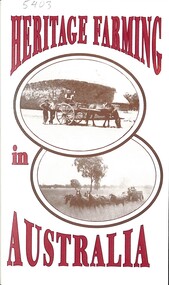
Film - Heritage Farming In Australia Video
... Heritage Farming In Australia Video...Heritage Farming In Australia Video...This video depicts the history of mechanical farming in Australia. It captures the transition from horse powered farming and early mechanical inventions to the forerunners of today's modern equipment. ...Farming Ian Sloane Heritage Farming In Victoria VHS Video Tape Heritage Farming In Australia Video Film Heritage Farming In Australia Video ...This video depicts the history of mechanical farming in Australia. It captures the transition from horse powered farming and early mechanical inventions to the forerunners of today's modern equipment. The filmmaker, Ian Sloane captured these contrasting modes of operation during 1935.Heritage Farming In Victoriafarming, ian sloane -
 Warrnambool and District Historical Society Inc.
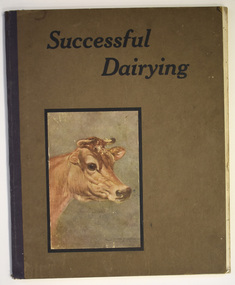
Book, The Nightingale Supply Company Limited, Sydney, Successful Dairy Farming in Australia, c.1930
... Successful Dairy Farming in Australia...Dairy Farming in Australia...This book gives information on dairy farming in Australia and includes details on cattle diseases, the best types of fodder, best breeding techniques and the maintenance of milking machines. ...Dairy Farming in Australia dairy cows warrnambool western victoria Information on dairy farming in Australia J. ...Information on dairy farming in AustraliaThis is a book of 71 pages. The cover is grey with a colour photograph of a jersey cow's head, black printing and dark blue binding. The pages contain black and white photographs, sketches and tables, printed text and a colour fold out of a cow showing internal organs etc. The cover is partly detached from the pages.non-fictionInformation on dairy farming in Australiadairy farming in australia, dairy cows, warrnambool, western victoria -
 National Wool Museum
Book, Practical sheep farming in Australia
... Practical sheep farming in Australia..."Practical sheep farming in Australia"- J W Jordan, 1961..."Practical sheep farming in Australia"- J W Jordan, 1961 Sheep breeding Sheep Dipping Shearing Sheep - nutrition Sheep stations - management Wool Growing Woolclassing Sheep breeding Sheep Dipping Shearing Sheep - nutrition Sheep stations - management Wool Growing Woolclassing Practical sheep farming in Australia Book ..."Practical sheep farming in Australia"- J W Jordan, 1961sheep breeding sheep dipping shearing sheep - nutrition sheep stations - management wool growing woolclassing, sheep breeding, sheep dipping, shearing, sheep - nutrition, sheep stations - management, wool growing, woolclassing -
 Sunshine and District Historical Society Incorporated
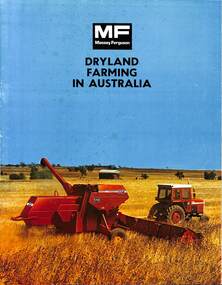
Booklet - Dryland farming in Australia, McKay Massey Harris, H.V
... Dryland farming in Australia...Booklet Dryland farming in Australia McKay Massey Harris, H.V ...farming, massey ferguson -
 Tatura Irrigation & Wartime Camps Museum
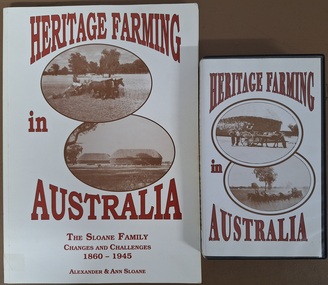
Film - Video Tape, Heritage farming in Australia DVD and Book
... Heritage farming in Australia DVD and Book...Soft covered book on the subject as well. Heritage farming in Australia DVD and Book Film Video Tape ...Black video tape box, white wrap around cover, brown writing & sepia photos on front.Tan writing with description of video contents, running time etc on back. Soft covered book on the subject as well. -
Whitehorse Historical Society Inc.
Document, Daniel Harvey:The father of power farming in Australia, 1995
... Daniel Harvey:The father of power farming in Australia...Daniel Harvey:The father of power farming in Australia Document Document ...The history of Daniel Harvey and his manufacturing of agricultural power machinery. 1876 - 1960.The history of Daniel Harvey and his manufacturing of agricultural power machinery. 1876 - 1960.The history of Daniel Harvey and his manufacturing of agricultural power machinery. 1876 - 1960.agricultural machinery, daniel harvey, finger, stan -
Clunes Museum
Book, GARRY FENTON, BORN TO BE A FARMER, MAY 2025
... ...FARMING IN AUSTRALIA...BLACK AND WHITE PHOTOGRAPH ON FRONT COVER AND THREE PHOTOGRAPHS ON BACK COVER.TARTAN PATTERN ON THE SPINE. 380 PAGES OF TEXT AND PHOTOGRAPHS OF THE HISTORY OF THE FENTON FAMILY FARMING IN AUSTRALIA FROM MID 1850'S TO 2018....GARRY FENTON FENTON FAMILY FARMING IN AUSTRALIA HISTORY OF THE FENTON FAMILY FARMING IN AUSTALIA FROM MID 1850'S TO 2018. ...HISTORY OF THE FENTON FAMILY FARMING IN AUSTALIA FROM MID 1850'S TO 2018. WRITTEN BY GARRY FENTONBLACK AND WHITE PHOTOGRAPH ON FRONT COVER AND THREE PHOTOGRAPHS ON BACK COVER.TARTAN PATTERN ON THE SPINE. 380 PAGES OF TEXT AND PHOTOGRAPHS OF THE HISTORY OF THE FENTON FAMILY FARMING IN AUSTRALIA FROM MID 1850'S TO 2018.non-fictionHISTORY OF THE FENTON FAMILY FARMING IN AUSTALIA FROM MID 1850'S TO 2018. WRITTEN BY GARRY FENTONgarry fenton, fenton family, farming in australia -
Tatura Irrigation & Wartime Camps Museum
Book, Warren Penney, The Farming of Australia, 1986
... The Farming of Australia...farming methods in Australia...A social and economic portrait of farming in Australia from 1788 to 1986....A social and economic portrait of farming in Australia from 1788 to 1986. farming methods in Australia Hard cover. ...A social and economic portrait of farming in Australia from 1788 to 1986.Hard cover. Colourful jacket with landscape photograph on front. Picture of certificate of merit from Royal Agricultural Society. Much early farming. Many photographs of early farming methods to 1986. Social life. Written by Robin Brumby, journalist.farming methods in australia -
 Whitehorse Historical Society Inc.
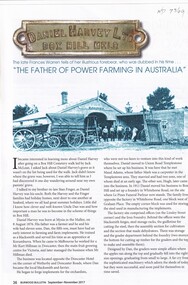
Article, Daniel Harvey, 1876 - 1960
... Daniel Harvey was dubbed 'The Father of Power Farming in Australia' and produced equipment for the farming industry....Danial Harvey Finger Stan Blacksmiths Harvey Hugh Box Hill Cemetery Warren Frances Daniel Harvey was dubbed 'The Father of Power Farming in Australia' . Daniel Harvey was dubbed 'The Father of Power Farming in Australia' and produced equipment for the farming industry. ...Daniel Harvey was dubbed 'The Father of Power Farming in Australia' .Daniel Harvey was dubbed 'The Father of Power Farming in Australia' and produced equipment for the farming industry.Daniel Harvey was dubbed 'The Father of Power Farming in Australia' .danial harvey, finger, stan, blacksmiths, harvey, hugh, box hill cemetery, warren, frances -
Tatura Irrigation & Wartime Camps Museum
VHS Video Tape
... VHS Video Tape.Black box, white sleeve, Brown writing, Heritage Farming in Australia, Sepia photos on front. Back cover printed with information regarding contents, running time etc....Original film taken in 1935 farming equipment VHS Video Tape.Black box, white sleeve, Brown writing, Heritage Farming in Australia, Sepia photos on front. Back cover printed with information regarding contents, running time etc. ...Original film taken in 1935VHS Video Tape.Black box, white sleeve, Brown writing, Heritage Farming in Australia, Sepia photos on front. Back cover printed with information regarding contents, running time etc.farming equipment -
 Bendigo Historical Society Inc.
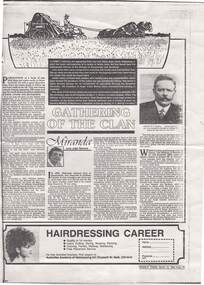
Newspaper - GATHERING OF THE CLAN: THE MCKAYS OF DRUMMARTIN AND SUNSHINE, 1864
... Like many other early immigrants to Australia, this family came from Ireland, and like so many arrivals they made for the diggings.This family's name became famous for its contribution to agriculture through the Sunshine Harvester, the invention of Hugh Victor McKay, which revolutionised farming in Australia....Like many other early immigrants to Australia, this family came from Ireland, and like so many arrivals they made for the diggings.This family's name became famous for its contribution to agriculture through the Sunshine Harvester, the invention of Hugh Victor McKay, which revolutionised farming in Australia. Newspaper GATHERING OF THE CLAN: THE MCKAYS OF DRUMMARTIN AND SUNSHINE ...Newspaper copy,Gathering of the Clan, The McKays of Drummartin and Sunshine. Like many other early immigrants to Australia, this family came from Ireland, and like so many arrivals they made for the diggings.This family's name became famous for its contribution to agriculture through the Sunshine Harvester, the invention of Hugh Victor McKay, which revolutionised farming in Australia.Weekly Timesnewspaper, weekly times, h.v.mckay the sunshine harvester -
 Puffing Billy Railway
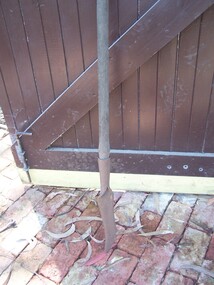
Tool - Sickle, Grass
... During early farming in Australia (before motorised whipper snippers) the hand held sickle was used to cut long grass, in this case in or around railway tracks. ...During early farming in Australia (before motorised whipper snippers) the hand held sickle was used to cut long grass, in this case in or around railway tracks. ...During early farming in Australia (before motorised whipper snippers) the hand held sickle was used to cut long grass, in this case in or around railway tracks. The inside of the blade's curve was sharp, so that the user can either draw or swing it against the base of the grass, catching the stems in the curve and slicing them at the same time. Historic - Railway Permanent Way and Works - track equipment - Grass SlasherWrought iron sickle with extended with wooden handle.puffing billy, extended sickle, farm tool, reaping hook, curved blade, grass cutting -
 Emerald Museum & Nobelius Heritage Park
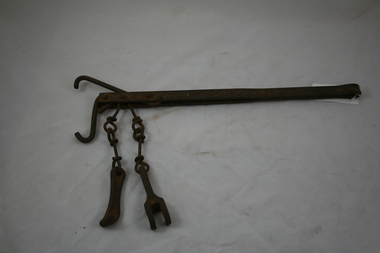
Sure Grip Wire Strainer (long chain is missing), 1917 - 1953
... The wire strainer was commonly used on Australian farming properties for putting fences up. ...The wire strainer was commonly used on Australian farming properties for putting fences up. ...The wire strainer was commonly used on Australian farming properties for putting fences up. Sure Grip Wire Strainers were advertised in Australia from 1917 to 1953. The distinctive grips were patented in Britain in 1913 (William Swann, (spring, hook and chain manufacturer, Walsall,in England).Improvements in or relating to means for gripping wire or the like: British patent 24,520/13. 29 October 1913.Steel bar with 2 interlocking grips for fastening the wire.Corroded marking about halfway along the lever. wire strainer -
 Kiewa Valley Historical Society
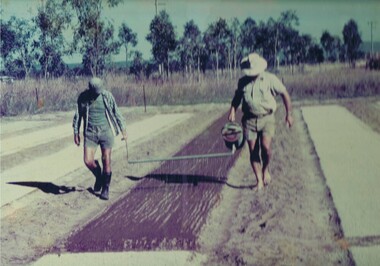
Photograph Tobacco planting, Planting Tobacco seeding, Circa mid to late 1900's
... In October 2006, by way of Government buy back of tobacco leases from growers, resulted in the end of Tobacco farming in Australia (after 136 years of planting the first crop). ...In October 2006, by way of Government buy back of tobacco leases from growers, resulted in the end of Tobacco farming in Australia (after 136 years of planting the first crop). ...This promotional photograph by the Tobacco Growers Association was in response to a 1935 meeting of tobacco growers from Victoria, South Australia and Queensland which produced four major resolutions for the industry covering the remainder of the 1900s. These four resolutions were: (1) Adequate tariff protection (2) Control of pests and diseases (3) Orderly marketing (4) The formation of an advisory council of growers. History has produced the following results. (1) adequate tariff protection was never achieved,(2) control of disease through benzol vapour (CSIRO) breakthrough, was later identified as carcinogenic, (3) orderly marketing was achieved through (4) the establishment of the Tobacco Growers Association(1984). In October 2006, by way of Government buy back of tobacco leases from growers, resulted in the end of Tobacco farming in Australia (after 136 years of planting the first crop). It was also significant that the major tobacco companies such as Philip Morris and The British American Tobacco Australasia advised the industry that it would source its tobacco requirements overseas by 2009.The remnants of the Tobacco Industry can still be viewed throughout the Kiewa Valley and adjacent regions on the former tobacco farms which still have the tobacco drying sheds and now converted into hay sheds. The problems from the large quantities of carcinogenic infused soil of farmlands in the region, still remains a problem now and for future generations. This particular photograph shows the lack of understanding by farmers and the contracted labour, at that time, and is demonstrated by the bare footed farmer walking next to the seed canister. Some workers did use protective "gum" boots but the majority of farm owners were skeptical of city scientists and their carcinogenic concerns, and it was only after the younger generation of farmers , who had attended Agricultural colleges, encompassed the scientific approach to farm management and began working closely with agricultural scientists. The "she'll be right mate" attitude of the earlier farming/rural community has since mid 1970s, been slowly dissipating. Stricter controls of herbicides and pesticides used in agriculture are now in force. The death of the tobacco industry(2006) resulted in the expansion of the dairy , sheep, beef cattle, venison and lama wool producers in the Kiewa Valley and surrounding regions.Coloured photograph pasted onto a thick wood chip backing. Two galvanised eyelets at the top of the frame, 50mm from each end, with a twine cord stretch from each, for hanging purposes. See also KVHS 0054(B) to KVHS 0054(F)A sign, which has been removed from the picture at some previous point in time is "The Tobacco seed, being so fine, is suspended in water and sown onto the seed base using a watering can [as in the photo] or similar device - August - Sept."tobacco, farming, rural industry, licences, ollie mould, blue mould, benzol vapour -
 Kiewa Valley Historical Society
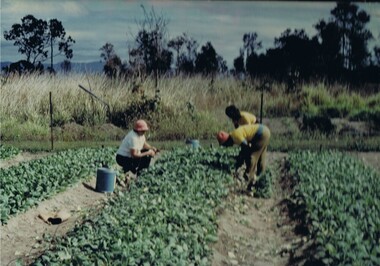
Photograph Tobacco seedlings, Pulling tobacco seedlings for Planting, Circa mid to late 1900s
... In October 2006, by way of Government buy back of tobacco leases from growers, resulted in the end of Tobacco farming in Australia (after 136 years of planting the first crop). ...In October 2006, by way of Government buy back of tobacco leases from growers, resulted in the end of Tobacco farming in Australia (after 136 years of planting the first crop). ...This promotional photograph by the Tobacco Growers Association was in response to a 1935 meeting of tobacco growers from Victoria, South Australia and Queensland which produced four major resolutions for the industry covering the remainder of the 1900s. These four resolutions were: (1) Adequate tariff protection (2) Control of pests and diseases (3) Orderly marketing (4) The formation of an advisory council of growers. History has produced the following results. (1) adequate tariff protection was never achieved,(2) control of disease through benzol vapour (CSIRO) breakthrough, was later identified as carcinogenic, (3) orderly marketing was achieved through (4) the establishment of the Tobacco Growers Association(19840. In October 2006, by way of Government buy back of tobacco leases from growers, resulted in the end of Tobacco farming in Australia (after 136 years of planting the first crop). It was also significant that the major tobacco companies such as Philip Morris and The British American Tobacco Australasia advised the industry that it would source its tobacco requirements overseas by 2009.The death of the tobacco industry(2006) resulted in the expansion of the dairy , sheep, beef cattle, venison and lama wool producers in the Kiewa Valley and surrounding regions. The remnants of the Tobacco Industry can still be viewed throughout the Kiewa Valley and adjacent regions on the former tobacco farms which still have the tobacco drying sheds and now converted into hay sheds. The problems from the large quantities of carcinogenic infused soil of farmlands in the region, still remains a problem now and for future generations. This particular photograph shows the lack of understanding by farmers and the contracted labour, at that time, and is demonstrated by the lack of protection of hands when handling seedlings and attached soil. Hand and foot protection was rarely used, even when later warnings were issued of the carcinogenic toxicity of the soil. The majority of farm owners, up until Health authorities stepped in the later stages of 1900s, were skeptical of city scientists' "carcinogenic" health warnings and it was only after the younger generation of farmers, who had graduated from Agricultural colleges, encompassed the scientific approach to farm management. The "she'll be right mate" attitude of the farming/rural community has since the 1970s been slowly dissipating. Stricter controls of herbicides and pesticides used in agriculture are now in force.Coloured photograph pasted onto a thick wood chip backing. Two galvanised eyelets at the top of the frame, 50mm from each end, with a twine cord stretch from each, for hanging purposes. See also KVHS 0054A, KVHS0054C to KVHS 0054FA sign, which has been removed from the picture at some previous point in time is "Pulling seedlings for planting"tobacco, farming, rural industry, licences, ollie mould, blue mould, benzol vapour, photograph -
 Kiewa Valley Historical Society
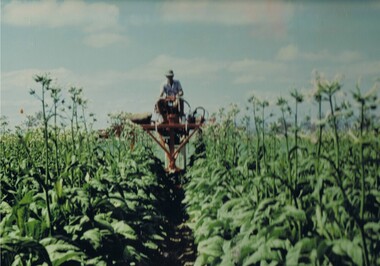
Photograph Topping Tobacco, Tobacco being topped (removal of flower), Circa mid to late 1900's
... In October 2006, by way of Government buy back of tobacco leases from growers, resulted in the end of Tobacco farming in Australia (after 136 years of planting the first crop). ...In October 2006, by way of Government buy back of tobacco leases from growers, resulted in the end of Tobacco farming in Australia (after 136 years of planting the first crop). ...This promotional photograph by the Tobacco Growers Association was in response to a 1935 meeting of tobacco growers from Victoria, South Australia and Queensland which produced four major resolutions for the industry covering the remainder of the 1900s. These four resolutions were: (1) Adequate tariff protection (2) Control of pests and diseases (3) Orderly marketing (4) The formation of an advisory council of growers. History has produced the following results. (1) adequate tariff protection was never achieved,(2) control of disease through benzol vapour (CSIRO) breakthrough, was later identified as carcinogenic, (3) orderly marketing was achieved through (4) the establishment of the Tobacco Growers Association(1984). In October 2006, by way of Government buy back of tobacco leases from growers, resulted in the end of Tobacco farming in Australia (after 136 years of planting the first crop). It was also significant that the major tobacco companies such as Philip Morris and The British American Tobacco Australasia advised the industry that it would source its tobacco requirements overseas by 2009.The remnants of the Tobacco Industry can still be viewed throughout the Kiewa Valley and adjacent regions on the former tobacco farms which still have the tobacco drying sheds and now converted into hay sheds. The problems from the large quantities of carcinogenic infused soil of farmlands in the region, still remains a problem now and for future generations. This particular photograph shows the lack of understanding by farmers and the contracted labour, at that time, and is demonstrated by the lack of protection of hands when handling seedlings and attached soil. Hand and foot protection was rarely used, even when later warnings were issued of the carcinogenic toxicity of the soil. The majority of farm owners, up until Health authorities stepped in the latter stages of 1900s, were skeptical of city scientists' "carcinogenic" health warnings and it was only after the younger generation of farmers, who had graduated from Agricultural colleges, encompassed the scientific approach to farm management. The "she'll be right mate" attitude of the farming/rural community has since the 1970s been slowly dissipating. Stricter controls of herbicides and pesticides used in agriculture are now in force. The death of the tobacco industry(2006) resulted in the expansion of the dairy , sheep, beef cattle, venison and lama wool producers in the Kiewa Valley and surrounding regions.Coloured photograph pasted onto a thick wood chip backing. Two galvanised eyelets at the top of the frame, 50mm from each end, with a twine cord stretch from each, for hanging purposes. See also KVHS 0054A ,KVHS 0054B and KVHC 0054D to KVHS 0054F A sign, which has been removed from the picture at some previous point in time is "The Tobacco crop being topped (flower removed)". tobacco, farming, rural industry, licences, ollie mould, blue mould, benzol vapour -
 Kiewa Valley Historical Society
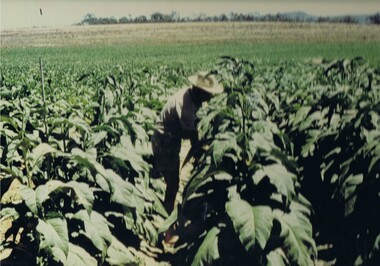
Photograph Tobacco plants, Tobacco fully grown prior to start picking, Circa mid to late 1900's
... In October 2006, by way of Government buy back of tobacco leases from growers, resulted in the end of Tobacco farming in Australia (after 136 years of planting the first crop). ...In October 2006, by way of Government buy back of tobacco leases from growers, resulted in the end of Tobacco farming in Australia (after 136 years of planting the first crop). ...This promotional photograph by the Tobacco Growers Association was in response to a 1935 meeting of tobacco growers from Victoria, South Australia and Queensland which produced four major resolutions for the industry covering the remainder of the 1900s. These four resolutions were: (1) Adequate tariff protection (2) Control of pests and diseases (3) Orderly marketing (4) The formation of an advisory council of growers. History has produced the following results. (1) adequate tariff protection was never achieved,(2) control of disease through benzol vapour (CSIRO) breakthrough, was later identified as carcinogenic, (3) orderly marketing was achieved through (4) the establishment of the Tobacco Growers Association(1984). In October 2006, by way of Government buy back of tobacco leases from growers, resulted in the end of Tobacco farming in Australia (after 136 years of planting the first crop). It was also significant that the major tobacco companies such as Philip Morris and The British American Tobacco Australasia advised the industry that it would source its tobacco requirements overseas by 2009.The remnants of the Tobacco Industry can still be viewed throughout the Kiewa Valley and adjacent regions on the former tobacco farms which still have the tobacco drying sheds and now converted into hay sheds. The problems from the large quantities of carcinogenic infused soil of farmlands in the region, still remains a problem now and for future generations. This particular photograph shows the lack of understanding by farmers, at that time, and is demonstrated by the lack of protection of hands and no masks over their noses, when handling plants. Hand, nose and foot protection was rarely used, even when later warnings were issued of the carcinogenic toxicity of the soil. The majority of farm owners, up until Health authorities stepped in the latter stages of 1900s, were skeptical of city scientists' "carcinogenic" health warnings and it was only after the younger generation of farmers, who had graduated from Agricultural colleges, encompassed the scientific approach to farm management. The "she'll be right mate" attitude of the farming/rural community has since the 1970s been slowly dissipating. Stricter controls of herbicides and pesticides used in agriculture are now in force. The death of the tobacco industry(2006) resulted in the expansion of the dairy , sheep, beef cattle, venison and lama wool producers in the Kiewa Valley and surrounding regions.Coloured photograph pasted onto a thick wood chip backing. Two galvanised eyelets at the top of the frame, 50mm from each end, with a twine cord stretch from each, for hanging purposes. See also KVHS 0054A to KVHS 0054C and 0054E to KVHS 0054FA sign, which has been removed from the picture at some previous point in time is "The Tobacco fully grown prior to start picking"tobacco, farming, rural industry, licences, ollie mould, blue mould, benzol vapour -
 Kiewa Valley Historical Society
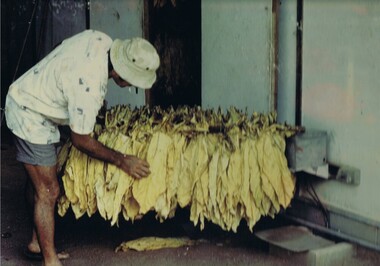
Photograph Tobacco drying leaves, Inspecting Drying tobacco leaves, 1950's to 1999
... In October 2006, by way of Government buy back of tobacco leases from growers, resulted in the end of Tobacco farming in Australia (after 136 years of planting the first crop). ...In October 2006, by way of Government buy back of tobacco leases from growers, resulted in the end of Tobacco farming in Australia (after 136 years of planting the first crop). ...This promotional photograph by the Tobacco Growers Association was in response to a 1935 meeting of tobacco growers from Victoria, South Australia and Queensland which produced four major resolutions for the industry covering the remainder of the 1900s. These four resolutions were: (1) Adequate tariff protection (2) Control of pests and diseases (3) Orderly marketing (4) The formation of an advisory council of growers. History has produced the following results. (1) adequate tariff protection was never achieved,(2) control of disease through benzol vapour (CSIRO) breakthrough, was later identified as carcinogenic, (3) orderly marketing was achieved through (4) the establishment of the Tobacco Growers Association(19840. In October 2006, by way of Government buy back of tobacco leases from growers, resulted in the end of Tobacco farming in Australia (after 136 years of planting the first crop). It was also significant that the major tobacco companies such as Philip Morris and The British American Tobacco Australasia advised the industry that it would source its tobacco requirements overseas by 2009.The remnants of the Tobacco Industry can still be viewed throughout the Kiewa Valley and adjacent regions on the former tobacco farms which still have the tobacco drying sheds and now converted into hay sheds. The problems from the large quantities of carcinogenic infused soil of farmlands in the region, still remains a problem now and for future generations. This particular photograph shows the lack of understanding by farmers and the contracted labour, at that time, and is demonstrated by the lack of protection of hands when handling the tobacco leaves and nose from tobacco dust. Hand and foot protection was rarely used, even when later warnings were issued of the carcinogenic toxicity of the soil. The majority of farm owners, up until Health authorities stepped in the later stages of 1900s, were skeptical of city scientists' "carcinogenic" health warnings and it was only after the younger generation of farmers, who had graduated from Agricultural colleges, encompassed the scientific approach to farm management. The "she'll be right mate" attitude of the farming/rural community has since the 1970s been slowly dissipating. Stricter controls of herbicides and pesticides used in agriculture are now in force. The death of the tobacco industry(2006) resulted in the expansion of the dairy , sheep, beef cattle, venison and lama wool producers in the Kiewa Valley and surrounding regions.Coloured photograph pasted onto a thick wood chip backing. Two galvanised eyelets at the top of the frame, 50mm from each end, with a twine cord stretch from each, for hanging purposes. See also KVHS 0054A to KVHS 0054D and KVHS 0054Ftobacco, farming, rural industry, licences, ollie mould, blue mould, benzol vapour, photograph -
 Kiewa Valley Historical Society
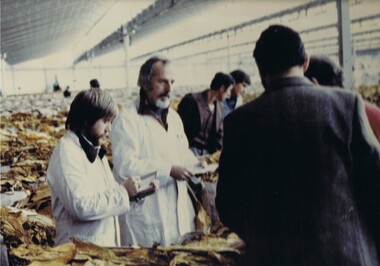
Photograph Tobacco selling, Tobacco sale floor, 1950 to 199
... In October 2006, by way of Government buy back of tobacco leases from growers, resulted in the end of Tobacco farming in Australia (after 136 years of planting the first crop). ...In October 2006, by way of Government buy back of tobacco leases from growers, resulted in the end of Tobacco farming in Australia (after 136 years of planting the first crop). ...This promotional photograph by the Tobacco Growers Association was in response to a 1935 meeting of tobacco growers from Victoria, South Australia and Queensland which produced four major resolutions for the industry covering the remainder of the 1900s. These four resolutions were: (1) Adequate tariff protection (2) Control of pests and diseases (3) Orderly marketing (4) The formation of an advisory council of growers. History has produced the following results. (1) adequate tariff protection was never achieved,(2) control of disease through benzol vapour (CSIRO) breakthrough, was later identified as carcinogenic, (3) orderly marketing was achieved through (4) the establishment of the Tobacco Growers Association(19840. In October 2006, by way of Government buy back of tobacco leases from growers, resulted in the end of Tobacco farming in Australia (after 136 years of planting the first crop). It was also significant that the major tobacco companies such as Philip Morris and The British American Tobacco Australasia advised the industry that it would source its tobacco requirements overseas by 2009.This particular photograph shows prospective buyers (from the major processing firms of Philip Morris and British American Tobacco Australasia) inspecting the dried tobacco leaves at the Melbourne sales, before 2009, when they moved to overseas growers.The remnants of the Tobacco Industry can still be viewed throughout the Kiewa Valley and adjacent regions on the former tobacco farms, which still have the former tobacco drying sheds but now converted into hay sheds. The death of the tobacco industry(2006) resulted in the expansion of the dairy , sheep, beef cattle, venison and lama wool producers in the Kiewa Valley and surrounding regions. The problems from the large quantities of carcinogenic infused soil of farmlands in the region, still remains a problem now and for future generations. The tighter restrictions of where the final product can be smoked and the higher tax levied (no tariff protection) was the main contributor to this one time lucrative industry's demise.Coloured photograph pasted onto a thick wood chip backing. Two galvanised eyelets at the top of the frame, 50mm from each end, with a twine cord stretch from each, for hanging purposes. See also KVHS 0054A to KVHS 0054EA sign, which has been removed from the picture at some previous point in time is "Tobacco sale floor"tobacco, farming, rural industry, licences, ollie mould, blue mould, benzol vapour, photograph -
 Arapiles Historical Society
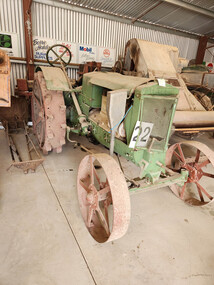
Vehicle - WALLIS Tractor
... Significance: This Wallis tractor is significant as an example of the machinery that helped usher in the mechanised farming era in Australia. It illustrates the technological advances that transformed agricultural production during the early twentieth century and contributed to the expansion of grain farming throughout western Victoria. ...Significance: This Wallis tractor is significant as an example of the machinery that helped usher in the mechanised farming era in Australia. It illustrates the technological advances that transformed agricultural production during the early twentieth century and contributed to the expansion of grain farming throughout western Victoria. ...FROM - Albert KLOWSS of Natimuk Lake This Wallis tractor represents one of the early generations of internal-combustion-powered agricultural machinery that transformed farming practices during the first decades of the twentieth century. Manufactured by the Wallis Tractor Company of Racine, Wisconsin, USA, these tractors gained a reputation for durability and reliability and were imported into Australia in significant numbers. Wallis tractors were widely used throughout grain-growing regions such as the Wimmera, where they gradually replaced horse teams for ploughing, cultivation, seeding and haulage work. Their introduction allowed farmers to cultivate larger areas, reduce labour requirements and improve efficiency during critical farming operations. The tractor belongs to a period when Australian agriculture was undergoing rapid mechanisation. Early tractors such as this often worked alongside horses for many years before fully replacing animal power on farms. Significance: This Wallis tractor is significant as an example of the machinery that helped usher in the mechanised farming era in Australia. It illustrates the technological advances that transformed agricultural production during the early twentieth century and contributed to the expansion of grain farming throughout western Victoria. The tractor demonstrates the transition from horse-drawn implements to engine-powered machinery and represents an important stage in the evolution of Australian farming practices. Machines such as this reduced the reliance on horse teams and enabled farmers to increase productivity on larger holdings. As a surviving example of an early imported tractor, it provides valuable insight into the development of agricultural technology and the changing nature of rural life in the Natimuk district and the wider Wimmera region. An early Wallis tractor mounted on four steel-spoked wheels, featuring a compact engine unit positioned between the front and rear axles. The tractor is finished in green paint, much of which has weathered and worn through years of agricultural use. The machine incorporates a large radiator assembly at the front, an exposed engine and transmission, operator's platform, steering wheel and steel wheel lugs designed to provide traction in cultivated soil. The tractor retains many of its original mechanical components, including the engine, transmission housing, steering system and drawbar arrangement. Its narrow profile and steel wheels are characteristic of tractors manufactured during the transition from horse-powered farming to mechanised agriculture in the early twentieth century.farm equipment, transport, klowss, wallis -
 National Wool Museum
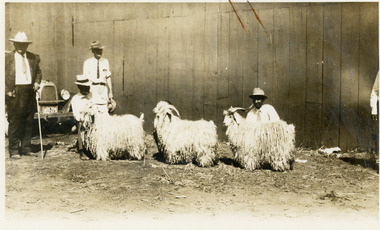
Photograph, Angora Bucks, 19/5/1960
... Pure bred Angoras were imported from Turkey in subsequent years up to 1873, to properties in New South Wales, Victoria, and later South Australia. Farming Angora goats became popular in the 1970s....Pure bred Angoras were imported from Turkey in subsequent years up to 1873, to properties in New South Wales, Victoria, and later South Australia. Farming Angora goats became popular in the 1970s. wool angora goat goat On rear top edge - Duaes(?) ...Angora goats are believed to have originated in the Himalaya Mountains of Asia. Angora goats were first imported into Australia in 1832 and 1833. They came from M Polonceau’s stud in France to the property of the Riley family of Raby N.S.W. Pure bred Angoras were imported from Turkey in subsequent years up to 1873, to properties in New South Wales, Victoria, and later South Australia. Farming Angora goats became popular in the 1970s.Sepia photo of three Angora Goat Bucks with four men wearing white shirts and and brim hats in a landscape format.On rear top edge - Duaes(?) Anorgra Bucks 19-560wool, angora goat, goat -
 National Wool Museum
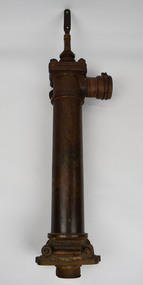
Tool - Water Pump, c.1960
... A windmill may be considered one of the most iconic sights of Australian Farming life. A pump like this rest at the heart of all such windmills, turning wind energy into water for farmers both here in Australia and worldwide alike. ...A windmill may be considered one of the most iconic sights of Australian Farming life. A pump like this rest at the heart of all such windmills, turning wind energy into water for farmers both here in Australia and worldwide alike. ...A windmill may be considered one of the most iconic sights of Australian Farming life. A pump like this rest at the heart of all such windmills, turning wind energy into water for farmers both here in Australia and worldwide alike. The water windmills access is referred to as an aquifer, an underground layer of water trapped in rocks but accessible with use of water wells and windmills. Australia is home to an underground aquifer known as the Great Artesian Basin. It is the largest and deepest aquifer in the world. Stretching over 1,700,000 square kilometres, the Basin underlies nearly a quarter of the continent including most of Queensland, the south- east corner of the Northern Territory, the north-east part of South Australia and the northern part of New South Wales. The basin is 3,000 metres deep in places and is estimated to contain 64,900 cubic kilometres of groundwater. To try and give this number context, a megalitre is a million litres. The Great Artesian Basin contains 65,000 million megalitres of water. This would be enough to cover all the land on the planet in almost half a metre of water.Lift style piston pump typical of an Australian farm connected to a multi-bladed windmill. Bronze cylindrical construction coming up from removable wood base. Rotating lever is above outlet pipe which would send water to the storage tank.windmill, australian farming, great artesian basin, aquifer -
 Flagstaff Hill Maritime Museum and Village
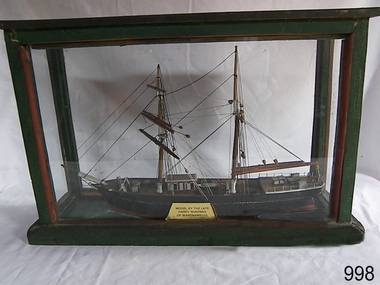
Craft - Ship Model, Mary Campbell, circa 1940
... farming in Peterborough. In about 1897, verging on retirement, Capt. Robiilliard superintended the Melbourne Sailors’ Home in Spencer Street, Melbourne, before being asked to leave this position in 1902 for trying to shut down the local hotel! At this time, the Melbourne Sailors’ Home was about to change its location. On 6th May 191,7, Captain James Arthur Robilliard J.P. died at Blackwood Park, in the Cobden district of Brucknell, which is now considered the first official Robilliard family homestead in Australia...farming in Peterborough. In about 1897, verging on retirement, Capt. Robiilliard superintended the Melbourne Sailors’ Home in Spencer Street, Melbourne, before being asked to leave this position in 1902 for trying to shut down the local hotel! At this time, the Melbourne Sailors’ Home was about to change its location. On 6th May 191,7, Captain James Arthur Robilliard J.P. died at Blackwood Park, in the Cobden district of Brucknell, which is now considered the first official Robilliard family homestead in Australia ...This ship model is of the sailing brigantine MARY CAMPBELL, which once belonged to Captain James Arthur Robilliard. The model was made by Harry McKenna, a well-known ship model maker and Warrnambool resident. CAPTAIN ROBILLIARD James Arthur Robilliard, sea captain and tent maker, was born in 19th April 1843 in St. Helier, Jersey, Channel Islands. He trained there in his father’s sail loft as a sailmaker. He later became a skipper. His first job was as a sailor in Liverpool, England. In 1875, James Robilliard migrated to Australia as a mate on the “E.M. Young”. Captain Robilliard and his family were amongst the early settlers along the Curdies River in the Heytesbury district. In 1877, he became a Captain. On 14th November 1879, Captain Robilliard married Helen Beckett. James and Helen had ten children: James Arthur (Jnr), Henry William, Nellie Jessie, Alfred Albert, Rubena Nellie, De Jersy Norman, Clifford Beckett, Olive Ida, Frances Ridley Havergal and Nellie Elvie, all born in Victoria. THE MARY CAMPBELL The ship “Mary Campbell” was built by Alexander Newton Jr. She was carvel-planked, of iron bark and blue gum timber. The family shipyard was at Pelican, on the Manning River, NSW, and “Mary Campbell” was first launched by her builder in 1869 as “The Son”. Three months later, she was renamed “Mary Campbell’ by her purchaser J. Campbell in Sydney. She was used to carry equipment for the Sydney Sugar Refinery’s Mill in Southgate, NSW. She then traded for the next 20 years between Australian ports and rivers along the east coast, as well as regular ports in New Zealand. She was “recognised as one of the best carrying little vessels in the timber trade” (Sydney Morning Herald). She had several owners over this time, the last one being Captain James A. Robilliard. On 29th April 1889, “Mary Campbell”, in the charge of her owner, Captain James A Robilliard, was on her way from Clarence River, NSW to Melbourne, Victoria with a cargo of railway girders for the Melbourne Harbour Trust. Captain Robilliard encountered a storm off Port Macquarie. He sailed the vessel south to 25 miles (about 40km) east of Cape Hawke, near Tuncurry and Forster. At 7 pm, he discovered that the cargo had shifted during the stormy seas and the heavy girders had damaged the hull, causing a leak. The pumps were inadequate to stem the fast-flowing leak, and over a meter of water filled the hull during the next 2 hours. Some of the crew began throwing the cargo overboard to lighten the vessel, hoping to keep it afloat until daylight. When the water reached over 2 meters in the hull, they realised their efforts were in vain. At 1:30 am on 30th April 1889, the crew left the vessel. They stood by in the lifeboat until 3 am. The ship was sinking fast, so they left for the shore, looking for a safe place to beach their boat. While still miles off Cape Hawke, all 7 crew members, including the Captain, were rescued by the Government Tug “Rhea” and taken to Port Macquarie hospital, then returned to Sydney in the “Wellington”. Captain Robilliard managed to rescue his ship’s compass, but no cargo was saved from the vessel. It had been under-insured, only covered for half its value, due to a lack of funds. Many years later, in 1976, an anchor was caught up in the net of a trawler south of Forster and thought to be from the “Mary Campbell”. It was donated and installed in the Great Lakes Museum, Tuncurry, NSW. (The same museum also has a half-model of the hull of “Mary Campbell”.) The name of the last ship Captain Robilliard sailed is currently unknown; however, he sailed that ship from the port of Marlborough, Queensland, carting steel railway girders for the Geelong-to-Camperdown line. On one trip, it hit a storm, the cargo shifted, and the ship was wrecked along the NSW coast. After this, Captain Robilliard exchanged sea life for farming in Peterborough. In about 1897, verging on retirement, Capt. Robiilliard superintended the Melbourne Sailors’ Home in Spencer Street, Melbourne, before being asked to leave this position in 1902 for trying to shut down the local hotel! At this time, the Melbourne Sailors’ Home was about to change its location. On 6th May 191,7, Captain James Arthur Robilliard J.P. died at Blackwood Park, in the Cobden district of Brucknell, which is now considered the first official Robilliard family homestead in Australia. He was buried in the Melbourne General Cemetery, Victoria. His wife, Helen, passed away in 1947. The Becket and Robilliard family names continue to be well known in the Western District. Flagstaff Hill Maritime Village also has a ship’s compass in the collection that was owned by Capt. J. Robilliard and used on the ship Mary Campbell.This ship model of the MARY CAMPBELL is of local significance for its association with well well-known Warrnambool resident and ship model maker. The model is also significant for its association with the brigantine MARY CAMPBELL, a trading vessel that brought railway girders to the Melbourne Harbour Trust.Ship model "Mary Campbell": a two-masted vessel with black hull, brown masts and black rigging, displayed in a glass case with a timber frame painted green. Made by Harry McKenna.Painted on the bow in white “MARY CAMPBELL” Gold label with black print attached to display case “MODEL BY THE LATE HARRY McKENNA OF WARRNAMBOOL”flagstaff hill, warrnambool, shipwrecked coast, flagstaff hill maritime museum, maritime museum, shipwreck coast, flagstaff hill maritime village, great ocean road, marine artwork, model making, captain james arthur robilliard, j.a. robilliard, vessel mary campbell, ship mary campbell, melbourne sailors home, vessels, harry mckenna, mary campbell -
 Federation University Historical Collection
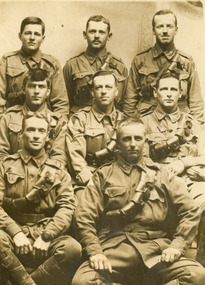
Photograph - World War One soldiers, Members of 18th Company Australian Army Service Corps, c1916
... farming interests. At the age of 18 he enlisted and served with AIF in Egypt, France and Belgium 1915-1918. Henry served at the famous battlegrounds of Ypes and Somme in the Australian Army 8th Battalion. ...farming interests. At the age of 18 he enlisted and served with AIF in Egypt, France and Belgium 1915-1918. Henry served at the famous battlegrounds of Ypes and Somme in the Australian Army 8th Battalion. ...HENRY SMERDON (Harry) HOLMES was born in 1897 at the family property, ’Sauchieburn’, 17 km north of Ballarat, in the Ascot district. He was the youngest of four children. After finishing his education at St Patrick’s College, Ballarat, Henry joined the Holmes family farming interests. At the age of 18 he enlisted and served with AIF in Egypt, France and Belgium 1915-1918. Henry served at the famous battlegrounds of Ypes and Somme in the Australian Army 8th Battalion. He was a Driver with the 4th D.A.C. The postcard is of "The Ascot" boys. Includes [Samuel] Gordon Spittle, Henry [Harry] Holmes's first cousin, and other Ascot lads and district connections: neighbours, Ascot State School classmates and football mates from Clunes / Creswick districts. [Research by a granddaughter of Henry Smerdon Holmes, Jane Dyer (nee Chatham) 2024] Ray Blight and Gordon Les Sim were former students of the Ballarat School of Mines. Les Sim was associated with Sim and Co. hardware and wood merchants). Eight soldiers of the AIF. They are the tent mates of Harry Holmes a Driver with the 5th D.A.C. The names of the soldiers are John Raymond (Ray) Blight, Joseph Fawcett, John Joseph (Jack) Nase, Gordon Spittle, Harry Holmes, Harold Joseph Reid, James Leslie (Les) Sim, Leslie John Walters. handwritten in pen on verso "This is a snap of our tent mates. Reading left to right. Back row, Jack Nase, Joe Fawcett, H. Reid. Middle - Les Walters, Ray Blight, Gordon Les Sim, (Sim and Co wood merchants) and Harryworld war 1, chatham, jack nase, chatham family archive, joe fawcett, h. reid, blight, sim, les walters, ray blight, gordon les sim, pickford, world war, gordon spittle, harry holmes, les sim, horace pickford, world war one, aif, armed services -
 Federation University Historical Collection
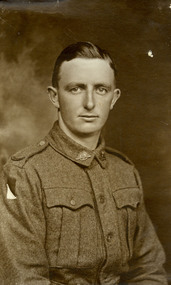
Photograph - Photograph - Sepia Postcard, Henry Smerdon Holmes, c 1915
... farming interests. At the age of 18 he enlisted and served with AIF in Egypt, France and Belgium 1915-1918. Henry served at the famous battlegrounds of Ypes and Somme in the Australian Army 8th Battalion https://www.awm.gov.au/collection/U51448 He was a Driver with the 4th D.A.C.https://www.awm.gov.au/collection/U51219 According to his Soldier's Pay Books (Cat. ...farming interests. At the age of 18 he enlisted and served with AIF in Egypt, France and Belgium 1915-1918. Henry served at the famous battlegrounds of Ypes and Somme in the Australian Army 8th Battalion https://www.awm.gov.au/collection/U51448 He was a Driver with the 4th D.A.C.https://www.awm.gov.au/collection/U51219 According to his Soldier's Pay Books (Cat. ...HENRY SMERDON (Harry) HOLMES was born in 1897 at the family property, ’Sauchieburn’, 17 km north of Ballarat, in the Ascot district. He was the youngest of four children. After finishing his education at St Patrick’s College, Ballarat, Henry joined the Holmes family farming interests. At the age of 18 he enlisted and served with AIF in Egypt, France and Belgium 1915-1918. Henry served at the famous battlegrounds of Ypes and Somme in the Australian Army 8th Battalion https://www.awm.gov.au/collection/U51448 He was a Driver with the 4th D.A.C.https://www.awm.gov.au/collection/U51219 According to his Soldier's Pay Books (Cat. No. 20112) Holmes Registration number was 7983. He was Catholic and enlisted in the Third Military District on 17 September 1915, and embarked on 8 November 1915. Holmes was in the 18th AASC Unit with the rank of Driver at that time. On 15 November 1918 Holmes was promoted to Lance Corporal. He received leave on: * 3 August 1917 - London (10 days) * 19 February 1918 - Paris (10 days) * 27 August 1918 - London (14 days) In 1922 Harry married Edith Pickford of 'Yeovil', Clunes, and they lived at 'Sauchieburn' with Henry's brother Willie. In 1933 Harry and Edith built a new timber home 'Launchley' (Ascot) on the rise east of 'Sauchieburn' on the Ballarat - Maryborough Road. The home was built by Con Zilles to the designs of Clegg and Morrow. In 1938 Harry and Edith purchased a property at Derrinallum, Victoria and called it 'Launchley Park' on their first son's return from World War 2. In 1953 Harry purchased William and Charlotte's portion of 'Sauchieburn' for his son, Bill, and daughter-in-law Margaret. [Source: Unpublished notes by Jane Dyer ( nee Chatham)]Sepia photographic postcard of a World War 1 Australian soldier in uniform, Henry Smerdon Holmes from Ascot Victoria.Verso in pen "The boys say this isn't to (sic) bad so it will show you any changes. Heaps of love to all. Harrychatham, chatham family collection, holmes, harry holmes, henry holmes, smerdon, world war, world war 1, world war i, uniform -
 Federation University Historical Collection
Postcard, Silk Embroidered World War One Postcard, c1917
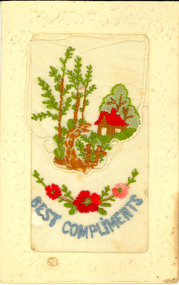
... Australian World War One Soldier memento. This postcard was possibly sent home from France during World War One, most probably from Harry Holmes of Ascot, Victoria. HENRY SMERDON (Harry) HOLMES was born in 1897 at the family property, ’Sauchieburn’, 17 km north of Ballarat, in the Ascot district. He was the youngest of four children. After finishing his education at St Patrick’s College, Ballarat, Henry joined the Holmes family farming...Australian World War One Soldier memento. This postcard was possibly sent home from France during World War One, most probably from Harry Holmes of Ascot, Victoria. HENRY SMERDON (Harry) HOLMES was born in 1897 at the family property, ’Sauchieburn’, 17 km north of Ballarat, in the Ascot district. He was the youngest of four children. After finishing his education at St Patrick’s College, Ballarat, Henry joined the Holmes family farming ...Australian World War One Soldier memento. This postcard was possibly sent home from France during World War One, most probably from Harry Holmes of Ascot, Victoria. HENRY SMERDON (Harry) HOLMES was born in 1897 at the family property, ’Sauchieburn’, 17 km north of Ballarat, in the Ascot district. He was the youngest of four children. After finishing his education at St Patrick’s College, Ballarat, Henry joined the Holmes family farming interests. At the age of 18 he enlisted and served with AIF in Egypt, France and Belgium 1915-1918. Henry served at the famous battlegrounds of Ypes and Somme in the Australian Army 8th Battalion. He was a Driver with the 4th D.A.C. The postcard is of "The Ascot" boys. Includes [Samuel] Gordon Spittle, Henry [Harry] Holmes's first cousin, and other Ascot and Tourello lads and district connections: neighbours (including a Wrigley boy), Ascot State School classmates and football mates from Clunes / Creswick districts. (Research by Jane Dyer) Postcard with embroidered detail on white silk, with top flap. The central embroidery depicts two small soldiers dressed in brown outside a gate leading to house in a peaceful setting surrounded by trees. Below is a blue embroidered "Best Compliments" and red embroidered garland of red flowers.chatham family collection, chatham, world, war, world war one, world war 1, world war i, france, harry holmes, holmes, embroidery, postcard -
 Federation University Historical Collection
Postcard, 'United We Stand' World War One Souvenir Postcard, c1916
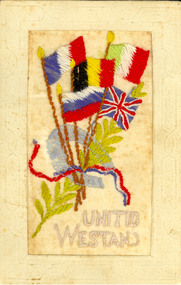
... farming interests. At the age of 18 he enlisted and served with AIF in Egypt, France and Belgium 1915-1918. Henry served at the famous battlegrounds of Ypes and Somme in the Australian Army 8th Battalion. ...farming interests. At the age of 18 he enlisted and served with AIF in Egypt, France and Belgium 1915-1918. Henry served at the famous battlegrounds of Ypes and Somme in the Australian Army 8th Battalion. ...Postcard sent from the French theatre of war during World War One by Harry Holmes. HENRY SMERDON (Harry) HOLMES was born in 1897 at the family property, ’Sauchieburn’, 17 km north of Ballarat, in the Ascot district. He was the youngest of four children. After finishing his education at St Patrick’s College, Ballarat, Henry joined the Holmes family farming interests. At the age of 18 he enlisted and served with AIF in Egypt, France and Belgium 1915-1918. Henry served at the famous battlegrounds of Ypes and Somme in the Australian Army 8th Battalion. He was a Driver with the 4th D.A.C. The postcard is of "The Ascot" boys. Includes [Samuel] Gordon Spittle, Henry [Harry] Holmes's first cousin, and other Ascot lads and district connections: neighbours, Ascot State School classmates and football mates from Clunes / Creswick districts. (Research by Henry's grand-daughter, Jane Dyer nee Chatham) White postcard with embroidery on white silk. The embroidery includes 5 flags (England, France, Italy, Belgium, Russia), a blue horseshoe, a green sprig rosemary and the words 'United We Stand".Verso: With best love from Harry 13/5/16chatham, chatham family collection, holmes, harry holmes, henry holmes, world war, world war 1, world war i, world war one. -
 Federation University Historical Collection
Postcard, World War One Souvenir Christmas Postcard, c1916
... Australian Imperial Forces (AIF) in France. HENRY SMERDON (Harry) HOLMES was born in 1897 at the family property, ’Sauchieburn’, 17 km north of Ballarat, in the Ascot district. He was the youngest of four children. After finishing his education at St Patrick’s College, Ballarat, Henry joined the Holmes family farming...Australian Imperial Forces (AIF) in France. HENRY SMERDON (Harry) HOLMES was born in 1897 at the family property, ’Sauchieburn’, 17 km north of Ballarat, in the Ascot district. He was the youngest of four children. After finishing his education at St Patrick’s College, Ballarat, Henry joined the Holmes family farming ...Soldier Harry Holmes of Ascot, Victoria sent this postcard to his family while serving in the Australian Imperial Forces (AIF) in France. HENRY SMERDON (Harry) HOLMES was born in 1897 at the family property, ’Sauchieburn’, 17 km north of Ballarat, in the Ascot district. He was the youngest of four children. After finishing his education at St Patrick’s College, Ballarat, Henry joined the Holmes family farming interests. At the age of 18 he enlisted and served with AIF in Egypt, France and Belgium 1915-1918. Henry served at the famous battlegrounds of Ypes and Somme in the Australian Army 8th Battalion. He was a Driver with the 4th D.A.C. The postcard is of "The Ascot" boys. Includes [Samuel] Gordon Spittle, Henry [Harry] Holmes's first cousin, and other Ascot lads and district connections: neighbours, Ascot State School classmates and football mates from Clunes / Creswick districts. (Research by Jane Dyer) White Postcard with embroidery on white silk. The embroidery features green ivy leaves and red berries, and the words "Happy Christmas".Verso "All good wishes to all the dear ones at home for a happy Xmas and a bright New Year from Harry 11/11/16."chatham - holmes family archive, chatham, holmes, harry holmes, world war, world war 1, world war one, world war i, france, christmas -
 Federation University Historical Collection
Postcard, Eight Men Outside a Tent, c1917
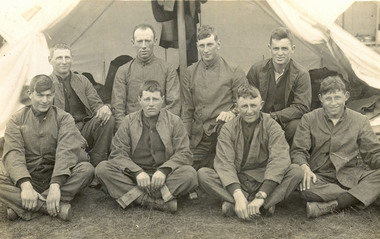
... farming interests. At the age of 18 he enlisted and served with AIF in Egypt, France and Belgium 1915-1918. Henry served at the famous battlegrounds of Ypes and Somme in the Australian Army 8th Battalion. ...farming interests. At the age of 18 he enlisted and served with AIF in Egypt, France and Belgium 1915-1918. Henry served at the famous battlegrounds of Ypes and Somme in the Australian Army 8th Battalion. ...HENRY SMERDON (Harry) HOLMES was born in 1897 at the family property, ’Sauchieburn’, 17 km north of Ballarat, in the Ascot district. He was the youngest of four children. After finishing his education at St Patrick’s College, Ballarat, Henry joined the Holmes family farming interests. At the age of 18 he enlisted and served with AIF in Egypt, France and Belgium 1915-1918. Henry served at the famous battlegrounds of Ypes and Somme in the Australian Army 8th Battalion. He was a Driver with the 4th D.A.C. [Jane Dyer May 2024] Black and white photograph showing eight men outside a tent. They are most probably World War One soldiers in the Australian Imperial Forces (AIF). The postcard is of "The Ascot" boys. Includes [Samuel] Gordon Spittle, Henry [Harry] Holmes's first cousin, and other Ascot lads and district connections: neighbours including a Wrigley son, Ascot State School classmates and football mates from Clunes / Creswick districts. The man in the front row, second from the right is probably my great-grandfather Henry [Harry] Holmes. The man far left in the back row is probably his cousin, Samuel Gordon Spittle [Jane Dyer 2024]harry holmes, world war one, tent, aif, soldiers, uniform, henry smerdon holmes, sauchieburn, ascot, postcard -
 Flagstaff Hill Maritime Museum and Village
Container - Box for seeds, ca. 1880s
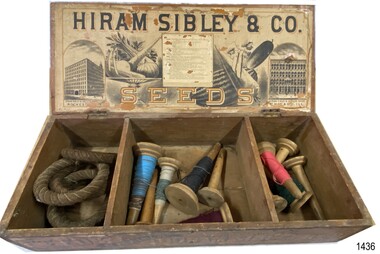
... Australia. The text and images of the box are an example of 1880s advertising Flagstaff Hill Warrnambool Maritime Village Maritime Museum Flagstaff Hill Maritime Museum & Village hiram sibley & co rochester n.y. seeds wooden seed box seed box seedsmen arable farming chicargo illinois seed house seed engineering seed distribution seeds by weight and measure Marked "HIRAM SIBLEY & CO / SEEDS", "WAREHOUSE - "ROCHESTER N.Y. ", "SEED HOUSE - CHICARGO, ILL.", "SEEDS BY WEIGHT & MEASURE", "PUT UP BY / HIRAM SIBLEY & CO. / ROCHESTER, N.Y. ...This seed box was made for Hiram Sibley for his seed house business. He sold seeds priced by the weight or the space they took up e.g. bushel. This box allowed for seeds to be divided by type, size or even date. The box was strong and easy to cart and store. It was also a handy item to 'recycle' as a storage container for other items. The Sibley seed box is a desirable collectors' item. A large variety of sizes and shapes are still available today in various stages of condition. Hiram Sibley developed seeds that were strong and the plants that grew from these seeds produced many seeds. Varieties of Sibley seeds and plants are still advertised for sale in modern times. HIRAM SIBLEY (1807-1888) - Hiram Sibley was born in America. He had a natural mechanical ability and became skilled in many trades. He and his partner Don Watson opened a sawmill then a machine shop and foundry. He became involved with Alfred Vale and Samuel Morse and their work on the telegraph. Eventually he became the first president of the Western Union Telegraph Company. Later, after leaving Western Union in the early 1860s, Sibley bought and sold railroads, manufactured sold, ran timber mills, and became involved in farming and seed supply. In this area he used his skills to engineer seeds that were stronger and develop plants that produced more seeds. The production of seeds became his main business. He bought land cheaply and improved to soil so that he could produce seed and grain, and graze herds of cattle. He became the owner of 14 large farms. Hiram Sibley earned the reputation "as the most extensive farmer and seedsman in this country". The business of Hiram Sibley & Co. was conducted his warehouse in Rochester and his seed house in Chicago. One department of the business sold farming equipment, another department imported ornamental plants from overseas countries Sibley went on to invest a large amount of money in a bank, and to be financially involved in the community by making large donations to public services such as a library and a school of music. At one point he was the richest man in Monroe county.This box is significant for its historic connection with Hiram Sibley, who is famous for many reasons, among which is his very profitable business of seed engineering to improve the production of crops. This box also represents the value of containers used for selling products in the 1880s, being re-used for other useful purposes. The box is an example of goods imported for use in Australia. The text and images of the box are an example of 1880s advertisingBox, wooden, with two brass hinges joining lid to base. Base has two wooden partitions, divided into three unequal sized compartments. Lid's underside has label with drawings of buildings and produce, text with maker's name and description of vegetables. Front edge of box has stencilled text and diagrams. Outside lid, and the other three sides, have no inscriptions. Made by Hiram Sibley & Co., USA. (Box is currently used to store quoits 1436.2 and cones of cotton thread 1436.3.)Marked "HIRAM SIBLEY & CO / SEEDS", "WAREHOUSE - "ROCHESTER N.Y. ", "SEED HOUSE - CHICARGO, ILL.", "SEEDS BY WEIGHT & MEASURE", "PUT UP BY / HIRAM SIBLEY & CO. / ROCHESTER, N.Y. AND CHICARGO, ILL."flagstaff hill, warrnambool, maritime village, maritime museum, flagstaff hill maritime museum & village, hiram sibley & co, rochester n.y., seeds, wooden seed box, seed box, seedsmen, arable farming, chicargo illinois, seed house, seed engineering, seed distribution, seeds by weight and measure
