
Showing 63 items matching "federation of australian states"
-
 Flagstaff Hill Maritime Museum and Village
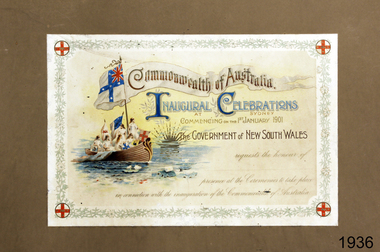
Document - Invitation, Government of New South Wales, Commonwealth of Australia Inaugural Celebrations, Bef. 01-01-1901
... ...Federation of Australia...Australian States...Federation of Australia's united Colonies. It was created on behalf of the Government of New South Wales. January 1st, 1901, is the official date of Australia's Federation. There is no recipient's name on the invitation. The illustrations on the invitation represent the Federation of Australian States...Federation of Australia's united Colonies. It was created on behalf of the Government of New South Wales. January 1st, 1901, is the official date of Australia's Federation. There is no recipient's name on the invitation. The illustrations on the invitation represent the Federation of Australian States ...This is an Invitation to attend the Inaugural Celebrations of the Commonwealth of Australia, to celebrate the Federation of Australia's united Colonies. It was created on behalf of the Government of New South Wales. January 1st, 1901, is the official date of Australia's Federation. There is no recipient's name on the invitation. The illustrations on the invitation represent the Federation of Australian States, with their historic symbols carried on the sailing ship, representing the colonisation of Australia. The 'rising sun' possibly represents the rising of the young Australia. The Sough Australian symbol appears to be the historic seal of South Australia, depicting Britania meeting an Australian Aboriginal seated on the beach. The symbol was replaced in 1904. The Victorian symbol of a crown above the Southern Cross appears on the flag at the back of the ship, with a crown and the Southern Cross beside each other. The invitation was originally framed by G.U. Petterd, a picture framer and plush worker in Warrnambool, Victoria.The invitation holds great significance, representing a point in Australia's history when the British Colony became an independent nation, with the states uniting under a Federal government. The symbols on the invitation represent those used by each state at the time, many of which have evolved and changed since that time. The decorative and careful creation of the certificate represents the importance placed on the celebrations.Invitation; rectangular page printed in colour with text and illustrations, and attached to cardboard. The document has a floral border with a symbol in each corner. The illustration includes a wooden sailing ship with six figures with long fair hair wearing white robes, and holding six flags or symbols. The mast holds a swallow-tailed banner showing a flag and text. The invitation is from the Government of New South Wales, for the recipient to attend the inaugural celebrations in Sydney on 1st January 1901, for the official date of the Federation of Australia. There is a purple oval stamp on the revers with inscriptions. The picture was originally framed by G.U. Petterd, WarrnamboolSTAMP: "G.U. PETTERD, WARRNAMBOOL / PICTURE FRAMER & PLUSH / WORKER" TEST: - "Commonwealth of Australia. / INAUGURAL CELEBRATIONS / AT SYDNEY / COMMENCING on the 1st JANUARY 1901" "The GOVERNMENT of NEW SOUTH WALES / requests the honour of / (blank line) / presence at the Celebrations to take place / in connection with the inauguration of the Commonwealth of Australia" Symbols: - [white flag, blue cross, Union Jack] (Australian Federation Flag) [blue Maltese cross with crown in centre] (Queensland symbol) [red St George cross with a lion in the centre] (New South Wales symbol) [white with a symbol on one side (crown?) with a blue flag with Southern Cross on the other] (Victoria's symbols of Crown above Southern Cross) [red lion on white] (Tasmanian symbol) [black swan on yellow] (Western Australia badge) [two figures, one standing and one seated] (South Australian seal) and image of (rising sun on the horizon)flagstaff hill, flagstaff hill maritime museum and village, warrnambool, maritime museum, maritime village, great ocean road, shipwreck coast, invitation, commonwealth of australia, inaugural celebrations, sydney, 1st january 1901, 01-01-1901, federation of australia, australian states, government of new south wales, symbols, flags, australian colony, certificate, g.u. petturd, picture framer and plush worker, picture framer, plush worker, 1901 -
 Warrnambool and District Historical Society Inc.
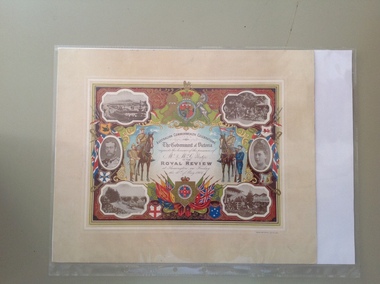
Certificate - Royal Review 1901 G Rolfe, 1901
... Federation of Australian States...This certificate was sent to those who had been present at one of the celebrations in connection with the Federation of the six States of Australia in 1901 – The Royal Review at Flemington Racecourse on 10th May 1901. ...The certificate was issued to a prominent Warrnambool person, George Rolfe and his wife. Federation of Australian States George Rolfe of Lyndoch History of Warrnambool george rolfe ‘Australian Commonwealth Celebrations’ ‘The Government of Victoria requests the honour of the presence of Mr & Mrs G. ...This certificate was sent to those who had been present at one of the celebrations in connection with the Federation of the six States of Australia in 1901 – The Royal Review at Flemington Racecourse on 10th May 1901. The invitation to attend the event was issued by the Government of Victoria. The certificate was intended to be kept as a souvenir of the event and framed. This particular certificate was issued to George Rolfe and his wife of Warrnambool. George Rolfe (1836-1919), a tea merchant from Melbourne, began buying blocks of land near the mouth of the Hopkins River in Warrnambool in the 1870s. By the early 1880s he had acquired 50 acres of land in the town and several farming properties. He used the buildings on the land near the mouth of the Hopkins River as holiday accommodation and called the property, Lyndoch. He improved the property by adding stables, chaff and bone sheds, jetty, boathouse, reservoir, water well and windmill and extensive gardens and he spent most of his later life in the Warrnambool area. Lyndoch today is the site of an aged care facility. This certificate is of considerable importance for two reasons: 1. It is an important memento of a signal event on Australia’s history – the Federation of the six States in 1901 and the subsequent celebrations. 2. The certificate was issued to a prominent Warrnambool person, George Rolfe and his wife.This is multi-coloured sheet of paper mounted on card. There are four black and white photographs of the Royal Review at Flemington and photographs of the Duke and Duchess of Cornwall and York. The images include the Royal Crest, the shields of the six Australian States, a shield of Victoria with a background of flags, cannon and ammunition, two mounted soldiers with a soldier and sailor standing nearby and swords and bayonets. There is also much colour decoration around the edges of the certificate. The names of Mr and Mrs Rolfe are handwritten in black ink. ‘Australian Commonwealth Celebrations’ ‘The Government of Victoria requests the honour of the presence of Mr & Mrs G. Rolfe at the Royal Review at Flemington on Friday the 10th of May 1901’ federation of australian states, george rolfe of lyndoch, history of warrnambool, george rolfe -
 Old Colonists' Association of Ballarat Inc.
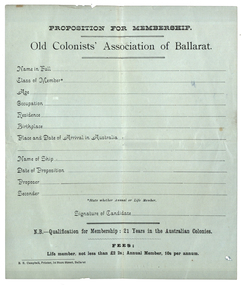
Document, E.E. Campbell, Proposition for Membership to the Old Colonists' Association of Ballarat, c1990
... This suggests the form was printed before the federation of Australian States in 1901....This suggests the form was printed before the federation of Australian States in 1901. Old COlonists' Associaiton of Ballarat Ballarat Old Colonists' Club membership form Printed form for potential Members of the Old Colonists' Association of Ballarat to fill out. ...To qualify for membership of the Old Colonists' Association of Ballarat the potential member had to be 21 years in the Australian Colonies. This suggests the form was printed before the federation of Australian States in 1901.Printed form for potential Members of the Old Colonists' Association of Ballarat to fill out. The annual life membership fee was two pounds to shillings, and the annual member fee was 10 shillings per annum. Potential members were asked for the Name, Age, occupation, residence, birthplace, place and the of arrival in Australia, name of ship, date of propositions, proposer and seconder. old colonists' associaiton of ballarat, ballarat old colonists' club, membership form -
 Federation University Historical Collection
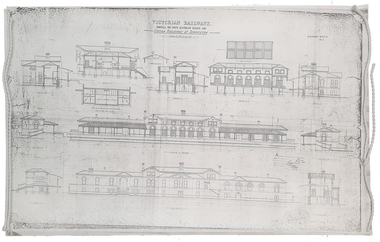
Plan, Copy of a Plan of Serviceton Railway Station Building, 1888
... The Railway Station included customs offices which were no longer necessary after the Federation of Australian States in 1901. ( https://en.wikipedia.org/wiki/Serviceton,_Victoria, accessed 30 August 2021)...The Railway Station included customs offices which were no longer necessary after the Federation of Australian States in 1901. ( https://en.wikipedia.org/wiki/Serviceton,_Victoria, accessed 30 August 2021) railway servicetone railway station plan serviceton Copy of plan for the Serviceton Railway Line Copy of a Plan of Serviceton Railway Station Building Plan ...The Serviceton Railway Station was completed in 1889 , with the Colony of Victoria and the Colony of South Australia sharing the cost. Ut was at Serviceton the the Victorian rail line and the Adelaide-Wolseley railway line of South Australia joined. The Railway Station included customs offices which were no longer necessary after the Federation of Australian States in 1901. ( https://en.wikipedia.org/wiki/Serviceton,_Victoria, accessed 30 August 2021)Copy of plan for the Serviceton Railway Linerailway, servicetone railway station, plan, serviceton -
 Bendigo Historical Society Inc.
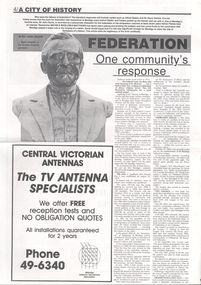
Document - Newspaper article re Sir John Quick, Michele Matthews Collection, 1992
... The article explores the role of Sir John Quick in persuading Bendigo to support federation of the Australian States. Published on September 23rd, 1992. ...federation of Australia. The Committee aimed to raise awareness of the contribution of Sir John Quick and to ensure that he was recognized for the part he played. Sir John Quick Federation Copy of a newspaper article published in the Bendigo Advertiser Supplement "Bendigo: Birthplace of a Nation". Two-page article written by Michele Matthews - "FEDERATION. One community's response". The article explores the role of Sir John Quick in persuading Bendigo to support federation of the Australian States ...The Sir John Quick Committee was formed in 1991 to commemorate the achievements of Sir John Quick who played a prominent role in the federation of Australia. The Committee aimed to raise awareness of the contribution of Sir John Quick and to ensure that he was recognized for the part he played.Copy of a newspaper article published in the Bendigo Advertiser Supplement "Bendigo: Birthplace of a Nation". Two-page article written by Michele Matthews - "FEDERATION. One community's response". The article explores the role of Sir John Quick in persuading Bendigo to support federation of the Australian States. Published on September 23rd, 1992. sir john quick, federation -
 Creswick Museum
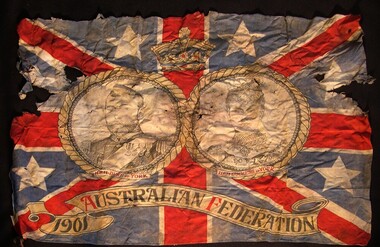
Flag, Early 20th Century
... Federation of six states of Australia ...States of the Federation. Portraits of their H.R.H George, Duke of Cornwall and York and his wife Mary, Duchess of Cornwall and York. A crown above their portraits and a scroll with the words Australian Federation 1901. ...Federation of six states of Australia Rare Souvenir Flag from Federation of Australia 1901 Royal Tour 1901 Federation Silk printed flag. ...Federation of six states of Australia Rare Souvenir Flag from Federation of Australia 1901Silk printed flag. Union Jack as background with 6 stars representing the 6 States of the Federation. Portraits of their H.R.H George, Duke of Cornwall and York and his wife Mary, Duchess of Cornwall and York. A crown above their portraits and a scroll with the words Australian Federation 1901. After conservation the flag has been mounted on a pad and stored in box made to fit the flag.royal tour 1901, federation, -
 Warrnambool and District Historical Society Inc.
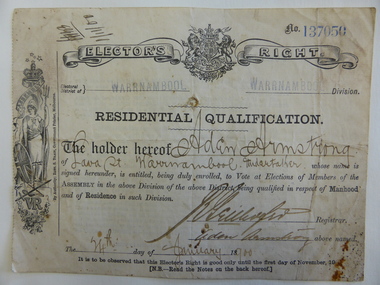
Original Document, Residential Qualification: Aden Armstrong, Circa 1900
... The timeframe of this document is on the cusp of major electoral change in Australia with the Federation of Australian states happening in 1901 and the granting of the vote for Australian women in the various states over the next decade....The timeframe of this document is on the cusp of major electoral change in Australia with the Federation of Australian states happening in 1901 and the granting of the vote for Australian women in the various states over the next decade. ...This is an original Elector’s right certificate of 1900 for the Warrnambool Electoral District. This entitled the owner to vote at elections held for the Legislative Assembly in the Government of Victoria. The voter had to be male and resident in the electorate( in this case Warrnambool).This certificate was issued to Aden Armstrong an undertaker with a business in Timor Street opposite the Old National Bank which was at the corner of Kepler and Timor Streets. The Registrar who signed the certificate was Richard Geilhofer. The certificate was one of the items in the Henri Worland collection of historical society in 1973 by the Warrnambool City Council via Keith Arnel the Town Clerk. The timeframe of this document is on the cusp of major electoral change in Australia with the Federation of Australian states happening in 1901 and the granting of the vote for Australian women in the various states over the next decade.This item would have been a common item at the time as all those entitled to vote had to present same. It has local significance with Aden Armstrong being in business in Warrnambool for a number of years.Cream coloured paper with black text. Victorian coat of Arms at centre top of document. Drawing of lady holding shield on left side Handwritten information is written in faded black ink. Blue stamped number 137050 on top right corner. Back is printed with notes for the elector.Signature and date 1/11/00 at top left. Warrnambool is stamped in dark blue twice at top. Aden Armstrong of Lava St Warrnambool, Undertaker is written on the form with his signature at bottom right. Also signed by the registrar of the day, Richard Geilhofer. Date is also included 24th January 1900 elector's right certificate, aden armstrong, warrnambool, warrnambool undertakers -
 Warrnambool and District Historical Society Inc.
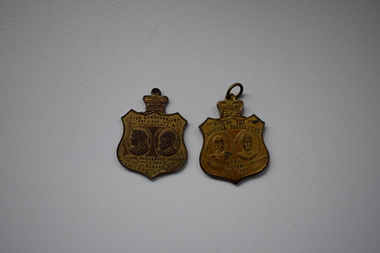
Medals, Opening of First Australian Parliament 1901, 1901
... These medals were issued to commemorate the opening of the first Parliament in Australia in Melbourne in May 1901. The Federation of the Australian States and Territories took place in January 1901. ...These medals were issued to commemorate the opening of the first Parliament in Australia in Melbourne in May 1901. The Federation of the Australian States and Territories took place in January 1901. ...These medals were issued to commemorate the opening of the first Parliament in Australia in Melbourne in May 1901. The Federation of the Australian States and Territories took place in January 1901. The Federal Parliament met in Melbourne until Canberra was established and a new Parliament House was opened in 1927. The fist Parliament in Australia was opened by the Duke and Duchess of Cornwall and York. These medals have no known local provenance and are retained for display purposes..1 This is a shield-shaped metal medal with a crown on the top. Obverse: Images of the Duke and Duchess of Cornwall and York and printing. Reverse: Images of Queen Victoria and Edward V11 and printing. .2 as above Opening of the First Federal Parliament T.R.H The Duke & Duchess of Cornwall and York Melbourne, May 1901 Aust. Commonwealth Est. 1 Jan. 1901 First Parliament opened May 1901 63rd of Victoria R.I. 1st of Edward V11 W.A. Tas. N.S.W. Vic. S.A. Qld. -
 Federation University Art Collection
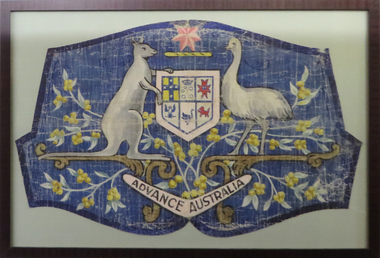
Painting - Acrylic on Canvas, Advance Australia
... Wattle Day originated in October 1889 by the Wattle Blossom League, and was associated with the Australian Natives Association during the lead up to the Federation of Australian States. The first 'national' Wattle Day was celebrated on 1 September 1910. ...Wattle Day originated in October 1889 by the Wattle Blossom League, and was associated with the Australian Natives Association during the lead up to the Federation of Australian States. The first 'national' Wattle Day was celebrated on 1 September 1910. ...This artwork was found among items associated with the Ballarat School of Mines. Although its purpose remains unknown, it was possibly painted by a staff member or student for use on Wattle Day. Wattle Day originated in October 1889 by the Wattle Blossom League, and was associated with the Australian Natives Association during the lead up to the Federation of Australian States. The first 'national' Wattle Day was celebrated on 1 September 1910. Early Wattle Days involved planting wattle trees in school grounds, street decorations of wattle blossom, and wearing sprigs of wattle. As public support for Wattle Day peaked, World War I broke out. Wattle took on a new significance during the war years, symbolising home for military personnel serving overseas. Beautifully designed Wattle Day badges, as well as wattle sprigs, were sold as a means of raising money for organisations such as the Red Cross. This item is part of the Federation University Art Collection. The Art Collection features over 1000 works and was listed as a 'Ballarat Treasure' in 2007.The Australian coat of arms with wattle, painted onto canvas.art, artwork, emu, kangaroo, crest, advance australia, wattle day, wattle, coat of arms, patriotic, australian coar of arms, national symbol -
 Stawell Historical Society Inc
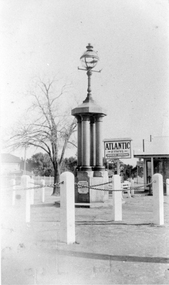
Photograph, Commonwealth Federation Memorial on the corner of Lower Main and Barnes Street Stawell unveiled 1903
... The memorial commemorates the Federation of the Australian States into the Commonwealth of Australia on the 1st January 1901. ...The memorial commemorates the Federation of the Australian States into the Commonwealth of Australia on the 1st January 1901. ...Commonwealth Federation Memorial unveiled 1903 corner of Lower Main St and Barnes Street Stawell. The memorial commemorates the Federation of the Australian States into the Commonwealth of Australia on the 1st January 1901. The memorial cost 100 pounds and has a foundation supporting 4 columns of Scottish rose granite. The base & caps of these columns are of black marble. Around the tops of the columns are the names of the six States. George Robson and George Gray, Stawell's monumental masons who carried out the work were also thought to be responsible for the design. Black & White photograph of a glass light memorial, supported on four columns. A fence of white posts and chains surround the memorial.Sign post in background "Atlantic Ethyl Service Station."stawell -
 Orbost & District Historical Society
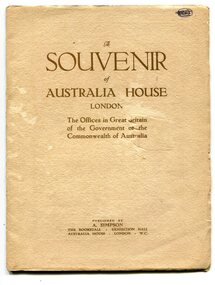
souvenir book, Souvenir of Australia House, 1920's
... Australian diplomatic mission and it is the longest continuously occupied foreign mission in London. King George V laid the building’s first foundation stone in 1913 but it was not until August 1918 that he officially opened the completed building. The stringencies of World War I – principally shipping difficulties and labour shortages – had delayed construction considerably. Federation of the six Australian states...Australian diplomatic mission and it is the longest continuously occupied foreign mission in London. King George V laid the building’s first foundation stone in 1913 but it was not until August 1918 that he officially opened the completed building. The stringencies of World War I – principally shipping difficulties and labour shortages – had delayed construction considerably. Federation of the six Australian states ...Australia House is the oldest Australian diplomatic mission and it is the longest continuously occupied foreign mission in London. King George V laid the building’s first foundation stone in 1913 but it was not until August 1918 that he officially opened the completed building. The stringencies of World War I – principally shipping difficulties and labour shortages – had delayed construction considerably. Federation of the six Australian states formally took place on 1 January 1901 but it was not until 1906 that the Federal Government sent an Official Secretary to London to represent Australia. In the intervening years Australia was represented by State Agents-General, the first of whom was the Agent-General of Victoria. The building is significant for its unique design, Beaux Arts style and the materials used in its construction. In the early 1900s black marble was being mined in the Bruthen district. Some was used for the Shrine of Remembrance in Melbourne and Australia House in London. 900 tonnes were shipped to London to be included in the construction of Australia House. This item is a useful research tool.A paper covered booklet which is a pictorial souvenir Of Australia House in London. Pictures show Buchan marble features of the building.buchan-marble australia-house -
 Orbost & District Historical Society
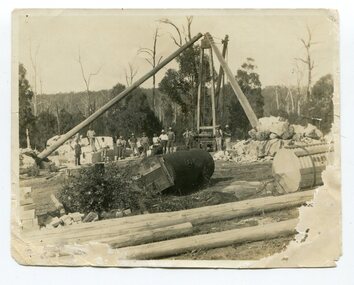
black and white photograph, first half 20th century
... Australian diplomatic mission and it is the longest continuously occupied foreign mission in London. King George V laid the building’s first foundation stone in 1913 but it was not until August 1918 that he officially opened the completed building. The stringencies of World War I – principally shipping difficulties and labour shortages – had delayed construction considerably. Federation of the six Australian states...Australian diplomatic mission and it is the longest continuously occupied foreign mission in London. King George V laid the building’s first foundation stone in 1913 but it was not until August 1918 that he officially opened the completed building. The stringencies of World War I – principally shipping difficulties and labour shortages – had delayed construction considerably. Federation of the six Australian states ...This photograph shows men working on cutting marble at South Buchan for Australia House in London. In the early 1900s black marble was being mined in the Bruthen district. Some was used for the Shrine of Remembrance in Melbourne and Australia House in London. 900 tonnes were shipped to London to be included in the construction of Australia House. DESCRIPTIONA paper covered booklet which is a pictorial souvenir Of Australia House in London. Pictures show Buchan marble features of the building.SIZE H-266mm W-192mm OBJECT REGISTRATION654KEYWORDSbuchan-marble australia-houseHISTORICAL INFORMATIONAustralia House is the oldest Australian diplomatic mission and it is the longest continuously occupied foreign mission in London. King George V laid the building’s first foundation stone in 1913 but it was not until August 1918 that he officially opened the completed building. The stringencies of World War I – principally shipping difficulties and labour shortages – had delayed construction considerably. Federation of the six Australian states formally took place on 1 January 1901 but it was not until 1906 that the Federal Government sent an Official Secretary to London to represent Australia. In the intervening years Australia was represented by State Agents-General, the first of whom was the Agent-General of Victoria. The building is significant for its unique design, Beaux Arts style and the materials used in its construction.Marble quarrying has been a significant part of the history of Buchan in East Gippsland. Its inclusion in Australia House in London and the shrine of Remembrance in Melbourne is noteworthy.A small black / white photograph of men in the background of a marble quarry. There is also a copy.on back - " Cutting Australian Home Marble at Sth Buchan"buchan-marble geology australia-house -
 Flagstaff Hill Maritime Museum and Village
Tool - Mortice Machine, Mathieson and Son, 1910-1940
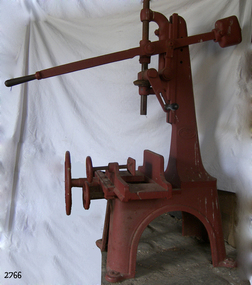
... McPherson's started as an Australian retailer of hardware products in Melbourne going on to become a company that supplied machinery and other items for the establishment of major infrastructure projects in Australia during the early days of the colony that assisted in linking the various states and territories which became a precursor of Federation. ...In 1792 John Manners had set up a workshop making woodworking planes at 14 Saracens Lane Glasgow. He also had employed an apprentice Alexander Mathieson (1773-1851). But in the following year at Saracen's Lane, the 1841 census describes Alexander Mathieson as a master plane-maker now at 38 Saracen Lane with his son Thomas Adam working with him as a journeyman plane-maker. Presumably, Alexander must have taken over the premises and business of John Manners. Now that the business had Thomas Adam Mathieson working with his father it gradually grew and became more diversified, and it is recorded at the time by the Post-Office Glasgow Annual Directory that by 1847-1848 Alexander Mathieson was a “plane, brace, bit, auger & edge tool maker” In 1849 the firm of James & William Stewart at 65 Nicolson Street, Edinburgh was taken over and Thomas was put in charge of the business, trading under the name Thomas A. Mathieson & Co. as plane and edge-tool makers. Thomas's company went on to acquire the Edinburgh edge-tool makers “Charles & Hugh McPherson” and took over their premises in Gilmore Street. In the Edinburgh directory of 1856/7, the business is recorded as being Alexander Mathieson & Son, plane and edge-tool makers at 48 Nicolson Street and Paul's Work, Gilmore Street Edinburgh. In the 1851 census, Alexander is recorded as working as a tool and plane-maker employing eight men. Later that year Alexander died and his son Thomas took over the business. Under the heading of an edge-tool maker in the 1852/3 Post-Office Glasgow Annual Directory the firm is now listed as Alexander Mathieson & Son, with further entries as "turning-lathe and vice manufacturers". By the early 1850s, the business had moved to 24 Saracen Lane. The directory for 1857/8 records that the firm had moved again only a few years later to East Campbell Street, off the Gallowgate area, and that through further diversification was also manufacturing coopers' and tinmen's tools. The ten-yearly censuses report the firm's growth in 1861 stating that Thomas was a tool manufacturer employing 95 men and 30 boys; in 1871 he had 200 men working for him and in 1881 300 men. By 1899 the firm had been incorporated as Alexander Mathieson & Sons Ltd, even though only Alexander's son Thomas appears ever to have joined the firm so the company was still in his fathers' name. In September 1868 Thomas Mathieson put a notice in the newspapers of the Sheffield & Rotherham Independent and the Sheffield Daily Telegraph stating that his firm had used the trade-mark of a crescent and star "for some time" and that "using or imitating the Mark would be proceeded against for infringement". The firm had acquired its interest in the crescent-and-star mark from the heirs of Charles Pickslay, the Sheffield cutler who had registered it with the Cutlers' Company in 1833 and had died in 1852. The year 1868 seems also to be the one in which the name Saracen Tool Works was first adopted; not only does it figure at the foot of the notice in the Sheffield press, it also makes its first appearance in the firm's entry in the Post-Office Glasgow Annual Directory in the 1868/9 edition. As Thomas Mathieson's business grew, so too did his involvement in local public life and philanthropy. One of the representatives of the third ward on the town council of Glasgow, he became a river bailie in 1868, a magistrate in 1870, and a preceptor of Hutcheson's Hospital in 1878. He had a passion for books and was an "ardent Ruskinian". He served on the committee handling the bequest for the setting up of the Mitchell Library in Glasgow. When he died at Coulter Maynes near Biggar in 1899, he left an estate worth £142,764. Company's later years: Both Thomas's sons, James Harper and Thomas Ogilvie were involved in the continuing life of the firm. James followed in his father's footsteps in becoming a local public figure. He was appointed Deputy Lieutenant of the County of the City of Glasgow and was made a deacon of the Incorporation of the Hammermen of Glasgow in 1919. His brother Thomas Ogilvie was recorded as a tool manufacturer and employer in the 1911 census. Thomas Ogilvie's son Thomas Alastair Sutherland Ogilvie Mathieson was born in 1908 took a rather different approach to engineering, however, by becoming a racing driver. In 1947 he wed the French film actress Mila Parély. The firm had won many awards at world fairs for their goods. At the Great Exhibition, London, 1851. Prize medal for joiners' tools in the class of Cutlery & Edge Tools, Great London Exposition, 1862. Prize medal honoris causa. International Exhibition, Melbourne, 1880. Gold medal International Exhibition of Industry, Science and Art, Edinburgh, 1886 Prize medal. See note section for Thomas McPherson Australian Retailer information: The firm of Alexander Mathieson & Sons was one of the leading makers of hand tools and later woodworking machines in Scotland. Its success went hand in hand with the growth of the shipbuilding industries on the Firth of Clyde in the nineteenth century and the emergence of Glasgow regarded as the "second city of the Empire". It also reflected the firm's skill in responding to an unprecedented demand for quality tools by shipyards, cooperages, and other industries, both locally and throughout the world. McPherson's started as an Australian retailer of hardware products in Melbourne going on to become a company that supplied machinery and other items for the establishment of major infrastructure projects in Australia during the early days of the colony that assisted in linking the various states and territories which became a precursor of Federation. From a humble beginning McPherson's became one of Australia's leading retail, and later manufacturing businesses that is still in existence today.Mortice machine metal with long metal lever handle with counter weight & 3 adjustment wheels & metal crank with wood end. Has 4 feet that can be bolted to floor & vertical moving piece that a cutting bit would fit into.Imprinted Alex Mathieson & Son Trademark Saracen Tool works Glasgow' also a brass plate "Thomas McPherson & Son Machinery Importer Melbourne"flagstaff hill, warrnambool, shipwrecked-coast, flagstaff-hill, flagstaff-hill-maritime-museum, maritime-museum, shipwreck-coast, flagstaff-hill-maritime-village -
 Federation University Historical Collection
Booklet, Churchill & District Community Association, Churchill's 40th Anniversary, 2005
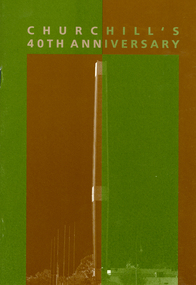
... states: "The 40th anniversary project was conceived, not as a detailed or comprehensive record of the town's forty-five year history, but as a series of 'snapshots' to commemorate Churchill's development. This booklet has been produced as an accompanying souvenir to the six portable display panels, which together provide a permanent record to our past". Assistance for the project was provided by the Glendonald Residents' Group Inc., Churchill District Community Association, Latrobe City, and Monash University. Federation University Australia...states: "The 40th anniversary project was conceived, not as a detailed or comprehensive record of the town's forty-five year history, but as a series of 'snapshots' to commemorate Churchill's development. This booklet has been produced as an accompanying souvenir to the six portable display panels, which together provide a permanent record to our past". Assistance for the project was provided by the Glendonald Residents' Group Inc., Churchill District Community Association, Latrobe City, and Monash University. Federation University Australia ...Green and brown soft covered book of 16 pages.non-fictionchurchill, monash university, hazelwood, yallourn, eel hole, eel hole school, cigar, hare's house, binishell, gippsland, gippsland campus, gippsland campus collection -
 Flagstaff Hill Maritime Museum and Village
Medal, 1951
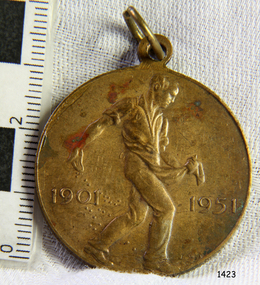
... Federation of Australia. The design was chosen after a competition, with the valuable cash prize of two hundred guineas, it was won by John Wolgang Elischer for his depiction of a man hand sowing wheat, The wheat has grown to represent the seven States of Australia on the other side to the medal Elischer was an Austrian sculptor and an Associate of the Royal Academy. ...Federation of Australia. The design was chosen after a competition, with the valuable cash prize of two hundred guineas, it was won by John Wolgang Elischer for his depiction of a man hand sowing wheat, The wheat has grown to represent the seven States of Australia on the other side to the medal Elischer was an Austrian sculptor and an Associate of the Royal Academy. ...The item is a 50th Anniversary of Commonwealth of Australia Schools Medal 1951. The medal was awarded to school children of the commonwealth of Australia in 1951 to mark the fiftieth anniversary of the Federation of Australia. The design was chosen after a competition, with the valuable cash prize of two hundred guineas, it was won by John Wolgang Elischer for his depiction of a man hand sowing wheat, The wheat has grown to represent the seven States of Australia on the other side to the medal Elischer was an Austrian sculptor and an Associate of the Royal Academy. The medal also had a red white and blue ribbon and a bar inscribed SUNRSYSIA, however this is missing on the subject itemCommemorating fifty years since Federation in 1901 specifically for school children in 1951 signifies a milestone in Australia's history. A commemorative medallion for 50 years Commonwealth of Australia. The medallion on one side has a man sewing seeds with the dates 1901 - 1951. The reverse has "50 Years Commonwealth of Australia" with a sun at the top and wheat at the bottom representing the number of Australian States. flagstaff hill, warrnambool, shipwrecked-coast, flagstaff-hill, flagstaff-hill-maritime-museum, maritime-museum, shipwreck-coast, flagstaff-hill-maritime-village, medal, fifty years commonwealth of australia, commemorative medal, bronze medal -
 Flagstaff Hill Maritime Museum and Village
Certificate - Invitation, Norman Lindsay (Artist), Opening of the Parliament of the Commonwealth by His Royal Highness The Duke of Cornwall and York, ca. 1901
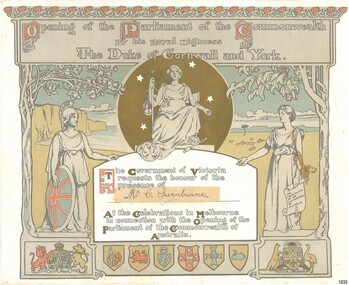
... Australia became a Federation on January 1st, 1901, uniting Australia's six British colonies - New South Wales, Victoria, Queensland, South Australia, Western Australia and Tasmania – into States of the Commonwealth of Australia. ...Australia became a Federation on January 1st, 1901, uniting Australia's six British colonies - New South Wales, Victoria, Queensland, South Australia, Western Australia and Tasmania – into States of the Commonwealth of Australia. ...Australia became a Federation on January 1st, 1901, uniting Australia's six British colonies - New South Wales, Victoria, Queensland, South Australia, Western Australia and Tasmania – into States of the Commonwealth of Australia. The Government of Victoria invited 12,000 guests to attend the official celebrations for the Opening of the Federal Parliament by His Royal Highness, the Duke of Cornwall and York (later King George V). The historic occasion was held at noon on May 9th, 1901, at Melbourne's Royal Exhibition Building, the only building large enough for that number of guests. The guests represented all six states of Australia with varied connections and interests, including politics, business and industry, the arts, religion, education, and public service. In Melbourne, the occasion was followed by two weeks of celebrations. The decorative, elaborate design of the certificate-size invitation represents Australia’s colonial history and its transition to the Federated Commonwealth of Australia. The National Gallery of Australia attributes the artwork of this invitation to Australian artists Norman Lindsay (1879–1969) and John Longstaff (1861–1941) and its printing to Sands & McDougall Limited, Melbourne. The invitation has no date or location details. This invitation has the label “Mr. C Swinburne” added over an original, handwritten name. Perhaps it was a spelling correction, or a late change, with Swinburne attending in the place of another citizen. The book “Our Invited Guests An Official Directory, Melbourne, Victoria, 1901” lists all the guests, but not one has the surname SWINBURNE. There are five Warrnambool listings, eight people in all: - - MoCOBMICK, G. D., Esq., P.M., Warrnambool. - O’DOWD, The Ven. Monsignor, Warrnambool. - OPIE, C. N. T., Esq. (and Lady), Warrnambool. - OSBORNE, Hy. Wm., Esq., Shire Secretary (and Lady), Town Hall, Warrnambool. - STEVENS, Mrs. F. P., Mia Mia, Warrnambool. CHARLES GRANT SWINBURNE (1864-1934): - Charles Grant Swinburne, known as Chas.., was a prominent Warrnambool figure: a member of Toc H., the Progress Association and several other local clubs and societies. He purchased Warrnambool’s Tattersall’s Hotel in 1911 and had a booth at the 1914 Warrnambool Show. In 1891, he married Susan Jane Granter (1867-19 June 1935), daughter of Joseph Granter (1832-1879) and Ann (born Holley). Joseph had arrived in Melbourne on the famous tall ship Marco Polo in February 1856. In 1868, he was a shareholder of the Warrnambool Steam Packet Co., trading along the coast of Victoria. His portrait is among those recognised on the historic Warrnambool Pioneers Board. The invitation is nationally significant for its connection with the first Federal Parliament in May 1901, where the first federal parliamentarians were sworn in, and where the Duke and Duchess of Cornwall and York attended, representing the continued link with Britain. The invitation also unites a local Warrnambool businessman, Mr C Swinburne, with the 12,000 guests representing their towns and states that in 1901 became the Commonwealth of Australia. Swinburn was also married to the daughter of Joseph Granter, an early pioneer recognised on Warrnambool’s Pioneer Board. Invitation: certificate size, colour lithograph on cream card with gilt highlights. The Victorian Government invited Mr C Swinburne to celebrate the Opening of Federal Parliament by HRH the Duke of Cornwall and York, held in Melbourne. The invitation has printed drawings of figures, decorations, heraldic symbols, and gilt accents behind the central figure, on the capital letters of the message, and the Advance Australia Arms. Inscribed with a handwritten label that covers handwritten text. [The event was held at Noon, 9th May 1901, Royal Exhibition Building, Melbourne.] Inscription, handwritten on a label: "Mr. C. Swinburne" Left image: [figure of Britannia holding a blue shield with three crossing red bands, standing below an oak tree] Central image, in front of a gilt circle : [symbolic female royal future with Orbe and Sceptre seated on throne, four stars around her] Right image: [young female figure representing Australia holding a scroll, standing below a flowering gum] "THE CONSTITUTION OF THE COMMONWEALTH OF AUSTRALIA" Bottom left: Combined Arms: "[Duke of Cornwall and York, Prince George Frederick Ernest Albert, Princess Alexandra, his Duchess]" Bottom centre: [six symbols representing the Coat of Arms for each state of Australia] Bottom right: Advance Australia Arms "[Shield with six symbols, between Kangaroo and Emu, and below Rising Sun'] ADVANCE AUSTRALIA"flagstaff hill maritime museum and village, flagstaff hill, maritime museum, maritime village, warrnambool, great ocean road, shipwreck coast, invitation, certificate, mr c swinburne, government of victoria, opening of federal parliament, hrh the duke of cornwall and york, c swinburne, susan jane granter, susan jane swinburne, federal parliament, 1901, australian federation, ceremonies, politics, royal exhibition building, invited guest, britannia, orb, sceptre, advance australia arms, constitution of the commonwealth of australia, norman lindsay, john longstaff, sands & mcdougall, federation, british colonies, commonwealth of australia, charles grant swinburne, chas swinburne, c g swinburne, opening of the federal parliament, duke of cornwall and york, may 9th, tattersall’s hotel, marco polo, warrnambool steam packet co, warrnambool pioneers board, joseph granter, ann granter -
 Federation University Historical Collection
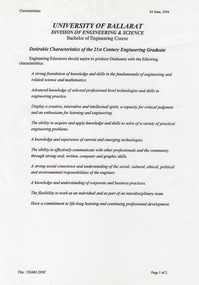
Document - Document - Student Characteristics, VIOSH: University of Ballarat, Division of Engineering and Science, Desirable Characteristics of Graduates
... Federation University. VIOSH Australia students are safety managers, senior advisors and experienced OHS professionals. They come from all over Australia and industry. Students are taught active research and enquiry; rather than textbook learning and a one-size fits all approach. VIOSH accepts people into the Graduate Diploma of Occupational Hazard Management who have no undergraduate degree - on the basis of extensive work experience and knowledge. A document titled "Desirable Characteristics of the 21st Century Engineering Graduate" was from the University of Ballarat Division of Engineering and Science, Bachelor of Engineering Course. Page 1 states...Federation University. VIOSH Australia students are safety managers, senior advisors and experienced OHS professionals. They come from all over Australia and industry. Students are taught active research and enquiry; rather than textbook learning and a one-size fits all approach. VIOSH accepts people into the Graduate Diploma of Occupational Hazard Management who have no undergraduate degree - on the basis of extensive work experience and knowledge. A document titled "Desirable Characteristics of the 21st Century Engineering Graduate" was from the University of Ballarat Division of Engineering and Science, Bachelor of Engineering Course. Page 1 states ...Victorian Institute of Occupational Safety and Health (VIOSH) Australia is the Asia-Pacific centre for teaching and research in occupational health and safety (OHS) and is known as one of Australia's leaders on the field. VIOSH has a global reputation for its innovative approach within the field of OHS management. VIOSH had its first intake of students in 1979. At that time the Institution was known as the Ballarat College of Advanced Education. In 1990 it became known as Ballarat University College, then in 1994 as University of Ballarat. It was 2014 that it became Federation University. VIOSH Australia students are safety managers, senior advisors and experienced OHS professionals. They come from all over Australia and industry. Students are taught active research and enquiry; rather than textbook learning and a one-size fits all approach. VIOSH accepts people into the Graduate Diploma of Occupational Hazard Management who have no undergraduate degree - on the basis of extensive work experience and knowledge. A document titled "Desirable Characteristics of the 21st Century Engineering Graduate" was from the University of Ballarat Division of Engineering and Science, Bachelor of Engineering Course. Page 1 states that Engineering educators should aspire to produce Graduates with a defined set of characteristics - 10 listed. Page 2 relates to the Engineering Course stating it should emphasise a number of key areas - 8 listed. Examples were obtained from Wollongong and Monash. These ideas were then used to formulate 10 characteristics for the University of Ballarat - "The Ideal Science Graduate" Document tabled by Roy Schrieke "The Ideal Science Graduate" 14/03/1995Six A4 pages - typed and with chartsviosh, victorian institute of occupational safety and health, university of ballarat, desirable charcteristics of engineering students, roy schrieke - lecturer, wollongong, monash, engineering and science -
 Federation University Historical Collection
Book, Glenn Withers, Commonality and Difference: Australian and the United States, 1991, 1991
... Smith was Chancellor of University of Ballarat (later Federation University Australia). robert h.t. smith Fulbright Act Fulbright Pogram Immigration higher education reganomics Beige and blue soft covered book. Commonality and Difference: Australian and the United States ...Robert H.T. Smith was Chancellor of University of Ballarat (later Federation University Australia).Beige and blue soft covered book. robert h.t. smith, fulbright act, fulbright pogram, immigration, higher education, reganomics -
 Lara RSL Sub Branch
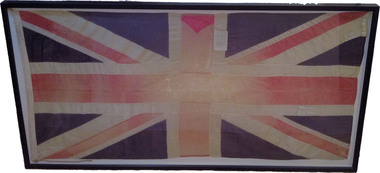
Flag, Australian Flag (Union Jack) 1900
... Australian Federation. Of the 16,500 men who served in South Africa, 606 were killed in action or died of diseases. The Australian War Memorial records that the fighting conditions in South Africa extremely hard on men and horses. Australians fighting in South Africa were doing so as part of Colony based Regiments such as the Victorian Mounted Rifles, New South Wales Lancers, Queensland Mounted Infantry as well as units from the other states. ...Australian Federation. Of the 16,500 men who served in South Africa, 606 were killed in action or died of diseases. The Australian War Memorial records that the fighting conditions in South Africa extremely hard on men and horses. Australians fighting in South Africa were doing so as part of Colony based Regiments such as the Victorian Mounted Rifles, New South Wales Lancers, Queensland Mounted Infantry as well as units from the other states. ...There is a Union Jack brought back from South Africa by 1229 Trooper Fredrick James Smith. Between 1899 and 1902, around 16,500 Australians served in South Africa during the Boer War. This was the largest international deployment of troops from the Australian Colonies before Australian Federation. Of the 16,500 men who served in South Africa, 606 were killed in action or died of diseases. The Australian War Memorial records that the fighting conditions in South Africa extremely hard on men and horses. Australians fighting in South Africa were doing so as part of Colony based Regiments such as the Victorian Mounted Rifles, New South Wales Lancers, Queensland Mounted Infantry as well as units from the other states. Australians were awarded six Victoria Crosses during the campaign along with many other decorations. In May of 1902 the treaty of Vereeniging was signed officially ending the Boer War. The Boer War is commemorated in many Towns and Cities around Australia. The Lara RSL Sub Branch holds some memorabilia from the Boer War. There is a Union Jack brought back from South Africa by 1229 Trooper Fredrick James Smith. He was a resident of Lara and was a member of the 5th Victorian Mounted Rifles. It was reported that he carried this flag into battle. The Lara RSL also holds the flag staff of the China, South African and Old Veterans Association. Both these items are of national significance. Both the flag and flag staff were used in marches in Geelong each year until 1916 when Anzac Day commenced. The flag and flag staff were donated to the Lara RSL sub Branch when he joined in 1928. Fredrick James Smith was born at Lara in 1879, the son of Mr/Mrs Smith from Lara. He was a farm hand from Horton Vale, Anakie when he joined F Company of the 5th Victorian Mounted Rifles at the beginning of February 1901. Two weeks later, he left for South Africa on the 15th February. Before leaving, he purchased the flag from W. Libby & Son Geelong. Frederick Left for South Africa on the 15 February 1901 on the Orient. He saw service between March 1901 - March 1902 in east Transvaal and Natal frontier under the British Major General S. Beatson then Pulteney, including the defeat at Wilmansrust where 18 soldiers were killed and 42 wounded (12th June 1901 - heaviest casualties of any Australian contingent,); and the successful intervention at Onverwacht on the 4th January 1902. The 5th Victorian Mounted Rifles suffered: 36 killed or died of wounds, 13 died of disease of a contingent of 46 Officers, 971 Other Ranks and 1099 horses. They returned to Australia on the 26th April 1902 on the Custodian after sailing from Point Natal in South Africa on the 5th April. On his return, Tropper Smith (Saddler Private) joined the South African Soldiers Association of Victoria – Geelong Branch, and after 1928, he joined the Lara RSL. He was buried in Western Cemetery on the 19th June 1968 at the age of 89. Enrolled February 1901 Departed for South Africa on 15 February 1901 Establishment: 46 Officers, 971 Other Ranks with 1099 horses Mobilised at Pretoria: 24 March -- 4 April 1901 Typical company: 1 Captain, 4 Lieutenants, 1 company sergeant-major, 1 company quartermaster-sergeant, 1 sergeant-farrier, 1 sergeant-saddler, 5 sergeants, 6 corporals, 3 shoeing-smiths, 3 saddlers, 1 bugler, 99 privates. Total in company: 126 with 131 horses. Engagements: Rhenoster Kop, Klippan, Kornfontein, Drivelfontein, Wilmansrust, Kambuladraai, H'Lobane, Luchiel's Nek, Loch's Kraal, Vryheid, Onverwacht, Johnston Hoek Killed in action (or died): six Officers, 48 Other Ranks VC Winner: Lieut. L. C. Maygar News article Leader (Melbourne) Saturday 31st May 1902, page 42 - Dear Cinderella. — This is the second time I have written to you. I was very sorry at not seeing my first letter in "The Leader". But I hope to say, that this one will be in. The last time I wrote to you I told you that my brother (Fredrick Smith) went to the Boer War in South Africa, and that he was supposed to be killed in the Wilmansrust disaster. But this time I am going to tell you about his return, and the grand welcome he got from the residents of Lara. Mother, Father, and my Brother, went down to Melbourne, to meet the boat. You can just imagine how rejoiced we all were to see him back again. The railway station was decorated some thing beautiful with flags of all description all the colours you could think of. He has bought a lot of Boer curios home and some Kaffir bracelets. They are such funny looking things. The residents of Lara, also gave my brother a grand social and ball there were over four hundred people present, They presented him with a hand some gold chain, and locket suitably inscribed, and a pair of gold sleeve links, they were magnificent. The ball was very nice. . I had a few dances. I enjoyed myself grand. I think this is all I can tell you this time. I must conclude with love. I remain yours sincerely - BESSIE SMITH. Age 14-years. This flag is of national significance as it was used in the Boer War by Private Fredrick James Smith (SN:1229) of the 5th Victorian Mounted Rifles, F Company in their deployment to South Africa between 1901 and 1902. The flag was taken into the Wilmansrust engagement in which 19 soldiers died and 41 were wounded. On return to Australia, the flag was used in marches by the South Africa, China Old Veterans Association - Geelong. This flag represents a unique part of Australian history from which the movie, Breaker Morant was taken. It is of spiritual significance as the Boer War was where the first Australian received the Imperial Victoria Cross, and the spirit of Anzac was conceived, giving birth in World War 1. The Flag represents the spirit of Australians who fought and died in South Africa.Cotton Union Jack flag approx 221cm wide by 109cm tall with small repair patches and center section cotton deteriorated.Has the word "Lara" inscribed in black on bottom part of the flag heading. Has the flag makers name "W.Libby & Son" on the top part of the flag heading.boer war, union jack flag, south africa, wilmansrust, 5th victorian mounted rifles, f coy, private fredrick james smith, service number 1229, february 1901, april 1902, south africa china old veterans association -
 Federation University Historical Collection
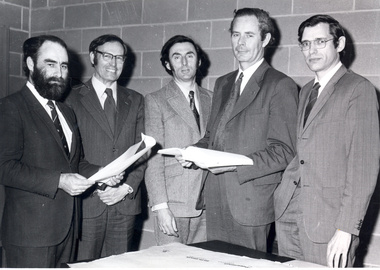
Photograph - Black and White, Staff of the Ballarat Institute of Advanced Education, 1973, 1973
... Ballarat Institute of Advanced Education is a predecessotr institution of Federation University Australia . e.j. barker jack barker Engineering degree ballarat institute of advanced education Engineering tom norwood bob martin brian lees Derek Woolley Mechanical Engineering civil and mining department electrical engineering A handwritten note on the back (from Jack Barker) states that the photo marks the Engineering Degree Approval by the Victorian Institute of Colleges. ...Ballarat Institute of Advanced Education is a predecessotr institution of Federation University Australia .Black and white photograph showing five staffmembers of the Ballarat Institute of Advanced Education (later Federation University Mt Helen Campus). Left to right: Tom Norwood (Head of Mechanical Engineering); Robert P. (Bob) Martin (Head of Civil Engineering); Brian M. Lees (Head of Electrical Engineering Department); E.J. (Jack) Barker (Director, Ballarat Institute of Technolog); Derek Woolley (Head of Engineering).A handwritten note on the back (from Jack Barker) states that the photo marks the Engineering Degree Approval by the Victorian Institute of Colleges. The Engineering degree course started in 1974.e.j. barker, jack barker, engineering degree, ballarat institute of advanced education, engineering, tom norwood, bob martin, brian lees, derek woolley, mechanical engineering, civil and mining department, electrical engineering -
 Flagstaff Hill Maritime Museum and Village
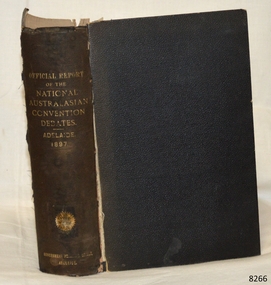
Book - Publication of Speeches, C. E. Bristow Government Printer, Official Report of The National Australasian Convention Debates Adelaide, 1897
... Federation. Some of the significant figures in attendance were Sir Edmund Barton (Australia's first Prime Minister), Charles Kingston (Premier of South Australia), Sir John Forrest, and Sir Samuel Griffith. Among the major topics discussed were the balance of power between large and small states...Bristows 1897 Adelaide volume, the framework for modern Australian federation, free interstate trade, and the balance of power between the states and the federal government would not exist in the form it does today. ...This volume is one of the primary founding documents of the Australian Federation. Published in Adelaide in 1897 by Charles Edward Bristow (the South Australian Government Printer), this heavy octavo volume captures the verbatim transcript of the First Session of the Australasian Federal Convention, held in Adelaide from 22 March to 5 May 1897. The volume contains verbatim debates from the convention, where statesmen from across the colonies drafted the framework for the Australian Constitution.Hard cover book, National Australasian Convention. (Debate Speeches March 22nd to May 5th 1897) Author: Various Speeches by various Speakers Publisher: C. E. Bristow Government Printer, North Terrace ,Adelaide. SA. Editor: C. E. Bristow Government Printer Date: 1897 Further Information: Black embossed cloth hardcover with a brown spine and lettering in gilt. The spine has a publishers logo in gilt.non-fictionThis volume is one of the primary founding documents of the Australian Federation. Published in Adelaide in 1897 by Charles Edward Bristow (the South Australian Government Printer), this heavy octavo volume captures the verbatim transcript of the First Session of the Australasian Federal Convention, held in Adelaide from 22 March to 5 May 1897. The volume contains verbatim debates from the convention, where statesmen from across the colonies drafted the framework for the Australian Constitution.flagstaff hill, warrnambool, shipwrecked coast, flagstaff hill maritime museum, maritime museum, shipwreck coast, flagstaff hill maritime village, great ocean road, book, pattison collection, warrnambool library, warrnambool mechanics’ institute, ralph eric pattison, corangamite regional library service, warrnambool city librarian, mechanics’ institute library, victorian library board, warrnambool books and records, warrnambool children’s library, official report of the national australasian convention debates adelaide -
 Geelong RSL Sub Branch
Flag, Lombard The Paper People, Late 20th Century
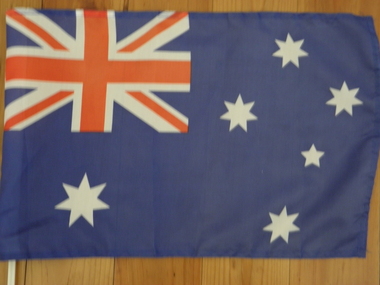
... The Australian flag was first unfurled on 3 September 1901, it comprises the Union Jack, below the Union Jack is a large six pointed star and the Federation Star representing the six States within the Commonwealth of Australia, in 1908 the star became a seven pointed star, to represent the Territories, in the fly of the flag, five stars symbolise the Southern Cross....The Australian flag was first unfurled on 3 September 1901, it comprises the Union Jack, below the Union Jack is a large six pointed star and the Federation Star representing the six States within the Commonwealth of Australia, in 1908 the star became a seven pointed star, to represent the Territories, in the fly of the flag, five stars symbolise the Southern Cross. ...The Australian flag was first unfurled on 3 September 1901, it comprises the Union Jack, below the Union Jack is a large six pointed star and the Federation Star representing the six States within the Commonwealth of Australia, in 1908 the star became a seven pointed star, to represent the Territories, in the fly of the flag, five stars symbolise the Southern Cross.This flag became the Australian Flag became upon Federation.Flag of Australiaflag, australia, federation -
 City of Moorabbin Historical Society (Operating the Box Cottage Museum)
Souvenir - Souvenir and Official Programme 'American Fleet Reception', Punch, Melbourne, 29 Aug 1908, Punch, Printed by the Publishers of ‘Punch’ Australia, c1908
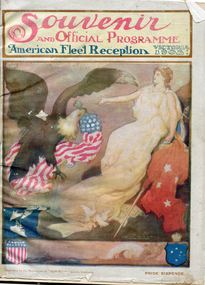
... states navy...prime minister deakin...early settlers...pioneers...moorabbin shire...moorabbin...brighton...cheltenham...federation of australia...Australia by Prime Minister Deakin. The fleet moved from port to port and was welcomed with enthusiasm. A souvenir of the visit by the American Fleet in 1908 that was welcomed by the early settlers in Victoria. american fleet united states navy prime minister deakin early settlers pioneers moorabbin shire moorabbin brighton cheltenham federation of australia SOUVENIR / and OFFICIAL PROGRAMME / American Fleet Reception / Victoria 1908 / / Printed by the Publishers of ‘Punch’ Australia Price sixpence Quarto, pictorial wrappers, 64 pp, illustrated. ...The American fleet was invited to visit Australia by Prime Minister Deakin. The fleet moved from port to port and was welcomed with enthusiasm.A souvenir of the visit by the American Fleet in 1908 that was welcomed by the early settlers in Victoria.Quarto, pictorial wrappers, 64 pp, illustrated. Front cover illustration by Will Dyson, further illustrations by Ruby Lindsay and Alek Sass. The first 16 pages of the programme are taken up by advertisements for Victorian businesses.SOUVENIR / and OFFICIAL PROGRAMME / American Fleet Reception / Victoria 1908 / / Printed by the Publishers of ‘Punch’ Australia Price sixpenceamerican fleet, united states navy, prime minister deakin, early settlers, pioneers, moorabbin shire, moorabbin, brighton, cheltenham, federation of australia -
 City of Moorabbin Historical Society (Operating the Box Cottage Museum)
Badge - Fifty Years Commonwealth of Australia, c. 1951
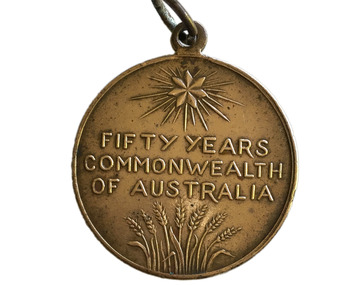
... Federation of Australia. The competition in 1950, with the valuable cash prize of two hundred guineas, for the design the medallion was won by John Elischer, a Melbourne sculptor. The medallion bears an image of a man hand sowing wheat with the dates 1901-1951 on one side. The reverse has wheat growing to represent the seven states...Federation of Australia. The competition in 1950, with the valuable cash prize of two hundred guineas, for the design the medallion was won by John Elischer, a Melbourne sculptor. The medallion bears an image of a man hand sowing wheat with the dates 1901-1951 on one side. The reverse has wheat growing to represent the seven states ...The medal was awarded to the school children of Australia in 1951 to mark the fiftieth anniversary of the Federation of Australia. The competition in 1950, with the valuable cash prize of two hundred guineas, for the design the medallion was won by John Elischer, a Melbourne sculptor. The medallion bears an image of a man hand sowing wheat with the dates 1901-1951 on one side. The reverse has wheat growing to represent the seven states of Australia and the words ‘Fifty years Commonwealth of Australia’.Metal MedalFifty Years Commonwealth of Australia 1901 - 1957commonwealth of australia, 50 years, medal -
 Learmonth and District Historical Society Inc.
Medal - Commonwealth Australia 1951, Commemorative Commonwealth Medal
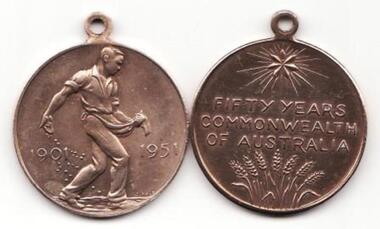
... Federation of Australia. The design was chosen after a competition, with the valuable cash prize of two hundred guineas. It was won by John Wolfgang Elischer for his depiction of a man hand-sowing wheat. The wheat has grown to represent the seven States...Federation of Australia. The design was chosen after a competition, with the valuable cash prize of two hundred guineas. It was won by John Wolfgang Elischer for his depiction of a man hand-sowing wheat. The wheat has grown to represent the seven States...Fifty Years of the Commonwealth of Australia 1901 - 1951. 1901 1951 commonweath australia medal On the front is a man throwing seed on the ground with the dates, 1901-1951, and on the back the words, "FIFTY YEARS COMMONWEALTH OF AUSTRALIA". along with a carving of the sun and seven ears of wheat representing the States and Territory. This medal was awarded to the school children of Australia in 1951 to mark the fiftieth anniversary of the Federation of Australia. ...This medal was awarded to the school children of Australia in 1951 to mark the fiftieth anniversary of the Federation of Australia. The design was chosen after a competition, with the valuable cash prize of two hundred guineas. It was won by John Wolfgang Elischer for his depiction of a man hand-sowing wheat. The wheat has grown to represent the seven States of Australia on the other side of the medal. Elischer was an Austrian sculptor and an Associate of the Royal Academy.Fifty Years of the Commonwealth of Australia 1901 - 1951.This medal was awarded to the school children of Australia in 1951 to mark the fiftieth anniversary of the Federation of Australia. The design was chosen after a competition, with the valuable cash prize of two hundred guineas. It was won by John Wolfgang Elischer for his depiction of a man hand-sowing wheat. The wheat has grown to represent the seven States of Australia on the other side of the medal. Elischer was an Austrian sculptor and an Associate of the Royal Academy. This is a round medal and is bronze in colour. On the front is a man throwing seed on the ground with the dates, 1901-1951, and on the back the words, "FIFTY YEARS COMMONWEALTH OF AUSTRALIA". along with a carving of the sun and seven ears of wheat representing the States and Territory.1901, 1951, commonweath australia medal -
 Montmorency–Eltham RSL Sub Branch
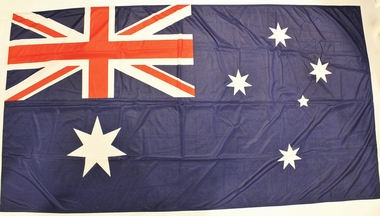
Flag - Australian National Flag
... Federation, star. It has seven points representing the unity of the six states and the territories of the Commonwealth of Australia....Presented with Cerificate from the Speaker of the House of Representatives Neil Andrews on June 22nd 1999 polyester australian flag national The flag has three elements on a blue background: the Union Jack, the Commonwealth Star and the Southern Cross. ... Below the Union Jack is a white Commonwealth, or Federation, star. It has seven points representing the unity of the six states ...Presented with Cerificate from the Speaker of the House of Representatives Neil Andrews on June 22nd 1999The flag has three elements on a blue background: the Union Jack, the Commonwealth Star and the Southern Cross. ... Below the Union Jack is a white Commonwealth, or Federation, star. It has seven points representing the unity of the six states and the territories of the Commonwealth of Australia.polyester, australian, flag, national -
 Flagstaff Hill Maritime Museum and Village
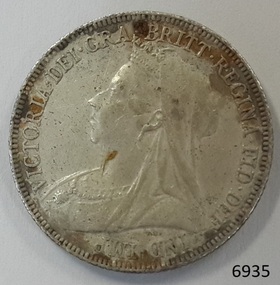
Currency - Coin, 1897
... Australia becoming a federation in 1901 its currency included British copper and silver coins, Australian gold sovereigns, locally minted copper trade tokens, private banknotes, New South Wales and Queensland government treasury notes and Queensland government banknotes. After Federation the Australian government began to overwrite privately issued notes and prepared for the introduction of its own currency. In 1910 a National Australian Currency was formed, based on the British currency of ‘pounds, shillings and pence’ and the first Commonwealth coining was produced, removing the power from the States...Australia becoming a federation in 1901 its currency included British copper and silver coins, Australian gold sovereigns, locally minted copper trade tokens, private banknotes, New South Wales and Queensland government treasury notes and Queensland government banknotes. After Federation the Australian government began to overwrite privately issued notes and prepared for the introduction of its own currency. In 1910 a National Australian Currency was formed, based on the British currency of ‘pounds, shillings and pence’ and the first Commonwealth coining was produced, removing the power from the States ...This Great Britain one shilling coin is dated 1897, which is during the reign of Queen Victoria. There were over 6 million of these coins minted. Queen Victoria succeeded King William IV to the British Throne in 1837 – she was only 18 years old at the time – and she ruled until 1901. British coins such as this one shilling were in circulation in the colony of Australia until 1910, when the Commonwealth of Australia began producing its own coinage. This one shilling coin was minted by the Royal Mint at Royal Mint Court, in Little Tower Hill, London, England. Coins for circulation in the Kingdom of England, Great Britain and most of the British Empire were produced here until the 1960’s when the Royal Mint shifted location to Wales. There are three main groups of shillings produced during Queen Victoria’s reign:- - The Young Head; 1837-1887, in 8 different versions, on the obverse showing the Queen’s maturing face over 50 years. - The Junior Head; 1887-1892, minted when Queen Victoria had been reigning for 50 years. Her head was smaller on the coins minted 1887-1889 than on those shillings minted 1889-1892. - The Old Head; 1893-1901, shows the veiled head of Queen Victoria. The obverse side of the coin was designed by Thomas Brock. The inscription’s translation is “Victoria by the Grace of God, Queen of the British territories, Defender of the Faith, Empress of India”. The reverse side of the coin was designed by Edward Paynter. The inscription "HONI SOIT QUI MAL Y PENSE" translates as "Evil be to him who evil thinks". AUSTRALIAN CURRENCY The early settlers of Australia brought their own currency with them so a wide variety of coins, tokens and even ‘promissory’ notes (often called IOU’s) were used in the exchange of goods and services. In 1813 Spanish dollars were imported and converted for use by punching a hole in the centre of the coin. Both the outer ring, called the holey dollar, and the punched out ‘hole’, called the dump, were then counter-stamped and used as the official currency. In 1825 the British Government passed the Sterling Silver Currency Act, making the British Pound the only legal form of currency in the Australian colonies. Not enough British currency was imported into the colony so other forms of currency were still used. In the mid 1800’s Australia entered the Gold Rush period when many made their fortunes. Gold was used for trading, often shaped into ingots, stamped with their weight and purity, and one pound tokens. In 1852 the Adelaide Assay Office, without British approval, made Australia’s first gold coin to meet the need for currency in South Australia after the Gold Rush began. In 1855 the official Australian Mint opened in Sydney, operating as a branch of the Royal Mint in London, and the gold was turned into coins called ‘sovereigns’. Other branches also opened in Melbourne and Perth. Up to the time of Australia becoming a federation in 1901 its currency included British copper and silver coins, Australian gold sovereigns, locally minted copper trade tokens, private banknotes, New South Wales and Queensland government treasury notes and Queensland government banknotes. After Federation the Australian government began to overwrite privately issued notes and prepared for the introduction of its own currency. In 1910 a National Australian Currency was formed, based on the British currency of ‘pounds, shillings and pence’ and the first Commonwealth coining was produced, removing the power from the States. In 1966, on February 14th, Australia changed over to the decimal currency system of dollars and cents. Australia did not have its own currency in the colonial times. Settlers brought money from other countries and they also traded goods such as grain when currency was scarce. For a long time there was no standardised value for the different currencies. In 1825 British currency became the only official currency in the colony of Australia and coins such as this silver shilling were imported into Australia to replace the mixture of foreign currency. Australia became a Federated nation on 1st January 1901. In 1910 National Australian Currency was formed and Australia produced its own currency, based on the British ‘pounds, shillings and pence’. The British currency was no longer valid. This silver shilling is of national significance as it represents the British currency used in Australia from 1825-1910. This silver shilling is also of significance to Australia as part one of the British Colonies ruled by Queen Victoria. It is part of the special silver and gold coins minted 1887-1893 to celebrate the 50 years Jubilee of Queen Victoria’s reign 1837-1887. Coin, Great Britain Shilling, 1897. Silver coin, round. Obverse; Queen Victoria head, ‘Old Head’, looking left. Reverse; 3 shields (each crowned) - 3 passant lions (England), 1 rampant lion (Scotland), golden harp (Northern Ireland) - floral symbols between them – 1 open rose, 2 thistles. Inscriptions on both sides of coin.Obverse “VICTORIA . DEI . GRA . BRITT . REGINA . FID . DEF . IND . IMP” Reverse “ONE SHILLING, 1897, Inner band, some letters hidden - HONI SO VI Y PENSE” flagstaff hill, warrnambool, shipwrecked coast, flagstaff hill maritime museum, maritime museum, shipwreck coast, flagstaff hill maritime village, great ocean road, coin, currency, money, legal tender, australian currency history, royal mint, british shilling 1897, thomas brock, edward paynter, great britain shilling, queen victoria currency, queen victoria 50 years golden jubilee shilling, colonial australia currency, numismatics -
 Flagstaff Hill Maritime Museum and Village
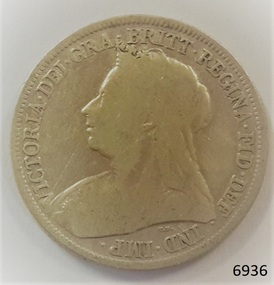
Currency - Coin, 1897
... Australia becoming a federation in 1901 its currency included British copper and silver coins, Australian gold sovereigns, locally minted copper trade tokens, private banknotes, New South Wales and Queensland government treasury notes and Queensland government banknotes. After Federation the Australian government began to overwrite privately issued notes and prepared for the introduction of its own currency. In 1910 a National Australian Currency was formed, based on the British currency of ‘pounds, shillings and pence’ and the first Commonwealth coining was produced, removing the power from the States...Australia becoming a federation in 1901 its currency included British copper and silver coins, Australian gold sovereigns, locally minted copper trade tokens, private banknotes, New South Wales and Queensland government treasury notes and Queensland government banknotes. After Federation the Australian government began to overwrite privately issued notes and prepared for the introduction of its own currency. In 1910 a National Australian Currency was formed, based on the British currency of ‘pounds, shillings and pence’ and the first Commonwealth coining was produced, removing the power from the States ...This Great Britain one shilling coin is dated 1897, which is during the reign of Queen Victoria. There were over 6 million of these coins minted. Queen Victoria succeeded King William IV to the British Throne in 1837 – she was only 18 years old at the time – and she ruled until 1901. British coins such as this one shilling were in circulation in the colony of Australia until 1910, when the Commonwealth of Australia began producing its own coinage. This one shilling coin was minted by the Royal Mint at Royal Mint Court, in Little Tower Hill, London, England. Coins for circulation in the Kingdom of England, Great Britain and most of the British Empire were produced here until the 1960’s when the Royal Mint shifted location to Wales. There are three main groups of shillings produced during Queen Victoria’s reign:- - The Young Head; 1837-1887, in 8 different versions, on the obverse showing the Queen’s maturing face over 50 years. - The Junior Head; 1887-1892, minted when Queen Victoria had been reigning for 50 years. Her head was smaller on the coins minted 1887-1889 than on those shillings minted 1889-1892. - The Old Head; 1893-1901, shows the veiled head of Queen Victoria. The obverse side of the coin was designed by Thomas Brock. The inscription’s translation is “Victoria by the Grace of God, Queen of the British territories, Defender of the Faith, Empress of India”. The reverse side of the coin was designed by Edward Paynter. The inscription "HONI SOIT QUI MAL Y PENSE" translates as "Evil be to him who evil thinks". AUSTRALIAN CURRENCY The early settlers of Australia brought their own currency with them so a wide variety of coins, tokens and even ‘promissory’ notes (often called IOU’s) were used in the exchange of goods and services. In 1813 Spanish dollars were imported and converted for use by punching a hole in the centre of the coin. Both the outer ring, called the holey dollar, and the punched out ‘hole’, called the dump, were then counter-stamped and used as the official currency. In 1825 the British Government passed the Sterling Silver Currency Act, making the British Pound the only legal form of currency in the Australian colonies. Not enough British currency was imported into the colony so other forms of currency were still used. In the mid 1800’s Australia entered the Gold Rush period when many made their fortunes. Gold was used for trading, often shaped into ingots, stamped with their weight and purity, and one pound tokens. In 1852 the Adelaide Assay Office, without British approval, made Australia’s first gold coin to meet the need for currency in South Australia after the Gold Rush began. In 1855 the official Australian Mint opened in Sydney, operating as a branch of the Royal Mint in London, and the gold was turned into coins called ‘sovereigns’. Other branches also opened in Melbourne and Perth. Up to the time of Australia becoming a federation in 1901 its currency included British copper and silver coins, Australian gold sovereigns, locally minted copper trade tokens, private banknotes, New South Wales and Queensland government treasury notes and Queensland government banknotes. After Federation the Australian government began to overwrite privately issued notes and prepared for the introduction of its own currency. In 1910 a National Australian Currency was formed, based on the British currency of ‘pounds, shillings and pence’ and the first Commonwealth coining was produced, removing the power from the States. In 1966, on February 14th, Australia changed over to the decimal currency system of dollars and cents. Australia did not have its own currency in the colonial times. Settlers brought money from other countries and they also traded goods such as grain when currency was scarce. For a long time there was no standardised value for the different currencies. In 1825 British currency became the only official currency in the colony of Australia and coins such as this silver shilling were imported into Australia to replace the mixture of foreign currency. Australia became a Federated nation on 1st January 1901. In 1910 National Australian Currency was formed and Australia produced its own currency, based on the British ‘pounds, shillings and pence’. The British currency was no longer valid. This silver shilling is of national significance as it represents the British currency used in Australia from 1825-1910. This silver shilling is also of significance to Australia as part one of the British Colonies ruled by Queen Victoria. It is part of the special silver and gold coins minted 1887-1893 to celebrate the 50 years Jubilee of Queen Victoria’s reign 1837-1887. Coin, Great Britain Shilling, 1897. Silver coin, round. Obverse; Queen Victoria head, ‘Old Head’, looking left. Reverse; 3 shields (each crowned) - 3 passant lions (England), 1 rampant lion (Scotland), golden harp (Northern Ireland) - floral symbols between them – 1 rose, 2 thistles. Inscriptions on both sides of coin.Obverse “VICTORIA . DEI . GRA . BRITT . REGINA . FID . DEF . IND . IMP” Reverse “ONE SHILLING, 1897, Inner band, some letters hidden - HONI SO VI Y PENSE” flagstaff hill, warrnambool, shipwrecked coast, flagstaff hill maritime museum, maritime museum, shipwreck coast, flagstaff hill maritime village, great ocean road, coin, currency, money, legal tender, australian currency history, royal mint, british shilling 1897, thomas brock, edward paynter, great britain shilling, queen victoria currency, queen victoria 50 years golden jubilee shilling, colonial australia currency, numismatics -
 Learmonth and District Historical Society Inc.
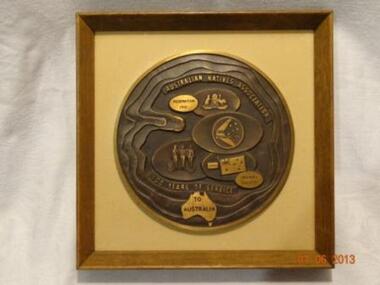
Plaque "ANA"100 years service to Australia, Circa 20th century
... CENTENARY PLAQUE AUSTRALIAN NATIVES ASSOCIATION.1871 - 1971.This plaque commemorates the centenary of the Australian Natives Association and depicts some of the achievements brought about by the Association in Australia over a Century.The circular shape symbolizes a continuous line of achievements around a central point or theme.Whithin this shape are three bands of waving and undulating sand textured steps,passing through the map of Australia. these bands signify the rolling sandy plains which are so characteristic of this country .There is a total of seven basic shapes representing the seven states - six of which are overlapping representing the mainland.The six oval shapes depict The ANA.crest Federation 1901.The Made in Australia Council.The Australia Day Council. ...CENTENARY PLAQUE AUSTRALIAN NATIVES ASSOCIATION.1871 - 1971.This plaque commemorates the centenary of the Australian Natives Association and depicts some of the achievements brought about by the Association in Australia over a Century.The circular shape symbolizes a continuous line of achievements around a central point or theme.Whithin this shape are three bands of waving and undulating sand textured steps,passing through the map of Australia. these bands signify the rolling sandy plains which are so characteristic of this country .There is a total of seven basic shapes representing the seven states - six of which are overlapping representing the mainland.The six oval shapes depict The ANA.crest Federation 1901.The Made in Australia Council.The Australia Day Council. ...CENTENARY PLAQUE AUSTRALIAN NATIVES ASSOCIATION.1871 - 1971.This plaque commemorates the centenary of the Australian Natives Association and depicts some of the achievements brought about by the Association in Australia over a Century.The circular shape symbolizes a continuous line of achievements around a central point or theme.Whithin this shape are three bands of waving and undulating sand textured steps,passing through the map of Australia. these bands signify the rolling sandy plains which are so characteristic of this country .There is a total of seven basic shapes representing the seven states - six of which are overlapping representing the mainland.The six oval shapes depict The ANA.crest Federation 1901.The Made in Australia Council.The Australia Day Council. The Armed Forces and Friendly Society.Made to commemorate 100 years service of ANA to Australia.A rectangular shadow box style frame of brown wood,in which is a round Brass Medallion on a beige background.Around the edge are wavy bands representing rolling sands.At the top are the words AUSTRALIAN NATIVES ASSOCIATION and at the bottom is inscribed 100 YEARS OF SERVICE and on a map of Australia TO AUSTRALIA.There are seven basic oval shapes on which -from the top-is the ANA Crest and the words Federation 1901.then a Boomerang with the stars of the Southern Cross and the words Buy Australian,then a map of Australia on which are standing three figures of Army,Navy,Airforce Personel,then the Australian flag with Jan 26 and Friendly Society.AUSTRALIAN NATIVES ASSOCIATION 100 YEARS OF SERVICE TO AUSTRALIA.ana commemoration plaque. -
 Orbost & District Historical Society
book, Australian Postmaster General's Dept, Course of Technical Instruction and Telegraphy, 1940's -1950's
... The Postmaster-General's Department (P.M.G.) of Australia was created in 1901 with Federation taking control over all six Colonies (States) Postal and Telegraphic services within Australia to form the national Postal and Telegraphic services within Australia. ...The Postmaster-General's Department (P.M.G.) of Australia was created in 1901 with Federation taking control over all six Colonies (States) Postal and Telegraphic services within Australia to form the national Postal and Telegraphic services within Australia. ...The Postmaster-General's Department (P.M.G.) of Australia was created in 1901 with Federation taking control over all six Colonies (States) Postal and Telegraphic services within Australia to form the national Postal and Telegraphic services within Australia. The Department was administered by the Postmaster-General. This manual was produced as a syllabus of training for Army Personnel units in P.M.G's Department schools.In war times the postal organisation was a vital link between the services, the community and overseas centres. The Postmaster-General's Department co-operated with service departments in the installation and operation of radio, telephone and telegraph systems. Its laboratories also designed, developed and manufactured vital defence equipment. This item reflects that contribution and history.A 31 pp buff colored book with orange cloth binding. Black print on the front cover - a oval shaped logo with Post Office Communication Australia around a small sketch depicting Mercury, the messenger of the gods below an Australian coat-of-arms. Below that is the title,"COURSE OF TECHNICAL INSTRUCTION TELEPHONY 1".manual-telephony postmaster-general's-training-department instruction-book communications
