
Showing 87 items matching "flower variety"
-
 University of Melbourne, Burnley Campus Archives
Book - Register, Roses + Iris, c.1938
... ...flower variety...register flowers flower variety roses iris record of position orchard For key to position see plan of garden N.B. ...Handwritten bound alphabetic indexed register. Each page has hand entered columns for Name, Position and Remarks. Rose varieties listed alphabetically. Note inside dated 1938. IRIS alphabetical entries all inserted under index 'B'. Remarks for each detail the colour mix.For key to position see plan of garden N.B. Nursery bed V.G Vegetable Garden B.H Buse House No. of varieties 381 Total 600 IRIS For iris see 'B'register, flowers, flower variety, roses, iris, record of position, orchard -
 Kew Historical Society Inc
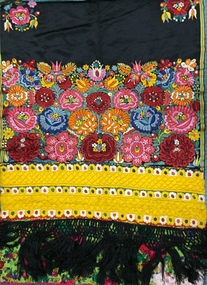
Clothing, Embroidered Silk & Cotton Apron, 1950s
... This example characterizes the dynamic color combinations and flower varieties of the Matyó tradition....This example characterizes the dynamic color combinations and flower varieties of the Matyó tradition. The textile is part of a large and significant collection of items donated by Rosemary Vaughan-Smith, past member and office-bearer of the Kew Historical Society. between 2005-12. ...The Matyó region of Hungary, which includes Mezökövesd is known for its rich costume traditions, specifically embroidery. Matyó embroidery is a densely-patterned style of free-hand work in rich and colorful floral motifs. Its prime era was the 1860s and 1870s when the folk arts thrived. This example characterizes the dynamic color combinations and flower varieties of the Matyó tradition.The textile is part of a large and significant collection of items donated by Rosemary Vaughan-Smith, past member and office-bearer of the Kew Historical Society. between 2005-12. The collection includes costumes, scrapbooks, autograph books, artworks and objects.Rectangular apron worked in three panels, the lower two of which are backed. The waist tie is of a floral fabric. The tape is attached to both vertical sides. There is a black fringe attached to the bottom panel over floral printed fabric. The needlework techniques employed in the embroidery include flat stitch which is used to create the effect of quilting and creating large brightly coloured flowers in the middle section. mezökövesd, aprons - hungarian, matyo embroidery, migration -
 University of Melbourne, Burnley Campus Archives
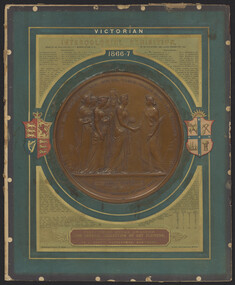
Certificate - Award Certificate and Medal, W. Calvert, Victorian Intercolonial Exhibition 1866-7 First Prize Medal for General Collection of Cut Flowers, 1866-1867
... Manners-Sutton, K.C.B, on the 24th October 1866; Closed February 23rd 1867 FIRST PRIZE MEDAL AWARDED FOR GENERAL DISPLAY OF CUT FLOWERS (Fuchsias, 10 varieties; Collection of cut flowers 50 varieties) TO J. ...Manners-Sutton, K.C.B, on the 24th October 1866; Closed February 23rd 1867 FIRST PRIZE MEDAL AWARDED FOR GENERAL DISPLAY OF CUT FLOWERS (Fuchsias, 10 varieties; Collection of cut flowers 50 varieties) TO J. ...First Prize Medal awarded to J. Scott, Nurseryman, Hawthorn. during the Intercolonial Exhibition 1866-67. Awarded by Mrs J.C. Corbett's aunt married a son of James Scott.Bronze coloured medal raised in relief - set in illuminated cardboard certificate glued on wooden back board with brown paper backing. Awarded to James Scott, Nurseryman, Hawthorn. Designed and printed and hand finished by W. Calvert 89 Little Collins St. East, Melbourne. Sculpted by C. Summers. Printed on the illuminated certificate are the Royal Standard of United Kingdom and Victorian coat of arms. (Also see B93.0664 - associated award to J Scott, and framed colour printed replica B92.0548)Bronze relief MEDAL AWARDED TO JAMES SCOTT VICTORIA INTERCOLONIAL EXHIBITION 1866-7 Latin inscription FACIES NON OMNIBUS UNA NEC DIVERSA TAMEN. QUALEM DECET ESSE SORORUM, with pictured classical ladies grouped in the relief. Certificate surrounding the metal relief contains much printed explanation of the exhibition. Opened by his excellence Sir J. H. T. Manners-Sutton, K.C.B, on the 24th October 1866; Closed February 23rd 1867 FIRST PRIZE MEDAL AWARDED FOR GENERAL DISPLAY OF CUT FLOWERS (Fuchsias, 10 varieties; Collection of cut flowers 50 varieties) TO J. SCOTT, NURSERYMAN, HAWTHORN. Handwritten on reverse, 'Presented by Mrs. J.C. Corbett, 28 Stawell St., Kew. (Her aunt married a son of James Scott)medal, certificate awarded, j. scott, nurseryman, w. calvert, c. summers, mrs. j.c. corbett, james scott, j.c. corbett, flowers, first prize, intercolonial exhibition -
 Wodonga & District Historical Society Inc
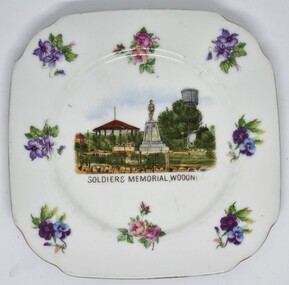
Souvenir - China Souvenir Plate Soldiers' Memorial. Wodonga, Victoria China, c1924 - 1939
... The central coloured image is surrounded by a 8 representations of a variety of flowers and a silver edge trim. The makers mark underneath the dish was used between 1918 - 1939 so assists in establishing provenance of the irem....The central coloured image is surrounded by a 8 representations of a variety of flowers and a silver edge trim. The makers mark underneath the dish was used between 1918 - 1939 so assists in establishing provenance of the irem. ...This item is from a collection donated by descendants of John Francis Turner of Wodonga. A wide range of small china pieces carrying scenic views of holiday destinations or key locations were a popular kind of souvenir during much of the 20th century. Several different items have been produced to commemorate Wodonga and its landmarks over time. These items document key changes in Wodonga and its heritage. This plate depicts three key landmarks in Wodonga. THE SOLDIERS' MEMORIAL in Wodonga was unveiled on Tuesday 18th November 1924. It was designed by Messrs. Hosken & Co., of Hawthorn, Victoria. The monument is all of Australian workmanship. The pedestal is made of Harcourt granite, 9ft x 9ft at the base, and rising in seven courses to a height of 10ft 2in. The emblems (rising sun and wreath) are of bronze, and the lettering of the inscription and names of fallen soldiers are in raised lead letters. Originally the Memorial was completed with a full life size, 6ft in height, sculpture of an Australian soldier in Sicilian marble. The memorial bore the inscriptions: ERECTED BY THE RESIDENTS OF WODONGA AND DISTRICT IN MEMORY of the Men of this Town and District who fell in the Great War, 1914-1919, Also in grateful recognition of the men who served and returned. “Lest We Forget.” In 1982, due to frequent vandalism and high cost of materials to repair, the soldier statue was removed and later installed at the RSL Rooms. THE WATER TOWER is a major landmark of High Street, Wodonga. It began operation from January 1924 until it ceased operation in 1959. It stood unused for a decade until the lower section was modified and put to use as “ The Tower’s Cobbler’s Inn” in 1962. In 1972 Wodonga City Council proposed to demolish the Tower. Their suggestion received an unfavorable response from the city’s citizens, so the Tower still stands today. THE BAND ROTUNDA was officially opened on Sunday 5th September 1920 at the naming of the triangular reserve at the corner of High and Hovell Streets as Woodland Grove. The Wodonga Band gave a public performance on this occasion. The tri-coloured ribbon, which stretched across the entrance to the Rotunda was cut by Mrs R.H Murphy, daughter of Mr. John Woodland, secretary of the Wodonga Shire Council for 35 years, after whom the area was named. The rotunda has since been moved to Martin Park, Wodonga.This item comes from a collection used by a prominent citizen of Wodonga. It is also an excellent example of souvenir items created featuring landmarks to represent the city of Wodonga.A china plate depicting the Soldiers' Memorial Wodonga. The central coloured image is surrounded by a 8 representations of a variety of flowers and a silver edge trim. The makers mark underneath the dish was used between 1918 - 1939 so assists in establishing provenance of the irem.Beneath image: "SOLDIERS' MEMORIAL WODONGA On back of dish, Beneath a crown " VICTORIA CHINA CZECHOSLAVAKIA"victoria china, souvenir wodonga, wodonga soldiers memorial, woodland grove wodonga -
Ringwood and District Historical Society
Programme, Ringwood and District Horticultural and Garden Club, Ringwood and District Horticultural and Garden Club Schedule for the Annual Autumn Show, 1971, 1971
... SECTION 4: DAHLIAS - NOVICE 491 Giant Dahlia 30c 501 Medium Dahlia 30c 511 Vase Miniature Dahlias, 3 Blooms, N.N.D.30c 521 Vase Charm Dahlias, 3 Blooms, N.N.D. 30c 531 Miniature Dahlia20c 541 Charm Dahlia 20c SECTION 5:R O S E S-O P E N 55Roses, 3 Blooms in Separate Containers, (Distinct Varieties)40c 56Roses, 3 Blooms, 1 colour shown separately 30c 57Roses, 3 Blooms, Bud to Full Bloom 30 c 58Roses, 3 Vases, Distinct Varieties 75c 59Roses, 1 Vase Full Bloom showing stamens 30c 60Roses, 1 Vase C.V.A. 20c Page Six Continuation of: SECTION 5 - R O S E S-O P E N SCH.NO:FIRST 611 Rose in Bloom20c 62Rose, 1 Vase of Floribunda or Grandiflora 30c SECTION 6 - R O S E S - A M A T E U R 63Rose, 1 Bloom20c 64Rose, 1 Vase, C.V.A. 30c 65Roses, 3 Blooms, Distinct Varieties35c 66Roses, 3 Blooms, Bud to Full Bloom 35c 67Roses, 1 Vase Floribunda or Grandiflora30c SECTION 7C U T F L O W E R S -O P E N 683 Vases Cut Flowers, Distinct Kinds, C.V.A. 50c 691 Vase Cut Flowers, Distinct Variety, C.V.A. 25c 701 Vase Cut Flowers, Red Shades, Distinct Kind 25c 711 Vase Cut Flowers, Pink Shades, Distinct Kind25c 721 Vase Cut Flowers, White Shades, Distinct Kind 25c 731 Vase Cut Flowers, Cream or Yellow Shades25c 741 Vase Cut Flowers, Blue Shades 25c 751 Head Hydrangeas25c 763 Vases Geranium or Pelargonium, N.N.D. 25c 771 Vase Asters, C.V.A.25c 781 Vase Zinnias, Distinct Variety, Dahlia Flowered25c 793 Vases Zinnias, Distinct Colours, Dahlia Flowered 25c 801 Vase Lilliput Zinnias, C.V.A. 25c 811 Vase Marigolds. ...SECTION 4: DAHLIAS - NOVICE 491 Giant Dahlia 30c 501 Medium Dahlia 30c 511 Vase Miniature Dahlias, 3 Blooms, N.N.D.30c 521 Vase Charm Dahlias, 3 Blooms, N.N.D. 30c 531 Miniature Dahlia20c 541 Charm Dahlia 20c SECTION 5:R O S E S-O P E N 55Roses, 3 Blooms in Separate Containers, (Distinct Varieties)40c 56Roses, 3 Blooms, 1 colour shown separately 30c 57Roses, 3 Blooms, Bud to Full Bloom 30 c 58Roses, 3 Vases, Distinct Varieties 75c 59Roses, 1 Vase Full Bloom showing stamens 30c 60Roses, 1 Vase C.V.A. 20c Page Six Continuation of: SECTION 5 - R O S E S-O P E N SCH.NO:FIRST 611 Rose in Bloom20c 62Rose, 1 Vase of Floribunda or Grandiflora 30c SECTION 6 - R O S E S - A M A T E U R 63Rose, 1 Bloom20c 64Rose, 1 Vase, C.V.A. 30c 65Roses, 3 Blooms, Distinct Varieties35c 66Roses, 3 Blooms, Bud to Full Bloom 35c 67Roses, 1 Vase Floribunda or Grandiflora30c SECTION 7C U T F L O W E R S -O P E N 683 Vases Cut Flowers, Distinct Kinds, C.V.A. 50c 691 Vase Cut Flowers, Distinct Variety, C.V.A. 25c 701 Vase Cut Flowers, Red Shades, Distinct Kind 25c 711 Vase Cut Flowers, Pink Shades, Distinct Kind25c 721 Vase Cut Flowers, White Shades, Distinct Kind 25c 731 Vase Cut Flowers, Cream or Yellow Shades25c 741 Vase Cut Flowers, Blue Shades 25c 751 Head Hydrangeas25c 763 Vases Geranium or Pelargonium, N.N.D. 25c 771 Vase Asters, C.V.A.25c 781 Vase Zinnias, Distinct Variety, Dahlia Flowered25c 793 Vases Zinnias, Distinct Colours, Dahlia Flowered 25c 801 Vase Lilliput Zinnias, C.V.A. 25c 811 Vase Marigolds. ...Ringwood and District Horticultural and Garden Club Schedule for the Annual Autumn Show, 1971.12 page booklet- typed Schedule.Front Page Ringwood and District Horticultural and Garden Club Schedule for the Annual Autumn Show To be held in the Assembly Hall, Ringwood High School, Bedford Road, Ringwood Saturday, March 6, 1971. (Doors Open at 2 p.m.) Entries close: 9 p.m. Thursday March 4th, 1971. Admission: Adults: 30 centsChildren: 5 cents Next Page OFFICE BEARERS LIFE MEMBERS: Mrs.Lord, Mrs.W.McDowell, Mr.B.J.Hubbard, Messrs.W.Gillespie, E.Bennett, G.W.Burns, E.T.Kearsley, Les.Ingram, W.McDowell. PRESIDENT:Mr.J.Roberts 39 Warrandyte Road Ringwood, Telephone: 870-1483 VICE-PRESIDENTS: Mrs.D.Hutchinson Mr.V.H.Wilson MENS' COMMITTEE: Mr.G.W.Burns, Mr.W.McDowell, Mr.E.Frame, Mr.V.H.Wilson, MR.J.Percival LADIES COMMITTEE: Mesdames: W.McDowell, D.Hutchinson, A.Mabu, D.Wilson, Miss Isbester TREASURER: Mr.D.Puckey Summit Crescent Ringwood North SECRETARY: Mrs.V.H.Wilson 38 William Street Ringwood, Telephone: 870-7458 ENTRIES CLOSE ON THRUSDAY MARCH 4TH 1971 AT 9 P.M. NO LATE ENTRIES WILL BE ACCEPTED AT THIS SHOW. PROGRAMME Staging of Exhibits 8.30 a.m. till 12 Noon Judging Commences 12.30 p.m. Show Opens 2.30 p.m. Removal of Exhibits 9.00 p.m. Admission: Adults: 30 centsChildren: 5 cents Page One EXHIBITORS MAY MAIL OR TELEPHONE ENTRIES TO THE UNDERMENTIONED:- MRS.V.H.WILSON,38 William Street, Ringwood870-7458 MRS.D.HUTCHINSON, 48 Caroline Street, RINGWOOD 870-8577 ENTRIES CLOSE THURSDAY MARCH 4TH AT 9 P.M. RULES FOR COMPETITORS All Exhibits must be stages by 12 Noon and must not be removed before 9 p.m. Exhibitors must apply on moring of Show to the Secretary for Cards which must be placed in front of Exhibit in the allotted space. All Exhibits, except Floral Art, must be grown by the Exhibitor. Awards will be made by the Judges whose decision is final. Prize Money available at 8 p.m. and if not claimed within one month will revert to the Society. Exhibits should be names. In a close finish this counts. No Exhibitor allowed in Hall whilst Judging is in progress. Any Protest shall be in writing accompanied with a 50 cent deposit lodged with the Secretary before 7 p.m. on day of Show. Protest must be limited to non-accordance of an Exhibit within the Schedule. The Committee is empowered to determine and protest to be forfeited if it deems such to be frivolous. BOWL:- The width of the vessel must be greater than its height. VASE:- The height of the vessel must be greater than its width. Page Two Continuation of: RULES FOR COMPETITORS... The Rules of the Royal Horticultural Society of Victoria will apply. Dahlias will be judged under the Rules and Standards laid down by the National and Royal Dahlias Society of Victoria. A VASE consists of 3 to 6 stems (in Cut Flowers) unless otherwise stated. AWARDS: Bronze Medal of the National Dahlia Society for Best Dahlia Exhibit. BLUE RIBBONS MAY BE AWARDD FOR:- BEST VASE OF CUT FLOWERS BEST DAHLIA OVER 6 INCHES BEST VASE DAHLIAS UNDER 6 INCHESBST FLORAL ART EXHIBIT BEST SEEDLING DAHLIA CERTIFICATES OF MERIT:- GIANT DAHLIA OVER 8 INCHESBEST SHRUB MINIATURE CACTUS DAHLIA BETWEEN 4 1/2" TO 6" BEST POT PLANT CHARM DECORATIVE BETWEEN 6' AND 8' BEST VEGETABLE BEST SINGLE ROSE UNLESS OTHERWISE STATED ENTRY FEE PER SCHEDULE CLA CLASS - 5 CENTS PER ENTRY. PLEASE NOTE THAT ENTRY FEE FOR ITEMS NO. 1 AND 2 IS 25 CENTS IN EACH SECTION ENTRIES CLOSE: THURSDAY MARCH 4TH, 1971 AT 9 P.M. Page Three VICTORIANCHAMPIONSHIPSECTION 1 SCH.NO: FIRST 1DAHLIAS UNDER 8 INCHES 12 Vases (3 of each) Distinct Varieties TROPHY VALUED AT $5.00 29 Giant Dahlias, Distinct Varieties (SPONSORED BY AMETCO TRAVEL AGENCY, RINGWOOD) To be won Three Times - Trophy valued at $20-00 DAHLIAS OPEN SECTION 2 39 Dahlias 3 Medium Cactus, 3 Miniature Cactus, 3 Charm Cactus, Distinct Varieties, Shown separately $2-00 44 Giant Decorative, Distinct Varieties 50c. 51 Giant Decorative 30c. 63 Giant Cactus, Distinct Varieties 50c. 71 Giant Cactus 30c. 86 Medium Garden Cactus N.N.D. 50c. 93 Medium Garden Cactus, Distinct Varieties 50c. 10 3 Medium Decorative Distinct Varieties 50c. 11 1 Medium Decorative 30c. 12 6 Vases Miniature Cactus, Distinct Varieties - 3 of each - 75c 13 3 Vases Miniature Cactus, Distinct Varieties - 3 of each - 50c 14 3 Vases Miniature Decorative, Distinct Varieties - 3 of each 50c 15 1 Vase Miniature Dahlias - 3 Blooms Distinct Variety 30c 16 3 Vases Charm Cactus, Distinct Varieties - 3 of each - 50c 17 3 Vases Charm Decorative - Distinct Varieties - 3 of each 50c Page Four Continuation of: SECTION 2 - DAHLIAS OPEN. SCH.NO. FIRST 18 1 Vase Charm, 3 Blooms, Distinct Variety30c 19 Seedling Dahlia Over Six Inches30c 20 Seedling Dahlia Under Six Inches 30c 21 3 Vases Pompones, Distinct Varieties, 3 of each50c 22 1 Vase Pompones, N.N.D, 50c 23 3 Exhibition Cactus Distinct Varieties 50c 24 1 Exhibition Cactus30c 25 1 Miniature Dahlia20c 26 1 Charm Dahlia 20c 27 1 Vase Dahlias Under 8 Inches, 10 Stalks, N.N.D. 75c SECTION 3: RINGWOOD AND DISTRICT AMATEUR CHAMPIONSHIP DAHLIAS - AMATEUR 28 6 Giant Dahlias, Distinct Varieties $1.00 29 9 Dahlias Distinct Varieties (Shown Separately) 3 Medium Cactus; 3 Miniature Cactus, 3 Charm Cactus $2.00 30 3 Giant Decorative Distinct Varieties 50c 31 1 Giant Decorative30c 32 3 Giant Cactus, Distinct Varieties 30c 34 3 Medium Decoratve Distinct Varieties 50c 35 1 Medium Decorative 30c 36 3 Medium Cactus Distinct Varieties50c 37 1 Medium Cactus 30c 38 3 Vases Miniature Cactus Distinct Varieties (3 of each) 50c 39 1 Vase Miniature Cactus 3 Blooms N.N.D. 50c 40 1 Vase Miniature Decorative 3 Blooms N.N.D.50c Page Five Continuation of: SECTION 3 - AMATEUR DAHLEA CLASS SCH.NO: FIRST 413 Vases Charm Cactus, Distinct Varieties - 3 of each -50c. 421 Vase Charm Cactus, Distinct Variety - 3 Blooms - 30c 433 Vases Charm Decorative, Distinct Varieties, 3 of each50c 441 Vase Charm Decorative 5 Blooms N.N.D. 30c 451 Vase Miniature, 3 Blooms, N.N.D.20c 461 Charm 471 Vase Pompones 5 Blooms N.N.D.50c 481 Vase Show or Ball Dahlias 3 Blooms N.N.D. 50c. SECTION 4: DAHLIAS - NOVICE 491 Giant Dahlia 30c 501 Medium Dahlia 30c 511 Vase Miniature Dahlias, 3 Blooms, N.N.D.30c 521 Vase Charm Dahlias, 3 Blooms, N.N.D. 30c 531 Miniature Dahlia20c 541 Charm Dahlia 20c SECTION 5:R O S E S-O P E N 55Roses, 3 Blooms in Separate Containers, (Distinct Varieties)40c 56Roses, 3 Blooms, 1 colour shown separately 30c 57Roses, 3 Blooms, Bud to Full Bloom 30 c 58Roses, 3 Vases, Distinct Varieties 75c 59Roses, 1 Vase Full Bloom showing stamens 30c 60Roses, 1 Vase C.V.A. 20c Page Six Continuation of: SECTION 5 - R O S E S-O P E N SCH.NO:FIRST 611 Rose in Bloom20c 62Rose, 1 Vase of Floribunda or Grandiflora 30c SECTION 6 - R O S E S - A M A T E U R 63Rose, 1 Bloom20c 64Rose, 1 Vase, C.V.A. 30c 65Roses, 3 Blooms, Distinct Varieties35c 66Roses, 3 Blooms, Bud to Full Bloom 35c 67Roses, 1 Vase Floribunda or Grandiflora30c SECTION 7C U T F L O W E R S -O P E N 683 Vases Cut Flowers, Distinct Kinds, C.V.A. 50c 691 Vase Cut Flowers, Distinct Variety, C.V.A. 25c 701 Vase Cut Flowers, Red Shades, Distinct Kind 25c 711 Vase Cut Flowers, Pink Shades, Distinct Kind25c 721 Vase Cut Flowers, White Shades, Distinct Kind 25c 731 Vase Cut Flowers, Cream or Yellow Shades25c 741 Vase Cut Flowers, Blue Shades 25c 751 Head Hydrangeas25c 763 Vases Geranium or Pelargonium, N.N.D. 25c 771 Vase Asters, C.V.A.25c 781 Vase Zinnias, Distinct Variety, Dahlia Flowered25c 793 Vases Zinnias, Distinct Colours, Dahlia Flowered 25c 801 Vase Lilliput Zinnias, C.V.A. 25c 811 Vase Marigolds. C.V.A. 25c 821 Vase Cut Flowers, not shown in this Schedule 25c 831 Vase Decorative Chrysanthemum, C.V.A., A.N.S.25c Page Seven Continuation of: SECTION 7:CUT FLOWERS - OPEN - SCH.NO: FIRST: 841 Container phlox, C.V.A.25c SECTION 8C U TF L O W E R S - AMATEUR 853 Vases Cut Flowers, Distinct Kinds, C.V.A. 40c 861 Vase Cut Flowers, Distinct Variety, C.V.A. 25c 871 Vase Cut Flowers, Red Shades, Distinct Kinds25c 881 Vase Cut Flowers, Red Shades, Distinct Kinds 25c 891 Vase Cut Flowers, Blue Shades, Distinct Kinds 25c 901 Vase Cut Flowers, White Shades, Distinct Kinds 25c 913 Vases Fuchsias, C.V.A.25c 923 Vases Geraniums or Pelargoniums (N.N.D.) 25c 931 Vase Aster, C.V.A.25c. 941 Vase African Marigolds, Distinct Variety 25c 951 Vase Zinnias, Dahlia Flowered, C.V.A. 25c. 961 Vase Cut Flowers not stated in Schedule 25c 971 Flower not stated in Schedule 25c 981 Vase Geranium, Distinct Variety25c 991 Container Phlox25c Page Eight SECTION 9 - C U T F L O W E R S - N O V I C E SCH.NO:FIRST: 1001 Vase Asters 25c 1011 Vase Snap Dragons C.V.A.25c 1021 Vase Marigold C.V.A.25c 1031 Vase Zemias, Dahlia Flowered, C.V.A. 25c 1041 Vase Zemias, Lilliput, C.V.A. 25c 1051 Container Phlox 25c SECTION 10 F L O R A L A R T O P E N FIRST SECOND 106Arrangement of Flowers for the Home50c 20c 107Table Centre Piece of Mixed Flowers 50c 20c 108Bowl of Dahlias 50c 20c 109Arrangement of Autumn Tones (Any Foliage Allowed)50c 20c 110 Arrangement of Flowers (Dahlias to predominate - May include any plant material and accessories)$1-00 50c 111Dry Arrangement 50c 20c 112Church Arrangement 50c 20c 113A Basket of Fruit 50c 20c 114Line Arrangement (May include any Plant Material) 50c 20c 115"AS I LIKE IT" (May include any Plant Material and Accessories) 50c 20c 116Arrangement, Tall and Stately 50c 20c 117Bowl of Floating Flowers (FLOWERS MUST FLOAT)35c 15c Page Nine SECTION 11 F L O R A L A R T - A M A T E U R SCH.NO: FIRST:SECOND: 118Arrangement of Dahlias35c 15c 119Miniature Arrangement 50c 15c 120Harvest Arrangement of Flowers and/or Vegetables 40c20c 121Arrangement of Gladioli 35c 15c 122One Flower Spray30c 15c 123Arrangement of Five Dahlias 35c 15c 124Presentation Basket50c 20c 125Arrangement in Pink and Gray on Silver 40c 20c S P E C I A L N O T I C E PLEASE NOTE THAT SCHEDULE NUMBERS 106, 118 AND 120, TO BE EXHIBITED IN 2FT.6IN. NICHE.. SECTION 12 F L O R A L A R T - INTERMEDIATE SCH.NO: FIRST: SECOND: 126A Dry Arrangement 30c15c 127Presentation Basket40c20c 128Tall Arrangement 30c15c 129Line Arrangement Five Flowers40c20c ENTRIES CLOSE THURSDAY MARCH 4TH, 1971 AT 9 P.M. Page Ten SECTION 13 F L O R A L A R T - N O V I C E SCH.NO:FIRST: SECOND: 130"My Choice" 30c 15c 131Dry Arrangement 30c 15c 132One Flower Spray 30c 15c 133Presentation Basket 40c 20c 134Arrangement, "AS I LIKE IT"30c 15c SECTION 14V E G E T A B L E S SCH.NO:FIRST: 135Collection of not more than 8 Vegetables $1.50 136Brace (2) of Apple Cuccumbers25c. 137Brace (2) of Long Cuccumbers 25c 138Plate of 4 Tomatoes, smooth, (eith Stalks) 25c. 139Plate of 4 Onions25c 140One Vegetable Marrow25c 141One Pumpkin 25c 142One Lettuce25c 143Plate of Peas - 12 Pods - 25c 144Plate of Climbing Beans - 12 Beans25c. 145Plate of Dwarf Beans - 12 Beans - 25c 146Bunch of Three Carrots with Tops25c 147Bunch of Three Parsnips 25c 148One Head Silver Beet25c 149Plate of 4 Potatoes25c 150Bunch of 3 Red Beet with Tops 25c 1513 Sticks of Rhubarb with Leaves25c 152Vegetable not otherwise specified 25c 1533 Cobs Sweet Corn25c. Page Eleven SECTION 14 - F R U I T SCH.NO: FIRST: SECOND: 154A Dish of 4 Culinary Apples 25c 155A Dish of 4 Dessert Apples 25c 156A Dish of 4 Lemons 25c 157A Dish of 6 Passion Fruit 25c 158A Fruit not otherwise stated 25c SECTION 15 - FLORAL ART - CHILDREN 11 TO 14 YEARS 159Floral Mat 12 inches by 9 inches 75c25c 160Arrangement of 3 Flowers (Any Foliage) 20c10c 161Decorated Saucer of Flowers20c 10c 162Flower Arrangement in Egg Cup 20c10c 163Novelty of any Horticultural Material20c 10c 164Boquet of Flowers 20c 10c 165Miniature Arrangement not to Exceed Three Inches 20c 10c. 166Arranged Vase of Flowers 20c 10c 167Arranged Vase of 6 Dahlias20c 10c. SECTION 16SPECIAL FUCHSIAS SECTION 168Single, 3 Distinct Variety 169Single, 6 Distinct Variety 170Single, 3 C.V.A. 171Single, 6 C.V.A. 172Double, 3 Distinct Variety 173Double, 6 Distinct Variety 174Double, 3 Distinct Variety 175Double, 6 C.V.A. Page Twelve Fuchsias Florets to be displayed on collar in a container (Small). Containers and Collars will be supplied by the Club, PRIZE-CARDS - FIRST, SECOND, WILL BE AWARDED ALSO MERIT CARD. A TROPHY WILL BE AWARDED TO THE BEST EXHIBIT IN SPECIAL FUCHSIAS SECTION SPECIAL OPEN CLASS - POT PLANTS.... SCH.NO:FIRST: 1761 Pot Plant, Foliage30c 1771 Pot Plant, Orchid In Bloom 30c 1781 Pot Succulents 30c 1791 Pot Geranium in Bloom 30c 1801 Pot Geranium Foliage 30c 1813 Indoor Plants - Different Varieties 30c 1825 Pots, at least 3 in Bloom 30c 183Container of Mixed Plants 30c 1841 Pot Plant in Bloom 30c Back Page G A R D E N C O M P E T I T I O N G A R D E N C O M P E T I T I O N sponsored by RINGWOOD CITY COUNCIL (Entries close Thursday February18th) (JUDGING SATURDAY FEBRUARY 27TH, 1971) ENTRIES MAY BE LEFT WITH: MRS.D.HUTCHINSON MRS.V.H.WILSON 43 Caroline Streetor38 William Street RINGWOOD RINGWOOD 870-8577870-7458 JOIN THESOCIETY Our MONTHLY MEETINGS are held on the THIRD MONDAY at 8 p.m. on each month in the PUBLIC LIBRARY, Warrandyte Road, RINGWOOD. YEARLY SUBSCRIPTION: ONE DOLLAR ($1-00) C H R Y S A N T H E M U M S H O W SATURDAY, MAY 8TH, 1971 WATCH FOR FURTHER DETAILS Sunrise Secretarial Service, 12 Grey Street, Ringwood East Telephone: 870-6871 -
 Federation University Historical Collection
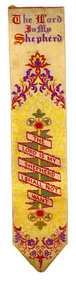
Accessory - Bookmark, Adam And Charles Black, The English Lakes and Religious Bookmark, 1949
... variety as to appeal to all tastes. The earliest productions seem to have been bookmarkers... The pictures included portraits of celebrities and local scenes, scriptural texts, hymns and psalms, and verses from the poets. Stevens also introduced to the Admiralty a hat ribbon with the name of the ship woven in gold wire. This he patented; it was adopted and for many years the firm was the sole supplier to the Admiralty Contracts Department. https://stevengraphs.com/thomstevandh.html Also found in the book was a small card with dried flowers...variety as to appeal to all tastes. The earliest productions seem to have been bookmarkers... The pictures included portraits of celebrities and local scenes, scriptural texts, hymns and psalms, and verses from the poets. Stevens also introduced to the Admiralty a hat ribbon with the name of the ship woven in gold wire. This he patented; it was adopted and for many years the firm was the sole supplier to the Admiralty Contracts Department. https://stevengraphs.com/thomstevandh.html Also found in the book was a small card with dried flowers ...This bookmark was found in a book called 'The English Lakes' owned by Elizabeth Chatham-Holmes. The bookmark is a Stevenograph. In 1854 Thomas Stevens began with weaving plain and fancy ribbons, but was soon experimenting with a development of jacquard weaving to produce pictures. For this, the picture was plotted on squared paper, in the fashion of a cross-stitch embroidery design, and a large card then perforated to represent each colour appearing in every "line" of the picture. The cards, arranged in an endless chain and attached to the loom, controlled the manipulation of the warp threads. Each time the shuttle crossed the loom a different card came into use, changing the arrangement of the warp threads and, consequently, the pattern woven..When the industry collapsed in 1860, Stevens determined to make use of his experiments by producing pictures in such variety as to appeal to all tastes. The earliest productions seem to have been bookmarkers... The pictures included portraits of celebrities and local scenes, scriptural texts, hymns and psalms, and verses from the poets. Stevens also introduced to the Admiralty a hat ribbon with the name of the ship woven in gold wire. This he patented; it was adopted and for many years the firm was the sole supplier to the Admiralty Contracts Department. https://stevengraphs.com/thomstevandh.html Also found in the book was a small card with dried flowers glued with the words 'Flowers from the Holy Land' and a WW2 photograph of the bust of a man in uniform with a cap..1) Red hard covered book called 'The English Lakes' by W.T. Palmer. .2) Woven silk bookmark with white (now cream) and yellow background and red, purple, green and yellow detail and the start of Psalm 23 woven into the bookmark. Possibly made in the late nineteenth century. .3) Small card with dried flowers glued with the words Flowers from the Holy Land .4) WW2 photograph of the bust of a man in uniform with a cap. .1) Inside front cover "E.S. Holmes Ascot" .2) Woven into the bookmark - The Lord is my Shepard I shall not want, & T. Stevens, Coventry .3) Printed on the front - Flowers from the Holy Land, Placed on the Holy Sepulchreholmes, ec holmes, ascot, religious, religion, bookmark, english lakes, w.t. palmer, chatham-holmes collection, flowers from the the holy land, stevengraph -
 Flagstaff Hill Maritime Museum and Village
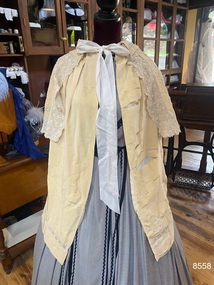
Clothing - Double Cape with Collar
... flower pattern most likely made of a combination of silk and cotton. The cape material appears to be a cream ribbed silk with the lining being of a polished cotton or silk variety. ...flower pattern most likely made of a combination of silk and cotton. The cape material appears to be a cream ribbed silk with the lining being of a polished cotton or silk variety. ...The cape is of a style from the Victorian or the Edwardian Era and so provides a good example of women's clothing from that time. The light colour, silk material and lace suggest a cape used for special occasions with the possibility of initially being a wedding cape.The item is of significance historically and socially as an example of women's clothing in the Victorian and Edwardian eras.Ladies cape consisting of two circular tiers and a collar. The inner tier is knee length with a thin lace insert around the hem. The outer tier is elbow length with a wide lace edge and the thin lace insert inside this. The collar has lace edging and a lace insert of the same width. The lace used is of a repeat flower pattern most likely made of a combination of silk and cotton. The cape material appears to be a cream ribbed silk with the lining being of a polished cotton or silk variety. Both materials have a silken sheen in the right light. A silk ribbon ties the cape at the neck. The lining and lace have been sewn with fine hand stitching.flagstaff hill, warrnambool, maritime village, maritime museum, flagstaff hill maritime museum and village, shipwreck coast, great ocean road, ladies cape, double cape, silk cape, layered cape, cape with lace collar, decorative lace edging, victorian era, edwardian era -
 Flagstaff Hill Maritime Museum and Village
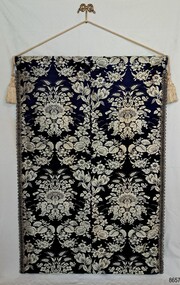
Textile - Wall Hanging, curtain, 1854-1855
... The carpets are of various coloured velvet pile, and the curtains are of satin damask, lined with white satin … The fronts of the berths are highly decorated, and festoons of flowers are painted on the panels … No two berths are furnished with the same-coloured material … the visitor is, therefore, much pleased with the variety which he has to inspect….” ...The carpets are of various coloured velvet pile, and the curtains are of satin damask, lined with white satin … The fronts of the berths are highly decorated, and festoons of flowers are painted on the panels … No two berths are furnished with the same-coloured material … the visitor is, therefore, much pleased with the variety which he has to inspect….” ...The striking fabric of this wall hanging was recovered from the sinking Schomberg. It was originally one of the many curtains adorning the captain’s cabin and ladies’ saloons that attracted first-class passengers to this luxury vessel, built for comfort and speed. The clipper ship was on its maiden voyage, full of passengers emigrating to Australia in 1855. Its commander was Captain James Nicol Forbes, who had been selected by James Baine & Co for his navigation skills, experience, and reputation for breaking sailing records. However, on December 26th, 1855, the vessel became stranded and sank west of Cape Otway, not quite reaching its destination of Melbourne. A reporter explored the Schomberg before its journey; the following detailed description is an excerpt of his article published in a newspaper after the disastrous voyage was announced. “ … descending by a flight of stairs, covered with carpet of a very rich pattern, we came to the saloon passengers’ cabin. This is a noble place, and all that refined taste would suggest has been done to make each berth a miniature palace. The bedding is of the very best material, and the fittings are replete with every convenience. The carpets are of various coloured velvet pile, and the curtains are of satin damask, lined with white satin … The fronts of the berths are highly decorated, and festoons of flowers are painted on the panels … No two berths are furnished with the same-coloured material … the visitor is, therefore, much pleased with the variety which he has to inspect….” (Trove: Shipping Gazette and Sydney General Trade, 31 Dec 1955, p. 283) The curtain material, ‘folded into a single piece and parcelled for protection’, has been passed down through generations of Captain Forbes’ relatives, starting with his half-sister Isabella Jeffrey Nicol. The curtain has remained with the family, although some transition details are incomplete. About a century later, Isabella and Blakiston Robinson’s great-grandson and his wife had the fabric professionally mounted as a wall hanging to showcase the beauty of the woven brocade. Eventually, the custodianship of the curtain was transferred to the donor, who is also a great-grandson of Isabella and Blakiston. He and his wife hung the curtain on the wall of a high-ceilinged room in their home, away from direct light, making it visible for all to appreciate its beauty and significance. In 2024, they donated the curtain for inclusion among the collection of artefacts that help tell the story of the Schomberg and those who sailed on its first and last voyage. The donor’s aunt was highly involved in the family’s history. She had collected and recorded information that dates back to pre-1341. A footnote included in a handwritten letter dated April 20, 1959, from the late Arthur William Rudd, OBE, MA, LLB, husband of another of the donor’s aunts, states, “The curtains you mentioned came from the Schomberg. AWR.” CAPTAIN JAMES NICOL FORBES (1821-1874) and the donor’s family: - Captain Forbes was born in Aberdeen. In his late teens, he moved to Liverpool, a hub for international trade and an emigration port. By the age of 25, he was master of the Prince of Waterloo and later, the Wakefield. He then commanded the Cleopatra for the James Baines Co., which, two years later, transferred him to command the Maria, providing fast and lucrative passage to the gold fields in Ballarat, Australia. James Baines Co. and shipbuilder Thomas Mackay formed the Black Ball Line of clipper ships in 1852. Forbes was appointed master of the largest ship in the fleet, the marvellous Marco Polo. He broke the record time for the passage to Australia, taking only 68 days at sea, and the return journey in only 76 days, a total of 5 months and 21 days. On his second voyage to Melbourne in the Marco Polo the following year, he took 75 days, and 95 days on the return trip. His accomplishment made him famous. James Baines reported that the Marco Polo was the only ship, sail or steam, to do the round trip within 6 months, and it had done it twice. Captain Forbes then took command of the American-built clipper Lightning, one of four built for the Black Ball line. His 19-year-old half-sister, Isabella Jaffray Nicol, was also onboard when he sailed for Melbourne in 1854. During the 77-day voyage, Isabella met Blakiston Robinson, and not long after the ship arrived in Melbourne on July 31, the couple married, with James Nicol Forbes as a witness, on August 16. When Forbes returned to Liverpool, he took a record-breaking 63 days, which has never been bettered. James Baines Co. ordered a new luxury emigrant ship from Alexander Hall of Aberdeen; the Schomberg was the largest sailing ship ever built in Britain. On October 6, 1855, the vessel departed Liverpool commanded by Captain Forbes, with 430 passengers on board, 54 of whom were First Class. It had almost completed its voyage to Melbourne when, on the night of December 26, it ran aground west of Cape Otway. Captain Doran, master of the steamer Queen, responded to the distress signal while on its way to Portland and, with the agreement of his passengers, rescued as many as possible from the Schomberg and returned to Melbourne with them. Captain Helpman, master of the steamer Champion, rescued most of the remaining Schomberg passengers on December 27. On Friday, 28th, Captain James Lawrence was on his way to Adelaide in the steamer Burra Burra, and called past the Schomberg. He reported that the remaining crew were all doing their duties, but the Schomberg was deteriorating on a sand spit and had about 16 feet of water in its hold. That same day, the schooner Jane Elizabeth collected 220 packages of passengers’ luggage to deliver to Melbourne on the 29th. Two steamers also arrived on the 29th with 20 men to collect passengers’ luggage and valuable ship’s cargo items. They were accompanied by water police, customs agents, company representatives and a Lloyds agent. The decision was made to abandon ship on the 30th due to rough and unsafe conditions. The officials and Captain Forbes voyaged to Melbourne, while the seamen remained behind awaiting rescue. Evacuation by sea became too risky, so on January 2, 1856, while the first Mate and Steward remained at the wreck site, the rest of the crew began the 70-mile march to Warrnambool, led by the band. They arrived on January 5th and left for Melbourne on the steamer Champion on January 10th. Parts of the Schomberg wreck ended up in New Zealand. The curtain is important for its connection to the Schomberg, which was unique for being designed and built in Aberdeen, and commanded by an Aberdonian who was the most celebrated clipper captain of the age. The ship was the largest sailing ship ever built in Britain, and reported as the largest vessel that sailed to Australia. The curtain is an example of the rich decorative furnishings available in 1855. The preservation and respect the donor and his family have shown towards the curtain over many decades reflect its important role in telling the family’s history; the journey, the romantic attachment, the family connection to the sea, and travel in gold rush times. The curtain is significant for its connection to James Nocol Forbes, a famous sailing ship commander who broke several sailing records, one of which has never been bettered. This wall hanging, also known as the Schomberg Curtain, was created from a curtain recovered from the stranded luxury ship Schomberg in December 1855. The woven satin damask fabric in blue and cream has been meticulously joined to blend the intricate pattern. The reverse features a soft cream lining. The hems at the top and bottom of the fabric hold wooden rods. The side edges feature decorative braid that has been hand-stitched in place. On the reverse, the bottom hem includes the same braid, which remains unseen from the front, and the centre of the top hem has a hand-worked, unused buttonhole. Each of the hems varies in depth. The curtain was tastefully mounted later to highlight the beauty of the original saloon curtain. A decorative twisted cord of cream silk threads, accented with gold highlights and decorative tassels, was coiled and attached to the ends of the top rod. The elegant display was completed with an ornate gold hook, chosen to complement the wall hanging.flagstaff hill maritime museum and village, great ocean road, shipwreck coast, shipwreck artefact, memorabilia, curtain, saloon curtain, schomberg, wall hanging, decorative object, domestic item, warrnambool, flagstaff hill, maritime museum, maritime village, maritime history, shipwreck, stranding, schomberg curtain, schomberg wall hanging, luxury ship, 1855, damask, silk damask, blue and cream, captain’s cabin, ladies’ saloon, clipper ship, migrant, emigrant, liverpool to australia, captain james nicol forbes, james forbes, captain forbes, bully forbes, james baines & co, james baines, cape otway, aberdeen, prince of waterloo, wakefield, cleopatra, maria, thomas mackay, black ball line, marco polo, sailing record, lightning, isabella jaffray nocol, blakiston robinson, alexander hall, steamer queen, captain helpman, james lawrence, steamer burra burra, steamer jane elizabeth, water police, customs agents, lloyds agent, ship’s band, walk to warrnambool, march to warrnambool, steamer champion, agnes nicol robinson, arthur william rudd obe ma llb -
 Flagstaff Hill Maritime Museum and Village
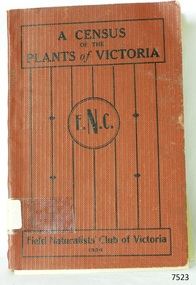
Book - Referance Book, Field Naturalist Club of Victoria, A Census of The Plants of Victoria, 1928
... varieties and their distribution in the Australian State of Victoria. This second edition was published by the Field Naturalists' Club of Victoria, and printed in Melbourne. It contains indexes to aid the students, botanists and plant enthusiasts in their search for information. Label on spine cover with typed text R.A. 581 CEN Front cover: "(F.N.C.V.) within a circle" Fly page: "[flower ...The book, 'A Census of the Plants of Victoria', is a comprehensive reference book of plant varieties and their distribution in the Australian State of Victoria. This second edition was published by the Field Naturalists' Club of Victoria, and printed in Melbourne. It contains indexes to aid the students, botanists and plant enthusiasts in their search for information.Orange-brown front cover with black printed text, vertical lines and rectangular borders around the upper title, and lower publishing group, and a central circular logo of the publishing group, Field Naturalists' Club of Victoria. Title: (in full) A Census of the Plants of Victoria With their Regional Distributions and the Vernacular Names as adopted by the Plant Names Committee of the Field Naturalists' Club of Victoria. Publisher: Field Naturalists Club of Victoria Edition: Second Edition Date: 1928non-fictionThe book, 'A Census of the Plants of Victoria', is a comprehensive reference book of plant varieties and their distribution in the Australian State of Victoria. This second edition was published by the Field Naturalists' Club of Victoria, and printed in Melbourne. It contains indexes to aid the students, botanists and plant enthusiasts in their search for information.warrnambool, shipwreck coast, flagstaff hill maritime museum, flagstaff hill maritime village, book, a census of the plants of victoria, field naturalists' club of victoria, plant names, plant species, distribution of plants, victoria's plants, plant identification -
 Ringwood and District Historical Society
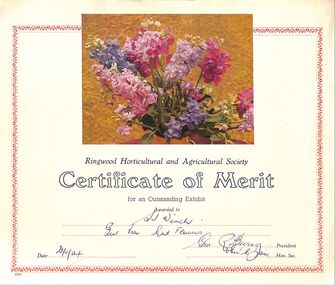
Certificate, Set of 6 certificates of Merit for outstanding exhibits at the Ringwood Horticultural & Agricultural Society - 1954-1971, 1954 - 1971
... 6 certificates awarded to S.Winch for vases of cut flowers (23-Oct-1954); equal best exhibit - Fuchsia Section - 12-Mar-1966 (2 certs), Best exhibit Fuchsia Section (13-May-1967), Double Fuchsias 3 varieties (8-May-1971) & exhibit in Fuchsia Section (6-Mar-1971)...6 certificates awarded to S.Winch for vases of cut flowers (23-Oct-1954); equal best exhibit - Fuchsia Section - 12-Mar-1966 (2 certs), Best exhibit Fuchsia Section (13-May-1967), Double Fuchsias 3 varieties (8-May-1971) & exhibit in Fuchsia Section (6-Mar-1971) Ringwood Horticultural & Agricultural Society Certificates of Merit for outstanding exhibits Set of 6 certificates of Merit for outstanding exhibits at the Ringwood Horticultural & Agricultural Society: 3 buff coloured with blue lettering, 3 white with blue lettering - each with a picture of flowers. ...6 certificates awarded to S.Winch for vases of cut flowers (23-Oct-1954); equal best exhibit - Fuchsia Section - 12-Mar-1966 (2 certs), Best exhibit Fuchsia Section (13-May-1967), Double Fuchsias 3 varieties (8-May-1971) & exhibit in Fuchsia Section (6-Mar-1971)Set of 6 certificates of Merit for outstanding exhibits at the Ringwood Horticultural & Agricultural Society: 3 buff coloured with blue lettering, 3 white with blue lettering - each with a picture of flowers. +Additional Keywords: S Winch(5) and D HollowayRingwood Horticultural & Agricultural Society Certificates of Merit for outstanding exhibits -
 Ringwood and District Historical Society
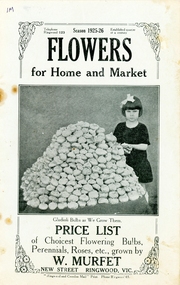
Booklet, W Murfet Flower Catalogue and Price List 1925-6 season
... varieties of bulbs and flowering plants, including information of growing season, height, planting instructions, and cost per dozen or by the hundred. The goods could be delivered by rail or post, within Australia, at the purchaser's risk and expense. The booklet was printed at the "Ringwood and Croydon Mail" office (Adelaide Street), phone 65. 20-page booklet containing price list for bulbs, flowers ...20-page booklet containing price list for bulbs, flowers and plants grown by W Murfet, New Street, RingwoodSeason 1925-26. Telephone Ringwood 123. Contains details of dozens of varieties of bulbs and flowering plants, including information of growing season, height, planting instructions, and cost per dozen or by the hundred. The goods could be delivered by rail or post, within Australia, at the purchaser's risk and expense. The booklet was printed at the "Ringwood and Croydon Mail" office (Adelaide Street), phone 65. -
 Flagstaff Hill Maritime Museum and Village
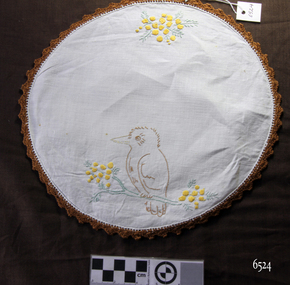
Textile - Doily, c. 1910
... flowers and leaves reflects the creator's interest in Australian flora and fauna. In the Words of donor, Betty Stone, … “These crocheted and embroidered articles cover a period of three generations- ie. Sarah (nee Chamberlain) Lees, Ann (nee Lees) Dale, and Daisy Elvena (nee Dale) Welsh. All three were accomplished needlewomen; also, both Sarah Lees (born 1844) and her daughter, Ann (b 1865) crocheted a wide variety...flowers and leaves reflects the creator's interest in Australian flora and fauna. In the Words of donor, Betty Stone, … “These crocheted and embroidered articles cover a period of three generations- ie. Sarah (nee Chamberlain) Lees, Ann (nee Lees) Dale, and Daisy Elvena (nee Dale) Welsh. All three were accomplished needlewomen; also, both Sarah Lees (born 1844) and her daughter, Ann (b 1865) crocheted a wide variety ...This doily is typical of items of household linen in popular use in the 19th and early-to-mid 20th centuries. It was a tradition for brides to have a 'glory box' containing linen and embroidered and crocheted articles to take to their new home. The chosen design of Kookaburra and wattle flowers and leaves reflects the creator's interest in Australian flora and fauna. In the Words of donor, Betty Stone, … “These crocheted and embroidered articles cover a period of three generations- ie. Sarah (nee Chamberlain) Lees, Ann (nee Lees) Dale, and Daisy Elvena (nee Dale) Welsh. All three were accomplished needlewomen; also, both Sarah Lees (born 1844) and her daughter, Ann (b 1865) crocheted a wide variety of articles for use in their homes. A few examples of these items have survived the years.” (NOTE: For additional information please refer to my book Pioneer and Places- A History of Three Warrnambool Pioneering Families ie. Chamberlain, Dale and Lees families) This item is associated with the Warrnambool pioneer families of Chamberlain, Dale and Lees. These families are listed in the Pioneers' Register for Warrnambool Township and Shire, 1835-1900, published by A.I.G.S. Warrnambool Branch. The item is a fine example of early 20th-century needlework. It is also significant for its reflection on the new Australian fauna and flora.Doily, round, white cotton. Embroidered Kookaburra on a branch, wattle flowers and leaves, and edged with brown crochet. From the Chamberlain Dale Lees Collectionflagstaff hill, warrnambool, flagstaff hill maritime museum and village, great ocean road, chamberlain family, dale family, lees family, betty stone, warrnambool pioneer, warrnambool genealogy, wangoom, chamberlain dale lees collection, glory box, doily, embroidery, needlework, crochet, handmade, craft, manchester, linen, haberdashery, kookaburra, wattle, australiana -
 Flagstaff Hill Maritime Museum and Village
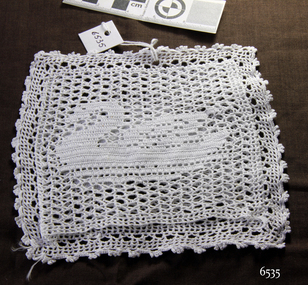
Textile - Lavender Bag, ca 1910
... flowers and leaves were used to add fragrance to linen and clothing. They were also used to repel insects and help preserve the textile pieces. Fragrant bags were used to freshen the air in rooms and even as a deodorant inside special pockets in ladies' undergarments. In the Words of donor, Betty Stone, … “These crocheted and embroidered articles cover a period of three generations- ie. Sarah (nee Chamberlain) Lees, Ann (nee Lees) Dale, and Daisy Elvena (nee Dale) Welsh. All three were accomplished needlewomen; also, both Sarah Lees (born 1844) and her daughter, Ann (b 1865) crocheted a wide variety...flowers and leaves were used to add fragrance to linen and clothing. They were also used to repel insects and help preserve the textile pieces. Fragrant bags were used to freshen the air in rooms and even as a deodorant inside special pockets in ladies' undergarments. In the Words of donor, Betty Stone, … “These crocheted and embroidered articles cover a period of three generations- ie. Sarah (nee Chamberlain) Lees, Ann (nee Lees) Dale, and Daisy Elvena (nee Dale) Welsh. All three were accomplished needlewomen; also, both Sarah Lees (born 1844) and her daughter, Ann (b 1865) crocheted a wide variety ...Small decorative bags containing dried lavender, rose petals and other fragrant flowers and leaves were used to add fragrance to linen and clothing. They were also used to repel insects and help preserve the textile pieces. Fragrant bags were used to freshen the air in rooms and even as a deodorant inside special pockets in ladies' undergarments. In the Words of donor, Betty Stone, … “These crocheted and embroidered articles cover a period of three generations- ie. Sarah (nee Chamberlain) Lees, Ann (nee Lees) Dale, and Daisy Elvena (nee Dale) Welsh. All three were accomplished needlewomen; also, both Sarah Lees (born 1844) and her daughter, Ann (b 1865) crocheted a wide variety of articles for use in their homes. A few examples of these items have survived the years.” It was a tradition for brides to have a 'glory box' containing linen and embroidered articles to take to their new home. Many of the items were made by Daisy, a skilled dressmaker. Daisy began her apprenticeship at two shillings and sixpence per week at Miss A. E. Emery's dressmaking establishment at 150-152 Liebig Street, Warrnambool. Considered to be the leading house of fashion in Warrnambool, Miss Emery employed about eight young women who worked long hours to sew elaborate gowns for clients, including wives of graziers who would attend the race carnivals and social functions in Warrnambool. (NOTE: For additional information please refer to my book Pioneer and Places- A History of Three Warrnambool Pioneering Families ie. Chamberlain, Dale and Lees families)This item is associated with the Warrnambool pioneer families of Chamberlain, Dale and Lees. These families are listed in the Pioneers' Register for Warrnambool Township and Shire, 1835-1900, published by A.I.G.S. Warrnambool Branch. The item is significant for its association with a ‘glory box’ or hope chest’, a tradition of single ladies making and collecting a range of linen and other domestic items in preparation for their future marriage. The item is a fine example of early 20th-century needlework and handmade domestic items.Lavender bag, white crocheted squares, back to back, with a border and a swan design incorporated in crochet. Part of the Chamberlain Dale Lees Collection.flagstaff hill, warrnambool, flagstaff hill maritime museum and village, great ocean road, chamberlain family, dale family, lees family, betty stone, warrnambool pioneer, warrnambool genealogy, wangoom, chamberlain dale lees collection, glory box, handmade, craft, manchester, linen, haberdashery, needlework, crochet, lavender bag, fragrant bag, insect repellant -
 Flagstaff Hill Maritime Museum and Village
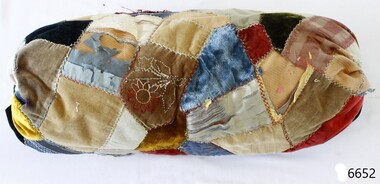
Craft - Cushion, Sarah Jane Jones (nee Emerson), 1898
... Bolster or sausage shaped patchwork cushion with irregularly shaped patches of a variety of design and fabric. A flower and stem are embroidered on one patch. ...Flagstaff Hill Flagstaff Hill Maritime Museum and Village Warrnambool Maritime Museum Maritime Village Great Ocean Road Shipwreck Coast cushion soft furnishing 1898 Victorian handmade patchwork craft handcraft sewing hobby needlework Bolster or sausage shaped patchwork cushion with irregularly shaped patches of a variety of design and fabric. A flower and stem are embroidered on one patch. ...This patchwork cushion was handmade in 1898 by Sarah Jane Jones (nee Emerson) and donated by her Great-Granddaughter. It is an example of needlework created in the late 19th century.The cushion is significant for is example of handmade craft and needlework used in the late 19th century for home decor.Bolster or sausage shaped patchwork cushion with irregularly shaped patches of a variety of design and fabric. A flower and stem are embroidered on one patch. The pieces are roughly joined together with visible cross stitches. Handmade by Sarah Jane Jones (nee Emerson) in 1898.flagstaff hill, flagstaff hill maritime museum and village, warrnambool, maritime museum, maritime village, great ocean road, shipwreck coast, cushion, soft furnishing, 1898, victorian, handmade, patchwork, craft, handcraft, sewing, hobby, needlework -
 Bendigo Military Museum
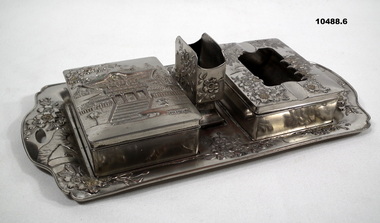
Domestic object - SMOKING SET, NIKKO, Unknown
... The flowers are of a five petal variety. Two corners have been bent back and damaged. 2. ...The flowers are of a five petal variety. Two corners have been bent back and damaged. 2. ...This smoking set was brought home by a member of BCOF, Japan. C.H. Shearing NX206537. Refer Cat No. 7089.16P for his service details.Six piece set of chromed pewter. 1. Tray, small, handles each end. Flower pattern tapped in to it or part of the mould. The flowers are of a five petal variety. Two corners have been bent back and damaged. 2. Base, ash tray. Rectangular shape with curved floor. There are some scratches and the coating is peeling. 3. Top of ash tray. Flower motifs, two channels to rest cigarettes. Pagoda on the side and bridge at bottom. 4. Match box holder, 4 sided, 2 sides raised a bit higher than the end. Rectangular base, flower motif. Some copper colour substrate shining through. 5. Base holder for packet of cigarettes. Rectangular shape with small lip around rim. The outside bottom surface has a lumpy appearance. The inside is well worn with scratches and marks. 6. Lid, cigarette packet holder. Flower motif top LH corner. A building with a wide roof in center. Two windows and a door in centre. Steps and fence under that. Bottom left has what looks like a bird home. R.H. Side possibly a lantern. Bottom right side has the word "NIKKO" embossed on it. Top is a bit worn, copper substrate coming through. There is a green tint showing on the roof of the building.smoking set, ww2, bcof, japan, c.h. shearine -
 Bendigo Historical Society Inc.
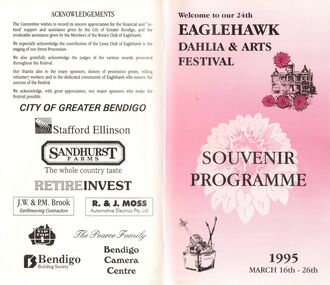
Document - DAHLIA & ARTS FESTIVAL, EAGLEHAWK, 16 March 1995
... Flower Show. Photographic Print Competition. Eaglehawk Heritage Society-Display. Bridge to Park... foot race. Street Procession. O'Shea-Ryan Bendigo Irish Dancing School and O'Shea-Ryan Academy of Irish Dance - Melbourne Performance. 2nd Seasons Fashion Show. 13th Annual Dahlia & Arts Half Marathon. Ecumenical Church Service. Picnic Lunch. Free Concert-Guinness Show Band. Cycling Criterium. Mining Heritage Tour of Eaglehawk. Dahlia Diner. Variety...Flower Show. Photographic Print Competition. Eaglehawk Heritage Society-Display. Bridge to Park, foot race. Street Procession. O'Shea-Ryan Bendigo Irish Dancing School and O'Shea-Ryan Academy of Irish Dance - Melbourne Performance. 2nd Seasons Fashion Show. 13th Annual Dahlia & Arts Half Marathon. Ecumenical Church Service. Picnic Lunch. Free Concert-Guinness Show Band. Cycling Criterium. Mining Heritage Tour of Eaglehawk. Dahlia Diner. Variety...Flower Show. Photographic Print Competition. Eaglehawk Heritage Society-Display. Bridge to Park foot race. Street Procession. O'Shea-Ryan Bendigo Irish Dancing School and O'Shea-Ryan Academy of Irish Dance - Melbourne Performance. 2nd Seasons Fashion Show. 13th Annual Dahlia & Arts Half Marathon. Ecumenical Church Service. Picnic Lunch. Free Concert-Guinness Show Band. Cycling Criterium. Mining Heritage Tour of Eaglehawk. Dahlia Diner. Variety ...Dahlia & Arts Festival, Eaglehawk.16th - 26th March, 1995. Programme. Debutante Ball (1), 'The Festival' Exhibition at the Borough Galleries. Debutant Ball (2). Art Preview and Presentation of Awards. Craft Market. Displays of Cake Decorating. Sidewalk Busking Competition. Gala Fair. Eaglehawk Fire Brigade open day. Porcelain Art and Craft Show. Art Show. Display of Memorabilia-Cornish Assoc. Static Display-Irish Assoc. Children's Multi-Dimensional Art Exhibition. Children's Photographic Display. Flower Show. Photographic Print Competition. Eaglehawk Heritage Society-Display. Bridge to Park, foot race. Street Procession. O'Shea-Ryan Bendigo Irish Dancing School and O'Shea-Ryan Academy of Irish Dance - Melbourne Performance. 2nd Seasons Fashion Show. 13th Annual Dahlia & Arts Half Marathon. Ecumenical Church Service. Picnic Lunch. Free Concert-Guinness Show Band. Cycling Criterium. Mining Heritage Tour of Eaglehawk. Dahlia Diner. Variety Concert. ''High Jinx On The High Seas''. Childrens Fancy Dress Parade. Gala Charity Old Time Ball. Brass Instrument Solo/Party Competition. 'Gardening Through The Drought'-Guided Tour. California Hill Church Open Day Craft & Devonshire Teas. Traditional Cornish Concert. 'A Time to Remember'. Annual Croquet & Bowls Tournaments. Festival Guest of Honor Mr Wayne Gregson - Journalist. Editor - Bendigo Advertiser. Festival President, Mr Noel Thomas. Vice Presidents Alan Bull, Kevin Herdman. Executive Officer Jeanette Moss. Treasurer Lorna Thomas. Acknowledgements and sponsors on back page.event, entertainment, eaglehawk dahlia & arts festival, dahlia & arts festival, eaglehawk.16th - 26th march, 1995. programme. debutante ball (1), 'the festival' exhibition at the borough galleries. debutant ball (2). art preview presentation of awards. craft market. displays of cake decorating. sidewalk busking competition. gala fair. eaglehawk fire brigade open day. porcelain art and craft show. art show. display of memorabilia-cornish assoc. static display-irish assoc. children's multi-dimensional art exhibition. children's photographic display. flower show. photographic print competition. eaglehawk heritage society-display. bridge to park, foot race. street procession. o'shea-ryan bendigo irish dancing school and o'shea-ryan academy of irish dance - melbourne performance. 2nd seasons fashion show. 13th annual dahlia & arts half marathon. ecumenical church service. picnic lunch. free concert-guinness show band. cycling criterium. mining heritage tour of eaglehawk. dahlia diner. variety concert. ''high jinx on the high seas''. childrens fancy dress parade. gala charity old time ball. brass instrument solo/party competition. 'gardening through the drought'-guided tour. california hill church open day craft & devonshire teas. traditional cornish concert. 'a time to remember'. annual croquet & bowls tournaments. festival guest of honor mr wayne gregson - journalist. editor - bendigo advertiser. festival president, mr noel thomas. vice presidents alan bull, kevin herdman. executive officer jeanette moss. treasurer lorna thomas. acknowledgements and sponsors -
 Bendigo Historical Society Inc.
Document - LYDIA CHANCELLOR COLLECTION: PICTURES
... EPHEMERA Mementoes history Lydia Chancellor collection photos pictures ephemera botany plants flowers Royal Yacht Britannia history British Royal Family royalty coronation motor car history automobile history vintage cars veteran cars birds art history architecture theatre buildings geography Adam Lindsay Gordon Australian poetry children's games Australian art Albert Namatjira Melbourne christianity religion advertisements London Tower of London Thames River Thames Brisbane Sydney boats ships events entertainment exploration heritage The Illustrated London News,' 'The Sun' and 'Woman's Day and Home A large folder containing many pictures taken from a variety of sources. ...A large folder containing many pictures taken from a variety of sources. Sources include 'The Illustrated London News,' 'The Sun' and 'Woman's Day and Home.' 1933 - 1963.The Illustrated London News,' 'The Sun' and 'Woman's Day and Homeephemera, mementoes, history, lydia chancellor, collection, photos, pictures, ephemera, botany, plants, flowers, royal yacht britannia, history, british royal family, royalty, coronation, motor car history, automobile history, vintage cars, veteran cars, birds, art history, architecture, theatre, buildings, geography, adam lindsay gordon, australian poetry, children's games, australian art, albert namatjira, melbourne, christianity, religion, advertisements, london, tower of london, thames, river thames, brisbane, sydney, boats, ships, events, entertainment, exploration, heritage -
 Bendigo Historical Society Inc.
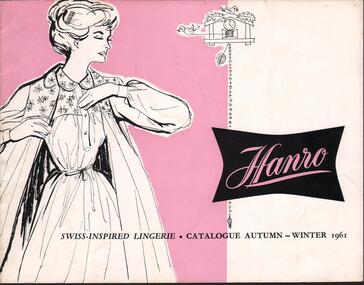
Magazine - HANRO COLLECTION: HANRO AUTUMN WINTER CATALOGUE 1961, 1961
... variety of lingerie with the items number, description, material, size, quantity and colours available on gloss paper. The last page is of yellow paper and is the suggested retail selling prices, Style, item number, sizes. On the back is Trade Price List, Style, Size Range and price. On the back of the catalogue on pink and white card is a scene of pink sky with white clouds, sketched in black ink is the Swiss Alps with a Swiss Chalet, trees, flowers...variety of lingerie with the items number, description, material, size, quantity and colours available on gloss paper. The last page is of yellow paper and is the suggested retail selling prices, Style, item number, sizes. On the back is Trade Price List, Style, Size Range and price. On the back of the catalogue on pink and white card is a scene of pink sky with white clouds, sketched in black ink is the Swiss Alps with a Swiss Chalet, trees, flowers ...The Hanro company was established in Switzerland in 1884. In 1926 a site in Hargreaves Street Bendigo, behind the School of Mines, was purchased to establish the Bendigo Knitting Mills, a subsidiary of Hanro. The managing director was Charles Handerchin who came from Switzerland. The company was delisted from the Australian Stock Exchange in 1963 when it was taken over by John Brown Industries.Hanro Autumn - Winter Catalogue 1961: The front cover is of a white and pink card background is a sketch in black ink of a lady wearing a matching night dress and dressing gown. To the right top is a sketch of a cuckoo clock. A black banner with Hanro in Pink is also to the right and across the bottom is *Swiss-inspired Lingerie . Catalogue Autumn - Winter 1961*. Inside the cover is advertising and the Index. The Catalogue consists of sketches of ladies wearing a variety of lingerie with the items number, description, material, size, quantity and colours available on gloss paper. The last page is of yellow paper and is the suggested retail selling prices, Style, item number, sizes. On the back is Trade Price List, Style, Size Range and price. On the back of the catalogue on pink and white card is a scene of pink sky with white clouds, sketched in black ink is the Swiss Alps with a Swiss Chalet, trees, flowers and a cow. In a box with a black border on a white background is *Hanro (Aust) Knitting Mills Limited. 163 Hargreaves Street, Bendigo, Victoria. 3024. Sales Offices, addresses and phone numbers of Melbourne, Sydney, Brisbane, Perth, Adelaide and Hobart. There is a sketch in black on a pink background of the Hanro factory in Switzerland *The home of World-Famous Hanro in Liestal, Switzerland*book, magazine, catalogue, hanro. catalogue -
 Bendigo Historical Society Inc.
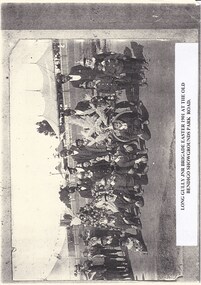
Photograph - LONG GULLY HISTORY GROUP COLLECTION: LONG GULLY JNR BRIGADE 1901
... Their is a variety of ages and they have one man with them. There is a small cart with flowers on it and another floral arrangement beside it. ...Their is a variety of ages and they have one man with them. There is a small cart with flowers on it and another floral arrangement beside it. ...Copy of a black and white photo of the Long Gully Jnr Brigade Easter 1901 at the Old Bendigo Showgrounds, Park Road.Most of the boys are dressed in uniform and wearing a variety of different hats. Their is a variety of ages and they have one man with them. There is a small cart with flowers on it and another floral arrangement beside it. The photo is taken at the Old Bendigo Showgrounds and there are tents in the background.bendigo, history, long gully history group, the long gully history group - long gully jnr brigade 1901, old bendigo showgrounds -
 Bendigo Historical Society Inc.
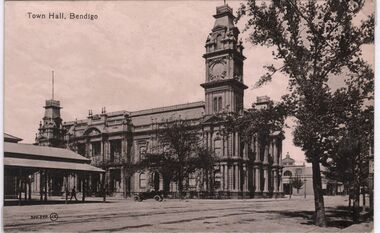
Postcard - CARWARDINE COLLECTION: TOWN HALL BENDIGO
... flowers arrived in good order. I was very pleased to get them. We were surprised to see that you had such a variety of carnations, sweet peas and marguerites also were very (illegible) Mother does not seem nearly so well she is certainly getting weaker, doctor was up again today, he said he could not prescribe anything different to what she is taking to keep up her strength' Card not signed. ...flowers arrived in good order. I was very pleased to get them. We were surprised to see that you had such a variety of carnations, sweet peas and marguerites also were very (illegible) Mother does not seem nearly so well she is certainly getting weaker, doctor was up again today, he said he could not prescribe anything different to what she is taking to keep up her strength' Card not signed. ...Black and white postcard. On top LH corner 'Town Hall, Bendigo'. Image shows two storey Town Hall building with clock tower. Corner of Market Building on LH side. Early motor vehicle ( 1920's) in front of building. Written on back of card ' 1926, Dear Alf, just a line to say that we were very pleased hearing that you got back safely. The flowers arrived in good order. I was very pleased to get them. We were surprised to see that you had such a variety of carnations, sweet peas and marguerites also were very (illegible) Mother does not seem nearly so well she is certainly getting weaker, doctor was up again today, he said he could not prescribe anything different to what she is taking to keep up her strength' Card not signed. Receipt number 355/16bendigo, business, carwardine soap and candle -
 Embroiderers Guild, Victoria
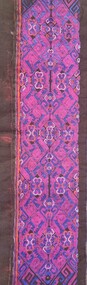
Textile - Embroidered Hmong Dress Panel
... Called "pajntaub" , which means "flower cloth", and it was traditionally practiced only by the women of the community. Using a variety of complex stitching techniques, they created intricate geometric patterns. ...Called "pajntaub" , which means "flower cloth", and it was traditionally practiced only by the women of the community. Using a variety of complex stitching techniques, they created intricate geometric patterns. ...During periods of harsh persecution, Hmong women developed a way to record their history by weaving it directly into their clothing. Called "pajntaub" , which means "flower cloth", and it was traditionally practiced only by the women of the community. Using a variety of complex stitching techniques, they created intricate geometric patterns. These designs were not just for decoration on clothes, collars and baby carriers. At times when their own language was suppressed, these symbols served as a form of communication and cultural documentation, with history hidden in the very pleats of their skirts. This tradition took on a new powerful meaning in the late 1970's after the wars in Southeast Asia. Forced into refugee camps in Thailand, Hmong women began creating "story cloths". These were larger tapestries that documented their lives, their traditions, and their harrowing journey from their homelands to the camps. These story cloths became a way to tell the world what had happened to them . They also became a vital source of income, sometimes selling for just one dollar, which helped families survive in the camps. Hmong Archives; Library of Congress. Hill Tribe clothing panel in fuchsia pinks and royal blue, with white, green, orange highlights. Embroidered in buttonhole stitch and satin stitch filling. Worked on black even weave linen. -
 Embroiderers Guild, Victoria
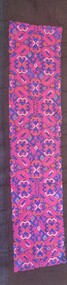
Textile - Embroidered Hmong Dress Panel
... Called "pajntaub" , which means "flower cloth", and it was traditionally practiced only by the women of the community. Using a variety of complex stitching techniques, they created intricate geometric patterns. ...Called "pajntaub" , which means "flower cloth", and it was traditionally practiced only by the women of the community. Using a variety of complex stitching techniques, they created intricate geometric patterns. ...During periods of harsh persecution, Hmong women developed a way to record their history by weaving it directly into their clothing. Called "pajntaub" , which means "flower cloth", and it was traditionally practiced only by the women of the community. Using a variety of complex stitching techniques, they created intricate geometric patterns. These designs were not just for decoration on clothes, collars and baby carriers. At times when their own language was suppressed, these symbols served as a form of communication and cultural documentation, with history hidden in the very pleats of their skirts. This tradition took on a new powerful meaning in the late 1970's after the wars in Southeast Asia. Forced into refugee camps in Thailand, Hmong women began creating "story cloths". These were larger tapestries that documented their lives, their traditions, and their harrowing journey from their homelands to the camps. These story cloths became a way to tell the world what had happened to them . They also became a vital source of income, sometimes selling for just one dollar, which helped families survive in the camps. Hmong Archives; Library of Congress. Hill Tribe clothing panel in fuchsia pinks and royal blue, with white, green, orange highlights. Embroidered in buttonhole stitch and satin stitch filling. Worked on black even weave linen. -
 Embroiderers Guild, Victoria
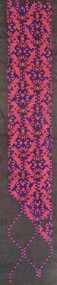
Textile - Embroidered Hmong Dress Panel
... Called "pajntaub" , which means "flower cloth", and it was traditionally practiced only by the women of the community. Using a variety of complex stitching techniques, they created intricate geometric patterns. ...Called "pajntaub" , which means "flower cloth", and it was traditionally practiced only by the women of the community. Using a variety of complex stitching techniques, they created intricate geometric patterns. ...During periods of harsh persecution, Hmong women developed a way to record their history by weaving it directly into their clothing. Called "pajntaub" , which means "flower cloth", and it was traditionally practiced only by the women of the community. Using a variety of complex stitching techniques, they created intricate geometric patterns. These designs were not just for decoration on clothes, collars and baby carriers. At times when their own language was suppressed, these symbols served as a form of communication and cultural documentation, with history hidden in the very pleats of their skirts. This tradition took on a new powerful meaning in the late 1970's after the wars in Southeast Asia. Forced into refugee camps in Thailand, Hmong women began creating "story cloths". These were larger tapestries that documented their lives, their traditions, and their harrowing journey from their homelands to the camps. These story cloths became a way to tell the world what had happened to them . They also became a vital source of income, sometimes selling for just one dollar, which helped families survive in the camps. Hmong Archives; Library of Congress. Hill Tribe clothing panel in progress in fuchsia pinks and royal blue, with white, green, orange highlights. Embroidered in buttonhole stitch and satin stitch filling. Worked on black even weave linen. -
 Uniting Church Archives - Synod of Victoria
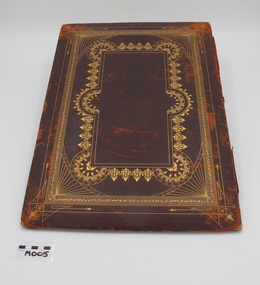
Illuminated Testimonial, Rev W Hewiston, 1895
... It is decorated with a variety of colourful flowers and an image of the Brunswick Presbyterian Church. ...It is decorated with a variety of colourful flowers and an image of the Brunswick Presbyterian Church. ...Presented to Rev Hewiston on his departure from Brunswick Presbyterian Church to the John Knox Church Dunedin New Zealand. Rev W Hewiston BA 1890 ordained Brunswick, assistant to A MacVean (McVean); 1895 Dunedin New Zealand, Knox ChurchBrown leather cover with heavily decorative gilt embossed border and text. The inside left has a richly illuminated border round the text which is addressed to the Rev & Mrs Hewiston. It is decorated with a variety of colourful flowers and an image of the Brunswick Presbyterian Church. The right side is a continuation of the testamonial from the Brunswick Presbyterian Church congregation. It is signed by the Acting Session Clerk Evander McIver; Treasurer Daniel Tough and Secretary Daniel McDougall.brunswick presbyterian church, daniel tough, rev w hewiston, rev allan macvean, john knox church dunedin new zealand, daniel mcdougall -
 Bellarine Historical Society Museum
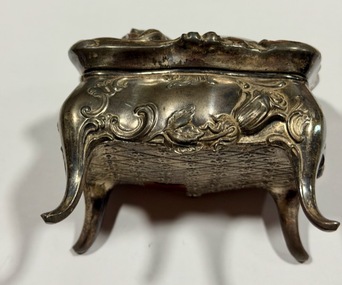
Container - Art Nouveau Silver Jewel Box, Jennings Brothers Manufacturing Company, circa 1910
... variety of objects. Each item is marked with JB and a 3-4 digit catalogue number. They went out of business in 1953. Their dies were purchased by another company to manufacture cheaper replicas of the original products. This box displays all of the typical features of a small example of this style of jewellery box or casket, particularly the elaborate Art Nouveau flower motifs decorating the lid and sides. ...Mass production of Jewelry Boxes began in the United States during the late 19th and early 20th Centuries. Jewelry boxes came in a variety of sizes. They were made of cast metal, first plated with copper, then silver or gold. They were lined with fine pale coloured silks and often trimmed with a fine twisted silk cording. The Art Metal boxes during the early 1900s in Art Nouveau style were most popular with floral motifs gaining great favour. Jennings Brothers were founded in 1890 and produced a variety of objects. Each item is marked with JB and a 3-4 digit catalogue number. They went out of business in 1953. Their dies were purchased by another company to manufacture cheaper replicas of the original products.This box displays all of the typical features of a small example of this style of jewellery box or casket, particularly the elaborate Art Nouveau flower motifs decorating the lid and sides. The diamond pattern with floral motives is unusual.Antique silver plated Art Nouveau Jewelry Box (or casket) on legs, lined with silk showing silk-corded edges.Manufactured by Jennings Brothers Company, USA. Base features diamond shapes with floral motive in each shape.Base bears the initials JB near bottom left leg and number 113 near top right leg. 'M' scratched in one shape on base.art nouveau -
 Embroiderers Guild, Victoria
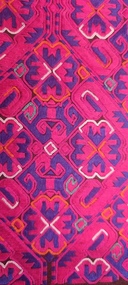
Textile - Embroidered Hmong Dress Panel
... Called "pajntaub" , which means "flower cloth", and it was traditionally practiced only by the women of the community. Using a variety of complex stitching techniques, they created intricate geometric patterns. ...Called "pajntaub" , which means "flower cloth", and it was traditionally practiced only by the women of the community. Using a variety of complex stitching techniques, they created intricate geometric patterns. ...During periods of harsh persecution, Hmong women developed a way to record their history by weaving it directly into their clothing. Called "pajntaub" , which means "flower cloth", and it was traditionally practiced only by the women of the community. Using a variety of complex stitching techniques, they created intricate geometric patterns. These designs were not just for decoration on clothes, collars and baby carriers. At times when their own language was suppressed, these symbols served as a form of communication and cultural documentation, with history hidden in the very pleats of their skirts. This tradition took on a new powerful meaning in the late 1970's after the wars in Southeast Asia. Forced into refugee camps in Thailand, Hmong women began creating "story cloths". These were larger tapestries that documented their lives, their traditions, and their harrowing journey from their homelands to the camps. These story cloths became a way to tell the world what had happened to them . They also became a vital source of income, sometimes selling for just one dollar, which helped families survive in the camps. Hmong Archives; Library of Congress. Hill Tribe clothing panel in fuchsia pinks and royal blue, with white, green, orange highlights. Embroidered in buttonhole stitch and satin stitch filling. Worked on black even weave linen. -
 Embroiderers Guild, Victoria
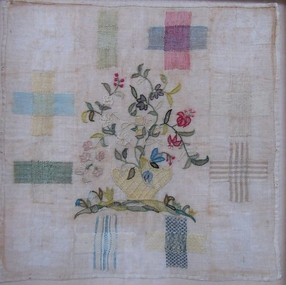
Textile - Darning Sampler, Late 18th/early 19th century
... It shows examples of fine darning in silk with a variety of patterns suitable for the mending of household linen. A number of squares and crosses surround a central motif of flowers in a basket in pattern darning and outline stitch. ...It shows examples of fine darning in silk with a variety of patterns suitable for the mending of household linen. A number of squares and crosses surround a central motif of flowers in a basket in pattern darning and outline stitch. ...A fine example of a darning sampler. It shows examples of fine darning in silk with a variety of patterns suitable for the mending of household linen. A number of squares and crosses surround a central motif of flowers in a basket in pattern darning and outline stitch. Wooden frame.embroidery, darning, samplers, early 19th century, england -
 Embroiderers Guild, Victoria
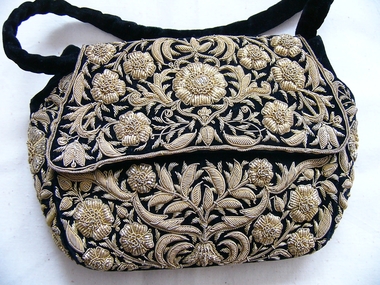
Accessory - Indian Goldwork Handbag, Early 20th century
... Intricate design on flowers in very typical of the variety of metal threads. Velvet handles with black silk lining with press-studs in both corners of the flap. ...Intricate design on flowers in very typical of the variety of metal threads. Velvet handles with black silk lining with press-studs in both corners of the flap. ...Known as Karchob it is divided into 2 types of gold embroidery: 1. Key Aspects of Zardozi Embroidery: Origin and Meaning: The term "Zardozi" comes from the Persian words "zar" (gold) and "dozi" (embroidery), literally meaning "sewing with gold". Materials Used: Traditionally, threads were made of pure gold or silver, but modern zardozi typically uses copper wires with a gold or silver polish, often blended with silk threads, sequins, and crystals. The Process: Adda: The fabric is stretched tightly over a wooden frame, known as an adda, to facilitate precise, delicate work. Aari Needle: Artisans often use a hook-ended needle, similar to a crochet needle, called an aari, to make intricate stitches. Techniques: Specialized techniques include Dabka (coiled wire) and Kasab (twisted wire) to create raised, three-dimensional motifs. Common Motifs: Designs often feature intricate floral patterns, leaves, paisley, and geometric shapes inspired by nature and architecture. 2. Key details about Kamdani embroidery: Technique: It is often called a "lighter version" of Zardozi. It involves using a needle to insert flat metallic wires (badla) through the fabric, making tiny stitches that sparkle, often creating dots, paisleys, or floral patterns. Origin: The craft originated in the Indian subcontinent, specifically developing in Lucknow, India. Materials: Originally done with pure gold or silver threads, modern Kamdani often uses synthetic metallic threads or beads for affordability. Application: It is commonly featured on luxurious textiles, including georgette, chiffon, and cotton, frequently worn as formal wedding wear (sarees, dupattas, and kurtas). Types of Work: It is often referred to by related terms such as Mukaish, Badla, or Fardi work.Gold embroidery all over bag except under flap. Intricate design on flowers in very typical of the variety of metal threads. Velvet handles with black silk lining with press-studs in both corners of the flap. Decorative beaded tassel at base. Intricate design of flowers in typical design known as Karchob.embroidery, bags, 1900-20, india, goldwork -
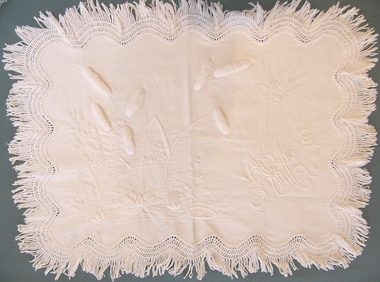 Embroiderers Guild, Victoria
Accessory - Sachet, Late 19th century
... Design is passion-fruit flowers, leaves and brambles in a variety of stitches. The sachet is edged in long and short buttonhole stitch and the decorative fringe which usually edges this work has been cut away....Design is passion-fruit flowers, leaves and brambles in a variety of stitches. The sachet is edged in long and short buttonhole stitch and the decorative fringe which usually edges this work has been cut away. ...White satin jean. Design is passion-fruit flowers, leaves and brambles in a variety of stitches. The sachet is edged in long and short buttonhole stitch and the decorative fringe which usually edges this work has been cut away.embroidery, mountmellick, late 19th century, ireland -
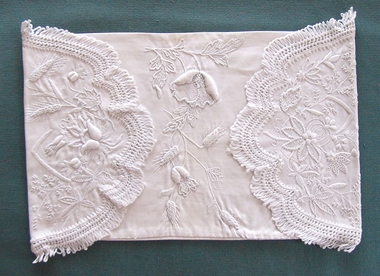 Embroiderers Guild, Victoria
Accessory - Mount Mellick Sachet, Mid to late 19th century
... Bold design of passion fruit flowers and leaves in a variety of stitches....Bold design of passion fruit flowers and leaves in a variety of stitches. Accessory Mount Mellick Sachet ...Gifted by the Misses Walsh and their late Aunt Miss E. Walsh (member). One of a pair (no. 433) The Misses Walsh, ran an exclusive children's wear shop 'The Nursery' in Little Collins in the 1930's and 1940's. Towards the end of the 1940's the shop closed. Sachet for stockings. White cotton satin jean with white embroidery and knitted fringe. Lozenge shaped with a flap. Bold design of passion fruit flowers and leaves in a variety of stitches.embroidery, mountmellick, ireland, late 19th century, sachet
