
Showing 118 items matching "growing annuals"
-
 Tatura Irrigation & Wartime Camps Museum
Book, Yates Annual 1941, 1941
... ...growing annuals...Yates Annual 1941 Catalogue yates garden catalogue growing roses growing annuals On front cover photograph of colourful columbines on banks of Derwent River Tasmania. ...On front cover photograph of colourful columbines on banks of Derwent River Tasmania. On back cover colour photograph of best six roses for 1941. Information about Yates seeds, plants and bulbs.yates garden catalogue, growing roses, growing annuals -
Federation University Historical Collection
Book - Book - Scrapbook, Ballarat College of Advanced Education: Scrapbook of newspaper cutting, Book 5; March 1979 to August 1979
... The cuttings cover the period from 21 March 1979 to 4 August 1979. . employment advertisements application for enrolment outline of courses scholarships for bcae students western mining corporation gunther jahnks stephen fernee jim stringer robert withers former student earthquakes new men at bcae geoff westcott garry kinnane jeffrey leeuwenberg study of muscle power dr alan roberts mark heuston new at bcae cao duc thac - school of business bruce cossins - civil engineering val lloyd - librarianship department prof hilda elkins - librarianship department for 6 months community support vital to colleges inquiry committee in ballarat growing concern for sports injuries shortage of qualified metallurgists 400 graduate graeme jeffries engineering accountancy prize to belinda tantau john wach appointed to mt stromlo observatory energy seminar minister for minerals and energy teacher union may put ban on bcae bcae director replies bcae indoor sports facilities popular chemical institute branch formed great hall takes shape educationalists in ballarat another degree for frank hurley dr mosley on barrier reef posters depict conservation bcae gets gift of logo bcae's first annual council meeting pilot fatigue significant factor management training - business survey better decision makers industrial safety engineering heritage display why people take risks vtu boycott suspended prof david klein u.s.a. prof praises bcae course swimming instructors 2-day course david jelbart retires gunther jahnke wins arblaster award bcae library expands regional colleges Book with grey cover, front. ...Newspaper cuttings relating to Ballarat College of Advanced Education. These are from various newspapers and include The Age, Ballarat Courier, The Australian, The Herald. The cuttings cover the period from 21 March 1979 to 4 August 1979. . Book with grey cover, front. Spiral bound.employment advertisements, application for enrolment, outline of courses, scholarships for bcae students, western mining corporation, gunther jahnks, stephen fernee, jim stringer, robert withers former student, earthquakes, new men at bcae, geoff westcott, garry kinnane, jeffrey leeuwenberg, study of muscle power, dr alan roberts, mark heuston, new at bcae, cao duc thac - school of business, bruce cossins - civil engineering, val lloyd - librarianship department, prof hilda elkins - librarianship department for 6 months, community support vital to colleges, inquiry committee in ballarat, growing concern for sports injuries, shortage of qualified metallurgists, 400 graduate, graeme jeffries engineering, accountancy prize to belinda tantau, john wach appointed to mt stromlo observatory, energy seminar, minister for minerals and energy, teacher union may put ban on bcae, bcae director replies, bcae indoor sports facilities popular, chemical institute branch formed, great hall takes shape, educationalists in ballarat, another degree for frank hurley, dr mosley on barrier reef, posters depict conservation, bcae gets gift of logo, bcae's first annual council meeting, pilot fatigue significant factor, management training - business survey, better decision makers, industrial safety, engineering heritage display, why people take risks, vtu boycott suspended, prof david klein u.s.a., prof praises bcae course, swimming instructors 2-day course, david jelbart retires, gunther jahnke wins arblaster award, bcae library expands, regional colleges -
 City of Moorabbin Historical Society (Operating the Box Cottage Museum)
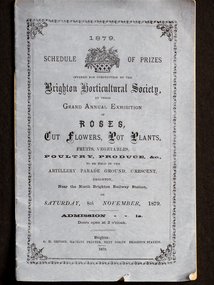
Booklet - Schedule Booklet, horticultural prizes, "1879 Schedule of Prizes Brighton Horticultural Society", 1879
... Their produce was sold at the St Kilda and Melbourne Markets for the growing population of Melbourne melbourne keys robert trophy leader newspaper leader cup brighton silver moorabbin bentleigh markets dendy henry st kilda bent thomas market gardens brighton horticultural society fruit gardens banks chartered "1879/ SCHEDULE OF PRIZES/OFFERED FOR COMPETITION BY THE/ BRIGHTON HORTICULTURAL SOCIETY,/ AT THEIR/ GRAND ANNUAL EXHIBITION/ OF / ROSES,/ CUT FLOWERS, POT PLANTS,/ FRUITS, VEGETABLES,/ POULTRY, PRODUCE, &c.,/TO BE HELD IN THE/ ARTILLERY PARADE GROUND, CRESCENT, / BRIGHTON,/ Near the North Brighton Railway Station, / ON / SATURDAY, 8th NOVEMBER, 1879./ ADMISSION 1s. / Doors open at 2 o'clock. / Brighton: / G. ...This booklet from 1879 was given to the Moorabbin Historical Society when the Robert Keys Leader Cup Trophy, 1882-1883 was re-discovered at 'Box Cottage' Museum in 2009. The Leader Cup Trophy, MAV 00001, is also itemised in this booklet (p9) The Leader Newspaper offered the 'Silver Cup, value Five Guineas for the best fruit garden in the Brighton District. The Proprietors of the English, Scottish and Australian Chartered Bank offered an second prize of three Guineas Commencing in 1856, the Brighton Horticultural Society only disbanded in 2009, and most of their archival holdings were given to the Brighton Historical Society. This booklet gives a good idea of the large varieties of plants, poultry and the skills of the pioneer settlers of the Brighton District.This Booklet describes the Schedule of Prizes for the 1879 Grand Annual Exhibition of the Brighton Horticultural Society in Brighton Victoria. The Booklet was donated to the Moorabbin Historical Society in 2009 upon the disbanding of the Brighton Horticultural Society..at that time. The Moorabbin Historical Society possesses the 1882 'Leader Cup Trophy' (cat 00001) presented to Robert Keys for the best Fruit Garden. This booklet is kept in the same cabinet as the Robert Key's Silver Trophy. After Henry Dendy's Special Survey in 1841 allotments of land were sold or rented to pioneer settlers who developed market gardens , fruit gardens and poultry farms in the Brighton area. Their produce was sold at the St Kilda and Melbourne Markets for the growing population of MelbourneBooklet with mauve paper cover and 16 pages listing the Schedule of prizes for the 1879 annual exhibition of the Brighton Horticultural Society to be held in Brighton, Victoria."1879/ SCHEDULE OF PRIZES/OFFERED FOR COMPETITION BY THE/ BRIGHTON HORTICULTURAL SOCIETY,/ AT THEIR/ GRAND ANNUAL EXHIBITION/ OF / ROSES,/ CUT FLOWERS, POT PLANTS,/ FRUITS, VEGETABLES,/ POULTRY, PRODUCE, &c.,/TO BE HELD IN THE/ ARTILLERY PARADE GROUND, CRESCENT, / BRIGHTON,/ Near the North Brighton Railway Station, / ON / SATURDAY, 8th NOVEMBER, 1879./ ADMISSION 1s. / Doors open at 2 o'clock. / Brighton: / G. H. ORFORD, MACHINE PRINTER, NEXT NORTH BRIGHTON STATION. / 1879 ;melbourne, keys robert, trophy, leader newspaper, leader cup, brighton, silver, moorabbin, bentleigh, markets, dendy henry, st kilda, bent thomas, market gardens, brighton horticultural society, fruit gardens, banks chartered -
 Orbost & District Historical Society
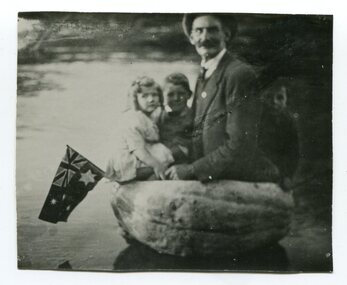
black and white photograph, first half 20th century
... There was usually a competition for the heaviest or biggest pumpkin at the annual Orbost agricultural Show. This photograph is associated with the history of pumpkin growing in the Orbost district. ...The pumpkin in this photograph was an award winner and was grown by Fred Mundy Snr. It weighed 194 lbs (approx. 88 kgs). Pumpkins were grown widely on Orbost farms and used to feed pigs. There was usually a competition for the heaviest or biggest pumpkin at the annual Orbost agricultural Show.This photograph is associated with the history of pumpkin growing in the Orbost district.A small black / white photograph of man with three children sitting in a hollowed out pumpkin in water. An Australian flag is on the left side of the pumpkin.on back - "Alec Cameron, Mr Fred Mundy" ; "Record pumpkin - Mr Fred Mundy 194lbs"mundy-fred pumpkins-orbost -
 Ringwood and District Historical Society
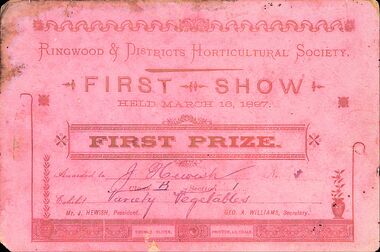
Document, Packet: Agricultural and Horticultural Shows - schedules, cuttings, notes etc 1897 - 1961
... Annual Show to be held on Friday and Saturday, 3rd and 4th April 1936. . Correspondence between Ringwood Show Society and Ringwood Borough Council in connection with the 1936 Ringwood Show. . Two typed pages about the fruit growing...Annual Show to be held on Friday and Saturday, 3rd and 4th April 1936. . Correspondence between Ringwood Show Society and Ringwood Borough Council in connection with the 1936 Ringwood Show. . Two typed pages about the fruit growing ...Miscellaneous Correspondence;; Cuttings;; Schedules 1971-1961 (Some missing);; 1897 - first show award.Packet includes: . Programme for Ringwood Show Society third Annual Show to be held on Friday and Saturday, 3rd and 4th April 1936. . Correspondence between Ringwood Show Society and Ringwood Borough Council in connection with the 1936 Ringwood Show. . Two typed pages about the fruit growing in the Ringwood district and the establishment of the Ringwood cool stores in the early 1900's (Physical copy moved to VC 11257 - see note). . Newspaper cuttings dated 1922 to 1964- Ringwood Horticultural Society shows and activities. . Ringwood Horticultural & Agricultural Society Schedule for the Annual Autumn Show March 11th, 1961. . Newspaper cuttings- Schedules for Ringwood Shows 1911, 1917, 1918, 1920, 1922, 1924, 1934, 1936, 1937. . First Show First Prize Award Certificate awarded to J. Hewish for Variety Vegetables exhibit. . Miscellaneous hand written notes by members on a variety of matters- early 1900's. -
 Orbost & District Historical Society
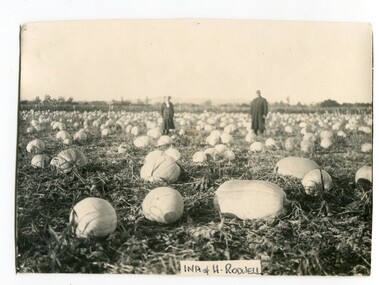
black and white photograph, Warren, Mrs H, firts half 20th century
... There was usually a competition for the heaviest or biggest pumpkin at the annual Orbost agricultural Show. This photograph is associated with the history of pumpkin growing in the Orbost district. rodwell-harold rodwell-ina pumpkins-orbost agriculture-orbost farming-orbost on front - INA & H, Rodwell A black / white photograph of a man and a woman people standing in a large paddock of pumpkins. black and white photograph Warren, Mrs H. ...This photograph shows Harold Rodwell and his daughter, Ina, in a paddock full of pumpkins. Pumpkins were grown widely on Orbost farms and used to feed pigs. There was usually a competition for the heaviest or biggest pumpkin at the annual Orbost agricultural Show.This photograph is associated with the history of pumpkin growing in the Orbost district.A black / white photograph of a man and a woman people standing in a large paddock of pumpkins.on front - INA & H, Rodwellrodwell-harold rodwell-ina pumpkins-orbost agriculture-orbost farming-orbost -
 Flagstaff Hill Maritime Museum and Village
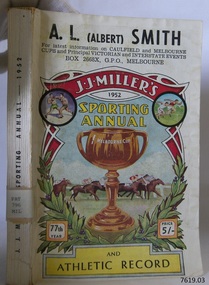
Book, J J Miller's Sporting Annual and Athletic Record 77th year
... Loans and grants allowed the Gallery collection to grow with significant early acquisitions by French, German, and Belgian artists, which were less expensive than British works. warrnambool shipwrecked-coast flagstaff-hill flagstaff-hill-maritime-museum maritime-museum shipwreck-coast flagstaff-hill-maritime-village shipwrecked-artefact book pattison collection warrnambool library warrnambool mechanics’ institute ralph eric pattison corangamite regional library service warrnambool city librarian mechanics’ institute library victorian library board warrnambool books and records warrnambool children’s library great ocean road j j miller's sporting annual and athletic record 77th year j j miller's sporting annual and athletic record a. l. ( albert) smith a. l. smith Label on spine cover with typed text PAT 796 MIL Front pastedown endpaper has sticker from Warrnambool Public Library J J Miller's Sporting Annual and Athletic Record 77th year Author: A. ...This item is from the ‘Pattison Collection’, a collection of books and records that was originally owned by the Warrnambool Mechanics’ Institute, which was founded in Warrnambool in 1853. By 1886 the Warrnambool Mechanics’ Institute (WMI) had grown to have a Library, Museum and Fine Arts Gallery, with a collection of “… choice productions of art, and valuable specimens in almost every branch and many wonderful national curiosities are now to be seen there, including historic relics of the town and district.” It later included a School of Design. Although it was very well patronised, the lack of financial support led the WMI in 1911 to ask the City Council to take it over. In 1935 Ralph Pattison was appointed as City Librarian to establish and organise the Warrnambool Library as it was then called. When the WMI building was pulled down in 1963 a new civic building was erected on the site and the new Warrnambool Library, on behalf of the City Council, took over all the holdings of the WMI. At this time some of the items were separated and identified as the ‘Pattison Collection’, named after Ralph Pattison. Eventually the components of the WMI were distributed from the Warrnambool Library to various places, including the Art Gallery, Historical Society and Flagstaff Hill. Later some were even distributed to other regional branches of Corangamite Regional Library and passed to and fro. It is difficult now to trace just where all of the items have ended up. The books at Flagstaff Hill Maritime Village generally display stamps and markings from Pattison as well as a variety of other institutions including the Mechanics’ Institute itself. RALPH ERIC PATTISON Ralph Eric Pattison was born in Rockhampton, Queensland, in 1891. He married Maude Swan from Warrnambool in 1920 and they set up home in Warrnambool. In 1935 Pattison accepted a position as City Librarian for the Warrnambool City Council. His huge challenge was to make a functional library within two rooms of the Mechanics’ Institute. He tirelessly cleaned, cleared and sorted a disarrayed collection of old books, jars of preserved specimens and other items reserved for exhibition in the city’s museum. He developed and updated the library with a wide variety of books for all tastes, including reference books for students; a difficult task to fulfil during the years following the Depression. He converted all of the lower area of the building into a library, reference room and reading room for members and the public. The books were sorted and stored using a cataloguing and card index system that he had developed himself. He also prepared the upper floor of the building and established the Art Gallery and later the Museum, a place to exhibit the many old relics that had been stored for years for this purpose. One of the treasures he found was a beautiful ancient clock, which he repaired, restored and enjoyed using in his office during the years of his service there. Ralph Pattison was described as “a meticulous gentleman whose punctuality, floorless courtesy and distinctive neat dress were hallmarks of his character, and ‘his’ clock controlled his daily routine, and his opening and closing of the library’s large heavy doors to the minute.” Pattison took leave during 1942 to 1945 to serve in the Royal Australian Navy, Volunteer Reserve as Lieutenant. A few years later he converted one of the Museum’s rooms into a Children’s Library, stocking it with suitable books for the younger generation. This was an instant success. In the 1950’s he had the honour of being appointed to the Victorian Library Board and received more inspiration from the monthly conferences in Melbourne. He was sadly retired in 1959 after over 23 years of service, due to the fact that he had gone over the working age of council officers. However he continued to take a very keen interest in the continual development of the Library until his death in 1969. WARRNAMBOOL PUBLIC LIBRARY The Warrnambool Mechanics’ Institute (WMI) was formed by a voluntary community group in 1863, within six years of Warrnambool’s beginnings, and its Reading Room opened in 1854. The WMI operated until 1963, at which time it was one of the oldest Mechanics’ Institutes in Victoria. Mechanics’ Institutes offered important services to the public including libraries, reading rooms and places to display and store collections of all sorts such as curiosities and local historical relics. In 1886 a Museum and Fine Arts Gallery were added to the WMI and by the beginning of the 20th century there was also a billiards room and a School of Art. By this time all Mechanics’ Institutes in country Victoria had museums attached. Over the years the Warrnambool Mechanics’ Institute Library was also known as the Warrnambool Public Library the Warrnambool Library and the Free Library. Early funding from the government was for the “Free Library”. The inscription in a book “Science of Man” was for the “Warrnambool Public Library”, donated by Joseph Archibald in 1899. Another inscription in the book “Catalogue of Plants Under Cultivation in the Melbourne Botanic Gardens 1 & 2, 1883” was presented to the “Warrnambool Library” and signed by the author W.R. Guilfoyle. In 1903 the Warrnambool Public Library decided to add a Juvenile Department to library and stock it with hundreds of books suitable for youth. In 1905 the Public Library committee decided to update the collection of books and added 100 new novels plus arrangements for the latest novels to be included as soon as they were available in Victoria. In July 1911 the Warrnambool Council took over the management of the Public Library, Art Gallery, Museum and Mechanics’ Institute and planned to double the size of the then-current building. In 1953, when Mr. R. Pattison was Public Librarian, the Warrnambool Public Library’s senior section 10,000 of the 13,000 books were fiction. The children’s section offered an additional 3,400 books. The library had the equivalent of one book per head of population and served around 33 percent of the reading population. The collection of books was made up of around 60 percent reference and 40 percent fiction. The library was lending 400 books per day. In 1963 the Warrnambool City Council allocated the site of the Mechanics’ Institute building, which included the Public Library, Museum and Art Gallery, for the new Municipal Offices and the Collections were dispersed until 1971. The Warrnambool Library took over the Mechanics’ Institute Library’s holdings on behalf of the Warrnambool City Council. Since the closure of the Warrnambool Mechanics’ Institute the exact location and composition of the original WMI books and items has become unclear. Other materials have been added to the collection, including items from Terang MI, Warrnambool Court House and Customs House. Many of the books have been identified as the Pattison Collection, named after the Librarian who catalogued and numbered the books during his time as Warrnambool Public Librarian in the time before the Mechanics’ Institute closed. It seems that when Warrnambool became part of the Corangamite Regional Library some of the books and materials went to its head office in Colac and then back to Warrnambool where they were stored at the Art Gallery for quite some time. Some then went to the Warrnambool Historical Society, some stayed at the Art Gallery and some were moved to Flagstaff Hill Maritime Village. The various stamps and labels on the books held at Flagstaff Hill show the variety of the collection’s distribution and origin. The books in the collection at Flagstaff Hill Maritime Village date from the 1850’s to the late 1950’s and include rare and valuable volumes. Many of the books are part of the “Pattison Collection” after the Warrnambool’s Public Librarian, Mr. R. Pattison. The Pattison Collection, along with other items at Flagstaff Hill Maritime Village, was originally part of the Warrnambool Mechanics' Institute’s collection. The Warrnambool Mechanics’ Institute Collection is primarily significant in its totality, rather than for the individual objects it contains. Its contents are highly representative of the development of Mechanics' Institute libraries across Australia, particularly Victoria. A diversity of publications and themes has been amassed, and these provide clues to our understanding of the nature of and changes in the reading habits of Victorians from the 1850s to the middle of the 20th century. The collection also highlights the Warrnambool community’s commitment to the Mechanics’ Institute, reading, literacy and learning in the regions, and proves that access to knowledge was not impeded by distance. These items help to provide a more complete picture of our community’s ideals and aspirations. The Warrnambool Mechanics Institute book collection has historical and social significance for its strong association with the Mechanics Institute movement and the important role it played in the intellectual, cultural and social development of people throughout the latter part of the nineteenth century and the early twentieth century. The collection of books is a rare example of an early lending library and its significance is enhanced by the survival of an original collection of many volumes. The Warrnambool Mechanics' Institute’s publication collection is of both local and state significance. The Warrnambool Mechanics' Institute Collection is primarily significant in its totality, rather than for the individual objects it contains. Its contents are highly representative of the development of Mechanics' Institute libraries across Australia, particularly Victoria. A diversity of publications and themes has been amassed, and these provide clues to our understanding of the nature of and changes in the reading habits of Victorians from the 1850s to the middle of the 20th century. The collection also highlights the Warrnambool community’s commitment to the Mechanics’ Institute, and to reading, literacy and learning in the regions, and proves that access to knowledge was not impeded by distance. These items help to provide a more complete picture of our community’s ideals and aspirations. As with many Mechanics' Institutes in Australia, the one which operated in Warrnambool was established and overseen for many years by key individuals associated with the development of the city itself. The WMI publication collection is historically significant because of its association with local people, places and the key historical themes in the development of Warrnambool of rural development, industry, farming, education, and community. The collection documents and illustrates the changing interests, focus and tastes of Victorians, especially those in regional cities. Generally the individual items in the collection are not particularly rare, as examples of all probably exist in other public collections in Victoria. It is primarily because there are so very few surviving Mechanics' Institute collections in Victoria, which lends this overall collection its significance. Many items in the WMI Collection have the potential to support further research, both as individual objects and through the collection in its entirety. This material is significant for its ability to assist in the interpretation of the history of the area and adds to the general understanding of the development of the township. Many components of the WMI publication collection complement and reinforce the Flagstaff Hill Maritime Museum Collection, the Warrnambool Art Gallery Collection, and that in the Warrnambool Historical Society, and also contribute to a clearer understanding of the original Warrnambool Mechanics' Institute collections. This will greatly enhance the appreciation of the few surviving Mechanics' Institute collections across Victoria, and also in New South Wales. The similarities and differences between the small number of collections that have survived can provide further insights into how the people of Victoria in general, and Warrnambool in particular, constructed a civic culture of adult learning to foster an informed citizenry. The Warrnambool Mechanics' Institute publication collection is of both local and state significance. (This Statement of Significance is quoted from the Significance Assessment : Warrnambool Mechanics’ Institute Book Collection at Flagstaff Hill Maritime Museum, February 2009, by Annette Welkamp, Cultural Connections, for Delise Oldfied, FHMV) References Juvenile Department in Warrnambool Public Library In August 1903 The Age newspaper reported in its Warrnambool news section that “With the object of discouraging boys from reading literature of the “penny dreadful” class, the committee of the local public library has decided to open a juvenile department and to stock it with hundreds of suitable books attractive to the youthful mind.” 100 new novels added to Warrnambool Public Library Shelves In November 1905 The Argue newspaper’s Warrnambool news section announced “The committee of the Public Library is bringing the collection of books more up to date. It has recently added 100 new novels to the shelves, and arrangements have been made for a supply of the latest novels immediately they arrive in the state.” Warrnambool Town Council takes over Mechanics’ Institute, Art Gallery, Public Library, Museum – and will double the building’s size In 1912 The Age reported in its Warrnambool news section “Considerable improvements are being effected by the town council in the most picturesque part of Liebig Street. Between the fire brigade station and the mechanics’ institute and art gallery a vacant block of land is being transformed a garden for carpet bedding and flowering plants. The council, which recently took over the control of the art gallery, public library, museum and mechanics’ institute, is doubling the size of the substantial stone building containing these institutions. The new building will contain a supper room for use in conjunction with functions in the town hall, adjoining, and a new reading room.” Mr Pattison, Public Librarian, says Library has a book per head of population In 1953 The Age reported an interview with the Public Librarian, Mr. R. Pattison, who said “Warrnambool has an insatiable thirst for reading. And its reading recipe contains a strong dash of fiction – 73 percent of it. Fiction makes up 10,000 of the 13,000 books in the senior section of the public library. That works out at a book per head of population. Warrnambool today is really book minded. This city has an almost insatiable thirst for knowledge as well as fiction. We’re lending 400 books a day. We supply 33 percent of the reading population of Warrnambool.” The reporter goes on to say “Warrnambool Public Library also has an ultra-modern children’s section of 3,400 books, open to every boy and girl attending school in Warrnambool. Mr Pattison hopes to show travel-talk films and install a radiogram in the children’s section “later on”. But it won’t disturb adult reading next door because the junior section is sound proof. “ Mechanics’ Institutes and Museums Mechanics’ Institutes were important sites for collecting in country Victoria … Warrnambool … all had museums attached to Mechanics’ Institutes before the end of the twentieth century” Warrnambool Mechanics’ Institute Ms Tierney said FHMV holds the collection of the Warrnambool Mechanics’ Institute in three different locations on its site. “The Mechanics’ Institute opened in 1871, was demolished in the 1960s and was one of the oldest in Victoria. “FHMV intends to create a new storage area and bring the collection together in one place which will greatly facilitate access and research. “The collection consists of books and archives dating from the 1850s to 1959s. “Some of the books are rare and valuable but it is unclear as to their relevance to the history of Warrnambool or Victoria,” Ms Tierney said. Warrnambool TAFE History South West TAFE has a long and proud history of providing technical and specialist education, with links back to the formation of the Mechanic’s Institute in 1853. Warrnambool Art Gallery’s History The Warrnambool Art Gallery began in 1886 when retired police officer Joseph Archibald opened its doors in a building behind the mechanics institute in Liebig Street. The Gallery began with an eclectic mix of artworks and museum curios. Before long Archibald mobilised public support and paid for a new gallery annex. Loans and grants allowed the Gallery collection to grow with significant early acquisitions by French, German, and Belgian artists, which were less expensive than British works. J J Miller's Sporting Annual and Athletic Record 77th year Author: A. L. ( Albert) Smith Publisher: Herald and Weekly Times Date: 1952Label on spine cover with typed text PAT 796 MIL Front pastedown endpaper has sticker from Warrnambool Public Librarywarrnambool, shipwrecked-coast, flagstaff-hill, flagstaff-hill-maritime-museum, maritime-museum, shipwreck-coast, flagstaff-hill-maritime-village, shipwrecked-artefact, book, pattison collection, warrnambool library, warrnambool mechanics’ institute, ralph eric pattison, corangamite regional library service, warrnambool city librarian, mechanics’ institute library, victorian library board, warrnambool books and records, warrnambool children’s library, great ocean road, j j miller's sporting annual and athletic record 77th year, j j miller's sporting annual and athletic record, a. l. ( albert) smith, a. l. smith -
 Mission to Seafarers Victoria
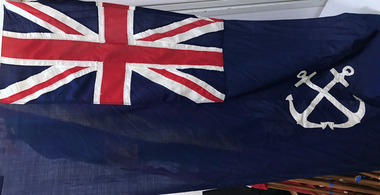
Flag, Melbourne Harbour Trust
... annual Seafarers Service. The Melbourne Harbor Trust was established in 1877 to improve and operate port facilities for the growing city of Melbourne. ...annual Seafarers Service. The Melbourne Harbor Trust was established in 1877 to improve and operate port facilities for the growing city of Melbourne. ...The first Seafarers Service was held on 23 October 1905 in the St Paul's Cathedral in London to celebrate the Centenary of the Battle of Trafalgar and the death of Vice-Admiral Horatio Nelson on 21 October 1805. Reverend Alfred Gurney Goldsmith launched the first Seafarers Service two years later and the first service was held on Sunday 10 November 1907. National and house flags are used during the annual Seafarers Service. The Melbourne Harbor Trust was established in 1877 to improve and operate port facilities for the growing city of Melbourne. It was superseded by the Port of Melbourne Authority in 1978 and later by the Port of Melbourne Corporation. The service continue to reflect the full range of the maritime activities in Australia. Representatives come from the Royal and Merchant Navies, the commercial world, shipping companies, mission and philanthropic societies, veterans’ associations, labour unions, youth and leisure organisations, but anyone is welcome to attend.Large blue rectangular flag with the Blue Ensign and two white anchors on the rightM.H.T written in black penflag, melbourne harbour trust, m.h.t., seafarers service -
 Eltham District Historical Society Inc
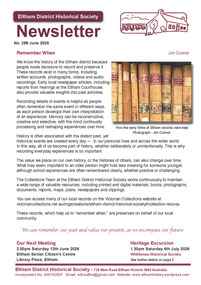
Journal - Newsletter, Newsletter, No. 288 June 2026
... Contents: • Remember When by Jim Connor • Next meeting – 2:00pm Saturday 13th June 2026 • Heritage Excursion - Saturday 4th July – Whittlesea Historical Society • From little things big things grow by Jim Connor • Notes from the Shire of Eltham Council Meeting – June 1926 • …. from our collection • Eltham High School Centenary by Jim Connor • Eltham High School – Recollections by Jim Connor • Memories of Eltham and District by Jack Shallard • Eltham by Liz Pidgeon • My People by Alan Marshall • Little Eltham • Annual General Meeting – Saturday 11th April 2026 • Members On-line Survey – March 2026...Contents: • Remember When by Jim Connor • Next meeting – 2:00pm Saturday 13th June 2026 • Heritage Excursion - Saturday 4th July – Whittlesea Historical Society • From little things big things grow by Jim Connor • Notes from the Shire of Eltham Council Meeting – June 1926 • …. from our collection • Eltham High School Centenary by Jim Connor • Eltham High School – Recollections by Jim Connor • Memories of Eltham and District by Jack Shallard • Eltham by Liz Pidgeon • My People by Alan Marshall • Little Eltham • Annual General Meeting – Saturday 11th April 2026 • Members On-line Survey – March 2026 The Shire of Eltham Historical Society was formed in October 1967. ...Contents: • Remember When by Jim Connor • Next meeting – 2:00pm Saturday 13th June 2026 • Heritage Excursion - Saturday 4th July – Whittlesea Historical Society • From little things big things grow by Jim Connor • Notes from the Shire of Eltham Council Meeting – June 1926 • …. from our collection • Eltham High School Centenary by Jim Connor • Eltham High School – Recollections by Jim Connor • Memories of Eltham and District by Jack Shallard • Eltham by Liz Pidgeon • My People by Alan Marshall • Little Eltham • Annual General Meeting – Saturday 11th April 2026 • Members On-line Survey – March 2026The Shire of Eltham Historical Society was formed in October 1967. The first newsletter of the Society was issued May 1978 and has been published continuously ever since on a bi-monthly basis. With the cessation of the Shire of Eltham in late 1994, the Society's name was revised to Eltham District Historical Society and this name first appeared with issue No. 103, July 1995. The collection of the Society's newsletters provides a valuable resource on the history of the Society's activities, office bearers and committee members, guest speakers and subjects of historical interest pertinent to the former Shire of Eltham and the Eltham District.A4 newsletter distributed to members (Digital and A4 photocopy)newsletter, eltham district historical society -
 Eltham District Historical Society Inc
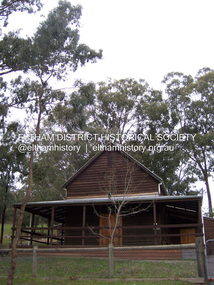
Photograph - Digital Photograph, Marguerite Marshall, Strathewen Public Hall, 20 August 2008
... annually for £1. When teacher Miss Mary Golding opened the school in 1917, it had no equipment.7 But in 1921 the Education Department provided desks and a hexagonal shelter shed (now a rare style in Victoria) and took control in 1925.8 By 1917 Strathewen was booming.9 George Apted had built a coolstore in 1916, and local orchardists bought storage space until the 1950s. This allowed the area to supply the market in and out of season. Guesthouses catered for growing...annually for £1. When teacher Miss Mary Golding opened the school in 1917, it had no equipment.7 But in 1921 the Education Department provided desks and a hexagonal shelter shed (now a rare style in Victoria) and took control in 1925.8 By 1917 Strathewen was booming.9 George Apted had built a coolstore in 1916, and local orchardists bought storage space until the 1950s. This allowed the area to supply the market in and out of season. Guesthouses catered for growing ...Strathewen Public Hall, social and spiritual centre was later lost in the Black Saturday fires 2009. The Strathewen Community decided a community hall was needed in 1901. In 1902 locals built the hall with messmate trees. It was located on the Cottlesbridge-Strathewen Road. The first function was a Grand concert and Balll attended by about 120 people. Several denominations held Church services and Sunday School services in the Hall. It survived several bushfires until after this photo was taken when it was destroyed in Black Saturday, 9 February 2009. Published: Nillumbik Now and Then / Marguerite Marshall 2008; photographs Alan King with Marguerite Marshall.; p89 Strathewen was settled late, largely because it was difficult to access.1 Early selectors found it a struggle to survive. They had to do everything themselves, from felling trees for buildings, to taking produce to market along bush tracks that they had helped cut. Small dairy farms were typical but fruit became the district’s prime produce. The first settlers east of Arthurs Creek were brothers John and Duncan Smith whose station Glen-Ard was probably operated as a sheep run. Other early settlers were the Mann family, who were to donate land for the hall, provide postal services and John Mann was an Eltham Shire councillor from 1916 to 1919.2 In 1873 James Mann, his wife Jane and their six children, settled on 207 acres (83.7) (Lang Fauld Farm) on both sides of Eagles Nest Road, from the foot of Mount Sugarloaf to the bank of the Arthurs Creek. In 1883 James took up another selection on Chads Creek. It was very hard work and at times he was well behind with his rent. However the family had a good social life, attending the Primitive Methodist Church at the Arthurs Creek Township and on New Year’s Eve throwing a party for all the locals. By 1874 James Mann’s younger brother, John, selected 311 acres (125.8ha) between Eagles Nest Road and upper Arthurs Creek. He called it Carseburn after his home parish in Scotland. Tragically in 1875 John drowned in the Yarra River, at Richmond.3 John Mann’s oldest son, also John, later purchased Duncan Smith’s land, which he named Violet Glen. He was to give one acre (0.4ha) of this land for the Strathewen Hall site. A Mann family diary written at Carseburn in 1897, tells how the district’s name was selected. Strathewen is derived from ‘strath’ meaning ‘broad mountain valley’ and from the name of Ewen H. Cameron, the local parliamentarian for almost 40 years. ‘George Brain came around to get a petition signed to get a post office up here and we had to vote for a name—Strathewen, Glen-Ard, or Headcorie’.4 It was at Carseburn that a public meeting in 1901, decided to build the Strathewen Hall on the Cottlesbridge-Strathewen Road. In 1902 the locals built the hall with messmate trees. The first function was a Grand Concert and Ball attended by around 120 people and several Protestant denominations took turns to hold church services and Sunday School there. Fortunately the hall has survived bushfires to be the town’s spiritual and social centre.5 The area continued to develop and in 1909 a post office operated somewhere at Strathewen and from around 1916 at Carseburn.6 It was not until 1914 that land was bought to establish the Strathewen State School on School Ridge Road. The residents paid £100 to build it on two acres (0.8 ha) while the Education Department contributed £30 and leased the building annually for £1. When teacher Miss Mary Golding opened the school in 1917, it had no equipment.7 But in 1921 the Education Department provided desks and a hexagonal shelter shed (now a rare style in Victoria) and took control in 1925.8 By 1917 Strathewen was booming.9 George Apted had built a coolstore in 1916, and local orchardists bought storage space until the 1950s. This allowed the area to supply the market in and out of season. Guesthouses catered for growing tourism. In the mid 1920s Mrs Eleanor Sparkes built the guest-house Singing Waters, which operated through the 1930s. Her daughter Mrs Vera McKimmie, ran it until the 1950s and the house remains in Chads Creek Road. In the Great Depression land was cleared for timber to be sold as firewood and there was small scale sawmilling. However the orchard industry diminished for several reasons including the 1939 bushfires and rapid changes in production methods. Today the Apteds still operate an orchard and farm at Glen-Ard, which straddles the border between Strathewen and Arthurs Creek. It includes the southern part of Duncan Smith’s original Glen-Ard selection.This collection of almost 130 photos about places and people within the Shire of Nillumbik, an urban and rural municipality in Melbourne's north, contributes to an understanding of the history of the Shire. Published in 2008 immediately prior to the Black Saturday bushfires of February 7, 2009, it documents sites that were impacted, and in some cases destroyed by the fires. It includes photographs taken especially for the publication, creating a unique time capsule representing the Shire in the early 21st century. It remains the most recent comprehenesive publication devoted to the Shire's history connecting local residents to the past. nillumbik now and then (marshall-king) collection, strathewan public hall -
 Eltham District Historical Society Inc
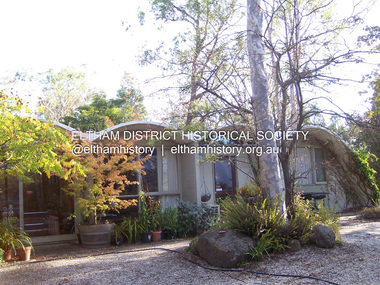
Photograph - Digital Photograph, Marguerite Marshall, Rice House, 69 Ryans Road, Eltham, 27 March 2007
... growing family, in the mid 1950s, Borland converted the second structure into two children’s bedrooms, a kitchenette, a bathroom and a living room. The two structures were originally linked by a covered way of suspended draped-concrete, but this collapsed in the 1980s. The design has several maintenance problems. Cracks developed where two halves of the shells were joined. Then the material sprayed over the cracks became brittle, causing leaks. Fortunately Harrie found another material he could use. The valleys between the arches collect water, requiring annual...growing family, in the mid 1950s, Borland converted the second structure into two children’s bedrooms, a kitchenette, a bathroom and a living room. The two structures were originally linked by a covered way of suspended draped-concrete, but this collapsed in the 1980s. The design has several maintenance problems. Cracks developed where two halves of the shells were joined. Then the material sprayed over the cracks became brittle, causing leaks. Fortunately Harrie found another material he could use. The valleys between the arches collect water, requiring annual ...Built in 1953, the Rice House was leading Melbourne architect Kevin Borland's first commssion and was one of two houses of its kind. The design of the shell-like structure was inspired by the Arch of Ctesiphon, built in the second century south of Baghdad. Cement with a waterproofing agent was applied in layers to a form of regularly spaced timber arches covered in hessian. This ctesiphon system was developed in the United Kingdom by engineer J.H. de Waller in 1947. Commissioned in 1951 by Harrie and Lorna Rice, after Harrie, then an art student, met Borland at The Age Small Homes Service. Borland suggested they buy land in Eltham because at that time it was the only council in Melbourne that would grant a permit for such an innovative house. Covered under Victorian Heritage. Inspired by an ancient arch in Iraq, a house stands on top of a hill in a private position, off Ryans Road, Eltham. One of only two houses of its kind, it was leading Melbourne architect Kevin Borland’s first commissioned house, which he built in 1953. The shell-like structure, partially screened by giant trees and cacti, was inspired by the Arch of Ctesiphon south of Baghdad, built in the second century.1 Cement with a waterproofing agent was applied in layers to a form of regularly spaced timber arches tightly covered by hessian. This ctesiphon system was developed in the United Kingdom by engineer J H de Waller in 1947. This house was the first of three such structures built in Victoria, of which only one other remains, although substantially altered.2 It is the Wood House and supermarket, at the corner of Cleveland Road and High Street Road, Ashwood, designed by Robin Boyd in 1952. The Rice House demonstrates Kevin Borland’s innovative and experimental work. It is an outstanding example of the post-war period of experimentation in domestic architecture in Melbourne – by Robin Boyd, Kevin Borland and others – for The Age Small Homes Service from 1947 to 1953. This was partly an expression of late-Modernism and also necessitated by the post-war shortage of building materials. In Eltham, the post-war shortage of building materials largely resulted in mud-brick houses. Examples of Borland’s public work include contributions to the Olympic Swimming Pool in Melbourne and the Preshil Junior School in Kew. After more than 50 years of living in the house, Harrie and Lorna Rice still love it. Facing north-east with large windows overlooking the garden and two courtyards, it is well lit and benefits from a through breeze. The couple commissioned the extraordinary house after Harrie, then an art student, met Borland in 1951 at The Age Small Homes Service. Harrie was so impressed by the recently graduated Borland’s enthusiasm, that he asked him to design them an interesting house for a low budget. The unusual design presented several hurdles for the young couple before they could construct it. Borland suggested that they buy land in Eltham, because at that time it had the only council in Melbourne that would allow such an innovative house. Another hurdle was to gain finance for this remarkable house. The State Savings Bank Manager refused finance on the grounds that it was ‘unliveable’ and a ‘disgrace’. Fortunately, through a family connection, the couple borrowed money from the National Bank. But they discovered years later, that the bank’s evaluation stated the two ‘concrete sheds’ were of no value! The house built in off-white concrete, consists of two sections. The main house has four arches supported by brick and concrete walls that create a series of inter-connected rooms. Inside, the ceiling follows the roofline. Originally this section was only ten square metres, because of building restrictions at the time. But in 1973 Borland added two rooms and a carport. The second structure of two arches was originally a garage and a studio for art teacher Harrie Rice. To accommodate the growing family, in the mid 1950s, Borland converted the second structure into two children’s bedrooms, a kitchenette, a bathroom and a living room. The two structures were originally linked by a covered way of suspended draped-concrete, but this collapsed in the 1980s. The design has several maintenance problems. Cracks developed where two halves of the shells were joined. Then the material sprayed over the cracks became brittle, causing leaks. Fortunately Harrie found another material he could use. The valleys between the arches collect water, requiring annual painting with a waterproof material to prevent leaking. Lorna framed the house with native and exotic plants, which provide privacy and as a bonus, the garden attracted the rare Eltham Copper Butterfly. Published: Nillumbik Now and Then / Marguerite Marshall 2008; photographs Alan King with Marguerite Marshall.; p157 Comments about the Rice House on Lost Eltham page on Facebook June 2018 https://www.facebook.com/Lost-Eltham-1535993463348408/ Kate Borland: My dad designed this house. It is the Rice house and it is being renovated to its original glory as we speak.... Katherine Fox: I remember Harry and Lorna's, there was a secret room...! And the best loo with a view as I recall. Katherine Fox: Love this house! Wish I'd known it was up for sale. Looking forward to seeing progress if possible...If I recall correctly, the concrete swag over the walk-way collapsed at some stage. Marcus Skipper: In our little green Landrover, my dad and Alister Knox drove up dirt roads, a dirt track through the bush and finally to the ridge to check out this joint in about 1960. After the war at some time, they were all together at RMIT studying building design. Alister was the only one to graduate. A situation that resulted, my father would joke, in Alister having a career wherein his qualifications exceeded his talent. World Peace had broken out and all were hip to the ‘People’s’ century. Kevin went with the Modernist’s concrete, Alister went with the peasant’s mudbrick. “If this is the future,” my dad said,”I don’t like it.” And we drove back to medieval Montsalvat.This collection of almost 130 photos about places and people within the Shire of Nillumbik, an urban and rural municipality in Melbourne's north, contributes to an understanding of the history of the Shire. Published in 2008 immediately prior to the Black Saturday bushfires of February 7, 2009, it documents sites that were impacted, and in some cases destroyed by the fires. It includes photographs taken especially for the publication, creating a unique time capsule representing the Shire in the early 21st century. It remains the most recent comprehenesive publication devoted to the Shire's history connecting local residents to the past. nillumbik now and then (marshall-king) collection, eltham, rice house, ryans road, kevin borland -
 Kiewa Valley Historical Society
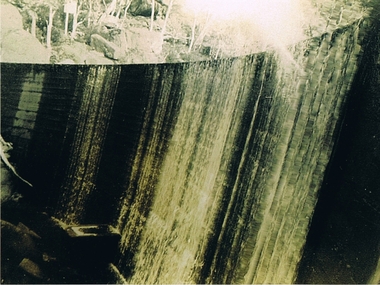
Photograph Clover Dam, Clover Dam Circa 1940, circa 1940s to 1950s
... growing population and heavy industrial ares within Melbourne City and State regions. Construction of dams, such as Clover Dam provided the large quantity holding areas of water required to turn the turbines at the various power stations to provide the electricity needed. The impact of these controls by moderating water run off from the alpine regions is beneficial in reducing flooding from thawing of snow on the alps. This by-product allows agriculture and grazing to be less vulnerable to seasonal flooding thereby resulting in a more stable annual ...As part of the push to cut electricity costs and diversify supply, the Victorian Government (circa 1930) implemented the conversion strategy from mainly brown coal supply to hydro - electricity. The Kiewa Hydroelectric Scheme became the largest scheme of its kind in the State Of Victoria and the second largest scheme in Australia. This dam was constructed to supply water to feed four turbines (62 mega watts) at the West Kiewa Power Station. This was at the forefront of sustainable "Green" energy. Costs associated with power supplies is still a major incentive of governments, however environmentally friendly alternatives such as wind and nuclear have also made inroads. The Kiewa valley and its surrounding alpine catchment were looked at(Victorian State Government), from the beginning of the twentieth century as a source of alternate power for an every increasing demand for electricity by growing population and heavy industrial ares within Melbourne City and State regions. Construction of dams, such as Clover Dam provided the large quantity holding areas of water required to turn the turbines at the various power stations to provide the electricity needed. The impact of these controls by moderating water run off from the alpine regions is beneficial in reducing flooding from thawing of snow on the alps. This by-product allows agriculture and grazing to be less vulnerable to seasonal flooding thereby resulting in a more stable annual production level.Reproduction (scanned) of a black and white photo of Clover Dam circa 1940. The paper used is KodakXtraLife II paperThe reverse side of photo " KodakXtraLife II paperdams, pondage, hydro electricity, power stations, clover dam, secv -
 Warrnambool and District Historical Society Inc.
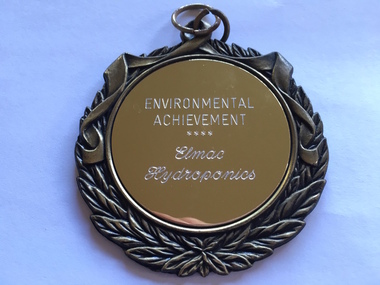
Medallion, Trophy Environmental achievement, 2000
... annually to businesses in its area of supply. In 2014 there were 15 awards for Business Excellence. Elmac Hydroponics was a business growing and supplying organically-produced tomatoes from 1997 to 2004. ...annually to businesses in its area of supply. In 2014 there were 15 awards for Business Excellence. Elmac Hydroponics was a business growing and supplying organically-produced tomatoes from 1997 to 2004. ...This is a medallion awarded in 2000 by Powercor Warrnambool to Elmac Hydroponics. Powercor Australia, founded in 1994, is an electrical distribution company operating in the Western District of Victoria and the western suburbs of Melbourne. Powercor Warrnambool, like other Powercor organizations, is involved in giving Business Excellence Awards annually to businesses in its area of supply. In 2014 there were 15 awards for Business Excellence. Elmac Hydroponics was a business growing and supplying organically-produced tomatoes from 1997 to 2004. It was situated at Mount Pleasant, Princes Highway, Allansford, Victoria. The business was operated by Graeme and Barbara McLeod and Keith and Leonie Ellerton. Hydroponics is a system of growing plants without soil, using a nutrient solution. Elmac Hydroponics had a 2,000 square metre greenhouse with 10,000 growing points. This is a significant medallion, showing the award given to a small business in the Warrnambool area and indicating its achievements in the environmental area. Elmac was an industry leader in in implementing an ‘Autopot’ hydroponic system which is aimed at reducing nutrient and waste water to zero. Elmac was also a finalist in the Ericsson 2002 Innovation Awards.This is a gilt metal medallion, oval-shaped, with an ornamental edging and a shield-shaped design on one side and a circular design on the other. The top has two metal rings for attachment to a chain or wall hook. On one side: ‘Environmental Achievement, Elmac Hydroponics’ On obverse side: ‘Powercor Warrnambool Region Business Achievement Awards, 2000’ elmac hydroponics, powercor business awards, warrnambool -
 Bendigo Historical Society Inc.
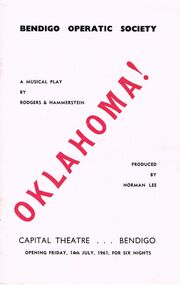
Programme - BENDIGO OPERATIC SOCIETY ''OKLAHOMA!''
... Grow the Lilacs''. The Story is set in Indian Territory just after the turn of the century and revolves around the lives of Curly, a cowboy, and Laurey. Laurey is in love with Curly, but to make him jealous pretends to be attracted to Jud fry. Everything is settled at the Annual...Grow the Lilacs''. The Story is set in Indian Territory just after the turn of the century and revolves around the lives of Curly, a cowboy, and Laurey. Laurey is in love with Curly, but to make him jealous pretends to be attracted to Jud fry. Everything is settled at the Annual ...Programme of the Bendigo Operatic Society. A Musical Play by Rodgers & Hammerstein ''Oklahoma'' Produced by Norman Lee. Capital theatre Bendigo Opening Friday 14th July 1961 for six Nights. Cast in Order of Appearance: Gertrude Perry as Aunt Eller - Harry Brewer as Curly - Dawn Beckwith as Laurey - Leonard Carr as Ike Skidmore - Peter Houston as Fred - Gerald Gleeson as Slim - Bryan Brewer as Will Parker - Brian Thomas as Jud Fry - Annette Wilson as Ado Annie Carnes - Alfred Annison as Ali Hakim - Wendy Griffiths as Gertie - Emily Westgarth as Ellen - Joan Crane as Viviene - Carol McKenzie as Faye - Ailleen Simmonds as Virginia - Patricia McCracken as Suzanne - Frederick Trewarne as Andrew Carnes - Reginald Boromeo as Cord Elam - Gerald Hayward as Ed - Victor White as Mike - Peter Haines as Jud (In Ballet) - Terry Carr as Curly (In Ballet) - Bronwen Townsend as Laurey (In Ballet). Musical Director: Max O'Loghlen. Society Pianist: Mrs. P.House. Ballet Mistress: Miss M.Welch. Synopsis: ''Oklahoma'' is a musical based on Lynn Rigg's play ''Green Grow the Lilacs''. The Story is set in Indian Territory just after the turn of the century and revolves around the lives of Curly, a cowboy, and Laurey. Laurey is in love with Curly, but to make him jealous pretends to be attracted to Jud fry. Everything is settled at the Annual Box Social.program, theatre, bendigo operatic society -
 Ithacan Historical Society
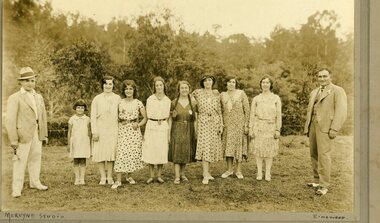
Photograph, Ithacan picnic, c1930
... annual picnic was a very popular outing amongst club members. A sepia photograph of seven ladies and a little girl standing in a line with a man on each side. There are trees and bushes growing ...The seven women and little girl are lining up to begin the 75 yard women's race at the Ithacan Society's annual picnic, which took place at a picnic ground on Melbourne's rural fringe sometime in the 1930s. There annual picnic was a very popular outing amongst club members.A sepia photograph of seven ladies and a little girl standing in a line with a man on each side. There are trees and bushes growing behind the group. -
 Ithacan Historical Society
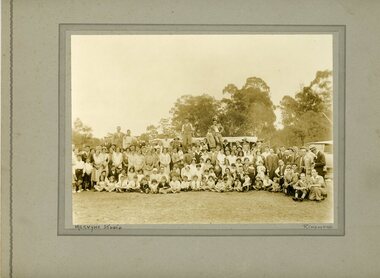
Photograph, Ithacan Picnic Group, Early 1930s
... annual picnic. All who attended the picnic on that day were included in the photograph. The first picnic took place in 1918 at South Morang where 200 people attended. The picnics continue to be a popular social event on the club's social calendar attracting large numbers of the generations of Ithacan Australians in Melbourne. A mounted sepia photograph of a large group of men women and children gathered together in a large sports ground. There are two buildings behind them with trees growing ...The photograph was taken at the Ithacan Philanthropic Society's16th annual picnic. All who attended the picnic on that day were included in the photograph. The first picnic took place in 1918 at South Morang where 200 people attended. The picnics continue to be a popular social event on the club's social calendar attracting large numbers of the generations of Ithacan Australians in Melbourne.A mounted sepia photograph of a large group of men women and children gathered together in a large sports ground. There are two buildings behind them with trees growing in the background. -
 Kiewa Valley Historical Society
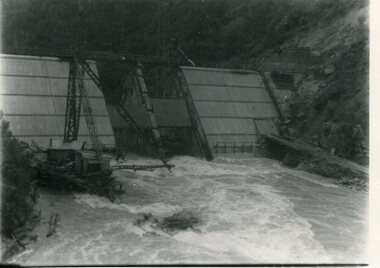
Photograph - Kiewa River in flood at Clover Dam
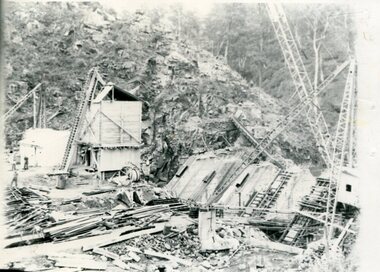
... growing population and heavy industrial areas within Melbourne City and State regions. Construction of dams, such as Clover Dam provided the large quantity holding areas of water required to turn the turbines at the various power stations to provide the electricity needed. The impact of these controls by moderating water run-off from the alpine regions is beneficial in reducing flooding from thawing of snow on the alps. This by-product allows agriculture and grazing to be less vulnerable to seasonal flooding thereby resulting in a more stable annual ...As part of the push to cut electricity costs and diversify supply, the Victorian Government (circa 1930) implemented the conversion strategy from mainly brown coal supply to hydro - electricity. The Kiewa Hydroelectric Scheme became the largest scheme of its kind in the State Of Victoria and the second largest scheme in Australia. Clover Dam and Power Station were built by the State Electricity Commission of Victoria as part of the Kiewa Hydro Electric Scheme from the late 1930's to the early 1940's. This dam was constructed to supply water to feed four turbines (62 mega watts) at the West Kiewa Power Station. This was at the forefront of sustainable "Green" energy. Costs associated with power supplies is still a major incentive of governments, however environmentally friendly alternatives such as wind and nuclear have also made inroads. The Kiewa valley and its surrounding alpine catchment were looked at(Victorian State Government), from the beginning of the twentieth century as a source of alternate power for an ever-increasing demand for electricity by growing population and heavy industrial areas within Melbourne City and State regions. Construction of dams, such as Clover Dam provided the large quantity holding areas of water required to turn the turbines at the various power stations to provide the electricity needed. The impact of these controls by moderating water run-off from the alpine regions is beneficial in reducing flooding from thawing of snow on the alps. This by-product allows agriculture and grazing to be less vulnerable to seasonal flooding thereby resulting in a more stable annual production level.Black and white photograph of Clover Dam with Kiewa River in flood. .5mm white boarder on 3 sides of photo.Handwritten on back of photograph in black pen - Kiewa in flood. Clover Dam.clover dam, secv -
 Kiewa Valley Historical Society
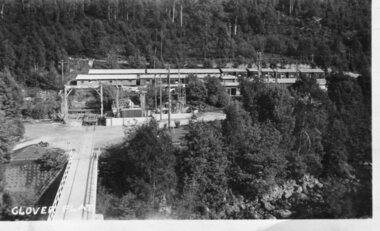
Photograph - Clover Dam
... growing population and heavy industrial areas within Melbourne City and State regions. Construction of dams, such as Clover Dam provided the large quantity holding areas of water required to turn the turbines at the various power stations to provide the electricity needed. The impact of these controls by moderating water run-off from the alpine regions is beneficial in reducing flooding from thawing of snow on the alps. This by-product allows agriculture and grazing to be less vulnerable to seasonal flooding thereby resulting in a more stable annual ...As part of the push to cut electricity costs and diversify supply, the Victorian Government (circa 1930) implemented the conversion strategy from mainly brown coal supply to hydro - electricity. The Kiewa Hydroelectric Scheme became the largest scheme of its kind in the State Of Victoria and the second largest scheme in Australia. Clover Dam and Power Station were built by the State Electricity Commission of Victoria as part of the Kiewa Hydro Electric Scheme from the late 1930's to the early 1940's. This dam was constructed to supply water to feed four turbines (62 mega watts) at the West Kiewa Power Station. This was at the forefront of sustainable "Green" energy. Costs associated with power supplies is still a major incentive of governments, however environmentally friendly alternatives such as wind and nuclear have also made inroads. The Kiewa valley and its surrounding alpine catchment were looked at(Victorian State Government), from the beginning of the twentieth century as a source of alternate power for an ever-increasing demand for electricity by growing population and heavy industrial areas within Melbourne City and State regions. Construction of dams, such as Clover Dam provided the large quantity holding areas of water required to turn the turbines at the various power stations to provide the electricity needed. The impact of these controls by moderating water run-off from the alpine regions is beneficial in reducing flooding from thawing of snow on the alps. This by-product allows agriculture and grazing to be less vulnerable to seasonal flooding thereby resulting in a more stable annual production level.Black and white photograph of Clover Dam buildings and Kiewa River. Has a .4cm white border around photograph Printed on bottom left corner of photograph in white - Clover Flatclover dam, secv -
 Kiewa Valley Historical Society
Photographs x 2 - Clover Dam, Circa 1940's
... growing population and heavy industrial areas within Melbourne City and State regions. Construction of dams, such as Clover Dam provided the large quantity holding areas of water required to turn the turbines at the various power stations to provide the electricity needed. The impact of these controls by moderating water run-off from the alpine regions is beneficial in reducing flooding from thawing of snow on the alps. This by-product allows agriculture and grazing to be less vulnerable to seasonal flooding thereby resulting in a more stable annual ...As part of the push to cut electricity costs and diversify supply, the Victorian Government (circa 1930) implemented the conversion strategy from mainly brown coal supply to hydro - electricity. The Kiewa Hydroelectric Scheme became the largest scheme of its kind in the State Of Victoria and the second largest scheme in Australia. Clover Dam and Power Station were built by the State Electricity Commission of Victoria as part of the Kiewa Hydro Electric Scheme from the late 1930's to the early 1940's. This dam was constructed to supply water to feed four turbines (62 mega watts) at the West Kiewa Power Station. This was at the forefront of sustainable "Green" energy. Costs associated with power supplies is still a major incentive of governments, however environmentally friendly alternatives such as wind and nuclear have also made inroads. The Kiewa valley and its surrounding alpine catchment were looked at(Victorian State Government), from the beginning of the twentieth century as a source of alternate power for an ever-increasing demand for electricity by growing population and heavy industrial areas within Melbourne City and State regions. Construction of dams, such as Clover Dam provided the large quantity holding areas of water required to turn the turbines at the various power stations to provide the electricity needed. The impact of these controls by moderating water run-off from the alpine regions is beneficial in reducing flooding from thawing of snow on the alps. This by-product allows agriculture and grazing to be less vulnerable to seasonal flooding thereby resulting in a more stable annual production level. Photographs also document early engineering and building techniques used in the construction of dams and power stations during the 1940’s and 1950’s. Note the lack of safety equipment and suitable work attire worn by construction workers on the sites 1. Black and white photograph of Clover Dam under construction. Has a .5cm white border around photo 2. Black and white photograph of Clover Dam under construction showing workmen at work. Has a .5cm white border around photo Written in pencil on back of both photographs - Clover Damclover dam, secv -
 Myrtleford and District Historical Society
Tobacco Sales Photograph
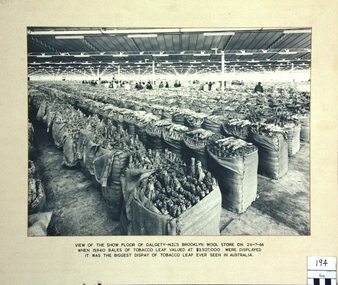
... annual tobacco harvest. The impact of post-war migration from southern Europe was playing an important role in reaching harvest records. The photograph reflects the "golden years" of tobacco growing in the district, which continued into the 1970s, prior to later deregulation in the 1980s and 90s and the ceasing of production altogether in 2006. ...The photograph depicts the magnitude of the tobacco industry in the late 1960s to 1970s era when many Myrtleford district growers contributed to the annual tobacco harvest. The impact of post-war migration from southern Europe was playing an important role in reaching harvest records.The photograph reflects the "golden years" of tobacco growing in the district, which continued into the 1970s, prior to later deregulation in the 1980s and 90s and the ceasing of production altogether in 2006. This sales floor attracted local farming families to observe activities off-season in Melbourne, before the sales were conducted at a complex in Myrtleford. A monochrome photograph displaying a large tobacco selling floorInscription: "VIEW OF THE SHOW FLOOR OF DALGETY-NZL's BROOKLYN WOOL STORE ON 27-6-1966 WHEN 15,940 BALES OF TOBACCO LEAF VALUED AT $3,507,000 WERE DISPLAYED. IT WAS THE BIGGEST DISPLAY OF TOBACCO LEAF EVER SEEN IN AUSTRALIA" tobacco industry, myrtleford tobacco selling floor -
National Wool Museum
Book, Dennys, Lascelles Limited Annual, 1927
... Agriculture Wool - transportation Dennys Lascelles Limited Wool Brokering Wool Growing Agriculture Wool - transportation Dennys, Lascelles Limited Annual, 1927 Book ..."Dennys, Lascelles Limited Annual", third issue, August 1927. Annual publication produced by the wool brokers Dennys, Lascelles Limited and containing articles of general interest, as well as on wool related topics. On the front cover is a fine printed reproduction of a 1927 sketch by the artist Victor Cobb depicting the Dennys Lascelles wool store (cnr Moorabool and Brougham Sts; now housing the National Wool Museum).wool brokering wool growing agriculture wool - transportation, dennys, lascelles limited, wool brokering, wool growing, agriculture, wool - transportation -
 National Wool Museum
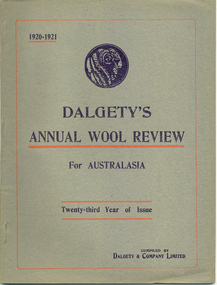
Report, Dalgety's Annual Wool Review for Australasia: 1920-1921
... Annual Wool Review for Australasia: 1920-1921". Part of the NWM Woolbroker's Office exhibit until late 1990's. Wool Stores Wool Brokering Wool Growing Dalgety and Company Limited Wool Stores Wool Brokering Wool Growing Dalgety's Annual Wool Review for Australasia: 1920-1921 Report ..."Dalgety's Annual Wool Review for Australasia: 1920-1921". Part of the NWM Woolbroker's Office exhibit until late 1990's.wool stores wool brokering wool growing, dalgety and company limited, wool stores, wool brokering, wool growing -
 National Wool Museum
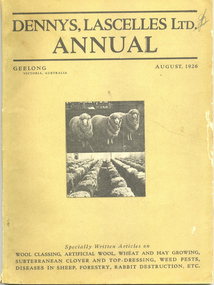
Book, Dennys, Lascelles Limited Annual, 1926
... Annual publication produced by the wool brokers Dennys, Lascelles Limited and containing articles of general interest, as well as on wool related topics. Wool Brokering Wool Growing ..."Dennys, Lascelles Limited Annual", third issue, August 1926. Annual publication produced by the wool brokers Dennys, Lascelles Limited and containing articles of general interest, as well as on wool related topics.GRAHAM REESwool brokering wool growing agriculture woolclassing pastoral industry - history, dennys, lascelles limited, wimmera, hamilton, heathcote, mansfield, wool brokering, wool growing, agriculture, woolclassing, pastoral industry - history -
 National Wool Museum
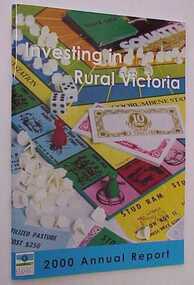
Annual Report, Victorian Farmers Federation: Annual Report 2000
... Associated documents from Mr R Lloyd provide further information Sheep stations - management Wool Growing Squatters Victorian Farmers Federation Lloyd Mr Robert Sheep stations - management Wool Growing Squatters Victorian Farmers Federation: Annual Report 2000 Annual Report ...Associated documents from Mr R Lloyd provide further informationsheep stations - management wool growing squatters, victorian farmers federation, lloyd, mr robert, sheep stations - management, wool growing, squatters -
National Wool Museum
Book, Riverina continuous farm study: first annual report 1957-1958
... "Riverina continuous farm study: first annual report 1957-1958" -Bureau of Agricultural Economics. Agriculture Sheep stations - management Wool Growing Riverina District New South Wales Agriculture Sheep stations - management Wool Growing Riverina continuous farm study: first annual report 1957-1958 Book ..."Riverina continuous farm study: first annual report 1957-1958" -Bureau of Agricultural Economics.agriculture sheep stations - management wool growing, riverina district, new south wales, agriculture, sheep stations - management, wool growing -
National Wool Museum
Journal, Sheepfarming Annual 1949
... "Sheepfarming Annual 1949" Massey Agricultural College (University of New Zealand), 1949. Wool Growing Sheep - New Zealand Massey Agricultural College (University of New Zealand) Wool Growing Sheep - New Zealand Sheepfarming Annual 1949 Journal ..."Sheepfarming Annual 1949" Massey Agricultural College (University of New Zealand), 1949.wool growing sheep - new zealand, massey agricultural college (university of new zealand), wool growing, sheep - new zealand -
National Wool Museum
Journal, Sheepfarming Annual 1948
... "Sheepfarming Annual 1948" Massey Agricultural College (University of New Zealand), 1948. Wool Growing Sheep - New Zealand Massey Agricultural College (University of New Zealand) Wool Growing Sheep - New Zealand Sheepfarming Annual 1948 Journal ..."Sheepfarming Annual 1948" Massey Agricultural College (University of New Zealand), 1948.wool growing sheep - new zealand, massey agricultural college (university of new zealand), wool growing, sheep - new zealand -
National Wool Museum
Journal, Sheepfarming Annual 1950
... "Sheepfarming Annual 1950" Massey Agricultural College (University of New Zealand), 1950. Wool Growing Sheep - New Zealand Massey Agricultural College (University of New Zealand) Wool Growing Sheep - New Zealand Sheepfarming Annual 1950 Journal ..."Sheepfarming Annual 1950" Massey Agricultural College (University of New Zealand), 1950.wool growing sheep - new zealand, massey agricultural college (university of new zealand), wool growing, sheep - new zealand -
National Wool Museum
Journal, Sheepfarming Annual 1951
... "Sheepfarming Annual 1951" Massey Agricultural College (University of New Zealand), 1951. Wool Growing Sheep - New Zealand Massey Agricultural College (University of New Zealand) Wool Growing Sheep - New Zealand Sheepfarming Annual 1951 Journal ..."Sheepfarming Annual 1951" Massey Agricultural College (University of New Zealand), 1951.wool growing sheep - new zealand, massey agricultural college (university of new zealand), wool growing, sheep - new zealand -
National Wool Museum
Journal, Sheepfarming Annual 1952
... "Sheepfarming Annual 1952" Massey Agricultural College (University of New Zealand), 1952. Wool Growing Sheep - New Zealand Massey Agricultural College (University of New Zealand) Wool Growing Sheep - New Zealand Sheepfarming Annual 1952 Journal ..."Sheepfarming Annual 1952" Massey Agricultural College (University of New Zealand), 1952.wool growing sheep - new zealand, massey agricultural college (university of new zealand), wool growing, sheep - new zealand
