
Showing 46 items matching "military helmets"
-
 Mont De Lancey
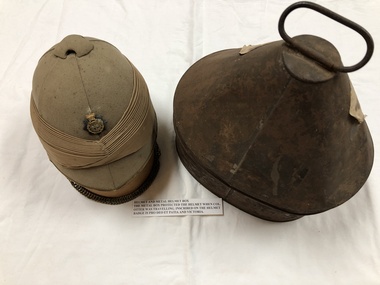
Helmet and Helmet Box
... ...Military helmets...Khaki Helmet with brass Military Badge. Rusted metal Helmet Box with handle and latch....Military badges Military helmets Badge: Pro Deo Et Patia and Victoria Khaki Helmet with brass Military Badge. ...Belonged to Colonel Otter.Khaki Helmet with brass Military Badge. Rusted metal Helmet Box with handle and latch.Badge: Pro Deo Et Patia and Victoriamilitary badges, military helmets -
 Geelong RSL Sub Branch
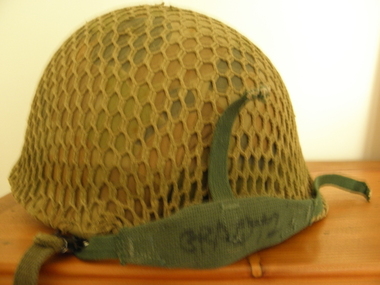
Helmet - US, Mid 20th century
... US Military Helmet,...This is a US Military Helmet WW2 vintage....A Helmet - US Military- green, camouflage and net cover, webbing on the inside and chin straps....This is a US Military Helmet WW2 vintage. This is a helmet used by a member of US Defence Force US Military Helmet, Graq 2 on the chip strap and head band. ...This is a US Military Helmet WW2 vintage.This is a helmet used by a member of US Defence ForceA Helmet - US Military- green, camouflage and net cover, webbing on the inside and chin straps.Graq 2 on the chip strap and head band.us military helmet, -
 Bendigo Historical Society Inc.
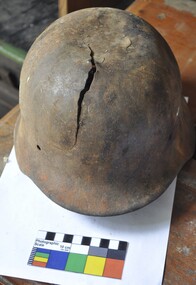
Uniform - GERMAN MILITARY ARMY HELMET
... GERMAN MILITARY ARMY HELMET...German Military Army Helmet. Damaged. Cracked and holed in the crown. ...Uniform GERMAN MILITARY ARMY HELMET ...The World War II German steel combat helmet was manufactured in 3 different variations. The first model which appeared in 1935 (M35) was a sophisticated craftwork and the M40 was an improved version. The last model, the M42 was simplified to make it faster and easier to manufacture larger numbers of helmets to compensate the huge losses of helmets during the last years of the war. The number refers to the year e.g. M40 = 1940German Military Army Helmet. Damaged. Cracked and holed in the crown. No webbing or straps.world war ii, germany -
 Frankston RSL Sub Branch
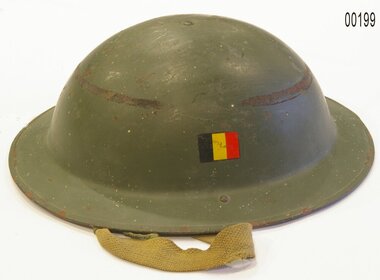
Helmet, Belgian
... This helmet was used by all services of the Belgian Military; Army, Navy and Air Force, as well as in Civil Defence. ...A Belgium Flag decal was worn on the left hand side of the shell, on all Military issue helmets. Stencilled on the liner is "COMET ABL 50", with the ABL (Armee Belge/Belgische Leger)....A Belgium Flag decal was worn on the left hand side of the shell, on all Military issue helmets. Stencilled on the liner is "COMET ABL 50", with the ABL (Armee Belge/Belgische Leger). ...Mark 2 Belgian Clone of the British Brodie helmet. After the end of the Second World War Belgium began manufacturing their own version of the British Mk.II Helmet, which came to be known as the Belgian Mk.II Clone. This helmet was used by all services of the Belgian Military; Army, Navy and Air Force, as well as in Civil Defence. Mk.II Clones were produced from 1949 to 1952 and were very similar to the British Mk.II in almost every respect. However on closer inspection the differences are obvious, most noteably with the liner. Belgian Mk.IIs have a brown leather liner with five tongues and a brown drawstring. The cross shaped crown pad has black sorbo foam covered by leather. The underside of the leather has the Belgium Crest printed, while British helmets used oilcloth. Also unlike on British made Mk.IIs, the rims and lugs are made of mild (i.e. magnetic) steel. A Belgium Flag decal was worn on the left hand side of the shell, on all Military issue helmets. Stencilled on the liner is "COMET ABL 50", with the ABL (Armee Belge/Belgische Leger). -
 The 5th/6th Battalion Royal Victoria Regiment Historical Collection
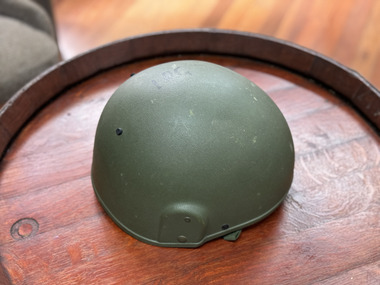
Headwear - Helmet, British Army Helmet Mk6
... Many military forces used these helmets such as Argentina, Mexico, and most listed UN countries as stated. ...Many military forces used these helmets such as Argentina, Mexico, and most listed UN countries as stated. ...The Mk 6 was issued to the British military in 1986.[3] They were known to be used in Operation Desert Storm and Desert Shield.[4] From 1992, the Mk 6 was supplied to the UN alongside the M88, MICH and the M1 to allow for protection of peacekeeping forces. Many military forces used these helmets such as Argentina, Mexico, and most listed UN countries as stated. These were either covered with the respective country's camouflage helmet cover, or issued with a blue Mk 6 cover to indicate it as a peacekeeping helmet.[5] From June 2009, the helmet was replaced by the Mk 7 helmet.British Army combat helmet mk 6 made of ballistic nylon, painted olive green. It has a foam and leather liner and an olve green webbing harness to secure the helmet to the soldiers head. "Becca" is written in sharpie on the inside rear right of the helmet forward of the manufactures sizing and serial tag. -
 Flagstaff Hill Maritime Museum and Village
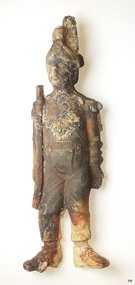
Leisure object - Toy Soldier, circa 1878
... Through is associated with the worst and best-known shipwreck in Victoria's history. flagstaff hill warrnambool flagstaff hill maritime museum shipwreck coast flagstaff hill maritime village great ocean road loch ard toy soldier napoleonic uniforms military toy moulded soldier An unpainted, cream-coloured toy soldier, recovered from the Loch Ard. The figure wears a Napoleonic Wars-era uniform, a plumed helmet, a short jacket with tails, bib-front trousers with button closure, straps crossed at the front and back, and epaulettes. ...The toy soldier is a relic from the shipwreck of the LOCH ARD in 1878. It has a companion piece in the Flagstaff Hill collection. The toy soldier is unpainted, but the style of uniform, and the weapons carried (a musket and a basket-handled cutlass), indicate it is a representation of the Napoleonic Wars period from the beginning of the nineteenth century. Mass-produced toy soldiers made of cast metal (lead or tin) became popular during the 1800s. Heyde of Germany manufactured silhouette-shaped flat toy soldiers early in the century. Mignot of France released three-dimensional solid figures and later around 1893 W. Britain, a toy company became known for its die-cast lead toy soldiers. These innovations were designed to make sets of toy soldiers more affordable for middle and lower-class children, extending the market beyond the intricately made and hand-crafted replicas that were the preserve of the rich in the eighteenth century. Wooden military figures, specially carved and unpainted ones, were therefore not particularly common at the time when the Loch Ard foundered on Victoria’s southwest coast. Mignot was the first to sell unpainted soldiers, leaving their customers to fill in the colours according to their own patriotic preferences. It is, therefore, possible the two figures in the Flagstaff Hill collection were part of a new set intended for sale, rather than part of a passenger’s existing collection. Loch Ard History: The Loch Ard got its name from ”Loch Ard” a loch that lies to the west of Aberfoyle, and the east of Loch Lomond. It means "high lake" in Scottish Gaelic. The vessel belonged to the famous Loch Line which sailed many vessels from England to Australia. The Loch Ard was built in Glasgow by Barclay, Curle & Co. in 1873, the vessel was a three-masted square-rigged iron sailing ship that measured 79.87 meters in length, 11.58 m in width, and 7 m in depth with a gross tonnage of 1693 tons with a mainmast that measured a massive 45.7 m in height. Loch Ard made three trips to Australia and one trip to Calcutta before its fateful voyage. Loch Ard left England on March 2, 1878, under the command of 29-year-old Captain Gibbs, who was newly married. The ship was bound for Melbourne with a crew of 37, plus 17 passengers. The general cargo reflected the affluence of Melbourne at the time. Onboard were straw hats, umbrellas, perfumes, clay pipes, pianos, clocks, confectionery, linen and candles, as well as a heavier load of railway irons, cement, lead and copper. There were other items included that were intended for display in the Melbourne International Exhibition of 1880. The voyage to Port Phillip was long but uneventful. Then at 3 am on June 1, 1878, Captain Gibbs was expecting to see land. But the Loch Ard was running into a fog which greatly reduced visibility. Captain Gibbs was becoming anxious as there was no sign of land or the Cape Otway lighthouse. At 4 am the fog lifted and a lookout aloft announced that he could see breakers. The sheer cliffs of Victoria's west coast came into view, and Captain Gibbs realised that the ship was much closer to them than expected. He ordered as much sail to be set as time would permit and then attempted to steer the vessel out to sea. On coming head-on into the wind, the ship lost momentum, the sails fell limp and Loch Ard's bow swung back towards land. Gibbs then ordered the anchors to be released in an attempt to hold their position. The anchors sank some 50 fathoms - but did not hold. By this time the ship was among the breakers and the tall cliffs of Mutton Bird Island rose behind. Just half a mile from the coast, the ship's bow was suddenly pulled around by the anchor. The captain tried to tack out to sea, but the ship struck a reef at the base of Mutton Bird Island, near Port Campbell. Waves subsequently broke over the ship and the top deck became loosened from the hull. The masts and rigging came crashing down knocking passengers and crew overboard. When a lifeboat was finally launched, it crashed into the side of Loch Ard and capsized. Tom Pearce, who had launched the boat, managed to cling to its overturned hull and shelter beneath it. He drifted out to sea and then on the flood tide came into what is now known as Lochard Gorge. He swam to shore, bruised and dazed, and found a cave in which to shelter. Some of the crew stayed below deck to shelter from the falling rigging but drowned when the ship slipped off the reef into deeper water. Eva Carmichael a passenger had raced onto the deck to find out what was happening only to be confronted by towering cliffs looming above the stricken ship. In all the chaos, Captain Gibbs grabbed Eva and said, "If you are saved Eva, let my dear wife know that I died like a sailor". That was the last Eva Carmichael saw of the captain. She was swept off the ship by a huge wave. Eva saw Tom Pearce on a small rocky beach and yelled to attract his attention. He dived in and swam to the exhausted woman and dragged her to shore. He took her to the cave and broke the open case of brandy which had washed up on the beach. He opened a bottle to revive the unconscious woman. A few hours later Tom scaled a cliff in search of help. He followed hoof prints and came by chance upon two men from nearby Glenample Station three and a half miles away. In a complete state of exhaustion, he told the men of the tragedy. Tom then returned to the gorge while the two men rode back to the station to get help. By the time they reached Loch Ard Gorge, it was cold and dark. The two shipwreck survivors were taken to Glenample Station to recover. Eva stayed at the station for six weeks before returning to Ireland by steamship. In Melbourne, Tom Pearce received a hero's welcome. He was presented with the first gold medal of the Royal Humane Society of Victoria and a £1000 cheque from the Victorian Government. Concerts were performed to honour the young man's bravery and to raise money for those who lost family in the disaster. Of the 54 crew members and passengers on board, only two survived: the apprentice, Tom Pearce and the young woman passenger, Eva Carmichael, who lost her family in the tragedy. Ten days after the Lochard tragedy, salvage rights to the wreck were sold at auction for £2,120. Cargo valued at £3,000 was salvaged and placed on the beach, but most washed back into the sea when another storm developed. The wreck of Lochard still lies at the base of Mutton Bird Island. Much of the cargo has now been salvaged and some items were washed up into Lochard Gorge. Cargo and artefacts have also been illegally salvaged over many years before protective legislation was introduced in March 1982. One of the most unlikely pieces of cargo to have survived the shipwreck was a Minton majolica peacock- one of only nine in the world. The peacock was destined for the Melbourne 1880 International Exhibition. It had been well packed, which gave it adequate protection during the violent storm. Today the Minton peacock can be seen at the Flagstaff Hill Maritime Museum in Warrnambool. From Australia's most dramatic shipwreck, it has now become Australia's most valuable shipwreck artifact and is one of very few 'objects' on the Victorian State Heritage Register.The toy soldier represents a 19th-century child's interest in military history. The item is one of two toy soldiers recovered from the Loch Ard in Flagstaff Hill's collection. The shipwreck of the Loch Ard is of significance for Victoria and is registered on the Victorian Heritage Register ( S 417). Flagstaff Hill has a varied collection of artefacts from Loch Ard and its collection is significant for being one of the largest accumulations of artefacts from this notable Victorian shipwreck of which the subject items are a small part. The collections of objects give us a snapshot of how we can interpret the story of this tragic event. The collection is also archaeologically significant as it represents aspects of Victoria's shipping history, allowing us to interpret Victoria's social and historical themes. Through is associated with the worst and best-known shipwreck in Victoria's history.An unpainted, cream-coloured toy soldier, recovered from the Loch Ard. The figure wears a Napoleonic Wars-era uniform, a plumed helmet, a short jacket with tails, bib-front trousers with button closure, straps crossed at the front and back, and epaulettes. The figure is in marching posture with one foot extended forward, and is bearing a musket at the slope-arms position, with a sabre or cutlass slung behind. It is unable to stand on its own. There are reddish-brown and orange-brown stains on the head and body. The body has seams along both sides that are uneven at the lower leg. There is a hole in the back and the inside is hollow. The material has a rough texture.flagstaff hill, warrnambool, flagstaff hill maritime museum, shipwreck coast, flagstaff hill maritime village, great ocean road, loch ard, toy soldier, napoleonic uniforms, military toy, moulded soldier -
 Frankston RSL Sub Branch
Helmet, Australian M1, circa 1960's
... This helmet type was issued to Australian defence personnel during the Vietnam conflict. The inner line has a transfer on the front " Australian Military Forces" with rising sun badge. ...This helmet type was issued to Australian defence personnel during the Vietnam conflict. The inner line has a transfer on the front " Australian Military Forces" with rising sun badge. ...Standard issue United States M1 pattern steel helmet, olive drab in colou, stretch cotton cargo type net, with fibreglass liner. On the inside of a strap in the liner '8415-153-6671' is printed in black ink. This number would appear to be the "Federal Stock Number (FSN)" which was used 1949 to 1975 when ti was replaced by "National Stock Number (NSN)' by additional of 00 after the first 4 numbers. this would indicate that it was made in USA. The chin strap and liner are both complete and fully operable. These helmets were first issued in 1941 to the United States Armed Forces. They were adopted after the Korean War by the Australian Defence Force. In the 1990s they were replaced by the Kevlar based Personnel Armour System-Ground Troop (PASGT) type helmet. However, as evidenced by this helmet, some M1 Steel helmets were not replaced in-service by the PASGT helmet and survived into the early 21st Century. Used by Royal Australian Army in Vietnam in areas where mines were significnat, such as Long Hai's mountains (together with US flak jackets), and also by Royal Australain Navy.An example of an Australian Army issue M1 steel battle helmet complete with fibreglass liner. This helmet type was issued to Australian defence personnel during the Vietnam conflict. The inner line has a transfer on the front " Australian Military Forces" with rising sun badge. The steel outer has an olive green elastic cover (similiar to cargo net) to hold camouflage material. The M1 is two "one-size-fits-all" helmets: an outer shell made of metal and a hard hat-type liner that is nestled inside the shell and contains the suspension system that would be adjusted to fit the wearer's head. Helmet covers and netting would be applied by covering the steel shell with the extra material tucked inside the shell and secured by inserting the liner. The helmet is 7 inches in height, width is 9.5 inches and length is 11 inches. The weight of a World War II era M1 is approximately 2.85 pounds including the liner and chinstrap. (From Wikipepedia) the inner line has a transfer on the front " Australian Military Forces" with rising sun badge.steel helmet -
 Werribee RSL Sub Branch
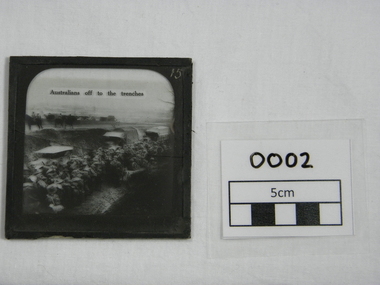
Photograph, glass plate, Australians of to the trenches, early to mid 20th century
... helmet to protect them. The conditions that they had to survive under can be seen. car world war one military soldiers trench truck world war i scene horses Printed on the top of the image. ...This photo was taken somewhere in Europe during World War I. It shows some of the equipment the soldiers had to carry and wear into battle. You will also notice that not all soldiers were not issued with metal helmet to protect them. The conditions that they had to survive under can be seen.Photograph,glass plate. It depicts two miliary scenes from World World I. Skillfully amagulmated on the one negative. In the top half there are soldiers on horseback with tents in the background, lower half a large group of soldiers, two trucks and a car in a trench.Printed on the top of the image. "Australians off to the trenches". On the edge "15" is written. car, world war one, military, , soldiers, trench, truck, world war i, scene, horses -
 Lara RSL Sub Branch
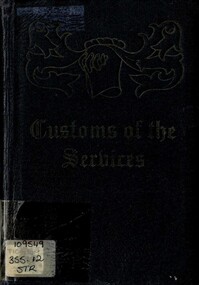
Booklet, Customs of the Services
... Military Services of the time, meant for newly Commissioned Officers as a "go to" training aid. First published as "Customs of the Service" in March 1939, and republished at regular intervals throughout the war years until publication of "Customs of the Services" September 1946. Preface: Group Captain A.H. Stradling OBE September 1946. Navy Blue material covered cardpaper, has Helmet ...This book covered all Military Services of the time, meant for newly Commissioned Officers as a "go to" training aid.Navy Blue material covered cardpaper, has Helmet Crest on front cover, "Customs of the Services"First published as "Customs of the Service" in March 1939, and republished at regular intervals throughout the war years until publication of "Customs of the Services" September 1946. Preface: Group Captain A.H. Stradling OBE September 1946. -
 Geelong RSL Sub Branch
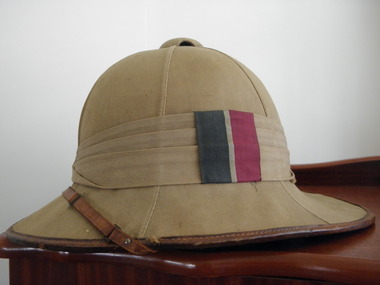
Pith Helmet
... The earliest appearance of these helmets went back as far as 1840 for use in the field and then worn with dress uniform only in the 20th century. The helmet was part of military uniform from 1840 up until the the mid 20th century. ...The earliest appearance of these helmets went back as far as 1840 for use in the field and then worn with dress uniform only in the 20th century. The helmet was part of military uniform from 1840 up until the the mid 20th century.Pith Helmet is khaki colour with khaki puggaree, the puggaree has three folds and sewn on the left hand side of the puggaree is a blue white red colour patch. There is a leather band around the brim of the helmet and across the front visor there is a leather chin strap with metal adjustment buckles there is a ball shaped finial in the top of the hat.Handwritten inside the helmet is the name of Sgt. Canr A.E.khaki pith helmet field use dress uniform headware -
 Flagstaff Hill Maritime Museum and Village
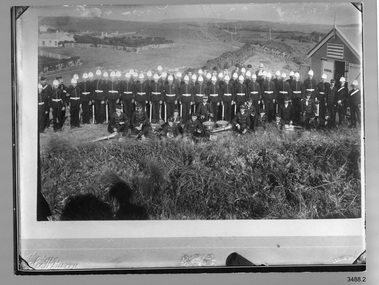
Photograph - Military
... helmets, the the band members wearing caps. Band instruments are in the foreground on the ground. There is a hut on the right with the word GENERAL painted on the door. There is a road and some buildings on the left, another road on the right with tall posts, and hills in the background. One of the instruments is a Rope Tensioned Bass Drum. 3488.1 is unmounted, and has two stamps on the back 3488.2 is a copy of a mounted photograph, with impressed inscriptions below Photograph Military ...Photograph; black and White group photograph of the Volunteer Corps and Band in dress uniform with white pith helmets, the the band members wearing caps. Band instruments are in the foreground on the ground. There is a hut on the right with the word GENERAL painted on the door. There is a road and some buildings on the left, another road on the right with tall posts, and hills in the background. One of the instruments is a Rope Tensioned Bass Drum. 3488.1 is unmounted, and has two stamps on the back 3488.2 is a copy of a mounted photograph, with impressed inscriptions below Painted on the building "GENERAL" (3488.1) Stamp, purple ink; "Flagstaff Hill Maritime Village" (3488.2) Impressed below the copy and photographed with the copy: Coat of Arms in centre [Lion and Unicorn], pulse impressed script on the left and impressed text on the right.flagstaff hill, warrnambool, shipwrecked-coast, flagstaff-hill, flagstaff-hill-maritime-museum, maritime-museum, shipwreck-coast, flagstaff-hill-maritime-village, photograph, volunteer corps band -
 Montmorency–Eltham RSL Sub Branch
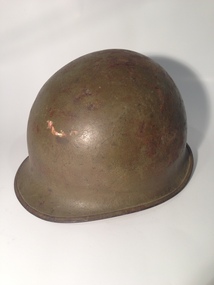
Uniform - Helmet, Steel US M-1, Vietnam era, Steel Helmet
... M1 steel helmet used by the United States military from WWII to 1985. ...M1 steel helmet used by the United States military from WWII to 1985. ...Vietnam eraM1 steel helmet used by the United States military from WWII to 1985. Painted textured finish light olive green. The rim edge has a crimped metal band running around it, with a rear seam. Mounted on each side of the helmet there are D shaped swiveled metal loops for a chinstrap. The adjustable chinstrap is made of olive drap coloured nylon webbing with blackened metal clips. A two pice clip system metal fastener is used to connect the two pieces of the chinstrap.On the inside of the helmet is written in black textra the name MORCOM, No 37019, and 1966-67.helmet, headgear -
 Montmorency–Eltham RSL Sub Branch
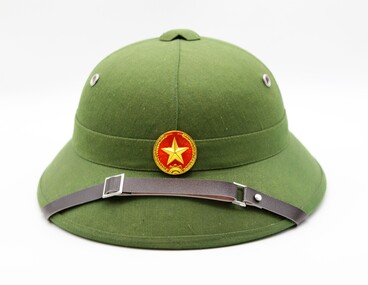
Uniform - Military Helmet (Republic of Vietnam), 2007
... Military Helmet (Republic of Vietnam)......military helmet...Uniform Military Helmet (Republic of Vietnam) ...Cotton Outer, Resin Inner, Green Colour, Pith Helmet Design.Republic of Vietnam Starhelmet, vietnam, military helmet -
 Bendigo Military Museum
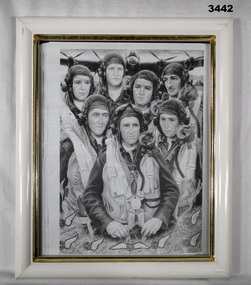
Drawing - DRAWING WW2, FRAMED, Possibly post WW2
... Names of airmen are: “CHAMPKIN D G, CARROLL M W, LYNCH T J, JARMAN E G D, HARRIS H R, JACKSON J G NEAL R L” illustrations-pen&ink military history - air force Airforce lancaster Black / white drawing of a Lancaster air crew. Each is wearing his flying gear, each has a last name drawn on front of helmet. ...Names of airmen are: “CHAMPKIN D G, CARROLL M W, LYNCH T J, JARMAN E G D, HARRIS H R, JACKSON J G NEAL R L”Black / white drawing of a Lancaster air crew. Each is wearing his flying gear, each has a last name drawn on front of helmet. An Avro Lancaster Bomber is at the top part of drawing. Winged badges bearing pilot's full names are at bottom part of drawing. Frame is simple wood design, painted white with a small amount of gold trim.illustrations-pen&ink, military history - air force, airforce, lancaster -
 Bendigo Military Museum
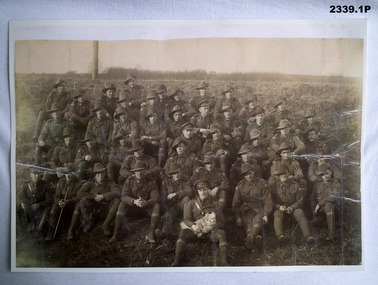
Photograph - PHOTOGRAPHS WW1, 2) 29/08/1916
... Embark for England 20.6.1916, hospital with Measles 18.8.1916, embark for France 22.11.1916, detached to 10th Light Trench Mortar Battery, WIA 6.5.1917 GSW to face and left eye, while recovering he was admitted to hospital 13.8.1917 with Retinitis (eye), returned to Australia and discharged medically unfit 5.2.1918. photography-photographs military history - army .1) Photo, sepia colour showing large group of soldiers (46) seated on a hill side. A small dog in the front row. .2) Postcard photo of soldier in pith helmet beside palm tress, B&W. .3) Postcard photo of soldier standing with crop, B&W. .4) Postcard photo of soldier standing with officers cane, B&W. .5) Postcard photo of soldier standing with riding crop, B&W. .6) Postcard photo of 11 soldiers outside a hut, B&W. .7) Photo postcard of soldier with "Red Cross" on arm, B&W. .8) Photo postcard of soldier, portrait, B&W. .9) Photo, postcard of group of soldiers (10) outside tents, B&W. .10) Photo, postcard of soldier standing outside building holding a crop, B&W. ....1) Is re Evan. EVANS No. 3114 in 6th Batt. 10th Reinforcements then transferred to 1st Pioneers. .2) "To Joe & Linne from cousin Leslie 3rd/38th Batt." .10) Letter is to Joe & Linne from apparently "Jim" .1) Re Evans. There is an Evan Owens No 3114 enlisted in 10th reinforcements 6th Batt AIF on 10.7.1915 age 21 years. Em bark for Egypt 29.9.1915, transfer to 1st Pioneer Batt 12.3.1916, embark for France 2.3.1916, WIA 22/27 .7.1916 GSW head, rejoin unit 16.10.1916, discharged from the AIF 3.8.1919. .2) Re Leslie. This possibly Albert Leslie Owens (brother to Evan) No 953, enlisted in the AIF in C Coy 38th Batt on 21.2.1916 age 24 years. Embark for England 20.6.1916, hospital with Measles 18.8.1916, embark for France 22.11.1916, detached to 10th Light Trench Mortar Battery, WIA 6.5.1917 GSW to face and left eye, while recovering he was admitted to hospital 13.8.1917 with Retinitis (eye), returned to Australia and discharged medically unfit 5.2.1918..1) Photo, sepia colour showing large group of soldiers (46) seated on a hill side. A small dog in the front row. .2) Postcard photo of soldier in pith helmet beside palm tress, B&W. .3) Postcard photo of soldier standing with crop, B&W. .4) Postcard photo of soldier standing with officers cane, B&W. .5) Postcard photo of soldier standing with riding crop, B&W. .6) Postcard photo of 11 soldiers outside a hut, B&W. .7) Photo postcard of soldier with "Red Cross" on arm, B&W. .8) Photo postcard of soldier, portrait, B&W. .9) Photo, postcard of group of soldiers (10) outside tents, B&W. .10) Photo, postcard of soldier standing outside building holding a crop, B&W. Letter written on the back in ink, B&W.photography-photographs, military history - army -
 Bendigo Military Museum
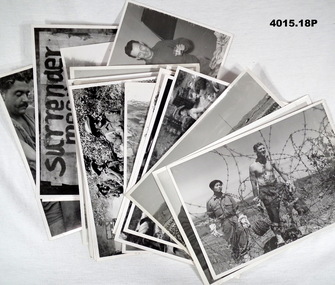
Photograph - MILITARY PHOTOGRAPHS, 1950 - 1956
... (.18) Soldier in a trench wearing a steel helmet. Photograph MILITARY PHOTOGRAPHS ...All photos relate to the collection of Francis William (Dinky) DEAN BEM, VX93960 2nd AIF, 3742 1 RAR, 1943 - 1975. Refer Cat No 124.2 for his service history. The photos are believed to be taken during 1 RAR’s 2nd tour of Korea 1954 - 56. BCFK (British Commonwealth Foce Korea)All photos are B & W. (.1) Two soldiers beside a sign holding a bottle of beer. (.2) Shows a hand painted sign on a timber boards. (.3) Same sign on a single board. (.4) An Australian and Korean soldier laying barb wire. (.5) two soldiers in winter clothes holding a box of rations. (.6) Large parade of Australian soldiers with a camp and buildings in the back ground. (.7) Group of men lining up receiving rations. (.8) Three soldiers sitting each with a tin of Golden Circle fruit or juice. (.9) Group of Officers lined up behind sand bags. (.10) Group of soldiers lined up on the ground with explosions in front of them. (.11) Australian soldier in a trench with radio equipment gear on. (.12) Five Australian soldiers on a road with a Jeep in the rear. (.13) Five soldiers silhouetted against a bush back ground. (.14) Australian soldiers in open ground firing mortars. (.15) Nine soldiers in the back of a truck, Frank Dean on the left in front. (.16) two soldiers, one being supported by the other. (.17) Three soldiers, one in white apron cutting up bread. (.18) Soldier in a trench wearing a steel helmet.All photos have on the rear stamped in purple; “Photo No, please credit to Public relations HQ BCFK” military, british common wealth force korea -
 Bendigo Military Museum
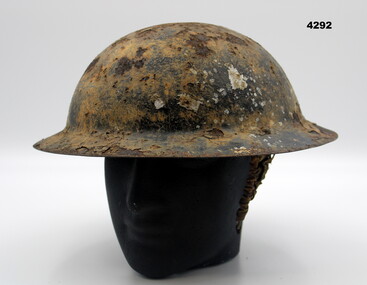
Headwear - STEEL HELMET, Possibly WW2 era
... military equipment army headwear steel Steel helmet with incomplete chin strap, British pattern Headwear STEEL HELMET ...Steel helmet with incomplete chin strap, British patternmilitary equipment, army, headwear, steel -
 Bendigo Military Museum
Film - PHOTOGRAPH, 1916 -1919
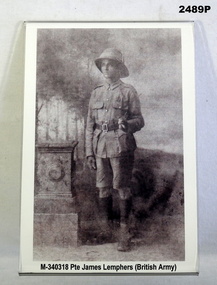
... Photography military British "M-340318 Pte James Lemphers (British Army)" Photo, sepia tone showing a British soldier standing in uniform with Pith Helmet. ...James Lemphers ASC - MT British Army. Refer 2490 medals.Photo, sepia tone showing a British soldier standing in uniform with Pith Helmet. Under the photo are the soldiers details. Photo is in a clear plastic frame for display."M-340318 Pte James Lemphers (British Army)"photography, military, british -
 Bendigo Military Museum
Headwear - HELMET - WW1 GERMAN, c. 1915
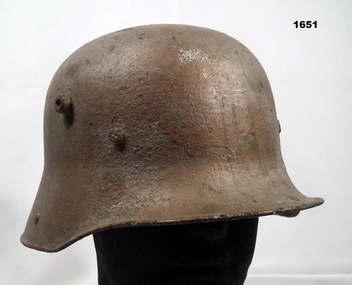
... Helmet...German Army - WW1...Military...Hanna was wounded during the 1916 Battle of the Somme. Helmet German Army - WW1 Military equipment Uniforms - army Headwear World War One German Army steel helmet. ...The helmet was captured by William J Hanna, Royal Irish Fusiliers. Hanna was wounded during the 1916 Battle of the Somme.World War One German Army steel helmet. The outer surface is painted. Two lugs/ventilation holes are visible on each side. Rivets securing the missing headband are also visible. The front of the helmet has an extended visor whilst the back and sides also project to cover the nape of the neck and ears. Inside on each side are attachment points for a chin strap.helmet, german army - ww1, military equipment, uniforms - army, headwear -
 Bendigo Military Museum
Photograph - PHOTOGRAPHS WW1, c. 1915 - 1919
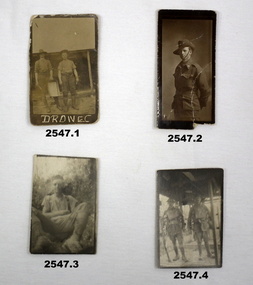
... military history - army 38th .1) verso: “Me & Sandy Port De Nieppe May 1917” .2) verso: “Taken in Liverpool, England while on <> leave Jan 1918. To Mother Father & all at home with love from Sandy” .1) 2 Australian soldiers in fatigues with what looks like a cooking apparatus, with letters below DROW EC (stylised). .2) 1/2 length portrait of an Australian soldier. .3) Casual portrait of a soldier sitting in fatigues, probably Sandy. Boots look muddy, scrub in background. .4) Portrait of 2 soldiers (allied) fully armed & wearing helmets ...Items relating to the collection re Alexander Norman Cummin No 18, 38th Batt AIF, his brother Harold Nesbit Cummin No 1239 Camel Corp. Refer 2535P (Alexander) 2530.3P (Harold) for their service details. .6) Graves photo. On the left, Sydney Graham Issell. He had 4 years pre war service in Senior cadets and Citizens Forces reaching the rank of Sgt. Enlisted on 8.2.1916 No 912 with the rank of Cpl, C Coy 38th Batt age 21 years 11 months. Embark for England 20.6.1916, promoted L/Sgt, embark for France 22.11.1916, hospital 13.5.1917 (NYD) rejoin unit 19.5.1917, WIA 29.5.1917 GSW chest then restated GSW Back, severe, rejoin unit 12.3.1918, KIA 1.8.1918. On the right, Harold James Fraser. He had 5 years pre war service in the Cadets and Citizens Forces. Enlisted on 27.10.1916 No 2802 6th reinforcements 38th Batt age 22 years. Embark for England 16.12.1916, moves through 10th, 14th Training Batt’s then 66th Batt on 28.4.1917, promoted Sgt and alloted No 2802A, embark for France 25.8.1917 as reinforcement 38th Batt, awarded the Military medal (MM)) 12.10.1917 East of Eypres, KIA 1.8.1918. Both were buried at Vaire Wood near Corbie. .1) 2 Australian soldiers in fatigues with what looks like a cooking apparatus, with letters below DROW EC (stylised). .2) 1/2 length portrait of an Australian soldier. .3) Casual portrait of a soldier sitting in fatigues, probably Sandy. Boots look muddy, scrub in background. .4) Portrait of 2 soldiers (allied) fully armed & wearing helmets. .5) Portrait of a soldier (allied) fully armed & dangerous. .6) Black & white photo of 2 graves with white crosses. Soldiers left cross: No 912 SGT SG ISSELL 38 BN AIF, Soldier right cross: No 2802 SGT HJ FRASER 38 BN AIF. .7) Black & white photo showing 2 Australian soldiers casually dressed in the ruins of an old factory. .8) Black & white mini photo showing building ruins & what appears to be derelict boilers. .9) Black & white mini photo showing what appears to be a WWI German soldier kamerading (surrendering). This is probably posing in captured enemy clothing. 10.) Black & white mini photo showing camels at rest. .11) Black & white mini photo showing a blown up British pattern tank MK1 on sandy terrain. A track has detached & curled up over the front of the tank. .1) verso: “Me & Sandy Port De Nieppe May 1917” .2) verso: “Taken in Liverpool, England while on <> leave Jan 1918. To Mother Father & all at home with love from Sandy”photography-photographs, military history - army, 38th -
 Bendigo Military Museum
Print - NURSE PRINT, FRAMED, Post WW2
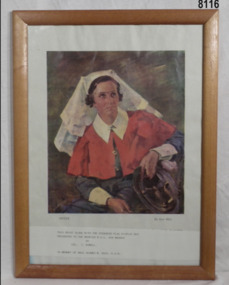
... Military Museum. Brsl smirsl ivor hele nurse On label under print. “In Memory of Able Seaman W Haas RAN This print along with the overhead flag display was presented to the Bendigo RSL Sub Branch by Cpl J ROWELL in memory of Able seaman W.HAAS. R.A.N”. A Sister of the Army Nursing Service Maple coloured timber glass front, cardboard back. Coloured print by Ivor Hele with white boarder. Female figure in sitting position in nurses uniform.with steel helmet ...This print was originally hanging in the foyer at the entrance to the Billiard room pre the SMI becoming a Military Museum.A Sister of the Army Nursing Service Maple coloured timber glass front, cardboard back. Coloured print by Ivor Hele with white boarder. Female figure in sitting position in nurses uniform.with steel helmet in left hand. Under the print, “A sister of the Army Nursing service” On label under print. “In Memory of Able Seaman W Haas RAN This print along with the overhead flag display was presented to the Bendigo RSL Sub Branch by Cpl J ROWELL in memory of Able seaman W.HAAS. R.A.N”. brsl, smirsl, ivor hele, nurse -
 Bendigo Military Museum
Headwear - STEEL HELMET, C. 1930’s - 40’s
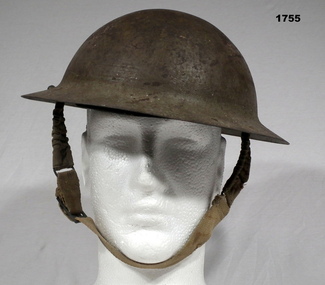
... military equipment - army costume - male - headwear metalcraft - steel British pattern steel helmet with leather insert & webbing chin strap. ...British pattern steel helmet with leather insert & webbing chin strap.military equipment - army, costume - male - headwear, metalcraft - steel -
 Bendigo Military Museum
Postcard - POSTCARDS PHOTOGRAPHIC WW1, Daily Mail, c.1914 - 1918
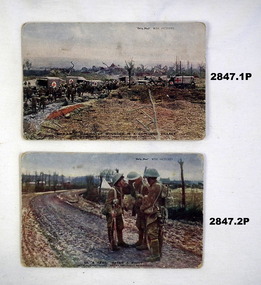
... Scenes WWI in Europe. photography-photographs military history passchendaele barracks trust .1) “RAMC picking up wounded in a captured village” .2) “A fag after a fight” .3) “British mine exploding at Beaumont-Hamel” .4) “British Machine Gunners wearing gas helmets” Four by colour enhanced postcards with scenes WW1. ...Daily Mail Official War Pictured, Series 2, No 10. Scenes WWI in Europe.Four by colour enhanced postcards with scenes WW1..1) “RAMC picking up wounded in a captured village” .2) “A fag after a fight” .3) “British mine exploding at Beaumont-Hamel” .4) “British Machine Gunners wearing gas helmets”photography-photographs, military history, passchendaele barracks trust -
 Bendigo Military Museum
Postcard - POSTCARDS, PHOTOGRAPHIC WW1, c.1914 - 1918
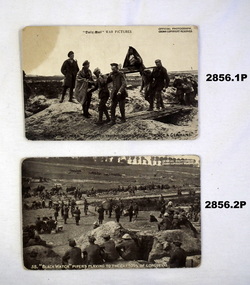
... military history Passchendaele Barracks Trust No 57 Wounded. Tommy to Photographer: I'm not a German! No 58 Black Watch Pipers Playing to the Captors of Longueval. No 59 The Burial of two British Soldiers on the Battlefield. No 60 A Fag After a Fight. No 62 British Machine Gunners Wearing Gas Helmets ...Black & white photos of WWI battle scenes in Europe. Seven Daily Mail battle pictures, black & white. Official war photos, Series VIII. No 57 Wounded. Tommy to Photographer: I'm not a German! No 58 Black Watch Pipers Playing to the Captors of Longueval. No 59 The Burial of two British Soldiers on the Battlefield. No 60 A Fag After a Fight. No 62 British Machine Gunners Wearing Gas Helmets. No 63 Tommy at Home in German Dugouts. No 64 A Big Mine Exploding.postcards - photographs, military history, passchendaele barracks trust -
 Bendigo Military Museum
Headwear - HELMET, PITH
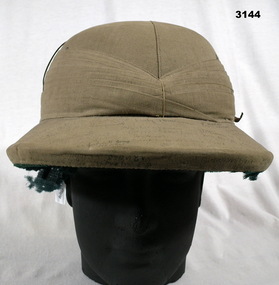
... The hand written signatures on the hat include high ranking AIF Officers, major local Officials and dozens of 8th Division AIF soldiers. military equipment - army costume - male headwear On top written in pen & ink: Many army numbers & names of soldiers and some dignitaries.. On top written in ink: To Dad etc from Cyril. British pattern Pith Helmet ...This hat was sent home to Laanecoorie, from Malaya, in 1941 by Driver Cyril John Johnson VX36298, 1 Coy A.A.S.C whilst a POW. Cyril enlisted in the 2nd AIF on 17.6.1940 age 22 years 2 months. Posted to 8th Div Petrol Coy Seymour 25.7.1940, hospital 12.8.1940 with Mumps, rejoin unit 31.8.1940, embark for overseas 2.2.1941, disembark Singapore 19.2.1941. He is listed as missing on 16.2.1942 and later listed as POW in a Thai Camp no date. (He was on the Burma Railway) Last entry on his records states Presumed to be dead 12.9.1944 SWPA. (South West Pacific Area) He with hundreds of others were on the Japanese prison ship Rakuyo Maru to Japan when it was sunk by an American submarine. The hand written signatures on the hat include high ranking AIF Officers, major local Officials and dozens of 8th Division AIF soldiers. British pattern Pith Helmet, khaki coloured cotton cloth with brown leather strap over the top. Large quantity of hand written names on top. Inside rim has green felt lining. Dome section is plaited red silk with manufacturer's label at crest. Hat band is brown leather.On top written in pen & ink: Many army numbers & names of soldiers and some dignitaries.. On top written in ink: To Dad etc from Cyril.military equipment - army, costume - male headwear -
 Bendigo Military Museum
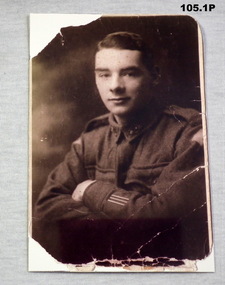
Photograph - PHOTOGRAPH COLLECTION, C. 1914 - 1918
... military history Photography AIF .4) Bottom centre in white print: C. COMP. 25 BATTALION. 16.5.15 HAVING DINNER IN OUR NEW DINING ROOM .1) Copy of sepia photo of Walter Henry SMITH seated, showing 3 WIA bars. .2) Copy of sepia photo depicting 2 soldiers, 1 standing, 1 seated, both wearing pith helmets. .3) Copy of sepia photo of 15 AIF soldiers & 2 children. .4) Copy of sepia photo depicting soldiers from C Company 25th Battalion eating in front of a tent. .5) Copy of sepia portrait of 5 AIF soldiers, 3 standing, 2 seated. .6) Copy of sepia portrait of 2 AIF soldiers. .7) Copy of elderly man wearing RSL badge - Walter H SMITH. ...Photos from WWI belonged to Walter Henry SMITH Reg No 1572. Refer Reg Nos 102.4 Medals, 104 Certificate..1) Copy of sepia photo of Walter Henry SMITH seated, showing 3 WIA bars. .2) Copy of sepia photo depicting 2 soldiers, 1 standing, 1 seated, both wearing pith helmets. .3) Copy of sepia photo of 15 AIF soldiers & 2 children. .4) Copy of sepia photo depicting soldiers from C Company 25th Battalion eating in front of a tent. .5) Copy of sepia portrait of 5 AIF soldiers, 3 standing, 2 seated. .6) Copy of sepia portrait of 2 AIF soldiers. .7) Copy of elderly man wearing RSL badge - Walter H SMITH. Metallic brass covered frame..4) Bottom centre in white print: C. COMP. 25 BATTALION. 16.5.15 HAVING DINNER IN OUR NEW DINING ROOMmilitary history, photography, aif -
 National Vietnam Veterans Museum (NVVM)
Flyer - Propaganda Flyer
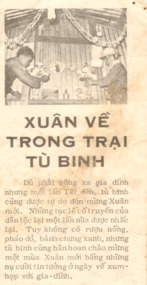
... Propaganda Viet Cong 9 RAR Lockwood Graham Keith 3123358 Major Graham Lockwood Royal Australian Infantry Corps Queensland University Regiment Citizens Military Forces (CMF) The Royal Australian Regiment A small propaganda flyer. Both sides have the heading "Xuan Ve Trong Trai Tu Binh", a black and white photograph of two men; one in a helmet is smiling at the camera, and the other is looking downwards. ...This document was taken from the body of a Viet Cong runner who was ambushed by a clearing patrol around the Bn Base in December 1968.A small propaganda flyer. Both sides have the heading "Xuan Ve Trong Trai Tu Binh", a black and white photograph of two men; one in a helmet is smiling at the camera, and the other is looking downwards. All text is in Vietnamese.propaganda, viet cong, 9 rar, lockwood graham keith, 3123358, major graham lockwood, royal australian infantry corps, queensland university regiment, citizens military forces (cmf), the royal australian regiment -
 National Vietnam Veterans Museum (NVVM)
Uniform - Uniform, ARVN, Mannequin
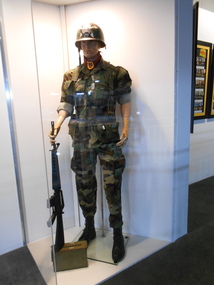
... A mannequin in full uniform & accessories consisting of a helmet, camoflage uniform, boots, dog tags, ranger scarves, military webbing & harness, ammunition pouches, a knife holding ar rifle which is sitting on an ammunition box....Mannequin South Vietnam Army Major Tu A mannequin in full uniform & accessories consisting of a helmet, camoflage uniform, boots, dog tags, ranger scarves, military webbing & harness, ammunition pouches, a knife holding ar rifle which is sitting on an ammunition box. ...A mannequin in full uniform & accessories consisting of a helmet, camoflage uniform, boots, dog tags, ranger scarves, military webbing & harness, ammunition pouches, a knife holding ar rifle which is sitting on an ammunition box.mannequin, south vietnam army, major tu -
 National Vietnam Veterans Museum (NVVM)
Headwear - Military police helmet, South Vietnamese
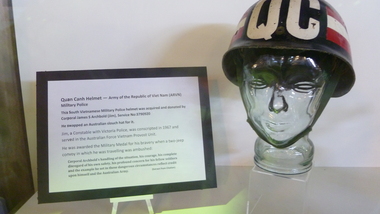
... Military police helmet, South Vietnamese...Helmet...South Vietnam Military Police...Helmet worn by the Quan Cahn, South Vietnamese military police, during the war in Vietnam. ...helmet from either side of the letters. es. . Inside there are the numbers, 29959 and the name Whitefield on the inside strap. Headwear Military ...Helmet worn by the Quan Cahn, South Vietnamese military police, during the war in Vietnam. This item was collected because it contributes to an understanding of those involved in the war in Vietnam (1962–1972) other than Australian servicemen. Black helmet with chin strap. Painted at centre front in large white letters is QC (Quan Canh). Three stripes of equal width (red, white, red) circle the helmet from either side of the letters. es. . Inside there are the numbers, 29959 and the name Whitefield on the inside strap.On front: QC, Inside are the numbers, 29959 and the name Whitefield on underside of chinstrap.qc, helmet, south vietnam military police, quan canh, cpl js archbold, military medal -
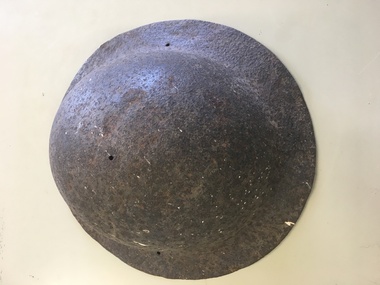 Warrnambool and District Historical Society Inc.
Helmet, Early to mid 20th century
... A steel helmet, popularly called a tin hat, is used as protective headwear by military personnel and civil workers in times of emergency and disasters. ...A steel helmet, popularly called a tin hat, is used as protective headwear by military personnel and civil workers in times of emergency and disasters. ...A steel helmet, popularly called a tin hat, is used as protective headwear by military personnel and civil workers in times of emergency and disasters. Steel helmets were first used in World War One, with the Allies troops using a design produced in London by John Brodie in 1915. This helmet was constructed in one piece pressed from a single thick sheet of steel and variants of this design have been used by military personnel ever since. It is not clear whether this particular item comes from World War One or World War Two. This steel helmet is retained as a good example of the protective headwear worn by Australian military personnel in World Wars One or Two.The crown of his helmet or tin hat is of an oval shape and it has a short flattened brim. There are three small holes for the insertion of a chin strap. The hat has some white paint marks and is very rusted.military headgear, history of warrnambool
