
Showing 188 items matching "mr power"
-
 Surrey Hills Historical Society Collection
Work on paper - Vertical file, Boroondara Roads Board
... ...Mr Power...Boroondara Roads Board Koonung Creek Mr Brooks Mr Power Mr Brown 1. History notes 1841-1864 from Alan Holt, undated (1 page). ...1. History notes 1841-1864 from Alan Holt, undated (1 page). boroondara roads board, koonung creek, mr brooks, mr power, mr brown -
Glen Eira Historical Society
Drawing - St Aloysius Church, Caulfield
... Mr.... Power Mrs....Popular Summer Girls Kehoe Miss Rattray Mrs Power Mr. Power Mrs. Kelly Mrs. Gleeson T. Mr. Gleeson T. ...Two Photocopies of a pamphlet from May 1924 signed A. L Kenny about the newly built St Aloysius Catholic Church on Balaclava Road, Caulfield. The pamphlet features a detailed description of the architectural features of the interior and exterior, including Gothic spire and nuns tubrine. The pamphlet is across 6 A4 pages for both copies. Included within are several photographs, of varying sizes, of the interior and exterior of the church, a photograph of the architect Bart Moriarty and an illustration of the proposed Presbytery. Within is a list of benefactors, their gifts to the church and the value of each gift.st aloysius’ church, o’ brien fr., parish of caulfield, returned soldiers and nurses caulfield, balaclava road, altar society, moriarty bart, caulfield., kenny a. l., popular summer girls, kehoe miss, rattray mrs, power mr., power mrs., kelly mrs., gleeson t. mr., gleeson t. mrs, foley m., guilfoyle, beth mr., murphy i. l mrs., killorn mr., walsh mr, radcliffe mrs., klaer d. miss, hogan a. miss, hennessy lady, pilkington m. miss, pilkington e. miss, connolly mr., hogan brothers, o’ loughlin count, o’ loughlin mrs, levers miss, burke t. m. mr, burke t.m. mrs, confoy t. j. mr, confoy t. j. mrs., harrington mrs., eccles e. mr., eccles e. mrs., dorgan d. mr, dorgan d. mrs, wren j. mr, wren j. mrs., kisby mrs, charlton h. miss, foulshan w mr., pilington mrs, mcgrath m. mr., mcnamara mrs, cornack mrs., connolly e. a. mr., malone mrs., wharton mr., wharton mrs., donoghue d. mr, foulsham w. mrs, sweeney p. mr., sweeney p. mrs., adams h. m mr, adams h. m mrs., vaughan d. e. mr, vaughan d. e. mrs., mclennan mrs, morgan myra miss, boland catherine miss, hennessy n. mr., casey s.p. mr, casey s.p. mrs., mclntyre e. miss, mannion mr., bennett mrs., drummond mrs., lectie mrs., catholic church, churches, gothic (revival) architecture, architectural features, architectural styles, architects, clergy residences, church furniture, religious ceremonies, nuns, communion rails, altars, fonts, pulpits, pews, stained glass, windows, organs, sculpture, cast iron work -
 Surrey Hills Historical Society Collection
Book, Early Canterbury, 1994
... ...(mr) thomas power...This booklet gives a brief description of the local settlement in Canterbury giving the landholders names and name of the house (before street numbering was introduced) and street it was located in. canterbury (ms) jane f portingale postmistress (mr) arundel wrighte wood brothers koonung creek (mr) thomas power (mr) oliver russell (mr) frederick griffin (mr) thomas payne shrublands w creek (mr) john gardiner (mr) james shanley (mr)robert hoddle (mr) michael logan (mr) patrick moloney (mr) hugh glass r. larkins t. hassett e. sturt d.s. campbell (mr) joseph camm riversdale road w. logan rochester road 1843 trees mont albert road a. sikes (mr) william smith 1853 (mr) ernest carter dentist elgar's surrey hindson family (mr) george granville mercy (mr) alfred golding (mr)alexander patterson (mr) thomas boanas (mr) thomas hyde builders (mr) richard terrill architects (mr) thomas miles drapers This booklet gives a brief description of the local settlement in Canterbury giving the landholders names and name of the house (before street numbering was introduced) and street it was located in. ...This booklet gives a brief description of the local settlement in Canterbury giving the landholders names and name of the house (before street numbering was introduced) and street it was located in.This booklet gives a brief description of the local settlement in Canterbury giving the landholders names and name of the house (before street numbering was introduced) and street it was located in.canterbury, (ms) jane f portingale, postmistress, (mr) arundel wrighte, wood brothers, koonung creek, (mr) thomas power, (mr) oliver russell, (mr) frederick griffin, (mr) thomas payne, shrublands, w creek, (mr) john gardiner, (mr) james shanley, (mr)robert hoddle, (mr) michael logan, (mr) patrick moloney, (mr) hugh glass, r. larkins, t. hassett, e. sturt, d.s. campbell, (mr) joseph camm, riversdale road, w. logan, rochester road, 1843, trees, mont albert road, a. sikes, (mr) william smith, 1853, (mr) ernest carter, dentist, elgar's surrey, hindson family, (mr) george granville mercy, (mr) alfred golding, (mr)alexander patterson, (mr) thomas boanas, (mr) thomas hyde, builders, (mr) richard terrill, architects, (mr) thomas miles, drapers -
 Clunes Museum
Photograph
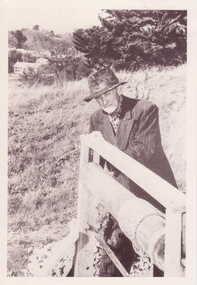
... .1 .2 .3 .4 .5 .6 BLACK AND WHITE PHOTOGRAPHS OF MR MARTIN POWER WORKING A WINDLASS OVER ONE OF HIS MINE SHAFTS ...STORY OF HIS LIFE IN 'IF ONLY I'D LISTENED TO GRANDPA' local history photography photographs mining MARTIN POWER - STORY OF HIS LIFE - 'IF ONLY I'D LISTENED TO GRANDPA' .1 .2 .3 .4 .5 .6 BLACK AND WHITE PHOTOGRAPHS OF MR MARTIN POWER WORKING A WINDLASS OVER ONE OF HIS MINE SHAFTS Photograph PHOTOGRAPH ...MARTIN POWER. STORY OF HIS LIFE IN 'IF ONLY I'D LISTENED TO GRANDPA'.1 .2 .3 .4 .5 .6 BLACK AND WHITE PHOTOGRAPHS OF MR MARTIN POWER WORKING A WINDLASS OVER ONE OF HIS MINE SHAFTS MARTIN POWER - STORY OF HIS LIFE - 'IF ONLY I'D LISTENED TO GRANDPA'local history, photography, photographs, mining -
Alexandra Timber Tramway & Museum
rubicon black and white photo, rubicon power haulage
... Rubicon Black and white photo of power house and hualage at rubicon .Note tin hut on outer edge and timber clearing for power lines. Mr Sapsford of Alexandra...Rubicon Power house and haulage Rubicon Black and white photo of power house and hualage at rubicon .Note tin hut on outer edge and timber clearing for power lines. Mr Sapsford of Alexandra rubicon power haulage rubicon black and white photo ...Rubicon Black and white photo of power house and hualage at rubicon .Note tin hut on outer edge and timber clearing for power lines. Mr Sapsford of AlexandraRubicon Power house and haulage -
 Ballarat Tramway Museum
Newspaper, The Courier Ballarat, "Tram depot to be sold next year", 10/08/1971 12:00:00 AM
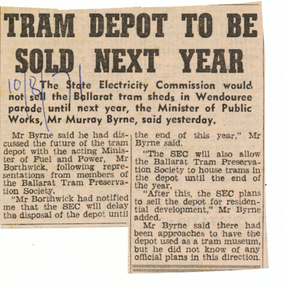
... Quotes Murray Byrne, Minister of Public Works and Acting Minister of Fuel and Power, Mr Borthwick about the sale and the interest of the BTPS....Quotes Murray Byrne, Minister of Public Works and Acting Minister of Fuel and Power, Mr Borthwick about the sale and the interest of the BTPS. ...Newspaper clipping from The Courier, Ballarat, titled "Tram depot to be sold next year", 10/8/1971, about the sale of the Wendouree Parade SEC tram depot. Quotes Murray Byrne, Minister of Public Works and Acting Minister of Fuel and Power, Mr Borthwick about the sale and the interest of the BTPS."10/8/71" in ink on the face of the cuttingbtps, sec, sec depot, sale of sec depot -
 Ballarat Tramway Museum
Newspaper, The Courier Ballarat, "Eight years to clear tram tracks", 22/09/1971
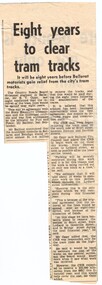
... Notes agreement with the SEC, mentions the Minister for Fuel and Power Mr. Balfour, cost $1.25million, quotes Mr. ...Notes agreement with the SEC, mentions the Minister for Fuel and Power Mr. Balfour, cost $1.25million, quotes Mr. ...Titled "Eight years to clear tram tracks", about the time planned to remove tram tracks in Ballarat by the CRB on their roads. Notes agreement with the SEC, mentions the Minister for Fuel and Power Mr. Balfour, cost $1.25million, quotes Mr. Oppy of the CRB. Notes that work on the removal of tracks in Sturt St had commenced this week. The second cutting includes a photo of a Mr G Hettich saw cutting the road surface - note the use of the term "instruments" in the caption.Yields information about the starting of track removal in Sturt St Ballarat and later on in other parts of the system, following closure of the SEC operated system.Newspaper cutting from The Courier, about 22/9/1971, about the removal of track in Ballarat and Bendigo. Has the newspaper source on the top edge in ink.crb, sturt st, closure, dismantling, track removal -
 Bendigo Historical Society Inc.
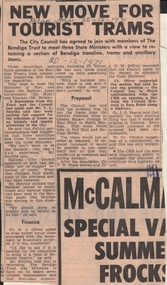
Newspaper - BENDIGO ADVERTISER DECEMBER 20, 1971 NEWSPAPER ARTICLE ''NEW MOVE FOR TOURIST TRAMS'', 20/12/1971
... (Local Ministers:) Minister of Fuel and Power Mr. Balfour, Local Government Minister Mr. ...(Local Ministers:) Minister of Fuel and Power Mr. Balfour, Local Government Minister Mr. ...BENDIGO ADVERTISER DECEMBER 20, 1971, NEWSPAPER ARTICLE ''NEW MOVE FOR TOURIST TRAMS''. (Local Ministers:) Minister of Fuel and Power Mr. Balfour, Local Government Minister Mr. Hunt, Minister for Tourism Mr. Dickie. Councilors T.R. Flood, J.C.M. Jeffrey, N.J. Oliver, J.P. Pearce, Mr. V.L. Smythe. Proposal of the time run tourist trams from Central Deborah Mine through to Emu Point in North Bendigo taking in Pall Mall and McCrae Streets.bendigo, newspapers, bendigo advertiser tourist trams -
 Ballarat Tramway Museum
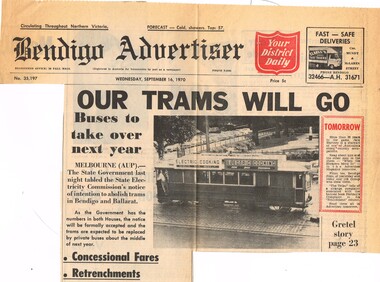
Newspaper, Bendigo Advertiser, "Our trams will go - buses to take over next year", 16/09/1970 12:00:00 AM
... Quotes the Minister for Fuel and Power - Mr. Balfour...Quotes the Minister for Fuel and Power - Mr. Balfour "Our trams will go - buses to take over next year" Newspaper Bendigo Advertiser ...Newspaper cutting - Bendigo Advertiser - Wednesday 16/9/1970 tilted "Our trams will go - buses to take over next year" about the tabling of the SEC Notice to abandon or abolish the tramways in both Ballarat and Bendigo. Notes the intention for concession fares on the buses, actual fares, revised bus routes, subsidy from the SEC to the Transport Regulation Board (TRB) for concession fares for a period of five years and service frequency. Has a photo of a single trucker at Charing Cross. Quotes the Minister for Fuel and Power - Mr. Balfourbendigo, transport regulation board, closure, buses, fares, sec -
 Ballarat Tramway Museum
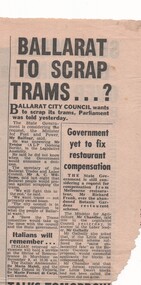
Newspaper, "Ballarat to Scrap Trams ...?", c1970
... about Parliament (Victorian) being told by the Minister for Fuel and Power (Mr. Balfour) that the City of Ballarat wanted to scrap its trams, following a question from Mr. ...about Parliament (Victorian) being told by the Minister for Fuel and Power (Mr. Balfour) that the City of Ballarat wanted to scrap its trams, following a question from Mr. ...Newspaper clipping from The Sun (?), undated, late 1970? about Parliament (Victorian) being told by the Minister for Fuel and Power (Mr. Balfour) that the City of Ballarat wanted to scrap its trams, following a question from Mr. Trezise (ALP Geelong North) in the Legislative Assembly. No decision had yet been made. Also quotes the Secretary of the Ballarat Trades and Labor Council, Mr. A.C. Williams saying that Ballarat people would protest this decision. On rear of cutting has an item about the Noongah Enquiry, an inquiry into the sinking of the Noongah. Appears to be from a Melbourne Paper, different typeface to that of the Courier.trams, tramways, closure, parliament, ballarat -
 Melbourne Tram Museum
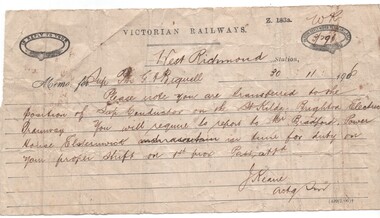
Document - Memorandum, Victorian Railways, Victorian Railways Memorandum, dated 30-11-1906 re St Kilda tramway, 30/11/1906 12:00:00 AM
... He was to report to Mr. Bradford at the Power Station, Elsternwick. Signed by J. ...He was to report to Mr. Bradford at the Power Station, Elsternwick. Signed by J. ...Victorian Railways Memorandum, dated 30-11-1906 on VR printed form Z 183a, advising Porter (?) G. H. Biquell (?) that he had been transferred to the position of Conductor on the St Kilda Brighton Electric Tramway from 1/12. He was to report to Mr. Bradford at the Power Station, Elsternwick. Signed by J. Keane Acting Station Master West Richmond station. Has been completed using a form with a perforated edge on the left hand side.trams, tramways, victorian railways, st kilda brighton, conductors, personnel, elwood -
 Bendigo Historical Society Inc.
Postcard - PETHARD COLLECTION: ALEXANDER WATSON POSTCARD
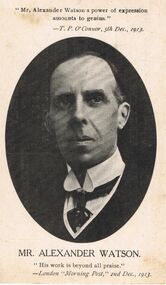
... Written on top 'Mr. Alexander Watson's power of expression amounts to genius' - T.P. ...Written on top 'Mr. Alexander Watson's power of expression amounts to genius' - T.P. ...Black and white image: head and shoulders of Mr. Alexander Watson, dressed in dark jacket, tie and turn down collar. Written on top 'Mr. Alexander Watson's power of expression amounts to genius' - T.P. O'Connor, 5th. Dec. 1913' On bottom 'Mr. Alexander Watson, His work is beyond all praise' - London 'Morning Post 2nd. Dec. 1913' On rear of postcard Two nights only 18th & 19th. May. Masonic Hall, Monday evening, 18th. May. Mr. Alexander Watson, will present a special Kipling night: McAndrew's Hymn; Oonts, The glory of the Garden 'Boots' Fuzzy Wuzzy 'Gunga din'. The Bolivar 'The clampherdown' 'Shamus O'Brien' 'Punch Brothers'. Tuesday, May 19th Part 1, The Merchant of Venice, Part 11 Charles Dickens & J.M. Barrie.person, individual, alexander watson, bendigo, petherd, chancellor, alexander watson, masonic hall, sandhurst -
 Nhill Aviation Heritage Centre
Memorabilia - Wall Clock, c. 1940
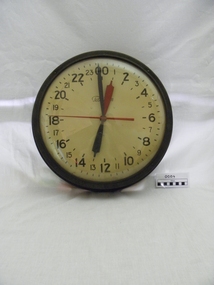
... The clock remained in action until the 17th October 2009 when Mr Rowe disconnected the power supply to the clock, and donated it to the Nhill Aviation Heritage Centre (NAHC) to be kept as memorabilia of the Second World War. ...The clock remained in action until the 17th October 2009 when Mr Rowe disconnected the power supply to the clock, and donated it to the Nhill Aviation Heritage Centre (NAHC) to be kept as memorabilia of the Second World War. ...Following the closure of the RAAF Air Base after the Second World War an auction sale was held. Mr Goldsworthy, mechanic and garage owner of Kaniva purchased the clock and hung it on the wall of the garage where it remained when the business was sold to Mr Eddy Rowe of Kaniva. The clock remained in action until the 17th October 2009 when Mr Rowe disconnected the power supply to the clock, and donated it to the Nhill Aviation Heritage Centre (NAHC) to be kept as memorabilia of the Second World War. On completion of the building of a new hangar/exhibition centre at the Nhill Aerodrome, the clock will be hung on the wall and once again connected to the power supply.Clock was used at the air school at Nhill during WW224 hour electric wall clock with Telechron brand on face. It has a pair of hour hands, one red one black and a black minute hand and second hand. A domed shaped Perspex front. The clock face has 24 hour markings. The glass and clock face are set within a steel frame.The clock has Telechron and twenty-four hour numbers written on the clock face. Pasted on the back side is "instructions for setting the clock which is marked WARREN TELECHRON COMPANY/Ashland Mass. U.S.A world war two, clock, electric clock,twenty four hour clock, nhill aerodrome, raaf air base, warren telechron, goldsworthy, eddy rowe -
 Ballarat Tramway Museum
Newspaper, The Courier Ballarat, "Time Running Out for the Trams", 16/09/1970 12:00:00 AM
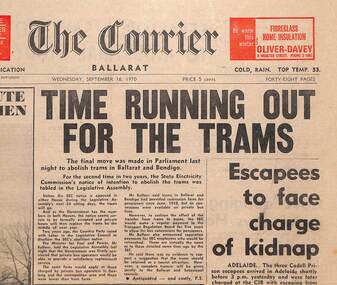
... Quotes Minister for Fuel and Power, Mr. Balfour about fares, would subsidise private bus operators to give concession fares as is done on the trams, separation or retrenchment payments for tramway employees, and mentions suggestion that trams should be retained as a tourist attraction. ...Quotes Minister for Fuel and Power, Mr. Balfour about fares, would subsidise private bus operators to give concession fares as is done on the trams, separation or retrenchment payments for tramway employees, and mentions suggestion that trams should be retained as a tourist attraction. ...Newspaper clipping from The Courier, front page, Wednesday Sept. 16, 1970, reporting on the final move made last night in Parliament to abolish the trams in Ballarat and Bendigo. The SEC's notice to abolish the trams was tabled in the Legislative Assembly for the second time in two years. Unless the SEC's notice was opposed in either during the next 24 sitting days, the trams will go. As Government has numbers in both houses, the trams will go, while two years ago, the Country and Labor Parties combined in the upper house to oppose this. Quotes Minister for Fuel and Power, Mr. Balfour about fares, would subsidise private bus operators to give concession fares as is done on the trams, separation or retrenchment payments for tramway employees, and mentions suggestion that trams should be retained as a tourist attraction. Has a continuation of item on page 5. No reference item number as at 29/5/1970.trams, tramways, closure, bus replacement, country party, concession fares, mr. balfour -
 Ballarat Tramway Museum
Newspaper, Bendigo Advertiser, "Somebody tries to "pinch" a Birney", 24/10/1972
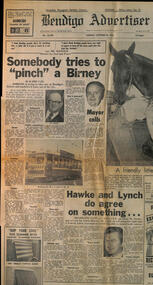
... The Adelaide-based tramway museum (AETM) was allocated Birney No. 29 by the SEC and agreed to by the Minister for Fuel and Power Mr Balfour. When they tried to collect it, the loading was stopped, with the agreement of the City of Bendigo, quoting Mayor Cr J P Pearce. ...The Adelaide-based tramway museum (AETM) was allocated Birney No. 29 by the SEC and agreed to by the Minister for Fuel and Power Mr Balfour. When they tried to collect it, the loading was stopped, with the agreement of the City of Bendigo, quoting Mayor Cr J P Pearce. ...Newspaper report on the issue of the disposal of former SEC Bendigo trams following the closure of the system. The Adelaide-based tramway museum (AETM) was allocated Birney No. 29 by the SEC and agreed to by the Minister for Fuel and Power Mr Balfour. When they tried to collect it, the loading was stopped, with the agreement of the City of Bendigo, quoting Mayor Cr J P Pearce. The newspaper gives the background to the issue of the retention by Bendigo of the former SEC fleet. Following this action, no other tramcars that had been allocated at the time left Bendigo. In 1975, the Government paid the Bendigo Trust to reconstruct a Birney that had been scrapped before the closure of the Bendigo system which was given to the AETM. See the AETM website for further details - tram 303. Story by Barry Cail. See item 8779 for the Herald Sun report of the same date. On the bottom left-hand corner of page 2, (see second image) is an item titled "Question on Tourist Trams", outlining several questions that Mr Floyd (Labour, Williamstown) will ask the Minister of Transport Mr Wilcox about the operation of Tourist trams, safety and insurance, and whether tourist trams will run in Ballarat.Yields information about the Bendigo system following closure and the retention of tramcars.Newspaper - page 1 of The Bendigo Advertiser 24/10/1972 - newsprintbendigo, tramcars, aetm, birney tramcars, tram 29, tram 303, adelaide, tramcar disposals, ballarat, tourist trams, safety -
 Flagstaff Hill Maritime Museum and Village
Equipment - Ship's Wheel, John Hastie et al, Early 20th Century
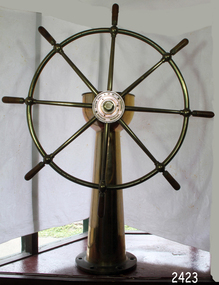
... power for discharging ships as a result the company was contracted to install this equipment in Hamburg Docks. By around 1870 he continued to construct machinery in London but realised that conditions were more favourable in Edinburgh. He acquired land at Rosebank adjoining the North British Railway Company's line to Granton, and the necessary infrastructure was completed allowing him to finish the Hamburg contract. The works at Rosebank were eventually extended and added to until they became one of the largest engineering works in the East of Scotland. Mr...power for discharging ships as a result the company was contracted to install this equipment in Hamburg Docks. By around 1870 he continued to construct machinery in London but realised that conditions were more favourable in Edinburgh. He acquired land at Rosebank adjoining the North British Railway Company's line to Granton, and the necessary infrastructure was completed allowing him to finish the Hamburg contract. The works at Rosebank were eventually extended and added to until they became one of the largest engineering works in the East of Scotland. Mr ...John Hastie Engineer and millwright John Hastie opened small manufacturing works in Greenock in 1845 and 1853 patented the first self-holding steering gear. The firm became known as John, Hastie and Co. Ltd. in 1898 after taking on limited liability status and their main works were at Kilblain Street, Greenock, where they specialised in ships' steering gear. The company also occupied works at Rue End Street, Greenock. Plans of this unit depict a stockyard to the east, with areas for welding; fitting and assembly; flame, cutting and fabrication; and a machine bay. The company was dissolved in 1991. Brown Brothers Brown Bros Rosebank Ironworks made the steering gears for many large ship's, including The Titanic. Andrew Betts Brown the founder was born in 1741 and closely associated with many improvements in marine engineering. He was educated in his native city and served his apprenticeship as an engineer in the locomotive works of the North British Railway Company at St. Margaret's. During his apprenticeship, he attended the evening classes at Watt College. subsequently going to Manchester to study chemistry. He went to London around 1863 and took over an old brewery, which he converted into an engineering works. During his time there he invented an overhead travelling crane, which was used on the construction of Blackfriars Bridge London. He went on to develop plant which used steam and hydraulic power for discharging ships as a result the company was contracted to install this equipment in Hamburg Docks. By around 1870 he continued to construct machinery in London but realised that conditions were more favourable in Edinburgh. He acquired land at Rosebank adjoining the North British Railway Company's line to Granton, and the necessary infrastructure was completed allowing him to finish the Hamburg contract. The works at Rosebank were eventually extended and added to until they became one of the largest engineering works in the East of Scotland. Mr Brown was a member of numerous engineering institutions, the best known at the time being the Institution of Naval Architects. He was also a Fellow of the Royal Society of Edinburgh, a member of the Institute of Mechanical Engineers and of the Institution of Marine Engineers he died in 1906 at the age of 67.An item made by two marine innovators of marine auxiliary machinery, equipment and itemsShip's wheel, brass, attached to brass pillar. The base has six holes in it for securing it in place. Top of the ship's wheel pillar has a brass, adjustable arrow pointer that is positioned over a dial etched into the flat brass surface. The dial reads " PORT STABD". Lines and degrees are marked, with '0' in centre and every 5 degrees, from 0-35, in both Port and Starboard sidesInscription to wheel hub "Brown Brothers & Co. Ltd, Rosebank Ironworks, Edinburgh"flagstaff hill, warrnambool, shipwrecked-coast, flagstaff-hill, flagstaff-hill-maritime-museum, maritime-museum, shipwreck-coast, flagstaff-hill-maritime-village, john hastie, john hastie, andrew betts brown, ships wheel, ship steering gear, marine equipment, instrument, navigation -
 Federation University Historical Collection
Booklet, The Ballarat School of Mines and Industries 1870-1920 Jubilee Booklet, 1920 (estimated)
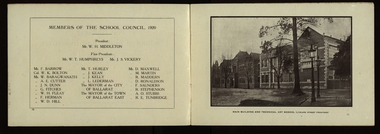
... power in the land. In these circumstances the suggestions to found a School of Mines met with ready acceptance. The late Mr...power in the land. In these circumstances the suggestions to found a School of Mines met with ready acceptance. The late Mr ...The first school of Mines in Australia was established at Ballarat in 1870. At the time of its jubilee (1930) the following people were members of the School Council: W.H. Middleton (President), W.T. Humphreys (VP), J.S. Vickery (VP), F. Barrow, Col. W.K. Bolton, William Baragwanath, A.E. Cutter, J.N. Dunn, G. Fitches, W.H. Fleay, F. Herman. W.D. Hill, T. Hurley, K. Kean. J. Kelly, L. Lederman, Mayor of Ballarat, Mayour of Ballarat East, D. Maxwell, M. Martin, R. Maddern, D. Ronaldson, F. Saunders, R. Stephenson, A.O. Stubbs, R.E. Tunbridge. The School Staff in 1920 comprised: Herbert H. Smith, Walter Rowbotham, Reginald L. Cutter, M.C. Young, Hilda Wardle, M. Wiliamson, P.S. Richards, L.H. Archibald, J. Woods, Ken Moss, W. Kenneth, Mrs McIlvena. B. Robinson, S. Rowe, E. Hope-Jones, Miss Abrams, L.St.G.P. Austin, Alfred Mica Smith, J.R. Pound, Herbert R. Murphy, N.H. Junner, Maurice Copland, L.H. Archibald, E.J.A. McConnon, Newton King, D.m. Hull, T.R. Gordon, John M. Sutherland, T.K. Jebb, Dick Richards, C. Tonkin, A.W. Steane, J. Paterson, H.W. Malin, R.V. Maddison, S.M. Mayo, F.A. King, W.H. Steane, T.R. Gordon, T.A. Williams, H. Waldron, G. Black, E.J. McConnon, R.V. Duncan. R. Cutter, E.G. Vawdrey, Hilda WardleWhite stapled booklet - landscape format - 20pp + soft covers with blue writing. Includes an historical sketch of the Ballarat School of Mines. Contains images of the school from around 1920. The history outlined in the booklet follows: 'Ballarat has helped to influence the life and destinies of Australia in many ways, the recital of which would perhaps prove tedious to the citizens of less favoured localities! However, it can be said, without much fear of contradiction, that only less known thought Australia than its fame as a gold field is the reputation won for it by its school of Mines, ... Ballarat was still quite a new place when the School was founded, but a very propserous and popular place all the same, with a go-ahead lot of citizens brim full of the spirit of enterprise which seemsto animate mining populations generally. Money was plentiful, and they launched out into ventures, which later, were to develop and take the place of the gold mines, while what is more to the point, they understood the value of education. the old digging days were passing away. So far as Ballarat itself was concerned the day of the cradle and tin dish had already passed into an antiquity "as dead and distant as the age of the Tubal Caon," said dir redmond Barry on declaring the School open. Mining had become a serious business, and the mining engineer, the metallurgist, and the geologist had become a power in the land. In these circumstances the suggestions to found a School of Mines met with ready acceptance. The late Mr James M. Bickett had the honor of bringing forward the proposition at a meeting of the Ballarat Mining Board in October, 1869. it was agreed to, and the Government, having been approached for assistance, granted a lease of the old Supreme Court buildings at a nominal reantal. A modest sum, including 100 pounds from the Borough Council of Ballarat West, was subscribed by a number of sympathisers, and on the 26th October, 1870, the inaugural address was delivered by Sir Redmond Barry, the first President of the School. Classes were commenced on the 23rd January, 1871. The students at first were mostly adults. They were chiefly men emloyed at the mines, who had the wisdom and energy to devote their spare time to study, and, though their attendance was somewhat irregular, they made very good progress. Old prints which have been preserved show them at work at furnaces, big bearded men of the old-fashioned type of miner. It is interesting to note that among those who gave evidence and encouragement was Sir Roderick Murchison, who many years before had advised Cornish miners to emigrate to Australia to search for gold, and who in 1848 was in possession of gold ore sent from this country. Sir Roderick sent a parcel of books for the library, and gave useful advice as to the curriculum which should be adopted. The Museum, which now contains a most valuable collection of minerals, was one of the first things attended to, and the reports presented to the Council from time to time speak of additions being made from all parts of the world. New equipment was constantly being added to the School, a good deal of assay work was done, and some specimens were sent from the East Indies for examination as far back as 1873. By this time there was a difficulty in providing accomodation for the students who wished to enrol, and the number of instructors had grown from two to four. In 1882 the first building was being erected on what was then part of the gaol reserve. A little more than ten years afterwards a buildnig formerly serving as a Methodist Church was absorbed, while later on, the demand for accomodation increasing, the attack upon the gaol was renewed. The School continued to grow in reputation and size, and became the science centre of the district, and in 1889 a learge new building was opened by Sir Alexander Peacock. Students came from over seas as well as from all the States of Australia, and after going through their courses they took with them the name and fame of the old School to all parts of the globe. School of Mines boys have played a great part in developing the mining fields of Western Australia, South Australia, and africa, while old students who have made a name in their profession are constantly dropping in to see how the old place is getting along. It was not to be expected, however, that the Ballarat School would be left without rivals, its very success inspiring competition. Mining Schools were started in other parts of Australia, and, at the same time, Victoria ceased to hold first place as a mining state. On the other hand there was a great advance in manufacturing, and the demand for technicaly trained men became a great and as insistent as ever it had been for trained mining men. The Council was quick to adapt the school to the new conditions, and the result is seen in the institution, which is one of Ballarat's proudest possession. Instruction is given in all branches of technical work, and the classes are filled with students who are building up for Ballarat a reputation as an industrial centre, which promises to equal that which it formerly held as a mining town. Owing to its bracing climate, its abundant opportunities for recreations, and its accessibilty, Ballarat as a city is an ideal place for educational purposed, and is yearly becoming more and more appreciated throughout the State. The chairman of one of Ballarat's biggests industries claims that the workman can do twice the day's work here that he can do in Melbourne. he was a little enthusiastic over it, perhaps, but it is a well-known fact that the healthy and invigourating Ballarat climate is conducive to both physical and mental activity, and the records of the School provide ample proof of it. One of the most interesting and successful branches of the School of Mines and Industries - if the name be enlarged with the enlargement of its scope - is the Technical Art School. "The City of Statues" has from its earliest days been a stronghold of art. Art schools have flourised here, and in 1905 the Education Department came to the conclusion that the best thing to do with them was to place them under the management of the School of Mines Council. A magnificent new Technical Art School was built at a cost of some 12,000 pounds on the site of the old Supreme Court building, and was formally opened on the 23rd July, 1915. The results have not only been justified but surpassed all anticipations. The most comprehensive list of subjects is taught, and this list is constantly added to. Students have flocked to the art School, which may be said to occupy a unique position in Australia, and its record of success is really astonishing. Its students supply art teachers for the newer schools that are being built, and many occupy leading positinos in important business houses. So well is its reputation known that orders are constantly being received, not only from Victoria, but from other States, for honor boards and challenge shields to be designed and made. The most recent addition to the School of Mines and Industries is the Junior Technical School, for which a new building is now being erected on a portion of the gaol site, transferred to the School of Mines Counci by the Government. At the present moment temporary quarters are being occupied. Some students after passing through the Junior School go straight to employment, continuing perhaps to attend the evening trade classes, while others move on to the senior School. In a review of the work of the School of Mines mention must be made of a series of industrial research carried out under supervision of the Principal. One in particular, regarding the suitability of the local ores for the manufacture of pigments attracted much attention, while the experiemtns on the manufacture of white potery from Victorian clayes were considered of sufficient importance by the Federal Advisory Council of Science and Industry to warrant the appointment of a special investigator. The results of these have been most encouraging, and may have far-reaching consequences. The vocational training of returned soldiers also should not be overlooked. The work was taken in hand from the first, before the Repatriation Department gave assistance, and now with the help of the department of the School has become one of the largest vocational training centres in Victoria outside of Melbourne. The soldiers, trained in a variety of occupations, have made remarkable progress, and already considerable numbers have found employment in local workshops and factories. To sum up, the School is divided into the following departments, each well staffed and equipped: - The School of Mines, science, and Engineering; the Techncial Art School, the Boys' Junior Technical School, the Girl's Preparatory Technical Classes, Trade Classes, and the Commercial School. The school of Mines, science and Engineering, comprises the following branches: - Mining, Metallurgy, Geology, Electrical Engineering, Civil Engineering, Mechanical Engineering, Applied Chemistry, and Pharmacy. Battery treatments, Cyanide Testing, Smelting, Assays, and Clay Testing from a regular part of the School's work. Students gaining qualifications obtain concession in their courses at the university, should they proceed there to continue their studies. The technical Art school curriculum includes training in all branches of pictorial and applied art, an Architectural Diploma Course, a Draughtman's Course, technical Art teachers' Course, Photography,Ticket Writing, Art Metal Work, Woodcarving, Needlework, and Leather work. The Trade Classes give instruction in Telephone Mechanics, telegraphy, Carpentry, Cabinet Making, Plumbing, Blacksmithing, Fitting, Electric Wiring, and Printing. Numerous Scholarships are offered every year, and altogether students will find few places to equal the Ballarat School of Mines and Industries as a training place for their life's work. One of the first in the continent to be established, its Jubilee finds it still in the front rank, keeping pace with the times, and offering to the youths of this country the means of taking advantage of Australia's teeming opportunities. william, battery, smith, herbert, drawing from the antique, ballarat school of mines botanical gardens, ballarat school of mines, redmond barry, alfred mica smith, james bickett, museum, dick richards, ballarat junior technical school, s m b, ballarat school of mines and industries, ballarat technical art school, model mine, james m bickett, j m bickett, roderick murchison, vocational training rooms, wesley church, methodist church, alexander peacock, lathes, repatriation, repatriatin department, war service, school council, baragwanath, gold mining, mining laboratory, plaster cast, r.w. richards, anniversary, jubilee -
 Federation University Historical Collection
Photograph - Black and White, Charlie Farr, Duncan McDougall
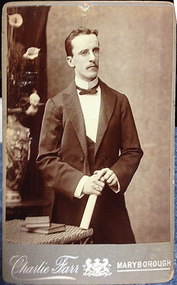
... Mr. McDou gall will handle these large classes as successfully as the classes he had last year." By 1925 McDougall is being reported in the Perth Daily News: "Duncan McDougall, lecturer on electrical engineering and physics at the W.A. School of Mines, put forward a scheme for reducing the cost of mining in Kalgoorlie. He contended it was the duty of the State and Federal Governments to establish a central electricity generation plant in Kalgoorlie and supply power...Mr. McDou gall will handle these large classes as successfully as the classes he had last year." By 1925 McDougall is being reported in the Perth Daily News: "Duncan McDougall, lecturer on electrical engineering and physics at the W.A. School of Mines, put forward a scheme for reducing the cost of mining in Kalgoorlie. He contended it was the duty of the State and Federal Governments to establish a central electricity generation plant in Kalgoorlie and supply power ...Duncan McDougall was associated with the pioneering X-rays conducted by the Ballarat School of Mines in 1896. He was in the Mendelssohn Choir, and was associated with Professor Ross from University of Western Australia. The Ballarat Courier reported on 20 July 1896:"The Ballarat Courier reported on 20 July 1896 Thanks to the energy of the staff of the School of Mines Ballarat and particularly to Messers F J Martell and Duncan McDougall the assistance of Roentgen xrays will soon be available, for the relief of suffering at this institution. On Wednesday evening 22 July 1896 a number of ladies and gentlemen witnessed a series of experiments with the Roentgen x rays." Duncan McDougall later worked at the Kalgoorlie School of Mines as a lecturer in physics and mathematics. on 19 February 1905 the 'West australian' newspaper announced: " Mr Duncan McDougall, formerly of the Ballarat, and later of the Maryborough Schools of Mines, was appointed to succeed Mr. Hart. Mr. McDougall had also charge of the branch class at Midland Junction. In both cases his work proved thoroughly good. The alterations in the trades class regulations will cause all the students in these classes to take up the study of this subject. I have every confidence that Mr. McDou gall will handle these large classes as successfully as the classes he had last year." By 1925 McDougall is being reported in the Perth Daily News: "Duncan McDougall, lecturer on electrical engineering and physics at the W.A. School of Mines, put forward a scheme for reducing the cost of mining in Kalgoorlie. He contended it was the duty of the State and Federal Governments to establish a central electricity generation plant in Kalgoorlie and supply power to the mines at not more than 1/2d a unit, at 3/4d per unit for winding only, and at 2d per unit for lighting. He suggested, the transmission of this power over a radius of 25 miles from Kalgoorlie." (06 May 1925)Photograph of a man in a shirt, bow tie and jacket, holding a scroll and wearing glasses. He has two books beside him on a table. The man is Duncan McDougall, and is portrait was taken in the Charlie Farr studio at Maryborough, Victoriaduncan mcdougall, mcdougall, x-ray, xray, xray, ballarat school of mines, choir, mendelssohn, kalgoorlie -
 Federation University Historical Collection
Newspaper, Lal Lal Iron and Coal as reported in the Ballarat Courier, 10/07/1923
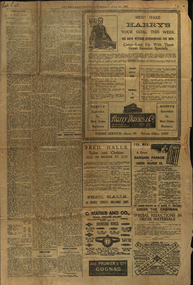
... power plant be installed at Crockers, Arnolds, Harry Hall, Ewins, Harry Davies, Fred Halls, The London Drapery there. Page 9 includes articles on Ripon's roads, Mount Cole Springs; Soldier Settlement Rates Beaufort; Creswick brass band Officers; Daylesford Road Deviation to Hepburn Springs; Dereel Public Telephone; State Electricity Supply for Beaufort; Newlyn Valedictory to Mr and Mrs W. ...power plant be installed at Crockers, Arnolds, Harry Hall, Ewins, Harry Davies, Fred Halls, The London Drapery there. Page 9 includes articles on Ripon's roads, Mount Cole Springs; Soldier Settlement Rates Beaufort; Creswick brass band Officers; Daylesford Road Deviation to Hepburn Springs; Dereel Public Telephone; State Electricity Supply for Beaufort; Newlyn Valedictory to Mr and Mrs W. ....1) Pages 7 to 10 of the Ballarat Courier, 10 July 1923. Page 7 includes the article 'Cheap electricity' and poses questions such as 'should Ballarat look to Morwell for cheap power?', and should an independent power plant be installed at Crockers, Arnolds, Harry Hall, Ewins, Harry Davies, Fred Halls, The London Drapery there. Page 9 includes articles on Ripon's roads, Mount Cole Springs; Soldier Settlement Rates Beaufort; Creswick brass band Officers; Daylesford Road Deviation to Hepburn Springs; Dereel Public Telephone; State Electricity Supply for Beaufort; Newlyn Valedictory to Mr and Mrs W. E. Bennett Page 9 - Racing at Ascot; Avoca Golf Tournament, Chinese Herbalists Page 10 - Auctions and house sales Advertisements include Harry Davies; Fred Halls; C. Marks and Co., London Drapery, Creer the Cashman; Chamberlain's Cough Remedy; Cornell's Little Liver Pills; Paynes; W. Fley Chemist; Bickart and Dawson; Rivers; Allchin Bros; J. Bartam & Son .2) Ballarat Courier, 30 July 1937, page 1 and 2 Page 1 reports Lal Lal's Iron Ore Company being formed. Page 2 reports the Prospectus of the lal lal Iron and Steel Blast Furnaces Mining Company, No Liability; Mining News - Wattle Gully; Commercial News Advertisements include Crockers, Arnolds, Harry Hall, Ewins, Harry Davies, Fred Halls, The London Drapery electricity, lal lal, lal lal iron, lal lal coalfield, morwell, gippsland, crockers, arnolds, harry hall, ewins, harry davies, fred halls, the london drapery, lal lal brown coal, ripon's roads, mount cole springs, soldier settlement rates beaufort, creswick brass band officers, daylesford road deviation to hepburn springs, dereel public telephone, state electricity supply for beaufort, newlyn, w.e. bennett, ascot, avoca golf tournament, chinese herbalists, c. marks and co., london drapery, creer the cashman, chamberlain's cough remedy, cornell's little liver pills, paynes, w. fley chemist, bickart and dawson, rivers, allchin bros, j. bartam & son, lal lal iron and steel blast furnaces mining company, wattle gully -
 Federation University Historical Collection
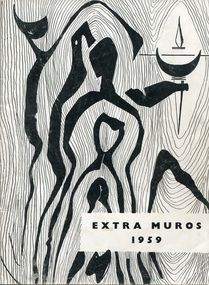
Booklet - Magazine, J.A. Hoskin & Son, Extra Muros, 1959, 1959
... Power...G. Briggs...D. Ryan...G. Wallace...V. Delbridge...S. Dawe...Miss Lloyd...Mr...Mr Ryan was the staff representative. The Students' representative council for 1959 were J. O'Neill, I. Ferguson, I. Jenkins, E.Davies, B. Matthews, M. Robinson, R. Cummings, B. Vandenberg, N. Wright, D. McKimmie, K. McDougall, D. Eldridge, N. Beacham, K. Ryrie, J. Rae and D. Wise. The social committee comprised R. Power...Mr Ryan was the staff representative. The Students' representative council for 1959 were J. O'Neill, I. Ferguson, I. Jenkins, E.Davies, B. Matthews, M. Robinson, R. Cummings, B. Vandenberg, N. Wright, D. McKimmie, K. McDougall, D. Eldridge, N. Beacham, K. Ryrie, J. Rae and D. Wise. The social committee comprised R. Power ...The Publications Committee were Ken McDougall, Kath Hayes, Brian Haig, Sue Tucker, heather Bell, Dawn Brown, Ian george, elizabeth Lemmon, Janette Leviston, Leah Harwood, Tony scanlon. Mal Wordsworth. Ian Walshe. The Year Book Committee were Carmel Keys, Judy Krahe, Jill Mayo, and Mr Ryan was the staff representative. The Students' representative council for 1959 were J. O'Neill, I. Ferguson, I. Jenkins, E.Davies, B. Matthews, M. Robinson, R. Cummings, B. Vandenberg, N. Wright, D. McKimmie, K. McDougall, D. Eldridge, N. Beacham, K. Ryrie, J. Rae and D. Wise. The social committee comprised R. Power, G. Briggs, D. Ryan, G. Wallace, V. Delbridge, S. Dawe, Miss Lloyd, Mr Bourke, R. Kelly, M. Grey, J. Cadzow, E. Davies, Monica Miller, G. Commons and F. Mason. A black and white soft covered magazine of the Ballarat Teachers' College. The cover design was by Doug Sheen. Articles include: education in North Borneo, Webster St Hostel, Gillies Street Girls Hostel, Victoria Street Hostel, Camp Street Hostel, Gillies Street Boys Hostel, Ex-Students' association, The Joys of caravaning, How to Spend One's Leisure, Ideas from the Design Club, Faces Behind the Wheel, Life's Bitterness, Characterization, Such is Life. ballarat teachers' college, margaret brown, ken mcdougall, kath hayes, brian haig, tom turner, k. mcdougall, noel beacham, norma mchenry, heather speedie, ted doney, north borneo, webster street hostel, victoria street hostel, students residences, . o'neill, i. ferguson, i. jenkins, e.davies, b. matthews, m. robinson, r. cummings, b. vandenberg, n. wright, d. mckimmie, d. eldridge, n. beacham, k. ryrie, j. rae, d. wise, r. power, g. briggs, d. ryan, g. wallace, v. delbridge, s. dawe, miss lloyd, mr bourke, r. kelly, m. grey, j. cadzow, e. davies, monica miller, g. commons, f. mason, camp street hostel, gillies street hostel -
Alexandra Timber Tramway & Museum
rubicon black and white photo, photo of tin hut at rubicon . photo taken though pipe on haulage of tin hut rubicon
... Mr Sapaford was a valualbe photogragher takening photos of local places and advents photo records one of the most important land marks in the area .Building of the rubicon power house at Rubicon taken though pipe on haulage of tin hut at rubicon . photo taken by Mr sapsford of alexandra black and white photo ,in good cond photo of tin hut at rubicon . photo taken though pipe on haulage of tin hut rubicon rubicon black and white photo Mr Sapsford ...Mr Sapaford was a valualbe photogragher takening photos of local places and adventsphoto records one of the most important land marks in the area .Building of the rubicon power house at Rubiconblack and white photo ,in good condtaken though pipe on haulage of tin hut at rubicon . photo taken by Mr sapsford of alexandra -
Alexandra Timber Tramway & Museum
Mr Sapsford, rubicon channel and tram tracks
... Photograph of local event .Building of Rubicon power house ( station ) Detail of construction evedent in photo Un replaceable .record of local events rubicon channel and tram tracks rubicon photo of channel and tram tracks, put in to feed hydro system .note tree harvest and elevated channel to the right taken by mr sapsford of alexandra rubicon channel and tram tracks Mr Sapsford ...Photograph of local event .Building of Rubicon power house ( station ) Detail of construction evedent in photoUn replaceable .record of local eventsrubicon photo of channel and tram tracks, put in to feed hydro system .note tree harvest and elevated channel to the right taken by mr sapsford of alexandrarubicon channel and tram tracks -
Alexandra Timber Tramway & Museum
Mr Sapsford, rubicon .Near power house (tin hut)
... rubicon photo black and white of power house ,in forground chonnel running over the rubicon river , mens camp for workers in back ground . taken by Mr Sapsford of Alexandar . in good cond...Power house was called the tin hut by those who built it and other locals . the building of Rubicon power house was helped by the timber indusary .As the timber and locals were helped by the building and supply of power Un replaceable rubicon . near power house (tin hut) rubicon photo black and white of power house ,in forground chonnel running over the rubicon river , mens camp for workers in back ground . taken by Mr Sapsford of Alexandar . in good cond rubicon .Near power house (tin hut) Mr Sapsford ...Power house was called the tin hut by those who built it and other locals . the building of Rubicon power house was helped by the timber indusary .As the timber and locals were helped by the building and supply of powerUn replaceablerubicon photo black and white of power house ,in forground chonnel running over the rubicon river , mens camp for workers in back ground . taken by Mr Sapsford of Alexandar . in good condrubicon . near power house (tin hut) -
Alexandra Timber Tramway & Museum
rubicon black and white photo, Mr Sapsford, Rubicon control station A
... Mr Sapsford photo taken addmisted the construction of the Rubicon power house ( station ) at Rubicon . ...Mr Sapsford photo taken addmisted the construction of the Rubicon power house ( station ) at Rubicon . ...Mr Sapsford photo taken addmisted the construction of the Rubicon power house ( station ) at Rubicon . With out the likes of this photographer (Sapsford ) we would not have such a great and all incompassing recordUnreplaceable . record of building of Rubicon power houseRubicon control stations A at Rubicon with transformers to the left . Photo taken by Mr Sapsford of Alexandra . In good condRubicon A control station -
Federation University Historical Collection
Booklet, The Ballarat School of Mines and Industries 1870-1920 Jubilee Booklet, 1920 (estimated)
... power in the land. In these circumstances the suggestions to found a School of Mines met with ready acceptance. The late Mr...power in the land. In these circumstances the suggestions to found a School of Mines met with ready acceptance. The late Mr ...The first school of Mines in Australia was established at Ballarat in 1870. At the time of its jubilee (1930) the following people were members of the School Council: W.H. Middleton (President), W.T. Humphreys (VP), J.S. Vickery (VP), F. Barrow, Col. W.K. Bolton, William Baragwanath, A.E. Cutter, J.N. Dunn, G. Fitches, W.H. Fleay, F. Herman. W.D. Hill, T. Hurley, K. Kean. J. Kelly, L. Lederman, Mayor of Ballarat, Mayour of Ballarat East, D. Maxwell, M. Martin, R. Maddern, D. Ronaldson, F. Saunders, R. Stephenson, A.O. Stubbs, R.E. Tunbridge. The School Staff in 1920 comprised: Herbert H. Smith, Walter Rowbotham, Reginald L. Cutter, M.C. Young, Hilda Wardle, M. Wiliamson, P.S. Richards, L.H. Archibald, J. Woods, Ken Moss, W. Kenneth, Mrs McIlvena. B. Robinson, S. Rowe, E. Hope-Jones, Miss Abrams, L.St.G.P. Austin, Alfred Mica Smith, J.R. Pound, Herbert R. Murphy, N.H. Junner, Maurice Copland, L.H. Archibald, E.J.A. McConnon, Newton King, D.m. Hull, T.R. Gordon, John M. Sutherland, T.K. Jebb, Dick Richards, C. Tonkin, A.W. Steane, J. Paterson, H.W. Malin, R.V. Maddison, S.M. Mayo, F.A. King, W.H. Steane, T.R. Gordon, T.A. Williams, H. Waldron, G. Black, E.J. McConnon, R.V. Duncan. R. Cutter, E.G. Vawdrey, Hilda WardleWhite stapled booklet - landscape format - 20pp + soft covers with blue writing. Includes an historical sketch of the Ballarat School of Mines. Contains images of the school from around 1920. The history outlined in the booklet follows: 'Ballarat has helped to influence the life and destinies of Australia in many ways, the recital of which would perhaps prove tedious to the citizens of less favoured localities! However, it can be said, without much fear of contradiction, that only less known thought Australia than its fame as a gold field is the reputation won for it by its school of Mines, ... Ballarat was still quite a new place when the School was founded, but a very propserous and popular place all the same, with a go-ahead lot of citizens brim full of the spirit of enterprise which seemsto animate mining populations generally. Money was plentiful, and they launched out into ventures, which later, were to develop and take the place of the gold mines, while what is more to the point, they understood the value of education. the old digging days were passing away. So far as Ballarat itself was concerned the day of the cradle and tin dish had already passed into an antiquity "as dead and distant as the age of the Tubal Caon," said dir redmond Barry on declaring the School open. Mining had become a serious business, and the mining engineer, the metallurgist, and the geologist had become a power in the land. In these circumstances the suggestions to found a School of Mines met with ready acceptance. The late Mr James M. Bickett had the honor of bringing forward the proposition at a meeting of the Ballarat Mining Board in October, 1869. it was agreed to, and the Government, having been approached for assistance, granted a lease of the old Supreme Court buildings at a nominal reantal. A modest sum, including 100 pounds from the Borough Council of Ballarat West, was subscribed by a number of sympathisers, and on the 26th October, 1870, the inaugural address was delivered by Sir Redmond Barry, the first President of the School. Classes were commenced on the 23rd January, 1871. The students at first were mostly adults. They were chiefly men emloyed at the mines, who had the wisdom and energy to devote their spare time to study, and, though their attendance was somewhat irregular, they made very good progress. Old prints which have been preserved show them at work at furnaces, big bearded men of the old-fashioned type of miner. It is interesting to note that among those who gave evidence and encouragement was Sir Roderick Murchison, who many years before had advised Cornish miners to emigrate to Australia to search for gold, and who in 1848 was in possession of gold ore sent from this country. Sir Roderick sent a parcel of books for the library, and gave useful advice as to the curriculum which should be adopted. The Museum, which now contains a most valuable collection of minerals, was one of the first things attended to, and the reports presented to the Council from time to time speak of additions being made from all parts of the world. New equipment was constantly being added to the School, a good deal of assay work was done, and some specimens were sent from the East Indies for examination as far back as 1873. By this time there was a difficulty in providing accomodation for the students who wished to enrol, and the number of instructors had grown from two to four. In 1882 the first building was being erected on what was then part of the gaol reserve. A little more than ten years afterwards a buildnig formerly serving as a Methodist Church was absorbed, while later on, the demand for accomodation increasing, the attack upon the gaol was renewed. The School continued to grow in reputation and size, and became the science centre of the district, and in 1889 a learge new building was opened by Sir Alexander Peacock. Students came from over seas as well as from all the States of Australia, and after going through their courses they took with them the name and fame of the old School to all parts of the globe. School of Mines boys have played a great part in developing the mining fields of Western Australia, South Australia, and africa, while old students who have made a name in their profession are constantly dropping in to see how the old place is getting along. It was not to be expected, however, that the Ballarat School would be left without rivals, its very success inspiring competition. Mining Schools were started in other parts of Australia, and, at the same time, Victoria ceased to hold first place as a mining state. On the other hand there was a great advance in manufacturing, and the demand for technicaly trained men became a great and as insistent as ever it had been for trained mining men. The Council was quick to adapt the school to the new conditions, and the result is seen in the institution, which is one of Ballarat's proudest possession. Instruction is given in all branches of technical work, and the classes are filled with students who are building up for Ballarat a reputation as an industrial centre, which promises to equal that which it formerly held as a mining town. Owing to its bracing climate, its abundant opportunities for recreations, and its accessibilty, Ballarat as a city is an ideal place for educational purposed, and is yearly becoming more and more appreciated throughout the State. The chairman of one of Ballarat's biggests industries claims that the workman can do twice the day's work here that he can do in Melbourne. he was a little enthusiastic over it, perhaps, but it is a well-known fact that the healthy and invigourating Ballarat climate is conducive to both physical and mental activity, and the records of the School provide ample proof of it. One of the most interesting and successful branches of the School of Mines and Industries - if the name be enlarged with the enlargement of its scope - is the Technical Art School. "The City of Statues" has from its earliest days been a stronghold of art. Art schools have flourised here, and in 1905 the Education Department came to the conclusion that the best thing to do with them was to place them under the management of the School of Mines Council. A magnificent new Technical Art School was built at a cost of some 12,000 pounds on the site of the old Supreme Court building, and was formally opened on the 23rd July, 1915. The results have not only been justified but surpassed all anticipations. The most comprehensive list of subjects is taught, and this list is constantly added to. Students have flocked to the art School, which may be said to occupy a unique position in Australia, and its record of success is really astonishing. Its students supply art teachers for the newer schools that are being built, and many occupy leading positinos in important business houses. So well is its reputation known that orders are constantly being received, not only from Victoria, but from other States, for honor boards and challenge shields to be designed and made. The most recent addition to the School of Mines and Industries is the Junior Technical School, for which a new building is now being erected on a portion of the gaol site, transferred to the School of Mines Counci by the Government. At the present moment temporary quarters are being occupied. Some students after passing through the Junior School go straight to employment, continuing perhaps to attend the evening trade classes, while others move on to the senior School. In a review of the work of the School of Mines mention must be made of a series of industrial research carried out under supervision of the Principal. One in particular, regarding the suitability of the local ores for the manufacture of pigments attracted much attention, while the experiemtns on the manufacture of white potery from Victorian clayes were considered of sufficient importance by the Federal Advisory Council of Science and Industry to warrant the appointment of a special investigator. The results of these have been most encouraging, and may have far-reaching consequences. The vocational training of returned soldiers also should not be overlooked. The work was taken in hand from the first, before the Repatriation Department gave assistance, and now with the help of the department of the School has become one of the largest vocational training centres in Victoria outside of Melbourne. The soldiers, trained in a variety of occupations, have made remarkable progress, and already considerable numbers have found employment in local workshops and factories. To sum up, the School is divided into the following departments, each well staffed and equipped: - The School of Mines, science, and Engineering; the Techncial Art School, the Boys' Junior Technical School, the Girl's Preparatory Technical Classes, Trade Classes, and the Commercial School. The school of Mines, science and Engineering, comprises the following branches: - Mining, Metallurgy, Geology, Electrical Engineering, Civil Engineering, Mechanical Engineering, Applied Chemistry, and Pharmacy. Battery treatments, Cyanide Testing, Smelting, Assays, and Clay Testing from a regular part of the School's work. Students gaining qualifications obtain concession in their courses at the university, should they proceed there to continue their studies. The technical Art school curriculum includes training in all branches of pictorial and applied art, an Architectural Diploma Course, a Draughtman's Course, technical Art teachers' Course, Photography,Ticket Writing, Art Metal Work, Woodcarving, Needlework, and Leather work. The Trade Classes give instruction in Telephone Mechanics, telegraphy, Carpentry, Cabinet Making, Plumbing, Blacksmithing, Fitting, Electric Wiring, and Printing. Numerous Scholarships are offered every year, and altogether students will find few places to equal the Ballarat School of Mines and Industries as a training place for their life's work. One of the first in the continent to be established, its Jubilee finds it still in the front rank, keeping pace with the times, and offering to the youths of this country the means of taking advantage of Australia's teeming opportunities. william, battery, smith, herbert, drawing from the antique, ballarat school of mines botanical gardens, ballarat school of mines, redmond barry, alfred mica smith, james bickett, museum, dick richards, ballarat junior technical school, s m b, ballarat school of mines and industries, ballarat technical art school, model mine, james m bickett, j m bickett, roderick murchison, vocational training rooms, wesley church, methodist church, alexander peacock, lathes, repatriation, repatriatin department, war service, school council, baragwanath, gold mining, mining laboratory, plaster cast, r.w. richards, anniversary, jubilee -
 Federation University Historical Collection
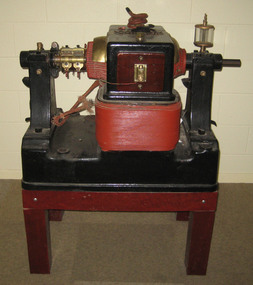
Equipment, Elwell-Powell, Elwell-Parker AC Generator
... Mr. Parker as manager of the lot. The whole of the works will be taken to Wolverhampton. Before I left, a tender for £50,000 was accepted for the construction of new works. generator ac generator elwell-parker ltd state electricity commission sec ballarat north power station james oddie wolverhampton AC Generator painted read and black on a stand. ...This AC generator operated for the State Electricity Commission in the Ballarat North Power Station prior to World War Two. James Oddie of Ballarat has an association with Thomas Parker of Elswell-Parker. In early 1887 Oddie arrived in England seeking information on electrical knowledge and its developments. At this time Henry Sutton was teaching Electricity and Magnetism at the Ballarat School of Mines. Oddie stayed in the United Kingdom for around three years and during that time became a close friend of Thomas Parker and his family. The two first met at the first official running of the Blackpool tram, and Oddie was invited to visit Parker at Wolverhampton. Over the years Thomas Parker kept newspaper cuttings (mainly Australian) relating to James Oddie and his work. The following article is a description of the Wolverhampton works by James Oddie, and was collected by Thomas Parker. After the dinner at Blackpool, Mr. Parker visited me, and cordially invited me to see his extensive works at Wolverhampton, an invitation I was not slow to avail myself of. This was the keynote of the best friendship I made in England. I went shortly afterwards and stayed several days, visiting the works daily, as Mr. Parker gave me the run of the whole works. There I ordered the installation of a 60 light dynamo, with a 28 cell storage battery and paraphernalia, now doing duty at the Observatory. I subsequently visited the works frequently, sometimes for a week at a time, and I regard it as the brightest spot in my English constellation. Mr. Parker started his works in 1880, with one man beside himself. He never had a single day’s instruction in electricity in his life; now he daily instructs between 300 and 400 employees, who worship him as a father. He is said to be now the most practical electrical engineer and mechanist in Europe. During one of my visits I took with me an artist, who is painting for me a portrait, 6 feet by 5 feet, of Mr. Parker, surrounded by dynamos, secondary batteries, measuring instruments etc. Electric tram cars are going to be a big thing in England. Parker’s Company Limited, is now, with three other companies, in the hands of the Electric Construction Company, with Mr. Parker as manager of the lot. The whole of the works will be taken to Wolverhampton. Before I left, a tender for £50,000 was accepted for the construction of new works.AC Generator painted read and black on a stand. This AC generator operated for the State Electricity Commission in the Ballarat North Power Station prior to World War Twogenerator, ac generator, elwell-parker ltd, state electricity commission, sec, ballarat north power station, james oddie, wolverhampton -
Federation University Historical Collection
Document, Zelda Martin, Central Victorian Goldmining towns - Boom Towns or Ghost Towns?, c1996
... * Large envelope addressed to Mr G Netherway containing newspaper cuttings regarding the life of Edward Stone Parker, the unveiling of the Memorial Cairn as mentioned above, articles titled 'Episodes from Our Early Days' (Edgar Morrison, Yandoit)- The Black's School, A School At Last and The Final years. Also a typed page titled 'Historical Background to E.S.Parker's Career. Includes an interesting tale titled 'When the cat lay doggo' re laying power... * Large envelope addressed to Mr G Netherway containing newspaper cuttings regarding the life of Edward Stone Parker, the unveiling of the Memorial Cairn as mentioned above, articles titled 'Episodes from Our Early Days' (Edgar Morrison, Yandoit)- The Black's School, A School At Last and The Final years. Also a typed page titled 'Historical Background to E.S.Parker's Career. Includes an interesting tale titled 'When the cat lay doggo' re laying power ...Zelda Martin was a PhD candidate at the University of Melbourne.[.1] 4th item in light blue display book titled Research Approach/Overview of Chapters/Confirmation of Canditure/Chapters1,2,3&4 of proposed thesis. *Twenty-seven page article on Victorian goldfields towns titled: Central Victorian Goldmining Towns - Boom Towns or Ghost Towns. The article was written during the author's PhD study. It outlines the context methodology, and resources and the chapters of the proposed thesis: (1) Central Victorian Goldmining Towns - The Context (2) Contemporary Views of the Factors Necessary for Town Growth (3) Outward Manifestations of Town Growth (4) The Trappings of Government (5-9) The Main Towns and Their Hinterland. [.2] 5th item in Light Blue display book as above item. *Chapter 1 of proposed thesis titled 'Pick, Shovel and Tin Dish Mining.' Covers in Section A: Central Victoria - Pre 1851: Aborigines in Central Victoria, Squatters, and Government. Section B: The years 1851-1854: The Early Gold Rushes, Government Reaction, Township Surveys, Legislation, Town Development, Local Government and Early Settlement. [.3] 6th item in Light Blue display book as above item. *2A of proposed thesis titled 'Contemporary Views of the Factors Necessary for Town Growth'. Similar information to Chapter 1 plus extra re towns and maps. Sections: Introduction, Context of Place - Geographical Towns Listed, The Context of Time - Pre1851 Aborigines, Governance of Port Phillip, The Squatters, The Villages of Central Victorian Highlands, Conclusion, Condensed Version of Chapter2B. [.4] 7th item in Light Blue display book as above item. *Chapter2B of proposed thesis. Sections: Area of Research, Schools, Banks, Newspapers, Progress Association, Town Development - Sandhurst (Bendigo), Ballarat, Castlemaine,, Maryborough, Ararat and Stawell. [.5] 8th item in Light Blue display book as above item. *Chapter 3 of proposed thesis titled 'Outward Manifestations of Town Growth'. Sections: Introduction, Contemporary Writing, Educationalists, The Bankers, The Townsfolk, Current Theory, General Theories of Urban Development, and Conclusion. [.6] 9th item in Light Blue display book as above item. *Chapter 4 of proposed thesis titled 'Trappings of Government' Sections: Introduction, Early Government Attitudes to Mining and Town Development, Law and Order, Township Surveys, Legislation, Local Government, Transport and Communication, The People and Lobbyists. [.7] 10th item in Light Blue display book as above item. *'The Rise and Fall of Central Victorian Goldmining Towns'. Includes a map showing main Goldfields, a table showing towns and villages at two points in time - 1857 and 1871; a Bibliography of Primary and Secondary Sources. [.8] Resource No1. Black display book titled Local Towns 1 : Alma: *Brief history *Directory *Maps Amphitheatre / Mountain Hut: *Brief History Post Office Directory Ararat: *Brief History *Post Office Directory 1869 - Alphabetical Listing by Occupation *Ararat - Prominent Citizens of 1858 *Langi-Morgala Museum Avoca: *Brief History *Excerpts from 'Avoca The Early Years', Margery and Betty Beavis; pg1 - Beginnings; pg11 - The Midas Touch; pg25 - Local Gold Escorts; pg27 - A Town is Born; pg51- The Administration of Justice; pg53 - The Ways of the Law; pg61 - News of the Day; pg65 - A Time to Play; pg72 - Land Ownership *Post Office Directory (Bailliere's) 1869 *Tourism Map and Information of area *Historic Avoca - A 5.5km Tour *Avoca & the Pyrenees Region - information pamphlet Ballarat: *Early History of Ballarat - Ballarat Historical Society, Publication No.1: origin of the name; Ballaarat - the Beginning; Fabulous Yields from the Ballaarat Goldfield; *Streetscape Lydiard Street. *Hand drawn map showing Leigh River, Old Portland Bay Road, plaque on road to Colac; etc. *Newspaper article re 'The Theatre Royal' ( which stood in the vicinity of the current Owen Williams store) - 'The News'15/04/1998 *Article - 'Ballarat's Mechanics' Institute Lives On' Ballarat Courier, 14/09/1985 *Article - Standing the Test of Time' The News 17/11/1993 re The Mechanics Institute & picture of the Reading Room *'Ballarat a Study of a City, Phyllis Reichl, pub. Nelson, 1968; no.3 place, time and people field studies series *Investigator Vol.33 No.2, 1998 Geelong Historical Society. Article on pg75 describes Ballarat in 1861 *Folded poster - 'Ballarat 100' a history of telegraph communication, pub. Telecom. Beaufort (Fiery Creek): *Brief history *Post Office Directory [.9] Resource No.2 Black Folder Titled Towns cont.No2 Bendigo (Sandhurst): *'Family & Local History at the Bendigo Library - 1851-2001 150 years of gold'. *Bendigo Government Camp in 1853 illustration; key to sketch and names of Government officers stationed there *Excerpts from 'Bendigo and Vicinity' Adolph Haman *The Bendigo Goldfield Registry - pgs 1-7 Introduction *Excerpt: 'Breaking the Grip' *Excerpt: The Most Go-Ahead Place *Excerpts from 'History of Bendigo' - anti license agitation; laying out of town; proposed railway; gold calls and dividends; the Sandhurst Municipality; journalism *Bibliography Blackwood: *Excerpts from 'Aspects of Early Blackwood - The Goldfield, the Landmarks, the Pioneers' Alan J Buckingham and Margaret F Hitchcock, JG Publishing,1980 Buninyong: *A Brief History *Investigator Vol1 No.2 Feb 1966 Geelong Historical Society. Pg3 - Article re gold escort route - Mt Alexander to Adelaide - (see a simple monument on the Western Highway a few miles out of Horsham. Pg 15 - Ballarat Excursion - re the finding of gold. *Three articles published by Buninyong and District Historical Society Inc: (Magpie Exploration; Finding Gold In The Green Hills; Magpie Exploration; Burnt Bridge to Cargarie to Mt Mercer) *Copies of newspaper articles/items *Buninyong Street Directory Carisbrook: *In the Beginning There Was Carisbrook *The History of the Carisbrook Racecourse Carngham / Snake Valley: *Brief History *Directory Castlemaine: *Directory 1865-1866 - Alphabetical and Street *Poster - Castlemaine A Contemporary Guide "The Great Centre" 1866 - A Contemporary Guide to the Fascinating Past *Pamphlet - Castlemaine District Community Hospital *Map - Castlemaine, Maldon & Surrounding Districts *Map and Information - The Dry Diggings Track - a 55kl walk among historic goldfields relics ( Castlemaine Fryerstown Vaughan Mt Franklin Hepburn Daylesford) *Postcard - Former Court House *Directory 1867 - Alphabetical, Trade [.10] Resource No.3 Grey folder Titled Towns 3 Creswick to Maryborough Creswick: *Brief History *Booklet - "Creswick Cemetery Walk" *Booklet - The Buried Rivers of Gold Heritage Trail Creswick *Creswick Historical Museum Information Sheet *Chronological History of Creswick *Alphabetical Directory of the Borough of Creswick *Creswick's Creek Directory 1856 *Historic Creswick Walking Tour *A Brief Account of the Schools of Creswick - Past and Present *100 Years of Railway Travel in Creswick *The Berry Deep Leads *The Spence Home at Jackass Gully in the Creswick State Forest ( William Guthrie Spence - Pioneer) *The New Australian Mine and the 1882 Disaster *Creswick District News, Issue 7, July August 1999 *The Creswick Miners Walk - Information and Map *Maps Chewton: *Brief History *Directory Clunes: *Brief History *Clunes Street Directory Daylesford: *Brief History *Notable Bushfires in Daylesford District Over More Than a Century - "Black Thursday" 1851; 1862; 1899; the Disastrous Hepburn Fire of 1906; 1939; 1944; 1969. *Post Office Directory -Daylesford and Hepburn Dunolly / Inkerman: *Brief History *Directory *Pamphlet - Goldfields Historical Museum *Pamphlet - Historic Dunolly - Victoria's Best Kept Secret *Map of Gold Workings at Dunolly Area - showing where the main gold rushes occurred *Brief History - Inglewood *Directory - Inglewood - Name Occupation, Dwelling Kingower: *Brief History *Directory - Name / Ocupation / Dwelling Linton / Happy Valley / Piggoreet: *Brief History *Directory - Lintons McIvor: *"A History of the Shire and the Township of Heathcote" by J.O. Randell Majorca: *Brief History *Official Post Office Directory 1869 - Name / Occupation/ Address Maldon (Tarrangower): *Brief History Part 1 *Brief History Part 2 *Post Office Directory *List - Alphabetical Order by Names plus Business and Trade (Tarrangower Times Oct/1858) *List - Alphabetical Order by Trade plus Name and Business *Directory - Name / Occupation / Dwelling Maryborough: *Worsley Cottage - built by Arthur Worsley, a contractor in stonework in 1894 [.11] Resource No. 4 Blue Display Book titled Towns 4 Moliagul to Stawell Moliagul: *Brief History *Moligul Legislative Assembly (Voting?) List - Names and Occupations *Moliagul Victorian Post Office Directory 1868 - Name / Ocupation / Address / Comments *"The Welcome Stranger" gold nugget *The Sunday School *The Welcome Stranger Discovery Walk - information and map Moonambel (Mountain Creek) Redbank *Brief History *List of names extracted from advertisments of the Pioneer and Mountain Creek Advertiser 16/02/1861. *Bailliere's Directory 1869 - Alphabetical List of Name / Occupation / Place St Arnaud: *Brief History Sebastapol: *Brief History *Directory 1869 - Alphabetical by Name; plus occupation and address. Browns and Scarsdale: *Brief History *Browns Street Directory - Name and Occupation Smythesdale: *Brief Description *Smythesdale Street Directory -Name and Occupation Stawell (Pleasant Creek) *Brief History *Victorian Official Post Office Directory - Name /Occupation / Dwelling *Chronology - 1841-1920 *Production of gold statistics - 1879 - 1900 *Big Hill *Extracts from "The Golden Years of Stawell". Chapt 1 - Stawell's Coming Out. Capt. 2 - The Gold Rush. Caapt.3 - Cradle of Democracy. Chapt.4 - The Reefs Becomes Stawell. Chapt. 5 - Rushing In. Chapt.6 - The Pioneers. Chapt 7 - The Decade of Optimism. [.12] Resource No. 5: Blue Display Book titled 'Towns Steiglitz to the The Golden Triangle. Steiglitz: Brief History Victorian Post Office Directory 1869 *Map of Steiglitz *List of maps relevant to Steiglitz history *Information 6 tables of data from "Reports of Mining Surveyors Talbot (Back Creek) Brief History Taradale: Post office Directory 1869 - Name/Occupation/Street. Also list in alphabetical order by Occupation Taradale *Chronological Reference to Taradale Mines *Water - The Coliban System of Waterworks *Joseph Brady *The Syphon Tarnagulla (Sandy Creek) *Brief History *Tarnagulla Businessmen Cameos to give depth to advertisments in 'The Tarnagulla Courier' various issues 1864-1871 *Directory - Name/Occupation /Address *List - Name/Business/Trade Wedderburn (Koorong) *Brief History *List - Name/Occupation The Golden Triangle: *The Early Rushes - Wedderburn / Moliagul / Sandy Creek - Tarnagulla / Jones Creek - Waanyarra / Kingower / Dunolly - Goldsborough / Inglweood *Census of 1857 - Population / Occupations *1858-1871 - A Time of Consolidation- Wedderburn / Moliagul / Sandy Creek- Tarnagulla / Arnold *Census 1871 - Population *Information gleaned from the census data - Demographics / Population / Occupations / marital / Birthplace / Religion / Literacy/ Occupation and Housing Cameos *Graphs - Birthplace of settlers /Male-Female Ratio / Married males / Children under 15 as Percentage of Population / Religion *Census 1857 - Statistical data *Maps *Bibliography [.13] Resource No. 6 - Black Display Book Information and Research in Central Victoria including: *Banking - Research from ANZ Bank Archives *Institutions - also includes articles listed from the Ballarat Times Newspaper *Australian mining History Association - A.M.H.A. Bibliography *Australia's Mining History * Bibliography - Land Surveys Victoria - *1853 Administration (Statistics and Other) includes: schools / ministers of religion / police / military / local administration / licences for sale of spirits / distances between various Victorian gold fields. * Victoria Government Gazette (Copy) - N0. 116, 12/12/1854 includes: Gold Felds Commission of Enquiry & No. 85, 15/09/1854 - Addresses presented to the Lieutenant Governor (Sir Charles Hotham) during his tour through the Gold Fields of Victoria,1854. Addresses on behalf of : the people of Bendigo; Members of the Church of England, Bendigo; Members of the Wesleyan Church on the Bendigo Gold Fields; Bendigo Gold District General Hospital; the Bendigo Prospecting Association; Committee of the Bendigo Local Exhibition; Bendigo District Medical Association; Coloured Americans Resident at Bendigo; German Inhabitants of Bendigo; Landowners, Inhabitants, and Miners of Castlemaine; Inhabitants of Forest Creek; Inhabitants of Heathcote and Gold Miners of McIvor; Residents and landholders of the District of Bacchus Marsh; Inhabitants of Kilmore and Vicinity. *Gold Fields Correspondence 1853: letter from Lieutenant Colonel Valiant, (Officer commanding the Troops in Victoria) to the Lieutenant Governor re threatened disturbance at Sandhurst (Bendigo) regarding the Gold License Fee. * Extracts from a book "Victoria" re Gold Fields Commission of Enquiry involving mainly Ballarat and Castlemaine and a chapter titled 'A Tour to the Victorian Gold-Fields' *Lists of central Victorian newspapers - listed by date published 1851to 1874; by first date available to State Library. *A list of cities and towns showing County, population in 1861 &1871, and municipal status. [.14] Resource no.7. Black display book. *Reference: Papers presented to Parliament Victoria - 1859-1860 4 volumes - relevant sections copied. Contains information on Branches of Government. General / Finance / Gold / Gazette / Commission and Warrant / Statistic. *Gold Fields Act. In accordance with the Act the gold fields are divided into six districts - Ballaarat, Castlemaine , Sandhurst, Avoca, Ararat, and Beechworth.. Official staff in each gold district consists of a Resident Warden, Wardens, Wardens' Clerks, Bailiffs, Chinese Protectors, Chinese Interpreters, and Mining Surveyors. *Gold Receiver *Gaols *Police magistrates and Clerks of Petty Sessions, etc. *Field Branch *Immigration and Emigration Overland - Chinese - 1859 *Population on the Goldfields *The Geological Survey - The Government Geologist is assisited by staff from four branches - the office Branch; the Publishing Branch; the Field Branch and the Museum Branch. *Commission to Enquire Into Sludge dated 10/02/1859 (Some sections copied) - Report to the Honorable Chief Commissioner of Public Works, Melbourne re the mode of carrying the sludge from the puddling mills in Sandhurst without interfering with the drainage of the town and the roads in the neighbourhood. [.15] Resource No.8: Camel display book titled Resource No. 8. Aborigines *Lists of book titles - +"Readings in Victorian prehistory" +"The Aborigines of Port Phillip" +Aboriginal languages and clans" +"A History of the Port Phillip District" +"Langi Ghiran 1: Aboriginal Rock...." +"Koorie History: sources for aboriginal studies in the State Library of Victoria", ed. Tom Griffiths, Melb. Friends of the State Library, 1989 +"The Public Lands of Australia Felix"; settlement and land appraisal in Victoria1834-91 with special reference to the Western Plains", J.M.Powell, Melb. Oxford University Press 1970 +*Bibliography of the Victorian Aborigines' from the earliest manuscripts to 31st December 1970, Massoa, Aldo, Melb. Hawthorn Press, 1971 +"Aborigines in Colonial Victoria, 1836-1886", M.F. Christie, Sydney University Press, 1979 +"Urban and Industrial Australia: readings in Human Geography" ed J.M. Powell, Melb. Sorrett Pub. 1974 *Extracts: -Processes of Pioneer Settlement - The Squatting Occupation of Victoria, 1834-60. J.M. Powell -Areal Variations in the Class Structure of the Central-Place Hierarchy. P. Scott - Volume1 and Volume 2: Notes Relating to the Habits of the Natives of Other Parts of Australia and Tasmania. Compiled from various sources for the Government of Victoria by R Brough Smyth. John Curry, O'Neil, Melb. 1st pub. Melb. 1876. p31-45 - Numbers and Distribution of the Aborigines in Victoria -Victorian Aborigines 1835-1901 - A Resource Guide to the Holdings of the Public Record Office, Victoria; published by the Government Information Centre 1984. *History of the Aboriginal Artefacts Displayed in the Daylesford Museum. F. G. Powell (4 page pamphlet) *Letter to Zelda Martin from Peter Lovett, Cultural Officer, Ballarat & District Aboriginal Co- Operative, 05/02/1997 *Map: Ian Clarke Victorian Tribunal Boundary Map - Clans of Central Victoria. *Victorian Rock Art and Mythology - Article about Mount Langhi Ghiran and myths of the Tjapwarong people. *Two Aboriginal myths relating to the Grampians - 'The Monster Emu' / 'The Aquisition of Fire', by the Aborigines in the Grampians Areas *Article titled (chapter 8) Ballarat - information re camping sites in the region. Lake Wendouree / Lake Burrumbeet (includes a myth) / Mt Bunninyong / Lal Lal / Pitfield / Mount Elephant / Mount Egerton / Meredith / Lake Goldsmith / Lake Learmonth / Ercildoune *Notes on the Aborigines of the Wider Ballarat Region plus European names=Aboriginal names. John Morris 26/07/1995 *Role of Aborigines in Town Development in Central Victoria. Mentions Native Police Force est. in Port Phillip 1842 and Central Board for Aborigines est. 1860 *The Grave of King Billy. (Frank Wilson) Pamphlet. *Camping Places in Central and Northern Victoria. Article re Lake Burrumbeet site. *Programme for the Unveiling of Memorial Cairn for Edward Stone Parker 1802-1865. Note portrait not accurate. Accurate portrait is available in the book "A Successful Failure A Trilogy The Aborigines and Early Settlers", Edgar Morrison, Graffiti Publications, 2002. * Large envelope addressed to Mr G Netherway containing newspaper cuttings regarding the life of Edward Stone Parker, the unveiling of the Memorial Cairn as mentioned above, articles titled 'Episodes from Our Early Days' (Edgar Morrison, Yandoit)- The Black's School, A School At Last and The Final years. Also a typed page titled 'Historical Background to E.S.Parker's Career. Includes an interesting tale titled 'When the cat lay doggo' re laying power leads for the unveiling ceremony at the memorial site. [.16] green display folder titled 'Research Aids' *List of references to Commissioners' & W'ardens' Reports (formerly held at La Trobe Library Archives, now at Public Records Office [PRO]). Indicates town referred to / date of report / name of camp if different to town. * Archive information re Anglican Records *Movement around the Goldfields - Miners and Storekeepers - usefulness of newspapers in providing information - areas covered - Castlemaine, Maldon, Ararat, Stawell, Tarnagulla, Dunolly. *Port Phillip /Victoria Directories 1839/1867 - Chronological list of Directories included in this series. *"Notes on the History of Local Government in Victoria" A.W. Greig Melb. University Press 1925 - Photo-copied extract p5-p40. (Source - Deakin University Library) - Introduction by W.Harrison Moore. Section 1 - Development in New South Wales Before Separation. Section 2 - Development in Victoria After Its Separation from New South Wales. Hand written notations: 'roads, markets, and local government 1855 on' ;'opportunity of squatters in parliament' and 'opportunities of matters in parliament p33' * Notes on the Establishment of Surveyor General's Department 1851and Commissioner of Crown Lands and Survey. * Newspaper articles from The Argus, 1849, re the discovery of gold in the Pyrenees region. * Excerpt - a report on schools - A.B.Orlebar, Inspector; re the need for permanent school buildings rather than tents. *Excerpt from - 'Approaches to Urban History', Sean Glynn: The Case for Caution * Except from - 'The Urban Sprinkle', Weston Bate: Country Towns and Australian Regional History *Reference- 'The History of Land Tenure in the Colony of Victoria', John Quick. References the Haines Land Bill, land tenure and Land Leagues. [.17] Light blue envelope folder titled 'Birtchnell's Ballarat, etc. Directory 1862 *Contains various directories for Smythesdale, Buninyong, Clunes, Brown's and Creswick. [.18] Red envelope folder no.2 titled Victorian Gazetteer *Selected pages from 1869 Victorian Gazetteer on A4 paper (with a handwritten note questioning if some pages are from 1868 Victorian Gazetteer as appears to be different sizes - A3 pages.) Information includes locations and descriptions of towns, hotels, banks, communications and populations. (Does not include names, residences and occupations) [.19] Red Envelope folder titled Bailliere's Official Post Office Directory 1868 (or1869 or a mixture of both?) *Preface *Contains a selection of pages of towns highlighted in yellow in the the index *Work on this directory was commenced in 1867. *Information includes: Municipalities - mayors and councilors; lists of towns naming male inhabitants and their occupations. [.20]Yellow manila folder titled Post Grad Seminar Presentation 1996 *Gives some background to Zelda Martin's proposed thesis and why she chose the topic Gold Mining Towns Boom or Bust [.21] A3 display book - No. 1A * A list of 'Relevant Newspapers collected: The Tarrangower Times and Maldon Advertiser (first published 1858) Includes dates 1858-1867. The Mount Alexander Mail. Includes dates 1854-1866 The Tarnagulla Courier. Includes dates from1864-1871 Dunolly and Burnt Creek Express. Includes dates from 1862-1871 * Selection of newspaper pages from The Mount Alexander Mail 1854 to 1856, mostly showing advertisements for businesses and services provided to that community. [.22] A3 display book - No. 1B * Selection of newspaper pages from The Mount Alexander Mail 1857 to 1866, mostly showing advertisements for businesses and services provided to that community. [.23] A3 display book -No. 2 * Selection of newspaper pages from The Tarnagulla Courier 1864 to 1871, mostly showing advertisements for businesses and services provided to that community. [.24] A3 display book - No. 3 *Selection of newspaper pages from The Tarrangower Times (and Maldon and Newstead) Advertiser 1858 to1867, mostly showing advertisements for businesses and services provided to that community. [.25] A3 display book - No.4 * Selection of newspaper pages from The Dunolly and Burnt Creek Express; and The Dunolly and Betbetshire Express 1862 to 1871, mostly showing advertisements for businesses and services provided for that community. [.26] A3 display book - No.5 Includes: * Bryce Ross's Diggings Directory. Includes instructions for using this directory. This directory was used by "all persons having connexion or desiring to communicate with 'working parties, private friends, or Stores at the Diggings." As a directory for each area wwas completed it was published in each month's issue of Bonwick's "Digger's Magazine." Years c1852/1853. This Directory commences first at the head of Forest Creek. Includes a directory for Bendigo and Ballarat. Of interest at the end of the Bendigo and Ballarat directory is a list of the number of storekeepers, butchers, doctors, smiths, eating houses, lemonade sellers and chapels. * The Castlemaine Directory and Book of General Information Comprehending Glass's Model Calendar for the Two Years 1862 and1863. "zelda martin, victorian goldfield towns, bendigo, castlemaine, ballarat, maldon, stawell, ararat, maryborough, creswick, avoca, heathcote, banks, bank of australasia, union bank of australia, government camp, sandhurst, water supply, tarnagulla, talbot, back creek, mountain creek, police court, carisbrook, dunolly, thompson's foundry, charles clacy, anthony trollope, robert cecil, mount alexander, urbanisation, national schools, education, govenrment, industry, railway, transport, settlement, land settlement in central victoria, steiglitz, joseph brady, the new australian mine, berry deep leads, william guthrie spence, creswick state forest, arthur worsley, worsley cottage, the welcome stranger, moliagul, moonambel, redbank, st arnaud, sebastapol, brown's, scarsdale, clunes, chewton, daylesford, bushfires, inkerman, inglewood, kingower, lintons, happy valley, piggoreet, mcivor, majorca, tarrangower, taradale, the coliban system, the syphon, sandy creek, wedderburn, koorong, arnold, jones creek, waanyarra, the golden triangle, census 1857, blackwood, buninyong, durham lead, magpie, carngham, snake valley, alma, amherst, daisy hill, amphitheatre, mountain hut, beaufort, fiery creek, counties, population, gold fields commission of enquiry1854, william westgarth, gold license fee, lieutenant colonel valiant, administration of the victorian gold fields, commission to enquire into sludge 1859, e.s. parker, edward stone parker, edgar morrison, mount franklin protectorate, dja dja wurrung, memorial cairn, franklinford, mt franklin memorial cairn, jajowurrong, dja dja wurung, tjaowarong, wothowurong, assistant protectors, daylesford museum, buluk, rock art - grampians, aboriginal mythology - grampians, aborigines, first nations people, mount franklin, aboriginal artifacts, lake burrumbeet, native police force, central board of aborigines, yandoit, commissioners' reports, wardens' reports, port phillip/victoria directories 1839-1867, local government - victoria 1853/1854, surveyor general's department - 1850's, victorian schools 1850's, a.b.orlebar, haines land bill, william charles haines, wilson gray, land tenure, land leagues, victorian gazetteer, the tarrangower times and maldon advertiser - 1858-1867, the mount alexander mail 1854-1866, the tarnagulla courier 1864, dunolly and burnt creek express 1862-1871, bryce rose's diggings directory, the castlemaine directory 1862-1863 -
Federation University Historical Collection
Book - Ledger, Ballarat School of Mines Minutes: 1909-1918, 1909-1918
... Mr Oddie's system of ventilation which he wishes introduced into the School. It was decided to postpone the matter for consideration when funds are available, ..." "... At Colonel Bolton's suggestion, it was decided to inform the Secretary of the Returned Soldiers Association that applications from returned soldiers for free instruction at this School would be favorably considered, and that it would be in the best interests of the movement if applications for admission were received through the Association. ... that Councillors T. Hurley, R. Stephenson, Colonel Bolton and the Principals be appointed as a sub-committee with power...Mr Oddie's system of ventilation which he wishes introduced into the School. It was decided to postpone the matter for consideration when funds are available, ..." "... At Colonel Bolton's suggestion, it was decided to inform the Secretary of the Returned Soldiers Association that applications from returned soldiers for free instruction at this School would be favorably considered, and that it would be in the best interests of the movement if applications for admission were received through the Association. ... that Councillors T. Hurley, R. Stephenson, Colonel Bolton and the Principals be appointed as a sub-committee with power ...The Ballarat School of Mines was the first School of Mines in Australia. It is a predecessor institution of Federation University Australia.Hard covered book with leather spine and corners. The minutes of the Ballarat School of Mines Council are handwrittten on the 25 March 1910 "... It was resolved that in the event of the Department of Forestry offering 250 pounds per annum for the instruction of their students at Creswick in Chemistry, Botany, Physics and Surveying that it be accepted ..." lined pages. 26 November 1909 "..It was decided to accept with thanks an offer of a flagpole and flag made by Mr W. Coltman through the student association. Mr Clegg to be consulted as to its erection. ..." 25 August 1916 "... A very cordial welcome was extended to Colonel Bolton, who was present for the first time since his return from Gallipoli. ... " 25 July 1910 "... A letter was received from the staff in reference to Mr Oddie's system of ventilation which he wishes introduced into the School. It was decided to postpone the matter for consideration when funds are available, ..." "... At Colonel Bolton's suggestion, it was decided to inform the Secretary of the Returned Soldiers Association that applications from returned soldiers for free instruction at this School would be favorably considered, and that it would be in the best interests of the movement if applications for admission were received through the Association. ... that Councillors T. Hurley, R. Stephenson, Colonel Bolton and the Principals be appointed as a sub-committee with power to act, in dealing with application from Returned Soldiers. "ballarat school of mines, james bickett, richard t. vale, j.k. dunn, s.e. figgis, samuel figgis, j. lonie, r. maddern, j.y. mcdonald, w.h. middleton, d. mitchell, dr morrison, h.a. nevett, j. ssxton, dr scott, w.h. sewell, j. vikery, g.h. fitches, andrew anderson, g. buchanan, j. dunn, f. herman, j. mitchell, r. scott, r.e. williams, j.d. woolcott, j. pearse, james oddie, shackleton polarizer, forestry school, creswick, b. whittington, ida johnson, j. barber, j. foster, h. hall, w.j. humphries, s. flohm, signwriting, frank tate, colonel bolton, j.b. robinson, alexander peacock, h.h. smith, charles fenner, c.a. hoadley, a.w. steane, j.n. dunn, w.d. hill, c. fenner, g. fitches, r. pearse, a.o. stubbs, daniel walker, w. nixon, t. hurley, r. stephenson, a.e. cutter, w.h. flaey, j.w. gower, j.n. montgomery, ballarat school of mines museum, a.m. lilburne, d. maxwell, d. ronaldson, r.e. tunbridge, j. jolly, j.m. sutherland, frederick martell, w.j. hoare, j.j. brokenshire, r. cutter, g. remfry, j.e. molloy, .stewart bequest, h.b. herbert, j. kean, f. saunders, george swinburne, w.j. humphreys, j. stevens, william baragwanath, richard g. walker, j.f. wiles, w.j. parry, george vincent, m.hannah, repatriation, returned soldiers, william k. bolton, maurice copland, d.v. allen, r.f. barker, a.f. heseltine, r.w. richards, appointment of dick richards, j.f.w. sporn, p.g. brown, h. daykin -
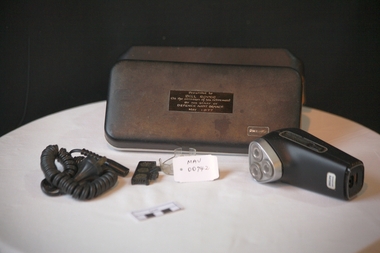 City of Moorabbin Historical Society (Operating the Box Cottage Museum)
Personal Effects. 'Philips" electric Shaver, c1977
... power system inspires the Philishave triple head electric razor. A triple-head model was test marketed in Australia and New Zealand in 1956, but would not be introduced globally until 1966. The brand name Philishave was phased out in 2006 so shavers now bear only the Philips name. Mr ...Established in 1891 in Eindhoven, the Netherlands, Philips & Co. was founded to meet the growing demand for light bulbs following the commercialization of electricity. Science and technology underwent tremendous development in the 1940s and 1950s, with Philips Research inventing the rotary heads that led to the development of the Philishave electric shaver, and laying down the basis for later ground-breaking work in transistors and integrated circuits.Philishave was the brand name for the electric shavers manufactured by the Philips Domestic Appliances and Personal Care unit of Philips They used the Philishave brand name for their shavers from 1939 to 2006. The Philishave shaver was invented by Philips engineer Alexandre Horowitz, who used rotating cutters instead of the reciprocating cutters that had been used in previous electric shavers. The shaver was introduced in 1939, though initial production was limited due to the outbreak of World War II. A more ergonomic egg-shaped single-head model was introduced in 1948 and was designed by US industrial designer Raymond Loewy. Global sales increased markedly after a double-head model was introduced in 1951. As a spin off from the light bulb and research is the dynamo-powered bicycle lamp. Its rotating power system inspires the Philishave triple head electric razor. A triple-head model was test marketed in Australia and New Zealand in 1956, but would not be introduced globally until 1966. The brand name Philishave was phased out in 2006 so shavers now bear only the Philips name. Mr Alfred William ( Bill ) Roper, 1913 - 1996 grew up in Ripponlea, ( East St Kilda ) Victoria. As a child he went with his father Arthur Leopold Roper to purchase vegetables from the Moorabbin Chinese market gardeners at the Hotham St. / Nepean Highway corner. c1920 . Bill served in WW2 in New Guinea and post war was Army Auditor, Victoria Barracks, St Kilda Road Melbourne. His staff presented this 'Philishave upon his retirement and he used it until his death1996. He lived in Carlton, Belgrave, Ascot Vale, South Yarra, East St Kilda and moved to Bentleigh in 1987.A ‘Philishave’ triple head electric razor , with cord, head protector and cleaning brush in a hinged plastic case The case has compartments, for Razor and cord, that are lined with a mustard coloured, soft, synthetic material .Case top PHILIPS ; inside EXCLUSIVE PHILISHAVE Razor Handle front PHILIPS / PHILISHAVE; back Type HP 1121/ 110-130V/ 220-240 V / PHILIPS Shield / ? Shield / BS 3456 / V 75255 / MADE IN HOLLAND Nameplate Presented to / BILL ROPER / On the occasion of his retirement / BY THE STAFF OF / DEFENCE AUDIT BRANCH / May 1977 philishave, royal philips electric company, razors, electric razors, bentleigh, moorabbin, market gardeners, st kilda markets, world war 2 1939-1945, department of defence melbourne, melbourne, roper alfred william, roper arthur leopold, ripponlea, chinese market gardeners -
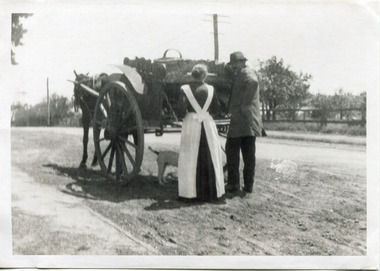 City of Moorabbin Historical Society (Operating the Box Cottage Museum)
Photograph - Photograph, Black & White Mrs J.L.Smith & Butcher, 1915
... J.L.Smith at first rented a cottage 'Law Muir Den' & Shed from Mr Box and commenced business as a wood merchant - sawing logs into shorter pieces using one horse to power the saw. ...J.L.Smith at first rented a cottage 'Law Muir Den' & Shed from Mr Box and commenced business as a wood merchant - sawing logs into shorter pieces using one horse to power the saw. ...The Butcher Mr Bill Ellin delivering meat to Mrs J.L.Smith in front of the house Law Muir Den 510 Centre Rd Bentleigh c 1915. Groceries, Ice, Milk, Bread, Eggs, Poultry were delivered to housewives by the traders in horse drawn carts, Also Hawkers and Pedlars plied their wares by visiting the cottages. John Logan Smith 1860-1932 , the son of Irish immigrants James and Marianne Smith was born at their home near the 'Toll Gates' on Point Nepean Road and Dendy Street. East Brighton. At that time the area had many orchards that were later replaced by market gardens. J.L.Smith at first rented a cottage 'Law Muir Den' & Shed from Mr Box and commenced business as a wood merchant - sawing logs into shorter pieces using one horse to power the saw. He purchased the property, added to the buildings , began trading in fuel and fodder as well and installed a chaff cutting mill powered by 10hp steam engine. The business prospered 1909 following the death of Tommy Bent, J/L Smith was nominated for Councillor of the Shire of Moorabbin. WW1 1914 - 18 both John and Mary Ann supported local War Relief Auxiliaries and their son Vic served as a Signaler in AIF. As Motor transport was increasing 1926 J L Smith built a small Garage on the opposite corner (Woolworths Supermarket 2005) , employed a good mechanic ( Reg Hunt ) and developed another successful business. The Grain Store was managed by family until 1930. In 1932 JL Smith assisted a man whose car had broken down, pushing it to the garage and sadly suffered a heart attack and died. He is buried in Cheltenham Cemetery. J.L.Smith was an early settler in East Brighton now Bentleigh and established successful Wood cutting, Grain & Chaff cutting and Motor garage businesses in Centre Road . He was elected Councillor of the Shire of Moorabbin and, with Mary Ann, his family were involved with local Church, Red Cross, and other community organizations.A Black and white photograph c 1915 showing the Butcher delivering meat to Mrs J.L Smith Bentleighsmith j l, smith mary ann, stanley helen, smith vic, smith harry redvers, chaff cutter, horse drawn carts, toll gates brighton, motor cars 1900, steam engines, early settlers, bentleigh, parish of moorabbin, city of moorabbin, county of bourke, moorabbin roads board, shire of moorabbin, henry dendy's special survey 1841, bent thomas, charman s, highett william, ormond francis, market gardeners, vineyards, orchards, william ellin, butcher
