
Showing 33 items matching "pin disc"
-
 Embroiderers Guild, Victoria
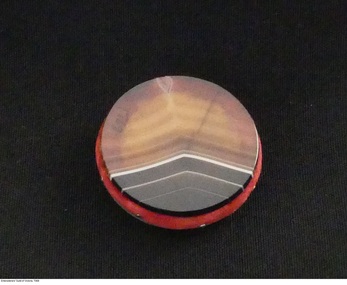
Tool - Disc pin cushion, 19th century
... Disc pin cushion...Pin disc...Unusual pin disc made with onyx stone sides. No other information available ...Disc pincushion with red velvet insert between two onyx discs. Eight pins...Unusual pin disc made with onyx stone sides. No other information available Very unusual pin disc sith onyx covers Pin disc Onyx Disc pincushion with red velvet insert between two onyx discs. ...Unusual pin disc made with onyx stone sides. No other information available Very unusual pin disc sith onyx coversDisc pincushion with red velvet insert between two onyx discs. Eight pinspin disc, onyx -
 Embroiderers Guild, Victoria
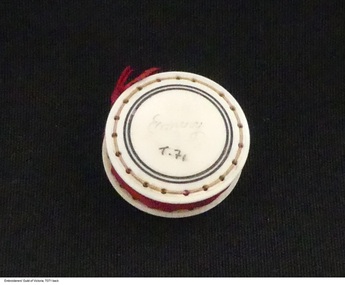
Tool - Ivory emery pin disc, 19th century
... Ivory emery pin disc......ivory pin disc...Circular double sided ivory emery pin/needle disc. Dot and circle pattern one one side, other side incised with 'Emery'. ...Tool Ivory emery pin disc ...Rust was a problem with early pins and needles. Cushion shaped containers filled with emery powder (corundum) or sand were used to polish the pins and needles. They are heavier than pincushions and often smaller. Emeries were essential tools for sewing. An elegant presentation of an essential tool for keeping pins and needles rust free.Circular double sided ivory emery pin/needle disc. Dot and circle pattern one one side, other side incised with 'Emery'. Edge stitching with loops of fawn thread. Red silk ribbon around the edge, finished with two loops. Dot and circles pattern on one side, 'Emery' incised on the otheremery, ivory pin disc, madras style decoration -
 Embroiderers Guild, Victoria
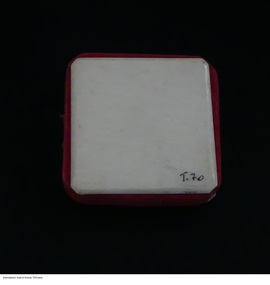
Tool - Ivory pin cushion, 19th century
... Pin disc...Pins are essential sewing tool, the second half of the 19th century saw mass production of them and many 'receptacles' to protect and keep them were made. Disc...Era of improving technology for making pins, growing middle class with a taste for luxury needlework tools Pin disc ivvory Low relief flowers with leaves - possibly lilac on decorated side. ...Pins are essential sewing tool, the second half of the 19th century saw mass production of them and many 'receptacles' to protect and keep them were made. Disc style pin cushions were very popular, this one has been made with elegantly carved ivory making it a status symbol. Era of improving technology for making pins, growing middle class with a taste for luxury needlework toolsSquare double sided ivory pin cushion with floral covering on one leaf, the other plain. Cushion covered in red velvetLow relief flowers with leaves - possibly lilac on decorated side.pin disc, ivvory -
 Embroiderers Guild, Victoria
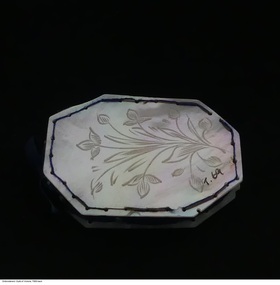
Tool - Mother of pearl pin cushion, 19th century
... ...Pin disc...Pins are essential sewing tool, the second half of the 19th century saw mass production of them and many 'receptacles' to protect and keep them were made. Disc...Era of improving technology for both making pins and preparation of thinner sheets of mother of pearl led to production of pin discs such as this. Mother of pearl Pin disc Floral design Mother of pearl elongated octagonal pin cushion. ...Pins are essential sewing tool, the second half of the 19th century saw mass production of them and many 'receptacles' to protect and keep them were made. Disc style pin cushions were very popular and this one has been made with mother of pearl which was very fashionable and with improved cutting and polishing equipment could be used on luxury items more affordably.Era of improving technology for both making pins and preparation of thinner sheets of mother of pearl led to production of pin discs such as this.Mother of pearl elongated octagonal pin cushion. Double sided with incised floral design. Padding covered with blue silk ribbon, ending in a bow, Stitching with matching navy blue threadFloral designmother of pearl, pin disc -
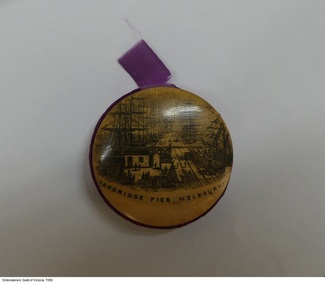 Embroiderers Guild, Victoria
Tool - Mauchline ware Pincushion, ?1890's
... Mauchline transfer ware pin disc, fuscia velvet cushion between circular wood. ...Mauchline transfer ware pin disc, fuscia velvet cushion between circular wood. ...Rare Mauchline ware pin cushion with an early Melbourne scene. Sandridge was renamed Port Melbourne in 1884. Mauchline transfer images of Australian scenes are rare This was donated to the Embroiderers Guild by descendants of the Leviny family of Castlemaine. Ernest Leviny was a significant goldsmith and jeweller in the young colony, his single daughters lived in the family home "Buda' and were very creative artists in many art forms. This was donated to the Embroiderers Guild by descendants of the Leviny family of Castlemaine, an imortant artisitic family of VictoriaMauchline transfer ware pin disc, fuscia velvet cushion between circular wood. Two black pins.Torn ribbon at top. Transfer ware image shows many tall sailing ships moored alongside a pier (image c 1870's).(Top) SANDRIDGE PIER, MELBOURNE. levinhy family, mauchline ware -
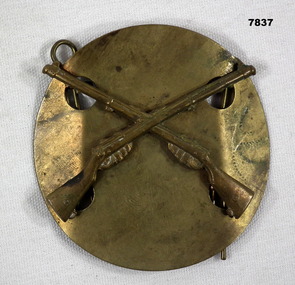 Bendigo Military Museum
Badge - CROSSED RIFLES, INFANTRY MARKSMAN
... Rifles have two loops attached which protrude through holes in disc for pins to be attached....Rifles have two loops attached which protrude through holes in disc for pins to be attached. Badge CROSSED RIFLES, INFANTRY MARKSMAN ...Crossed Rifles badge issued to marksmen of the Infantry.Circular brass disc with crossed rifles attached. Rifles have two loops attached which protrude through holes in disc for pins to be attached.cooper collection, crossed rifles, marksmen -
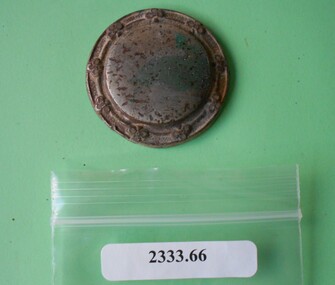 Bendigo Historical Society Inc.
Accessory - QC BINKS COLLECTION: METAL BUCKLE
... Metal object - possibly a badge or pin. Round metal disc with a pattern of trefoils around the border. ...BENDIGO Gold mining QC Binks QC Binks Metal object - possibly a badge or pin. Round metal disc with a pattern of trefoils around the border. ...Metal object - possibly a badge or pin. Round metal disc with a pattern of trefoils around the border. A raised centre piece has remnants of a decoration. Reverse has remains of two lugs possibly for a pin. Item is rusted.bendigo, gold mining, qc binks, qc binks -
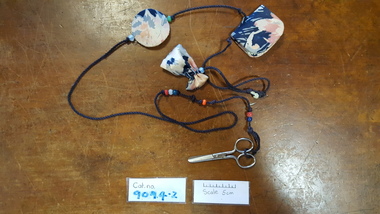 Coal Creek Community Park & Museum
Sewing kit
... 9094.1 Sewing kit on a beaded string, to be worn around neck, with scissors on one end, thimble in cotton purse on the other end, with a disc for pins and a folded book shaped container for needles. 9094.2 Thimble...9094.1 Sewing kit on a beaded string, to be worn around neck, with scissors on one end, thimble in cotton purse on the other end, with a disc for pins and a folded book shaped container for needles. 9094.2 Thimble Sewing kit ...9094.1 Sewing kit on a beaded string, to be worn around neck, with scissors on one end, thimble in cotton purse on the other end, with a disc for pins and a folded book shaped container for needles. 9094.2 Thimble -
 Warrnambool and District Historical Society Inc.
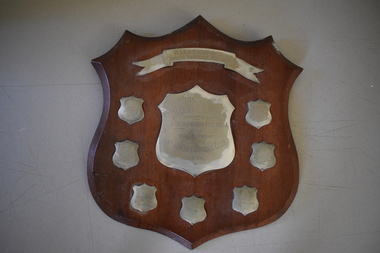
Trophy, Junior Challenge Shield 1936, 1932
... This is a wooden shield with nine silver-coloured metal discs affixed to the shield with metal pins. Eight of these discs are shield-shaped. ...M.L.A. 1932’ ‘Won Outright West End Football Club 1936’ This is a wooden shield with nine silver-coloured metal discs affixed to the shield with metal pins. Eight of these discs are shield-shaped. ...This junior football shield was given by James Fairbairn (1897-1940), a prominent Western District pastoralist, aviator, local politician and Federal Cabinet minister. He was killed in a Canberra air disaster in 1940. The shield shows that several football teams, including West End, Russells Creek and East Warrnambool won the shield in the 1930s. In 1936 the shield was won outright by West End Football Club. This club, founded in the late 19th century, played in Western District Leagues until 1946 when it joined the newly-formed Warrnambool District Football League. In 1971 it merged with the Allansford Football Club to become the West End-Allansford Club and in 2002 the name ceased to exist when the team name was changed back to Allansford Football Club. This trophy is of interest as a football trophy given over 80 years ago and as a memento of the Warrnambool West End Football Club, a team no longer existing. The sport of Australian football has been, and still is, highly prominent in the Warrnambool district with football first played in the town in 1861. This is a wooden shield with nine silver-coloured metal discs affixed to the shield with metal pins. Eight of these discs are shield-shaped. All of the discs have etched inscriptions. The discs are somewhat stained and the wooden shield has traces of paint on it. There is a wire attached to the back of the shield for hanging on a wall. ‘Warrnambool Junior Football League’ ‘Junior Challenge Shield presented by J.V. Fairbairn Esq. M.L.A. 1932’ ‘Won Outright West End Football Club 1936’ west end football club, warrnambool, j.v.fairbairn -
 Flagstaff Hill Maritime Museum and Village
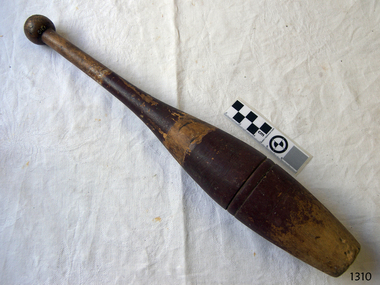
Equipment - Juggling Club, late 19th to early 20th century
... pin or an Indian club. It dates approximately to the early 20th century. It may have been used as one of a pair for gymnastics or exercise, or part of a larger set used by a juggler for entertainment in a circus or carnival. At some time it may have been used with a ball or disc...pin or an Indian club. It dates approximately to the early 20th century. It may have been used as one of a pair for gymnastics or exercise, or part of a larger set used by a juggler for entertainment in a circus or carnival. At some time it may have been used with a ball or disc ...This wooden juggling club or exercise club may also be referred to as a juggling pin. It is very similar in shape to a bowling pin or an Indian club. It dates approximately to the early 20th century. It may have been used as one of a pair for gymnastics or exercise, or part of a larger set used by a juggler for entertainment in a circus or carnival. At some time it may have been used with a ball or disc as part of a Skittles or bowling game set. The historical collection of Federation University Australia, Victoria, includes a very similar but slightly shorter club, labelled ‘timber skittle”, as can be seen in their photograph. Another example of very similar-shaped, same-sized clubs can be seen in the collection of Nobelius Heritage Park and Emerald Museum, Emerald, Victoria. JUGGLING Jugglers entertain audiences with their tricks and routines at events such as circuses, amusement parks, parties, shows on television or theatre, schools and parties. Juggles also compete at International Championships to obtain world records, performing as individuals or in groups or teams. Contemporary champion juggler David Cain performs a Juggling History Show that both entertains and educates his audience. His routines date from the early 1600s to the 20th century. He uses a wide variety of equipment in his acts including juggling clubs. EXERCISE Exercise clubs or Indian clubs were used in 19th century Victorian times as part of exercise or strengthening programs when they were swung in certain patterns and movements. Even in the early 20th century workplace a few minutes of Indian club swinging was common practice for the relief of tension. A video clip of an American school room in 1904 shows a group of boys and girls skilfully wielding clubs in an exercise sequence (see ‘Links” section). The 1904 and 1932 Olympic Games had an event called Club Swinging. Rhythmic gymnastics was added to the Olympic Program at the L.A. Games in 1984 where competitors use apparatus such as rope, hoop, ball, ribbon and clubs. The clubs come in a variety of weights and heights and have been used from the mid-1800s until around the 1930s in schools and military institutions. They are decorated in a variety of patterns and colours and some have feature lines or scored rings on them. This juggling club is significant for its association with education, entertainment and sport in the late 19th and early 20th century.Wooden juggling club (or pin, skittle or Indian club). Vintage, bottle-shaped club with a flat, slightly concave, base. Its turned, solid timber body tapers out from the base then in again to a very narrow handle with a round knob joined onto the top. Two concentric feature lines are scored into the wider part of club. It was possibly used in exercise, gymnastics or as a skittle. Sections of the club have two brown painted stripes; paint on the lower strip has been worn off at the base . There are remnants of white paint in two areas, possibly the remains of a maker’s name or decoration. There also appears to be an inscription stamped into the wooden handle but this is illegible. Late 19th to early 20th century.Remnants of what appears to be stamped lettering and painted labelling.flagstaff hill, warrnambool, shipwrecked coast, flagstaff hill maritime museum, maritime museum, shipwreck coast, flagstaff hill maritime village, great ocean road, wooden skittle, entertainment, bowling skittle, wooden juggling pin, wooden juggling club, wooden exercise club, indian club, exercise club, club swinging, rhythmic gymnastics, sport equipment, juggling equipment, wooden club -
 Flagstaff Hill Maritime Museum and Village
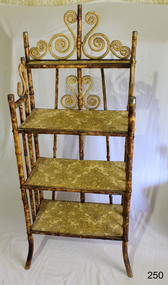
Furniture - Shelves, A. Englander & Searle, Late 19th Century (1898)
... discs. Methods of construction fell into three categories. First and most common is that of pegging. Bamboo stems being hollow, thick dowels can easily be glued into the joints. Some firms farmed out this work of `plugging' the ends of the canes to part-time workers at home. The second method, that of pinning...discs. Methods of construction fell into three categories. First and most common is that of pegging. Bamboo stems being hollow, thick dowels can easily be glued into the joints. Some firms farmed out this work of `plugging' the ends of the canes to part-time workers at home. The second method, that of pinning ...This music stand set of shelves is one of many 19th century items of furniture, linen and crockery donated to Flagstaff Hill Maritime Village by, Vera and Aurelin Giles. The items are associated with the Giles Family and are known as the “Giles Collection”. Many of the items of furniture, linen and crockery in the Lighthouse Keeper’s Cottage were donated by Vera and Aurelin Giles and mostly came from the simple home of Vera’s parents-in-law, Henry Giles and his wife Mary Jane (nee Freckleton) whose photos are in the parlour. They married in 1880. Henry, born at Tower Hill in 1858, was a labourer on the construction of the Breakwater before leaving in 1895 to build bridges in N.S.W. for about seven years. Mary Jane was born in 1860 at Cooramook. She attended Mailor’s Flat State School where she was also a student teacher before, as family legend has it, she became a governess at “Injemiara” where her grandfather, Francis Freckleton, once owned land. Henry and Mary’s family of six, some of whom were born at Mailor’s Flat and later children at Wangoom, lived with their parents at Wangoom and Purnim west, where Henry died in 1933 and Mary Jane in 1940. THE SHELVES During the years 1869-1935 there were well over 250 registered bamboo furniture producers in Britain. The earliest recorded firm was Hubert Bill of 14 Little Camden St, London N.W., who claimed to have been established in (1869 the first bamboo furniture maker), while Daniel Jacobs & Sons of Hackney Road, London, were still in business in 1915, after 45 years of production. Design, quality, price and methods of construction were fairly consistent throughout the whole period, but it was the imaginative and often eccentric choice of subject matter that marked the differentiation between the various firms. While most produced standard tables, stands and fire-screens, the more adventurous offered for sale items such as Corner shelve units, charcoal barbecue grills and musical tea tables. Shelves were often covered with embossed leather paper designs, at first imported from Japan and then later produced in England. Some firms incorporated the knobbly roots of the bamboo stems into their designs, generally to form feet. Occasionally handles to drawers and cupboards were made with these roots although they were more commonly carved as imitations. Handles were mostly of cheap metal or brass. The ends of the bamboo canes were capped with stamped metal or turned bone, ivory or wooden discs. Methods of construction fell into three categories. First and most common is that of pegging. Bamboo stems being hollow, thick dowels can easily be glued into the joints. Some firms farmed out this work of `plugging' the ends of the canes to part-time workers at home. The second method, that of pinning, was far less satisfactory as bamboo tends to split lengthwise and therefore the jointed pieces eventually disintegrated. The most efficient method was that patented in 1888 (patent No 2383) by the firm of W. F. Needham in Birmingham. It consisted of metal shoes and covers for all joints which were made by wrapping a metal strip around the stems and soldering the overlapping ends. Some joints were further strengthened by a small pin or screw. Needham was by far the largest and most successful manufacturer and their individual and superior method of construction undoubtedly gained them their reputation. A. Englander & Searle of 34 Gt Eastern St and 31 Mare St, Hackney, London, were a firm particularly concerned with methods of construction. Although they seem to have entered the bamboo furniture market at a comparatively late date, about 1898, they produced inexpensive bamboo, aimed particularly at the export trade. The company stated in their catalogue that bamboo furniture “can be exported in one piece or it can be exported in pieces and put together again. The fixing up is much facilitated by a system of marking and numbering. Further, no glue is required for putting together as the screw system only is applied”. This method of construction best fits the Etagere in the Flagstaff collection and it is believed to have been made by A Englander & Searle, exported in a knock down form to Australia, purchased in kit form from a dealer hear and put together by the owner. The Etagere is a significant item as it highlight furniture fashion of the late Victorian era. This item was highly sort after in its time and although mass produced, not many examples remain, so this example is a valuable addition to the Flagstaff collection. It is believed that the construction method used is by a notable and respected maker of bamboo furniture and that its production was aimed at the export market and probably came to Australia in kit form.Bamboo shelves: decorative free standing Etagere comprising three large shelves and one small shelf. Shelves are made of wood used to store either orange or bacon boxes (as there are no knots in the wood, imported from South America and cheap to recycle). Shelves are covered with embossed leather paper. Frame is made from tortoise shell bamboo (brown lacquer applied to simulate tortoise shell appearance). Ends of bamboo canes are covered with metal shoes and fixed with a pin. Other bamboo joints are fixed with round head steel screws. This item is part of the Giles Collection.Noneflagstaff hill, warrnambool, shipwrecked-coast, flagstaff-hill, flagstaff-hill-maritime-museum, maritime-museum, shipwreck-coast, flagstaff-hill-maritime-village, bamboo shelves, bamboo etagere, victorian furniture, furniture, bamboo furniture, embossed leather paper, simulated bamboo, tortise shell, a englander & searle, giles collection, henry giles, tower hill, cooramook, warrnambool breakwater, mailor’s flat, wangoom, 19th century furniture -
 Flagstaff Hill Maritime Museum and Village
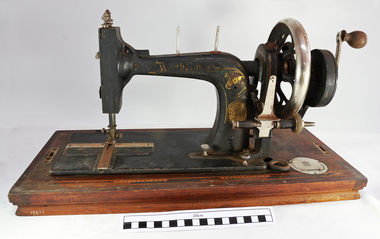
Domestic object - Sewing Machine and case, Joseph Wertheim, late 19th century
... pins are inside. Body of machine has brand name transfer across front and oval metal trademark disc on front. ...Cover of pin holder has symbol ‘Wings above a shield’. Maker’s trademark on gold oval disc, “WERTHEIM / FRANCFURT” and picture of a dwarf with a hammer. ...pins are inside. Body of machine has brand name transfer across front and oval metal trademark disc on front. ...Hugo Wertheim (1854-1919), was a merchant and manufacturer and was born on the 12th July 1854 at Lispenhausen, in the German electorate of Hesse-Kassel, son of Meyer Wertheim and his wife Minna, née Heinemann. Hugo reached Melbourne in October 1875. He soon began advertising, from premises at 39 Flinders Lane East, as agent for his father's cousin Joseph Wertheim, a well-established manufacturer of sewing machines. Hugo returned to Germany where he married Joseph Wertheim's daughter Sophie Emilie (1864-1953) on 30 August 1885 at Frankfurt. the couple then came to Melbourne. In a short time, with extensive advertising, Hugo established a substantial business, selling sewing machines, bicycles, pianos and other mechanical devices, under brands such as Wertheim, Electra, Planet, Griffin and Hapsburg. He also mounted elaborate displays at agricultural shows and in 1901 at the Pan American Exposition, Buffalo, United States of America. O. C. Beale worked with him before setting up his own piano business in New South Wales. Hugo continued to own 25 per cent of one of Beale's companies, which became Wertheim's Queensland business. In 1908 Wertheim opened a large, innovative piano factory at Richmond, Melbourne, intending to produce 2000 pianos and player pianos annually, predominantly using Australian materials. In laying the foundation stone, Prime Minister Alfred Deakin observed that “few men with such opportunities for a life of ease would have embarked on such an enterprise” Hugo died of chronic hepatitis on 11 July 1919 at his home at South Yarra, his wife, two daughters and three sons survived him; Herbert Joseph (1886-1972), the eldest, continued the business. Rupert became a share broker and went on to represent Victoria in inter-State tennis in 1913-27 and Australia in Davis Cup matches against Czechoslovakia in 1922. The piano factory closed in 1935, becoming a Heinz food processing plant and in 1955, GTV Channel 9 studios and offices.Early Australians had to be self-reliant in regards to making and mending their clothes and utensils. This sewing machine was one of many items used that exhibit the skill and craftsmanship of the women in these early families. A sewing machine was a necessary part of each home and this item demonstrates how women of the time managed had to become self-reliant in the repair and making of their families clothes to make their household budgets go further.Sewing machine, Wertheim brand “ Syst 182” hand crank operated machine with folding handle, timber case and carry handle. Metal machine is painted black, with remnants of gold, red and green scrolls and floral decoration. Machine has base with inlaid measuring rule across front and 2 holes drilled through the base (perhaps for mounting machine to a bench). Machine tilts open, hinged on one side, after thumb screw is unwound, revealing machine’s workings and serial number. Base has a fitted round, concave, silver metal pin holder with lid that hinges open, and symbol pressed into lid; several pins are inside. Body of machine has brand name transfer across front and oval metal trademark disc on front. Metal sliding covers over footplates have stamped lettering. Timber machine case or cover includes an accessory box with sliding cover and metal hook and eye latch, and inside the box are 23 metal sewing attachments, a disc and a stick of black crayon with maker’s trademark on it paper cover. Workings of machine have seized up. The crayon wrapper has printed on it “For the wonderful Wertheim new family machine made in Germany ‘Syst. 182’”, and the maker’s symbol with “Trademark” beside it. Made for Hugo Wertheim.“WERTHEIM” transfer across front and back of machine body. Cover of pin holder has symbol ‘Wings above a shield’. Maker’s trademark on gold oval disc, “WERTHEIM / FRANCFURT” and picture of a dwarf with a hammer. Left footplate has script “Syst 182”, right footplate has stamp in oval shape “MANUFACTURED IN - - /SPECIALLY FOR / HUGO WERTHEIM” Serial Number “7501”flagstaff hill, warrnambool, shipwrecked-coast, flagstaff-hill, flagstaff-hill-maritime-museum, maritime-museum, shipwreck-coast, flagstaff-hill-maritime-village, sewing machine, hand crank sewing machine, hugo wertheim, wertheim, clothing manufacturer, sewing, syst 182 -
 Flagstaff Hill Maritime Museum and Village
Pin
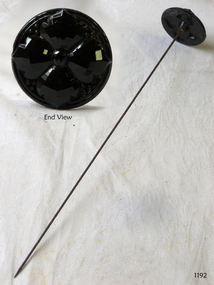
... Pin long with black and shiny decorative head. Head is disc shaped with flower decoration....Flagstaff Hill Warrnambool Shipwrecked-coast Flagstaff-Hill Flagstaff-Hill-Maritime-Museum Maritime-Museum Shipwreck-coast Flagstaff-Hill-Maritime-Village Pin long with black and shiny decorative head. Head is disc shaped with flower decoration. ...Pin long with black and shiny decorative head. Head is disc shaped with flower decoration.flagstaff hill, warrnambool, shipwrecked-coast, flagstaff-hill, flagstaff-hill-maritime-museum, maritime-museum, shipwreck-coast, flagstaff-hill-maritime-village -
 Blacksmith's Cottage and Forge
Biscuit Forcer
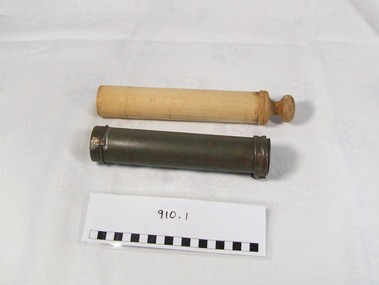
... Inner wooden pin or forcer, knob on end to be pushed into metal cylinder to force dough out through patterned disc....Inner wooden pin or forcer, knob on end to be pushed into metal cylinder to force dough out through patterned disc. ...Dough was put in forcer/case/cylinder and wooden pin pressed down to force dough out as a star-shaped biscuit. In use in a working-class home in the mid 20th century.Representative of kitchen utensils in common use in working class kitchens in 20th century prior to the common availability of packaged biscuits. Tin/metal outer cylinder/case/open one end, lid other end, with star pattern (can be removed for washing). Inner wooden pin or forcer, knob on end to be pushed into metal cylinder to force dough out through patterned disc.domestic, kitchen, food, technology, biscuit, forcer, baking, woman s, work, appliances -
 Shepparton RSL Sub Branch
Binoculars
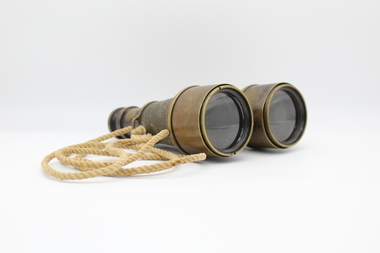
... disc on each wide end. Each barrel joined together via a joint platform approximately halfway and 9/10ths of the way up the binoculars. Binoculars can change shape by barrels swivelling on a central pin. ...disc on each wide end. Each barrel joined together via a joint platform approximately halfway and 9/10ths of the way up the binoculars. Binoculars can change shape by barrels swivelling on a central pin. ...These binoculars appear to have been made for use by service personnel, carrying a broad arrow symbol on the barrel. The inscriptions "MG" may indicate the manufacturer or initials of the owner. The service number 48582 may indicate that the pair was owned by Lionel James O'Dempsey, a Victorian who served as a Lance Sergeant with the 3 Light Anti Aircraft Regiment during the Second World War.Brass binoculars with cotton cord acting as strap, fastened via a knot on one side of a small loop cast into the side of the barrel. Two cone shaped barrels with circular convex glass disc on each wide end. Each barrel joined together via a joint platform approximately halfway and 9/10ths of the way up the binoculars. Binoculars can change shape by barrels swivelling on a central pin. Binoculars also zoom in and out (i.e. barrel reduces and expands) due to grooved dial in centre of pin. One eye piece missing on left side, right side intact but able to be unscrewed. Barrels are tinted green from copper corrosion and retractable barrel sections have black colouring in parts.Inscribed on centre platform between eye pieces "M G", in the direction of the wearer. On top of adjustable barrels: "[broad arrow] (right side)", "Mk VSP-/48582"second world war, worl war two, world war ii, binoculars, looking glass, surveillance -
 Federation University Historical Collection
Object, School of Mines Ballarat Lapel Badge, c1920s
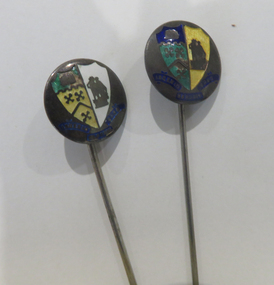
... The circular disc is attached to a long pin. 1). The enamel is yellow, green and blue 2). ...The university merged with Monash University's Gippsland (Churchill) campus in 2013 and the merged schools are now the Federation University Australia school of mines ballarat school crest lapel pins On face - Ingenio Effodere Opes These Coat of Arms of the School of Mines Ballarat are circular lapel badges and are made of sterling silver and enamel. The circular disc ...Tertiary education at Ballarat began with the establishment of the School of Mines in 1870, making it Australia's third oldest tertiary institution. Classes began in surveying, mathematics, chemistry and a decade later they included metallurgy, assaying and geology. The technical division provided such programs as wool classing, plumbing and bricklaying. In 1967, it was split into three separate institutions, Ballarat School of Industries, Ballarat Technical School, and Ballarat Institute of Advanced Education. Then in 1976 the Ballarat Institute of Advanced Education became into Ballarat College of Advanced Education. The Ballarat School of Industries and Ballarat Technical School became the School of Mines and Industries, Ballarat (SMB). In 1998, the Ballarat School of Mines and Industries and the Horsham-based Wimmera Institute of TAFE merged with the University of Ballarat. The university merged with Monash University's Gippsland (Churchill) campus in 2013 and the merged schools are now the Federation University AustraliaThese Coat of Arms of the School of Mines Ballarat are circular lapel badges and are made of sterling silver and enamel. The circular disc is attached to a long pin. 1). The enamel is yellow, green and blue 2). The enamel is white, yellow, green and blueOn face - Ingenio Effodere Opesschool of mines ballarat, school crest, lapel pins -
 Flagstaff Hill Maritime Museum and Village
Equipment - Pattern, Briggs Brass Foundry, 1912-1972
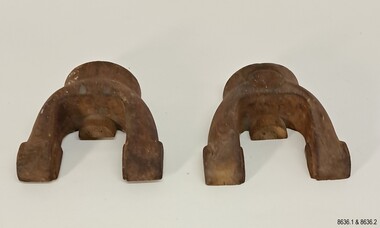
... The blocks have opposing metal pins and holes to hold them together. One block has a disc shape carved into the base. ...The blocks have opposing metal pins and holes to hold them together. One block has a disc shape carved into the base. ...The wooden pattern forms part of a larger collection; some of them were secured within a durable wooden crate. The cast pattern was an essential tool at Briggs Brass Foundry, specifically designed for creating sand casts. Sand casting is a time-honoured technique, with a history exceeding 2,000 years. The handcrafted nature of this process produces brass and copper alloy items particularly suitable for maritime applications. Typical products include bells, boat hooks, cowls, propellers, handles, lids, rowlocks, hooks, letters, bolts, rail holders, brackets, deck plates, flanges, rudder guides, portholes and covers. The distinctive bronze mixture used at Briggs’ Foundry is copper based. It is composed of local ingots of copper, tin, zinc and lead, blended in precisely measured quantities. The resulting alloy is non-ferrous, known for its exceptional durability and longevity. HISTORY OF BRIGGS MARINE: The Briggs Brass Foundry, trading as Briggs & Son Foundry, was established in 1912 by Herbert Harrison Briggs (1863-1931) with his son George Edward Briggs. In 1922, the youngest son, Cyril Falkiner McKinnon Briggs, joined the foundry. After Herbert died in 1931, his sons George and Cyril ran the foundry. The business became known as Briggs Marine Foundry, the “non-ferrous founders” and “bell specialists”. The foundry products were made using the traditional sand-casting method, which is now over two thousand years old and is becoming a dying art. The foundry operated at 70 Wellington St, Collingwood, and specialised in casting ship bells and other marine equipment and fittings. It also made decorative items such as miniature ship propellers. The great-granddaughter of Herbert Briggs inherited a Briggs brass bell, similar to one at Flagstaff Hill Maritime Village. In 1965, Cyril was the only remaining family member involved in Briggs Marine Products. The firm relocated to Chesterville Rd, Moorabbin and Cyril went into partnership with Frank Lee. In the same year, the firm exhibited its products at the 1965 Boat Show. When Cyril passed away in 1967, Frank took over the business with two new partners. After Frank Lee died in 1971, the foundry was run by his son and daughter-in-law, Les and Eva Lee. Briggs Marine still exists today, but the Briggs family is no longer involved. Briggs Foundry had a community-minded retail branch in Warrnambool, selling cast boat fittings and equipment to fishermen and others in the regional marine industry. The branch closed in 1972. In Flagstaff Hill’s formative years, 1972-1975, many Briggs Marine brassware products were generously donated from its Melbourne foundry, along with casting patterns, tools, machinery and a cupboard. EXHIBITION and LEGACY: The donated items were displayed in a simulated Brass Foundry within the Village, where visitors could view them and gain insight into the foundering and metalwork trades that supported maritime industries, including shipwrights and boatbuilders. The castings produced at the foundry were also vital for farmers, manufacturers and other local industries. This exhibit was part of a broader showcase of working crafts, trades and services typical of a Maritime town. The display was available to the public from the completion of the building in 1986 until 1994, when the space was repurposed. It is believed that Briggs Marine’s family members gave personal assistance in setting up the displays in the original village shops, particularly the ‘Brass Foundry’ building. A notable feature of the Village Brass Foundry was the historic Cornish chimney, presented as a working model. This chimney visually demonstrated the process of smelting metal in furnaces and pouring it into sand moulds. Constructed from specially curved bricks, the chimney now stands at about two-thirds of its original height, having been relocated from the Grassmere Cheese factory. The hand-cast sand patterns hold considerable significance due to their association with Briggs Brass Founders, a firm established in the early 20th century and widely recognised for its expertise in producing, repairing, and restoring ship bells and marine equipment. Known for their specialisation in non-ferrous metal casting, Briggs Brass Founders supplied high-quality fittings and equipment for maritime use. The company extended its operations by opening a branch in Warrnambool, where it actively supported the local community. The foundry’s ability to cast essential products was important to local and regional industries, like fishing, farming, manufacturing and commercial businesses. Through its presence, its reputation was reinforced as both a skilled manufacturer and a community-minded enterprise. The foundry is notably associated with the Schomberg Bell at Flagstaff Hill, having restored this small, historic bell to its original condition. The Schomberg Bell is a fine example from a luxury migrant vessel dating back to the mid-19th century, reflecting the craftsmanship and heritage preserved by Briggs Brass Foundry Pattern: pair of U-shaped carved blocks, unpainted. The blocks have opposing metal pins and holes to hold them together. One block has a disc shape carved into the base. The pattern is part of a set of foundry patterns from Briggs Brass Foundry.flagstaff hill, flagstaff hill maritime museum and village, warrnambool, maritime museum, maritime village, great ocean road, shipwreck coast, briggs' bronze, traditional method, trade, sand cast, cast, brass alloy, copper alloy, pattern, mould, foundry, brass foundry, metal foundry, casting, sand mould, sand casting, marine equipment, marine tools, marine fittings, copper tin zinc lead, non-ferrous, non-corrosive, brassware, metalware, foundering, metalwork, maritime, bell founders, ship chandlers, marine products, biggs, briggs family, herbert harrison briggs, h h briggs, george edward briggs, cyril falkiner mckinnon briggs, cyril briggs, briggs & son brass foundry, h h briggs & sons foundry, briggs marine, alliance casting & engineering solutions, grassmere cheese factory, cornish chimney, curved bricks, collingwood, moorabbin, collingwood foundry, moorabbin foundry, 1912, briggs, briggs brass foundry, briggs marine foundry, briggs marine products, frank lee, les lee, eva lee, briggs marine warrnambool, non-ferrous founders, bell specialists, ship bell specialists, founders, metalworking, traditional sand casting, casting pattern, foundry pattern -
 Flagstaff Hill Maritime Museum and Village
Equipment - Pattern, Briggs Brass Foundry, 1912-1972
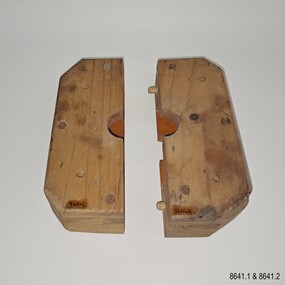
... disc shape inside. The block is made from laminated pieces of wood with cut corners. Both sides have four drilled holes in a square configuration, but in different positions. The cut faces, and the space carved into them, are painted red; one piece has two dowel pins...disc shape inside. The block is made from laminated pieces of wood with cut corners. Both sides have four drilled holes in a square configuration, but in different positions. The cut faces, and the space carved into them, are painted red; one piece has two dowel pins ...The wooden pattern forms part of a larger collection; some of them were secured within a durable wooden crate. The cast pattern was an essential tool at Briggs Brass Foundry, specifically designed for creating sand casts. Sand casting is a time-honoured technique, with a history exceeding 2,000 years. The handcrafted nature of this process produces brass and copper alloy items particularly suitable for maritime applications. Typical products include bells, boat hooks, cowls, propellers, handles, lids, rowlocks, hooks, letters, bolts, rail holders, brackets, deck plates, flanges, rudder guides, portholes and covers. The distinctive bronze mixture used at Briggs’ Foundry is copper based. It is composed of local ingots of copper, tin, zinc and lead, blended in precisely measured quantities. The resulting alloy is non-ferrous, known for its exceptional durability and longevity. HISTORY OF BRIGGS MARINE: The Briggs Brass Foundry, trading as Briggs & Son Foundry, was established in 1912 by Herbert Harrison Briggs (1863-1931) with his son George Edward Briggs. In 1922, the youngest son, Cyril Falkiner McKinnon Briggs, joined the foundry. After Herbert died in 1931, his sons George and Cyril ran the foundry. The business became known as Briggs Marine Foundry, the “non-ferrous founders” and “bell specialists”. The foundry products were made using the traditional sand-casting method, which is now over two thousand years old and is becoming a dying art. The foundry operated at 70 Wellington St, Collingwood, and specialised in casting ship bells and other marine equipment and fittings. It also made decorative items such as miniature ship propellers. The great-granddaughter of Herbert Briggs inherited a Briggs brass bell, similar to one at Flagstaff Hill Maritime Village. In 1965, Cyril was the only remaining family member involved in Briggs Marine Products. The firm relocated to Chesterville Rd, Moorabbin and Cyril went into partnership with Frank Lee. In the same year, the firm exhibited its products at the 1965 Boat Show. When Cyril passed away in 1967, Frank took over the business with two new partners. After Frank Lee died in 1971, the foundry was run by his son and daughter-in-law, Les and Eva Lee. Briggs Marine still exists today, but the Briggs family is no longer involved. Briggs Foundry had a community-minded retail branch in Warrnambool, selling cast boat fittings and equipment to fishermen and others in the regional marine industry. The branch closed in 1972. In Flagstaff Hill’s formative years, 1972-1975, many Briggs Marine brassware products were generously donated from its Melbourne foundry, along with casting patterns, tools, machinery and a cupboard. EXHIBITION and LEGACY: The donated items were displayed in a simulated Brass Foundry within the Village, where visitors could view them and gain insight into the foundering and metalwork trades that supported maritime industries, including shipwrights and boatbuilders. The castings produced at the foundry were also vital for farmers, manufacturers and other local industries. This exhibit was part of a broader showcase of working crafts, trades and services typical of a Maritime town. The display was available to the public from the completion of the building in 1986 until 1994, when the space was repurposed. It is believed that Briggs Marine’s family members gave personal assistance in setting up the displays in the original village shops, particularly the ‘Brass Foundry’ building. A notable feature of the Village Brass Foundry was the historic Cornish chimney, presented as a working model. This chimney visually demonstrated the process of smelting metal in furnaces and pouring it into sand moulds. Constructed from specially curved bricks, the chimney now stands at about two-thirds of its original height, having been relocated from the Grassmere Cheese factory. The hand-cast sand patterns hold considerable significance due to their association with Briggs Brass Founders, a firm established in the early 20th century and widely recognised for its expertise in producing, repairing, and restoring ship bells and marine equipment. Known for their specialisation in non-ferrous metal casting, Briggs Brass Founders supplied high-quality fittings and equipment for maritime use. The company extended its operations by opening a branch in Warrnambool, where it actively supported the local community. The foundry’s ability to cast essential products was important to local and regional industries, like fishing, farming, manufacturing and commercial businesses. Through its presence, its reputation was reinforced as both a skilled manufacturer and a community-minded enterprise. The foundry is notably associated with the Schomberg Bell at Flagstaff Hill, having restored this small, historic bell to its original condition. The Schomberg Bell is a fine example from a luxury migrant vessel dating back to the mid-19th century, reflecting the craftsmanship and heritage preserved by Briggs Brass Foundry. Pattern: a pair of blocks that form a rectangle with a carved centre hole and a disc shape inside. The block is made from laminated pieces of wood with cut corners. Both sides have four drilled holes in a square configuration, but in different positions. The cut faces, and the space carved into them, are painted red; one piece has two dowel pins that fit into two drilled holes on the other. The pattern is part of a set of foundry patterns from Briggs Brass Foundry.flagstaff hill, flagstaff hill maritime museum and village, warrnambool, maritime museum, maritime village, great ocean road, shipwreck coast, briggs' bronze, traditional method, trade, sand cast, cast, brass alloy, copper alloy, pattern, mould, foundry, brass foundry, metal foundry, casting, sand mould, sand casting, marine equipment, marine tools, marine fittings, copper tin zinc lead, non-ferrous, non-corrosive, brassware, metalware, foundering, metalwork, maritime, bell founders, ship chandlers, marine products, biggs, briggs family, herbert harrison briggs, h h briggs, george edward briggs, cyril falkiner mckinnon briggs, cyril briggs, briggs & son brass foundry, h h briggs & sons foundry, briggs marine, alliance casting & engineering solutions, grassmere cheese factory, cornish chimney, curved bricks, collingwood, moorabbin, collingwood foundry, moorabbin foundry, 1912, briggs, briggs brass foundry, briggs marine foundry, briggs marine products, frank lee, les lee, eva lee, briggs marine warrnambool, non-ferrous founders, bell specialists, ship bell specialists, founders, metalworking, traditional sand casting, casting pattern, foundry pattern -
 Orbost & District Historical Society
handsaw, !930's
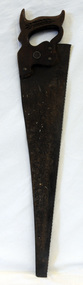
... disc around a keyhole is "Warranted Superior". Hand saw with a skew-back, steel blade and a wooden handle. It has three metal saw pins and a medallion marked 'warranted superior'. ...Donated by the Harry Cameron family, Harry's father, James Cameron, came to Bellagoogan on Majors Creek in 1882. Bellagoogan was on Majors Creek near Orbost and was the site of the first race course. Like many other at the time, the Camerons bred race horses.Harry died in 1964 aged 75.Hand saw with a skew-back, steel blade and a wooden handle. It has three metal saw pins and a medallion marked 'warranted superior'. There is a chip carved wheat sheaf decorating the front hand grip. This handsaw is probably a Disston Keystone K-4 Air MasterOn a metal disc around a keyhole is "Warranted Superior".tool timber-industry handsaw -
 Montmorency–Eltham RSL Sub Branch
Medal - Medal Group, British War & Victory (Pte. Dempster)
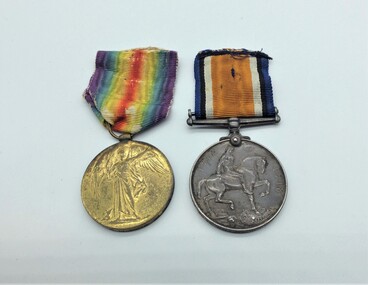
... British War Medal Silver disc with a straight clasp suspender without a swivel Ribbon (in clasp) - wide central watered stripe of orange, flanked by two narrow white stripes, which are in turn flanked by two black pin-stripes, further flanked by two outer stripes of blue Obverse ... bare headed effigy of King George V (by Sir Bertram Mackennal) facing left with the legend around circumference Reverse ... ...Dempster, 24 BN AIF British War Medal Silver disc with a straight clasp suspender without a swivel Ribbon (in clasp) - wide central watered stripe of orange, flanked by two narrow white stripes, which are in turn flanked by two black pin-stripes, further flanked by two outer stripes of blue Obverse ... bare headed effigy of King George V (by Sir Bertram Mackennal) facing left with the legend around circumference Reverse ... ...Ancestor of Sub Branch memberPte. Dempster was an ancestor of a Montmorency/Eltham sub-branch member.British War Medal Silver disc with a straight clasp suspender without a swivel Ribbon (in clasp) - wide central watered stripe of orange, flanked by two narrow white stripes, which are in turn flanked by two black pin-stripes, further flanked by two outer stripes of blue Obverse ... bare headed effigy of King George V (by Sir Bertram Mackennal) facing left with the legend around circumference Reverse ... St. George on horseback trampling shield of eagle (symbol of "Central Powers"); above is rising sun of victory. Victory Medal Bronze disc with circular loop which is threaded with ribbon Ribbon - a ‘two rainbow’ design, with the violet from each rainbow on the outside edges moving through to a central red stripe where both rainbows meet Obverse ... image of "winged Victory" Reverse ... inscription surrounded by laurel reathBritish War Medal Obverse ... GEORGIVS V BRITT OMN : REX ET IND. IMP. (George V, King of all the British Isles and Emperor of India) Reverse ... 1914 1918 Rim ... Pte J. H. Dempster, 24 BN AIF Victory Medal Obverse ... no inscription Reverse ... THE GREAT WAR FOR CIVILIZATION 1914 - 1919 Rim ... Pte J. H. Dempster, 24 BN AIFwar service medals, ww1 -
 Montmorency–Eltham RSL Sub Branch
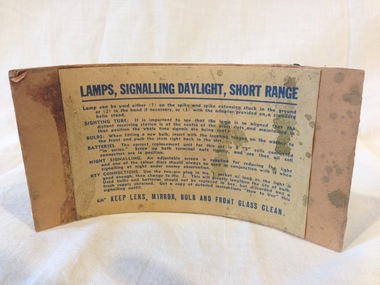
Equipment - Instruction Card, Lamps, Signalling Daylight, Short Range, MK II, PMG 1942, 1942
... NIGHT SIGNALLING: An adjustable screen is supplied for reducing the light and one of the colour discs should always be used in conjunction with it when signalling at night under enemy observation. KEY CONNECTIONS. Use the two-pin...NIGHT SIGNALLING: An adjustable screen is supplied for reducing the light and one of the colour discs should always be used in conjunction with it when signalling at night under enemy observation. KEY CONNECTIONS. Use the two-pin ...Dark blue printed instructions on paper mounted on a buff coloured cardboard card.LAMPS, SIGNALLING DAYLIGHT, SHORT RANGE Lamp can be used either (1) on the spike and spike extension stuck in the ground or (2) in the hand if necessary, or (3) withe the adaptor provided on a standard helio stand. SIGHTING TUBE: It is important to see that the lamp is so aligned that the distant receiving station is at the centre of the cross slots and maintained in that position the whole time that signals are being sent. BULBS: when fitting a new bulb, insert the locating tongue on the washer to the front and push the stem right back in the slot. BATTERIES: The correct replacment unit for this set is 8 "S" cells connected "in series". Screw up both terminal nuts tightly, ans see thar all connectors are in position. NIGHT SIGNALLING: An adjustable screen is supplied for reducing the light and one of the colour discs should always be used in conjunction with it when signalling at night under enemy observation. KEY CONNECTIONS. Use the two-pin plug in No.1 socket as long as the light is good enough, then cahnge to No.2. This will greatly lengthen the life of bulb. Used bulbs and batteries should not be relaced in the box, but discarded and a fresh supply obtained. Get a copy of detailed instructions "How to Use" this signalling outfit. KEEP LENS, MIRROR, BULB AND FRONT GLASS CLEAN.instructions, lamp, signalling, daylight, short range -
 Lorne Historical Society
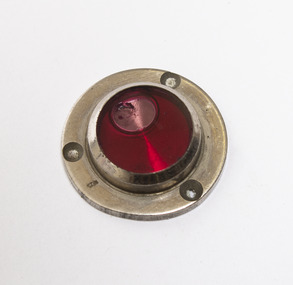
Tool - Cirkut Panoramic Camera Number 5 spirit level
... Silver colored metal disc with circular glass cylinder containing red leveling fluid. The base has three holes to put pins in to attach it to the camera...Camera William Anderson Silver colored metal disc with circular glass cylinder containing red leveling fluid. The base has three holes to put pins in to attach it to the camera Tool Cirkut Panoramic Camera Number 5 spirit level ...Used in William Anderson’s Cirkut Panoramic Camera. Silver colored metal disc with circular glass cylinder containing red leveling fluid. The base has three holes to put pins in to attach it to the cameracamera, william anderson, -
 Flagstaff Hill Maritime Museum and Village
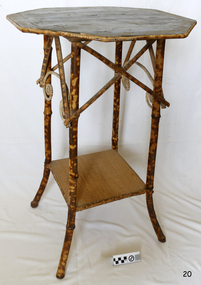
Furniture - Plant Stand, 1880
... discs. Methods of construction fell into three categories. First and most common is that of pegging. Bamboo stems being hollow, thick dowels can easily be glued into the joints. Some firms farmed out this work of `plugging' the ends of the canes to part-time workers at home. The second method, that of pinning...discs. Methods of construction fell into three categories. First and most common is that of pegging. Bamboo stems being hollow, thick dowels can easily be glued into the joints. Some firms farmed out this work of `plugging' the ends of the canes to part-time workers at home. The second method, that of pinning ...During the years 1869-1935, there were well over 250 registered bamboo furniture producers in Britain. The earliest recorded firm was Hubert Bill of 14 Little Camden St, London N.W., who claimed to have been established in 1869, while Daniel Jacobs & Sons of Hackney Road, London, were still in business in 1915, after 45 years of production. Design, quality, price and methods of construction were fairly consistent throughout the whole period, but it was the imaginative and often eccentric choice of subject matter that marked differentiation between the various firms. While most produced standard tables, stands and fire-screens, the more adventurous offered for sale items such as corner shelve units, charcoal barbecue grills and musical tea tables. Shelves were often covered with embossed leather paper designs, at first imported from Japan and then later produced in England. Some firms incorporated the knobbly roots of the bamboo stems into their designs, generally to form feet. Occasionally, handles to drawers and cupboards were made with these roots, although they were more commonly carved as imitations. Handles were mostly of cheap metal or brass. The ends of the bamboo canes were capped with stamped metal or turned bone, ivory or wooden discs. Methods of construction fell into three categories. First and most common is that of pegging. Bamboo stems being hollow, thick dowels can easily be glued into the joints. Some firms farmed out this work of `plugging' the ends of the canes to part-time workers at home. The second method, that of pinning, was far less satisfactory as bamboo tends to split lengthwise and therefore the jointed pieces eventually disintegrated. The most efficient method was that patented in 1888 (patent No. 2383) by the firm of W. F. Needham in Birmingham. It consisted of metal shoes and covers for all joints, which were made by wrapping a metal strip around the stems and soldering the overlapping ends. Some joints were further strengthened by a small pin or screw. Needham was by far the largest and most successful manufacturer, and their individual and superior method of construction undoubtedly gained them their reputation. A. Englander & Searle of 34 Gt Eastern St and 31 Mare St, Hackney, London, were a firm particularly concerned with methods of construction. Although they seem to have entered the bamboo furniture market at a comparatively late date, about 1898, they produced inexpensive' bamboo, aimed particularly at the export trade. Stating in their catalogue that bamboo furniture “can be exported in one piece or it can be exported in pieces and put together again. The fixing up is much facilitated by a system of marking and numbering. Further, no glue is required for putting together as the screw system is applied”. This method of construction best fits the Etagere and this item in the Flagstaff collection, and it is believed to have been made by A Englander & Searle, exported in a knock-down form to Australia, purchased in kit form from a dealer here and put together by the purchaser. The bamboo plant stand is a significant item as it highlight furniture fashion of the late Victorian era. This item was highly sort after in its time and although mass produced, not many examples remain because the item is so fragile so this example is a valuable addition to the Flagstaff collection. It is believed,the construction method used is by a notable and respected maker in England of bamboo furniture that was aimed specifically at the export market and probably came to Australia in kit form to be assembled by the purchaser.Plant stand: a bamboo plant stand with a hexagonal pine timber top edged with tortoise shell bamboo. The top is supported on four tortoise shell bamboo legs joined at the base by a square cane-covered shelf. The tortoise shell appearance is brown lacquer. This stand is part of the Giles Collection. flagstaff hill, warrnambool, shipwrecked coast, flagstaff hill maritime museum, shipwreck coast, furniture, plant stand, bamboo furniture, etagere, victorian furniture, simulated bamboo, tortise shell, a englander & searle, domestic furniture, giles collection, henry giles, cooramook, mailor’s flat, wangoom, 19th century household goods -
 Bendigo Military Museum
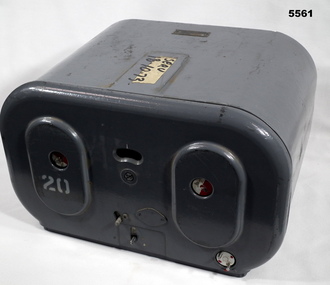
Magazine - MAGAZINE, FILM, Williamson Manufacturing Co Ltd
... Bottom RHS has a disc with 2 pins, red dots are printed on it. Nearly level with the top of ovals is a kidney shaped hole. ...Bottom RHS has a disc with 2 pins, red dots are printed on it. Nearly level with the top of ovals is a kidney shaped hole. ...This photographic magazine attaches to the gear box universal ( see cat 4531). As an assembly, the type F22 aerial camera came into RAF and RAAF service c1942. It was used by the RAF over Europe and by the RAAF extensively through the Sth. West Pacific area of operations, during WW2. This type of camera was used through the Vietnam war up to the early 1980's. The F22 camera assembly when mounted in the reliable Canberra aircraft, did aerial survey work in PNG, Indonesia, Malaysia and Sumatra and the Australian mainland. This type of camera was used in Spitfires, Mosquitos, Avro Lincolns and Canberra aircraft.This is a heavy metal container painted in a grey colour. The label is on the top. One side has two enlarged oval sections. in those two ovals is one hole of 22 mm diameter. In those holes is a disc painted half red and half white. Below the ovals are two levers connected to the internal mechanism. Bottom RHS has a disc with 2 pins, red dots are printed on it. Nearly level with the top of ovals is a kidney shaped hole. In that hole is a rotating disc with graduations and numbers. the action side of magazine has a rectangular opening size 83/4" x 7/16". It is covered with a black soft material.Top has “serv 18-10-73” The number '20' has been stenciled on two surfaces.aerial photography, magazine, ww2, raaf -
 Bendigo Military Museum
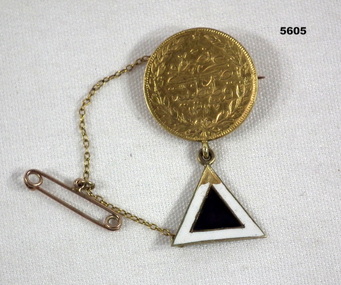
souvenir - BADGE, ARMOURED CAR SECTION, E. B. Edwards
... The disc and badge are connected with a gold coloured chain with a safety pin attached. ...The disc and badge are connected with a gold coloured chain with a safety pin attached. ...Part of the Leo Reoch Cohn Collection. See Catalogue No. 5527.2 for his service record. The badge represents the 1st Australian Armoured Car Section.A triangular metal and enamel unit badge depicting the colour patch of the Armoured Car Section suspended below a gold coloured disc. The disc and badge are connected with a gold coloured chain with a safety pin attached. The back of the disc has a pin and hook attached to allow the wearer to fasten it to a garment. The disc features Arabic writing. The triangular badge has a central enamel purple triangle which is bordered with white enamel.Stamped on the back of the triangular badge: 'E. B. EDWARDS, (hallmarks below)'.souvenir, armoured car section, leo reoch cohn, unit badge -
 Bendigo Military Museum
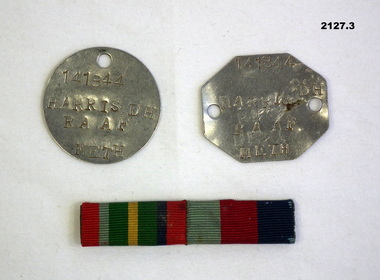
Award - SERVICE RIBBON SET WW2, IDENTITY DISC’S, c.1944
... .1) Identity disc, polished metal, round with small holes re HARRIS D.H stamped lettering front & rear. .2) Identity disc, 8 sided, polished metal with 2 holes re 2127.2. .3) Service ribbons, set of 2 mounted on brass plate with pin clip. 1. 1939-45 ribbon 2. ...Accessory ribbons identity service discs .1) "141844 HARRIS D H, RAAF, METH, O4" .1) Identity disc, polished metal, round with small holes re HARRIS D.H stamped lettering front & rear. .2) Identity disc, 8 sided, polished metal with 2 holes re 2127.2. .3) Service ribbons, set of 2 mounted on brass plate with pin clip. 1. 1939-45 ribbon 2. ...Donald Henry Harris No 141844, RAAF. Refer Cat No 2318 for service history also 2126.2..1) Identity disc, polished metal, round with small holes re HARRIS D.H stamped lettering front & rear. .2) Identity disc, 8 sided, polished metal with 2 holes re 2127.2. .3) Service ribbons, set of 2 mounted on brass plate with pin clip. 1. 1939-45 ribbon 2. Pacific Star ribbon.1) "141844 HARRIS D H, RAAF, METH, O4"accessory, ribbons, identity, service, discs -
 Bendigo Historical Society Inc.
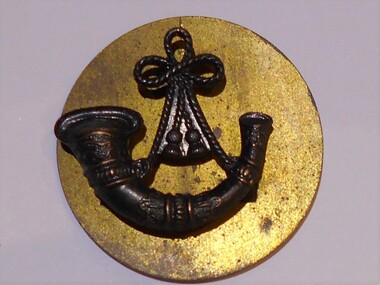
Accessory - BADGE COLLECTION: LIGHT INFANTRY HAT BADGE, UK
... The badge is mounted on a brass disc (dia.4cm). Three lugs on the badge with two holding pins. The bugle horn badge was first introduced by the Germans in the 1700's. ...The badge is mounted on a brass disc (dia.4cm). Three lugs on the badge with two holding pins. The bugle horn badge was first introduced by the Germans in the 1700's. ...Object. Light Infantry Hat Badge, dark metal Bugle horn Badge with looped tassels above it, symbolizing the Rose of York. The badge is mounted on a brass disc (dia.4cm). Three lugs on the badge with two holding pins. The bugle horn badge was first introduced by the Germans in the 1700's. From the 1700's each British Foot Regiment had Light Companies (more mobile and loosely organized). These became Regiments in their own right, which were then called Light Infantry.numismatics, badges - military, light infantry hat badge -
 Bendigo Historical Society Inc.
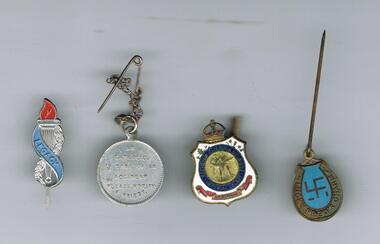
Accessory - ERROL BOVAIRD COLLECTION: RSL BADGES
... Small RSl badge from the First World War, Circular metal disc issued by the Catholic Church, lapel pin issued by legacy. ...Errol Boivard badges RSL Small RSl badge from the First World War, Circular metal disc issued by the Catholic Church, lapel pin issued by legacy. ...Small RSl badge from the First World War, Circular metal disc issued by the Catholic Church, lapel pin issued by legacy. All contained in a small leather pouch.errol boivard, badges, rsl -
 Kiewa Valley Historical Society
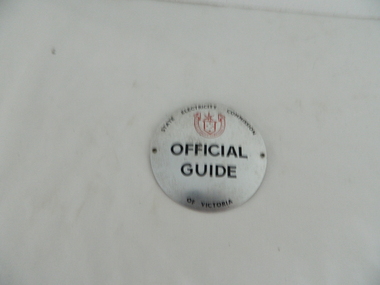
Badge -State Electricity of Victoria, Official Guide Badge
... Circular Metal disc with a large safety pin attached at the top of the back....This badge was issued by the State Electricity Commission of Victoria for use within the Kiewa Hydro Electric Scheme. state electricity commission of victoria; guides; tours; kiewa hydro electric scheme In black print: State Electricity Commission/ SECV logo (in red) / Official Guide/ of Victoria Circular Metal disc with a large safety pin attached at the top of the back. ...This is a badge which was worn by the official guides who led tours of the Kiewa Hydro Electric Scheme.This badge was issued by the State Electricity Commission of Victoria for use within the Kiewa Hydro Electric Scheme.Circular Metal disc with a large safety pin attached at the top of the back.In black print: State Electricity Commission/ SECV logo (in red) / Official Guide/ of Victoriastate electricity commission of victoria; guides; tours; kiewa hydro electric scheme -
 Uniting Church Archives - Synod of Victoria
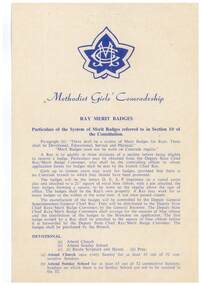
Pamphlet - Methdoist Girls' Comradeship, Rays' Merit Badges
... The Merit badges were a round metal disc which was attached to a 2.5 inch square of royal blue ribbon with a pin attached. ...The Merit badges were a round metal disc which was attached to a 2.5 inch square of royal blue ribbon with a pin attached. ...This pamphlet outlines the particulars of the System of Merit Badges referred to in Section 10 of the Constitution. The pamphlet explains the MGC Rays' merit badge system. There were four badges: Devotional, Educational, Service and Physical. The Merit badges were a round metal disc which was attached to a 2.5 inch square of royal blue ribbon with a pin attached. The four badges, forming a square were worn on the regalia above the sign of office. E3094.1 and E3094.2 - White bi-fold paper with blue text with the Methodist Girls' Comradeship badge on the front.methodist girls' comradeship rays' section, merit badges, methodist girls' comardeship, rays' merit badges
