
Showing 59 items matching "resourcefulness"
-
 Lakes Entrance Historical Society
Book, The State Library of Victoria Foundation, Indigenous Victorians eds. Lynette Russell and John Arnold, May 2010
... The LaTrobe Journal No.85 May 2010 Repressed, resourceful and respected...Fighting for Lake Tyers by Sue Taffe. pg 157 Cover photograph: Fred Kruger, Aboriginal Cricketers at Corranderrk ca 1877 Aboriginal history A special addition of the LaTrobe Journal The LaTrobe Journal No.85 May 2010 Repressed, resourceful and respected Brown soft cover with photograph of cricketers. 208 pages Indigenous Victorians eds. ...A special addition of the LaTrobe JournalBrown soft cover with photograph of cricketers. 208 pagesnon-fictionA special addition of the LaTrobe Journalaboriginal history -
 Friends of Westgarthtown
Functional object - Hand seed sower, c.1920
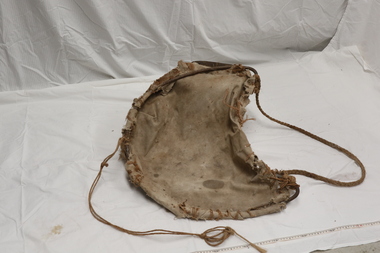
... ...resourcefulness...This handmade seed-sowing pouch was used on the Ziebell family farm at Westgarthtown, Thomastown, Victoria, and reflects the practical ingenuity and resourcefulness associated with everyday agricultural work. ...This handmade seed-sowing pouch was used on the Ziebell family farm at Westgarthtown, Thomastown, Victoria, and reflects the practical ingenuity and resourcefulness associated with everyday agricultural work. ...This handmade seed-sowing pouch was used on the Ziebell family farm at Westgarthtown, Thomastown, Victoria, and reflects the practical ingenuity and resourcefulness associated with everyday agricultural work. Henry Ziebell recalled that the pouch was constructed using a reused hessian sack, with a piece of iron or fencing wire bent inside to support its opening. The rope was placed around the worker's neck, allowing the pouch to hang in front of the body, while a second string was tied around the waist to hold it securely in place. The pouch was filled with seed, which was then distributed by hand as the worker walked across the field, throwing seed alternately from one side to the other. This traditional method, known as broadcast sowing, allowed seed to be scattered across prepared ground before the widespread use of mechanised sowing equipment. The reuse of hessian, fencing wire and rope demonstrates the resourcefulness of farming families, who frequently adapted readily available materials to create practical tools suited to their needs. The pouch provides a tangible connection to traditional agricultural practices, manual labour and the working lives of the Ziebell family at Westgarthtown. The pouch was donated to Ziebell's Farmhouse Museum by Lyn and James Ziebell.Handmade agricultural seed-sowing pouch constructed from repurposed hessian sack material, fencing wire and rope. The pouch features a bent metal support fitted inside the upper section to maintain its opening, with a rope strap designed to hang around the wearer's neck. An additional length of string attached to the lower section was secured around the waist to stabilise the pouch during use. The pouch was designed to hold seed for manual broadcasting across cultivated fields.seed-sowing pouch, broadcast sowing, seed broadcasting, agricultural equipment, handmade farm tools, hessian, farming, resourcefulness, westgarthtown, ziebell family. -
 Ballarat Apron Festival
Apron, Sugar Bag Apron, 1930s
... Sugar bag apron (circa 1930s) Ballarat Apron Festival collection Until the mid-20th century concepts of thrift and resourcefulness were highly regarded as desirable feminine traits. ...Part of Theresa's glory box, this apron is in immaculate condition and is an example of depression era clothing and resourcefulness. Colonial Sugar Refining Co Ltd. ...This apron was made by Theresa Dunn (néé Wallis) of Breakaway Creek, Victoria. Born in 1912, Theresa came from a farming family and left school at the age of 14 following the death of her mother to help care for her younger siblings. Well known for her needlework, Theresa and her sister Eileen exhibited widely and later judged work for Victorian and interstate needlework competitions. Sticklers for perfection, they were known to always look at the back of the work first. In 1935 Theresa married Allan Dunn. This apron formed part of her glory box; a collection of items saved in preparation for married life. Never used, it was donated to the Ballarat Apron Festival in 2017 by Theresa’s daughter. Made by Theresa Dunn of Breakaway Creek in the 1930s, this apron reflects early-20th century ideals of thrift and resourcefulness that were highly regarded as desirable feminine traits. By making do and adapting waste materials, such as hessian sacks and fabric scraps, into practical clothing, women could demonstrate their sewing expertise and ingenuity; highly prized qualities during times of economic depression or frugalness. Part of Theresa's glory box, this apron is in immaculate condition and is an example of depression era clothing and resourcefulness. Sugar bag apron (circa 1930s) Ballarat Apron Festival collection Until the mid-20th century concepts of thrift and resourcefulness were highly regarded as desirable feminine traits. By making do and adapting waste materials, such as hessian sacks and fabric scraps, into practical clothing, women could demonstrate their sewing expertise and ingenuity; highly prized qualities during times of economic depression or frugalness. Colonial Sugar Refining Co Ltd. Pure Cane Sugar 70lbs. Melbourne 1A -
 Bendigo Military Museum
Book - BOOK, POW WW2, Charles Lewis, The Exceptional Melbourne Cup, 2006, revised 2001, 2014
... A story of Australian Tradition, honour, resourcefulness and courage. Charles Lewis for his father, Warren Hastings Lewis....A story of Australian Tradition, honour, resourcefulness and courage. Charles Lewis for his father, Warren Hastings Lewis. ...The Exceptional Melbourne Cup. Tuesday November 3rd 1942 - Tavoy Burma. A story of Australian Tradition, honour, resourcefulness and courage. Charles Lewis for his father, Warren Hastings Lewis.Soft cardboard cover, black print on front / back. Blue background, front illustrated, 3 colour photos the trophy cup. 33 cut, plain, white, pages. Illustrated black / white / colour photos, maps, illustrations.book, burma, pow, cup, melbourne -
 Federation University Historical Collection
Book, John Murray, The Passing of the Aborigines: A Lifetime spent among the Natives of Australia, 1949
... Written in pencil on inside page - G.Holmes, Humour, Courage, Resourcefulness, Wisdom, Large mindedness, Opinion of Blacks, Christians, Rem Joan O'Donohue & the budge Written in pencil on Title page - What is D. ...Holmes. g holmes the passing of the aborigines daisy bates chatham-holmes family collection Written in pencil on inside page - G.Holmes, Humour, Courage, Resourcefulness, Wisdom, Large mindedness, Opinion of Blacks, Christians, Rem Joan O'Donohue & the budge Written in pencil on Title page - What is D. ...This book is part of a collection of books, photos and memorabilia donated from the Chatham-Holmes family collection. The book belonged to G. Holmes.A blue-green cloth covered, hard bound book with the book name, author and publisher printed on the spine in dark blue. The book was owned by G. Holmes.Written in pencil on inside page - G.Holmes, Humour, Courage, Resourcefulness, Wisdom, Large mindedness, Opinion of Blacks, Christians, Rem Joan O'Donohue & the budge Written in pencil on Title page - What is D. Bates answer to the problem of the treatment of the Aborigines? Do you think it tis the best answer?g holmes, the passing of the aborigines, daisy bates, chatham-holmes family collection -
 National Vietnam Veterans Museum (NVVM)
Equipment - Lamp, Viet Cong
... The Viet Cong were extremely resourceful and would make items from whatever was available. ...The Viet Cong were extremely resourceful and would make items from whatever was available. ...The Viet Cong were extremely resourceful and would make items from whatever was available. This improvised lamp, known also as a trail lantern, was designed to burn any salvageable fuel. It provided sealed storage of the fuel in an easily portable form. A large leaf was often used to focus the light forward to illuminate a track.Glass bottle with metal collar and lid connected with a metal rings and chain. Has a wick.Alcool DeMenthelamp, vc, viet cong, lantern, trail lantern -
 Embroiderers Guild, Victoria
Textile - Wagga Quilt Margaretta Egan 1860-1940, Margaretta Ross Egan 1860-1940, Wagga Quilt, Early 1900's
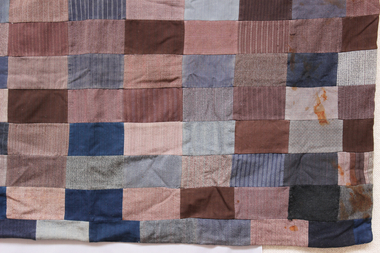
... A Wagga quilt is a resourceful, utilitarian Australian quilt, traditionally made from repurposed materials like jute (burlap) sacks, old blankets, and clothing scraps, embodying the spirit of "making do" in the bush for drovers, swagmen, and families. ...A Wagga quilt is a resourceful, utilitarian Australian quilt, traditionally made from repurposed materials like jute (burlap) sacks, old blankets, and clothing scraps, embodying the spirit of "making do" in the bush for drovers, swagmen, and families. ...A Wagga quilt is a resourceful, utilitarian Australian quilt, traditionally made from repurposed materials like jute (burlap) sacks, old blankets, and clothing scraps, embodying the spirit of "making do" in the bush for drovers, swagmen, and families. Named likely from Wagga Wagga flour bags, these functional, often rough, creations served as warm bedding, distinct from fancier patchwork, and showcase a unique part of Australian textile heritage. Suiting fabric made into a Wagga (quilt). Lined with cotton.Margaretta Egan, Portland on reverse.patchwork, suiting fabric, waggas -
 Mont De Lancey
Domestic object - Dripping Container, Unknown
... The dripping container was once a common and indispensable item in many Australian households, representing a frugal and resourceful approach to cooking....The dripping container was once a common and indispensable item in many Australian households, representing a frugal and resourceful approach to cooking. Cooking Cooking equipment Dripping containers A label with 'Dripping' is stamped on a black background on the front of the container. ...Vintage aluminium dripping containers were common in Australian kitchens from the mid-20th century, used to store rendered animal fat from roasts for cooking, particularly for making gravy and frying potatoes. While specific manufacturers are difficult to trace, these containers were an essential part of a typical Aussie kitchen, with the rendered fat providing flavour. The dripping container was once a common and indispensable item in many Australian households, representing a frugal and resourceful approach to cooking.An aluminium dripping container with two side handles at the top of the rim and a removable strainer with holes. No lid.The container collected fat drippings from roasting meats like beef and lamb. This fat was then stored to be used later in cooking. Made from aluminium, a material that was becoming increasingly common for kitchenware during the mid-20th century.A label with 'Dripping' is stamped on a black background on the front of the container.cooking, cooking equipment, dripping containers -
 Warrnambool and District Historical Society Inc.
Medal - Medals WW1, R.A.Hose MM, 1919
... In May 1917 he was awarded the Military Medal for his courage and resourcefulness and being a fine example to his men in an incident near Beaumetz les Cambrai in France. ...In May 1917 he was awarded the Military Medal for his courage and resourcefulness and being a fine example to his men in an incident near Beaumetz les Cambrai in France. ...These medals were awarded to Robert Andrew Hose, enlistment number 114 was born in Warrnambool in 1892 (parents George and Janet Hose). Prior to enlistment in World War One in 1914 Sergeant Robert Hose served with the permanent armed forces at Maribyrnong, Melbourne. He saw war service in Egypt, Gallipoli and the Western Front. In May 1917 he was awarded the Military Medal for his courage and resourcefulness and being a fine example to his men in an incident near Beaumetz les Cambrai in France. He died of his wounds a few days later. He is buried in France. These World War One medals are of high significance, particularly the Military Medal awarded for bravery to Robert Andrew Hose, a soldier born in Warrnambool. The Military Medal is a treasured item in our collection because of its rarity and association with a local World War One hero. .1 A bronze medal with a laurel wreath and printing on one side and the figure of Winged Victory on the other side. There is also an inscription around the edges. .2 A silver-coloured medal with the image of King George V of Britain on one side and the image of a figure on horseback. The medal has a metal bar at the top to which is attached a multi-coloured ribbon.( Blue, black, white , and orange.) .3 A silver medal with a laurel wreath, a crown, initials and printing on one side and an image of King George V of Britain on the other side. Red ,White and blue coloured ribbon attached. .4 A black and white photograph of a soldier (R.A.Hose) with handwriting on the front and handwriting and printing on the back. This photograph is a post card. .1The Great War For Civilisation 1914-1919 .2 1914-1918 114 SJT R.A.Hose 1st F.A. Bde. A.I.F. .3 For Bravery In The Field 114 SJT. R.A. Hose 1st F.A.Bde Aust. P.A. .4 Sgt. R.A. Hose MM robert andrew hose, world war one, history of warrnambool, r a hose 114 -
 Melbourne Legacy
Leisure object - Toy Bear, Legacy Bear $20 - Army, 2021
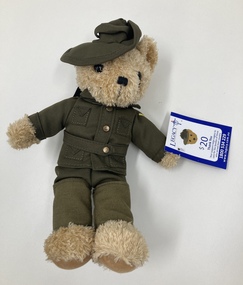
... This Digger bear reminds us of the endurance, courage, ingenuity, good humour, hardiness, and resourcefulness the ANZAC forces showed during the Gallipoli campaign and other WW1 campaigns. ...This Digger bear reminds us of the endurance, courage, ingenuity, good humour, hardiness, and resourcefulness the ANZAC forces showed during the Gallipoli campaign and other WW1 campaigns. ...In the 2000s Legacy released a range of Legacy Bears to expand the merchandise available for sale during Legacy Week and at other fundraising opportunities during the year. This bear is in an Australian World War 1 uniform and slouch hat. He was given the name Digger. The term "digger" was military slang for Australian and New Zealand soldiers. It became closely linked with the principles of mateship during World War I. This Digger bear reminds us of the endurance, courage, ingenuity, good humour, hardiness, and resourcefulness the ANZAC forces showed during the Gallipoli campaign and other WW1 campaigns. This was a special edition of the bears. In 2021 the price was increased to $20 per bear.An example of the type of products sold along with Legacy Badges for fundraising in the 2010-2020s.Legacy bear dressed in a World War 1 uniform with a printed cardboard tag.Printed tag gives the price as $20.legacy appeal, fundraising, legacy bear -
 City of Moorabbin Historical Society (Operating the Box Cottage Museum)
Tools, 'Carter' wood plane, c1900
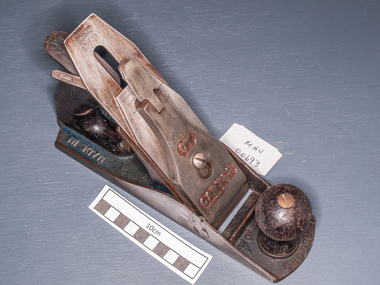
... Collections are noted Geoff Thomas 2019, Mitchell 2019 , Bob Burgess 2022 The early settlers were resourceful and self sufficient so they made and repaired their tools as required....Collections are noted Geoff Thomas 2019, Mitchell 2019 , Bob Burgess 2022 The early settlers were resourceful and self sufficient so they made and repaired their tools as required. ...Richard Carter Ltd is still making edge tools in Honley, near Huddersfield. Established in 1740 by Jeremiah Carter in High Burton: the 1834 Piggots directory list three edge tool CARTER - makers at Kirk Burton: Henry Carter, John Carter and Robert Carter. By 1870 the company was known by its current name. The Stanley Rule and Level Company was founded in 1857 by Henry Stanley in New Britain, Connecticut. In 1920, this company merged with the separate but related Stanley Works, founded by Henry Stanley's cousin Frederick Trent Stanley, and continued operating as its hand tools division.. 2010 merger of The Stanley Works with Black & Decker Subsequent reports by visitors to Vic. Collections are noted Geoff Thomas 2019, Mitchell 2019 , Bob Burgess 2022 The early settlers were resourceful and self sufficient so they made and repaired their tools as required.Early settlers were self sufficient and resourceful making and mending their tools, farm and household equipment.c1900 A 'Carter' hand wood plane, made of metal with an adjustable screw for blade thickness.early settlers, pioneers, market gardeners, moorabbin, bentleigh, brighton, cheltenham, tools -
 Eltham District Historical Society Inc
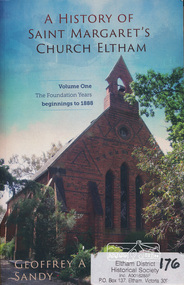
Book, Geoffrey A Sandy, A History of Saint Margaret's Church Eltham (Volume One) by Geoffrey A Sandy, 2014
... The key to the success of this faith community during its foundation years was the initiative and resourcefulness of its laypersons. - back cover. ...The key to the success of this faith community during its foundation years was the initiative and resourcefulness of its laypersons. - back cover. ...History of Saint Margaret's Church Eltham beginnings to 1888. Throughout this foundation period the community grew in numbers and influence within the developing district of Eltham. The minister's and lay readers appointed to Saint Margaret's are indentified and their contribution discussed. The significant events of the establishment of a temporary chuch and then a permanent church, the opening and closing of a denominational school, the construction of a parsonage, libraries and Sunday school are all examined. The key to the success of this faith community during its foundation years was the initiative and resourcefulness of its laypersons. - back cover. The early beginnings of the church included congregations at St Helena, Greensborough and Diamond Creek. People described in the book are listed as subjects in this description. The author Geoff Sandy mentions the following in the acknolwedgements on page iii: "Harry Gilham and Russell Yeoman of the Eltham District Historical Society willingly assisted me with locating records and images relevant to the scopeof this book".The first in a three volume set capturing a comprehensive rich history of the church and importantly its community for the first time.This volume discusses the pioneers of the Etham district who contributed not only to the foundation of the church but its wider thriving community and adds to the records of what we know about the early history.367 pages : colour illustrations ; 25 cm.[written inside front cover] Donated to the Eltham and District Historical Society on the occasion of the launch of "A History of Saint Margaret's Church Eltham" - 23 February 2014, Geoffrey A Sandysaint margaret's anglican church eltham, eltham, st helena church, dixon bertram, robert mackie, josiah hollis, andrew brown, arthur joseph pickering, john boyle gason, thomas cooper searle, henry dendy, william bravery andrew, charles symons wingrove, patrick alfred armstrong, patrick armstrong, john pearson, thomas hunniford, john gardner, thomas batt, isaac hill, william austin page, richard warren, john lindsay beale, henry stooke, john beale, charles hamilton, edwin willis maygar, william frederick ford, isaac briggs, david george clark, richard lowman, walter wippell, george knapman, benjamin oliver wallis, benjamin o. wallis, benjamin wallis, andrew logan, james rossiter, james thomas foster gilding, charles mash maplestone, george bird, george bird (1845-1921), charles hobart, e m bill, j c cole, william morris, francis flintoff, church of england, st margaret's anglican church, st margaret's anglican church eltham, st margaret's church, st margaret's church eltham, st margaret's church of england eltham, st margarets, st margarets anglican church, george stebbing, george stebbing builder -
 Warrnambool and District Historical Society Inc.
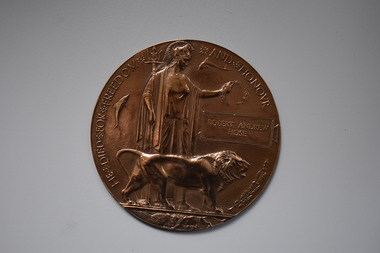
Medallion, Dead Man's Penny Robert Andrew Hose, 1920s
... In Egypt he was promoted to Sergeant and then served in France where he was awarded the Military Medal for showing courage, resourcefulness and a fine example to his men in an encounter with the enemy near Beaumetz les Cambrai. ...In Egypt he was promoted to Sergeant and then served in France where he was awarded the Military Medal for showing courage, resourcefulness and a fine example to his men in an encounter with the enemy near Beaumetz les Cambrai. ...This medallion, called a Memorial Plaque and popularly known as a Dead Man’s Penny, was one of those given to the family of an Australian soldier who died on active service in World War One. Memorial Plaques, such as this one, were given out in the early 1920s. This medallion was presented to the family of Robert Andrew Hose. Born in Warrnambool in 1892 to George and Janet Hose, Robert Hose was a regular soldier when he enlisted in World War One in August 1914. He served on Gallipoli at Cape Helles where he was wounded but returned to his post and was promoted to corporal. In Egypt he was promoted to Sergeant and then served in France where he was awarded the Military Medal for showing courage, resourcefulness and a fine example to his men in an encounter with the enemy near Beaumetz les Cambrai. In that incident he sustained severe wounds from which he died in May 1917. He is buried in France. As well as the Military Medal he was awarded the 1914-15 Star, the British War Medal and the Victory MedalThis item is of great importance as a significant memento of World War One that was given to the family of Robert Andrew Hose following his death on active service in World War One. Robert Hose was born in Warrnambool and this medallion is a treasured object in our collection.This is a round bronze medallion with raised images of Britannia holding a laurel wreath over an inscribed name, a lion, dolphins, an oak branch, a lion cub and an eagle. The medal is inscribed around the left and top edges.He Died For Freedom and Honour Robert Andrew Hose robert andrew hose, world war one memorial plaque, history of warrnambool -
 Parks Victoria - Wilsons Promontory Lightstation
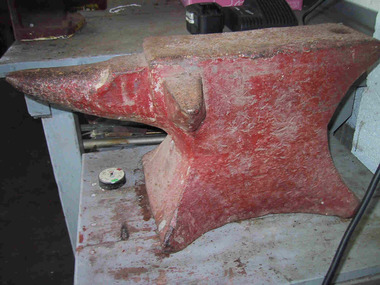
Anvil
... Lightkeepers in our time had to be self sufficient, resourceful and innovative and I imagine that would have been the case in the past." ...Lightkeepers in our time had to be self sufficient, resourceful and innovative and I imagine that would have been the case in the past." ...As quoted from Wikipedia, ‘An anvil is a block with a hard surface on which another object is, struck. The block is as massive as it is practical, because the higher the inertia of the anvil, the more efficiently it causes the energy of the striking tool to be transferred to the work piece’. The lightstation’s anvil is a red-painted iron block with a conical beak or horn at one end that was used for hammering curved pieces of metal. It would have stood on a heavy free-standing pedestal, such as a large tree stump, to allow complete access to the item being hammered. Some anvils display the manufacturer’s name in the metal on the side, but this is not the case here, and its age, although unknown appears to be quite old, perhaps c.1900. It appears to have had a lot of use, and although no record of this survives, it is presumed that a forge operated on site for hammering, cutting, shaping and repairing tools such as bolts, nails, hooks, chain segments, pulley blocks, hinges, crow bars, picks, chisels, horseshoes and harness hardware. A hames hook (which forms part of the collar worn by a draught horse) survives at the lightstation as do many other heavy metal tools and pieces of equipment. The anvil is an example of the necessary resourcefulness and self sufficiency practiced by lightkeepers working and living in a remotely located workplace and home, and many of the iron items in the collection may have been repaired or even made on its working surface. As a lightstation manager Chris Richter used the anvil to manufacture pulley blocks for sash windows, repair brass door hinges & sharpen cold chisels, crowbars and picks and other lightkeepers have used this anvil for many fabricating jobs such as manufacturing ducting for the generator room ventilation system."The lightship only came in every three months with supplies and there would have been repairs to do between visits from a blacksmith - who would have had to travel on the ship. Also, the ship was only anchored in the bay long enough to unload supplies and collect and deliver lightkeeping staff – probably not enough time to get much smithy work done – especially if the weather packed it in and the ship had to depart. Lightkeepers in our time had to be self sufficient, resourceful and innovative and I imagine that would have been the case in the past." It has second level contributory significance.Red painted blacksmith's anvil. -
 Eltham District Historical Society Inc
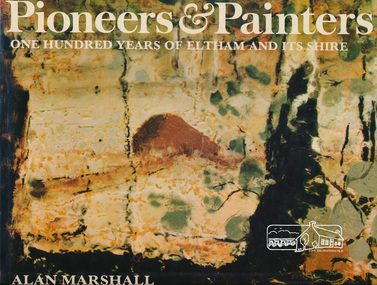
Book, Alan Marshall (1902-1984), Pioneers & painters : one hundred years of Eltham and its shire, 1971
... "Eltham Shire is a well known as a district in which a large number of painters, sculptors, potters, writers and other creative people, The early settlers were, for the most part, resourceful and far-sighted ; the present residents are no less so. ..."Eltham Shire is a well known as a district in which a large number of painters, sculptors, potters, writers and other creative people, The early settlers were, for the most part, resourceful and far-sighted ; the present residents are no less so. ...Jacket painting by Clifton Pugh. "Eltham Shire is a well known as a district in which a large number of painters, sculptors, potters, writers and other creative people, The early settlers were, for the most part, resourceful and far-sighted ; the present residents are no less so. Mention the name Eltham and many things spring to mind ; conservation ; the integration of architecture with the environment ; mud-brick buildings; Montsalvat - the list is endless. In 1971, the centenary of the Shire's birth, the Council felt that the publication of a history would fittingly mark more than a century of achievement.." - Dust jacket. Contents: The Beginning Kangaroo Ground Education at Kangaroo Ground The Days of Gold Queenstown Panton Hill The Pioneer Women Christmas Hills and Yarra Glen Eltham Education at Eltham and Research Kinglake Hurstbridge by Sheila Ferguson Montmorency and Lower Plenty The New Way of Life Old Identities Eltham in modern times Educationalists and Writers Earth building in Eltham Early Painters by Peter Glass Painters Today by Peter Glass Warrandyte painters and Potters by Peter Glass Wildlife Present day This book provides a comprehensive history of the former Shire of Eltham and its first one hundred years. Hardback Book with Dust Jacket - 144 p. : illus. (part col.) ; ISBN 0170019489 eltham, alan marshall, shire of eltham, clifton pugh -
 Wodonga & District Historical Society Inc
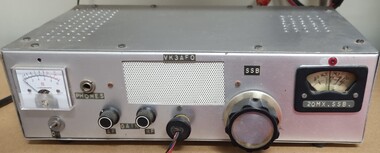
Functional object - Radio Transceiver
... He had an amazing understanding of the science, allowing him to build the majority of his equipment from scratch, often without a circuit diagram. Through his resourcefulness, Merv frequently modified old black and white TV's and other equipment destined for landfill, incorporating them into gear ranging from transceivers to test equipment. ...He had an amazing understanding of the science, allowing him to build the majority of his equipment from scratch, often without a circuit diagram. Through his resourcefulness, Merv frequently modified old black and white TV's and other equipment destined for landfill, incorporating them into gear ranging from transceivers to test equipment. ...This transceiver was made by Merv Collins, a long-time resident of Wodonga. His call sign VK3AF) is attached to both of the radios. "Merv" Mervyn Aubrey Lascelles Collins was born near Horsham Victoria in 1922. He and his family moved to Wodonga in 1965 so that he could work at the newly opened TV transmission station at Mt Baranduda, to Wodonga's south. He was passionate about electronics and radio, becoming an Amateur Radio (Ham) operator in the 1950s. He had an amazing understanding of the science, allowing him to build the majority of his equipment from scratch, often without a circuit diagram. Through his resourcefulness, Merv frequently modified old black and white TV's and other equipment destined for landfill, incorporating them into gear ranging from transceivers to test equipment. Merv’s handiwork allowed him to talk to people all around the world. He lived in Leonard Street, Wodonga for over 40 years, and the antennas that rose from the back yard were a local landmark. He passed away in 2010, a proud Wodonga resident and keen "Ham" to the end.This item is significant because it was owned by a local resident who operated it in Wodonga for over 40 years.Two radio transmitters used by a ham radio operator in Wodonga.merv collins wodonga, ham radio transceiver, amateur radio, radio communications -
 Wodonga & District Historical Society Inc
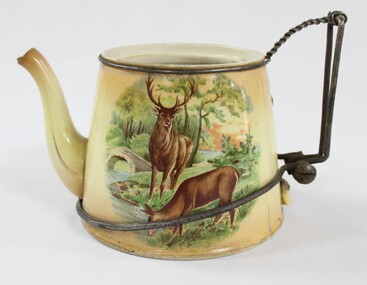
Domestic object - Haeusler Collection Teapot
... The ingenious repair to the teapot's handle reflects the resourcefulness and thriftiness of the Haeusler family during the economic hardships of the 1930s Great Depression. ...The ingenious repair to the teapot's handle reflects the resourcefulness and thriftiness of the Haeusler family during the economic hardships of the 1930s Great Depression. ...The Wodonga Historical Society Haeusler Collection provides invaluable insight into life in late nineteenth and early twentieth century north east Victoria. The collection comprises manuscripts, personal artefacts used by the Haeusler family on their farm in Wodonga, and a set of glass negatives which offer a unique visual snapshot of the domestic and social lives of the Haeusler family and local Wodonga community. The Haeusler family migrated from Prussia (Germany) to South Australia in the 1840s and 1850s, before purchasing 100 acres of Crown Land made available under the Victorian Lands Act 1862 (also known as ‘Duffy’s Land Act’) in 1866 in what is now Wodonga West. The Haeusler family were one of several German families to migrate from South Australia to Wodonga in the 1860s. This teapot is one of the many domestic objects in the Haeusler Collection that represent family and home life in early twentieth century Wodonga. The ingenious repair to the teapot's handle reflects the resourcefulness and thriftiness of the Haeusler family during the economic hardships of the 1930s Great Depression. The teapot was manufactured in England, likely dating from the early twentieth-century. This item has well documented provenance and a known owner. It forms part of a significant and representative historical collection which reflects the local history of Wodonga. It contributes to our understanding of domestic and family life in early twentieth century Wodonga, as well as providing interpretative capacity for themes including local history, social history, and women’s history. A glazed ceramic teapot with a printed design depicting two deer and a hunter in a woodland on one side, and two deer by a stream in a woodland on the other. The broken handle of the teapot has been replaced with wire. The teapot handle was repaired by Alfred Haeusler (b.1922, d.1997) and holds remarkable balance, perfectly retaining its function. Faded, circular makers mark on the base of teapot, illegible/"ENGLAND"teapot, teaware, tableware, ceramic, domestic, social history -
 Friends of Westgarthtown
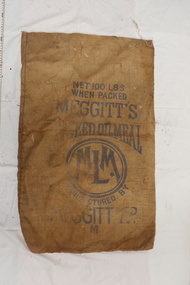
Textile - Megget's Linseed hessian sack, c.1900
... The reuse of hessian sacks reflects the resourcefulness of farming families, who frequently adapted available materials for practical purposes rather than discarding them. ...The reuse of hessian sacks reflects the resourcefulness of farming families, who frequently adapted available materials for practical purposes rather than discarding them. ...This hessian sack forms part of the Ziebell family collection associated with their farm at Westgarthtown, Thomastown, Victoria. Linseed meal, a by-product of linseed oil production, was commonly used as a supplementary feed for dairy cattle. Rich in protein, it provided additional nutrition to support the condition and productivity of livestock. Henry Ziebell recalled that linseed meal was used as cattle feed on the family farm. He also described how empty hessian sacks were repurposed for agricultural use, particularly during haymaking. Once hay had been gathered and stacked in the fields, hessian sacks were sewn together to create large coverings that helped protect the haystacks from wind and rain. The reuse of hessian sacks reflects the resourcefulness of farming families, who frequently adapted available materials for practical purposes rather than discarding them. The sack provides a tangible connection to dairy farming, livestock feeding and traditional haymaking practices at Westgarthtown, illustrating both the agricultural supplies used on the property and the importance of reusing materials in everyday farm operations. The sack was donated to Ziebell's Farmhouse Museum by Lyn and James Ziebell.Hessian sack bearing printed lettering reading 'Megget's Linseed' and 'MLM'. Originally used for the packaging, storage and transport of linseed products intended as supplementary feed for livestock, particularly dairy cattle. The sack is constructed from woven hessian, a durable material commonly used for agricultural packaging and the transport of bulk produce and animal feed.hessian sack, megget's linseed, mlm, linseed meal, cattle feed, dairy farming, animal fodder, haymaking, agricultural packaging, westgarthtown, ziebell family -
 Friends of Westgarthtown
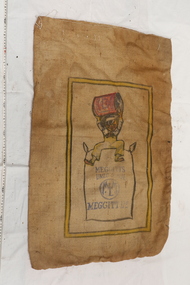
Textile - Megget's Linseed Meal hessian sack, c.1900
... The reuse of hessian sacks reflects the resourcefulness and practical ingenuity of farming families, who frequently adapted and repurposed available materials to meet everyday agricultural needs. ...The reuse of hessian sacks reflects the resourcefulness and practical ingenuity of farming families, who frequently adapted and repurposed available materials to meet everyday agricultural needs. ...This hessian linseed meal sack forms part of the Ziebell family collection associated with their farm at Westgarthtown, Thomastown, Victoria. Linseed meal is a by-product of linseed oil production, produced from the remaining seed material after oil has been extracted. Rich in protein, it was commonly used as supplementary feed for dairy cattle to support their nutritional requirements and condition. Henry Ziebell recalled that linseed meal was used as cattle feed on the family farm. He also described how empty hessian sacks were repurposed for agricultural use, particularly during haymaking. Once hay had been gathered and stacked in the fields, hessian sacks were sewn together to create large coverings that helped protect the haystacks from wind and rain. The reuse of hessian sacks reflects the resourcefulness and practical ingenuity of farming families, who frequently adapted and repurposed available materials to meet everyday agricultural needs. The sack provides a tangible connection to dairy farming, livestock feeding and traditional haymaking practices at Westgarthtown, illustrating both the agricultural supplies used on the property and the importance of reusing materials in everyday farm operations. The sack was donated to Ziebell's Farmhouse Museum by Lyn and James Ziebell.Hessian sack bearing printed lettering reading 'Megget's Linseed Meal' and 'MLM'. Originally used for the packaging, storage and transport of linseed meal intended as supplementary feed for livestock, particularly dairy cattle. The sack is constructed from woven hessian, a durable material commonly used for agricultural packaging and the transport of bulk produce and animal feed.MLMhessian sack, megget's linseed meal, mlm, linseed meal, cattle feed, dairy farming, animal fodder, haymaking, haystack, agricultural packaging, westgarthtown, ziebell family. -
Broadmeadows Historical Society & Museum
Clothing - Christening Gown, c. 1930's
... The handmade nature of the gown reflects the domestic skills and resourcefulness of women in the home, who often created ceremonial garments using materials they had on hand or inherited. ...The handmade nature of the gown reflects the domestic skills and resourcefulness of women in the home, who often created ceremonial garments using materials they had on hand or inherited. ...A handmade silk christening gown from the 1930s carries deep historical and cultural resonance, particularly given the turbulent context of the decade. The 1930s were marked by global economic hardship due to the Great Depression, as well as rising political tensions leading up to World War II. Despite these challenges, families continued to uphold traditions like christenings, which were seen as vital expressions of faith, hope, and continuity. Silk, a luxurious and delicate fabric, suggests that the gown was made with great care and possibly reserved for a special occasion or a family of some means, even during a time of widespread austerity. The handmade nature of the gown reflects the domestic skills and resourcefulness of women in the home, who often created ceremonial garments using materials they had on hand or inherited. The style of the gown—likely featuring long flowing lines, lace accents, and fine detailing—would have adhered to modest and elegant design conventions of the era. Historically, such a gown serves as a poignant reminder of how personal and religious traditions persisted through adversity. It embodies the resilience of families who maintained cultural rituals despite economic and social upheaval, and it offers insight into the intersection of fashion, faith, and domestic life during a defining period of the 20th century.This handmade silk christening gown, stylistically dated to the 1930s, is a poignant artifact from a decade marked by global economic depression and rising geopolitical unrest. Crafted during a time of widespread hardship, the gown reflects the enduring importance of religious and familial traditions, even in the face of uncertainty. The use of silk—a luxurious and delicate material—underscores the significance of the christening ceremony and suggests a deep familial commitment to preserving cultural rites. Its handmade construction highlights the domestic craftsmanship and resourcefulness of the era, when many families relied on inherited skills and materials to create meaningful garments. As a ceremonial object, the gown embodies themes of resilience, continuity, and hope, offering valuable insight into the social fabric and private lives of families during one of the most challenging periods of the 20th century. Handmade silk christening gown with lace inserts, style suggests it was made in the 1930s.christening, gown, silk, handmade -
 Arapiles Historical Society
Container - Roy SCHMIDT Collection - Cotton Flour Bags (3)
... This object captures a unique intersection of food marketing, household resourcefulness, and early 20th-century domestic life. [2] Mammy Self-Raising Flour Bag: This item is a mid-20th-century Australian flour bag, branded “Mammy Oven Puff”, produced by A. ...This object captures a unique intersection of food marketing, household resourcefulness, and early 20th-century domestic life. [2] Mammy Self-Raising Flour Bag: This item is a mid-20th-century Australian flour bag, branded “Mammy Oven Puff”, produced by A. ...[1] Three Bears Porridge Flaked Oatmeal Bag: This textile bag originates from Canadian Cereal Mills Ltd., which marketed "Three Bears" flaked oatmeal. Popular in the early 1900s to mid-century, this product combined functional packaging with a child-friendly incentive — a cut-out cloth doll. The practice of printing toys, games, or clothing patterns on flour or oat sacks was a common marketing strategy, encouraging reuse and appealing to families during times when thrift and creativity were essential, especially during the Depression and wartime years. The Three Bears brand played off the enduring popularity of children’s nursery tales, while the doll encouraged children (and parents) to reuse packaging creatively. This object captures a unique intersection of food marketing, household resourcefulness, and early 20th-century domestic life. [2] Mammy Self-Raising Flour Bag: This item is a mid-20th-century Australian flour bag, branded “Mammy Oven Puff”, produced by A. Mammy Products Pty Ltd in West Footscray, Victoria. The use of the name "Mammy" and the caricatured illustration draws on a now widely recognised and offensive racial stereotype originating from American minstrel culture, commonly used in product branding in the early-to-mid 20th century. While the bag reflects a specific period in Australian domestic and commercial packaging history, it also exemplifies racially insensitive advertising that would be considered inappropriate and harmful by today’s standards. Such items are preserved today in museum collections to help document past social attitudes, consumer culture, and the evolution of racial representation in advertising. [3] Bandung Blue Triangle Brand Flour Bag: This bag represents a mid-20th-century Australian flour export product, particularly aimed at international markets such as Indonesia (as indicated by "Bandung"). The “Blue Triangle Brand” was likely a registered trademark used by a Melbourne-based flour mill engaged in both local and overseas trade. The use of durable cloth bags for bulk flour was common prior to the widespread adoption of paper and plastic packaging. These bags were often reused domestically for household textiles, clothing patterns, or storage. The export reference (Bandung) underscores Australia's historical agricultural trade ties with Southeast Asia, especially in wheat and flour exports. – Roy SCHMIDT resided with his siblings Mabel and Jack at ‘Parklands’ 85 Lake Avenue Natimuk home of Heinrich Friederick ‘Heiny’ & Minna Christina SUDHOLZ nee LANGE and their children Louis, Sophie, Alma, Lena (Roy's Mother), Florence 'Florrie' and Edward ‘Ted’.[1] Three Bears Porridge Flaked Oatmeal Bag: A vintage cloth oatmeal bag printed with black ink on both sides. One side is branded with "Three Bears Porridge – Flaked Oatmeal", showing an image of three bears behind a gate, referencing the well-known “Goldilocks and the Three Bears” fairytale. The opposite side features a printed cut-out doll design, showing a young girl with curly hair holding a bouquet of flowers, intended to be sewn into a stuffed toy. Instructions note that the reverse side (the doll’s back) could be obtained from a second bag. The design combines product branding with a promotional activity for children, typical of early- to mid-20th-century grocery packaging aimed at reuse. [2] Mammy Self-Raising Flour Bag: A small vintage cloth flour bag with printed branding in faded red, blue, and black inks. The front of the bag features a central image of a caricatured smiling African American woman wearing a headscarf. The text is unevenly faded but legible in parts. The bag has a rectangular shape with an open top edge and signs of previous use, including creasing and some fraying at the corners. [3] Bandung Blue Triangle Brand Flour Bag: A large, rectangular vintage cloth flour bag made of cream-coloured calico or cotton. The front of the bag is printed in bold blue ink with branding and export information. It prominently features a large triangular logo reading “Blue Triangle Brand” and numerous lines of text in block and stylised fonts. The bag is open at the top with frayed edges, suggesting it was once machine-stitched shut and later opened.[1] Three Bears Porridge Flaked Oatmeal Bag: Front side (branding side): "THREE BEARS Porridge – FLAKED OATMEAL" "7 Lbs. Net." “Packed and guaranteed by Canadian Cereal Mills Ltd., Toronto” Reverse side (doll pattern): "This is the Front for Three Bears Cut-out Doll" "In order to complete this Doll it will be necessary to obtain the Back Design from another Bag of Three Bears Rolled Oats or Oatmeal." [2] Mammy Self-Raising Flour Bag: Main product name: “MAMMY OVEN PUFF SELF-RAISING FLOUR” Additional text: “The Only Creamed Flour” “Prepared with phosphate aerator” “A. MAMMY PRODUCTS PTY. LTD., Sunshine Rd., West Footscray. Phone: FW 7321” “7 LBS. NET” (near top edge, very faded) [3] Bandung Blue Triangle Brand Flour Bag: The bag is printed with the following: “10270” “G.W.C | H.L” “BANDUNG” “BEST AUSTRALIAN” “BLUE TRIANGLE BRAND” (inside the triangle logo) “GROWER & GRINDERS” (curved around the logo) “Patent Roller” “MELBOURNE” “FLOUR” “50 LBS. GROSS WHEN PACKED” These inscriptions indicate that this flour bag was manufactured in Melbourne, Australia, and was likely exported to Bandung, Indonesia.farm equipment, flour, milling, oats, mammy, bandung blue, schmidt, sudholz, parklands -
 Parks Victoria - Wilsons Promontory Lightstation
Tank lid
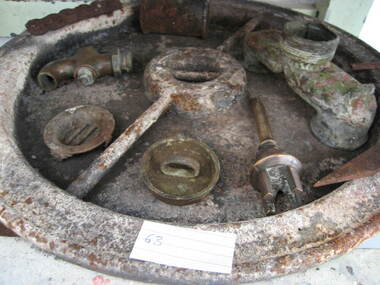
... Once in the colonies, the tanks were often recycled and adapted for many resourceful uses such as water tanks, packing cases, dog kennels, oil containers and food stores and this invariably led to the separation of the lid and tank. ...Once in the colonies, the tanks were often recycled and adapted for many resourceful uses such as water tanks, packing cases, dog kennels, oil containers and food stores and this invariably led to the separation of the lid and tank. ...Lid for ship's tanks used for early domestic water storage (1860's) at the lightstation The water tank and lid are probably from the same unit that was used for transporting drinking water or perishable dry goods on ships. The unit comprised a large, riveted metal tank which was fitted with a heavy cast iron round lid to form a hermetically sealed container. It had a rubber sealing ring ‘which was screwed tight with the aid of lugs cast into the lid and wedges cast into the rim of the loading hole’. A raised iron rod welded across the outer face of many lids allowed for screwing the lid tight. Ship tanks were invented in1808 by notable engineer, Richard Trevithick and his associate John Dickinson. Their patent obtained the same year described the tank’s superior cubic shape that allowed it to fit squarely as a container in ships and thus use space efficiently, while its metal fabric preserved and secured its contents, whether liquid or solid, from damage. The containers revolutionised the movement of goods by ship and made wooden casks redundant. Research by Michael Pearson has determined that they were carried on passages to Australia from at least the 1830s, conveying ships’ victuals and water storage as well as general goods heading for the colonies, and by the 1870s they were in common use. Once in the colonies, the tanks were often recycled and adapted for many resourceful uses such as water tanks, packing cases, dog kennels, oil containers and food stores and this invariably led to the separation of the lid and tank. Raised lettering on the lids indicates that nearly all of the ship tanks transported to Australia came from London manufacturers, and it was usual also for the brand name to feature as a stencil on the associated square tank but in most cases this eventually wore off. It is not known if the Wilsons Promontory tank retains its stencil, and the heavy lid will need to be turned over to reveal its manufacturer’s name. How it came to the lightstation is also not known, but it was either brought to the site as a recycled tank or salvaged from a shipwreck. Pearson writes that Ship tanks show up at a wide range of sites, many of them isolated like lighthouses. They were, I think, usually taken there for the purposes they filled, usually water storage, as they were readily available, relatively light to transport, and probably very cheap to buy as second‐hand goods containers. In rural areas they may have been scavenged for their new uses from local stores, to whom goods were delivered in them. Recycled to serve as a water tank, the Wilsons Promontory tank is the last surviving example of several that were used at the site to hold water for domestic consumption. The tank has had its lid removed and a tap fitted to the one of the sides. It stands on concrete blocks next to a building to receive water running off the roof via a metal pipe. Wilsons Promontory is the only lightstation managed by Parks Victoria with a tank container, although Cape Otway and Point Hicks have lids. Parks Victoria has identified four other lids which include two at Point Hicks, one manufactured by Lancaster and Co. the other by Bellamy. Cape Otway also has two, one unidentified and the other by the Bow Tank Works, East London, which produced tanks between 1910 and 1930. Pearson notes that ‘surviving lids are far less numerous than the tanks themselves, presumably because the uses to which the tanks were put did not require the lid to be retained’. The tank and lid, which are possibly part of the same unit, have first level contributory significance for their historic values and rarity. Round ship's tanks lid, iron. -
 Flagstaff Hill Maritime Museum and Village
Tool - Wood moulding Plane, Edward Preston & Sons, Early 20th century
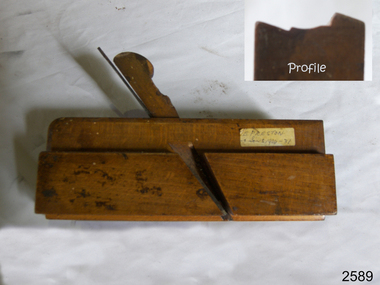
... He appears to have been quite a talented and resourceful young man, as he had later been able to start up his own "wood and brass spirit level manufacturing business at 97½ Lichfield Street by 1864. ...He appears to have been quite a talented and resourceful young man, as he had later been able to start up his own "wood and brass spirit level manufacturing business at 97½ Lichfield Street by 1864. ...By the end of the nineteenth century, the firm of Edward Preston & Sons was founded in 1825, becoming one of England's leading makers of hand tools and in many ways a British counterpart to America's "Stanley" for its wide range of quality utilitarian tools at affordable prices. Edward Preston Sr. (1798–1883) was first listed as a plane-maker at 77 Lichfield Street in the Birmingham Directory of 1833, but later listings and advertisements assert that the business was started in 1825. Preston is likewise recorded as a plane-maker living with his family in Lichfield Street in the 1841 census, at which time his younger son Edward was 6 years old. Around 1850, his son Edward left school to join his father's business and is recorded in the 1851 census as a plane-maker at his father's address. He appears to have been quite a talented and resourceful young man, as he had later been able to start up his own "wood and brass spirit level manufacturing business at 97½ Lichfield Street by 1864. By 1866, Edward Jnr had added planes, routers, joiners, coach, gun, cabinet, and carpenters tools to his line, and the following year he moved his shop from his father's address and relocated to 26 Newton Street, before moving again to much larger premises at 22–24 Whittall Street. This location became known as the Whittall Works and later was the office and factory of Edward Preston & Sons, Ltd. In 1889 Edward Preston Jnr and his three sons were brought into the firm and the name was changed to Edward Preston & Sons, becoming Edward Preston & Sons Ltd on incorporation in 1898. Part of the firm's output was a healthy line of malleable and gun-metal planes and patent adjustable iron smoothers, shoulder planes, bull-nose, and block planes - a range that was expanded in later years. The 1901 catalog shows several styles of planes that were unique to the Preston brand, along with the usual styles which had already been set by other makers. The death of Edward Preston Jnr was reported in the Lichfield Mercury of 26 September 1913. "Mr. Preston was decided of an innovative turn of mind," the newspaper wrote, "as many of the machines in use at his works, as well as of the tools produced were the invention of himself and his three sons, who now manage the business." The report noted that at the time of his death, the business was carried on at Whittall Works, Cheston Street, Aston, Birmingham. Falling on hard times, the firm of Edward Preston & Sons was sold to the Birmingham firm of John Rabone & Sons in 1932, and shortly thereafter manufacturing rights to some of the Preston range of planes were sold to the Sheffield firm of C. & J. Hampton, who would later merge with the Record Tool Company. Some of the Preston planes were directly added to the Record line by the Hampton firm, while others were modified or discontinued altogether. Generally, all Preston wooden planes are stamped on the front of the plane, the shape, size, and character type of the stamp indicating the age of the plane. On some metal planes, all the parts were stamped with a number or symbol during manufacture. This number was used to re-assemble the parts following a batch process. Not all Preston tools are trade-marked clearly. Early shoulder, rebate, chariot planes, and chamfer rebates commonly appear without trademarks but may have assembly numbers. The "E P" trade-mark was already in use by 1882. The trade-mark "Preston" also appears on some later tools that were manufactured in Sheffield, England. These are generally smoothing planes and appear modern and very similar in construction to other modern manufacturers' planes.The item gives a snapshot of one of England's premier tool manufacturing companies at a time when significant industrial changes were occurring in manufacturing and business structures in the World that were beginning to affect social changes.Ogee moulding Plane Maker E Preston & Sons sticker with date 1904 -1931flagstaff hill, warrnambool, shipwrecked-coast, flagstaff-hill, flagstaff-hill-maritime-museum, maritime-museum, shipwreck-coast, flagstaff-hill-maritime-village -
 Flagstaff Hill Maritime Museum and Village
Tool - Wood moulding Plane, Edward Preston & Sons, Early 20th century
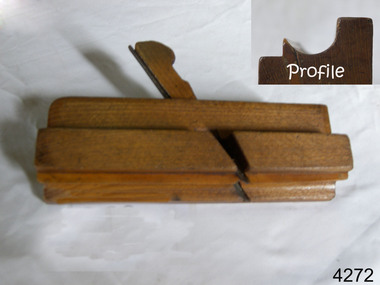
... He appears to have been quite a talented and resourceful young man, as he had later been able to start up his own "wood and brass spirit level manufacturing business at 97½ Lichfield Street by 1864. ...He appears to have been quite a talented and resourceful young man, as he had later been able to start up his own "wood and brass spirit level manufacturing business at 97½ Lichfield Street by 1864. ...By the end of the nineteenth century, the firm of Edward Preston & Sons was founded in 1825, becoming one of England's leading makers of hand tools and in many ways a British counterpart to America's "Stanley" for its wide range of quality utilitarian tools at affordable prices. Edward Preston Sr. (1798–1883) was first listed as a plane-maker at 77 Lichfield Street in the Birmingham Directory of 1833, but later listings and advertisements assert that the business was started in 1825. Preston is likewise recorded as a plane-maker living with his family in Lichfield Street in the 1841 census, at which time his younger son Edward was 6 years old. Around 1850, his son Edward left school to join his father's business and is recorded in the 1851 census as a plane-maker at his father's address. He appears to have been quite a talented and resourceful young man, as he had later been able to start up his own "wood and brass spirit level manufacturing business at 97½ Lichfield Street by 1864. By 1866, Edward Jnr had added planes, routers, joiners, coach, gun, cabinet, and carpenters tools to his line, and the following year he moved his shop from his father's address and relocated to 26 Newton Street, before moving again to much larger premises at 22–24 Whittall Street. This location became known as the Whittall Works and later was the office and factory of Edward Preston & Sons, Ltd. In 1889 Edward Preston Jnr and his three sons were brought into the firm and the name was changed to Edward Preston & Sons, becoming Edward Preston & Sons Ltd on incorporation in 1898. Part of the firm's output was a healthy line of malleable and gun-metal planes and patent adjustable iron smoothers, shoulder planes, bull-nose, and block planes - a range that was expanded in later years. The 1901 catalog shows several styles of planes that were unique to the Preston brand, along with the usual styles which had already been set by other makers. The death of Edward Preston Jnr was reported in the Lichfield Mercury of 26 September 1913. "Mr. Preston was decided of an innovative turn of mind," the newspaper wrote, "as many of the machines in use at his works, as well as of the tools produced were the invention of himself and his three sons, who now manage the business." The report noted that at the time of his death, the business was carried on at Whittall Works, Cheston Street, Aston, Birmingham. Falling on hard times, the firm of Edward Preston & Sons was sold to the Birmingham firm of John Rabone & Sons in 1932, and shortly thereafter manufacturing rights to some of the Preston range of planes were sold to the Sheffield firm of C. & J. Hampton, who would later merge with the Record Tool Company. Some of the Preston planes were directly added to the Record line by the Hampton firm, while others were modified or discontinued altogether. Generally, all Preston wooden planes are stamped on the front of the plane, the shape, size, and character type of the stamp indicating the age of the plane. On some metal planes, all the parts were stamped with a number or symbol during manufacture. This number was used to re-assemble the parts following a batch process. Not all Preston tools are trade-marked clearly. Early shoulder, rebate, chariot planes, and chamfer rebates commonly appear without trademarks but may have assembly numbers. The "E P" trade-mark was already in use by 1882. The trade-mark "Preston" also appears on some later tools that were manufactured in Sheffield, England. These are generally smoothing planes and appear modern and very similar in construction to other modern manufacturers' planes.The item gives a snapshot of one of England's premier tool manufacturing companies at a time when significant industrial changes were occurring in manufacturing and business structures in the World that were beginning to affect social changes.Ogee wood moulding plane Maker E Preston & Sons No 5 (Owner A T Nipe) also has A's stamped on ends and the No 7flagstaff hill, warrnambool, shipwrecked-coast, flagstaff-hill, flagstaff-hill-maritime-museum, maritime-museum, shipwreck-coast, flagstaff-hill-maritime-village -
 Parks Victoria - Point Hicks Lightstation
Lid, ship tank
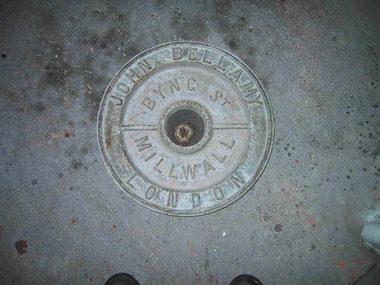
... Once in the colonies, the ship tanks were often recycled and adapted for many resourceful uses such as packing cases, dog kennels, water tanks, oil containers and food stores and this invariably led to the separation of the lid and tank. ...Once in the colonies, the ship tanks were often recycled and adapted for many resourceful uses such as packing cases, dog kennels, water tanks, oil containers and food stores and this invariably led to the separation of the lid and tank. ...The heavy cast iron, round lid was originally fastened into a large, riveted metal box, known as a ship tank. It has the name ‘John Bellamy London’ cast in capitals in a continuous circle on the outer edge of the lid face, and the words ‘Byng St Millwall’ on the inner circle. , of Millwall, London, manufactured boilers and ship tanks from the 1860s to the 1930s and came from a family of tank makers who began manufacturing tanks some time before 1856. Ship tanks were invented in 1808 by notable engineer, Richard Trevithick and his associate John Dickinson. Their patent obtained the same year described the tank’s superior cubic shape that allowed it to fit squarely as a container in vessels and thus use space efficiently, while its metal fabric preserved and secured its liquid or solid contents from damage. The containers revolutionised the movement of goods by ship and made wooden casks redundant. Research by Michael Pearson has determined that they were carried on passages to Australia from at least the 1830s conveying ships’ victuals and water storage, as well as general goods heading for the colonies. Pearson found photographic evidence of their use in the 1860s, and by the 1870s they appeared to be in common use. lids surviving from containers indicate that nearly all the tanks transported to Australia came from London manufacturers. It was usual for the brand name to also feature as a stencil on the tank but in most cases this eventually wore off. A tank without its original stencil survives at Wilsons Promontory. Tanks transporting ‘drinking water or perishable dry goods were hermetically sealed by the use of the tightly fitting lid with a rubber sealing ring ‘which was screwed tight with the aid of lugs cast into the lid and wedges cast into the rim of the loading hole’. The raised iron rod welded across the outer face of many lids such as the Bellamy example, allowed for screwing the lid tight. Once in the colonies, the ship tanks were often recycled and adapted for many resourceful uses such as packing cases, dog kennels, water tanks, oil containers and food stores and this invariably led to the separation of the lid and tank. The Bellamy lid could have been salvaged from a shipwreck but is more likely to have to have originated from a recycled tank that was brought to the lightstation for water storage purposes. Pearson writes that: Ship tanks show up at a wide range of sites, many of them isolated like lighthouses. They were, I think, usually taken there for the purposes they filled, usually water storage, as they were readily available, relatively light to transport, and probably very cheap to buy as second-hand goods containers. In rural areas they may have been scavenged for their new uses from local stores, to whom goods were delivered in them. Parks Victoria has identified five tank lids in the lightstation collections covered by this project. In addition to the Bellamy lid at Point Hicks, they include a Bow brand lid at Point Hicks and another at Cape Otway, unidentified lids at Cape Otway and Wilsons Promontory. Pearson and Miles Lewis have each recorded two versions of the Bellamy trade name on the lids; one being ‘John Bellamy Byng St. London’; the other, ‘John Bellamy Byng St. Millwall London’. The Point Hicks lid has the second version of the name, as do other examples in Victoria that Lewis has identified at Illawarra, Toorak; Warrock homestead, Casterton; Eeyeuk homestead, Terang; Ward’s Mill, Kyneton; and Boisdale homestead near Maffra, and in NSW at Ayrdale Park, Wolumla; and Bishop’s Lodge, Hay. Pearson’s list includes the same lids in NSW at Tumbarumba; the Quarantine Station, Sydney; Willandra Station; Bedervale, Braidwood; Gunnedah Museum; Walla Walla and Macquarie Island. The Point Hicks lid is currently stored in the lighthouse although it is unlikely that its use had any association with this building. The lid is in good condition and retains the central bung. Pearson notes that ‘surviving lids are far less numerous than the tanks themselves, presumably because the uses to which the tanks were put did not require the lid to be retained’.347 The Bellamy ship tank lid has first level contributory significance for its historic values. Circular cast-iron disc with raised outer ridge with inscription. It also has an inner depression with inscription. Two metal sections form handles over inner depression. Hole in middle of disc.Around perimeter of outer edge "JOHN BELLAMY LONDON" Around inner area "BYNG ST MILLWALL" -
 Melbourne Legacy
Document - Speech, Moments in the History of Legacy 1987 (H59), 1987
... The strength has been in the resourceful ability of those of its members.' ...The strength has been in the resourceful ability of those of its members.' ...A copy of an address given at a Foundation Day Luncheon by a long standing Legatee and past President Legatee Rob Allison. He had joined Legacy in 1950, and he comments that only 5 members remain active that were with him in 1950. In 1950 they were all posted as member of various committees, he got Welfare and Friday night girls' classes. There were 9 boys' classes throughout Melbourne, and girls' twice a week at Legacy Headquarters at 24 Market St. There were 230 active members and each legatee had 4 or 5 families with children. He mentions that in 1950 the President was 62 years old but only 5 years after the end of the war, the tide had begun to turn towards the 39ers. (He called the older legatees '1914ers' or 'the Bow and Arrow boys'). He applauded the 'founding fathers' for limiting the numbers of members, in 1929 it was 230 and in 1959 a limit of 300. They used a classification method to classify the members so they had a diverse range of skills and community representation. Areas were: Production, Distribution, Services Public Authority, Services Other, and Board List. The President had a Secret Committee of 3, no one knew who was on the committee, even those members didn't know the identity of the other 2. This committee vetted the background and integrity of new members. In 1950 the budget was £27,000 plus a capital budget of £3,500. Legatee Allison tells a good story of his induction into Legacy, including his wife joining other Legatees wives in fundraising. In 1951 Comradeship meetings moved to Thursday nights at the instigation of Burt Nathan. 'Birthday boy' invitations started in 1958 when John Cooper was Chairman of the Comradeship. After some years of discussion the first paid Social Worker was employed in 1953 and as a result her efforts the first Senior Widows' Group got underway. Until the 1950s Legacy had always found the money it required, from big companies, wealthy members of the community, Estates, or Trusts. In 1951 it tried to copy a Sydney Legacy idea (Certificate of Adoption Plan) and called it 'The Endowment Scheme'. Other fundraisers included films, premiere showing and musicals were very much a part of the social life of Legatees. One premiere show in 1952, 'The Greatest Show on Earth' was sold at £100 a double. In 1959 Sir Frank and Lady Tait were kind enough for give us a premiere of 'My Fair Lady'. As the 50s progressed cash flow was not enough and it was decided in 1957 to have the first public appeal (he says 1957 but it was 1956). The first Badge day was 1958 (according to this account). He says it grossed £21,000 (net £17,000). And the Legacy story was becoming better known. 'Legacy has never been a one man band. The strength has been in the resourceful ability of those of its members.' He was well placed to tell the story of the donation towards Dureau House. BG Corporation in New York used 'Brown and Dureau' as agents in Melbourne for their spark plug manufacturing (for the American aircraft based in Australia during the war). A royalty of two shillings and sixpence was agreed. The entrepreneur President of BG Corporation was Richard Goldsmith. L/ Grat Grattan had a friend Mr Edwards who was managing director at Brown and Dureau and heard of the desire by Goldsmith to leave a permanent memorial to ex-servicemen in Australia (Children's Hospital was considered). Grat took Edwards to Market St and showed him the inadequacy of the building. It was agreed if Melbourne Legacy could come up with a purchased building in 10 days they would get the money needed. The property purchased was 'Storey Hall' in Swanston St (also called Hibernian Hall in other documents). After the war it turned out not to be suitable and a new building was required. The speaker is identified as Rob Allison based on two things; at one stage he refers to himself as 'Rob' and this copy of the speech has been faxed to Legacy from the offices of John Allison Monkhouse. Another copy of this address has been located with the date of September 1988 that was filed with information on Past Presidents and the lives prominent legatees. The notation H59 in black pen shows that it was part of the archive project that was trying to capture the history of Legacy. A record of Legatee Rob Allison speaking at a Legacy luncheon about significant events since he joined in 1950. Speakers at Legacy luncheons were from very different walks of life and the subjects spoken on were many and varied. Foundation Day was celebrated with a special luncheon.White A4 photocopy with black type x 8 pages of an address about Legacy history written in 1987.Handwritten H59 in black pen. history, speech, foundation day, past presidents, dureau house, rob allison -
 Marysville & District Historical Society
Book, The Swiss Family Robinson
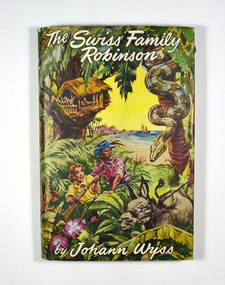
... A book that was owned by a resident of Marysville. swiss family robinson shipwreck switzerland johann r. wyss fiction The Swiss Family Robinson-father, mother and four young sons - are callously abandoned on a sinking ship near the rocky shore of an unknown land. the father, a man of unbounded energy and resourcefulness, makes a raft by means of which they ferry themselves and many useful goods to the shore. ...The Swiss Family Robinson-father, mother and four young sons - are callously abandoned on a sinking ship near the rocky shore of an unknown land. the father, a man of unbounded energy and resourcefulness, makes a raft by means of which they ferry themselves and many useful goods to the shore. They establish a camp and are later able to salvage much of the cargo. Their first home, a tree-house, is later abandoned in favour of a cave which they convert into a permanent residence. their New Switzerland abounds in wild life and useful trees and plants, and they are able to lead a happy and diligent life farming, hunting, fishing and devising means of supplying all their household needs. Many years pass and the lads grow up strong and adventurous. At last the discovery of another castaway and the eventual arrival of a rescue ship set them the problem - to return to Europe or to remain in New Switzerland?Front cover has an illustration showing two people, one carrying a rifle, a donkey and a large boa constrictor. In the background is a tree-house and a bay of water with a small boat floating in the water. The back cover has a list of Hamly Classic books and the details of the publisher of the book.fictionThe Swiss Family Robinson-father, mother and four young sons - are callously abandoned on a sinking ship near the rocky shore of an unknown land. the father, a man of unbounded energy and resourcefulness, makes a raft by means of which they ferry themselves and many useful goods to the shore. They establish a camp and are later able to salvage much of the cargo. Their first home, a tree-house, is later abandoned in favour of a cave which they convert into a permanent residence. their New Switzerland abounds in wild life and useful trees and plants, and they are able to lead a happy and diligent life farming, hunting, fishing and devising means of supplying all their household needs. Many years pass and the lads grow up strong and adventurous. At last the discovery of another castaway and the eventual arrival of a rescue ship set them the problem - to return to Europe or to remain in New Switzerland?swiss family robinson, shipwreck, switzerland, johann r. wyss, fiction -
 Flagstaff Hill Maritime Museum and Village
Book - A Fictional Adventure Story, Jules Verne et al, Keraban The Inflexible (part 1) The Captain of The Guidara, 1887
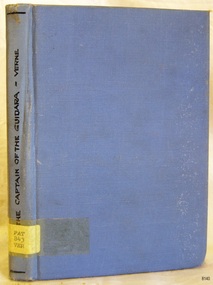
... While not among his most famous stories from his "Voyages Extraordinaire" series it has resourcefulness themes. (For more information on the Pattison Collection see item 3678 Flagstaff Hill collections) https://victoriancollections.net.au/items/5580c7e72162f114d8b758db warrnambool shipwrecked-coast flagstaff-hill flagstaff-hill-maritime-museum maritime-museum shipwreck-coast flagstaff-hill-maritime-village shipwrecked-artefact book pattison collection warrnambool library warrnambool mechanics’ institute ralph eric pattison corangamite regional library service warrnambool city librarian mechanics’ institute library victorian library board warrnambool books and records warrnambool children’s library great ocean road keraban the inflexible (part 1) the captain of the guidara jules verne "The Captain of the Guidara" refers to the English title of the first volume of Jules Verne's 1883 novel Kéraban le Têtu, part of his Voyages Extraordinaire series. ..."The Captain of the Guidara" refers to the English title of the first volume of Jules Verne's 1883 novel Kéraban le Têtu, part of his Voyages Extraordinaire series. The second novel features “Scarpante the Spy” to complete the two part volume of “Kéraban the Inflexible”.In the English edition, the story is following The Captain of the Guidara. Originally published in French in 1883 and in Britain with two volumes in 1887. The story follows a stubborn Turkish merchant, Keraban, who refuses to pay a new tax on crossing the Bosporus and instead embarks on a lengthy journey around the Black Sea. The "Guidara" refers to the ship central to this Ottoman era adventure. It features two Dutchmen and the obstinate Keraban navigating political, cultural, and geographical challenges. The novel is richly illustrated and reflects Verne’s signature blend of travel, exploration, and historical detail.Hard cover book, Keraban The Inflexible (part 1)The Captain of The Guidara. Author: Jules Verne Publisher: Sampson Low Marston Searle and Rivington, Crown Buildings 188 Fleet Street, London. W1. Date: 1887 Light blue hardcover with the title on the spine having lettering to spine in black hand written text pen. fiction"The Captain of the Guidara" refers to the English title of the first volume of Jules Verne's 1883 novel Kéraban le Têtu, part of his Voyages Extraordinaire series. The second novel features “Scarpante the Spy” to complete the two part volume of “Kéraban the Inflexible”.In the English edition, the story is following The Captain of the Guidara. Originally published in French in 1883 and in Britain with two volumes in 1887. The story follows a stubborn Turkish merchant, Keraban, who refuses to pay a new tax on crossing the Bosporus and instead embarks on a lengthy journey around the Black Sea. The "Guidara" refers to the ship central to this Ottoman era adventure. It features two Dutchmen and the obstinate Keraban navigating political, cultural, and geographical challenges. The novel is richly illustrated and reflects Verne’s signature blend of travel, exploration, and historical detail. warrnambool, shipwrecked-coast, flagstaff-hill, flagstaff-hill-maritime-museum, maritime-museum, shipwreck-coast, flagstaff-hill-maritime-village, shipwrecked-artefact, book, pattison collection, warrnambool library, warrnambool mechanics’ institute, ralph eric pattison, corangamite regional library service, warrnambool city librarian, mechanics’ institute library, victorian library board, warrnambool books and records, warrnambool children’s library, great ocean road, keraban the inflexible (part 1) the captain of the guidara, jules verne -
 City of Moorabbin Historical Society (Operating the Box Cottage Museum)
Photograph - Black & White, Mr F. Guumes 1884-1950 & Hand made Harness outfit c1947, c1947
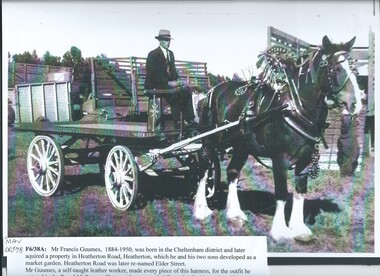
... Stanley 2005) Early settlers in Moorabbin Shire had to be resourceful and self sufficient as they developed market gardens and farms. ...Mr Francis Guumes1884-1950, was born in the Cheltenham district and later bought land in Heatherton Rd, Heatherton, where he and his two sons developed a market garden. Mr Guumes , a self taught leather worker, made every piece of this harness. He entered this outfit in the Royal Melbourne Show c1947 and was awarded 1st Prize in his section. ( H. Stanley 2005)Early settlers in Moorabbin Shire had to be resourceful and self sufficient as they developed market gardens and farms. The community learned to make, repair and invent tools and equipment that was needed on their properties. Black & White photograph, enlarged, showing Mr Francis Guumes, with the rig and leather work that he entered and won 1st prize in the Royal Melbourne Show c 1947guumes francis, royal melbourne show 1947, leatherwork, saddles, harness, draught horses, horse drawn carts, smith j l; smith mary ann, stanley helen, smith vic, , chaff cutter, horse drawn carts, toll gates brighton, motor cars 1900, steam engines, early settlers, bentleigh, mckinnon, parish of moorabbin, city of moorabbin, county of bourke, moorabbin roads board, shire of moorabbin, henry dendy's special survey 1841, were j.b.; bent thomas, o'shannassy john, king richard, charman stephen, highett william, ormond francis, maynard dennis, market gardeners, vineyards, orchards -
 Orbost & District Historical Society
animl prodder, first half 20th century
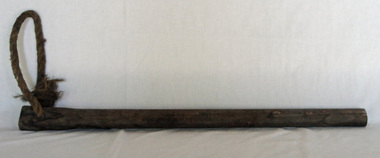
... This is an example of the resourcefulness of rural families in economising and re-cycling. livestock prod A wooden stick - probably a handle from a tool - with rope threaded through the top. ...A cattle prod, also called a stock prod, is a handheld device commonly used to make cattle or other livestock move by striking or poking them. This is a home-made prod.This is an example of the resourcefulness of rural families in economising and re-cycling.A wooden stick - probably a handle from a tool - with rope threaded through the top. It was probably a home-made animal prodder.livestock prod
