
Showing 53 items matching "silver bell"
-
 Flagstaff Hill Maritime Museum and Village
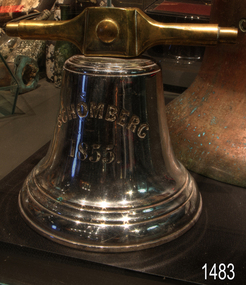
Functional object - Bell, Schomberg 1855, Before 1855
... ...silver plated bell...Upon examination, the specialists at Briggs discovered the reason behind the bell’s persistent lack of shine: it had originally been silver-plated, but most of the plating had worn away over time. ...A small ship’s bell. The silver-plated metal bell bears the ship’s name and year of construction on one side and the name and address of the ship’s builders on the other. ...A small ship’s bell. The silver-plated metal bell bears the ship’s name and year of construction on one side and the name and address of the ship’s builders on the other. ...The Rescue and Journey of the Schomberg Bells: This bell was the smaller of two rescued by the crew of the Schomberg following the ship’s wreck in 1855. While the specific purpose of the smaller bell is unknown, it may have served to assemble the crew or signal mealtimes on board. After surviving the shipwreck, the crew carried both bells as they made their way along the coastline. Their journey eventually led them to the home of settler John Manning, located at Hopkins Point near Warrnambool. Manning took possession of the bells and subsequently presented them to two churches in Warrnambool. The smaller bell went to St Joseph’s Catholic Church, while the larger bell went to St John’s Presbyterian Church. After around a year, the small bell at St Joseph’s developed a crack and became unusable. Thomas Manifold imported a replacement bell for the church, and the damaged bell was stored at his farm. Years later, when the property was sold to John Logan, the discarded bell was donated to the old Warrnambool Museum upon its opening in 1886. The Curator, Joseph Archibald, placed the bell on display in the entry. In 1975, it was transferred from the Warrnambool Art Gallery to Flagstaff Hill. The ’Mystery’ of the small bell solved: Despite numerous attempts by the staff at Flagstaff Hill to restore the bell’s lustre, the bell remained dull and tarnished. In October 1986, Director Peter Ronald decided to send the bell for professional advice. The bell was entrusted to Briggs Marine Products, a renowned brass founder established in 1912. Upon examination, the specialists at Briggs discovered the reason behind the bell’s persistent lack of shine: it had originally been silver-plated, but most of the plating had worn away over time. The experts at Briggs then undertook the task of restoring the bell, successfully returning it to a gleaming silver surface. The Sailing Ship Schomberg: Launched in 1855, the Schomberg was regarded as the “Noblest” ship afloat at the time. Owned by the Black Ball Line, it was built for their passenger fleet by Alexander Hall of Aberdeen at a cost of £43,103. The construction featured three skins: one planked fore and aft and two diagonally planked, all fastened with screw-threaded trunnels (wooden rails). The ship’s First Class accommodation was luxurious, boasting velvet pile carpets, large mirrors, rosewood, birds-eye maple and mahogany timbers, satin damask soft furnishings, and an oak-lined library with a piano. Schomberg had a capacity for 1,000 passengers. The ship’s master, Captain James Nicol Forbes—also known as ‘Bully’ Forbes—was only 34 years old at the launch. He had a reputation for setting and breaking speed records on the Black Ball Line’s Marco Polo and Lightning. In 1852, Forbes completed the London to Melbourne journey on the Marco Polo in 68 days, a record at the time, though 53 passengers died during the voyage. In 1854, he sailed the Lightning to Melbourne in 76 days and returned in only 63 days—a record that stood among sailing ships. Forbes was known for driving his ship and crew to their limits, often prioritising speed over passenger comfort. Determined to set new records, he promised to reach Melbourne in sixty days, declaring he would do so “with or without the help of God.” The Maiden Voyage and the Wreck: Schomberg departed Liverpool on 6th October 1855, flying a banner that read “Sixty Days to Melbourne”. The vessel carried 430 passengers and 3,000 tons of cargo, including materials to build the Melbourne to Geelong Railway and a bridge over the Yarra River. Among the cargo were a cow for fresh milk, pens for fowls and pigs, and 90,000 gallons of water for drinking and washing. Additionally, it transported 17,000 letters and 31,800 newspapers. The ship and cargo were insured for $300,000, a considerable sum for the era. Poor winds while crossing the equator delayed Schomberg’s progress. Land was first sighted on Christmas Day at Cape Bridgewater near Portland. Captain Forbes followed the coastline towards Melbourne, but was reportedly playing cards when the third mate, Henry Keen, reported land only three miles away. The ship ran aground on a sand spit near Curdie’s Inlet (approximately 56 km west of Cape Otway) on 26th December 1855, after 78 days at sea. The sand spit and nearby currents were not marked on Forbes’s map. During the night, the crew launched a lifeboat to search for a safe landing spot for the passengers. The scouting party advised Forbes to wait until morning, as rough seas posed a danger to the lifeboats. At dawn, the ship’s Chief Officer spotted the SS Queen and signalled for help. The master of the Queen brought his vessel alongside, and all passengers and crew disembarked safely. The Black Ball Line’s Melbourne agent sent another steamer to collect the passengers’ baggage, and other steamers assisted with cargo salvage until worsening weather forced operations to cease. Notably, a plunderer later recovered a case of Wellington boots, but all were for the left foot. The wreck and its cargo were sold to local merchants Manifold & Bostock, who did not attempt further salvage. They later sold their interest to a Melbourne businessman and two seafarers. In 1864, after two men drowned in their attempt to reach the Schomberg, salvage efforts were abandoned. By 1870, parts of the ship had washed ashore on New Zealand’s South Island. Today, the wreck is about nine metres below the surface. Although most woodwork has disintegrated, the vessel’s shape remains discernible due to the railway irons, girders, and framework. Various goods and materials from the ship are scattered nearby. The bell is particularly significant in that along with other items from the wreck helped in part to having the legislation changed to protect shipwrecks, with far tighter controls being employed to oversee the salvaging of wreck sites. This bell forms part of the Schomberg collection at Flagstaff Hill maritime museum. The collection as a whole is of historical and archaeological significance at a State level. Flagstaff Hill’s collection of artefacts from the Schomberg is also significant for its association with the Victorian Heritage Registered Schomberg shipwreck (VHR S 612). The collection is of additional significance because of the relationship between the objects salvaged, as together they help us to interpret the story of the Schomberg. The collection as a whole is historically significant for representing aspects of Victoria's maritime history and its potential to interpret social and historical themes from society at the time of the wreck. A small ship’s bell. The silver-plated metal bell bears the ship’s name and year of construction on one side and the name and address of the ship’s builders on the other. These details are deeply engraved into the metal and formed in bold, upper-case lettering. The bell has two bell stands: the left and the right. Both stands have an Iron pipe bent into an inverted ‘Y’ shape, with a hole along its length and feet attached to a rectangular metal plate at the other two ends. Feet are bolted to a timber base that has a hole drilled through the centre for mounting. Bell's front; “SCHOMBERG” with “1855” below. Bell's back “HALL & SONS (crack splits letter “N”) / BUILDERS (in italics) / ABERDEEN” (crack splits letter “B”).flagstaff hill, flagstaff hill maritime museum and village, warrnambool, maritime museum, maritime village, great ocean road, shipwreck coast, schomberg, silver plated bell, mess bell, bell stands, captain ‘bully’ forbes, alexander hall and son, james baines and company, liverpool’s black ball line, bell, schomberg bell, ship's bell, small bell, st joseph's church, briggs marine, john manning, john logan, warrnambool museum, briggs foundry, silver bell -
 Vision Australia
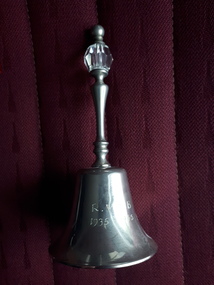
Memorabilia - Object, Silver handbell
... Silver hand bell with 'RVIB 1935-1945' inscribed. ...1 silver hand bell with clear plastic bed on handle and inscription...Silver hand bell with 'RVIB 1935-1945' inscribed. ...Silver hand bell with 'RVIB 1935-1945' inscribed. Unsure of origin, however assuming that this was made as a commemorative piece as Neil Maxwell arrived at the RVIB in 1945.1 silver hand bell with clear plastic bed on handle and inscriptionRVIB 1935-1945royal victorian institute for the blind, neil maxwell -
 Australian Jazz Museum
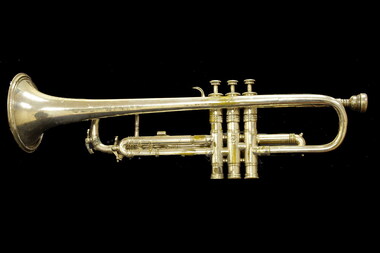
Musical instrument, Henry Selmer, Mid 20th century
... bell...silver trumpet...Trumpet played by Australian Jazz musician Roger Bell through the mid to late 20th century roger bell silver trumpet henry selmer Engraved "Made by Henry Selmer - Paris Depose Grand Prix Geneve 1927 Liege 1930 Signed by maker Henry Selmer Place Dancourt, Paris Made in France" "Silver on Brass Serial # 6697 (engraved on second valve)" Silvered brass trumpet and mouthpiece with slight dent on rear Musical instrument Henry Selmer ...Trumpet which belonged to Roger Emerson Bell leading jazz trumpeter and composer who was a major influence on the development of a uniquely Australian Jazz form. He played with his brother Graeme Bell and also led his own groups.Trumpet played by Australian Jazz musician Roger Bell through the mid to late 20th centurySilvered brass trumpet and mouthpiece with slight dent on rearEngraved "Made by Henry Selmer - Paris Depose Grand Prix Geneve 1927 Liege 1930 Signed by maker Henry Selmer Place Dancourt, Paris Made in France" "Silver on Brass Serial # 6697 (engraved on second valve)" roger bell, silver trumpet, henry selmer -
 Bendigo Historical Society Inc.
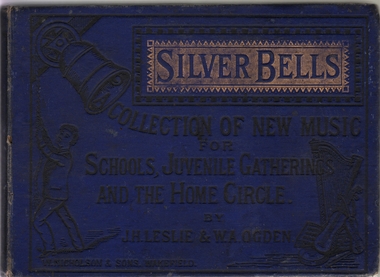
Book - LONG GULLY PRIMARY SCHOOL COLLECTION: SILVER BELLS COLLECTION OF NEW MUSIC
... Small hardback book titled: Silver Bells collection of new music for schools, junenile gatherings and the home circle by J.H. ...BOOKS Music Small hardback book titled: Silver Bells collection of new music for schools, junenile gatherings and the home circle by J.H. ...Small hardback book titled: Silver Bells collection of new music for schools, junenile gatherings and the home circle by J.H. Leslie and W.A. Ogden. The blue cover has a boy ringing a bell on the left side and on the left an harp. Inscribed on the inside front cover: Edward John Pinch, Long Gully, Sandhurst, Monday August 28, 1882.books, music -
![Memorabilia - Small hand bell, [ca.1931]](/media/collectors/50187a8f023fd7201471f198/items/510f24082162ef0f3caf93c3/item-media/511082802162ef19087cff4c/item-fit-380x285.jpg?cb=6) Alfred Hospital Nurses League - Nursing History Collection
Alfred Hospital Nurses League - Nursing History CollectionMemorabilia - Small hand bell, [ca.1931]
... A small, engraved electroplated nickel silver metal bell. A double rim around the base and leaf shaped handle with graded spaces along the length of the handle....bell. EPNS at top of back of handle A small, engraved electroplated nickel silver metal bell. ...A few Alfred nurses who trained in the 1880's and 1890's presented this bell, on August 3, 1931, to the Alfred Hospital Nurses League. List of names Emma F. Rice (Graduated 1888) E.M. Farie-Wright (1888), J.May (1891), Rosa J.M.Snodgrass (1897), Florence B.Lloyd-Wilson (1891) Agnes Dale-Smith (1891) Annie Russell (1889) Annie E.H.Thomson (1892)The Nurses League was founded in 1918 for 'nurses to socialize and exchange ideas'. The League was very active and the social events notoriously noisy. The bell was presented in 1931 with a note, 'hoping it will be useful and also to show warm appreciation of our very pleasant Reunions from a few of the Trainees of the Eighties and Nineties'. The thought was to help bring the gatherings to order long enough to make announcements. It has been used extensively for this purpose over the years and most recently, at the League's centenary lunch in 2018.A small, engraved electroplated nickel silver metal bell. A double rim around the base and leaf shaped handle with graded spaces along the length of the handle.'Presented to the Alfred Hospital Nurses League from a Few Trainees of the Eighties & Nineties.' engraved on front of body of bell. EPNS at top of back of handlehand bell, alfred nurses hospital league -
 Vision Australia
Equipment - Object, Stainsby-Wayne, Stainsby Braille writer in case, 1933-1980
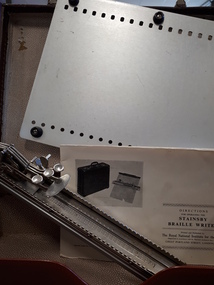
... Stored in a brown cardboard lockable case and this complete kit consists of a metal Braille writing machine; a long slim rectangular device with carriage and six silver keys and a bell, a metal board to attach Braille writer, a metal hinged Braille paper clamp and an instructional booklet. ...Silver Brailler, rectangular with six silver keys and a bell, with paper board and clip, in cardboard suitcase...Silver Brailler, rectangular with six silver keys and a bell, with paper board and clip, in cardboard suitcase Stainsby Braille writer in case Equipment Object Stainsby-Wayne ...The Stainsby Braillewriter was utilised by Braille tutors and volunteers as well the blind and visually impaired. Stored in a brown cardboard lockable case and this complete kit consists of a metal Braille writing machine; a long slim rectangular device with carriage and six silver keys and a bell, a metal board to attach Braille writer, a metal hinged Braille paper clamp and an instructional booklet. Henry Stainsby (1859-1925), Supt. of the Birmingham Royal Institution for the Blind, (later General Secretary of the British & Foreign Blind Association) along with Birmingham manufacturer Albert Wayne, introduced their portable brailler writer around 1903. An "improved" version, featuring aluminum parts and a paper clamp allowing accurate interpointing or interlining, was announced in "Outlook for the Blind" as early as 1927 and available generally by 1933 in the RNIB catalog. By 1978, RNIB sold the Improved Stainsby in a number of formats, including a large version available with interlining and inter-pointing board, and a small version with a folding board. Both large and small models came in ordinary and reverse keyed versions. Silver Brailler, rectangular with six silver keys and a bell, with paper board and clip, in cardboard suitcaseM8839 M88 (Brailler) M 8839 (Board) On the outside of the suitcase an address label reads "Braille Library, 31-51 Commercial Road, South Yarra". braille equipment, assistive devices -
 National Wool Museum
Needle Gauge
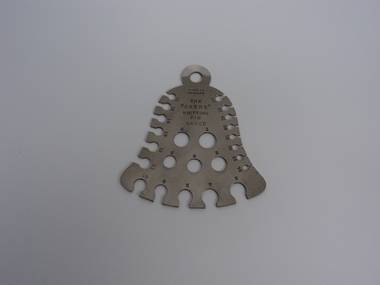
... Silver-coloured metal bell-shaped pin gauge with holes of various sizes, each one with a different number. ...Silver-coloured metal bell-shaped pin gauge with holes of various sizes, each one with a different number. ...Silver-coloured metal bell-shaped pin gauge with holes of various sizes, each one with a different number. Reverse is blank. -
 Alfred Hospital Nurses League - Nursing History Collection
Equipment - Stethoscope, Eschmann, Eschmann Stethoscope, unknown
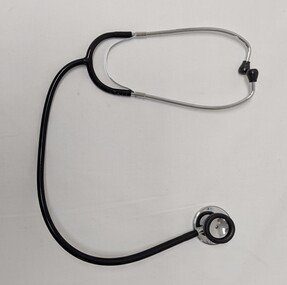
... A small disc-shaped resonator/bell (silver metal with straw coloured plastic diaphragm on one side and black plastic ring on other) connected to a black plastic tube, that then divides in two. ...Stethoscope used to auscultate body sounds, include measurement of blood pressure in conjunction with sphygmomanometer Of significance to AHNL as all nurses used them medical equipment nursing stethoscope ESCHMANN ENGLAND engraved on resonator A small disc-shaped resonator/bell (silver metal with straw coloured plastic diaphragm on one side and black plastic ring on other) connected to a black plastic tube, that then divides in two. ...Stethoscope used to auscultate body sounds, include measurement of blood pressure in conjunction with sphygmomanometerOf significance to AHNL as all nurses used themA small disc-shaped resonator/bell (silver metal with straw coloured plastic diaphragm on one side and black plastic ring on other) connected to a black plastic tube, that then divides in two. These connect to two silver coloured metal tubes with black plastic earpieces ESCHMANN ENGLAND engraved on resonatormedical equipment, nursing, stethoscope -
 Brighton Historical Society
Earrings, circa 1956
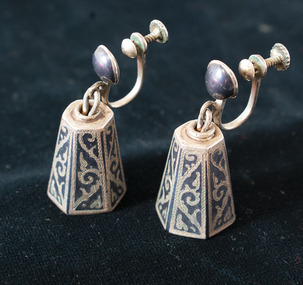
... Six-sided bell-shaped silver screw-back earrings for non-pierced ears. ...The house remained in the family for more than 75 years, before it was sold in 2018. marlene pearl austin marlene pearl trenberth 1950s 1956 olympic games olympic games earrings jewellery Six-sided bell-shaped silver screw-back earrings for non-pierced ears. ...These earrings were given to Marlene Austin, nee Trenberth by members of the Thai Olympic delegation when she drove them around Melbourne during the 1956 Olympic Games. Marlene, who was living with her parents in Brighton at the time, took leave from her job as a stenographer to work as an official driver at the Olympics. She drove officials and dignitaries from a variety of nations (including Thailand, Italy, Cuba and Sweden) to and from events, collecting a number of souvenirs. Marlene's family have lived in Brighton since 1941, when her parents moved into a house at 15 Moffat Street. The house remained in the family for more than 75 years, before it was sold in 2018.Six-sided bell-shaped silver screw-back earrings for non-pierced ears. Each of the six sides features a vine pattern with black inlays. Each earring has a hollow interior containing a small metal bead dangling on a chain, causing the earrings to jingle when the wearer moves.marlene pearl austin, marlene pearl trenberth, 1950s, 1956 olympic games, olympic games, earrings, jewellery -
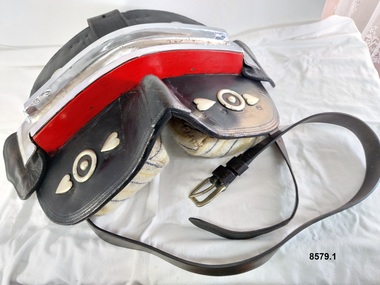 Flagstaff Hill Maritime Museum and Village
Equipment - Show Harness, R. Mitchell, Saddler, Early to mid-20th century
... It has a stainless steel "Liverpool Driving Bit" with a curb chain, a variety of decorative silver ornaments (rosettes, diamonds plus a heart and two circles) on each end of the forehead band, dropper and strap as well as a silver metal bell (sometimes known as a "fly terret" or "swinger") that sits on the headpiece of the bridle. 5. ...It has a stainless steel "Liverpool Driving Bit" with a curb chain, a variety of decorative silver ornaments (rosettes, diamonds plus a heart and two circles) on each end of the forehead band, dropper and strap as well as a silver metal bell (sometimes known as a "fly terret" or "swinger") that sits on the headpiece of the bridle. 5. ...The early settlers of Victoria depended on horse drawn vehicles to farm, make roads and railways, deliver produce and transport people. Horse harnesses were an important requisite for all drivers and could be found wherever there were working horses. Horse Harnesses have played an essential role in different cultures throughout history. Simple, utilitarian horse harnesses made of leather straps and iron rings were being used in early China before AD 500 as well as ancient Greece and Rome, allowing horses to pull chariots and ploughs. The Greeks and Romans were the first to use a "horse collar" which distributed the weight of the harness evenly across the horse's chest rather than relying on a "throat harness" that could damage a horse's throat or choke them. During the medieval period, European horse harnesses became more elaborate and decorative. Variations of different horse harnesses were also found in Native American and Middle Eastern cultures. Horse Harnesses usually have four basic components which include - 1. Communication - the bridle, bit and reins allows the driver to communicate instructions and commands to the horse, guiding its movement and direction. 2. Draft - the collar, hame straps, hames, traces and chains enables the horse to draw and pull the load efficiently by distributing the weight and transferring the pulling force to the vehicle. 3. Stopping - the breeching band, pole straps and breast strap helps to control or stabilise the horse and vehicle when moving downhill or stopping. 4. Support - the back pad, backband, belly band and back saddle keep the harness in the correct position and proper alignment. This show harness was used by Mr. Andy Bourke when showing his Clydesdales at shows or demonstrations. Although a more modern example with decorative embellishments, it still has many essential components traditionally found in an everyday working horse harness. The original purpose of the "housen" for example, was to run rain or drizzle off the horse's neck when they had to work in wet conditions - it was laid flat for this purpose on the top of the collar. Nowadays it is purely for show and is often used to advertise a business or stud. Horse brasses and fly terrets were fastened to various parts of a horse's harness. In the early days they probably began as amulets to ward off evil and to bring good luck and continued to be used as a festive decoration. The heyday of horse brasses was between the years 1851 and 1900. Horse brasses are fastened to various parts of the harness with many of their designs being symbolic. The ornamentation on this harness (although not authentic horse brasses) are based on the horse brasses that were popular in the 19th century. This horse harness is a significant example of the equipment that was needed wherever heavy horses were being used - particularly in the early years of Victoria's settlement by white settlers. Harnesses such as this example were used with stage coaches, drays, farming equipment, delivery carts and personal transportation.A leather and metal horse harness used when showing a Clydesdale (or other breed of heavy horse). It is made up of a number of components. 1. Decorative leather cart saddle with two large cloth pads underneath (which have a scalloped leather and stud border), a raised leather pommel and a silver and red coloured metal back strap holder across the top. It has two symmetrical sets of ornamentation (silver hearts and circles) in the front and a wide strap or girth (with a maker's stamp reading "R. Mitchell Saddler") and buckle which attaches the saddle to the horse. 2. Pair of steel hames which are gently curved (to fit on a horse collar) and are topped with steel knobs. They have several steel rings and lugs (to hold straps and chains) and a "Made in England Warranted Steel" stamp. 3. Breeching harness which consists of a number of leather straps, chains and metal rings including a wide padded leather strap with a scalloped edge that sits on the back of the horse and a thick leather strap that goes around the hind quarters of a horse which is joined to the back strap with four shorter vertical straps and buckles. These straps feature silver and red patent leather trim and silver heart shaped ornamentation. The strap also features the maker's stamp of "R. Mitchell". 4. Decorative leather bridle with blinkers featuring the same silver and red patent leather trim on the cheek piece, brow band and throatlatch. It has a stainless steel "Liverpool Driving Bit" with a curb chain, a variety of decorative silver ornaments (rosettes, diamonds plus a heart and two circles) on each end of the forehead band, dropper and strap as well as a silver metal bell (sometimes known as a "fly terret" or "swinger") that sits on the headpiece of the bridle. 5. Leather "violin shaped" dropper (or hanger) with two silver rosette shaped ornaments and a stainless steel clip on the top 6. Stainless steel "Liverpool Driving Bit" with a straight mouthpiece which is ribbed on one side. It has three rein spots (spaces) and a curb chain. 7. Leather arch shaped "Housen" covered in black and red patent leather and decorated with silver studs (some spelling out F H) and bordered with a red fringe. It has a leather strap at the back and two leather loops on the front. 8. Leather padded backband (Australian style "Stallion Draught Roller") decorated with two groups of nine metal "horse brasses" or harness ornaments displaying horseshoe, starburst and horse head designs on blue, red and white striped webbing. The backband has three notched straps at each end, a buckle near the centre and the initial B stamped in two places underneath. 9. Bellyband made of leather and red, white and blue striped webbing. It has a set of three buckles at each end (which correspond with the notched straps of the backband). 10. Wide, thick leather strap which has a buckle and notches at each end. It also has the maker's stamp of "R. Mitchell Saddler". 11.One pair of long leather traces - each with a buckle and notched loop at one end, decorated with a small silver diamond shaped harness ornament. 12. Length of stainless steel heavy duty chain with two swivel connectors.Saddle - "R.MITCHELL / SADDLER" Hames - "MADE IN ENGLAND / WARRANTED / STEEL" "MADE IN ENGLAND / WARRANTED / unclear" Breeching Straps - "R. MITCHELL / MAKER / R. MITCHELL MAKER" Housen - "F H" Backband "B / B' Wide leather strap - "R. MITCHELL / SADDLER"flagstaff hill maritime museum and village, warrnambool, great ocean road, shipwreck coast, harness, horse harness, show harness, clydesdale horses, andy bourke, horse drawn cart, housen, bridle, hames, breeching straps, dropper, bit, liverpool bit, backband, harness ornamentation, bellyband, back saddle, fly terret -
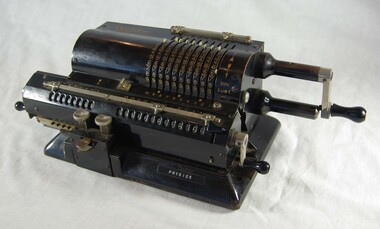 Federation University Historical Collection
Instrument - equipment, Mechanical Pinwheel Calculator, c1940, 1935-1945
... bell indicates calculations in the negative. Used in Ballarat Institute of Advanced Education (B.I.A.E) Physics department. calculating machine pinwheel calculator scientific instruments stott & hoare pty ltd physics odhner ballarat institute of advanced education Ser. No. 29-286781.5 Black symotape on base front: "PHYSICS". Maker's identification on top surface. Supplier's label (metal, silver ...Willgodt T. Odhner invented his very successful “pinwheel” four-function calculator mechanism in Russia in 1874, and his invention was cloned by numerous companies, resulting in dozens of similar models that remained in wide use for almost a century. Numbers are dialed into the sliding levers on the top part of the machine, and are added to the register visible in the carriage at the bottom when the large crank is turned. Shifting the carriage sideways allows multiplication through a sequence of addition operations; the two small cranks zero the registers. The design includes ingenious error-preventing interlocks between all the controls: should the operator fail to return a crank to its resting position, the other controls are frozen until this is corrected. A bell indicates calculations in the negative. Used in Ballarat Institute of Advanced Education (B.I.A.E) Physics department.Black, mechanical calculating machine. Metal. Hand-operated, with three hand-cranks. 10x10 rotor with 13 digit result. Ser. No. 29-286781.5 Black symotape on base front: "PHYSICS". Maker's identification on top surface. Supplier's label (metal, silver & blue) on back: "STOTT & HOARE Pty. Ltd. 171 William St. Melbourne C1 M1991". Stamped on rear panel: "MADE IN SWEDEN". Cast lettering on underside: "M-602 07".calculating machine, pinwheel, calculator, scientific instruments, stott & hoare pty ltd, physics, odhner, ballarat institute of advanced education -
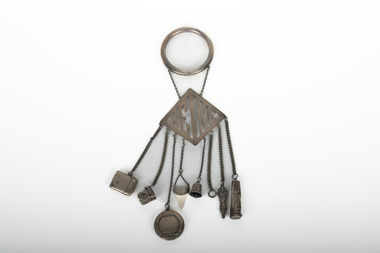 The Beechworth Burke Museum
Accessory - Chatelaine, C. 1890
... A decorative silver belt hook with small household object attached by chains to a suspended name plate. There are 8 chains and 7 objects; a vesta case, scent bottle lid, compact, shark tooth, bell, button hook handle, container....S/ Anchor symbol/ x symbol/ lion symbol/ [Hallmark on scent bottle lid] R/ HM/ Anchor symbol/ Lion symbol/ m symbol/ [Hallmark on back of the compact] SYDNEY/ [inscription on shark tooth] Proclaim liberty throughout all the land unto all inhabitants thereof/ By order of the Assembly of the Province of Pensylvania for the State House in Philada/ [inscription on bell] A01176/ A decorative silver belt hook with small household object attached by chains to a suspended name plate. ...The exact creation date of this chatelaine is unknown, however the hallmarks and engravings on some of the attached objects indicate that this chatelaine was made in the late 1890s. The shark tooth and the liberty bell attached to the chatelaine suggest that the item once belonged to an Australian who had connections to America. The compact, scent bottle lid, and feminine design of the other objects suggest that this wasowned by a woman. The name on the plate indicates that this object may have belonged to someone with the surname Heine. The hallmarks on the scent bottle lid and the compact indicate that they were made in Birmingham, England in the late 1890s, and that the compact was made by H. Matthews. Chatelaines where used by both men and women, usually fastened to a belt or pocket, and small household objects were attached to the main body of the chatelaine by chains. They were only worn by the heads of the household as a display of position and power.The social history objects held in the Burke Museum's collection help to tell the stories of Beechworth's past by showing the social, cultural, and economic aspects of the town's history.A decorative silver belt hook with small household object attached by chains to a suspended name plate. There are 8 chains and 7 objects; a vesta case, scent bottle lid, compact, shark tooth, bell, button hook handle, container.HEINE/ [plate] CHERRY./ from/ LEO/ May 12th 1899/ [inscription on vesta case] L??S/ Anchor symbol/ x symbol/ lion symbol/ [Hallmark on scent bottle lid] R/ HM/ Anchor symbol/ Lion symbol/ m symbol/ [Hallmark on back of the compact] SYDNEY/ [inscription on shark tooth] Proclaim liberty throughout all the land unto all inhabitants thereof/ By order of the Assembly of the Province of Pensylvania for the State House in Philada/ [inscription on bell] A01176/ burke museum, silverware, social history, heine -
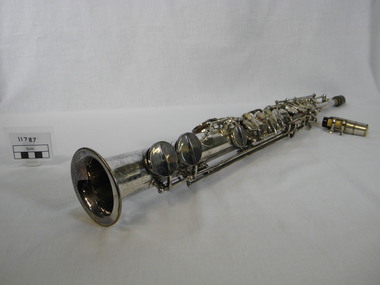 Australian Jazz Museum
Musical Instrument, Circa 1920s
... Owned and played by Dr Phillip Garth (Phil) Law AC, CBE, for dances and other functions, while teaching during the 1930s, and on many of his 28 expeditions to the Antarctic. dr phil law dr phillip law soprano saxophone kohlert and sons kohlert sons antarctic explorer b flat soprano saxophone silver instrument reed instrument On bell of saxophone "Kohlert Sons / Graslitz / Czechoslovakia" framed by flower and leaf motif Metal Silver B flat soprano saxophone made by V. ...Restored by Tony Newstead. Played by Dr Phil Law during the 1930s, "for dances and other functions, while teaching at Clunes, Talbot, Creswick, Learmonth, Newtown, Smeaton, and while teaching at Elwood (at Eltham, Gisborne and Sunbury." including on many of his expeditions to the Antarctic. Phil Law was a dedicated jazz reed player and band leader in his early years as a country school teacher. His brothers also played. Gift of Dr Phil Law - 1999. Dr Law died in Melbourne on 28 February 2010 at the age of 97.Owned and played by Dr Phillip Garth (Phil) Law AC, CBE, for dances and other functions, while teaching during the 1930s, and on many of his 28 expeditions to the Antarctic. Metal Silver B flat soprano saxophone made by V. Kohlert and Sons, Graslitz, Czechoslovakia. Circa 1920s. Mother of pearl keys, slight denting. Additional mouth piece. On bell of saxophone "Kohlert Sons / Graslitz / Czechoslovakia" framed by flower and leaf motifdr phil law, dr phillip law, soprano saxophone, kohlert and sons, kohlert sons, antarctic explorer, b flat soprano saxophone, silver instrument, reed instrument -
 The Beechworth Burke Museum
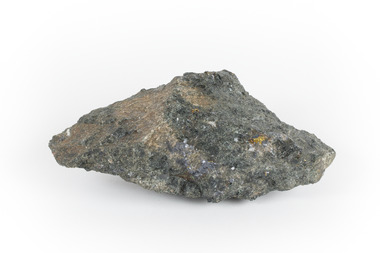
Geological specimen - Mangan Hedenbergite
... Many of these specimens were sent to research and collecting organisations across Australia, including the Burke Museum, to educate and encourage further study. manganese open cut mine manganese ore processing Bell Bay Tasmania Northern Territory steel industry zinc-carbon batteries alkaline batteries tin cans A hand-sized mineral specimen in shades of silver and black Geological specimen Mangan Hedenbergite ...This specimen was recovered from Broken Hill, NSW. It was given the name Mangan Hedenbergite in 1819 by Jöns Jakob Berzelius in honor of Mr. Anders Ludvig of Hedenberg who was the first to define hedenbergite as a mineral. Hedenbergite, belongs in the pyroxene group having a monoclinic crystal system. The mineral is extremely rarely found as a pure substance. Mangan Hedenbergite is a manganese bearing variety of Hedenbergite. Manganese is the world’s fourth most used mineral after iron, aluminium, and copper primarily because it has no satisfactory substitute in its major applications. Globally, the steel industry is the primary user of manganese metal, utilizing it as an alloy to enhance the strength and workability of steel and in the manufacture of tin cans. Manganese is a key component of certain widely used aluminium alloys and, in oxide form, dry cell batteries used in electric vehicles. These batteries are in high demand. Another potential use for manganese may as an additive to help coat and protect a car’s engine. Manganese is also used for non-metallurgical purposes such as plant fertilizers, animal feed, and colorants for bricks. This specimen is part of a larger collection of geological and mineral specimens collected from around Australia (and some parts of the world) and donated to the Burke Museum between 1868-1880. A large percentage of these specimens were collected in Victoria as part of the Geological Survey of Victoria that begun in 1852 (in response to the Gold Rush) to study and map the geology of Victoria. Collecting geological specimens was an important part of mapping and understanding the scientific makeup of the earth. Many of these specimens were sent to research and collecting organisations across Australia, including the Burke Museum, to educate and encourage further study.A hand-sized mineral specimen in shades of silver and blackmanganese, open cut mine, manganese ore processing, bell bay, tasmania, northern territory, steel industry, zinc-carbon batteries, alkaline batteries, tin cans -
 Federation University Historical Collection
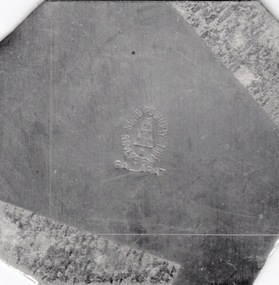
Article - Article - Metal plate, ZILLES COLLECTION: Metal plate stamped with Soho Foundry Sovereign Hill Ballarat with symbol
... Bell Street Ballarat. Small metal plate with the name stamped into it. It is Soho Foundry, Sovereign Hill Ballarat. zilles foundry soho ballarat metal plate Symbol with writing around it - SOHO FOUNDRY SOVEREIGN HILL BALLARAT Small square silver colour metal plate. ...Zilles Printers was begun by Lewis Zilles in the early 1930s. It was in McKenzie Street Ballarat. His son Jeffrey also became a printer - letterpress, offset and screen printer. The business became Zilles Printers/Graphics and was in Armstrong Street and later Bell Street Ballarat. Small metal plate with the name stamped into it. It is Soho Foundry, Sovereign Hill Ballarat.Small square silver colour metal plate. Corners cut and two sections show residue of sticking tape.Symbol with writing around it - SOHO FOUNDRY SOVEREIGN HILL BALLARATzilles, foundry, soho, ballarat, metal plate -
 Federation University Historical Collection
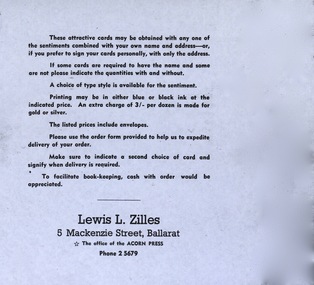
Card - Card - Christmas Card Selection, ZILLES COLLECTION: Selection of Christmas Cards with various inscription options
... Bell Street Ballarat. Selection of Christmas cards that are available with inscription printed inside. A selection of sentiments to choose from plus the persons name and address - various type forms - can be printed inside. Printing maybe in either blue or black ink. An extra charge is made for gold and silver...Bell Street Ballarat. Selection of Christmas cards that are available with inscription printed inside. A selection of sentiments to choose from plus the persons name and address - various type forms - can be printed inside. Printing maybe in either blue or black ink. An extra charge is made for gold and silver ...Zilles Printers was begun by Lewis Zilles in the early 1930s. It was in McKenzie Street Ballarat. His son Jeffrey also became a printer - letterpress, offset and screen printer. The business became Zilles Printers/Graphics and was in Armstrong Street and later Bell Street Ballarat. Selection of Christmas cards that are available with inscription printed inside. A selection of sentiments to choose from plus the persons name and address - various type forms - can be printed inside. Printing maybe in either blue or black ink. An extra charge is made for gold and silver. A second choice of card is advised and date for delivery requested.Twelve black cover paper sheets with card glued on. Price information given. Two A4 information sheets. Order form pad.zilles printers, ballarat, lewis zilles, christmas cards, christmas sentiments, type forms, gold and silver, order form -
 Federation University Historical Collection
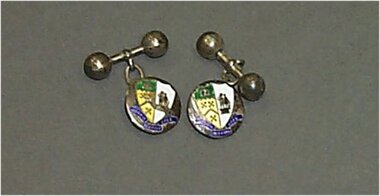
Accessory - Object, School of Mines Ballarat Cuff Links, c1920s
... These circular cuff links are the Coat of Arms of the School of Mines Ballarat and are made of sterling silver and white, yellow, green and blue enamel attached by three links to a small bar with dumb bells. ...The university merged with Monash University's Gippsland (Churchill) campus in 2013 and the merged schools are now the Federation University Australia school of mines ballarat school crest cuff links On face - Ingenio Effodere Opes These circular cuff links are the Coat of Arms of the School of Mines Ballarat and are made of sterling silver and white, yellow, green and blue enamel attached by three links to a small bar with dumb bells. ...Tertiary education at Ballarat began with the establishment of the School of Mines in 1870, making it Australia's third oldest tertiary institution. Classes began in surveying, mathematics, chemistry and a decade later they included metallurgy, assaying and geology. The technical division provided such programs as wool classing, plumbing and bricklaying. In 1967, it was split into three separate institutions, Ballarat School of Industries, Ballarat Technical School, and Ballarat Institute of Advanced Education. Then in 1976 the Ballarat Institute of Advanced Education became into Ballarat College of Advanced Education. The Ballarat School of Industries and Ballarat Technical School became the School of Mines and Industries, Ballarat (SMB). In 1998, the Ballarat School of Mines and Industries and the Horsham-based Wimmera Institute of TAFE merged with the University of Ballarat. The university merged with Monash University's Gippsland (Churchill) campus in 2013 and the merged schools are now the Federation University AustraliaThese circular cuff links are the Coat of Arms of the School of Mines Ballarat and are made of sterling silver and white, yellow, green and blue enamel attached by three links to a small bar with dumb bells. On face - Ingenio Effodere Opesschool of mines ballarat, school crest, cuff links -
 Federation University Historical Collection
Book, W. & R. Chambers, Silver Bells, 1952
... Orange and blue covered 48 page book of poems for use in the teaching of reading Silver Bells Book A.Stamp and T.C. Collocott L.M. ...Mary Egan who died on April 4th, 1981, spent 23 years as a greatly-respected lecturer in English curriculum at the Ballarat Teachers College, State College of Victoria and Ballarat College of Advanced Education. Orange and blue covered 48 page book of poems for use in the teaching of reading Book Plate, M.Egan on sticker on front cover that some one has tried to remove.mary egan, ballarat teachers college, state college of victoria, ballarat college of advanced education, education department victoria, a. stamp, t.c. collocott, l.m dufty, w & r chambers, t and a. constable -
 Federation University Historical Collection
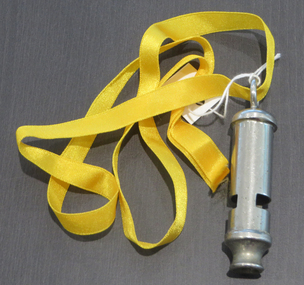
Object, Rider and Bell, Whistle, 1942
... This whistle was used by Helen Veitch who went to the Ballarat Teachers' College in 1948 and taught in numerous schools afterwards. whistle helen veitch school whistle teaching aid Engraved - Aussie, Rider & Bell, Sydney, 1942 Silver coloured school whistle. Whistle Object Rider and Bell ...This whistle was used by Helen Veitch who went to the Ballarat Teachers' College in 1948 and taught in numerous schools afterwards.Silver coloured school whistle.Engraved - Aussie, Rider & Bell, Sydney, 1942whistle, helen veitch, school whistle, teaching aid -
Federation University Historical Collection
Article - Whistle, School Whistle, 1942
... whistle school education helen veitch Silver coloured school whistle used by Helen Veitch School Whistle Article Whistle Rider and Bell ...Silver coloured school whistle used by Helen Veitchwhistle, school, education, helen veitch -
 Flagstaff Hill Maritime Museum and Village
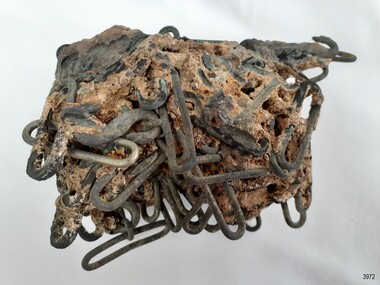
Functional object - "S" Hook Buckle, Ca. 1855
... The collection as a whole is historically significant for representing aspects of Victoria's maritime history and its potential to interpret social and historical themes. flagstaff hill warrnambool flagstaff hill maritime museum maritime museum shipwreck coast flagstaff hill maritime village great ocean road shipwreck artefact schomberg horse harness fitting harness hardware "S" hook buckle "S" Hook buckles conglomeration of buckles Belt buckle fastener quick release fastener Flagstaff Hill Sub-aqua group Peter Ronald Barry Lowther Jeff Bell "S" hook buckles; oval silver alloy buckles contained within a conglomeration of materials from the sea. ...The "S" hook buckles were grouped together under the sea as part of the cargo of the vessel Schomberg. "S" hook buckles are used for fastening two ends of fabric together such as harness belts, trouser belts and similar items. The buckles were recovered in October 1980 by the Flagstaff Hill Sub-Aqua Group, Peter Ronald, Barry Lowther and Jeff Bell. ABOUT THE SCHOMBERG (October 6 to December 27, 1855)- When the ship Schomberg was launched in 1855, she was considered the most perfect clipper ship ever to be built. James Baine’s Black Ball Line had commissioned her for their fleet of passenger liners. The Aberdeen builders designed her to sail faster than the clippers designed the three-masted wooden clipper ship to be fast. The timber used for the diagonal planking was British oak with layers of Scottish larch. This luxury emigrant vessel was designed for superior comfort. She had ventilation ducts to provide air to the lower decks and a dining saloon, smoking room, library and bathrooms for the first-class passengers. The master for Schomberg’s maiden voyage was Captain ‘Bully’ Forbes. He drunkenly predicted at her launch that he would make the journey between Liverpool and Melbourne in 60 days. Schomberg departed Liverpool on 6 October 1855 with 430 passengers and 3000 tons of cargo including iron rails and equipment intended the build the Geelong Railway and a bridge over the Yarra from Melbourne to Hawthorn. The poor winds slowed Schomberg’s sail across the equator. She was 78 days out of Liverpool when she ran aground on a sand spit near Peterborough, Victoria, on 27 December; the sand spit and currents were not marked on Forbes’s map. The ship’s Chief Officer spotted the coastal steamer SS Queen at dawn and sent a signal. The master of the SS Queen approached the stranded vessel and all of Schomberg’s passengers safely disembarked. In 1975, 120 years after the Schomberg was wrecked, divers from Flagstaff Hill found an ornate communion set at the wreck site along with many other artefacts. In 1978 a diamond ring was discovered under the concretion in the lid of the communion set, which is currently on display. Former Director of Flagstaff Hill, Peter Ronald, had salvaged most of the artefacts from the wreck. This group of "S" hook buckles and conglomeration of buckles is significant as an example of an item in common use in the mid-19th century and the items carried on ship as cargo. The Schomberg collection as a whole is of historical and archaeological significance at a State level. Flagstaff Hill’s collection of artefacts from the Schomberg is also significant for its association with the Victorian Heritage Registered shipwreck (VHR S 612). The collection is of prime significance because of the relationship between the objects salvaged, as together they help us to interpret the story of the Schomberg. The collection as a whole is historically significant for representing aspects of Victoria's maritime history and its potential to interpret social and historical themes. "S" hook buckles; oval silver alloy buckles contained within a conglomeration of materials from the sea. The group was recovered from the wreck of the Schomberg.flagstaff hill, warrnambool, flagstaff hill maritime museum, maritime museum, shipwreck coast, flagstaff hill maritime village, great ocean road, shipwreck artefact, schomberg, horse harness fitting, harness hardware, "s" hook buckle, "s" hook buckles, conglomeration of buckles, belt buckle, fastener, quick release fastener, flagstaff hill sub-aqua group, peter ronald, barry lowther, jeff bell -
 Morongo Old Collegians
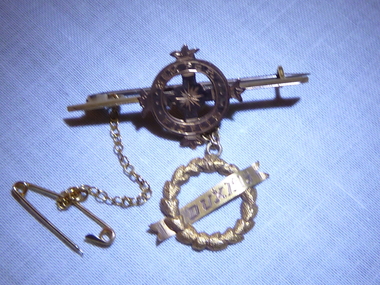
Badge
... Mavis was the first School Dux at the re-named 'Roslyn'. education school morongo geelong girls boarding presbyterian uniting history badges 1920-1994 kindergarten-year-12 sint-lucernae-ardentes private bell-post-hill lucy shaw gertrude pratt dulcie brookshaw "Dux 1920" and "Semier Fidelis" An all-silver round badge with a crown on top and a star in the centre on a crossbar with fine chain and pin attached. ...This badge was won by Mavis Pettitt in 1920.Mavis was the first School Dux at the re-named 'Roslyn'.An all-silver round badge with a crown on top and a star in the centre on a crossbar with fine chain and pin attached. It has an extra circular wreath with a ribbon across and it attached by a small link. A fine safety chain and pin are attached."Dux 1920" and "Semier Fidelis"education, school, morongo, geelong, girls, boarding, presbyterian, uniting, history, badges, 1920-1994, kindergarten-year-12, sint-lucernae-ardentes, private, bell-post-hill, lucy shaw, gertrude pratt, dulcie brookshaw -
 Flagstaff Hill Maritime Museum and Village
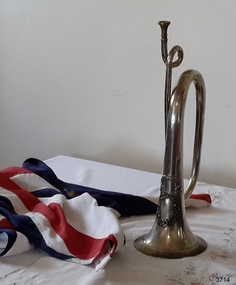
Instrument - Bugle, 1861
... Silver alloy Bugle, with a brass mouthpiece, a long tube of metal, narrow at the mouth end and gradually flaring to a wider shape at the bell at the other end. ...Within the wreath “TO THE / WARRNAMBOOL / VOLUNTEER RIFLE COMPANY / this tribute of due appreciation / is presented by / THE LADIES / of the District / Warrnambool 18th June / 1861” Silver alloy Bugle, with a brass mouthpiece, a long tube of metal, narrow at the mouth end and gradually flaring to a wider shape at the bell at the other end. ...Bugles have been used for hundreds of years to communicate instructions, particularly in battles and for announcements such as calls to assemble and various other daily routines, especially for infantry and military units. This pure silver bugle was presented to the Warrnambool Rifle Volunteers by Lady Helpman, on behalf of the Ladies of the District of Warrnambool, on June 18th, 1861. Lady Helpman's husband, Captain Benjamin Franklin Helpman, was the Warrnambool Harbour master. The gift of this silver bugle was presented to the commanding officer of the Warrnambool Volunteer Rifle Corps, Captain Bushe, who then passed it on to the Warrnambool Volunteer Band. On 11th August 2016, during a ceremony at Flagstaff Hill, the Australian Army handed over guardianship of two very significant historical items, the 1885 W. Clarke Trophy and the 1861 Warrnambool Ladies Silver Bugle, to Warrnambool City Council for display at Flagstaff Hill Maritime Museum. Both heritage-listed items are strongly connected to the city of Warrnambool and form an integral part of the history of the Warrnambool Garrison.The Silver Bugle is locally significant to the community of Warrnambool for its connection to the Warrnambool Volunteer Rifle Corps - part of the original Warrnambool Garrison – which was formed to protect the Warrnambool Harbour. The site of the 1888 Warrnambool Garrison and Fortifications is Victorian State Heritage-listed. It is significant for its intact and operational nature, and is one of the best-preserved pieces of Victoria's early colonial heritage.Silver alloy Bugle, with a brass mouthpiece, a long tube of metal, narrow at the mouth end and gradually flaring to a wider shape at the bell at the other end. The tube is shaped into three bends. The front of the bell features an elaborate design, including a ribbon banner attached above an oval floral wreath that encloses an inscription. The outer rim of the bell has an impressed ancient Greek geometric border.On ribbon banner “Armed for the Right”. Within the wreath “TO THE / WARRNAMBOOL / VOLUNTEER RIFLE COMPANY / this tribute of due appreciation / is presented by / THE LADIES / of the District / Warrnambool 18th June / 1861”flagstaff hill, warrnambool, shipwrecked coast, flagstaff hill maritime museum, maritime museum, shipwreck coast, flagstaff hill maritime village, great ocean road, silver bugle 1861, bugle musical instrument, lieutenant benjamin helpman, doctor breton, captain bushe, bugler corrigan, drill instructor bernard, warrnambool volunteer rifle corps 1861, statistics of warrnambool volunteer rifle corps 1861, warrnambool volunteer rifle company, warrnambool rifle volunteers, warrnambool volunteer band, armed for the right, wall’s family hotel warrnambool, warrnambool garrison, volunteer corps -
 Bendigo Military Museum
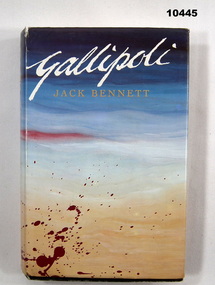
Book - BIOGRAPHICAL FICTION, GALLIPOLI, WW1, Jack Bennett, "GALLIPOLI", 1981
... Silver colour print on spine. Dustcover - paper, yellow, white and black print on front and spine. Illustrated in colours of blue, red and yellow, abstract style painting. Front and back flaps have printed blurb. 280 pages, cut, plain, off white paper. Small illustration at the beginning of each chapter of black on white print of the Rising Sun Badge. Handwritten inscription on title page. "GALLIPOLI" Book BIOGRAPHICAL FICTION, GALLIPOLI, WW1 Jack Bennett Angus & Robertson Ltd Hedges & Bell ...This is a biographical fiction story of two boys at Gallipoli.Hardcover book with dustcover. Hardcover - cardboard with black colour buckram. Silver colour print on spine. Dustcover - paper, yellow, white and black print on front and spine. Illustrated in colours of blue, red and yellow, abstract style painting. Front and back flaps have printed blurb. 280 pages, cut, plain, off white paper. Small illustration at the beginning of each chapter of black on white print of the Rising Sun Badge. Handwritten inscription on title page.Handwritten details - blue ink pen. "HAZEL TALBOT/ XMAS 1982/ FROM RAE & PETER".publications, book, biographical fiction, gallipoli, ww1 -
 Waverley RSL Sub Branch
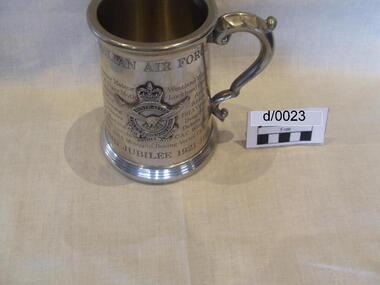
Silver Tankard R.A.A.F
... tankard mug Inc: Famous RAAF Aircraft General Dynamics F111c deHaviand DH9A Tiger Moth Bristol Bulldog Short Sunderland Hawker Demon Douglas Boston Curtis Kitthawk Supermarine Spitfire DAP Bristol Beaufort Lockheed Hudson CAC Boomerang Fairey IIID Lockheed Hurculese Bell Iroquois GAFEE Canbera Consolidated Liberator Lockheed Neptune DHC Caribou GAF Lincon CAC NA Sabre DAP Bristol Beaufighter Avro Lancaster DHA Mosquito Boeing Vertol Chinook Westland Wapiti Lockheed Orion Avro Anson DHA Vampire Douglas Dakota CAC Wirraway Diamond Jublee 1921 - 1981 Presented to the Waverley R.S.L.by R.A.A.F. Members April 1981 Pewter drinking cup with ornate handle, R.A.A.F Badge with Queens Crown. Glass bottom. Tapered sides. Listing aircraft. From World War 1, World War 11,, Korea, Malaya and Vietnam to present day Silver ...Pewter drinking cup with ornate handle, R.A.A.F Badge with Queens Crown. Glass bottom. Tapered sides. Listing aircraft. From World War 1, World War 11,, Korea, Malaya and Vietnam to present dayInc: Famous RAAF Aircraft General Dynamics F111c deHaviand DH9A Tiger Moth Bristol Bulldog Short Sunderland Hawker Demon Douglas Boston Curtis Kitthawk Supermarine Spitfire DAP Bristol Beaufort Lockheed Hudson CAC Boomerang Fairey IIID Lockheed Hurculese Bell Iroquois GAFEE Canbera Consolidated Liberator Lockheed Neptune DHC Caribou GAF Lincon CAC NA Sabre DAP Bristol Beaufighter Avro Lancaster DHA Mosquito Boeing Vertol Chinook Westland Wapiti Lockheed Orion Avro Anson DHA Vampire Douglas Dakota CAC Wirraway Diamond Jublee 1921 - 1981 Presented to the Waverley R.S.L.by R.A.A.F. Members April 1981tankard, mug -
 Eltham District Historical Society Inc
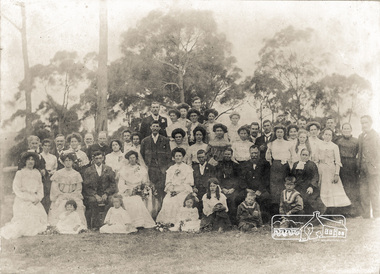
Photograph, Wedding of Sarah Ann Bird (b.1881) to Edward Ernest Pepper (b.1874) held at the Bird family home of "View Hill', Eltham, 1904, 1904
... About 10 p.m., "while all was merry as a marriage bell", the bride and bridegroom departed secretly "to cheat surprise and prying eyes". The presents were numerous and handsome:– Parents of the bride, sewing machine; Miss A. Bird, silver...About 10 p.m., "while all was merry as a marriage bell", the bride and bridegroom departed secretly "to cheat surprise and prying eyes". The presents were numerous and handsome:– Parents of the bride, sewing machine; Miss A. Bird, silver ...Sarah Bird 4th from left (seated) and Edward Pepper on her left (standing). George Bird, 2nd from right (seated). George Bird her great-grandfather and Sarah Bird and Edward Pepper, her grandparents. [from Evelyn Observer and Bourke East Record, morning edition, 18 November 1904, p. 3:] ORANGE BLOSSOM. The marriage of Miss Sarah A. Bird, eldest daughter of Mr George Bird, of "View Hill," Eltham, to Mr Ernest Edward Pepper, of Diamond Creek, was celebrated at the residence of the bride's parents on Wednesday, 9th November, 1904. The ceremony took place at 4 p.m. and was performed by the Rev Percey Knight, B.A., of Alphington. The bride entered the drawing room with her father who gave her away, and the Wedding March, was nicely played by Miss Wild. The bride was prettily dressed in creme voile nicely tucked and gathered, trimmed with guipure lace and silk ruching, sprays of orange blossom, wreath and veil, and she carried a shower bouquet. Her travelling dress was a very pretty blue. The brides-maids were Miss Ethel Barker dressed in pale green voile trimmed with creme guipure lace and silk ruching; and Miss Button in creme voile, guipure lace, silk ruching; both carried pretty bouquets. The groomsmen were Mr Lorimer, of Diamond Creek, and Mr George Bird, brother of the bride. Between forty and fifty relatives and friends partook of a bountifully provided and nicely laid out breakfast. The usual toasts were honored, and congratulations were freely tendered "to the happy couple". The decorations were very tastefully executed by Miss Beatrice Nelson, and Mr Sayers. The evening was very pleasantly spent in singing, recitations, games, and other suitable pastimes, while others "tipped the light fantastic toe". About 10 p.m., "while all was merry as a marriage bell", the bride and bridegroom departed secretly "to cheat surprise and prying eyes". The presents were numerous and handsome:– Parents of the bride, sewing machine; Miss A. Bird, silver breakfast cruet; Miss N. Bird, bread board and knife; Master A. Bird, pair glass dishes; Master R. Bird, pair photo frames; Mr Sayers, tea set; Miss Kidd, silver jam dish and spoon; Miss Wilkinson, carpet; Mr J. Kilpatrick, cheque; Mr W. Kilpatrick, clock; Miss Kilpatrick, silver butter knife; Mr J. H. Kilpatrick, hand painted mirror; Mrs Kerwin, pictures; Mrs Gilsenan, the handsome wedding cake; Mrs Nelson, Japanese occasional table; Misses Nelson, jugs and candlestick; Mrs Bunker, silver cruet stand; Miss Bunker, hand-painted vases; Miss E. Bunker, epergne; Mr E. Bunker, crumb tray and brush; Miss Jessie Gilsenan, cake stand; Mr Harold Gilsenan, auger basin and ornaments; Mr Lorimer, silver breakfast cruet; Mr A. Collins and Miss Jones, epergne; Miss Cassie Sweeney, jardiniere; Miss Ida and Ollie Cooper, silver butter dish; Miss Mills, large vases; Misses M. and F. Shillinglaw, handsome oak clock; Misses C. and E. Shillinglaw, pair large pictures; Mr Lucas and Miss Sutton, silver butter dish and knife, and silver jam dish and spoon; Miss M. and A. Short, teapot, cheese dish, and tumblers; Mr and Mrs J. Anderson, butter dish; Miss Williams, pen tray; Miss Griffiths, vases; Mr I. Hill, cheque; Miss Wild, biscuit barrel; Mr, Mrs and Miss Brown, trifle bowl and crystal jug; Mrs Weller, water jug and glasses; Mrs Hadfield, pair glass dishes and butter dish; Mr and Mrs Blackney, photo frames; Mr Wilson, beaded basket pin cushion; Mr Linsy, cheque; Mrs Linsy, fruit dish; Mrs Stebbing, pair candle sticks; Mrs Blanchard, pictures.Digital copy of framed sepia photographanderson, bird, blanchard, blackney, bunker, collins, cooper, edward ernest pepper, george bird, george bird jnr, gilsenan, griffiths, hadfield, hill, jones, kerwin, kidd, kilpatrick, linsy, mills, nelson, sarah ann bird, sayers, shillinglaw, short, stebbing, sutton, sweeney, view hill, wedding, weller, wild, wilkinson, williams, wilson, brown, lesley mitchell (nee pepper) collection -
 Eltham District Historical Society Inc
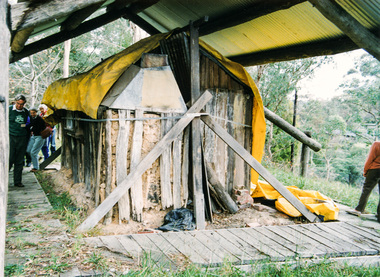
Photograph, Slab hut, Warrandyte, Warrandyte Mystery Tour, 29 May 1994, 29/05/1994
... Outside we heard the same bird songs, the trills and bell-pealing, saw the same straggly eucalypts, and a silver leafed wattle in flower, native grasses and ferns, and the neat present day houses, often of Warrandyte stone, perhaps veneered only. ...Outside we heard the same bird songs, the trills and bell-pealing, saw the same straggly eucalypts, and a silver leafed wattle in flower, native grasses and ferns, and the neat present day houses, often of Warrandyte stone, perhaps veneered only. ...[article by Bettina Woodburn in EDHS Newsletter No. 97, July 1994:] THE WARRANDYTE MYSTERY TOUR MAY 29TH 1994 - Members of the Eltham Historical Society met at the Old Post Office, now converted into the Warrandyte Historical Museum, for a picnic lunch on the sunny back verandah overlooking the shimmering Yarra River. Interesting photographs and artefacts filled various rooms outlining the history of this area, and told tales of Aboriginal and more recent neighbours of the Eltham Shire. The weather was calm, cloudy mostly with only occasional sunny patches, but it wasn't cold, although the autumnal leaf colours had changed to wintry brown. "All Aboard" and we set off in the Warrandyte Community Bus (with the School Bus sign displayed at the rear) to learn about local places of "Pride and Joy” from Bruce our guide and Tom the driver. Almost directly opposite we entered Whipstick Gully to explore the first of the district's hidden treasures - the Victory, one of the largest of the six or so major mines, past the old quarry now used for abseiling practice. By torchlight we entered the rocky hillside and saw the seams of quartz the miners had followed in their search for gold. Stamping batteries, and there was one in this gully, converted discarded rock into 'road metal'. Warrandyte is proud to be the first declared Goldfield in 1851, and one of the longest surviving, into the 1920s. A pleasant drive across the Bridge and along Bradley's Lane to Norman's Reserve brought us to see another Tunnel at Pound Bend through which the Yarra was diverted to allow about three miles of river-bed to be used for prospecting for alluvial gold. Still on this side of the river we visited the Old Slab Hut in Castles Road. This remnant of miners' housing is preserved because it had been incorporated into a weatherboard house, and saved from the bulldozers - a last minute reprieve, for preservation, by the National Trust. Devastating bush fires have destroyed other old cottages built of wattle and daub, with bark roofs and stone fire-places. The Cairn commemorating the disclosure of Gold Discovery at Warrandyte on June 30th 1851 beside Anderson's Creek Road was our next point of historical interest. We drove on to South Warrandyte and circled back to above the ford on Anderson's Creek to the entrance of the 4th Hill Mine. Again we crept along with our torches, careful of the low roof-rock, and side shafts. At a junction in a large cavity we were able to stand, look up a long air-vent which some 'cavers' climb down, and marvel at, and experience an aspect of a miner's life. Outside we heard the same bird songs, the trills and bell-pealing, saw the same straggly eucalypts, and a silver leafed wattle in flower, native grasses and ferns, and the neat present day houses, often of Warrandyte stone, perhaps veneered only. The day ended pleasantly, seeing more of the Yarra from Everard Drive, and the water rushing out of the Tunnel at Pound Bend, before returning to afternoon tea or coffee at the Museum. A great day for all concerned - many thanks to the Organisers.Colour photographslab hut, warrandyte, "warrandyte miner's cottage" -
 Eltham District Historical Society Inc
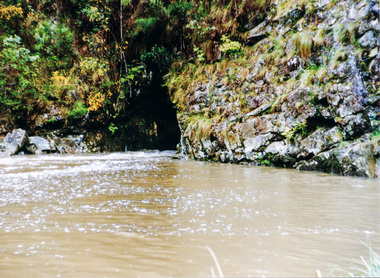
Photograph, Pound Bend tunnel, Warrandyte, Warrandyte Mystery Tour, 29 May 1994, 29/05/1994
... Outside we heard the same bird songs, the trills and bell-pealing, saw the same straggly eucalypts, and a silver leafed wattle in flower, native grasses and ferns, and the neat present day houses, often of Warrandyte stone, perhaps veneered only. ...Outside we heard the same bird songs, the trills and bell-pealing, saw the same straggly eucalypts, and a silver leafed wattle in flower, native grasses and ferns, and the neat present day houses, often of Warrandyte stone, perhaps veneered only. ...[article by Bettina Woodburn in EDHS Newsletter No. 97, July 1994:] THE WARRANDYTE MYSTERY TOUR MAY 29TH 1994 - Members of the Eltham Historical Society met at the Old Post Office, now converted into the Warrandyte Historical Museum, for a picnic lunch on the sunny back verandah overlooking the shimmering Yarra River. Interesting photographs and artefacts filled various rooms outlining the history of this area, and told tales of Aboriginal and more recent neighbours of the Eltham Shire. The weather was calm, cloudy mostly with only occasional sunny patches, but it wasn't cold, although the autumnal leaf colours had changed to wintry brown. "All Aboard" and we set off in the Warrandyte Community Bus (with the School Bus sign displayed at the rear) to learn about local places of "Pride and Joy” from Bruce our guide and Tom the driver. Almost directly opposite we entered Whipstick Gully to explore the first of the district's hidden treasures - the Victory, one of the largest of the six or so major mines, past the old quarry now used for abseiling practice. By torchlight we entered the rocky hillside and saw the seams of quartz the miners had followed in their search for gold. Stamping batteries, and there was one in this gully, converted discarded rock into 'road metal'. Warrandyte is proud to be the first declared Goldfield in 1851, and one of the longest surviving, into the 1920s. A pleasant drive across the Bridge and along Bradley's Lane to Norman's Reserve brought us to see another Tunnel at Pound Bend through which the Yarra was diverted to allow about three miles of river-bed to be used for prospecting for alluvial gold. Still on this side of the river we visited the Old Slab Hut in Castles Road. This remnant of miners' housing is preserved because it had been incorporated into a weatherboard house, and saved from the bulldozers - a last minute reprieve, for preservation, by the National Trust. Devastating bush fires have destroyed other old cottages built of wattle and daub, with bark roofs and stone fire-places. The Cairn commemorating the disclosure of Gold Discovery at Warrandyte on June 30th 1851 beside Anderson's Creek Road was our next point of historical interest. We drove on to South Warrandyte and circled back to above the ford on Anderson's Creek to the entrance of the 4th Hill Mine. Again we crept along with our torches, careful of the low roof-rock, and side shafts. At a junction in a large cavity we were able to stand, look up a long air-vent which some 'cavers' climb down, and marvel at, and experience an aspect of a miner's life. Outside we heard the same bird songs, the trills and bell-pealing, saw the same straggly eucalypts, and a silver leafed wattle in flower, native grasses and ferns, and the neat present day houses, often of Warrandyte stone, perhaps veneered only. The day ended pleasantly, seeing more of the Yarra from Everard Drive, and the water rushing out of the Tunnel at Pound Bend, before returning to afternoon tea or coffee at the Museum. A great day for all concerned - many thanks to the Organisers.Two colour photographswarrandyte, activities, pound bend -
 Warrnambool and District Historical Society Inc.
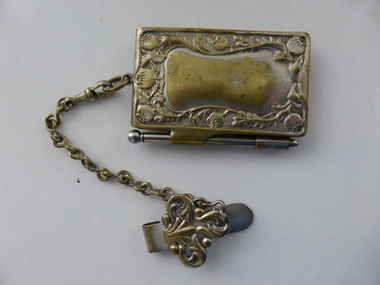
Artefact, Silver plate note pad, Early 20th century
... Bell, Warrumyea, Wangoom, Warrnambool’ This is a heavily-embossed silver note-pad holder with a hinged lid on the front and clips at the side to hold a pencil. ...This note-pad and holder perhaps belonged to Jessie Bell whose name is written on the first page. There are several entries on the pages and the dates range from 1908 to 1929. The entries include references to a Banquet for Mr J. Duffus, Purnim, 1912, Jack Ross’ Wedding Party, Dennington, 1912, R.J. Jones’ Dance, Woolshed, 1928 and Leila Jenkins’ 21st Birthday Party, 1928. This notebook and holder is of interest because it is an example of the type of appointment book used by the more affluent in the early 20th century. This is a heavily-embossed silver note-pad holder with a hinged lid on the front and clips at the side to hold a pencil. The writing material inside the pencil is missing. The back of the holder has a blank space in the middle where a name can be inscribed. At the top of the holder is a ring, holding a chain with an ornamented clip at the end. This enables the holder and pad to be hooked over a belt or lapel. Inside the holder are fifty paper pages on which to write appointments or notes. The pages are gilt-paged. The paper contains several notes handwritten in pencil re dances, parties etc. First Page: ‘Jessie A. Bell, Warrumyea, Wangoom, Warrnambool’ jessie bell, appointment book, warrnambool history -
 4th/19th Prince of Wales's Light Horse Regiment Unit History Room
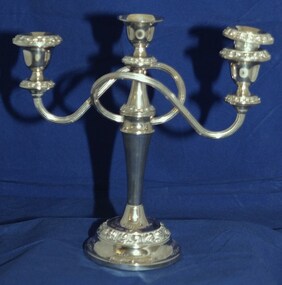
Domestic object - Silver Candelabra, 3 Stem
... Presented to 4/19 PWLH Sergeants Mess by Mrs G Swan Mrs Perkins Mrs M Tuskin Miss S D'Atri Mrs M Baker Mrs J Douglas Mrs M D'Atri Mrs M Bullock Mrs C Summers Mrs J Axten (sic) Mrs M Bell Mrs G Burke Mrs L Hibberd Mrs J Arnott Silver plated by Ianthe of England...candelabra silverware sergeants' mess Presented to 4/19 PWLH Sergeants Mess by Mrs G Swan Mrs Perkins Mrs M Tuskin Miss S D'Atri Mrs M Baker Mrs J Douglas Mrs M D'Atri Mrs M Bullock Mrs C Summers Mrs J Axten (sic) Mrs M Bell Mrs G Burke Mrs L Hibberd Mrs J Arnott Silver plated by Ianthe of England Set of 5 with catalogue no 0455, 0534, 0535, 0536. 3 stem, silver EPNS candelabra. 3 Stem Domestic object Silver Candelabra Ianthe ...Set of 5 with catalogue no 0455, 0534, 0535, 0536. 3 stem, silver EPNS candelabra.Presented to 4/19 PWLH Sergeants Mess by Mrs G Swan Mrs Perkins Mrs M Tuskin Miss S D'Atri Mrs M Baker Mrs J Douglas Mrs M D'Atri Mrs M Bullock Mrs C Summers Mrs J Axten (sic) Mrs M Bell Mrs G Burke Mrs L Hibberd Mrs J Arnott Silver plated by Ianthe of Englandcandelabra, silverware, sergeants' mess
