
Showing 124 items matching "st kilda businesses"
-
 St Kilda Historical Society
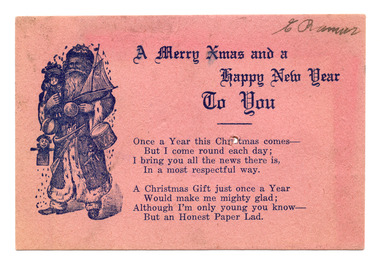
Card - Seasonal card, A Merry Xmas and a Happy New Year to You, 20th century
... St Kilda businesses...Undated but perhaps early 20th century. St Kilda businesses 20th century St Kilda - history McArthur's Agency Printed on front: 'A Merry Xmas and a Happy New Year to You. ...A card encouraging customers to give a gift at Christmas to the boy who delivers or sells them their daily newspapers. Undated but perhaps early 20th century.Pink coloured card with greeting, verse and image of Santa Claus printed in blue. Stamped on the back.Printed on front: 'A Merry Xmas and a Happy New Year to You. Once a Year this Christmas comes - But I come round each day; I bring you all the news there is, in a most respectful way. A Christmas Gift just once a Year Would make me mighty glad; Although I'm only young you know - But an Honest Paper Lad. Stamped on rear: 'Cards, Books and Stationery. You will get satisfaction from McArthur's Agency St Kilda. Latest books & periodicals by every mail.'st kilda businesses, 20th century, st kilda - history, mcarthur's agency -
 St Kilda Historical Society
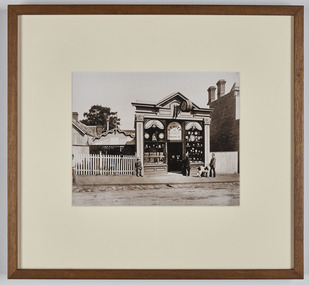
Photograph - Building, Levitt's clock shop
... ...St Kilda businesses...Samuel J Levitt established his business as watchmaker, jeweller and silversmith in High Street, St Kilda in 1864...Samuel J Levitt established his business as watchmaker, jeweller and silversmith in High Street, St Kilda in 1864 Levitt St Kilda businesses Black and white photograph in wooden frame Levitt's clock shop Photograph Building ...Samuel J Levitt established his business as watchmaker, jeweller and silversmith in High Street, St Kilda in 1864Black and white photograph in wooden framelevitt, st kilda businesses -
 St Kilda Historical Society
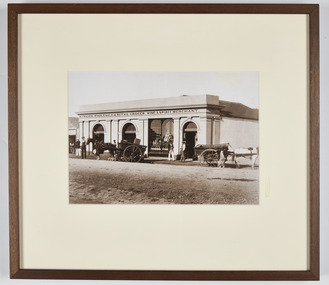
Photograph - Building, M Frazer wholesale and retail grocer St Kilda
... St Kilda businesses...St Kilda. The Sands and McDougal's Melbourne and Suburban Directory of 1864 locates the premises of 'Frazer, M., grocer and wine and spirit merchant' on the east side of High Street, near the intersection with the east end of Inkerman Street. St Kilda businesses ...Moses Frazer was reportedly the first grocer to open in High Street, St Kilda. The Sands and McDougal's Melbourne and Suburban Directory of 1864 locates the premises of 'Frazer, M., grocer and wine and spirit merchant' on the east side of High Street, near the intersection with the east end of Inkerman Street.Black and white photograph in wooden framest kilda businesses, m frazer grocer, moses frazer -
 St Kilda Historical Society
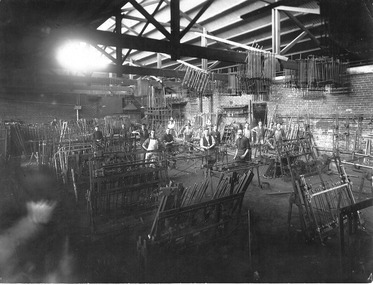
Photograph - Industrial, Galliers & Klaerr Iron and Brass Foundry
... St Kilda businesses...Galliers & Klaerr was an iron foundry and plumbing business in St Kilda, known for producing gas, cooking, and heating stoves from 1883. ...These days it is the Aldi Supermarket. St Kilda businesses Galliers & Klaerr black and white photograph Galliers & Klaerr Iron and Brass Foundry Photograph Industrial ...Galliers & Klaerr was an iron foundry and plumbing business in St Kilda, known for producing gas, cooking, and heating stoves from 1883. Located on Inkerman Street, the firm was a major industrial employer in the area, specializing in cast iron stoves and appliances until the company was sold in the 1960s. Henry Albert Galliers (1845-1907), born in England and a plumber and gasfitter by trade, moved to Australia in 1872 and set up business in rented premises in High Street, and later Inkerman Street. In 1882-1883 he established Galliers & Klaerr with Frederick Klaerr (1856 - 1934) also a plumber. Galliers returned to England in 1980 and the partnership was dissolved, with Klaerr undertaking to continue the business on his own account and to continue to use the business name Galliers & Klaerr. After the company was sold in 1960 the site became the St Kilda 10-pin Bowl, then a data processing centre, and then a Commonwealth Employment Service. These days it is the Aldi Supermarket.black and white photographst kilda businesses, galliers & klaerr -
 St Kilda Historical Society
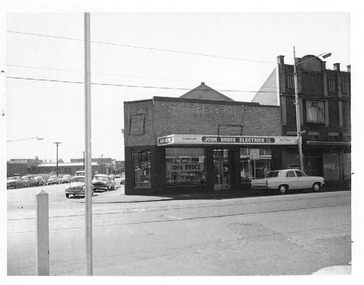
Photograph - Shop, John Bruce Electrics Pty Ltd, 1978
... St Kilda businesses...John Bruce Furniture and Electrics shop St Kilda businesses black and white photograph John Bruce Electrics Pty Ltd Photograph Shop ...John Bruce Furniture and Electrics shopblack and white photographst kilda businesses -
 St Kilda Historical Society
Photograph - Industrial, Barge, Galliers & Klaerr Iron and Brass Foundry, c.1925
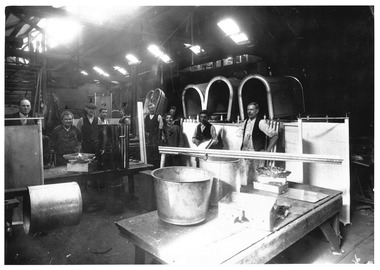
... ...St Kilda businesses...Galliers & Klaerr was an iron foundry and plumbing business in St Kilda, known for producing gas, cooking, and heating stoves from 1883. ...Galliers & Klaerr St Kilda businesses Tin Smiths Shop Circa 1925,Galiers and Klaer black and white photograph original good condition Galliers & Klaerr Iron and Brass Foundry Photograph Industrial Barge ...Interior view of tinsmiths shop. Galliers & Klaerr was an iron foundry and plumbing business in St Kilda, known for producing gas, cooking, and heating stoves from 1883. Located on Inkerman Street, the firm was a major industrial employer in the area, specializing in cast iron stoves and appliances until the company was sold in the 1960s. Henry Albert Galliers (1845-1907), born in England and a plumber and gasfitter by trade, moved to Australia in 1872 and set up business in rented premises in High Street, and later Inkerman Street. In 1882-1883 he established Galliers & Klaerr with Frederick Klaerr (1856 - 1934), also a plumber. Galliers returned to England in 1980 and the partnership was dissolved, with Klaerr undertaking to continue the business on his own account and to continue to use the business name Galliers & Klaerr. After the company was sold in 1960 the site became the St Kilda 10-pin Bowl, then a data processing centre, and then a Commonwealth Employment Service. These days it is the Aldi Supermarket.black and white photograph original good conditionTin Smiths Shop Circa 1925,Galiers and Klaergalliers & klaerr, st kilda businesses -
 St Kilda Historical Society
Photograph - Industrial, Barge, Galliers & Klaerr Iron and Brass Foundry, 1925
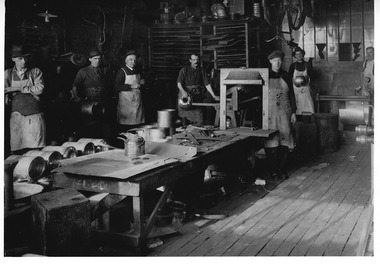
... ...St Kilda businesses...Galliers & Klaerr was an iron foundry and plumbing business in St Kilda, known for producing gas, cooking, and heating stoves from 1883. ...Galliers & Klaerr St Kilda businesses black and white photograph original good condition Galliers & Klaerr Iron and Brass Foundry Photograph Industrial Barge ...Interior view of coppershop Armstrong, Bates, Bernidis, Booth, Burgess, Daiey, Elligham, Featherson, Fulton, Hannan, Kelly, Linard, Mahony, Mathews, Melbourne, Osborne, Parish, Peel, Perkins, Schelble, Walker, West. Galliers & Klaerr was an iron foundry and plumbing business in St Kilda, known for producing gas, cooking, and heating stoves from 1883. Located on Inkerman Street, the firm was a major industrial employer in the area, specializing in cast iron stoves and appliances until the company was sold in the 1960s. Henry Albert Galliers (1845-1907), born in England and a plumber and gasfitter by trade, moved to Australia in 1872 and set up business in rented premises in High Street, and later Inkerman Street. In 1882-1883 he established Galliers & Klaerr with Frederick Klaerr (1856 - 1934), also a plumber. Galliers returned to England in 1980 and the partnership was dissolved, with Klaerr undertaking to continue the business on his own account and to continue to use the business name Galliers & Klaerr. After the company was sold in 1960 the site became the St Kilda 10-pin Bowl, then a data processing centre, and then a Commonwealth Employment Service. These days it is the Aldi Supermarket.black and white photograph original good conditiongalliers & klaerr, st kilda businesses -
 St Kilda Historical Society
Photograph - Industrial, Barge, Galliers & Klaerr Iron and Brass Foundry, 1925
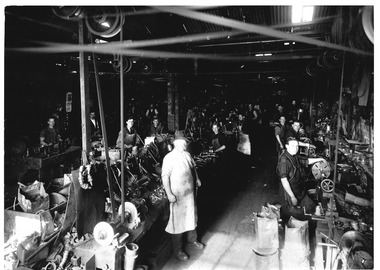
... St Kilda businesses...St Kilda. Galliers & Klaerr was an iron foundry and plumbing business in St Kilda, known for producing gas, cooking, and heating stoves from 1883. ...St Kilda. Galliers & Klaerr was an iron foundry and plumbing business in St Kilda, known for producing gas, cooking, and heating stoves from 1883. ...Interior view of machine shop. Galliers and Klaerr Iron and Brass Foundry, Inkerman St, St Kilda. Galliers & Klaerr was an iron foundry and plumbing business in St Kilda, known for producing gas, cooking, and heating stoves from 1883. Located on Inkerman Street, the firm was a major industrial employer in the area, specializing in cast iron stoves and appliances until the company was sold in the 1960s. Henry Albert Galliers (1845-1907), born in England and a plumber and gasfitter by trade, moved to Australia in 1872 and set up business in rented premises in High Street, and later Inkerman Street. In 1882-1883 he established Galliers & Klaerr with Frederick Klaerr (1856 - 1934), also a plumber. Galliers returned to England in 1980 and the partnership was dissolved, with Klaerr undertaking to continue the business on his own account and to continue to use the business name Galliers & Klaerr. After the company was sold in 1960 the site became the St Kilda 10-pin Bowl, then a data processing centre, and then a Commonwealth Employment Service. These days it is the Aldi Supermarket.black and white photograph original good conditionst kilda businesses, galliers & klaerr -
 St Kilda Historical Society
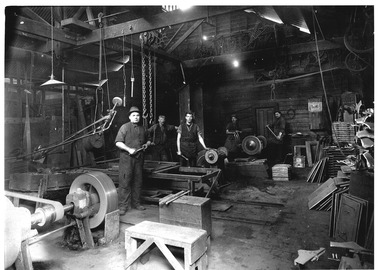
Photograph - Industrial, Barge, Galliers & Klaerr Iron and Brass Foundry, 1925
... ...St Kilda businesses...Galliers & Klaerr was an iron foundry and plumbing business in St Kilda, known for producing gas, cooking, and heating stoves from 1883. ...Galliers & Klaerr St Kilda businesses black and white photograph Galliers & Klaerr Iron and Brass Foundry Photograph Industrial Barge ...Interior view of grinding shop. Galliers & Klaerr was an iron foundry and plumbing business in St Kilda, known for producing gas, cooking, and heating stoves from 1883. Located on Inkerman Street, the firm was a major industrial employer in the area, specializing in cast iron stoves and appliances until the company was sold in the 1960s. Henry Albert Galliers (1845-1907), born in England and a plumber and gasfitter by trade, moved to Australia in 1872 and set up business in rented premises in High Street, and later Inkerman Street. In 1882-1883 he established Galliers & Klaerr with Frederick Klaerr (1856 - 1934), also a plumber. Galliers returned to England in 1980 and the partnership was dissolved, with Klaerr undertaking to continue the business on his own account and to continue to use the business name Galliers & Klaerr. After the company was sold in 1960 the site became the St Kilda 10-pin Bowl, then a data processing centre, and then a Commonwealth Employment Service. These days it is the Aldi Supermarket.black and white photographgalliers & klaerr, st kilda businesses -
 St Kilda Historical Society
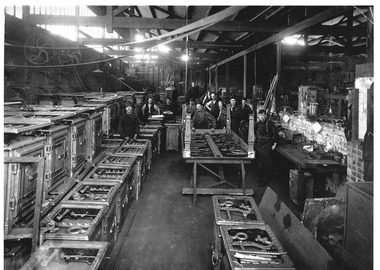
Photograph - Industrial, Barge, Galliers & Klaerr Iron and Brass Foundry, 1925
... St Kilda businesses...Galliers & Klaerr was an iron foundry and plumbing business in St Kilda, known for producing gas, cooking, and heating stoves from 1883. ...These days it is the Aldi Supermarket. St Kilda businesses Galliers & Klaerr black and white photograph original good condition Galliers & Klaerr Iron and Brass Foundry Photograph Industrial Barge ...Galliers & Klaerr was an iron foundry and plumbing business in St Kilda, known for producing gas, cooking, and heating stoves from 1883. Located on Inkerman Street, the firm was a major industrial employer in the area, specializing in cast iron stoves and appliances until the company was sold in the 1960s. Henry Albert Galliers (1845-1907), born in England and a plumber and gasfitter by trade, moved to Australia in 1872 and set up business in rented premises in High Street, and later Inkerman Street. In 1882-1883 he established Galliers & Klaerr with Frederick Klaerr (1856 - 1934), also a plumber. Galliers returned to England in 1980 and the partnership was dissolved, with Klaerr undertaking to continue the business on his own account and to continue to use the business name Galliers & Klaerr. After the company was sold in 1960 the site became the St Kilda 10-pin Bowl, then a data processing centre, and then a Commonwealth Employment Service. These days it is the Aldi Supermarket.black and white photograph original good conditionst kilda businesses, galliers & klaerr -
 St Kilda Historical Society
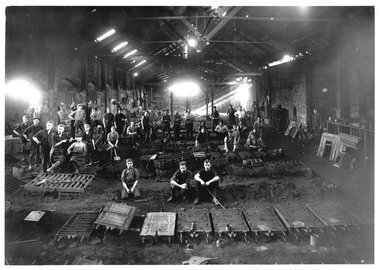
Photograph - Industrial, Barge, Galliers & Klaerr Iron and Brass Foundry, 1925
... St Kilda businesses...Galliers & Klaerr was an iron foundry and plumbing business in St Kilda, known for producing gas, cooking, and heating stoves from 1883. ...These days it is the Aldi Supermarket. St Kilda businesses Galliers & Klaerr black and white photograph original good condition Galliers & Klaerr Iron and Brass Foundry Photograph Industrial Barge ...Interior view of stove shop. Galliers & Klaerr was an iron foundry and plumbing business in St Kilda, known for producing gas, cooking, and heating stoves from 1883. Located on Inkerman Street, the firm was a major industrial employer in the area, specializing in cast iron stoves and appliances until the company was sold in the 1960s. Henry Albert Galliers (1845-1907), born in England and a plumber and gasfitter by trade, moved to Australia in 1872 and set up business in rented premises in High Street, and later Inkerman Street. In 1882-1883 he established Galliers & Klaerr with Frederick Klaerr (1856 - 1934), also a plumber. Galliers returned to England in 1980 and the partnership was dissolved, with Klaerr undertaking to continue the business on his own account and to continue to use the business name Galliers & Klaerr. After the company was sold in 1960 the site became the St Kilda 10-pin Bowl, then a data processing centre, and then a Commonwealth Employment Service. These days it is the Aldi Supermarket.black and white photograph original good conditionst kilda businesses, galliers & klaerr -
 St Kilda Historical Society
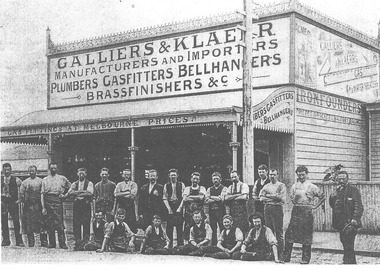
Postcard - Group portrait, Galliers & Klaerr staff
... St Kilda businesses...St Kilda businesses Galliers & Klaerr Galliers & Klaerr staff Postcard Group portrait ...st kilda businesses, galliers & klaerr -
 St Kilda Historical Society
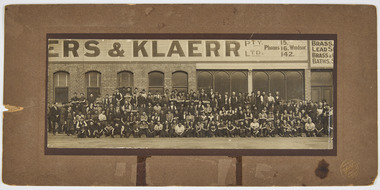
Photograph - Group portrait, Galliers & Klaerr staff, c1924
... St Kilda businesses...Galliers & Klaerr was an iron foundry and plumbing business in St Kilda, known for producing gas, cooking, and heating stoves from 1883. ...St Kilda businesses Galliers & Klaerr "Jack Klaerr in the middle. ...Galliers & Klaerr staff photo. Galliers & Klaerr was an iron foundry and plumbing business in St Kilda, known for producing gas, cooking, and heating stoves from 1883. Located on Inkerman Street, the firm was a major industrial employer in the area, specializing in cast iron stoves and appliances until the company was sold in the 1960s. Henry Albert Galliers (1845-1907), born in England and a plumber and gasfitter by trade, moved to Australia in 1872 and set up business in rented premises in High Street, and later Inkerman Street. In 1882-1883 he established Galliers & Klaerr with Frederick Klaerr (1856-1934), also a plumber. Galliers returned to England in 1980 and the partnership was dissolved, with Klaerr undertaking to continue the business on his own account and to continue to use the business name Galliers & Klaerr. After the company was sold in 1960 the site became the location of, in turn, the St Kilda 10-pin Bowl, a data processing centre, an office of the Commonwealth Employment Service and an Aldi Supermarket.black and white photograph mounted on cardboard"Jack Klaerr in the middle. Ladies 1. Walsh, 2. Barret, 3.,4.,5. Heatherington. This photo taken approx 1924. M.E. Mahony"st kilda businesses, galliers & klaerr -
 St Kilda Historical Society
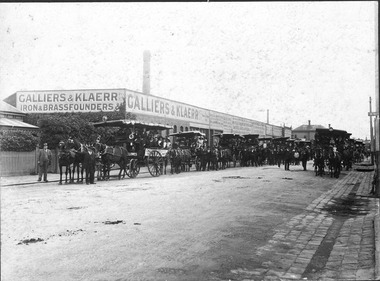
Photograph - Industrial, Galliers & Klaerr Iron and Brass Foundry
... ...St Kilda businesses...St Kilda. Setting off for the Annual Picnic. Galliers & Klaerr was an iron foundry and plumbing business in St Kilda, known for producing gas, cooking, and heating stoves from 1883. ...St Kilda. Setting off for the Annual Picnic. Galliers & Klaerr was an iron foundry and plumbing business in St Kilda, known for producing gas, cooking, and heating stoves from 1883. ...Galliers & Klaerr, Iron and Brass Founders Inkerman St, St Kilda. Setting off for the Annual Picnic. Galliers & Klaerr was an iron foundry and plumbing business in St Kilda, known for producing gas, cooking, and heating stoves from 1883. Located on Inkerman Street, the firm was a major industrial employer in the area, specializing in cast iron stoves and appliances until the company was sold in the 1960s. Henry Albert Galliers (1845-1907), born in England and a plumber and gasfitter by trade, moved to Australia in 1872 and set up business in rented premises in High Street, and later Inkerman Street. In 1882-1883 he established Galliers & Klaerr with Frederick Klaerr (1856 - 1934), also a plumber. Galliers returned to England in 1980 and the partnership was dissolved, with Klaerr undertaking to continue the business on his own account and to continue to use the business name Galliers & Klaerr. After the company was sold in 1960 the site became the St Kilda 10-pin Bowl, then a data processing centre, and then a Commonwealth Employment Service. These days it is the Aldi Supermarket.black and white photograph, mounted, original, good conditionOn front: Setting off for the Annual Picnicgalliers & klaerr, st kilda businesses -
 Coal Creek Community Park & Museum
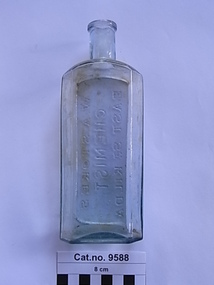
Bottle, glass, c.1887- c.1903
... 'The Pharmaceutical Register cont'd.........No. on register : 140, Date of registration : 30 May 1877, Stokes, William Albert, Balaclava Road, East St. Kilda, Qualification : in business in Victoria before 1 October 1876'. ...'The Pharmaceutical Register cont'd.........No. on register : 140, Date of registration : 30 May 1877, Stokes, William Albert, Balaclava Road, East St. Kilda, Qualification : in business in Victoria before 1 October 1876'. ...Victorian Government gazette, Wednesday January 28, 1902, page 20. 'The Pharmaceutical Register cont'd.........No. on register : 140, Date of registration : 30 May 1877, Stokes, William Albert, Balaclava Road, East St. Kilda, Qualification : in business in Victoria before 1 October 1876'. TROVE : Argus (Melbourne, Vic. : 1848 - 1957), Tuesday 7 September 1875, page 1. 'WANTED, a respectable BOY ; must live in the neighbourhood. References W. A. Stokes, chemist, Balaclava'. TROVE : Bendigo Independent (Vic. : 1891 - 1918), Tuesday 1 December 1914, page 5. 'ABOUT PEOPLE. The death of Dr. James Stokes, M.R.C.S., L., occurred at his home, 43 Ebden Street, Elsternwick, on Saturday at the age of 90 years. Dr. Stokes, who was born in London,, arrived in Victoria in 1849 and for many years practiced in different parts of the State. He was the last on the male side of an old family, one of his sons, who predeceased him, being the late Mr. W. A. Stokes, chemist, of Carlisle Street, St. Kilda. The funeral took place yesterday morning, when the remains were in interred in the family grave at St, Kilda Cemetery'. TROVE : The Age (Melbourne, Vic. : 1854 - 1954) Tuesday 13 December 1887 p 5 Article " ROUGH ON RATS" POISON.' . PROSECUTION UNDER THE POISONS ACT. At the St. Kilda police court, on Friday, W, A. Stokes, chemist, Carlisle-street, Balaclava, was prosecuted under the Poisons Statute on the charge of selling to one Mrs. Hannah Charlton a poison without having made and signed the entry required by the act. A second charge of selling to Mrs, Hannah Charlton a poison without having obtained the signature of the purchaser to an entry as required by the act was also preferred against the defendant. Both cases were taken together. Mr, Donovan appeared to prosecute, and Mr. Cole for the defence. Senior-constable Connell deposed that he knew the defendant. On the 24th of October last an inquest was held at East St. Kilda relative to the cause of the death of a man named Charlton. A packet bearing the label " Rough on Rats," which was found. in the deceased's bedroom, was produced at the inqiry, and afterwards handed over to Mr. Blackett, Government analytical chemist for analysis. The verdict of the jury was that the deceased died from the effects of arsenical poisoning. Hannah Charlton, a widow, residing in South Yarra, said in September last she purchased a packet of "Rough on Rats" from the defendant's assistant. Witness was not asked her name, place of abode, occupation or for what purpose the poison was required; neither did she observe the assistant make any entry in a book, She did not attach her signature to any document, and was not asked to do so. The packet was purchased for the purpose of poisoning rats. Cuthbert Robert Blackett, Government analytical chemist, stated that Constable Ballantyne handed him the packet produced. Witness made an analysis of the contents, and found it composed of arsenic, slightly coloured with a carbonaceous matter. The mayor announced that there was a doubt in the minds of the magistrates as to whether the defendant could be held guilty under the law, but they thought the prosecution had attained its object by making known the fact that "Rough on Rats" is a poison. They thought that such preparations should be entered by the sellers, but in that case they were inclined to give the defendant the benefit of the doubt and dismiss the case.Aqua tinted clear glass bottle with angled corners for stopper seal with text embossed on one side and on base.On side : 'W.A.STOKES CHEMIST EAST ST. KILDA'. On base : 'K6228'.w a stokes, chemist -
 Flagstaff Hill Maritime Museum and Village
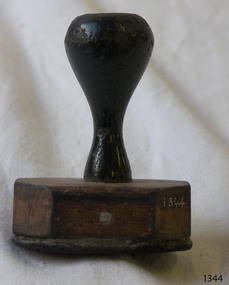
Equipment - Stamp, Cramond and Dickson, Mid-19th century
... St Kilda. They were inspired by the growth in Warrnambool after a visit and opened a second store there in 1855. The Cramond and Dickson store, grocers – drapery – ironmongery - chemist, was located on the corner of Liebig and Timor Streets, Warrnambool (now the site of a Mexican restaurant). Both Cramond and Dickson were involved in the business...St Kilda. They were inspired by the growth in Warrnambool after a visit and opened a second store there in 1855. The Cramond and Dickson store, grocers – drapery – ironmongery - chemist, was located on the corner of Liebig and Timor Streets, Warrnambool (now the site of a Mexican restaurant). Both Cramond and Dickson were involved in the business ...This stamp was made for and used by Cramond and Dickson, a large clothing store on the corner of Liebig and Timor Streets, Warrnambool. They traded from 185 – 1974. John Glass Cramond and James Dickson migrated from Scotland to Melbourne where they opened a Cramond and Dickson store in St Kilda. They were inspired by the growth in Warrnambool after a visit and opened a second store there in 1855. The Cramond and Dickson store, grocers – drapery – ironmongery - chemist, was located on the corner of Liebig and Timor Streets, Warrnambool (now the site of a Mexican restaurant). Both Cramond and Dickson were involved in the business and social aspects of Warrnambool’s community. Cramond and Dickson closed in 1974. An advertisement placed by Cramond and Dickson in The Camperdown Chronicle, Saturday 6th April 1895, states them “showing the latest novelties for the coming winter season” … “import directly from English and Continental manufacturers” … “representatives in London … always in touch with the Newest Continental Fashions” ... “having been established for so many years we know the requirements of the Western District”… “allow 5 percent discount on goods paid for at the time of purchase”.The rubber stamp is significant for its association with Cramond and Dickson, a large retail store established in Warrnambool and operating from 1855 to 1974. Both partners were prominent figures in the community.Rubber stamp, octagonal-sided, with wooden handle. The stamp was owned and used by Warrnambool's department store, Cramond & Dickson."Warrnambool" "Outfitters and Drapers" "Cramond and Dickson"flagstaff hill maritime museum and village, flagstaff hill, maritime village, maritime museum, shipwreck coast, great ocean road, warrnambool, cramond and dickson, warrnambool business, department store, commerce, timor street, liebig street, sales, retail equipment, office equipment, stamp, rubber stamp, business stamp -
 Flagstaff Hill Maritime Museum and Village
Container - Boot Polish Tin, Cramond and Dickson, 1855-1974
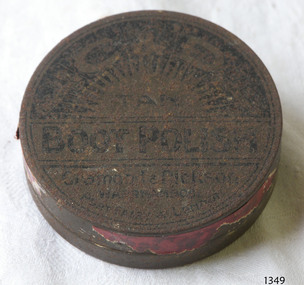
... St Kilda. They were inspired by the growth in Warrnambool after a visit and opened a second store there in 1855. The Cramond and Dickson store, grocers – drapery – ironmongery - chemist, was located on the corner of Liebig and Timor Streets, Warrnambool. Both Cramond and Dickson were involved in the business...St Kilda. They were inspired by the growth in Warrnambool after a visit and opened a second store there in 1855. The Cramond and Dickson store, grocers – drapery – ironmongery - chemist, was located on the corner of Liebig and Timor Streets, Warrnambool. Both Cramond and Dickson were involved in the business ...This tin of boot polish was a product sold be Cramond and Dickson store, which traded in Warrnambool from 1855 - 1974. John Glass Cramond and James Dickson migrated from Scotland to Melbourne, where they opened a Cramond and Dickson store in St Kilda. They were inspired by the growth in Warrnambool after a visit and opened a second store there in 1855. The Cramond and Dickson store, grocers – drapery – ironmongery - chemist, was located on the corner of Liebig and Timor Streets, Warrnambool. Both Cramond and Dickson were involved in the business and social aspects of Warrnambool’s community. Cramond and Dickson closed in 1974. An advertisement placed by Cramond and Dickson in The Camperdown Chronicle, Saturday 6th April 1895, states them “showing the latest novelties for the coming winter season” … “import directly from English and Continental manufacturers” … “representatives in London … always in touch with the Newest Continental Fashions” ... “having been established for so many years we know the requirements of the Western District”… “allow 5 percent discount on goods paid for at the time of purchase”.The tin of boot polish is an example of the goods sold in Warrnambool in the 19th and early 20th century. It s significant for its association with Cramond and Dickson, a large retail store established in Warrnambool and operating from 1855 to 1974. Both partners were prominent figures in the community.Container: a tin of boot polish, with a small amount of light tan polish inside. Inscribed for the makers, Cramond and Dickson, Warrnambool, Port Fairy & Londo. Labelling is partly obscured by corrosion. Instructions for use are on the base of the tin. "C and D Tan Boot Polish" and "Cramond and Dickson, Warrnambool, Port Fairy & London" and "For best results, remove all dust and apply a little C and D Dressing, Brush Briskly" "Weight when packed 1 1/2 ozs net"flagstaff hill maritime museum and village, flagstaff hill, maritime village, maritime museum, shipwreck coast, great ocean road, warrnambool, boot polish, shoe cleaning, grooming, cramond and dickson, warrnambool business, department store, commerce, timor street, liebig street, port fairy business, metal craft, tinware -
 Flagstaff Hill Maritime Museum and Village
Functional object - String Dispenser, Cramond and Dickson, mid-19th century
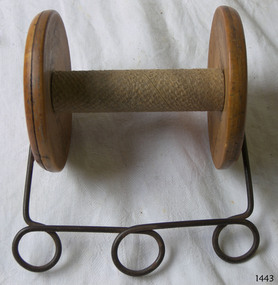
... St Kilda. They were inspired by the growth in Warrnambool after a visit and opened a second store there in 1855. The Cramond and Dickson store, grocers – drapery – ironmongery - chemist, was located on the corner of Liebig and Timor Streets, Warrnambool (now the site of a Mexican restaurant). Both Cramond and Dickson were involved in the business...St Kilda. They were inspired by the growth in Warrnambool after a visit and opened a second store there in 1855. The Cramond and Dickson store, grocers – drapery – ironmongery - chemist, was located on the corner of Liebig and Timor Streets, Warrnambool (now the site of a Mexican restaurant). Both Cramond and Dickson were involved in the business ...This dispenser was most likely used for holding and dispensing string. It was used in the Cramond and Dickson store, which operated in Warrnambool from 1855 + 1974. John Glass Cramond and James Dickson migrated from Scotland to Melbourne where they opened a Cramond and Dickson store in St Kilda. They were inspired by the growth in Warrnambool after a visit and opened a second store there in 1855. The Cramond and Dickson store, grocers – drapery – ironmongery - chemist, was located on the corner of Liebig and Timor Streets, Warrnambool (now the site of a Mexican restaurant). Both Cramond and Dickson were involved in the business and social aspects of Warrnambool’s community. Cramond and Dickson closed in 1974. An advertisement placed by Cramond and Dickson in The Camperdown Chronicle, Saturday 6th April 1895, states them “showing the latest novelties for the coming winter season” … “import directly from English and Continental manufacturers” … “representatives in London … always in touch with the Newest Continental Fashions” ... “having been established for so many years we know the requirements of the Western District”… “allow 5 percent discount on goods paid for at the time of purchase”.The string dispenser is significant for being used at the local historical Cramond and Dickson department store in Warrnambool It is also of significance as it is an example of office equipment used in many stores for the wrapping and securing of parcels.Dispenser for string; spindle, reel or spool with cylindrical axle in centre, a wooden disc at each end. A length of wire is attached to each end and bend into a 'U' shape, with three loops formed across the base of the 'U'. Item came from Cramond and Dickson store in Warrnambool and was possibly used for dispensing string, with the wire being used as a handle or for mounting.flagstaff hill maritime museum and village, flagstaff hill, maritime village, maritime museum, shipwreck coast, great ocean road, warrnambool, cramond and dickson, warrnambool business, department store, commerce, timor street, liebig street, sales, retail equipment, office equipment, string dispenser, string reel, packaging, parcelling -
 Flagstaff Hill Maritime Museum and Village
Equipment - Cash Ball, Cramond and Dickson, 1855 - 1974
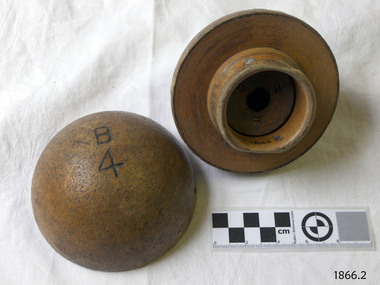
... St Kilda. They were inspired by the growth in Warrnambool after a visit and opened a second store there in 1855. The Cramond and Dickson store, grocers – drapery – ironmongery - chemist, was located on the corner of Liebig and Timor Streets, Warrnambool (now the site of a Mexican restaurant). Both Cramond and Dickson were involved in the business...St Kilda. They were inspired by the growth in Warrnambool after a visit and opened a second store there in 1855. The Cramond and Dickson store, grocers – drapery – ironmongery - chemist, was located on the corner of Liebig and Timor Streets, Warrnambool (now the site of a Mexican restaurant). Both Cramond and Dickson were involved in the business ...This cash ball was used by Cramond and Dickson, a large clothing store on the corner of Liebig and Timor Streets, Warrnambool. The Cash Ball system serviced the ground floor, which measured about 30 metres by 25 metres. An overhead pipe connected each service point in the store, with the pipes connected to the upstairs office. The ball would be filled with a note of details of the sale, and the cash payment; a vacuum system would be activated that would transport the ball upstairs to the office, where details were recorded and the change assembled. Change was placed in the ball, and the vacuum system was activated to return the ball to the correct sales point. A frequent customer has reported that she never remembered the system not working efficiently, and the service was probably quicker than having a cash register at each sales location. John Glass Cramond and James Dickson migrated from Scotland to Melbourne, where they opened a Cramond and Dickson store in St Kilda. They were inspired by the growth in Warrnambool after a visit and opened a second store there in 1855. The Cramond and Dickson store, grocers – drapery – ironmongery - chemist, was located on the corner of Liebig and Timor Streets, Warrnambool (now the site of a Mexican restaurant). Both Cramond and Dickson were involved in the business and social aspects of Warrnambool’s community. Cramond and Dickson closed in 1974. An advertisement placed by Cramond and Dickson in The Camperdown Chronicle, Saturday 6th April 1895, states them “showing the latest novelties for the coming winter season” … “import directly from English and Continental manufacturers” … “representatives in London … always in touch with the Newest Continental Fashions” ... “having been established for so many years we know the requirements of the Western District”… “allow 5 percent discount on goods paid for at the time of purchase”.The cash ball represents an efficient retail system used in the late 19th to mid 20th century to securely transfer cash from one part of the store to another. It is significant for its association with Cramond and Dickson, a large retail store established in Warrnambool and operating from 1855 to 1974. Both partners were prominent figures in the community.Cash ball: a wooden, round, hollow ball in two pieces. Two half spheres that fit into each other securely. Both are marked with carved characters. "B4" and one has "Fancy" marked on it. It was used by Warrnambool's Cramond and Dickson clothing store. "B4" "Fancy"flagstaff hill, warrnambool, shipwrecked-coast, flagstaff-hill, flagstaff-hill-maritime-museum, maritime-museum, shipwreck-coast, flagstaff-hill-maritime-village, cash ball, cramond and dickson, office equipment, retail equipment, cash handling, sales, warrnambool business, department store, commerce, timor street, liebig street -
 Federation University Historical Collection
Book, Ballarat School of Mines Visitors' Book, 1879-1890, 1879-1890
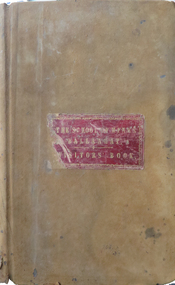
... Holtermann Out of business Adelaide 1890 21 May Mr and Mrs Fairchild, gentleman. Yarra house, Dalgety St, St Kilda...Holtermann Out of business Adelaide 1890 21 May Mr and Mrs Fairchild, gentleman. Yarra house, Dalgety St, St Kilda Ballarat School of Mines Visitors' Book, 1879-1890 Book Book ...James Redmond Gilbert (sr) was born in 1837 at Hamilton, Ontario, Canada. He married Ellen Spouse. He , James Gilbert died on 26 July 1900 at Melbourne, and is buried at Boroondara Cemetery (Kew). J.R Gilbert lived at Running Creek (later Havilah) for some time, and during that time was employed in one of the bigger mines in the district. (Research by Ren at Havilah Research, 2019) Leatherbound ledger with hand written names, professions, residence and remarks relating to visitors to the Ballarat School of Mines. Sample Names: 1881 May 2 David Kerr Diamond Miner South Africa May 2 S. R. Dodds Diamond Miner South Africa May 3 Albert E. King Accountant Adelaide, South Australia "see signature 6 leaves back" May 6 William Morley Wesleyan Minister Auckland, New Zealand May 6 Rainsford Ravin Wellington, New Zealand May 7 Frank E. Lawrence, Lake River, Tasmania May 9 M. Richter Engineer Germany May 9 Dr Wilhelm Landall naturalist Berlin, Germany May 10 William Ralph Heaton Mercantile Birmingham May 11 Arthur I. Traill Grazier Llanpollen, New South Wales May 10 Marian Traill 1882 July 10 Arthur W.W. Brown London July 10 Benjamin Spargo Mining Mananger and owner Snowy Creek July 10 Thomas Cooke Miner Ballarat July 14 Robert H. Kenny July 14 Mr and Mrs Buston, [Indigo Planter?] Bengal, Indonesia July 14 Samuel H. Halker Ballarat July 14 Charles Phelan Talbot July 14 E. Walker Ballarat 1884 June 30 M.N. Cooper Dunedin, new Zealand June 30 Richard Hosking gardiner Gong Gong Well pleased with School June 30 Humphrey John Ballarat July 1 Cecily Gilbert Melbourne July 1 Florence Shrivall Melbourne July 1 [W.N. Marsh?] Colonial Secretary Hong Kong July 1 Louis Fause Engine Driver Dunolly July 1 John L. Bertram Blacksmith Melbourne July 1 Thomas Eardley Coachmaker London "Exceedingly obliged to Mr Oddie for a very pleasant instruction time spent in inspection of the various scientific appliances in the Ballarat School of Mines." (Donation 2/6) July 4 E. Goodwin [David?] Artist Spellbound July 4 W. Glumley Station Master Murtoa July July 4 James Thomas Miner Corrinondie, New Zealand "Very pleased with the School in all its branches. I hope to contribute to the specimen department. J.T." July 8 Robert Wall Engine Driver 1885 September 16 J.W. Springthorpe, M.D., Melbourne (very much pleased in every way) September 26 M. Oddie, Ballarat 1886 January 12 William Piekard, Leicester, England January 12 Robert Linford, Norwich, England January 12 H. Tipping, Draughtsman, Adelaide (Very instructive and should be taken advantage of by all who can) January 12 Fred H.K. Dreslecher, London (ditto) January 23 Walter Redgate, Manchester (ditto) April 7 Annie Bellingham, Richmond April 9 Fred Kruger, Landscape Photo, Geelong April 14 Mary Barry, Murtoa April 19 N.J. Tabuteau Accountant Napier, New Zealand April 19 George N. [Baroft?] Gentleman Cheshire, England April 21 Hon. George D'Almaine, Peer of England, London April 21 Lord Augustus Honour April 21 William Holt, South Melbourne April 21 H. Bartell, Gentleman, Smythes April 21 Fred Musgrove, Gentleman April 21 A. Chirnside, Squatter April 23 Alice Cravino, student, Buninyong April 24 East Melbourne Bicycle Club April 28 J. Kinnear, Kyneton April 28 J.P. Kinnear, Kyneton May 19 Bob Selby, Doctor, Ballarat May 19 J.W.M.. Quiggin, globe trotter, Picton (NS Wales) May 25 Arthur Night, Sutton Hotel, Ballarat (very fair) May 28 D. Kelly, attendant, China May 28 J. Kelly, schoolboy, China June 1 Joseph Jelbart, Blacksmith, Harrow September 9 David Ham, M.L.C. Ballarat ( A right to be pleased) September 9 J.J. Green, Merchant, Adelaide (Very much pleased with my visit to this intitiution it has my hearty sympathy and appreciation, Much pleased at what I have seen its value to the community) 9 December James H. Tappin, Agent, Ballarat (very pleased with instruction 1887 March 20 Thomas Bath Learmonth March 20 James R. Gilbert= Miner Running Creek March 20 C. Holtermann Out of business Adelaide 1890 21 May Mr and Mrs Fairchild, gentleman. Yarra house, Dalgety St, St Kildaballarat school of mines, visitors, j.w. springthorpe, chinese visitors, visitors' book, running creek, james redmond gilbert sr, havilah -
 City of Moorabbin Historical Society (Operating the Box Cottage Museum)
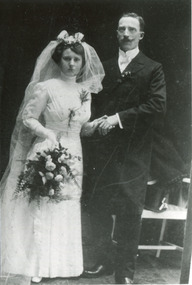
Photograph, B/W, x3 Wedding August & Frieda Rietmann 1910 and Certicicate, 1910,1915
... business in the Box Cottage during the latter 1920s. After becoming interested in pressed cement casting, he took on apprentices (1930s Depression) and among his products were garden furniture, pots and also street lamp standards, some of which were installed in St Kilda Road. ...August Rietmann (1877-1951) of Lustdorf ,Switzerland, married Maria Frieda Oesschlager (2/21878- 22/7/1942) of Baden Baden, Germany on 6/8/1910 In 1915 August and his wife Frieda migrated to Melbourne, Victoria, Australia. They leased Box Cottage, Ormond in 1917 and raised two children, Stefanie (1918 -2006) and William (1920- 1997). 1935 August purchased the property and the family used the Cottage during the day and slept in the Front House. August was a monumental mason, potter and sculptor, and was employed at Corbens Ltd Clifton Hill, to carve war memorials in Victoria post WW1 c 1915-1922. During the 1920's August set up his own business in pressed cement making pot plants, columns,paving slabs and lampstands. He continued to carve headstones and figures and took contract work for Artists eg Paul Mountford. He built a workshop in the Barn and used the Cottage for plaster moulding. His son William joined the business and and the family continued to use the site after August died in 1951. Rietman's Landscaping Ltd moved to Bay Road Highett in 1953 and later to Carrum. The land, containing the Box Cottage, was sold to Lewis Timber Pty Ltd in 1970 and Mr Lewis proposed that Moorabbin City Council should preserve the heritage Cottage. In 1984 the Cottage was dismantled and reconstructed in the adjacent Joyce Park.The Rietman family is an example of the diverse nationalities that lived and worked productively in Moorabbin Shire 1871–1933 , the City of Moorabbin 1934-1994 and continues today in the Cities of Glen Eira, Kingston, Bayside, and Monash. August, a sculptor and stone mason, was employed by Corben Pty Ltd Clifton Hill to carve WW1 Memorials before establishing his own successful masonry business in the Box Cottage during the latter 1920s. After becoming interested in pressed cement casting, he took on apprentices (1930s Depression) and among his products were garden furniture, pots and also street lamp standards, some of which were installed in St Kilda Road. After August’s death in 1951, his family continued the business ‘Rietman’s Landscaping Ltd.’, at Highett and Carrum.a) Photograph Black & White August & Frieda Rietmann Wedding 6/8/1910 in Baden Baden ; b) Passport Photograph August Rietmann 1915; c) Photograph Frieda Rietmann 1915; d) Document Wedding Certificate August & Frieda Rietmann Baden Baden 1910a) b) c) Handwritten information d) Official Document in Germanrietmann august, rietman august, rietmann frieda, rietman frieda, stonnington city town hall, war memorials, world war 1 1914-1918, rietman stefanie, rennick stefanie, francis stefanie, rietman william, rietman ray, mountford paul, malvern city town hall,box cottage museum ormond, box william, box elizabeth, joyce park ormond, rietman's landscaping pty ltd, bay road highett, macrobertson pty ltd, coleraine soldier memorial 1921, -
 City of Moorabbin Historical Society (Operating the Box Cottage Museum)
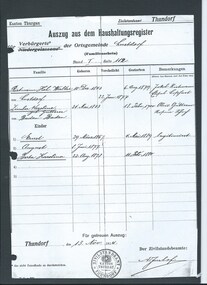
Documents, x3 Printed, Census Lustdorf 1914,15, Swiss Citizen Pass1915, 1914-1915
... business in the Box Cottage during the latter 1920s. After becoming interested in pressed cement casting, he took on apprentices (1930s Depression) and among his products were garden furniture, pots and also street lamp standards, some of which were installed in St Kilda Road. ...August Rietmann (1877-1951) of Lustdorf ,Switzerland, married Maria Frieda Oesschlager (2/21878- 22/7/1942) of Baden Baden, Germany on 6/8/1910 In 1915 August and his wife Frieda migrated to Melbourne, Victoria, Australia. They leased Box Cottage, Ormond in 1917 and raised two children, Stefanie (1918 -2006) and William (1920- 1997). 1935 August purchased the property and the family used the Cottage during the day and slept in the Front House. August was a monumental mason, potter and sculptor, and was employed at Corbens Ltd Clifton Hill, to carve war memorials in Victoria post WW1 c 1915-1922. During the 1920's August set up his own business in pressed cement making pot plants, columns,paving slabs and lampstands. He continued to carve headstones and figures and took contract work for Artists eg Paul Mountford. He built a workshop in the Barn and used the Cottage for plaster moulding. His son William joined the business and and the family continued to use the site after August died in 1951. Rietmann Landscaping Ltd moved to Bay Road Highett in 1953 and later to Carrum. The land, containing the Box Cottage, was sold to Lewis Timber Pty Ltd in 1970 and Mr Lewis proposed that Moorabbin City Council should preserve the heritage Cottage. In 1984 the Cottage was dismantled and reconstructed in the adjacent Joyce Park. The Rietman family is an example of the diverse nationalities that lived and worked productively in Moorabbin Shire 1871–1933 , the City of Moorabbin 1934-1994 and continues today in the Cities of Glen Eira, Kingston, Bayside, and Monash. August, a sculptor and stone mason, was employed by Corben Pty Ltd Clifton Hill to carve WW1 Memorials before establishing his own successful masonry business in the Box Cottage during the latter 1920s. After becoming interested in pressed cement casting, he took on apprentices (1930s Depression) and among his products were garden furniture, pots and also street lamp standards, some of which were installed in St Kilda Road. After August’s death in 1951, his family continued the business ‘Rietman’s Landscaping Ltd.’, at Highett and Carrum.Documents a) Census 1914 Household Register Lustdorf, Switzerland; b) Census 1915 Household Register Lustdorf, Switzerland; c) Swiss Confederation Citizen ship I.D Pass Frieda Rietman 4/8/1915;Printed Government Documents in Swiss Language lustdorf switzerland, rietmann august, rietman august, rietmann frieda, rietman frieda, stonnington city town hall, war memorials, world war 1 1914-1918, rietman stefanie, rennick stefanie, francis stefanie, rietman william, rietman ray, mountford paul, malvern city town hall,box cottage museum ormond, box william, box elizabeth, joyce park ormond, rietman's landscaping pty ltd, bay road highett, macrobertson pty ltd, coleraine soldier memorial 1921,, box cottage museum ormond -
 City of Moorabbin Historical Society (Operating the Box Cottage Museum)
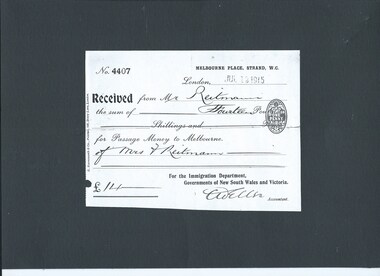
Document, x 2 ,Photograph colour x1, Reciept NSW Govt. Immigration Dept., Ticket Orient Line 'Osterley' 1915 Mr Rietmann, Osterley steam ship, 1915
... business in the Box Cottage during the latter 1920s. After becoming interested in pressed cement casting, he took on apprentices (1930s Depression) and among his products were garden furniture, pots and also street lamp standards, some of which were installed in St Kilda Road. ...August Rietmann (1877-1951) of Lustdorf ,Switzerland, married Maria Frieda Oesschlager (2/21878- 22/7/1942) of Baden Baden, Germany on 6/8/1910 In August 8th 1915 August and his wife Frieda migrated to Melbourne, Victoria, Australia sailing on the Steam Ship ‘Osterley’ from Marseilles to Melbourne They leased Box Cottage, Ormond in 1917 and raised two children, Stefanie (1918 -2006) and William (1920- 1997). 1935 August purchased the property and the family used the Cottage during the day and slept in the Front House. August was a monumental mason, potter and sculptor, and was employed at Corbens Ltd Clifton Hill, to carve war memorials in Victoria post WW1 c 1915-1922. During the 1920's August set up his own business in pressed cement making pot plants, columns,paving slabs and lampstands. He continued to carve headstones and figures and took contract work for Artists eg Paul Mountford. He built a workshop in the Barn and used the Cottage for plaster moulding. His son William joined the business and and the family continued to use the site after August died in 1951. Rietmann Landscaping Ltd moved to Bay Road Highett in 1953 and later to Carrum. The land, containing the Box Cottage, was sold to Lewis Timber Pty Ltd in 1970 and Mr Lewis proposed that Moorabbin City Council should preserve the heritage Cottage. In 1984 the Cottage was dismantled and reconstructed in the adjacent Joyce Park. 'Osterley' SS of the Orient Line, 12,129 tons, was a Royal Mail Steam- Ship sailing to and from Australia c1915The Rietman family is an example of the diverse nationalities that lived and worked productively in Moorabbin Shire 1871–1933 , the City of Moorabbin 1934-1994 and continues today in the Cities of Glen Eira, Kingston, Bayside, and Monash. August, a sculptor and stone mason, was employed by Corben Pty Ltd Clifton Hill to carve WW1 Memorials before establishing his own successful masonry business in the Box Cottage during the latter 1920s. After becoming interested in pressed cement casting, he took on apprentices (1930s Depression) and among his products were garden furniture, pots and also street lamp standards, some of which were installed in St Kilda Road. After August’s death in 1951, his family continued the business ‘Rietman’s Landscaping Ltd.’, at Highett and Carrum.Printed Documents a) Mr A Rietmann Receipt from Immigration Department of New South Wales Australia; b) Original Ticket Orient Line Ship 'Osterley' Marseilles to Melbourne 1915 c) Photograph colour of 'Osterley' Steam Shipa) No. 4407 MELBOURNE PLACE, THE STRAND W.C. /London July 12 1915/ Received from Mr Rietmann Fourteen Pounds for passage Money to Melbourne b) ORIENT LINE/ ROYAL MAIL STEAM-SHIPS TO AUSTRALIA/ ............THIRD CLASS PASSENGER CONTRACT TICKET..............OSTERLEY ... to take in passengers of the Port of Marseilles for ..........MELBOURNE............on the Eighth day of August 1915 ..........Mr August Rietmann .......................£15:4 : - to be paid before embarkation c) Osterly Steam ship en route to Melbourneport of marseilles france, melbourne australia, orient steam ship line, osterley steam ship,rietmann august, rietman august, rietmann frieda, rietman frieda, stonnington city town hall, war memorials, world war 1 1914-1918, rietman stefanie, rennick stefanie, francis stefanie, rietman william, rietman ray, mountford paul, malvern city town hall,box cottage museum ormond, box william, box elizabeth, joyce park ormond, rietman's landscaping pty ltd, bay road highett, macrobertson pty ltd, coleraine soldier memorial 1921, -
 City of Moorabbin Historical Society (Operating the Box Cottage Museum)
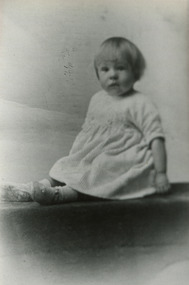
Photographs x 2 B/W, Stefanie & William Rietman c1920, c1920
... business in the Box Cottage during the latter 1920s. After becoming interested in pressed cement casting, he took on apprentices (1930s Depression) and among his products were garden furniture, pots and also street lamp standards, some of which were installed in St Kilda Road. ...Stefanie and William Rietman were the children of August and Frieda Rietmann. Stefanie became a school teacher and designed and made resin jewellery, Later she established a Native grass garden in Joyce park, Ormond, William joined August's business and after his death continued the development of Rietman's Landscaping and pottery firm . His son Ray also continued the family business in Bay Road Highett and the Carrum. August Rietman 1877-1951 and his wife Frieda 1878-1942 leased the Cottage in 1917 and raised 2 children Stefanie 1918-2006, and William 1920– 1997. August was a Monumental Mason / Potter / Sculptor and he was employed at Corbens Ltd Clifton Hill, to make the War Memorials for many towns post WW1. August purchased the property 1935,and established a pressed concrete business using the cottage as a workshop and storeroom After August died in 1951, William, his son, continued to work in the business from the site until the land was sold to Lewis Co. Ltd Timber Merchants in 1970. Rietman's Landscaping Ltd moved to Bay Road Highett 1953 and later to Carrum. The Rietman family is an example of the diverse nationalities that lived and worked productively in Moorabbin Shire 1871–1933 , the City of Moorabbin 1934-1994 and continues today in the Cities of Glen Eira, Kingston, Bayside, and Monash. August, a sculptor and stone mason, was employed by Corben Pty Ltd Clifton Hill to carve WW1 Memorials before establishing his own successful masonry business in the Box Cottage during the latter 1920s. After becoming interested in pressed cement casting, he took on apprentices (1930s Depression) and among his products were garden furniture, pots and also street lamp standards, some of which were installed in St Kilda Road. After August’s death in 1951, his family continued the business ‘Rietman’s Landscaping Ltd.’, at Highett and Carrum.Photographs x 2 Black & White, of Stefanie Amilie Rietman, and William Henry Rietman c 1920 at Ormond AustraliaHand written namesrietmann august, rietman august, rietmann frieda, rietman frieda, stonnington city town hall, war memorials, world war 1 1914-1918, rietman stefanie, rennick stefanie, francis stefanie, rietman william, rietman ray, mountford paul, malvern city town hall, box cottage museum ormond, box william, box elizabeth, joyce park ormond, rietman's landscaping pty ltd, bay road highett, macrobertson pty ltd, coleraine soldier memorial 1921, resin jewellery, australian native grasses, schools, education, craftwork, pottery, ceramics, ormond state school -
 City of Moorabbin Historical Society (Operating the Box Cottage Museum)
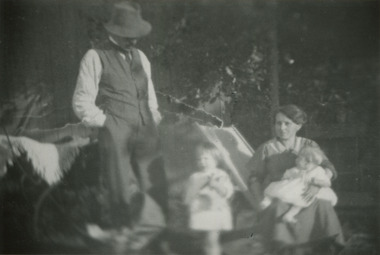
Photographs, x 2 B/W Rietmann Family c1920's, c1920s
... business in the Box Cottage during the latter 1920s. After becoming interested in pressed cement casting, he took on apprentices (1930s Depression) and among his products were garden furniture, pots and also street lamp standards, some of which were installed in St Kilda Road. ...August Rietmann (1877-1951) of Lustdorf ,Switzerland, married Maria Frieda Oesschlager (2/2/1878- 22/7/1942) of Baden Baden, Germany on 6/8/1910 In August 8th 1915 August and his wife Frieda migrated to Melbourne, Victoria, Australia sailing on the Steam Ship ‘Osterley’ from Marseilles to Melbourne They leased Box Cottage, Ormond in 1917 and raised two children, Stefanie (1918 -2006) and William (1920- 1997). 1935 August purchased the property and the family used the Cottage during the day and slept in the Front House. August was a monumental mason, potter and sculptor, and was employed at Corbens Ltd Clifton Hill, to carve war memorials in Victoria post WW1 c 1915-1922. During the 1920's August set up his own business in pressed cement making pot plants, columns,paving slabs and lampstands. He continued to carve headstones and figures and took contract work for Artists eg Paul Mountford. He built a workshop in the Barn and used the Cottage for plaster moulding. His son William joined the business and and the family continued to use the site after August died in 1951. Rietmann Landscaping Ltd moved to Bay Road Highett in 1953 and later to Carrum. The land, containing the Box Cottage, was sold to Lewis Timber Pty Ltd in 1970 and Mr Lewis proposed that Moorabbin City Council should preserve the heritage Cottage. In 1984 the Cottage was dismantled and reconstructed in the adjacent Joyce Park. The Rietman family is an example of the diverse nationalities that lived and worked productively in Moorabbin Shire 1871–1933 , the City of Moorabbin 1934-1994 and continues today in the Cities of Glen Eira, Kingston, Bayside, and Monash. August, a sculptor and stone mason, was employed by Corben Pty Ltd Clifton Hill to carve WW1 Memorials before establishing his own successful masonry business in the Box Cottage during the latter 1920s. After becoming interested in pressed cement casting, he took on apprentices (1930s Depression) and among his products were garden furniture, pots and also street lamp standards, some of which were installed in St Kilda Road. After August’s death in 1951, his family continued the business ‘Rietman’s Landscaping Ltd.’, at Highett and Carrum.Photographs x2 Black & White of August and Frieda Rietmann with children and friends at Ormond and Sorrento in 1920sHand written a) at Ormond 1921 ; b) at Sorrento c 1920'ssorrento beach victoria, box cottage museum, ormond, rietmann august, rietman august, rietmann frieda, rietman frieda, stonnington city town hall, war memorials, world war 1 1914-1918, rietman stefanie, rennick stefanie, francis stefanie, rietman william, rietman ray, mountford paul, malvern city town hall, box cottage museum ormond, box william, box elizabeth, joyce park ormond, rietman's landscaping pty ltd, bay road highett, macrobertson pty ltd, coleraine soldier memorial 1921 -
 City of Moorabbin Historical Society (Operating the Box Cottage Museum)
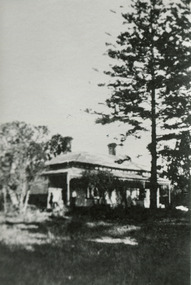
Photographs x 3 B/W Box Cottage Front House with Pine Trees at Ormond, Frieda in garden c 1921, c1921
... business in the Box Cottage during the latter 1920s. After becoming interested in pressed cement casting, he took on apprentices (1930s Depression) and among his products were garden furniture, pots and also street lamp standards, some of which were installed in St Kilda Road. ...In 1855 William and Elizabeth Box migrated from Sussex England to Melbourne and in 1868, 1869 purchased 2 x 10acre Lots in part of Henry Dendy's Special Survey Brighton 1841. A Cottage was already on the land and they established a flower garden and raised 13 children. In 1888 William sold one Lot and built a new Front House . William died 1902 and Elizabeth sold the land except 1 acre and retained both the Cottage and the Front House. After her death in 1914, her daughters Violet and Ada leased the Cottage and Front House to tenants until August Rietmann purchased the property in 1935. August Rietmann (1877-1951) of Lustdorf ,Switzerland, married Maria Frieda Oesschlager (2/2/1878- 22/7/1942) of Baden Baden, Germany on 6/8/1910. In August 8th 1915 August and his wife Frieda migrated to Melbourne, Victoria, Australia sailing on the Steam Ship ‘Osterley’ from Marseilles to Melbourne They leased Box Cottage, Ormond in 1917 and raised two children, Stefanie (1918 -2006) and William (1920- 1997). 1935 August purchased the property and the family used the Cottage during the day and slept in the Front House. August was a monumental mason, potter and sculptor, and was employed at Corbens Ltd Clifton Hill, to carve war memorials in Victoria post WW1 c 1915-1922. During the 1920's August set up his own business in pressed cement making pot plants, columns,paving slabs and lampstands. He continued to carve headstones and figures and took contract work for Artists eg Paul Mountford. He built a workshop in the Barn and used the Cottage for plaster moulding. His son William joined the business and and the family continued to use the site after August died in 1951. Rietmann Landscaping Ltd moved to Bay Road Highett in 1953 and later to Carrum. The land, containing the Box Cottage, was sold to Lewis Timber Pty Ltd in 1970 and Mr Lewis proposed that Moorabbin City Council should preserve the heritage Cottage. In 1984 the Cottage was dismantled and reconstructed in the adjacent Joyce Park. The Rietman family is an example of the diverse nationalities that lived and worked productively in Moorabbin Shire 1871–1933 , the City of Moorabbin 1934-1994 and continues today in the Cities of Glen Eira, Kingston, Bayside, and Monash. August, a sculptor and stone mason, was employed by Corben Pty Ltd Clifton Hill to carve WW1 Memorials before establishing his own successful masonry business in the Box Cottage during the latter 1920s. After becoming interested in pressed cement casting, he took on apprentices (1930s Depression) and among his products were garden furniture, pots and also street lamp standards, some of which were installed in St Kilda Road. After August’s death in 1951, his family continued the business ‘Rietman’s Landscaping Ltd.’, at Highett and Carrum.Photographs x 3 Black & White of the Front House with Pine Trees at Ormond and Frieda Rietmann in garden c1921 Photograph x 1 Colour Digital by Glen Lewis of these Pine Trees in situ Lewis Timber Pty Ltd Ormond 2020Handwritten a) path to Front House c 1921; b) Pine trees and Front House c) Frieda in garden c1921box william, box elizabeth, box cottage museum ormond, dendy henry, dendy's special survey brighton 1841, market gardeners, seedling nurseries, rietmann august, rietman august, rietmann frieda, rietman frieda, stonnington city town hall, war memorials, world war 1 1914-1918, rietman stefanie, rennick stefanie, francis stefanie, rietman william, rietman ray, mountford paul, malvern city town hall, joyce park ormond, rietman's landscaping pty ltd, bay road highett, macrobertson pty ltd, coleraine soldier memorial 1921 -
 City of Moorabbin Historical Society (Operating the Box Cottage Museum)
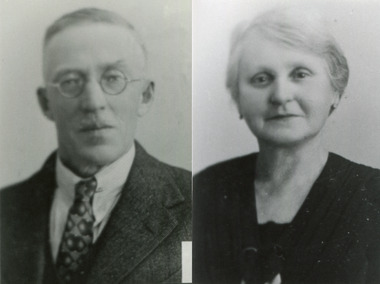
Photographs, x 3 B/W August and Frieda Rietman c 1939 and Gravestone c 1990, 1939
... business in the Box Cottage during the latter 1920s. After becoming interested in pressed cement casting, he took on apprentices (1930s Depression) and among his products were garden furniture, pots and also street lamp standards, some of which were installed in St Kilda Road. ...August Rietmann (1877-1951) of Lustdorf ,Switzerland, married Maria Frieda Oesschlager (2/2/1878- 22/7/1942) of Baden Baden, Germany on 6/8/1910 In August 8th 1915 August and his wife Frieda migrated to Melbourne, Victoria, Australia sailing on the Steam Ship ‘Osterley’ from Marseilles to Melbourne They leased Box Cottage, Ormond in 1917 and raised two children, Stefanie (1918 -2006) and William (1920- 1997). 1935 August purchased the property and the family used the Cottage during the day and slept in the Front House. August was a monumental mason, potter and sculptor, and was employed at Corbens Ltd Clifton Hill, to carve war memorials in Victoria post WW1 c 1915-1922. During the 1920's August set up his own business in pressed cement making pot plants, columns,paving slabs and lampstands. He continued to carve headstones and figures and took contract work for Artists eg Paul Mountford. He built a workshop in the Barn and used the Cottage for plaster moulding. His son William joined the business and and the family continued to use the site after August died in 1951. Rietmann Landscaping Ltd moved to Bay Road Highett in 1953 and later to Carrum. The land, containing the Box Cottage, was sold to Lewis Timber Pty Ltd in 1970 and Mr Lewis proposed that Moorabbin City Council should preserve the heritage Cottage. In 1984 the Cottage was dismantled and reconstructed in the adjacent Joyce Park. The Rietman family is an example of the diverse nationalities that lived and worked productively in Moorabbin Shire 1871–1933 , the City of Moorabbin 1934-1994 and continues today in the Cities of Glen Eira, Kingston, Bayside, and Monash. August, a sculptor and stone mason, was employed by Corben Pty Ltd Clifton Hill to carve WW1 Memorials before establishing his own successful masonry business in the Box Cottage during the latter 1920s. After becoming interested in pressed cement casting, he took on apprentices (1930s Depression) and among his products were garden furniture, pots and also street lamp standards, some of which were installed in St Kilda Road. After August’s death in 1951, his family continued the business ‘Rietman’s Landscaping Ltd.’, at Highett and Carrum.Photographs x 2 Black & White, of August and Frieda Rietmann World War 11 Registration 1939; Photograph x1 Black & White of the Rietmann Memorial at Cheltenham new Cemetery c1990Hand written informationrietmann august, rietman august, rietmann frieda, rietman frieda, stonnington city town hall, war memorials, world war 1 1914-1918, rietman stefanie, rennick stefanie, francis stefanie, rietman william, rietman ray, mountford paul, malvern city town hall, box cottage museum ormond, box william, box elizabeth, joyce park ormond, rietman's landscaping pty ltd, bay road highett, macrobertson pty ltd, coleraine soldier memorial 1921, box cottage ormond -
 City of Moorabbin Historical Society (Operating the Box Cottage Museum)
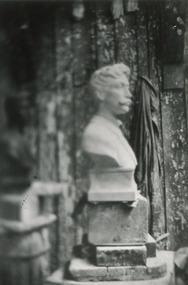
Photograph x 1 B/W 'MacRobertson' Bust , Letter, Envelope 1922 August Rietmann sculptor, 1922
... business in the Box Cottage during the latter 1920s. After becoming interested in pressed cement casting, he took on apprentices (1930s Depression) and among his products were garden furniture, pots and also street lamp standards, some of which were installed in St Kilda Road. ...1922 August Rietmann was commissioned to sculpt a bust of Sir MacPherson Robertson 1859-1945, confectionery maker, ( famous for Freddo Frogs and Cherry Ripe chocolate bar). The Bust was installed at Mac Robertson Girls High School for which he had donated funds for the building. 'MacRob' also funded the bridge over the Yarra River and the herbarium in the Botanical Gardens that all bear his name. August Rietmann (1877-1951) of Lustdorf ,Switzerland, married Maria Frieda Oesschlager (2/2/1878- 22/7/1942) of Baden Baden, Germany on 6/8/1910 In August 8th 1915 August and his wife Frieda migrated to Melbourne, Victoria, Australia sailing on the Steam Ship ‘Osterley’ from Marseilles to Melbourne They leased Box Cottage, Ormond in 1917 and raised two children, Stefanie (1918 -2006) and William (1920- 1997). 1935 August purchased the property and the family used the Cottage during the day and slept in the Front House. August was a monumental mason, potter and sculptor, and was employed at Corbens Ltd Clifton Hill, to carve war memorials in Victoria post WW1 c 1915-1922. During the 1920's August set up his own business in pressed cement making pot plants, columns,paving slabs and lampstands. He continued to carve headstones and figures and took contract work for Artists eg Paul Mountford. He built a workshop in the Barn and used the Cottage for plaster moulding. His son William joined the business and and the family continued to use the site after August died in 1951. Rietmann Landscaping Ltd moved to Bay Road Highett in 1953 and later to Carrum. The land, containing the Box Cottage, was sold to Lewis Timber Pty Ltd in 1970 and Mr Lewis proposed that Moorabbin City Council should preserve the heritage Cottage. In 1984 the Cottage was dismantled and reconstructed in the adjacent Joyce Park. The Rietman family is an example of the diverse nationalities that lived and worked productively in Moorabbin Shire 1871–1933 , the City of Moorabbin 1934-1994 and continues today in the Cities of Glen Eira, Kingston, Bayside, and Monash. August, a sculptor and stone mason, was employed by Corben Pty Ltd Clifton Hill to carve WW1 Memorials before establishing his own successful masonry business in the Box Cottage during the latter 1920s. After becoming interested in pressed cement casting, he took on apprentices (1930s Depression) and among his products were garden furniture, pots and also street lamp standards, some of which were installed in St Kilda Road. After August’s death in 1951, his family continued the business ‘Rietman’s Landscaping Ltd.’, at Highett and Carrum.Photograph x 1 Black & White Sculptured bust of Sir MacPherson Robertson c 1922; b) Letter, printed , typed from Sir MacPherson Robertson to August Rietmann (Richman) with payment for the Bust - £65-5-0 - ; c) Envelope, printed, typed addressed to Mr Rietmann { Richman) at Corbens Ltd.; d) reverse of envelope printed a) 1922; b) printed letter MacRobertson Pty Ltd ; c) printed envelope MacRobertson Ltdmacrobertson chocolate ltd., macrobertson girls high school, fitzroy town hall, rietmann august, rietman august, rietmann frieda, rietman frieda, stonnington city town hall, war memorials, world war 1 1914-1918, rietman stefanie, rennick stefanie, francis stefanie, rietman william, rietman ray, mountford paul, malvern city town hall, box cottage museum ormond, box william, box elizabeth, joyce park ormond, rietman's landscaping pty ltd, bay road highett, macrobertson pty ltd, coleraine soldier memorial 1921, box cottage ormond, freddo frog chocolate, cherry ripe chocolate bar, cadbury schweppes ltd., robertson sir macpherson 1859-1945, confectionery, chocolate -
 City of Moorabbin Historical Society (Operating the Box Cottage Museum)
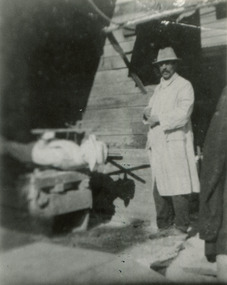
Photographs, x3 B/W August Rietmann working at Corbens Ltd c1915-22, c1915 -1922
... business in the Box Cottage during the latter 1920s. After becoming interested in pressed cement casting, he took on apprentices (1930s Depression) and among his products were garden furniture, pots and also street lamp standards, some of which were installed in St Kilda Road. ...August Rietmann (1877-1951) of Lustdorf ,Switzerland, married Maria Frieda Oesschlager (2/2/1878- 22/7/1942) of Baden Baden, Germany on 6/8/1910 In August 8th 1915 August and his wife Frieda migrated to Melbourne, Victoria, Australia sailing on the Steam Ship ‘Osterley’ from Marseilles to Melbourne They leased Box Cottage, Ormond in 1917 and raised two children, Stefanie (1918 -2006) and William (1920- 1997). 1935 August purchased the property and the family used the Cottage during the day and slept in the Front House. August was a monumental mason, potter and sculptor, and was employed at Corbens Ltd Clifton Hill, to carve war memorials in Victoria post WW1 c 1915-1922. During the 1920's August set up his own business in pressed cement making pot plants, columns,paving slabs and lampstands. He continued to carve headstones and figures and took contract work for Artists eg Paul Mountford. He built a workshop in the Barn and used the Cottage for plaster moulding. His son William joined the business and and the family continued to use the site after August died in 1951. Rietmann Landscaping Ltd moved to Bay Road Highett in 1953 and later to Carrum. The land, containing the Box Cottage, was sold to Lewis Timber Pty Ltd in 1970 and Mr Lewis proposed that Moorabbin City Council should preserve the heritage Cottage. In 1984 the Cottage was dismantled and reconstructed in the adjacent Joyce Park. The Rietman family is an example of the diverse nationalities that lived and worked productively in Moorabbin Shire 1871–1933 , the City of Moorabbin 1934-1994 and continues today in the Cities of Glen Eira, Kingston, Bayside, and Monash. August, a sculptor and stone mason, was employed by Corben Pty Ltd Clifton Hill to carve WW1 Memorials before establishing his own successful masonry business in the Box Cottage during the latter 1920s. After becoming interested in pressed cement casting, he took on apprentices (1930s Depression) and among his products were garden furniture, pots and also street lamp standards, some of which were installed in St Kilda Road. After August’s death in 1951, his family continued the business ‘Rietman’s Landscaping Ltd.’, at Highett and Carrum.a) Photograph Black & White, August working at Corbens Ltd Clifton Hill c 1915-1922 b) Photograph, Black & White, August with sculpture of Jack Eugene Riva, 1922 c) Photograph, Black & White, August carving a WW1 Soldier Memorial c 1922Handwritten August at Corbens Ltdcorbens ltd clifton hill, rietmann august, rietman august, rietmann frieda, rietman frieda, stonnington city town hall, war memorials, world war 1 1914-1918, rietman stefanie, rennick stefanie, francis stefanie, rietman william, rietman ray, mountford paul, malvern city town hall, box cottage museum ormond, box william, box elizabeth, joyce park ormond, rietman's landscaping pty ltd, bay road highett, macrobertson pty ltd, coleraine soldier memorial 1921, box cottage ormond -
 City of Moorabbin Historical Society (Operating the Box Cottage Museum)
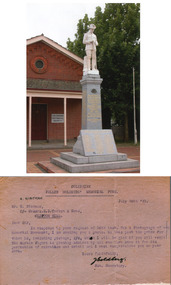
Photograph, Colour , WW1 Memorial at Coleraine, Letter to August Rietmann, c1921, c 1990
... business in the Box Cottage during the latter 1920s. After becoming interested in pressed cement casting, he took on apprentices (1930s Depression) and among his products were garden furniture, pots and also street lamp standards, some of which were installed in St Kilda Road. ...August Rietmann (1877-1951) of Lustdorf ,Switzerland, married Maria Frieda Oesschlager (1878- 1942) of Baden Baden, in Germany on 6/8/1910 In August 8th 1915 August and his wife Frieda migrated to Melbourne, Victoria, Australia sailing on the Steam Ship ‘Osterley’ from Marseilles to Melbourne August and Frieda leased the Box Cottage in 1917 and raised 2 children Stefanie 1918-2006, and William 1920– 1997. August was a Monumental Mason / Potter / Sculptor and he was employed at Corbens Ltd Clifton Hill, to make the World War 1 Memorials for many Victorian towns c1920. This Soldier Statue at Coleraine was typical of many carved by August, however it was not usual for him to sign this work .Records have only been found for the Towns of Boort, Morewell and Coleraine. Other Soldier statue memorials in the same style are at Myrtleford, Benalla, Bonnie Doon and Yarck and possibly other towns. August purchased the property 1935,and established a pressed concrete business using the cottage as a workshop and storeroom After August died in 1951, William, his son, continued to work in the business from the site until the land was sold to Lewis Co. Ltd Timber Merchants in 1970. Rietman's Landscaping Ltd moved to Bay Road Highett 1953 and later to Carrum. The Rietman family is an example of the diverse nationalities that lived and worked productively in Moorabbin Shire 1871–1933 , the City of Moorabbin 1934-1994 and continues today in the Cities of Glen Eira, Kingston, Bayside, and Monash. August, a sculptor and stone mason, was employed by Corben Pty Ltd Clifton Hill to carve WW1 Memorials before establishing his own successful masonry business in the Box Cottage during the latter 1920s. After becoming interested in pressed cement casting, he took on apprentices (1930s Depression) and among his products were garden furniture, pots and also street lamp standards, some of which were installed in St Kilda Road. After August’s death in 1951, his family continued the business ‘Rietman’s Landscaping Ltd.’, at Highett and Carrum.a) Photograph , colour of the WW1 Memorial at Coleraine, Victoria carved by August Rietman st Corbens Ltd. c1921. b) Letter from The Secretary of the Coleraine Fallen Soldiers' Memorial Funda) Handwritten information b) Typed letter signed by Goldbergrietmann august, rietman august, rietmann frieda, rietman frieda, stonnington city town hall, war memorials, world war 1 1914-1918, rietman stefanie, rennick stefanie, francis stefanie, rietman william, rietman ray, mountford paul, malvern city town hall, box cottage museum ormond, box william, box elizabeth, joyce park ormond, rietman's landscaping pty ltd, bay road highett, macrobertson pty ltd, coleraine soldier memorial 1921, box cottage ormond, box elizab
