
Showing 554 items matching "students students in class"
-
 University of Melbourne, Burnley Campus Archives
Mixed media - Photographs and Labels, Display, After 2016
... ...students students in class...Students in a chemistry class. 2. Copy of B91.172 Students testing soild. 3. Copy of B93.754 Students in chemistry class. 7 labels for items on display. ...Found in MB08 Filing Cabinet display exhibition chemistry class students students in class soil testing 3 black and white photographs pasted on cardboard and covered with plastic. ...Found in MB08 Filing Cabinetdisplay, exhibition, chemistry class, students students in class, soil testing -
University of Melbourne, Burnley Campus Archives
Newspaper, Lone Girl Student Among Male Class, Late 1940s
... students...students in class...Students taking notes in class. Possibly Commonwealth Reconstruction Training Scheme students....students students in class crts Photograph in unidentified newspaper. Late 1940s. Students taking notes in class. ...students, students in class, crts -
 University of Melbourne, Burnley Campus Archives
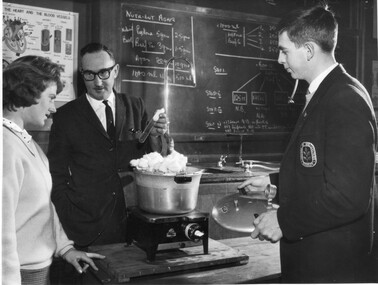
Photograph - Black and white print, Publicity Branch Victorian Department of Agriculture, Laboratory Class, c. 1962
... students...laboratory...students in class...a.j. farrance biological sciences students laboratory students in class publicity dept of agriculture On reverse, "Photograph by Publicity Branch Victorian Department Of Agriculture Ref. No. D.162.B." Black and white photograph. A.J. Farrance (Biological Sciences, holding a test tube)with 2 students ...Black and white photograph. A.J. Farrance (Biological Sciences, holding a test tube)with 2 students in the Laboratory. Writing on blackboard in the background.On reverse, "Photograph by Publicity Branch Victorian Department Of Agriculture Ref. No. D.162.B."a.j. farrance, biological sciences, students, laboratory, students in class, publicity, dept of agriculture -
 University of Melbourne, Burnley Campus Archives
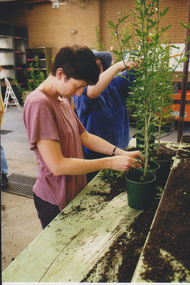
Photograph - Colour print, Kodak, Nursery, Unknown
... students...students working in class...nursery plants students students working in class 3 similar colour photographs of 2 students potting trees in the Nursery Nursery Photograph Colour print Kodak ...3 similar colour photographs of 2 students potting trees in the Nurserynursery, plants, students, students working in class -
 University of Melbourne, Burnley Campus Archives
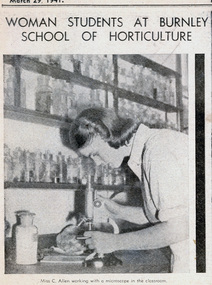
Newspaper - Newspaper Cutting, The Leader, Woman Students at Burnley School of Horticulture, 1941
... students working outside...students in class...the leader c. allen margaret bowron microscope cynthia allen joan harrison vegetables rhubarb orchard students working outside students in class pumpkins begonias Cutting from The Leader, March 29, 1941. Includes six photos of students working at Burnley. ...Cutting from The Leader, March 29, 1941. Includes six photos of students working at Burnley. Captions are: (1) "Miss C. Allen working with a microscope in the classroom." (2)"A ride back to the college buildings in a dray is much more fun than walking." (3) "Miss Margaret Bowron with a pumpkin grown in the vegetable garden." (4) "The theoretical side of horticulture, is too, important - and interesting, to judge by the expression on the faces of these students." (5). "Miss Joan Hamborg disbudding begonias." (6)"Miss Joan Harrison is here seen among the rhubarb in the vegetable garden."the leader, c. allen, margaret bowron, microscope, cynthia allen, joan harrison, vegetables, rhubarb, orchard, students working outside, students in class, pumpkins, begonias -
 University of Melbourne, Burnley Campus Archives
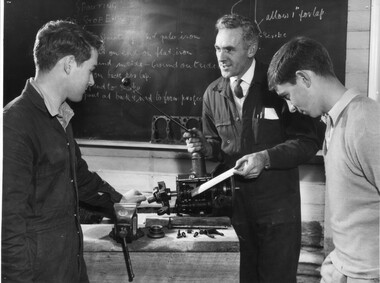
Photograph - Black and white print, Publicity Branch Victorian Department of Agriculture, Mechanics Class, 1960-1970
... students...engineering workshop...students in class...george grumont students engineering workshop students in class publicity dept of agriculture On reverse, "Photograph by Publicity Branch Victorian Department Of Agriculture Ref. No. D.162.E." Black and white photograph. George Grumont and 2 male students ...Black and white photograph. George Grumont and 2 male students in the old Engineering Workshop. Writing on a blackboard in the background.On reverse, "Photograph by Publicity Branch Victorian Department Of Agriculture Ref. No. D.162.E."george grumont, students, engineering workshop, students in class, publicity, dept of agriculture -
 Kiewa Valley Historical Society
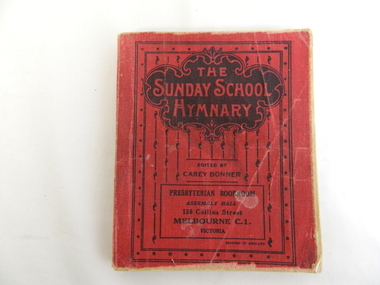
Book - Religious Education, The Sunday School Hymnary (2 copies)
... At Sunday Schools, hymns were taught to students. Students attended Sunday School classes at the Kergunyah Presbyterian Church. ...students. Students attended Sunday School classes at the Kergunyah Presbyterian Church. Sunday school was held in a little 16 foot square wooden building which came from Rocky Valley after it was no longer needed there. Ewen Wallace's father initiated and organised the move. C 2011 the building was knocked down because of white ants. The Presbyterian Church will be 125 years old in 2015. Historical: Religious Education: This book was used by students ...At Sunday Schools, hymns were taught to students. Students attended Sunday School classes at the Kergunyah Presbyterian Church. Sunday school was held in a little 16 foot square wooden building which came from Rocky Valley after it was no longer needed there. Ewen Wallace's father initiated and organised the move. C 2011 the building was knocked down because of white ants. The Presbyterian Church will be 125 years old in 2015.Historical: Religious Education: This book was used by students who attended the Sunday School classes at Kergunyah Presbyterian Church. Religion: Presbyterian Church at Kergunyah, in the Kiewa Valley, celebrates its 125th anniversary in 2015 after being handed over to the Uniting Church in the 1970s.Small red book with 'linen' cover. Title is printed red inside black decorative cloud shape. Other print is black inside red blank rectangles. Border is black lines which continue vertically from left to right.In pen "Kergunyah / Presbyterian / Sunday School / inside on first page.religion, sunday school, hymns, presbyterian, kergunyah, ewen wallace -
 Kiewa Valley Historical Society
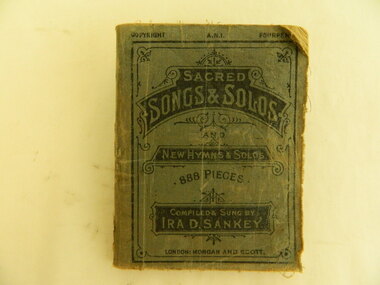
Book - Religious Education, Sacred Songs & Solos - Compiled & Sung by Ira D. Sankey
... At Sunday school sacred songs were taught to/ sung by students. Students attended Sunday School classes at the Kergunyah Presbyterian Church. ...students. Students attended Sunday School classes at the Kergunyah Presbyterian Church. Sunday school was held in a little 16 foot square wooden building which came from Rocky Valley after it was no longer needed there. Ewen Wallace's father initiated and organised the move. C2011 the building was knocked down because of white ants. The Presbyterian Church will be 125 years old in 2015 Historical: Religious Education: This book was used by students ...At Sunday school sacred songs were taught to/ sung by students. Students attended Sunday School classes at the Kergunyah Presbyterian Church. Sunday school was held in a little 16 foot square wooden building which came from Rocky Valley after it was no longer needed there. Ewen Wallace's father initiated and organised the move. C2011 the building was knocked down because of white ants. The Presbyterian Church will be 125 years old in 2015Historical: Religious Education: This book was used by students who attended the Sunday School classes at the Kergunyah Presbyterian Church. Religion: Presbyterian Church at Kergunyah, in the Kiewa Valley, celebrates its 125th anniversary in 2015 after being handed over to the Uniting Church in the 1970s.Small faded bluish book with linen cover. Print has black background within a decorative ribbon like shape. Border outside a black line within which is a thinner black line with a swirl at each corner.On the first page in pencil 'King"religion, hymns, songs, christian, kergunyah, ewen wallace, sunday school -
 Kiewa Valley Historical Society
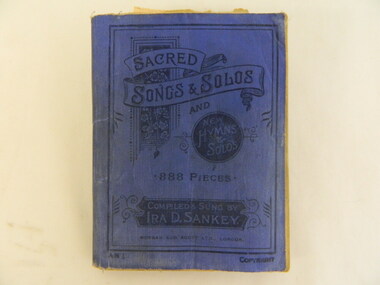
Book - Religious Education, Sacred Songs and Solos Compiled and Sung by Ira D. Sankey x2
... At Sunday school sacred songs were sung / taught to students. Students attended Sunday School classes at the Kergunyah Presbyterian Church. ...students. Students attended Sunday School classes at the Kergunyah Presbyterian Church. Sunday school was held in a little 16 foot square wooden building which came from Rocky Valley after it was no longer needed there. Ewen Wallace's father initiated and organised the move. C2011 the building was knocked down because of white ants. The Presbyterian Church will be 125 years old in 2015. Historical: Religious Education: This book was used by students ...At Sunday school sacred songs were sung / taught to students. Students attended Sunday School classes at the Kergunyah Presbyterian Church. Sunday school was held in a little 16 foot square wooden building which came from Rocky Valley after it was no longer needed there. Ewen Wallace's father initiated and organised the move. C2011 the building was knocked down because of white ants. The Presbyterian Church will be 125 years old in 2015.Historical: Religious Education: This book was used by students who attended the Sunday School classes at Kergunyah Presbyterian Church Religion: Presbyterian Church at Kergunyah, in the Kiewa Valley, celebrates its 125th anniversary in 2015 after being handed over to the Uniting Church in the 1970s.Royal blue linen cover book with faded black print and border. The title is in black within a ribbon shape. There is a black circle middle and slightly to the left with blue print 'New Hymns Solos'. At the bottom, on ribbon shape, in blue with black background - the author.religion, hymns, songs, kergunyah, sacred, ewen wallace, christian, sunday school, presbyterian church -
 Sunshine and District Historical Society Incorporated
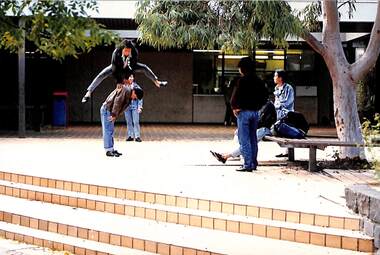
Photograph - Sunshine Technical School Memorabilia - 1989 School Photographs
... 3562.01 - Students Playing In Courtyard|3562.02 - Students Line Dancing|3562.03 - Students Line Dancing|3562.04 - Students Art Class|3562.05 - School Yard With Portables In Background|3562.06 - Canteen|3562.07 - Teacher & Students Art Class|3562.08 - Student Studying|3562.09 - Court Yard|3562.10 - School Badge|3562.11 - Teacher & Students Studying|3562.12 - Students Computer Class|3562.13 - School Building|3562.14 - Students Computer Class|3562.15 - Plants|3562.16 - Student Art Class|3562.17 - School Yard|3562.18 - School Badge|3562.19 - Students Indoor Volley Ball|3562.20 - Students Indoor Volley Ball|3562.21 - Teacher Mr Peck|3562.22 - Graphics|3562.23 - Students Computer Class|3562.24 - Students Computer Class|3562.25 - Student Woodworking Class|3562.26 - Students Computer Class|3562.27 - Student Art Class|3562.28 - Students Computer Class|3562.29 - Students Typing Class|3562.30 - Hall Indoor Activities|3562.31 - Students Welding Class|3562.32 - Teachers|3562.33 - Teachers|3562.34 - Teachers|3562.35 - Teachers|3562.36 - Students In Courtyard...Was part of the Sunshine Technical School Collection Sunshine Technical School Technical School 3562.01 - Students Playing In Courtyard|3562.02 - Students Line Dancing|3562.03 - Students Line Dancing|3562.04 - Students Art Class|3562.05 - School Yard With Portables In Background|3562.06 - Canteen|3562.07 - Teacher & Students Art Class|3562.08 - Student Studying|3562.09 - Court Yard|3562.10 - School Badge|3562.11 - Teacher & Students Studying|3562.12 - Students Computer Class|3562.13 - School Building|3562.14 - Students Computer Class|3562.15 - Plants|3562.16 - Student Art Class|3562.17 - School Yard|3562.18 - School Badge|3562.19 - Students Indoor Volley Ball|3562.20 - Students Indoor Volley Ball|3562.21 - Teacher Mr Peck|3562.22 - Graphics|3562.23 - Students Computer Class|3562.24 - Students Computer Class|3562.25 - Student Woodworking Class|3562.26 - Students Computer Class|3562.27 - Student Art Class|3562.28 - Students Computer Class|3562.29 - Students Typing Class|3562.30 - Hall Indoor Activities|3562.31 - Students Welding Class|3562.32 - Teachers|3562.33 - Teachers|3562.34 - Teachers|3562.35 - Teachers|3562.36 - Students In Courtyard Collection of colour photographs of students and teachers in various classses and activties Photograph Sunshine Technical School Memorabilia - 1989 School Photographs ...Was part of the Sunshine Technical School Collection3562.01 - Students Playing In Courtyard|3562.02 - Students Line Dancing|3562.03 - Students Line Dancing|3562.04 - Students Art Class|3562.05 - School Yard With Portables In Background|3562.06 - Canteen|3562.07 - Teacher & Students Art Class|3562.08 - Student Studying|3562.09 - Court Yard|3562.10 - School Badge|3562.11 - Teacher & Students Studying|3562.12 - Students Computer Class|3562.13 - School Building|3562.14 - Students Computer Class|3562.15 - Plants|3562.16 - Student Art Class|3562.17 - School Yard|3562.18 - School Badge|3562.19 - Students Indoor Volley Ball|3562.20 - Students Indoor Volley Ball|3562.21 - Teacher Mr Peck|3562.22 - Graphics|3562.23 - Students Computer Class|3562.24 - Students Computer Class|3562.25 - Student Woodworking Class|3562.26 - Students Computer Class|3562.27 - Student Art Class|3562.28 - Students Computer Class|3562.29 - Students Typing Class|3562.30 - Hall Indoor Activities|3562.31 - Students Welding Class|3562.32 - Teachers|3562.33 - Teachers|3562.34 - Teachers|3562.35 - Teachers|3562.36 - Students In Courtyardsunshine technical school, technical school -
Federation University Historical Collection
Programme, Programme for the Official Opening of the Mt Helen Campus, 10/1970
... Students first starting using the campus in the same year. The programme includes the following historical information: "On 26th October, 1870, Sir Redmond Barry officially opened the first venture into formal technical education in Australia - the Ballarat School of Mines. Over the preceding year a small group of Ballarat citizens interested in mining had conceived and brought into being the idea of creating such a school. They leased a derelict Court House next to the Ballarat Gaol in Lydiard St., at a nominal rental for15 years, and started classes with 4 students and an honorary lecturer. The School developed its courses beyond the initially intended range of studies related to mining, increased in enrolments, took over neighbouring properties and buildings and developed three levels of education - tertiary, trade and secondary. From the latter part of the 19th Century, even though remaining under the control of its own autonomous Council, it developed close links with the State Education Department. From the earliest times the School achieved widespread recognition and a particularly high reputation, and its graduates spread across Australia and the world. For several years it was affiliated with Melbourne University. In the last decade its scope has been further broadened by the introduction of new tertiary courses. During 1965 the State Government created the Victoria Institute of Colleges - a non-teaching body empowered to award degrees and directed towards the task of co-ordinating and developing tertiary education in Victorian in institutions other than universities. the tertiary division of the School became affiliated with the V.I.C. at the end of that same year. Subsequently the Council of the School decided that, whilst retaining for the whole establishment the time honoured title - The School of Mines and Industries, Ballarat - it should more distinctly sub-title the three divisions. the tertiary division then became known as the Ballarat Institute of Advanced Education. On receipt of substantial Commonwealth-State Grants, made to it as a college of advanced education, the Council was enabled at the start of 1967, to purchase for the Institute the 20 acre campus at Mt Helen. A master plan has been produced to develop this beautiful and spacious site as a tertiary institution enrolling, in due course, some 3000 full time students...Students first starting using the campus in the same year. The programme includes the following historical information: "On 26th October, 1870, Sir Redmond Barry officially opened the first venture into formal technical education in Australia - the Ballarat School of Mines. Over the preceding year a small group of Ballarat citizens interested in mining had conceived and brought into being the idea of creating such a school. They leased a derelict Court House next to the Ballarat Gaol in Lydiard St., at a nominal rental for15 years, and started classes with 4 students and an honorary lecturer. The School developed its courses beyond the initially intended range of studies related to mining, increased in enrolments, took over neighbouring properties and buildings and developed three levels of education - tertiary, trade and secondary. From the latter part of the 19th Century, even though remaining under the control of its own autonomous Council, it developed close links with the State Education Department. From the earliest times the School achieved widespread recognition and a particularly high reputation, and its graduates spread across Australia and the world. For several years it was affiliated with Melbourne University. In the last decade its scope has been further broadened by the introduction of new tertiary courses. During 1965 the State Government created the Victoria Institute of Colleges - a non-teaching body empowered to award degrees and directed towards the task of co-ordinating and developing tertiary education in Victorian in institutions other than universities. the tertiary division of the School became affiliated with the V.I.C. at the end of that same year. Subsequently the Council of the School decided that, whilst retaining for the whole establishment the time honoured title - The School of Mines and Industries, Ballarat - it should more distinctly sub-title the three divisions. the tertiary division then became known as the Ballarat Institute of Advanced Education. On receipt of substantial Commonwealth-State Grants, made to it as a college of advanced education, the Council was enabled at the start of 1967, to purchase for the Institute the 20 acre campus at Mt Helen. A master plan has been produced to develop this beautiful and spacious site as a tertiary institution enrolling, in due course, some 3000 full time students ...The first building at the Mt Helen Campus was opened in October 1970. Students first starting using the campus in the same year. The programme includes the following historical information: "On 26th October, 1870, Sir Redmond Barry officially opened the first venture into formal technical education in Australia - the Ballarat School of Mines. Over the preceding year a small group of Ballarat citizens interested in mining had conceived and brought into being the idea of creating such a school. They leased a derelict Court House next to the Ballarat Gaol in Lydiard St., at a nominal rental for15 years, and started classes with 4 students and an honorary lecturer. The School developed its courses beyond the initially intended range of studies related to mining, increased in enrolments, took over neighbouring properties and buildings and developed three levels of education - tertiary, trade and secondary. From the latter part of the 19th Century, even though remaining under the control of its own autonomous Council, it developed close links with the State Education Department. From the earliest times the School achieved widespread recognition and a particularly high reputation, and its graduates spread across Australia and the world. For several years it was affiliated with Melbourne University. In the last decade its scope has been further broadened by the introduction of new tertiary courses. During 1965 the State Government created the Victoria Institute of Colleges - a non-teaching body empowered to award degrees and directed towards the task of co-ordinating and developing tertiary education in Victorian in institutions other than universities. the tertiary division of the School became affiliated with the V.I.C. at the end of that same year. Subsequently the Council of the School decided that, whilst retaining for the whole establishment the time honoured title - The School of Mines and Industries, Ballarat - it should more distinctly sub-title the three divisions. the tertiary division then became known as the Ballarat Institute of Advanced Education. On receipt of substantial Commonwealth-State Grants, made to it as a college of advanced education, the Council was enabled at the start of 1967, to purchase for the Institute the 20 acre campus at Mt Helen. A master plan has been produced to develop this beautiful and spacious site as a tertiary institution enrolling, in due course, some 3000 full time students. the first sod was turned, to initiate this development, by the then Governor General of Australia, The Right Honourable Lord Casey, on 19th October, 1967. The first building group, now completed and occupied, has involved an expenditure approaching $1,000,000. It contains the departments of Mechanical, Civil and Mining Engineering, Metallurgy and Geology. it also contains the Computer Centre, a temporary Library and temporary student amenities. Over the next two years a further four buildings, costing about $2,500,000, will be erected, and a further major portion of the Institute will move to Mt Helen. these buildings, in addition to one for direct teaching work, will include a Library, a Union and the first stage of a Hall of Residence."White, folded, paper programme printed on the occasion of the official opening of the Ballarat Institute of Advanced Education (BIAE) Mount Helen Campus on the occasion of the centenary of the Ballarat School of Minesuniversity of ballarat, ballarat school of mines, biae, mount helen, mt helen campus, mb john, jack barker, e.j. barker, rolly parfenovics, parfenovics, nigel bown, campus. victorian institute of colleges, m.b. john -
 Federation University Historical Collection
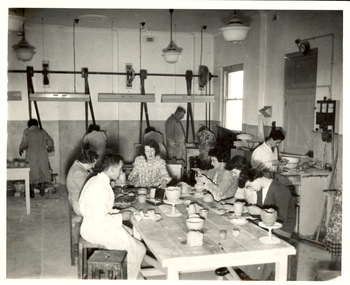
Photograph - Photograph - black and white, Ballarat School of Mines Ceramics Class, early 1940s
... students work in the Ballarat School of Mines Technical Art School Ceramics Studio. Six students sit at a work bench undertake handbuilt pottery. Five students sit at pottery wheels, while tutor Neville Bunning stands and oversees (far right corner). Ballarat School of Mines Ceramics Class ...Ceramics was taught at the Ballarat School of Mines Technical Arts School. A number of ceramics students work in the Ballarat School of Mines Technical Art School Ceramics Studio. Six students sit at a work bench undertake handbuilt pottery. Five students sit at pottery wheels, while tutor Neville Bunning stands and oversees (far right corner).ballarat school of mines, ballarat technical art school, art, ceramics, pottery, neville bunning, visual arts -
 Federation University Historical Collection
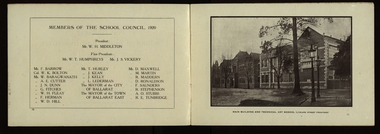
Booklet, The Ballarat School of Mines and Industries 1870-1920 Jubilee Booklet, 1920 (estimated)
... Students gaining qualifications obtain concession in their courses at the university, should they proceed there to continue their studies. The technical Art school curriculum includes training in all branches of pictorial and applied art, an Architectural Diploma Course, a Draughtman's Course, technical Art teachers' Course, Photography,Ticket Writing, Art Metal Work, Woodcarving, Needlework, and Leather work. The Trade Classes give instruction in Telephone Mechanics, telegraphy, Carpentry, Cabinet Making, Plumbing, Blacksmithing, Fitting, Electric Wiring, and Printing. Numerous Scholarships are offered every year, and altogether students...Students gaining qualifications obtain concession in their courses at the university, should they proceed there to continue their studies. The technical Art school curriculum includes training in all branches of pictorial and applied art, an Architectural Diploma Course, a Draughtman's Course, technical Art teachers' Course, Photography,Ticket Writing, Art Metal Work, Woodcarving, Needlework, and Leather work. The Trade Classes give instruction in Telephone Mechanics, telegraphy, Carpentry, Cabinet Making, Plumbing, Blacksmithing, Fitting, Electric Wiring, and Printing. Numerous Scholarships are offered every year, and altogether students ...The first school of Mines in Australia was established at Ballarat in 1870. At the time of its jubilee (1930) the following people were members of the School Council: W.H. Middleton (President), W.T. Humphreys (VP), J.S. Vickery (VP), F. Barrow, Col. W.K. Bolton, William Baragwanath, A.E. Cutter, J.N. Dunn, G. Fitches, W.H. Fleay, F. Herman. W.D. Hill, T. Hurley, K. Kean. J. Kelly, L. Lederman, Mayor of Ballarat, Mayour of Ballarat East, D. Maxwell, M. Martin, R. Maddern, D. Ronaldson, F. Saunders, R. Stephenson, A.O. Stubbs, R.E. Tunbridge. The School Staff in 1920 comprised: Herbert H. Smith, Walter Rowbotham, Reginald L. Cutter, M.C. Young, Hilda Wardle, M. Wiliamson, P.S. Richards, L.H. Archibald, J. Woods, Ken Moss, W. Kenneth, Mrs McIlvena. B. Robinson, S. Rowe, E. Hope-Jones, Miss Abrams, L.St.G.P. Austin, Alfred Mica Smith, J.R. Pound, Herbert R. Murphy, N.H. Junner, Maurice Copland, L.H. Archibald, E.J.A. McConnon, Newton King, D.m. Hull, T.R. Gordon, John M. Sutherland, T.K. Jebb, Dick Richards, C. Tonkin, A.W. Steane, J. Paterson, H.W. Malin, R.V. Maddison, S.M. Mayo, F.A. King, W.H. Steane, T.R. Gordon, T.A. Williams, H. Waldron, G. Black, E.J. McConnon, R.V. Duncan. R. Cutter, E.G. Vawdrey, Hilda WardleWhite stapled booklet - landscape format - 20pp + soft covers with blue writing. Includes an historical sketch of the Ballarat School of Mines. Contains images of the school from around 1920. The history outlined in the booklet follows: 'Ballarat has helped to influence the life and destinies of Australia in many ways, the recital of which would perhaps prove tedious to the citizens of less favoured localities! However, it can be said, without much fear of contradiction, that only less known thought Australia than its fame as a gold field is the reputation won for it by its school of Mines, ... Ballarat was still quite a new place when the School was founded, but a very propserous and popular place all the same, with a go-ahead lot of citizens brim full of the spirit of enterprise which seemsto animate mining populations generally. Money was plentiful, and they launched out into ventures, which later, were to develop and take the place of the gold mines, while what is more to the point, they understood the value of education. the old digging days were passing away. So far as Ballarat itself was concerned the day of the cradle and tin dish had already passed into an antiquity "as dead and distant as the age of the Tubal Caon," said dir redmond Barry on declaring the School open. Mining had become a serious business, and the mining engineer, the metallurgist, and the geologist had become a power in the land. In these circumstances the suggestions to found a School of Mines met with ready acceptance. The late Mr James M. Bickett had the honor of bringing forward the proposition at a meeting of the Ballarat Mining Board in October, 1869. it was agreed to, and the Government, having been approached for assistance, granted a lease of the old Supreme Court buildings at a nominal reantal. A modest sum, including 100 pounds from the Borough Council of Ballarat West, was subscribed by a number of sympathisers, and on the 26th October, 1870, the inaugural address was delivered by Sir Redmond Barry, the first President of the School. Classes were commenced on the 23rd January, 1871. The students at first were mostly adults. They were chiefly men emloyed at the mines, who had the wisdom and energy to devote their spare time to study, and, though their attendance was somewhat irregular, they made very good progress. Old prints which have been preserved show them at work at furnaces, big bearded men of the old-fashioned type of miner. It is interesting to note that among those who gave evidence and encouragement was Sir Roderick Murchison, who many years before had advised Cornish miners to emigrate to Australia to search for gold, and who in 1848 was in possession of gold ore sent from this country. Sir Roderick sent a parcel of books for the library, and gave useful advice as to the curriculum which should be adopted. The Museum, which now contains a most valuable collection of minerals, was one of the first things attended to, and the reports presented to the Council from time to time speak of additions being made from all parts of the world. New equipment was constantly being added to the School, a good deal of assay work was done, and some specimens were sent from the East Indies for examination as far back as 1873. By this time there was a difficulty in providing accomodation for the students who wished to enrol, and the number of instructors had grown from two to four. In 1882 the first building was being erected on what was then part of the gaol reserve. A little more than ten years afterwards a buildnig formerly serving as a Methodist Church was absorbed, while later on, the demand for accomodation increasing, the attack upon the gaol was renewed. The School continued to grow in reputation and size, and became the science centre of the district, and in 1889 a learge new building was opened by Sir Alexander Peacock. Students came from over seas as well as from all the States of Australia, and after going through their courses they took with them the name and fame of the old School to all parts of the globe. School of Mines boys have played a great part in developing the mining fields of Western Australia, South Australia, and africa, while old students who have made a name in their profession are constantly dropping in to see how the old place is getting along. It was not to be expected, however, that the Ballarat School would be left without rivals, its very success inspiring competition. Mining Schools were started in other parts of Australia, and, at the same time, Victoria ceased to hold first place as a mining state. On the other hand there was a great advance in manufacturing, and the demand for technicaly trained men became a great and as insistent as ever it had been for trained mining men. The Council was quick to adapt the school to the new conditions, and the result is seen in the institution, which is one of Ballarat's proudest possession. Instruction is given in all branches of technical work, and the classes are filled with students who are building up for Ballarat a reputation as an industrial centre, which promises to equal that which it formerly held as a mining town. Owing to its bracing climate, its abundant opportunities for recreations, and its accessibilty, Ballarat as a city is an ideal place for educational purposed, and is yearly becoming more and more appreciated throughout the State. The chairman of one of Ballarat's biggests industries claims that the workman can do twice the day's work here that he can do in Melbourne. he was a little enthusiastic over it, perhaps, but it is a well-known fact that the healthy and invigourating Ballarat climate is conducive to both physical and mental activity, and the records of the School provide ample proof of it. One of the most interesting and successful branches of the School of Mines and Industries - if the name be enlarged with the enlargement of its scope - is the Technical Art School. "The City of Statues" has from its earliest days been a stronghold of art. Art schools have flourised here, and in 1905 the Education Department came to the conclusion that the best thing to do with them was to place them under the management of the School of Mines Council. A magnificent new Technical Art School was built at a cost of some 12,000 pounds on the site of the old Supreme Court building, and was formally opened on the 23rd July, 1915. The results have not only been justified but surpassed all anticipations. The most comprehensive list of subjects is taught, and this list is constantly added to. Students have flocked to the art School, which may be said to occupy a unique position in Australia, and its record of success is really astonishing. Its students supply art teachers for the newer schools that are being built, and many occupy leading positinos in important business houses. So well is its reputation known that orders are constantly being received, not only from Victoria, but from other States, for honor boards and challenge shields to be designed and made. The most recent addition to the School of Mines and Industries is the Junior Technical School, for which a new building is now being erected on a portion of the gaol site, transferred to the School of Mines Counci by the Government. At the present moment temporary quarters are being occupied. Some students after passing through the Junior School go straight to employment, continuing perhaps to attend the evening trade classes, while others move on to the senior School. In a review of the work of the School of Mines mention must be made of a series of industrial research carried out under supervision of the Principal. One in particular, regarding the suitability of the local ores for the manufacture of pigments attracted much attention, while the experiemtns on the manufacture of white potery from Victorian clayes were considered of sufficient importance by the Federal Advisory Council of Science and Industry to warrant the appointment of a special investigator. The results of these have been most encouraging, and may have far-reaching consequences. The vocational training of returned soldiers also should not be overlooked. The work was taken in hand from the first, before the Repatriation Department gave assistance, and now with the help of the department of the School has become one of the largest vocational training centres in Victoria outside of Melbourne. The soldiers, trained in a variety of occupations, have made remarkable progress, and already considerable numbers have found employment in local workshops and factories. To sum up, the School is divided into the following departments, each well staffed and equipped: - The School of Mines, science, and Engineering; the Techncial Art School, the Boys' Junior Technical School, the Girl's Preparatory Technical Classes, Trade Classes, and the Commercial School. The school of Mines, science and Engineering, comprises the following branches: - Mining, Metallurgy, Geology, Electrical Engineering, Civil Engineering, Mechanical Engineering, Applied Chemistry, and Pharmacy. Battery treatments, Cyanide Testing, Smelting, Assays, and Clay Testing from a regular part of the School's work. Students gaining qualifications obtain concession in their courses at the university, should they proceed there to continue their studies. The technical Art school curriculum includes training in all branches of pictorial and applied art, an Architectural Diploma Course, a Draughtman's Course, technical Art teachers' Course, Photography,Ticket Writing, Art Metal Work, Woodcarving, Needlework, and Leather work. The Trade Classes give instruction in Telephone Mechanics, telegraphy, Carpentry, Cabinet Making, Plumbing, Blacksmithing, Fitting, Electric Wiring, and Printing. Numerous Scholarships are offered every year, and altogether students will find few places to equal the Ballarat School of Mines and Industries as a training place for their life's work. One of the first in the continent to be established, its Jubilee finds it still in the front rank, keeping pace with the times, and offering to the youths of this country the means of taking advantage of Australia's teeming opportunities. william, battery, smith, herbert, drawing from the antique, ballarat school of mines botanical gardens, ballarat school of mines, redmond barry, alfred mica smith, james bickett, museum, dick richards, ballarat junior technical school, s m b, ballarat school of mines and industries, ballarat technical art school, model mine, james m bickett, j m bickett, roderick murchison, vocational training rooms, wesley church, methodist church, alexander peacock, lathes, repatriation, repatriatin department, war service, school council, baragwanath, gold mining, mining laboratory, plaster cast, r.w. richards, anniversary, jubilee -
 Federation University Historical Collection
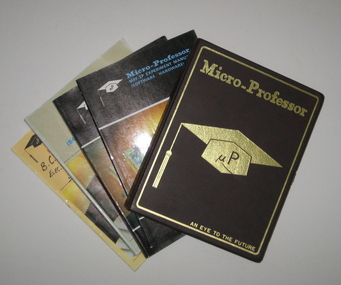
Computer, Mutlitech Industrial Corporation, Micro-Professor MPF-IP and manuals, 1983 (estimated)
... students from the Ballarat School of Mines and the Ballarat College of Advanced Education used a class set (as they were relatively inexpensive at approx. $100 each) during the mid to late 1980s. Student were encouraged to borrow the Micro-Professors in order to assist in learning how to use them. Only one was ever not returned on time. When pressed to return the device the student...students from the Ballarat School of Mines and the Ballarat College of Advanced Education used a class set (as they were relatively inexpensive at approx. $100 each) during the mid to late 1980s. Student were encouraged to borrow the Micro-Professors in order to assist in learning how to use them. Only one was ever not returned on time. When pressed to return the device the student ...The Micro-Professor I Plus (MPF-IP) was a low cost, versatile microcomputer system featuring sophisticated software and hardware capabilities. (MPF-IP) boasted a display panel with the ability to display 20 characters using 16-segment fonts. All 64 standard ASCII characters could be displayed. The operation of the MPF-IP was controlled by an 8k monitor program which resides in the Read Only Memory (ROM). The monitor, aided by 4k Random Access Memory (RAM), enabled the user to enter a comprehensive set of single keystroke commands, making it easier for the user to use the CPU, memory and I/0 devices. This allowed the user to concentrate of microprocessor software development and application design. The system allowed printing at 48 lines per minute, and the ability to permanently record the commands, data, programs, status and other messaged. Each character printed by the printer is in a 5 by 7 dot matrix. Although the prime purpose of the programming was for machine language object code formed as hexadecimal numbers, the Micro-Professor has an embedded Tiny Basic interpreter for which formation of some of the alpha characters using a standard 7 segment display was ingenious. The program memory consisted of non volatile 2 kilobytes electrically programmable ROM whilst the Random Access Memory came with 2 kilobytes of static RAM but could be upgraded to 4 kilobytes by insertion of another chip. The entire memory space of 64 kilobytes was accessible by way of the terminals on the left hand side of the board. Engineering and Science students from the Ballarat School of Mines and the Ballarat College of Advanced Education used a class set (as they were relatively inexpensive at approx. $100 each) during the mid to late 1980s. Student were encouraged to borrow the Micro-Professors in order to assist in learning how to use them. Only one was ever not returned on time. When pressed to return the device the student confessed that his dog had chewed the plastic case. This is still in our collection complete with bite marks! The Micro-Professor used a Zilog Z80 microprocessor. This was the most powerful of the 8 bit microprocessors at the time. Zilog was derived from the Intel 8080 microprocessor. The Z80 had 158 instructions of which the Intel 78 instructions were a subset. The Intel processor continued on through development in the IBM computers as 8086, 80286, 80386, 80486 and later the pentiums. Zilog lost most of its market share when it developed the 16 bit Z8000 microprocessor. Although the microprocessor was excellent, the lack of peripherals caused users to abandon Zilog products. A brown and gold plastic box containing a microcomputer for use in classrooms. Four manuals are titled 'Micro-Professor MPF-IP user's Manual', 'MPF-I Experiment Manual (Software/Hardware)', Micro-professor MPF-IP experiment Manual (Software/Hardware)' and Micro-Professor MPF-I Monitor Program Source Listing.microcomputer, micro computer, micro professor, electronics -
 Federation University Historical Collection
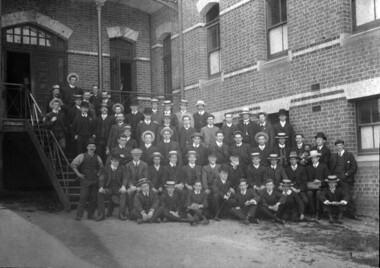
Photograph - Photograph (Black & White), Ballarat School of Mines Students, c1907
... This building was built at the Ballarat School of Mines, now a campus of Federation University Australia. ballarat school of mines students alumni alfred mica smith class Administration Building A building Verso: Group of Ball. Sch. Mines Students 25.10.07 A black and white photograph mounted onto dark card showing a group of Ballarat School of Mines students and staff posing around the stairs at the back of the New Classrooms (now known as the Administration Building) . ...This building was built at the Ballarat School of Mines, now a campus of Federation University Australia.A black and white photograph mounted onto dark card showing a group of Ballarat School of Mines students and staff posing around the stairs at the back of the New Classrooms (now known as the Administration Building) . Professor Alfred Mica Smith sits in the second front row Verso: Group of Ball. Sch. Mines Students 25.10.07 ballarat school of mines, students, alumni, alfred mica smith, class, administration building, a building -
 Federation University Historical Collection
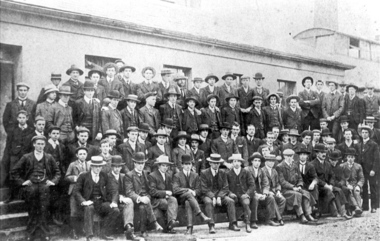
Photograph - Photograph (Black & White), Ballarat School of Mines Students, 1895, c1900
... This photograph shows students in front of that building, which was demolished c1912 to make way for the Ballarat Technical Art School building. ballarat school of mines ballarat circuit court house court house ballarat mining board students class former ballarat circuit courthouse alumni boater hats A group of men pose for a photograph at the side of the original Ballarat School of Mines Building (Former Circuit Court - now demolished). Many wear hats. Ballarat School of Mines Students ...The Ballarat School of Mines was established in the disused Ballarat Circuit Court in 1870 through the initiatives of the Ballarat Mining Board, which was concerned with the shortage of trained men for the goldfields. The former Ballarat Circuit Court House was originally abandoned due to subsidence of its foundations, possible caused by under-mining. This photograph shows students in front of that building, which was demolished c1912 to make way for the Ballarat Technical Art School building. A group of men pose for a photograph at the side of the original Ballarat School of Mines Building (Former Circuit Court - now demolished). Many wear hats.ballarat school of mines, ballarat circuit court house, court house, ballarat mining board, students, class, former ballarat circuit courthouse, alumni, boater hats -
 Federation University Historical Collection
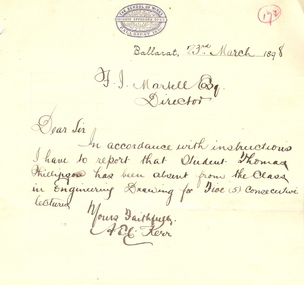
Document, Ballarat School of Mines letter concerning Thomas Philipson, 23 March 1898
... Martell, informing him that student Thomas Phillipson had been absent from 5 consecutive lectures. ballarat school of mines frederick martell alfred kerr fj martell alfred ec kerr aec kerr thomas phillipson united masonic choir st andrews ballarat .1) One page hand written letter on Ballarat School of Mines letterhead relating to the repeated non attendance of student Thomas Phillipson in Engineering Drawing. .2) Response from Thomas Phillipson stating that he missed class as he had to look after the St Andrew's Sunday School for the United Masonic Choir Practice as his father was otherwise engaged. ...The writer of the letter, Alfred E.C. Kerr was a lecturer in Engineering Drawing at the Ballarat School of Mines. He wrote to the registrar, Fred. J. Martell, informing him that student Thomas Phillipson had been absent from 5 consecutive lectures. .1) One page hand written letter on Ballarat School of Mines letterhead relating to the repeated non attendance of student Thomas Phillipson in Engineering Drawing. .2) Response from Thomas Phillipson stating that he missed class as he had to look after the St Andrew's Sunday School for the United Masonic Choir Practice as his father was otherwise engaged.ballarat school of mines, frederick martell, alfred kerr, fj martell, alfred ec kerr, aec kerr, thomas phillipson, united masonic choir, st andrews ballarat -
 Federation University Historical Collection
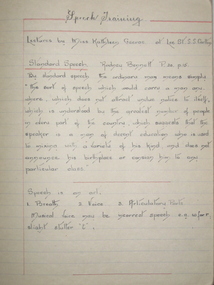
Exercise Book, Monica Miller's Speech Training Notes
... students from 1946 to 1965 remember music lecturer Monica Miller with great fondness. Speech Training was also the domain of Monica Miller at BTC. Her Speech Training class notes include: Voice, Articulation parts, Correct positions for consonants, vowels and dipthongs, Phonetic Stules, Correction of Speech Defects, Speech Training in the schools, Poetry Appreciation, Rhythm, Lessons for county classes, Lessons for Student Teacher Classes and Lessons to Grades. ...students from 1946 to 1965 remember music lecturer Monica Miller with great fondness. Speech Training was also the domain of Monica Miller at BTC. Her Speech Training class notes include: Voice, Articulation parts, Correct positions for consonants, vowels and dipthongs, Phonetic Stules, Correction of Speech Defects, Speech Training in the schools, Poetry Appreciation, Rhythm, Lessons for county classes, Lessons for Student Teacher Classes and Lessons to Grades. ...Former Ballarat Teachers' College (BTC) students from 1946 to 1965 remember music lecturer Monica Miller with great fondness. Speech Training was also the domain of Monica Miller at BTC. Her Speech Training class notes include: Voice, Articulation parts, Correct positions for consonants, vowels and dipthongs, Phonetic Stules, Correction of Speech Defects, Speech Training in the schools, Poetry Appreciation, Rhythm, Lessons for county classes, Lessons for Student Teacher Classes and Lessons to Grades. (taken from http://guerin.ballarat.edu.au/curator/honour-roll/honourroll_miller.shtml)Black cardboard cover with burgandy tape on spine. The book contained beautifully handwritten notes on speech training by Monica Miller who lectured at the Ballarat Teachers' College. The lectures were given by Kathleen George at Lee Street State School, Carlton.btc, ballarat teachers college, monica miller, kathleen george, speech training -
 Federation University Historical Collection
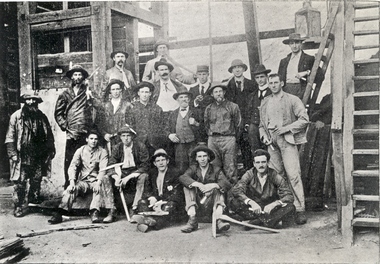
Photograph (black & white), Ballarat School of Mines Students visit the New Normanby Mine, 1899, 1899
... students, pose outside Ballarat's New Normanby Mine. Some hold picks and candles. The man in the centre wearing a waistcoat is John Rowe, experienced miner and lecturer in Practical Mining at the Ballarat School of Mines. The June 1899 Ballarat School of Mines Magazine records: "The mining class visited the Britannia Gold Mine, and were kindly shown over the surface and underground workings by Mr. Harvey." Ballarat School of Mines Students ...In 1875 John Rowe enrolled at the Ballarat School of Mines (SMB) where he studied Metallurgy and Assaying. In 1880 the Britannia Mine closed and John Rowe moved to Launceston working as Manager of the Royal Tasman Gold Mining Company. He returned to Ballarat two years later to manage the Long Gully United Gold Mining Company. In 1885 John Rowe sought work in New Caledonia followed by South Africa. While in South Africa he received an offer from SMB to lecture in Practical Mining, an instructional innovation which involved weekly visits to some of the principle mines in the district. John Rowe took up this position in 1994, but it appears to have been a short lived innovation ending in 1996, possibly due to John Rowe's failing health. (http://guerin.ballarat.edu.au/curator/honour-roll/honourroll_Rowe,John.shtml)Nineteen men, some Ballarat School of Mines students, pose outside Ballarat's New Normanby Mine. Some hold picks and candles. The man in the centre wearing a waistcoat is John Rowe, experienced miner and lecturer in Practical Mining at the Ballarat School of Mines. The June 1899 Ballarat School of Mines Magazine records: "The mining class visited the Britannia Gold Mine, and were kindly shown over the surface and underground workings by Mr. Harvey."candle, ballarat school of mines, safety cage, john rowe, new normanby gold mine, mining alumni, pick -
 Federation University Historical Collection
Photograph - Art class photograph, Drawing from the Antique, 1920, c1920
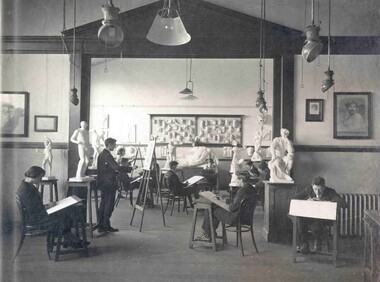
... students of the Ballarat School of Mines Technical Art School drawing from plaster models of human bodies in various poses and of various scales. The students are in a room of the Ballarat Technical Art School which was custom built for teaching art. The image was reproduced in the 1920 Ballarat School of Mines Students' Magazine. Drawing from the Antique, 1920 Photograph Art class ...The large plaster Illisos depicted in the back of this image is still held by Federation University Australia. The Ballarat Technical Art School (No. 10) was part of the Ballarat School of Mines and was established in 1907. After conducting classes in various locations around Ballarat a custom built art school was erected on the site of the former Ballarat Circuit Court House, previously used as the initial building of the Ballarat School of Mines. Examples of drawings undertaken by students, as well as some plaster castes are held in the University of Ballarat Historical Collection. The Ballarat Technical art School is the oldest continuous Tertiary Art School in Australia. Sir Alexander Peacock opened the new Ballarat Technical Art School building in July 1915. It cost 10,000 pounds and was constructed by the Public Works Department from plans drawn by the then Art School Principal, Herbert H. Smith. The building contractors were Messrs Gower and Eddards. According to the SMB Annual Report of 1914 'the internal upholstering and fittings have all been carried out in Australian timbers, with Queensland maple largely used throughout.' The building could be described as federation-art deco in style. It features sandstone insertion with sandstone string coursing. The base of the building is rusticated sandstone. The building is functional in design with large metal windows in the south wall to ensure good light into the studios. The northern wall has standard double hung windows. The interior of the building features a carved wooden staircase and cast iron ceiling vents. The rear drawing studios could be made into one large studio by opening panelled timber doors. This opening features classical plaster pilasters with a pediment above. (http://guerin.ballarat.edu.au/curator/buildings/technical_art_school.shtml) Black and white mounted photograph showing eleven students of the Ballarat School of Mines Technical Art School drawing from plaster models of human bodies in various poses and of various scales. The students are in a room of the Ballarat Technical Art School which was custom built for teaching art. The image was reproduced in the 1920 Ballarat School of Mines Students' Magazine. drawing, ballarat school of mines, ballarat technical art school, art studio, plaster caste, gribble building, illisos, hercules, drawing from the antique, visual arts -
 Federation University Historical Collection
Programme, Ballarat Teachers' College, Ballarat Teachers' College Grand Concert, 1947, 1947
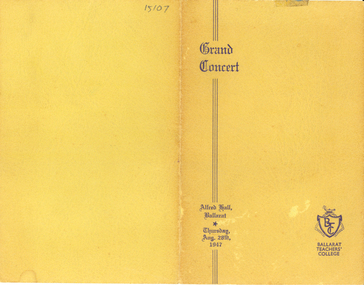
... students moved to the Mount Helen Campus. In 1990 Ballarat College of Advanced Education became Ballarat University College, an affiliated college with the University of Melbourne. The University of Ballarat was formed in January 1994. Ballarat Teachers' College education Alfred Hall Yellow folded card programme for the Ballarat Teachers' College Grand Concert held at Alfred Hall Ballarat on Thursday 28 August 1947. Student Teachers from the 1947 class ...Ellwood was the Principal of the Ballarat Teachers' College. Ballarat Teachers’ College was opened on 04 May 1926, at S.S. 33 Dana Street, with an enrolment of 61 students. Its original staff consisted of the Principal, Mr W.H. Ellwood, M.A., M.Ed. (Chairman of the Teachers’ Tribunal from its inception in 1946 until 1954), Miss A. Bouchier, B.A., and Mr A.B. Jones, BA., (lecturers). In 1927 Miss P.A. Hamano joined the staff. In 1927 the college moved to the old Ballarat East Town Hall (remodelled for their use) in Barkly Street. During 1927 the numbers in the College were augmented by 26 Manual Arts students, who had formerly received their training at Ballarat High School. Manual Art students continued till 1930 when, on grounds of economy, their training was concentrated at Melbourne Teachers’ College. During the four succeeding years, approximately 60 students annually entered the primary course. Inclusive of Manual Arts students, and private fee-paying students, exactly 400 trainees passed through the College in its brief span of life (1926-1931). Five per cent of each year’s students were granted an extension of their studentship to enable them to proceed to Melbourne Teachers’ College, and to take the first year’s course for a University degree. With the advent of the economic depression of the ‘thirties, Ballarat Teachers' College closed its doors in December, 1931. Fourteen years were to pass before the College opened again on February 2nd, 1946. The college re-commenced at SS Dana Street, under the guidance of Mr W.F. Lord, M.C., M.M., B.A., Dip. Ed., (acting, later Principal 1946-1950) and a staff consisting of Miss E.B. Hughes, B.A., Dip. Ed., Mr C.B. Bryan, B.A., B. Com., Dip. Ed., Miss Monica H. Miller, L.Mus.A., and Miss G. Kentish, Dip. Phys. Ed. The opening ceremony was performed by the Minister of Education at that time, the Hon. F. Field, M.L.A., accompanied by the Hon. T.T. Hollway, M.L.A., and the then Director of Education, Mr J.A. Seitz. It was originally intended to cater for women students only but, at the last moment, men resident in Ballarat were also accepted. A co-educational college was thus set up instead, and it has continued as such. 1951 saw the introduction of the two-year course, successful students being presented with the Trained Primary Teacher’s Certificate at the final College Assembly each year. In December 1955, College held its first Graduation Ceremony, with its own Graduation Hymn, the words of which were written by Miss C.M. (Mavis) Canty of the staff. Lord remained as principal until 1951 when he transferred to establish a teachers' college at Toorak. Tom William Turner was Lord's successor. A highlight of his term was the construction of new college buildings at Gillies Street with the students commencing their lessons there in February 1958. Turner retired in 1970, having overseen a period of substantial growth in the institution. In that year alone more than one hundred and forty students completed their primary teaching qualification to meet a severe shortage of teachers. Doug Watson commenced as principal in 1971. In 1973 Ballarat Teachers' College became the State College of Victoria at Ballarat. Three years later Ballarat College of Advanced Education was formed and the teacher education students moved to the Mount Helen Campus. In 1990 Ballarat College of Advanced Education became Ballarat University College, an affiliated college with the University of Melbourne. The University of Ballarat was formed in January 1994.Yellow folded card programme for the Ballarat Teachers' College Grand Concert held at Alfred Hall Ballarat on Thursday 28 August 1947. Student Teachers from the 1947 class performed, including Jessie Batson, Ruth Tozer, Joy Love, N. Kerr, Arthur Lelean, D. Cooper, John Collins, Ann McKinnnon, Peg Purdue, Lindsay Harley.ballarat teachers' college, education, alfred hall -
 Federation University Historical Collection
Book, Moonta School of Mines Annual Report, 1903, 1905
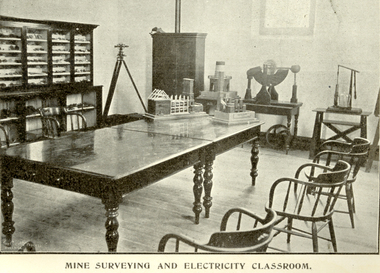
... students who wanted to increase their knowledge of those arts and sciences which were especially important to miners and others similarly engaged. The School had subsidiary classes at Wallaroo Mines. It was the only institution on the Yorkes Peninsula furnishing technical education The School was situated close to the Moonta Mines, at that time the most important copper mines in Australia. The the mines students...students who wanted to increase their knowledge of those arts and sciences which were especially important to miners and others similarly engaged. The School had subsidiary classes at Wallaroo Mines. It was the only institution on the Yorkes Peninsula furnishing technical education The School was situated close to the Moonta Mines, at that time the most important copper mines in Australia. The the mines students ...The Moonta School of Mines was intended for students who wanted to increase their knowledge of those arts and sciences which were especially important to miners and others similarly engaged. The School had subsidiary classes at Wallaroo Mines. It was the only institution on the Yorkes Peninsula furnishing technical education The School was situated close to the Moonta Mines, at that time the most important copper mines in Australia. The the mines students were able to acquire practical knowledge of the work of a miner. The close by smelting works at Wallaroo were seen to be of great service to those wanting to become acquainted with chemistry and metallurgy. Subjects taught at the Moonta School of Mines included Chemistry, Metallurgy, Steam and the Steam Engine, Magnetism and Electricity, Mathematics, Machine Design, Mine Surveying and Leveling, Drawing, Plumbing and Sheet Metal Work.Grey soft coloured book with images of the interior of the Moonta School of Mines in South Australia, and members of Council .moonta, moonta school of mines, rogers, mueller, pomroy, martin, blatchford, richardson, brown, potter, w. peter hughes, ricky hains, henry lipson hancock, henry richard hancock, r.e. hancock, david james, edwin martin, bessie poole, kim potter, james richardson, g. warrington rogers, t. cooke and sons, g. ulrich, schools of mines, wallaroo, billy muir, south australia -
 Federation University Historical Collection
Photograph - Photograph - Black and White, Student Group in Photography Studio Room 106, c1990s
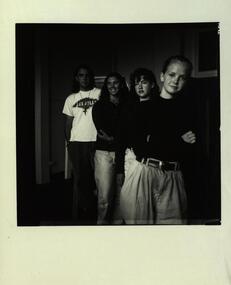
... This photograph was taken as part of Paul Lambeth's photography class student group photography studio Paul Lambeth TAFE photography in pencil on verso "Student Group in Photography Studio Room 106" Black and white photograph adhered to card Student Group in Photography Studio Room 106 Photograph Photograph - Black and White ...This photograph was taken as part of Paul Lambeth's photography classBlack and white photograph adhered to cardin pencil on verso "Student Group in Photography Studio Room 106"student group, photography studio, paul lambeth, tafe photography -
 Federation University Historical Collection
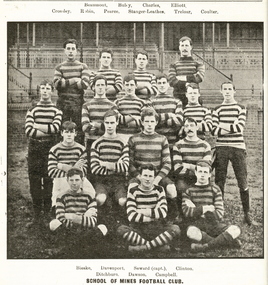
Book, Ballarat School of Mines Students' Magazine, 1907-1909, 1907-9
... Students by F. Howells * Life in Mining Camp * Wise Words to Mining School Students * Military Search Lights * Gleaning s on resistance * Ministerial Visit to the Ballarat School of Mines by the Hon. A.A. Billson, Minister of Education , accompanied by Frank Tate, Director of Education. * Picture Making in Photography Composition * Mountains of Fire * A Walking Engine - New Military Machine - Guns into Action - Caterpillar No. 1. (Tank) * Fireless Locomotives * Elmore Concentrating Process (includes plan of Elmore Concentrator) * Mount Pani Limited * Surveying for Irrigation * Weights and Measures * Carbon Monoxide * Joseph Francis Usher obituary * The Problem of the Metalliferous Veins * Ballarat School of Mines Ambulance Class...Students by F. Howells * Life in Mining Camp * Wise Words to Mining School Students * Military Search Lights * Gleaning s on resistance * Ministerial Visit to the Ballarat School of Mines by the Hon. A.A. Billson, Minister of Education , accompanied by Frank Tate, Director of Education. * Picture Making in Photography Composition * Mountains of Fire * A Walking Engine - New Military Machine - Guns into Action - Caterpillar No. 1. (Tank) * Fireless Locomotives * Elmore Concentrating Process (includes plan of Elmore Concentrator) * Mount Pani Limited * Surveying for Irrigation * Weights and Measures * Carbon Monoxide * Joseph Francis Usher obituary * The Problem of the Metalliferous Veins * Ballarat School of Mines Ambulance Class * Treatment of Gold in a battery Without the Use of Copper Plates by E.C. Hurdsfield * Meteorites * Werribee Gorge * Dredging in the Ovens Valley * Electrical Chatter - Electrocution by an Imaginary Eye-Witness * The Electric Furnace in Iron Metallurgy Ballarat School of Mines Students ...Bound volume of the Ballarat School of Mines Students' Magazine for 1907-1909. Articles include the location and pegging of a tramway Route, the transmission of Power by Rope Driving by A.E.C. Kerr, A visit to the Briseis Mine, and New Brothers' Home, Mining Engineers in Tasmania, Obituaries for David Ham and Matthew Lyndsay, Pioneer Mining at Leichhardt, Automatic Ore Feeders and Chacedony Park by J.H. Adams. Images include the Ballarat School of Mines Football Team and the Ballarat School of Mines Sports Committee. 1907 * Hubert Krause 1908 * The location and Pegging of a Tramway Route by Yamba * The Unity of things by John Brittain * The transmission of power by Rope Driving, by A.E.C. Kerr * A visit to the Briseis Mine, and New Brothers' Home (includes photographs) * Mining Engineers in Tasmania * Limericks Sluiced at Snake Valley * David Ham Obituary * Matthew Lyndsay Obituary * Some Bunsen Memories by Professor Alfred Mica Smith * Geological Camp to Daylesford * Practical Mathematics by Hubert F. Hall * Pioneer Mining - Leickhardt * Automatic Ore Feeders * A Unique Ore Deposit (Lucknow Goldfield, NSW) * A country Ramble * The Alkaline Titration for Zinc * Chalcedony Park, Arizona, United States of America by J.H. Adams * Notetaking at Lectures * Smelter Cost-Keeping by Oliver E. Jaeger * Benefits of Physical Culture * Mineral Tasmania and its Wonderful Resources by F.F. Bradford * A holiday Trip to Queensland * The Compression of Air as Applied to Mining * Machine V Hand Drilling * The mining in the Malay States * William Thomas Grownow Obituary (includes image) * Timbering Stopes (Includes images) * Trip to Melbourne * Two Problems of Alluvial Mining by Richard Hain * The Berry Leads (includes plan of mines) * Black Pudding Supper * Observations for Meridian * NOtes on Coking Plants (includes plan) * How Old is the Earth * Conglomerations * A Pat Formula * The making of a Suitable Muffle for General Assay Work * Reduction of Gold Chloride by Charcoal * Chemical Definitions * Old Boys (R.J. Allen, W.B. Blyth, F. Brinsden, Lindsay D. Cameron, George W. Cornwell, John M. Currie, C.M. Harris, T. Wighton-Hood, W. Lakeland, W.S. Macartney, Fred A. Marriott, Karl B. Moore, G.E. Sander, Sherb. H. Sheppard, Norman S. Stuckby, John Sutherland, Lewis A. Westcott, Walter White, O.C. Witherden, Gerald Young) 1909 * The Graduates Problem * An Interesting Nevada Cyanide Plant (Bamberger De Lamar Gold Mines) * Easter Geological Camp to Ingliston * New Methods for the Volumetric Estimation of Lead * William Charles Kernott Obituary * Mount Morgan Mine by G.W. Williams * Tin Dredging at Tingha, New South Wales * Notes on the Iodide estimation of Copper * Photograph of the Ballarat School of Mines Students' Association Committee * The Importance of Mine Ventilation to the Students by F. Howells * Life in Mining Camp * Wise Words to Mining School Students * Military Search Lights * Gleaning s on resistance * Ministerial Visit to the Ballarat School of Mines by the Hon. A.A. Billson, Minister of Education , accompanied by Frank Tate, Director of Education. * Picture Making in Photography Composition * Mountains of Fire * A Walking Engine - New Military Machine - Guns into Action - Caterpillar No. 1. (Tank) * Fireless Locomotives * Elmore Concentrating Process (includes plan of Elmore Concentrator) * Mount Pani Limited * Surveying for Irrigation * Weights and Measures * Carbon Monoxide * Joseph Francis Usher obituary * The Problem of the Metalliferous Veins * Ballarat School of Mines Ambulance Class * Treatment of Gold in a battery Without the Use of Copper Plates by E.C. Hurdsfield * Meteorites * Werribee Gorge * Dredging in the Ovens Valley * Electrical Chatter - Electrocution by an Imaginary Eye-Witness * The Electric Furnace in Iron Metallurgy ballarat school of mines, ballarat school of mines football team, football, sports, tramway, mining engineers, david ham, matthew lyndsay, jack adams, berry lead, hepburn consuls, madame berry, west ristori, ristori no 1, allendale, dyke's co, charleson's mill, australian extended, mining, r.j. allen,, w.b. blyth, f. brinsden, lindsay d. cameron, george w. cornwell, john m. currie, c.m. harris, t. wighton-hood, w. lakeland, w.s. macartney, fred a. marriott, karl b. moore, g.e. sander, sherb. h. sheppard, norman s. stuckby, john sutherland, lewis a. westcott, walter white, o.c. witherden, gerald young, ballarat school of mines students' association, hubert krause, krause, vfl, afl -
 Federation University Historical Collection
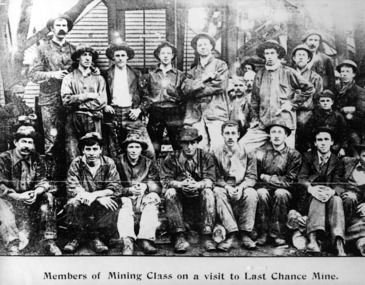
Photograph (black & white), Ballarat School of Mines Students visit the Last Chance Mine, c 1898
... students. Mr Campbell took a photo of the students dressed for the occasion, and some were flattered, and some looked very like the universal "Weary Willie". (Ballarat School of Mines Students' Magazine, July 1899, p.2.) ballarat school of mines last chance thomas hart john rowe hart mining mining alumni rowe charles campbell Verso: Copied from Annual report 1898, Thomas Hart - back Row, 2nd from right with beard. Over 24 men pose for a photograph outside the Last Chance mine. Some of the men are members of the visiting Ballarat School of Mines mining class ...The mining class visited the Last Chance on the afternoon of Thursday, 8th June, under the guidance of Mr Kirby, the mine manager. Mr Campbell, the photographic instructor, also dared the perils of the deep in order to take some flashlight photos. As this was Mr Campbell's first visit below, several difficulties which he did not now existed prevented success. The students all ranged themselves in poetic and heroic attitudes for the first flashlight, but the development of the plate showed only the light from the candles and the moisture on the lens. The next two tries were better, but were under-exposed, and of no value, except as experience. Two gentlemen from England also went below with the students, but history repeated itself and Australia won the "test." The Englishmen left early. Mr Hart secured a fine specimen of arsenopyrite and indicator slate; also a bootlace, the property of a much-vexed miner, whose boots Mr Hart had borrowed. Horrors! Mr Hart steal a bootlace! Impossible! However, a tragedy was averted by the miner securing a new lace, and he was at once all smiles - so were the students. Mr Campbell took a photo of the students dressed for the occasion, and some were flattered, and some looked very like the universal "Weary Willie". (Ballarat School of Mines Students' Magazine, July 1899, p.2.)Over 24 men pose for a photograph outside the Last Chance mine. Some of the men are members of the visiting Ballarat School of Mines mining class. Thomas Hart (beard) stands at the back right. Verso: Copied from Annual report 1898, Thomas Hart - back Row, 2nd from right with beard.ballarat school of mines, last chance, thomas hart, john rowe, hart, mining, mining alumni, rowe, charles campbell -
 Federation University Historical Collection
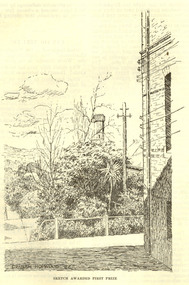
Booklet - Magazine, Ballarat School of Mines Students' Magazine, 1927
... -Mentions of the Mica Smith Scholarship -4th Annual reunion for Past Students Association, 23rd October -Descriptive article on Port Arthur -Tour of the Mount Lyell District, with mentions of the North Lyell Mine, Port Kembla, Lake Margaret Hydro Electric Works -Paper making -A brief description of the rubber industry -Decorating for the Gala Ball -Sporting activities, 1926 and 1927 -The Junior Techs class and sporting activities. Mentions of their participation in the Procession *Prints -S.M.B. Botanical Gardens by Graham Hopwood, awarded first prize -Caricatures unknown subjects, though to be staff and students...Students Association, 23rd October -Descriptive article on Port Arthur -Tour of the Mount Lyell District, with mentions of the North Lyell Mine, Port Kembla, Lake Margaret Hydro Electric Works -Paper making -A brief description of the rubber industry -Decorating for the Gala Ball -Sporting activities, 1926 and 1927 -The Junior Techs class and sporting activities. Mentions of their participation in the Procession *Prints -S.M.B. Botanical Gardens by Graham Hopwood, awarded first prize -Caricatures unknown subjects, though to be staff and students at the school *Photographs -Editorial Staff -S.M.B. Athletic Team, 1926- Winners of the Herald Shield -S.M.B. Football Team, 1927 -School of Mines Girls' Basket Ball team, 1927 -Girls' Hockey Team, Ballarat School of Mines, 1927 -Winners of the Thompson Shield, 1926. Premiers N.C.D.- J.T.S.A. (Junior Technical School Association) *Advertisements -A.N.A. Hall, Camp St. 'The Rollicking English Company- "The Rivals", presented by the School of Mines Dramatic Company. Wednesday, 14th September, 1927. smb ballarat school of mines hockey ballarat school of mines botanical gardens graham hopwood basketball netball A.T Morrison E. Van Beek G. Dimsey G. Inglis L. Hillman J. Muir J. Johnson N. Nicholls B. Saunders Dr. J. R. Pound Mr. H. Jolly A. Proctor j. walters Green soft covered book relating to the Ballarat School of Mines student ...Every year the Ballarat School of Mines (S.M.B) produced a magazine, between 1898-1967. The 1927 magazine Editorial Staff- A.T Morrison, E. Van Beek, G. Dimsey, G. Inglis, L. Hillman, J. Muir, J. Johnson, N. Nicholls, B. Saunders, Dr. J. R. Pound, Mr. H. Jolly, A. Proctor, and J. Walters. Contains list of course students for 1927. Listing of School Council and staff for 1927 (inside front cover). Listing of departments, courses and fees (approximate) available at S.M.B . (inside back cover) *Articles -Mr. John Rowell regarding his receiving the Crouch Memorial Prize -S.M.B. Procession, 1927 -S.M.B. Ball July 20th at the City Hall -Letter to Editor 'The Chemists' Trip to Melbourne mentioning a tour of the Footscray Technical School; an exploration of the Mount Lyell Chemical Works; visits to the Colonial Sugar Refining Company, The Melbourne Mint, the Deer Park Explosive Works (met with former S.M.B. students, A. Perry and H. R. Kofoed), Nobel (Australasia) Ltd. -Mentions of Literary Society activities -Geelong trip by school football team July 18th to play Gordon Tech. -Extract from the 'People's Paper', July 14 regarding the S.M.B Gala Night and the election of Miss S.M.B. -Mentions of the Mica Smith Scholarship -4th Annual reunion for Past Students Association, 23rd October -Descriptive article on Port Arthur -Tour of the Mount Lyell District, with mentions of the North Lyell Mine, Port Kembla, Lake Margaret Hydro Electric Works -Paper making -A brief description of the rubber industry -Decorating for the Gala Ball -Sporting activities, 1926 and 1927 -The Junior Techs class and sporting activities. Mentions of their participation in the Procession *Prints -S.M.B. Botanical Gardens by Graham Hopwood, awarded first prize -Caricatures unknown subjects, though to be staff and students at the school *Photographs -Editorial Staff -S.M.B. Athletic Team, 1926- Winners of the Herald Shield -S.M.B. Football Team, 1927 -School of Mines Girls' Basket Ball team, 1927 -Girls' Hockey Team, Ballarat School of Mines, 1927 -Winners of the Thompson Shield, 1926. Premiers N.C.D.- J.T.S.A. (Junior Technical School Association) *Advertisements -A.N.A. Hall, Camp St. 'The Rollicking English Company- "The Rivals", presented by the School of Mines Dramatic Company. Wednesday, 14th September, 1927.Green soft covered book relating to the Ballarat School of Mines student activities for the year 1927. smb, ballarat school of mines, hockey, ballarat school of mines botanical gardens, graham hopwood, basketball, netball, a.t morrison, e. van beek, g. dimsey, g. inglis, l. hillman, j. muir, j. johnson, n. nicholls, b. saunders, dr. j. r. pound, mr. h. jolly, a. proctor, j. walters -
 Federation University Historical Collection
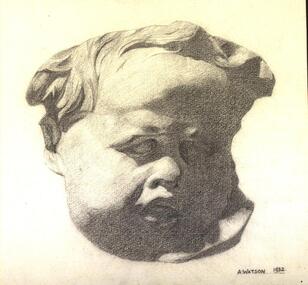
Drawing - Artwork - Drawing, Edith Alice Watson, 'Drawing the Human Figure from Casts' by Alice Watson, 1931 and 1932
... Alice Watson died in Ballarat, aged 95, having conserved her beautiful student folio, which was generously gifted to the Federation University permanent Historical Collection by the Watson family. edith alice watson alice watson ballarat technical art school plaster cast artwork alumni drawing the human figure from casts Visual Arts most are signed A.Watson 1932. Twelve drawings undertaken for the 'Drawing the Human Figure from Casts' class at the Ballarat Technical Art School. The works were undertaken by Edith Alice Watson. The full folio of work undertaken while Alice Watson was a student ...Edith (Alice) WATSON (1914–2010) Murtoa | Australia Alice Watson studied at the Ballarat Technical Art School (at the School of Mines, Ballarat) from 1930 until 1933. Watson sat several departmental exams, including drawing and painting plant forms from nature, lettering, Composition of Form and Colour and advanced General Design, as well as dressmaking and embossed leatherwork. Her folio applies many Australian native floral elements to design. Upon graduating, Watson taught at the Murtoa High School, living with her parents until their deaths in 1972 and 1988 when she was 74 years old. Alice Watson died in Ballarat, aged 95, having conserved her beautiful student folio, which was generously gifted to the Federation University permanent Historical Collection by the Watson family.Twelve drawings undertaken for the 'Drawing the Human Figure from Casts' class at the Ballarat Technical Art School. The works were undertaken by Edith Alice Watson. The full folio of work undertaken while Alice Watson was a student at the Ballarat Technical Art School is held by Federation University Australia.most are signed A.Watson 1932.edith alice watson, alice watson, ballarat technical art school, plaster cast, artwork, alumni, drawing the human figure from casts, visual arts -
 Federation University Historical Collection
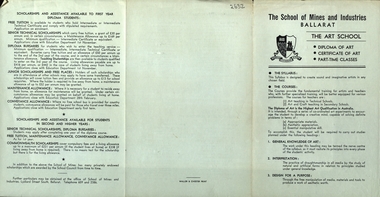
Document, Waller and Chester, Ballarat School of Mines and Industries Ballarat: The Art School, c1948, c1948
... students to undertake a further two years of specialised training in a chosen field of art. The Diploma of Art was a two-year course of specialised training available to students, who have passed the Certificate of Art Examination or its equivalent. Candidates of the examination must be at least 19 years of age, must have completed two years' full -time training or not less than three years' part-time training, and must present for the Matriculation examination for English Expression. Part-Time classes...students to undertake a further two years of specialised training in a chosen field of art. The Diploma of Art was a two-year course of specialised training available to students, who have passed the Certificate of Art Examination or its equivalent. Candidates of the examination must be at least 19 years of age, must have completed two years' full -time training or not less than three years' part-time training, and must present for the Matriculation examination for English Expression. Part-Time classes ...Entrance requirements for a full-course student was an Intermediate Certificate of equivalent. The Certificate of Art was a two year course of basic study to enable students to undertake a further two years of specialised training in a chosen field of art. The Diploma of Art was a two-year course of specialised training available to students, who have passed the Certificate of Art Examination or its equivalent. Candidates of the examination must be at least 19 years of age, must have completed two years' full -time training or not less than three years' part-time training, and must present for the Matriculation examination for English Expression. Part-Time classes at the Ballarat Technical Art School c1948 were: Day: Dressmaking, Weaving, Leatherwork, Pottery, Metalwork, Painting, Sculpture, Junior Art. Evening: Dressmaking, Weaving, Leatherwork, pottery, Metalwork, Painting, Sculpture, Ticket Writing, Lettering, Figure Drawing. Two fold, 6 page information flyer on classes held at the Ballarat Technical Art School. The Art school offered Diploma of Art, Certificate of Art and Part-time classes.ballarat technical art school, art, diploma of art, certificate of art, part-time classes, syllabus, design, scholarships, diploma of art in pottery, diploma of art in advertising, art education, dressmaking, weaving, leatherwork, pottery, metalwork, painting, sculpture, junior art, dressmaking, weaving, leatherwork, pottery, metalwork, painting, sculpture, ticket writing, lettering, figure drawing -
 Federation University Historical Collection
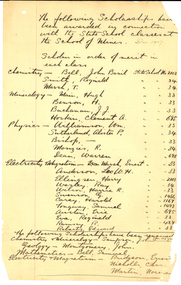
Letter - Correspondence, State School Classes at the Ballarat School of Mines, 1907, 1907
... Samuel Taong-Way State School students Foolscap page with handwritten list of State School Students who were awarded a scholarship to study a subject at the Ballarat School of Mines. State School Classes ...A number of students from local state schools were awarded a scholarship to undertake a subject at the Ballarat School of Mines. R. Menzies from Humffray Street State School (No. 34) is Robert Menzies who became Prime Minister of Australia in 1939. Menzies topped the State scholarship examination in 1907.Foolscap page with handwritten list of State School Students who were awarded a scholarship to study a subject at the Ballarat School of Mines.ballarat school of mines, scholarship, state school scholarship, robert menzies, john basil bell, reginald smith, t. marsh, hugh main, h. benson, j.j. buchanan, clement a. hoskin, william williamson, alister p. sutherland, bishop, warren dean, ernest marsh, leo w.h. anderson, harry ellingham, ray wasley, harrie r. wilson, g. swenson, harold carey, samuel tongway, eric austin, reginald eva, r. ramsey, edward roberts, john montgomery, samuel bell, ernest pridgeon, charles nicholls, norman martin., samuel taong-way, state school students -
 Federation University Historical Collection
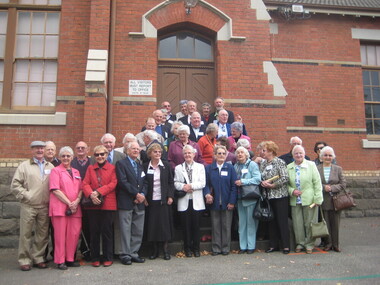
Photograph - Colour, Ballarat Teachers' College Class of 1949 60th Reunion Photo in the Ground of Dana Street Primary School, 2009, 06/04/2009
... Class of 1949 60th Reunion started at the Dana Street Primary School, the home of the Ballarat Teachers' College in 1949. The reunion started with singing the College Anthem 'Extra Muros', and many other songs associated with the College. The attendees then travelled by bus around the Ballarat Schools they worked with as Student Teachers' in 1949. Lunch followed, before a return to Dana Street Primary School for Class photos. Ballarat Teachers' College reunion 1949 49ers Dana Street Primary School A number of former students ...The Ballarat Teachers' College Class of 1949 60th Reunion started at the Dana Street Primary School, the home of the Ballarat Teachers' College in 1949. The reunion started with singing the College Anthem 'Extra Muros', and many other songs associated with the College. The attendees then travelled by bus around the Ballarat Schools they worked with as Student Teachers' in 1949. Lunch followed, before a return to Dana Street Primary School for Class photos.A number of former students of the Ballarat Teachers' College pose for a photograph in the grounds of the Dana Street Primary School at the 60th reunion of the Class on 1949.ballarat teachers' college, reunion, 1949, 49ers, dana street primary school
