
Showing 16 items matching "travelling hawker"
-
 Flagstaff Hill Maritime Museum and Village
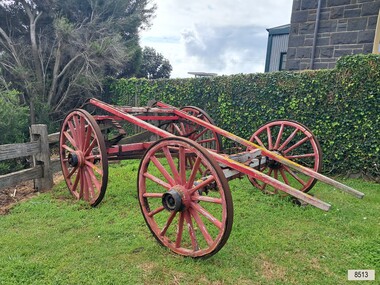
Vehicle - Wagon, Circa 1909
... ...travelling hawker...Flagstaff Hill Warrnambool Maritime Village Maritime Museum Flagstaff Hill Maritime Museum and Village Shipwreck coast Great Ocean Road southwest Victoria northwest Victoria western district Colac Colac Hospital Colac Licensing Court Thowgla Corryong Garvoc Cooramook Road Warrnambool Petty Sessions Court Warrnambool Hospital Russells Creek Road Ganges Warrnambool Cemetery Uppal Bhopa Jalandhar Hawker’s Licence covered wagon wagon hawker's wagon horse-drawn cart hawker's cart light delivery vehicle hawker travelling salesman travelling hawker door-to-door sales rural salesman rural commerce Prince Duke Clydesdale horse 1997 Pooran Singh Indian immigrant Pat John James Moore Vera Moore John and Vera Moore John Moore Guyatt’s Funerals Kapil Dev Harmel Uppal Avis Quarrell Wagon: a light delivery vehicle once used as a hawker's wagon. ...This wagon was used in towns across south-west Victoria during the first half of the twentieth century by Pooran Singh, an Indian-born immigrant. Singh arrived in Australia alone in 1899 at the age of 30. The following year, at the Colac Licensing Court in western Victoria, he was one of 78 hawkers granted a Hawker’s Licence. According to the Colac Herald, all but two of the applicants appeared to be Asian. While some hawkers registered horse-drawn carts, Singh was one of nineteen licensed to trade on foot, selling door to door. Applicants were encouraged to contribute to a collection for the Colac Hospital. Over time, Pooran Singh came to own his own wagon—a top-of-the-range light delivery vehicle—and a horse named Prince. His work often took him along rough country roads, and for a period, he worked in the Corryong district of north-eastern Victoria, an area popular with hawkers. In September 1909, near Thowgla, he was thrown from his wagon while attempting to navigate a deep rut and was run over by one of its wheels. Although he suffered bruising to his chest, his injuries were not serious. The following year, he was granted a Hawker’s Licence in Corryong. By 1916, Singh was living and working at Garvoc in western Victoria, where that year, he lost his paper licence on Cooramook Road, and he placed a notice in The Standard. In 1918, at the Warrnambool Petty Sessions Court, he was one of four applicants granted renewal of their hawkers’ licences, and each donated ten shillings to Warrnambool Hospital. Throughout these years, Singh became well known to farmers and their families as he travelled across Victoria’s Western District, living and working from his covered wagon. In his later years, Pooran Singh formed a close friendship with John Jandes Moore and his wife, Vera, of Russells Creek, Warrnambool. They offered him the use of their property as a base for his travels and cared for him during his final illness. John Moore was later appointed one of the two executors of Singh’s will. Pooran Singh died in Warrnambool on 8 June 1947, aged 77. His final wish was to be cremated and for his ashes to be returned to India for immersion in the Ganges. The cremation was arranged by Guyett’s Funerals in Warrnambool. Having never married, Singh left his estate to his four nephews, enabling them to buy land and build homes; one later installed a memorial plaque in his honour. In the late 1980s, Guyett’s Funerals placed his ashes in the niche wall at Warrnambool Cemetery as a memorial, while continuing to hope that family instructions might eventually arrive. Nearly 63 years after his death, renewed enquiries brought public attention to the long and respectful care given to his ashes. As a result, the renowned Indian cricketer Kapil Dev travelled to Warrnambool to collect them and escort them to India, helping to fulfil Singh’s final wish. He was joined by one of Singh’s grand-nephews, Harmel Uppal, who had travelled from England. At a formal ceremony on 25 July 2010 commemorating Singh’s life, the ashes were handed to Dev and Uppal, and local resident Avis Quarrell, who had known Singh as a child, read a poem she had written in his memory. She still owned a shell necklace that Singh had made for her mother. Some Warrnambool locals who had been closely involved also travelled to India, where they joined Uppal’s family from the village of Uppal Bhopa, near Jalandhar. On 31 July 2010, Pooran Singh’s ashes were immersed in the Ganges, fulfilling the wish he had expressed more than six decades earlier. After Pooran Singh’s death, his horse and wagon remained on John Moore’s property. When Prince died, he was buried on the beach at Warrnambool. The wagon remained with the Moore family and was occasionally used as a cubby house. In about 1997, John Moore, the son of John Jandes Moore, donated it to Flagstaff Hill. After restoration, the wagon became an attraction in the village, where volunteer Pat and his Clydesdale horse, Duke, offered visitors rides around Flagstaff Hill’s lake. This wagon is significant for its association with an Indian emigrant who used it to earn an income in Australia. It also reflects the vital role of hawkers, who travelled through rural and regional communities in the late nineteenth and early twentieth centuries, supplying food, goods and news. The wagon is also historically significant as a former Flagstaff Hill attraction, offering visitors the experience of horse-drawn rides around the lake.Wagon: a light delivery vehicle once used as a hawker's wagon. It is a four-wheel, horse-drawn vehicle with iron tyres, brakes, spoked wheels painted red with decorative yellow strips on the hubs, a timber shaft, and springs on the undercarriage. It was once a covered wagon, fitted with green, wooden sideboards, a front seat with leather-padded backrest and mounting steps. The late-19th to early-20th-century wagon was once owned by Pooran Singh, a local Indian hawker. flagstaff hill, warrnambool, maritime village, maritime museum, flagstaff hill maritime museum and village, shipwreck coast, great ocean road, southwest victoria, northwest victoria, western district, colac, colac hospital, colac licensing court, thowgla, corryong, garvoc, cooramook road, warrnambool petty sessions court, warrnambool hospital, russells creek road, ganges, warrnambool cemetery, uppal bhopa, jalandhar, hawker’s licence, covered wagon, wagon, hawker's wagon, horse-drawn cart, hawker's cart, light delivery vehicle, hawker, travelling salesman, travelling hawker, door-to-door sales, rural salesman, rural commerce, prince, duke, clydesdale horse, 1997, pooran singh, indian immigrant, pat, john james moore, vera moore, john and vera moore, john moore, guyatt’s funerals, kapil dev, harmel uppal, avis quarrell -
 Warrnambool and District Historical Society Inc.
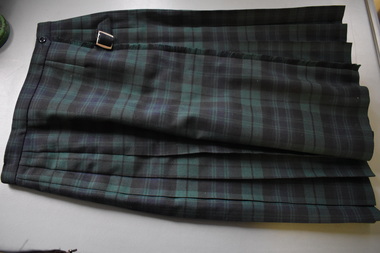
Clothing - Fletcher Jones Skirt, late 20th century
... David Fletcher Jones (1895-1977) setup as a travelling hawker in the 1920s selling drapery in Western Victoria. ...David Fletcher Jones (1895-1977) setup as a travelling hawker in the 1920s selling drapery in Western Victoria. ...This skirt was made by the Fletcher Jones company as part of the uniform of the Penleigh Grammar School, Essendon, Melbourne. David Fletcher Jones (1895-1977) setup as a travelling hawker in the 1920s selling drapery in Western Victoria. In 1924 he opened a store in Warrnambool, moving into a two-storeyed building in Liebig Street in 1931. He manufactured and sold men's clothing at this site, opening a store in Melbourne in 1946 and a factory in Warrnambool in 1948. The company of Fletcher Jones and Staff, established in 1951, opened more stores and factories and operated Australia-wide and became well-known firstly for its production of men's trousers and later men's and women's clothing. By 2011 the Warrnambool factory was sold and the company dissolved. This skirt is of interest as a fine example of the quality clothing made by the Fletcher Jones clothing company. This business commenced in Warrnambool and was a dominant one in Warrnambool (and Australia) during the 20th century.This is a woman's tartan skirt in green and navy tonings. The skirt is pleated at the back and sides and has a silver-coloured metal buckle at the left side. It has metal clips and buttons that adjust the waistline size and a green cloth folder designed as a wallet with a press stud closer inside the front waist.College Apparel by Fletcher Jones Australiafletcher jones clothing stores, penleigh grammar uniform, penleigh grammar skirt, tartan skirt -
 Lake Bolac & District Historical Society
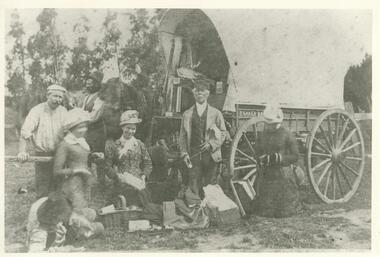
Black and white photograph, Travelling salesman at Lake Bolac
... Travelling salesmen (hawkers) regularly journeyed from farm to farm selling useful household items like needles, thread, clothing, even cooking pots. ...Travelling salesmen (hawkers) regularly journeyed from farm to farm selling useful household items like needles, thread, clothing, even cooking pots. ...Travelling salesmen (hawkers) regularly journeyed from farm to farm selling useful household items like needles, thread, clothing, even cooking pots. Mr T Saker was a salesman selling drapery. He was based in Warrnambool and had a regular route to Lake Bolac and through the Western district.lake bolac, hawkers, drapery, warrnambool, western district -
 Warrnambool and District Historical Society Inc.
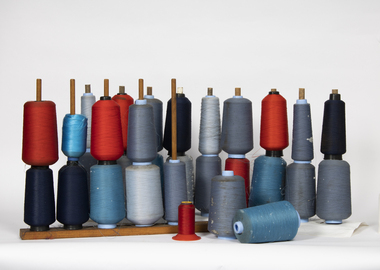
Functional object - Thread Spools, mid 20th century
... David Fletcher Jones (1895-1977) set up as a travelling hawker selling drapery in the Western District in the 1920s. ...David Fletcher Jones (1895-1977) set up as a travelling hawker selling drapery in the Western District in the 1920s. ...These thread spools come from the Fletcher Jones Factory in Warrnambool. They would have been used in the sewing and manufacture of the men's and ladies' garments made at the factory. The Fletcher Jones factory was established by David Fletcher Jones in 1948. David Fletcher Jones (1895-1977) set up as a travelling hawker selling drapery in the Western District in the 1920s. In the same decade he opened a shop in Warrnambool manufacturing men's clothing, specialising in the production of men's trousers. In 1946 a Fletcher Jones shop was opened in Melbourne and a company, Fletcher Jones and Staff, was established in 1951. The company expanded to manufacturing both men's and women's clothing, opening outlets in all States and becoming well-known Australia-wide. The company was dissolved in 2011 and the Warrnambool factory was sold.These items are of interest as a memento of the Fletcher Jones Factory and the Fletcher Jones company, one of the most important businesses ever established in Warrnambool and certainly one of the most cherished by the local Warrnambool community..1 A wooden stand with upright spikes holding 11 spools containing coloured thread (various colours). The threads are on blue and black plastic reels. .2 A wooden stand with upright spikes holding 16 spools containing coloured thread (various colours). The threads are on blue and black plastic reels.fletcher jones and staff pty ltd, fletcher jones factory warrnambool -
 Wodonga & District Historical Society Inc
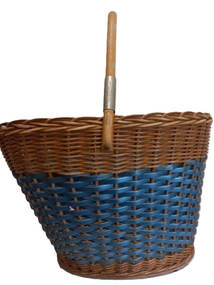
Domestic object - Vintage cane basket
... They were made in a wide range of shapes and sizes, including laundry baskets, storage items in the home, in shops and by travelling hawkers. Wicker was also a common material used for furniture. ...They were made in a wide range of shapes and sizes, including laundry baskets, storage items in the home, in shops and by travelling hawkers. Wicker was also a common material used for furniture. ...This handmade basket is typical of baskets used for domestic purposes for many years in the early to mid 20th century. It was produced in Australia by Graf's. Wicker baskets were popular at this time as they were light but durable. They were made in a wide range of shapes and sizes, including laundry baskets, storage items in the home, in shops and by travelling hawkers. Wicker was also a common material used for furniture. Vintage baskets by Graf's are still in demand by collectors. Franz and Anneliese Graf arrived in Australia about 1960 and spent time at the Bonegilla Migrant Camp where one of their sons Arnold was born. They moved to Melbourne and began Graf’s basket making business soon after. The basket in our Collection brings the Graf story full circle back to its Australian roots.This item is significant as it is representative of basketry items popular throughout Australia in the 1960s. This basket was hand-made in Australia and used by a resident of the Wodonga District.A woven cane shopping basket with a wooden base and single bamboo handle. The basket is made from mixed weaving of cane and light-blue strips. Underneath basket: Original GRAF'S Basket Hand made in AUSTRALIA On metal attached to handle: GRAF’S HANDLE BINDING, PAT.PEND vintage cane wear, vintage basket, graf baskets, basketware australia -
 Warrnambool and District Historical Society Inc.
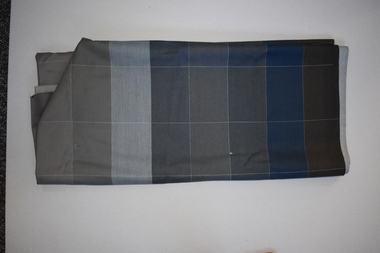
Textile, Fletcher Jones, Mid 20th century
... David Fletcher Jones (1895-1977) served in the First World War and in the 1920s set up as a travelling hawker selling drapery in the Western District of Victoria. ...David Fletcher Jones (1895-1977) served in the First World War and in the 1920s set up as a travelling hawker selling drapery in the Western District of Victoria. ...This piece of cloth came from the Fletcher Jones factory in Warrnambool. David Fletcher Jones (1895-1977) served in the First World War and in the 1920s set up as a travelling hawker selling drapery in the Western District of Victoria. In 1924 he leased three shops in Liebig Street, Warrnambool and in 1928 he moved to the Koroit/Liebig Streets intersection with his Man’s Shop. He manufactured men’s clothing on site. In 1931 he moved the business into a new two-storeyed building on the site. He opened a Fletcher Jones shop in Melbourne in 1946 and in 1948 a factory was established in Warrnambool. In 1951 the business of Fletcher Jones and Staff was established. The company expanded and became known Australia- wide, firstly for the production of men’s trousers and later both men’s and women’s clothing. By 2011 the Warrnambool factory was sold and the company was dissolved. This piece of material is of interest as an example of the cloth used in the Fletcher Jones factory in Warrnambool. The Fletcher Jones clothing company, known Australia-wide, was one of the important industries based in Warrnambool in the 20th and early 21st centuryThis is piece of check material in grey and blue tonings. It is stained in various places.fletcher jones clothing stores, warrnambool, history of warrnambool -
 Warrnambool and District Historical Society Inc.
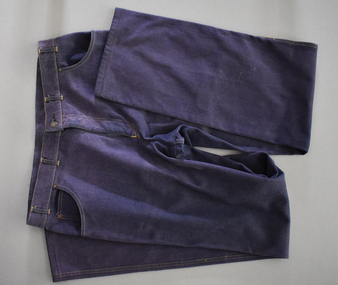
Textile, Fletcher Jones, Men's Fletcher Jones Jeans, Early 21st century
... David Fletcher Jones (1895-1977) served in World War One and in the 1920s set up as a travelling hawker selling drapery in the Western District of Victoria. ...David Fletcher Jones (1895-1977) served in World War One and in the 1920s set up as a travelling hawker selling drapery in the Western District of Victoria. ...This pair of jeans comes from the Fletcher Jones factory in Warrnambool. David Fletcher Jones (1895-1977) served in World War One and in the 1920s set up as a travelling hawker selling drapery in the Western District of Victoria. In 1924 he leased three shops in Liebig Street Warrnambool and in 1928 he moved the business to the corner of Koroit and Liebig Streets with his Man’s Shop. He manufactured men’s clothing on site. In 1931 a new set of buildings was erected on the site and Fletcher Jones moved into the new building. In 1946 a Fletcher Jones shop was opened in Melbourne and in 1948 a factory was opened in Warrnambool with a new company Fletcher Jones and Staff established in 1951. This company became known Australia-wide, firstly for the production of men’s trousers and later for both men’s and women’s clothing. By 2011 the factory was sold and the company dissolved. These jeans are retained as an example of the clothing made at the Warrnambool Fletcher Jones factory. The Fletcher Jones clothing company was one of the most important businesses in Warrnambool in the 20th century. This is a pair of blue cotton jeans pants with yellow stitching and a metal zip The garment has four pockets. The back pocket has the maker’s label and there are two labels attached to the inside. The front inside top section is lined with white material. ‘Fletcher Jones Australia’fletcher jones clothing company, history of warrnambool -
 Warrnambool and District Historical Society Inc.
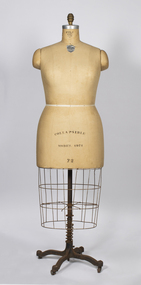
Functional object - Dressmaker's model, Wolf Form and Co. (New York), 1971
... David Fletcher Jones (1895-1977) served in World War One and in the 1920s set up as a travelling hawker selling drapery in Western Victoria. ...David Fletcher Jones (1895-1977) served in World War One and in the 1920s set up as a travelling hawker selling drapery in Western Victoria. ...This dressmaker's model has been made by a New York firm (1971 model) and comes from the Fletcher Jones Factory in Warrnambool. It would have been used for making and displaying ladies' clothing made at the factory. David Fletcher Jones (1895-1977) served in World War One and in the 1920s set up as a travelling hawker selling drapery in Western Victoria. In 1924 he opened a men's wear shop in Warrnambool and manufactured in sute. In 1946 a Fletcher Jones shop opened in melbourne and in 1948 a factory was established in Warrnambool with a new company, Fletcher Jones and Staff begun in 1951. The company initially specialized in men's trousers but later expanded into both men's and women's clothing. It became an Australia-wide company known throughout the country until it ceased in 2011 and the Warrnambool factory buildings were sold.This dressmaker's model is of considerable interest as a memento of the Fletcher Jones and Staff Company, founded in Warrnambool, employing many local people for a great number of years and known throughout Australia for its quality products and pioneering business model as a founder and staff co-operative.This is a dressmaker's model with the body section (bust and torso) having a fabric cover over a wooden core. The top section is bronze-coloured with a silver rim. Beneath the body section is a wire frame and a metal base on castors. The castors are rusty and the fabric is broken in places. Collapsible model 1971 22 WOLF FORM Registered perfect model forms N Y 140 5th Avefletcher jones and staff, fletcher jones factory warrnambool, warrnambool history -
 Warrnambool and District Historical Society Inc.
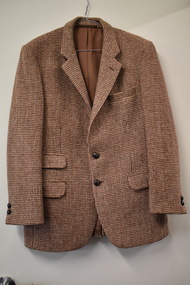
Clothing - Fletcher Jones Man's Sports Coat, 1970s
... David Fletcher Jones (1895-1977) served in World War One and in the 1920s set up as a travelling hawker selling drapery in Western Victoria. ...David Fletcher Jones (1895-1977) served in World War One and in the 1920s set up as a travelling hawker selling drapery in Western Victoria. ...This sports coat was made at a Fletcher Jones factory about the 1970s. David Fletcher Jones (1895-1977) served in World War One and in the 1920s set up as a travelling hawker selling drapery in Western Victoria. In 1924 he leased three shops in Liebig Street, Warrnambool and in 1928 opened his Man's Shop at the intersection of Koroit/Liebig Streets. He manufactured men's clothing on site in a new building erected in 1931. In 1946 a Fletcher Jones shop was opened in Melbourne and in 1948 a factory was established in Warrnambool with a new company Fletcher Jones and Staff established in 1951.This company then operated in other States and known Australia-wide firstly for its production of men's trousers and later for men's and women's clothing. By 2011 the Warrnambool factory was closed and the company dissolved. This coat was bought by Lew Officer, a member of a family with pastoral interests in the Western District.This item is of considerable historical interest as an example of the high quality work produced by the Fletcher Jones and Staff Clothing Stores. This company was a key industry in Warrnambool in the 20th centuryThis is a man's sports coat made of Harris tweed hand woven in the Outer Hebrides made from Scottish-grown wool. The checked material is in brown tonings. The coat has a brown material lining and there are two brown buttons down the front and two on each sleeve. The collar has a grey felt lining.fletcher jones clothing stores, warrnambool, harris tweed jacket, lew officer -
 Warrnambool and District Historical Society Inc.
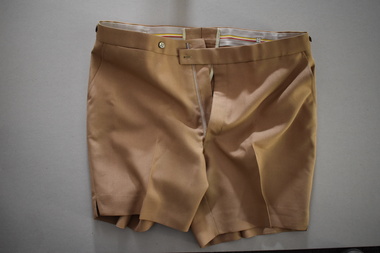
Clothing, Fletcher Jones Clothing Factory, Men's shorts Fletcher Jones, Late 20th century
... David Fletcher Jones (1895-1977) served in World War One and in the 1920s set up as a travelling hawker selling drapery in the Western District of Victoria. ...David Fletcher Jones (1895-1977) served in World War One and in the 1920s set up as a travelling hawker selling drapery in the Western District of Victoria. ...These shorts come from the Fletcher Jones clothing factory in Warrnambool. They have never been worn. David Fletcher Jones (1895-1977) served in World War One and in the 1920s set up as a travelling hawker selling drapery in the Western District of Victoria. In 1924 he leased three shops in Liebig Street Warrnambool and in 1928 he moved his business to the corner of Koroit and Liebig Streets. He manufactured men’s clothing on site with the business known as the Men’s Shop. In 1931 he moved into a newly-erected two-storeyed building on the site. In 1946 he opened a store in Melbourne and in 1948 he established a clothing factory in Warrnambool with a new company set up in 1951 – Fletcher Jones and Staff. This company became known Australia-wide with its production, firstly of men’s trousers and later both men’s and women’s clothing. By 2011 the factory was closed and the company dissolved. These shorts are of interest as an example of an item made at the Fletcher Jones factory in Warrnambool. The Fletcher Jones Clothing Company, known throughout Australia, was one of the most important industries in Warrnambool in the 20th century. These men’s shorts are made of polyester and viscose and are light brown in colour. They have an elasticised waist band with five buttons and a corded lining, three pockets and a nylon zip front opening with a metal fastener. The shorts have two labels stitched into the inside of the garment and one paper label attached to the shorts by a nylon clip. ‘Fletcher Jones Australia’fletcher jones factory, history of warrnambool -
 Warrnambool and District Historical Society Inc.
Functional object - Wrapping Paper (2 sheets), Fletcher Jones and Staff, Warrnambool, c. 1970
... David Fletcher Jones (1895-1977) served in World War One and in the 1920s set up as a travelling hawker selling drapery in Western Victoria. ...David Fletcher Jones (1895-1977) served in World War One and in the 1920s set up as a travelling hawker selling drapery in Western Victoria. ...These sheets of wrapping paper come from the clothing company of Fletcher Jones (Warrnambool). One sheet has been produced for the After Sales Department. David Fletcher Jones (1895-1977) served in World War One and in the 1920s set up as a travelling hawker selling drapery in Western Victoria. In 1924 he leased three shops in Liebig Street, Warrnambool and in 1928 he moved to the Koroit/Liebig Streets intersection with his Man's Shop. He manufactured men's clothing on site. In 1931 he moved into a new set of two-storeyed buildings on the site. In 1946 he opened a men's store in Melbourne and in 1948 he opened a factory in Warrnambool with a new company called Fletcher Jones and Staff (1951). This company extended to other parts of Australia and became well-known throughout Australia for the production of men's trousers and later men's and women's clothing. By 2011 the Warrnambool factory was sold and the company dissolved.These wrapping papers are of interest as a memento of the Fletcher Jones Clothing Company, a major industry in Warrnambool and Australia for many years.These are two sheets of wrapping paper from the Fletcher Jones clothing company. .1 A sheet of grey paper over-printed with a blue logo (shield and needle and thread) and blue printing .2 A sheet of buff-coloured paper (tissue quality) over-printed with a blue logo (shield and needle and thread) and red printing.1 Fletcher Jones Says Compare .2 Fletcher Jones, After Sales Service, F.J. Plus 8, Dry Cleaning, Lock Pressing, Form Setting, Adjustments and Repairsfletcher jones warrnambool, warrnambool businesses -
 Warrnambool and District Historical Society Inc.
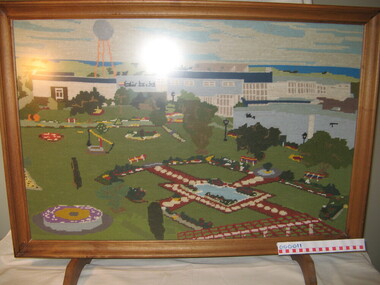
Textile - Fire screen, Tapestry, Post 1967
... David Fletcher Jones (1895-1977) was a travelling hawker who opened a business in Liebig Street, Warrnambool in 1924. ...David Fletcher Jones (1895-1977) was a travelling hawker who opened a business in Liebig Street, Warrnambool in 1924. ...David Fletcher Jones (1895-1977) was a travelling hawker who opened a business in Liebig Street, Warrnambool in 1924. In 1931 he opened The Man's Shop at the corner of Liebig Street and Koroit Street. He sold suits and overcoats tailored in the work rooms upstairs. In 1948 his factory known as Pleasant Hill was opened in Flaxman Street in Warrnambool, the site of an old quarry. In 1951 the company Fletcher Jones and Staff was formed with the staff owning 51% of the shares, By the 1970s Fletcher Jones and Staff had become one of the largest clothing companies in Australia with 55 shops and 3000 employees. In 1992 the Warrnambool City Council bought the factory and gardens with the site now a tourist attraction. Although the name is retained today for trading purposes the original Fletcher Jones company has been dissolved. The screen is a representation of the Fletcher Jones factory post 1967. It a wool tapestry by Martin Prider who was a painter and caretaker what the Fletcher Jones factory. He lived in one of the Fletcher Jones cottages on site. (Robin Boyd Age Small Homes Scheme, today Heritage listed.)This is an interesting memento of the Fletcher Jones company and the factory. It was done by a local resident and features the famous Fletcher Jones gardensTapestry fire screen in a rectangular light timber frame depicting the Fletcher Jones Factory Gardens. The screen has two timber feet, non relective glass and appears to be a wool tapestry. The image of the gardens is after 1967 as the silver ball is included and that was erected in 1967. Nilfletcher jones company and warrnambool factory, pleasant hill warrnambool, martin prider, fletcher jones, tapestry of fletcher jones factory -
 Warrnambool and District Historical Society Inc.
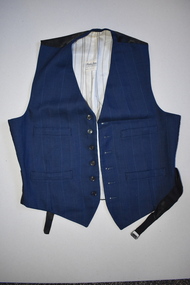
Textile, Fletcher Jones Man’s Shop, Waistcoat Fletcher Jones, 1946
... David Fletcher Jones (1895-1977) served in World War One and in the 1920s set up as a travelling hawker selling drapery in Western Victoria. ...David Fletcher Jones (1895-1977) served in World War One and in the 1920s set up as a travelling hawker selling drapery in Western Victoria. ...This waistcoat was made for Mr Alan Vinnell by the Fletcher Jones Man’s Shop in 1946 and was worn by Mr Vinnell at his wedding in Lang Lang on 27/4/1946 to Miss Madge Ridgway. Alan was the son of Albert Vinnell and Ada Rose Wood. He attended school in Macarthur about 40 kilometres northwest of Warrnambool. The Fletcher Jones Man’s Shop was located at the corner of Liebig and Koroit Streets in Warrnambool. David Fletcher Jones (1895-1977) served in World War One and in the 1920s set up as a travelling hawker selling drapery in Western Victoria. In 1924 he leased three shops in Liebig Street and in 1928 he moved to the Koroit/Liebig Streets intersection with his Man’s Shop. He manufactured men’s clothing on site. In 1931 a new set of two-storeyed buildings was erected on the site and Fletcher Jones moved into the building. In 1946 a Fletcher Jones shop was opened in Melbourne and in 1948 a factory was established in Raglan Parade, Warrnambool with a new company, Fletcher Jones and Staff established in 1951. This company became known Australia-wide, firstly for the production of men’s trousers, and later men’s and women’s clothing. By 2011 the Warrnambool factory was sold and the company dissolved. This waistcoat is of historical interest as an example of the high quality work produced at the Fletcher Jones Man’s Shop in Warrnambool in the mid 1940s. The Fletcher Jones business became one of the most important ones in Warrnambool in the 20th century and the early 21st century.This is a sleeveless woollen waistcoat made of blue striped material with a black cotton backing. The back has two black cotton flaps with a metal buckle to allow for the tightening of the coat across the back. The inside is lined with a cream, yellow and grey striped cotton material. The waistcoat has one inside pocket with a button enclosure and four outside pockets. The waistcoat has six black buttons on the outside and a maker’s label stitched on the inside. ‘Fletcher Jones The Man’s Shop Warrnambool Mr A. Vinnell Date 15/2/46’fletcher jones man’s shop warrnambool, history of warrnambool, albert vinnell, vinnell -
 Orbost & District Historical Society
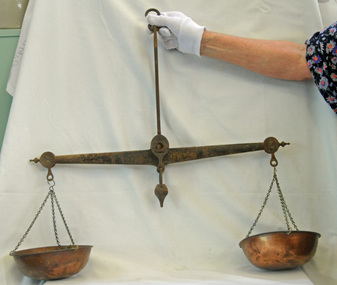
scales, c. 19th century
... Possibly used in a shop or as a travelling set of scales for a hawker....Possibly used in a shop or as a travelling set of scales for a hawker. This item is an example of an early device used for measurement. scales weight-measure hanging-scales A number of scroll designs are imprinted into the beam. ...Possibly used in a shop or as a travelling set of scales for a hawker.This item is an example of an early device used for measurement.A set of hanging scales. Two copper containers are suspended one from each end of a beam. In the centre of the beam is a hanging rod to the top and a pointer at the bottom.A number of scroll designs are imprinted into the beam. scales weight-measure hanging-scales -
 Surrey Hills Historical Society Collection
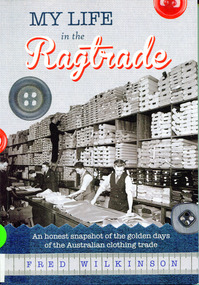
Book - My Life in the Ragtrade
... In 'My life in the ragtrade', author Fred Wilkinson takes us on a trip back in time to the days of Sidney Myer's beginnings in Bendigo, to Flinders Lane, Melbourne ('The Lane'), travelling salesmen and hawkers, and names and slogans which we've all but forgotten: Anthony Squires, Sutex, Keith Courtenay, Pelaco, Crestknit, Chesty Bond, Love Me in my Glo-Weave, Hard Yakka, He's so good he thinks he's King G, and more. ...'My life in the ragtrade' is the story of the famous Australian brand names, many developed from humble beginnings yet made in clothing factories employing thousands of people, and the grand retail stores and clothing shops that stocked those brands. In 'My life in the ragtrade', author Fred Wilkinson takes us on a trip back in time to the days of Sidney Myer's beginnings in Bendigo, to Flinders Lane, Melbourne ('The Lane'), travelling salesmen and hawkers, and names and slogans which we've all but forgotten: Anthony Squires, Sutex, Keith Courtenay, Pelaco, Crestknit, Chesty Bond, Love Me in my Glo-Weave, Hard Yakka, He's so good he thinks he's King G, and more. Then there were the retailers - Winns, Farmer's, Anthony Hordern, Mark Foy and more. Shopping back then was an adventure, it was a pleasure to be served and customers were treated like royalty. There is a useful chronology of take-overs and closures of Australian department stores.xv, 197 pages : illustrations, portraits, facsimiles ; 25 cm.non-fiction'My life in the ragtrade' is the story of the famous Australian brand names, many developed from humble beginnings yet made in clothing factories employing thousands of people, and the grand retail stores and clothing shops that stocked those brands. In 'My life in the ragtrade', author Fred Wilkinson takes us on a trip back in time to the days of Sidney Myer's beginnings in Bendigo, to Flinders Lane, Melbourne ('The Lane'), travelling salesmen and hawkers, and names and slogans which we've all but forgotten: Anthony Squires, Sutex, Keith Courtenay, Pelaco, Crestknit, Chesty Bond, Love Me in my Glo-Weave, Hard Yakka, He's so good he thinks he's King G, and more. Then there were the retailers - Winns, Farmer's, Anthony Hordern, Mark Foy and more. Shopping back then was an adventure, it was a pleasure to be served and customers were treated like royalty. There is a useful chronology of take-overs and closures of Australian department stores.clothing trade, fred wilkinson, clothing workers, ragtrade, sidney myer, sutex, keith courtenay clothing, flinders lane, robert reid & company, paterson laing & bruce, paterson reid & bruce, anthony squires, sax altman, myer emporium, ken fogarty, jon bentley's, maurie blackman, sidney sinclair, louis klein, don collier, stafford ellinson, levi strauss, levi jeans, amco, louis epstein, hiscocks saddlery, just jeans, jeans west, general pants, glo-weave, comfort shirt company, saul same, pelaco, pearson & law, james law, james pearson, david laidlaw, d k laidlaw & sons, yakka, chesty bond, george bond, bond industries, bob adcock, king gee, king gee clothing co, jack stahmer, d & w murray, commercial travellers, commercial travellers' association, james davies, fletcher jones -
 Bacchus Marsh & District Historical Society
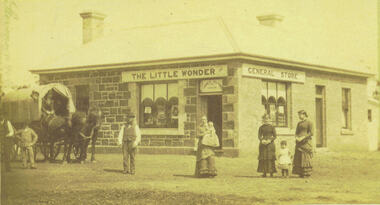
Photograph, Alford's Little Wonder Store Bacchus Marsh 1883
... The photo also shows the covered wagon of a travelling salesman, who were known as ‘hawkers’, who were significant in the supply of goods and news to outlying towns and districts before the development of road and rail networks. ...The photo also shows the covered wagon of a travelling salesman, who were known as ‘hawkers’, who were significant in the supply of goods and news to outlying towns and districts before the development of road and rail networks. ...The Little Wonder Store was built in 1883 from materials of the demolished Maddingley School. It was located on the corner of Grant Street and Labilliere Street. In 1886 James Alford obtained a licence to conduct the Railway Hotel and General Store there. A second storey was added later and the building continued to operate as the Railway Hotel. It was destroyed by fire in 1998. The photo also shows the covered wagon of a travelling salesman, who were known as ‘hawkers’, who were significant in the supply of goods and news to outlying towns and districts before the development of road and rail networks. Small sepia 'carte de viste' style unframed photograph on card with gold border framing photograph. Housed in the Jeremeas Family Album which contains photographs of Bacchus Marsh and District in 1883 by the photographers Stevenson and McNicoll. The photo shows a single-storey building of bluestone and brick with two signs on the front and side, the front sign reading “THE LITTLE WONDER” and the side sign “GENERAL STORE”. Above the door is a sign with the name ‘James Alford’. The windows display the merchandise of the store. Outside the store is a travelling salesman’s cart pulled by two horses. The salesman sits in the cart ready to drive off. Standing along the street outside the store are three men, three women and two young children.Printed On the front: Stevenson & McNicoll. Photo. 108 Elizabeth St. Melbourne. COPIES CAN BE OBTAINED AT ANY TIME. On the back: LIGHT & TRUTH inscribed on a banner surmounted by a representation of the rising sun. Copies of this Portrait can be had at any time by sending the Name and Post Office Money Order or Stamps for the amount of order to STEVENSON & McNICOLL LATE BENSON & STEVENSON, Photographers. 108 Elizabeth Street, MELBOURNE. stevenson and mcnicoll 1883 photographs of bacchus marsh and district, shops bacchus marsh, general stores bacchus marsh vic., hawkers, hotels bacchus marsh
