
Showing 83 items matching "volunteer regiments"
-
 Federation University Historical Collection
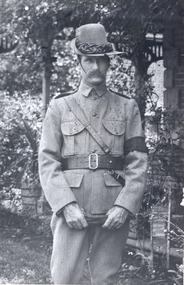
Photograph, Boer War Veteran Alfred G. Johnston
... ...volunteer regiments...Council Meeting 31-5-1901). boer boer war south african war south africa volunteer regiments alfred johnston a g johnston johnston ballarat school of mines victorian mounted rifles Verso: AUTHENTICATION REQUESTED Photographic portrait of LIEUTENANT ALFRED GRESHAM JOHNSTON (with handwritten note - or Gersham) 5th Regiment V.M.R. ...Alfred G Johnston was a former Ballarat School of Mines student who was killed in action at Rhenosterkop, Middleburg district, Transvaal, South Africa, on 7 May 1901, aged 29 years. A letter of condolence was sent to his parents (see S.M.B. Council Meeting 31-5-1901).An image from the original black and white photograph showing the torso of a man in military uniform - Alfred G Johnston who served in the 5th Regiment of the Victorian Mounted Rifles. The uniform (the forerunner of the uniform of the Australian Light Horse) includes a slouch hat. Also see: Photograph of Alfred G. Johnston as S.M.B. student, 1899. Catalogue number 00414. A photograph of the memorial that Ballarat School of Mines put up in his honour is Catalogue number 00531.Verso: AUTHENTICATION REQUESTED Photographic portrait of LIEUTENANT ALFRED GRESHAM JOHNSTON (with handwritten note - or Gersham) 5th Regiment V.M.R. (late student of S.M.B.) Killed in action at Rhenoster Kop. South Africa, May 7, 1901 S.M.B. Council Meeting (31-5-1901) - - - letter of condolence to parents. Please return to W.T. Ryan, c/- School of Mines, Ballarat. 3350boer, boer war, south african war, south africa, volunteer regiments, alfred johnston, a g johnston, johnston, ballarat school of mines, victorian mounted rifles -
 Federation University Historical Collection
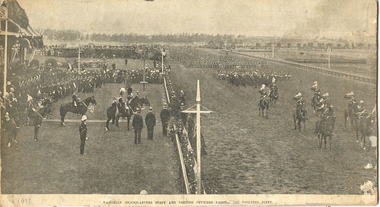
Image, Victorian Headquarters Staff and Visiting Officers, 1901
... ...volunteer regiments...armed services Boer War cadets volunteer regiments E.A. Daley George V toyal visit Victorian Headquarters staff and visiting officers passing the saluting point at Flemington Racecourse. ...Victorian Headquarters staff and visiting officers passing the saluting point at Flemington Racecourse. This was part of the Royal Tour by Geaorge V to the British Colonies in 1901. The Duke and Duchess of Cornwall and York were in Melbourne to open the first Parliament of the OCmmonwealth of Australia. armed services, boer war, cadets, volunteer regiments, e.a. daley, george v, toyal visit -
 Ballarat Heritage Services
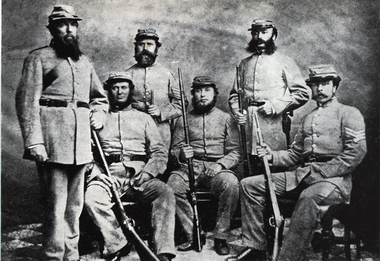
Photograph - Image, North Melbourne Rifle Regiment
... Regiment...volunteer regiments...North Melbourne Rifle Regiment volunteer regiments rifles A photograph of six uniformed men of the North Melbourne Rifle Regiment. ...A photograph of six uniformed men of the North Melbourne Rifle Regiment.north melbourne rifle regiment, volunteer regiments, rifles -
 Bendigo Military Museum
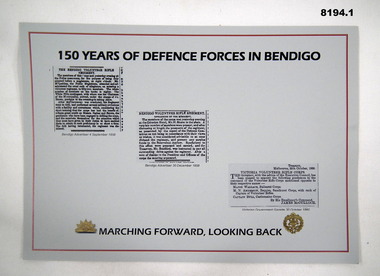
Accessory - PLACE MATS 2008
... These Place mats relate to the Anniversary Dinner Cat No 8193. .1) LH side article, 14.8.1858 talks about recruiting members to the Bendigo Volunteer Regiment and drill. Centre article, 30.12.1858 talks about the Disbandment of the Regiment and its funds and instructions to do so. ...Five place mats, grey background colour, each has a red border, all have a gold images of badges of a badge. .1) Has 3 articles relating to Bendigo Volunteer Regiments & Victorian Volunteer Rifle Corps. .2) Has a near full page image of a Sunday Military parade. .3).4) Has an image of a Military Band. .5) Has an Image of a Military Band....These Place mats relate to the Anniversary Dinner Cat No 8193. .1) LH side article, 14.8.1858 talks about recruiting members to the Bendigo Volunteer Regiment and drill. Centre article, 30.12.1858 talks about the Disbandment of the Regiment and its funds and instructions to do so. ...These Place mats relate to the Anniversary Dinner Cat No 8193. .1) LH side article, 14.8.1858 talks about recruiting members to the Bendigo Volunteer Regiment and drill. Centre article, 30.12.1858 talks about the Disbandment of the Regiment and its funds and instructions to do so. RH side article, 25.10.1860, From the Victorian Rifle Corps re the appointment of Officers to Command the following. Ballarat Corps. Sandhurst Corps. (Bendigo) Castlemaine Corps. .2)Sunday Parade at…. .3).4)38th Battalion Band 1916 .5) 67th Battalion Band 1917Five place mats, grey background colour, each has a red border, all have a gold images of badges of a badge. .1) Has 3 articles relating to Bendigo Volunteer Regiments & Victorian Volunteer Rifle Corps. .2) Has a near full page image of a Sunday Military parade. .3).4) Has an image of a Military Band. .5) Has an Image of a Military Band.brsl, smirsl, 150 -
 Federation University Historical Collection
Document, Ballarat's Irish Lawyers, c2000
... Ballarat Volunteer Rifle Regiment...Hardy, Hardy Brothers, Joseph Hardy, John Hardy, Leonard Hardy, Richard Ford, Agar Lynn, Adam Loftus Lynn, Richard O'Cock, Ballarat Volunteer Rifle Regiment...Hardy Hardy Brothers Joseph Hardy John Hardy Leonard Hardy Richard Ford Agar Lynn Adam Loftus Lynn Richard O'Cock Ballarat Volunteer Rifle Regiment Folder of research notes on early Ballarat Lawyers of Irish origin, including Woods Point, Philip D. ...22188Folder of research notes on early Ballarat Lawyers of Irish origin, including Woods Point, Philip D. Hardy, Hardy Brothers, Joseph Hardy, John Hardy, Leonard Hardy, Richard Ford, Agar Lynn, Adam Loftus Lynn, Richard O'Cock, Ballarat Volunteer Rifle Regimentdianne campbell goldfields lawyers collection, lawyers, ballarat, legal, woods point, philip d. hardy, hardy brothers, joseph hardy, john hardy, leonard hardy, richard ford, agar lynn, adam loftus lynn, richard o'cock, ballarat volunteer rifle regiment -
Clunes Museum
Memorabilia - MEDAL & PRINTED MATERIAL
... MORTON 1912 .3 A4 FOLDED BOOKLET - PHOTOCOPIED TITLED "THE BALLARAT VOLUNTEER RIFLE REGIMENT 1858---1883 CELER ET AUDAX .4 PHOTOCOPY 1 PAGE - SHOWS IMAGE OF VICTORIAN VOLUNTEERS MARKSMAN'S BADGE c.1864 AND VICTORIAN VOLUNTEER'S MARKSMAN'S BADGE SHOWING BARS FOR THE BEST SHOT IN COMPANY FOR THE PREVIUS 4 YEARS...MORTON 1912 .3 A4 FOLDED BOOKLET - PHOTOCOPIED TITLED "THE BALLARAT VOLUNTEER RIFLE REGIMENT 1858---1883 CELER ET AUDAX .4 PHOTOCOPY 1 PAGE - SHOWS IMAGE OF VICTORIAN VOLUNTEERS MARKSMAN'S BADGE c.1864 AND VICTORIAN VOLUNTEER'S MARKSMAN'S BADGE SHOWING BARS FOR THE BEST SHOT IN COMPANY FOR THE PREVIUS 4 YEARS Memorabilia MEDAL & PRINTED MATERIAL ...AWARDED TO CORPORAL WILLIAM BENNET- 26TH AUGUST 1870.1 MEDAL FOR 1ST PRIZE FOR MARKMANSHIP AWARDED TO CORPORAL WILLIAM BENNET OF THE CLUNES DETACHMENT 2ND BALLARAT VOLUNTEER RIFLES .2 PHOTOCOPIED DOCUMENT 25 PAGES TITLED "SOUVENIR OF BALLARAT VOLUNTEERS-BALLARAT RANGERS-THE OLD THIRD-THE SEVENTH" COMPLIED BY COL. G. F. MORTON 1912 .3 A4 FOLDED BOOKLET - PHOTOCOPIED TITLED "THE BALLARAT VOLUNTEER RIFLE REGIMENT 1858---1883 CELER ET AUDAX .4 PHOTOCOPY 1 PAGE - SHOWS IMAGE OF VICTORIAN VOLUNTEERS MARKSMAN'S BADGE c.1864 AND VICTORIAN VOLUNTEER'S MARKSMAN'S BADGE SHOWING BARS FOR THE BEST SHOT IN COMPANY FOR THE PREVIUS 4 YEARSlocal history, numismatics, medals, military, military -
 Orbost & District Historical Society
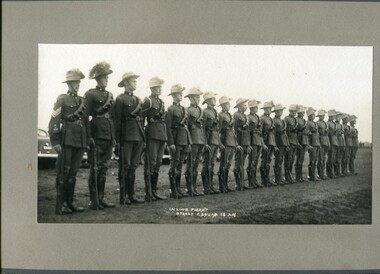
Photograph - two black and white photographs, 13th Light Horse Brigade 2 Troop C Squad
... These 2 photos are of Orbost men who were part of the 13th Light Horse volunteer regiment. This military training activity continued on after W W I. ...These 2 photos are of Orbost men who were part of the 13th Light Horse volunteer regiment. This military training activity continued on after W W I. ...These 2 photos are of Orbost men who were part of the 13th Light Horse volunteer regiment. This military training activity continued on after W W I. These photos were taken at the training camp at Seymour, Victoria. The Orbost troop would journey to other areas for training, sometimes to Bombala, and also practice on the Orbost Rifle Range. Although not identified in these photos, George William Wraight was a leader of the Light Horse Troop in Orbost and it is his daughter Dorothy Hepburn who has donated these photos. George W Wraight was the railway-station master at Orbost from 1935. The Troop often met at the Wraight house in Tarra Street, Orbost for training. George had been in W W I in the Middle East with the Light Horse. While at the railway station at Orbost, George had an accident and suffered 2 broken legs which meant that he could no longer work there. During W W II, he worked as a recruiting officer at Sale and Warrnambool. The Troop was disbanded in the c. late 1930s.Shows evidence of military training activities, Orbost district Two sepia photographs onto grey card. Both photos show a line-up of 20 soldiers standing at attention. Size is H-22cm W-34cmIn Line Picket 2 Troop C Squad 13 LH - written on to both photos13th light horse brigade, c squad 2 troop, military training, george w wraight -
 Federation University Historical Collection
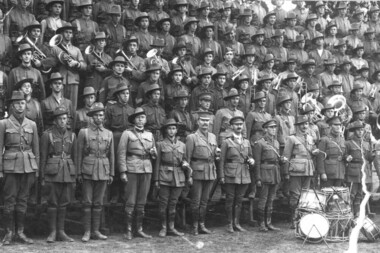
Photos, 71st Infantry Band Broadmeadows Camp
... selectedversion=NBD11485892) The Ballarat phase of the battalion's history was formed as the Ballarat Volunteer Rifle Regiment on 9 August 1858 as a result of the Crimean War, coupled with the withdrawal of the British Army in 1857. ...selectedversion=NBD11485892) The Ballarat phase of the battalion's history was formed as the Ballarat Volunteer Rifle Regiment on 9 August 1858 as a result of the Crimean War, coupled with the withdrawal of the British Army in 1857. ...71st Infantry Band based at the Broadmeadows Camp 1917. Percy Code write a piece of music called the 71st Infantry Quick March. (http://trove.nla.gov.au/work/31795246?selectedversion=NBD11485892) The Ballarat phase of the battalion's history was formed as the Ballarat Volunteer Rifle Regiment on 9 August 1858 as a result of the Crimean War, coupled with the withdrawal of the British Army in 1857. In the years between its formation and the outbreak of War in 1914, the battalion went through a series of name changes as follows: Victorian Colonial Defence Force: 1858 – Ballarat Volunteer Rifle Regiment 1860 – Ballarat Volunteer Rifle Rangers 1863 – Ballarat Volunteer Rangers 1884 – 3rd Battalion, Victorian Rifles 1892 – 1st Battalion, 3rd Victorian Regiment 1898 – 3rd Battalion, Victorian Infantry Brigade Under the new Federal Government: 1901 – 3rd Battalion, Infantry Brigade Australian Army: 1903 – 7th Australian Infantry Regiment 1908 – 1st Battalion, 7th Australian Infantry Regiment 1912 – 70th Infantry (Ballarat East, Geelong and Queenscliff) 1912 – 71st Infantry (Ballarat West, Warrnambool) 1914 – 70th Infantry (Ballarat Regiment) - in Ballarat East 1914 – 71st (City of Ballarat) Infantry – in Ballarat West.1 Large group photo of members of the band .2 Photograph of part of the band The soldier in the front holding the conductor's batton is Percy Code. The trombone player next to Percy Code is Jack Shackles. 71st Infantry Band (Percy Code Bandmaster) Broadmeadows Camp 191771st infantry band, broadmeadows camp, percy code, code, frank wright, brass band, percy shackles, shackles -
4th/19th Prince of Wales's Light Horse Regiment Unit History Room
DVD, Laying Up Guidons 7th August 2005
... Regiments. This DVD of the cermony was compiled by Harry Austen (now deceased), a volunteer of the Regiment's Unit History Room ...Regiments. This DVD of the cermony was compiled by Harry Austen (now deceased), a volunteer of the Regiment's Unit History Room DVD Laying up Guidons DVD Laying Up Guidons 7th August 2005 DVD Harry Austen (dec) ...On 7 August 2005, 4th/19th Prince of Wales's Light Horse Regiment conducted a ceremonial parade at the Shrine of Remembrance Melbourne to present five Light Horse Regiment guidons to the Shrine Trustees for laying up. The guidons were those of thwe 8th, 13th, 17th, 19th and 20th Light Horse Regiments. This DVD of the cermony was compiled by Harry Austen (now deceased), a volunteer of the Regiment's Unit History Room DVDdvd, laying up guidons -
 8th/13th Victorian Mounted Rifles Regimental Collection
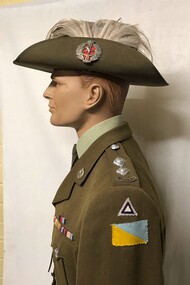
Uniform - Martin uniform
... Lieutenant Des Martin was a member of the Wodonga Troop of the pre-WWII 8th Light Horse (Indi) regiment. He volunteered for the AIF, 12/6/1940 (VX31564) and served with the 2/2nd Pioneer Battalion in Syria and New Guinea. ...Lieutenant Des Martin was a member of the Wodonga Troop of the pre-WWII 8th Light Horse (Indi) regiment. He volunteered for the AIF, 12/6/1940 (VX31564) and served with the 2/2nd Pioneer Battalion in Syria and New Guinea. ...Lieutenant Des Martin was a member of the Wodonga Troop of the pre-WWII 8th Light Horse (Indi) regiment. He volunteered for the AIF, 12/6/1940 (VX31564) and served with the 2/2nd Pioneer Battalion in Syria and New Guinea. He was discharged 11/2/1944 with the rank of lieutenant. He was a horseman of considerable repute and was the author of the book “Australia Astride”. He provided valuable assistance to the 8/13 VMR Heritage Troop when it was raised. Wearing this uniform, he rode with a group of former light horsemen leading ANZAC Day marches in Melbourne for many years.Half mannequin dress in service dress tunic with 8th Light Horse lapel badges, silver buttons, badges of rank and colour patches. Complemented with slouch hat with 8th Light Horse hat badge and emu plumes, and Sam Browne belt.military, anzac day, melbourne, martin, pioneer, vmr, light horse, world war two, wwii -
 Australian Army Museum of Western Australia
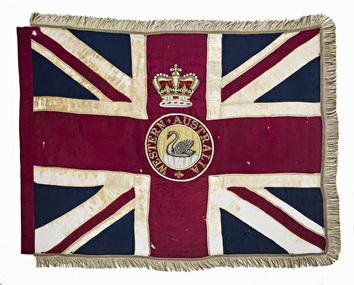
Queen's Colour - 1st Infantry Regiment (WA Volunteer Forces), 1895-96
... Queen's Colour - 1st Infantry Regiment (WA Volunteer Forces)...Presented to 1st Infantry Regiment (WA Volunteer Forces) by HE the Governor of WA, Lt-Colonel Sir Gerard Smith, KCMG at a Queen's Birthday parade held on the Recreation Ground, Bazaar Terrace, Perth (now where the Esplanade is situated), on 28 May 1896. ...Queen's Colour - 1st Infantry Regiment (WA Volunteer Forces) ...Presented to 1st Infantry Regiment (WA Volunteer Forces) by HE the Governor of WA, Lt-Colonel Sir Gerard Smith, KCMG at a Queen's Birthday parade held on the Recreation Ground, Bazaar Terrace, Perth (now where the Esplanade is situated), on 28 May 1896. Consecrated by Senior Chaplain of the Forces, the Very Reverend Dean Goldsmith. Purchased by the WA Government, with the sanction of the Home Authorities, the colour was manufactured at the Pimlico Army Clothing Depot, London. It was the first Queen's Colour to be presented to a Western Australian Army unit. (A detailed description of this colour appeared in "The West Australian" of 23 May 1896) This colour was subsequently inherited by successor Militia units to the 1st Infantry Regiment, including 11th Australian Infantry Regiment (Perth Regiment), 88th (Perth) Infantry, 11th Battalion (The Perth Regiment) and 11th/16th Battalion. The colour was handed over to the Perth City Council at a special parade of the 11th/16th Battalion held in Forrest Place on 7 June 1930, and was laid up in the Council Chambers in Murray Street. Together with the other historic colours handed over at the time, this colour later went into storage when Council moved premises in the early 1960's. Perth City Council had some restoration work carried out on these colours in 1975 and later had them on display in their display room at Council House, St Georges Terrace. They were subsequently placed in storage again. Following negotiations by the Army Museum of WA Perth City Council passed on these Colours to the Museum in November 1993. Purchased by the WA Government, with the sanction of the Home Authorities, this was the first Queen's Colour to be presented to a Western Australian Army unit. (A detailed description of this colour appeared in "The West Australian" of 23 May 1896)Union flag with red and gold fringe. In the centre a circle inscribed "Western Australia", surmounted by a crown. Within the circle a black swan on gold background.military heraldry -
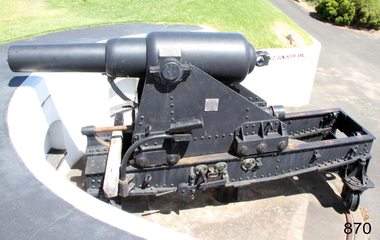 Flagstaff Hill Maritime Museum and Village
Weapon - Cannon, 1866
... volunteer corps...ordinance...armaments...cannon hill fortifications...4th australian light horse regiment...Regiment. The two 80 Pounder RML were moved back to the Fortifications in 1973. They were both fully restored by Army First Year Apprentices at the Ordinance Factory in Bendigo in time for the centenary year of the fortifications in 1987. The guns are capable of firing 80 pound (32.3kg) armour piercing exploding shells 3.65kms out to sea. They were original manned by volunteers...Regiment. The two 80 Pounder RML were moved back to the Fortifications in 1973. They were both fully restored by Army First Year Apprentices at the Ordinance Factory in Bendigo in time for the centenary year of the fortifications in 1987. The guns are capable of firing 80 pound (32.3kg) armour piercing exploding shells 3.65kms out to sea. They were original manned by volunteers ...In the years following the Crimean War (1854-1857J) there was a great concern in the Colony that Imperial Russia would attempt an invasion. Coastal defences in the colony of Victoria were greatly strengthened by the Government as a result. Warrnambool was originally protected by cannons at Cannon Hill, approximately 1 kilometer west of the Flagstaff Hill Fortifications. These cannons included two 1866 guns, both 80 Pound Rifled Muzzle Loaders (RML) purchased by Victoria’s Colonial Government. They were part of a shipment of 26 such guns sent from England in December 1866. They are registered as No. 23 (80cwt-2qr-0lbs) - Gun 1, and No.13 (81cwt-1qr-12lbs) - Gun 2. They were cast at the Royal Gun Factory, Woolwich Arsenal, in 1866 and have a 6.3 inch bore. Both barrels carry the Royal Cypher of Queen Victoria, Insignia of the Royal Engineers, within the Garter and Motto surmounted by the Crown, with the Royal Cypher of Queen Victoria within the Garter (letters in centre “VR”, motto “HONI SOIT QUI MAL Y PENSE”, "Shame be to him who thinks evil of it."). The guns were originally supplied with wooden carriages. (The Royal Arsenal at Woolwich, England, was established eleven years after the Restoration of King Charles II. It was the principal supplier of armaments to the British and Empire Governments. At the height of its operations during World War One the factory covered 1300 acres and employed very nearly 80,000 workers. Woolwich was the Headquarters of the Royal Artillery since the raising of that Regiment in 1716. The Arsenal was closed in the late 1960’s.) These two cannons were transferred to the Warrnambool Garrison Artillery Battery Fortifications erected at Flagstaff Hill in 1887 as part of Victoria’s Coastal Defences. The original wooden carriages were subsequently replaced with the present iron garrison carriages in 1888. They are a “C” pivot. The ‘racers’ or curved track set into the floor of the gun emplacement (which enabled the guns to be traversed more quickly) are as specified for guns up to 10 inch, being of wrought iron 2.78 inches wide. A temporary third gun, now no longer on Flagstaff Hill’s site, was a 5 inch Rifled Breech Loading (BL) Armstrong gun mounted on an Elswick hydro pneumatic disappearing carriage It was faster to load and fire than the 80 pound RMLs and its arrival spelt the end of the older 80 pound guns’ useful life, apart from being used for practice sessions. The 5 inch BL gun was the main defensive weapon of the Warrnambool Battery until the Battery was downgraded in importance and the gun was recalled to Melbourne in 1910. The State of Victoria took over the ownership of the guns at the time of Australian Federation in 1901. In about 1901/1902 the Garrison Battery was converted to the Warrnambool Battery of the Australian Field Artillery (No 4 Field Battery). It was equipped with 4.7 inch naval guns mounted on field carriages. They were now a mobile unit but continued to use the Warrnambool Garrison area at Flagstaff Hill for practice. When the Fortifications were declared obsolete, the two 80 Pounder RML were relocated to Cannon Hill in 1910. On the outbreak of World War One the 4.7 inch guns were recalled to Melbourne, and the Battery was disbanded. Most of the personnel probably re-enlisted in the local 4th Australian Light Horse Regiment. The two 80 Pounder RML were moved back to the Fortifications in 1973. They were both fully restored by Army First Year Apprentices at the Ordinance Factory in Bendigo in time for the centenary year of the fortifications in 1987. The guns are capable of firing 80 pound (32.3kg) armour piercing exploding shells 3.65kms out to sea. They were original manned by volunteers before a paid Garrison was established. Now the Guns are again fired by volunteers on Special Event days. Since restoration the Gun Number 1 had been fired on a regular basis but Gun Number 2 hadn’t been fired since the mid 1990’s. In April 2015 Gun Number 2 was serviced in preparation for the firing of both cannons on the ANZAC Centenary commemorations on April 25th 2015. Other guns from the original Cannon Hill location were obsolete by the time the 1887 Warrnambool Garrison Artillery Battery was built. These guns are (1) a 32 Pounder Muzzle Loading Smooth Bore (SB) cast in 1813 at the famous Carron Foundry, number 80837 and now located in the Warrnambool Botanic Gardens (2) a 68 Pounder Muzzle Loading Smooth Bore cast in 1861 at the equally august Low Moor Foundry, number 10310 and now located on the lawn area at the entrance to Flagstaff Hill Maritime Village. Both of these guns are mounted on their original wooden garrison carriages. There are only seven 32 Pounder SB made by Carron and fifteen 68 Pounder SB made at Low Moor known to exist in the State of Victoria. Funding was received to repair Cannon No.2 and its iron carriage. After completion, both Cannon No 1 and No. 2 were 'fired' in a public re-enactment on April 4th, 2026. (Conservation Management Plan for Victorian Guns and Cannon, South Western Victoria, May 2008, ref W/F/05)The Warrnambool Garrison has been added to the Victorian Heritage Register H1250 “for its intact battery and guns, a strong reminder of Victoria’s wealth and determination to protect itself from the perceived threat of invasion in the 1880’s.” The City of Warrnambool is one of several custodians of a collection of artillery pieces of heritage significance at a state, national and international level. These pieces are directly related to the defence of south-west Victoria in the 19th century. The care and preservation come under the Heritage Act 1995. Cannon. 80 Pound Rifled Muzzle Loading (RML) Gun on iron carriage and slide, installed in the Battery at Flagstaff Hill’s Fortifications. Made in 1866 at the Royal Gun Factory (R-G-F), Woolich, England. Gun Reg No 13. Flagstaff Hill Garrison Gun 2 (Gun No. 2). Insignia of the Royal Engineers, and the weight of the gun, stamped on top of the gun’s barrel. There is a brass plate on the side of the gun with the details of 1987 restoration.Stamped into the metal on top of the barrel, Insignia of the Royal Engineers; Garter and Motto “HONI SOIT QUI MAL Y PENSE”, surmounted by the Crown, with the Royal Cypher of Queen Victoria “VR” within the Garter. Also stamped on top of the gun are 2 inward pointing arrows above the weight ”81-1-12”. Brass plate “RESTORATION / BY / FIRST YEAR / APPRENTICES / ORDANANCE FACTORY / BENDIGO 1987”flagstaff hill, warrnambool, shipwrecked coast, flagstaff hill maritime museum, maritime museum, shipwreck coast, flagstaff hill maritime village, great ocean road, colonial defences, victoria’s coastal defences, warrnambool fortification, warrnambool garrison battery, warrnambool volunteer corps, ordinance, armaments, cannon hill fortifications, 4th australian light horse regiment, no 4 field battery, 80 pound cannon rifled muzzle loaders (rml), victorian colonial government, royal gun factory england, woolwich arsenal, royal cypher of queen victoria, garrison gun -
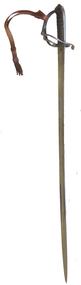 Federation University Historical Collection
Weapon - Object, Sword, 1877
... In 1862, the units of the Mounted Volunteer Corps in Victoria were formed into a single regiment known as the Victorian Volunteer Light Horse. ...In 1862, the units of the Mounted Volunteer Corps in Victoria were formed into a single regiment known as the Victorian Volunteer Light Horse. ...In 1862, the units of the Mounted Volunteer Corps in Victoria were formed into a single regiment known as the Victorian Volunteer Light Horse. This title changed again in 1863, to the Prince of Wales Victorian Volunteer Light Horse ( Hussars ). In 1870 a uniform was adopted that was based on the British 19th Hussars. Troops were based at various times at Geelong, Ballarat, Kyneton, Bendigo, Castlemaine and Dandenong, as well as metropolitan Melbourne. In 1885, most of the Cavalry were incorporated into a newly formed Victorian Mounted Rifles. (http://www.awm.gov.au/collection/REL/18070.001) "It is notified in the Gazette that Lieutenant Laurence Whyte, Ballarat troop Prince of Wales Light Horse, has been appointed captain, seniority to date from January 31. " (The Argus, 17 February 1883) "An official inspection of the P.W.L.H. took place in the Royal Park last evening by the colonel-commandant, assisted by Colonel Rede; Captain Medealf in command of the, troop. After bring exercised in field movements, a sword competition took place, toe first prize bring awarded to Trooper L. Whyte ; the "second to Sergeant Blight; the third, to Trooper Jenkins; and the fourth, to Trooper Orr, of Creswick. Major Sleep officiated as timekeeper. The colonel commandant complimented Captain Med-calf upon the efficiency of the troop, and officers and men afterwards dined together at Craig's hotel. (Ballarat Courier, 09 March 1877.)Silver coloured sword and scabbard with leather hand grip within the hilt. The sword was awarded to Trooper Whyte of the Prince of Wales Victorian Volunteer Light Horse (Ballarat) in 1877.. Engraved into handle "Ballarat Troop P.W.V.V.L.H Officers Trophy FIRST PRIZE WON BY Trooper Whyte AT SWORD Competition 8th March 1877" volunteer forces, sword, trooper whyte, prince of wales victorian volunteer light horse (ballarat), l. whyte, laurence whyte -
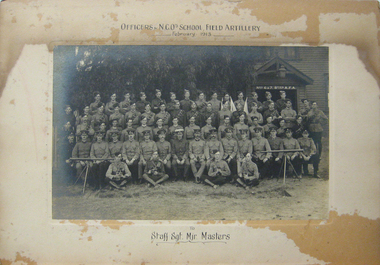 Federation University Historical Collection
photograph - Black and White, Officers and Non-Commissioned Officers School, Field Artillery, February 1913, 02/1913
... ...volunteer regiment...army field artillery field artillery school masters staff sergeant major masters volunteer regiment Major Masters To Staff Sgt Major Masters. ...A mounted black and white photograph of uniformed men in front of a weatherboard building. They are officers and non commissioned officers of the Field Artillery School, February 1913, 6th and 7th batteries.To Staff Sgt Major Masters. army, field artillery, field artillery school, masters, staff sergeant major masters, volunteer regiment, major masters -
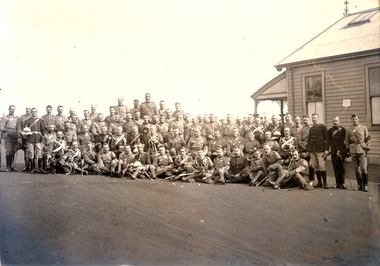 Federation University Historical Collection
Photograph - Black and White, Officers of the Volunteer Corps in Australia, 1898
... ...volunteer regiment...armed services band music volunteer corps militia volunteer regiment Robertson Tom Price D.C. Lewis uniform swords rifles Black and white photograph of officers representing all volunteer corps in Australia. ...Black and white photograph of officers representing all volunteer corps in Australia. The photograph was taken during a visit to Australia by the Duke of York, later George V.armed services, band, music, volunteer corps, militia, volunteer regiment, robertson, tom price, d.c. lewis, uniform, swords, rifles -
 Federation University Historical Collection
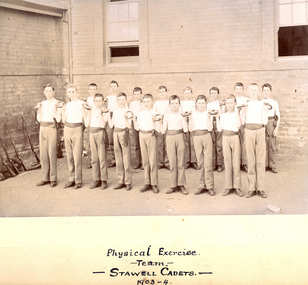
Photograph, Matson and Co, Stawell Volunteer Cadet Corps, 1903, 1900-1904
... ...volunteer regiment...Possibly associated with Stawell State School No 502 armed services music stawell volunteer regiment Stawell volunteer cadets Back "Stawell Cadet Corps Capt Daley 1903 (part of detachment without rifles) .1) Stawell Volunteer Cadets - Corps - 1903. ...Possibly associated with Stawell State School No 502.1) Stawell Volunteer Cadets - Corps - 1903. Captain Daley written underneath a number of young cadets i uniform in front of a picket fence. The back row stands, the front row crouces on one knee, .2) Stawell cadets Physical Education Team stand in front of a brick building holding hand rings. Named on verso. Back "Stawell Cadet Corps Capt Daley 1903 (part of detachment without rifles)armed services, music, stawell, volunteer regiment, stawell volunteer cadets -
 Federation University Historical Collection
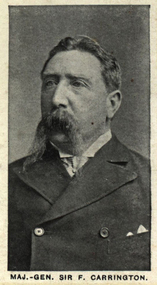
Photograph (black & White), Major-General Sir Frederick Carrington - South Africa
... Regiment of Foot in 1864. In 1875 he went to South Africa and formed and commanded the Mounted Infantry in the Griqualand West expedition and the Frontier Light Horse in the Ninth Frontier War in 1877. In 1878-1879 he commanded the Transvaal Volunteer...Regiment of Foot in 1864. In 1875 he went to South Africa and formed and commanded the Mounted Infantry in the Griqualand West expedition and the Frontier Light Horse in the Ninth Frontier War in 1877. In 1878-1879 he commanded the Transvaal Volunteer ...After completing his education, Sir Frederick Carrington joined the 24th Regiment of Foot in 1864. In 1875 he went to South Africa and formed and commanded the Mounted Infantry in the Griqualand West expedition and the Frontier Light Horse in the Ninth Frontier War in 1877. In 1878-1879 he commanded the Transvaal Volunteer Force against Sekhukhune and the Cape Mounted Riflemen in the Basuto Gun War of 1881. In 1885 he was in command of the 2nd Mounted Infantry when he accompanied Sir Charles Warren expedition to Bechuanaland. The Infantry soon became known as "Carrington's Horse". He became military adviser to the High Commissioner in the First Matabele War and commanded the British Force in the Matabele Rebellion in 1896. During 1899-1900 he was back in Ireland but returned to South Africa in 1900 following the outbreak of the Second Boer War and was appointed on the staff of the South Africa Field Force with the rank of lieutenant-general. he was in command of the Rhodesian Field Force during the war. He was awarded the Knight Commander of the Order of St Michael and St George in 1887 and Knight Commander of the Order of the Bath in 1897.Individual image from photographed poster of tobacco and cigarette cards.sir frederick carrington, south africa, transvaal volunteer force, mounted infantry, frontier light horse, griqualand west, ninth frontier war, cape mounted riflemen, basuto gun war, carrington's horse, high commissioner, second boer war, lieutenant-general, knight commander of the order of the bath, knight commander of the order of st michael and st george, rhodesian field force -
 Lara RSL Sub Branch
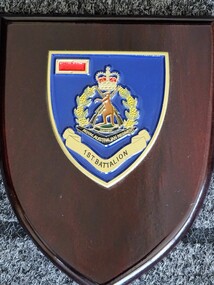
Plaque, Late 20th Century
... Volunteer Rifles raised in New South Wales. The Battalion was active during periods 1914-1919, 1921-1930 and 1957-1971. The Battalion is still in existence as the 1st/19th Battalion Royal NSW Regiment....Volunteer Rifles raised in New South Wales. The Battalion was active during periods 1914-1919, 1921-1930 and 1957-1971. The Battalion is still in existence as the 1st/19th Battalion Royal NSW Regiment. ...1st Battalion Australia is an Infantry Battalion of the Australian Army. The 1st Battalion can be traced back to 1854 as a unit of Volunteer Rifles raised in New South Wales. The Battalion was active during periods 1914-1919, 1921-1930 and 1957-1971. The Battalion is still in existence as the 1st/19th Battalion Royal NSW Regiment.The Plaque is an original.Wooden Plaque, tri shadark brown background, ?metal blue plaque with the RAR Badge, 1st Battalion underneath the badge, Red US Badge for Commendation.RAR, !st Battalion -
 Lara RSL Sub Branch
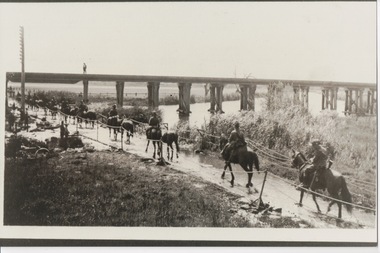
Photograph, Set 4 photographs. and others for Torquay Light Horse camp, 1940
... By 1914, when Australia joined the war against Germany, there were 23 Light Horse regiments of militia volunteers. Many men from these units joined the Light Horse regiments of the Australian Imperial Force (AIF). ...By 1914, when Australia joined the war against Germany, there were 23 Light Horse regiments of militia volunteers. Many men from these units joined the Light Horse regiments of the Australian Imperial Force (AIF). ...These images capture for all time Light Horsemen travelling through Geelong on their way to camp at Torquay for the last Group meeting in Australia . information following - details obtained from .........https://torquayhistory.com/light-horse-brigade/ On Australia Day, 1997, Sir John Young unveiled this plaque on Point Danger, Torquay. Torquay history, Light Horse Training Camp, WW2 Plaque at Pt. Danger Note----- (See images to view plaque) The plaque identifies a significant event in Torquay’s history and the sentiments of ‘change’ for the Light Horse Brigade – from horses to machines. In 1940 the four Light Horse Regiments (4th, 8th, 13th and 20th), some 5000 Light Horse and 2000 horses camped and trained at Torquay. Three other regiments, formerly mounted on horses, were also at Torquay ‘mounted’ on privately owned trucks and cars. Division troops included Artillery, Engineers, Signals, Field Ambulance and other branches of the Army necessary to enable a Division to function. It wasn’t just the sheer numbers of men coming to this little town that made the event significant, it was also the fact that the men of the Light Horse were dramatic, almost glamorous figures and it is easy to see their exploits as some splendid adventure. Horses have played a special role in the story of Australia. They were the only means of transport across this huge country, so it was necessary for everyone to have the ability to ride a horse. When war broke out in 1899 between Britain and the Boers of South Africa (“Boer” was Dutch for “farmer”) Australia sent troops to fight. At first Britain was wary of using untried, unprofessional colonial cavalrymen but soon saw that the slouch-hatted Australian “bushmen” were a match for the fast-moving and unconventional mounted commandos of the Boers. The Australians proved themselves to be expert rough-riding horsemen and good shots. Bush life had hardened them to go for long periods with little food and water. They also showed remarkable ability to find their way in a strange country and use its features for cover, in both attack and defence. By 1914, when Australia joined the war against Germany, there were 23 Light Horse regiments of militia volunteers. Many men from these units joined the Light Horse regiments of the Australian Imperial Force (AIF). Men were given remounts (if not using their own horses) – army horses bought by Commonwealth purchasing officers from graziers and breeders. These were called “walers” because they were a New South Wales stockhorse type – strong, great-hearted animals with the strains of the thoroughbred and semi-draught to give them speed, strength and stamina. On 1st November, 1914, Australia’s First Infantry Division and the first four Light Horse regiments sailed for England in a fleet of transport ships. The first of the Light Horse arrived at Gallipoli in May without their horses. Back with their horses after Gallipoli, they were formidable combatants across the Sinai and Palestine. Some British commanders observed that the light horseman moved with a “lazy, slouching gait, like that of a sleepy tiger” but described how the promise of battle “changes that careless gait, into a live athletic swing that takes him over the ground much quicker than other troops”. They had Light Horse, Torquay, training campdeveloped a reputation as formidable infantrymen. The Turks called them “the White Ghurkas” – a reference to their deadly skill with the bayonet. The Arabs called them “The Kings of the Feathers”. The plume had originally been a battle honour of the Queensland Mounted Infantry for their work in the shearer’s strike of 1891. During WW1 it was adopted by almost all the Light Horse Regiments. It was the proud badge of the light horseman. The most famous of their battles was the attack on Beersheba- the charge of the 4th Light Horse Brigade. Mounted infantrymen and their superb walers had carried out one of the most successful cavalry charges in history – against what seemed impossible odds. They surprised the Turks by charging cavalry-style, when they would normally have ridden close to an objective then dismounted to fight. The fall of Beersheba swung the battle tide against the Turks in Palestine; and changed the history of the Middle East. While 19 men from the Surf Coast Shire served with the 4th Light Horse over the course of WW1, only four were involved in the charge of Beersheba- John GAYLARD, Philip QUINN.(Winchelsea); Wallace FINDLAY (Anglesea); Harry TRIGG (Bambra). After the war, Light Horse units played a key role in the Australian Government’s compulsory military training programme. The Citizen Military Forces (C.M.F.) thrived on the glamour of the wartime Light Horse tradition, ignoring the possibility that motor vehicles would soon replace the horses. When training was no longer compulsory, the C.M.F. regiments declined and horses became more of a luxury during the 1930s depression years of poverty and unemployment. Some regiments were motorised. Then, in 1939, Australia joined Britain in another world war. Training was increased for the militia at both home bases and regional training camps. The camp at Torquay in 1940, commanded by Major General Rankin, was at Divisional strength. By the end of the camp some felt that the Division was ready for active service. Gradually, over the next four years, the Australian Light Horse units were mounted on wheels and tracks and the horses were retired. Six men enlisted at the Torquay camp and another 57 men and women enlisted at Torquay for service in WW2. Those who served in the Militia provided valuable Officers and NCOs and men for the armed services during the war. Each infantry division of the 2nd AIF had a Light Horse regiment attached to it. But the day of the Australian mounted soldier hadn’t quite passed. During World War II, Australia’s 6th Cavalry Regiment formed a mounted unit they called “The Kelly Gang” which did valuable scouting work. In New Guinea, a mounted Light Horse Troop did patrol duty and helped carry supplies. Some fully equipped walers were flown into Borneo for reconnaissance in rugged mountain country. But by the end of the war, in 1945, the horse had disappeared from the Australian Army. References: Australian Light Horse Association www.lighthorse.org.au National Australia Archives Australian War Memorial Surf Coast Shire WW1 memorials www.togethertheyserved.com The Light horse- a Cavalry under Canvas Light Horse, Training Camp, Torquay, WW2 Late in 1939 it was decided to set up a Lighthorse training camp in Torquay to train both men and horses for the battles of the Second World War. Horses, men and equipment came on special trains from all over Victoria and NSW, and as you would expect horseman came from areas such as Omeo and Sale, the Wimmera and the Western District. They arrived at the Geelong racecourse for watering in the Barwon River and then were ridden across the ford at the breakwater and began their 11 mile trek to Torquay. Light Horse, Training Camp, Torquay, WW2 Tent city By the end of January 1940 the camp at Torquay accommodated some 5000 men and 2500 horses of the Second Cavalry Division. The rows of horses, tents and huts near Blackgate Road were quite a sight. While the cavalrymen engaged in exercises on the land and on the beaches, many of the troops took over the Torquay School for special training of men and officers. Mr Bob Pettit local farmer and Councillor for the Barrabool Shire, wrote about the Light horse in the Surf Coast Community News in 1985 saying “They used to travel about the district riding four abreast in one long convoy. To my annoyance they went through my property and shut all the gates behind them. I had certain gates open to let stock in to the water holes and it would take me three -quarters of an hour to follow the horsemen up and put all the gates right again” he continued “the men from the Light Horse were here when the fire went through in March 1940. He recalled an incident when early one morning, as some one blew the bugle, a soldier putting a white sheet on the line frightened the horses. They panicked and ran off in all directions. Six went over the cliff near Bird Rock, five were never found, and the rest were gathered up after nearly a fortnight in the bush around Addiscott and Anglesea" Light Horse, Training Camp, Torquay, WW2, Geelong Parade Geelong parade The training camp culminated in a parade through the streets of Geelong on March 12th 1940. The salute was given at the Town Hall and the troops continued on a route to the You Yang’s for a training exercise. Note-----(see media section for photograph) The Camp was abandoned in mid 1940 as it was deemed unsuitable for training during winter and the cost of a permanent camp could not be justified if it could not be used all year. Historic.......Rare,,,Interpretive.Sepia photographs.set of four ....post card size ....Horses &LighthorsemenNo 1, Lighthorsemen Regiment Geelong 1940......No 2 Light Horse at Breakwater Geelong 1938 to 1940....No 3 Light Horse at Breakwater Geelong 1938 to 1940.....No 4 Light Horse crossing Breakwater camped at Geelong Showgrounds. These markings are on reverse of photographs.light horsemengeelong 1940., world war 2 -
 Ballarat Clarendon College
Medal
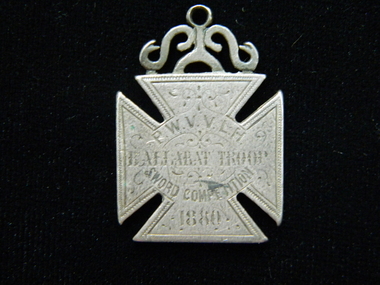
... In 1862, the units of the Mounted Volunteer Corps in Victoria were formed into a single regiment known as the Victorian Volunteer Light Horse. ...In 1862, the units of the Mounted Volunteer Corps in Victoria were formed into a single regiment known as the Victorian Volunteer Light Horse. ...The medal was awarded to Trooper John Garbutt of the Prince of Wales Victorian Volunteer Light Horse (Ballarat) in 1880 for attaining fourth prize n the sword competition. In 1862, the units of the Mounted Volunteer Corps in Victoria were formed into a single regiment known as the Victorian Volunteer Light Horse. This title changed again in 1863, to the Prince of Wales Victorian Volunteer Light Horse ( Hussars ). In 1870 a uniform was adopted that was based on the British 19th Hussars. Troops were based at various times at Geelong, Ballarat, Kyneton, Bendigo, Castlemaine and Dandenong, as well as metropolitan Melbourne. In 1885, most of the Cavalry were incorporated into a newly formed Victorian Mounted Rifles. (http://www.awm.gov.au/collection/REL/18070.001) John Garbutt was Principal of Ballarat College 1877 - 1909. He was educated at Geelong National Grammar School and in 1860 was the first dux of the college. He was educated at Geelong National Grammar School and in 1860 was the first dux of the college. Fist class Honourman Arts and Laws at Melbourne University 1866; Two years a master at Geelong College; seven years master and three years senior master at Scotch College, Melbourne. Mein's 1964 History of Ballarat College states: 'To summarise, it may be fairly claimed that the College's War Record in 1914-1918 would have reflected great credit on a school with ten times its numbers...Some of the credit of the college war record must be attributed to the influence of Major John Garbutt, M.A. who was Principal of the College for 33 years...Nearly all the old Collegians who distinguished themselves in the war had been trained by him. Silver coloured maltese cross medal with decorative link attached to top and engraved on both sides. The medal was awarded to Trooper Whyte of the Prince of Wales Victorian Volunteer Light Horse (Ballarat) in 1877. Face: P.W.V.V.L.H. / BALLARAT TROOP / SWORD COMPETITION / 1880 Verso: 4th PRIZE / Trooper garbutt ballarat-college, principal-john-garbutt, prince of wales victorian volunteer light horse, medal, 1880, principal -
 Lara RSL Sub Branch
Photograph, Regiment of the Australian Light Horse on the March in Jerusalem in Palestine
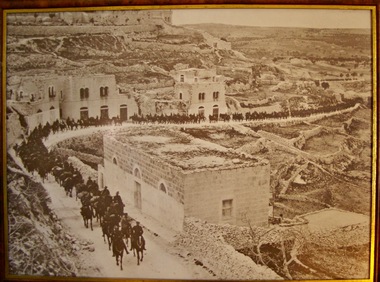
... By 1914, when Australia joined the war against Germany, there were 23 Light Horse regiments of militia volunteers. Many men from these units joined the Light Horse regiments of the Australian Imperial Force (AIF). ...By 1914, when Australia joined the war against Germany, there were 23 Light Horse regiments of militia volunteers. Many men from these units joined the Light Horse regiments of the Australian Imperial Force (AIF). ...By 1914, when Australia joined the war against Germany, there were 23 Light Horse regiments of militia volunteers. Many men from these units joined the Light Horse regiments of the Australian Imperial Force (AIF). Initially Australia promised four regiments of Light Horse, 2000 men, to fight in the British cause. By the end of the war, 16 regiments would be in action.The Light Horse were seen as the “national arm of Australia’s defence” and young men, most from the country, flocked to join. Framed and glass covered photo of a Regiment of the Australian Light Horse on the March in Jerusalem in Palestine"A Regiment of the Australian Light Horse on the March in Jerusalem in Palestine."ww1, world war 1, australian light horsemen, palestine, lara r.s.l. -
 Federation University Historical Collection
Photograph (black & White), Major General, Sir Hector Archibald MacDonald - South Africa
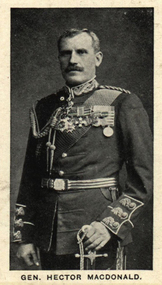
... Volunteers and in 1871 enlisted in the 92nd Gordon Highlanders. He rose rapidly through the noncommissioned ranks. His distinguished conduct in the presence of the enemy during the Second Afghan War led to him being offered either a Victoria Cross or a commission with his regiment. ...Volunteers and in 1871 enlisted in the 92nd Gordon Highlanders. He rose rapidly through the noncommissioned ranks. His distinguished conduct in the presence of the enemy during the Second Afghan War led to him being offered either a Victoria Cross or a commission with his regiment. ...In 1870 MacDonald joined the Inverness-shire Highland Rifle Volunteers and in 1871 enlisted in the 92nd Gordon Highlanders. He rose rapidly through the noncommissioned ranks. His distinguished conduct in the presence of the enemy during the Second Afghan War led to him being offered either a Victoria Cross or a commission with his regiment. He chose the latter. He served in the First Boer War and at the Battle of Majuba Hill made prisoner. At the Battle of Omdurman (1898), the British commander Lord Kitchener was assisted by the skillful manoeuvring of MacDonald and his men in overcoming the Dervishes. Due to this MacDonald was promoted to colonel, appointed an aide-de-camp to Queen Victoria and received a cash reward. In Scotland MacDonald was regarded the true hero of Omdurman, not Kitchener. In 1899 he was seconded to command a military district in India but with the outbreak of war in South Africa, he was ordered to command the Highland Brigade, under Lord Roberts and his Chief of Staff, Lord Kitchener. MacDonald arrived in Cape Town and assumed command of the Highland Brigade stationed at Modder River with rank of Major-general. He took part in the Battle of Paardeberg and later operations in Bloemfontein and Pretoria. In 1901 he was knighted as Knight Commander of the Order of the Bath In1902 he was appointed Commander-in-Chief of British Troops in Ceylon with the temporary rank of major-generalIndividual image taken from photographed poster of tobacco and cigarette cards.hector macdonald, highland rifle volunteers, gordon highlanders, noncommissioned, second afghan war, victoria cross, first boer war, battle of majuba hill, battle of omdurman, lord kitchener, lord roberts, aide-de-camp, queen victoria, dervishes, cape town, highland brigade, modder river, battle of paardeburg, bloemfontein, pretoria, knight commander of the order of the bath, commander-in-chief, ceylon -
 Flagstaff Hill Maritime Museum and Village
Gun Emplacement, 1890's
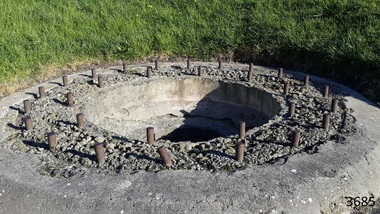
... volunteer corps...ordinance...armaments...cannon hill fortifications...flagstaff hill fortifications...4th australian light horse regiment...Regiment. The two 80 Pounder RML were moved back to the Fortifications in 1973. They were both fully restored by Army First Year Apprentices at the Ordinance Factory in Bendigo in time for the centenary year of the fortifications in 1987. The guns are capable of firing 80 pound (32.3kg) armour piercing exploding shells 3.65kms out to sea. They were originally manned by volunteers...Regiment. The two 80 Pounder RML were moved back to the Fortifications in 1973. They were both fully restored by Army First Year Apprentices at the Ordinance Factory in Bendigo in time for the centenary year of the fortifications in 1987. The guns are capable of firing 80 pound (32.3kg) armour piercing exploding shells 3.65kms out to sea. They were originally manned by volunteers ...The Warrnambool Battery on Flagstaff Hill has embankments for 3 guns. Those on the left and right still have cannon in place but in the centre is an empty embankment, apart from this concrete ring with metal threaded studs. In 1898 a 5 inch breech loading gun (BL) was installed here. The gun had a hydro-pneumatic disappearing carriage (hence the sign on the concrete wall "5" BL HP").. This type of gun was faster to load and fire that the 80 pound RML’s installed on either side of it. Its arrival spelt the end of the 80 pound RML guns’ useful life, although they continued to be used for practice sessions. The 5 inch BL was the main defensive weapon of the Warrnambool Battery until the Battery was downgraded in importance. It was removed in 1904 and recalled to Melbourne in 1910. The gun emplacement ring is all that remains of the mounting for a 5 inch Armstrong rifled breech loading gun. HISTOR of the WARRNAMBOOL GUNS & CANNON In the years following the Crimean War (1854-1857J) there was a great concern in the Colony that Imperial Russia would attempt an invasion. Coastal defences in the colony of Victoria were greatly strengthened by the Government as a result. Warrnambool was originally protected by cannons at Cannon Hill, approximately 1 kilometer west of the Flagstaff Hill Fortifications. The cannons included two 1866 guns, both 80 Pound Rifled Muzzle Loaders (RML) purchased by Victoria’s Colonial Government. They were part of a shipment of 26 such guns sent from England in December 1866. They are registered as No. 23 (80cwt-2qr-0lbs) - Gun 1, and No.13 (81cwt-1qr-12lbs) - Gun 2. They were cast at the Royal Gun Factory, Woolwich Arsenal, in 1866 and have a 6.3 inch bore. Both barrels carry the Royal Cypher of Queen Victoria, Insignia of the Royal Engineers, within the Garter and Motto surmounted by the Crown, with the Royal Cypher of Queen Victoria within the Garter (letters in centre “VR”, motto “HONI SOIT QUI MAL Y PENSE”, "Shame be to him who thinks evil of it."). The guns were originally supplied with wooden carriages. (The Royal Arsenal at Woolwich, England, was established eleven years after the Restoration of King Charles II. It was the principal supplier of armaments to the British and Empire Governments. At the height of its operations during World War One the factory covered 1300 acres and employed very nearly 80,000 workers. Woolwich was the Headquarters of the Royal Artillery since the raising of that Regiment in 1716. The Arsenal was closed in the late 1960’s.) These two 80pdr cannons were transferred to the Warrnambool Garrison Artillery Battery Fortifications erected at Flagstaff Hill in 1887 as part of Victoria’s Coastal Defences. The original wooden carriages were subsequently replaced with the present iron garrison carriages in 1888. They are a “C” pivot. The ‘racers’ or curved track set into the floor of the gun emplacement (which enabled the guns to be traversed more quickly) are as specified for guns up to 10 inch, being of wrought iron 2.78 inches wide. A temporary third gun, now no longer on Flagstaff Hill’s site, was the 5 inch Rifled Breech Loading (BL) Armstrong gun mounted on an Elswick hydro pneumatic disappearing carriage and installed in this very concrete base or pad. The State of Victoria took over the ownership of the guns at the time of Australian Federation in 1901. In about 1901/1902 the Garrison Battery was converted to the Warrnambool Battery of the Australian Field Artillery (No 4 Field Battery). It was equipped with 4.7 inch naval guns mounted on field carriages. They were now a mobile unit but continued to use the Warrnambool Garrison area at Flagstaff Hill for practice. When the Fortifications were declared obsolete the two 80 Pounder RML were relocated to Cannon Hill in 1910. On the outbreak of World War One the 4.7 inch guns were recalled to Melbourne, and the Battery was disbanded. Most of the personnel probably re-enlisted in the local 4th Australian Light Horse Regiment. The two 80 Pounder RML were moved back to the Fortifications in 1973. They were both fully restored by Army First Year Apprentices at the Ordinance Factory in Bendigo in time for the centenary year of the fortifications in 1987. The guns are capable of firing 80 pound (32.3kg) armour piercing exploding shells 3.65kms out to sea. They were originally manned by volunteers before a paid Garrison was established. Now the Guns are again fired by volunteers on Special Event days. Since restoration the Gun Number 1 had been fired on a regular basis but Gun Number 2 hadn’t been fired since the mid 1990’s. In April 2015 Gun Number 2 was serviced in preparation for the firing of both cannons on the ANZAC Centenary commemorations on April 25th 2015. Other guns from the original Cannon Hill location were obsolete by the time the 1887 Warrnambool Garrison Artillery Battery was built. These guns are (1) a 32 Pounder Muzzle Loading Smooth Bore (SB) cast in 1813 at the famous Carron Foundry, number 80837 and now located in the Warrnambool Botanic Gardens. It is now mounted on a replica carriage due to the original carriage being in a fragile condition (the original carriage stored under cover at Flagstaff Hill). (2) a 68 Pounder Muzzle Loading Smooth Bore cast in 1861 at the equally august Low Moor Foundry, number 10310 and now located on the lawn area at the entrance to Flagstaff Hill Maritime Village. It is still mounted on its original wooden garrison carriage. Its wooden slide compressor mechanism is fragile and now kept in Flagstaff Hill’s storage. There are only seven 32 Pounder SB made by Carron and fifteen 68 Pounder SB made at Low Moor known to exist in the State of Victoria [references; Flagstaff Hill Maritime Village interpretation boards, information sheets and other documents; South Western Victoria Guns and Cannon report, May 2008, ref W/F/08] The Gun embankment is contained within the heritage listed Lady Bay Lighthouse Comples, on the Victorian Heritage Register VHR H1520. The gun emplacement base is evidence of the last defences installed on this stretch of coastline. The Warrnambool Garrison has been added to the Victorian Heritage Register H1250 “for its intact battery and guns, a strong reminder of Victoria’s wealth and determination to protect itself from the perceived threat of invasion in the 1880’s.” The City of Warrnambool is one of several custodians of a collection of artillery pieces of heritage significance at a state, national and international level. These pieces are directly related to the defence of south-west Victoria in the 19th century. The care and preservation come under the Heritage Act 1995. Gun emplacement; the remains of the mounting platform of a temporary third gun installed in 1898 in the centre of the battery. This consists of a circular concrete well or sump surrounded by two rings of mounting bolts, the inner of 10 and the outer of 20. The base once held a 5 inch Armstrong rifled breech loading gun with hydro-pneumatic disappearing. In the centre of the ring on the ground is a keyhole shaped space. The gun was removed in 1904. flagstaff hill, warrnambool, shipwrecked coast, flagstaff hill maritime museum, maritime museum, shipwreck coast, flagstaff hill maritime village, great ocean road, colonial defences, victoria’s coastal defences, warrnambool fortification, warrnambool garrison battery, warrnambool volunteer corps, ordinance, armaments, cannon hill fortifications, flagstaff hill fortifications, 4th australian light horse regiment, garrison gun, 5 inch breech loading gun, emplacement for hydro-pneumatic disappearing carriage, gun emplacement -
 Flagstaff Hill Maritime Museum and Village
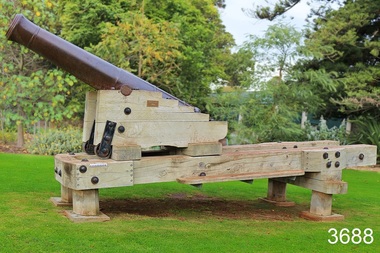
Weapon - Cannon, 1813
... Regiment. The two 80 Pounder RML were moved back to the Fortifications in 1973. They were both fully restored by Army First Year Apprentices at the Ordinance Factory in Bendigo in time for the centenary year of the fortifications in 1987. The guns are capable of firing 80 pound (32.3kg) armour piercing exploding shells 3.65kms out to sea. They were original manned by volunteers...Regiment. The two 80 Pounder RML were moved back to the Fortifications in 1973. They were both fully restored by Army First Year Apprentices at the Ordinance Factory in Bendigo in time for the centenary year of the fortifications in 1987. The guns are capable of firing 80 pound (32.3kg) armour piercing exploding shells 3.65kms out to sea. They were original manned by volunteers ...This 1813 cannon is classified as a carronade, having been made by the Carron Ironworks foundry in Stirling, Scotland in 1813. It is a large calibre, short range, gun mainly used on ships. The carronade model of cannon was first used when introduced into the British Royal Navy in the American War of the Revolution (1775-1883). This cannon was originally a 28pdr, 48cwt, 8ft gun. The date ‘1837’ on the barrel probably indicates the date that the Board of Ordinance accepted the change in size to a 32pdr. It may originally have been a naval gun and the conversion undertaken when it was brought ashore. It is very probably one of the 15 guns that are known to have constituted the defences of Victoria in 1860. This group of 32pdrs was the shorter model of the 4800width and 8ft length cannon and as such are different from the 32pdrs found in NSW. It was originally located on Cannon Hill in Warrnambool when it was the site of the Warrnambool Battery Western Artillery, formed in 1866. It was obsolete by the time of the 1887 fortifications, and was moved from the Warrnambool Fortifications to the Botanic Gardens in 1910, when the Fortifications were declared obsolete. HISTORIC INFORMATION ABOUT THE CANNON IN THE WARRNAMBOOL AREA In the years following the Crimean War (1854-1857J) there was a great concern in the Colony that Imperial Russia would attempt an invasion. Coastal defences in the colony of Victoria were greatly strengthened by the Government as a result. Warrnambool was originally protected by cannons at Cannon Hill, approximately 1 kilometer west of the Flagstaff Hill Fortifications. The cannons included two 1866 guns, both 80 Pound Rifled Muzzle Loaders (RML) purchased by Victoria’s Colonial Government. They were part of a shipment of 26 such guns sent from England in December 1866. They are registered as No. 23 (80cwt-2qr-0lbs) - Gun 1, and No.13 (81cwt-1qr-12lbs) - Gun 2. They were cast at the Royal Gun Factory, Woolwich Arsenal, in 1866 and have a 6.3 inch bore. Both barrels carry the Royal Cypher of Queen Victoria, Insignia of the Royal Engineers, within the Garter and Motto surmounted by the Crown, with the Royal Cypher of Queen Victoria within the Garter (letters in centre “VR”, motto “HONI SOIT QUI MAL Y PENSE”, "Shame be to him who thinks evil of it."). The guns were originally supplied with wooden carriages. (The Royal Arsenal at Woolwich, England, was established eleven years after the Restoration of King Charles II. It was the principal supplier of armaments to the British and Empire Governments. At the height of its operations during World War One the factory covered 1300 acres and employed very nearly 80,000 workers. Woolwich was the Headquarters of the Royal Artillery since the raising of that Regiment in 1716. The Arsenal was closed in the late 1960’s.) The two 80pdr cannons were transferred to the Warrnambool Garrison Artillery Battery Fortifications erected at Flagstaff Hill in 1887 as part of Victoria’s Coastal Defences. The original wooden carriages were subsequently replaced with the present iron garrison carriages in 1888. They are a “C” pivot. The ‘racers’ or curved track set into the floor of the gun emplacement (which enabled the guns to be traversed more quickly) are as specified for guns up to 10 inch, being of wrought iron 2.78 inches wide. A temporary third gun, now no longer on Flagstaff Hill’s site, was a 5 inch Rifled Breech Loading (BL) Armstrong gun mounted on an Elswick hydro pneumatic disappearing carriage It was faster to load and fire than the 80 pound RMLs and its arrival spelt the end of the older 80 pound guns’ useful life, apart from being used for practice sessions. The 5 inch BL gun was the main defensive weapon of the Warrnambool Battery until the Battery was downgraded in importance and the gun was recalled to Melbourne in 1910. The gun emplacement still remains in place set between the 2 80pdr cannon. The State of Victoria took over the ownership of the guns at the time of Australian Federation in 1901. In about 1901/1902 the Garrison Battery was converted to the Warrnambool Battery of the Australian Field Artillery (No 4 Field Battery). It was equipped with 4.7 inch naval guns mounted on field carriages. They were now a mobile unit but continued to use the Warrnambool Garrison area at Flagstaff Hill for practice. When the Fortifications were declared obsolete the two 80 Pounder RML were relocated to Cannon Hill in 1910. On the outbreak of World War 1 the 4.7 inch guns were recalled to Melbourne, and the Battery was disbanded. Most of the personnel probably re-enlisted in the local 4th Australian Light Horse Regiment. The two 80 Pounder RML were moved back to the Fortifications in 1973. They were both fully restored by Army First Year Apprentices at the Ordinance Factory in Bendigo in time for the centenary year of the fortifications in 1987. The guns are capable of firing 80 pound (32.3kg) armour piercing exploding shells 3.65kms out to sea. They were original manned by volunteers before a paid Garrison was established. Now the Guns are again fired by volunteers on Special Event days. Since restoration the Gun Number 1 had been fired on a regular basis but Gun Number 2 hadn’t been fired since the mid 1990’s. In April 2015 Gun Number 2 was serviced in preparation for the firing of both cannons on the ANZAC Centenary commemorations on April 25th 2015. Other guns from the original Cannon Hill location were obsolete by the time the 1887 Warrnambool Garrison Artillery Battery was built. These guns are (1) a 32 Pounder Muzzle Loading Smooth Bore (SB) cast in 1813 at the famous Carron Foundry, number 80837 and now located in the Warrnambool Botanic Gardens. It is now mounted on a replica carriage due to the original carriage being in a fragile condition (the original carriage stored under cover at Flagstaff Hill). (2) a 68 Pounder Muzzle Loading Smooth Bore cast in 1861 at the equally august Low Moor Foundry, number 10310 and now located on the lawn area at the entrance to Flagstaff Hill Maritime Village. It is still mounted on its original wooden garrison carriage. Its wooden slide compressor mechanism is fragile and now kept in Flagstaff Hill’s storage. There are only seven 32 Pounder SB made by Carron and fifteen 68 Pounder SB made at Low Moor known to exist in the State of Victoria Plaque attached to the carriage “This replica carriage was constructed by the Warrnambool Tritan Woodworkers club in conjunction with the generosity of local businesses and the Warrnambool community. The original carriage (circa 1860) was removed for restoration and is now located at Flagstaff Hill Maritime Village. The timber used for the replica carriage is Monterey Cypress, which was an early planting in the gardens. 2010 marked the centenary of the cannon’s relocation in the Warrnambool Botanic Gardens.” (Reference; Victorian Guns and Cannons, South Western Victoria Assessment, May 2008, item W/B/01; Flagstaff Hill Maritime Village datasheets and archives). There are only seven 32 Pounder SB made by Carron known to exist in the State of Victoria and this is one of them. On a world level, this cannon represents a high level of rarity. Further, as it has been modified (bored up) it is representative of the historical process of amending artillery in order to ensure a longer usefulness of each piece despite rapidly advancing artillery technology. The number of surviving carriages with traversing slides in this group in South Western Victoria is unique in Australia and probably in the World. Out of 10 such platforms surviving in Australia, the South Western Victorian group has half. Several survive around the world but probably not in such a large group. The wooden sliding compressor mechanism belonging to this cannon is extremely rare, and the only one in this South Western Victorian group of Guns and Cannons. As a whole, this cannon has undergone very little restoration or modification, giving it a high level of integrity. The City of Warrnambool is one of several custodians of a collection of artillery pieces of heritage significance at a state, national and international level. These pieces are directly related to the defence of south-west Victoria in the 19th century. The care and preservation come under the Heritage Act 1995. (Reference; Victorian Guns and Cannons, South Western Victoria Assessment, May 2008).Cannon, or carronade, 32pdr with wheels. Muzzle loading smooth bore (SB) cannon. Cannon has original wooden Burmese Teak carriage and slide with wrought iron fittings and iron wheels. Manufactured by Carron in Scotland, in 1813. It has been converted from a 28pdr. There is a loop for a rope on the cascabel, which was part of the original casting. Re-bored in 1837. Marks include Serial Number, Royal Cypher of King George III, broad arrow of proofing, and numbers to represent the weight. NOTE: The cannon is displayed in the Warrnambool Botanic Gardens and is mounted on a replica wooden carriage; the original wooden carriage is now stored under cover at Flagstaff Hill Maritime Village. This carriage has 4 wheels on swivel attachments and a central gear that allows the wheels to turn on rails. Pressed into left trunnion “80837 / CARRON / 1813”, cast on barrel“symbol (Royal Cypher of King George III”, “symbol (broad arrow of proofing)” and numbers “45-3-24 / 1837” . Cascable “CV” and marks with gradations from nought to three in quarters on each side, On the carriage the end of one of the main slide members carries the mark “W symbol (broad arrow) D” incised into the timber. Plaque attached to the carriage by the Warrnambool Tritan Woodworkers club, 2010, marking the centenary of the cannon’s relocation in the Warrnambool Botanic Gardens and the addition of the replica carriage. flagstaff hill, warrnambool, shipwrecked coast, flagstaff hill maritime museum, maritime museum, shipwreck coast, flagstaff hill maritime village, great ocean road, victoria’s coastal defences, warrnambool fortification, warrnambool garrison battery, ordinance, armaments, cannon hill fortifications, victorian colonial government, carron ironwroks foundary, 32pdr smooth bore cannon, 28pdr smooth bore cannon, 1813 cannon, carronade -
 Flagstaff Hill Maritime Museum and Village
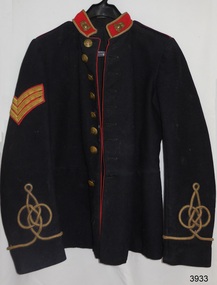
Uniform - Tunic, 1899-1903
... volunteer forces...victorian regiment...volunteers who served in the Artillery were from rural areas. They belonged to rifle clubs and were experience horsemen as well. Australia's defence at this time relied on these mounted troops, or Light Horse men. In 1899 the Victorian Garrison Artillery Corps amalgamated with the New South Wales and Queensland Permanent Artillery to become the Victorian Regiment of the Royal Australian Artillery (RAA). ...The tunic has local significance in its connection with local social events. flagstaff hill warrnambool shipwrecked coast flagstaff hill maritime museum maritime museum shipwreck coast flagstaff hill maritime village great ocean road uniform jacket uniform tunic garrison volunteer uniform fortifications in victoria victorian permanent artillery pre-federation military uniform sergeant's uniform jacket militia Victoria victorian volunteer forces victorian regiment royal australian artillery raa field gun sergeant W. ...This original tunic or jacket is part of the full dress uniform of the pre-Federation Victorian Permanent Artillery regiment. Its owner had the rank of Sergeant, as indicated by the three inverted chevrons. The Artillery design of the badges and buttons indicate the date of the tunic to be from 1893 to 1903. However the maker of the tunic, W. Moncton, began manufacture in Melbourne in 1899, so this the tunic can be dated between 1899 and 1903. The donor's grandfather was given this tunic but not the name of the original owner. It has since been suggested to the family that the tunic was worn by a local Western District Light Horse member. This could very well have been the case because mounted troops were officially referred to as the Light Horse in the late 19th to early 20th century. Several local men were involved in the Light Horse during the First World War. The donor's grandfather wore this tunic in the local district when riding a penny farthing bicycle. The donor's father also wore the tunic when dressed as a 'Captain' hosting a local disco dance. BRIEF MILITARY HISTORY- The Crimean War began In 1854 and many people in colonial Australia were afraid of a Russian attack. Volunteer forces were established to strengthen the British Imperial troops posted here. A battery of artillery was raised in Victoria as well as in other Australian states. In 1870 Australia became responsible for its own naval and military defence. The Volunteer Corps and Victorian Navy shared the responsibility of defending the existing forts, assisted by volunteer coastal and mobile field batteries. The Permanent Victorian Artillery force was established. It was disbanded in 1880 then re-formed in 1882 as the Victorian Garrison Artillery Corps. In 1895 the Geelong, Warrnambool, Port Fairy and Portland Batteries became part of the Western District Garrison Artillery. Many of the volunteers who served in the Artillery were from rural areas. They belonged to rifle clubs and were experience horsemen as well. Australia's defence at this time relied on these mounted troops, or Light Horse men. In 1899 the Victorian Garrison Artillery Corps amalgamated with the New South Wales and Queensland Permanent Artillery to become the Victorian Regiment of the Royal Australian Artillery (RAA). Then prior to Federation, the RAA and the Permanent Artillery of South Australia, Western Australia and Tasmania all combined, becoming the Royal Australian Artillery Regiment with two Batteries of Field Artillery; Battery A from Sydney and Battery B from Melbourne.This original uniform tunic of the pre-Federation Victorian Permanent Artillery is significant for its association with Australia's military defence and the fortifications of our district, state and country. The tunic is also significant, representing part of the history and evolution of uniforms in the Australian military forces. The tunic is also significant in its representation of Australia's independence in forming its own defences. The tunic has local significance in its connection with local social events.Tunic or jacket, part of the full dress uniform of the pre-Federation Victorian Permanent Artillery operating from 1893 to 1903. Original, single-breasted tunic of dark blue wool, red piping trim, black cotton lining in body. Sleeves lined with blue striped, white cotton. Front closure has eight brass buttons. Red band-style collar with hook-and-eye closure has gold bullion braid trim and a brass badge pinned each side at the front. Upper right sleeve has three inverted chevrons on red fabric with gold bullion braid trim (rank of Sergeant). Both sleeves have gold bullion braid 'Austrian knot' emblems stitched onto lower arm, with ends finishing on the inner sleeve. Shoulder epaulettes have red piping and smaller brass buttons. Closed back vent has vertical scalloped design with six brass buttons, in two columns of three, and red piping trim. Brass belt hook is attached to the left back waist, close to the seam (right side has a mark indicating a previous similar clip). Inside left breast is a concealed pocket. Tunic has both machine and hand stitching. All brass shank-style buttons have matching Artillery emblems with inscriptions on the back. The two brass collar badges have additional artillery emblems of exploding grenade and star as well as an inscription. Buttons were made for W. Moncton, of Melbourne and marked with his name. He traded from 1899, dating the tunic to between 1899 and 1903.Button front: Artillery emblem on front (field cannon facing left, in front of a muzzle-loading ram rod). Button back: engraved "W. MONCTON . MELBOURNE ." Collar badges: Artillery emblem (field cannon facing right | stars | exploding grenade | "AUSTRALIA")flagstaff hill, warrnambool, shipwrecked coast, flagstaff hill maritime museum, maritime museum, shipwreck coast, flagstaff hill maritime village, great ocean road, uniform jacket, uniform tunic, garrison volunteer uniform, fortifications in victoria, victorian permanent artillery, pre-federation military uniform, sergeant's uniform, jacket, militia, victoria, victorian volunteer forces, victorian regiment, royal australian artillery, raa, field gun, sergeant, w. moncton, garrison, dress uniform, tunic, scarlet collar, red collar, scarlet piping, red piping, gold bullion, artillery emblem, light horse, artillery, mounted troops, victorian garrison artillery corps -
 Flagstaff Hill Maritime Museum and Village
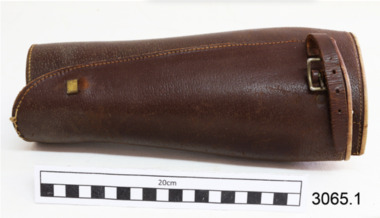
Clothing - Leather Leggings, 1899 to 1920
... Light Horse brigades in the Australian Imperial Force (AIF) mostly contained recruits who served in the Light Horse regiments of the Citizen Forces. Many young men from rural areas of Australia volunteered for the Light Horse regiments. ...Light Horse brigades in the Australian Imperial Force (AIF) mostly contained recruits who served in the Light Horse regiments of the Citizen Forces. Many young men from rural areas of Australia volunteered for the Light Horse regiments. ...The subject leather leggings are associated with mounted troops known as the Australian Light Horse that served in the South African War from 1899 to 1902. After the war, Britain wanted to use fewer mounted troops and restructured its force around a style of combat that needed more infantry. But the defence of Australia still relied upon mounted military units as these were more mobile than infantry and could travel faster over long distances. Light Horse brigades in the Australian Imperial Force (AIF) mostly contained recruits who served in the Light Horse regiments of the Citizen Forces. Many young men from rural areas of Australia volunteered for the Light Horse regiments. They had to pass a riding test to join, this test was easier for men from the bush because horses were still the main method of transport on farms and in country towns. The army did not officially accept First Australians into the AIF until May 1917 when enlistment standards were relaxed to include 'half-castes' with a parent of European origin. Indigenous soldiers served as valuable members of the Light Horse and many possessed excellent horse handling skills and specialist tracking knowledge.The subject items are part of the uniform for the Light Horse Units that served in the Australian army from 1899 until 1918. These leggings were worn by soldiers on horseback and are significant as they represent a noteworthy time in Australia's early military history. It was a time when many young men gave their lives during the South African and First World Wars in the defence of the then British Empire as part of the Imperial Forces that were gathered from many British-controlled Colonial countries.A pair of two Leather Leggings used by Mounted Australian soldiers during the first world war. The leggings are dark tan in colour with stitching to attach buckles and fastener straps. The strap buckles are made of brass and the leather legging straps are of same leather as leggings. Noneflagstaff hill, warrnambool, flagstaff hill maritime museum, shipwreck coast, flagstaff hill maritime village, great ocean road, leggings, leather leggings, protective leggings, protective clothing, australian mounted light horse units, military equipment -
 Orbost & District Historical Society
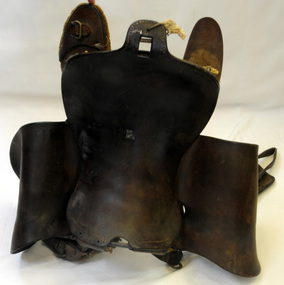
saddle, Before 1915
... By 1914, when Australia joined the war against Germany, there were 23 Light Horse regiments of militia volunteers. Many men from these units joined the Light Horse regiments of the Australian Imperial Force (AIF)....By 1914, when Australia joined the war against Germany, there were 23 Light Horse regiments of militia volunteers. Many men from these units joined the Light Horse regiments of the Australian Imperial Force (AIF). ...By 1914, when Australia joined the war against Germany, there were 23 Light Horse regiments of militia volunteers. Many men from these units joined the Light Horse regiments of the Australian Imperial Force (AIF).This WW1 item is a reminder of the roles that men from Orbost played in that conflict.Large brown leather saddle used by the Light Horse Brigade in WW1. The saddle is built on a pair of felt-padded wooden "bars" which sat on either side of the horse's spine. These are joined by steel arches with a shaped leather seat laced between them. C G H F The saddle also has a few other numbers on it which are difficult to read with accuracy. saddle military-history army transport horse -
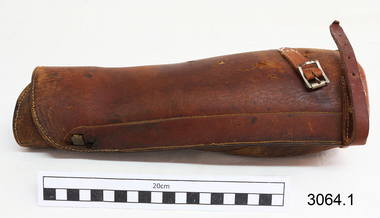 Flagstaff Hill Maritime Museum and Village
Clothing - Leather Leggings, 1899 to 1918
... Light Horse brigades in the Australian Imperial Force (AIF) mostly contained recruits who served in the Light Horse regiments of the Citizen Forces. Many young men from rural areas of Australia volunteered for the Light Horse regiments. ...Light Horse brigades in the Australian Imperial Force (AIF) mostly contained recruits who served in the Light Horse regiments of the Citizen Forces. Many young men from rural areas of Australia volunteered for the Light Horse regiments. ...The subject leather leggings are associated with mounted troops known as the Australian Light Horse that served in the South African War from 1899 to 1902. After the war, Britain wanted to use fewer mounted troops and restructured its force around a style of combat that needed more infantry. But the defence of Australia still relied upon mounted military units as these were more mobile than infantry and could travel faster over long distances. Light Horse brigades in the Australian Imperial Force (AIF) mostly contained recruits who served in the Light Horse regiments of the Citizen Forces. Many young men from rural areas of Australia volunteered for the Light Horse regiments. They had to pass a riding test to join, this test was easier for men from the bush because horses were still the main method of transport on farms and in country towns. The army did not officially accept First Australians into the AIF until May 1917 when enlistment standards were relaxed to include 'half-castes' with a parent of European origin. Indigenous soldiers served as valuable members of the Light Horse and many possessed excellent horse handling skills and specialist tracking knowledge.The subject items are part of the uniform for the Light Horse Units that served in the Australian army from 1899 until 1918. These leggings were worn by soldiers on horseback and are significant as they represent a noteworthy time in Australia's early military history. It was a time when many young men gave their lives during the South African and First World Wars in the defence of the then British Empire as part of the Imperial Forces that were gathered from many British-controlled Colonial countries.A pair of two Leather Leggings used by Mounted Australian soldiers during the first world war. The leggings are dark tan in colour with stitching to attach buckles and fastener straps. The strap buckles are made of brass and the leather legging straps are of same leather as leggings. Noneflagstaff hill, warrnambool, flagstaff hill maritime museum, shipwreck coast, flagstaff hill maritime village, great ocean road, leggings, leather leggings, protective leggings, protective clothing, australian mounted light horse units, military equipment -
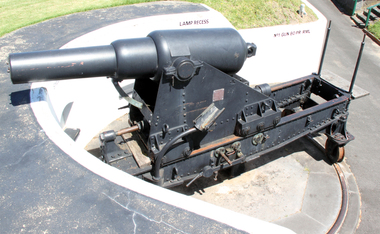 Flagstaff Hill Maritime Museum and Village
Weapon - Cannon, 1866
... Regiment. The two 80 Pounder RML were moved back to the Fortifications in 1973. They were both fully restored by Army First Year Apprentices at the Ordinance Factory in Bendigo in time for the centenary year of the fortifications in 1987. The guns are capable of firing 80 pound (32.3kg) armour piercing exploding shells 3.65kms out to sea. They were original manned by volunteers...Regiment. The two 80 Pounder RML were moved back to the Fortifications in 1973. They were both fully restored by Army First Year Apprentices at the Ordinance Factory in Bendigo in time for the centenary year of the fortifications in 1987. The guns are capable of firing 80 pound (32.3kg) armour piercing exploding shells 3.65kms out to sea. They were original manned by volunteers ...In the years following the Crimean War (1854-1857J) there was a great concern in the Colony that Imperial Russia would attempt an invasion. Coastal defences in the colony of Victoria were greatly strengthened by the Government as a result. Warrnambool was originally protected by cannons at Cannon Hill, approximately 1 kilometer west of the Flagstaff Hill Fortifications. These cannons included two 1866 guns, both 80 Pound Rifled Muzzle Loaders (RML) purchased by Victoria’s Colonial Government. They were part of a shipment of 26 such guns sent from England in December 1866. They are registered as No. 23 (80cwt-2qr-0lbs) - Gun 1, and No.13 (81cwt-1qr-12lbs) - Gun 2. They were cast at the Royal Gun Factory, Woolwich Arsenal, in 1866 and have a 6.3 inch bore. Both barrels carry the Royal Cypher of Queen Victoria, Insignia of the Royal Engineers, within the Garter and Motto surmounted by the Crown, with the Royal Cypher of Queen Victoria within the Garter (letters in centre “VR”, motto “HONI SOIT QUI MAL Y PENSE”, "Shame be to him who thinks evil of it."). The guns were originally supplied with wooden carriages. (The Royal Arsenal at Woolwich, England, was established eleven years after the Restoration of King Charles II. It was the principal supplier of armaments to the British and Empire Governments. At the height of its operations during World War One the factory covered 1300 acres and employed very nearly 80,000 workers. Woolwich was the Headquarters of the Royal Artillery since the raising of that Regiment in 1716. The Arsenal was closed in the late 1960’s.) These two cannons were transferred to the Warrnambool Garrison Artillery Battery Fortifications erected at Flagstaff Hill in 1887 as part of Victoria’s Coastal Defences. The original wooden carriages were subsequently replaced with the present iron garrison carriages in 1888. They are a “C” pivot. The ‘racers’ or curved track set into the floor of the gun emplacement (which enabled the guns to be traversed more quickly) are as specified for guns up to 10 inch, being of wrought iron 2.78 inches wide. A temporary third gun, now no longer on Flagstaff Hill’s site, was a 5 inch Rifled Breech Loading (BL) Armstrong gun mounted on an Elswick hydro pneumatic disappearing carriage It was faster to load and fire than the 80 pound RMLs and its arrival spelt the end of the older 80 pound guns’ useful life, apart from being used for practice sessions. The 5 inch BL gun was the main defensive weapon of the Warrnambool Battery until the Battery was downgraded in importance and the gun was recalled to Melbourne in 1910. The State of Victoria took over the ownership of the guns at the time of Australian Federation in 1901. In about 1901/1902 the Garrison Battery was converted to the Warrnambool Battery of the Australian Field Artillery (No 4 Field Battery). It was equipped with 4.7 inch naval guns mounted on field carriages. They were now a mobile unit but continued to use the Warrnambool Garrison area at Flagstaff Hill for practice. When the Fortifications were declared obsolete the two 80 Pounder RML were relocated to Cannon Hill in 1910. On the outbreak of World War One the 4.7 inch guns were recalled to Melbourne, and the Battery was disbanded. Most of the personnel probably re-enlisted in the local 4th Australian Light Horse Regiment. The two 80 Pounder RML were moved back to the Fortifications in 1973. They were both fully restored by Army First Year Apprentices at the Ordinance Factory in Bendigo in time for the centenary year of the fortifications in 1987. The guns are capable of firing 80 pound (32.3kg) armour piercing exploding shells 3.65kms out to sea. They were original manned by volunteers before a paid Garrison was established. Now the Guns are again fired by volunteers on Special Event days. Since restoration the Gun Number 1 had been fired on a regular basis but Gun Number 2 hadn’t been fired since the mid 1990’s. In April 2015 Gun Number 2 was serviced in preparation for the firing of both cannons on the ANZAC Centenary commemorations on April 25th 2015. Other guns from the original Cannon Hill location were obsolete by the time the 1887 Warrnambool Garrison Artillery Battery was built. These guns are (1) a 32 Pounder Muzzle Loading Smooth Bore (SB) cast in 1813 at the famous Carron Foundry, number 80837 and now located in the Warrnambool Botanic Gardens (2) a 68 Pounder Muzzle Loading Smooth Bore cast in 1861 at the equally august Low Moor Foundry, number 10310 and now located on the lawn area at the entrance to Flagstaff Hill Maritime Village. Both of these guns are mounted on their original wooden garrison carriages. There are only seven 32 Pounder SB made by Carron and fifteen 68 Pounder SB made at Low Moor known to exist in the State of Victoria On April 4th, 2026, both Cannon No 1 and the recently restored Cannon No. 2 were 'fired' in a public re-enactment. (Conservation Management Plan for Victorian Guns and Cannon, South Western Victoria, May 2008, ref W/F/04)The Warrnambool Garrison has been added to the Victorian Heritage Register H1250 “for its intact battery and guns, a strong reminder of Victoria’s wealth and determination to protect itself from the perceived threat of invasion in the 1880’s.” The City of Warrnambool is one of several custodians of a collection of artillery pieces of heritage significance at a state, national and international level. These pieces are directly related to the defence of south-west Victoria in the 19th century. The care and preservation come under the Heritage Act 1995. Cannon. 80 Pounder Rifled Muzzle Loading (RML) Gun on iron carriage and slide, installed in the Battery at Flagstaff Hill’s Fortifications.. Made in 1866 at the Royal Gun Factory (R-G-F), Woolich, England. Gun Reg No - 23. Flagstaff Hill Garrison Gun 1 (Gun No. 1) Insignia of the Royal Engineers, and the weight of the gun, stamped on top of the gun’s barrel. There is a brass plate on the side of the gun with the details of 1987 restoration.Stamped on axle cover on side of barrel “R-G-F / No 23 / 1866”. Stamped into the metal on top of the barrel, Insignia of the Royal Engineers; Garter and Motto “HONI SOIT QUI MAL Y PENSE”, surmounted by the Crown, with the Royal Cypher of Queen Victoria “VR” within the Garter. Also stamped on top of the gun are 2 inward pointing arrows above the weight ”81-2-0”. Brass plate “RESTORATION / BY / FIRST YEAR / APPRENTICES / ORDANANCE FACTORY / BENDIGO 1987”flagstaff hill, warrnambool, shipwrecked coast, flagstaff hill maritime museum, maritime museum, shipwreck coast, flagstaff hill maritime village, great ocean road, cannon, 80 pounder, rifled muzzle, loading, royal gun factory, woolich -
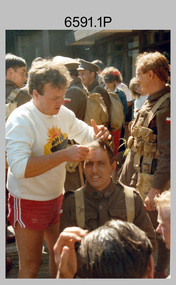 Bendigo Military Museum
Photograph - The ANZACS TV Series - Army Survey Regiment’s Extras, Phillip Island, Victoria, 1985
... This is a set of six photographs of Army Survey Regiment personnel who volunteered as extras in the ANZACS TV Series filmed in 1985. ...This is a set of six photographs of Army Survey Regiment personnel who volunteered as extras in the ANZACS TV Series filmed at Phillip Island, Victoria in 1985. ...This is a set of six photographs of Army Survey Regiment personnel who volunteered as extras in the ANZACS TV Series filmed in 1985. ...This is a set of six photographs of Army Survey Regiment personnel who volunteered as extras in the ANZACS TV Series filmed in 1985. Many of the extras playing the roles of Australian soldiers were serving members of the Army Survey Regiment, Bendigo and the Armoured Regiment, Puckapunyal. This was done to keep costs down so that actors did not have to learn how to act as soldiers or to have to teach them how to use the weapons. Army Svy Regt’s 28 personnel left Bendigo in the early hours of the morning arriving at Phillip Island’s Cowes Motor Inn. Wardrobe staff make-up artists dressed the soldiers from both units in authentic WW1 uniforms in readiness for filming at Woolamai Surf Beach, on the other side of Phillip Island. Filming for the day involved a battle scene simulation of the beach landings at Gallipoli, Turkey. A long day of filming ensued, with 8 arduous re-takes of charges from the beach to the steep cliffs, and the scrubland beyond the cliffs before the producers were satisfied with the footage. The producers provided ample refreshments back at Cowes Motor Inn at the end of the day, before Army Svy Regt’s 28 personnel departed on the 4-hr trip back to Bendigo. This is a set of six photographs of Army Survey Regiment personnel who volunteered as extras in the ANZACS TV Series filmed at Phillip Island, Victoria in 1985. The colour photographs. were printed on photographic paper and are part of the Army Survey Regiment’s Collection. The photographs were scanned at 300 dpi. A newspaper article published by the Bendigo Advertiser on the 29th of October 1985 is stored with the photos. .1) - Photo, colour, 1985. A hairdresser attends to Garry Hudson’s hair at the Cowes Motor Inn. Glen Weatherall is on far right. .2) - Photo, colour, 1985. Production staff preparing a scene at the cliff base at Woolamai Surf Beach. .3) - Photo, colour, 1985. A make-up artist applies simulated wounds to an unidentified soldier. .4) - Photo, colour, 1985. Production staff preparing a beach landing scene. .5) - Photo, colour, 1985. Extras from the Army Svy Regt and 1st Armd Regt gather at Woolamai Surf Beach. L to R in foreground: Gary Tremain, Graham Hales, unidentified, Dave Lawler, unidentified. .6) - Photo, colour, 1985. The 28 extras from the Army Svy Regt at Woolamai Surf Beach. Standing L to R: Terry McIntyre, unidentified, Ian Fitzgerald, unidentified, John Reid, unidentified, Gary Tremain, unidentified (x2), Chad Hardwick, unidentified, Dave Lawler, Barry Hogan, Terry Danger, Peter Imeson, Garry Hudson. Kneeling L to R: unidentified, Peter Ball, Harald Mai, Paul Baker, Alan Staley, Ian McKenzie, Brad Peppler. Sitting: Rod Skidmore. ‘Filming of “ANZACS” 1985’ annotated on cover sleeve.royal australian survey corps, rasvy, army survey regiment, army svy regt, fortuna
