
Showing 36 items matching "new years gifts"
-
 Latrobe Regional Gallery
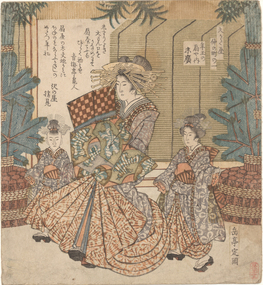
Print, GAKUTEI, Yashima, Suehiro of the Ôgiya with New Year's Gifts (Toshidama no Ôgiya uchi Suehiro), No. 1 from the series Views of Naka-no-chô for the Hisakataya Club (Hisakataya Nakanochô no ichi), 1825
... new years gifts...Edo Period new years gifts Surimono (Coloured woodblock print with additional special inks) Suehiro of the Ôgiya with New Year's Gifts (Toshidama no Ôgiya uchi Suehiro), No. 1 from the series Views of Naka-no-chô for the Hisakataya Club (Hisakataya Nakanochô no ichi) Print GAKUTEI, Yashima ...Edo PeriodSurimono (Coloured woodblock print with additional special inks)new years gifts -
 Federation University Historical Collection
Book - Book - Scrapbook, Ballarat College of Advanced Education: Scrapbook of newspaper cutting, Book 3; November 1977 to May 1978
... The cuttings cover the period from 15 November 1977 to 12 May 1978. employment advertisements application for enrolment outline of courses $5000 for reseach at bcae art display by bcae third year students government to increase expenditure on bcae $1060000 contract for bcae education building terry lee - rock drilling championship graduate course for librarians business degree course engineer off to antarctic ron brown more want to study in ballarat d taylor keeock retires stained glass windows no jobs for many new teachers anne vine student counsellor gifts for research new bcae computer has all the answers father ray gregory lectures mr james tye - british safety chief tv equipment to cae criticism rejected by barker building over drain vertical windmill top facilities 'the lost generation' coaching panel visits ballarat endurance test for students accident prevention seminar jim reid ron moulds derek viner harold thomas shake-up urged in tertiary education education report - partridge report maureen boon wins prize 'scrap deakin' - 12 college principals percy cerutty's ideas transplanted romp through war years hitz of the blitz orienteering - canadian forest education no answer to unemployment future of bcae assured canoe class course on hearing conservation program billycart designs Book with yellow cover, front. ...Newspaper cuttings relating to Ballarat College of Advanced Education. These are from various newspapers and include The Age, Ballarat Courier, The Australian, The Herald. The cuttings cover the period from 15 November 1977 to 12 May 1978. Book with yellow cover, front. Spiral bound.employment advertisements, application for enrolment, outline of courses, $5000 for reseach at bcae, art display by bcae third year students, government to increase expenditure on bcae, $1060000 contract for bcae education building, terry lee - rock drilling championship, graduate course for librarians, business degree course, engineer off to antarctic, ron brown, more want to study in ballarat, d taylor keeock retires, stained glass windows, no jobs for many new teachers, anne vine student counsellor, gifts for research, new bcae computer has all the answers, father ray gregory lectures, mr james tye - british safety chief, tv equipment to cae, criticism rejected by barker, building over drain, vertical windmill, top facilities, 'the lost generation', coaching panel visits ballarat, endurance test for students, accident prevention seminar, jim reid, ron moulds, derek viner, harold thomas, shake-up urged in tertiary education, education report - partridge report, maureen boon wins prize, 'scrap deakin' - 12 college principals, percy cerutty's ideas transplanted, romp through war years, hitz of the blitz, orienteering - canadian forest, education no answer to unemployment, future of bcae assured, canoe class, course on hearing conservation program, billycart designs -
 Lara RSL Sub Branch
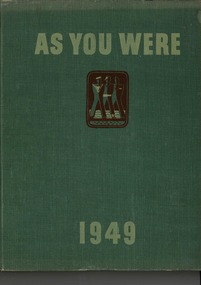
Book, As You Were 1949, 1949
... years. Historical recount through stories, poems and illustrations of Australians in World War 2 george alan vasey palestine gaza italian pow's ae2 sea of marmora noic naavy information operations command captain sir ross smith no.1 squadron greece retreat new guinea tregonning ammunition de ruyter exeter perth java houston To the memory of the fallen ' They gave their lives. For that public gift ...Compilation of articles, short stories and poems of events and experiences of servicemen and women. This volume recalls the courage and humour, the boredom and the achievements, the travel and adventure and misdeeds, and above all the good comradeship of the services in the war years.Historical recount through stories, poems and illustrations of Australians in World War 2As You Were 1949 Illustrations, photographs, Green coloured hardcover front and back with light green test on front page 'As you were' and '1949'. There is a rectangular relief showing three tri servicemen. The inside front and back covers have illustrations of Air force, Navy and Army on a dark green background. The Southern Cross is also a feature of the illustrations.To the memory of the fallen ' They gave their lives. For that public gift they received a praise which never ages and a tomb most glorious - not so much the tomb in which they lie, but that in which their fame survives, to be remembered forever when occasion comes for word or deed...'george alan vasey, palestine, gaza, italian pow's, ae2, sea of marmora, noic naavy information operations command, captain sir ross smith, no.1 squadron, greece retreat, new guinea, tregonning, ammunition, de ruyter, exeter, perth, java, houston -
 Ballarat Clarendon College
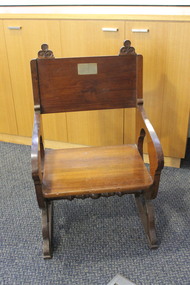
Chair
... Mrs Cairns was an inaugural member of the new Clarendon Presbyterian Ladies College Council, established 1919 and remained on the Council for 30 years. This chair was a personal gift to Mrs Cairns by the PWMU to honour of her long and devoted service to that organisation. ...Mrs Cairns was an inaugural member of the new Clarendon Presbyterian Ladies College Council, established 1919 and remained on the Council for 30 years. This chair was a personal gift to Mrs Cairns by the PWMU to honour of her long and devoted service to that organisation. ...Wife of the Rev T D Cairns, Minister of St Andrews Kirk, Mrs Mary Cairns served on the Council of Clarendon Presbyterian Ladies College 1919 - 1949. Her generous guarantee of loans from the Ballarat Banking Company, together with other donations, enabled the Presbytery of Ballarat to purchase Clarendon Ladies College from Mr Kennedy in 1919 for 1500 pounds. Mrs Cairns was an inaugural member of the new Clarendon Presbyterian Ladies College Council, established 1919 and remained on the Council for 30 years. This chair was a personal gift to Mrs Cairns by the PWMU to honour of her long and devoted service to that organisation. Mrs Cairns donated the chair back to St Andrews Kirk where it remained in use until the sale of the property in 2019. Congregation member, Max Harris, kindly arranged the donation of the chair to the school because of Mrs Cairn's long association with Clarendon PLC. Solid wood chancel chair with discreet carving; plaque on front side of back supportPlaque: This chair was presented by the / Members of the St Andrews P W M U / on the occasion of the retirement of / Mrs T R Cairns / from the Presidency of the Branch / after holding that office for more than fifty years / as an acknowledgement of her devoted service / as President / & of their deep personal regard. mrs mary cairns, 1919, st andrews kirk, clarendon presbyterian ladies college -
 Glenelg Shire Council Cultural Collection
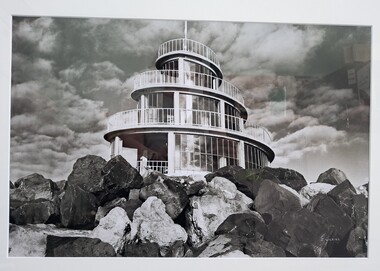
Photograph, John Wilkins, Photographer, Corkscrew, n.d
... gift to the Portland Harbour Trust by the contractors who constructed the port. It was designed in 1960 and fabricated shortly after the completion of the Main Breakwater. The corkscrew was built as an observatory, with the observation deck approximately 13 metres above sea level. Its original design life was less than 25 years. The original structure was dilapidated, extremely unsafe and in danger of collapse. Understanding the historical and community importance of the original structure, in 2016 Port of Portland began the process of designing and building a replacement. The new...gift to the Portland Harbour Trust by the contractors who constructed the port. It was designed in 1960 and fabricated shortly after the completion of the Main Breakwater. The corkscrew was built as an observatory, with the observation deck approximately 13 metres above sea level. Its original design life was less than 25 years. The original structure was dilapidated, extremely unsafe and in danger of collapse. Understanding the historical and community importance of the original structure, in 2016 Port of Portland began the process of designing and building a replacement. The new ...From the Port of Portland website: The original corkscrew was built as a gift to the Portland Harbour Trust by the contractors who constructed the port. It was designed in 1960 and fabricated shortly after the completion of the Main Breakwater. The corkscrew was built as an observatory, with the observation deck approximately 13 metres above sea level. Its original design life was less than 25 years. The original structure was dilapidated, extremely unsafe and in danger of collapse. Understanding the historical and community importance of the original structure, in 2016 Port of Portland began the process of designing and building a replacement. The new corkscrew is a similar size and has been based on the same spiral shape of the original structure. The corkscrew has been constructed using mild steel, heavily coated in marine grade paint (similar to what is used on ships). Heavy duty plastic has been used for the walkway section which will withstand the harsh elements of the marine environment.Photograph of the Portland Corkscrew in the 1980s. Image is in black and white. The corkscrew is in front of a sky which is dotted with fluffy clouds. To the front of the Corkscrew are large rocks. The building is a spiral with glass windows. There is a white metal fence around it and a white pole at the top which reaches to the top of the image.Bottom right: J WILKINSportland, seafront, maritime, portland landmark, corkscrew, port of portland, portland photography, photography -
 Mission to Seafarers Victoria
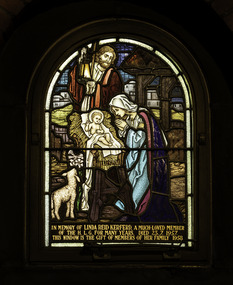
Artwork, other - Stained glass window, George H. Dancey, Nativity - In memory of Linda Reid Kerferd, 1958
... new background. The window is a memorial to one of the many volunteers working the Mission. st peter chapel flinders street mission to seafarers seamen's mission mission to seamen st peter sailors seamen stained glass windows WIN memorial chapel linda reid kerferd hlg harbour lights guild nativity In memory of Linda Reid Kerferd A much loved member of the H.L.G. for many years Died 23.7.52 This window is the gift of members of her family 1958 Arch stained glass window depicting the birth of Jesus with a text in memory of Linda Kerferd Nativity - In memory of Linda Reid Kerferd Artwork, other Stained glass window George H. ...Linda Reid Kerferd (born 1875) was a long time member of the Harbour Lights Guild. She died 23 July 1957. Daughter of George B. Kerferd and Ann Martindale. The window was taken from an old cartoon drawn up by George H. Dancey and adapted for the opening with a new background.Arch stained glass window depicting the birth of Jesus with a text in memory of Linda KerferdIn memory of Linda Reid Kerferd A much loved member of the H.L.G. for many years Died 23.7.52 This window is the gift of members of her family 1958 st peter chapel, flinders street, mission to seafarers, seamen's mission, mission to seamen, st peter, sailors, seamen, stained glass windows, win, memorial chapel, linda reid kerferd, hlg, harbour lights guild, nativity -
 Mission to Seafarers Victoria
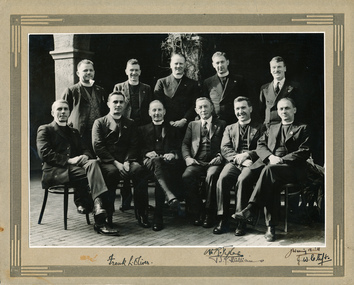
Photograph - Photograph, Black and white, Conference of Australasian Chaplains, Melbourne, 1936, 1936
... years ago." The photograph was published in the 1936 Annual Report This photograph is representative of the relationship between the Mission to Seafarers Victoria and the Anglican Church. Reverend Frank Oliver served as Chaplain at the Mission to Seafarers Victoria from 1930 - 1960. A gift of £20,000 for the rebuilding of the Port Melbourne institute, which was old and dilapidated, was announced at the conference. courtyard chaplains archbishop melbourne mission to seafarers flinders street frank leslie oliver conference australasian chaplains anglican church reverends australia new zealand 1936 seamen's mission chaplains group chaplain conferences Top edge of mountboard title of occasion and photo in Black ink all upper case: (see title details this record); Lwr edge first line corresponding to back row of group: 'REv Wm Hoog (Brisbane); Revd W.H. ...The photograph is a record of a historic conference of MTS representatives from Australia and New Zealand. , September 1-3 , 1936: Revd Wm Hoog (Brisbane) Revd W.H. Terry (Port Pirie) Revd H.C Cuthbertson (Adelaide) Revd W.R. Tyler (Melbourne) Mr J.W. Neill (Melbourne) Revd. F. J. Evans (Sydney) Revd Frank L. Oliver ( Melbourne MTS) F W Melbourne (Archbishop F W Head 1929- 1942) Mr J.C. Grahame (Hobart) Rev B.J. Williams ((Wellington NZ) Rev J.C. Clift (Fremantle) From the Argus (Melbourne, Vic. : 1848 - 1957), Saturday 5 September 1936, page 34: "For three days this week chaplains of missions to seamen in different ports of Australia and New Zealand met in conference in Melbourne. Bishop Stephen, chairman of the executive committee of the mission in Melbourne, presided over the conference, which was opened by Archbishop Head celebrating Holy Communion in the Chapel of St. Peter at the mission. Among the questions considered was the problem of foreign vessels, from which nothing is contributed toward the support of the missions. It was felt that there was great scope for work of an international character, and that every effort should be made by the chaplains to bring men from the ships of different countries together. The chaplains said that many thousands of men from foreign ships attended the mission institutes. Efforts will be made for more contact to be made with men on coastal ships, and commendation of men from one port to the next will ensure that the needs of men are cared for as well as possible. An ordained chaplain will be sent from London for a new mission at Geraldton (WA), and a new mission will also be opened at Port Kembla (N.SW.). The chaplains will endeavour to obtain police cooperation in keeping docks and wharves free from undesirable persons. It is hoped that an effort will be made to seek the co-operation of the port authorities in order to ensure the pos-sibility of ships being allowed to be alongside during week-ends and public holidays without having to face the full port charges. To avoid the heavy charges the ships now anchor in the bay during week-ends and public holidays. Melbourne was chosen as the central port for Australia for supplies for mis-sions to seamen, and it was decided that the conference should be held every three years, in Melbourne. The last was held 11 years ago." The photograph was published in the 1936 Annual ReportThis photograph is representative of the relationship between the Mission to Seafarers Victoria and the Anglican Church. Reverend Frank Oliver served as Chaplain at the Mission to Seafarers Victoria from 1930 - 1960. A gift of £20,000 for the rebuilding of the Port Melbourne institute, which was old and dilapidated, was announced at the conference. Black and white photograph mounted on cardboard with border detail on the front. The photograph is of eleven men, five standing behind six seated. Nine of the men are wearing clerical collars and two are in suit and ties. The photograph appears to have been taken in the courtyard of the Mission to Seafarers Victoria, at 717 Flinders St. Each of the people in the photograph appears to have hand inscribed their names/ signatures on the lower edge of the mountboard.Top edge of mountboard title of occasion and photo in Black ink all upper case: (see title details this record); Lwr edge first line corresponding to back row of group: 'REv Wm Hoog (Brisbane); Revd W.H. Terry (Port Pirie); Rev H.C Cuthbertson (Adelaide) ; Rev W.R. Tyler (Melbourne) ; Mr J.W. Neill (Melbourne) : / Lwr edge second line corresponding to front row seated: "Revd. F. J. Evans (Sydney) ; Revd Frank L. Oliver ( Melbourne MTS); F W Melbourne (Archbishop F W Head 1929- 1942); Mr J.C. Grahame (Hobart); Rev B.J. Williams ((wellington NZ).; Rev J.C. Clift (Fremantle); courtyard, chaplains, archbishop melbourne, mission to seafarers, flinders street, frank leslie oliver, conference, australasian chaplains, anglican church, reverends, australia, new zealand, 1936, seamen's mission, chaplains group, chaplain conferences -
 Warrnambool and District Historical Society Inc.
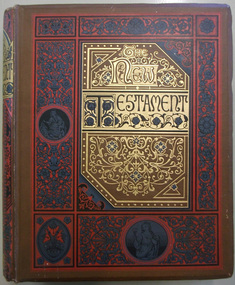
Book, New Testament, 1883
... gift to George Rolfe who resided for many years in Warrnambool. He owned the property of Lyndoch and later purchased Shipley. A tangible link to one of the early citizens of Warrnambool. warrnambool george rolfe bessie wordsworth new testament wood engravings Bessie Wordsworth Xmas 1887from*****. ...This book contains a number of plates taken from paintings by Raphael, Poussin, Da Vinci Ferrari, Perugino and numerous engravers including J Cooper J L Williams W. Meason and H Shaw. As well as the large number of plates there is also much ornamentation on initial letters medallions and margins. It was a gift to George Rolfe who resided for many years in Warrnambool. He owned the property of Lyndoch and later purchased Shipley. A tangible link to one of the early citizens of Warrnambool.Light brown cover with red, blue and gold embellishments. Pages edged in gold. Numerous plates taken from engravings on wood, throughout the book. Bessie Wordsworth Xmas 1887from*****. George Rolfe with much love from his affectionate cousin * * Turner * 8th 1915. warrnambool, george rolfe, bessie wordsworth, new testament, wood engravings -
 Warrnambool and District Historical Society Inc.
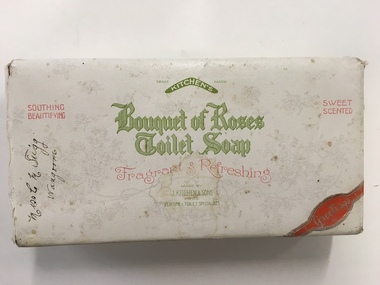
Box, Bouquet of Roses Toilet Soap, Mid 20th century
... years later. Over the next 30years the business expanded further employing upwards of 300 people and became one of the leading manufacturers of soaps, candles and associated products in Australia and New Zealand. They were makers of long standing brands such as Velvet soap and Solvol and by the mid 1920's were employing about 1400 people. It was around this time that they merged with the Lever Co of Sydney and after absorption of other soap companies over the next 40 years , the company became known as Lever & Kitchen in 1962. This box contained gift...years later. Over the next 30years the business expanded further employing upwards of 300 people and became one of the leading manufacturers of soaps, candles and associated products in Australia and New Zealand. They were makers of long standing brands such as Velvet soap and Solvol and by the mid 1920's were employing about 1400 people. It was around this time that they merged with the Lever Co of Sydney and after absorption of other soap companies over the next 40 years , the company became known as Lever & Kitchen in 1962. This box contained gift ...The business of Kitchen and Sons began in 1856 when John Kitchen began to make tallow candles in their backyard in Emerald Hill but had to move two years later due to it being an offensive trade. Bad luck plagued them again after two years when fire destroyed their premises. However after rebuilding , the expanded and moved to Footscray ten years later. Over the next 30years the business expanded further employing upwards of 300 people and became one of the leading manufacturers of soaps, candles and associated products in Australia and New Zealand. They were makers of long standing brands such as Velvet soap and Solvol and by the mid 1920's were employing about 1400 people. It was around this time that they merged with the Lever Co of Sydney and after absorption of other soap companies over the next 40 years , the company became known as Lever & Kitchen in 1962. This box contained gift soaps and probably belongs to the period prior to 1924. Miss C M Trigg of Wangoom was the owner. A common item with links to a district family.White card box with overlapping lid which is covered in white paper with green and red text. A red banner across right bottom corner. Light grey floral pattern as background.Miss C M Trigg Wangoom written in black ink on left corner. Made by J Kitchen & Sons Pty Ltd.warrnambool, warrnambool history, wangoom, c m trigg wangoom -
 Geoffrey Kaye Museum of Anaesthetic History
Decorative object - Vase, Joy McElvey
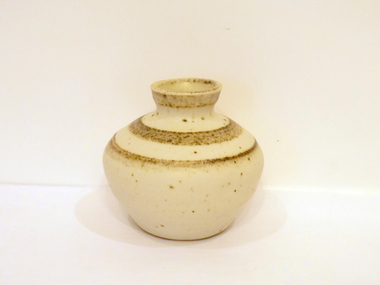
... New Zealand. The gift was accompanied by a card with the following inscription: "Thank you for allowing me to be a small part of your great institution as Councillor and Faculty Dean these past two years. ...New Zealand. The gift was accompanied by a card with the following inscription: "Thank you for allowing me to be a small part of your great institution as Councillor and Faculty Dean these past two years. ...The vase was made from the liquefaction that came out of the Christchurch earthquake of 22 February 2011. The vase was gifted to the College by Professor Edward Shipton (known as Ted) on his retirement as Dean of the Faculty of Pain Medicine, and from Council. Professor Shipton is from New Zealand. The gift was accompanied by a card with the following inscription: "Thank you for allowing me to be a small part of your great institution as Councillor and Faculty Dean these past two years. My gift to the College is a small vase. This vase was made from the liquefaction that came out of the 22 February 2011 Christchurch Earthquake. It pays tribute to the medical personnel, our Fellows and Trainees that gave so much during that time to preserve life and relieve suffering. Sincerely Edward (Ted) Shipton"Small cream coloured, round vase with brown glazed rings around the shoulder of the vase.shipton, edward (ted), dean, faculty of pain medicine, christchurch earthquake, liquefaction, pottery, mcelvey, joy -
 Bendigo Historical Society Inc.
Ephemera - LYDIA CHANCELLOR COLLECTION: EPHEMERA
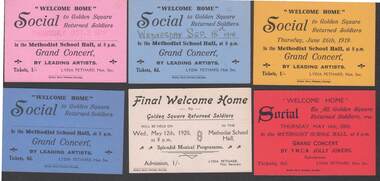
... New Year 1919. Printed for Wor.Bro. G.A. Pethard W.M., Golden and Corinthian Lodge, No. 7, Bendigo. It has a photo of the Masonic Temple Bendigo in the centre of the card. (II) 2 copies of the Australian Comforts Fund Victorian Division newspaper depot tags.(III) An assortment of cards and ephemeral pieces of paper. (IV) A thankyou gift card to the Mayoress (Mrs. Geo. Pethard) from the Debutantes set of 1952 thanking her for her support and wishing her the best in the years...New Year 1919. Printed for Wor.Bro. G.A. Pethard W.M., Golden and Corinthian Lodge, No. 7, Bendigo. It has a photo of the Masonic Temple Bendigo in the centre of the card. (II) 2 copies of the Australian Comforts Fund Victorian Division newspaper depot tags.(III) An assortment of cards and ephemeral pieces of paper. (IV) A thankyou gift card to the Mayoress (Mrs. Geo. Pethard) from the Debutantes set of 1952 thanking her for her support and wishing her the best in the years ...A plastic bag containing ephemeral items. (I) A Christmas card dated Christmas 1918 New Year 1919. Printed for Wor.Bro. G.A. Pethard W.M., Golden and Corinthian Lodge, No. 7, Bendigo. It has a photo of the Masonic Temple Bendigo in the centre of the card. (II) 2 copies of the Australian Comforts Fund Victorian Division newspaper depot tags.(III) An assortment of cards and ephemeral pieces of paper. (IV) A thankyou gift card to the Mayoress (Mrs. Geo. Pethard) from the Debutantes set of 1952 thanking her for her support and wishing her the best in the years ahead. (V) A 'Well done, Boys!' welcome home tag. (VI) Golden Square Methodist Church invitation to a social evening on 17th. August, 1951 in aid of the Carpet Fund. It is in the form of a rhyme and a small hand made money bag. (VII) A Melbourne Cricket Club lady's ticket dated 1961-62 (VIII) A printed 1911 Xmas card from Mrs Mulgrove and Frank, 'Charlton,' Church Street, Woking. (IX) 8 tickets for various welcome home socials to the Golden Square returned soldiers 1918.lydia chancellor, collection, ephemera, christmas, golden and corinthian lodge bendigo, masonic temple bendigo, 1952 mayoral debutantes set, golden square methodist church, melbourne cricket club, world war 1, golden square returned soldiers, australian comforts fund. -
 Narre Warren and District Family History Group
Book, Narre Warren & District Family History Group Inc, Casey Cardinia Collection - Pakenham Information File - Volume 1, 2014
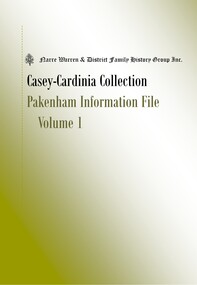
... Orchards 14 Nov 2007 Pigeons take flight 25 Jul 2007 Oh how the town’s grown 26 Mar 2008 Historic hotel has new look – Pakenham Hotel 10 Dec 2008 Stock agent who called the shots – Roly Hewson 10 Dec 2008 Apple a day keeps orchardists aweigh – Hardings Orchard 06 Feb 2008 Service is in the can – Ray Coombs from Nestle Unknown It’s service with a smile – Charlie Rossetti 02 Apr 2008 The hell that was Gallipoli 05 Dec 2007 Una (Cafra) at 101 is unstoppable 05 Sep 2007 Neighbours for seven decades (Bill Shelton & Jack Buckland) 00 Dec 2008 Connectsus –newsletter of the Beaconhills College Alumni 19 Oct 2011 Historic Oak Journey Continues 19 Oct 2011 Beat is their guiding light 08 Sep 2010 Printz’s passion hits home 8 Apr 2015 Chuggs Tug at Heartstrings - Jean & Dennis Chugg 2 Sep 2015 Silence for a Good Man - John Goff 19 Oct 2016 Iconic Home is up for Sale 18 Jan 2017 A Great Blast from the Past - Pakenham East Cricket Club 23 Nov 2016 Her Caring Nature - Patricia Benyan 18 Jan 2017 Magical 100 Candles Lit - Mary Blundy 14 Oct 2015 Loyal Race Club Stalwarts Retire - Frances Knapp & Ron Carroll 17 Feb 2016 Pakenham Icon Passes - Gavan Bourke 17 Feb 2016 Pakenham Mourns a legend - Gavan Bourke 21 Sep 2016 Hughie Loved Community - Hughie Bourke 27 Jul 2016 It’s a Grant to Remember 1 Jun 2016 Principal Out of Trenches - St Patrick’s Primary School 150th 15 Jun 2016 Rotary was Charlie’s Life - Charlie Huyskens 31 Aug 2016 Man of Letters - John Murrell 20 Oct 2010 Hairdressing Win Career Highlight - Bronny Saunders 10 Feb 2016 Shut Down for Dore Milestone - John Dore 30 Apr 2008 Time for Reflection - Pakenham Cemetery Trust 5 Nov 2003 A Return to Glory Days for Former Shire Offices 23 Mar 1994 Ellie Ellett’s Memories of a Fortunate Life 23 Apr 2008 From Concrete to Soil - Roger & Chris McGill 21 Dec 2009 Joe is Fondly Remembered - Joe Russell 21 Dec 2009 Lorna’s Elegance Shone Through - Lorna Giles nee Ramage 16 Jan 2013 Johnny Appleseed - John Wiadrowski 13 Feb 2013 Treloar Makes Final Cut - Graham Treloar 13 Feb 2013 Pakenham as it was 17 Jun 2009 Learning Keeps Jean Young - Jean Ferguson 29 Oct 2014 Sweet Man with a Sweet Tooth - Keith Cook 22 May 2013 Machinery was Alan’s Game - Alan Porter 16 Sep 2015 Lucy’s Long, Loving Life - Lucy Rouse 22 Jul 2015 French Decoration - Jack Kane 13 Jan 2016 Athlete Marches Off - Sheldon Ronald 10 Feb 2016 Friends for Life - 60 Years not out - Bob & Kath Florance 10 Feb 2016 Newborn is Across the Generations - Nate Delphine 25 Apr 2012 Exhausted but Excited by Milestone Birthday - Ellen McKenzie 25 Aug 2005 Newspaper Pioneer Dies - Florrie Thomas 2010 Loss of Former Scout Leader - Joe Zaal 15 Jul 2015 Senior Citizens Celebrate Birthday 15 Jul 2015 Congrats Joan on OAM - Joan Vogels 26 May 2010 Cath is our Centenarian - Cath Marson 15 Sep 2021 Together 50 Golden Years - Alwyn & Terry Williams 10 Jun 2021 They Made the Regal List - Donald Duffy 12 Jun 2013 Zach’s Footy Dream Comes True - Zach Stephens 10 Jun 2015 Stableford a Welcome Relief 15 May 2013 Jackie Loves Scouting Life - Jackie Connelly 5 Aug 2009 Sisters in Arms - Thelma Rhein & Joan Hayles 11 Feb 2009 Death of a Soldier - Aaran McCann 18 Feb 2015 Poppy Plaque for Service 28 Jun 2017 Sports Carnival was a Gift 23 Sep 2015 Hardware Icon Unhooks - Hardys 28 Jun 2017 Norm’s Dedication to RSL - Norm Joseph 25 Nov 2009 Pottering Around - Robert Gordon Pottery 1 Oct 2014 Hardy’s Toasts 60 Years 27 May 2015 Sod Turns New Page in Family’s History - Webster 4 Aug 2021 Siren Goes for “Stinger” - Ian Murphy 24 May 2017 50th Anniversary - Pakenham Secondary School 22 Sep 2021 Trusting in our Future - PB Ronald Memorial Trust 16 Dec 2009 Spotlight on the Hoof and Hook 15 May 2013 Sporting Legend who Rode High in the Saddle of Life 7 Jan 2009 Jubilee Team Nod is Jewel in Crown - Lionel Sexton 12 Aug 2015 Papers Together - Dandenong Journal 12 Aug 2015 Dickson - a Doyen of Jounal(ism) - Greg Dickson 12 Aug 2015 Quiet Man had Depth of Strength - Harold Tulloch 8 Sep 2021 100 and More Birthdays - Hautie Crick & Sybil Hickman 5 Aug 2015 St James Marks Ruby 6 Oct 2021 Young Spirit Worth Bottling - Daryl Young 12 Aug 2015 Gwen Followed the Paper Trail - Gwen Jarvis 12 Aug 2015 We Loved Our Youthful Adventures - Sue Jarvis 13 Oct 2021 Pizza Queen’s Farewell - Rosa Santo 4 Feb 2009 Gaynor Goes it Alone as Family Spreads Wide - Rotteveel 25 Feb 2009 Hooves of History - Pakenham Show 19 Sep 2018 Uncertain Future for Post-War Pat - St James Village 19 Sep 2018 Do You Recognise These Soldiers? ...Orchards 14 Nov 2007 Pigeons take flight 25 Jul 2007 Oh how the town’s grown 26 Mar 2008 Historic hotel has new look – Pakenham Hotel 10 Dec 2008 Stock agent who called the shots – Roly Hewson 10 Dec 2008 Apple a day keeps orchardists aweigh – Hardings Orchard 06 Feb 2008 Service is in the can – Ray Coombs from Nestle Unknown It’s service with a smile – Charlie Rossetti 02 Apr 2008 The hell that was Gallipoli 05 Dec 2007 Una (Cafra) at 101 is unstoppable 05 Sep 2007 Neighbours for seven decades (Bill Shelton & Jack Buckland) 00 Dec 2008 Connectsus –newsletter of the Beaconhills College Alumni 19 Oct 2011 Historic Oak Journey Continues 19 Oct 2011 Beat is their guiding light 08 Sep 2010 Printz’s passion hits home 8 Apr 2015 Chuggs Tug at Heartstrings - Jean & Dennis Chugg 2 Sep 2015 Silence for a Good Man - John Goff 19 Oct 2016 Iconic Home is up for Sale 18 Jan 2017 A Great Blast from the Past - Pakenham East Cricket Club 23 Nov 2016 Her Caring Nature - Patricia Benyan 18 Jan 2017 Magical 100 Candles Lit - Mary Blundy 14 Oct 2015 Loyal Race Club Stalwarts Retire - Frances Knapp & Ron Carroll 17 Feb 2016 Pakenham Icon Passes - Gavan Bourke 17 Feb 2016 Pakenham Mourns a legend - Gavan Bourke 21 Sep 2016 Hughie Loved Community - Hughie Bourke 27 Jul 2016 It’s a Grant to Remember 1 Jun 2016 Principal Out of Trenches - St Patrick’s Primary School 150th 15 Jun 2016 Rotary was Charlie’s Life - Charlie Huyskens 31 Aug 2016 Man of Letters - John Murrell 20 Oct 2010 Hairdressing Win Career Highlight - Bronny Saunders 10 Feb 2016 Shut Down for Dore Milestone - John Dore 30 Apr 2008 Time for Reflection - Pakenham Cemetery Trust 5 Nov 2003 A Return to Glory Days for Former Shire Offices 23 Mar 1994 Ellie Ellett’s Memories of a Fortunate Life 23 Apr 2008 From Concrete to Soil - Roger & Chris McGill 21 Dec 2009 Joe is Fondly Remembered - Joe Russell 21 Dec 2009 Lorna’s Elegance Shone Through - Lorna Giles nee Ramage 16 Jan 2013 Johnny Appleseed - John Wiadrowski 13 Feb 2013 Treloar Makes Final Cut - Graham Treloar 13 Feb 2013 Pakenham as it was 17 Jun 2009 Learning Keeps Jean Young - Jean Ferguson 29 Oct 2014 Sweet Man with a Sweet Tooth - Keith Cook 22 May 2013 Machinery was Alan’s Game - Alan Porter 16 Sep 2015 Lucy’s Long, Loving Life - Lucy Rouse 22 Jul 2015 French Decoration - Jack Kane 13 Jan 2016 Athlete Marches Off - Sheldon Ronald 10 Feb 2016 Friends for Life - 60 Years not out - Bob & Kath Florance 10 Feb 2016 Newborn is Across the Generations - Nate Delphine 25 Apr 2012 Exhausted but Excited by Milestone Birthday - Ellen McKenzie 25 Aug 2005 Newspaper Pioneer Dies - Florrie Thomas 2010 Loss of Former Scout Leader - Joe Zaal 15 Jul 2015 Senior Citizens Celebrate Birthday 15 Jul 2015 Congrats Joan on OAM - Joan Vogels 26 May 2010 Cath is our Centenarian - Cath Marson 15 Sep 2021 Together 50 Golden Years - Alwyn & Terry Williams 10 Jun 2021 They Made the Regal List - Donald Duffy 12 Jun 2013 Zach’s Footy Dream Comes True - Zach Stephens 10 Jun 2015 Stableford a Welcome Relief 15 May 2013 Jackie Loves Scouting Life - Jackie Connelly 5 Aug 2009 Sisters in Arms - Thelma Rhein & Joan Hayles 11 Feb 2009 Death of a Soldier - Aaran McCann 18 Feb 2015 Poppy Plaque for Service 28 Jun 2017 Sports Carnival was a Gift 23 Sep 2015 Hardware Icon Unhooks - Hardys 28 Jun 2017 Norm’s Dedication to RSL - Norm Joseph 25 Nov 2009 Pottering Around - Robert Gordon Pottery 1 Oct 2014 Hardy’s Toasts 60 Years 27 May 2015 Sod Turns New Page in Family’s History - Webster 4 Aug 2021 Siren Goes for “Stinger” - Ian Murphy 24 May 2017 50th Anniversary - Pakenham Secondary School 22 Sep 2021 Trusting in our Future - PB Ronald Memorial Trust 16 Dec 2009 Spotlight on the Hoof and Hook 15 May 2013 Sporting Legend who Rode High in the Saddle of Life 7 Jan 2009 Jubilee Team Nod is Jewel in Crown - Lionel Sexton 12 Aug 2015 Papers Together - Dandenong Journal 12 Aug 2015 Dickson - a Doyen of Jounal(ism) - Greg Dickson 12 Aug 2015 Quiet Man had Depth of Strength - Harold Tulloch 8 Sep 2021 100 and More Birthdays - Hautie Crick & Sybil Hickman 5 Aug 2015 St James Marks Ruby 6 Oct 2021 Young Spirit Worth Bottling - Daryl Young 12 Aug 2015 Gwen Followed the Paper Trail - Gwen Jarvis 12 Aug 2015 We Loved Our Youthful Adventures - Sue Jarvis 13 Oct 2021 Pizza Queen’s Farewell - Rosa Santo 4 Feb 2009 Gaynor Goes it Alone as Family Spreads Wide - Rotteveel 25 Feb 2009 Hooves of History - Pakenham Show 19 Sep 2018 Uncertain Future for Post-War Pat - St James Village 19 Sep 2018 Do You Recognise These Soldiers? ...Folder containing a table of contents and various newspaper clippings and other information pertaining to the Pakenham area Volume 1. The date the articles were published, and title of articles are listed below. 10 Aug 2005 John McMillan honoured as Secretary of Pakenham Cemetery Trust 09 Feb 2005 Arch Munro – obituary 17 Nov 2004 St. James 120th Anniversary 17 Nov 2004 Gwen Crouch – people in profile 23 Mar 2005 Ranald & Rae Webster Diamond Anniversary 19 May 2004 Curnow Farm, Henry Road 23 Jun 2004 Lottie Schultz – obituary 17 Dec 2003 Doris Kirkland – obituary 13 Oct 1993 Main Street 1947 08 Jan 2004 Toomuc Ridge – sale of property 24 Nov 1998 Berwick-Pakenham Historical Society 02 Aug 2002 Joseph Purves – obituary 19 Jan 1999 Pakenham Stockyards 27 Oct 2004 Artefacts halt pool dig 12 Oct 1999 Pakenham Library 10 Nov 2004 Joyce Parker – widow wages war against injustice Unknown John Chapman celebrates six decades at Pakenham Sale Yards 12 Sep 2007 Noel Gardner – obituary 21 Jul 2004 Mick Manestar – RSL top honour for war veteran 31 Mar 2004 William Bruce Ronald Reserve 08 Sep 2004 Muriel Gladys Treloar – obituary 02 May 2007 Anzac Day at Pakenham 23 Sep 1998 Lorna Anderson – people in profile 21 Apr 2004 Max & Toni Myers – organic apple orchard 14 May 2008 Lorna Jackson – moving 14 May 2008 Norma Jackson – people in profile 14 May 2008 Bill Shelton – me and my car 31 Jun 2007 Vandals Raid RSL 05 Mar 2008 Vicki Mantel – nee McLeod 31 Jan 2007 Sisters follow family style – Green family 08 Jun 2005 Alice Bould – 81st birthday 12 Jan 2011 Church Robbers 03 Dec 2008 Una’s 102 not out – Una Cafra 14 Nov 2007 Dot Murphy & the Pakenham Pool 04 Feb 2009 Jack Buckland 20 May 2003 It was apples at the orchard school 18 Feb 2009 Aaron Stewart McCann 18 Feb 2009 Ray Caldwell 29 Nov 2006 Una Cafra – people in profile 05 Dec 2007 Apples to the core – Priest Bros. Orchards 14 Nov 2007 Pigeons take flight 25 Jul 2007 Oh how the town’s grown 26 Mar 2008 Historic hotel has new look – Pakenham Hotel 10 Dec 2008 Stock agent who called the shots – Roly Hewson 10 Dec 2008 Apple a day keeps orchardists aweigh – Hardings Orchard 06 Feb 2008 Service is in the can – Ray Coombs from Nestle Unknown It’s service with a smile – Charlie Rossetti 02 Apr 2008 The hell that was Gallipoli 05 Dec 2007 Una (Cafra) at 101 is unstoppable 05 Sep 2007 Neighbours for seven decades (Bill Shelton & Jack Buckland) 00 Dec 2008 Connectsus –newsletter of the Beaconhills College Alumni 19 Oct 2011 Historic Oak Journey Continues 19 Oct 2011 Beat is their guiding light 08 Sep 2010 Printz’s passion hits home 8 Apr 2015 Chuggs Tug at Heartstrings - Jean & Dennis Chugg 2 Sep 2015 Silence for a Good Man - John Goff 19 Oct 2016 Iconic Home is up for Sale 18 Jan 2017 A Great Blast from the Past - Pakenham East Cricket Club 23 Nov 2016 Her Caring Nature - Patricia Benyan 18 Jan 2017 Magical 100 Candles Lit - Mary Blundy 14 Oct 2015 Loyal Race Club Stalwarts Retire - Frances Knapp & Ron Carroll 17 Feb 2016 Pakenham Icon Passes - Gavan Bourke 17 Feb 2016 Pakenham Mourns a legend - Gavan Bourke 21 Sep 2016 Hughie Loved Community - Hughie Bourke 27 Jul 2016 It’s a Grant to Remember 1 Jun 2016 Principal Out of Trenches - St Patrick’s Primary School 150th 15 Jun 2016 Rotary was Charlie’s Life - Charlie Huyskens 31 Aug 2016 Man of Letters - John Murrell 20 Oct 2010 Hairdressing Win Career Highlight - Bronny Saunders 10 Feb 2016 Shut Down for Dore Milestone - John Dore 30 Apr 2008 Time for Reflection - Pakenham Cemetery Trust 5 Nov 2003 A Return to Glory Days for Former Shire Offices 23 Mar 1994 Ellie Ellett’s Memories of a Fortunate Life 23 Apr 2008 From Concrete to Soil - Roger & Chris McGill 21 Dec 2009 Joe is Fondly Remembered - Joe Russell 21 Dec 2009 Lorna’s Elegance Shone Through - Lorna Giles nee Ramage 16 Jan 2013 Johnny Appleseed - John Wiadrowski 13 Feb 2013 Treloar Makes Final Cut - Graham Treloar 13 Feb 2013 Pakenham as it was 17 Jun 2009 Learning Keeps Jean Young - Jean Ferguson 29 Oct 2014 Sweet Man with a Sweet Tooth - Keith Cook 22 May 2013 Machinery was Alan’s Game - Alan Porter 16 Sep 2015 Lucy’s Long, Loving Life - Lucy Rouse 22 Jul 2015 French Decoration - Jack Kane 13 Jan 2016 Athlete Marches Off - Sheldon Ronald 10 Feb 2016 Friends for Life - 60 Years not out - Bob & Kath Florance 10 Feb 2016 Newborn is Across the Generations - Nate Delphine 25 Apr 2012 Exhausted but Excited by Milestone Birthday - Ellen McKenzie 25 Aug 2005 Newspaper Pioneer Dies - Florrie Thomas 2010 Loss of Former Scout Leader - Joe Zaal 15 Jul 2015 Senior Citizens Celebrate Birthday 15 Jul 2015 Congrats Joan on OAM - Joan Vogels 26 May 2010 Cath is our Centenarian - Cath Marson 15 Sep 2021 Together 50 Golden Years - Alwyn & Terry Williams 10 Jun 2021 They Made the Regal List - Donald Duffy 12 Jun 2013 Zach’s Footy Dream Comes True - Zach Stephens 10 Jun 2015 Stableford a Welcome Relief 15 May 2013 Jackie Loves Scouting Life - Jackie Connelly 5 Aug 2009 Sisters in Arms - Thelma Rhein & Joan Hayles 11 Feb 2009 Death of a Soldier - Aaran McCann 18 Feb 2015 Poppy Plaque for Service 28 Jun 2017 Sports Carnival was a Gift 23 Sep 2015 Hardware Icon Unhooks - Hardys 28 Jun 2017 Norm’s Dedication to RSL - Norm Joseph 25 Nov 2009 Pottering Around - Robert Gordon Pottery 1 Oct 2014 Hardy’s Toasts 60 Years 27 May 2015 Sod Turns New Page in Family’s History - Webster 4 Aug 2021 Siren Goes for “Stinger” - Ian Murphy 24 May 2017 50th Anniversary - Pakenham Secondary School 22 Sep 2021 Trusting in our Future - PB Ronald Memorial Trust 16 Dec 2009 Spotlight on the Hoof and Hook 15 May 2013 Sporting Legend who Rode High in the Saddle of Life 7 Jan 2009 Jubilee Team Nod is Jewel in Crown - Lionel Sexton 12 Aug 2015 Papers Together - Dandenong Journal 12 Aug 2015 Dickson - a Doyen of Jounal(ism) - Greg Dickson 12 Aug 2015 Quiet Man had Depth of Strength - Harold Tulloch 8 Sep 2021 100 and More Birthdays - Hautie Crick & Sybil Hickman 5 Aug 2015 St James Marks Ruby 6 Oct 2021 Young Spirit Worth Bottling - Daryl Young 12 Aug 2015 Gwen Followed the Paper Trail - Gwen Jarvis 12 Aug 2015 We Loved Our Youthful Adventures - Sue Jarvis 13 Oct 2021 Pizza Queen’s Farewell - Rosa Santo 4 Feb 2009 Gaynor Goes it Alone as Family Spreads Wide - Rotteveel 25 Feb 2009 Hooves of History - Pakenham Show 19 Sep 2018 Uncertain Future for Post-War Pat - St James Village 19 Sep 2018 Do You Recognise These Soldiers? 26 Jul 2016 Beatrice Breaks Through the Glass Ceiling - Beatrice Thomas 25 Apr 2018 Navy Veteran Finds God - Ken Walton 27 Apr 2016 Light in the Darkness 23 Aug 2017 Memory Lives on in Trust - P.B. Ronald 19 Jul 2017 Les Answered Call to Duty - Les Futcher 11 Oct 2017 A Fortunate Life - Liz Jeavons 11 Jun 2014 No Stone is Left Unturned - Stone family 20 Jun 2018 Telling War Stories - Patrick Ferry 27 Sep 2017 Sybil Makes 100 - Sybil Hickman 20 Jul 2016 Save Our Storenon-fictionpakenham (vic.), john mcmillan -
Glen Eira Historical Society
Document - BRIGHTON GENERAL CEMETERY
... Ladies Almanack: The Southern Cross Or Australian Album And New Years Gift...Cemeteries Brighton Authors Journalists Occupations People Documents Pamphlets Tourist Leaflets Migrants Widowers Knowles Marion Cambridge Ada Buckley Herbert Browne Thomas Alexander Walstab George Alexander Cunningham Edward Sheldon Dow John Lament Dexter Caroline Lynch Caroline Brighton General Cemetery People Associated With Culture Brighton Cemetorians East Brighton North Road People By Circumstance Knowles Joseph Cross George Frederick Ribbledon Herbert Horseracing Equestrian Events Pioneers Squatters Civil Servants Police Boldrewood Rolf Robbery Under Arms The Miner’s Right Babes In The Bush Communication Activities The Age The Herald The Argus Edward Wilson Estate Burketown The Leader Walstab Mary Anne Nolan Anne Jackson Maval Mary Sir Graham Barry Ministry Dow Marion Jane Orr Marion Jane McKenzie David Dexter William Ladies Almanack: The Southern Cross Or Australian Album And New Years Gift Institute Of Hygiene Lynch William Mayors Bombala Cheltenham Pioneer Cemetery Cheltenham Memorial Park Bunurong Memorial Park Cheltenham And Regional Cemeteries Trust Springvale Cemetery Southern Metropolitan Cemeteries Trust Manson Johanna Religious Groups Groups (People) Funerals Cremation Joynt William Donovan Boyd Arthur Peeler Walter Soldiers Armed Forces McCubbin Frederick Casey James Joseph Buckley Maurice Vincent Ogg Charles Catani Carlo Sutton Henry Newland James Ernest Laver Frank Joseph Furphy John Boyd Guy Ballantyre George Frederick Gordon Adam Lindsay McCoy Frderick Higin Batham George Monash John Bent Thomas Miller Septimus Cohen Godfrey Abraham Creswell William Rooke Guilfoyle William Boyd Theodore Penleigh Heinze Bernard Taylor Joseph Leslie Theodore Taylor Squizzy Tritschke Alma Elder James Alexander MacKenzie Breen Marie Boyd William Merrie Boyd Doris Maps East Brighton Hawthorn Road East Brighton Sheffield Road East Brighton Sussex Road Presbyterian Religion Baptist Religion Jewish Religion Roman Catholic Religion Methodist Religion Church of England Anglican Religion Document BRIGHTON GENERAL CEMETERY ...This file contains two brochures from the Brighton General Cemetery, one black and white dated 2013, the other in colour and undated. The first provides eight short biographies of notable writers and journalists interned at the cemetery, the other containing a map with the location of thirty-four notable internments unrelated to literature. Both provide a brief history of the cemetery with the first also including images of some of the people discussed and what appears to be the cemetery emblem. The second brochure displays a colour photograph of a structure in the cemetery.cemeteries, brighton, authors, journalists, occupations, people, documents, pamphlets, tourist leaflets, migrants, widowers, knowles marion, cambridge ada, buckley herbert, browne thomas alexander, walstab george alexander, cunningham edward sheldon, dow john lament, dexter caroline, lynch caroline, brighton general cemetery, people associated with culture, brighton cemetorians, east brighton north road, people by circumstance, knowles joseph, cross george frederick, ribbledon herbert, horseracing, equestrian events, pioneers, squatters, civil servants, police, boldrewood rolf, robbery under arms, the miner’s right, babes in the bush, communication activities, the age, the herald, the argus, edward wilson estate, burketown, the leader, walstab mary anne, nolan anne, jackson maval mary, sir graham barry ministry, dow marion jane, orr marion jane, mckenzie david, dexter william, ladies almanack: the southern cross or australian album and new years gift, institute of hygiene, lynch william, mayors, bombala, cheltenham pioneer cemetery, cheltenham memorial park, bunurong memorial park, cheltenham and regional cemeteries trust, springvale cemetery, southern metropolitan cemeteries trust, manson johanna, religious groups, groups (people), funerals, cremation, joynt william donovan, boyd arthur, peeler walter, soldiers, armed forces, mccubbin frederick, casey james joseph, buckley maurice vincent, ogg charles, catani carlo, sutton henry, newland james ernest, laver frank joseph, furphy john, boyd guy, ballantyre george frederick, gordon adam lindsay, mccoy frderick, higin batham george, monash john, bent thomas, miller septimus, cohen godfrey abraham, creswell william rooke, guilfoyle william, boyd theodore penleigh, heinze bernard, taylor joseph leslie theodore, taylor squizzy, tritschke alma, elder james alexander mackenzie, breen marie, boyd william merrie, boyd doris, maps, east brighton hawthorn road, east brighton sheffield road, east brighton sussex road, presbyterian religion, baptist religion, jewish religion, roman catholic religion, methodist religion, church of england, anglican religion -
 Sandhurst Diocese Historical Commission
Knife, Circa 1870 - 1900
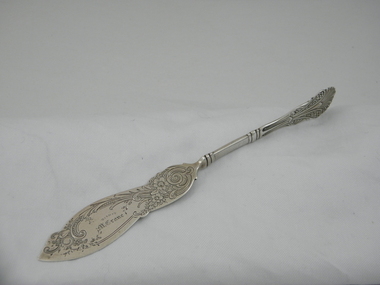
... gift and is engraved on the front with his name. Martin Crane was a progressive leader in Sandhurst and built many new schools and churches in the Diocese. The knife is significant because it belonged to the first Bishop of Sandhurst, Martin Crane. Irish born Crane was an Augustinian priest before being ordained in 1874. Crane was Bishop of Sandhurst for 27 years ...Martin Crane was the first Bishop of Sandhurst. 1874 - 1901. The knife was probably a gift and is engraved on the front with his name. Martin Crane was a progressive leader in Sandhurst and built many new schools and churches in the Diocese. The knife is significant because it belonged to the first Bishop of Sandhurst, Martin Crane. Irish born Crane was an Augustinian priest before being ordained in 1874. Crane was Bishop of Sandhurst for 27 years. Elaborately engraved sterling silver knife. Floral, leafy design. Probably a cheese or butter knife. The handle sits 90 degrees to the knife blade. This a part of a cutlery set. Bishop. M. Crane. Engraved on the front of knife. Silversmith's name/symbol engraved on the back of knife blade. Sterling. P??? engraved on the back of knife blade. knife, silverplate, cutlery, catholic clergy -
 Ruyton Girls' School
Letter, Helen Cole, 1952
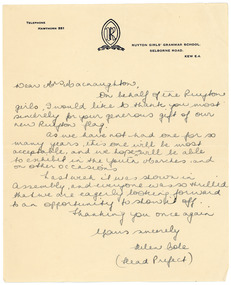
... . / Dear Mrs Macnaughton, / On behalf of the Ruyton / girls, I would like to thank you most / sincerely for your generous gift of our / new Ruyton flag. / As we have not had one for so / many years, this one will be most / acceptable, and we hope ^ we will be able / to exhibit in the youth marches and / on other occasions / Last week it was shown in / assembly, and everyone was so thrilled / that we are eagerly looking forward / to an opportunity to show it off. / Thanking you once again / Yours sincerely / Helen Cole / (Head Prefect) / Reverse: RGS008/2024/0008 /.... / Dear Mrs Macnaughton, / On behalf of the Ruyton / girls, I would like to thank you most / sincerely for your generous gift of our / new Ruyton flag. / As we have not had one for so / many years, this one will be most / acceptable, and we hope ^ we will be able / to exhibit in the youth marches and / on other occasions / Last week it was shown in / assembly, and everyone was so thrilled / that we are eagerly looking forward / to an opportunity to show it off. / Thanking you once again / Yours sincerely / Helen Cole / (Head Prefect) / Reverse: RGS008/2024/0008 / One loose sheet of cream coloured paper containing a handwritten letter, and printed with Ruyton Girls' School's name and emblem. ...The handwritten letter addresses Mrs McNaughton (also known as Kathleen "Kitty" Hepworth), thanking her for her gift to Ruyton Girls' School. The Ruytonian December 1952 also acknowledges this gift, describing Mrs McNaughton as having "presented the school with a beautiful Ruyton flag." Kathleen McNaughton was a former Ruyton student, having enrolled in 1925. The letter is signed by Helen Cole. Research indicates that the Ruyton flag was probably one used in inter and intra-school athletic competitions known as 'flag races', which were popular in the first half of the 20th century. In such races, teams ran relay-style, with their School's flag held aloft in the manner of an 18th century soldier charging into battle. Each flag was an important public symbol of school identity, and was made with care and used with pride. Though once a ubiquitous part of any school's sporting equipment, one flag races fell out of favour in the later 20th century, racing flags were usually discarded. However, it is unclear whether the flag gifted by Mrs McNaughton was indeed used for flag racing.The record has strong historic significance as it was written by a former notable student, Helen Gordon (maiden name Cole). Helen started at Little Ruyton in Prep in 1940 and finished Year 12 in 1952 as School Captain, Bromby Captain, Form Captain for Matric, Tennis Captain, Hockey Captain, Swimming Vice Captain, and an award for Best All-Round Girl. She also played baseball for Victoria. After finishing school, Helen went on to graduate from the University of Melbourne as a physiotherapist in 1956. Her first position at age 19 involved setting up clinics with the Victorian Health Department Poliomyelitis Rural division. Helen’s strong ties to Ruyton continued when she held the position of President of the Old Ruytonians’ Association from the start of 1966 to the end of 1967. In 2019, Helen received an Order of Australia Medal for service to community health as a physiotherapist. She was also the recipient of the 2022 Victorian Senior Achiever Award at Parliament House. Helen passed away in July 2023 at age 88. The record's significance is further enhanced by its strong provenance, having been produced by Ruyton Girls' School and donated to the Archives by a familial connection.One loose sheet of cream coloured paper containing a handwritten letter, and printed with Ruyton Girls' School's name and emblem.Obverse: TELEPHONE / HAWTHORN 331 / R / RUYTON GIRLS' GRAMMAR SCHOOL / RECTE ET FIDE LITER / SELBORNE ROAD. / KEW E.4. / Dear Mrs Macnaughton, / On behalf of the Ruyton / girls, I would like to thank you most / sincerely for your generous gift of our / new Ruyton flag. / As we have not had one for so / many years, this one will be most / acceptable, and we hope ^ we will be able / to exhibit in the youth marches and / on other occasions / Last week it was shown in / assembly, and everyone was so thrilled / that we are eagerly looking forward / to an opportunity to show it off. / Thanking you once again / Yours sincerely / Helen Cole / (Head Prefect) / Reverse: RGS008/2024/0008 /ruyton girls' school, students, school, ruyton, victoria, high school, senior school, day school, letter, old ruytonians association, kew -
 Bayside Gallery - Bayside City Council Art & Heritage Collection
Work on paper - ink and watercolour, Annette Meikle, Band Rotunda, 1977
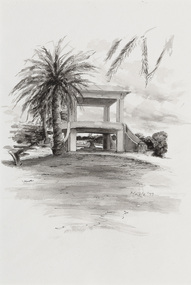
... newer architectural changes. Meikle went on to donate 22 of these sketches to Bayside City Council in 2003. Built in 1926, the Band Rotunda was a gift to the people of Sandringham by local doctor and former soldier Thomas Garnet Leary. On Sunday afternoons throughout the inter-war years...newer architectural changes. Meikle went on to donate 22 of these sketches to Bayside City Council in 2003. Built in 1926, the Band Rotunda was a gift to the people of Sandringham by local doctor and former soldier Thomas Garnet Leary. On Sunday afternoons throughout the inter-war years ...In 1977, artist Annette Meikle undertook a commission to illustrate a book recording stories of places and people in the Bayside area. It was published in 1978 as Sandringham Sketchbook, with text by Elizabeth Waters. The sketches were intended to record remaining examples of Bayside’s early architecture and environment, as well as reflect newer architectural changes. Meikle went on to donate 22 of these sketches to Bayside City Council in 2003. Built in 1926, the Band Rotunda was a gift to the people of Sandringham by local doctor and former soldier Thomas Garnet Leary. On Sunday afternoons throughout the inter-war years, brass bands such as the military uniformed 46th Battalion Brass Band and the popular Sandringham Boys Band would play. The canopied top storey comfortably held twenty five performers with enough room for their large instruments. Large crowds would picnic along the foreshore listening to the performances. The drinking fountain pictured under the rotunda has since been removed.Annette Meikle, Band Rotunda 1977, ink and watercolour, 33.8 x 23.5 cm. Bayside City Council Art and Heritage Collection. Donated by the artist, 2003annette meikle, sandringham sketchbook, elizabeth waters, band rotunda, sandringham, thomas garnet leary, foreshore -
 Brighton Historical Society
Accessory - Bag, 1960s-1970s
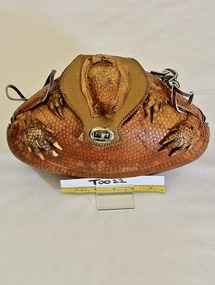
... Originally from New Zealand, Di and her family lived in Male Street, Brighton for many years. A vibrant and energetic person with a zest for life and a gift for bringing people together, Di was a friend to many in the Bayside community and active in local community organisations. ...Originally from New Zealand, Di and her family lived in Male Street, Brighton for many years. A vibrant and energetic person with a zest for life and a gift for bringing people together, Di was a friend to many in the Bayside community and active in local community organisations. ...This item is part of the Di Reidie collection. Diane Reidie was a much loved volunteer and President of Brighton Historical Society from 1999 until 2016. Originally from New Zealand, Di and her family lived in Male Street, Brighton for many years. A vibrant and energetic person with a zest for life and a gift for bringing people together, Di was a friend to many in the Bayside community and active in local community organisations. Her tireless work as President of BHS saw her named Bayside Citizen of the Year in 2008. As a seller and collector of vintage clothing, she was passionate about fashion history; one of her many enduring contributions to BHS was her extensive work in preserving, developing and promoting the Society's costume collection. In 2018-19, Di donated more than one hundred items from her personal vintage clothing collection to the Society. The collection, which includes clothing, hats, handbags and shoes from local and international designers, is representative of Di's wide-ranging interests, colourful personality, creativity, humour and love of fashion and travel. Di purchased this bag from Tyabb Packing House Antiques in Tyabb, Victoria.Oval shaped bag made from armadillo leather with head and feet attached. Leather straps may be a recent addition. Metal clasp. Mirror on inside of lid. Interior lined with blue silk.handbag, armadillo, 1960s fashion, 1970s fashion, di reidie, vintage clothing -
 Brighton Historical Society
Outfit, Mandamatilda, Evening dress and jacket, c1975
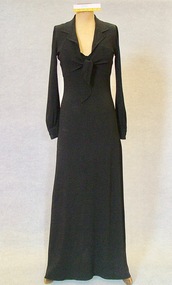
... Originally from New Zealand, Di and her family lived in Male Street, Brighton for many years. A vibrant and energetic person with a zest for life and a gift for bringing people together, Di was a friend to many in the Bayside community and active in local community organisations. ...Originally from New Zealand, Di and her family lived in Male Street, Brighton for many years. A vibrant and energetic person with a zest for life and a gift for bringing people together, Di was a friend to many in the Bayside community and active in local community organisations. ...This item is part of the Di Reidie collection. Diane Reidie was a much loved volunteer and President of Brighton Historical Society from 1999 until 2016. Originally from New Zealand, Di and her family lived in Male Street, Brighton for many years. A vibrant and energetic person with a zest for life and a gift for bringing people together, Di was a friend to many in the Bayside community and active in local community organisations. Her tireless work as President of BHS saw her named Bayside Citizen of the Year in 2008. As a seller and collector of vintage clothing, she was passionate about fashion history; one of her many enduring contributions to BHS was her extensive work in preserving, developing and promoting the Society's costume collection. In 2018-19, Di donated more than one hundred items from her personal vintage clothing collection to the Society. The collection, which includes clothing, hats, handbags and shoes from local and international designers, is representative of Di's wide-ranging interests, colourful personality, creativity, humour and love of fashion and travel. Di purchased this two piece ensemble from the influential fashion boutique "The House of Merivale and Mr John" to wear to a performance of "The Sleeping Beauty" by London Festival Ballet, featuring Rudolph Nureyev at the Palais Theatre in St Kilda in May 1975.A two piece ensemble consisting of long evening dress (.1) and matching jacket (.2), cropped jacket of black acetate. The jacket features a tie front and long buttoned sleeve. The full length dress is slim fitting with centre back zip, shoestring straps and shaped bust with ruched centre front."Mandamatilda", "Dry Clean Only, SSWdi reidie, 1970s, house of merivale, manda matilda -
 Brighton Historical Society
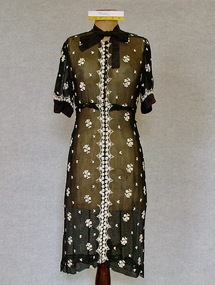
Dress, c1930s
... Originally from New Zealand, Di and her family lived in Male Street, Brighton for many years. A vibrant and energetic person with a zest for life and a gift for bringing people together, Di was a friend to many in the Bayside community and active in local community organisations. ...Originally from New Zealand, Di and her family lived in Male Street, Brighton for many years. A vibrant and energetic person with a zest for life and a gift for bringing people together, Di was a friend to many in the Bayside community and active in local community organisations. ...This item is part of the Di Reidie collection. Diane Reidie was a much loved volunteer and President of Brighton Historical Society from 1999 until 2016. Originally from New Zealand, Di and her family lived in Male Street, Brighton for many years. A vibrant and energetic person with a zest for life and a gift for bringing people together, Di was a friend to many in the Bayside community and active in local community organisations. Her tireless work as President of BHS saw her named Bayside Citizen of the Year in 2008. As a seller and collector of vintage clothing, she was passionate about fashion history; one of her many enduring contributions to BHS was her extensive work in preserving, developing and promoting the Society's costume collection. In 2018-19, Di donated more than one hundred items from her personal vintage clothing collection to the Society. The collection, which includes clothing, hats, handbags and shoes from local and international designers, is representative of Di's wide-ranging interests, colourful personality, creativity, humour and love of fashion and travel. Di purchased this 1930s dress in 1983 to wear to her sister's Registry Office wedding in William Street, Melbourne. It was the first vintage clothing item she ever purchased and was the starting point of a lifelong love of collecting, preserving and promoting historical clothing. She subsequently wore the dress to a great number of events and considered it an important piece in her wardrobe. c1930s black cotton filet net dress with white cotton embroidered flowers. The dress fastens centre front with three hook and eyes, eleven black silk covered buttons and finished with black acetate ribbon band pussy bow at the neck , is slim fitting and finishes at approximately knee length. The head of the sleeve is gathered with a small shoulder band and finishes above the elbow with a black silk band. filet net, 1930s, di reidie, vintage clothing -
 Brighton Historical Society
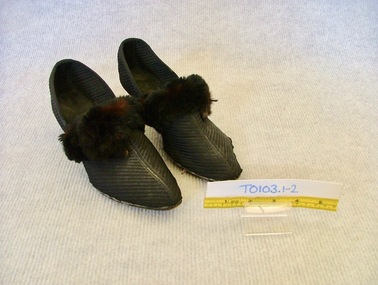
Shoes, c1890s
... Originally from New Zealand, Di and her family lived in Male Street, Brighton for many years. A vibrant and energetic person with a zest for life and a gift for bringing people together, Di was a friend to many in the Bayside community and active in local community organisations. ...Originally from New Zealand, Di and her family lived in Male Street, Brighton for many years. A vibrant and energetic person with a zest for life and a gift for bringing people together, Di was a friend to many in the Bayside community and active in local community organisations. ...This item is part of the Di Reidie collection. Diane Reidie was a much loved volunteer and President of Brighton Historical Society from 1999 until 2016. Originally from New Zealand, Di and her family lived in Male Street, Brighton for many years. A vibrant and energetic person with a zest for life and a gift for bringing people together, Di was a friend to many in the Bayside community and active in local community organisations. Her tireless work as President of BHS saw her named Bayside Citizen of the Year in 2008. As a seller and collector of vintage clothing, she was passionate about fashion history; one of her many enduring contributions to BHS was her extensive work in preserving, developing and promoting the Society's costume collection. In 2018-19, Di donated more than one hundred items from her personal vintage clothing collection to the Society. The collection, which includes clothing, hats, handbags and shoes from local and international designers, is representative of Di's wide-ranging interests, colourful personality, creativity, humour and love of fashion and travel. Di purchased these 1890s shoes around 1990 and recalled wearing them to approximately three events before she donated them to BHS in 2019. Di enjoyed the novelty and conversation they would inspire due to their unusual appearance by modern standards. The shoes are indicative of Di's playful approach to clothing and life. The decorative preserved mink pelt with head featured on the vamps of these shoes is typical of Victorian era interest in and prevalent use of preserved animals for decorative purposes in clothing, millinery and household adornment. This fashion reflected social positioning of oneself as being affluent, educated and worldly. Following the death of Queen Victoria's husband Prince Albert in 1861, the Queen's approach to mourning his death influenced social conventions for the public, with the wearing of black becoming a significant aspect of Victorian fashions. The shoes were made by Kendal Milne & Co, a large department store on Deansgate, Manchester. It has traded under various names and owners since it opened in 1832; it traded as Kendal Milne & Co from 1862-1919, and continued to be known by this name for many years after. The store is currently owned by the House of Fraser department store chain and is known as House of Fraser Manchester.Black silk linear quilted uppers of single piece construction with feature centre front vamp seam. Horsehair wadding can be seen along the side of the forefoot where the upper is coming away from the leather soles. Approx 4.5 cm plain black silk covered heel with leather top piece missing from right shoe. Both shoes feature the head of a small preserved mink with glass eyes. The toppling of the vamp features a decorative strip of mink fur. Inside of both shoes is a gold printed manufacturers label on the black silk insole.Manufacturers label - Made expressly for Kendall Milne and Co, Manchester.victoriana, mink pelt, taxidermy, 1890s, fur, di reidie, vintage clothing -
 Brighton Historical Society
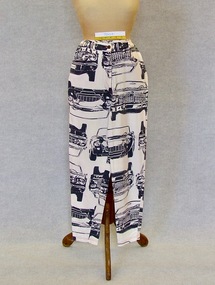
Trousers, Howard Showers, "Howard Showers" trousers, c1990s
... Originally from New Zealand, Di and her family lived in Male Street, Brighton for many years. A vibrant and energetic person with a zest for life and a gift for bringing people together, Di was a friend to many in the Bayside community and active in local community organisations. ...Originally from New Zealand, Di and her family lived in Male Street, Brighton for many years. A vibrant and energetic person with a zest for life and a gift for bringing people together, Di was a friend to many in the Bayside community and active in local community organisations. ...This item is part of the Di Reidie collection. Diane Reidie was a much loved volunteer and President of Brighton Historical Society from 1999 until 2016. Originally from New Zealand, Di and her family lived in Male Street, Brighton for many years. A vibrant and energetic person with a zest for life and a gift for bringing people together, Di was a friend to many in the Bayside community and active in local community organisations. Her tireless work as President of BHS saw her named Bayside Citizen of the Year in 2008. As a seller and collector of vintage clothing, she was passionate about fashion history; one of her many enduring contributions to BHS was her extensive work in preserving, developing and promoting the Society's costume collection. In 2018-19, Di donated more than one hundred items from her personal vintage clothing collection to the Society. The collection, which includes clothing, hats, handbags and shoes from local and international designers, is representative of Di's wide-ranging interests, colourful personality, creativity, humour and love of fashion and travel. Di wore these novelty car print "Howard Showers" pants to many car rally events in Victoria, Australia and USA between 1990 and 2010, where she would perform the role of navigator and co-driver in a team with her husband David. Di's choice of clothing at the rallies is indicative of her sense of humour and attitude towards clothing. Cream coloured cotton French terry cloth pants with metal zip fly front, branded button closure, feature red stitching and printed cars in black ink. There are several car designs featured with each design appearing c1960s - 1970s. One car design features the name "Howard" on its number plate. Manufacturers label "Howard Showers, Holiday, size 12" Metal button inscription "Howard Showers, Syd (Sydney), Aust (Australia). "Made in Australia". Care label. howard showers, novelty print clothing, 1990s, di reidie -
 Brighton Historical Society
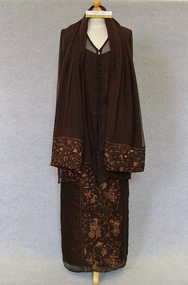
Evening outfit, Four piece outfit of blouse, camisole, skirt and wrap, c.1997
... Originally from New Zealand, Di and her family lived in Male Street, Brighton for many years. A vibrant and energetic person with a zest for life and a gift for bringing people together, Di was a friend to many in the Bayside community and active in local community organisations. ...Originally from New Zealand, Di and her family lived in Male Street, Brighton for many years. A vibrant and energetic person with a zest for life and a gift for bringing people together, Di was a friend to many in the Bayside community and active in local community organisations. ...This item is part of the Di Reidie collection. Diane Reidie was a much loved volunteer and President of Brighton Historical Society from 1999 until 2016. Originally from New Zealand, Di and her family lived in Male Street, Brighton for many years. A vibrant and energetic person with a zest for life and a gift for bringing people together, Di was a friend to many in the Bayside community and active in local community organisations. Her tireless work as President of BHS saw her named Bayside Citizen of the Year in 2008. As a seller and collector of vintage clothing, she was passionate about fashion history; one of her many enduring contributions to BHS was her extensive work in preserving, developing and promoting the Society's costume collection. In 2018-19, Di donated more than one hundred items from her personal vintage clothing collection to the Society. The collection, which includes clothing, hats, handbags and shoes from local and international designers, is representative of Di's wide-ranging interests, colourful personality, creativity, humour and love of fashion and travel. Of all the items Di donated to the Society, this four-piece Easton Pearson outfit was her favourite. When she bought it around 1997-98, it was the first time she had spent a large amount of money on clothing, and she thought it only fitting to throw a suitably elegant party at which to wear it. James Cameron's hit movie 'Titanic' had just been released, and upon discovering the recipe book 'Last Dinner On the Titanic: Menus and Recipes from the Great Liner', Di was inspired to host a Titanic-themed party for her friends. Held at her home in Brighton in 1998, the event included a string quartet, an eleven-course meal prepared entirely by Di, and a life boat in the backyard swimming pool.A four piece outfit consisting of a blouse/cardigan, camisole, skirt and wrap. Double-layered silk wrap with an outer layer of silk chiffon. Both ends feature and embroidered band of brown and black cotton, copper wire, and copper glass beads. Camisole of black and copper shot polyester rayon with wide shoulder straps and small shoulder pads. Blouse of brown silk chiffon, with a v-neck and eleven silk-covered buttons and loops at centre front. Patch pockets over front hip and full length sleeves. The neckline and sleeve edges are trimmed with copper-coloured glass beads. Full-length double-layered straight skirt with black and copper shot polyester rayon lining and silk chiffon overskirt. The skirt secures centre back with a nylon zip and botton closure. The skirt features a centre front embroidered panel of brown and black cotton leaf and flower motifs, with copper wire and copper glass beads. manufacturer's label: "Oh! Easton Pearson", "Pure Silk", "Polyester Rayon", Care label, "M"costume party, titanic, easton pearson, pamela easton, lydia pearson, australian fashion, di reidie, 1990s -
 Brighton Historical Society
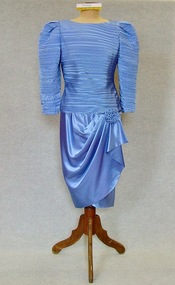
Dress, Cocktail dress, c1980s
... Originally from New Zealand, Di and her family lived in Male Street, Brighton for many years. A vibrant and energetic person with a zest for life and a gift for bringing people together, Di was a friend to many in the Bayside community and active in local community organisations. ...Originally from New Zealand, Di and her family lived in Male Street, Brighton for many years. A vibrant and energetic person with a zest for life and a gift for bringing people together, Di was a friend to many in the Bayside community and active in local community organisations. ...This item is part of the Di Reidie collection. Diane Reidie was a much loved volunteer and President of Brighton Historical Society from 1999 until 2016. Originally from New Zealand, Di and her family lived in Male Street, Brighton for many years. A vibrant and energetic person with a zest for life and a gift for bringing people together, Di was a friend to many in the Bayside community and active in local community organisations. Her tireless work as President of BHS saw her named Bayside Citizen of the Year in 2008. As a seller and collector of vintage clothing, she was passionate about fashion history; one of her many enduring contributions to BHS was her extensive work in preserving, developing and promoting the Society's costume collection. In 2018-19, Di donated more than one hundred items from her personal vintage clothing collection to the Society. The collection, which includes clothing, hats, handbags and shoes from local and international designers, is representative of Di's wide-ranging interests, colourful personality, creativity, humour and love of fashion and travel. Di purchased this 1980s cocktail dress second hand around 2000 to wear as part of a Dame Edna Everage costume to a hen's party. A blue mid calf length polyester dress with prominent gathered and padded shoulders, horizontally ruched bodice, high scoop neckline, full length sleeves and dropped waist. The skirt is of plain blue polyester mock wrap style with ruched blue spiral detail on left leg seam of bodice to skirt. The dress secures at the centre back with a nylon zip and self covered button. The sleeve is lined with mauve / pink polyesterManufacturers label "Teena Varigos" "Size 14, To Fit Bust 90cm, Waist 70cm, Hip 95cm" "Do not iron pleating" "100% Polyester, Warm Iron, Dry Clean Only"teena varigos, costume party, cocktail dress, 1980s, dame edna everage, di reidie -
 Brighton Historical Society
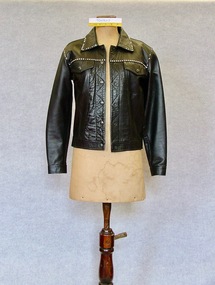
Jacket, c1990s
... Originally from New Zealand, Di and her family lived in Male Street, Brighton for many years. A vibrant and energetic person with a zest for life and a gift for bringing people together, Di was a friend to many in the Bayside community and active in local community organisations. ...Originally from New Zealand, Di and her family lived in Male Street, Brighton for many years. A vibrant and energetic person with a zest for life and a gift for bringing people together, Di was a friend to many in the Bayside community and active in local community organisations. ...This item is part of the Di Reidie collection. Diane Reidie was a much loved volunteer and President of Brighton Historical Society from 1999 until 2016. Originally from New Zealand, Di and her family lived in Male Street, Brighton for many years. A vibrant and energetic person with a zest for life and a gift for bringing people together, Di was a friend to many in the Bayside community and active in local community organisations. Her tireless work as President of BHS saw her named Bayside Citizen of the Year in 2008. As a seller and collector of vintage clothing, she was passionate about fashion history; one of her many enduring contributions to BHS was her extensive work in preserving, developing and promoting the Society's costume collection. In 2018-19, Di donated more than one hundred items from her personal vintage clothing collection to the Society. The collection, which includes clothing, hats, handbags and shoes from local and international designers, is representative of Di's wide-ranging interests, colourful personality, creativity, humour and love of fashion and travel. This jacket originally belonged to Australian singer, actress and philanthropist Olivia Newton-John, who autographed it and donated it to be auctioned at a Leather and Lace Ball for the Austin Health Olivia Newton-John Cancer Centre Appeal on 15 May 2004. Newton-John has long been an advocate for cancer research and awareness, having undergone multiple treatments for cancer, a disease Di also battled for many years. Di's husband David purchased the jacket at the auction for around $1,000, and it has since been much worn by Di and her daughter Kathryn. The nature of the jacket - which is faux-leather, with glued-on diamantés, suggests that it was likely part of a stage costume rather than an item from Olivia Newton-John's personal wardrobe.Black polyester leather look jacket with black polyester lining. The jacket features a centre front opening secured by six black press studs, two bust height flap pockets with press studs, and collar. Full length sleeves with band and black press stud closure. The jacket features diamanté decorative finish along the collar and shoulder placket. "IMMAGINE, Made in Italy" "40" "Made in Italy, Fabrique en Italie, 100% Polyiestere, Polyestere, Polyester, Polyester" Personal signature of Olivia Newton John in fine silver pen, "Love Olivia Newton John, 04".olivia newton john, stage costume, olivia newton john cancer centre, austin health, di reidie, immagine, 1990s -
 Brighton Historical Society
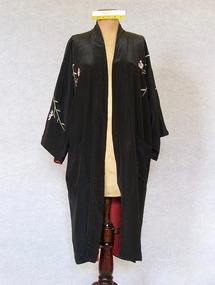
Jacket, Kimono, c.1960s
... Originally from New Zealand, Di and her family lived in Male Street, Brighton for many years. A vibrant and energetic person with a zest for life and a gift for bringing people together, Di was a friend to many in the Bayside community and active in local community organisations. ...Originally from New Zealand, Di and her family lived in Male Street, Brighton for many years. A vibrant and energetic person with a zest for life and a gift for bringing people together, Di was a friend to many in the Bayside community and active in local community organisations. ...This item is part of the Di Reidie collection. Diane Reidie was a much loved volunteer and President of Brighton Historical Society from 1999 until 2016. Originally from New Zealand, Di and her family lived in Male Street, Brighton for many years. A vibrant and energetic person with a zest for life and a gift for bringing people together, Di was a friend to many in the Bayside community and active in local community organisations. Her tireless work as President of BHS saw her named Bayside Citizen of the Year in 2008. As a seller and collector of vintage clothing, she was passionate about fashion history; one of her many enduring contributions to BHS was her extensive work in preserving, developing and promoting the Society's costume collection. In 2018-19, Di donated more than one hundred items from her personal vintage clothing collection to the Society. The collection, which includes clothing, hats, handbags and shoes from local and international designers, is representative of Di's wide-ranging interests, colourful personality, creativity, humour and love of fashion and travel. In 2006, as Di prepared for a trip to New York City, fellow BHS volunteer Liz Gay gifted her a copy of the book “Alligators, Old Mink and New Money” by vintage clothing dealer and former fashion model Alison Houtte. Between 1995 and 2015, ran the vintage and second hand clothing store Hooti Couture at 321 Flatbush Avenue, Brooklyn, and after reading the book Di was inspired to seek out the shop. During her visit she met Alison, who autographed her book, and purchased this kimono jacket from the store.Pure silk black kimono with red silk lining. The kimono features floral and leaf motif machine embroidery in pale pink and green."Made in Japan"hooti couture, alligators, old mink and new money, kimono, alison houtte, vintage clothing, di reidie, 1960s -
 Brighton Historical Society
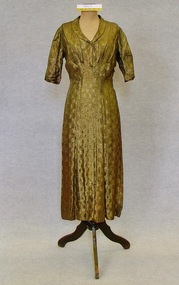
Dress, Evening dress, c.1930s
... Originally from New Zealand, Di and her family lived in Male Street, Brighton for many years. A vibrant and energetic person with a zest for life and a gift for bringing people together, Di was a friend to many in the Bayside community and active in local community organisations. ...Originally from New Zealand, Di and her family lived in Male Street, Brighton for many years. A vibrant and energetic person with a zest for life and a gift for bringing people together, Di was a friend to many in the Bayside community and active in local community organisations. ...This item is part of the Di Reidie collection. Diane Reidie was a much loved volunteer and President of Brighton Historical Society from 1999 until 2016. Originally from New Zealand, Di and her family lived in Male Street, Brighton for many years. A vibrant and energetic person with a zest for life and a gift for bringing people together, Di was a friend to many in the Bayside community and active in local community organisations. Her tireless work as President of BHS saw her named Bayside Citizen of the Year in 2008. As a seller and collector of vintage clothing, she was passionate about fashion history; one of her many enduring contributions to BHS was her extensive work in preserving, developing and promoting the Society's costume collection. In 2018-19, Di donated more than one hundred items from her personal vintage clothing collection to the Society. The collection, which includes clothing, hats, handbags and shoes from local and international designers, is representative of Di's wide-ranging interests, colourful personality, creativity, humour and love of fashion and travel. Di purchased this in 2012 at an auction of vintage clothing from the private collection of prominent Sydney fashion designer Lisa Ho, part of a wider sale of assets after Ho's business fell into deep debt. Ho began collecting vintage clothing and fabrics at the age of fifteen and her collection featured significant clothing items collected from around the world. For many years she drew on it as a source of design inspiration, particularly for print, in her highly successful fashion business. Di later wished she had purchased more at the auction!A full length slim fitting gown of gold metal thread and black thread self wave design fabric. The dress features a shawl collar, vertical pleat bodice, three panel, peaked front skirt. The dress secures with press studs at the centre front for modesty with a full left side opening secured by press studs. The sleeve features a front and back seam creating a squared shoulder head with fullness that is pleated in centre on the arm. the sleeve length is above the elbow. lisa ho, lisa ho collection, di reidie, vintage clothing, 1930s -
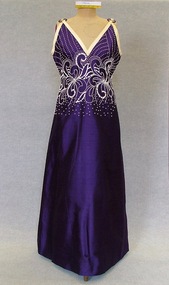 Brighton Historical Society
Dress, Evening dress, c1960s
... Originally from New Zealand, Di and her family lived in Male Street, Brighton for many years. A vibrant and energetic person with a zest for life and a gift for bringing people together, Di was a friend to many in the Bayside community and active in local community organisations. ...Originally from New Zealand, Di and her family lived in Male Street, Brighton for many years. A vibrant and energetic person with a zest for life and a gift for bringing people together, Di was a friend to many in the Bayside community and active in local community organisations. ...This item is part of the Di Reidie collection. Diane Reidie was a much loved volunteer and President of Brighton Historical Society from 1999 until 2016. Originally from New Zealand, Di and her family lived in Male Street, Brighton for many years. A vibrant and energetic person with a zest for life and a gift for bringing people together, Di was a friend to many in the Bayside community and active in local community organisations. Her tireless work as President of BHS saw her named Bayside Citizen of the Year in 2008. As a seller and collector of vintage clothing, she was passionate about fashion history; one of her many enduring contributions to BHS was her extensive work in preserving, developing and promoting the Society's costume collection. In 2018-19, Di donated more than one hundred items from her personal vintage clothing collection to the Society. The collection, which includes clothing, hats, handbags and shoes from local and international designers, is representative of Di's wide-ranging interests, colourful personality, creativity, humour and love of fashion and travel. Di was gifted this dress by a former manager of the Bayside Gallery, who herself had worn it to a fancy dress event after finding it in a local opportunity shop. Di subsequently wore it to a party with friends at the Windsor Hotel in Melbourne to celebrate and watch the televised royal wedding of Prince Harry and Meghan Markle in May 2018.Purple silk full length dress with cream neckline and arm hole band trim and white decorative beading over waist. The bodice joins front and back at the shoulder with a decorative purple ring. The lining is made of magenta coloured silk."Exclusively Yours Hartnell REGD Melbourne", "Exclusive Finest Imported Fabric"costume party, fancy dress, royal wedding, hartnell of melbourne, ralph samuel, melbourne designers, flinders lane, di reidie, 1960s -
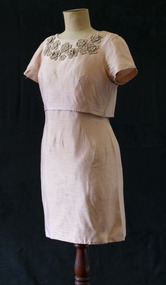 Brighton Historical Society
Dress
... Originally from New Zealand, Di and her family lived in Male Street, Brighton for many years. A vibrant and energetic person with a zest for life and a gift for bringing people together, Di was a friend to many in the Bayside community and active in local community organisations. ...Originally from New Zealand, Di and her family lived in Male Street, Brighton for many years. A vibrant and energetic person with a zest for life and a gift for bringing people together, Di was a friend to many in the Bayside community and active in local community organisations. ...This item is part of the Di Reidie collection. Diane Reidie was a much loved volunteer and President of Brighton Historical Society from 1999 until 2016. Originally from New Zealand, Di and her family lived in Male Street, Brighton for many years. A vibrant and energetic person with a zest for life and a gift for bringing people together, Di was a friend to many in the Bayside community and active in local community organisations. Her tireless work as President of BHS saw her named Bayside Citizen of the Year in 2008. As a seller and collector of vintage clothing, she was passionate about fashion history; one of her many enduring contributions to BHS was her extensive work in preserving, developing and promoting the Society's costume collection. In 2018-19, Di donated more than one hundred items from her personal vintage clothing collection to the Society. The collection, which includes clothing, hats, handbags and shoes from local and international designers, is representative of Di's wide-ranging interests, colourful personality, creativity, humour and love of fashion and travel. Di purchased this dress as a vintage item and wore it during the years 2010-18, before donating it to BHS. The Mooney sisters, Nell and Ida, were situated beside the Regent Theatre in Collins Street, Melbourne and were well respected milliners and dressmakers.Short sleeved peach silk dress (.1) featuring beige lace appliqué on neckline, along with original rectangular brown cardboard box (.2).Label: "MF 2900 / Misses Mooney / of Collins Street" Printed on lid of box: "Misses Mooney / 189 Collins Street, Melbourne"di reidie, vintage clothing, misses mooney, melbourne designers -
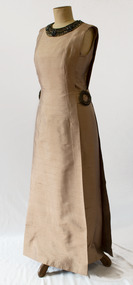 Brighton Historical Society
Dress, Evening dress, late 1950s - early 1960s
... Originally from New Zealand, Di and her family lived in Male Street, Brighton for many years. A vibrant and energetic person with a zest for life and a gift for bringing people together, Di was a friend to many in the Bayside community and active in local community organisations. ...Originally from New Zealand, Di and her family lived in Male Street, Brighton for many years. A vibrant and energetic person with a zest for life and a gift for bringing people together, Di was a friend to many in the Bayside community and active in local community organisations. ...This item is part of the Di Reidie collection. Diane Reidie was a much loved volunteer and President of Brighton Historical Society from 1999 until 2016. Originally from New Zealand, Di and her family lived in Male Street, Brighton for many years. A vibrant and energetic person with a zest for life and a gift for bringing people together, Di was a friend to many in the Bayside community and active in local community organisations. Her tireless work as President of BHS saw her named Bayside Citizen of the Year in 2008. As a seller and collector of vintage clothing, she was passionate about fashion history; one of her many enduring contributions to BHS was her extensive work in preserving, developing and promoting the Society's costume collection. In 2018-19, Di donated more than one hundred items from her personal vintage clothing collection to the Society. The collection, which includes clothing, hats, handbags and shoes from local and international designers, is representative of Di's wide-ranging interests, colourful personality, creativity, humour and love of fashion and travel. Di purchased this dress as a vintage item.Light brown floor-length silk evening dress featuring a band of black and bronze beading around neckling. Circular beaded buckles at either side of waist. Zip at back.Label, pale blue on cream "Exclusively Yours / Hartnell REGD / MELBOURNE" Label, black on pale grey: "Exclusive Finest / IMPORTED FABRIC".di reidie, vintage clothing, melbourne designers, hartnell of melbourne, ralph samuel -
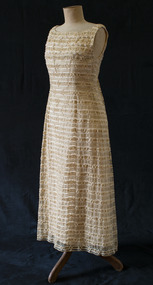 Brighton Historical Society
Dress, Evening dress, early 1960s
... Originally from New Zealand, Di and her family lived in Male Street, Brighton for many years. A vibrant and energetic person with a zest for life and a gift for bringing people together, Di was a friend to many in the Bayside community and active in local community organisations. ...Originally from New Zealand, Di and her family lived in Male Street, Brighton for many years. A vibrant and energetic person with a zest for life and a gift for bringing people together, Di was a friend to many in the Bayside community and active in local community organisations. ...This item is part of the Di Reidie collection. Diane Reidie was a much loved volunteer and President of Brighton Historical Society from 1999 until 2016. Originally from New Zealand, Di and her family lived in Male Street, Brighton for many years. A vibrant and energetic person with a zest for life and a gift for bringing people together, Di was a friend to many in the Bayside community and active in local community organisations. Her tireless work as President of BHS saw her named Bayside Citizen of the Year in 2008. As a seller and collector of vintage clothing, she was passionate about fashion history; one of her many enduring contributions to BHS was her extensive work in preserving, developing and promoting the Society's costume collection. In 2018-19, Di donated more than one hundred items from her personal vintage clothing collection to the Society. The collection, which includes clothing, hats, handbags and shoes from local and international designers, is representative of Di's wide-ranging interests, colourful personality, creativity, humour and love of fashion and travel. Di purchased this dress as a vintage item. Brian Samuel, son of Hartnell owner Ralph Samuel, viewed this dress at BHS in 2019 and suggested that it may potentially have originally belonged to his mother Shirley Samuel (nee Slonim, 1922-2006).Sleeveless gold lurex evening dress. Zip at back, partially covered by three small cream bows.Label, pale blue on cream "Exclusively Yours / Hartnell / REGD / MELBOURNE"di reidie, vintage clothing, melbourne designers, hartnell of melbourne, ralph samuel, shirley samuel
