
Showing 100 items matching "women in agriculture"
-
 Chiltern Athenaeum Trust
Photograph
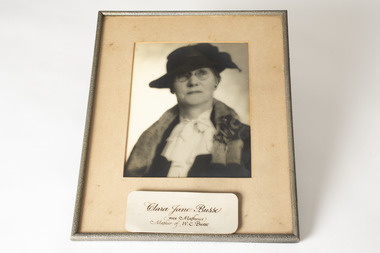
... ...Women in Agriculture...Clara Jane Busse Clara Busse C J Busse Busse Women in Agriculture Remarkable Women 20th Century Women Women's History Working Women Wilfred Busse wilfred clarence busse Obverse: Clara Jane Busse / (nee Mathews) / Mother of W. ...Clara Jane Matthews was born in 1870 as the eldest daughter of Robert Matthews. She married William Frederick Busse on the 5th of December, 1894 at St Columb’s church, Hawthorn. Clara and her husband lived on Main Street in Chiltern, and her husband was a Clerk of Courts in Chiltern and Wodonga throughout his life. Clara and William also owned a 640 acre farm called Clairedale Park, four miles (6.5km) outside of Barnawartha. They had both crops and sheep on the property, and adopted innovative farming practices. It appears that Clara was heavily involved in the farm business, as she is listed as a purchaser of sheep in multiple stock reports between 1914 and 1918. This is very unusual for the era, as women were not generally involved in stock markets, especially if her husband was still alive. Clara’s husband’s work at the court likely meant that he wasn’t able to travel to the markets in order to purchase stock. Clara’s taking the reigns in this manner was highly unusual, and signals just how strong of a woman she must have been. Clara Busse died in Chiltern in 1968, when she was 98 years old. She is also the mother of Wilfred C Busse, who was an author and a member of the Chiltern Athenaeum. This photograph is of a woman who lived most of her life in Chiltern, and undoubtedly contributed to the community of the town within her 98 years. She will most likely be remembered as the wife of William Frederic Busse, Clerk of Petty Sessions, or as the mother or Wilfred Clarence Busse, author and barrister. Although the records of her time almost entirely connect her with the men of her life, her father, husband and then her son, some digging can reveal that she was an entire person of her own, who broke norms of her time and is worthy of being remembered for her own sake.Black and white rectangular photograph printed on matte photographic paper mounted on board in a textured metallic frameObverse: Clara Jane Busse / (nee Mathews) / Mother of W. C. Busse / clara jane busse, clara busse, c j busse, busse, women in agriculture, remarkable women, 20th century women, women's history, working women, wilfred busse, wilfred clarence busse -
 University of Melbourne, Burnley Campus Archives
Letter, Ruth Beilin, Inside Out, 1998
... ...women in agriculture conference...ruth beilin senior lecturer women in agriculture conference rural women stories of rural women Floppy disk formatted in Word for Windows v2. ...ruth beilin, senior lecturer, women in agriculture conference, rural women, stories of rural women -
 Ballarat Heritage Services
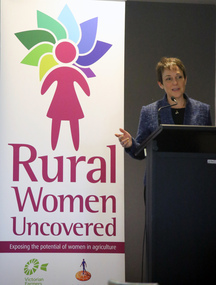
Photograph - Digital photographs, L.J. Gervasoni, Minister for Agriculture Jaala Pulford at Rural Women Uncovered 2017, September 2017
... Minister for Agriculture Jaala Pulford at Rural Women Uncovered 2017...Agriculture...Rural Women...women. Sponsors Victorian Farmers Federation, Agriculture Victoria, Rabo Bank, Chandler Agribusiness, Department of Infrastructure and Regional Development. ...What can we do to make a difference in the life of others. Agriculture Rural Women Victoria Minister for Agriculture Jaala Pulford Victorian Farmers Federation Rural Women Uncovered Rabo Bank Agriculture Victoria Chandler Agribusiness Digital images Minister for Agriculture Jaala Pulford at Rural Women Uncovered 2017 Photograph Digital photographs L.J. ...Conference to empower rural women. Sponsors Victorian Farmers Federation, Agriculture Victoria, Rabo Bank, Chandler Agribusiness, Department of Infrastructure and Regional Development. What can we do to make a difference in the life of others. Digital imagesagriculture, rural women, victoria, minister for agriculture, jaala pulford, victorian farmers federation, rural women uncovered, rabo bank, agriculture victoria, chandler agribusiness -
 Federation University Historical Collection
Book, Victoria Education Gazette and Teachers' Aid, 1900-1910, 1900-1910
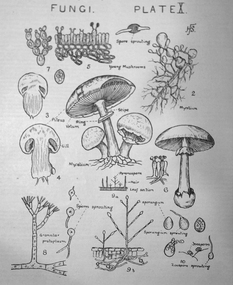
... Agricultural College, George R. Button, training college students attending the university, Sloyd teachers, Staff at the Summer School, Outside Wilson Hall, Watt's River Weir, Fungi .3) Images: Walhalla State School; Francis W. Parker (p. 18); Freearm Drawing- Sale State School (p.71) .5) Images: Map of Australia (p.33); Formalin lamps for disinfecting rooms (p. 80); Melbourne Teachers Training College (p. 167) .6) Werribee Gorge Supplement (p. 3, 4, 11, 12, 13) .7) First Exhibition of Women's Work (p. 7, 73-76) .8) Images: Franco-British Exhibition; Memorial to William H. ...Agricultural College, George R. Button, training college students attending the university, Sloyd teachers, Staff at the Summer School, Outside Wilson Hall, Watt's River Weir, Fungi .3) Images: Walhalla State School; Francis W. Parker (p. 18); Freearm Drawing- Sale State School (p.71) .5) Images: Map of Australia (p.33); Formalin lamps for disinfecting rooms (p. 80); Melbourne Teachers Training College (p. 167) .6) Werribee Gorge Supplement (p. 3, 4, 11, 12, 13) .7) First Exhibition of Women's Work (p. 7, 73-76) .8) Images: Franco-British Exhibition; Memorial to William H. ...The Federation University Historical Collection holds a full range of Victoria Education Gazette and Teachers' Aid from 1900-1968.Ten black hard covered volumes with red tape spine, covering 1900 to 1910. The gazettes include Education Department appointments, transfers, resignations and retirements, notices, queries, notices of books, examination papers, original articles, lesson plans, suggestions for lessons, drawing, obituaries, notes on nature study, mathematics, music, sloyd woodwork, English grammar, Victorian State School Swimming Clubs, Geography, penmanship, science, History, Latin, Geography; The School Garden - Shean's Creek .1) Arbour Day (pg 135) Images: Melbourne Teachers' College 1888 Building (p.8); Union Jack (p. 80); Gasometer (p. 132) .2) Plant Life lesson plans, The Antarctic in 1910, Model Nature Lesson - what plants live on , Superannuation Fund, Saluting the Flag, A.N.A. School Children's Competitions, school garden awards, Teacher Training College, Nature Study - A page from a Teacher's Diary, A Mushroom, Mrs Bush's Kindergarten Christmas Images: Dookie Agricultural College, George R. Button, training college students attending the university, Sloyd teachers, Staff at the Summer School, Outside Wilson Hall, Watt's River Weir, Fungi .3) Images: Walhalla State School; Francis W. Parker (p. 18); Freearm Drawing- Sale State School (p.71) .5) Images: Map of Australia (p.33); Formalin lamps for disinfecting rooms (p. 80); Melbourne Teachers Training College (p. 167) .6) Werribee Gorge Supplement (p. 3, 4, 11, 12, 13) .7) First Exhibition of Women's Work (p. 7, 73-76) .8) Images: Franco-British Exhibition; Memorial to William H. Nichols (p. 191) .9) Temperance Teaching; Birds native to Australia (p.4) Images: Royal Agricultural Show State Schools Exhibit (p. 5-18); Leonard's Hill School; Visit of the American Fleet .10) Funeral of Edward VII Images: Portsea Quarantine Station (p. 33-35)w.o. ryan, f. thomas, a.a. tipping, t.n. considine, w.c. fordyce, e.e. bull, h.w. byrne, j.t. flynn, r.t. smith, a.w. steane, james bagge, theo fink, frank tate, siede, nature, garden, education, school, teacher, teaching, arbor day, arbour day -
 The Beechworth Burke Museum
Audio - Oral History, Jennifer Williams, Mr Harry Mason, 13th April 2000
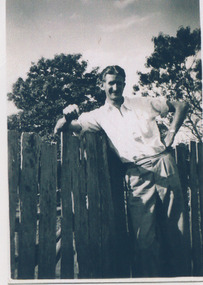
... He details important historical events and hardships in the region's history that had a lasting local, regional and national impact, including Australia during war time, economic struggles, and women's societal roles in a rural area. Mr Mason also discusses agricultural and gravedigging practices of the time as well as what it was like growing up in rural Australia. ...Mr Harry Mason was born in Stanley, Victoria, on the 23rd of July 1925, attending the primary school in Stanley and high school in Beechworth on the mail truck. His family initially moved to the area during the initial Gold Rush period. He moved to Beechworth in 1960. For seven years after school, he worked in the local orchard full time before becoming the local gravedigger, responsible for digging the graves of Beechworth residents and Asylum for 23 years. This oral history recording was part of a project conducted by Jennifer Williams in the year 2000 to capture the everyday life and struggles in Beechworth during the twentieth century. This project involved recording seventy oral histories on cassette tapes of local Beechworth residents which were then published in a book titled: Listen to what they say: voices of twentieth-century Beechworth. These cassette tapes were digitised in July 2021 with funds made available by the Friends of the Burke.Mr Harry Mason's account of his life in Beechworth and the local area during the 20th century is historically and socially significant to the cultural heritage of the region. He details important historical events and hardships in the region's history that had a lasting local, regional and national impact, including Australia during war time, economic struggles, and women's societal roles in a rural area. Mr Mason also discusses agricultural and gravedigging practices of the time as well as what it was like growing up in rural Australia. This first-hand account is imperative to our understanding of life during the last century. This oral history account is socially and historically significant as it is a part of a broader collection of interviews conducted by Jennifer Williams which were published in the book 'Listen to what they say: voices of twentieth-century Beechworth.' While the township of Beechworth is known for its history as a gold rush town, these accounts provide a unique insight into the day-to-day life of the town's residents during the 20th century, many of which will have now been lost if they had not been preserved.This is a digital copy of a recording that was originally captured on a cassette tape. The cassette tape is black with a horizontal white strip and is currently stored in a clear flat plastic rectangular container. It holds up 40 minutes of recordings on each side.Mr Harry Madon /listen to what they say, beechworth, oral history, burke museum, harry mason, stanley, orchard, jennifer williams, asylum -
 Federation University Historical Collection
Book, Victoria Education Gazette and Teachers' Aid, 1911-1919, 1910-1919
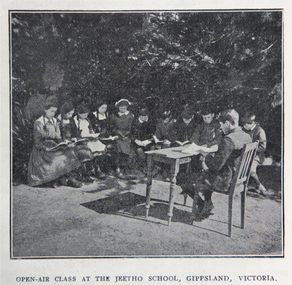
... Black hard covered book with red spine, holding Victorian Education Gazettes for one calendar year. .1) 1910 .2) 1912 .3) 1911 .4) 1914 .5) 1918 Images: Open Air Classroom Black Rock; Open Air Classroom, Jeetho, Gippsland; Open Air Nurses bedroom, Mildura; Gym at Canterbury School ; Babies and Nurses at Melbourne Foundling Hospital; Camp at Portland; Alexander Peacock Opens a Melbourne School; Unveiling Major Mitchell Memorial at Mt Arapiles; Agricultural Plot; School Interior; Swimming Drill; Graham Dux Prize Board; Bathing Place; Classroom with blackboard and pictures; Major Mitchell's Map; Melbourne, Derbyshire; Market Place Melbourne; The Blackwood; World War One Send-off at The Athenaeum; Scarsdale Old Boy's logo; Sloyd articles for the Field Hospital; World War One; Gifts for Transport to the Wharf; soldiers; ANZAC Day; ANZAC Day Medalion .5) 1915: Education Department's War Relief Fund, William Park obituary, Closer Settlement Act 1912, Agriculture, needlework, Swimming and Life Saving, explorers, Gregory Blaxland, Matthew Flinders, Composition, Geography, potatoes, onions, gardens, Needlework for Infants, Iona and Staffa, Trained Primary Teacher's Course, Electricity, Electrical Technology, hygiene, Arbour Day, Horticulture, Wattle Day, Bird Day, Technical Schools, Landing at Gaba Tepe, Evils of Alcohol, Old Boys of Scarsdale, Belgium, Teachers' College Images: The British at War, The Sonnet, History and Patriotism, Male Swimming Teachers Summer School at Geelong, Women Swimming Teachers at Port Fairy, Buln Buln State School, Burwood East State School, needlework plans, methods of Rescue and Resucitation. plan of the journey of Gregory Blaxland, Macquarie House, teachers killed (William Ross Hoggart, Stanley Robert Close, William Roy Hodgson, Campbell McDiarmid Peter, William Henry Dawkins, William Hugh Hamilton, Frederick McRae Neal, Vernon Brookes, Frank J. ...Bailey Black hard covered book with red spine, holding Victorian Education Gazettes for one calendar year. .1) 1910 .2) 1912 .3) 1911 .4) 1914 .5) 1918 Images: Open Air Classroom Black Rock; Open Air Classroom, Jeetho, Gippsland; Open Air Nurses bedroom, Mildura; Gym at Canterbury School ; Babies and Nurses at Melbourne Foundling Hospital; Camp at Portland; Alexander Peacock Opens a Melbourne School; Unveiling Major Mitchell Memorial at Mt Arapiles; Agricultural Plot; School Interior; Swimming Drill; Graham Dux Prize Board; Bathing Place; Classroom with blackboard and pictures; Major Mitchell's Map; Melbourne, Derbyshire; Market Place Melbourne; The Blackwood; World War One Send-off at The Athenaeum; Scarsdale Old Boy's logo; Sloyd articles for the Field Hospital; World War One; Gifts for Transport to the Wharf; soldiers; ANZAC Day; ANZAC Day Medalion .5) 1915: Education Department's War Relief Fund, William Park obituary, Closer Settlement Act 1912, Agriculture, needlework, Swimming and Life Saving, explorers, Gregory Blaxland, Matthew Flinders, Composition, Geography, potatoes, onions, gardens, Needlework for Infants, Iona and Staffa, Trained Primary Teacher's Course, Electricity, Electrical Technology, hygiene, Arbour Day, Horticulture, Wattle Day, Bird Day, Technical Schools, Landing at Gaba Tepe, Evils of Alcohol, Old Boys of Scarsdale, Belgium, Teachers' College Images: The British at War, The Sonnet, History and Patriotism, Male Swimming Teachers Summer School at Geelong, Women Swimming Teachers at Port Fairy, Buln Buln State School, Burwood East State School, needlework plans, methods of Rescue and Resucitation. plan of the journey of Gregory Blaxland, Macquarie House, teachers killed (William Ross Hoggart, Stanley Robert Close, William Roy Hodgson, Campbell McDiarmid Peter, William Henry Dawkins, William Hugh Hamilton, Frederick McRae Neal, Vernon Brookes, Frank J. ...Black hard covered book with red spine, holding Victorian Education Gazettes for one calendar year. .1) 1910 .2) 1912 .3) 1911 .4) 1914 .5) 1918 Images: Open Air Classroom Black Rock; Open Air Classroom, Jeetho, Gippsland; Open Air Nurses bedroom, Mildura; Gym at Canterbury School ; Babies and Nurses at Melbourne Foundling Hospital; Camp at Portland; Alexander Peacock Opens a Melbourne School; Unveiling Major Mitchell Memorial at Mt Arapiles; Agricultural Plot; School Interior; Swimming Drill; Graham Dux Prize Board; Bathing Place; Classroom with blackboard and pictures; Major Mitchell's Map; Melbourne, Derbyshire; Market Place Melbourne; The Blackwood; World War One Send-off at The Athenaeum; Scarsdale Old Boy's logo; Sloyd articles for the Field Hospital; World War One; Gifts for Transport to the Wharf; soldiers; ANZAC Day; ANZAC Day Medalion .5) 1915: Education Department's War Relief Fund, William Park obituary, Closer Settlement Act 1912, Agriculture, needlework, Swimming and Life Saving, explorers, Gregory Blaxland, Matthew Flinders, Composition, Geography, potatoes, onions, gardens, Needlework for Infants, Iona and Staffa, Trained Primary Teacher's Course, Electricity, Electrical Technology, hygiene, Arbour Day, Horticulture, Wattle Day, Bird Day, Technical Schools, Landing at Gaba Tepe, Evils of Alcohol, Old Boys of Scarsdale, Belgium, Teachers' College Images: The British at War, The Sonnet, History and Patriotism, Male Swimming Teachers Summer School at Geelong, Women Swimming Teachers at Port Fairy, Buln Buln State School, Burwood East State School, needlework plans, methods of Rescue and Resucitation. plan of the journey of Gregory Blaxland, Macquarie House, teachers killed (William Ross Hoggart, Stanley Robert Close, William Roy Hodgson, Campbell McDiarmid Peter, William Henry Dawkins, William Hugh Hamilton, Frederick McRae Neal, Vernon Brookes, Frank J. Olle, Alfred J. Collins, Ernest R. Fairlie, William J. McLaren, A.E. Smith, Thomas Patton, Francis W. Kemp, Frederick G. Hall, Rupert O. Hepburn, Woolston J. Govan), Frederick Harold Tubb VC, Botanic Gardens Red Gum, Shelter Pavillions, Head of Wheat, Australian Commonwealth Flag, Iona Cathedral, Drawing exercises, ANZAC Madallion, School Rolls of Honor .6) 1916 - Nature Study, war relief, school gardening, horticulture, singing class, geography of the war, School Rolls of Honour, Ponsonby Carew-Smyth, Astronomy, ANZAC Day, Empire Day, Arbor Day, "Some Suul of Goodness in Things Evil" by Frank Tate, War Relief Gardeners' League, ANZAC Day medallion, Solar System, Abolition of German Schools in Victoria, ANZAC Avenues, avenues of honour, Geography of the War: The West, War relief and handwork, Victorian State Schools Horticultural Society, Patrick Maloney obituary, formalin lamps, Victoria League of Victoria, Wonwondah East Roll of Honor Images - Teachers killed (John Clarke, A.C.H. Jackson, Alexander Robertson, Noel Gambetta, Ralp E. Leyland, Laurance J. Woodruff, Walter E. Cass, Percy D. Moncur, Thomas M. Carmichael, Edward G. Brain, Reginald N.F. Woods, George E. James, William Colvin, David Dobson, Stanley L. Robinson, Charles Allen, G.E. James, H.F. Curnow, Franl L. Cousins, James R. Thompson, Henry H. Campbell, George E. Read, Ernest D. Morshead, Wilfred S. Merlin, Henry R. Wright, George B. Webb, Noel Nicholas, David H. Thomas, Charles A. Levens, Thomas R. Fenner, John M. Daniell, P.J. Larkin, Ralph Smith, Philip Ormsby), school rolls of honour, Swimming Instructors at Queenscliff, The Southern Sky, Map of the North Sea and its Littorals, Easter School of Horticulture at Oakleigh, Map of the Eastern Front, Map of Mesopotamia, Map of the War Area in the Egyptian Campaign, leeches for the Melbourne Hospital .7) 1917 - Swimming and Life-Saving, Childre's FLower Day, Education Department's War Relief Fund, State War Council, Horticulture, Bird Day, Swimming, Growing Chicory at Cowes Images - Teachers killed during World War One (G.M. Nicholas, William C.W. Spencer, J.W.C. Profitt, Ivon C. Bromilow, John Colwell, Robert W. Campbell, Arthur P. Bourchier, Francid G. Houston, Claude N. Harrison, Edgar Williams, Leslie A. Stevens, Charles E. W. Chester, Stanley R. Green, Walter Baker, Arthur G. Scott, Harry L. Swinburne, Horace W. Brown, Arnold Bretherton, Edward W. Jenkins Aubrey Liddelow, Ewen A. Cameron, Edmund R. Lyall, John H. Martin, Harry Bell, Frank L. Nicholls, Melville R. Hughes, Edwin W. Hauser, Walter S. Filmer, Walter G. Barlow, Henry A. Donaldson, Edward H. Jones, Walter W. Raw, Alfred W. Dean, Wiliam Lea, Frederick G. Drury, J.T. Richards, Norman G. Pelton, Lance-Corporal Doran, Kenneth F. McKenzie, William F. Robertson, Wiliam Jarrott, Norman Graham, George G. Paul, Victor Green, Arthur William Rennie, Alfred J. Glendinning, Robert B. Liston, Eward P. Toll, George Jones, Errol E. Rodda, Christian P. Christensen, Charles F. Sydes, H.G. Clements, Norman C. Fricker, J.M. Romeo. Eric N. Lear, Thomas J. Bartley, Norval Birrell, Frederick H. Tubb. J.T. Hamilton Aram, Arthur Wilcock, William M. Conroy, Alex. H. Miller, Patrick J. Cunningham, Charles S. Mitchell, John R. Maddern, James Roadknight, Harry Arundel, Jack C. McKellar, duncan M. McKellar, George S. Manfield, Edgar C. Holmes, George A. Young, Raymond A. Gardiner, William B. Bell, William Opie, George R. Scott, Richard V.B. Vine, Herbery S. Marshall, Hugh St Omer Dentry, George B. Fullerton, Harry Oulton, Iva F. Morieson), School Honor Books, Drawing, Presentation of 30,000 pounds to the British Red Cross at Melbourne Town Hall .8) 1918 .9) 1919 - Photographs of World War One soldiers from the Education Department, Margaret Montgomery Memorial, 1918 Act relating to State School Teachers, State Scolarships, Victorian State Schools' Horticultural Society, Pneumonic Influenza, Spanish Flu, epedemic, swimming and life savinfJunior cadet training, vacancies in Fiji, School Committees, Arbor Day, Arbour Day, Henry Harding of Yinnar, Planting Trees and Shrubs, Juvenile Crime, The use of 'Get', Soldier-Teachers from Overseas in Congress London, Australia's Effort in the War, Military, Working Bees, Tree Planting, fence building, Welcoming Home a Returned Soldier, Avenue of Honour planting, Discipline, Unveiling an Honor Board, School gymnasium, school tennis court, E. E. Crogger grave at Aldershot, The School Honor Book. War Relief Fund, Commonwealth War Record, Caulfield Military Hosptial, ANZAC Day Pilgrimage, Jimmie Panikin, Donald Fraser, Arthur Mee, Card Sun Dial, Balboa Day in Honolulu, William Hamilton, Alfred Jackson, The Backward Child, Flies, Language Teaching and Learning, Spelling, The Education of the Adolescent, victorian education gazette, education gazette and teachers' aid, sloyd, william a. cavanagh, james i froebel, school, education, world war one, memorials, alfred williams, exploration and settlement, cadets, australian naval college, bernard o;dowd, birds, swimming, drawingempire league, eucalypts, paper in history, forestry, arbor day, identification of trees, forestrey museums, fiji, gravel hill school band, horticulture, hygiene, gould league of bird lovers, life saving, la perouse, bandin, j. holland, w. hamilton, charles sturt, principles of archimedes, james holland, william hamilton, scarsdale old boys' reunion, foundling home melbourne, montessori education, open air schools, james hughes, marie corelli, flinders sydney harbour, major mitchell's map, tooth brushing, r.h.s. bailey -
Federation University Historical Collection
Book - Book - Scrapbook, Ballarat School of MInes: Scrapbook of Newspaper Cuttings, Book 78, April 1997 to June 1997
... women into study...maeve mckeown co-ordinator of rwap...uni chief hits back at call for mergers...joint venture in china...newspaper important teaching tool...tertiary merger closer...early childhood studies at smb...your university - message from vice-chancellor...interview with dr ron wild...university tafe plan worries australian education union...tertiary merger hinges on smb talks...video link overcomes distance...opportunity and agriculture...The papers concerned are The Courier, Ballarat, The Australian, The Age and other region papers over the period of 4 April 1997 to 5 June 1997. teaching positions advertised pre-employment courses courses available enrolment for smb courses asian trip to lift profiles uni ans smb unit to fight outsider peter bailey champion welder trip to world titles angela mazur keeps up tradition graduates aid uni recruiting ballarat - a centre of educational excellence safer food handling uni proposal to wimmera merger would provide benefits wimmera institute of tafe horsham campus overseas campus coup malaysian tertiary campus contract ararat tafe stands to benefit from merger apprentice andrew rodgers takes top award support for arts assets drive smb expands training program uni to offer courses in indonesia trainees a credit to employers trainee of the year award academy needs help to succeed arthur senior - obituary ashes to be scattered near the heads smb new course in hygiene smb presents "ship of fools" $18m to ballarat program puts rural women into study maeve mckeown co-ordinator of rwap uni chief hits back at call for mergers joint venture in china newspaper important teaching tool tertiary merger closer early childhood studies at smb your university - message from vice-chancellor interview with dr ron wild university tafe plan worries australian education union tertiary merger hinges on smb talks video link overcomes distance opportunity and agriculture smb seeks extra time bapa launch smb will keep title in merger smb awards night Book with yellow cover, front, spiral bound. ...Collection of newspaper articles related to Ballarat School Of Mines.They cover activities and advertisements for staff. The papers concerned are The Courier, Ballarat, The Australian, The Age and other region papers over the period of 4 April 1997 to 5 June 1997. Book with yellow cover, front, spiral bound. teaching positions advertised, pre-employment courses, courses available, enrolment for smb courses, asian trip to lift profiles, uni ans smb unit to fight outsider, peter bailey champion welder, trip to world titles, angela mazur keeps up tradition, graduates aid uni recruiting, ballarat - a centre of educational excellence, safer food handling, uni proposal to wimmera, merger would provide benefits, wimmera institute of tafe, horsham campus, overseas campus coup, malaysian tertiary campus contract, ararat tafe stands to benefit from merger, apprentice andrew rodgers takes top award, support for arts assets drive, smb expands training program, uni to offer courses in indonesia, trainees a credit to employers, trainee of the year award, academy needs help to succeed, arthur senior - obituary, ashes to be scattered near the heads, smb new course in hygiene, smb presents "ship of fools", $18m to ballarat, program puts rural women into study, maeve mckeown co-ordinator of rwap, uni chief hits back at call for mergers, joint venture in china, newspaper important teaching tool, tertiary merger closer, early childhood studies at smb, your university - message from vice-chancellor, interview with dr ron wild, university tafe plan worries australian education union, tertiary merger hinges on smb talks, video link overcomes distance, opportunity and agriculture, smb seeks extra time, bapa launch, smb will keep title in merger, smb awards night -
 Glenelg Shire Council Cultural Collection
Painting, Yvonne Cohen, Banana Grower, c. 1966
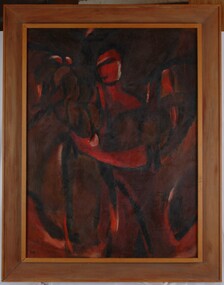
... Women...Bannana...Agriculture...CEMA Portland Artists Society Female Artists Female Women Bannana Agriculture Front: Von(lower left, etched into black paint) Back: Taped label:"Banana Grower" Yvonne Cohen Porter St Templestow $ 90.00 Glued label: Yvonne Cohen :Banana Grower"(1966) Yellow sticker: 1966 Abstract depiction of a person with a bunch of bananas completed in shades of red, brown and black. ...CEMA Art collection. Winner of 1966 Portland art Society Art Prize for category oil. Included in the 1999 "Salvage" exhibition at CEMA Arts Centre.AbstractAbstract depiction of a person with a bunch of bananas completed in shades of red, brown and black. The focus of the work is the standing human figure with brown clothing and red skin tones. The person is looking to their right at the bunch of bananas they are holding. The work has a two tiered wooden frame and exposed canvas.Front: Von(lower left, etched into black paint) Back: Taped label:"Banana Grower" Yvonne Cohen Porter St Templestow $ 90.00 Glued label: Yvonne Cohen :Banana Grower"(1966) Yellow sticker: 1966cema, portland artists society, female artists, female, women, bannana, agriculture -
 Orbost & District Historical Society
Photograph - Three photographs - Bombala; SS Whyralla; bean picking, Crown Studios ( W Stanley Vogt), c.1920s
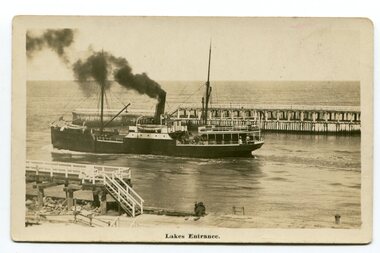
... Agriculture Bombala Lakes Entrance SS Wyrallah 2717.1 BOMBALA Crown Studios, Bairnsdale, Victoria 2717.2 on back of card: To dear David and Violet with love and best wishes from father and mother 2717.3 Lakes Entrance 3 b/w photographs/postcards 2717.1 shows the street with buildings, some two-storey on both sides of the street. A number of cars and people are in the street. 2717.2 shows a flat paddock with rows of a crop (probably beans), and 20-30 people, men, women ...These 3 photos are of locations in East Gippsland. They all appear to be c. 1920s. 2717.1 Bombala was at the terminus of a railway line in NSW, and also road routes. 2717.2 shows the intensive labour force involved with agriculture in the 1920s eg. beans. 2717.3 shows the man-made entrance to Lakes Entrance, with the Steam Ship Wyrallah sailing through. This ship was a regular coastal trader from Melbourne to Lks. Entrance. She was sunk in 1924 when run down by the SS Dilkerra at Pt Phillip Heads, with a loss of 6 lives.These photographs are significant because they show different aspects of East Gippsland locations c.1920s.3 b/w photographs/postcards 2717.1 shows the street with buildings, some two-storey on both sides of the street. A number of cars and people are in the street. 2717.2 shows a flat paddock with rows of a crop (probably beans), and 20-30 people, men, women and children. Many of them carry baskets or tins and wear hats. In the background is a fence and a shed. 2717.3 shows a steam ship travelling through two embankments made from wood. 2717.1 BOMBALA Crown Studios, Bairnsdale, Victoria 2717.2 on back of card: To dear David and Violet with love and best wishes from father and mother 2717.3 Lakes Entranceagriculture, bombala, lakes entrance, ss wyrallah -
 Orbost & District Historical Society
black and white photograph, Warren. Mrs H, first half 20th century
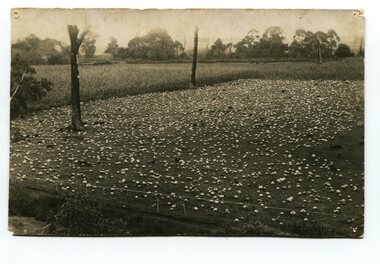
... women photographers who started out with nothing but the instructions on the packets of film and chemicals. In over fifty years practice she graduated from the total novice, who opened all her first mail order plates in bright sunlight and ruined them, to a competent photographer who became both the local press correspondent and an inveterate producer of humorous trompe l’oeil postcard images. This item is a pictorial record of farming in Orbost in the early 20th century. It is also associated with Helena Warren. a well-known photographer born in Orbost. agriculture ...Many farmers on the flats at Orbost used to grow a lot of maize and harvest the maize by putting the pigs in to eat the maize.. Maize and pumpkins fed in conjunction were largely used for fattening pigs. The photographer was Warren, Helena (1871-1962) who was a self-taught photographer who became both the local press correspondent and a producer of humorous trompe l'oeil postcard images. Helena Warren was a thirty-two year old settler living on a small mixed farm with her husband, William, at Newmerella, near Orbost in Gippsland, Victoria, when she bought her first camera, an Austral Box quarter-plate. Her family says she was entirely self-taught, like many women photographers who started out with nothing but the instructions on the packets of film and chemicals. In over fifty years practice she graduated from the total novice, who opened all her first mail order plates in bright sunlight and ruined them, to a competent photographer who became both the local press correspondent and an inveterate producer of humorous trompe l’oeil postcard images.This item is a pictorial record of farming in Orbost in the early 20th century. It is also associated with Helena Warren. a well-known photographer born in Orbost.a black / white photographagriculture farming-orbost pumpkins maize pigs warren-helena -
 Orbost & District Historical Society
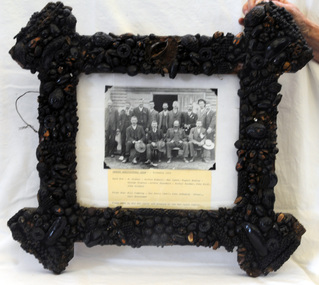
framed photograph, C 1904
... Agricultural shows are an important part of cultural life in small country towns and the Orbost Show is an integral part of Orbost 's agricultural history. It is also an example of the craft skills of women in the early 20th century. ...The first meeting to form an Agricultural society in Orbost was convened by the then Orbost Progress Association and held in the Mechanics Hall on Saturday, 10th October 1891. Its first show was held on 3rd March 1904...on a site alongside the Bonang Road where the present Golf Club stands. It is currently held at the Recreation Reserve at Newmerella. (Ref: In Times Gone By-Deborah Hall) This frame was made by Mary Lynch, wife of Matt Lynch. Pictured in the photograph are: Back: W. Fisher, Archie Rodwell, Mat Lynch, Rupert Mosley, George Granter, Arthur Saunders, Arther Pardew, John Bird, John Gilbert. Front: Bill Ginning, George Perry (secretary) John Johnston (president), Carl Dreverman.This item is associated with the Orbost Agricultural Society 's Annual Show which has been a major event in Orbost for over a century. Agricultural shows are an important part of cultural life in small country towns and the Orbost Show is an integral part of Orbost 's agricultural history. It is also an example of the craft skills of women in the early 20th century.A black / white photograph of a group of thirteen men, some standing, some sitting in front of a wooden shed. The photograph is in an ornate frame made of dried seeds.on front - "Orbost Agricultural Show Committee probably 1904"orbost-agricultural-society lynch-mary orbost-show -
 Orbost & District Historical Society
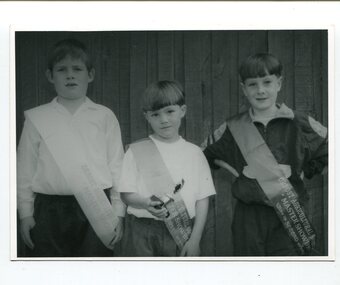
black and white photographs, second half 20th century - 1980's?
... agricultural history. On the back of each photo are the details and names. Four black / white photographs related to the Orbost Show. 3086.1 is of three young boys wearing sashes. The middle boy is holding a trophy. 3086.2 shows a woman bending over a young girl wearing a sash. 3086.3 has three girls, one one right wearing a hat, one on left has a sash. 3086.4 is of three women holding babies. ...These photographs are of winners in the Orbost Agricultural Show's Show Boy and Show Girl competitions. The first photograph is of Peter? Joiner and Jarod Forrester in the Master Show Bow Competition. The second is of Pauline Bommer (Weston) and her daughter at the Nowa Nowa Gymkhana. The third has Chloe Kenny on the left. in the fourth photograph are Dianna Munn with Laura; Sharon Chambers with Jessica and Sharon Cook with Tayla. These photographs are pictorial records of a social event in Orbost. They are associated with the Orbost Agricultural Society 's Annual Show which has been a major event in Orbost for over a century. Agricultural shows are an important part of cultural life in small country towns and the Orbost Show is an integral part of Orbost 's agricultural history. Four black / white photographs related to the Orbost Show. 3086.1 is of three young boys wearing sashes. The middle boy is holding a trophy. 3086.2 shows a woman bending over a young girl wearing a sash. 3086.3 has three girls, one one right wearing a hat, one on left has a sash. 3086.4 is of three women holding babies. All babies have sashes and the one in the middle has a trophyOn the back of each photo are the details and names. -
 Orbost & District Historical Society
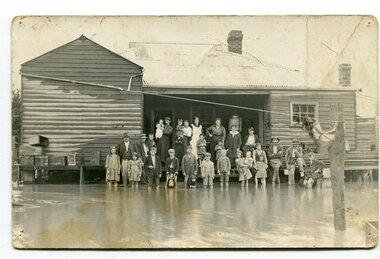
black and white photograph, poss. 1920
... These floods cover the rich agricultural land. orbost - floods - nixon - 1920 on back - "Billy Nixon's house (now Downys 1991)" A black / white photograph / postcard of a group of people standing in floodwaters outside a timber building. Included are young children and babies being held by women ...In the photograph are the Rice family, Billy Nixon' family and Charlie Johnston. William Nixon, son of James Nixon and Alice (Roberts) Nixon was married to Ilma Muriel (Cadwallader) Nixon on 2 Apr 1902 in Orbost. They had six children - Llewella Adele (Nixon) King, Sydney William Columbo Nixon, Arthur Harry Nixon, Jack Warton Nixon, Claudine Frances (Nixon) Taylor and Daphne Joyce (Nixon) Menz Damage estimated at £500,000 was caused by the 1934 floods in the Orbost district. This 1934 flood was devastating, destroying a section of the 1922 Orbost bridge, wrecking fences, bridges and roads, dumping silt and debris on the rich river flats and drowning cattle. Note: although this card has the date 1934 written onto the rear, the flood incident depicted most likely dates from 1920 (ref. Weekly Times, Saturday 6 March 1920 p 41 when this photo was printed).This item is a pictorial record of a flood in 1920 (ref. Weekly Times, Saturday 6 March 1920 p41). Snowy River flood are a feature of the Orbost area. These floods cover the rich agricultural land. A black / white photograph / postcard of a group of people standing in floodwaters outside a timber building. Included are young children and babies being held by women. Two boys are holding dogs in front of them.on back - "Billy Nixon's house (now Downys 1991)"orbost - floods - nixon - 1920 -
 Eltham District Historical Society Inc
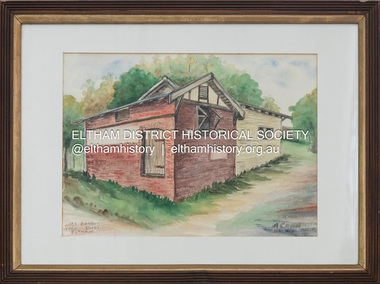
Painting, Audrey Cahn, Old Bakery, York Street, Eltham, May 1974
... Audrey got into Agricultural Science at Melbourne University and in 1928 was the second women to get such a degree. ...Audrey got into Agricultural Science at Melbourne University and in 1928 was the second women to get such a degree. ...Painted for the Shire of Eltham Historical Society by Audrey Cahn, a member of our Society for many years and Vice President till 1978. Audrey was the sister of the late Charis Palling, founding president of our Society. She had remained a member for many years although she had moved from her family home at Warrandyte to live with her daughter in New South Wales. Audrey had been blind for some years but maintained a local interest by having our Newsletter read to her. Audrey's associations with Warrandyte started because her father Professor Osbourne had bought 60 acres in 1904. " Gold mining was beginning to die out and Warrandyte was a decaying area. Land was cheap because of the lack of transport and the soil was poor for farming” Audrey said. Audrey first attended school in the city at the Church of England Girls Grammar School and was always a bit rebellious. “If I felt some restrictions were unfair or some judgement unjust, I resented it”. Audrey got into Agricultural Science at Melbourne University and in 1928 was the second women to get such a degree. Audrey married in 1926, and later divorced Leslie Cahn an architect. They had twin daughters whom she left with her parents in Warrandyte while she studied dietetics during the depression. She found employment as a microbiologist at the Kraft/Walker Milk and Cheese Factory in Drouin - she drove home at weekends to see her daughters who were then at boarding school. During the war Audrey was in charge of catering at the Heidelberg Military Hospital – again the appointment of a women caused some unrest. She was in the army for more than 4 years and achieved the rank of General which-made her the most highly-ranked-woman at the hospital. After the war she became a senior lecturer in Dietetics at Melbourne University, again being aware of the limitations her gender brought to promotion possibilities. During her time at the university, she undertook a series of studies in nutritional biochemistry. Of especial note is the analysis of common dietary foods so that the composition and calorific value, the data that was needed for inclusion in Food tables - that professional sports people and weight-watchers so avidly follow today! She was an early proponent of the need to reduce fat intake and to substitute saturated fats with polyunsaturated fatty acids. In the 1950's Audrey and fellow workers established norms for the growth of Australian children to be compared with British and American children. Over 17 years they concluded that Australian children were overweight and inactive - what is new! She bought a cottage in Warrandyte as her home. In 1968 she retired to further develop her other interests as a potter and painter. Audrey was a foundation member of the group of potters that set up Potters Cottage. Audrey died in 2008 aged 102. (Ref:Newsletter No. 185 March 2009)art, artwork, audrey cahn, eltham, old bakery, york street -
 Eltham District Historical Society Inc
Work on paper (item) - Magazine, New Idea, October 18, 1961, October 18, 1961
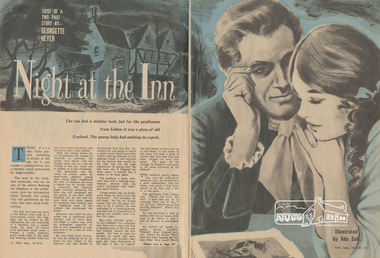
... Ada's son and daughter Susan model jumpers that were knitting competition prize winners at the Royal Agricultural Society of Victoria's Royal Show including Mrs L.M. Fullerton. (page 15) This was the "Special Baby Issue". It includes articles on women...Patterns for making a baby-sac, bonnet, jackets and babycot, advertising, letters, beauty column, patterns and other features. women's royal army corp women's royal australian navy service women's auxiliary australian air force wrans wrac wraaf marriage mary jane virtue ada zull georgette heyer royal agricultural society of victoria royal melbourne show l.m. fullerton egg dishes handcrafts baby-care magazine women 1961 susan zull susan bennett 48 pages New Idea, October 18, 1961 Work on paper Magazine ...Florence Ada Zull, known as Ada was an illustrator for the 'New Idea for Women" magazine. In 1961 she lived in Brunswick. From 1963 she and her husband Robert built a Alistair Knox designed house at Lot 8. Metery Road, Eltham "... Mum .. worked too during the week.. from the bungalow in Brunswick. The New Idea, a woman's magazine would send her the galley for the week's short story and she would illustrate an appropriate picture." - Sue Bennett (nee Zull), Eltham District Historical Society Newsletter, No 250 February 2020. In this issue Ada Zull has a full page illustration for part one of a story by Georgette Heyer. (page 12 and 13). Ada's son and daughter Susan model jumpers that were knitting competition prize winners at the Royal Agricultural Society of Victoria's Royal Show including Mrs L.M. Fullerton. (page 15) This was the "Special Baby Issue". It includes articles on women in the Armed forces and marriage, Mrs Mary Jane Virtue a pilot, Egg dish recipes and a number of pages relating to baby care. Patterns for making a baby-sac, bonnet, jackets and babycot, advertising, letters, beauty column, patterns and other features. women's royal army corp, women's royal australian navy service, women's auxiliary australian air force, wrans, wrac, wraaf, marriage, mary jane virtue, ada zull, georgette heyer, royal agricultural society of victoria, royal melbourne show, l.m. fullerton, egg dishes, handcrafts, baby-care, magazine, women, 1961, susan zull, susan bennett -
 Eltham District Historical Society Inc
Work on paper (item) - Photograph, Little Models, 1961
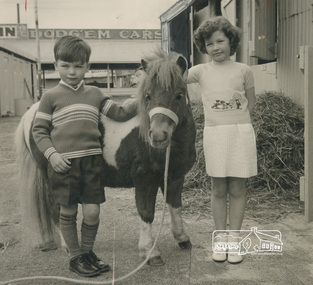
... Women" magazine. In 1961 she lived in Brunswick. From 1963 she and her husband Robert built a Alistair Knox designed house at 2 (lot 8) Metery Road, Eltham. In this issue Ada's son and daughter Susan model jumpers that were knitting competition prize winners at the Royal Agricultural Society of Victoria's Royal Show including Mrs L.M. ...Women" magazine. In 1961 she lived in Brunswick. From 1963 she and her husband Robert built a Alistair Knox designed house at 2 (lot 8) Metery Road, Eltham. In this issue Ada's son and daughter Susan model jumpers that were knitting competition prize winners at the Royal Agricultural Society of Victoria's Royal Show including Mrs L.M. ...Florence Ada Zull, known as Ada was an illustrator for the 'New Idea for Women" magazine. In 1961 she lived in Brunswick. From 1963 she and her husband Robert built a Alistair Knox designed house at 2 (lot 8) Metery Road, Eltham. In this issue Ada's son and daughter Susan model jumpers that were knitting competition prize winners at the Royal Agricultural Society of Victoria's Royal Show including Mrs L.M. Fullerton. (page 15) The opposite page features a photograph of film star Virginia Mayo and a beauty column. Original photo cut in half donated along with the issue of the magazine the photo was published in. royal agricultural society of victoria, royal melbourne show, l.m. fullerton, 1961, susan zull, susan bennett, zull family, knitting, pony, jumpers, virgninia mayo -
Glen Eira Historical Society
Book - Thomas, George
... Thomas George Thomas George Snr Thomas George Jnr Land Surveyors Land Subdivision settlements Estate of Klaterville Brighton Estate Churches Church Groups McKinnon Road Thomas Road Thomas Street Tucker Road Orrong Road Glen Eira Road St Marys Church of England Glen Eira Road Gardeners Farmers Caulfield Seymour Road Thomas George Alfred Thomas Adelaide Warrein Road North Road Thomas Percival Theodore Thomas Elsie Adelaide Thomas Arthur Gilbert Quarries Stone Quarries Agricultural Activities Methodist Church Church Groups Thomas Cecilia Hilda Thomas Stanley Charles Thomas Bertha Alice Melbourne Street Murrumbeena Murrumbeena Methodist Church Sunday Schools Sunday Schools Teacher Moonya Road Thomas Amy Ida Mary Women’s Christian Temperance Union Thomas Edith Minnie Bible Society Thomas William Henry Linacre Jane Ann Book Thomas, George ...History and biography of George Thomas senior and junior. Also gives details of the siblings, family tree of few siblings, and some plans of Thomas properties. A forty-four page book published by Eric F. Thomas in 1986thomas eric f., thomas george, thomas george snr, thomas george jnr, land surveyors, land subdivision settlements, estate of klaterville, brighton estate, churches, church groups, mckinnon road, thomas road, thomas street, tucker road, orrong road, glen eira road, st marys church of england glen eira road, gardeners, farmers, caulfield, seymour road, thomas george alfred, thomas adelaide, warrein road, north road, thomas percival theodore, thomas elsie adelaide, thomas arthur gilbert, quarries, stone quarries, agricultural activities, methodist church, church groups, thomas cecilia hilda, thomas stanley charles, thomas bertha alice, melbourne street, murrumbeena, murrumbeena methodist church, sunday schools, sunday schools teacher, moonya road, thomas amy ida mary, women’s christian temperance union, thomas edith minnie, bible society, thomas william henry, linacre jane ann -
 Kiewa Valley Historical Society
Book - Non Fiction History, Australia's Royal Welcome 1954, circa 1954
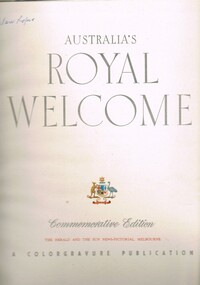
... women's organisations 2. to attend a Children's Display. She also visited Government House and visited Country Victoria on the Royal train from 24th Feb - 9th March. The Kiewa Valley and all the rural areas in the region were still very much tied to the "mother land" and trade between Britain and Australia was very strong. Trade with Asian manufacturers was minimal and needed the late 1900s to see both the trade and immigration barriers fall. This book was produced during a time when the majority of Australians looked more to England for trade and companionship. The agricultural ...This publication covers the mid 1900s and relates to a period where the majority of the Australian population was engrossed with the Queen of Australia, even though her Highness did not reside on this continent. The period covered was before the great immigration insurgence from Europe.The Labour Party's "White Australian" policy was a hinderance and a barrier towards the Asian and African prospective immigrants. The motto Queen and Country was still very ingrained in the rural population. This period in Australian domestic self reliance, brought about the growing strength and very active trade union movement and their staunch support for the Tariff protection against a growing swell of imported goods. This self reliance psyche was essentially a by product of World War II, and the isolation felt by the Australian People. The Queen (royalty) was the binding force holding the British Empire together which was emphasised with her popularity when touring Australia Queen Elizabeth's visited the MCG twice in 1954 1. to attend an assembly of ex-servicemen and women's organisations 2. to attend a Children's Display. She also visited Government House and visited Country Victoria on the Royal train from 24th Feb - 9th March.The Kiewa Valley and all the rural areas in the region were still very much tied to the "mother land" and trade between Britain and Australia was very strong. Trade with Asian manufacturers was minimal and needed the late 1900s to see both the trade and immigration barriers fall. This book was produced during a time when the majority of Australians looked more to England for trade and companionship. The agricultural trade with England and Europe was very high and the motto of the time was "Australia grows on the sheep's back". Late 1900's saw the motto "Australia grows on the miner's back" The Queen was still very popular then which was emphasised by the large crowds which greeted her on tour. Residents of Mt Beauty including Cubs, Brownies, Scouts and Guides travelled to Benalla to see the Queen. Clare Roper was a founding member of the KVHS and attended a garden party at Buckingham Palace representing the local CWA. She has purchased this book and therefore giving this a close historical significance connection, it has good provenance and interpretive capacity. This hard(blue coloured) covered book contains thirty six double sided pages. Both the first and last pages (inside cover included) has the royal crest of Australia (kangaroo and emu) balancing the individual six states crests ,united under the royal crown. The first six double pages, each portraying a coloured free hand sketches of various Australian scenery enclosing the Queen's day by day and State by State itinerary. There are 115 black and white photographs and 25 coloured photographs contained in this book.Third page has free hand penned signature "Clare Roper"1954 royal tour, queen elizabeth ii monarchy, british empire in the 1900s, god save the queen. -
 Bendigo Historical Society Inc.
Memorabilia - Victorian Gold Jubilee Glass
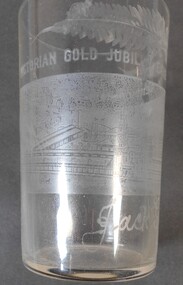
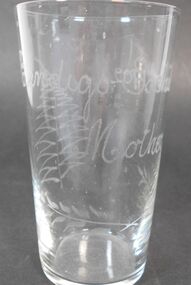
... Agricultural”, “Naval & Military Court” and “Art”. The female visitors to the Exhibition were able to view exhibits deemed suitable for the fairer sex and located within their own “Women’s Court”. ...Agricultural”, “Naval & Military Court” and “Art”. The female visitors to the Exhibition were able to view exhibits deemed suitable for the fairer sex and located within their own “Women’s Court”. ...The Victorian Gold Jubilee Exhibition, held at Bendigo from 13 November 1901 to 14 May 1902. The courts were numbered from one, or had titles like “Machinery”, “Agricultural”, “Naval & Military Court” and “Art”. The female visitors to the Exhibition were able to view exhibits deemed suitable for the fairer sex and located within their own “Women’s Court”. There were exhibits such as “Parasols & Umbrellas”, cotton and haberdashery from Manchester and Staffordshire, “Corsets & Embroideries” from Paris. The most valuable exhibits were mining machinery such as Taylor Horsfield’s £850 “Air Compressor & Rock Borer”. “Bohemian Glassware” brought down from Sydney was valued at £600. The profits from this Exhibition were used to fund the sculpture known as the Gold Monument, which still gazes along Pall Mall (from the McCrae Street end). The Exhibition’s Cash Book shows payments, which totalled £1160, were made to then up and coming sculptor C.D.Richardson. Recently a City of Greater Bendigo staff member used both these volumes to write a detailed report about this monument, for Heritage Victoria.Etched Drinking Glass to commemorate Victorian Gold Jubilee Exhibition Bendigo 1901-2 Decorated with a scene of Bendigo and fern fronds.Victorian Gold Jubilee Exhibition Bendigo 1901-2 Jack Gordonvictorian gold jubilee exhibition bendigo, 1901-2, jack gordon, bendigo -
 Bendigo Historical Society Inc.
Memorabilia - Bendigo Exhibition Glass
... Agricultural”, “Naval & Military Court” and “Art”. The female visitors to the Exhibition were able to view exhibits deemed suitable for the fairer sex and located within their own “Women’s Court”. ...Agricultural”, “Naval & Military Court” and “Art”. The female visitors to the Exhibition were able to view exhibits deemed suitable for the fairer sex and located within their own “Women’s Court”. ...The Victorian Gold Jubilee Exhibition, held at Bendigo from 13 November 1901 to 14 May 1902. The courts were numbered from one, or had titles like “Machinery”, “Agricultural”, “Naval & Military Court” and “Art”. The female visitors to the Exhibition were able to view exhibits deemed suitable for the fairer sex and located within their own “Women’s Court”. There were exhibits such as “Parasols & Umbrellas”, cotton and haberdashery from Manchester and Staffordshire, “Corsets & Embroideries” from Paris. The most valuable exhibits were mining machinery such as Taylor Horsfield’s £850 “Air Compressor & Rock Borer”. “Bohemian Glassware” brought down from Sydney was valued at £600. The profits from this Exhibition were used to fund the sculpture known as the Gold Monument, which still gazes along Pall Mall (from the McCrae Street end). The Exhibition’s Cash Book shows payments, which totalled £1160, were made to then up and coming sculptor C.D.Richardson. Recently a City of Greater Bendigo staff member used both these volumes to write a detailed report about this monument, for Heritage Victoria.Etched drinking glass. Bendigo Exhibition 1902 - Mother - Etched on front - Fern frond etched on back.Mother 1902, etched glass, bendigo exhibition 1902 -
 Bendigo Historical Society Inc.
Souvenir - Views of Bendigo, 1902
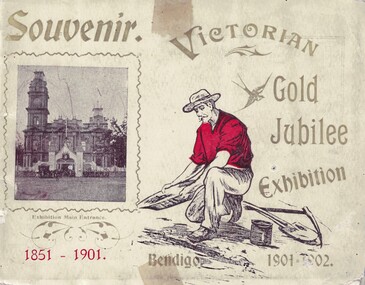
... Agricultural”, “Naval & Military Court” and “Art”. The female visitors to the Exhibition were able to view exhibits deemed suitable for the fairer sex and located within their own “Women’s Court”. ...Agricultural”, “Naval & Military Court” and “Art”. The female visitors to the Exhibition were able to view exhibits deemed suitable for the fairer sex and located within their own “Women’s Court”. ...The Victorian Gold Jubilee Exhibition, held at Bendigo from 13 November 1901 to 14 May 1902. The courts were numbered from one, or had titles like “Machinery”, “Agricultural”, “Naval & Military Court” and “Art”. The female visitors to the Exhibition were able to view exhibits deemed suitable for the fairer sex and located within their own “Women’s Court”. There were exhibits such as “Parasols & Umbrellas”, cotton and haberdashery from Manchester and Staffordshire, “Corsets & Embroideries” from Paris. The most valuable exhibits were mining machinery such as Taylor Horsfield’s £850 “Air Compressor & Rock Borer”. “Bohemian Glassware” brought down from Sydney was valued at £600. The profits from this Exhibition were used to fund the sculpture known as the Gold Monument, which still gazes along Pall Mall (from the McCrae Street end). The Exhibition’s Cash Book shows payments, which totalled £1160, were made to then up and coming sculptor C.D.Richardson. Recently a City of Greater Bendigo staff member used both these volumes to write a detailed report about this monument, for Heritage Victoria.Carol Holsworth Collection: Small book Souvenir, 29 pages plus cover; each page. has a photo of the exhibit. Exhibition was held on the site of the present Bendigo Library between Hargreaves St and Lyttleton Terrace. * 8662.1a Victorian Gold Jubilee Exhibition - Front Cover: Printed 'Souvenir', 'Bendigo 1901-1902'; a photo of the Entrance to the exhibition beside the Town Hall. * 8662.1b Victorian Gold Jubilee Exhibition - Inside Front Cover - Page 1 of 29. Portraits of Exhibition President S.H. Cowen esq.; and G.V. Allen esc., General Secretary. Photos by W.H. Robinson publisher. Printed by T. Cambridge, Market Square Bendigo. * 8662.1c Victorian Gold Jubilee Exhibition - Page 1 of 29 The Governor General at the Exhibition. Photo of the crowd, police, trooper and horse drawn vehicles. * 8662.1d Victorian Gold Jubilee Exhibition - Page 2 of 29 Procession Passing the Fountain, Pall Mall. The crowd and horse drawn vehicles. *8662.1e Victorian Gold Jubilee Exhibition - Page 3 of 29 James Martin and Co's Exhibit. James Martin & Co was an Australian engineering company which progressed from making agricultural equipment to making railway locomotives. * 8662.1f Victorian Gold Jubilee Exhibition - Page 4 of 29 Old Pioneers. Elderly gentlemen on foot and carriage - at the Bendigo Railway Station. * 8662.1g Victorian Gold Jubilee Exhibition - Page 5 of 29 Robert Harper and Company's Exhibit. From Trove - The Brisbane Courier 25 Aug 1891: One of the best known firms in the Southern hemisphere is Messrs. Robert Harper and Co , tea importers, coffee, rice, and spice merchants and manufacturers Then productions circle this continent, and every thrifty housewife is familiar with their Empire tens, their Star' brand of goods, then oatmeal, wheatmeal, and other breakfast table luxuries The headquarters of the firm are placed at Port Melbourne, and the manufactory there occupies over an acre of ground, while the mills at Sydney and Adelaide are as great in proportion It is eight cars since the firm opened business in this colony. The step was taken with much confidence, the principals the firm being quite attracted. * 8662.1h Victorian Gold Jubilee Exhibition - Page 6 of 29 The Electric Tram * 8662.1i Victorian Gold Jubilee Exhibition - Page 7 of 29 G. Weymouth Proprietary Ltd. The business of G. Weymouth & Co was founded in 1898 by George Andrew Philip Weymouth, who began operating from a small workshop on City Road, South Melbourne (opposite Princes Bridge). An early advertisement describes the firm's activities at this time as being 'makers of dynamos, (electric) motors, x-ray apparatus and electrical instruments, &c' together with 'repairs to every class of electrical work'. * 8662.1j Victorian Gold Jubilee Exhibition - Page 8 of 29 The Exhibition Fernery * 8662.1k Victorian Gold Jubilee Exhibition - Page 9 of 29 Cohn Bros'. Exhibit. In 1857 at the height of the gold rush, with people pouring into Central Victoria from all over the world, three brothers from Denmark – Moritz, Julius and Jacob Cohn – founded a small cordial factory in the booming town of Bendigo. They went on to build an empire and, through introducing lager, which is served cold, to the country, changed the drinking preferences of Australians. * 8662.1l Victorian Gold Jubilee Exhibition - Page 10 of 29 Ornamental Lake in the Exhibition Grounds * 8662.1m Victorian Gold Jubilee Exhibition - Page 11 of 29 Australian Explosives and Chemical Co.'s Exhibit. The Australian Explosives and Chemical Company began manufacturing explosives in Melbourne's outskirts (the area now known as Deer Park) in 1875. In 1897 the Company was purchased by Nobel, forming Nobel (Australasia) Ltd. * 8662.1n Victorian Gold Jubilee Exhibition - Page 12 of 29 Tasmanian Court * 8662.1o Victorian Gold Jubilee Exhibition - Page 13 of 29 N. Guthridge's Limited Exhibit. Guthridge sold a variety of mining supplies and equipment; also 'Rackarock' which was used to fill the mining drill holes before blasting. * 8662.1p Victorian Gold Jubilee Exhibition - Page 14 of 29 Navel and Military Court (LARGE File) * 8662.1q Victorian Gold Jubilee Exhibition - Page 15 of 29 Women's Court * 8662.1r Victorian Gold Jubilee Exhibition - Page 16 of 29 T. J. Connelly and Co's Exhibit. T.J. Connelly an American immigrant came to the Bendigo goldfields where he later established Connelly’s Tin Shop on the corner of High and Forest Streets 1853. Connelly was named after Thomas Jefferson the famous statesman who wrote much of the American Declaration of Independence in 1776 and became the third United States President. Connelly, along with other prominent citizens of the time established Bendigo’s first Fire Brigade, Mechanics Institute. * 8662.1s Victorian Gold Jubilee Exhibition - Page 17 of 29 The Potter's Wheel * 8662.1t Victorian Gold Jubilee Exhibition - Page 18 of 29 G. D. Guthrie and Co.'s Exhibit. In 1863 the Bendigo Pottery was set up by Guthrie. * 8662.1u Victorian Gold Jubilee Exhibition - Page 19 of 29 The Ladies' Committee * 8662.1v Victorian Gold Jubilee Exhibition - Page 20 of 29 J. Kitchen and Sons Exhibit. In Port Melbourne since the 1850s they made such products as Velvet Soap and Electrine Candles from the tallow and other animal fats from the nearby slaughter yards. In recent decades the company has become Kitchen & Lever then Unilever and most recently Unichema. * 8662.1w Victorian Gold Jubilee Exhibition - Page 21 1of 29 The Executive Committee * 8662.1x Victorian Gold Jubilee Exhibition - Page 22 of 29 Taylor Horsfield Exhibit. The most valuable exhibits were mining machinery such as Taylor Horsfield’s £850 “Air Compressor & Rock Borer” * 8662.1y Victorian Gold Jubilee Exhibition - Page 23 of 29 A Peep at the Education Department 8662.1z Victorian Gold Jubilee Exhibition - Page 24 of 29 John Danks and Co's Exhibit. John Danks & Son was a major manufacturing company in Melbourne, Victoria and Sydney, New South Wales. * 8662.1aa Victorian Gold Jubilee Exhibition - Page 25 of 29 Glance at the Agricultural Department's Court * 8662.1bb Victorian Gold Jubilee Exhibition - Page 26 of 29 T. York's Exhibit. Thomas York was an instrument repairer and brass instrument maker that resided in Melbourne in the late 19th to the early 20th century. While old newspaper advertisements suggested he repaired all instruments, it appears the focus of his business were military and brass band instruments. (BrassandWoodWind.com) * 8662.1cc Victorian Gold Jubilee Exhibition - Page 27 of 29 T. McPherson and Son's Exhibit. Possibly monumental masons. * 8662.1dd Victorian Gold Jubilee Exhibition - Page 28 of 29 T. Lewis and Whitty's Exhibit - Inside Back Cover. Lewis & Whitty were prominent boot blacking manufacturers as well as a number of other chemical products such as “Odourbane" disinfectant. * 8662.1ee Victorian Gold Jubilee Exhibition - Page 29 of 29 Singer Manufacturing Coy's Exhibithistory, bendigo, victorian gold jubilee exhibition bendigo, carol holsworth collection -
 Narre Warren and District Family History Group
Book, Narre Warren & District Family History Group Inc, Casey Cardinia Collection - Pakenham Information File - Volume 2, 2021
... The date the articles were published, and title of articles are listed below. 23 Aug 2018 Proud Publishing History - Star News Group 26 Sep 2018 The Grange - A Heritage Classic 25 Oct 2017 Decades of Service - Lyn Stephenson 25 Oct 2017 Heather’s Favourite Things - Heather Arnold 21 Sep 2016 Still Keeping the Faith - Father John Readman 19 Sep 2018 Tributes for a Local Legend - Barry Cunningham 19 Sep 2018 Death & Funeral Notices - Barry Cunningham 21 Jun 2017 In the Footsteps of Kokoda - Harold Bould Kokoda Award 14 Nov 2007 Community Remembers Mates Lost and Found 26 Apr 2017 Next Generation of Lions’ Pride Steps up in the Netball Stakes 13 Oct 2016 St Patrick’s 150th Celebrations 27 Jan 2016 Looking Back 1 Feb 2017 Plaque is a Legacy - Pakenham Secondary College 23 Aug 2017 Death & Funeral Notices - Alan Stone Aug 2017 Death & Funeral Notices - Drew Morphett Aug 2017 Death & Funeral Notices - Paul Garvey 2018 50 Years - Andrew Facey 18 Oct 2017 “Disgusting and Beastly State” - Fraser’s Hotel 13 Apr 2016 Big Festival Milestone Yakkerboo 13 Apr 2016 Community 40 Years on - Yakkerboo 13 Apr 2016 Feeling Like a Princess - Yakkerboo 15 Feb 2017 Reserve Seats of Honour - Pakenham Upper Recreation Reserve UNKNOWN Looking Back 13 Oct 2021 Rivals Face a Great Divide 13 Oct 2021 Football’s Ultimate Warrior - Lincoln Withers 25 Feb 2009 Iron Horse Does it Again - Telopia 3 Nov 2021 Brett was Born to Serve - Brett Owen 29 Jun 2016 Historic Day for Racing 14 Nov 2007 Help for Historical Collection 16 Feb 2011 Calling All Show Girls 17 Nov 2021 Bugle Sounds for Sacrifice 1 Dec 2021 A Box Full of Honour - Dot Wade 10 Sep 2009 Thomas Empire Built on Paper 15 Dec 2021 End of a Retail Era - Graham Treloar 16 Feb 2011 Might as Well Jump - Commando Skydivers 13 Apr 2010 Farewell to “Saint” - Ranald Webster 7 Dec 2009 Farewell to a Good Sport - Leslie Hilton Vagg 8 Jun 2022 Digger Attends Coronation- Larry Moon 25 May 2022 Giving Back in Tim’s DNA - Tim Ahern 7 Sep 2022 Vale Clive Fielder 28 Sep 2022 Morgan Makes History - Natalie Morgan 9 Mar 2022 Old Pakenham on Show 27 Oct 2021 Farewell to Glenmac 27 Oct 2021 One of the Four-tunate Few - Dan O’Loughlin 18 May 2022 Locals Lament for Lilypond - Henty Lily Pond 8 Jun 2022 Dutch Perspective on War - Boer War 26 Oct 2022 Marion’s Amazing Journey 15 Nov 2017 Quiet Life in a Simple Town - Neil Lucas 11 Nov 2020 A Family’s Greek Tragedy - Mann family 20 Apr 2022 Blackwood Boys in Battle - Arch & Andy Blackwood 20 Apr 2022 Off With Mum’s Blessing - Andy Blackwood 16 Aug 2023 Bonds Built Through War - Vietnam 30 Aug 2023 Awards Celebrate Achievements of Two Agriculture Icons 1 Mar 2023 Your Say - Local Women who Deserve to be Recognised 14 Nov 2018 Diggers Still Remembered More Than A Century On 24 Oct 2018 Not Short on Character - Kath Short 30 Aug 2023 Scanlons’ Racing Journey - Tom Scanlon 29 Nov 2023 35 Years of Care - Malcolm McCowan 17 Jan 2024 A Trip Down Main Street’s Memory Lane 14 Feb 2024 Verna’s Life of Dedication - Verna Thewlis 31 Oct 2012 Words Come Easy to Joan - Joan Burke 21 Dec 2005 Green is Go for Golfers - Pakenham Golf Course 13 Aug 2008 Old Wood to Polished Art - Alan Cherry 23 Feb 2011 Come Rain, Hail or Shine Mr Pakenham’s on the Job 3 Aug 2022 Tributes Flow for Community Leader Jeff - Jeff Lempriere 11 June 2008 Honour Humbles Charlie - Charlie Rossetti 31 Jan 2007 Jason Keeps it in the Family - Jason Ronald 4 July 2007 A Chapter Closes - Heather Ronald 4 July 2012 Heart of a Lion - Pakenham Football Club 4 July 2012 Marshalling Championship Troops 5 June 2019 Pat’s Brush with Fame - Pat Lalor 9 Oct 2019 A Generous, Popular Soul - Ray Paynter 9 Oct 2019 Small Town Success - Michael Cormick 21 Aug 2019 Still Country at Heart UNKNOWN Four Decades of Caring - David W Bull 19 July 2023 Plaque Marks Flynn Link 20 Dec 2023 Aunty Norma’s Century - Norma Jackson 8 Feb 2023 70 Years in Pakenham - Knaap family 24 Oct 2018 Honour a School Pioneer - Maria Frederika Hagens 6 Nov 2019 From Matron to a Media Trailblazer - Mary Gannon UNKNOWN Of Courage and Sacrifice - Wilfred Rendall 7 Nov 2018 Tracking War’s Tragedy 6 Nov 2019 A Life Tragically Cut Shot - Robert Begg 24 Oct 2018 Restore Dignity - Harry Worship...The date the articles were published, and title of articles are listed below. 23 Aug 2018 Proud Publishing History - Star News Group 26 Sep 2018 The Grange - A Heritage Classic 25 Oct 2017 Decades of Service - Lyn Stephenson 25 Oct 2017 Heather’s Favourite Things - Heather Arnold 21 Sep 2016 Still Keeping the Faith - Father John Readman 19 Sep 2018 Tributes for a Local Legend - Barry Cunningham 19 Sep 2018 Death & Funeral Notices - Barry Cunningham 21 Jun 2017 In the Footsteps of Kokoda - Harold Bould Kokoda Award 14 Nov 2007 Community Remembers Mates Lost and Found 26 Apr 2017 Next Generation of Lions’ Pride Steps up in the Netball Stakes 13 Oct 2016 St Patrick’s 150th Celebrations 27 Jan 2016 Looking Back 1 Feb 2017 Plaque is a Legacy - Pakenham Secondary College 23 Aug 2017 Death & Funeral Notices - Alan Stone Aug 2017 Death & Funeral Notices - Drew Morphett Aug 2017 Death & Funeral Notices - Paul Garvey 2018 50 Years - Andrew Facey 18 Oct 2017 “Disgusting and Beastly State” - Fraser’s Hotel 13 Apr 2016 Big Festival Milestone Yakkerboo 13 Apr 2016 Community 40 Years on - Yakkerboo 13 Apr 2016 Feeling Like a Princess - Yakkerboo 15 Feb 2017 Reserve Seats of Honour - Pakenham Upper Recreation Reserve UNKNOWN Looking Back 13 Oct 2021 Rivals Face a Great Divide 13 Oct 2021 Football’s Ultimate Warrior - Lincoln Withers 25 Feb 2009 Iron Horse Does it Again - Telopia 3 Nov 2021 Brett was Born to Serve - Brett Owen 29 Jun 2016 Historic Day for Racing 14 Nov 2007 Help for Historical Collection 16 Feb 2011 Calling All Show Girls 17 Nov 2021 Bugle Sounds for Sacrifice 1 Dec 2021 A Box Full of Honour - Dot Wade 10 Sep 2009 Thomas Empire Built on Paper 15 Dec 2021 End of a Retail Era - Graham Treloar 16 Feb 2011 Might as Well Jump - Commando Skydivers 13 Apr 2010 Farewell to “Saint” - Ranald Webster 7 Dec 2009 Farewell to a Good Sport - Leslie Hilton Vagg 8 Jun 2022 Digger Attends Coronation- Larry Moon 25 May 2022 Giving Back in Tim’s DNA - Tim Ahern 7 Sep 2022 Vale Clive Fielder 28 Sep 2022 Morgan Makes History - Natalie Morgan 9 Mar 2022 Old Pakenham on Show 27 Oct 2021 Farewell to Glenmac 27 Oct 2021 One of the Four-tunate Few - Dan O’Loughlin 18 May 2022 Locals Lament for Lilypond - Henty Lily Pond 8 Jun 2022 Dutch Perspective on War - Boer War 26 Oct 2022 Marion’s Amazing Journey 15 Nov 2017 Quiet Life in a Simple Town - Neil Lucas 11 Nov 2020 A Family’s Greek Tragedy - Mann family 20 Apr 2022 Blackwood Boys in Battle - Arch & Andy Blackwood 20 Apr 2022 Off With Mum’s Blessing - Andy Blackwood 16 Aug 2023 Bonds Built Through War - Vietnam 30 Aug 2023 Awards Celebrate Achievements of Two Agriculture Icons 1 Mar 2023 Your Say - Local Women who Deserve to be Recognised 14 Nov 2018 Diggers Still Remembered More Than A Century On 24 Oct 2018 Not Short on Character - Kath Short 30 Aug 2023 Scanlons’ Racing Journey - Tom Scanlon 29 Nov 2023 35 Years of Care - Malcolm McCowan 17 Jan 2024 A Trip Down Main Street’s Memory Lane 14 Feb 2024 Verna’s Life of Dedication - Verna Thewlis 31 Oct 2012 Words Come Easy to Joan - Joan Burke 21 Dec 2005 Green is Go for Golfers - Pakenham Golf Course 13 Aug 2008 Old Wood to Polished Art - Alan Cherry 23 Feb 2011 Come Rain, Hail or Shine Mr Pakenham’s on the Job 3 Aug 2022 Tributes Flow for Community Leader Jeff - Jeff Lempriere 11 June 2008 Honour Humbles Charlie - Charlie Rossetti 31 Jan 2007 Jason Keeps it in the Family - Jason Ronald 4 July 2007 A Chapter Closes - Heather Ronald 4 July 2012 Heart of a Lion - Pakenham Football Club 4 July 2012 Marshalling Championship Troops 5 June 2019 Pat’s Brush with Fame - Pat Lalor 9 Oct 2019 A Generous, Popular Soul - Ray Paynter 9 Oct 2019 Small Town Success - Michael Cormick 21 Aug 2019 Still Country at Heart UNKNOWN Four Decades of Caring - David W Bull 19 July 2023 Plaque Marks Flynn Link 20 Dec 2023 Aunty Norma’s Century - Norma Jackson 8 Feb 2023 70 Years in Pakenham - Knaap family 24 Oct 2018 Honour a School Pioneer - Maria Frederika Hagens 6 Nov 2019 From Matron to a Media Trailblazer - Mary Gannon UNKNOWN Of Courage and Sacrifice - Wilfred Rendall 7 Nov 2018 Tracking War’s Tragedy 6 Nov 2019 A Life Tragically Cut Shot - Robert Begg 24 Oct 2018 Restore Dignity - Harry Worship Casey Cardinia Collection - Pakenham Information File - Volume 2 Book Narre Warren & District Family History Group Inc. ...Folder containing a table of contents and various newspaper clippings and other information pertaining to the Pakenham area Volume 2. The date the articles were published, and title of articles are listed below. 23 Aug 2018 Proud Publishing History - Star News Group 26 Sep 2018 The Grange - A Heritage Classic 25 Oct 2017 Decades of Service - Lyn Stephenson 25 Oct 2017 Heather’s Favourite Things - Heather Arnold 21 Sep 2016 Still Keeping the Faith - Father John Readman 19 Sep 2018 Tributes for a Local Legend - Barry Cunningham 19 Sep 2018 Death & Funeral Notices - Barry Cunningham 21 Jun 2017 In the Footsteps of Kokoda - Harold Bould Kokoda Award 14 Nov 2007 Community Remembers Mates Lost and Found 26 Apr 2017 Next Generation of Lions’ Pride Steps up in the Netball Stakes 13 Oct 2016 St Patrick’s 150th Celebrations 27 Jan 2016 Looking Back 1 Feb 2017 Plaque is a Legacy - Pakenham Secondary College 23 Aug 2017 Death & Funeral Notices - Alan Stone Aug 2017 Death & Funeral Notices - Drew Morphett Aug 2017 Death & Funeral Notices - Paul Garvey 2018 50 Years - Andrew Facey 18 Oct 2017 “Disgusting and Beastly State” - Fraser’s Hotel 13 Apr 2016 Big Festival Milestone Yakkerboo 13 Apr 2016 Community 40 Years on - Yakkerboo 13 Apr 2016 Feeling Like a Princess - Yakkerboo 15 Feb 2017 Reserve Seats of Honour - Pakenham Upper Recreation Reserve UNKNOWN Looking Back 13 Oct 2021 Rivals Face a Great Divide 13 Oct 2021 Football’s Ultimate Warrior - Lincoln Withers 25 Feb 2009 Iron Horse Does it Again - Telopia 3 Nov 2021 Brett was Born to Serve - Brett Owen 29 Jun 2016 Historic Day for Racing 14 Nov 2007 Help for Historical Collection 16 Feb 2011 Calling All Show Girls 17 Nov 2021 Bugle Sounds for Sacrifice 1 Dec 2021 A Box Full of Honour - Dot Wade 10 Sep 2009 Thomas Empire Built on Paper 15 Dec 2021 End of a Retail Era - Graham Treloar 16 Feb 2011 Might as Well Jump - Commando Skydivers 13 Apr 2010 Farewell to “Saint” - Ranald Webster 7 Dec 2009 Farewell to a Good Sport - Leslie Hilton Vagg 8 Jun 2022 Digger Attends Coronation- Larry Moon 25 May 2022 Giving Back in Tim’s DNA - Tim Ahern 7 Sep 2022 Vale Clive Fielder 28 Sep 2022 Morgan Makes History - Natalie Morgan 9 Mar 2022 Old Pakenham on Show 27 Oct 2021 Farewell to Glenmac 27 Oct 2021 One of the Four-tunate Few - Dan O’Loughlin 18 May 2022 Locals Lament for Lilypond - Henty Lily Pond 8 Jun 2022 Dutch Perspective on War - Boer War 26 Oct 2022 Marion’s Amazing Journey 15 Nov 2017 Quiet Life in a Simple Town - Neil Lucas 11 Nov 2020 A Family’s Greek Tragedy - Mann family 20 Apr 2022 Blackwood Boys in Battle - Arch & Andy Blackwood 20 Apr 2022 Off With Mum’s Blessing - Andy Blackwood 16 Aug 2023 Bonds Built Through War - Vietnam 30 Aug 2023 Awards Celebrate Achievements of Two Agriculture Icons 1 Mar 2023 Your Say - Local Women who Deserve to be Recognised 14 Nov 2018 Diggers Still Remembered More Than A Century On 24 Oct 2018 Not Short on Character - Kath Short 30 Aug 2023 Scanlons’ Racing Journey - Tom Scanlon 29 Nov 2023 35 Years of Care - Malcolm McCowan 17 Jan 2024 A Trip Down Main Street’s Memory Lane 14 Feb 2024 Verna’s Life of Dedication - Verna Thewlis 31 Oct 2012 Words Come Easy to Joan - Joan Burke 21 Dec 2005 Green is Go for Golfers - Pakenham Golf Course 13 Aug 2008 Old Wood to Polished Art - Alan Cherry 23 Feb 2011 Come Rain, Hail or Shine Mr Pakenham’s on the Job 3 Aug 2022 Tributes Flow for Community Leader Jeff - Jeff Lempriere 11 June 2008 Honour Humbles Charlie - Charlie Rossetti 31 Jan 2007 Jason Keeps it in the Family - Jason Ronald 4 July 2007 A Chapter Closes - Heather Ronald 4 July 2012 Heart of a Lion - Pakenham Football Club 4 July 2012 Marshalling Championship Troops 5 June 2019 Pat’s Brush with Fame - Pat Lalor 9 Oct 2019 A Generous, Popular Soul - Ray Paynter 9 Oct 2019 Small Town Success - Michael Cormick 21 Aug 2019 Still Country at Heart UNKNOWN Four Decades of Caring - David W Bull 19 July 2023 Plaque Marks Flynn Link 20 Dec 2023 Aunty Norma’s Century - Norma Jackson 8 Feb 2023 70 Years in Pakenham - Knaap family 24 Oct 2018 Honour a School Pioneer - Maria Frederika Hagens 6 Nov 2019 From Matron to a Media Trailblazer - Mary Gannon UNKNOWN Of Courage and Sacrifice - Wilfred Rendall 7 Nov 2018 Tracking War’s Tragedy 6 Nov 2019 A Life Tragically Cut Shot - Robert Begg 24 Oct 2018 Restore Dignity - Harry Worshipnon-fictionpakenham (vic.) -
 Ithacan Historical Society
Photograph, Harvest time - Ithaca, 1951
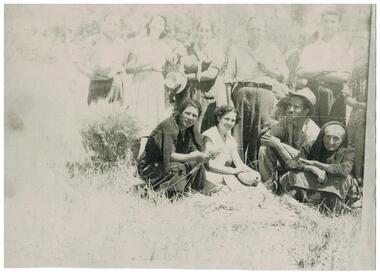
... As in most developed countries, such subsistence farming activities have virtually disappeared on Ithaca. farming agriculture Stamped on the back in black: ITHACAN HISTORICAL SOCIETY INCORPORATED. A faded black and white photograph of a family group of eleven people taken in a grain field. Two women ...The photograph was taken in 1951 in the village of Platrithia, Ithaca during the grain harvest, possibly in August.A faded black and white photograph of a family group of eleven people taken in a grain field. Two women and three men are standing and one of the women is holding a child. While three women and a man are sitting in front. A bundle of wheat is on the ground next to one of the women in the front. Stamped on the back in black: ITHACAN HISTORICAL SOCIETY INCORPORATED.farming, agriculture -
 National Wool Museum
Photograph, Woolwork
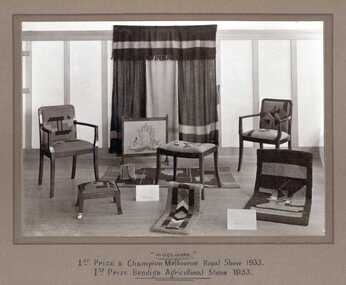
... Photo depicts a show entry of woolwork which won first prize and show champion at the Royal Melbourne Show in 1933 and the first prize at the Bendigo Agricultural Show in 1933. According to the donor, the entry was undertaken by the Women's Section of the Country Party to promote the use of wool in furnishings. ... shows Country Party - women's section Handicrafts Agricultural shows "WOOLWORK" / 1st Prize & Champion Melbourne Royal Show 1933. / 1st Prize Bendigo Agricultural Show 1933. ...Photo depicts a show entry of woolwork which won first prize and show champion at the Royal Melbourne Show in 1933 and the first prize at the Bendigo Agricultural Show in 1933. According to the donor, the entry was undertaken by the Women's Section of the Country Party to promote the use of wool in furnishings. There are two certificates in the photo, on which the word "Tarnagulla" can be seen. The women who made the items may have been from this town. The items are interesting for the use of modernist, Art Deco style designs.Photograph depicting a show entry of woolwork which won first prize and show champion at the Royal Melbourne Show in 1933 and the first prize at the Bendigo Agricultural Show in 1933."WOOLWORK" / 1st Prize & Champion Melbourne Royal Show 1933. / 1st Prize Bendigo Agricultural Show 1933.handicrafts agricultural shows, country party - women's section, handicrafts, agricultural shows -
 Sunshine and District Historical Society Incorporated
Archive - Sunshine Beautification Group
... Flyer and Badge from What Can I do to Help Clean up the future|Flyer Clean Up Day Warning You must Register|Folder for Clean up Australia|1st Sunshine Beautification Group Garden Competition Pennant|Minutes of Sunshine Beautification Group 6th February 1986 at Sunshine Municipal Offices Alexandra Avenue Sunshine|Newspaper Article Star Weekly 11 January 2005 Brimbank is filthy dirty pigsty claim|Newspaper Article Brimbank Messenger 21 March 2000 Clean up not just single day|Newspaper Article Herald Sun 13 October 1994 Scribble scrapped|Newspaper Article 21 December 2004 Council rubbished for removing litter bins|Typed Letter 25 April 1991 Clean up Australia Day|Typed Letter 31 March 1981 The Sunshine Advocate Pruning of street trees|Typed Letter 21 June 1983 Sunshine International Womens Year Action Committee beautify the Ballarat Road Land|Typed Letter 6 June 1986 Conduct a Tidy Street|Typed Minutes Sunshine Beautification Group 5 June 1986|Typed Minutes Sunshine Beautification Group 7 August 1986|Typed Letter from 9 July 1986 RJ Cantrill Plant Advisory Officer Department of Agriculture Parasitic Wasp|Typed Letter 21 October 1987 to Mr Bill Fogarty Harzardous Materials Storage and Transport Strategies for Local Government in Melbourne's Western Region|Typed Letter 4 May 1988 Mr John James Town Clerk Saving Trees|Typed Minutes Sunshine Beautification Group 12 May 1988|Typed Minutes Sunshine Beautification Group 2 June 1988|Notices of Motion 14 June 1988 Litter|Typed Letter from IC Patience Deputy Town Clerk 13 June 1988 Nomination suggestion for Mrs Beth Argle for the 1988 Women's Award|Typed Letter 23 June 1988 Mr B Griffin Chief Health Surveyor New Litter Act|Typed Letter 23 June 1988 Mr J James The Town Clerk request for $500|Typed Minutes Sunshine Beautification Group 7 July 1988|Typed Minutes Sunshine Beautification Group 3 November 1988|Typed Report Metropolitan Area Improvement Programs General Information on funding conditions March 1991|Typed Minutes Sunshine Beautification Group 4 April 1991|Typed Letter to Gwen about Tidy Street Competition and Keep Australia Beautiful|Flyer Sunshine Beautification Group Keep Australia Beautiful program March 1993|Typed Minutes Sunshine Beautification Group 1 September 1994|Typed Minutes Sunshine Beautification Group 6 October 1994|Typed Minutes Sunshine Beautification Group 3 November 1994|Handwritten Minutes Sunshine Beautification Group 3 October 1996|Typed Minutes Sunshine Beautification Group 5 November 1998|Typed Minutes Sunshine Beautification Group 4 February 1999|Typed Minutes Sunshine Beautification Group 5 April 2001|Typed Minutes Sunshine Beautification Group 5 June 2003|Typed Minutes Sunshine Beautification Group 3rd February 2005|Letter to Sheryl Ashley 30 December 2004 Removal of Rubbish Bins at Bus Stops and Public places|Handwritten Letter to Gwen Goedecke 1 February 1999|Newsletter December 1998 Tootgarook Wetlands|Sash for 1st prize in Sunshine Beutification Group Garden Competition...Sunshine Beautification Group Flyer and Badge from What Can I do to Help Clean up the future|Flyer Clean Up Day Warning You must Register|Folder for Clean up Australia|1st Sunshine Beautification Group Garden Competition Pennant|Minutes of Sunshine Beautification Group 6th February 1986 at Sunshine Municipal Offices Alexandra Avenue Sunshine|Newspaper Article Star Weekly 11 January 2005 Brimbank is filthy dirty pigsty claim|Newspaper Article Brimbank Messenger 21 March 2000 Clean up not just single day|Newspaper Article Herald Sun 13 October 1994 Scribble scrapped|Newspaper Article 21 December 2004 Council rubbished for removing litter bins|Typed Letter 25 April 1991 Clean up Australia Day|Typed Letter 31 March 1981 The Sunshine Advocate Pruning of street trees|Typed Letter 21 June 1983 Sunshine International Womens Year Action Committee beautify the Ballarat Road Land|Typed Letter 6 June 1986 Conduct a Tidy Street|Typed Minutes Sunshine Beautification Group 5 June 1986|Typed Minutes Sunshine Beautification Group 7 August 1986|Typed Letter from 9 July 1986 RJ Cantrill Plant Advisory Officer Department of Agriculture Parasitic Wasp|Typed Letter 21 October 1987 to Mr Bill Fogarty Harzardous Materials Storage and Transport Strategies for Local Government in Melbourne's Western Region|Typed Letter 4 May 1988 Mr John James Town Clerk Saving Trees|Typed Minutes Sunshine Beautification Group 12 May 1988|Typed Minutes Sunshine Beautification Group 2 June 1988|Notices of Motion 14 June 1988 Litter|Typed Letter from IC Patience Deputy Town Clerk 13 June 1988 Nomination suggestion for Mrs Beth Argle for the 1988 Women's Award|Typed Letter 23 June 1988 Mr B Griffin Chief Health Surveyor New Litter Act|Typed Letter 23 June 1988 Mr J James The Town Clerk request for $500|Typed Minutes Sunshine Beautification Group 7 July 1988|Typed Minutes Sunshine Beautification Group 3 November 1988|Typed Report Metropolitan Area Improvement Programs General Information on funding conditions March 1991|Typed Minutes Sunshine Beautification Group 4 April 1991|Typed Letter to Gwen about Tidy Street Competition and Keep Australia Beautiful|Flyer Sunshine Beautification Group Keep Australia Beautiful program March 1993|Typed Minutes Sunshine Beautification Group 1 September 1994|Typed Minutes Sunshine Beautification Group 6 October 1994|Typed Minutes Sunshine Beautification Group 3 November 1994|Handwritten Minutes Sunshine Beautification Group 3 October 1996|Typed Minutes Sunshine Beautification Group 5 November 1998|Typed Minutes Sunshine Beautification Group 4 February 1999|Typed Minutes Sunshine Beautification Group 5 April 2001|Typed Minutes Sunshine Beautification Group 5 June 2003|Typed Minutes Sunshine Beautification Group 3rd February 2005|Letter to Sheryl Ashley 30 December 2004 Removal of Rubbish Bins at Bus Stops and Public places|Handwritten Letter to Gwen Goedecke 1 February 1999|Newsletter December 1998 Tootgarook Wetlands|Sash for 1st prize in Sunshine Beutification Group Garden Competition Sunshine Beautification Group Archive Sunshine Beautification Group ...Came from the Gwen Goedecke|The pennant was donated to the society when the Municipal Offices in Alexandra Ave was being cleaned out.Flyer and Badge from What Can I do to Help Clean up the future|Flyer Clean Up Day Warning You must Register|Folder for Clean up Australia|1st Sunshine Beautification Group Garden Competition Pennant|Minutes of Sunshine Beautification Group 6th February 1986 at Sunshine Municipal Offices Alexandra Avenue Sunshine|Newspaper Article Star Weekly 11 January 2005 Brimbank is filthy dirty pigsty claim|Newspaper Article Brimbank Messenger 21 March 2000 Clean up not just single day|Newspaper Article Herald Sun 13 October 1994 Scribble scrapped|Newspaper Article 21 December 2004 Council rubbished for removing litter bins|Typed Letter 25 April 1991 Clean up Australia Day|Typed Letter 31 March 1981 The Sunshine Advocate Pruning of street trees|Typed Letter 21 June 1983 Sunshine International Womens Year Action Committee beautify the Ballarat Road Land|Typed Letter 6 June 1986 Conduct a Tidy Street|Typed Minutes Sunshine Beautification Group 5 June 1986|Typed Minutes Sunshine Beautification Group 7 August 1986|Typed Letter from 9 July 1986 RJ Cantrill Plant Advisory Officer Department of Agriculture Parasitic Wasp|Typed Letter 21 October 1987 to Mr Bill Fogarty Harzardous Materials Storage and Transport Strategies for Local Government in Melbourne's Western Region|Typed Letter 4 May 1988 Mr John James Town Clerk Saving Trees|Typed Minutes Sunshine Beautification Group 12 May 1988|Typed Minutes Sunshine Beautification Group 2 June 1988|Notices of Motion 14 June 1988 Litter|Typed Letter from IC Patience Deputy Town Clerk 13 June 1988 Nomination suggestion for Mrs Beth Argle for the 1988 Women's Award|Typed Letter 23 June 1988 Mr B Griffin Chief Health Surveyor New Litter Act|Typed Letter 23 June 1988 Mr J James The Town Clerk request for $500|Typed Minutes Sunshine Beautification Group 7 July 1988|Typed Minutes Sunshine Beautification Group 3 November 1988|Typed Report Metropolitan Area Improvement Programs General Information on funding conditions March 1991|Typed Minutes Sunshine Beautification Group 4 April 1991|Typed Letter to Gwen about Tidy Street Competition and Keep Australia Beautiful|Flyer Sunshine Beautification Group Keep Australia Beautiful program March 1993|Typed Minutes Sunshine Beautification Group 1 September 1994|Typed Minutes Sunshine Beautification Group 6 October 1994|Typed Minutes Sunshine Beautification Group 3 November 1994|Handwritten Minutes Sunshine Beautification Group 3 October 1996|Typed Minutes Sunshine Beautification Group 5 November 1998|Typed Minutes Sunshine Beautification Group 4 February 1999|Typed Minutes Sunshine Beautification Group 5 April 2001|Typed Minutes Sunshine Beautification Group 5 June 2003|Typed Minutes Sunshine Beautification Group 3rd February 2005|Letter to Sheryl Ashley 30 December 2004 Removal of Rubbish Bins at Bus Stops and Public places|Handwritten Letter to Gwen Goedecke 1 February 1999|Newsletter December 1998 Tootgarook Wetlands|Sash for 1st prize in Sunshine Beutification Group Garden Competitionsunshine beautification group -
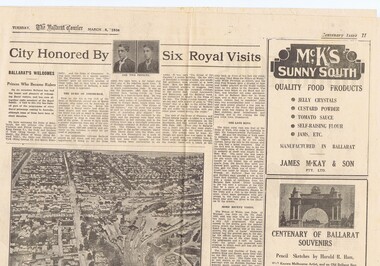 Ballarat Tramway Museum
Newspaper, The Courier Ballarat, City Honored by six Royal Visits, Mar. 1938
... women's store. Page 19 - articles - Ballarat Lighting and Power, ESCo, SEC, electric trams. photos of the Arch of Victory, first electric tram, Lake Wendouree. Advertisements for Austin Spears (cycles), McDougall and Chisholm (drapers), W.E. Longhurst (bread) and the ES&A bank. Also article on South St. Society - music and elocution. Page 20 - articles - Ballarat Gas Co., horse and electric trams, agriculture...women's store. Page 19 - articles - Ballarat Lighting and Power, ESCo, SEC, electric trams. photos of the Arch of Victory, first electric tram, Lake Wendouree. Advertisements for Austin Spears (cycles), McDougall and Chisholm (drapers), W.E. Longhurst (bread) and the ES&A bank. Also article on South St. Society - music and elocution. Page 20 - articles - Ballarat Gas Co., horse and electric trams, agriculture ...Yields information about Ballarat and its locations or environs late 1938.Pages 11,12, 19 and 20 of the centenary of settlement in the Ballarat district by the Ballarat Courier - March 1938. See also items 186, 198 and 199. Page 11 Royal visits, banking in Ballarat, photos - NW section of Ballarat, railway station in foreground. Ads for J.McKay and Son, Roy Reeds (Men's store) and Ballarat Gas Co. Also photo of "The Corner" in Sturt St. - old Mining Exchange. Page 12 - full page ad for Morseheads, women's store. Page 19 - articles - Ballarat Lighting and Power, ESCo, SEC, electric trams. photos of the Arch of Victory, first electric tram, Lake Wendouree. Advertisements for Austin Spears (cycles), McDougall and Chisholm (drapers), W.E. Longhurst (bread) and the ES&A bank. Also article on South St. Society - music and elocution. Page 20 - articles - Ballarat Gas Co., horse and electric trams, agriculture in district and Ballarat's war record (WWI). Photos of work at Gong Gong Reservoir and Committeemen of the Ballarat Horticultural Society - 1859 to 1885. Ads for Ballarat College, Clarendon, Queens (girls) and Ballarat Grammar schools, Ern Craig Motors (Vauxhall) and Snows men's wear. Record reviewed and images of pages added 7-9-2013 and 10-9-2013trams, tramways, ballarat electricity, centenary, banking, transport, trams, esco -
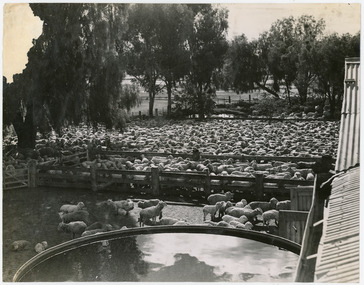 National Wool Museum
Photograph - Sheep in Shearing Shed Yards, 1960s
... Women...Boonoke Station...Farming...Sheep Farming...Agriculture...Wool Industry Working Life Women Boonoke Station Farming Sheep Farming Agriculture Sheep Stations Transport Wool Processing Shearing Textile Industry Wool W43 / AUSTRALIAN NATIONAL [?] ...One of fifty one photographs originally in a photo album found in the National Wool Museum’s office. The album was water damaged and the images were removed for conservation. The images follow the process of wool. Beginning in a sheep paddock and finishing as a folded fabric. It includes all the steps in between in this process, including shearing, transporting, selling, washing and the many different steps in the process of turning a single thread of wool into fabric.Black and white image showing sheep in stockyards with water tank in foreground.W43 / AUSTRALIAN NATIONAL [?] / ASSOCIATION / FLINDERS STREET [?] / MELBOURNE / Ya[?] Shearing shed / [?]nooke Stationwool industry, working life, women, boonoke station, farming, sheep farming, agriculture, sheep stations, transport, wool processing, shearing, textile industry, wool -
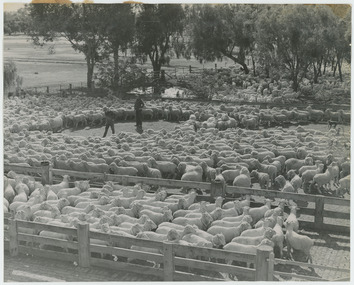 National Wool Museum
Photograph - Sheep in Shearing Shed Yards, 1960s
... Women...Boonoke Station...Farming...Sheep Farming...Agriculture...Wool Industry Working Life Women Boonoke Station Farming Sheep Farming Agriculture Sheep Stations Transport Wool Processing Shearing Textile Industry Wool W61 / W 61. ...One of fifty one photographs originally in a photo album found in the National Wool Museum’s office. The album was water damaged and the images were removed for conservation. The images follow the process of wool. Beginning in a sheep paddock and finishing as a folded fabric. It includes all the steps in between in this process, including shearing, transporting, selling, washing and the many different steps in the process of turning a single thread of wool into fabric.Black and white image showing sheep in stockyards with two men standing amongst the sheep.W61 / W 61. Yarding at shearing shed.wool industry, working life, women, boonoke station, farming, sheep farming, agriculture, sheep stations, transport, wool processing, shearing, textile industry, wool -
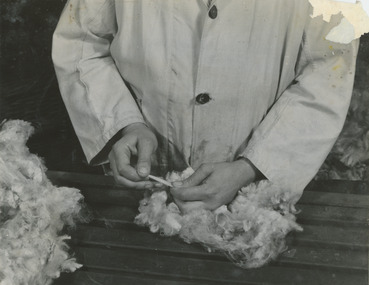 National Wool Museum
Photograph - Testing Staple for Strength, 1960s
... Women...Boonoke Station...Farming...Sheep Farming...Agriculture...Wool Industry Working Life Women Boonoke Station Farming Sheep Farming Agriculture Sheep Stations Transport Wool Processing Shearing Textile Industry Wool AUSTRALIAN NATIONAL PUBLICITY / ASSOCIATION / FLINDERS STREET RAILWAY BUILDING, / MELBOURNE AUSTRALIA / W9 / W9. ...One of fifty one photographs originally in a photo album found in the National Wool Museum’s office. The album was water damaged and the images were removed for conservation. The images follow the process of wool. Beginning in a sheep paddock and finishing as a folded fabric. It includes all the steps in between in this process, including shearing, transporting, selling, washing and the many different steps in the process of turning a single thread of wool into fabric.Black and white image showing a man in a lab coat handling wool.AUSTRALIAN NATIONAL PUBLICITY / ASSOCIATION / FLINDERS STREET RAILWAY BUILDING, / MELBOURNE AUSTRALIA / W9 / W9. Testing Staple for strengthwool industry, working life, women, boonoke station, farming, sheep farming, agriculture, sheep stations, transport, wool processing, shearing, textile industry, wool -
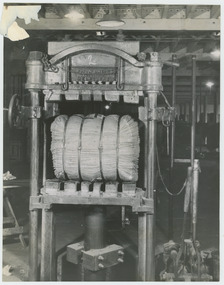 National Wool Museum
Photograph - Bale Dumped and Strapped, 1960s
... Women...Boonoke Station...Farming...Sheep Farming...Agriculture...Wool Industry Working Life Women Boonoke Station Farming Sheep Farming Agriculture Sheep Stations Transport Wool Processing Shearing Textile Industry Wool AUSTRALIAN NATIONAL PUBLICITY / ASSOCIATION / FLINDERS STREET RAILWAY BUILDING, / MELBOURNE AUSTRALIA / W7 / W 7. ...One of fifty one photographs originally in a photo album found in the National Wool Museum’s office. The album was water damaged and the images were removed for conservation. The images follow the process of wool. Beginning in a sheep paddock and finishing as a folded fabric. It includes all the steps in between in this process, including shearing, transporting, selling, washing and the many different steps in the process of turning a single thread of wool into fabric.Black and white image showing a wool bale in a Robinson Bro dumping machine.AUSTRALIAN NATIONAL PUBLICITY / ASSOCIATION / FLINDERS STREET RAILWAY BUILDING, / MELBOURNE AUSTRALIA / W7 / W 7. Bale dumped and strapped.wool industry, working life, women, boonoke station, farming, sheep farming, agriculture, sheep stations, transport, wool processing, shearing, textile industry, wool
