
Showing 21 items matching "woodford road"
-
 Warrnambool and District Historical Society Inc.
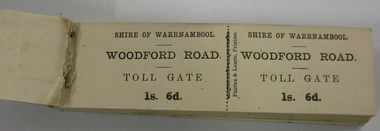
Functional object - Ticket Book, Fairfax & Laurie, Printers, Shire of Warrnambool, Woodford Road Toll Gate, 1s 6d, Circa 1866
... Shire of Warrnambool, Woodford Road Toll Gate, 1s 6d......woodford road... In 1866, in an effort to maintain the main roads of the region it was decided to establish toll roads on the Belfast, Woodford, Purnim and Allansford roads. ...Shire of Warrnambool. WOODFORD ROAD. TOLL GATE 1s. 6d. Fairfax & Laurie, Printers...WOODFORD ROAD. TOLL GATE 1s. 6d. Fairfax & Laurie, Printers Small booklet 140mms long by 40mms wide 13mm depth. ...In 1866, in an effort to maintain the main roads of the region it was decided to establish toll roads on the Belfast, Woodford, Purnim and Allansford roads. Gates were erected and the leases were disposed of by auction. In 1867 the Woodford tollhouse was destroyed by fire suspected to be deliberate. The tolls were removed three years later after much opposition.This item has historic significant as in the early years(1864) of Warrnambool Tolls were levied on the three main roads leading from Warrnambool into the Shire. In 1864 the Shire of Warrnambool decided that tolls were the only just way to raise funds for maintenance of metalled roads. the Shire of Warrnambool had been created in 1863 from the old Warrnambool Roads Board.Small booklet 140mms long by 40mms wide 13mm depth. Blue & grey marbled cardboard covers back & green oiled cloth binding. Inside full book of double side ticket stubs with perforations in the middle.Shire of Warrnambool. WOODFORD ROAD. TOLL GATE 1s. 6d. Fairfax & Laurie, Printerswarrnambool, shire of warrnambool, woodford road, main belfast road, toll gate, toll tickets, woodford toll house 1866, fairfax & laurie printers -
 Warrnambool and District Historical Society Inc.
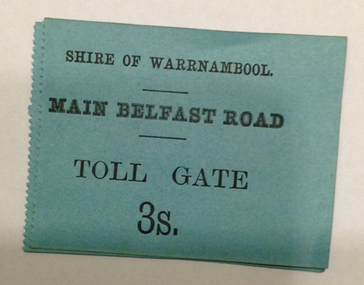
Document - Main Belfast Road Toll Gate Ticket Collection, 1860s
... ...woodford road...There were three toll gate locations – on the main Belfast (Port Fairy) Road at Dennington Bridge, on the Woodford Road at Russells Creek and on the Geelong Road at the Allansford Bridge. ...The Belfast Road tickets are yellow, green, blue and cream and the Woodford Road one is white. All have black printing. ...Belfast Tickets: Shire of Warrnambool, Main Belfast Road, Toll Gate and the price Woodford Road: Shire of Warrnambool, Woodford Road, Toll Gate, 1s 6d Six of the eleven tickets also have ‘Fairfax and Laurie, Printers’ The sixpence ticket on card has the name R P Christian in ink written on the back of the card. ...There were three toll gate locations – on the main Belfast (Port Fairy) Road at Dennington Bridge, on the Woodford Road at Russells Creek and on the Geelong Road at the Allansford Bridge. ...The Shire of Warrnambool operated toll gates from 1866 to 1869 as a means of raising revenue for road construction. There were three toll gate locations – on the main Belfast (Port Fairy) Road at Dennington Bridge, on the Woodford Road at Russells Creek and on the Geelong Road at the Allansford Bridge. The toll gates were unpopular and unprofitable for the lessees as travellers were able to avoid the tax by skirting around the gates. They had toll houses besides the tollgates. The printers of these tickets, William Fairfax and Henry Laurie, were the lessees at the time of the Warrnambool Examiner newspaper. This paper, founded by Richard Osburne and John Wilkinson, and published with some gaps from 1851 to 1880, is a key source today of Warrnambool’s history at the time. These toll gate tickets are significant because:- 1. They date back to the 1860s and were only issued from 1866 to 1869 2. They are the only artefacts we hold of the time when toll gates were operating in our local district 3. They are the best example of how the Shire of Warrnambool in its early history raised revenue for road building and maintenance. These are eleven toll gate tickets, ten for the Belfast (Port Fairy) Road toll gate and one for the Woodford Road toll gate. One is mounted on a Swintons store label (6 pence) and four are mounted on cardboard (2 shillings, sixpence, and two shillings and sixpence) and six are loose (three shillings, two shillings and sixpence and threepence). The Belfast Road tickets are yellow, green, blue and cream and the Woodford Road one is white. All have black printing. There is also an undated newspaper cutting with information on the toll gate tickets. Belfast Tickets: Shire of Warrnambool, Main Belfast Road, Toll Gate and the price Woodford Road: Shire of Warrnambool, Woodford Road, Toll Gate, 1s 6d Six of the eleven tickets also have ‘Fairfax and Laurie, Printers’ The sixpence ticket on card has the name R P Christian in ink written on the back of the card. shire of warrnambool, toll gates, r p christian, woodford road, main belfast road, swintons pty ltd -
 Warrnambool and District Historical Society Inc.
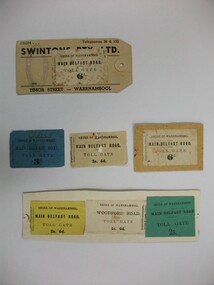
Document - Tickets, Toll road, 1866-1869
... In 1866, in an effort to maintain the main roads of the region it was decided to establish toll roads on the Belfast, Woodford Purnim and Allansford roads. ...Six are for the Main Belfast Road and one for the Woodford road. There are various prices ranging from sixpence to three shillings. ...Six are for the Main Belfast Road and one for the Woodford road. There are various prices ranging from sixpence to three shillings. ...In 1866, in an effort to maintain the main roads of the region it was decided to establish toll roads on the Belfast, Woodford Purnim and Allansford roads. Gates were erected and the leases were disposed of by auction. In 1867 the Woodford tollhouse was destroyed by fire suspected to be deliberate. The tolls were removed three years later after much opposition. These tickets are a physical link to one of the earliest attempts to introduce a toll road in the district. Seven toll road tickets five mounted on card. Light paper. Six are for the Main Belfast Road and one for the Woodford road. There are various prices ranging from sixpence to three shillings. Four are cream in colour, one each of blue, yellow and green. They are accompanied by a small newspaper cutting which relates the discovery of one such ticket and the situation of the Belfast tollhouses which were later relocated to 94 and 96 Henna Street near the Alderdice brass foundry.Shire of Warrnambool, Fairfax & Laurie Printers. tollgate, tollgate tickets, woodford toll tickets, shire of warrnambool -
 Warrnambool and District Historical Society Inc.
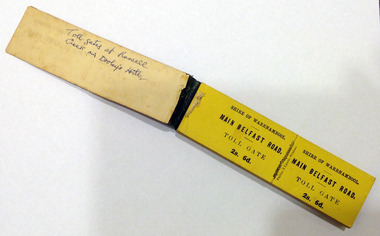
Certificate - Ticket Book, Main Belfast Road Toll, 2s 6d, 1860s
... There were three toll gate locations – on the main Belfast (Port Fairy) Road at Dennington Bridge, on the Woodford Road at Russells Creek and on the Geelong Road at the Allansford Bridge. ...There were three toll gate locations – on the main Belfast (Port Fairy) Road at Dennington Bridge, on the Woodford Road at Russells Creek and on the Geelong Road at the Allansford Bridge. ...The Shire of Warrnambool operated toll gates from 1866 to 1869 as a means of revenue rai sing for road construction. There were three toll gate locations – on the main Belfast (Port Fairy) Road at Dennington Bridge, on the Woodford Road at Russells Creek and on the Geelong Road at the Allansford Bridge. The toll gates were unpopular and unprofitable for the lessees as travellers were able to avoid the tax by skirting around the gates. They had toll houses besides the gates. The printers of these tickets, Fairfax and Laurie were the lessees at the time of the Warrnambool Examiner newspaper. This paper, founded by Richard Osburne and John Wilkinson, and published with some gaps from 1851 to 1880, is a key source today of Warrnambool’s history at that time. These toll gates tickets are significant because:- 1. They date back to the 1860s and were only issued from 1866 to 1869. 2. They are the only artefacts we hold of the time when toll gates were operating in our local district 3. They are the best example of how the Shire of Warrnambool in its early history raised revenue for road building and maintenance This is a book of toll gate tickets for sale at the Main Belfast (Port Fairy) Road Toll Gate. The tickets (about 50) are yellow and in duplicate with provision to detach the outer ticket for the purchaser to keep. The tickets (two shillings and sixpence) are bound with an adhesive tape and the cover is mottled in pattern (brown and blue). There are also four loose tickets in blue (3 shillings). Back Cover: ‘136’ Tickets in book: ‘Shire of Warrnambool, Main Belfast Road, Toll Gate 2s 6d., Fairfax and Laurie, Printers’ Loose tickets: ‘Shire of Warrnambool, Main Belfast Road, Toll Gate, 3s.’ shire of warrnambool, toll gates -
 Warrnambool and District Historical Society Inc.
Document, Wollaston sale, 1919
... This land, on the northern side of the Merri River, near the Woodford Road was three kilometres from the Warrnambool town. ...This land, on the northern side of the Merri River, near the Woodford Road was three kilometres from the Warrnambool town. ...This is a poster advertising the sale of part of the Wollaston Estate in Warrnambool in 1919. The sections for sale were Allotments 1, 18 and 19 which included the Wollaston Homestead. The original Wollaston property of 679 acres was selected by Thomas Manifold in the late 1840s. This land, on the northern side of the Merri River, near the Woodford Road was three kilometres from the Warrnambool town. The first farmer we know who leased the property was William Simpson. Walter Manifold inherited the property and he took it over in 1884. The swing bridge he built in 1890 still stands today. In 1919 the Closer Settlement Board of Victoria acquired Wollaston and 17 lots were sold to returned soldiers for farming purposes. By 1930 there were only five soldier settlers remaining. In 2009 further subdivision took place with lots sold for residential purposes. The homestead allotments were sold separately in 1919 with various owners of the homestead itself recorded since that time. This poster is of interest as it shows the areas of the Wollaston Estate which were sold in 1919. The history of this estate is well-documented and of importance in the history of Warrnambool. This is a sheet of paper with red and black printing and a map of the Wollaston Estate which is photo-lithographed. The sheet has been folded three times. It has some small tears at the top of the page. wollaston, history of warrnambool, walter manifold -
 Warrnambool and District Historical Society Inc.
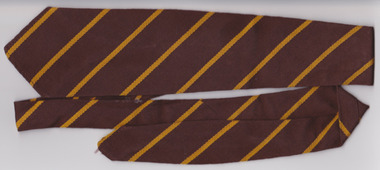
Textile - Warrnambool Primary School 1743 Tie, Circa 1950’s
... The site in Jamieson St was easy to access from the surrounding areas of Belfast, Woodford, and Allansford roads. It was the main school in Warrnambool, before the development of Primary schools at East and West Warrnambool. ...The site in Jamieson St was easy to access from the surrounding areas of Belfast, Woodford, and Allansford roads. It was the main school in Warrnambool, before the development of Primary schools at East and West Warrnambool. ...Warrnambool State School, No, 1743 was opened in 1876. The site in Jamieson St was easy to access from the surrounding areas of Belfast, Woodford, and Allansford roads. It was the main school in Warrnambool, before the development of Primary schools at East and West Warrnambool. A large part of Warrnambool’s children have attended this school over the 140 years it has been in existence.A common item with which a large number of Warrnambool residents would identify. Brown woven woollen tie with diagonal yellow stripes. White tag with black and red writing sewn into back seam.Tee- Dee, pure wool, school and college wear. warrnambool, warrnambool jamieson street primary school, no 1743, school tie, warrnambool primary school -
 Warrnambool and District Historical Society Inc.
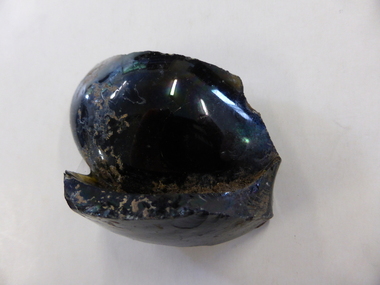
Bottle, Bottle fragment Woodford hotel est 1845, 19th century
... This fragment was found in Bridge Road, Woodford on the site of the Travellers’ Rest Hotel, Woodford and it is believed that it may date from the time when the hotel was operating. ...This fragment was found in Bridge Road, Woodford on the site of the Travellers’ Rest Hotel, Woodford and it is believed that it may date from the time when the hotel was operating. ...This fragment was found in Bridge Road, Woodford on the site of the Travellers’ Rest Hotel, Woodford and it is believed that it may date from the time when the hotel was operating. The Travellers’ Rest Hotel in Woodford was established some time in the 1840s with the first known date, 1847. It pre-dates the settlement of Warrnambool founded in late 1847. The Travellers’ Rest Hotel was established by William Kirby and his wife Mary took over the hotel management when her husband was drowned in August 1847. The hotel had seven other licensees and closed in 1875. If this item comes from the time of the Travellers’ Rest Hotel in Woodford then it is of considerable interest as an early memento of that hotel and the early days of Woodford. This is a fragment of a black bottle or other domestic item. It is made of heavy glass and is curved and could be part of the base of the object. history of woodford, travellers’ rest hotel, woodford, warrnambool history -
 Flagstaff Hill Maritime Museum and Village
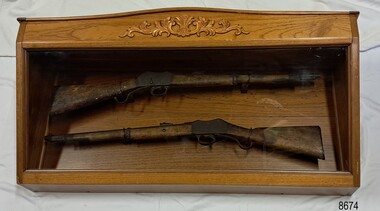
Weapon - Historic Rifles, Royal Small Arms Factory, 1877-1900
... Road...Shipwreck Coast...Martini Henry...Victoria Police...Woodford...In December 1854, Woodford Police barracks and stables were built on the hill by the Merri River on Bridge Road east, where Jubilee Park now stands. ...In December 1854, Woodford Police barracks and stables were built on the hill by the Merri River on Bridge Road east, where Jubilee Park now stands. ...Martini-Henry Artillery Carbin rifles were made by the Royal Small Arms Factory at Enfield, Britain, from 1877 until 1900. Many were distributed to the British Colonies, including this pair, which was allocated to the Woodford Police, Victoria Police District of Warrnambool, Southwest Victoria. The Carbine model rifles were shorter than the standard rifles and more suited to mounted police and troopers. It is likely that in the early 20th century, Victoria Police replaced the two carbines with more modern firearms, and the outdated guns were stored in the stables. The rifles were left there and likely forgotten about due to changes in police staff. In 1915, police authorities announced that they would be replacing patrol horses with bicycles and would also close some smaller police stations. This affected Woodford Police Station, which closed in 1917. The forgotten firearms remained in the stables and were noticed by schoolboy Robert Jellie in 1940 and seen again in 1946. In 1995, the property was sold by the Education Department to a private owner. The Woodford Community donated the pair of Martini-Henry Carbines to the Victoria Police Museum in the late 1990s for mounting and display, which was funded by the Victoria Police Historical Society Inc. The decorative wood and glass display case and frame were designed to preserve the significant history of the guns. On November 1st 1999, the display was presented to Warrnambool Police and the local community due to the historical significance of the Woodford Police Station. In 2025, these items were formally deaccessioned by the Victoria Police Museum, and ownership was transferred to the Warrnambool Police Station. On March 10th, 2025, the display was transferred to Flagstaff Hill Maritime Museum and Village, where the historical story of the Martini-Henry Carbines could continue to be preserved and accessed by local families, the community, visitors to the area, and online visitors. WOODFORD POLICE: - The small settlement at Woodford was established in the 1840s around the Merri River where there was a ford across the water and a bridge from 1848 to 1851. The area was settled very early in Victoria’s history, and the river crossing provided travellers with access to the early route between Port Fairy (named Belfast at that time), Warrnambool and Melbourne. Occasionally, a Warrnambool police trooper would ride through Woodford and the district. In December 1854, Woodford Police barracks and stables were built on the hill by the Merri River on Bridge Road east, where Jubilee Park now stands. A local mounted trooper kept law and order in the area. In 1856, a lock-up was installed, and the first Woodford Police Station was in action in 1857. By 1871, the police station had been moved from the hill to land across the Merri River bridge, on the southern side of Bridge Road west, near Mill Street. In 1890, the police residence there was replaced by a stone Edwardian-style building with the stables and lock-up behind it and the old police station at the rear. The police continued to have a presence in Woodford until it was closed by the Police Commissioner in July 1917 for economic reasons. The residence was used for government housing until 1923, when it was taken over by the Education Department for the school teacher’s home. In 1995, it became privately owned. THE MARTINI-HENRY ARTILLERY CARBINE: - The Martini-Henry rifles were made in Britain from 1871 at the Royal Small Arms factory at Enfield and were stamped with the symbol of the Royal Cipher (Crown over VR) over ENFIELD to identify their origin. They were named after two of several people who helped design this method: Swiss Friederich von Martini and Scotsman Alexander Henry. The design was breech-loaded, and the inner barrel was rifled. A thumb rest was incorporated into the top right of the bullet receiver’s chamber. The small teardrop lever on the right side of the rifle showed whether the rifle was ready to be shot. In 1877, the shorter, lighter-weight Carbine version of the firearm was produced for mounted troops and artillery. Its official name was “Carbine, B.L., Rifled, Martini-Henry.” The bullets were slightly lighter in weight than those used for the longer rifle. The sight position was adjusted for the shorter gun, and wings were added to the sight on the tip, making it easier to slide the rifle back into a saddle bag. Some of the later Carbines also had leather sight covers screwed to the stock to prevent them from catching on the saddle bags. The Carbines had accessories available, such as barrel extensions with bayonets and swivels for adding slings. The Martini-Henry Carbine designs were later modified to fire the British .303 ammunition. Eventually, by 1900, the Martini-Henry Carbines were replaced by the Lee Enfield gun design. The pair of Martini-Henry Carbine firearms represents policing in the early pre-1900 days of colonial settlement; Woodford was one of the first townships settled in Victoria, and it had a police presence from 1854 until 1917. The rifles and display provide a historic connection between the location of Woodford and relatives and associates. The carbine rifles show a stage in the evolution of weapon design, adapted to suit mounted troops, and adding features to streamline use and storage. The ammunition was also improved during this progression. The carbines are important for their connection to policing law and order in a remote area. They are significant for their association with the township of Woodford, which was important to travel in the southwest Victoria district, providing access across a river for a road between Port Fairy and Melbourne, and later Warrnambool, and supplying food, goods and accommodation for the travellers. A pair of mounted rifles is mounted behind glass in a timer case, accompanied by a framed display of two photographs and an account of the rifles’ history. The case and display each have a horizontal board with a gently curved edge and carved decorations added. The identical firearms are British-made Martini Henry Carbine breach-loaded rifled guns, supplied by Britain to its Colonial troops from around 1877. The rifles are lever-action, single-shot .500 calibre weapons. They have a teardrop lever on their right side. They were used by Victoria Police mounted troops at the Woodford Police Station, Victoria. The black and white photographs were taken in 1946. The left photograph has a circled area; the right photograph is an enlarged view of the circled area, showing the Woodford Police Station in detail. The printed text is on textured paper with the Victoria Police watermark. It gives a summary of the rifle’s history. There is an inscription on the left photograph. Left photograph, handwritten in white pen: “WOODFORD” Document’s print: “During the late 1840s the small town of Woodford grew around the crossing of the Merri River on the Melbourne/Port Fairy Rad. Woodford was proclaimed a township in 1854 and a police quarters was established there in 1857. The police station remained until 1917 when it was closed and police service from then on was provided from Warrnambool. The building was then used as a school residence and is now privately owned. In !940 Robert JELLIE, then a schoolboy, observed two rifles mounted on the wall of the disused stable at the rear of the old police building. Following the devastating flood of 1946 (see photograph above) the rifles were again seen in the room next to the stable but were not seen again until the building was sold by the Education Department many years later. It was a recognition of the historical value of the rifles which led to their donation to the Warrnambool Police Complex. The rifles have been authenticated by the Victoria Police Armoury as being Victoria Police issue some time before 1900. The rifles are an identical pair of the famous British-made Martini Henry, a .500 inch calibre military weapon widely used by British Colonial troops. Victoria Police and the wider community of Warrnambool are indebted to the members of the Woodford community for their fine gesture in donating the rifles for mounting so that their historical importance can be preserved and they can be displayed for generations to come. This display was funded by the Victoria Police Historical Society Incorporated, and presented on the first day of November, 1999.”flagstaff hill maritime museum and village, great ocean road, shipwreck coast, martini henry, victoria police, woodford police station, rifle, carbine, display case, british, martini henry carbine, breech-loaded, rifled, colonial, single-shot, .500 calibre, weapon, gun, 1877, troops, mounted troops, merri river, victoria police woodford, victoria police warrnambool, victoria police melbourne, police quarters, robert jellie, school residence, stable, 1946 flood, victoria police armoury, identical pair, british colonial troops, victoria police historical society incorporated, woodford, bicycles, found by a schoolboy, edwardian-style building, victoria police museum, warrnambool police station -
 Flagstaff Hill Maritime Museum and Village
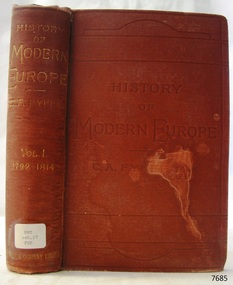
Book, A History of Modern Europe Vol 1
... The Warrnambool Mechanics' Institute’s publication collection is of both local and state significance. warrnambool shipwrecked-coast flagstaff-hill flagstaff-hill-maritime-museum maritime-museum shipwreck-coast flagstaff-hill-maritime-village shipwrecked-artefact book pattison collection warrnambool library warrnambool mechanics’ institute ralph eric pattison corangamite regional library service warrnambool city librarian mechanics’ institute library victorian library board warrnambool books and records warrnambool children’s library great ocean road a history of modern europe vol 1 c a fyffe William Gilbert Label on spine cover with typed text PAT 940.27 FYF Has hand writing on the front loose endpaper looks as if it reads " William Gilbert, Shepperton 1892" Then is son has written "Dad. Born ............ 1872. From eldest son George, Woodford ...This item is from the ‘Pattison Collection’, a collection of books and records that was originally owned by the Warrnambool Mechanics’ Institute, which was founded in Warrnambool in 1853. By 1886 the Warrnambool Mechanics’ Institute (WMI) had grown to have a Library, Museum and Fine Arts Gallery, with a collection of “… choice productions of art, and valuable specimens in almost every branch and many wonderful national curiosities are now to be seen there, including historic relics of the town and district.” It later included a School of Design. Although it was very well patronised, the lack of financial support led the WMI in 1911 to ask the City Council to take it over. In 1935 Ralph Pattison was appointed as City Librarian to establish and organise the Warrnambool Library as it was then called. When the WMI building was pulled down in 1963 a new civic building was erected on the site and the new Warrnambool Library, on behalf of the City Council, took over all the holdings of the WMI. At this time some of the items were separated and identified as the ‘Pattison Collection’, named after Ralph Pattison. Eventually the components of the WMI were distributed from the Warrnambool Library to various places, including the Art Gallery, Historical Society and Flagstaff Hill. Later some were even distributed to other regional branches of Corangamite Regional Library and passed to and fro. It is difficult now to trace just where all of the items have ended up. The books at Flagstaff Hill Maritime Village generally display stamps and markings from Pattison as well as a variety of other institutions including the Mechanics’ Institute itself. RALPH ERIC PATTISON Ralph Eric Pattison was born in Rockhampton, Queensland, in 1891. He married Maude Swan from Warrnambool in 1920 and they set up home in Warrnambool. In 1935 Pattison accepted a position as City Librarian for the Warrnambool City Council. His huge challenge was to make a functional library within two rooms of the Mechanics’ Institute. He tirelessly cleaned, cleared and sorted a disarrayed collection of old books, jars of preserved specimens and other items reserved for exhibition in the city’s museum. He developed and updated the library with a wide variety of books for all tastes, including reference books for students; a difficult task to fulfil during the years following the Depression. He converted all of the lower area of the building into a library, reference room and reading room for members and the public. The books were sorted and stored using a cataloguing and card index system that he had developed himself. He also prepared the upper floor of the building and established the Art Gallery and later the Museum, a place to exhibit the many old relics that had been stored for years for this purpose. One of the treasures he found was a beautiful ancient clock, which he repaired, restored and enjoyed using in his office during the years of his service there. Ralph Pattison was described as “a meticulous gentleman whose punctuality, floorless courtesy and distinctive neat dress were hallmarks of his character, and ‘his’ clock controlled his daily routine, and his opening and closing of the library’s large heavy doors to the minute.” Pattison took leave during 1942 to 1945 to serve in the Royal Australian Navy, Volunteer Reserve as Lieutenant. A few years later he converted one of the Museum’s rooms into a Children’s Library, stocking it with suitable books for the younger generation. This was an instant success. In the 1950’s he had the honour of being appointed to the Victorian Library Board and received more inspiration from the monthly conferences in Melbourne. He was sadly retired in 1959 after over 23 years of service, due to the fact that he had gone over the working age of council officers. However he continued to take a very keen interest in the continual development of the Library until his death in 1969. The Pattison Collection, along with other items at Flagstaff Hill Maritime Village, was originally part of the Warrnambool Mechanics' Institute’s collection. The Warrnambool Mechanics’ Institute Collection is primarily significant in its totality, rather than for the individual objects it contains. Its contents are highly representative of the development of Mechanics' Institute libraries across Australia, particularly Victoria. A diversity of publications and themes has been amassed, and these provide clues to our understanding of the nature of and changes in the reading habits of Victorians from the 1850s to the middle of the 20th century. The collection also highlights the Warrnambool community’s commitment to the Mechanics’ Institute, reading, literacy and learning in the regions, and proves that access to knowledge was not impeded by distance. These items help to provide a more complete picture of our community’s ideals and aspirations. The Warrnambool Mechanics Institute book collection has historical and social significance for its strong association with the Mechanics Institute movement and the important role it played in the intellectual, cultural and social development of people throughout the latter part of the nineteenth century and the early twentieth century. The collection of books is a rare example of an early lending library and its significance is enhanced by the survival of an original collection of many volumes. The Warrnambool Mechanics' Institute’s publication collection is of both local and state significance. A History of Modern Europe Vol 1 Author: C A Fyffe Publisher: Cassell & Company Date: 1891Label on spine cover with typed text PAT 940.27 FYF Has hand writing on the front loose endpaper looks as if it reads " William Gilbert, Shepperton 1892" Then is son has written "Dad. Born ............ 1872. From eldest son George, Woodford, via Koriot 3282 30/10/1987."warrnambool, shipwrecked-coast, flagstaff-hill, flagstaff-hill-maritime-museum, maritime-museum, shipwreck-coast, flagstaff-hill-maritime-village, shipwrecked-artefact, book, pattison collection, warrnambool library, warrnambool mechanics’ institute, ralph eric pattison, corangamite regional library service, warrnambool city librarian, mechanics’ institute library, victorian library board, warrnambool books and records, warrnambool children’s library, great ocean road, a history of modern europe vol 1, c a fyffe, william gilbert -
 Flagstaff Hill Maritime Museum and Village
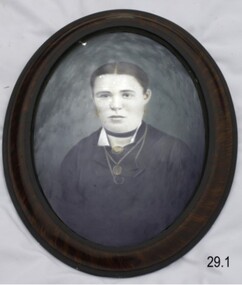
Photograph - Mrs Mary Jane Giles of Woodford, International Art Company, Circa 1880
... road...photograph late 1800s...oval wooden frame...portrait...mrs mary jane giles of woodford...The photograph itself is of added significance as we can see the faces of the family whose lives the collection represents . flagstaff hill warrnambool shipwrecked coast flagstaff hill maritime museum shipwreck coast flagstaff hill maritime village great ocean road photograph late 1800s oval wooden frame portrait mrs mary jane giles of woodford victoria giles collection henry giles tower hill cooramook warrnambool breakwater mailor’s flat wangoom 19th century personal effects mary giles christine giles Inscription on back of frame "International Art Company 30/-" "Rosewood" Portrait photograph mounted in an oval rosewood frame, one of a pair. ...The pair of photographs of Mr Henry and Mrs Mary Jane Giles was made by the International Art Company, the price was 30 shillings and the choice of frame was Rosewood. It is part of the Giles Collection, which also includes a photograph of the couple's daughter Christina Giles, who died in 1899 aged seven years. There are many 19th century items of furniture, linen and crockery donated to Flagstaff Hill Maritime Village by, Vera and Aurelin Giles. The items are associated with Warrnambool and the Giles Family history. Items donated by the family have come to be known as the “Giles Collection”. Many items in the Lighthouse Keeper’s Cottage were donated by Vera and Aurelin Giles and mostly came from the home of Vera’s parents-in-law, Henry Giles and his wife Mary Jane (nee Freckleton) who married in 1880 and whose photos are on display in the parlour. Henry was born at Tower Hill in 1858, and was a labourer on the construction of the Warrnambool Breakwater before leaving in 1895 for around seven years to build bridges in NSW. Mary Jane was born in 1860 at Cooramook and she attended Mailor’s Flat State School and where she eventually was to become a student teacher. After which she became a governess at “Injemiara” where her grandfather, Francis Freckleton, had once owned land. Henry and Mary’s family consisted of six, some of the children were born at Mailor’s Flat and later some children at Wangoom. They lived with their parents at Wangoom and Purnim west, and this is where Henry died in 1933 and Mary Jane in 1940.This photograph is locally significant due to its association with a local pioneering family. The Giles family collection is of social significance at a local level, because it not only illustrates the level of material support the Warrnambool community gave to Flagstaff Hill during it’s establishment. But the Giles collection also gives us today a snapshot into what domestic life was like in early colonial times prior to Federation. The photograph itself is of added significance as we can see the faces of the family whose lives the collection represents . Portrait photograph mounted in an oval rosewood frame, one of a pair. This photograph is Mary Jane Giles, dressed formally showing chest to head. Her hair is tied back hair and she has a neck band. The couple in the pair of photographs is Mr and Mrs Giles of Woodford, Victoria. The photographic studio was the International Art Company. It is part of the Giles Collection.Inscription on back of frame "International Art Company 30/-" "Rosewood"flagstaff hill, warrnambool, shipwrecked coast, flagstaff hill maritime museum, shipwreck coast, flagstaff hill maritime village, great ocean road, photograph late 1800s, oval wooden frame, portrait, mrs mary jane giles of woodford victoria, giles collection, henry giles, tower hill, cooramook, warrnambool breakwater, mailor’s flat, wangoom, 19th century personal effects, mary giles, christine giles -
Glen Eira Historical Society
Drawing - Methodist Church, 23 - 25 Bundeera Road, Caulfield South
... Road... Methodist Church... Woodford...Organs Collier Charitable Fund South Caulfield Primary Schools Kooyong Road Methodist Church Woodford Bambra Estate McConchie Rev. ...Phamphlet containing photocopied and dated newspaper articles about construction of church from various newspapers in 1926 and a brief outline of how and why church was begun and of its eventual demise, 1923 - 1985. Photocpied page of Recollections of Bundeera Road Church by Charlotte Harley (b. 1890), listing the members of December, 1985.methodist church, taylor mr., latham a. t., kindergartens, methodist uniting church, wesley johns rev., corben mrs, bundeera road, eddy r., organs, collier charitable fund, south caulfield, primary schools, kooyong road, methodist church, woodford, bambra estate, mcconchie rev. r. bruce, davenport mr., davies bill, davies mrs., philp rev., shaw mesolames, morris, miles, monday, bryant, woodford, paice, warren, evans bert, shaw william ronald, gvard w. h. rev., wells charlotte, evans elsie, narrawong road., bundeera road uniting church., mcraw dick, westaway frank, adamson dorothy, harley charlotte (nee wells), harley j, hunkin ena, hunkin edward rev., lydiard ruby, lydiard dick, sharples d, sharples j, spence margaret, spence bert, summers mary, summers ron, veitch alan, westaway m, arundell joyce, campbell heather, cock marian, heywood. a, putland roy, richards d, spence philip, taylor mrs., trewin norman, newton m., uniting church archives, kilgour alex, mann gwenda, gray daniel, gray gordon, heywood a, putland roy, richards d, featenby rev., brent p. e, woodford s. g., bent mr., st. kilda circuit, bundeera road ladies gvild, sunday school, choirs, windows -
 Warrnambool and District Historical Society Inc.
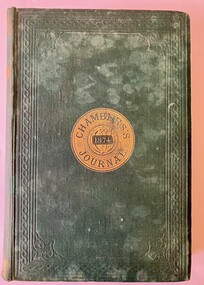
Book - Chambers Journal 1874, Chambers’s Journal 1874, 1874
... Road today). The aunt, Mrs J. Davidson would be the wife of John Davidson, the brother of James and a farmer at ‘Rosebank’, Woodford. ...Road today). The aunt, Mrs J. Davidson would be the wife of John Davidson, the brother of James and a farmer at ‘Rosebank’, Woodford. ...Chambers's Journal was published weekly from 1832 through to 1956 in Edinburgh. It was a popular magazine and was priced at one penny. Topics included history, religion, language, and science. Publication moved to London around 1856. Some articles were stand alone while others were serialised. This is a bound copy of a years collection of the weekly publication. This is a book given to Margaret Davidson in 1875 by her aunt, Mrs J. Davidson. Margaret Milne Davidson (1839-1928) was the eldest child of James and Isabella Davidson and she was born in Kirriemuir, Scotland. She came to the Warrnambool area in 1850. The property, ‘Woodend’, was near Cassadys Bridge (Caramut Road today). The aunt, Mrs J. Davidson would be the wife of John Davidson, the brother of James and a farmer at ‘Rosebank’, Woodford. The portraits of John and James Davidson are on the Warrnambool Pioneer Honour Board. This book is of interest because of its inscription. The book is connected to the Davidson families, prominent in Warrnambool’s pioneer history.This is a hard cover book of 832 pages. The book has a dark green cover with dark green and gold lettering with ornamental gold surrounds. The book has an index, short stories, poems, essays and articles on science and the arts. The book contains monthly journals for 1874 combined in one volume. The cover is stained and blotched. There are several stamps of the Warrnambool & District Historical Society. The inscription on the first page is handwritten in black ink. ‘Margaret M. Davidson, Woodend, from her aunt, Mrs J. Davidson, 30/9/75’.margaret davidson, james and john davidson, history of warrnambool, chambers journal, chambers journal 1874 -
 Warrnambool and District Historical Society Inc.
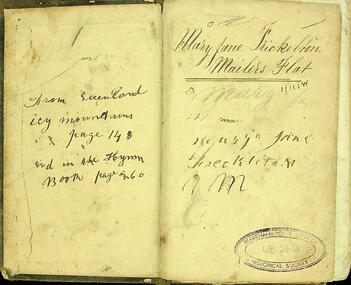
Book, Third Book, Late 19th century
... Road and closed in 1994. The first Head Teacher was Julian Castles. There were Freckelton families in the 19th century in Port Fairy, Caramut, Woolsthorpe, Woodford and Mailors Flat. ...Road and closed in 1994. The first Head Teacher was Julian Castles. There were Freckelton families in the 19th century in Port Fairy, Caramut, Woolsthorpe, Woodford and Mailors Flat. ...This little book is very old, presumably 19th century, but the wording on the front cover is indecipherable, no date is evident and the first and last pages are missing. The book was owned by Mary Jane Freckleton with the main inscription written in an adult hand – ‘Mary Jane Frickelton, Mailers Flat’. The spelling of Mailers Flat with an ‘e’ was not a mistake but this was the common spelling in the 19th century and the early 20th century. According to the Freckleton family history ‘Freckleton’ was sometimes spelled ‘Frickelton’ or ‘Frickleton’. Mailors Flat is nine kilometres from Warrnambool and the Mailors Flat School, number 1210, was opened in 1872 in Caramut Road and closed in 1994. The first Head Teacher was Julian Castles. There were Freckelton families in the 19th century in Port Fairy, Caramut, Woolsthorpe, Woodford and Mailors Flat. The Freckletons at Mailors Flat were engaged in farming. Mary Jane Freckleton was for a time a pupil teacher at Mailors Flat School. She was born at the Injemira property and married Henry Giles. This is an interesting book because of its age and because it belonged to Mary Jane Freckleton, a member of the Freckleton families, early settlers in the areas north of Warrnambool. She may have used the book when she was a pupil teacher at the Mailors Flat School. This is a hard cover book of 284 pages (some pages missing). The cloth cover is brown and much torn and stained. There are 86 chapters of prose and verse and a sprig of dried flowers is enclosed in the pages. There is the red stamp of the Warrnambool & District Historical Society on the first page and several snippets of writing in black ink on the front and back pages.‘Mary Jane Frickelton Mailers Flat’mary jane freckleton, mailors flat school, mailers flat, frickelton -
 Warrnambool and District Historical Society Inc.
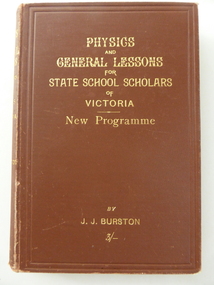
Book, Physics & General Lessons for State School Scholars of Victoria, 1892
... John Burston was at Mepunga and Woodford schools before leaving in 1871 to be the Master of the Anglican School at Creswick. He then became the head teacher at schools in Ballarat and Bendigo before going to the Brighton Road State School in St. ...John Burston was at Mepunga and Woodford schools before leaving in 1871 to be the Master of the Anglican School at Creswick. He then became the head teacher at schools in Ballarat and Bendigo before going to the Brighton Road State School in St. ...This school text book was written by John James Burston. He was the son of David and Sarah Burston of Warrnambool. Both his father and his brother Benjamin taught in schools in the Warrnambool area. John Burston was at Mepunga and Woodford schools before leaving in 1871 to be the Master of the Anglican School at Creswick. He then became the head teacher at schools in Ballarat and Bendigo before going to the Brighton Road State School in St. Kilda. He spent 16½ years there before retiring in 1911. Burston was a well-known writer of school text books, including The State School Arithmetic, The State School Grammar and Exercises in Practice and Proportion. He died in 1915.This book is of great interest because it was written by John James Burston, a one-time resident in the Warrnambool area and a teacher with a distinguished record in education – he taught in schools in Victoria for 44½ years and wrote several texts for State Schools.This is a hard cover book of 243 pages. There are several blank pages in the middle of the book and at the end for teachers’ notes. The cover is dark red with gold lettering on the front cover and on the spine. There are some illustrations scattered throughout the text.john james burston, physics and general lessons for victorian state schools, warrnambool -
 Warrnambool and District Historical Society Inc.
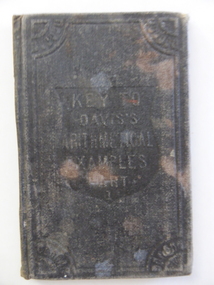
Book, A Key to Davis's Arithmetical Examples, 1887
... Henrietta Robina Victoria Giles was born in Woodford in 1881 to Henry and Mary Jane Giles, early settlers in the Warrnambool district. They lived on the Allansford Road....Henrietta Robina Victoria Giles was born in Woodford in 1881 to Henry and Mary Jane Giles, early settlers in the Warrnambool district. They lived on the Allansford Road. ...This school text book was used at the Wangoom State School by Henrietta Giles in the late 19th century. The Wangoom School was established in 1865 as the Wangoom Common School and later became the Wangoom State School. It is now closed. Henrietta Robina Victoria Giles was born in Woodford in 1881 to Henry and Mary Jane Giles, early settlers in the Warrnambool district. They lived on the Allansford Road.This book is of interest as an example of a school text book used in Victoria late in the 19th century. It is also of interest because it belonged to Henrietta Giles, a member of a family living in the Warrnambool district in the 19th century. This is a hard cover book of 70 pages. The cover is brown with embossed lettering and ornamentation on the front and back cover. It is much stained and splotched. The first page is torn at the edge and some of the other pages are dog-eared. The two inscriptions (identical) are handwritten in black ink.‘Henrietta R.V. Giles, Wangoom State School, No. 645’wangoom state school, henrietta giles -
 Warrnambool and District Historical Society Inc.
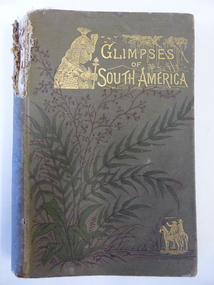
Book, Glimpses of South America, 1882
... Woodford district. James Cassady was the son of William and Elizabeth Cassady and the family lived at Boughton on the Merri River (near Cassady’s Bridge, Caramut Road today). ...Woodford district. James Cassady was the son of William and Elizabeth Cassady and the family lived at Boughton on the Merri River (near Cassady’s Bridge, Caramut Road today). ...This book was given as a Sunday School prize to James Cassady. The donor was William Wines. The Wines families were pioneers in the Woodford district. James Cassady was the son of William and Elizabeth Cassady and the family lived at Boughton on the Merri River (near Cassady’s Bridge, Caramut Road today). This property was established about 1845. Charley and Joe, whose names have also been written in the book, were James’ brothers. This book is of interest because it belonged to James Cassady, the son of pioneer settlers in Cassadys’ Bridge/Woodford area. This is a hard cover book of 220 pages with 32 extra pages at the back of the book giving information on other books produced by the same publisher. The cover is grey-green with gold lettering, green and black floral decorations and gold images of two men on horseback and a South American Indian chief. The spine is torn away at the top and the cover and pages are stained and crumpled. There are many black and white illustrations throughout the text, with the frontispiece protected by a piece of tissue. The inscriptions are handwritten in black ink and pencil.‘Woodford Sunday School presented to James Cassidy (sic) by his well-wisher William Wines’ (this is re-written underneath in pencil with the correct spelling of ‘Cassady’) ‘Chaley cassady, boughton, merri river (sic) “Joe’ james cassady,, boughton, william wines, woodford sunday school, history of warrnambool -
 Warrnambool and District Historical Society Inc.
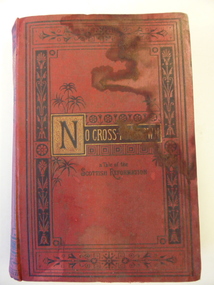
Book, No Cross No Crown A Tale of the Scottish Reformation, 1885
... Woodford Sunday School to Edith Cassady (note the misspelling of ‘Cassady’). Edith Cassady was the daughter of William and Elizabeth who lived at Boughton on the Merri River (near Cassady’s Bridge, Caramut Road today). ...Woodford Sunday School to Edith Cassady (note the misspelling of ‘Cassady’). Edith Cassady was the daughter of William and Elizabeth who lived at Boughton on the Merri River (near Cassady’s Bridge, Caramut Road today). ...This book has been given by the Woodford Sunday School to Edith Cassady (note the misspelling of ‘Cassady’). Edith Cassady was the daughter of William and Elizabeth who lived at Boughton on the Merri River (near Cassady’s Bridge, Caramut Road today). This property was established about 1845. The donor of the book was William Wines, a member of a pioneering family in the Woodford district. This book is of some interest as it belonged to Edith Cassady, a member of a pioneering family who lived at Boughton on the Merri River. This is a hard cover book of 344 pages. The cover is red with black border decorations and black and gold lettering. There are several full page black and white illustrations scattered throughout the book which has 23 chapters of story. The cover and pages are much water-stained. The inscription is handwritten in black ink. ‘Woodford Sunday School Presented to Edith Cassidy (sic) by her well-wisher William Wines’ william wines, woodford, history of woodford, edith cassady, boughton property, cassady family, woodford sunday school -
 Warrnambool and District Historical Society Inc.
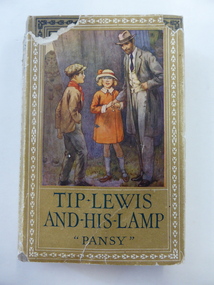
Book, Tip Lewis & his lamp, 1925
... Road in the early 20th century. There were several Jenkins families in the Warrnambool district and some were early settlers in the Wangoom/Grasmere area. Some Jenkins families were associated with hotels in Purnim and Woodford...Road in the early 20th century. There were several Jenkins families in the Warrnambool district and some were early settlers in the Wangoom/Grasmere area. Some Jenkins families were associated with hotels in Purnim and Woodford ...This book was awarded by the Grasmere Presbyterian Sabbath School to Stuart Jenkins for his essay on the Apostle Paul. The teacher was H. Giles. The Giles family lived on the Allansford Road in the early 20th century. There were several Jenkins families in the Warrnambool district and some were early settlers in the Wangoom/Grasmere area. Some Jenkins families were associated with hotels in Purnim and Woodford and the properties Grasmere Station, Roseneath, Dyffen, Vrowen and Fala Park. St. Andrew’s Presbyterian Church at Grasmere was built in 1898 (the second church on the site). This book is an example of Sabbath School prizes awarded to scholars in the 1920's. It is retained for its connection to the Grasmere Presbyterian Church and the Jenkins and Giles families of the Wangoom and Grasmere area.This is a hard cover book of 252 pages. The cover is brown with a multi-coloured illustration of a man and two children on the front cover and black lettering and border ornamentation on the spine and front cover. The dust jacket has a yellow background and the same illustration as on the front cover. The dust cover is partly torn away. There is a full page colour plate at the beginning of the text and a page of advertisements for books by the same publisher at the end of the text. The inscription is handwritten in black ink. ‘Grasmere Presbyterian Sabbath School ‘Essay’ Missionary Journeys of the Apostle Paul. First Prize Awarded to Stuart Jenkins from his teacher, H. Giles’. stuart jenkins, grasmere, history of warrnambool, grasmere presbyterian church, h giles -
 Warrnambool and District Historical Society Inc.
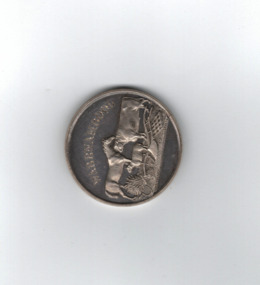
Medal, Villiers and Heytesbury Agricultural Association (Daniel Hourigan 1877), C 1877
... Woodford in 1853 and the first Show was held in Warrnambool in 1855 on a green bound by Fairy, Henna and Koroit Streets. It was held there until 1875 when it moved to the present Warrnambool Showgrounds in Koroit Street. At the 37th Annual Show in 1890 Warrnambool held its first Grand National Show, a title granted by the Chamber of Agriculture in Victoria. The Villiers and Heytesbury Agricultural Association became known as the Warrnambool Agricultural Show in 1911. Daniel Hourigan was a farmer, road...Woodford in 1853 and the first Show was held in Warrnambool in 1855 on a green bound by Fairy, Henna and Koroit Streets. It was held there until 1875 when it moved to the present Warrnambool Showgrounds in Koroit Street. At the 37th Annual Show in 1890 Warrnambool held its first Grand National Show, a title granted by the Chamber of Agriculture in Victoria. The Villiers and Heytesbury Agricultural Association became known as the Warrnambool Agricultural Show in 1911. Daniel Hourigan was a farmer, road ...This medal was awarded at the Villiers and Heytesbury Agricultural Association Annual Show to Daniel Hourigan in 1877 for his yearling colt by 'Prince of the Isles'. The formation of the Villiers and Heytesbury Agricultural Association arose out of a meeting at Woodford in 1853 and the first Show was held in Warrnambool in 1855 on a green bound by Fairy, Henna and Koroit Streets. It was held there until 1875 when it moved to the present Warrnambool Showgrounds in Koroit Street. At the 37th Annual Show in 1890 Warrnambool held its first Grand National Show, a title granted by the Chamber of Agriculture in Victoria. The Villiers and Heytesbury Agricultural Association became known as the Warrnambool Agricultural Show in 1911. Daniel Hourigan was a farmer, road contractor, poundkeeper and auditor who lived in the Tower Hill area in the 19th century. This medal is of considerable interest as it is a memento of the Villiers and Heytesbury Agricultural Association Annual Show in the 19th century. Annual Agricultural Shows have been an important feature of agricultural life in Victoria since the early days of European settlement and a feature of agricultural life in the Warrnambool district since the 1850s. The medal is also of great interest because it was awarded to Daniel Hourigan, a prominent settler in the Warrnambool district in the 19th century. .1 Circular silver disc with image of horse, bull, sheep, wheat sheaf and plough on the reverse with script around edge of obverse with awardees details engraved in the centre. Edge of the medal is plain. .2 Square maroon leather case with small metal clasp and hinge. Lined on the interior with blue velvet and cream silk.Obverse :" Warrnambool" engraved above image of cattle. W J Taylor London Reverse : Villiers & Heytesbury Agricultural Association in low relief around the edge. 1st prize awarded to Daniel Houriganfor yearling colt , "Prince of the Isles Annual Show 10th October 1877.warrnambool, villiers and heytesbury, daniel hourigan, prince of the isles, 1877, villiers & heytesbury agricultural show -
 Warrnambool and District Historical Society Inc.
Title Search Document, 1930s to 1960s
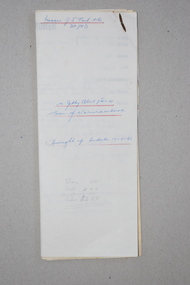
... Woodford and then moved into Warrnambool and began land speculating.. In 1856 his property was valued at £20,000 but by 1858 he was declared insolvent following the insolvency of his financial backer, William Bateman and his properties were sold. He died in 1860 following an accident at a Ballarat gold mine. Other notable Warrnambool identities who owned this property on Pertobe Road...Woodford and then moved into Warrnambool and began land speculating.. In 1856 his property was valued at £20,000 but by 1858 he was declared insolvent following the insolvency of his financial backer, William Bateman and his properties were sold. He died in 1860 following an accident at a Ballarat gold mine. Other notable Warrnambool identities who owned this property on Pertobe Road ...These documents concern the property in South Warrnambool, Jetty Allotment 7, Section 4. They include a search made of the title of this property in 1937 and information on later purchasers of the property. The first owner of this property was James Cust who purchased it in April 1853. James Cust (1815-1860) came from Ireland to Australia in 1841. From 1847 on he farmed first at Woodford and then moved into Warrnambool and began land speculating.. In 1856 his property was valued at £20,000 but by 1858 he was declared insolvent following the insolvency of his financial backer, William Bateman and his properties were sold. He died in 1860 following an accident at a Ballarat gold mine. Other notable Warrnambool identities who owned this property on Pertobe Road included Thomas King, Christopher Beattie, Thomas Goodall, William McMahon and Alan Lane.These documents are of interest as they detail the history of a property in Warrnambool up to the 1960s. They are also an example of the type of property once owned by James Cust, an important early land speculator in Warrnambool. These are nine loose sheets of paper concerning a legal search made of a block of land in Warrnambool and later documents on the same property The papers contain handwriting in blue and black ink and pencil and one red stamp. One of the pages is an invoice for the charge made for the search.‘Searched 25/5/37 W.D. Richardson Titles Searcher 418 Little Collins Street Melbourne C1’james cust,, history of warrnambool -
Kew Historical Society Inc
Archive (Sub-series) - Subject File, Kew Historical Society et al, JONES, Robert & Family, 1958
... Archive file containing a typed letter by David Jones, including reference to his forebears who lived in Woodford Avenue, then 152 Bulleen Road (1888-92) Kew. Thomas Jones had a tailor shop at 4 Cotham Road. ...Typically files will contain primary and secondary sources. kew - history 4 cotham road - kew (vic) retailers - kew (vic) 152 bulleen road - kew (vic) Archive file containing a typed letter by David Jones, including reference to his forebears who lived in Woodford Avenue, then 152 Bulleen Road (1888-92) Kew. ...Various partiesReference, Research, InformationSecondary Values (KHS Imposed Order)Subject file containing a typed letter by David Jones, including reference to his forebears who lived in Woodford Avenue, then 152 Bulleen Road (1888-92) Kew. Thomas Jones had a tailor shop at 4 Cotham Road.kew - history, 4 cotham road - kew (vic), retailers - kew (vic), 152 bulleen road - kew (vic)kew - history, 4 cotham road - kew (vic), retailers - kew (vic), 152 bulleen road - kew (vic)
