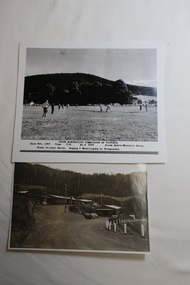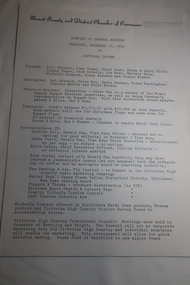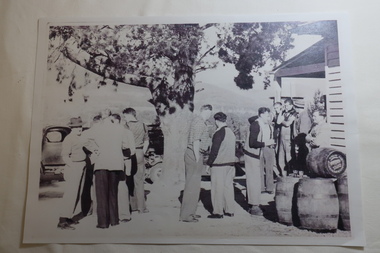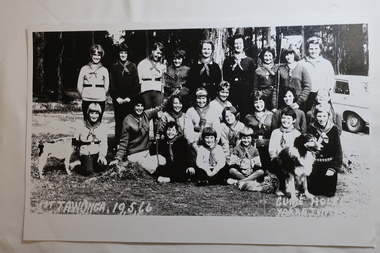
Kiewa Valley Historical Society Mt Beauty, Victoria
The Kiewa Valley Historical Society aims to preserve and conserve the history and heritage of the Kiewa Valley & district. Through the use of permanent, and temporary exhibitions, information walls, a photo gallery, a diorama of the Bogong High Plains, a model hydro system, and two DVD screens we show the area's history and highlights, that tell our social history, natural science areas and technological developments.
The collection has many artefacts that show the history and cultural heritage of the first indigenous people. Along with artefacts from pioneer settlers of the Kiewa Valley and Mount Beauty lived, worked and socialised. Items such as photos, books, farming equipment, hospital equipment, technological equipment from the Kiewa Hydro Scheme, household items, plus oral histories, and genealogy books are in our collection. All the items in the collection have either historical, technological or aesthetic significance to the Kiewa Valley and have good interpretive capacity. Artefacts have to meet this assessment criteria before being considered to be added into the collection. We do not buy, sell or give valuations for any artefacts at this stage.
The historical society Museum space shares the same premises as the Mt Beauty Visitor Information Centre. There is wheel chair access, a disability toilet and separate male and female toilets. Free parking is found the North side of the information centre. There is also a small seating area in the sun deck of the centre. The centre is with in walking distance from Mt Beauty main shopping centre and a 50 - 60 minute drive from the larger centres of Wodonga / Albury.
New members are always welcomed.
Contact Information
Opening Hours
10am to 4pm Monday to Thursday 10am - 5pm Friday 9am - 5pm Saturday 9am - 4pm Sunday During school holidays open 9:00 am to 5:00 pm daily. Closed Christmas Day.
Entry Fee
Gold coin donation.
Location
Mount Beauty Information Centre 31 Bogong High Plains Rd Mt Beauty Victoria
View on Google MapsThe collection has authentic items which highlight the first peoples who roamed the Kiewa Valley. Along with the social history of the first white settlers of the Kiewa Valley and Mount Beauty lived, worked and socialised from the late 1800's onwards. Items such as photos, books, farming equipment, hospital equipment, technological equipment from the Kiewa Hydro Scheme, household items, plus oral histories, and genealogy records and books are in our collection.
Significance
The Kiewa Valley Historical Society collection has historic significance as it shows how the first white settlers lived and worked through out the valley. Scientific significance applies to the rock cores taken by the SEC during the construction of the hydro scheme. The indigenous stones & tools also have historic significane as they show the cultural heritage of the first people of the Kiewa Valley. Other than the archives, all items have interpretative capacity to be in the collection.
1215 items
1215 items
Photographs – Set of 21 colour photographs of the Opening Ceremony and commemorative torch lighting to celebrate the first Official Hoppet race run at Falls Creek in 1991
Kiewa Valley Historical Society, Mt Beauty
Set of 21 colour photographs of the Opening Ceremony and Commemorative Torch lighting to celebrate the first Official Hoppet race run at Falls Creek in 1991 1-3 - John Konrads (1956 Olympic Swimmer) lighting the Commemorative Torch with the original torch used at the 1956 Olympics at the MCG in Melbourne. 4-13 – Official opening ceremony and torch lighting by Liberal representative for Indi Mr Lou Leibermann. MC’d by Mr Ken Bell, representing the Chamber of Commerce 14 – Parachute fly over by Mr Ross Schult 15-18 – Photographs of the Multi National flags displayed in the commemorative garden in front of the SECV administration buildings. Flags represent the countries participating in the Kangaroo Hoppet. Snow-capped Mt Bogong in the background. 19-21 – Commemorative torch, erected by SECV to commemorate the first official Kangaroo Hoppet held at Falls Creek.
Historical information
In 1977 a group of Mount Beauty cross country skiers formed the Birkebeiner Nordic Ski Club. In 1979, a version of the famous Birkebeiner race, the first Australian Birkebeiner was held at Falls Creek. In June 1990 representatives from Australia put their case for a southern hemisphere race in the series. Following a trial event in 1990. Australia became the 12th member of Worldloppet in the winter of 1991, with the first Kangaroo Hoppet. In 1991 a parade and commemorative torch lighting ceremony were organised in Mt Beauty as part of the celebrations to mark the first official Kangaroo Hoppett with participation from local community groups and commercial organisations, the Chamber of Commerce, local government representatives and individuals.
Significance
Kangaroo Hoppet caters to diverse interests by offering a 42km and 21km event. It also offers a 7km event that attracts skiers, ranging from elite juniors to parents, grandparents, babies and first time skiers. It is recognised on the world cross country ski race calendar. It brings large numbers of participants and spectators to the area which support tourism, local businesses and employment. The 2018 event will be the 28th Kangaroo Hoppet, with cross country skiers travelling from across the country and overseas to compete.
Inscriptions & Markings
No markings
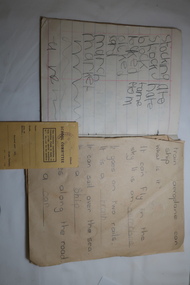
Framed Letter - Bogong State School 1946
Kiewa Valley Historical Society, Mt Beauty
Dark wooden frame, glass cover, cardboard back not attached to the frame. 2 rings screwed at the top on the sides of the frame with string attached to each. Paper yellowed letter titled "Australian American Association" dated 6 May 1946 addressed to the Principal Bogong State School.
Historical information
Bogong State School was awarded First Prize in its Class for 'the Project Book'. The school received a cheque for the purchase of library books or approved equipment.
Significance
Bogong is a town established by the State Electricity Commission of Victoria during the construction of the Kiewa Hydro Electric Scheme. The project "displays some most artistic work in illustrating birds of the district" confirming that the principal at the time had a very good reputation especially with his knowledge of the surrounding bush and wild life.
Anaesthetic Mask
Kiewa Valley Historical Society, Mt Beauty
Metal egg shaped frame with metal pieces crossing longitudinally and across with attached moveable metal piece that holds cloth in when closed and fits into open hollow egg shaped frame. At one end is a flat metal piece that would rest on the forehead. Usually used for children. To add cloth (gauze or muslin) with anaesthetic (chloroform or ether) open the mask and place the cloth onto the frame. It clipped on and the fluid then dripped onto the cloth.
Historical information
This Anaesthetic Mask 'Schimmelbusch' mask was used to deliver chloroform or ether as an anaesthetic. When this mask was in use most doctors would have delivered the anaesthetic themselves. During the 1940s and 1950s, some nurses may have played an active role in the delivery of anaesthetics, particularly in remote areas and during wartime or doctor shortages. This medical / hospital equipment was the latest available in the 1950s when the Tawonga District General Hospital was built specifically for the increase in population due to the Kiewa Hydro Scheme.
Significance
Historical: Shows the development of scientific hospital equipment. Provenance: Used in the Tawonga District General Hospital which was remote and therefore required good equipment. Good condition and good interpretation capacity.
Inscriptions & Markings
CHIRON GERMANY between handle and oval.
Book - School Prize - Her Treasure of Truth by H. Louisa Bedford
Kiewa Valley Historical Society, Mt Beauty
Blue hard covered book with light blue title surrounded by light blue swirl on cover. On the spine - the title and author's name are embossed in gold. RTS is embossed in gold at the bottom of the spine. The decoration on the spine is light blue. Inside: Font is large. Between the title page and a picture is a clear sheet of 'tissue' paper.
Historical information
In 1911, students received prizes for highest marks. Books were appropriate prizes.
Significance
Everil Fisher grew up and lived at Mongan's Bridge in the Kiewa Valley.
Inscriptions & Markings
Everil Fisher / Highest marks / S. S. 3403 / 25. 4. 11 - Handwritten on first page.
Sand Sieve - Tobacco Farming
Kiewa Valley Historical Society, Mt Beauty
Used for sifting sand over the sowing of tobacco seed in seed beds. Rectangular wooden frame with tin attached on all 4 sides. Tin has been punched randomly to form ragged holes about 20 mm apart. A wooden beam has been attached vertically to the frame and extends upwards to form a handle tapered towards the end. Tin is nailed on.
Historical information
Tobacco farming began circa 1960 in the Kiewa Valley and consequently became one of its major industries. Many of the Italian families were involved in tobacco farming.
Significance
Historical: This equipment was used on one of the first tobacco farms in the Kiewa Valley at Mongans Bridge. The sand sieve was home-made showing the resourcefulness of farmers living in the Kiewa Valley. Provenance: This tobacco farmer came from Italy and was sponsored to visit a tobacco farmer in Myrtleford to learn how to grow tobacco so that he could transfer those skills to his own farm in the Kiewa Valley.
Journal - S.E.C.V. Nov. 1987 - SEC News - November 1987 No. 331
Kiewa Valley Historical Society, Mt Beauty
Shiny paper cover with coloured photo of a dredger covering the front and back. Held with 2 staples containing 14 pages.
Historical information
The Journal of the SECV was published every month except January and contained articles about the work and employees of the SECV.
Significance
Employees of the SECV are included in the personal announcements.
Hair Locks - Memento Personal
Kiewa Valley Historical Society, Mt Beauty
Wooden, possibly pine, cigar box with hinged lid. Inside lid is a photo, [male], in a red velvet frame. Base of box contains hair locks tied with apricot coloured ribbon x 3, covered with plastic.Top of box has tape covering the cigar label.
Historical information
This photo was a loving memento of a young man, possibly kept by his girl friend or even his mother. Perhaps he was leaving home to go to work or even to war. The locks of blonde hair tied with apricot coloured ribbons probably belonged to a young lady or a child.
Significance
This is of social significance. It is pre digital cameras, pre colour photos. Keeping locks of hair was, popular, especially in Victorian times.
Mincer Meat
Kiewa Valley Historical Society, Mt Beauty
This heavy industrial type meat mincer(cast iron) has a top "rounded feeder cup" with a mincer screw blade at the bottom. A winder handle rotates the screw like mechanism to mince and express solid pieces of meat at the other end. There is a clamp below the main structure which permits the fastening of the hand driven mincer to a table or solid ledge. The hand grip of the handle is made from wood and fashioned like a clothes peg.
Historical information
This meat mincer was born in a period where hand operated mincing and blending machines were only available for household mincing meats and blending ingredients up to the 1960's. Electrical kitchen based whitegoods were rare in areas where the connection to electricity was intermittent or not at all.
Significance
This kitchen aid is a very significant item in the Kiewa Valley before suitable electrically operated mincers became available and constant reliable electrical connections were installed. The Kiewa Hydro Electricity Scheme provide the stable supply of electricity which made most of the hand operated mincing machines obsolete. However large mincers for bulk supplies were still required eg. kitchens for SEC workers during the 50's and 60's.
Inscriptions & Markings
On the rounded feeder bowl "MAJOR" and on the winder handle "A POPE PRODUCT"
Boots Riding
Kiewa Valley Historical Society, Mt Beauty
These knee high "riding" boots have a 4 "rung" laces at the base of the upright boot and a strap at the top of the boot. They are made of brown leather and have a small heel (not the usual higher heel for stirrups)
Historical information
The early Kiewa Valley farmers opened up the Bogong High Plains for cattle grazing in the late 1800's and early 1900's. Many farmers of the Kiewa Valley built huts on the Bogong High Plains to stay in during the summer mustering season. The Roper family had their own cattle run on the High Plains with several version's of Ropers Hut being built and used for this purpose. These boots were owned by Fred Roper whose father was one of the first pioneers of the Upper Kiewa Valley and Tawonga farming district. These boots were made around the late 1800's to early 1900's and are of a quality hide and a very good example of historical clothing worn at the time.
Significance
These boots are very significant to the Kiewa Valley because the mark a period of early farming within the Kiewa Valley and Bogong High Plains as they were worn by Fred Roper who comes from one of the farming pioneering families of Tawonga. These boots were used when mustering the families cattle up to the Bogong High Plains for summer grazing and also around his farm in Tawonga when riding his horses. They were donated by his great grand daughter Leonie Roper in 2011, therefore the manufacturing of these boots could be anything from the late 1880's to early 1900's. They are made of high quality leather and were made to last the tough conditions of mustering and farming cattle. They also had wooden stock which fitted into them "KVHS 0445"
Bottle - Phenyle
Kiewa Valley Historical Society, Mt Beauty
This amber glass, diamond shaped bottle with cork stopper once contained Phenyle. Phenyle is a highly poisonous liquid. The amber opaque glass was used and not a clear glass to highlight it's content. It has a cork stopper at the top of a slender neck. All the glass embossed writing is highlighted by a string of crosses. The cross was used to enforce a visual danger sign.
Historical information
Bottled Phenyle cleaner was used throughout the 1900's in domestic kitchens, toilets and other "clean, germ free" environments. Some of these environments would encompass dairying milk handling rooms and hospital kitchens and ablution areas. It is a product which has resulted in the poisoning of some unwitting users (newspaper accounts of a woman in 1928 who drank some phenyle mistakenly for wine and died). The reliance of effective poisonous cleaning products in kitchens, especially in the 1900's was and is still a very hazardous element that the "most pivotal place in a house" contains. In the era when this particular bottle was used (1920's) the main means where consumed around the kitchen table, and this was especially so in rural areas. Keeping this area "germ" free was a mandatory requirement.
Significance
This bottle is significant to the Kiewa Valley because this area was mostly rural with "out houses" and milk collection areas that required that "extra attention" of sanitation. Rural areas also where more prone to have the kitchen area as a general meeting place for the family before dinner and other meals. Sanitation was of greater importance in rural areas, due to the greater distances to hospitals and doctors if contamination occurred. City homes at this time frame had lounge rooms for the daily get together of the family unit. This was an era before the television and computer age fragmented and isolated family members from one another. This was a time that family members grouped together in the kitchen to find out "the latest news".
Inscriptions & Markings
On one side "THIS BOTTLE IS THE PROPERTY OF" and in large print underneath "KITCHEN'S" and below this and underlined "POISONOUS". On the next side "NOT TO BE TAKEN" and next side in very large print and surrounded by a border "PHENYLE" with crosses enclosing it. On the bottom of a "blank side is "REGd. No. 2140" On the base is M 959 and M
Book - Reference S.E.C. History - Brown Power A Jubilee History of the State Electricity Commission of Victoria
Kiewa Valley Historical Society, Mt Beauty
This book has a brown hard cover encapsulated by a cream sleeve with brown and black print. On the front of the sleeve is an embossed circular motif with centre piece S.E.C. emblem and around this the words "50 YEARS OF SERVICE" and below this" STATE ELECTRICITY COMMISSION OF VICTORIA". The book contains 313 double sided pages of black print and black and white photographs.
Historical information
Although this book revolves around the supply of power(Electricity) from brown coal it does cover the period 1937 onwards when the Kiewa Hydro Electricity Scheme was first mooted. This area was believed to be far away from aerial bombardment should the coastal power stations be attacked by air in World War II(1939 -1945). After the war, post 1945, the demand for a continual power supply, not affected by seasonal coastal flooding was together with a lower cost of hydro electricity power the major incentive for the Victoria Government of the day to proceed (in the 1940s) with The Kiewa Hydro Electricity Scheme. In 1946 Victorian government sought greater independence from the New South Wales black coal supplies.
Significance
The significance of this book to the Kiewa Valley and its outlying regions is that it details why the development of an Alpine region was and now still is pocketed with a European flavour both in buildings and in town vegetation(trees and flowers). European (post World War II refugees) where attracted to these alpine areas not only for hard labouring positions but also for their technical skills and some street names offer a distinct European lineage rather than convict or of earlier English settler. The construction phase accommodation continued after completion of the Kiewa Hydro Electricity Scheme to become popular venues for an increasing winter tourism industry.
Inscriptions & Markings
On front of paper sleeve "Brown Power A Jubilee History of the State Electricity Commission of Victoria Cecil Edwards". On the second page, below the Title "Brown Power" there is a pasted, printed presentation certificate, with the S.E.C. emblem and these printed words " Presented by the Chairman and Commissioners to A.G. MILLIST, ESQ. in recognition of long and valued service with the Commission"
Typing Plate and Carbon with Backing Sheet
Kiewa Valley Historical Society, Mt Beauty
Large cream and red cardboard box with 10 Gestetner Typing Plate with carbon and backing sheets. Each group of papers is attached to a single paper with green stripes with random looking holes. On cover of box in red 'Durotype 62'
Historical information
Typists used carbon paper to make copies of letters and documents.
Significance
These stencils were used in the SECV office on the Kiewa Hydro Electric Scheme where Jan Burnett worked.
Inscriptions & Markings
Side of box in blue ink 'stencils'
Tin Snips - Tool
Kiewa Valley Historical Society, Mt Beauty
Cousin's Regular Pattern. Used by builders and plumbers to cut tin. Regular pattern with straight cutting edge. Best cast steel, black finish, ground blades. 9 inch. When closed blades meet at the point. Handles meet when closed and are curved outwards.
Historical information
Used by builders and plumbers to cut tin.
Significance
Used by Alan Tyers who worked for the State Electricity Commission of Victoria on the Kiewa Hydro Scheme.
Inscriptions & Markings
"J. Cousins & Sons. Sheffield"- Inscribed on handle side of pivot on one side.
PHOTOGRAPHS - 2 Colour photographs of logs being harvested and milled for timber in the Kiewa Valley
Kiewa Valley Historical Society, Mt Beauty
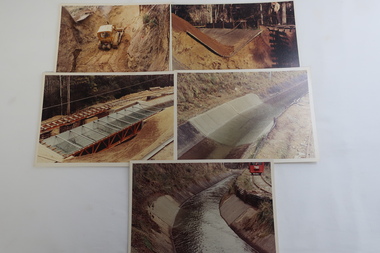
1. Colour photograph of large logs being milled for timber at a timber mill 2. Colour photograph of heavy machinery being used to harvest large logs for milling
Historical information
: Hume and Hovell discovered the area in 1824 and by the end of the 19th century the Kiewa Valley was transformed by logging, dairy and beef cattle properties and tobacco farms. The logs could have been milled for timber at the State Electricity Commission's mill at Howman's Gap which provided a much needed source of timber for construction of McKay Creek Power Station which began construction in 1951 and also the camps and houses for the workers and their families There was a need for housing and infrastructure for an increasing population of workers for the hydro-electric scheme as there was a general shortage of this commodity. A timber mill was started in Tawonga by Mates, of Albury, in 1945, and electricity became available in 1946 the S.E.C. bought the mill, and enlarged it. In 1960 it was purchase by a local family, they also started a timber mill in Mt Beauty worked both until 1980 when they closed the Tawonga mill and enlarged the mill called Mt. Beauty Timbers Pty Ltd which employed approximately 50 people.
Significance
An historical pictorial record of the type of machinery and vehicles in use in the 1950’s to harvest and mill the logs from surrounding forested areas.
Insulator - Porcelain large x3
Kiewa Valley Historical Society, Mt Beauty
White porcelain bell shaped insulator with an indent between the wide open end and the narrow closed end (for cable to be attached). The wide end is open with a white porcelain cylinder inside narrowing to thread for screwing in the narrow section.
Historical information
Insulates electrical wire/cable which is attached between narrow and wide ends of the 'bell' shape (in a groove). Screwed onto the cross arm of a power pole. Non conductive so electricity doesn't short out to the ground.
Significance
Used on power poles in the Kiewa Valley.
Book - Religious Education - Prayers New and Old
Kiewa Valley Historical Society, Mt Beauty
Bright shiny aqua small book with vertical black thin line 3 quarters of the way along from the spine. This black line goes through the middle of a picture of a book which is drawn in black with a rectangular of white around it. Title is in white and cursive script. Title is written in bold white print along spine. Back of book has ISBN number in black
Historical information
Students attended Sunday School classes at the Kergunyah Presbyterian Church. Sunday school was held in a little 16 foot square wooden building which came from Rocky Valley after it was no longer needed there. Ewen Wallace's father initiated and organised the move. C2011 the building was knocked down because of white ants. The Presbyterian Church will be 125 years old in 2015.
Significance
Historical: Religious Education: This book was used by students who attended the Sunday School classes at the Kergunyah Presbyterian Church. Religion: Presbyterian Church at Kergunyah, in the Kiewa Valley, celebrates its 125th anniversary in 2015 after being handed over to the uniting Church in the 1970s.
Inscriptions & Markings
Pencil inside on cover page "170" "3/MA" Pencil inside on back cover page 15 names listed and $2.40 Warwick, Ken, Debbie, Cameron, Thomas, Anna, Ricki, Glen Simpson, Brett, Mathew, Lorinda, Tracey, Luke, John, Megan
Sign - S.E.C.V.
Kiewa Valley Historical Society, Mt Beauty
Red, white, black and yellow steel sign with a circular hole at the top left hand corner. Used to warn people of danger near high voltage equipment. The back is white.
Historical information
The State Electricity Commission of Victoria used signs to warn people of danger when near high voltage equipment.
Significance
The S.E.C.V. built the Kiewa Hydro Electric Scheme from the late 1940s. Their towers and switch boards had high voltage equipment.
Inscriptions & Markings
Danger / High Voltage / Do Not Climb
Tin Tobacco / Cigarette
Kiewa Valley Historical Society, Mt Beauty
This tobacco/cigarette tin is constructed from tin plated thin rolled steel. The lid is attached by two pressed and formed (from the main frame) hinges using the nip and tuck construction method.The outside lid and frame has a yellow colour anodised to the metal.
Historical information
This particular brand of tobacco (State Express 555) was first made in 1915, and was most popular in Asia and China. The number triple 5 was mooted as a sacred number, and may have contributed to its high level of demand by Asian smokers. This would have been a favourite "smoke" for the Chinese emigrants, and especially those who settled in rural areas of Australia. In the era where 'male' type of activities such as motor racing, were sponsored by tobacco companies, roll your own cigarettes was ingrained as a macho male requirement. It was only in the early 2000s, when cigarette advertising had greater restrictions attached to the product, that the roll your own, and cigarettes in general, became less "cool". This particular cigarette tin would have also been useful for roll your own (ready rub tobacco)
Significance
The significance of this particular Qantas cigarette tin to this rural region is that it demonstrates that overseas travel by plane was not only for the affluent city dweller but also available, and not impossible to the inhabitants of the Kiewa Valley. This cigarette tin also may hint that the influx of Asian immigrants into this region where able to visit relatives back in Asia without too much effort. The use of a Qantas cigarette tin in the Kiewa Valley also suggests a degree of affluent there or tourists from elsewhere. This tobacco tin relays a long ago era, when personal contact, and not something that has been written down by some "unknown", was valued as the true appraisal of a member of the community. This was especially relevant in a small regional area such as the Kiewa Valley. Although social networking was not as fast then as the internet provides now, appearances, manners, fashion and etiquette with first impressions high on the order of evaluating someone in the community. Pointer such as the brand of tobacco smoked was part of the rural assessment method. Up until the demise of the Australian Tobacco Industry, circa 2004, the Kiewa Valley and surrounding district was part of a vibrant producer of tobacco leaves. The remnants of this industry still remain today but the drying sheds (for tobacco leaves) are now used to store hay for the valley's dairy and beef cattle industries.
Inscriptions & Markings
On the front of the lid are the following printed: "STATE EXPRESS" ,in yellow print, and below this are two horizontal lines in brown and central to these are the numbers "555" . Below this appears and within a 'royal' crest, in yellow writing on a brown circular background "STATE EXPRESS". Below this, in brown print, "PICCADILLY, LONDON". On each side of the tin are printed in brown colour: front side" ARDATH TOBACCO CO. LTD. PICCADILLY, LONDON" . On the left and right sides are printed in brown colour "20 STATE EXPRESS 555". On the rear side is with smaller print "MANUFACTURED UNDER ARRANGEMENTS WITH THE POPRIETORS". On the inside of the lid printed in red colour, are the following words, the royal crest and sketch of the winged kangaroo(symbol of the QANTAS logo). Within a red elongated square border, are the Royal Crest and in very small red print "BY APPOINTMENT TO HER MAJESTY THE QUEEN" underneath in slightly larger print "STATE EXPRESS" The print underneath this and in smaller print is "CIGARETTE MANUFACTURERS ARDARTH TOBACCO CO. LTD." Next to the royal crest and in much larger print is "STATE EXPRESS" and underneath this ,the numerals 555 with the words "CIGARETTES" below. The lower half of the inside lid has the following words and the "flying" kangaroo(winged). These words in written (running free hand) style "Specially packed for QANTAS(in red print). Underneath and in smaller print is "AUSTRALIA'S OVERSEAS AIRLINE". On the bottom of this tobacco tin is stamped into the metal surface, the number"704"
Folder - Tidy Towns - Tidy Towns Mount Beauty
Kiewa Valley Historical Society, Mt Beauty
This large blue coloured lever arch folder (cloth with a red lined border) has 104 plastic pockets each with two sheets of documentation for the appraisal of the decision makers/judges of the "Keep Australia Beautiful Council (Vic), "Tidy Towns" competition.
Historical information
This folder represents the true "Aussie" and the pride felt living in small rural communities. It was present in the period before the 1990's but fell so ever slightly away through the faster pace of the "modern" life evolution into a more "introspective" life style. The changes brought on by technology e.g. computers, mobile telephone "texting" and the internet has slowly impinged upon those community "get togethers" of the 1900's. Life in small rural towns and regions however have only slowly moved away from the community self worth attitudes which were so strong when life in rural areas was more insulated through physical and technologically isolation.
Significance
This Tiny Towns Folder with its content is highly significant to the small town of Mount Beauty and the Kiewa Valley and its region because it represents the "true" value of rural life in the "modern" Australia. The "old" values of "mateship" and looking after the community is still very strong in the rural sector, as compared with living in the cities. The psychological and physical benefits of living in smaller rural centres is clearly demonstrated by the contents of this "Tidy Towns", keep Australia Beautiful, competition. The value of "the true blue, dinky die mateship" is still very much alive in country towns and rural environments. Although the physical isolation of yesteryear may not be so strong as the technology and population growths boost a greater interaction between city and rural folk, the ingrained attitude of comradeship still prevades.
Inscriptions & Markings
Adhesive stickers on front cover "Tidy Towns" "Keep Australia Beautiful" below this "Mount Beauty"
Tin Tobacco
Kiewa Valley Historical Society, Mt Beauty
A dark metal tobacco tin covered in a bright metallic gold fleck pattern with a black frame on the lid around a drawing of a woodsman with a musket and axe sitting on a stump overlooking a valley that reads "Pioneer Brand", next to a company seal incorporating a wreath, eagle and shield. The front side reads "Richmond Cavendish Co./ Limited/ Liverpool." and the right and left side "Golden Flake Cavendish". The bottom has the same woodsman feature as the lid. The back side is an elongated diagram featuring tobacco leaves and plant summit. Inside lid surface has a half torn coloured (red, black and green) sketch on paper of the woodsman scene depicted on the top lid.
Historical information
This early tobacco tin was manufactured in England and imported to the "colony" Australia at the beginning of the 1900s. This manufacturer had won the Gold Medal at the Liverpool International Exhibition in 1884. This tobacco would have therefore been very expensive to purchase making it a must for the wealthier client of the Kiewa Valley. The Golden Flake Cavendish smells of the man of wealth and position. In this era the type of dress and the brand of tobacco smoked showed everyone at first glance where the man using it was on the social ladder and his pecking order. With the demise of tobacco smoking in the early 2000s clothes themselves do not show the pecking order in that quickly visualised manner, as at the time of manufacture of this tobacco tin. In the 21st century the level that men are in the socio economic field is realized on "the social information" available on the internet.
Significance
This tobacco tin relays a long ago era, when personal contact, and not something that has been written down by some "unknown", was valued as the true appraisal of a member of the community. This was especially relevant in a small regional area such as the Kiewa Valley. Although social networking was not as fast then as the internet provides now, appearances, manners, fashion and etiquette with first impressions high on the order of evaluating someone in the community. Pointer such as the brand of tobacco smoked was part of the rural assessment method. Up until the demise of the Australian Tobacco Industry, circa 2004, the Kiewa Valley and surrounding district was part of a vibrant producer of tobacco leaves. The remnants of this industry still remain today but the drying sheds (for tobacco leaves) are now used to store hay for the valley's dairy and beef cattle industries.
Inscriptions & Markings
The following inscriptions are displayed on the top and inside lid and on the bottom tobacco tin: "PIONEER BRAND" and to the left of the scene the "SEAL OF THE COMPANY TRADE MARK" Both side of the ens have the following words in large thick print "GOLDEN FLAKE CAVENDISH" and each is contained withih a black boarder.
Knuckle Bones
Kiewa Valley Historical Society, Mt Beauty
Two white knuckle bones from a sheep, used to play the game 'knuckle bones'
Historical information
During the 1950's a childhood game called 'knucklebones' was played by primary school girls. At least 2 people were required to play sitting opposite each other and going through the 'moves' (throwing the bones up from the back of your hand, picking up a bone from the floor and catching the others), using 5 knucklebones, as listed on written instruction that came with a coloured plastic version mass produced and with instructions.
Significance
During the 1950's games were played that required natural substances but increasingly extending to commercial equivalents.
Video - Fainter Falls - Fainter Falls
Kiewa Valley Historical Society, Mt Beauty
White cardboard cover with black plastic video labelled "Fainter Falls" on outer edge.
Historical information
Visual workings and development of the Fainter Falls Trail completed in 2008. The trail was originally accessible via a fire fighting access trail. The fire in the summer of 2003 highlighted the beauty of the area and provided the residents of the Kiewa Valley with the opportunity to consider the redevelopment of the trail. Work to establish a 700 metre grade 2 walking trail with a 50 metre grade 3 extension trail to the Falls began in 2005. It also includes 3 observation decks, a bridge over a creek crossing, car parking and interpretive signage.
Significance
This video recording is a visual recording of the process of the establishment of the Fainter Falls Walking Trail giving an insight into the process, the work, tools and materials used for such work from 2003 to 2008. It also shows the vegetation in the area and the amount of water flowing at the time.
Inscriptions & Markings
"Fainter Falls"
Book - Whitcombe's New Austral Grammars - a Fourth Book of Grammar and Composition for Grades V11 & V111
Kiewa Valley Historical Society, Mt Beauty
A greeny/grey book with cardboard cover and with bluish picture of 3 children sitting on a fence looking at a view of the countryside. The countryside is in a solid circle of blue. Border is black with ladder-like line about 2 mm wide. Bottom right corner in circle coloured blue is (in black) 2/- Title: in black Whitcombe's / New austral Grammars / A Fourth Book of / Grammar and Composition / for / Grades VII & VIII.
Historical information
Educational book for Grammar and Composition. Published for the Victorian Education Department.
Significance
Historical: Comparative with other text books used in schools in different eras.
Inscriptions & Markings
See physical description.
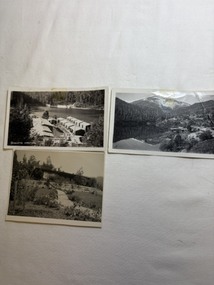
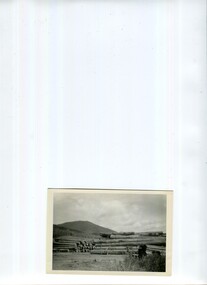
Photograph from Lake Guy, Bogong Village - Scene from shores of Lake Guy to Mountain range
Kiewa Valley Historical Society, Mt Beauty
This black and white photograph shot from the shores of Lake Guy toward the mountain range of the Victorian Alps details the early construction of the construction worker's accommodation of the Bogong Village. The paper is of 200gms and is not photographic paper and can be assumed to be a reproduction of an original photo
Historical information
In 1940 Field Headquarters for the Kiewa Scheme were established at Bogong with office, workshop facilities and accommodation for workmen, staff and some families constructed. (There had been a 'tent camp' on this site in 1939 but was destroyed by bushfires) Construction of accommodation continued until 1947. A total of 40 houses plus a hostel for single staff, post office, police station, medical centre and primary school all with water and sewerage and electricity supply. The staff hostel was known as Kiewa House and is now occupied by the Education Department. Lake Guy was named after Mr. L.T. Guy who was the Resident Engineer in charge of construction work and associated activities on the Kiewa area. He held this position from 1939 to November 1946 when he was transferred to Head Office.
Significance
The Bogong Township was developed firstly as an accommodation centre (base camp) for construction workers employed under the Kiewa Hydroelectric Scheme. Due to the influx of European workers into the Township the beautification of the immediate surrounds(gardens etc.) had a distinct European flavour. This environment has been very beneficial for tourism in later years. Strict environmental control has not allowed for any extensive redevelopment in tourist accommodation and basically restricted it to the accommodation initially built for the construction workers. Activities such a bike riding, snow skiing, restricted horse riding and bush walking on the Alpine plains and mountains are now a viable part of the Kiewa Valley Tourist Industry. The lake is one of the many water storage storage reservoirs used to supply the power stations their main power to run the huge turbines generating the final product, electricity
Pat Butter - pair
Kiewa Valley Historical Society, Mt Beauty
This pair of butter pats have been crafted from wood. One has one side with grooves running from the handle to the tip of the rectangle. the other side is smooth. These grooves would stop the wet butter from clinging to the pat. The top side of the pat has been bevelled. The second pat is longer and wider without grooves along the handle. This one also has 3 arrows on the handle pointing down towards the handle end and isn't bevelled.
Historical information
This type of butter mould was used by rural families in the Kiewa Valley to fashion/shape home/farm made butter either for domestic use or to sell locally.
Significance
Kiewa Valley was a dairying district with many farms in remote locations especially before the State Electricity Commission of Victoria built the Kiewa Hydro Electric Scheme from the 1940's.
Inscriptions & Markings
3 arrows.
Drill Auger
Kiewa Valley Historical Society, Mt Beauty
This cast iron hand operated drill, has a short barrel-shaped cylinder, known as "the eye" welded across the main rod and is 30mm in circumference. It also has a hole drilled to allow a screw to be fastened onto the hand stock ( not available).The main rod is solid for 400mm and then has been flattened and coiled (Helical screw blade) for another 200mm. At the end of the larger screw blade there is a smaller gauged starter blade with a pointer thread 15mm long. This Auger produces a 1/8th inch hole (metric measurement not used at time of manufacture) See KVHS 0469 for 3/4 inch hole and KVHS 0470 for another 1/8th inch hole.
Historical information
This item was before diesel, electric and battery drilling apparatus were used by farmers, and other trades requiring a portable yet reliable method of drilling holes. As this item is a 3/4 inch hole drill it would be suitable for fencing and providing holes for structural studs. As with all outdoor farm equipment, man power was required (be it the farmer or farm hands). Fitness of the operator was at a high standard but protective gloves were not highly thought of as it was before occupational, health and safety regulations became mandatory over all manual handling activities, be they on rural properties or town/city factories. This period was one where the male ego was at its pinnacle i.e. the harder the tasks the more of a man was required. Hard manual work was not only the "way to go" but also a necessity. Evolution of cheap portable electric/battery powered tools opened up a more efficient method available, especially to those with less muscle strength.
Significance
This item personifies the rugged environment of the rural workplace. The Kiewa Valley with its main emphasis on farming and grazing provided ample opportunity to use this construction implement. The manufacturer being a Scottish tool company is very significant in the era when this hole maker was in high demand. British steel products were of high grade and had a good record of reliability. The reliability of any tool was a solid factor for farmers and tradesmen in this semi-isolated region (Circa early 1900s) of the Kiewa Valley and its regional area. This factor,although not as crucial, post 1960s, when Asian manufacturers entered the market place and produced cheaper tools and transportation and supplies was more frequent and reliable, the need for the more expensive British made tools diminished considerably. After the influx of tradesmen from war torn Europe (post 1945) and the increased availability of tradesmen in the Kiewa Valley and its region the price of tools is not as crucial and the cost of all required tools has become a minimal part of the equation. It is only with the emerging younger trades person, farmer and grazier, who have more, "one eye on production costs" and no "old ties to the motherland" inert mind set that quality tools such as this auger and other hand tools "must be made to last a life time" is no longer part of the modern work environment.
Bottle - Cream
Kiewa Valley Historical Society, Mt Beauty
Clear glass bottle with straight sides three quarters of the way up from the base. It tapers in a little to the opening. There is a lip on the rim.
Historical information
Cream came in bottles bought at the local store or at a large city store on a shopping expedition. The shape of the bottles changed as did the stopper used to seal it.
Significance
Historical: Change of bottles - shape, size, stopper, embossing, use Aesthetic: Display showing embossing, size and shape
Inscriptions & Markings
Base: 626
Bottle - Wine
Kiewa Valley Historical Society, Mt Beauty
Dark green glass wine bottle with straight sides about half way up before tapering gradually to the neck and then the top. The base is indented. In the middle of the base there is a 'knob'. The bottle is hand finished.
Historical information
Wine was stored in bottles and bought at licensed premises either locally or in larger cities visited during shopping expeditions. The shape and colour of bottles varied. History of making glass and hand finishing.
Significance
Historical: Change of bottles - shape, manufacture, glass Aesthetic: Display showing colour & shape.
Inscriptions & Markings
Marked with bubbles in the glass and random ridges.
Box Spectacles
Kiewa Valley Historical Society, Mt Beauty
This brown coloured cardboard box was used by Coles and Garrard (Sight Testing Opticians) to transport spectacles to one of their clients. The box lid has four staples holding the four folded sides in place. The base is of similar proportions and fastened together.
Historical information
This eye wear transportation box was forwarded from and returned to Kiewa Valley in the 1960's. This period in time, the Kiewa Valley was still a semi remote location, and specialist eye facilities were not available in the region. It was not until the Australian Government proceeded with a "regional development Centre" (for relocating some Federal Departments from Canberra) that the Wodonga/Albury townships developed into a medium city, allowing "specialist" facilities to become available and multiply.
Significance
This item is very significant to the Kiewa Valley as it demonstrates that even in the 1960's early 1970's the Kiewa Valley residents still had to obtain "specialist" services from MELBOURNE. The "isolation" of the Kiewa Valley was still in place due to unreliable transport routes, long distance travel needed to visit cities and a relatively "small" population. The slow but progress marketing of recreational areas in the region and the movement of retirees away from "city violence" and to a quieter location has been on the increase. The expansion of the existing small airfield to one that can accommodate larger aircraft will hasten the expansion of the population in the region, bringing an ever increasing "visiting specialists" covering among other fields, eye and medical practitioners.
Inscriptions & Markings
Printed on the top outside lid, in small print "When forwarding your spectacles for repairs, your co-operation is requested in placing name and full address inside the packet. This will obviate delay in repairing and returning spectacles", underneath and in bold print "COLES & GARRARD pty ltd", underneath "Sight Testing Optticians" underneath "We visit over 100 towns in Victoria. Local Newspapers give full details"
Folder - Clare Roper No. 5 - Items of Interest
Kiewa Valley Historical Society, Mt Beauty
Orange plastic with clear front cover with 10 plastic sleeves / pages. Includes: North East Victoria. Rutherglen. Wallace's Hut - ownership and maintenance since classified by National Trust in 1970.
Historical information
Clare Roper was a resident of the Kiewa Valley and belonged to the Kiewa Valley Historical Society.
Significance
Clare Roper collected and collated items of historical interest for the Kiewa Valley Historical Society.
Bottle - Chemist
Kiewa Valley Historical Society, Mt Beauty
Small round brown opaque glass bottle with straight sides and sealed by a rusty screw top lid. Embossing on the base.
Historical information
Bottles were bought locally or in larger city stores on a shopping expedition.
Significance
Historical: Change of bottles - shape, size and use. Aesthetic: Display showing shape, colour and size
Inscriptions & Markings
Base: Common seal at top 'A' with 'G' and 'M' inside the A and across the middle 'G 764' and underneath 'M'
Educational Program - Two Years in the Infant School. Topics 1 to 21; 22 to 42; 43 to 63; 64 to 84
Kiewa Valley Historical Society, Mt Beauty
4 grey boxes which open up with a lid that is the shape of the box cut diagonally in half. The side opposite the hinge falls down as it is attached at the bottom (not the sides). Inside are a lot of pamphlets. Each topic is bound with string through 2 holes punched along the side. Each topic is numbered and of about 8 Sections which cover each area of the curriculum. eg. Topic 19 is 'Sugar' and has 14 pages. Box 1 has topics 1 to 21; Box 2 has topics 22 to 42; Box 3 has topics 43 to 63 and Box 4 has topics 64 to 84.
Historical information
This educational program was used at Mt Beauty Primary school possibly in the 1950s.
Significance
Historical: Mt Beauty primary School was establish in the late 1940s as a result of an increase in the population due to the Kiewa Hydro Electric Scheme. Provenance: As a new school it was considered to be very modern with the latest equipment. This program can be compared to other programs used in Education.
Inscriptions & Markings
Inside front of box in ink 'E.A. Plyton(?) On cover page: Two Years / in the / Infant School / Prepared / Under the Supervision of / Enid Blyton, N.F.U.
Bottle - Medical
Kiewa Valley Historical Society, Mt Beauty
Clear glass bottle with glass stopper. The part of the stopper that fits in the neck is opaque as is that part of the neck.Straight sides taper sharply in to neck. There is a torn white label on the bottle. The label has a blue line border. The label has hand written blue ink printing on it.
Historical information
This bottle was used in the Tawonga District General Hospital which was built in the 1950's specifically for the increase in population due to the Kiewa Hydro Scheme.
Significance
Historical: Shows the development of types of treatment used for cleaning wounds. Provenance: Used in the Tawonga District General Hospital which was remote.
Inscriptions & Markings
Label: 'Zephiran / 1 : 1000 / For Cleaning Wounds Base: F55 embossed
Bottle - Medical
Kiewa Valley Historical Society, Mt Beauty
Small clear brown bottle with screw top opening. Base is a rectangular shape. Heavily embossed on the front. Short narrow neck. Heavily embossed on the base.
Historical information
This bottle was used in the Tawonga District General Hospital which was built in the 1950's specifically for the increase in population due to the Kiewa Hydro Scheme.
Inscriptions & Markings
Front:'The J. R. Watkins Co. / Made in Australia Base: 'MG888'
Fan Personal
Kiewa Valley Historical Society, Mt Beauty
Personal hand fan (slide out sideways open). Cardboard screen on wooden spine frame. Main side bright coloured green trees on golden red and royal blue background. Wispy silver lined clouds, black branches and brown earth with moss. Flip side gold speckled on white background Bamboo like slivers
Historical information
Personal fan of Asian origin used by early immigrant family living in Kiewa Valley and indicative of the mixed heritages within the Valley. Personal Fan of vintage circa 1920s suggests middle to upper socio-economic level
Significance
Historically this item places certain ethnic group in the Kiewa Valley circa 1920's - 1950's. This personal fan indicates that it may have belonged to a middle class person with greater leisure time than that of a working class. The multicultural fabric of the region is also highlighted.
Telephone Handset Field
Kiewa Valley Historical Society, Mt Beauty
This sturdy field telephone has a shell housing made in black bakelite material with a "U" form housing the major components (wiring, magneto and batteries). The main housing has two metal bells, with a central ringer between both, on the top part (to notify incoming calls). In front of the main structure is a box with the telephone hand piece (ear and mouth receptacles) nestled on two cradles. An on/off switch is activated when handset is removed from its cradle. On the front of the control box is a winder handle(to ring off) and in a field situation to activate/deactivate the magneto. To the left of the winder but on the the main body are two wind up connection buttons for the connection of operational wires (power)
Historical information
This field telephone was developed primary for military purposes (World War I) and other wars/military interventions there after. It was the first "mobile" telephone which had a prime objective of providing isolated or "hard" to connect with locations instant communication links. Like a lot of "new" technologies it evolved from a war environment. This handset was used to connect offices and workshops, which due to their functions could not be co-located with their prime office(external workshops).The evolution from the early 1900s to the mid 1980s when mobile communication technology progressed in leaps and bounds from hard wire telephone communication to mobile digital receivers. This handset was manufactured by a subcontracted Australian company under the Australian Post Office mandate.
Significance
This handset is significant in that it was donated by the Mount Beauty Timber yards and formed an integrated part of its communication system with its out lying work yards and buildings, before the mobile handset evolution. This handset was located in an environment which required a rugged and reliable day to day communications linkage as a vital part of its logistical (business) survival. As progress demands it, the faster that customers are satisfied with the service they obtain from suppliers the longer those services will be asked for and the longer and more profitable the supplier will be. This edict is as true for rural companies as it is for small or large city businesses. The customer is "always" right.
Inscriptions & Markings
On the main right hand front body and next to two chrome switches is a plate with "L (next to the top switch) and below this "L2" and underneath this are "or" "EARTH". There is a plate fastened to the front of the handset and behind the winder with "REPLACE HANDSET WHEN FINISHED" and below the winder 'SERIAL NUMBER 5116"
Breast Reliever - Omega - Medical
Kiewa Valley Historical Society, Mt Beauty
Cardboard box with a label on the lid. Inside is a rubber bulb pump attached to a clear glass 'receiver'. The glass is a cylinder opening to an almost flat wide circular disc. On one side of the cylinder is a sphere opening to the cylinder presumably where the milk is collected.
Historical information
This medical / hospital instrument was used in the Tawonga District General Hospital which was built in the 1950's specifically for the increase in population due to the Kiewa Hydro Scheme.
Significance
Historical: Shows the development of scientific hospital equipment. Provenance: Used in the Tawonga District General Hospital which was remote and therefore required good equipment. Good condition and good interpretation capacity.
Inscriptions & Markings
Label: (Top Left):'Ingram's / London' / (On the right): 'Omega Breast Reliever / The finest quality / Rubber Bulb fitted / with a Glass Receiver / of approved design.' (Bottom left): Recommended by the / Medical & Nursing / Professions On rubber: Ingram's / London / Omega
Brush and Comb Set - Personal Item
Kiewa Valley Historical Society, Mt Beauty
Pig bristle hair brush with ovate head, narrow neck and smaller ovate handle. Cream [butter coloured] xylanite [ lined pattern] . Wide toothed matching comb.
Historical information
This brush & comb set was used by Mrs Rooks who lived in Mt. Beauty between 19 and 2 . It is typical of the sets that adorned dressing tables in the 1950s and 1960s. Could be part of a larger vanity set. Handle on brush indicates it is a ladies brush and not a mans. Today these types of items are becoming more collectible .
Significance
Historic, & social asignificance. As it is the only one in our collection it also has good interpretive capacity as it shows the types dresser sets or vanity set used for womens personal attirement during the 1950's.
Probes - Dental Instruments
Kiewa Valley Historical Society, Mt Beauty
Clear plastic sealed bag holding about 27 steel probes of different sizes. Used for Dental work.
Historical information
This dental instrument was used in the Tawonga District General Hospital which was built in the 1950's specifically for the increase in population due to the Kiewa Hydro Scheme.
Significance
Historical: Shows the development of scientific hospital equipment. Provenance: Used in the Tawonga District General Hospital which was remote and therefore required good equipment. Good condition and good interpretation capacity.
Inscriptions & Markings
On the bag in red handwriting 'Electric'
Photo - Bogong Village huts
Kiewa Valley Historical Society, Mt Beauty
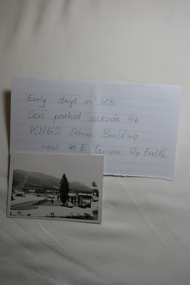
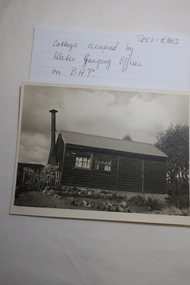
Black and white photograph of House Number 1 at Bogong Village
Historical information
Bogong Village was used between the 1930's -1950's by S.E.C.V. to house workers and their families on the Hydro Electricity Scheme
Significance
State Electricity Commission of Victoria (S.E.C.V.) construction of the Kiewa Hydro Electric Scheme. Housing for workers
Photographs – SECV – Clover Power Station
Kiewa Valley Historical Society, Mt Beauty
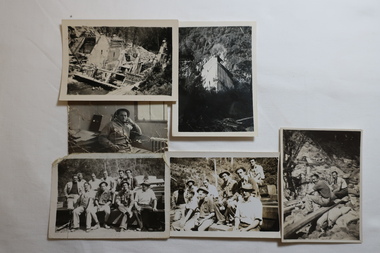
Set of black and white photographs taken by the official SECV photographer who gave each photo a number prefixed by K (for Kiewa) K1630- 23 Aug 1944 Clover Power Station K1633- no date Clover Power Station K1683- 10 Oct 1944 Weir K1700- no date Tail boy for Clover Power Station K1710- 11 Oct 1944 Part of aqueduct – Clover K1767- 6 Jan 1945 Switchboard in the power station K1769- 6 Jan 1945 Turbine and shaft K1770- 10 Jan 1945 Houses under construction at Bogong Village K1897- 22 Feb 1945 Equipment in the power station K1808- 22 Feb 1945 Equipment in the power station K1910- 31 May 1945 Top of the turbine and the shaft K1964- 16 Jul 1945 Equipment in the power station K1970- 17 Jul 1945 Bogong Village K1983- 30 Jul 1945 Turbine in power station K1984- 30 Jul 1945 Bogong Village K1989- 2 Aug 1945 Turbines in power station K1990- 2 Aug 1945 Equipment in power station K1991- 2 Aug 1945 Bogong village K2011- 28 Aug 1945 Equipment in power station K2015- 28 Aug 1945 Generators in power station K2016- 28 Aug 1945 Top of the turbine and the shaft K2018- 30 Aug 1945 Spiral casing, the turbine and the shaft
Historical information
The Junction Dam and Clover Dam Power Station, stages of the Kiewa Hydro-Electric Scheme, were needed to meet the increased power demands of the wartime industry in Victoria. Clover added 26 megawatts to the grid. Junction Dam was completed and ready to hold water by September 1943, but was emptied in December 1943 and not filled again until May 1944. Construction of Clover Power Station commenced in July 1941 and both turbines were in service by May 1945.
Significance
Clover Power Station and Junction Dam were part of the Kiewa Hydro Electric Scheme constructed by the State Electricity Commission of Victoria
Inscriptions & Markings
On the back- each photograph has a handwritten reference number starting with K and the date stamped or written
Auger
Kiewa Valley Historical Society, Mt Beauty
Small wood auger used to drill small holes in timber. It has a wooden cylindrical handle attached at right angles to a steel auger half of which is straight before twisting to a point.
Historical information
Augers are used to drill holes. Sizes vary as does the surface that they can drill into. Electric and cordless (battery operated) drills are more commonly used now.
Can Fuel Measuring
Kiewa Valley Historical Society, Mt Beauty
This specially spout fitted can was provided with the Coleman self heating kerosene iron (see KVHS 0347A). On one side of the half enclosed top of the can there is a small spout(for poring the appropriate liquid into the egg shaped fount container) at the rear end of the hand iron. The can is made from tin. See KVHS 0347B- Instruction sheet; KVHS 0347C- Wrench.
Historical information
The 1950's saw a revolution in small appliances for use in the average household. The hand held self heating(kerosene) iron for which this filling can was provided ,was introduced as a time saving and more convenient iron for pressing clothes and other cloth fabrics. It replaced irons needing an external fire source to heat the ironing plate. These irons continued to be in service, even when electricity was available in cities and larger rural towns. This item was used before and during the electricity supplies available from the Kiewa Hydro Electricity Scheme. These irons remained in use within regional rural areas that had limited or unreliable electrical reticulation and the ability to service them from this filling can was an essential part.
Significance
n the 1950s and later the Kiewa Valley was still a relatively isolated region which was home to rural properties and small settlements. The availability of electricity and or the financial means to afford new types of electric hand irons ensured that older and sometimes less efficient ironing appliances remained for an extended period covering the 1960s to 1970s. Kerosene products, such as the kerosene self heating (KVHS 0347A) iron and this kerosene filling item, was a cheaper method for farm based domestic and other rural activities requiring a heat source. The use of kerosene as a heat/light source was able to be supplied in bulk and able to be used when floods severed vital roads into this region. The supply of electricity was in summer time subject to interruption from bush fire damaged wooden poles carrying the electrical cables. Self sufficiency by rural populations was the backbone of survival and the ability to store energy sources "on the farm" was a prerequisite of isolated regions, such as the Kiewa Valley, circa 1950s.
Inscriptions & Markings
On one side of the can in black print on yellow background is "FUEL MEASURING CAN" underneath is "For Coleman Instant-Lite Iron" underneath are four numbered paragraphs detailing the use of this can. Below this is the name and places of manufacture. On the other side of the can is printed "BE SURE" with filling and maintenance instructions
Photographs –Collection of copies of black and white photographs and printed articles relating to skiing on the Bogong High Plains
Kiewa Valley Historical Society, Mt Beauty
Collection of copies of black and white photographs and printed articles relating to skiing on the Bogong High Plains. Some pieces have been enlarged to A3 poster size copies for display purposes 1. Copy of black and white photograph of group of skiers at Falls Creek 2. Copy of photograph of early skier on Bogong High Plains with temporary buildings and tents in the background 3. Copy of photograph of 3 skiers on Mt McKay 4. Copy of SECV photograph of Rocky Valley Camp under snow 5. Early sepia photograph of Falls Creek village with skiers in the foreground 6. Copy of a page from booklet (SECV?) promoting the benefits of owning a holiday home in the Bogong Village area 7. Copy of a page from booklet (SECV?) promoting the benefits of holidaying in and around Falls Creek/Mt Beauty
Historical information
After World War II, the Kiewa Hydro-Electric Scheme was started in the Kiewa River Valley by the State Electricity Commission of Victoria. On land previously used only for summer cattle grazing in the natural alpine grasslands, the first ski lodge was built in 1948 by workers from the hydro scheme as skiing was a popular recreation. Many of the hydro employees were of European background and had grown up enjoying skiing and snow sports in their homelands and were keen to continue to pursue their winter sports interests. The first lift, a rope tow, was built in 1951 at Falls Creek and the first chairlift in Australia was constructed there in 1957. Two T-Bars were opened in 1961. In 1964, the Victorian Municipal Directory recorded that Falls Creek had 29 ski club lodges and 16 commercial lodges. The area became a popular tourist destination for both winter and summer sports.
Significance
: Employees of the State Electricity Commission of Victoria in the Kiewa River Valley were the earliest skiers on the Bogong High Plains and built one of the first ski lodges at Falls Creek. They were amongst those pivotal in the development of the skiing and tourist industry at Falls Creek and on the Bogong High Plains.
Inscriptions & Markings
1. Bogong Ski Club Members & Friends 1944 2. Jack Neve – electrician. Rocky Valley 3. 17.5.55 Skiers ascending Mt McKay 4. State Electricity Commission of Victoria. Date:17.8.55 No:K8132 Kiewa Hydro Electric Works. Rocky Valley Camp – From Engineering Office 5. No markings 6 & 7 Short article relating to photos on each page
Bottle - Medical
Kiewa Valley Historical Society, Mt Beauty
Hypothecary bottle of clear green glass with screw top. Front and base are heavily embossed.
Historical information
This bottle was used in the Tawonga District General Hospital which was built in the 1950's specifically for the increase i population due to the Kiewa Hydro Scheme.
Inscriptions & Markings
Front: Gauge with horizontal lines equal distance apart - at the top 'CC' and going down on every second line - 100, 200, 300, 400, On each side 10 vertical lines. Base:'PGC' '5' in middle '1FG-L'
Photographs – Set of 25 colour photographs of the street parade to celebrate the first Official Hoppet race run at Falls Creek in 1991
Kiewa Valley Historical Society, Mt Beauty
PHYSICAL: Set of 22 colour photographs of the street parade to celebrate the first Official Hoppet race run at Falls Creek in 1991. Participants from a range of local community groups are traveling along Kiewa Cres. Photos are taken near the corner of Maddison St 1&2 – Horseman & accordion player leading the parade Sign reads ‘Falls Creek The Happy Mountain’ 3-4 Birkbeioner Nordic Ski Club with Chinese Nordic ski representatives 5 & 6- Girl Guides & Brownies 7, 8 & 9- Mt Beauty Primary School & Netball team 10 & 11- UKV Calisthenics Club 12- Lawn Bowls Club 13- Junior Football Club 14- Mt Beauty High School Band (on Wodonga Timber & Hardware truck) 15, 16 17 & 18- Mt Beauty Kindergarten 19,20, 21 & 22- Local Community Vehicles including Community Transport and Fire Brigade 23 & 24- Mt Beauty High School Band 25- Fiat 500 Topolino Vintage Car
Historical information
In 1977 a group of Mount Beauty cross country skiers formed the Birkebeiner Nordic Ski Club. In 1979, a version of the famous Birkebeiner race, the first Australian Birkebeiner was held at Falls Creek. In June 1990 representatives from Australia put their case for a southern hemisphere race in the series. Following a trial event in 1990. Australia became the 12th member of Worldloppet in the winter of 1991, with the first Kangaroo Hoppet. In 1991 a parade and commemorative torch lighting ceremony were organised in Mt Beauty as part of the celebrations to mark the first official Kangaroo Hoppett with participation from local community groups and commercial organisations, the Chamber of Commerce, local government representatives and individuals.
Significance
Kangaroo Hoppet caters to diverse interests by offering a 42km and 21km event. It also offers a 7km event that attracts skiers, ranging from elite juniors to parents, grandparents, babies and first time skiers. It is recognised on the world cross country ski race calendar. It brings large numbers of participants and spectators to the area which support tourism, local businesses and employment. The 2018 event will be the 28th Kangaroo Hoppet, with cross country skiers travelling from across the country and overseas to compete.
Inscriptions & Markings
No markings
Tracheotomy Tubes
Kiewa Valley Historical Society, Mt Beauty
6 metal tubes attached to white tape. the tubes are hollow with a hole midway in 3 of them. Shaped like a curved horn. At the broad end is an egg shaped shield with a square hook on each of the longer sides.
Historical information
This medical / hospital equipment was used in the Tawonga District General Hospital which was built in the 1950s specifically for the increase in population due to the Kiewa Hydro Scheme.
Significance
Historical: Shows the development of scientific hospital equipment. Provenance: Used in the Tawonga District General Hospital which was remote and therefore required good equipment. Good condition and good interpretation capacity.
Inscriptions & Markings
Inscribed: x3 ALLAN & HANBURYS LTD / LONDON on shield 26 on the other side; RAMSAY on the other 3
Book - Pupil Text Book - New Algebra for Schools by Clement V. Durell, M. A.
Kiewa Valley Historical Society, Mt Beauty
Parts 1 and 11 With Appendix With Answers. Stained pale green hard covered book with black writing on cover and spine. 'Bell' on spine.
Historical information
This book has been reprinted many times during the 1930s and 1940s.
Significance
This book may have been used by a student in the Kiewa Valley as it was donated to the KVHS.
Boyle Davis Tongue Depressor
Kiewa Valley Historical Society, Mt Beauty
In sterilized packet. A metal instrument mostly 2 sided, third side being very short slightly rounded and at right angles to the long side. . Long side has grooves embossed on the outside. Second side is at right angles to the long side (at other end) and is shaped like a tongue, with small embossed grooves on the inside and a metal hollow attachment on the outside that comes up near the junction of the two lengths.
Historical information
This medical / hospital instrument was used in the Tawonga District General Hospital which was built in the 1950s specifically for the increase in population due to the Kiewa Hydro Scheme.
Significance
Historical: Shows the development of scientific hospital equipment. Provenance: Used in the Tawonga District General Hospital which was remote and therefore required good equipment.
Inscriptions & Markings
Grooves on 2 sides.
Booklet - S.E.C.V. - Cooking for Christmas
Kiewa Valley Historical Society, Mt Beauty
Small 12 page booklet with soft cover and two staples binding it. Cover has coloured photos of plates of food with the title in green at the top.
Historical information
The State Electricity Commission of Victoria's Home Advisory Service prepared this collection of recipes. They also assisted with advice and information on the best use of electricity in the home. The S.E.C. sold electrical appliances at their showrooms, one of which was located in Mt Beauty where this booklet came from.
Significance
The S.E.C.V. constructed the Kiewa Hydro Electric Scheme employing many workers. They built the townships of Bogong and Mt Beauty and assisted with the infrastructure required to support the influx of population. In the Mt Beauty shopping centre, one of the shops was the S.E.C. Showroom which sold electrical appliances and gave advice on their use along with recipe booklets for cooking on the new electrical appliances.