
Showing 28 items matching "centenary trophy"
-
 Royal Melbourne Yacht Squadron
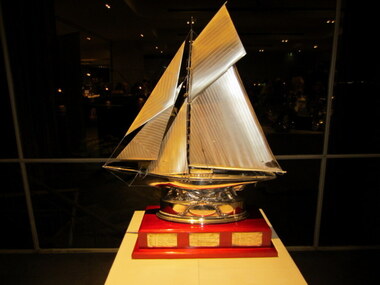
Award - Centenary Trophy
... Centenary Trophy...Centenary Trophy...To mark the Centenary of the Squadron, H.V. (Rusty) Foreman re-donated old trophy of unknown origin in February 1978. ...CENTENARY TROPHY PRESENTED BY H.V. (RUSTY) FOREMAN FOR THE MOST CONSISTENT PERFORMER DURING THE SEASON 1978...Awarded by reviewing the number of races at RMYS and Block Entry races that a yacht competes in and balancing this with the minimum change in VYC handicap during the Season. Centenary Trophy CENTENARY TROPHY PRESENTED BY H.V. ...To mark the Centenary of the Squadron, H.V. (Rusty) Foreman re-donated old trophy of unknown origin in February 1978. For the Squadron’s most consistent Yacht in VYC handicapping, on the Club Course for the Season. It was first won Season 1977-78 by Les R. Williams with Aquarius. Awarded by reviewing the number of races at RMYS and Block Entry races that a yacht competes in and balancing this with the minimum change in VYC handicap during the Season.Pewter Gaff–rigged Cutter Yacht, 500mm long mounted on 100mm high rectangle redwood base. Silver rectangular winners inscription plaques around edge of base.CENTENARY TROPHY PRESENTED BY H.V. (RUSTY) FOREMAN FOR THE MOST CONSISTENT PERFORMER DURING THE SEASON 1978centenary trophy -
 Glenelg Shire Council Cultural Collection
Souvenir - Commemorative Sandwich Plate - The MacRobertson Trophy Air Race, c. 1934
... From Wikipedia: The MacRobertson Trophy Air Race (also known as the London to Melbourne Air Race) took place in October 1934 as part of the Melbourne Centenary celebrations. ...From Wikipedia: The MacRobertson Trophy Air Race (also known as the London to Melbourne Air Race) took place in October 1934 as part of the Melbourne Centenary celebrations. ...From Wikipedia: The MacRobertson Trophy Air Race (also known as the London to Melbourne Air Race) took place in October 1934 as part of the Melbourne Centenary celebrations. The race was devised by the Lord Mayor of Melbourne, Sir Harold Gengoult Smith,[1] and the prize money of £15,000 was provided by Sir Macpherson Robertson, a wealthy Australian confectionery manufacturer, on the conditions that the race be named after his MacRobertson confectionery company, and that it was organised to be as safe as possible.[2] A further condition was that a gold medal be awarded to each pilot who completed the course within 16 daysClear glass sandwich plate, commemorating the Air Race from UK to Australia. Map of UK and Australia, aeroplanes, etched into glass.Front: VICTORIAN AND MELBOURNE CENTENARY 1934-1935 - etched from beneathuk australia air race, macrobertson air race, 1934, melbourne centenary -
 Orbost & District Historical Society
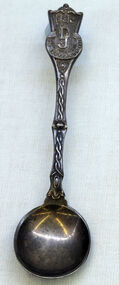
spoon, 1938
... The bottom part of the trophy is embraced by a scroll with the inscription '1838 CENTENARY 1938', the reeded body of the cup features overlapping initials 'DJ' in the centre and the number '100' applied just below the domed cover with a ball finial. ...CENTENARY 1938', 'DJ' and '100'. A small spoon in electroplated silver with a circular bowl and flat handle terminating in a flat finial in the form of a stylised covered cup (trophy). ...Used as advertising for David Jones centenary (1838-1938). A small spoon in electroplated silver with a circular bowl and flat handle terminating in a flat finial in the form of a stylised covered cup (trophy). The bottom part of the trophy is embraced by a scroll with the inscription '1838 CENTENARY 1938', the reeded body of the cup features overlapping initials 'DJ' in the centre and the number '100' applied just below the domed cover with a ball finial. The back of stem is stamped with two marks 'EPNS' and 'ENGLAND' in an oval. Inscription on finial '1838 CENTENARY 1938', 'DJ' and '100'.spoon souvenir david-jones silver centenary -
 Phillip Island and District Historical Society Inc.
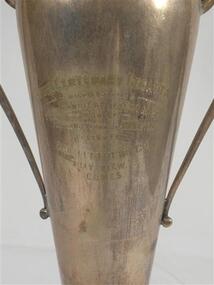
Prize Cup, 01-03-1935
... centenary of the settlement of Melbourne. The "Mayflower" was built by the owner Joseph Nicholas Walton who was a fisherman and carpenter. local history trophies & awards sports silver cup yacht race cowes centenary regatta The Mayflower J N Walton Cowes Centenary Regatta. ...The Regatta was held to celebrate the centenary of the settlement of Melbourne. The "Mayflower" was built by the owner Joseph Nicholas Walton who was a fisherman and carpenter.Silver Cup atached to black bakelite stand with two handles.Cowes Centenary Regatta. Open Handicap Yacht Race won by "Mayflower" owned by J. M. Walton. Presented by C. H. Matthews, Esq, "Bayview" Cowes.local history, trophies & awards, sports, silver cup, yacht race, cowes centenary regatta, the mayflower, j n walton -
Ringwood and District Historical Society
Container, Ringwood Garden Club Inc - Tub of Artefacts and Documents to be catalogued
... Trophy for Amateur Cut Flowers: winners from 1973 to 1987. Old Photograph: From the Royal Agricultural Society of Victoria, awarded at the Royal Melbourne Show in 1947, First Prize, Ringwood. Certificate: From the Melbourne City Council: Festival of Progress, held in 1951, to Commemorate the Centenary...Trophy for Amateur Cut Flowers: winners from 1973 to 1987. Old Photograph: From the Royal Agricultural Society of Victoria, awarded at the Royal Melbourne Show in 1947, First Prize, Ringwood. Certificate: From the Melbourne City Council: Festival of Progress, held in 1951, to Commemorate the Centenary ...RINGWOOD GARDEN CLUB INC. The following is a list of items that are stored at the RDHS Archive site, from the Ringwood Garden Club. This box of items does not include all the archival items from the Club, the Minutes will be kept at the home of the Archive Officer. Medal: From the Royal Horticultural Society of Victoria. Won at Box Hill show, in 1978. Badge: An early Ringwood Horticultural & Agricultural Society badge. Old Photograph: “Judging the Fruit Exhibits”, circa 1908. Certificate: 3rd. Prize at the 2009 Hanging Basket Competition, from the R.H.S.V. Shield: From the National Dahlia Society of Victoria, Annual Inter Society Championship In 1975. Won by the then: Ringwood & District Horticultural Garden Club. Tray: The Bill McDowell Perpetual Trophy for Amateur Cut Flowers: winners from 1973 to 1987. Old Photograph: From the Royal Agricultural Society of Victoria, awarded at the Royal Melbourne Show in 1947, First Prize, Ringwood. Certificate: From the Melbourne City Council: Festival of Progress, held in 1951, to Commemorate the Centenary of Victorian Government. Certificate of Merit: from past winners at shows. (5) Certificates: 2 unused Certificates of Merit, 1 unused Champion certificate. Garden Competition Certificates: from 1959 to 1981. Poster: Early Autumn Show poster displayed in shop Windows. Hortico Prize Certificates: 2 unused, $10.00 & $5.00 value. Tape Recording: Recorded history of the Ringwood Garden Club, talk given by the late Hugh McCall on 23/9/1996, Club’s centenary. Prize Cards: 41 First Prize” cards from Mrs. D. Holloway & 27 “Second Prize” cards, from 1956 to 1960. Prize Cards: 2 First Prize & 1 Second Prize card from Mrs. Holloway at the 1st. Heathmont Boy Scouts in 1958. Prize Cards: 4 Prize Cards from the Upwey & District Garden Club. 3 lsts., 12nd. Prize Card: from the Boronia & District H & A. Society: 1st. Prize, (no other information) Prize Card: from the R.H.S.V.: Second Prize for 1 Vase of Daffodils, Mr W Rosel. Prize Card: from the Dandenong Ranges Floral Festival, Easter Show, First Prize, Mrs Holloway in April, 1957 plus a Second Prize, same year. Prize Card: from the Mitcham Horticultural Society, Autumn Show, Mrs Holloway, 1 Bowl of Floating Flowers in 1958. Laminated Certificates: from the Great Victorian Hanging Basket Competition by the R.H.S.V. (no years mentioned) Club Syllabus: from 1980 to 2015. Photographs: from winners at our shows and judges at those shows. Ribbons: Ringwood Horticultural Society, 1962, Champion, Exhibit in Vegetables. Upwey & District Garden Club, 1977, Jubilee Carnival of Flowers. Ringwood garden Club, Vic. Large Dahlia Championships, 1983,6 Dahlias, D.V.’s. National Dahlia Soc. of Vic., Autumn Show, 1975, Inter-Societies Championship. Upwey & District Garden Club, 1980 Carnival of Flowers, Mountain Dist. Cham’s. “ “ “ “ , Spring Show, 1973. “ “ “ “ , Carnival of Flowers, 1984, Inter Society Exhibit. “ “ “ “ , “ “ “ , 1982. Best Exhibit. Healesville Garden Club: Autumn Show, Best Exhibit, Cut Flower Section. Ringwood Garden Club, Autumn Show, 1964, Best Exhibit in Vegetables. Upwey & District Garden Club, 1974 Carnival of Flowers. Ringwood Garden Club, Spring 1986, Best Exhibit in Junior Cookery. Ringwood & District Hort. & Graden Club, Autumn Show, 1974, Best Floral Art. Ringwood garden Club, Autumn 1989, Ringwood Amateur Dahlia Championship, Ringwood Horticultural Society, Autumn Show, 1963, Best Exhibit in Vegetables. Ringwood H & A Society: Autumn Show, 1957, Best Exhibit Floral Art. Ringwood & District Horticultural & Garden Club, Spring Show, 1973, Best Floral Art Exhibit. Upwey & District Garden Club, Carnival of Flowers, 1985. Mountain District Championships, Inter-Society Exhibit. Yarra Glen A. & H. Society Inc. Annual Show: small blue sash-style ribbon. Small Ribbons: from Victoria 150, a second (red) & 3rd. (green) Felt Badges: 1 green for Secretary: 1 blue for Judge. Rosette: 3rd. Prize at the Hanging Basket Competition in 2009. Blue Folder: contains photographs, prize cards, certificates, awards, etc. Albums: 4 photo, albums of garden shows, floral art, Spring Celebration photos and Newspaper articles. * All items placed in the container were placed there on 2nd. September, 2019. -
 Eltham District Historical Society Inc
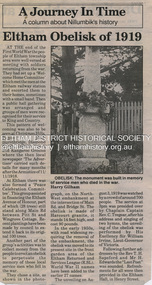
Folder, Eltham Obelisk (later Cenotaph), 1918-2018
... Centenary, 2013 45. Newspaper article: Memories of our heroes, Diamond Valley Leader, 25 Apr 2018 – also Veteran saluted, featuring article on Army veteran, Glen Ferrarotto. eltham cenotaph nillumbik shire council eltham war memorial montmorency eltham rsl sub-branch dawn service cenotaph eltham rsl sub-branch eltham war memorial trust garden of remembrance harry gilham collection john cohen obelisk remembrance garden shillinglaw trees German Machine Gun war memorial War Trophy Contents: Newspaper article: Eltham Obelisk of 1919, Harry Gilham, August 2000 as well as draft submitted dated 22 Aug 2000 Newspaper article: Eltham, The Advertiser 15 Nov 1918 and 18 Nov 1918 Newspaper article: An Obelisk at Eltham, The Advertiser, 11 Jul 1919 Newspaper advertisement: Unveiling of Obelisk at Eltham, The Advertiser, 1 Aug 1919 Newspaper article: Eltham Soldiers’ Memorial; Unveiled by Sir William Irvine, The Argus, Monday, 4 Aug 1919, p8 Newspaper article: Eltham Memorial to Fallen Soldiers, Diamond Creek Valley Advocate, 8 Aug 1919 Newspaper article: Memorial to the Fallen; Unveiled at Eltham, The Age, Monday, 4th August 1919 Newspaper article: Programme - Presentation of German Machine Gun at the Obelisk, Eltham on Sunday, 8th August, 1920, at 3.30 P.M. ...The Eltham Obelisk was originally located at the corner of Bridge and Main Roads in 1919. It commemorated the memory of the Eltham Soldiers who fell in the First World War and complemented the Eltham Avenue of Honour established in 1917 to those that served. In 1943 (WW2) the local community commenced plans to establish the Eltham War Memorial, a living memorial to benefit the children as opposed to a one in stone as per the obelisk. The Eltham War Memorial Trust was established in 1945. In 1947 the Trust intended for the Obelisk to be relocated from Bridge Street and Main Road to the Garden of Remembrance which was planned as part of the Baby Health Centre which was to be the first of three buildings of the Eltham War Memorial to be built in 1951. In 1951 the Eltham RSL was invited to be represented on the Eltham War Memorial Trust. During the period of June through October 1956 the original wooden bridge over the Diamond Creek in Bridge Street was replaced with a new concrete structure. At the same time the intersection of Bridge Street at Main Road was revised necessitating the relocation of the Eltham Obelisk. It was ‘temporarily’ relocated to the front garden of the Eltham RSL Sub-Branch on Main Road for safe keeping. In 2007, a suggestion was proposed by Harry Gilham (President, EDHS) to John Cohen (ERSL) to claim a special site along with the historic Shillinglaw trees on the now vacant former Eltham Shire Office site adjacent to the Eltham War Memorial precinct for relocation of the obelisk. In 2010 following the financial collapse and sale of the Eltham RSL Sub-Branch property and amalgamation with the Montmorency Eltham RSL sub-branch, the location of the obelisk was again in immediate jeopardy and in conjunction with Nillumbik Shire Council, supported by the RSL, the obelisk was relocated in front of the Eltham War Memorial buildings in preparation for the Dawn Service on Anzac Day 2012. The new location resulted in significant impact upon the Eltham War Memorial Garden. Council’s preferred location was near the Eltham Library however that would have cost $39,000. The Eltham War Memorial Garden was subjected to further intrusion in 2014 with a proposed expansion of the War Memorial Terrace. Contents: 1. Newspaper article: Eltham, The Advertiser, 15 Nov 1918 2. Newspaper article: Eltham, The Advertiser, 18 Nov 1918 3. Newspaper article: An Obelisk at Eltham, The Advertiser, 11 Jul 1919 4. Newspaper advertisement: Unveiling of Obelisk at Eltham, The Advertiser, 1 Aug 1919 5. Newspaper article: Eltham Soldiers’ Memorial; Unveiled by Sir William Irvine, The Argus, Monday, 4 Aug 1919, p8 6. Newspaper article: Memorial to the Fallen; Unveiled at Eltham, The Age, Monday, 4th August 1919 7. Newspaper article: Eltham Memorial to Fallen Soldiers, Diamond Creek Valley Advocate, 8 Aug 1919 8. Newspaper article: Programme - Presentation of German Machine Gun at the Obelisk, Eltham on Sunday, 8th August 1920, at 3.30 P.M. 9. Newspaper article: article about presentation of a war trophy, a heavy machine gun placed beside obelisk, The Advertiser, 13 Aug 1920 10. Newspaper article: Eltham: ANZAC Services, The Advertiser, Friday, May 2, 1924 11. Newspaper article: Eltham War Memorial, The Advertiser, Oct 26, 1928 12. Newspaper article: Obelisk honors their memory, Diamond Valley News, March 30, 1971, p11 13. Newspaper article: Eltham Obelisk of 1919, Harry Gilham, August 2000 as well as draft submitted dated 22 Aug 2000 14. Newspaper article: Names renewal, thanks to Barry, Diamond Valley Leader, 18 Apr 2007, p3 with picture featuring Eltham RSL president John Haines and Gwen Rosewall 15. Handwritten note from Harry Gilham (President EDHS) to John Cohen (ERSL) regarding history of Eltham RSL site and 1947 newspaper article "Eltham War Memorial Trust "Garden of Remembrance" referencing relocation of Obelisk to the proposed Garden of Remembrance at the Baby Health Centre (Eltham War Memorial), 24 December 2000. 16. Minutes of Eltham RSL and Community Meeting held at 29 Nyora Road, Eltham, 23 June 2010 (Community meeting re closure of Eltham RSL sub-branch and relocation of the WW1 Obelisk) 17. Newspaper article: RSL branch has a fight on its hands by Alana Schetzer, Heidelberg & Valley Weekly, 3 August 2010, p7 18. Newspaper article: Locals battle state RSL over building, Diamond Valley Leader, 4 August 2010, p7 19. Newspaper article: Move war memorial: RSL, c. Dec. 2010 20. Officers' reports, 11.113/10 Relocation of Eltham RSL Cenotaph, Nillumbik Shire Council Ordinary Meeting, 21 December 2010 21. Newspaper article: New home for cenotaph; Councillors support proposal for relocation to Eltham's War Memorial Hall, Diamond Valley Leader, 12 January 2011 22. Newspaper article: CFA hot for RSL site; MP presses for 'fast-track' purchase, Diamond Valley Leader, 23 February 2011, p1 23. Email Correspondence: EDHS President to NSC General Manager Community and Leisure re RSL Obelisk (Cenotaph) proposed relocation, 24 May 2011 24. Officers' reports, OCM.091/11 Interim Relocation site for the Eltham Cenotaph, Nillumbik Shire Council Ordinary Meeting, 23 August 2011 25. Newspaper article: New home for cenotaph delights war veterans, Diamond Valley Leader, 31 August 2011, p9 26. Newsletter Extract: Eltham RSL and War Memorial, EDHS Newsletter 14 Sep 2011 27. Officers' reports, OCM.004/121 Interim Relocation of the Eltham Cenotaph, Nillumbik Shire Council Ordinary Meeting, 31 January 2012 (includes Funding agreement between NSC and Montmorency-Eltham RSL Sub-branch Inc) 28. Newspaper article: Memorial move lags, Diamond Valley Leader, 1 February 2012 29. Site history of Obelisk and Wall Memorial Hall, Montmorency-Eltham RSL, March 2012 draft 30. Open Letter to the Residents of ELTHAM and MONTMORENCY [And their Surrounding Districts]; Montmorency-Eltham RSL, 19 March 2012 (including drafts) 31. Newspaper advertisement: Open letter to the residents of Eltham and Montmorency, Montmorency Eltham RSL, Diamond Valley News, 21 March 2012 32. Newspaper advertisement: Open letter to the residents of Eltham and Montmorency, Montmorency Eltham RSL, Banyule & Nillumbik Weekly, 27 March 2012, p7 33. Newspaper article: New dawn for tribute, Diamond Valley Leader ca April 2012 34. Email (Copy): Alex Smith (MERSL Ast. Sec.) advising that contractor (Malcorp) will relocate obelisk Monday, April 2, 2012 35. Newspaper article: Memorial Moved, Banyule/Nillumbik Weekly, 10 April 2012 36. Newspaper article: Eltham cenotaph move goes 'like clockwork', Diamond Valley Leader, 11 April 2012 37. Newspaper photo: Veterans (l-r) Alan Field, Max Lowerson and John Cohen will join piper David Cretney to commemorate fallen Diggers, 2012 (standing beside relocated obelisk in front of the Eltham War Memorial complex), c. 11 April 2012 38. Advertisement, Program for Eltham Dawn Service, Diamond Valley Leader, April 2012 39. Program for Montmorency Anzac Day March 2012 (incomplete, some pages duplicated, some pages upside down). 40. Newspaper article: RSL site nets $1.8m, Diamond Valley Leader, 9 May 2012 41. OCM.076/13 Amendment C84 Eltham Cenotaph; 11. Officer's reports, Ordinary Meeting of Council Agenda, 25 June 2013, pp42-44 and Attachment; Amendment C84 Eltham Cenotaph; Citation - Eltham War Memorial (4 pages) 42. Newspaper article: Council seeks to protect cenotaph, Diamond Valley Leader, Wednesday, July 3, 2013, p5 43. Newspaper article: Future safe for war memorial, Diamond Valley Leader, Wednesday, November 13, 2013, p5 44. Handwritten notes in pencil (2 pages) by Harry Gilham, Items form the Eltham and Whittlesea Shires The Advertiser newspaper 7 June 1918 - 1919 providing a summary of the formation of the Peace Celebration Committee leading to the establishment of the Avenue of Honour and the Eltham Obelisk and seeking information in lead up to WW1 Centenary, 2013 45. Newspaper article: Memories of our heroes, Diamond Valley Leader, 25 Apr 2018 – also Veteran saluted, featuring article on Army veteran, Glen Ferrarotto. Contents: Newspaper article: Eltham Obelisk of 1919, Harry Gilham, August 2000 as well as draft submitted dated 22 Aug 2000 Newspaper article: Eltham, The Advertiser 15 Nov 1918 and 18 Nov 1918 Newspaper article: An Obelisk at Eltham, The Advertiser, 11 Jul 1919 Newspaper advertisement: Unveiling of Obelisk at Eltham, The Advertiser, 1 Aug 1919 Newspaper article: Eltham Soldiers’ Memorial; Unveiled by Sir William Irvine, The Argus, Monday, 4 Aug 1919, p8 Newspaper article: Eltham Memorial to Fallen Soldiers, Diamond Creek Valley Advocate, 8 Aug 1919 Newspaper article: Memorial to the Fallen; Unveiled at Eltham, The Age, Monday, 4th August 1919 Newspaper article: Programme - Presentation of German Machine Gun at the Obelisk, Eltham on Sunday, 8th August, 1920, at 3.30 P.M. Newspaper article: article about presentation of a war trophy, a heavy machine gun placed beside obelisk, The Advertiser, 13 Aug 1920 Newspaper article: Eltham: ANZAC Services, The Advertiser, Friday, May 2, 1924 Newspaper article: Eltham War Memorial, The Advertiser, Oct 26, 1928 Handwritten note from Harry Gilham (President EDHS) to John Cohen (ERSL) regarding history of Eltham RSL site and 1947 newspaper article "Eltham War Memorial Trust "Garden of Remembrance" referencing relocation of Obelisk to the proposed Garden of Remembrance at the Baby Health Centre (Eltham War Memorial). Officers' reports, 11.113/10 Relocation of Eltham RSL Cenotaph, Nillumbik Shire Council Ordinary Meeting, 21 December 2010 Email Correspondence: EDHS President to NSC General Manager Community and Leisure re RSL Obelisk (Cenotaph) proposed relocation, 24 May 2011 Newsletter Extract: Eltham RSL and War Memorial, EDHS Newsletter 14 Sep 2011 Officers' reports, OCM.091/11 Interim Relocation site for the Eltham Cenotaph, Nillumbik Shire Council Ordinary Meeting, 23 August 2011 Officers' reports, OCM.004/121 Interim Relocation of the Eltham Cenotaph, Nillumbik Shire Council Ordinary Meeting, 31 January 2012 (includes Funding agreement between NSC and Montmorency-Eltham RSL Sub-branch Inc) Newspaper article: Move war memorial: RSL, c.2011 Newspaper article: Memorial move lags, Diamond Valley Leader, 1 February 2012 Newspaper article: New dawn for tribute, Diamond Valley Leader ca April 2012 Open letter to the residents of Eltham and Montmorency and copies of drafts by the Montmorency Eltham RSL, no date and final version published in Diamond Valley New 21 March 2012 and Banyule & Nillumbik Weekly, 27 March, 2012 Newspaper article: RSL site nets $1.8m, Diamond Valley Leader, 9 May 2012 Newspaper article: Memorial Moved, Banyule/Nillumbik Weekly, 10 April 2012 Newspaper article: Eltham cenotaph move goes 'like clockwork', Diamond Valley Leader, 11 April 2012 Advertisement, Program for Eltham Dawn Service, Diamond Valley Leader, April 2012 Newspaper photo: Veterans (l-r) Alan Field, Max Lowerson and John Cohen will join piper David Cretney to commemorate fallen Diggers, 2012 (standing beside relocated obelisk in front of the Eltham War Memorial complex) Program for Montmorency Anzac Day March 2012 (incomplete, some pages duplicated, some pages upside down). Newspaper article: Plan to expand memorial, Diamond Valley Leader, Sep. 2004, p5 Newspaper article: Names renewal, thanks to Barry, Diamond Valley Leader, 18 Apr 2007, p3 with picture featuring Eltham RSL president John Haines and Gwen Rosewall Letter: EDHS President to Manager Community Participation, Learning and Culture, Nillumbik Shire Council regarding a proposal by the Montmorency-Eltham RSL Sub-branch to expand the area occupied by the relocated obelisk further into the Eltham War Memorial Garden of Remembrance, 18 Aug 2014 Notices of Motion, NOM.001/14 pertaining to memorials Advisory Committee and Montmorency-Eltham RSL to upgrade the Eltham War Memorial site in time for ANZAC Day 2015, Nillumbik Shire Council Ordinary Meeting, 26 August 2014 Agenda: User Groups and Stakeholders Meeting, Proposed Extension to Memorial Terrace, 11 September 2014 EDHS presentation to NSC Policy and Services meeting 9 September 2014 regarding the Montmorency-Eltham RSL proposal to expand/upgrade the Eltham War Memorial Policy and Services reports, PSD.034/14 Eltham War Memorial Building Precinct - Proposed Extension to Memorial Terrace, Nillumbik Shire Council Ordinary Meeting, 9 September 2014 Email (copy): President EDHS re Eltham War Memorial Complex, Main Road, Eltham, 15 Sep 2014 requesting Nillumbik Shire Council place a Heritage Overlay upon the Eltham War Memorial Complex Media Release: Support for cenotaph expansion, Nillumbik Shire Council, Sep 2014 Newspaper article: Council defers RSL war memorial upgrade to see consultation, Diamond Valley News, 17 Sep 2014 Letter (copy): Harry Gilham, Eltham to local press and others, 20 Sep 2014 protesting attempts by the RSL to further expand upon the area already ceded from the Eltham War Memorial for the relocated WW1 obelisk and alter the original vision for an Eltham War Memorial complex. Letter: Alan Field, President, The Eltham Veterans War Memorial Preservation Society Inc. to CEO and Councillors, Nillumbik Shire Council protesting at perceived injustices and ‘veteran bashing’ regarding their previous efforts to relocate ‘their Obelisk and Cenotaph’ to the Eltham War Memorial complex and their frustration in their attempts to further expand upon the Memorial Terrace. Areas of letter are highlighted with handwritten markups and notes. Also notes on loose card and paper with definitions of Memorial, Obelisk, Cenotaph, commentary on establishment of Eltham War Memorial, The Eltham War Memorial Trust and RSL involvement and current actions by RSL in respect to claims in the letter (written by Harry Gilham ?). Policy and Services reports, PS.038/14 Eltham War Memorial Building Precinct - proposed extension to the Eltham Cenotaph Terrace, Nillumbik Shire Council Policy and Services Committee Meeting, 14 October 2014 Newspaper article: Centenary dawn service moves to Petrie Park, Diamond Valley Leader, 22 Oct 2014 Newspaper article: Upset over upgrade; war memorial revamp plans get culled, Diamond Valley Leader, 29 Oct 2014 Newspaper article: Memories of our heroes, Diamond Valley Leader, 25 Apr 2018 – also Veteran saluted, featuring article on Army veteran, Glen Ferrarotto. Handwritten notes in pencil (2 pages) by Harry Gilham, Items form the Eltham and Whittlesea Shires The Advertiser newspaper 7 June 1918 - 1919 providing a summary of the formation of the Peace Celebration Committee leading to the establishment of the Avenue of Honour and the Eltham Obelisk Newspaper article: Obelisk honors their memory, Diamond Valley News, March 30, 1971, p11eltham cenotaph, nillumbik shire council, eltham war memorial, montmorency eltham rsl sub-branch, dawn service, cenotaph, eltham rsl sub-branch, eltham war memorial trust, garden of remembrance, harry gilham collection, john cohen, obelisk, remembrance garden, shillinglaw trees, german machine gun, war memorial, war trophy -
 Bendigo Historical Society Inc.
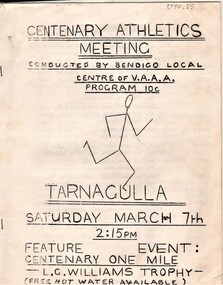
Document - AULSEBROOK COLLECTION: CENTENARY ATHLETICS MEETING PROGRAM, 1970
... Centenary...Athletics...Tarnagulla...L.G. Williams trophy...Centenary Athletics Tarnagulla L.G. Williams trophy Bendigo Centre of VAAA Aulsebrook Collection: Centenary Athletics Meeting program -Conducted by Bendigo Local Centre of V.A.A.A. ...Aulsebrook Collection: Centenary Athletics Meeting program -Conducted by Bendigo Local Centre of V.A.A.A. -Tarnagulla, March 7th, 1970 -Lists of events for the day, -Lists of participants and officialscentenary, athletics, tarnagulla, l.g. williams trophy, bendigo centre of vaaa -
 Warrnambool and District Historical Society Inc.
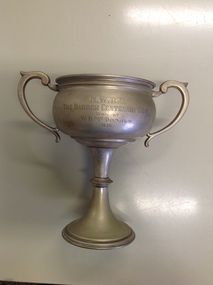
Unknown - Trophy, NWRC Barber Cup 1935
... Barber was a member of the Rifle Club in 1934-5 and winner of the Gray Centenary Cup. W. D. McDonald, the winner of the trophy, was the Captain of the C lub in 1935....It was a trophy named ‘The Barber Centenary Cup’ given for competitions amongst the North Warrnambool Rifle Club members during 1934-5. ...It was a trophy named ‘The Barber Centenary Cup’ given for competitions amongst the North Warrnambool Rifle Club members during 1934-5. ...The North Warrnambool Rifle Club was operating in Warrnambool in the 1930s. It had 132 members in 1935. A noted member was the well-known local photographer, Arthur Jordan whose father, Joseph, was a crack rifle shot and was a member of the Warrnambool Rifle Club. The Barber Centenary Cup was presumably established to commemorate the Centenary of Victoria as the cup competitions commenced in 1934 and were completed in 1935. The competitions were usually held over distances of 300, 500 and 600 yards. It is not known which member of the several Barber families in Warrnambool at the time donated the cup but G. Barber was a member of the Rifle Club in 1934-5 and winner of the Gray Centenary Cup. W. D. McDonald, the winner of the trophy, was the Captain of the C lub in 1935.This item is significant as it is connected with early 20th century Warrnambool sport (rifle shooting). It shows what sort of award was given for competition winners and reveals the popularity of rifle shooting in Warrnambool in earlier decades, with two clubs existing at that timeThis is a sports trophy cup made of electro-plated nickel silver (now very tarnished). It was a trophy named ‘The Barber Centenary Cup’ given for competitions amongst the North Warrnambool Rifle Club members during 1934-5. On cup: N.W.R.C. The Barber Centenary Cup Won by W.D.McDonald 1935 On base: E.P.N.S. Empire Plate warrnambool;, rifle shooting; barber centenary cup; w.d.mcdonald, barber centenary cup, w.d.mcdonald -
 Moorabbin Air Museum
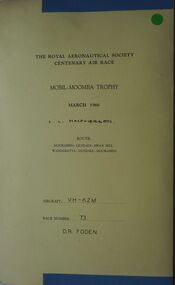
Memorabilia (item) - The Royal Aeronautical Society Centenary Air Race. Mobil-Moomba Trophy March 1966, Aircraft VH-KZB Race No 73 D.R.Foden
... The Royal Aeronautical Society Centenary Air Race. Mobil-Moomba Trophy March 1966...Aircraft VH-KZB Race No 73 D.R.Foden Memorabilia The Royal Aeronautical Society Centenary Air Race. Mobil-Moomba Trophy March 1966 ... -
Glen Eira Historical Society
Document - Elsternwick District Bowling Club (E.D.B.C.)
... Centenary Edition, 1934, on Arthur Apps, J.P. “Mortician” with cartoon portrait, noting that he is now associated with the Elsternwick District Bowling Club. Mounted photograph of Opening Day of the Elsternwick District Bowling Club 1934, handwritten on the reverse, of the raising of the flag for new club building. Mounted photograph of Elsternwick District Bowling Club Opening Day. Previous label on file states that it shows the presentation of a small trophy...Centenary Edition, 1934, on Arthur Apps, J.P. “Mortician” with cartoon portrait, noting that he is now associated with the Elsternwick District Bowling Club. Mounted photograph of Opening Day of the Elsternwick District Bowling Club 1934, handwritten on the reverse, of the raising of the flag for new club building. Mounted photograph of Elsternwick District Bowling Club Opening Day. Previous label on file states that it shows the presentation of a small trophy ...This file contains eight items. “A Short Outline of the History of the E.D.B.C.” Photocopy of typewritten history of the club, one page from 1909 to 1982, noting important events and personalities. Handwritten notes from Southern Cross newspaper, 08/05/1909 and 10/04/1909 about meetings to establish the club, into lists of office-bearers. Three photocopies of a group photo of members of the E.D.B.C., undated but probably 1910-14. No caption but verse of one copy states Early Days E.D.B.C. Photocopy of one page from 500 Victorians, Centenary Edition, 1934, on Arthur Apps, J.P. “Mortician” with cartoon portrait, noting that he is now associated with the Elsternwick District Bowling Club. Mounted photograph of Opening Day of the Elsternwick District Bowling Club 1934, handwritten on the reverse, of the raising of the flag for new club building. Mounted photograph of Elsternwick District Bowling Club Opening Day. Previous label on file states that it shows the presentation of a small trophy “Kitty” to Mayor H.C.H. Smith and Mayoress on opening day 1934. Photocopy of printed R.S.V.P. invitation from Elsternwick District Bowling Club for meeting of Official Opening of the Green and 75th Anniversary of the Club Opening 31/08/1984. The page states that the original Invitation in file 1204A with note on back. Ten mounted original colour photographs on five pages of Opening of the Green, presumably 31/08/1984 but no date is given, of presentations and speeches by office-bearers and photographs of members, identified by handwritten names written under each photograph. Backing used in this file states that it contains History of Elsternwick District Bowling Club 1909-1951 but this is not included.elsternwick district bowling club, king j.l., levens g., hunt keith, charlesworth harold, hannah charlie, donaldson janet, hunt ellen mrs., hannah doris, pearson les, peterson les, mcloghlin jim, berg john, berg joy, trimble family, christie j., cook r., dear i., hunt e., shier n., vessey l., ward i., white m., main m. i., coz charles, meadows s., watts j., regan j.b., ross w.t., murphy e.c., davies h.g., scott arthur, cunningham h., brown w.r., lillie a.g., apps arthur, smith h.c.h., elsternwick district ladies bowling club, govett miss y., ward norma, martins veronica, peace mary, markaris thelma, tirrike trio, sporting clubs, lawn bowls, anniversaries, elsternwick, bowling clubs -
 Kiewa Valley Historical Society
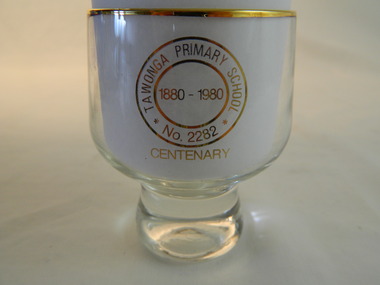
Trophies - Glass - Tawonga Primary School, 1980
... Underneath both circles gold embossed: Centenary Clear glass with gold metal brim and embossed in gold on two sides. Base is solid tapering up to the glass sides. Trophies ...The Tawonga Primary School was a weatherboard building built on 8 acres. In 1900 a fire destroyed the building and its records. The school was then moved to the Old Tawonga Hall before a new one was built in 1910 on land donated by Frank Cooper. In 1937 and 1954 further buildings were added. Tobacco farming and the building of the Kiewa Hydro Electric Scheme increased the number of pupils during the 1950s and 1960s. This glass represents the celebration held when the school became 100 years old.Tawonga Primary School was established for the children of the farmers of the Kiewa Valley in 1880 and later for children of the tobacco farmers and workers on the Kiewa Hydro Electric Scheme. The history of the school reflects the activities of the people living in the valley and in particular Tawonga township.Clear glass with gold metal brim and embossed in gold on two sides. Base is solid tapering up to the glass sides.On one side: Gold embossed picture of school building On opposite side: Gold embossed 2 circles - Inside inner one: 1880 - 1980. Between this and outer circle - Tawonga Primary School No 2282. Underneath both circles gold embossed: Centenarytawonga primary school, kiewa valley, education -
 Uniting Church Archives - Synod of Victoria
Award - Trophy, A.P. Co, 1934
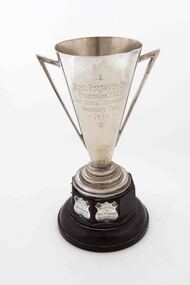
... On trophy: "Alma Pedersen Cup Stratherne P.G.G.S. Best general improvement centenary year 1934" On base: "Awarded to Betty Dawborn 1934" "Awarded to Vonda Lloyd 1935" "Awarded to Joan Dawborn 1936" "Awarded to Shirley Dahllof 1937" "Awarded to Joan McNaughton 1938"...Alma Pedersen Cup Stratherne Presbyterian Girls' School Hawthorn On trophy: "Alma Pedersen Cup Stratherne P.G.G.S. Best general improvement centenary year 1934" On base: "Awarded to Betty Dawborn 1934" "Awarded to Vonda Lloyd 1935" "Awarded to Joan Dawborn 1936" "Awarded to Shirley Dahllof 1937" "Awarded to Joan McNaughton 1938" Art Deco style silver trophy on a stand with five shield shaped silver plaques screwed to its bakelite base. ...Stratherne Presbyterian Girls' School was founded in 1889 at the home of Miss Ethel Dare at 45 Riversdale road, Hawthorn. The final location of the school was 131 Power street, Hawthorn - a house gifted to the school by Mr and Mrs John Patterson in 1923. The Alma Pedersen Cup was awarded for best general improvement in the Junior school. The school closed in 1968.Art Deco style silver trophy on a stand with five shield shaped silver plaques screwed to its bakelite base. The trophy has two handles.On trophy: "Alma Pedersen Cup Stratherne P.G.G.S. Best general improvement centenary year 1934" On base: "Awarded to Betty Dawborn 1934" "Awarded to Vonda Lloyd 1935" "Awarded to Joan Dawborn 1936" "Awarded to Shirley Dahllof 1937" "Awarded to Joan McNaughton 1938"alma pedersen cup, stratherne presbyterian girls' school hawthorn -
 Ballarat Tramway Museum
Book, H.P. James, "Out of the Past", 1940
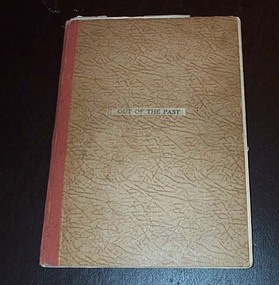
... Other cuttings about early residents of the Ballarat district. 13 - Newspaper cutting dated 2/5/1936 about the donation from the CTA to the Ballarat Hospital. 14 - Newspaper cuttings - Photo of Ballarat Bicycle and Tricycle Club in the Gardens, the issue of a stamp to commemorate the Centenary of Ballarat, radio stations in Sydney, Ballarat Choirs and fire brigade demonstrations trophies. 16 - Copy of the "City of Ballaarat Regulation No. 13" concerning Hackney and Stage coaches working within the City - See Reg. item 2537. 18, 20 - Newspaper cutting - "The Working Classes in Early Ballarat" - Nathan Spielvogel 21 - handwritten note on "Doctor" Thomas Blackett who died during 1940. 22 - Miscellaneous cuttings from the Melbourne Sun. 23 - Newspaper cuttings "Story of South Street", Show Grounds, and "The Alfred" Hall and a photograph of the 1938 Floral Carpet at Alfred Hall. 24 - Newspaper cutting - obituary and hand written note on Ballarat identity Mr. ...Other cuttings about early residents of the Ballarat district. 13 - Newspaper cutting dated 2/5/1936 about the donation from the CTA to the Ballarat Hospital. 14 - Newspaper cuttings - Photo of Ballarat Bicycle and Tricycle Club in the Gardens, the issue of a stamp to commemorate the Centenary of Ballarat, radio stations in Sydney, Ballarat Choirs and fire brigade demonstrations trophies. 16 - Copy of the "City of Ballaarat Regulation No. 13" concerning Hackney and Stage coaches working within the City - See Reg. item 2537. 18, 20 - Newspaper cutting - "The Working Classes in Early Ballarat" - Nathan Spielvogel 21 - handwritten note on "Doctor" Thomas Blackett who died during 1940. 22 - Miscellaneous cuttings from the Melbourne Sun. 23 - Newspaper cuttings "Story of South Street", Show Grounds, and "The Alfred" Hall and a photograph of the 1938 Floral Carpet at Alfred Hall. 24 - Newspaper cutting - obituary and hand written note on Ballarat identity Mr. ...ESCo Employee Hours Work Record book that has been used by an ESCo/SEC inspector, H. P. James as a record / note book for his personal collection or papers or journal titled "Out of the Past". Book sewn with string in 36 page sections, blank end papers, board covers with stipple paper out sides and Rexene cloth binding. Comprising plain paper end papers and 104 printed pages (52 leaves), with each sheet printed in black on feint ruled paper for recording the hours worked and other details of drivers and conductors employed by ESCo. Printed for daily use, with Day and date page headings - made out for the 1930's. Images: Book - i1 Inside front cover - i2 Members Certificate - i3 Has been used to gather mementos such as photos, articles, newspaper clippings, letters and other miscellaneous documents on Ballarat local history. Newspaper cuttings etc often have side notes written by Mr. James. Inside front cover has certificate recording Mr. James membership to the Ballarat Historical Society for 1940. Receipt signed by Edward Crimmins. Also a newspaper cutting on the cost of pensions to Lord Nelson's family. On facing page a photo of Queen Elizabeth, a printer colour cover or sheet about Walt Disney's "Pinocchio", a newspaper cutting regarding Father's Day and a black and white photograph of a young girl in a hospital carriage being pushed by a man. Pages numbered odd numbers only in the top right hand corner in pencil. Primary items are: 1 - Coloured cover to a writing tablet, titled "Australian Birds". Underlying this on the back of the writing tablet is two newspaper cuttings: the Ballarat Historical Society - reports on the 6th Annual meeting of the Society. 3 - Photo of the pattern Ballaarat Horse Tram company tram outside the Duncan and Fraser's Carriage Works in Adelaide with hand written notes underneath, including a sketch of a horse tram drivers seat - see Reg. Item 2527. 4, 6 - Group of nine black and white printed cards (15 illustrations) of early Ballarat pasted onto the sheet - see Reg. Item 2528. 5, 7 & 9 - Printed notes titled "Valedictory to Bob Haines" - see Reg. Item 2529. On page 9 in the left hand margin, a printed list of Church Officers; Church of England. 8 - Newspaper cuttings titled "The Heralds Man's Quiz" and the answers adjacent. City of Ballaarat - Public Inoculation Depot - Influenza form for HP James of ESCo - See Reg. Item 2530. Page Numbering from this point changes - even numbers in top right hand corner of folios instead of odd numbers. 9A - Newspaper cuttings about a Theatre Show, 54 years service of Mr. E. R. Bodycomb (Ballarat Gas) and planting of trees in the Avenue of Honour - with a red line around H. P. James names and a reproduction of the opening photograph of ESCo Electric Trams - noting 30 years ago - See Reg. Item 310.2. ESCo 4d Ticket - Purple - Grenville St to Sebastopol Terminus - See Reg Item 2531. ESCo 3d Adult Transfer Ticket - See Reg. Item 2532. Illustration - cartoon - H.P. James - See Reg. Item 2533. 10 - Newspaper cutting "From Horse Tram to Trolley Bus" - See Reg Item 2534. Newspaper cutting "Melbourne's First Tramcars" - See Reg Item 2535. An inscription or written note from T. Thomas etc. on lower edge of the sheet. 11,12 - Newspaper cuttings about the Passing of Melbourne's Cable Trams, including a photo of cable trailer No. 1 - See Reg. Item 2536. Other cuttings about early residents of the Ballarat district. 13 - Newspaper cutting dated 2/5/1936 about the donation from the CTA to the Ballarat Hospital. 14 - Newspaper cuttings - Photo of Ballarat Bicycle and Tricycle Club in the Gardens, the issue of a stamp to commemorate the Centenary of Ballarat, radio stations in Sydney, Ballarat Choirs and fire brigade demonstrations trophies. 16 - Copy of the "City of Ballaarat Regulation No. 13" concerning Hackney and Stage coaches working within the City - See Reg. item 2537. 18, 20 - Newspaper cutting - "The Working Classes in Early Ballarat" - Nathan Spielvogel 21 - handwritten note on "Doctor" Thomas Blackett who died during 1940. 22 - Miscellaneous cuttings from the Melbourne Sun. 23 - Newspaper cuttings "Story of South Street", Show Grounds, and "The Alfred" Hall and a photograph of the 1938 Floral Carpet at Alfred Hall. 24 - Newspaper cutting - obituary and hand written note on Ballarat identity Mr. J. P. Bourke. 25 - Newspaper cutting - cartoon "Tiddley" Winks and Wally - Stan Cross (later "Wally and the Major" 26 - Newspaper cutting - "Ballarat in the sixties" - General R.E. Williams and "Early Recollections" - Arthur Reid. 27 - Handwritten note re Mrs. Bill Danks, dated Jan. 1941 - Tobacconist in Bridge St. 28 - Newspaper cutting - "First Town Hall" and note on "City Hall". 30 - Newspaper cuttings - "Good Friday, Now and Then - T.P. Long, Mont Albert and "On Fashions" James R. Pound. 32 - Newspaper cutting "School and School life in old Ballarat" - Nathan F. Spielvogel. 34 - Newspaper cutting continued from page 32 and Obituary - Mr. Archie Dawson and Tom Blackett. 35 - Newspaper cutting of Ballarat - 4 photos - include Bridge St. with a tram. 36 - Newspaper cutting - "Ballarat - Pastoral and Industrial Resources" from a Melbourne paper, 17/2/1940. 38 - Newspaper cuttings - obituaries - Mr. R. E. Tunbridge, Graeme Dowling and Thomas Crosthwaite. 39 - Illustration - black and white - Late Mr. P. J. Pringle - See Reg. Item 2538. 40 - Handwritten notes on Ballarat Trams and the power station staff - See Reg. Item 2539. 41 - Handwritten notes on Ballarat Pie Stalls 42 - Newspaper cuttings - cartoon "Professor Nimbus", photo of the Norwegian town of Hell (Railway station); bicycles on a Copenhagen bridge following German occupation and dragon flies in Melbourne. 43 - Newspaper cutting on the official opening of the Ballarat Historical Society's Museum. 44 - Newspaper cuttings and associated handwritten notes on a fire in Ballarat, poultry fanciers, historical dates for August. 46 - Newspaper cuttings - "Victoria's first profitable goldfield" - Ballarat and the unveiling of the Sovereign Hill direction pillar. 48 - Newspaper cutting - "Worked 27 years without holiday" - See Reg. Item. 2540. - Other newspaper cuttings - thoughts of a visitor to Ballarat from Sydney and H.P. James - Liquor control in Ballarat and "This Week at the Zoo". 50 - Handwritten notes on clothing. 51 - Handwritten note on a visit to W. H. Middleton 52 - Newspaper cuttings "The Kings Empire", "Ballarat Birthdays" for Sept and Oct and an obituary on Mr. W. H. Middleton. 54 - Newspaper cuttings "Richmond has Links With Early Goldfields" - Malcolm McCullum and "England's Greatest Battle" 55, 56 - Newspaper cuttings - "Ballarat Birthdays" for November and December, a photograph of Nick Oliver - former Ballarat fireman and "Railway Birthday" - birth of the VR. 57, 58 - Handwritten notes on Ballarat tram timetables, weekly tickets, motorman's record cards, tourist tickets and sample tickets or cards, See Reg. Item 2541. Lunch Hour Weekly Ticket - Reg. Item 2542 Morning and Evening Weekly Ticket - Reg. Item 2543 Motorman's Record - Reg. Item 2544 Tourist Ticket - 1/- - Reg. Item 2545. 60 - Newspaper cuttings - parts 1 and 2 - "The Two Ballarat" by Nathan Spielvogel. 62 - Newspaper cuttings - continued from page 60, the death of comedians Sam Mayo and Gus Bluett and some handwritten notes on comedians. 64 - Newspaper cuttings on cricket, choir rules, a Methodist ladies function at the home of H.P. James, Footballer Percy Beames and entertaining air force recruits at the showgrounds. 66 - Newspaper cuttings - "The Anvil Chorus" - Hitler and Mussolini and "Strength against Nazi Threat". 68 - Newspaper cuttings - 50 years ago in Ballarat, Social function at H.P. James house, coldest morning in Ballarat and the death of Col. A. W. Bennett. 70 - Newspaper cuttings - about the sale of spirits in early Ballarat, the first motorcars in Ballarat and handwritten note about Mr. Jago. 72 - Newspaper cuttings - misc. about horse racing, trainers and racing. 73 - Newspaper cuttings and handwritten notes about Ballarat Schools. 74 - Newspaper cuttings - Bruno Hauptmann (Charles Lindbergh) and the death of actor Darcy Kelway. 75, 76 - Newspaper cuttings - Rail services to and from Ballarat, effects of the war and Ballarat 70 years ago, the invasions of Britain and "A stroll down Memory Lane" - T.P. Long of Mont Albert. 77,78 - Newspaper cuttings - Lake Wendouree - Nathan Spielvogel, the opening of the new Ballarat Historical Society's Museum and farewell function of Mr. James Shannon. 79 - Newspaper cuttings - about boats on lake Wendouree. 99 - Obituary and hand written note re Mr. Arthur M. David. 100 - Newspaper cuttings - cartoon "Wally and the Major", Dr William Maloney, Gus Bluett and "Old Rowley" - in connection with the Melbourne Cup of 1940. 101 - Cartoon advertisement for Kolynos Dental Cream Inside rear cover - Programme for the Centenary of Thanksgiving Service - Back to Ballarat 1934, dated 4/11/1934 (has been affected by other sheets of paper due to their acidic nature), printed notes titled "A ramble on stilts with Freddie" written by Baker James. Many in pencil and inktrams, tramways, h.p. james, esco, horse trams, ballarat, civic history -
Stawell Historical Society Inc
Photograph, Mick Walsh, Mick Walsh Stawell Studio Colour Negatives, 1975 to 1986
... Salvation Army Centenary Laverne & Baby OKeefe Family Bull & Mouth Hotel Larken Lindy Muller Reg Mathews & Muller Newton Slaughter Yards Silverband Falls Watchorn Painting Sharon McLeod Dave Morgan Mr & Mrs Stan Faravoni Seppelts Launch of New Wine Norm Sendoff Sheep Show 1984 Gun Club Trophies Treloar Accident Dunn Brothers Barkers Cages Suzanne Wilson & Harris Austin Baby Stawell Mall Laverne Baby St Pattrics School Alterations Adreanne Loraine Eric Dunn Grandfather Fraser Family four generations Phil Gray First Communion 1984 Gail McCann & Neil Haggert Monument Rugg Christine McLeod & Phillip Elliott Salvation Army Ladies Bowling Team 1984 Glen Jasper Family Goldfields Motel Lyn Smith & Peatt Sue Frencham & Ian Barham Gay Rahley & Robert Delley ...Salvation Army Centenary Laverne & Baby OKeefe Family Bull & Mouth Hotel Larken Lindy Muller Reg Mathews & Muller Newton Slaughter Yards Silverband Falls Watchorn Painting Sharon McLeod Dave Morgan Mr & Mrs Stan Faravoni Seppelts Launch of New Wine Norm Sendoff Sheep Show 1984 Gun Club Trophies Treloar Accident Dunn Brothers Barkers Cages Suzanne Wilson & Harris Austin Baby Stawell Mall Laverne Baby St Pattrics School Alterations Adreanne Loraine Eric Dunn Grandfather Fraser Family four generations Phil Gray First Communion 1984 Gail McCann & Neil Haggert Monument Rugg Christine McLeod & Phillip Elliott Salvation Army Ladies Bowling Team 1984 Glen Jasper Family Goldfields Motel Lyn Smith & Peatt Sue Frencham & Ian Barham Gay Rahley & Robert Delley Photography Mick Walsh 52 Patrick Street Stawell Colour negatives of families, weddings and other. ...Negatives from Stawell Photographer. Discarded from Penna Print Ararat. Son contacted and gave approval for Stawell Historical Society to keep them. Only those of a non personal nature scanned. Salvation Army Centenary Laverne & Baby OKeefe Family Bull & Mouth Hotel Larken Lindy Muller Reg Mathews & Muller Newton Slaughter Yards Silverband Falls Watchorn Painting Sharon McLeod Dave Morgan Mr & Mrs Stan Faravoni Seppelts Launch of New Wine Norm Sendoff Sheep Show 1984 Gun Club Trophies Treloar Accident Dunn Brothers Barkers Cages Suzanne Wilson & Harris Austin Baby Stawell Mall Laverne Baby St Pattrics School Alterations Adreanne Loraine Eric Dunn Grandfather Fraser Family four generations Phil Gray First Communion 1984 Gail McCann & Neil Haggert Monument Rugg Christine McLeod & Phillip Elliott Salvation Army Ladies Bowling Team 1984 Glen Jasper Family Goldfields Motel Lyn Smith & Peatt Sue Frencham & Ian Barham Gay Rahley & Robert Delley Colour negatives of families, weddings and other. Nineteen Lever Arch Folders Mick Walsh 52 Patrick Street Stawellphotography -
 Kew Historical Society Inc
Memorabilia, Two tickets to the Children's Centenary Picnic, Victoria Park, 1934, 1934
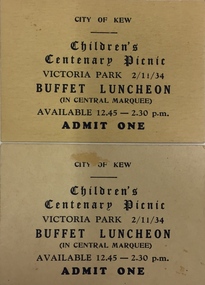
... Needless to say the theatre was crowded to capacity, in addition to special pictures a punch and judy show was provided and a number of aborigines who are in Melbourne for the Centenary gave, exhibitions of native dances and corroborees. The trophies for the sports events are to do competed for at a later date. ...Needless to say the theatre was crowded to capacity, in addition to special pictures a punch and judy show was provided and a number of aborigines who are in Melbourne for the Centenary gave, exhibitions of native dances and corroborees. The trophies for the sports events are to do competed for at a later date. ...1934 was the year that Victoria celebrated the European settlement of Victoria. Events were planned through Victoria. In Kew a children's picnic was planned. The following newspaper report records what happened: KEW CHILDREN'S PICNIC. Owing to rain the picnic which the Kew Centenary celebrations committee had arranged for children resident in the municipality, which was to have taken place at Victoria Park yesterday, had to be postponed. The organisers decided to forward to the various schools the luncheons which had been prepared for the children and hurriedly made arrangements for their entertainment at a picture theatre. Needless to say the theatre was crowded to capacity, in addition to special pictures a punch and judy show was provided and a number of aborigines who are in Melbourne for the Centenary gave, exhibitions of native dances and corroborees. The trophies for the sports events are to do competed for at a later date. (The Age, 3 Nov 1934, p. 24)Local ephemera deriving from the eventTwo tickets to a Children's Centenary Picnic including a buffet luncheon in Victoria Park. The event commemorated the settlement at Melbourne in 1833. The event occurred on 1/11/34. The tickets were donated by Joy Stewart in 1980.City of Kew / Children's Centenary Picnic / Victoria Park 2/11/34 / Buffet Luncheon (in central marquee) / Available 12.45 - 2.30 p.m. / Admit 1.centenary of melbourne (1834-1934), victoria park (kew), printed ephemera -
 Vision Australia
Document - Text, Blind bowlers meet the challenge
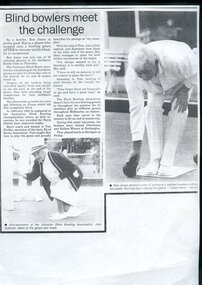
... trophy for the most improved. The Bowling Association does not have its own grounds, so throughout the summer its 41 members played on greens all over Melbourne. The article includes a picture of Ron Jones about to release the ball and Jean Sullivan after releasing a bowl. Elizabeth Maxwell Neil Maxwell Victorian Blind Bowling Association Ron Jones Summary update of Centenary ...Article profiling Ron Jones, who played at the Jerilderie Bowls Club as part of a three day visit and season break up by the Victorian Blind Bowlers Association. Taking up bowling six years ago, he soon competed at the Australian Blind Bowling championships and was awarded the trophy for the most improved. The Bowling Association does not have its own grounds, so throughout the summer its 41 members played on greens all over Melbourne. The article includes a picture of Ron Jones about to release the ball and Jean Sullivan after releasing a bowl.1 photocopied newspaper article with two imagesnon-fictionelizabeth maxwell, neil maxwell, victorian blind bowling association, ron jones -
 Vision Australia
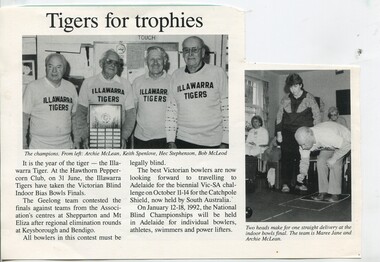
Article - Text, Tigers for Trophies, 1991
... Association for the Blind Elizabeth Maxwell Neil Maxwell Illawarra Tigers Recreation Summary update of Centenary Appeal 1 cut out article from an AFB publication Tigers for Trophies Article Text ...The 1991 Victorian Blind Bowlers Final was won by the Illawarra Tigers team of Archie McLean, Keith Spenlove, Hec Stephenson and Bob McLeod. The team will go on to represent Victoria in the biennial VA-SA Challenge for the Catchpole Shield.1 cut out article from an AFB publicationnon-fictionassociation for the blind, elizabeth maxwell, neil maxwell, illawarra tigers, recreation -
 Vision Australia
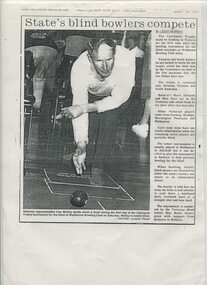
Article - Text, 'State's blind bowlers compete' by Leigh Murray
... Trophy. Association for the Blind Elizabeth Maxwell Neil Maxwell Ivan Molloy Leigh Murray Summary update of Centenary Appeal 1 photocopied article taken from unknown source 'State's blind bowlers compete' by Leigh Murray Article Text ...To promote blind bowling, the annual tournament between Victoria and South Australia, will be held in Ballarat's Webbcona Bowling Club. Victorian representatives from Ballarat, Geelong, Bendigo, Mornington Peninsula and Melbourne will be competing to win the Catchpole Trophy.1 photocopied article taken from unknown sourcenon-fictionassociation for the blind, elizabeth maxwell, neil maxwell, ivan molloy, leigh murray -
 Vision Australia
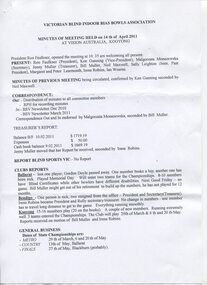
Document - Text, Victorian Indoor Bias Bowls Association Meeting Minutes 14 April 2011
... trophy - to be played between Kooyong and Blackburn clubs. Elizabeth Maxwell Neil Maxwell Victorian Indoor Blind Bias Bowls Association Summary update of Centenary Appeal 5 typed pages - 3 of meeting minutes, 2 of large print guidelines for Roy Langdon trophy Victorian Indoor Bias Bowls Association Meeting Minutes 14 April 2011 Document Text ...Minutes from the VIBBA meeting held on 14th April 2011, with recommended format and conditions for the Roy Langdon trophy - to be played between Kooyong and Blackburn clubs.5 typed pages - 3 of meeting minutes, 2 of large print guidelines for Roy Langdon trophynon-fictionelizabeth maxwell, neil maxwell, victorian indoor blind bias bowls association -
 Trafalgar Holden Museum
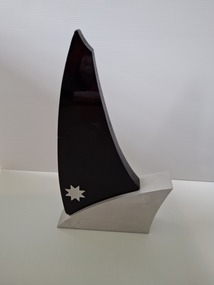
Award - Trophy
... Award Trophy Centenary of Federation Business star. Holden LTD 18 October 2001 Business SA Black marble smooth shiny front with rough back and side surface. ...Black marble smooth shiny front with rough back and side surface. Chrome star bottom front, mounted on chrome baseCentenary of Federation Business star. Holden LTD 18 October 2001 Business SAaward, trophy -
The 5th/6th Battalion Royal Victoria Regiment Historical Collection
Award - Trophy, S.A Centenary 1936 "DUNVEGAN CUP"
... S.A Centenary 1936 "DUNVEGAN CUP" Award Trophy ...Cup presented to VSR pipes and drums during SA year of celebrations of their centenary.Cup is of silver finish with two handles with a wooden base. Engraved SA CENTENARY HIGHLAND PIPE BAND CONTEST 1936 "DUNVEGAN CUP" Presented by W.McLeod ESQ. Outer base of silver cup is engraved paramount Epns.SA CENTENARY HIGHLAND PIPE BAND CONTEST 1936 "DUNVEGAN CUP" Presented by W.McLeod ESQ5/6 rvr, victorian scottish regiment -
 Mont De Lancey
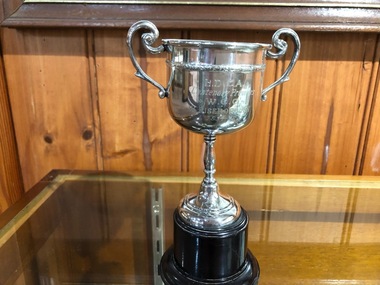
Trophy, 1935
... Cup awarded to Mr Walter Riseborough as a member of Centenary Premiership Team 1934-35 from Wandin Cricket Club. Trophies Commemorative cups "W.D.C.A. ...Cup awarded to Mr Walter Riseborough as a member of Centenary Premiership Team 1934-35 from Wandin Cricket Club.Silver cup with handles, on brown plastic stand."W.D.C.A. Centenary Premiers W.G. Riseborough 1934-35"trophies, commemorative cups -
 Rutherglen Historical Society
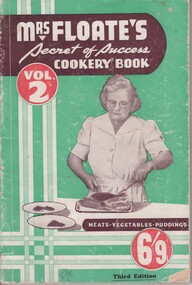
Book, Robertson & Mullens, Mrs Floate's Secret of Success Cookery Book, Vol. 2, 1950
... On the following pages are photographs of Mrs Floate with trophys and other awards received for competitive cooking, as well as a certificate received from the Royal Agricultural Society of Victoria at the Melbourne Centenary Royal Show in 1934....On the following pages are photographs of Mrs Floate with trophys and other awards received for competitive cooking, as well as a certificate received from the Royal Agricultural Society of Victoria at the Melbourne Centenary Royal Show in 1934. dorothy floate cooking cookery recipes Paperback cookery book, cover printed in green background, title printed in white on a brown background, volume no and price shown in white on red background. ...On the page following the title page is the following information: "Mrs. Dorothy Floate's Cookery Book Presented to the Queen. Authoress Honored. On the occasion of the visit of Her Majesty Queen Elizabeth II. to Australia, Mrs. Dorothy Floate's now famous "Secrets of Success" Cookery Book was presented to Her majesty as a gift from the Authoress. It was duly accepted and gratefully acknowledged by Her Majesty." On the following pages are photographs of Mrs Floate with trophys and other awards received for competitive cooking, as well as a certificate received from the Royal Agricultural Society of Victoria at the Melbourne Centenary Royal Show in 1934.Paperback cookery book, cover printed in green background, title printed in white on a brown background, volume no and price shown in white on red background. Black and white photo of author on cover. 160 pagesdorothy floate, cooking, cookery, recipes -
 Wodonga & District Historical Society Inc
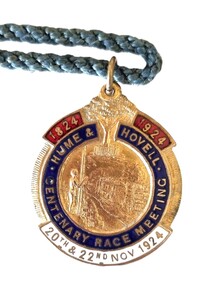
Memorabilia - Hume and Hovell Centenary Race Meeting - Albury
... The star events were the Centenary Cup of I mile and 3 furlongs with a prize of £1000 (one thousand pounds) and a Gold Cup valued at one hundred guineas, donated by Mrs. Jas. Mitchell of Tabletop, and the John Campbell Handicap of one mile carrying $500 and trophy valued at 50 guineas donated by the chairman of the Club, Mr. ...The star events were the Centenary Cup of I mile and 3 furlongs with a prize of £1000 (one thousand pounds) and a Gold Cup valued at one hundred guineas, donated by Mrs. Jas. Mitchell of Tabletop, and the John Campbell Handicap of one mile carrying $500 and trophy valued at 50 guineas donated by the chairman of the Club, Mr. ...Great celebrations took place in Albury, NSW for the celebration of the Centenary of the Hume and Hovell expedition. The Hume and Hovell journey of discovery to Port Phillip took place during 1824-1825. On November 20, 1824, they successfully crossed the Murray River not far from Albury and proceeded on a route to Port Phillip. To celebrate the Centenary of this crossing, the city of Albury held a series of activities during the week of Sunday 16th November to Saturday 22nd November 1924. As part of these celebrations the Albury Race Club held a special race meeting conducted on Thursday 20th and Saturday 22nd November 1924. This badge was produced as a memorabilia for that meeting. Prize money over the two day meeting totalled over £3,000. The star events were the Centenary Cup of I mile and 3 furlongs with a prize of £1000 (one thousand pounds) and a Gold Cup valued at one hundred guineas, donated by Mrs. Jas. Mitchell of Tabletop, and the John Campbell Handicap of one mile carrying $500 and trophy valued at 50 guineas donated by the chairman of the Club, Mr. J. Campbell. A gold whip donated by Mr. Norman Crow was presented to the jockey riding the Cup winner. This item is significant because it is an example of memorabilia produced for the centenary celebrations for the Hume and Hovell Expedition.An enamelled fob medallion featuring a central image with a tree at the top and text. The tree is the Hovell Tree at Albury. The central image is of indigenous man facing Albury’s civic buildings with the Murray River in between. The fob is attached to a blue twisted cord.1824 1924 HUME & HOVELL CENTENARY RACE MEETING 20th and 22nd Nov 1924 On back: 244B SIMPSONhume & hovell, hume & hovell centenary, albury race club -
 City of Melbourne Libraries
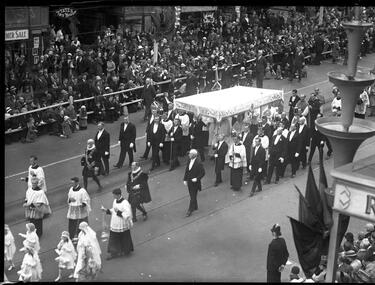
Photograph, Bull, Hugh Jones, 1897-1993, Eucharistic Congress Procession, Collins Street, Melbourne
... Centenary along all principal thoroughfares. “The poles are painted white, the superstructure resembling three trumpet lilies are made of durable fibro-cement, and their colour scheme deepens from clear yellow on the top cone to orange on the lowest, with slender rims of vermilion and white. Each cone is flooded with light externally from three lamps concealed in the one below it. There is also a painted coat of arms from which spring a trophy...Centenary along all principal thoroughfares. “The poles are painted white, the superstructure resembling three trumpet lilies are made of durable fibro-cement, and their colour scheme deepens from clear yellow on the top cone to orange on the lowest, with slender rims of vermilion and white. Each cone is flooded with light externally from three lamps concealed in the one below it. There is also a painted coat of arms from which spring a trophy ...Published: The Age 10 December 1934 Published title: RELIGIOUS PAGEANTRY AND FERVOR MARKED CLOSE OF EUCHARISTIC CONGRESS. Published caption: Thousands of men and women marched in the Eucharistic procession yesterday which brought the Congress to a close. The picture above shows the procession headed by the Children of Mary in Bourke-street and turning into Spring-street, in front of Parlia ment House. Right (top) — The procession leaving the starting point at St. Patrick's Cathedral and below, the Papal Legate carrying the Host under a canopy borne by a guard of laymen and preceded by white-clad girls scattering rose leaves, incense bearers and the Papal Chamberlains in their Spanish uniforms. The end of the procession in front of Mount St. Evin’s Hospital from which the final benediction was given by Cardi nal MacRory from an altar on the bal cony. The Papal Legate carrying the Host is passing through the assemblage of surpliced priests. On the left is an aerial picture taken just as the Children of Mary at the head of the procession are taking up their places for the final assembling. In the left top corner of the picture is St Patrick's Cathedral, from which the procession started, and in the right lower corner is Mount St. Evin’s Hospital. The space immediately in front of the hospital was reserved for the processionists while on either side is the crowd that assembled to take part in the final service. Trove article identifier: http://nla.gov.au/nla.news-article205067634 Religious pageantry and fervour The National Eucharistic Congress took place from Sunday 2 to Sunday 9 December 1934. An initiative of the Roman Catholic Church, it was their contribution to Melbourne’s Centenary Celebrations. 200,000 Catholics resided in Melbourne at this time – one quarter of the city’s population. While the Congress was aimed at Catholics, and acted as an opportunity to reinforce their living faith and homage, it contained a variety of events of splendour, solemnity and significance designed to appeal to Melbournians, and would additionally provide incentive for people to travel to Victoria, thereby creating an economic benefit to the state. The Procession of the Blessed Sacrament concluded the week-long Congress. Commencing at St Patrick’s Cathedral, it covered a two-mile route via Gisborne, Collins, Elizabeth and Bourke streets, then to Victoria Parade, where a final benediction was pronounced by Cardinal MacRory from the balcony of Mount St. Evin’s Hospital (today the site of St Vincent’s Private Hospital). An estimated 100,000 took part. Onlookers line Swanston Street, some standing at the entrance to Tate’s Tea House – a well-known Melbourne landmark located in the basement of the Manchester Unity Building. The white-veiled Children of Mary Sodalists strew rose petals in the path of the canopy, covering the jewelled Monstrance containing the Blessed Sacrament of consecrated Host (bread) and carried by the Cardinal. Church hierarchy in scarlet robes walk alongside, followed by incense bearers, the Papal Chamberlains in their Spanish uniforms, and a guard of honour of laymen of the city and country parishes. In the foreground is a tiered pole. This is one of 800 “Venetian Lights” specifically installed for the Centenary along all principal thoroughfares. “The poles are painted white, the superstructure resembling three trumpet lilies are made of durable fibro-cement, and their colour scheme deepens from clear yellow on the top cone to orange on the lowest, with slender rims of vermilion and white. Each cone is flooded with light externally from three lamps concealed in the one below it. There is also a painted coat of arms from which spring a trophy of flags.” – Australian Home Beautiful Featured in "Newsworthy: Melbourne in photographs 1933-1936" exhibition at East Melbourne Library, October to December 2023. Exhibition caption by project volunteer, Louise McKenzie. Research by project volunteer, Louise McKenzie: This photo was taken on Sunday 9 December 1934, looking from the Melbourne Town Hall (corner of Swanston and Collins streets) across the road to the Manchester Unity Building. This is the afternoon procession concluding the Catholic Church’s National Eucharistic Congress in Melbourne - a procession of the Blessed Eucharist through the Melbourne city. It commenced at St Patrick’s Cathedral, and covered a two mile route via Gisborne, Collins, Elizabeth and Bourke streets, then to Victoria Parade where a final benediction was pronounced by the Cardinal from the balcony of Mount St. Evin’s Hospital (present day St Vincent’s Private Hospital). An estimated 100,000 took part in the march. The people lining the streets a men in suits and hats, women in coats and hats, and children in their “Sunday best”, kneeling beside the road, many with their hands clasped in front of them. The small girls ahead of the canopy covering the Host are pale-blue clad, white veiled Children of Mary Sodalists, who strew rose petals to pave the way of the Cardinal carrying the jewelled Monstrance (Blessed Sacrament of consecrated Host (bread)), together with church heirarchy wearing scarlet robes. Behind came incense bearers and the Papal Chamberlains in their Spanish uniforms, followed by a guard of honour of laymen of the city and country parishes. The Children of Mary Sodalities was a religious body which aimed at fostering in its members an ardent devotion, reverence, and filial love towards the Blessed Virgin Mary, initially embracing the pupils and orphans of the schools and institutions of the Sisters of Charity of St Vincent de Paul. In 1847, Blessed Pius IX affiliated them to the Jesuit Roman Sodality. They were distinguished by a medal suspended from a blue ribbon, and once a fully-fledged a Child of Mary wore a distinctive blue cape. On the extreme right foreground of the photo can be seen an intriguing piece of artistic design – a tiered pole. This is one of the 800 “Venetian Lights” specifically installed for Melbourne’s Centenary along all principal thoroughfares. “The poles are painted white, the superstructure resembling three trumpet lilies are made of durable fibro-cement, and their colour scheme deepens from clear yellow on the top cone to orange on the lowest, with slender rims of vermilion and white. Each cone is flooded with light externally from three lamps concealed in the one below it. There is also a painted coat of arms from which spring a trophy of flags.” Note the sign for Tates Tea House - a well-known Melbourne landmark, located in the basement of the Manchester Unity Building. References: RELIGIOUS PAGEANTRY AND FERVOR MARKED CLOSE OF EUCHARISTIC CONGRESS. (1934, December 10). The Age (Melbourne, Vic. : 1854 - 1954), p. 11. Retrieved September 14, 2023, from http://nla.gov.au/nla.news-article205067634 Eucharistic Congress (1934, December 1). The Argus (Melbourne, Vic. : 1848 - 1957), p. 11. Retrieved January 23, 2024, from http://nla.gov.au/nla.news-article10997817 National Eucharistic Congress, Melbourne. (1934, December 6). The Catholic Press (Sydney, NSW : 1895 - 1942), p. 28. Retrieved January 23, 2024, from http://nla.gov.au/nla.news-article104371824 'The year of the Melbourne Eucharistic Congress: 1934.' The Campion Society, https://campion.australiancardijninstitute.org/ch-7-the-year-of-the-melbourne-eucharistic-congress-1934/ 'Melbourne Eucharistic Congress 1934.' Panoramic photograph, https://emhs.org.au/catalogue/emdf0123 The National Eucharistic Congress, Melbourne, Australia December 2nd-9th, 1934. Edited by Rev. J.M. Murphy and Rev. F. Moynihan, The Advocate Press, Melbourne. 'Children of Mary Sodalists', Wikipedia, https://en.wikipedia.org/wiki/Sodality_of_Our_Lady 'Dressing Melbourne for the Duke' (1934, October 1). The Australian home beautiful : a journal for the home builder, p. 21, 58. Retrieved September 14, 2023, from http://nla.gov.au/nla.obj-2950922209 Photographer notations on slide: "Eucharistic Congress Procession on Swanston St B61" [sic - actually Collins Street].events, religion, parades, catholic church -
 City of Melbourne Libraries
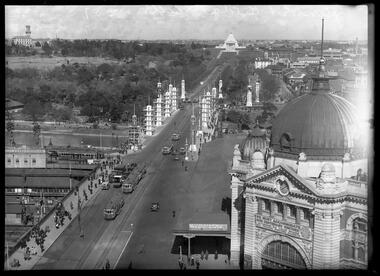
Photograph, Bull, Hugh Jones, 1897-1993, Princes Bridge Centenary pylons under construction
... Centenary, converting it “… into a coloured fairyland by night.” The estimated cost of 10 pounds per hour the lights were on. The display included 800 standard light poles 30 feet high which were tiered with electric bulbs concealed in inverted cones, 138 specially designed “Venetian poles” draped in flags trophies and streamers. ...Centenary, converting it “… into a coloured fairyland by night.” The estimated cost of 10 pounds per hour the lights were on. The display included 800 standard light poles 30 feet high which were tiered with electric bulbs concealed in inverted cones, 138 specially designed “Venetian poles” draped in flags trophies and streamers. ...Princes Bridge Centenary pylons under construction Possibly taken from Young and Jacksons Hotel (formerly Princes Bridge Hotel) on the corner of Flinders and Swanston streets, Flinders Street Station’s clocks and main entrance dominate, along with its distinctive copper dome and decorative façade. The time on the main clock is 1.40pm, and the sign underneath, reflecting Melbourne’s upcoming Centenary reads, “We must accommodate our Centenary visitors! Citizens! Do your share by taking paying guests.” At left is the original Princes Bridge Station, today the site of Federation Square. The riverside tram terminus advertises a Café/Tobacconist/Refreshment Room selling cigars & cigarettes, fountain drinks & confectionery, and in smaller text: “Leave your boot repairs here”. Nearly everyone is dressed in dark suits, coats and hats. The footpaths are wide and there are no traffic lights. The roadway stretches towards the Shrine of Remembrance, not yet dedicated but very dominant on the skyline. Government House is clearly visible across the wide parkland that would come to be known as Kings Domain and that is an area of deep importance to the people of the Eastern Kulin. Originally, Birrarung was part of a network of swamps and lagoons linked to the course of the river. From 1896, Public Works Department engineer Carlo Catani, oversaw a new channel to straighten the river and the swamps and lagoons were filled with spoil from the channel works. From the same vantage point today, only the top of the tower of Government House would be visible. The photo captures the pylons along Princes Bridge, mid-construction and being installed to mark Melbourne’s Centenary. The pylons were not without controversy. Both The Argus and The Age bemoaned them for being “made almost entirely of imported softwood timber”, denying work to native hardwood timber workers and sawmillers, and leading visitors to think Australia did not have its own exceptional native hardwoods. The pylons were also variously described in their incomplete state, as unimaginative and resembling an oilfield. Published: The Age 5 September 1934 Featured in "Newsworthy: Melbourne in photographs 1933-1936" exhibition at East Melbourne Library, October to December 2023. Exhibition caption by project volunteer, Louise McKenzie Photographer notations on slide: "Pylons + St Kilda Rd C57" Published: Age (Melbourne, Vic. : 1854 - 1954), Wednesday 5 September 1934, page 11 Published title: DECORATIONS -- THEN AND NOW. Published caption: "Although not completed yet, some impression of the effect of the decorations on Princes-bridge may be obtained from the first picture which shows the majestic sweep of St Kilda road with the Shrine of Remembrance and Government House dominating the horizon. The area to the left of St. Kilda-road and in front of Government House is portion of the area which it is proposed to call the King's Domain, which extends to Domain-road and Anderson-street..." Description: East-facing, elevated view of Flinders Street Station and Princes Bridge, featuring partially completed pylons erected for Melbourne's Centenary celebrations. The Shrine of Remembrance and Government House can be seen in the distance. In the foreground are trams, cars and trucks, pedestrians, Batman Avenue tram terminus and refreshment rooms. Signage on Flinders Street Station encourages citizens to accommodate Centenary visitors. The Melbourne Centenary was held 1934-35 in celebration John Batman's proclamation that Melbourne "the place for a village". Centenary events included a visit by Prince Henry, Duke of Gloucester. A Centenary Cake measuring 50 feet in height and ten tons in weight was cut into 250,000 pieces and sold at 1 shilling per piece for charity. Spectacular floodlighting of city landmarks, the creation of the Pioneer Women's Memorial Garden, and the MacRobertson Air Race from London, were other notable activities. Research by project volunteer, Louise McKenzie: The photo in The Age collage of 5 September 1934 has a slightly cropped foreground. The original photo has been taken from an elevated vantage point, most probably the roof of the Nicholas Building on the corner of Flinders and Swanston streets. The right foreground is dominated by the main “clocks” entrance to Flinders Street Station, showing its distinctive copper dome and decorative façade. The time on the main clock is 1.40 pm. The main sign on the front of the Station reads, "We Must Accommodate our Centenary Visitors! Citizens! Do your share by taking paying guests. Write to The Official Centenary Accommodation Bureau, 436 Collins St. City. Tel M 4671”. Another sign at eye level at the main entrance says: “Cheap Trips on Sundays”. The sign on the end of the roof along the eastern side of the station reads, “The Babies Need Your Help! Support Broadmeadows Foundling Hospital Appeal. July and August”. Run by the Sisters of St Joseph of the Sacred Heart, St Joseph’s Foundling Hospital was a purpose built infants’ home for up to 300 babies, plus accommodation for expectant mothers, mainly single women. In the early 1930s, the department (Victorian Children’s Welfare Department) contracted St Joseph’s Foundling Hospital to care for an additional 60 infant state wards, and up to 175 non wards at any given time. In 1931 it also operated a mothercraft training school. The centre foreground shows the commencement of Princes Bridge. Beneath the left side of the bridge was the site of the original Princes Bridge Station, by this time incorporated into Flinders Street Station, and today the area is the site of Federation Square. It was linked to Flinders Street station by the railway tracks that ran underneath the northern approach to the bridge. This photo shows a tram terminus which has a Café/Tobacconist/Refreshment Room, selling cigars & cigarettes, fountain drinks & confectionary, and a sign: Leave your boot repairs here. In the foreground is a wide roadway running south/north, comprising two vehicle lanes each heading north/south, and a central section containing two sets of tram tracks. There are cars, buses and delivery vans on the roadway. The trams visible are Glen Iris (Route No. 6; tram no. 448), Toorak (Route No. 8, tram no. 333), ? (No. 7), ? (No. 1), and ? (No. 2A). The footpaths are extremely wide. There is a square newspaper/magazine stand on the eastern side footpath. And also a “Ferry” sign. There are no traffic lights, but a policeman is visible on the roadway. There are pedestrians – men, women, children, a porter with trolley, women with prams. Clothing comprises dark suits, coats and hats for nearly everyone. There are double headed “Collins Street” lights along the side of the roadway, and along the northern riverbank. The roadway in the foreground is an extension of Swanston Street, which becomes Princes Bridge, then St Kilda Road, stretching towards the Shrine of Remembrance, and diverting past it. The Shrine had not yet been officially dedicated, and looks very white and dominant on the skyline. On the LHS of St Kilda Road, Government House is clearly visible across the wide parkland to be known as Kings Domain. The Kings Domain area is important to the people of the Eastern Kulin nation, and also has historical importance for its association with the early settlement of Melbourne and the foundation of British colonial administration in Victoria. On the southern side of the Yarra River (Birrarung) an historic rowing boathouse is visible, located adjacent to the Alexandra Gardens. Originally Birrarung was part of a network of swamps and lagoons linked to the course of the river. From 1896, under the guidance of engineer Carlo Catani* a new channel to straighten the river was created and the swamps and lagoons were filled with spoil from the channel works. The gardens were then created and completed in time for a Royal visit by the Duke of York in May 1901. The gardens are named after Alexandra of Denmark, the wife of King Edward VII. Both these areas, plus the Royal Botanic Gardens Victoria, Shrine of Remembrance Reserve, Sidney Myer Music Bowl, Government House, and the Queen Victoria Gardens together form the Domain Parklands. The extent of the subsequent plantings is evident today, where from the same vantage point only the top of the tower of Government House would be visible. *Catani was born in Florence in 1852, but after arriving in Melbourne worked as a civil engineer for the Victorian Government. His last major project was the reclamation of the foreshore of St Kilda, envisaged in the style of a European resort, complete with a split level esplanade, bathing pavilions, dance halls, amusements and a French-Italian style of landscape complete with palms. The gardens at the end of Fitzroy Street, St Kilda, now bear his name. The historic boathouse visible across the Yarra is another glimpse into Melbourne’s past. “Boathouse Row” comprises 7 amateur rowing clubs, the first established in 1859 (Melbourne University Boat Club). Other Clubs were Richmond, Melbourne, Banks, Melbourne Grammar School, Yarra Yarra and Mercantile. South of the river and west of the bridge is an area today developed into the Melbourne arts precinct of Hamer Hall and the Arts Centre. But at this time it was the home of Wirths Olympia Circus, which comprised Wirths Pleasure Park (an amusement park), a 5,000 seat auditorium – Hippodrome, a roller skating rink, a glaciarium, a cinema, and the Green Mill Dance Hall. Dog shows were also held at Olympia. The Green Mill Dance Hall closed in 1950, and the remainder of the Wirth buildings on site were destroyed by fire in December 1953. The feature of the photo is the pylons erected along Princes Bridge to mark Melbourne’s Centenary in 1934. The sixteen plastered pylons were designed by Roy Prentice, the second person to qualify as an architect at The University of Melbourne’s Bachelor of Architecture degree, in 1933, aged 27. Simon Reeves in his article marking the 100th birthday of Roy Prentice on 20 June 2006 reports that the State Electricity Commission sponsored this work, and the Argus reported that “… the pylons were “illuminated from within to give the effect of soft radiance”. Australia Home Beautiful 1 Oct 1934 reports in a very detailed and comprehensive article: The 10 taller pylons, including flagpole, were 48 ft, with a base of 8 ft. Timber-framed and faced with fibrous plaster and galvanised sheet iron, each structure was securely bolted to a concrete foundation three feet in depth. Panels of glass let into the shaft of each pylon were indirectly lit by 40, 100 watt lamps, and the upper bank of internal lamps were dyed so as to flood the panels with a deep red light. The decorative painted shields and flagpoles/pennants were illuminated by three 200 watt projectors concealed in the roof of each pylon, and were part of an electric night light decoration scheme involving 28 miles of wire to supply more than 20,000 lights. An article in the Argus on 18 October 1934 provided minute detail of the lighting erected in Melbourne for the Centenary, converting it “… into a coloured fairyland by night.” The estimated cost of 10 pounds per hour the lights were on. The display included 800 standard light poles 30 feet high which were tiered with electric bulbs concealed in inverted cones, 138 specially designed “Venetian poles” draped in flags trophies and streamers. The streets included in the electric night light decoration scheme were Bourke Street from Spring to William, the entire length of Collins Street, Flinders Street from Elizabeth to Spring, Lonsdale Street from Elizabeth to Swanston, Swanston and Elizabeth Streets from Flinders to Lonsdale, and parts of Springs and Spencer Streets. Together with the Princes Bridge pylons, approximately 28 miles of wire was required to supply power to the more than 20,000 lights. And that is just in the city of Melbourne. It was estimated the same amount of lighting was duplicated among other local councils. The pylons were not without controversy. The Argus on 28 August 1934 in an article headed “Imported Timber in Pylons” reported that the Princes Bridge pylons are “made almost entirely of imported softwood timber”, and have therefore denied work to native hardwood timber workers and sawmillers. The same day the Melbourne Age ran a similar story, bemoaning the fact that foreign oregon had been used which may lead tourists to think Australia did not have its own exceptional native hardwoods. A Camberwell City Councillor described the pylons as unimaginative, and the Herald reported that skeletons of pylons for the Centenary decorations in their present form led the area to resemble an oilfield! The Yarra River and Princes Bridge have long been a focal point of Melbourne life. In the early days of European settlement in Melbourne a rope-hauled punt carried people across the Yarra River. A surge in population and increased shipping traffic created a need for a bridge. There was difficulty in agreeing on a suitable site for the bridge (options were crossing at Elizabeth, Swanston, Queen or Market Streets), but the NSW Government favoured Swanston Street and the Melbourne Town Council decided on a temporary bridge across the Yarra spanning from the foot of Swanston Street. This first bridge was a single span timber toll bridge designed by Scottish born bridge designer David Lennox, and completed in 1845. It was 120 feet long, had a roadway of 17 feet wide, and a footpath on one side of 4 feet. It was leased to the Melbourne Bridge Company in the name of Robert A Balbirnie. The tollhouse was on the north side of the river and the toll keeper, Patrick Doherty, was credited with saving nine lives during the four years he was in charge of the toll station. The second bridge was stone (completed 1850), and named Prince’s Bridge after the HRH Prince of Wales, later Edward VII. It was designed with an elliptical single arc and an exceedingly small rise in proportion to the span. However, this design created an obstacle for flood waters, and together with Melbourne’s increasing population it was quickly apparent that a new bridge was required. At its opening on 15 November 1850 coincided with the imminent declaration of Victoria as a separate colony, it provided a moment of great celebration for Melbournians and “The opening ceremony was described as the grandest processional display witnessed in the colony.” (ToMelbourne.com.au) Princes Bridge in its present form, as depicted in this photograph, was designed by Jenkins, D’Ebro and Grainger, and constructed in 1886-88 by David Munro. John Grainger (father of Australian composer Percy Grainger) did the majority of the design work for the bridge. The structure was to have three arches each 96 feet wide measured across the river, and the banks on both sides were raised to allow more space for floodwater to flow. St Kilda Road was originally many feet below the current level. The bridge is of architectural significance for its substantial size, giant half columns, extensive use of wrought and cast iron, decorative elements (cast-iron lamps) and the skilled stonemasonry in the construction of the abutments and piers. Its main design features are similar to those of Blackfriars Bridge in London (1870). The bluestones were quarried from Footscray, the Malmsbury stones were from quarries at Kyneton, and the granite from Harcourt. The cost was met by the State of Victoria, City of Melbourne, and six out of seven of its municipalities, and their coats of arms feature on the bridge. The building of the bridge reflected the boom period of Melbourne, including the Victorian gold rush 1851- late 1860s, and its contractor, David Munro, was also responsible for the construction of Queens Bridge and Sandridge Railway Bridge. The Centenary pylons are no longer in place, but today this intersection still plays a major part in Melbourne’s daily life: people still meet “under the clocks” at Flinders Street station, and the route in and out of the city along St Kilda Road is often a feature of parades such as Moomba, the Grand Final Parade, and of course the Anzac Day Parade which commences at the Princes Bridge intersection and finishes at the Shrine of Remembrance. There are many tram routes, which cross the Bridge, and it directs pedestrians towards the Arts Precinct, the various components of Domain Park, plus the Southbank restaurant and rowing precincts. Even though this is a street scene, it feels very intimate; the viewer is instantly immersed in the activity of a Melbourne afternoon, looking down St Kilda Road from a viewpoint near today’s Federation Square. References: DECORATIONS -- THEN AND NOW. (1934, September 5). The Age (Melbourne, Vic. : 1854 - 1954), p. 11. Retrieved September 21, 2023, from http://nla.gov.au/nla.news-article205880269 'Flinders Street railway station', Wikipedia, https://en.wikipedia.org/wiki/Flinders_Street_railway_station 'St Joseph’s Foundling Hospital (1901-75)', Finding Records, Department of Health and Human Services, State of Victoria, https://www.findingrecords.dhhs.vic.gov.au/collectionresultspage/St-JosephsFoundling-Hospital-Babies-Home#departmental-administration 'Alexandra Gardens', City of Melbourne, https://www.melbourne.vic.gov.au/community/parks-open-spaces/major-parks-gardens/Pages/alexandra-gardens.aspx 'Wirths Circus', Wikipedia, https://en.wikipedia.org/wiki/Wirth's_Circus 'Roy Prentice: Centenary Architect', Built Heritage Pty Ltd, Simon Reeves, https://www.builtheritage.com.au/downloads/prentice.pdf 'Princes Bridge', Heritage Council Victoria, https://vhd.heritagecouncil.vic.gov.au/places/817 PORT PHILLIP. (1846, April 1). The Sydney Morning Herald (NSW : 1842 - 1954), p. 3. Retrieved September 21, 2023, from http://nla.gov.au/nla.news-article12886251 'Edward VII', Wikipedia, https://en.wikipedia.org/wiki/Edward_VII 'Princes Bridge', ToMelbourne.com, https://tomelbourne.com.au/princes-bridge/ 'Princes Bridge', eMelbourne, https://www.emelbourne.net.au/biogs/EM01189b.htm 'Princes Bridge', Australia for everyone, http://australiaforeveryone.com.au/files/melbourne/princes-bridge.html 'Victorian gold rush', Wikipedia, https://en.wikipedia.org/wiki/Victorian_gold_rush IMPORTED TIMBER IN PYLONS (1934, August 28). The Argus (Melbourne, Vic. : 1848 - 1957), p. 9. Retrieved September 21, 2023, from http://nla.gov.au/nla.news-article10952507 Princes-Bridge Pylons. (1934, August 28). The Age (Melbourne, Vic. : 1854 - 1954), p. 7. Retrieved September 21, 2023, from http://nla.gov.au/nla.news-article205532235 Pylons Appear Near Princes Bridge (1934, August 18). The Herald (Melbourne, Vic. : 1861 - 1954), p. 1. Retrieved September 21, 2023, from http://nla.gov.au/nla.news-article243104375 PRINCES-BRIDGE PYLONS. (1934, September 20). The Age (Melbourne, Vic. : 1854 - 1954), p. 10. Retrieved September 21, 2023, from http://nla.gov.au/nla.news-article205873535 28 Miles of Wire (1934, October 18). The Argus (Melbourne, Vic. : 1848 - 1957), p. 1 (The Junior Argus). Retrieved September 21, 2023, from http://nla.gov.au/nla.news-article10977836 'Historical references for Boathouse Row, Melbourne', http://boathouserowmelbourne.com.au/history/ 'ITALIAN DELEGATION TO HONOUR CARLO CATANI, DESIGNER OF THE ST KILDA FORESHORE, St Kilda Historical Society, 2001, https://web.archive.org/web/20070928061938/http://www.skhs.org.au/~SKHSarticles/articles/Carlo_Catani.html# HISTORY IN LIGHTS (1934, July 12). The Herald (Melbourne, Vic. : 1861 - 1954), p. 16. Retrieved September 21, 2023, from http://nla.gov.au/nla.news-article243172436 'Dressing Melbourne for the Duke', The Australian home beautiful: a journal for the home builder. Vol 12 No. 10 (1 October 1934), page 21, 58. Retrieved September 14, 2023, from http://nla.gov.au/nla.obj-2950922209Photographer notations on slide: "Pylons + St Kilda Rd C57".centenaries, bridges, lighting, flinders street railway station -
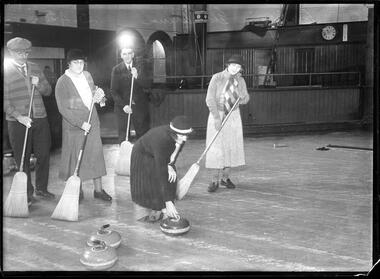 City of Melbourne Libraries
Photograph, Bull, Hugh Jones, 1897-1993, Curling at the Glaciarium, South Melbourne
... In June 1935, for the Melbourne Centenary, the New Zealand team came to Melbourne to compete for the Silver Fern Trophy. ...In June 1935, for the Melbourne Centenary, the New Zealand team came to Melbourne to compete for the Silver Fern Trophy. ...Curling at the Glaciarium Mr A G Outhwaite, Mrs Lorna Moffatt-Pender and others, play a game of curling at Melbourne’s Glaciarium, c1933. “Game for Women who are “getting on”!” ran The Herald headline reporting that, “Mrs Moffatt-Pender finds curling a delightful game for the woman who is not quite as young as she was and wants something livelier than croquet. “There is no reason why women should not play up to 50 years of age. And there is always the domestic appeal of the broom which accompanies the curler on ice. Accuracy is the great thing in the game.” Arthur Grenby Outhwaite co-wrote popular “fairy” books, illustrated by his wife, Ida Rentoul Outhwaite. Featured in "Newsworthy: Melbourne in photographs 1933-1936" exhibition at East Melbourne Library, October to December 2023. Exhibition caption by project volunteer, Fiona Collyer. Photographer notations on slide: "Curling - Glaciarium B42" Description: Mr A G Outhwaite, Mrs Lorna Moffatt-Pender, Mrs S J Allen and two unidentified people play a game of curling at Melbourne Glaciarium. Research by project volunteer, Fiona Collyer: Mr Arthur Grenby Outhwaite was married to Ida Rentoul Outhwaite, who was regarded as Australia’s greatest children’s book illustrator and they, along with Ida’s sister Annie, collaborated on many books about fairies, elves and koalas. Ida designed four beautiful stained glass windows at St Marks Fitzroy, which are still there. Mrs Lorna Moffatt-Pender née Smith was married to Captain Iain Moffatt-Pender, a former Scottish Rugby Union international player and Seaforth Highlander in WWI, before he emigrated to Australia and became a wealthy sheep farmer. They were both keen curlers and participated in the NZ v Australia bonspiels at Melbourne Glaciarium in 1935. According to The Herald 9/4/1934, Mrs Moffatt-Pender wore fur-lined suede moccasins on the ice and found curling to be "a delightful game for the woman who is not quite as young as she was and wants something livelier than croquet. “There is no reason why women should not play up to 50 years of age. And there is always the domestic appeal of the broom which accompanies the curler on ice. There is a good sprinkling of women among curlers overseas. Accuracy is the great thing in the game.”" The Curling Club of Australia was formed in Melbourne in 1933 with Wimbledon Singles Champion 1907 and 1914, Sir Norman Brookes, the inaugural president. It disbanded in 1939. Curling was invented in Scotland in 1541, where the tradition is that the laird and the crofter are the same on the ice and after bonspiels (curling tournaments) everybody adjourn for a meal of beef and greens. Rocks of granite are sourced from the Scottish island of Ailsa Craig and weigh 20 kg each. Curling is similar to lawn bowls, but on ice. Two teams of four people each take turns to slide granite stones towards a target known as a house. The team with the most rocks closest to the centre of the house, scores points. Curling stones are delivered with a pre-determent rotation so that they curl as they travel – hence “curling”. Opposition teams can throw guards to block the house or take out the opponent’s stone. The sweeping is to gently warm the surface of the ice where the stone will glide, to extend the path of the stone. In 1934, an Australian team which included the Moffatt-Penders, travelled to New Zealand to compete in a bonspiel on frozen Idaburn Dam near Oturehua, Central Otago. New Zealand won. In June 1935, for the Melbourne Centenary, the New Zealand team came to Melbourne to compete for the Silver Fern Trophy. They voyaged on the M.S. Wanganella and the crew nicknamed the curlers the “Ladies Hairdressers”. Australia won two tests and the third test was a draw. At the conclusion of the bonspiel, a secret, centuries old initiation was held at a “curlers’ court” at Anzac House with seven Australian curlers initiated. Afterwards, a dinner was held at the Occidental Hotel (corner of Exhibition and Collins streets, demolished 1950s), where the haggis was carried in under an archway of curling brooms. The “Ode to the Haggis” was recited by “My Lord of the Court”, Captain Moffatt-Pender before he presented each New Zealand team member with a miniature curling stone as a souvenir of their visit. The Melbourne Glaciarium (also known as "The Glaci" or "The Glassy") opened in 1906 at 16 City Road, South Melbourne and was the third largest ice rink in the world at the time. There was seating for 2000 people which was heated with hot water pipes, and they could hire out 1500 pairs of skates. Up to 5000 people could attend hockey matches and ice sports carnivals at any one time. Patrons could watch films in summer or dance to the Glaciarium’s own orchestra conducted by Frank Bladen, who had played with the Pavlova and the Gilbert and Sullivan orchestras. In 1911 John Sousa, creator of the Sousaphone, and his band played a season of concerts. In 1924, the Glaciarium was turned into a makeshift film studio for filming of the interior scenes of "Jewelled Nights", starring Australian actress Louise Lovely, who had achieved success in Hollywood. The basketball and gymnastic competitions for the 1956 Melbourne Olympic Games were held there. Public skating sessions always finished with “Till we Meet Again”, a popular WWI song about the parting of a soldier and his sweetheart, written by Richard A Whiting and Raymond B Egan. The Glaciarium closed in 1959 and was demolished after a fire in 1963. References: WOMAN CURLER RETURNS (1934, April 9). The Herald (Melbourne, Vic. : 1861 - 1954), p. 14. Retrieved September 14, 2023, from http://nla.gov.au/nla.news-article243253779 CURLERS INITIATED (1935, June 24). The Argus (Melbourne, Vic. : 1848 - 1957), p. 4. Retrieved February 2, 2024, from http://nla.gov.au/nla.news-article12251790 Melbourne Glaciarium, Only Melbourne, https://www.onlymelbourne.com.au/melbourne-glaciarium Melbourne Glaciarium, Legends of Australian Ice, https://icelegendsaustralia.com/glaciariums.htmlPhotographer notations on slide: "Curling - Glaciarium B42".curling, 1930-1939, glaciarium, fires -
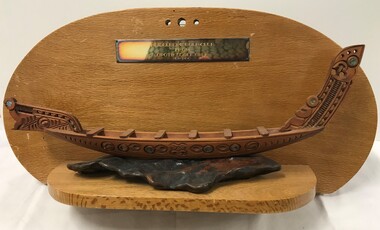 Heidelberg Golf Club
Memorabilia - Trophy, Opotiki Golf Club, Heidelberg Golf Club from Opotiki Golf Club New Zealand, 12/03/1969
... trophy was presented to HGC by Opotiki Golf Club on 12/03/1969. Opotiki Golf Club is located on the Eastern Bay of Plenty, North Island of New Zealand. This club celebrated its centenary...trophy was presented to HGC by Opotiki Golf Club on 12/03/1969. Opotiki Golf Club is located on the Eastern Bay of Plenty, North Island of New Zealand. This club celebrated its centenary ...This trophy was presented to HGC by Opotiki Golf Club on 12/03/1969. Opotiki Golf Club is located on the Eastern Bay of Plenty, North Island of New Zealand. This club celebrated its centenary in 2018. There are no details on why this trophy was given to the Heidelberg Golf Club. If you have any ideas, please contact us.Timber backboard with brass plaque and small Maori boat on shelf.Heidelberg Golf Club from Opotiki Golf Club New Zealandopotiki golf club, heidelberg golf club
