
Showing 124 items matching "farmers of the kiewa valley"
-
 Kiewa Valley Historical Society
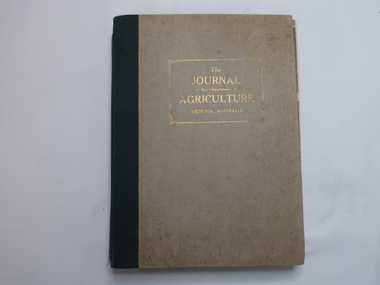
Book of Journals - Agriculture 1949, The Journal of the Department of Agriculture Victoria, Australia
... ...farmers of the Kiewa Valley...Each journal has eg January 50 pages and February 100 pages with advertisements, articles, etc updating farmers on current issues and the latest inventions. Farmers in the Kiewa Valley subscribed to these journals enabling them to keep up with the changes in farming in Victoria, Australia. department of agriculture in Victoria farmers of the Kiewa Valley 1949 Journals Large, thick book box with monthly journals in 1949 enclosed. ...Each journal has eg January 50 pages and February 100 pages with advertisements, articles, etc updating farmers on current issues and the latest inventions.Farmers in the Kiewa Valley subscribed to these journals enabling them to keep up with the changes in farming in Victoria, Australia.Large, thick book box with monthly journals in 1949 enclosed. Each journal is held by string. Spine is black and cover is beige.department of agriculture in victoria, farmers of the kiewa valley, 1949 journals -
 Kiewa Valley Historical Society
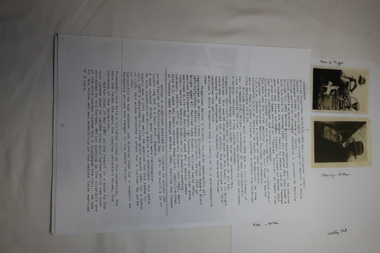
Higginson Family History from 1852
... ...Farmers of the Kiewa Valley...The Kiewa Valley was a farming district being developed by clearing and farming the land with cattle. The Higginson family were early farmers of the Kiewa Valley. ...The Kiewa Valley was a farming district being developed by clearing and farming the land with cattle. The Higginson family were early farmers of the Kiewa Valley. They were related to the Ryder family, by marriage. The Ryder family were also early settlers of the Kiewa Valley.2 A3 and 4 A4 sheets of paper including one A4 sheet typed history of the Higginson Family history and including photocopies of several black and white photos higginson family, ryder family, farmers of the kiewa valley -
 Kiewa Valley Historical Society
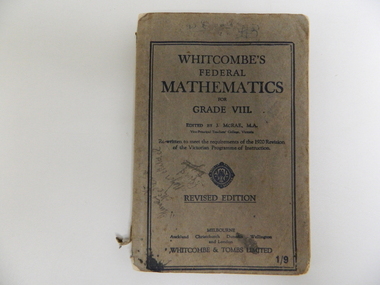
Book - Maths, Whitcombe's Federal Mathematics for Grade VIII, 1920
... Tas Davies was a farmer in the Kiewa Valley....Tas Davies was a farmer in the Kiewa Valley. Historical: Education compared over the years with the use of Mathematic text books and the Victorian education Department. ...Education in Mathematics in the Victorian Education Department Schools in the 1920s. Tas Davies was a farmer in the Kiewa Valley.Historical: Education compared over the years with the use of Mathematic text books and the Victorian education Department. Provenance: Tas Davies local farmer of the Kiewa Valley and his education. He worked on the Kiewa Hydro Electric Scheme.Grey thin cardboard cover with two black lines around the perimeter the outside one being thicker than the inside one. Writing in blackWhitcombe's / Federal / mathematics / for / Grade VIII. / Edited by J. McRae, M.A. / Vice Principal Teachers' College Victoria / Re-written to meet the requirements of the 1920 Revision / of the Victorian Programme of instruction / emblem / Revised Edition / Melbourne / Auckland Christchurch Dunedin Wellington / and Londaon / Whitcombe & Tombs Limited / 1/9 Written in ink on inside cover page 'Mrs Davies'. In pencil 'Tas Davies'education. victorian education department. tas davies.mathematics. schools -
 Kiewa Valley Historical Society
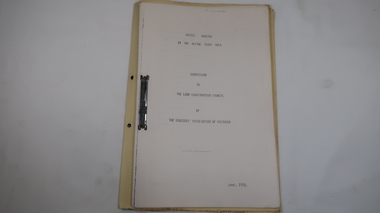
Folder - Cattle Grazing, Cattle Grazing in the Alpine Study Area
... Cattlemen / Beef Farmers of the Kiewa Valley took their cattle up to the High Plains to graze during summer....Cattlemen / Beef Farmers of the Kiewa Valley took their cattle up to the High Plains to graze during summer. bogong high plains cattle grazing farmers of the kiewa valey national parks J. ...Cattlemen / Beef Farmers of the Kiewa Valley took their cattle up to the High Plains to graze during summer.Cover includes the heading 'National Parks Service' and is bound on the spine with black tape. This is followed by 'File Title' on yellow cardboard marked with column and lines. Inside: 35 pages printed on one side. Pages are bound by steel binder. Dated: June 1978J. Commins on cover page at the top.bogong high plains, cattle grazing, farmers of the kiewa valey, national parks -
 Kiewa Valley Historical Society
Egg Box
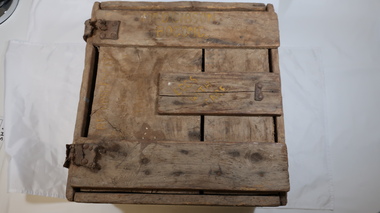
... Higginson and Hollond families - farmers in the Kiewa Valley. ...Higginson and Hollond families - farmers in the Kiewa Valley. Bogong was a property owned by Kiewa Valley farmers. ...Pre egg cartons.Home-made with reused 'crate' wooden panels. Higginson and Hollond families - farmers in the Kiewa Valley. Bogong was a property owned by Kiewa Valley farmers. Dave Gibson worked with the SEC in the early days and married Lois Hollond (Robert and Reg's sister). Lois lives in WodongaOld brown wooden handmade box with two panels joined together on each face (sides, bottom, top). The lid fits inside at the top and has 3 smaller panels nailed on, 2 of which have leather straps nailed on one side of the box and fastened (nailed) to 1 side as a hinge. Inside: the box has 2 wooden vertical panels dividing the box into 3 sectionsTop of the lid in yellow paint "Mr D. Gibson/Bogong" on 1 wooden panel and "Eggs with Care" on smaller panel between the side panelseggs, farming. chooks, kiewa valley, higginson family, hollond family -
 Kiewa Valley Historical Society
Book - English, Intermediate English, 1957
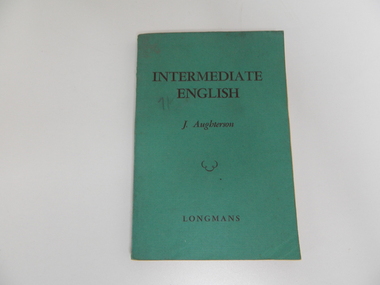
... The Davies family, farmers in the Kiewa Valley, used this book at the Mt Beauty Secondary College. ...The Davies family, farmers in the Kiewa Valley, used this book at the Mt Beauty Secondary College. ...This book was used by Victorian schools for the education of students and was bought at Halls Book Store, 371 Bourke St., Melbourne. The Davies family, farmers in the Kiewa Valley, used this book at the Mt Beauty Secondary College. Historical: In the 1950s the Victorian Education Department supplied the text books for Government schools. Provenance: The families of the Kiewa Valley attended the local Secondary school and owned their text books.Green book with soft cardboard cover with black print for title, author and publisherINTERMEDIATE / ENGLISH / J. Aughterson / squiggle like cloud / LONGMANS on coverschool. secondary school. english. education. davies. mt beauty. local family. text book. -
 Kiewa Valley Historical Society
Map - Cattlemen from Kiewa Valley
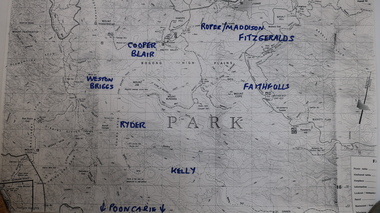
... The families were farmers from the Kiewa Valley. The 2003 fires interrupted this tradition which was discontinued altogether in 2005 for environmental reasons. ...The families were farmers from the Kiewa Valley. The 2003 fires interrupted this tradition which was discontinued altogether in 2005 for environmental reasons. ...Cattle grazing on the Bogong High Plains occurred on most summers since the 1840s. The families were farmers from the Kiewa Valley. The 2003 fires interrupted this tradition which was discontinued altogether in 2005 for environmental reasons. This tradition is still controversial.History of Cattle grazing on the Bogong High Plains and farming in the Kiewa Valley and the families that lived there.Photocopied topographical map of part of the Alpine National Park showing 11 families areas for cattle grazing. Dated 1991/92 up to 2003 fires.91/92 Until fires in 2003 Families names have been added in blue texta. They are: 'Kelly, Faithful, Weston Briggs, Ryder, Cooper, Blair, Roper, Maddison, Fitzgeralds, Hicks.'cattlemen of the kiewa valley, cattle grazing on the bogong high plains -
 Kiewa Valley Historical Society
Photo - Pack horses leaving Mt Beauty
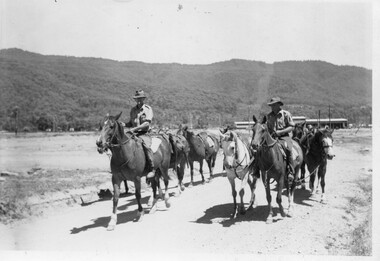
... Farmers from the Kiewa Valley drove their cattle up to the Bogong High Plains during summer. ...Farmers from the Kiewa Valley drove their cattle up to the Bogong High Plains during summer. ...Farmers from the Kiewa Valley drove their cattle up to the Bogong High Plains during summer. Each family had a lease and a hut to stay in. Pack horses were used to carry food and other necessary items for the men while they were away.The Ryder family farmed in the Kiewa Valley and had a grazing lease and hut on the Bogong High Plains where they droe their cattle during summer. Black and white photo with 2 men on horses each followed by two packhorses. Wally Ryder is on the horseman on the right. January 1947. This photo is published on page 114 of 'A History of the Kiewa Valley' by Esther Temple and David Lloyd.On back 'Pack horses leaving Mt Beauty / January 1947 / Suspect Wally Ryder on right.'wally ryder, cattlemen, packhorses -
 Kiewa Valley Historical Society
Newspapers - Cattlemen
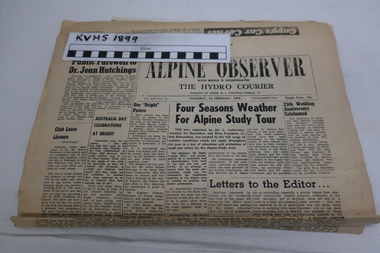
... Traditionally, farmers from the Kiewa Valley took their cattle up to the Bogong High Plains during the summer for better feed. ...Traditionally, farmers from the Kiewa Valley took their cattle up to the Bogong High Plains during the summer for better feed. ...Traditionally, farmers from the Kiewa Valley took their cattle up to the Bogong High Plains during the summer for better feed. From 1978, the Alpine National Park management, along with the Victorian Government stopped the practice as a result of studies showing the deterioration of the land due to the cattle grazing on the High Plains.This disagreement resulted in the banning of cattle on the High Plains.A collection of newspaper reports on the issue of cattle grazing on the Bogong High Plains. Also, the Conservation Council's argument for the cattle being excluded from the Bogong High Plains. Newspaper cuttings re Cattlemen in the High Plains from 1978. Book - Land Conservation 1983 - pale blue 81 pages.cattlemen on the high plains, bogong high plains, land conservation council -
 Kiewa Valley Historical Society
Family History - Crosthwaite Family, January 2012
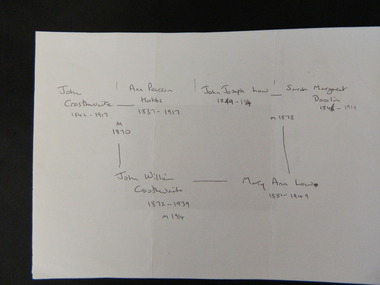
... The Crosthwaite family have been long term dairy farmers at Gundowring in the Kiewa Valley....The Crosthwaite family have been long term dairy farmers at Gundowring in the Kiewa Valley. Long term dairy farmers of the Kiewa Valley. ...The Crosthwaite family have been long term dairy farmers at Gundowring in the Kiewa Valley.Long term dairy farmers of the Kiewa Valley.Consists of three pages: Handwritten family chart of the Crosthwaite family and two sheets of copies of photos labelled.Labels are handwrittencrosthwaite family; gundowring; kiewa valley -
 Kiewa Valley Historical Society
Map - Topographical, Ski Club of Victoria Bogong High Plains and Adjacent Peaks, Early 1930's
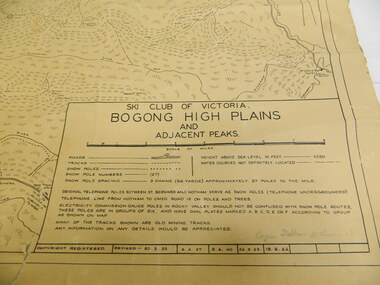
... The Ryder family are farmers in the Kiewa Valley and were involved in taking their cattle up to the Bogong High Plains where they had a lease. ...The Ryder family are farmers in the Kiewa Valley and were involved in taking their cattle up to the Bogong High Plains where they had a lease. ...This map has been in the Ryder family for approx. 70 years. Probably used when bush walking and skiing in the early days on the Bogong High Plains. The Ryder family are farmers in the Kiewa Valley and were involved in taking their cattle up to the Bogong High Plains where they had a lease. The State Electricity Commission of Victoria constructed the Kiewa Hydro Electric Scheme opening up the area during the 1940's and 1950's. This type of map is an early one, used by people in the Kiewa Valley and possibly by surveyors prior to construction.The map is an early topographic map used by farmers living in the Kiewa Valley. It is historically significant as these people were involved in taking cattle up to the High Plains during summer and may have been used for bush walking and skiing.This is a sepia coloured paper map which was originally printed copyright registered. It was revised in 20/6.33/4.4.37/8.4.40/24.8.43/19/6/54. It shows roads / tracks / snow poles / snow pole numbers (27) / Snow pole spacing (3 chains. 66 yards) approximately 27 poles to the mile / height above sea level in feet - 5280. Water courses not definitely located etc.Rocky Valley Dam (Kiewa Hydro Electric Scheme) has been drawn on the map by hand with a biro. There is a wooden rod at the top of the map.topographic map; kiewa valley; ryder family; high plains of victoria -
 Kiewa Valley Historical Society
Boots Riding, late 1800's - early 1900's
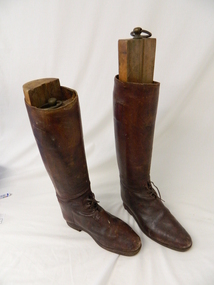
... Many farmers of the Kiewa Valley built huts on the Bogong High Plains to stay in during the summer mustering season. ...Many farmers of the Kiewa Valley built huts on the Bogong High Plains to stay in during the summer mustering season. ...The early Kiewa Valley farmers opened up the Bogong High Plains for cattle grazing in the late 1800's and early 1900's. Many farmers of the Kiewa Valley built huts on the Bogong High Plains to stay in during the summer mustering season. The Roper family had their own cattle run on the High Plains with several version's of Ropers Hut being built and used for this purpose. These boots were owned by Fred Roper whose father was one of the first pioneers of the Upper Kiewa Valley and Tawonga farming district. These boots were made around the late 1800's to early 1900's and are of a quality hide and a very good example of historical clothing worn at the time. These boots are very significant to the Kiewa Valley because the mark a period of early farming within the Kiewa Valley and Bogong High Plains as they were worn by Fred Roper who comes from one of the farming pioneering families of Tawonga. These boots were used when mustering the families cattle up to the Bogong High Plains for summer grazing and also around his farm in Tawonga when riding his horses. They were donated by his great grand daughter Leonie Roper in 2011, therefore the manufacturing of these boots could be anything from the late 1880's to early 1900's. They are made of high quality leather and were made to last the tough conditions of mustering and farming cattle. They also had wooden stock which fitted into them "KVHS 0445"These knee high "riding" boots have a 4 "rung" laces at the base of the upright boot and a strap at the top of the boot. They are made of brown leather and have a small heel (not the usual higher heel for stirrups)riding boots. footwear. cattle mustering footwear. roper family. cattlemen. bogong high plains. -
 Kiewa Valley Historical Society
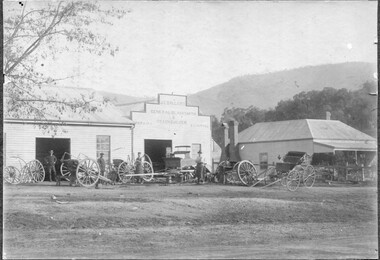
Photo - Blacksmith and Coach Builder business in Kiewa
... This business in Kiewa served farmers and residents in the Kiewa Valley. Originally opened in the 1880s before J. ...This business in Kiewa served farmers and residents in the Kiewa Valley. Originally opened in the 1880s before J. ...This business in Kiewa served farmers and residents in the Kiewa Valley. Originally opened in the 1880s before J. E. Ballard took over. Blacksmith and coach builder trades were taken over by motor cars and tractors.The creation and decline of a blacksmith and coach builder business in the Kiewa Valley.Sepia photo of wheels, buggies and people in front of premises with a house next door. On the business is - J.E. Ballard / General Blacksmith / and / Coach Builder / Repairs Painting. The photo is glued onto thick dark grey cardboard creating a border. This photo is published on pages 7, 44, and 52 of 'A History of the Kiewa Valley' by Esther Temple and David Lloyd blacksmith, coachbuilder, j.e. ballard -
 Kiewa Valley Historical Society
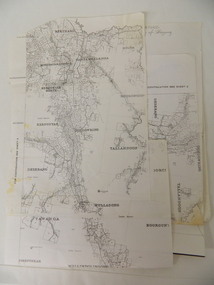
Parish Maps - Kiewa Valley
... Kiewa Valley. They show how the Kiewa Valley was divided up into allotments for town dwellers and farmers and enables further research. kiewa valley. parish maps. land owners Two copies of Parish Maps of the towns in the Kiewa Valley. ...The Parish Maps show how the Counties were divided into allotments for buyers. On one the original owners are named and the sizes of their properties given. The reference numbers enable individuals research the history of the property. The other is on a smaller scale giving only the allotment numbers. The map with the names gives information on the early settlers of the Kiewa Valley. They show how the Kiewa Valley was divided up into allotments for town dwellers and farmers and enables further research.Two copies of Parish Maps of the towns in the Kiewa Valley. One gives the original owners and the other the reference numbers of the allotments.kiewa valley. parish maps. land owners -
 Kiewa Valley Historical Society
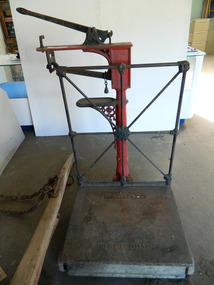
Scales - Tawonga Store
... Weights KVHS 0800 (A) The Tawonga Store opened c1920 and sold goods and produce to the farmers of the Kiewa Valley. The scales were a necessary item for a store as goods were sold in bulk. scales. weights. tawonga store. farm produce. ...These scales were used in the Tawonga Store which opened c1920. They were used to weigh produce e.g.. flour & wheat that the farmers used on their farms and in their homes. These scales pre date packaging. Ref. Weights KVHS 0800 (A)The Tawonga Store opened c1920 and sold goods and produce to the farmers of the Kiewa Valley. The scales were a necessary item for a store as goods were sold in bulk. Large steel dirty black platform attached at the middle of the back to a red cylinder which has 2 smaller platforms coming out to the side. The top platform has a black steel lever attached and a hook to hold it down. Below this platform is a measuring rod marked 2,4 etc up to 14 on which hangs a eight. The bottom platform is to rest the unused weights. Weights ref. KVHS 0800 (A)W. & T. Avery Birminghamscales. weights. tawonga store. farm produce. -
 Kiewa Valley Historical Society
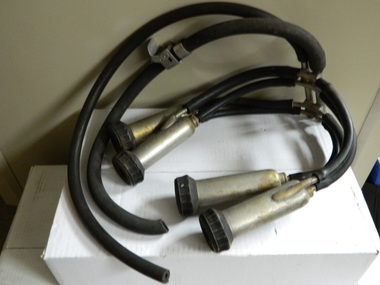
Milking Cups - Dairy
... The dairy industry is and has been one of the major industries of the Kiewa Valley. This equipment was used on local farmers, P & R. Creamer's dairy farm. milking machinery; dairy; Kiewa valley; Creamer family; At opening at end of cups: "Utility" possibly more but too difficult to read. ...This milking equipment was used in the early days of milking using machines. The dairy industry is and has been one of the major industries of the Kiewa Valley. This equipment was used on local farmers, P & R. Creamer's dairy farm.Set of early mechanical milking cups. 4 cups - 2 each side of 2 hollow metal (steel) rods which are attached to hollow rubber tubes that lead towards the main milking machine. The metal cups have black ends at the opening where they are attached to the cow. The outlet from the cups is via 2 metal tubes that lead into the rods that in turn lead to the tubes.At opening at end of cups: "Utility" possibly more but too difficult to read. milking machinery; dairy; kiewa valley; creamer family; -
 Kiewa Valley Historical Society
Bottle - Milk, After 1966
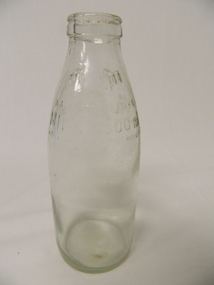
... Dairy farmers live in the Kiewa Valley and send their milk to the local dairy to be pasteurised and bottled. ...Milk bottles were bought at the local store. Metric measures were introduced in Australia in 1966. Bottles were recycled and remained the property of the manufacturer.Dairy farmers live in the Kiewa Valley and send their milk to the local dairy to be pasteurised and bottled. Historical: Bottles changed shape, size, embossing and seal. Aesthetic- Display showing bottles of different shape, size, embossing.Clear glass milk bottle with straight dies three quarters of the way up tapering gently to the opening. The tapered sides are heavily embossed in capital letters with 5 lines of writing.Near opening: around top: 4 lots of 'm' each in a circle on 4 sides Next line 'Wash and Return' twice i.e.. each side Next line 'Milk 600 ml' twice i.e.. each side Next line 'Use not permitted without written permission owner milk Bottles Recovery Ltd Next line: 'M10058 18'milk bottle; kiewa valley; dairy industry -
 Kiewa Valley Historical Society
Journal - John Creamer, Dairyfarmer, 1916 - 1942
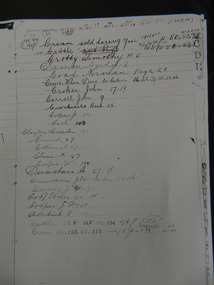
... The journal was kept by local dairy farmer John Creamer who farmed at Gundowring in the Kiewa Valley. It consists of names of local people and is representative of the business (produce and life) on the dairy farm at the time. ...Dairy farmers kept a journal to record their transactions and business on the farm. John Creamer's daughter Mary Cardwell has her father's journal covering the years 1916 to 1942.The journal was kept by local dairy farmer John Creamer who farmed at Gundowring in the Kiewa Valley. It consists of names of local people and is representative of the business (produce and life) on the dairy farm at the time.Photocopied A3 sized pages from John Creamer's dairy journal covering the years 1916-1942. The book has an alphabet index for people's names with details of their purchases (eg. mutton and potatoes) with the cost in pounds shillings and pence. Page 15 has the title "Sows When Due to Parrow" and lists the cows by name. Only pages 1 to 61 have been copied except for pages 39-41, 49, 54, 55. The rest has been digitised. See: KVHSs 1823 for digitised copydairy industry; creamer family; gundowring -
 Kiewa Valley Historical Society
DVD - Mary Cardwell's Father's Diary
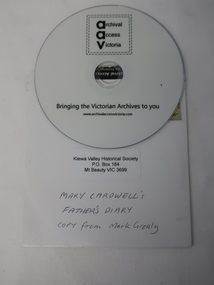
... The journal was kept by local dairy farmer John Creamer, who farmed at Gundowring in the Kiewa Valley. It consists of names of local people and is representative of the business (produce and life) on the dairy farm at the time. ...Dairy farmers kept a journal to record their transactions and business on the farm. John Creamer' daughter, Mary Cardwell has her father's journal covering the years 1916 to 1942. Mark Grealy digitised the journal for KVHS to preserve the contents and to make it available to the public at the PRO as an item of significance. DVDs have been replaced by USB sticks as technology advances.The journal was kept by local dairy farmer John Creamer, who farmed at Gundowring in the Kiewa Valley. It consists of names of local people and is representative of the business (produce and life) on the dairy farm at the time. DVDs are a digitised version of the Journal and require a computer to be able to play it as technology advances.DVD is white with black print:on the front: 'AAV' / 'Archival Access Victoria / Bringing the Victorian Archives to you / www.archivalaccessvictoria.com. The DVD is in a white cardboard sleeve with a postage stamp, KVHS address and Title: 'Mary Cardwell's / Father's Diary / Copy from Mark Grealy' Ref: KVHS 0947As Above. dairy industry, creamer family, gundowring, dvd dairy farm journal -
 Kiewa Valley Historical Society
Photo - Kiewa Butter Factory 1892
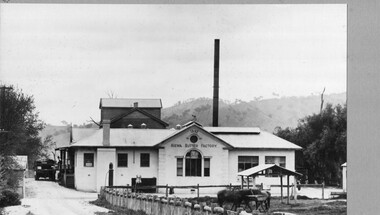
... In 1928 a new butter factory was built and a milk products factory was created in 1952 The Kiewa Butter Factory employed a lot of people and supported the farmers in the Kiewa Valley. Kiewa Butter Factory Creamery Dairy Industry Written in biro bottom front of cardboard '1932' Black and white photo of Kiewa Butter Factory 1892. ...Butter factory at Kiewa with creameries at Kergunyah and Gundowring met on 14th December 1892 and built it in 1893. In 1928 a new butter factory was built and a milk products factory was created in 1952The Kiewa Butter Factory employed a lot of people and supported the farmers in the Kiewa Valley.Black and white photo of Kiewa Butter Factory 1892. The photo was taken in 1932. The photo is glued to thick grey cardboard creating a frame. The photo is of a white building with a tall tower behind it. This photo is published on pages 45 and 89 of 'A History of the Kiewa Valley' by Esther Temple and David LloydWritten in biro bottom front of cardboard '1932'kiewa butter factory, creamery, dairy industry -
 Kiewa Valley Historical Society
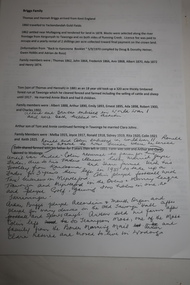
Papers and photos and CD - Briggs Family History, Thomas and Hannah Briggs from 1860
... The Briggs were early farmers in the Kiewa Valley - Tawonga. Includes documents (copied) of land sale and teacher appointments. ...Thomas and Hannah Briggs arrived from Kent, England. In 1860 they travelled to Yackandandah Gold Fields. Settled near Mullagong and selected land along the Kiewa River. They had 7 children.The Briggs were early farmers in the Kiewa Valley - Tawonga. Includes documents (copied) of land sale and teacher appointments. Includes a CD (labelled) and photos of the Briggs family.also labelled.4 A4 pages including typed pages with handwritten additions ans well as photocopied pages and photocopy of land sale and of teaching appointment. A CD titled Tawonga History "Briggs Pic". Photos and CD are labelled.Photos labelled on back of photos and on CD. handwriting added to typed heets.briggs family, cooper family, jessie montgomery -
 Kiewa Valley Historical Society
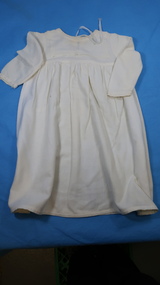
Clothes - Baby's Nighties x3
... The nighties were hand-made in the 1920s when clothing was usually hand made especially in the Kiewa Valley where access to shops was limited. The Cooper family were farmers in Tawonga. baby nighties nesta drew cooper family of tawonga Home-made so no marking or branding Three Vyella (brushed cotton) baby's nighties. ...Three early to mid 20th century baby's nighties, purported to have been worn by Nesta Drew nee Cooper. The Cooper family lived in Tawonga for three generations.The nighties were hand-made in the 1920s when clothing was usually hand made especially in the Kiewa Valley where access to shops was limited. The Cooper family were farmers in Tawonga.Three Vyella (brushed cotton) baby's nighties. White vyella fabric with silk thread embroidery. Very well home-sewn items, with cotton lace trimming.1920s.Home-made so no marking or brandingbaby nighties, nesta drew, cooper family of tawonga -
 Kiewa Valley Historical Society
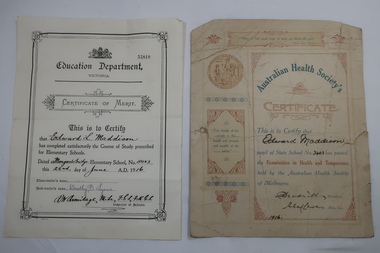
Papers - Certificates - Edward Maddison
... Edward Maddison's family were farmers in the Kiewa Valley and the children attended the local school. ...The Australian Health Society was formed in Melbourne in 1875 at the instigation of Unitarian Minister MarthaTurner. It promoted hygiene and comprised of doctors, prominent citizens and politicians. It targeted poorer districts and women. Schools were pressured to place health education on the curriculum. Society stalwarts made an annual examination in state schools. Mongan's Bridge No. 3403 opened in 1902. It was located beside the Kiewa river and operated part-time with nearby schools on occasions as well as full time. As numbers fluctuated it was also closed on occasions and then re-opened.Edward Maddison's family were farmers in the Kiewa Valley and the children attended the local school.Two certificates belonging to Edward Maddison 1. 1916 Pupil of State School No 3403 (Mongan's Bridge) - passed the Examination in Health and Temperance held by the Australian Health Society of Melbourne 2. 1916 Completed satisfactorily the Course of Study prescribed for Elementary Schools.- Mongan's Bridge Elementary School No. 3403edward maddison, australian health society, mongan's bridge school -
 Kiewa Valley Historical Society
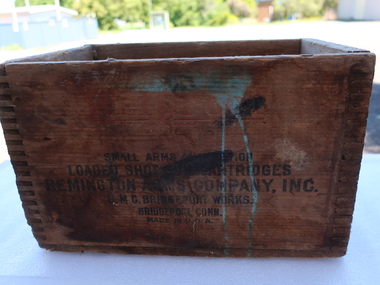
Ammunition Box - Remington America
... Used by hunters, farmers and recreational shooters in the Kiewa Valley. Remington Arms ammunition box hunters In black print on each side. ...Manufacturer of fire arms and ammunition. Founded in 1816. It was one of the oldest gun makers in the US. Used by hunters, farmers and recreational shooters in the Kiewa Valley.Wooden cubic shaped box with black print on each side including the makers name, Remington Arms Co. Inc. of Bridgeport, Conn., USAIn black print on each side. Varying quality of legible words.remington arms, ammunition box, hunters -
 Kiewa Valley Historical Society
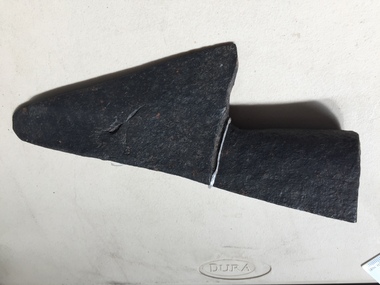
Ploughshare
... Now drawn by tractors. Farmers in the Kiewa Valley used ploughs before tractors became available. ploughshare agriculture farming crops Formerly KV 060. ...The ploughshare cuts grass and soil loosening or turning the soil before sowing seed or planting. Ploughs were drawn by oxen and horses. Now drawn by tractors.Farmers in the Kiewa Valley used ploughs before tractors became available.Formerly KV 060. Made of steel and a component of a plough. It is the cutting or leading edge of a mouldboard which closely follows the coulter wen ploughing. Attached picture shows the ploughshare as part of a plough. Ref. Farmyard Relics by Ken Arnold Page 49ploughshare, agriculture, farming crops -
 Kiewa Valley Historical Society
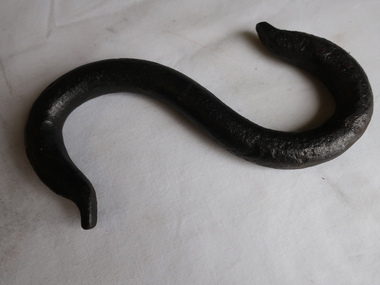
Metal Meat Hook
... Used to hang up meat or the carcasses of animals such as pigs and cattle.See KVHS 1511 Used by farmers and butchers in the Kiewa Valley. meat hook butcher beef pork An S-shaped steel hook. ...Used to hang up meat or the carcasses of animals such as pigs and cattle.See KVHS 1511Used by farmers and butchers in the Kiewa Valley.An S-shaped steel hook.meat hook, butcher, beef, pork -
 Kiewa Valley Historical Society
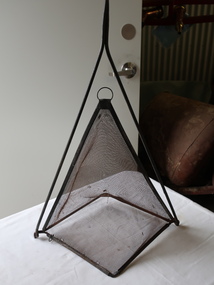
Handmade Tool - Insect Cover or Sieve or Fishing Net or yabby trap
... Farmers could use this sieve to fill with sand etc. to sort the sizes and also to use for eg. wheat to sort the grain. Yabbies are trapped in the creek or river by leaving food in the net for the yabby to crawl into. Food covers were used by residents of the Kiewa Valley ...Flies are plentiful and a problem especially in Australia's summer. Farms were a breeding ground for flies that bred in cow manure. Fly-wire was used to keep flies away from food as well as light cloth covers. Farmers could use this sieve to fill with sand etc. to sort the sizes and also to use for eg. wheat to sort the grain. Yabbies are trapped in the creek or river by leaving food in the net for the yabby to crawl into.Food covers were used by residents of the Kiewa Valley especially as many of them were dairy farmers. Farmers often made their own tools for a purpose such as sieving or for the family catching yabbies to eat or for fun.Tall triangular steel fly wire cover with a steel handle and frame. or The frame can be held in order to fill the sieve or to empty it. or the frame can hold bait for yabbiesfood cover, fly-wire, flies, sieve, handmade tool -
 Kiewa Valley Historical Society
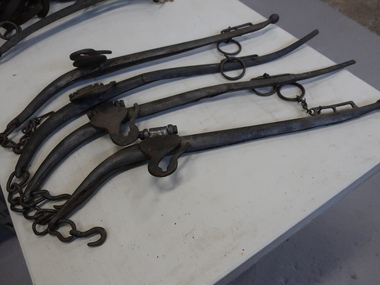
Hames - 2 pairs, Horse Equipment
... Used by farmers in the Kiewa Valley horse equipment hames horse collar Short knob top, forged hook, nut and bolt joint, loose rein ring, chain bottom, steel cased. ...Horse harness that connects a horse to a horse drawn vehicle 2 types 1. breast collar or breast strap 2. full collar or collar-and-hames. On either side of the collar are wooden or metal bars called hames.Used by farmers in the Kiewa ValleyShort knob top, forged hook, nut and bolt joint, loose rein ring, chain bottom, steel cased. They go on the collar and are made of two metal strips which take the full force of the pull padded by the collar.horse equipment, hames, horse collar -
 Kiewa Valley Historical Society
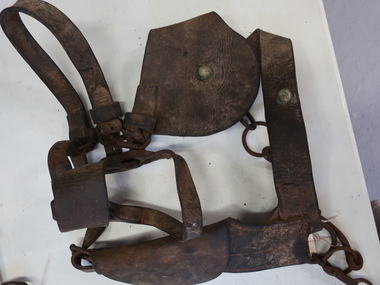
Blinkers, Horse Equipment
... Used by farmers in the Kiewa Valley. horse blinkers horse equipment Drag Blinkers, also known as binders or winkers. ...Made of leather and placed on either side of a horse's eyes and attached either to a bridle or an independent hood. Used by farmers, carters, bullock drivers etc specially when the horse is in a team of horses.Used by farmers in the Kiewa Valley.Drag Blinkers, also known as binders or winkers. Used beside the horse's eyes so that the horse can only look forward and not be distracted by other horses in the team. Straps are leather with steel buckles.horse blinkers, horse equipment -
 Kiewa Valley Historical Society
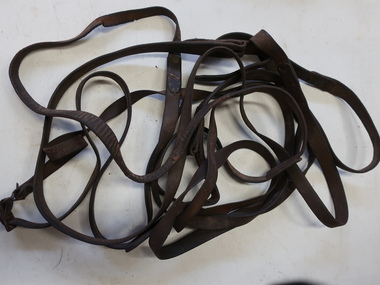
Horse Reins, Horse Equipment
... Used by residents of the Kiewa Valley especially farmers. horse reins horse equipment Made of leather with steel buckles. ...Reins are the means by which a horse rider or driver communicates directional commands to the horse's head. Pulling on the reins can be used to steer or stop the horse.Used by residents of the Kiewa Valley especially farmers.Made of leather with steel buckles. The reins are connected to the bit in the mouth and go to the rider or the person walking / controlling the horse/horses eg. on a dray, wagon, plough etc.horse reins, horse equipment
