
Showing 151 items matching "president's medal"
-
 Geoffrey Kaye Museum of Anaesthetic History
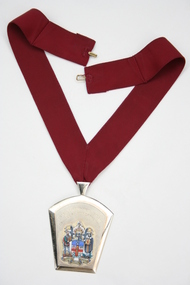
Medal - President's Medal
... President's Medal...medal...president...The President's Medal is a gold-gilded silver medal with an angular shape, with colour enamel Australian and New Zealand College of Anaesthetists (ANZCA) armorial bearings on a raised platform. ...medal president anaessthetist college Inscribed on face. ...The President's Medal is a gold-gilded silver medal with an angular shape, with colour enamel Australian and New Zealand College of Anaesthetists (ANZCA) armorial bearings on a raised platform. The ANZCA name is inscribed on the top of the medal in an arched design. The medal is attached to a woven maroon ribbon with brass hooks. The reverse has the donor's details and punched hallmarks. The medal is kept in its original green leather-covered presentation box with the maker's mark printed in gold on the inside cover. The box is decorated in a simple single gold line around the perimeter and is sealed with a gold clasp.Inscribed on face. "AUSTRALIAN AND NEW ZEALAND COLLEGE OF ANAESTHETISTS" Inscribed on reverse. "Presented by PROFESSOR A.B. BAKER / NUFFIELD PROFESSOR OF ANAESTHETICS / UNIVERSITY of SYDNEY / 19TH February, 1994"medal, president, anaessthetist, college -
 Federation University Historical Collection
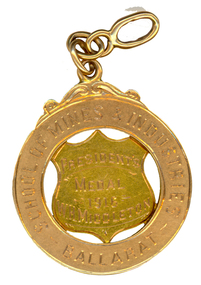
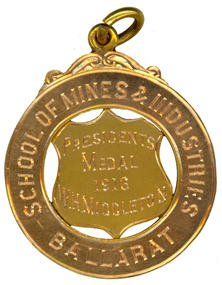
Medal, Ballarat School of Mines Presidents Medal presented to John Dulfer, 1916, 1916
... ...president's medal...The medal was won by John Dulfer who studied Sciemce at the Ballarat School of Mines. The President of the Ballarat School of Mines in 1916 was William Henry Middleton. ...It is the Ballarat School of Mine's President's Medal for most meritorious science student and was awarded to John Dulfer. ...Hand engraved into the medal: Front:"School of Mines & Industries Ballarat. President's medal 1916 W.H. Middleton" Verso: "Most meritorious Student Science School won by J. ...President's medal 1916 W.H. Middleton" Verso: "Most meritorious Student Science School won by J. ...The medal was won by John Dulfer who studied Sciemce at the Ballarat School of Mines. The President of the Ballarat School of Mines in 1916 was William Henry Middleton. Gold (15ct) round medal with a shield shape in the centre, and a gold jump link on the top, housed in it's original blue box. It is the Ballarat School of Mine's President's Medal for most meritorious science student and was awarded to John Dulfer. Hand engraved into the medal: Front:"School of Mines & Industries Ballarat. President's medal 1916 W.H. Middleton" Verso: "Most meritorious Student Science School won by J. Dulfer". "Hutton & Co 15 ct" ballarat school of mines, john dulfer, dulfer, ballarat technical art school, middleton, president's medal -
 Federation University Historical Collection
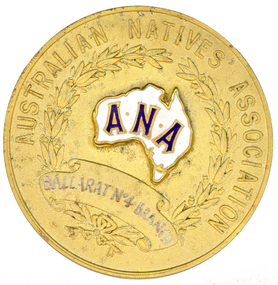
Numismatics, K.G. Luke, ANA (Ballarat Branch No. 4) President's Medal, 1979, c1979
... ANA (Ballarat Branch No. 4) President's Medal, 1979...It is presented in a hinged white plastic box by Casecraft ANA (Ballarat Branch No. 4) President's Medal, 1979 Numismatics K.G. Luke ...The Australian Natives' Association (ANA), a mutual society was founded in Melbourne, Australia in April 1871 as the Victorian Natives' Association. Ballarat branch (No 4) was founded in 1874, had a building in Camp Street and was one of the most active branches in the colony, playing a key role in Federation. The medallist, K.G. Luke, was a private mint that made 1956 Olympic Games medals for the Numismatic Association of Victoria, as well as a considerable number of other medals and trophies. It operated at least between 1937 and 1974. A gold coloured medal featured an a white enameled Australia with the words A.N.A. It is presented in a hinged white plastic box by Casecraftaustralian natives' association, ana, a.n.a., keith rash, rash, australian natives' association ballarat no. 4 branch, australian natives' association, ana, a.n.a., keith rash, rash, australian natives' association ballarat no. 4 branch -
 Geoffrey Kaye Museum of Anaesthetic History
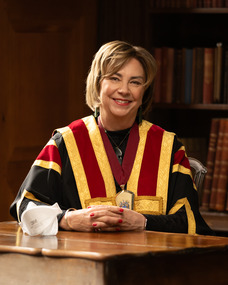
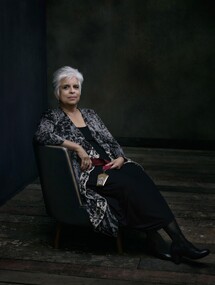
Photograph - Portrait, Ash Hunt, Presidential Portrait of Dr Vanessa Beavis
... president...President's Medal...She is wearing the Presidential gown, the President's Medal, and a pounamu from New Zealand/Aotearoa. ...She is wearing the Presidential gown, the President's Medal, and a pounamu from New Zealand/Aotearoa. ...Dr Vanessa Beavis was the ANZCA President from 2020-2022, during the time of the COVID-19 pandemic, and is hence also known as the "COVID President" or "Wartime President". The mask on the table next to her reflects this. The pounamu around her neck represents the New Zealand/Aotearoa part of ANZCA.In this portrait, Dr Vanessa Beavis is seated at her desk in her office, hands clasped in front of her on the desktop. She is wearing the Presidential gown, the President's Medal, and a pounamu from New Zealand/Aotearoa. Next to her on the desktop is an N95 face mask.presidential portrait, anzca president, president's medal, portrait, anaesthetist, covid-19, covid, pandemic -
 Federation University Historical Collection
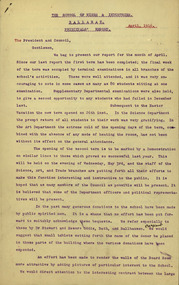
Document - Report, Ballarat School of Mines Principal's Monthly Report, 1916, 04/1916
... ...president's medal...charles fenner herbert h. smith h.h. smith ballarat school of mines museum w.h. middleton dr stewart james oddie thomas bath ballhausen donations australian miners' corps tunnellers australian mining corps andrew robertson president's medal a. boanas conscription soldiers robert dixon ballarat junior technical school donald clark leslie coulter returned soldiers albert gesell factory day E.J. ...4 typed foolscap pages containing the Ballarat School of Mines Principal's Report for 1916charles fenner, herbert h. smith, h.h. smith, ballarat school of mines museum, w.h. middleton, dr stewart, james oddie, thomas bath, ballhausen, donations, australian miners' corps, tunnellers, australian mining corps, andrew robertson, president's medal, a. boanas, conscription, soldiers, robert dixon, ballarat junior technical school, donald clark, leslie coulter, returned soldiers, albert gesell, factory day, e.j. mcconnon, trade teachers, ponsonby carew smyth, agricultural high school stained glass windows, peacock hall stained glass windows, victorian wildflower exhibibition, patriotic funds, red cross funds, telephone mechanics, plumbing, telegraphy, needlework, blacksmithing, d. ronaldson, annual fancy dress procession, dr james stewart, ballhauson, robert m. serjeant, trade department report, electric wiring, w.h. collyer, harold herbert, l.j. middleton, ballarat home coming, forward ballarat committee, eureka pageant, c.a. hoadley, c.a. hoadley resignation -
 Federation University Historical Collection
Medal - Numismatics, Ballarat School of Mines Presidents Medal presented to Allan Bernaldo, 1916, c1916
... The medal was won by Allan Bernaldo who studied Art at the Ballarat School of Mines Technical Art School. The President...It is the Ballarat School of Mine's President's Medal for most meritorious art student and was awarded to Allan Bernaldo. ...Hand engraved into the medal: Front:"School of Mines & Industries Ballarat. President's medal 1916 W.H. Middleton" Verso: "Most meritorious student Art School won by Allan Bernaldo". ...Ballarat School of Mines Presidents Medal presented to Allan Bernaldo, 1916 Medal Numismatics H.F. ...The medal was won by Allan Bernaldo who studied Art at the Ballarat School of Mines Technical Art School. The President of the Ballarat School of Mines in 1916 was William Henry Middleton.Gold (15ct) round medal with a shield shape in the centre, and a gold jump link on the top, housed in it's original blue box. It is the Ballarat School of Mine's President's Medal for most meritorious art student and was awarded to Allan Bernaldo. The medal is housed in its original blue velvet box with the following stamped in gold in the inside lining "H.F. Hutton & Co. The jewellers. Ballarat."Hand engraved into the medal: Front:"School of Mines & Industries Ballarat. President's medal 1916 W.H. Middleton" Verso: "Most meritorious student Art School won by Allan Bernaldo". "Hutton & Co 15 ct"ballarat school of mines, allan bernaldo, bernaldo, ballarat technical art school, middleton, numismatics, award, medal -
 Geoffrey Kaye Museum of Anaesthetic History
Photograph - Portrait, Chris Budgeon, Presidential Portrait of Dr Genevieve Goulding, 01 June 2016
... Framed colour photographic portrait of Dr Genevieve Goulding holding the President's medal....Goulding, Genevieve ANZCA President ANZCA Council Budgeon, Chris Photographic artist Framed colour photographic portrait of Dr Genevieve Goulding holding the President's medal. Presidential Portrait of Dr Genevieve Goulding Photograph Portrait Chris Budgeon ...This photographic portrait was commissioned to commemorate Dr Genevieve Goulding's term as President of ANZCA. Traditionally, ANZCA presidents have been commemorated at the end of their term with a commissioned oil painting. In 2015, the decision was made by ANZCA Council to change to photographic portraiture. This meant the existing oil paintings of College presidents became a formed collection which will not be added to and this portrait is the first to be commissioned in the new medium. It was unveiled at the ANZCA Council dinner on 22 July 2016. Framed colour photographic portrait of Dr Genevieve Goulding holding the President's medal.goulding, genevieve, anzca president, anzca council, budgeon, chris, photographic artist -
 Geoffrey Kaye Museum of Anaesthetic History
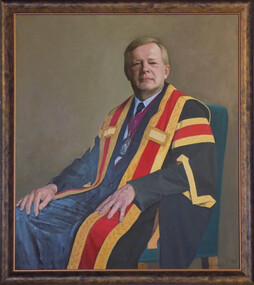
Painting - Portrait, Jiawei Shen, Presidential Portrait of Associate Professor Richard Walsh, 2005
... Oil painting on canvas of Associate Professor Richard Walsh sitting to the side facing left on a blue chair, wearing the College gown and President's medal against a plain background. Mounted in a mottled brown coloured frame....He is most famous for his 2006 winning entry of the prestigious Sir John Sulman Prize in which he painted a portrait of Pope Francis which was presented to His Holiness in 2014. painting walsh, richard anzca president shen, jiawei Lower left hand corner [artist signature \ '05] Oil painting on canvas of Associate Professor Richard Walsh sitting to the side facing left on a blue chair, wearing the College gown and President's medal against a plain background. Mounted in a mottled brown coloured frame. ...This is a portrait of former ANZCA President, Associate Professor Richard Walsh. In 1996, he was elected Vice President and, in 1998 was elected President, serving a full two year term. This painting was formally presented to the College in 2006. Further information about Associate Professor Richard Walsh can be obtained on the Lives of the Fellows, http://anzca.online-exhibition.net/fellows/fellows-1992/richard-george-walsh/ The artist, Jiawei Shen is a Chinese Australian artist considered to be one of Australia's leading portrait artists. He is most famous for his 2006 winning entry of the prestigious Sir John Sulman Prize in which he painted a portrait of Pope Francis which was presented to His Holiness in 2014. Oil painting on canvas of Associate Professor Richard Walsh sitting to the side facing left on a blue chair, wearing the College gown and President's medal against a plain background. Mounted in a mottled brown coloured frame.Lower left hand corner [artist signature \ '05]painting, walsh, richard, anzca president, shen, jiawei -
 Geoffrey Kaye Museum of Anaesthetic History
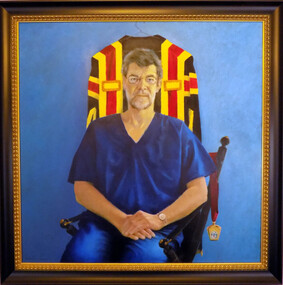
Painting - Portrait, Vytas Serelis, Presidential Portrait of Dr Richard Willis, 2006
... He is wearing surgical scrubs with the College gown on a plain hanger behind him and the President's medal hanging off the back of the chair. ...He is wearing surgical scrubs with the College gown on a plain hanger behind him and the President's medal hanging off the back of the chair. ...This is a portrait of Dr. Richard Willis, formally ANZCA President [2002-2004]. ANZCA commissioned the portrait which was unveiled to Dr. Willis on 23 February 2007. Oil painting on canvas of former ANZCA President Dr. Richard Willis seated face on with hands crossed on his lap. He is wearing surgical scrubs with the College gown on a plain hanger behind him and the President's medal hanging off the back of the chair. Plain light blue background mounted in a plain brown frame.[Lower Left Hand Side] V SERELIS SEPT 2006painting, president, willis, richard, serelis, vytas -
 Federation University Art Collection
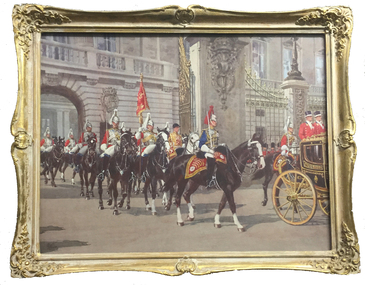
Painting, Allan Bernaldo, 'Sovereign's Escort' by Allan Bernaldo, 1960
... He received a certificate of merit in 1917, and the Ballarat School of Mines President's medal for the most meritorious Art student. ...He received a certificate of merit in 1917, and the Ballarat School of Mines President's medal for the most meritorious Art student. ...Artist's Statement: I spent time visiting the barracks, museums, libraries, gaining information, making special pencil drawings and colour notes, when and where possible. Preparatory drawings for larger paintings were always on detail paper. The reason for this was I could use both sides, correfting mistakes on either side, until a satisfactory end. I use this procedure so that the surface of the painting paper was not effected by erasion. The final drawing was traced on having rubbed a stick of charcoal on the detail paper. I have used this procedure from my early days as a commercial artist. In drawing each horseman fully and tracing each horseman fuly in his place in relation to the whole and rubbibg out the parts covered by the nearer objects. Such essential things as legs and shadows are sure to be in the right place. Most of the pencil drawings of the palace gates, and other features I needed had to be made from a standing position. all these were filed for future reference. Everything had to be in the right proportion to the palace gates. The procedure for the Escort is as follows: If the Life Guards mount the escort an officer of the Blues rides at the right of the coach by invitation. The Guards officer rides on the left. Then follows the Standard flanked by a commissioned officer on the right. The trumpeter on the left. The trumpeter rides on a white horse. He has a selection of twelve different uniforms. After that follows the unit. The stirrups used by the officers are squarish. The troopers stirrups are a conventional form. All personnel riding and on no account rise in the stirrups as normally they would at the trot. This modifies the ragged impression of heads bobbing up haphazardly - their behinds become acclimatized in time." Gift of the Artist, 1981. Allan BERNALDO (05 August 1898-25 June 1988) Born Creswick, Victoria Allan Bernaldo won a scholarship to the Ballarat School of Mines to study Architecture. He received a certificate of merit in 1917, and the Ballarat School of Mines President's medal for the most meritorious Art student. Allan Bernaldo was editor of the Ballarat School of Mines Magazine in 1918. He became known as a commercial artist, teacher and water-colourist who specialiesd in horses and flowers. He died at St. Ronan’s Nursing Home in Armadale, Victoria and was buried at Springvale Botanical Cemetery, with his wife Florence Victoria May Elliott, who predeceased him in 1966. This item is part of the Federation University Art Collection. The Art Collection features over 2000 works and was listed as a 'Ballarat Treasure' in 2007.Gift of Allan BernaldoFramed watercolour painted from materila gathered while the artist was in London during 1952 showing the queen's guards on horseback. art, artwork, bernaldo, allan bernaldo, royalty, guards, watercolour, available -
 Eltham District Historical Society Inc
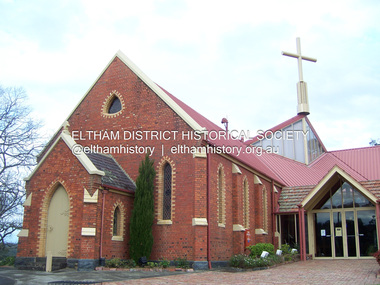
Photograph - Digital Photograph, Marguerite Marshall, St John's Anglican Church, Diamond Creek, 7 September 2008
... One of his sons Donald, who was a local doctor, won the Brownlow Medal, was President of the Melbourne Cricket Club and President of the Melbourne Grammar School Council. ...One of his sons Donald, who was a local doctor, won the Brownlow Medal, was President of the Melbourne Cricket Club and President of the Melbourne Grammar School Council. ...The building was designed by Charles Maplestone of Heidelberg, son-in-law to Anthony Beale of St Helena. Maplestone was a prominent architect who came out to Australia with his family in 1852. The foundation stone was laid by Mrs Isabella Maplestone on 11th November 1867. The bricklayers for the church were George Stebbing, H Limmer, H Spicer and a Mr Timm while Thomas Day was the stonemason. Another three years were to pass before sufficient money could be raised for its completion. It was opened by Bishop Perry on 1st November, 1870. The church bell which hung under a tree for 50 years until it was incorporated in the parish hall was brought out from England and presented by Charles Orme. In 1916, the estate of George Martin Pizzey left sufficient money to build the red brick hall, which still stands today (2023) though in January 1969 the hall and bell tower were badly damaged by bushfire. Coincidentally the former home of benefactor, George Pizzey was destroyed in the same fire. Of particular significance are the interior and exterior of the church, the Sunday school and hall with emphasis on pre-World War I fabric (excluding the 1990s additions) and the three coloured glass windows currently suspended in the 1990s entry foyer. In 2011 further alterations were made to the front of the Church. The church is historically significant because it was the oldest public building in the former Diamond Valley Shire, is amongst the oldest buildings in the Shire of Nillumbik and is associated with the early settlement of the Diamond Creek district. The church is historically, socially and spiritually significant because it has been a place of worship for over 150 years and continues to be, an important meeting place in the Shire. The church is aesthetically significant for the three stained glass windows executed by the noted stained glass manufacturers, Ferguson & Urie, as well as the supporting coloured glass windows in the church. The Sunday school & parish hall is architecturally significant because the hall is a well executed and preserved example of the work of noted church architects, North & Williams. It is historically significant because it is connected with local parishioner and Melbourne industrialist, George Pizzey, who bequeathed funds for its construction. Covered under Heritage Overlay, Nillumbik Planning Scheme. National Estate Ntionl Trust of Australia (Victoria) Local significance Published: Nillumbik Now and Then / Marguerite Marshall 2008; photographs Alan King with Marguerite Marshall.; p85 St John’s Anglican Church stands like a beacon on the hill on Main Street, Diamond Creek. Today the church has a large congregation, but its early years were marked by a small congregation struggling to find enough money to survive. It was gold in Diamond Creek that resulted in the building of this National Trust registered property.1 This church is far removed from William Wilson’s humble barn (later the Bowling Green) where the first Anglican church services were conducted – probably the first in the district.2 In the mid 19th century services were infrequent as the Rev Francis Hales, travelling on horseback, also conducted services elsewhere, including at Heidelberg, Coburg, Kinglake, Arthurs Creek, St Andrews and Kangaroo Ground. In 1860 Diamond Creek came under the jurisdiction of the Eltham Parish. Until the mid 1860s the Diamond Creek settlement included only about 20 families who were struggling farmers. But this changed when gold was found in 1862. Then the township grew to 200 families, including miners, civil administration workers and shopkeepers. The resulting growth of Church of England adherents prompted them to petition the Government in 1866 for land to build a church. The area chosen, on which the original building still stands, was at the centre of the proposed township. Today church leaders believe that this conspicuous location is one of the reasons for its exceptional growth. Prominent architect Charles Maplestone designed the building as he did the Presbyterian Church at Kangaroo Ground. St John’s, which is still intact, was built in the Gothic Revival style with the traditional rectangular plan of a central nave and sanctuary at the end. It is typical of small churches built in Victoria at that time, with polychromatic hand-made bricks, a porch, diagonal buttresses and a slate roof.3 The church was officially opened by Lord Bishop Perry on November 1, 1870. But during the next 40 years, due to the varying fortunes of gold mining, the church struggled to remain viable. In 1909 it separated from the Eltham Parish to form a parish with Greensborough. Life became more difficult with the privations of World War One. Then disaster struck in 1915 when fire destroyed the Diamond Creek Gold Mine, wiping out the major livelihood of most parishioners. However the church’s morale was lifted in 1916, when it received a bequest to build the red brick hall, from late parishioner and prominent leather manufacturer, George Pizzey. As prosperity grew, in 1924 the congregation separated from Greensborough, but they rejoined in the 1930s Depression. In the 1950s the wider population soared, impacting on St John’s, and it became a separate parish, becoming responsible for six churches at St Andrews, Hazel Glen, Hurstbridge, St Helena and Yarrambat. As parishioner numbers outgrew the building, extensions were added in 1989 and then in 1993, blending in well with the original building. Church members have made a huge contribution to the local community. John Ryan was a Heidelberg Shire Councillor for 25 years from 1931, Mayor in 1939 and headed several local sporting and other organisations. His son Jock became a clergyman and a local historian heading the Nillumbik Historical Society. Another parishioner, Dr Ted Cordner, came to Diamond Creek in 1920. One of his sons Donald, who was a local doctor, won the Brownlow Medal, was President of the Melbourne Cricket Club and President of the Melbourne Grammar School Council. Roy ‘Monty’ Vale was a state Liberal MP and was related to May Vale, a member of the Heidelberg School of Artists.4 In the early 21st century St John’s Anglican Church is one of the fastest growing congregations in Melbourne. References: St Johns Anglican Church complex, Sunday School and Parish Hall 61 Main Street DIAMOND CREEK, NILLUMBIK SHIRE. (2023, June 7). Retrieved from https://vhd.heritagecouncil.vic.gov.au/places/64023 Diamond Creek, VIC. – St John’s Anglican (2023, June 7). Retrieved from https://www.churchhistories.net.au/church-catalog/diamond-creek-vic-st-johns-anglican This collection of almost 130 photos about places and people within the Shire of Nillumbik, an urban and rural municipality in Melbourne's north, contributes to an understanding of the history of the Shire. Published in 2008 immediately prior to the Black Saturday bushfires of February 7, 2009, it documents sites that were impacted, and in some cases destroyed by the fires. It includes photographs taken especially for the publication, creating a unique time capsule representing the Shire in the early 21st century. It remains the most recent comprehenesive publication devoted to the Shire's history connecting local residents to the past. nillumbik now and then (marshall-king) collection, st john's anglican church, diamond creek -
 Flagstaff Hill Maritime Museum and Village
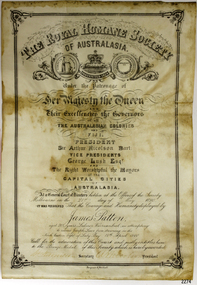
Award - Certificate of Merit, Royal Humane Society of Australia, James Patten, 21-05-1890
... Call for the admiration of this court and justly, entitles him to the Bronze Medal of this society which is hereby awarded." Signatures [Secretary] and [President]...Call for the admiration of this court and justly, entitles him to the Bronze Medal of this society which is hereby awarded." Signatures [Secretary] and [President] Certificate, cream paper, rectangular, decorative border and headings, printed and handwritten in pen and ink. ...The Bronze Medal and Certificate of Merit of the Royal Humane Society of Australasia were awarded to James Patten for the bravery he displayed on 18th April 1890, and presented to him on 21st May 1890. The Royal Humane Society of Australasia was founded in 1874 with the aim to recognise those who risked their lives to save others and to assist those whose acts of bravery caused them or their surviving dependants to be disadvantaged in some way. The producers of the certificate were Fergusson & Mitchell, a Melbourne organisation established by 1858 that was an engraver, lithographer and printer. Details of the incident were published in the Argus, Saturday 19 April 1890, page 11 - "FATAL BOATING ACCIDENT, (BY TELEGRAPH FROM OUR CORRESPONDENT.), WARRNAMBOOL, FRIDAY A fatal boating disaster occurred in Lady Bay this morning, the victim being Joseph Lowe, licensee of the Bay View Hotel, South Warrnambool. The deceased, in company with two lads named James Ferrier and James Patten, went out in a small dingy to shoot musk ducks. The water was perfectly smooth, and the party were tempted to proceed as far as the mouth of the Hopkins River. In their eagerness they neglected to keep clear of the breakers, and were presently carried in on the crest of a large wave, and the boat cap sized within a cable's length of the shore, precipitating the occupants into the water. Patten and Lowe stuck to the overturned boat, Ferrier striking out for the shore, which he reached in an exhausted state. In the meantime his companions had been washed off the boat, and were struggling in the breakers. Lowe was unable to swim, and Patten kept him afloat, at the same time making gallant attempts to get him ashore, but finally had to leave him to his fate. Ferrier, seeing Lowe's danger, undressed and swam out, but became exhausted. Ferrier and Patten were both found in a fainting condition by persons who saw the catastrophe from the jetty, and ran along the beach to render assistance. Attempts were subsequently made to rescue Lowe's body, which could be seen washing abort in the surf. These proved unsuccessful, and no hope is now entertained of recovering it. Lowe was a smart young man, 28 years of age, and unmarried. He was formerly bar-man at the Commercial Hotel here, having been engaged in Melbourne...." The bronze medal and accompanying certificate of the Royal Humane Society of Australasia recognise the bravery of James Patten, a Warrnambool citizen who risked his life in the attempt to save the life of his friend Joseph Lowe.Certificate, cream paper, rectangular, decorative border and headings, printed and handwritten in pen and ink. Letterhead of The Royal Humane Society of Australasia. Awarded on 21st May 1890 to James Patten of Warrnambool. for his bravery on 18th April 1890.Print and writing includes - "The Royal Humane Society of Australia under the patronage of Her Majesty the Queen and their excellencies, the Governors of all the Australian Colonies and Fiji. At a general court of directors holden at the Offices of the Society Melbourne on the 21st day of May 1890, it was resolves that the courage and humanity displayed by James Patten, aged 20 years, labourer Warrnambool in attempting to rescue Joseph Lowe from drowning in the North Eastern bight of Lady Bay 18th April 1890. Call for the admiration of this court and justly, entitles him to the Bronze Medal of this society which is hereby awarded." Signatures [Secretary] and [President]flagstaff hill, warrnambool, flagstaff-hill, maritime museum, maritime village, shipwreck-coast, flagstaff hill maritime museum & village, bronze medal 1890, royal humane society of australasia, james patten, medal, australian award medal, commemorative medal, numismatics, life saving, lifesaving, rescue, bravery, drowning, joseph lowe, james ferrier, lady bay, hopkins river, boating accident, certificate of merit, lithograph, north eastern bight -
 Flagstaff Hill Maritime Museum and Village
Photograph - Portrait, late 19th century
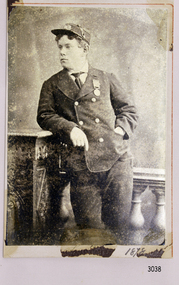
... Criterion C: Potential to yield information that will contribute to an understanding of Victoria’s cultural history. flagstaff hill warrnambool shipwrecked coast flagstaff hill maritime museum maritime museum shipwreck coast flagstaff hill maritime village loch ard shipwreck tom pearce thomas r pearce eva carmichael mutton bird island loch ard survivor loch ard hero coleman jacobs the young hero schottische photograph of tom pearce Printed green text “PHOTOGRAPHIC / SOCIETY OF VICTORIA / MELBOURNE / REGISTERED COPYRIGHT / JULY 24th 1878” and “NONE ARE GENUINE UNLESS WITH / SIGNATURES THUS” and “PRESIDENT / VICE PRESIDENT / SECRETARY” Photograph of Mr Tom Pearce dressed in a uniform with a medal pinned on it. ...This photograph is of Tom Pearce, one of only 2 survivors from the shipwreck LOCH ARD. Loch Ard was bound for Melbourne in 1878 loaded with passengers and cargo when it ran into a rocky reef at the base of Mutton Bird Island, near Port Campbell. Of the 54 crew members and passengers on board, only two survived: an apprentice, Tom Pearce and a young woman passenger, Eva Carmichael, who lost all of her family in the tragedy. Coleman Jacobs composed the music “The Young Hero Schottische” and dedicated it, by permission, to Mr. Thomas R. (Tom) Pearce. The sheet music was published in 1878 by the Messieurs Roberts, professors of dancing etc. Melbourne. It was on sale for 3/- (3 shillings) and in aid of the “LOCH ARD” fund. [This is Coleman Jacobs’ only surviving musical work Coleman Jacobs, accomplished pianist, musical performer, singer, composer, professor of music and music teacher, was born in 1827 and died on 4 July 1885, aged 58 years. Coleman Jacobs was buried in the Melbourne Cemetery (grave 461, Church of England section).] The wreck of Loch Ard still lies at the base of Mutton Bird Island and much of the cargo has been salvaged. Some was washed up into what is now known as Loch Ard Gorge following the shipwreck. Cargo and artefacts have also been illegally salvaged over many years before protective legislation was introduced. The photograph is significant for its association with the wreck of the Loch Ard. This wreck has been protected as a Historic Shipwreck since 11 March 1982, under the Commonwealth Historic Shipwrecks Act (1976) Flagstaff Hill’s collection of artefacts from Loch Ard is significant for being one of the largest collections of artefacts from this shipwreck in Victoria. It is significant for its association with the shipwreck, which is on the Victorian Heritage Register. The collection is significant because of the relationship between the objects, as together they have a high potential to interpret the story of the Loch Ard. The Loch Ard collection is archaeologically significant as the remains of a large international passenger and cargo ship. The Loch Ard collection is historically significant for representing aspects of Victoria’s shipping history and its potential to interpret sub-theme 1.5 of Victoria’s Framework of Historical Themes (living with natural processes). The collection is also historically significant for its association with the Loch Ard, which was one of the worst and best known shipwrecks in Victoria’s history. The Loch Ard collection meets the following criteria for assessment: Criterion A: Importance to the course, or pattern, of Victoria’s cultural history. Criterion B: Possession of uncommon, rare or endangered aspects of Victoria’s cultural history. Criterion C: Potential to yield information that will contribute to an understanding of Victoria’s cultural history. Photograph of Mr Tom Pearce dressed in a uniform with a medal pinned on it. Standing with his arm resting on a masonry pillar. Reverse has piece of tape centre top and bottom. Also has printed maker’s information. Printed by the Photographic Society of Victoria, Melbourne.Printed green text “PHOTOGRAPHIC / SOCIETY OF VICTORIA / MELBOURNE / REGISTERED COPYRIGHT / JULY 24th 1878” and “NONE ARE GENUINE UNLESS WITH / SIGNATURES THUS” and “PRESIDENT / VICE PRESIDENT / SECRETARY” flagstaff hill, warrnambool, shipwrecked coast, flagstaff hill maritime museum, maritime museum, shipwreck coast, flagstaff hill maritime village, loch ard shipwreck, tom pearce, thomas r pearce, eva carmichael, mutton bird island, loch ard survivor, loch ard hero, coleman jacobs, the young hero schottische, photograph of tom pearce -
 Federation University Historical Collection
Booklet - Annual Report, Ballarat School of Mines, Ballarat School of Mines Annual Report, 1969, 1969
... President M.B. John. Page 5 lists the Diplomas awarded. Page 6 lists the scholarships, prizes and awards, including the Josephine Brelaz Scholarship, Martha Pinkerton Scholarship, Frank Pinkerton Scholarship, Mica Smith/Serjeant/Ironworkers Scholarship, Ballaarat Has Comapny Scholarship, Ballaarat City Council Scholarship, R.W. Richards Medal...President M.B. John. Page 5 lists the Diplomas awarded. Page 6 lists the scholarships, prizes and awards, including the Josephine Brelaz Scholarship, Martha Pinkerton Scholarship, Frank Pinkerton Scholarship, Mica Smith/Serjeant/Ironworkers Scholarship, Ballaarat Has Comapny Scholarship, Ballaarat City Council Scholarship, R.W. Richards Medal ...This annual report was one year before the opening of the new tertiary division at Mt Helen. Council decided to retain the overall title "The School of Mines and Industries, Ballarat" for the foreseeable future, but to separately name the three divisions as follows: 1. Diploma School - The Ballarat Institute of Advanced Education (A division of the School of Mines and Industries, Ballarat) 2. Trades School - The Ballarat School of Industries (A division of the School of Mines and Industries, Ballarat) 3. Secondary School - The Ballarat Technical School (A division of the School of Mines and Industries, Ballarat). The annual report also foreshadowed the Centenary of the School (and technical education in Australia) in 1970. Speaker at the trade Prize Night and Apprenticeship Week was W.J. Anderson, and Craftsmen Certificates were presented by the Ballarat City Council. A number of quarto pages with stapled inside a brown card cover. The report was for the year ended 30 June 1969, and was delivered by Ballarat School of Mines President M.B. John. Page 5 lists the Diplomas awarded. Page 6 lists the scholarships, prizes and awards, including the Josephine Brelaz Scholarship, Martha Pinkerton Scholarship, Frank Pinkerton Scholarship, Mica Smith/Serjeant/Ironworkers Scholarship, Ballaarat Has Comapny Scholarship, Ballaarat City Council Scholarship, R.W. Richards Medal. Page 8 covers buildings and accommodation. Conditions were cramped at Lydiard Street , with conditions hoped to be improved when the Stage I buildings at Mount Helen were completed in the following year. Mount Helen Master Plan was undertaken by Joint site planners G.J. Harrison, staff architect at the Flinders University of South Australia. and messrs L.H. Vernon and associates, of Ballarat. The following staff members retired: A.L.H. Aldersey; J.V. Crotty; M. Page; J.Ralston; P.J. Smith, P.B. Todd; Derek Wooley; Mr Goldfinch. TRADE DIVISION: F.D. Hamilton, J. Moran, D.Drake The following new lecturing appointments were made during the year: G.I. Boyd; E.W. Butters; D.R. Dowling; P.D. Kelly; G.J. medwell; R.E. Northey; C.A. Pogliani; R.H. Pyke; Roy Schrieke; B.J. Shearer, D.J. Stabb, T.W. Sweatman; A.C. Turner; D.G. Williams; C.M. McGarry. The Computer centre was enlarged when Arch MacKinnon was transferred as Mathematics lecturer to Computer Manager. J.A. Wilson was the computer operator, and R. Kopke, E. Dykstra and V. Gay were Card Punch Operators. Preliminary work on the new Brewing and Malting course was continuing, and plans were being made for the commencement of courses in Librarianship and General Studies. A Halls of Residence Committee had held meetings to explore the type of student accommodation required. ballarat school of mines, library, m.b. john, stohr, robertson, beanland, graeme beanland, arthur nicholson, m.j. brown, anderson, rex hollioake, w.j.c. north, patterson, smail, w.g. smith. sutton, e.j. tippett, webb, white, yandell, mount helen, scholarship, martha pinkerton, josephine brelaz, graham beanland -
 Federation University Historical Collection
Medal, Ballarat School of Mines Hillman Award (medal), c1992
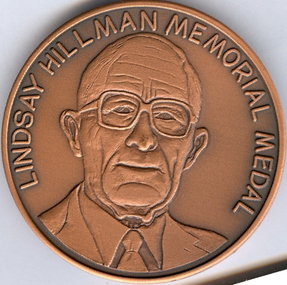
... President of Council from 1981 until his death in 1991 Hillman took a leading part in the implementation of many of the major building projects on the Lydiard Street Campus. The L.F.J. Hillman Award was established by the Ballarat School of Mines Council in conjunction with and through the generosity of the Hillman family in honour of the late Lindsay Frederick John Hillman. The bronze medal...President of Council from 1981 until his death in 1991 Hillman took a leading part in the implementation of many of the major building projects on the Lydiard Street Campus. The L.F.J. Hillman Award was established by the Ballarat School of Mines Council in conjunction with and through the generosity of the Hillman family in honour of the late Lindsay Frederick John Hillman. The bronze medal ...Lindsay F.J. Hillman was born in Ballarat in 1910, and attended the Ballarat Junior Technical School. He became a cadet in Electrical Engineering Laboratory at the Ballarat School of Mines where he gained eventually gained a student Teachership for diploma studies at the School. Hillman was particularly active and excelled in a wide range of sporting interests and in student activities. In 1928 and 1928 he was awarded the Ballarat School of Mines Honour blazer by the Old Boys' association for all round athletic ability, leadership and scholarship. After spending two years with the Melbourne City Council Electric Supply Department gaining industrial experience Hillman was awarded his Diploma of electrical engineering in 1931, returning to the School in 1932 to teach apprentices and senior students. Hillman was appointed lecturer in Engineering Design and Graphics in 1937, lecturer in Engineering Design and Civil Engineering in 1944, Lecturer-in-Charge of Mechanical and Civil Engineering in 1948 and Head of the Electrical Engineering Department in 1949, a position he held until his retirement in 1973. In 1975 Lindsay Hillman was appointed to the Council of the Ballarat School of Mines and played an active role in school affairs.As Vice-President of Council from 1981 until his death in 1991 Hillman took a leading part in the implementation of many of the major building projects on the Lydiard Street Campus. The L.F.J. Hillman Award was established by the Ballarat School of Mines Council in conjunction with and through the generosity of the Hillman family in honour of the late Lindsay Frederick John Hillman. The bronze medal was presented annually to an enrolled student in an accredited course in the field of electrical/electronics studies at the Ballarat School of Mines. specific Criteria for the Award consisted of a balance of academic performance, leadership qualities, commitment to further study and involvement in sporting and/or community groups. Bronze medal designed depicting the portrait of Lindsay Hillman. The medal has a copper finish, and is presented in a blue hinged box. The first Hillman Award was presented in 1992. The recipients are: 1992 - Brett A. Hovey 1993 - Nil 1994 - Brent L. Ferguson 1995 - Kirsty McKenzie 1996 - Peter J. White 2000 - Roger Bush 2001 - Thomas Edward George 2002 - Mark William Holden 2003 - David James Hopwood 2004 - Leighton Dunn 2005 - Donald Pirouet 2006 - Mark Irvin 2007 - Ricky Wilson 2008 - Luther Dean 2009 - Daniel Thatcher 2010 - Craig Coulter 2011 - Sarah Draper 2012 - Rhys Hendrickson 2013 - Jayden Hooper "Lindsay Hillman Memorial Medal" Verso: "The School of Mines and Industries Ballarat, Est. 1870 Presented to "ballarat school of mines, hillman, lindsay hillman, medal, numismatics, honour blazer, electrical engineering, electronics, hillman medal, hillman award -
 Federation University Historical Collection
Photographs - Colour, Hillman Award Agreement and Presentation, 1991, 1991
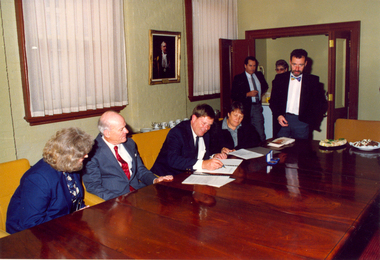
... President of Council from 1981 until his death in 1991 Hillman took a leading part in the implementation of many of the major building projects on the Lydiard Street Campus. The L.F.J. Hillman Award was established by the Ballarat School of Mines Council in conjunction with and through the generosity of the Hillman family in honour of the late Lindsay Frederick John Hillman. The bronze medal...President of Council from 1981 until his death in 1991 Hillman took a leading part in the implementation of many of the major building projects on the Lydiard Street Campus. The L.F.J. Hillman Award was established by the Ballarat School of Mines Council in conjunction with and through the generosity of the Hillman family in honour of the late Lindsay Frederick John Hillman. The bronze medal ...Lindsay F.J. Hillman was born in Ballarat, and attended the Ballarat Junior Technical School. He became a cadet in Electrical Engineering Laboratory at the Ballarat School of Mines where he gained eventually gained a student Teachership for diploma studies at the School. Hillman was particularly active and excelled in a wide range of sporting interests and in student activities. In 1928 and 1928 he was awarded the Ballarat School of Mines Honour blazer by the Old Boys' association for all round athletic ability, leadership and scholarship. After spending two years with the Melbourne City Council Electric Supply Department gaining industrial experience Hillman was awarded his Diploma of electrical engineering in 1931, returning to the School in 1932 to teach apprentices and senior students. Hillman was appointed lecturer in Engineering Design and Graphics in 1937, lecturer in Engineering Design and Civil Engineering in 1944, Lecturer-in-Charge of Mechanical and Civil Engineering in 1948 and Head of the Electrical Engineering Department in 1949, a position he held until his retirement in 1973. In 1975 Lindsay Hillman was appointed to the Council of the Ballarat School of Mines and played an active role in school affairs.As Vice-President of Council from 1981 until his death in 1991 Hillman took a leading part in the implementation of many of the major building projects on the Lydiard Street Campus. The L.F.J. Hillman Award was established by the Ballarat School of Mines Council in conjunction with and through the generosity of the Hillman family in honour of the late Lindsay Frederick John Hillman. The bronze medal was presented annually to an enrolled student in an accredited course in the field of electrical/electronics studies at the Ballarat School of Mines. specific Criteria for the Award consisted of a balance of academic performance, leadership qualities, commitment to further study and involvement in sporting and/or community groups. The first Hillman Award was presented in 1991. The recipients are: 1991: Paul Donald 1992 - Brett A. Hovey 1994 - Brent L. Ferguson 1995 - Kirsty McKenzie 1996 - Peter J. WhiteEighteen colour photographs of the signing of the Hillman award agreement and the first presentation of the award in 1991 to Paul Donald . .2) Gregor Hillman, Judith Tinney and Caroline Bethune .4) Judith Tinney or Caroline Bethune and Bill Gribble sign the agreement .8) Gregor Hillman, Judith Tinney and Caroline Bethune sign the agreement, along with President of the Ballarat School of Mines, Bill Gribble. .10) Paul Donald with his L.F.J. Hillman Award, 1991 .11) Ballarat School of Mines Principal, Peter Shiells, speaks at the lectern watched on by members of the Hillman family.ballarat school of mines, hillman, lindsay hillman, medal, numismatics, electrical engineering, electronics, gregor hillman. judith tinney, caroline bethune, tinney, bethune, hovey, ferguson, mckenzie, white, paul donald, donald -
 Federation University Historical Collection
Book, Ballarat School of Mines Annual Report, 1971, 1971
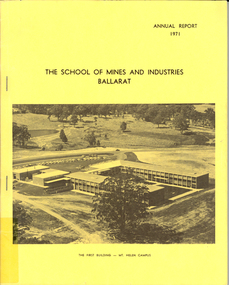
... President in 1971 was M.B. John bald biddington olive rattray andrew berry harrison greenhalgh annual report Yellow soft covered, stapled annual report with an image of the first building on the Mount Helen campus. Contents include: E.A. Bald, Centenary Medallion, Centenary medal ...The President in 1971 was M.B. JohnYellow soft covered, stapled annual report with an image of the first building on the Mount Helen campus. Contents include: E.A. Bald, Centenary Medallion, Centenary medal, Greenhalgh, Stokes and Son, Centenary Booklet, plaques, opening of the Mount Helen Campus, Centenary appeal, Mt Helen Master Plan, Metallurgy, fourth University Enquiry,bald, biddington, olive rattray, andrew berry, harrison, greenhalgh, annual report -
 Federation University Historical Collection
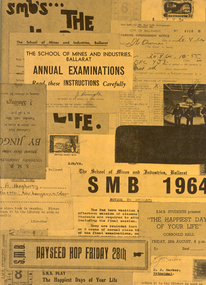
Magazine - Booklet, Ballarat School of Mines Students' Magazine, 1964, 1964
... Richards Medal; John Costa was SRC Secretary, Jon McDonald was SRC President Images are named and include student activities Advertisement include: Ronaldson Brothers and Tippett; Electrolytic Zinc Company, Myers, Mount Isa Mines, Austaluco Aluminium, Owen's of Ballarat, Alexandria Tea Rooms, Roy Brack's Men's Wear, Lamanz, A.J. ...Richards Medal; John Costa was SRC Secretary, Jon McDonald was SRC President Images are named and include student activities Advertisement include: Ronaldson Brothers and Tippett; Electrolytic Zinc Company, Myers, Mount Isa Mines, Austaluco Aluminium, Owen's of Ballarat, Alexandria Tea Rooms, Roy Brack's Men's Wear, Lamanz, A.J. ...Ballarat School of Mines Students' Magazine was a Students' Association magazine. The president was G.N. Hart and the 1964 editors were Kelvin Whitford and Armand Krastins. The cover was designed by Colin Jellet. Advertising was obtained by Jon McDonald and Peter Smith. Active collaborators were John Costa, Ken Delany, Roger Lonsdale, John Byrne and Bobby Ong Gim Sen. Harry Arblaster retired in 1964 as the Principal of the Ballarat School of Mines, and E.J. Barker was appointed in his place. The Vice-Principal was H.J. TrudingerYellow/orange soft covered book of 96 pages. Articles include: Initiation, The creative Personality, Folk Singing by the Miners, SMB Silent Movies Inc., Red Roar and the Commie Threat, Paleopyrology, Conventional Wisdom, B-Day, The Malaysian Student in Australia, Moral Heresy, Sport, The Past and the Future?, The Possibility of Fusion Power, School Council, Members of Staff, list of full time diploma students. Those who had diplomas conferred were listed, as were the prize winners. Snippets: D.M. Pollard won the R.W. Richards Medal; John Costa was SRC Secretary, Jon McDonald was SRC President Images are named and include student activities Advertisement include: Ronaldson Brothers and Tippett; Electrolytic Zinc Company, Myers, Mount Isa Mines, Austaluco Aluminium, Owen's of Ballarat, Alexandria Tea Rooms, Roy Brack's Men's Wear, Lamanz, A.J. William Electrical Instruments, H.B. Selby, M.G. Taylor, T.J. Coutts, Ballaarat Gas Company, H.A. Davis Motor Service, Henderson-Palmer, Coca-Cola, Philps Electrical Industries, the Wattle, Eclipse Motors, BHP, M.B. John & Hattersley, Sheffield's Record Bar, Andrew Gault, Tait Book Company, Broken Hill Associated Smelters, Ballarat Colour Centre, Morsheads, Commonwealth Aircraft Corporation, J.J. Mortimer, Ewins, Gallery 321, J.A. Hoskinballarat school of mines, students' association, ray windmill, kelvin whitford, jennifer boyd, malcolm park, jutta bacsak, noel brady, gloria medlyn, ken felstead, jan butterworth, wayne collins, diana berry, lora richter, arblaster, stephen drew, judi woodward, michael moissinac, marilyn barclay, jon mcdonald, gloria roberts, ratnam nachiappan, jeni milbourne, daila berzins, bernard livingston, trudinger, barker, ballarat asian students' association, margaret leong, yew har ong, william cheng, elen leong, joan wright, poh teck shen, kristine goodier, kok fong ho, robert grub, tan joo lim, eric mcgrath award, kevin whitford, ronaldson brothers and tippett, electrolytic zinc company, myers, mount isa mines, austaluco aluminium, owen's of ballarat, alexandria tea rooms, roy brack's men's wear, lamanz, a.j. william electrical instruments, h.b. selby, m.g. taylor, t.j. coutts, ballaarat gas company, h.a. davis motor service, henderson-palmer, coca-cola, philps electrical industries, the wattle, eclipse motors, bhp, m.b. john & hattersley, sheffield's record bar, andrew gault, tait book company, broken hill associated smelters, ballarat colour centre, morsheads, commonwealth aircraft corporation, j.j. mortimer, ewins, gallery 321, j.a. hoskin -
 Blacksmith's Cottage and Forge
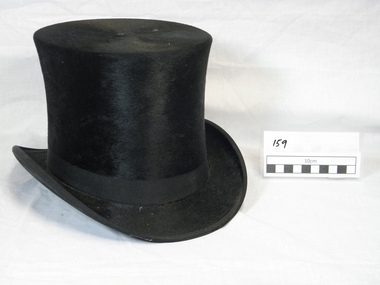
Top Hat, late 19th century
... president bacchus marsh shire...federation celebrations 1910...federation...owner millbank...mad hatter...opening parliament 1910...royal exhibition building...original box...greaseproof prize medal...It is representative of formal gentlemen's dress in the latter part of the 19th century/early 20th century. 1910 top hat gentlemen s fashion mr grant velour ninteenth century attire skilled hatter upper class attire formal wear monopoly token president bacchus marsh shire federation celebrations 1910 federation owner millbank mad hatter opening parliament 1910 royal exhibition building original box greaseproof prize medal royal isignia the sea breeze no 5044 size 6 7 8 Inscription in gold inside hat reads "GREASE PROOF / Prize Medal" / Royal Insignia with motto "Honi soit qui mal y pense" / "VENTILATED / AND / FELT BANDED". ...This hat belonged to Mr William Grant, Shire President of Bacchus Marsh. Mr Grant and his wife were invited to the opening of the first Federal Parliament held in the Royal Exhibition Building, Carlton, on the 9th May 1901. The opening was attended by the Duke and Duchess of Cornwall and York (later George V and Queen Mary) and 12,000 guests. Mr Grant's family were early settlers in Bacchus Marsh, and both he and his father were influential people in the town. They owned the property "Millbank". When William Grant died in 1924, his obituary in the 'Express' listed 17 public positions he held, including severaal terms as Shire President.This item has historical significance at a local, state and national level. It is representative of formal gentlemen's dress in the latter part of the 19th century/early 20th century.Gentleman's black shiny velour top hat with silk ribbon band, bound inside with leather sweat band, adjustable with silk ties. Inscription inside hat. Purple lining with gold embossing. Light canvas coated inside. Protective silver paper sweat band under leather sweat band.Inscription in gold inside hat reads "GREASE PROOF / Prize Medal" / Royal Insignia with motto "Honi soit qui mal y pense" / "VENTILATED / AND / FELT BANDED".1910, top hat, gentlemen s fashion, mr grant, velour, ninteenth century attire, skilled hatter, upper class attire, formal wear, monopoly token, president bacchus marsh shire, federation celebrations 1910, federation, owner millbank, mad hatter, opening parliament 1910, royal exhibition building, original box, greaseproof prize medal royal isignia, the sea breeze, no 5044, size 6, 7 8 -
Federation University Historical Collection
Certificate, Ballarat School of Mines and Industries Technical School No. 10 Prize Giving Certificate of Merit Awarded to Allan Bernaldo, c1917, 1917
... Prize giving certificate of merit awarded to Allan Bernaldo in recognition of the Gold Medal presented by the President of the Ballarat School of Mines, W.H. ...ballarat school of mines technical school no 10 ballarat technical art school ballarat technical art school no 10 allan bernaldo certificate award Prize giving certificate of merit awarded to Allan Bernaldo in recognition of the Gold Medal presented by the President of the Ballarat School of Mines, W.H. ...Prize giving certificate of merit awarded to Allan Bernaldo in recognition of the Gold Medal presented by the President of the Ballarat School of Mines, W.H. Middleton, to the most meritorious st student - Architectural Diploma Course. ballarat school of mines, technical school no 10, ballarat technical art school, ballarat technical art school no 10, allan bernaldo, certificate, award -
Federation University Historical Collection
Book - Book - Scrapbook, Ballarat College of Advanced Education: Scrapbook of newspaper cutting, Book 17; February 1986 to June 1986
... president to national organisation...dr don watts...engineering study awards...ricky calvert...barry walker...indian brewer returns...n c mohan ram...metallurgy medal...Mention of the Solutions Data Bank developed within the VIOSH program conducted at Ballarat College of Advanced Education. . employment advertisements application for enrolment outline of courses ballarat college of advanced education bcae dr ray watson psychologist moneghetti for world events musical cultural exchange annie begonia queen "cool burn" may save animals wombat state forest trainees at queen elizabeth centre course will benefit sport council president to national organisation dr don watts engineering study awards ricky calvert barry walker indian brewer returns n c mohan ram metallurgy medal to ian mckee political desert images geoff bonney jack coman garry kinnane lecturer biography of george johnston mayor crebbins graduates education for the nation degrees for dad and daughter paul hotchin a busy man robert morrow mining engineer the flab kids speech problems rife brett sinclair wins $1000 roderick ramsay top geology student pro david klein revisits merit for geologist filipino academic at bcae method to assess skills student nurses meet patients schools compete for environment awards students set to join vsu victorian student union first for local sculpture students adrian thomas head of perfoming arts key role in inventions head questions government plans saga of survival on the ice dick richards dr jim thyer physics lecturer old u s defence 'secret' safety solutions data bank dennis else Book with beige cover, front. ...Newspaper cuttings relating to Ballarat College of Advanced Education. These are from various newspapers and include The Age, Ballarat Courier, The Australian, The Herald. The cuttings cover the period from 15 February 1986 to 28 June 1986. Mention of the Solutions Data Bank developed within the VIOSH program conducted at Ballarat College of Advanced Education. . Book with beige cover, front. Spiral bound.employment advertisements, application for enrolment, outline of courses, ballarat college of advanced education, bcae, dr ray watson psychologist, moneghetti for world events, musical cultural exchange, annie begonia queen, "cool burn" may save animals, wombat state forest, trainees at queen elizabeth centre, course will benefit sport, council president to national organisation, dr don watts, engineering study awards, ricky calvert, barry walker, indian brewer returns, n c mohan ram, metallurgy medal to ian mckee, political desert images, geoff bonney, jack coman, garry kinnane lecturer, biography of george johnston, mayor crebbins graduates, education for the nation, degrees for dad and daughter, paul hotchin a busy man, robert morrow mining engineer, the flab kids, speech problems rife, brett sinclair wins $1000, roderick ramsay top geology student, pro david klein revisits, merit for geologist, filipino academic at bcae, method to assess skills, student nurses meet patients, schools compete for environment awards, students set to join vsu, victorian student union, first for local sculpture students, adrian thomas, head of perfoming arts, key role in inventions, head questions government plans, saga of survival on the ice, dick richards, dr jim thyer physics lecturer, old u s defence 'secret', safety solutions data bank, dennis else -
Federation University Historical Collection
Correspondence, R. W. (Dick) Richards, Letters from Dick Richards to John Tippett, 1971-84, 1971-1984
... John Tippett was the President of the Ballarat School of Mines Council dick richards r.w. richards antarctica albert medal george cross john tippett e.j.t. tippett tony gaze irvine gaze luftwafer white polar ribbon hermann goering lex davidson Photocopies of three letters written by Dick Richards to John Tippett. .1) One page typed letter dated 31 October 1971. ...Dick Richards was a Principal at the Ballarat School of Mines. John Tippett was the President of the Ballarat School of Mines CouncilPhotocopies of three letters written by Dick Richards to John Tippett. .1) One page typed letter dated 31 October 1971. The letter relates to the Albert Medal and George Cross. .2) One page typed letter dated 11 November 1983. The letter thanks John and Anne Tippett for their birthday wishes. It also mentions J.L. Cope and the role he played in Dick Richards recovery from severe physical collapse in August 1916. Richards writes 'he nursed by like a mother for a protracted period. ...' The letter ends with 'I ain't no bloody hero but I thought you would like to know. .3) One page typed letter dated 03 November 1984. It is a general letter which mentions Tony Gaze, Irvine Gaze. Irvine GAZE joined the RAF during World War One and was shot down near at luftwafer camp. A German airman saw Irvine Gaze's white polar ribbon and invited him to a meal where the President was Hermann Goering. Tony Zaze was a Spitfire pilot during World War 2 and was shot down about 100 miles from where his father was shot down. He escaped with the assistance of the resistance.dick richards, r.w. richards, antarctica, albert medal, george cross, john tippett, e.j.t. tippett, tony gaze, irvine gaze, luftwafer, white polar ribbon, hermann goering, lex davidson -
Federation University Historical Collection
Book - Book - Scrapbook, Ballarat School of MInes: Scrapbook of Newspaper Cuttings, Book 53, August 1992 to October 1992
... medal...smb training restaurant...tafe students' travelling show...horticultural work offered to jobless...michael kern...michael murphy...first and second in vacc awards...clinton miller mechanical design drafting...cultural instructors' course graduates...staff and students reunion...smb committed to enrichment...disability week...mechanics show their skill...work skill competition...disabled cam make a difference...top apprentices out of work...shelley robinsonwins award...lindy wuestewald cocktail winner...sculpture exhibition...paul robert donald...winner of hillman award...bill gribble new smb council president...The papers concerned are The Courier, Ballarat, The Australian, The Age over the period of 6 August 1992 to 28 October 1992. teaching positions advertised pre-employment courses courses available enrolment for smb courses donna tregenza kim raynor sharren galvin studies pay off victorian budgetgains short lived tafe week l f j hillman medal smb training restaurant tafe students' travelling show horticultural work offered to jobless michael kern michael murphy first and second in vacc awards clinton miller mechanical design drafting cultural instructors' course graduates staff and students reunion smb committed to enrichment disability week mechanics show their skill work skill competition disabled cam make a difference top apprentices out of work shelley robinsonwins award lindy wuestewald cocktail winner sculpture exhibition paul robert donald winner of hillman award bill gribble new smb council president paul donald apprentice of the year Book with green cover, front, spiral bound. ...Collection of newspaper articles related to Ballarat School Of Mines.They cover activities and advertisements for staff. The papers concerned are The Courier, Ballarat, The Australian, The Age over the period of 6 August 1992 to 28 October 1992.Book with green cover, front, spiral bound. teaching positions advertised, pre-employment courses, courses available, enrolment for smb courses, donna tregenza, kim raynor, sharren galvin, studies pay off, victorian budgetgains short lived, tafe week, l f j hillman medal, smb training restaurant, tafe students' travelling show, horticultural work offered to jobless, michael kern, michael murphy, first and second in vacc awards, clinton miller mechanical design drafting, cultural instructors' course graduates, staff and students reunion, smb committed to enrichment, disability week, mechanics show their skill, work skill competition, disabled cam make a difference, top apprentices out of work, shelley robinsonwins award, lindy wuestewald cocktail winner, sculpture exhibition, paul robert donald, winner of hillman award, bill gribble new smb council president, paul donald apprentice of the year -
 Lara RSL Sub Branch
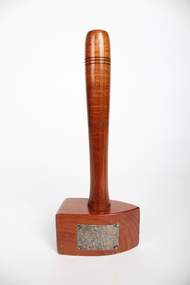
Gavel, 1965
... Alan received the RSL Meritorious Service Medal. Alan was the president of Lara RSL from 1965-1970, and this gavel was used at committee meetings by the president after its donation in 1965....Alan received the RSL Meritorious Service Medal. Alan was the president of Lara RSL from 1965-1970, and this gavel was used at committee meetings by the president after its donation in 1965. ...This hammer was presented to the Lara RSL by AJ Quick in 1965. Alan James Quick was a member of the 1st Australian Parachute Battalion during the Second World War, and was later a life member of Lara RSL. Alan received the RSL Meritorious Service Medal. Alan was the president of Lara RSL from 1965-1970, and this gavel was used at committee meetings by the president after its donation in 1965.This gavel is a key object of Lara RSL's history. It was used in committee meetings in the 1960s and perhaps later, and provides a documented link to an earlier president.Small wooden hammer with flat head and pointed reverse. The handle is rounded and has five rings carved into it. The wood is smooth and polished. The head has a small metal plaque attached. "Lara RSL. Presented by A.J Quick. 1965."quick, lara, rsl, parachute, ww2, world war two -
 Lara RSL Sub Branch
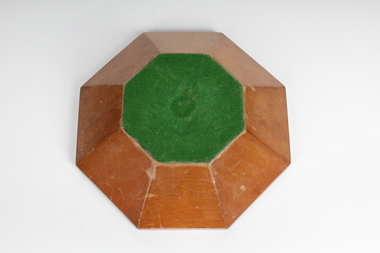
Sound Block, 1965
... Alan received the RSL Meritorious Service Medal. Alan was the president of Lara RSL from 1965-1970, and this gavel was used at committee meetings by the president after its donation in 1965....Alan received the RSL Meritorious Service Medal. Alan was the president of Lara RSL from 1965-1970, and this gavel was used at committee meetings by the president after its donation in 1965. ...This sound block was presented along with a gavel to the Lara RSL by AJ Quick in 1965. Alan James Quick was a member of the 1st Australian Parachute Battalion during the Second World War, and was later a life member of Lara RSL. Alan received the RSL Meritorious Service Medal. Alan was the president of Lara RSL from 1965-1970, and this gavel was used at committee meetings by the president after its donation in 1965.This sound blockis a key object of Lara RSL's history. It was used in committee meetings in the 1960s and perhaps later, and provides a documented link to an earlier president.Small octagonal wooden sound block with sloped sides and green felt top. Underside is painted dark green and has a round hole in the base.sound block, lara, rsl, quick -
 Ballarat Clarendon College
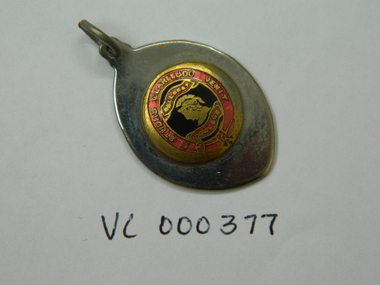
Sculpture - Pendant, 1900s
... Terry was a past President of the Numismatic Association of Victoria and a medal designer in his own right. ...Terry was a past President of the Numismatic Association of Victoria and a medal designer in his own right. ...Item purchased on eBay 2016. Belonged to Terry Pepperell (dec 2013), an avid school badge collector and an expert in school memorabilia. This pendant was possibly designed by Terry. Terry was a past President of the Numismatic Association of Victoria and a medal designer in his own right. His significant private collection of school memorabilia was auctioned after his death. This piece was purchased by James McLachlan-Troup and sold to the school via eBay. No particular significance to the school apart from its creative use of school memorabilia. Small enamel Ballarat College crest on a Stokes pendant backing with linkterry-pepperell -
Federation University Historical Collection
Document, Ballarat School of Mines Annual Report, 1979, 1979
... President of the Ballarat School of Mines Council. A music centre was opened at 4 Hickman Street ballarat school of mines annual report Rex Hollioake R.C. Muir N.A. Croach J.GF. McKay R.J. Dobell E.J. Barker J. chambers Ken Flecknoe Jack Barker Lindsay Hillman M.B. John Arthur Nicholson R.J. Selkirk J. Short E.J. Tippett F.R. Uhe T.A. Wiseman L.C. Yandell i. aitken Gary Little Land Laboratory Walkways Music centre 4 Hickman St Lake Bolac TAFE centre welfare certificate Jack Sewell plumber andrew trigg wins silver medal ...In 1979 Rex Hollioake was the President of the Ballarat School of Mines Council. A music centre was opened at 4 Hickman StreetBrown covered A4 reportballarat school of mines, annual report, rex hollioake, r.c. muir, n.a. croach, j.gf. mckay, r.j. dobell, e.j. barker, j. chambers, ken flecknoe, jack barker, lindsay hillman, m.b. john, arthur nicholson, r.j. selkirk, j. short, e.j. tippett, f.r. uhe, t.a. wiseman, l.c. yandell, i. aitken, gary little, land laboratory, walkways, music centre, 4 hickman st, lake bolac tafe centre, welfare certificate, jack sewell, plumber andrew trigg wins silver medal, gordon spittle, a. trigg, caravan park management course, mt clear technical high school, betty collier, alistair highway, i. mitaxa, rolly parfenovics, enolments, trevor kellam, eileen kelly, brian mclennan, women's access program, drama, r.c. morgan, intake -
 Flagstaff Hill Maritime Museum and Village
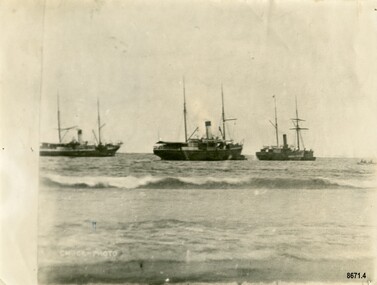
Photograph - Steamers - Julia Percy, Dawn and Coorong, Chuck Photo Ballarat, Circa 1885
... Medals of Bravery were awarded to the Captain and crew of the S.S. Dawn by the President of the United States, through the Consul-general (Mr Oliver M. ...Medals of Bravery were awarded to the Captain and crew of the S.S. Dawn by the President of the United States, through the Consul-general (Mr Oliver M. ...This photograph was one of ten photographs donated to Flagstaff Hill Maritime Museum and Village by Fred Trewartha. Frederick John Fox Trewartha (Fred) was a well-known Warrnambool businessman. He was born in Beeac near Geelong in 1920 and came to Warrnambool with his family as a very young child. He was apprenticed to his father John, as a saddler and later opened his own shop on Raglan Parade. He then moved into working with tarpaulins and canvases for the trucking industry. Fred was keenly interested in photography (and was a member of the Warrnambool Cine Club), yachting and boat building. He kept his yacht moored at Port Fairy for many years and participated in sailing events locally and interstate. He also built boats with his sons. He had the opportunity to meet many older sailors and it's thought this photo (and others in the set) may have been given to him by one of these men. Fred Trewartha died in 2016 in Warrnambool. Shipping was the cheapest and most practical means of carrying produce and goods during the period 1840-1890. Regular domestic steamer services commenced in the Warrnambool district in the late 1850’s and by 1870 the passenger trade was booming. Four coastal traders made regular stops at Warrnambool in the 1880's - S. S. Julia Percy, S. S. Dawn, S. S. Nelson and S. S. Casino. The S.S. Julia Percy (later named Leeuwin) was an iron passenger-cargo steam ship built in 1876. At one point in time the Julia Percy would sail from Warrnambool to Melbourne every Friday and return from Melbourne to Warrnambool every Tuesday. The cost of a return ticket for a Saloon Fare was £1.0.0. The Julia Percy was built in Glasgow by Thomas Wingate & Company, Whiteinch, in 1876 for the Warrnambool Steam Packet Company, which commissioned it for trade in Victoria’s western district. It was first registered in Warrnambool, Victoria in 1876. Two steamships, the Julia Percy and the Nelson, collided on 25th December 1881. The Julia Percy was at that time owned by its first owners, the Warrnambool Steam Packet Company, and she sailed under the command of Captain Chapman. It had left Melbourne the evening of 24th December, with about 150 passengers, sailing in fine weather through Port Phillip Heads around 9pm. It was headed for Warrnambool, Belfast (now named Port Fairy) and Portland. The Julia Percy was off Apollo Bay when Captain Chapman was woken by the ship’s whistle after midnight, the steamer Nelson being on a collision course with the Julia Percy. The Nelson struck Julia Percy midship. Boats were lowered from the ship (apart from a damaged lifeboat) and about 30-40 of the passengers boarded the Nelson. The engine room and the forehold were checked and found clear of water. The company manager, Mr. Evans, had been on the Nelson, so he boarded and inspected the Julia Percy and the decision was made to continue on to Warrnambool with the passengers as there appeared to be no immediate danger. However, Captain Thomas Smith said the Nelson was taking on water, so Julia Percy followed it for about an hour towards Melbourne on standby in case of need. Then Julia Percy turned around towards Warrnambool again. Shortly afterwards the Nelson turned to follow her, the ships stopped and passengers were returned to Julia Percy, and three from Julia Percy boarded the Nelson. Both ships proceeded on their way. Julia Percy passed Cape Otway light afterwards, signaling that there had been a collision. It was discovered later that one of the passengers was missing, then thought to have boarded the Nelson but later thought to have fallen into the sea and drowned while trying to jump from Julia Percy to Nelson. There had been 3 tickets purchased under the same name of that passenger “Cutler”; a father, son and friend named Wordsworth, which had caused quite some confusion. No further mishap occurred to either ship and both the Julia Percy and the Nelson reached their destinations safely. An enquiry was instigated by the Victoria Steam Navigation Board regarding the cause of the accident between the two steamships, in connection with the death of Cutler who was supposed to have lost his life by the collision. The enquiry resulted in Captain Thomas Smith having his master's certificate suspended for six months. The Julia Percy changed hands several times. Its next owner was the Western Steam Navigation Co (1887), managed by Mr. T.H. Osborne (the company’s office was on the corner of Timor and Liebig Streets - its north-western wall is now part of the current Warrnambool Regional Art Gallery.) The Melbourne Steamship Co became the next owners (1890), followed by William Howard Smith and Sons (1901) for use in Queensland coastal trades and then it was bought by George Turnbull in 1903 and used for local mail contract in Western Australia. The Julia Percy was sold to the Melbourne Steamship Company Ltd. (1906) and re-named the “Leeuwin” but continued in her Western Australian coastal run. It was converted into a coal hulk in Melbourne in 1910 as a result of damaged caused when it was driven against the jetty at Dongara during a gale. The ship was eventually dismantled and scuttled off Port Phillip Heads on 28 December 1934. The steamship "Dawn" was a 522-ton coastal trader built in 1876 and the vessel operated around the Victorian west coast from 1877 until 1898 for the Portland & Belfast Steam Navigation Co. sailing between Melbourne and Portland, via Warrnambool. The vessel was then owned in October 1885 by the renamed company, Belfast & Koroit Steam Navigation Co., until March 1896 when its ownership moved to W Howard Smith & Sons Ltd. This Melbourne company used the ship to service most ports around Australia. Captain F. Chapman took over from Captain Jones and served on the SS Dawn from 1898 until 1900 when he took command of the SS Casino. On September 4th 1880, the three masted clipper ship, "Eric the Red" struck Otway Reef, near Cape Otway. The S. S. Dawn, under the command of Captain Jones, was returning to Warrnambool from Melbourne, its sailing time different to its usual schedule. The provedore of the Dawn, Benjamin Lear, heard cries of distress coming through the portholes of the saloon. He gave the alarm and the engines were stopped. Cries could be heard clearly, coming from the land. Captain Jones sent out crew in two boats, and fired off rockets and blue lights to illuminate the area. They picked up the three survivors who were in the long boat from "Eric the Red". Two men were picked up out of the water, one being the owner’s son who was clinging to floating kerosene boxes. At daylight the Dawn then rescued the 18 men from the floating portion of the deckhouse, which had drifted about 4 miles from where they’d struck the reef. Shortly after the rescue the deckhouse drifted onto breakers and was thrown onto rocks at Point Franklin, about 2 miles east of Cape Otway. Captain Jones had signalled to Cape Otway lighthouse the number of the Eric the Red and later signalled that there was a wreck at Otway Reef but there was no response from the lighthouse. The captain and crew of the Dawn spent several more hours searching unsuccessfully for more survivors, even going back as far as Apollo Bay. On board the Dawn the exhausted men received care and attention to their needs and wants, including much needed clothing. Four men (three crew and one passenger) died. A week after the shipwreck, the Australian Government had also conveyed its thanks to the Captain and crew of the S.S. Dawn - “Captain Griffith Jones, S.S. Dawn, The Hon. Mr Clark desires that the thanks of the Government should be conveyed to you for the prompt, persevering and seamanlike qualities displayed by you, your officers and crew in saving the number of lives you did on the occasion referred to. The Hon. The Commissioner has also been pleased to award you a souvenir in commemoration of the occasion, and a sum of 65 pounds to be awarded to your officers and crew according to annexed scale. I am, &c, W Collins Rees, for and in the absence of the Chief Harbour Master.” The Awards are as follows: - Crew of DAWN'S lifeboat-Chief Officer, Mr G. Peat, 15 pounds; boat's crew-G. Sterge, A.B., 5 pounds; T. Hammond, A.B., 5 pounds; J. Black, A.B., 5 pounds; H. Edwards, A.B., 5 pounds. Dinghy's Crew-Second Officer, Mr Christie, 10 pounds; boat's crew -F. Lafer, A.B., 5 pounds; W. Johnstone, A.B., 5 pounds; Mr Lear, provedore, 5 pounds; Mr Dove, purser, 5 pounds. Captain Jones receives a piece of plate. (from “Wreck of the ship Eric the Red” by Jack Loney). Medals of Bravery were awarded to the Captain and crew of the S.S. Dawn by the President of the United States, through the Consul-general (Mr Oliver M. Spencer), in July 1881 “ … in recognition of their humane efforts in rescuing the 23 survivors of the American built wooden sailing ship, the Eric the Red, on 4th September 1880.” The men were also presented with substantial monetary rewards and gifts. The city of Warrnambool’s care of the survivors was also mentioned by the President at the presentation, saying that “the city hosted and supported the crew ‘most graciously’. The Medal of Bravery awarded to Nelson Johnson is in the collection at Flagstaff Hill Maritime Museum and Village in Warrnambool. Prior to 1882, and the arrival of the S. S. Casino, the "Dawn" was the only steamer to be able to navigate up the Moyne River at Port Fairy and unload at the wharf. The other regular steamers had to anchor in the bay instead. In February 1891 (as reported in The Age newspaper) the "Dawn" became the first vessel to berth alongside the newly completed Warrnambool Breakwater. The occasion was celebrated with a number of prominent townspeople assembling on board to "participate of a glass of wine". In 1895 the owners of the S.S. Dawn, the Portland and Belfast Steam Navigation Co., wound up and sold out to the Belfast Company who took over the Dawn for one year before selling it to Howard Smith. It took over the Melbourne to Warrnambool run in 1906 when the S. S. Flinders was sold. The S. S. Dawn was condemned and sunk in Suva in 1928. The State Library of Victoria has a lithograph in its collection depicting the steamer Dawn and the shipwrecked men, titled. "Wreck of the ship Eric the Red, Cape Otway: rescue of the crew by the Dawn". The third ship depicted in the photograph was thought to be the S. S. Coorong but there was a question mark next to its name. The photograph was thought to have been taken in 1885 and it's possible the S.S. Coorong was working in Clarence River, N. S. W. by this time. The steamer "Coorong" was built in 1862 by J. G. Lawrie of Glasgow. It was an "iron screw" steamer of 304 tons. It had many owners including Joseph Darwent of Adelaide (1863 - 1871), McMeckan Blackwood and Company, Melbourne (1871 - 1877), Mount Gambier Steamship Company Ltd. (1877 - 1881). William Whineham, Port Adelaide (1882), John See and Company, Sydney (1884 - 1892) and the North Coast Steam Navigation Company Ltd, Sydney (1892 - 1910). In 1911 it was hulked in Sydney Harbour and in 1921 it was being used as a coal hulk at Sydney. It had been originally imported into South Australia for the Port Augusta trade (primarily transporting goods needed by the early settlers) however the owners recognized that it had too much space for that purpose, so it was moved to work on the Adelaide to Melbourne line. Its passenger accommodation was enlarged and it enjoyed a "first class reputation" and by 1874 had made 313 voyages between Melbourne and Adelaide. Its captains included Captain McLean, Captain Ashton and Captain Dowell. In 1867, when 25 miles west of Cape Otway, while travelling from Adelaide to Melbourne, it came across the crew of the schooner "Black Watch" who had abandoned ship after it began quickly taking on water. The crew (six men) were able to get away in a small boat with a compass, chart and few candles. They were "excessively cold from exposure to the weather" when the S. S. Coorong picked them up. In 1877 the Coorong ran aground when entering the Outer Harbour at Adelaide (but was not damaged) and in 1882 it was stranded (for a short time) near Curdies Inlet (Victoria) with some slight damage to its bottom plates. Note - A ship with the same name "Coorong" (a coal carrying barque) was often on the Newcastle / Wollongong to Adelaide route also stopped several times in Warrnambool in the mid 1880's. The photograph has the label "Chuck Photos" printed on the front. Thomas Foster Chuck (born 1826 in London) was a photographer and entrepreneur who arrived in Victoria in 1861. The following year he produced and toured a "Grand Moving Diarama" of dramatic painted scenes from the Burke and Wills expedition. By 1866 he had established a photography studio in Daylesford and later he returned to Melbourne where he opened a studio in the Royal Arcade. In 1874 a collection of Chuck's photographs won a gold medal at the Annual International Exhibition in London. Throughout the 1870's he took over 700 individual photographs of prominent citizens for his historical photographic montage titled "Historical Pictures of the Explorers and Early Colonists of Victoria" which is now in the collection of the National Library of Australia. By 1888 he had sold his Melbourne studio and had established a studio in Ballarat (with his son Thomas Henry Chuck). In 1886 they produced an album titled "Warrnambool and District 1886, Western Hotel - J. Fox proprietor" containing over sixty large photographs of local coastal scenes and seascapes, for the use of patrons of the Western Hotel. This photo (of the three steamers in Lady Bay) was taken at this time and is in the album. Thomas Chuck died on December 7th, 1898, in Albert Park, Melbourne and his son Thomas Henry continued to operate the photography studio in Ballarat into the 1920's.This photograph is a significant record of several of the well-known coastal traders (S. S. Julia Percy, S. S. Dawn and possibly S. S. Coorong) that sailed along the southwest coast of Victoria for many years - transporting goods and passengers between Melbourne and Warrnambool in the 1880's. They are also significant in the role they played in the history of Warrnambool and the other coastal ports they visited as well as being examples of the dangers and hazards associated with navigating the waters along the southern coast of Australia. It is also a good example of a photograph taken by a well-known and significant photographer of that era.Black and white photograph of three steam ships anchored in Lady Bay, Warrnambool. They each have a funnel and two masts and are side on to the beach. A small rowboat with a crew can be seen on the far right. The words "CHUCK-PHOTO" are on the bottom left of the photograph. On the back of the photograph is the name and telephone number of the donor (handwritten in black ball point pen) and the names of the three steamships and date written in uppercase letters in dark blue ink. There is a four-figure number stamped in the centre of the back.Front - "CHUCK-PHOTO" Back - Name of donor and telephone number "6944" "JULIA PERCY, DAWN & KOORONG(?) IN LADY BAY 1885"flagstaff hill maritime museum and village, warrnambool, great ocean road, fred trewartha, s. s. julia percy, s. s. dawn, s. s. nelson, s. s. casino, leeuwin, steamer, steamship, coastal trader, warrnambool steam packet company, captain chapman, victorian steam navigation board, western steam navigation company, melbourne steamship company, william howard smith and sons, portland and belfast steam navigation company, w howard smith and sons ltd, eric the red, captain jones, medal of bravery, rescue, moyne river, warrnambool breakwater, lady bay, s. s. coorong, mount gambier steamship company, black watch, thomas foster chuck, chuck photos, chuck photography -
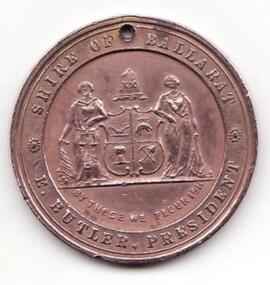 Learmonth and District Historical Society Inc.
Medal - Queen Victoria 1897, Queen Victoria Diamond Jubilee 1837-1897, Circa 1897
... medals were mass produces by Stokes & Sons of Melbourne, many of the local government bodies had them made. Marking the 60 years that Queen Victoria was on the throne. queen victoria shire of ballarat diamond jubilee The two faces of Queen Victoria, one as a young woman, the other later in life with the words, "QUEEN VICTORIA'S 60th YEAR OF REIGN. 1837 TO 1897". On the front. On the back is written "SHIRE OF BALLARAT. E.BUTLER. PRESIDENT ...To mark the diamond jubilee of Queen Victoria reigning as the monarchy for 60 years. She died four years later in 1901. These medals were mass produces by Stokes & Sons of Melbourne, many of the local government bodies had them made.Marking the 60 years that Queen Victoria was on the throne. A round medal with a young and older faced Queen Victoria on one side. And on the other side is the Shire of Ballarat 's "Coat of Arm". This medal was issued by the Ballarat Shire as did many of the local government bodiesThe two faces of Queen Victoria, one as a young woman, the other later in life with the words, "QUEEN VICTORIA'S 60th YEAR OF REIGN. 1837 TO 1897". On the front. On the back is written "SHIRE OF BALLARAT. E.BUTLER. PRESIDENT". Also there is the Ballarat Shire "Coat of Arms", written underneath is the words "BY THESE WE FLOURISH".queen victoria, shire of ballarat, diamond jubilee -
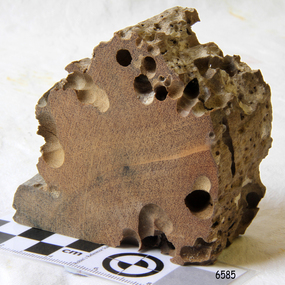 Flagstaff Hill Maritime Museum and Village
Wood Sample, about 1871
... Flagstaff Hill Maritime Village also has part of the helm (steering wheel), a carved wooden sword (said to be the only remaining portion of the ship’s figurehead; further research is currently being carried out), a door, a metal rod, several samples of wood and a medal for bravery, awarded to Nelson Johnson, a crew member of the S.S. Dawn by the U.S. President, for the rescue of the crew. ...Flagstaff Hill Maritime Village also has part of the helm (steering wheel), a carved wooden sword (said to be the only remaining portion of the ship’s figurehead; further research is currently being carried out), a door, a metal rod, several samples of wood and a medal for bravery, awarded to Nelson Johnson, a crew member of the S.S. Dawn by the U.S. President, for the rescue of the crew. ...This piece of timber from the ship Eric the Red has been eaten through by the marine animals called Teredo Worms, sometimes called sea worms or ‘termites of the sea’. The worms bore holes into wood that is immersed in sea water and bacteria inside the worms digest the wood. Shipbuilders tried to prevent this problem by using coatings of tar, wax, lead or pitch. In the 18th and 19th centuries the outside of their ships were sheathed in copper or a combination of copper and zinc (called Muntz metal) and would be re-metalled periodically to ensure the sheathing would remain effective. In more recent times the ships are protected with a toxic coating. The American ship Eric the Red was a wooden, three masted clipper ship. She had 1,580 tons register and was the largest full-rigged ship built at Bath, Maine, USA in 1871. She was built and registered by Arthur Sewall, later to become the partnership E. & A. Sewall, the 51st ship built by this company. The annually-published List of Merchant Vessels of the U.S. shows Bath was still the home port of Eric the Red in 1880. The vessel was named after the Viking discoverer, Eric ‘the Red-haired’ Thorvaldsson , who was the first European to reach the shores of North America (in 980AD). The ship Eric the Red at first traded in coal between America and Britain, and later traded in guano nitrates from South America. In 1879 she was re-metalled and was in first class condition. On 10th June 1880 (some records say 12th June) Eric the Red departed New York for Melbourne and then Sydney. She had been commissioned by American trade representatives to carry a special cargo of 500 exhibits (1400 tons) – about a quarter to a third of America’s total exhibits - for the U.S.A. pavilion at Melbourne’s first International Exhibition. The exhibits included furniture, ironmongery, wines, chemicals, dental and surgical instruments, paper, cages, bronze lamp trimmings, axles, stamped ware, astronomical and time globes, samples of corn and the choicest of leaf tobacco. Other general cargo included merchandise such as cases of kerosene and turpentine, brooms, Bristol's Sarsaparilla, Wheeler and Wilson sewing machines, Wheeler’s thresher machine, axe handles and tools, cases of silver plate, toys, pianos and organs, carriages and Yankee notions. The Eric the Red left New York under the command of Captain Zaccheus Allen (or some records say Captain Jacques Allen) and 24 other crew including the owner’s son third mate Ned Sewall. There were also 2 saloon passengers on board. The ship had been sailing for an uneventful 85 days and the voyage was almost at its end. As Eric the Red approached Cape Otway there was a moderate north-west wind and hazy and overcast atmosphere. On 4th September 1880 at about 1:30am Captain Allen sighted the Cape Otway light and was keeping the ship 5-6 miles offshore to stay clear of the hazardous Otway Reef. However he had badly misjudged his position. The ship hit the Otway Reef about 2 miles out to sea, south west of the Cape Otway light station. Captain Allen ordered the wheel to be put ‘hard up’ thinking that she might float off the reef. The sea knocked the helmsman away from the wheel, broke the wheel ropes and carried away the rudder. The lifeboats were swamped, the mizzenmast fell, with all of its rigging, then the mainmast also fell and the ship broke in two. Some said that the passenger Vaughan, who was travelling for his health and not very strong, was washed overboard and never seen again. The ship started breaking up. The forward house came adrift with three of the crew on it as well as a longboat, which the men succeeded in launching and keeping afloat by continually bailing with their sea boots. The captain, the third mate (the owner’s son) and others clung to the mizzenmast in the sea. Then the owner’s son was washed away off the mast. Within 10 minutes the rest of the ship was in pieces, completely wrecked, with cargo and wreckage floating in the sea. The captain encouraged the second mate to swim with him to the deckhouse where there were other crew but the second mate wouldn’t go with him. Eventually the Captain made it to the deckhouse and the men pulled him up. At about 4:30am the group of men on the deckhouse saw the lights of a steamer and called for help. At the same time they noticed the second mate and the other man had drifted nearby, still on the spur, and pulled them both onto the wreck. The coastal steamer SS Dawn was returning to Warrnambool from Melbourne, its sailing time different to its usual schedule. She was built in 1876 and bought by the Portland and Belfast Steam Navigation Co. in 1877. At the time of this journey she was commanded by Captain Jones, and was sailing between Melbourne and Portland via Warrnambool. The provedore of the Dawn, Benjamin Lear, heard cries of distress coming through the portholes of the saloon. He gave the alarm and the engines were stopped. Cries could be heard clearly, coming from the land. Captain Jones sent out crew in two boats, and fired off rockets and blue lights to illuminate the area. They picked up the three survivors who were in the long boat from Eric the Red. Two men were picked up out of the water, one being the owner’s son who was clinging to floating kerosene boxes. At daylight the Dawn then rescued the 18 men from the floating portion of the deckhouse, which had drifted about 4 miles from where they’d struck the reef. Shortly after the rescue the deckhouse drifted onto breakers and was thrown onto rocks at Point Franklin, about 2 miles east of Cape Otway. Captain Jones had signalled to Cape Otway lighthouse the number of the Eric the Red and later signalled that there was a wreck at Otway Reef but there was no response from the lighthouse. The captain and crew of the Dawn spent several more hours searching unsuccessfully for more survivors, even going back as far as Apollo Bay. On board the Dawn the exhausted men received care and attention to their needs and wants, including much needed clothing. Captain Allen was amongst the 23 battered and injured men who were rescued and later taken to Warrnambool for care. Warrnambool’s mayor and town clerk offered them all hospitality, the three badly injured men going to the hospital for care and others to the Olive Branch Hotel, then on to Melbourne. Captain Allen’s leg injury prevented him from going ashore so he and three other men travelled on the Dawn to Portland. They were met by the mayor who also treated them all with great kindness. Captain Allen took the train back to Melbourne then returned to America. Those saved were Captain Zaccheus Allen (or Jacques Allen), J. Darcy chief mate, James F. Lawrence second mate, Ned Sewall third mate and owner’s son, John French the cook, C. Nelson sail maker, Clarence W. New passenger, and the able seamen Dickenson, J. Black, Denis White, C. Herbert, C. Thompson, A. Brooks, D. Wilson, J. Ellis, Q. Thompson, C. Newman, W. Paul, J. Davis, M. Horenleng, J. Ogduff, T. W. Drew, R. Richardson. Four men had lost their lives; three of them were crew (Gus Dahlgreen ship’s carpenter, H. Ackman steward, who drowned in his cabin, and George Silver seaman) and one a passenger (J. B. Vaughan). The body of one of them had been found washed up at Cape Otway and was later buried in the lighthouse cemetery; another body was seen on an inaccessible ledge. Twelve months later the second mate James F. Lawrence, from Nova Scotia, passed away in the Warrnambool district; an obituary was displayed in the local paper. Neither the ship, nor its cargo, was insured. The ship was worth about £15,000 and the cargo was reportedly worth £40,000; only about £2,000 worth had been recovered. Cargo and wreckage washed up at Apollo Bay, Peterborough, Port Campbell, Western Port and according to some reports, even as far away as the beaches of New Zealand. The day after the wreck the government steam ship Pharos was sent from Queenscliff to clear the shipping lanes of debris that could be a danger to ships. The large midship deckhouse of the ship was found floating in a calm sea near Henty Reef. Items such as an American chair, a ladder and a nest of boxes were all on top of the deckhouse. As it was so large and could cause danger to passing ships, Captain Payne had the deckhouse towed towards the shore just beyond Apollo Bay. Between Apollo Bay and Blanket Bay the captain and crew of Pharos collected Wheeler and Wilson sewing machines, nests of boxes, bottles of Bristol’s sarsaparilla, pieces of common American chairs, axe handles, a Wheelers’ Patent thresher and a sailor’s trunk with the words “A. James” on the front. A ship’s flag-board bearing the words “Eric the Red” was found on the deckhouse; finally those on board the Pharos had the name of the wrecked vessel. During this operation Pharos came across the government steamer Victoria and also a steamer S.S. Otway, both of which were picking up flotsam and wreckage. A whole side of the hull and three large pieces of the other side of the hull, with some of the copper sheathing stripped off, had floated on to Point Franklin. Some of the vessels yards and portions of her masts were on shore. The pieces of canvas attached to the yards and masts confirmed that the vessel had been under sail. The beach there was piled with debris several feet high. There were many cases of Diamond Oil kerosene, labelled R. W. Cameron and Company, New York. There were also many large planks of red pine, portions of a small white boat and a large, well-used oar. Other items found ashore included sewing machines (some consigned to ‘Long and Co.”) and notions, axe and scythe handles, hay forks, wooden pegs, rolls of wire (some branded “T.S” and Co, Melbourne”), kegs of nails branded “A.T. and Co.” from the factory of A. Field and Son, Taunton, Massachusetts, croquet balls and mallets, buggy fittings, rat traps, perfumery, cutlery and Douay Bibles, clocks, bicycles, chairs, a fly wheel, a cooking stove, timber, boxes, pianos, organs and a ladder. (Wooden clothes pegs drifted in for many years). There seemed to be no personal luggage or clothing. The Pharos encountered a long line, about one and a half miles, of floating wreckage about 10 miles off land, south east of Cape Otway, and in some places about 40 feet wide. It seemed that more than half of it was from Eric the Red. The ship’s crew rescued 3 cases that were for the Melbourne Exhibition and other items from amongst the debris. There were also chairs, doors, musical instruments, washing boards, nests of trunks and fly catchers floating in the sea. Most of the goods were saturated and smelt of kerosene. A section of the hull lies buried in the sand at Parker River Beach. An anchor with chain is embedded in the rocks east of Point Franklin and a second anchor, thought to be from Eric the Red, is on display at the Cape Otway light station. (There is a photograph of a life belt on the verandah of Rivernook Guest House in Princetown with the words “ERIC THE RED / BOSTON”. This is rather a mystery as the ship was registered in Bath, Maine, USA.) Parts of the ship are on display at Bimbi Park Caravan Park and at Apollo Bay Museum. Flagstaff Hill Maritime Village also has part of the helm (steering wheel), a carved wooden sword (said to be the only remaining portion of the ship’s figurehead; further research is currently being carried out), a door, a metal rod, several samples of wood and a medal for bravery, awarded to Nelson Johnson, a crew member of the S.S. Dawn by the U.S. President, for the rescue of the crew. Much of the wreckage was recovered by the local residents before police and other authorities arrived at the scene. Looters went to great effort to salvage goods, being lowered down the high cliff faces to areas with little or no beach to collect items from the wreckage, their mates above watching out for dangerous waves. A Tasmanian newspaper reports on a court case in Stawell, Victoria, noting a man who was caught 2 months later selling tobacco from the wreckage of Eric the Red. Some of the silverware is still treasured by descendants of Mr Mackenzie who was given these items by officials for his help in securing the cargo. The gifts included silver coffee and tea pots, half a dozen silver serviette rings and two sewing machines. A Mr G.W. Black has in his possession a medal and a purse that were awarded to his father, another Dawn crew member who was part of the rescue team. The medal is inscribed and named “To John Black ….” (from “Shipwrecks” by Margaret E. Mackenzie, 3rd edition, published 1964). The wreck and cargo were sold to a Melbourne man who salvaged a quantity of high quality tobacco and dental and surgical instruments. Timbers from the ship were salvaged and used in the construction of houses and sheds around Apollo Bay, including a guest house, Milford House (since burnt down in bushfires), which had furniture, fittings and timber on the dining room floor from the ship. A 39.7 foot long trading ketch, the Apollo, was also built from its timbers by Mr Burgess in 1883 and subsequently used in Tasmanian waters. It was the first attempt at ship building in Apollo bay. In 1881 a red light was installed about 300 feet above sea level at the base of the Cape Otway lighthouse to warn ships when they were too close to shore; It would not be visible unless a ship came within 3 miles from it. This has proved to be an effective warning. Nelson Johnson, recipient of the medal for bravery, married Elizabeth Howard in 1881 and they had 10 children. They lived in South Melbourne, Victoria. Nelson died in 1922 in Fitzroy Victoria, age 66. In 1895 the owners of the S.S. Dawn, the Portland and Belfast Steam Navigation Co., wound up and sold out to the Belfast Company who took over the Dawn for one year before selling her to Howard Smith. She was condemned and sunk in Suva in 1928. The State Library of Victoria has a lithograph in its collection depicting the steamer Dawn and the shipwrecked men, titled. "Wreck of the ship Eric the Red, Cape Otway: rescue of the crew by the Dawn".The wood (timber) sample is listed on the Collections Australia Database, Heritage Victoria, number 239 00010 A “The Eric the Red is historically significant as one of Victoria's major 19th century shipwrecks. (Heritage Victoria Eric the Red; HV ID 239) The wreck led to the provision of an additional warning light placed below the Cape Otway lighthouse to alert mariners to the location of Otway Reef. The site is archaeologically significant for its remains of a large and varied cargo and ship's fittings being scattered over a wide area. The site is recreationally and aesthetically significant as it is one of the few sites along this coast where tourists can visit identifiable remains of a large wooden shipwreck, and for its location set against the background of Cape Otway, Bass Strait, and the Cape Otway lighthouse.“ (Victorian Heritage Database Registration Number S239, Official Number 8745 USA) Wood sample from the wreck of the ship Eric the Red. Triangular shaped, full of sea worm (Teredo worm) holes. The wood is dark in colour and is very light in weight.flagstaff hill, warrnambool, shipwrecked-coast, flagstaff-hill, flagstaff-hill-maritime-museum, maritime-museum, shipwreck-coast, flagstaff-hill-maritime-village, shipwreck-artefact, eric-the-red, zaccheus-allen, sewall, 1880, melbourne-exhibition, cape-otway, otway-reef, wood-sample, s.s.-dawn
