
Showing 36 items matching "tibetan buddhism""
-
 Great Stupa of Universal Compassion
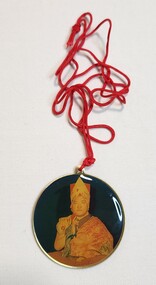
Memorabilia - Amulet pendant with a portrait of the 16th Karmapa
... ...Tibetan Buddhism...The front features a portrait of the 16th Karmapa, the spiritual leader of the Karma Kagyu lineage in Tibetan Buddhism, in ceremonial robes and a distinctive hat. ...Worship device Tibetan Buddhism A two-sided amulet with a red cord for wearing. ...Buddhist protection amulets are deeply rooted in spiritual traditions across Asia, especially in countries like Thailand, Tibet and Nepal. These sacred objects are believed to offer protection, attract good fortune and connect the wearer with enlightened energies.A two-sided amulet with a red cord for wearing. The front features a portrait of the 16th Karmapa, the spiritual leader of the Karma Kagyu lineage in Tibetan Buddhism, in ceremonial robes and a distinctive hat. The reverse side features the image of a wrathful deity Mahakala. The rim of the amulet is shaded in gold.worship device, tibetan buddhism -
 Great Stupa of Universal Compassion
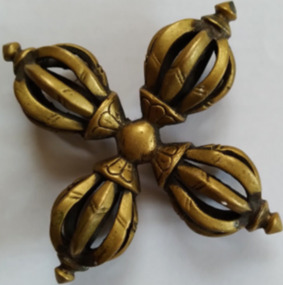
Ceremonial object - Double dorje
... tibetan buddhism...In Tibetan Buddhism a "dorje" (also known as "vajra" in Sanskrit) symbolizes the indestructible nature of reality, spiritual power, and enlightenment, often depicted as a thunderbolt or diamond scepter, representing the ability to cut through illusion and achieve ultimate wisdom; it is a key ritual object in the Vajrayana school of Tibetan Buddhism, signifying the union of compassion and wisdom through its male principle association when used with a bell (female principle). ...In Tibetan Buddhism a "dorje" (also known as "vajra" in Sanskrit) symbolizes the indestructible nature of reality, spiritual power, and enlightenment, often depicted as a thunderbolt or diamond scepter, representing the ability to cut through illusion and achieve ultimate wisdom; it is a key ritual object in the Vajrayana school of Tibetan Buddhism, signifying the union of compassion and wisdom through its male principle association when used with a bell (female principle). ...In Tibetan Buddhism a "dorje" (also known as "vajra" in Sanskrit) symbolizes the indestructible nature of reality, spiritual power, and enlightenment, often depicted as a thunderbolt or diamond scepter, representing the ability to cut through illusion and achieve ultimate wisdom; it is a key ritual object in the Vajrayana school of Tibetan Buddhism, signifying the union of compassion and wisdom through its male principle association when used with a bell (female principle). The Double Dorje (Vishvavajra), is a powerful Buddhist symbol. It consists of two crossed vajras (dorjes) and represents the foundation of the physical world. The Double Dorje is often associated with stability and protection, symbolizing the indestructible nature of the universe. This double dorje is a cross of two dorjes, which look like a small scepter with multiple prongs at each end.tibetan buddhism, holy objects, worship devices -
 Great Stupa of Universal Compassion
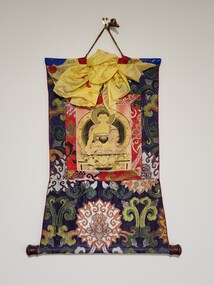
Artwork, other - Shakyamuni Buddha thangka
... ...Tibetan Buddhism...Thangkas are cloth scrolls unique to Tibetan Buddhism, depicting deities, venerated spiritual figures, or religious symbols. ...Thangkas are cloth scrolls unique to Tibetan Buddhism, depicting deities, venerated spiritual figures, or religious symbols. ...Thangkas are cloth scrolls unique to Tibetan Buddhism, depicting deities, venerated spiritual figures, or religious symbols. Intended for personal meditation or instruction of monastic students, they are invested with the spirit of a deity to whom they are consecrated. The design of a thangka allows it to be rolled up for easy transport, a feature that was essential for traveling monks and practitioners in nomadic regions. The Shakyamuni Buddha thangkas serve as potent aids for cultivating compassion and awareness, offering inspiration and spiritual guidance to practitioners. The Buddha's path to enlightenment and subsequent teachings form the foundation of Buddhist philosophy. This thangka features an image of the Buddha in a meditative pose, holding an alms bowl in his lap. Framed by rich red textiles and surrounded by vibrant floral and cloud motifs, it is mounted on wooden dowels and topped with a yellow cover cloth.buddhist art, tibetan buddhism, holy objects -
 Great Stupa of Universal Compassion
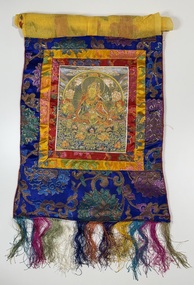
Artwork, other - Padmasambhava thangka
... ...Tibetan Buddhism...Thangkas are cloth scrolls unique to Tibetan Buddhism, depicting deities, venerated spiritual figures, or religious symbols. ...Thangkas are cloth scrolls unique to Tibetan Buddhism, depicting deities, venerated spiritual figures, or religious symbols. ...Thangkas are cloth scrolls unique to Tibetan Buddhism, depicting deities, venerated spiritual figures, or religious symbols. Intended for personal meditation or instruction of monastic students, they are invested with the spirit of a deity to whom they are consecrated. The design of a thangka allows it to be rolled up for easy transport, a feature that was essential for traveling monks and practitioners in nomadic regions. Padmasambhava thangkas are used to invoke protection, dispel obstacles, and deepen tantric practice. His image serves as a powerful reminder of transformation, spiritual resilience, and the integration of wisdom and compassion.This thangka portrays Padmasambhava seated on a lotus with a red cap, the legs crossed, the right hand holding a dorje (vajra) and the left resting in his lap. Smaller deities or lineage masters appear above and below him, each enclosed in circular frames, signifying the transmission of teachings. The thangka is framed with layers of silk brocade in yellow, red, orange and blue, with floral and cloud motifs that evoke the celestial realm. A decorative fringe at the bottom adds ceremonial richness, while the yellow fabric-covered rod at the top allows the thangka to be hung for ritual or meditative use.buddhist art, tibetan buddhism, holy objects -
 Great Stupa of Universal Compassion
Artwork, other - Shakyamuni Buddha thangka
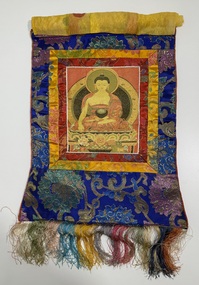
... ...Tibetan Buddhism...Thangkas are cloth scrolls unique to Tibetan Buddhism, depicting deities, venerated spiritual figures, or religious symbols. ...Thangkas are cloth scrolls unique to Tibetan Buddhism, depicting deities, venerated spiritual figures, or religious symbols. ...Thangkas are cloth scrolls unique to Tibetan Buddhism, depicting deities, venerated spiritual figures, or religious symbols. Intended for personal meditation or instruction of monastic students, they are invested with the spirit of a deity to whom they are consecrated. The design of a thangka allows it to be rolled up for easy transport, a feature that was essential for traveling monks and practitioners in nomadic regions. The Shakyamuni Buddha thangkas serve as potent aids for cultivating compassion and awareness, offering inspiration and spiritual guidance to practitioners. The Buddha's path to enlightenment and subsequent teachings form the foundation of Buddhist philosophy.Embroided thangka with outer cover, fringing and embroided Shakyamuni Buddha deity. Surrounded by three borders with floral motifs in gold.buddhist art, tibetan buddhism, holy objects -
 Great Stupa of Universal Compassion
Artwork, other - White Tara thangka
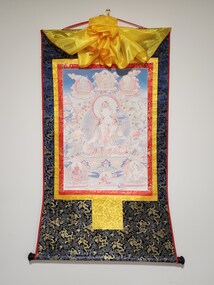
... ...Tibetan Buddhism...Thangkas are cloth scrolls unique to Tibetan Buddhism, depicting deities, venerated spiritual figures, or religious symbols. ...Thangkas are cloth scrolls unique to Tibetan Buddhism, depicting deities, venerated spiritual figures, or religious symbols. ...Thangkas are cloth scrolls unique to Tibetan Buddhism, depicting deities, venerated spiritual figures, or religious symbols. Intended for personal meditation or instruction of monastic students, they are invested with the spirit of a deity to whom they are consecrated. The design of a thangka allows it to be rolled up for easy transport, a feature that was essential for traveling monks and practitioners in nomadic regions. In Tibetan Buddhism, White Tara represents maternal compassion, healing, longevity, and purity. She is a female Buddha who offers swift help to those in need, providing protection, removing obstacles, and granting long life to practitioners for the purpose of spiritual practice and enlightenment. White Tara is worshipped for her ability to heal physical and mental illnesses.This thangka depicts White Tara seated in a meditative posture, radiating serenity and benevolence. Her white body symbolises purity and transcendent wisdom, and she is adorned with rich ornaments and flowing silks, reflecting her enlightened status.buddhist art, tibetan buddhism, holy objects -
 Great Stupa of Universal Compassion
Artwork, other - Thangka of 21 eminent female Buddhist masters from Tibet and India, 2025
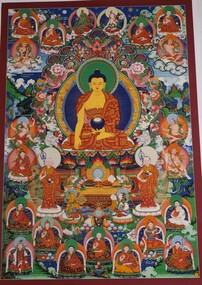
... ...Tibetan Buddhism...Thangkas are cloth scrolls unique to Tibetan Buddhism, depicting deities, venerated spiritual figures, or religious symbols. ...Thangkas are cloth scrolls unique to Tibetan Buddhism, depicting deities, venerated spiritual figures, or religious symbols. ...Thangkas are cloth scrolls unique to Tibetan Buddhism, depicting deities, venerated spiritual figures, or religious symbols. Intended for personal meditation or instruction of monastic students, they are invested with the spirit of a deity to whom they are consecrated. The design of a thangka allows it to be rolled up for easy transport, a feature that was essential for traveling monks and practitioners in nomadic regions. This thangka is a homage to the 21 exceptional women teachers, yoginis and practitioners who achieved high levels of spiritual realisation in the Buddhist traditions of Tibet and India and played foundational roles in transmitting Buddhist lineages. The thangka was envisioned and conceptually designed by His Holiness the Dalai Lama in 2008.Buddha Shakyamuni, surrounded by the 21 female Mahasiddhas (Masters of Accomplishment), is seated in the center on a lotus throne, performing the earth-witness mudra with his right hand while holding an alms bowl in his left. Standing on either side directly below are his two main disciples, Shariputra and Maudgalyayana. The perimeter features 21 distinct female masters arranged symmetrically across a vibrant sky and landscape backdrop. Each figure is depicted within a rainbow aura or circular halo, captured in meditative, teaching, or dynamic poses.Each figure is provided with a number and name printed in Tibetan and English.buddhist art, tibetan buddhism, holy objects -
 Great Stupa of Universal Compassion
Artwork, other - Guru Padmasambhava thangka
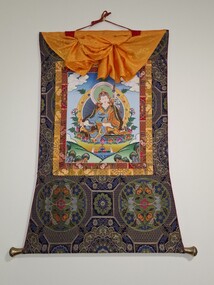
... ...Tibetan Buddhism...Thangkas are cloth scrolls unique to Tibetan Buddhism, depicting deities, venerated spiritual figures, or common religious symbols. ...Thangkas are cloth scrolls unique to Tibetan Buddhism, depicting deities, venerated spiritual figures, or common religious symbols. ...Thangkas are cloth scrolls unique to Tibetan Buddhism, depicting deities, venerated spiritual figures, or common religious symbols. Intended for personal meditation or instruction of monastic students, they are invested with the spirit of a deity to whom they are consecrated. A thangka is a composite three-dimensional object consisting of a picture panel which is painted or embroidered; a brocade mounting; and one or more of the following: a silk cover, leather corners, wooden dowels at the top and bottom and metal or wooden decorative knobs on the bottom dowel. Guru Padmasambhava (meaning 'Lotus-born', signifying his mythical origin as a being emerging from a lotus flower), also known as Guru Rinpoche, is seen as a manifestation of Buddha Shakyamuni. His teachings and legacy are deeply ingrained in Tibetan culture as he was responsible for bringing advanced Buddhist Tantric teachings to Tibet in the 8th century.A Tibetan thangka depicting Guru Padmasambhava. Framed in a traditional silk brocade border; a wooden dowel is inserted in a sleeve along the bottom edge of the fabric frame. buddhist art, tibetan buddhism, holy objects -
 Great Stupa of Universal Compassion
Artwork, other - Medicine Buddha thangka
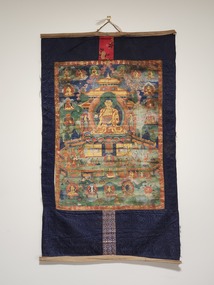
... ...Tibetan Buddhism...Thangkas are cloth scrolls unique to Tibetan Buddhism, depicting deities, venerated spiritual figures, or common religious symbols. ...Thangkas are cloth scrolls unique to Tibetan Buddhism, depicting deities, venerated spiritual figures, or common religious symbols. ...Thangkas are cloth scrolls unique to Tibetan Buddhism, depicting deities, venerated spiritual figures, or common religious symbols. Intended for personal meditation or instruction of monastic students, they are invested with the spirit of a deity to whom they are consecrated. A thangka is a composite art form consisting of a picture panel which is painted or embroidered; a brocade mounting; and one or more of the following: a silk cover, leather corners, wooden dowels at the top and bottom and metal or wooden decorative knobs on the bottom dowel. This allows a thangka to be rolled up for portability, reflecting its origins in the nomadic lifestyle of Tibetan monks.The Medicine Buddha (also known as Bhaisajyaguru or Sangyé Menla) is revered as the embodiment of healing and associated with practices helping with mental and physical ailments, as well as purifying negative karma. His iconic imagery, including the medicine bowl and healing plant, represents the union of wisdom and compassion as forces of healing. His teachings, rooted in the "Four Medicine Tantras," emphasize that the root of all diseases lies in negative emotions of greed, hatred, and ignorance.The central figure in this old thangka is Medicine Buddha, seated on a lotus throne and surrounded by other deities and figures. He has a bowl in his left hand, and a flower in his right hand. An interesting feature is that his body is not painted blue, as is customary for the image Medicine Buddha. The paint colours were derived from natural ingredients – grinded coral, turquoise and other gemstones. The 'Om Ah Hum' mantra is printed in Tibetan in red ink on the verso of the thangka.buddhist art, tibetan buddhism, holy objects -
 Great Stupa of Universal Compassion
Album (item) - Set of photographs from the visit of His Holiness Sakya Trizin to the Great Stupa site on 05/05/2003, May 2003
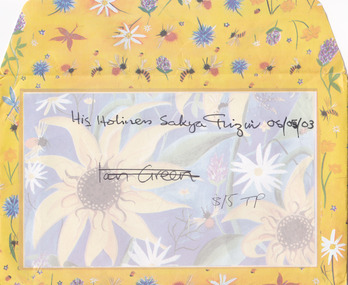
... Tibetan Buddhism...The 41st Sakya Trizin, Kyabgon Gongma Trichen Rinpoche, the throne holder of the Sakya Lineage of Tibetan Buddhism, is regarded as one of the most highly qualified lineage holder respected by all four schools of Tibetan Buddhism. ...His Holiness Sakya Trizin visited the site of the Great Stupa on 5 May 2003. The 41st Sakya Trizin, Kyabgon Gongma Trichen Rinpoche, the throne holder of the Sakya Lineage of Tibetan Buddhism, is regarded as one of the most highly qualified lineage holder respected by all four schools of Tibetan Buddhism.His Holiness Sakya Trizin, 05/05/03; Ian Green (crossed out) tibetan buddhism, visits, great stupa archive -
 Great Stupa of Universal Compassion
Photograph - Portrait of His Holiness Dalai Lama in 1954, c. 1980
... ...Tibetan Buddhism...Buddhist art Tibetan Buddhism Dalai Lama XIV Framed colour reproduction of a photograph on a polyester cloth canvas Photograph Portrait of His Holiness Dalai Lama in 1954 ...A reproduction of a rare portrait of the Dalai Lama in a pith helmet, worn when travelling during his visit to China in 1954 when he was 19 years old.There are very few photographs of the 14th Dalai Lama from his trip to China, which was his first foreign visit outside Tibet. The Dalai Lama toured various parts of China and held discussions with the Chinese leadership about the future of Tibet, aiming to foster better relations between Tibet and China. His efforts were unsuccessful. Framed colour reproduction of a photograph on a polyester cloth canvasbuddhist art, tibetan buddhism, dalai lama xiv -
 Great Stupa of Universal Compassion
Sculpture - Amitayus (Buddha of limitless life)
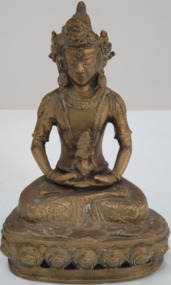
... tibetan buddhism...Amitayus is considered one of the Five Dhyani Buddhas in Mahayana Buddhism. tibetan buddhism holy objects Buddhist art Statues Amitayus Buddha statue, wearing jewelled ornaments of a peaceful heavenly god according to the classical Indian system of divine aesthetics. ...Amitayus, also called Amitabha, is the Buddha of Infinite Light, associated with longevity. He is holding in his hands a vessel containing the nectar of immortality. Amitayus is considered one of the Five Dhyani Buddhas in Mahayana Buddhism. Amitayus Buddha statue, wearing jewelled ornaments of a peaceful heavenly god according to the classical Indian system of divine aesthetics. tibetan buddhism, holy objects, buddhist art, statues -
 Great Stupa of Universal Compassion
Ceremonial object - Indian pandit mask
... tibetan buddhism...Representing the original Indian pandits (Hindu scholars) who brought Buddhism to Tibet; used in the Cham Dances performed by monks during the Monlam Prayer Festival. tibetan buddhism worship devices Rituals A solid wood mask carved in a Tibetan style Ceremonial object Indian pandit mask ...Representing the original Indian pandits (Hindu scholars) who brought Buddhism to Tibet; used in the Cham Dances performed by monks during the Monlam Prayer Festival. A solid wood mask carved in a Tibetan styletibetan buddhism, worship devices, rituals -
 Great Stupa of Universal Compassion
Sculpture - Statue of Shakyamuni Buddha
... ...Tibetan Buddhism...Buddhist art Tibetan Buddhism Holy objects Statues The Buddha is depicted seating in meditation on a lotus throne. ...The Shakyamuni Buddha statue holds profound significance in Buddhism, representing the historical Buddha, Siddhartha Gautama, who lived around 2,500 years ago. The statue portrays Shakyamuni Buddha, the founder of Buddhism, who attained enlightenment and shared his teachings to help others achieve the same. For practitioners, the Shakyamuni Buddha statue serves as a focal point during meditation, promoting mindfulness, peace, and a deeper connection to the Buddha's teachings. The Buddha is depicted seating in meditation on a lotus throne. His legs are crossed in the lotus position. His right hand is holding an alms bowl, signifying care and compassion for all beings. His left hand touches the ground in a gesture (bhumisparsha mudra) calling the earth to witness his determination to achieve enlightenment.buddhist art, tibetan buddhism, holy objects, statues -
 Great Stupa of Universal Compassion
Sculpture - Tsatsa of Shakyamuni Buddha
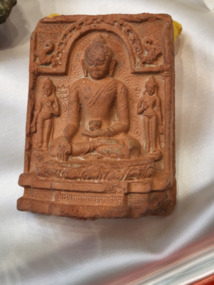
... ...Tibetan Buddhism...Buddhist art Tibetan Buddhism Holy objects The tsatsa features inscriptions in an ancient script. ...Tsatsas are small votive tablets shaped like deities, stupas, or sacred symbols. Buddhists may vow to create 100,000 tsatsas for purification and merit. These can be placed as an offering in holy sites, home altars, or gau boxes. Traditionally made of clay using moulds, tsatsas are dried, decorated, and blessed with mantras.Portable nature of tsatsas allows them to accompany practitioners on journeys, providing spiritual protection and serving as a focus for prayer and meditation. Due to their inexpensive production and portability, tsatsas made a great contribution to the spread of Buddhism in Tibet. This tsatsa is of the Buddha in a sitting position, accompanied by two standing figures. The Buddha is richly adorned with delicate carvings around it. The tsatsa features inscriptions in an ancient script.buddhist art, tibetan buddhism, holy objects -
 Great Stupa of Universal Compassion
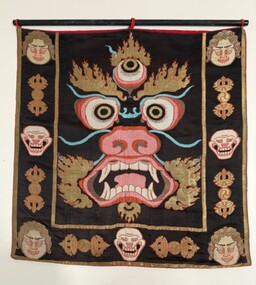
Artwork, other - Mahakhala dance apron
... ...Tibetan Buddhism...Mahakala is a primary Wisdom Dharmapala (protector) in Tibetan Buddhism, representing a wrathful manifestation of Chenrezig, that removes obstacles to enlightenment. ...A Mahakala dancing apron is a sacred garment used in Tibetan Buddhist ceremonial masked dances (Cham) to represent Mahakala, the fierce protector deity and emanation of compassion. The apron makes up part of a costume of a monastic dancer. It was worn either with a mask or as part of the ‘Black Hat Dance’. Mahakala is a primary Wisdom Dharmapala (protector) in Tibetan Buddhism, representing a wrathful manifestation of Chenrezig, that removes obstacles to enlightenment. Often appearing in black with multiple arms, he symbolizes the transformation of negative emotions into wisdom, protecting practitioners and the Buddha's teachings. Made of silk brocade this sacred apron features a wrathful face, bulging eyes, fangs, and skull motifs to ward off evil and destroy obstacles. The apron is mounted on a metal hanging rod.buddhist art, tibetan buddhism, holy objects -
 Great Stupa of Universal Compassion
Work on paper - A set of line drawings created by Gomchen Oleshey, Diamond Sow Publication, Deities, lamas and yogis of Tibet : a treasury of drawings, 1975
... ...Tibetan Buddhism"..."Buddhist art Tibetan Buddhism" The set consist of 1 envelope, 4 stapled pages, 94 loose sheets. ...The set consist of 1 envelope, 4 stapled pages, 94 loose sheets.A collection of traditional Tibetan Buddhist line drawings created by the Sherpa hermit and artist Gomchen Oleshey (1924–1983). The drawings are paired with traditional songs of homage and descriptive prayers collected by Lama Khempo Sangyay Tenzin (1904–1990), with English introductions and translations by scholar Keith Dowman. non-fictionThe set consist of 1 envelope, 4 stapled pages, 94 loose sheets."buddhist art, tibetan buddhism" -
 Great Stupa of Universal Compassion
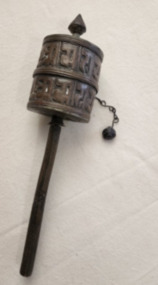
Ceremonial object - Hand-held prayer wheel
... tibetan buddhism...As Buddhism spread to Tibet in the 7th century, prayer wheels became an essential attribute of Tibetan Buddhist practice. ...They believe that turning the wheel with a pure, compassionate intention releases the mantras into the universe, which purifies negative karma, accumulates merit, and radiates compassion to all living beings. tibetan buddhism worship devices holy objects "Om Mani Padme Hum" in Tibetan script This prayer wheel consists of a hollow metal cylinder attached to a wooden handle. ...As Buddhism spread to Tibet in the 7th century, prayer wheels became an essential attribute of Tibetan Buddhist practice. This practice is linked to teachings attributed to Nagarjuna (ca. 150 –250 CE), who emphasised the power of mantra recitation and visualisation. A prayer wheel, used for personal worship, allowed to release the spiritual power contained within the mantras, enabling practitioners, including those who could not read, to generate spiritual merit.Prayer wheels are used by Tibetan practitioners every day, sometimes hours at a time. They believe that turning the wheel with a pure, compassionate intention releases the mantras into the universe, which purifies negative karma, accumulates merit, and radiates compassion to all living beings. This prayer wheel consists of a hollow metal cylinder attached to a wooden handle. Inside the cylinder is a tightly wound scroll printed with numerous mantras and wrapped around a central spindle. A chain with a small weight attached to its end is affixed to the cylinder, allowing it to be spun with a slight rotation of the wrist."Om Mani Padme Hum" in Tibetan script tibetan buddhism, worship devices, holy objects -
 Great Stupa of Universal Compassion
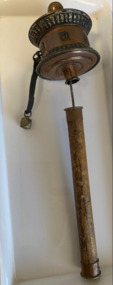
Ceremonial object - Hand-held prayer wheel
... tibetan buddhism...As Buddhism spread to Tibet in the 7th century, prayer wheels became an essential attribute of Tibetan Buddhist practice. ...They believe that turning the wheel with a pure, compassionate intention releases the mantras into the universe, which purifies negative karma, accumulates merit, and radiates compassion to all living beings. tibetan buddhism holy objects worship devices “Om Mani Padme Hum” This prayer wheel consists of a hollow metal cylinder embossed with the “Om Mani Padme Hum” in Tibetan script and attached to a wooden handle. ...As Buddhism spread to Tibet in the 7th century, prayer wheels became an essential attribute of Tibetan Buddhist practice. This practice is linked to teachings attributed to Nagarjuna (ca. 150 –250 CE), who emphasised the power of mantra recitation and visualisation. A prayer wheel, used for personal worship, allowed to release the spiritual power contained within the mantras, enabling practitioners, including those who could not read, to generate spiritual merit.Prayer wheels are used by Tibetan practitioners every day, sometimes hours at a time. They believe that turning the wheel with a pure, compassionate intention releases the mantras into the universe, which purifies negative karma, accumulates merit, and radiates compassion to all living beings.This prayer wheel consists of a hollow metal cylinder embossed with the “Om Mani Padme Hum” in Tibetan script and attached to a wooden handle. Inside the cylinder is a tightly wound scroll printed with numerous hand-written mantras and wrapped around a central spindle. A chain with a small weight attached to its end by a leather strip is affixed to the cylinder, allowing it to be spun with a slight rotation of the wrist.“Om Mani Padme Hum” tibetan buddhism, holy objects, worship devices -
 Great Stupa of Universal Compassion
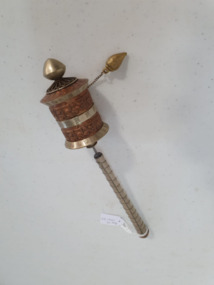
Ceremonial object - Hand-held prayer wheel
... tibetan buddhism...As Buddhism spread to Tibet in the 7th century, prayer wheels became an essential attribute of Tibetan Buddhist practice. ...They believe that turning the wheel with a pure, compassionate intention releases the mantras into the universe, which purifies negative karma, accumulates merit, and radiates compassion to all living beings. tibetan buddhism holy objects worship devices "Om Mani Padme Hum" in Tibetan script This hand-held prayer wheel features a cylindrical body made of copper alloy and silver alloy and embossed with the “Om Mani Padme Hum” mantra (associated with Avalokiteśvara, the Bodhisattva of Compassion) in Tibetan script and decorative motifs. ...As Buddhism spread to Tibet in the 7th century, prayer wheels became an essential attribute of Tibetan Buddhist practice. This practice is linked to teachings attributed to Nagarjuna (ca. 150 –250 CE), who emphasised the power of mantra recitation and visualisation. A prayer wheel, used for personal worship, allowed to release the spiritual power contained within the mantras, enabling practitioners, including those who could not read, to generate spiritual merit.Prayer wheels are used by Tibetan practitioners every day, sometimes hours at a time. They believe that turning the wheel with a pure, compassionate intention releases the mantras into the universe, which purifies negative karma, accumulates merit, and radiates compassion to all living beings.This hand-held prayer wheel features a cylindrical body made of copper alloy and silver alloy and embossed with the “Om Mani Padme Hum” mantra (associated with Avalokiteśvara, the Bodhisattva of Compassion) in Tibetan script and decorative motifs. The cylinder, mounted on a metal handle, is spun clockwise during prayer and meditation. A weighted chain attached to the side helps maintain the wheel's rotation. "Om Mani Padme Hum" in Tibetan scripttibetan buddhism, holy objects, worship devices -
 Great Stupa of Universal Compassion
Ceremonial object - Hand-held prayer wheel
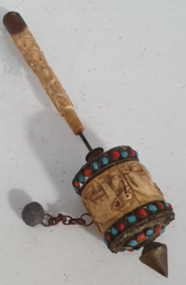
... tibetan buddhism...As Buddhism spread to Tibet in the 7th century, prayer wheels became an essential attribute of Tibetan Buddhist practice. ...They believe that turning the wheel with a pure, compassionate intention releases the mantras into the universe, which purifies negative karma, accumulates merit, and radiates compassion to all living beings. tibetan buddhism holy objects worship devices This prayer wheel has a hollow metal cylinder inside covered with a layer of ivory with carved elephants. ...As Buddhism spread to Tibet in the 7th century, prayer wheels became an essential attribute of Tibetan Buddhist practice. This practice is linked to teachings attributed to Nagarjuna (ca. 150 –250 CE), who emphasised the power of mantra recitation and visualisation. A prayer wheel, used for personal worship, allowed to release the spiritual power contained within the mantras, enabling practitioners, including those who could not read, to generate spiritual merit.Prayer wheels are used by Tibetan practitioners every day, sometimes hours at a time. They believe that turning the wheel with a pure, compassionate intention releases the mantras into the universe, which purifies negative karma, accumulates merit, and radiates compassion to all living beings.This prayer wheel has a hollow metal cylinder inside covered with a layer of ivory with carved elephants. The cylinder is inlaid with coral and turquoise and attached to an ivory handle. It contains a tightly wound scroll printed with numerous mantras, wrapped around a spindle. A chain with a small weight attached to its end is affixed to the cylinder, allowing it to be spun with a slight rotation of the wrist.tibetan buddhism, holy objects, worship devices -
 Great Stupa of Universal Compassion
Ceremonial object - Hand-held prayer wheel (mani wheel)
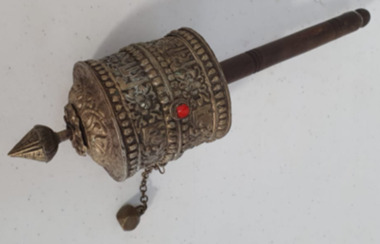
... tibetan buddhism...As Buddhism spread to Tibet in the 7th century, prayer wheels became an essential attribute of Tibetan Buddhist practice. ...They believe that turning the wheel with a pure, compassionate intention releases the mantras into the universe, which purifies negative karma, accumulates merit, and radiates compassion to all living beings. tibetan buddhism holy objects worship devices "Om Mani Padme Hum" in Tibetan script This hand-held prayer wheel features a cylindrical bronze body embossed with the Om Mani Padme Hum mantra and traditional Tibetan decorative motifs. ...As Buddhism spread to Tibet in the 7th century, prayer wheels became an essential attribute of Tibetan Buddhist practice. This practice is linked to teachings attributed to Nagarjuna (ca. 150 –250 CE), who emphasised the power of mantra recitation and visualisation. A prayer wheel, used for personal worship, allowed to release the spiritual power contained within the mantras, enabling practitioners, including those who could not read, to generate spiritual merit.Prayer wheels are used by Tibetan practitioners every day, sometimes hours at a time. They believe that turning the wheel with a pure, compassionate intention releases the mantras into the universe, which purifies negative karma, accumulates merit, and radiates compassion to all living beings.This hand-held prayer wheel features a cylindrical bronze body embossed with the Om Mani Padme Hum mantra and traditional Tibetan decorative motifs. It is further embellished with prominent inlaid red coral beads. The top of the cylinder is surmounted by a decorative, tiered conical finial, shaped in the form of a lotus bud or sacred jewel. A small metal chain with a weight is attached to the side of the cylinder, providing the centrifugal force needed to maintain a smooth, continuous rotation when the prayer wheel is spun by its wooden handle during prayer or meditation."Om Mani Padme Hum" in Tibetan scripttibetan buddhism, holy objects, worship devices -
 Great Stupa of Universal Compassion
Ceremonial object - Hand-held prayer wheel (mani wheel), ca. 18th century
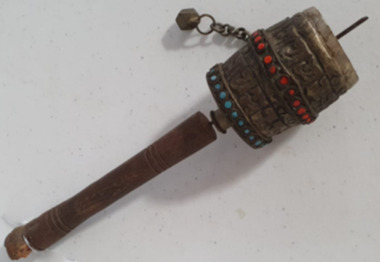
... tibetan buddhism...As Buddhism spread to Tibet in the 7th century, prayer wheels became an essential attribute of Tibetan Buddhist practice. ...They believe that turning the wheel with a pure, compassionate intention releases the mantras into the universe, which purifies negative karma, accumulates merit, and radiates compassion to all living beings. tibetan buddhism holy objects worship devices “Om Mani Padme Hum” in Sanskrit script The central cylinder of this prayer wheel, made from a textured metal alloy, features an embossed mantra “Om Mani Padme Hum” in Sanskrit script. ...As Buddhism spread to Tibet in the 7th century, prayer wheels became an essential attribute of Tibetan Buddhist practice. This practice is linked to teachings attributed to Nagarjuna (ca. 150 –250 CE), who emphasised the power of mantra recitation and visualisation. A prayer wheel, used for personal worship, allowed to release the spiritual power contained within the mantras, enabling practitioners, including those who could not read, to generate spiritual merit.Prayer wheels are used by Tibetan practitioners every day, sometimes hours at a time. They believe that turning the wheel with a pure, compassionate intention releases the mantras into the universe, which purifies negative karma, accumulates merit, and radiates compassion to all living beings.The central cylinder of this prayer wheel, made from a textured metal alloy, features an embossed mantra “Om Mani Padme Hum” in Sanskrit script. It is further decorated with two horizontal bands of inlaid beads—of coral and turquoise. The cylinder is missing the top, which makes visible the tightly wound scroll printed with numerous mantras and wrapped around a central spindle. The wooden handle is chipped at the bottom and shows wear lines and a smooth patina from handling. A small metal link chain with a metallic weight attached to its end is affixed to the cylinder, allowing it to be spun with a slight rotation of the wrist.“Om Mani Padme Hum” in Sanskrit scripttibetan buddhism, holy objects, worship devices -
 Great Stupa of Universal Compassion
Ceremonial object - Hand-held prayer wheel
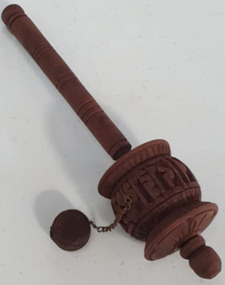
... tibetan buddhism...As Buddhism spread to Tibet in the 7th century, prayer wheels became an essential attribute of Tibetan Buddhist practice. ...They believe that turning the wheel with a pure, compassionate intention releases the mantras into the universe, which purifies negative karma, accumulates merit, and radiates compassion to all living beings. tibetan buddhism holy objects worship devices "Om Mani Padme Hum" in Tibetan script This prayer wheel features a wooden cylinder with a carved mantra in Tibetan script. ...As Buddhism spread to Tibet in the 7th century, prayer wheels became an essential attribute of Tibetan Buddhist practice. This practice is linked to teachings attributed to Nagarjuna (ca. 150 –250 CE), who emphasised the power of mantra recitation and visualisation. A prayer wheel, used for personal worship, allowed to release the spiritual power contained within the mantras, enabling practitioners, including those who could not read, to generate spiritual merit.Prayer wheels are used by Tibetan practitioners every day, sometimes hours at a time. They believe that turning the wheel with a pure, compassionate intention releases the mantras into the universe, which purifies negative karma, accumulates merit, and radiates compassion to all living beings.This prayer wheel features a wooden cylinder with a carved mantra in Tibetan script. The cylinder is attached to a wooden handle. Inside the cylinder is a tightly wound scroll printed with numerous mantras and wrapped around a spindle. A metal chain with a small wooden weight attached to its end is affixed to the cylinder, allowing it to be spun with a slight rotation of the wrist."Om Mani Padme Hum" in Tibetan scripttibetan buddhism, holy objects, worship devices -
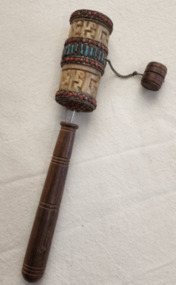 Great Stupa of Universal Compassion
Ceremonial object - Hand-held prayer wheel
... tibetan buddhism...As Buddhism spread to Tibet in the 7th century, prayer wheels became an essential attribute of Tibetan Buddhist practice. ...They believe that turning the wheel with a pure, compassionate intention releases the mantras into the universe, which purifies negative karma, accumulates merit, and radiates compassion to all living beings. tibetan buddhism holy objects worship devices "Om Mani Padme Hum" in Tibetan script This prayer wheel features a cylinder finished with a layer of ivory with a carving of a mantra in Tibetan script and inlaid with coral and turquoise. ...As Buddhism spread to Tibet in the 7th century, prayer wheels became an essential attribute of Tibetan Buddhist practice. This practice is linked to teachings attributed to Nagarjuna (ca. 150 –250 CE), who emphasised the power of mantra recitation and visualisation. A prayer wheel, used for personal worship, allowed to release the spiritual power contained within the mantras, enabling practitioners, including those who could not read, to generate spiritual merit. Prayer wheels are used by Tibetan practitioners every day, sometimes hours at a time. They believe that turning the wheel with a pure, compassionate intention releases the mantras into the universe, which purifies negative karma, accumulates merit, and radiates compassion to all living beings.This prayer wheel features a cylinder finished with a layer of ivory with a carving of a mantra in Tibetan script and inlaid with coral and turquoise. The cylinder is attached to a wooden handle. Inside the cylinder is a tightly wound scroll printed with numerous mantras and wrapped around a spindle. A metal chain with a small wooden weight attached to its end is affixed to the cylinder, allowing it to be spun with a slight rotation of the wrist."Om Mani Padme Hum" in Tibetan scripttibetan buddhism, holy objects, worship devices -
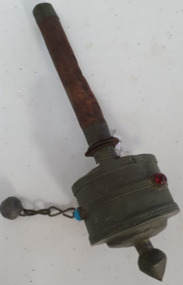 Great Stupa of Universal Compassion
Ceremonial object - Hand-held prayer wheel (mani wheel), ca. 18th century
... tibetan buddhism...As Buddhism spread to Tibet in the 7th century, prayer wheels became an essential attribute of Tibetan Buddhist practice. ...They believe that turning the wheel with a pure, compassionate intention releases the mantras into the universe, which purifies negative karma, accumulates merit, and radiates compassion to all living beings. tibetan buddhism holy objects worship devices This prayer wheel features a cylindrical metal drum (a copper alloy or brass) mounted on a central axis, connected to a turned wooden handle. ...As Buddhism spread to Tibet in the 7th century, prayer wheels became an essential attribute of Tibetan Buddhist practice. This practice is linked to teachings attributed to Nagarjuna (ca. 150 –250 CE), who emphasised the power of mantra recitation and visualisation. A prayer wheel, used for personal worship, allowed to release the spiritual power contained within the mantras, enabling practitioners, including those who could not read, to generate spiritual merit.Prayer wheels are used by Tibetan practitioners every day, sometimes hours at a time. They believe that turning the wheel with a pure, compassionate intention releases the mantras into the universe, which purifies negative karma, accumulates merit, and radiates compassion to all living beings.This prayer wheel features a cylindrical metal drum (a copper alloy or brass) mounted on a central axis, connected to a turned wooden handle. A small metal link chain with a metallic weight attached to its end is affixed to the cylinder, allowing it to be spun with a slight rotation of the wrist. The drum is decorated with inset glass or semi-precious stone cabochons and two turquoise beads. Inside the cylinder is a tightly wound scroll printed with numerous mantras and wrapped around a spindle. The object exhibits a prominent, naturally aged patina across the metal components, with visible oxidation and darkening consistent with handling and environmental exposure. The wooden handle shows wear from use, minor surface abrasions, and a rich, dark discoloration from skin oils. tibetan buddhism, holy objects, worship devices -
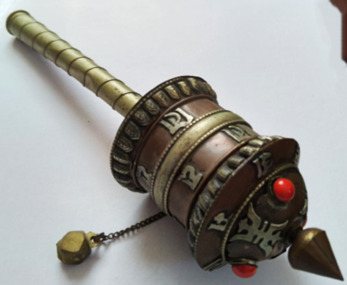 Great Stupa of Universal Compassion
Ceremonial object - Hand-held prayer wheel
... tibetan buddhism...As Buddhism spread to Tibet in the 7th century, prayer wheels became an essential attribute of Tibetan Buddhist practice. ...They believe that turning the wheel with a pure, compassionate intention releases the mantras into the universe, which purifies negative karma, accumulates merit, and radiates compassion to all living beings. tibetan buddhism holy objects worship devices "Om Mani Padme Hum" in Tibetan script This prayer wheel consists of a hollow metal cylinder and a metal handle attached to it. ...As Buddhism spread to Tibet in the 7th century, prayer wheels became an essential attribute of Tibetan Buddhist practice. This practice is linked to teachings attributed to Nagarjuna (ca. 150 –250 CE), who emphasised the power of mantra recitation and visualisation. A prayer wheel, used for personal worship, allowed to release the spiritual power contained within the mantras, enabling practitioners, including those who could not read, to generate spiritual merit.Prayer wheels are used by Tibetan practitioners every day, sometimes hours at a time. They believe that turning the wheel with a pure, compassionate intention releases the mantras into the universe, which purifies negative karma, accumulates merit, and radiates compassion to all living beings.This prayer wheel consists of a hollow metal cylinder and a metal handle attached to it. The cylinder is inlaid with coral stones and embossed with the “Om Mani Padme Hum” mantra in Tibetan script. Inside the cylinder is a tightly wound scroll printed with numerous mantras and wrapped around a central spindle. A chain with a small weight attached to its end is affixed to the cylinder, allowing it to be spun with a slight rotation of the wrist."Om Mani Padme Hum" in Tibetan scripttibetan buddhism, holy objects, worship devices -
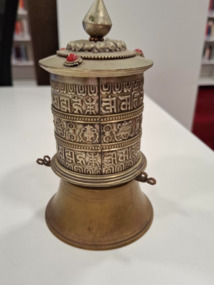 Great Stupa of Universal Compassion
Ceremonial object - Standing prayer wheel (mani wheel)
... tibetan buddhism...As Buddhism spread to Tibet in the 7th century, prayer wheels became an essential attribute of Tibetan Buddhist practice. ...Prayer wheels have been used in Tibetan Buddhism for personal worship since the 7th century. ...As Buddhism spread to Tibet in the 7th century, prayer wheels became an essential attribute of Tibetan Buddhist practice. This practice is linked to teachings attributed to Nagarjuna (ca. 150 –250 CE), who emphasised the power of mantra recitation and visualisation. A prayer wheel, used for personal worship, allowed to release the spiritual power contained within the mantras, enabling practitioners, including those who could not read, to generate spiritual merit. Prayer wheels have been used in Tibetan Buddhism for personal worship since the 7th century. Turning the wheel with a pure, compassionate intention is believed to release the mantras into the universe, resulting in purification of negative karma of the practitioner, accumulation of merit, and spreading compassion to all living beings.The main body of this standing prayer wheel consists of a rotating hollow metal cylinder (drum) set on a flared, bell-shaped pedestal stand. Small decorative loops extend outward from the lower rim of the drum, which are used to manually flick and spin the wheel in a clockwise direction. The top lid features decorative, scalloped petal patterns resembling a lotus flower. It is crowned with a pointed metallic finial–in a jewel shape–and adorned with small, inlaid red coral stones. This small standing prayer wheel can be placed by Buddhist practitioners on a flat surface like an altar or table and easily rotated to disseminate the blessings to all. "Om Mani Padme Hum" mantra in Sanskrit scripttibetan buddhism, holy objects, worship devices -
 Great Stupa of Universal Compassion
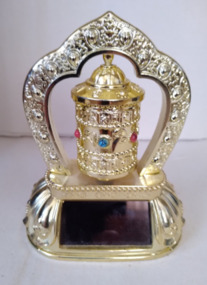
Ceremonial object - Solar-powered prayer wheel
... tibetan buddhism...As Buddhism spread to Tibet in the 7th century, prayer wheels became an essential attribute of Tibetan Buddhist practice. ...Prayer wheels have been used in Tibetan Buddhism for personal worship since the 7th century. ...As Buddhism spread to Tibet in the 7th century, prayer wheels became an essential attribute of Tibetan Buddhist practice. This practice is linked to teachings attributed to Nagarjuna (ca. 150 –250 CE), who emphasised the power of mantra recitation and visualisation. A prayer wheel, used for personal worship, allowed to release the spiritual power contained within the mantras, enabling practitioners, including those who could not read, to generate spiritual merit.Prayer wheels have been used in Tibetan Buddhism for personal worship since the 7th century. Turning the wheel with a pure, compassionate intention is believed to release the mantras into the universe, resulting in purification of negative karma of the practitioner, accumulation of merit, and spreading compassion to all living beings. This solar-powered prayer wheel is based on the traditional Tibetan prayer wheel design. However, it uses solar power to rotate the wheel containing mantras, disseminating the blessings to all. Often placed by Buddhist practitioners on a windowsill or car dashboard.This modern adaptation of the traditional Tibetan Buddhist prayer wheel has a mantra-filled drum which rotates automatically using solar power when exposed to light. The ornate gold-coloured frame and prayer wheel in the centre (embellished with small faux gemstones) reflect the aesthetic traditions associated with Tibetan Buddhist sacred objects. The solar panel is concealed in the base. tibetan buddhism, holy objects, worship devices -
 Great Stupa of Universal Compassion
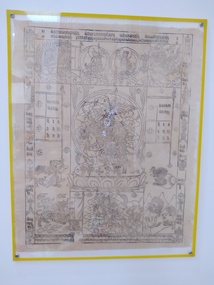
Print - Woodblock print featuring Gesar, Unknown
... ...Tibetan Buddhism...Padmasambhava Tibetan Buddhism Woodblock printing This woodblock print on hand-made paper depicts Gesar, a legendary Tibetan warrior king who is invoked as a protector of the Buddha's teachings and emanation of Padmasambhava. ...Woodblock printing in Tibet began to flourish from the 10th century onwards, driven by the high demand for Buddhist scriptures and images. Monasteries saw woodblock printing as a means to preserve and propagate authentic Buddhist teachings. The durability of woodblocks made them ideal for creating lasting impressions of sacred texts, enabling mass production and wide dissemination.This woodblock print on hand-made paper depicts Gesar, a legendary Tibetan warrior king who is invoked as a protector of the Buddha's teachings and emanation of Padmasambhava. Gesar's image is surrounded by four magical animals - garuda (top left), makara (top right), tiger (bottom left) and snow lion (bottom right). The print is framed using acrylic sheets. padmasambhava, tibetan buddhism, woodblock printing
